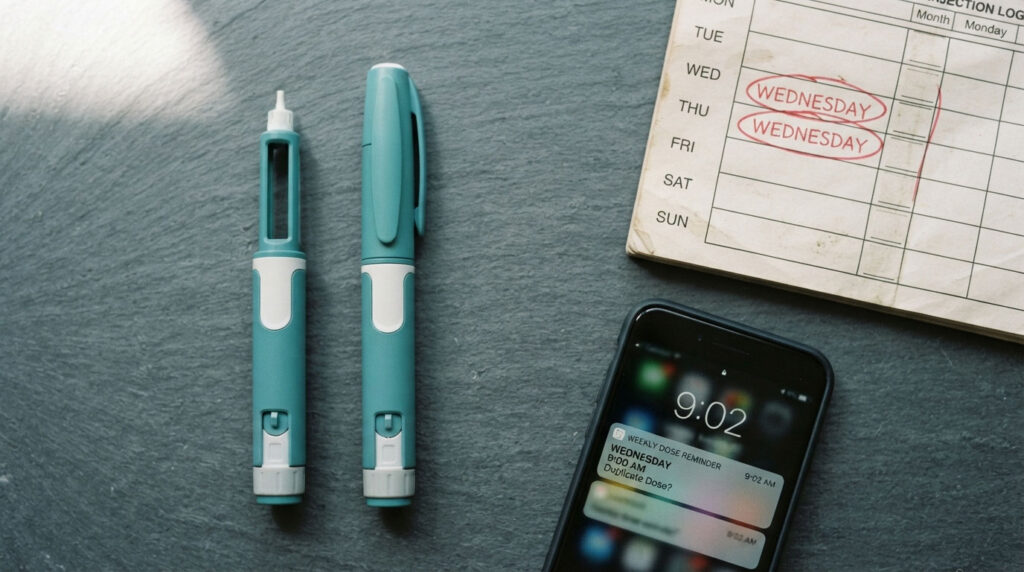
The most common version of this mistake is not forgetfulness. It is the person who presses the pen, hears nothing, sees no drop of liquid, decides it failed, and injects a second full dose.
Table of Contents
Patients booking lab work through HealthCareOnTime describe that exact sequence more often than any other. The pen almost always worked the first time.
Quick answer: A double dose of Mounjaro means two injections inside the same weekly window, whether they were minutes or days apart. Do not inject again, do not try to even it out, and call Poison Help at 1-800-222-1222 or your prescriber. Tirzepatide peaks around 24 to 48 hours, so symptoms can build for two days and linger one to two weeks. Call 911 for confusion, seizures, fainting, or nonstop vomiting.
At a Glance
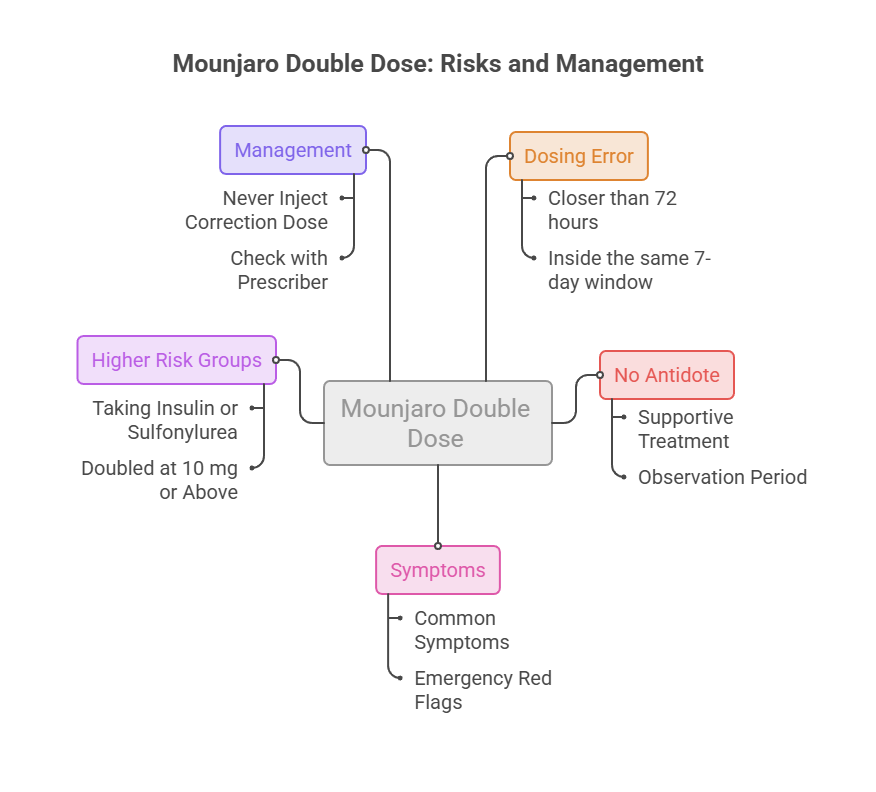
- Two Mounjaro injections closer than 72 hours apart is a dosing error; two inside the same 7-day window means more tirzepatide than your body was scheduled to receive.
- There is no antidote. The FDA prescribing information directs supportive treatment based on symptoms, with an observation period that accounts for tirzepatide’s roughly 5-day half-life.
- Most accidental double doses cause several days of stomach symptoms, not a life-threatening emergency.
- Two groups face higher risk: people also taking insulin or a sulfonylurea, and people who doubled at 10 mg or above.
- Emergency red flags: confusion or fainting, seizures, severe upper abdominal pain, and vomiting you cannot stop.
- Never inject a correction dose, and never skip a scheduled dose without checking with your prescriber first.
What to Do in the First 60 Minutes
Start here, then read the rest.
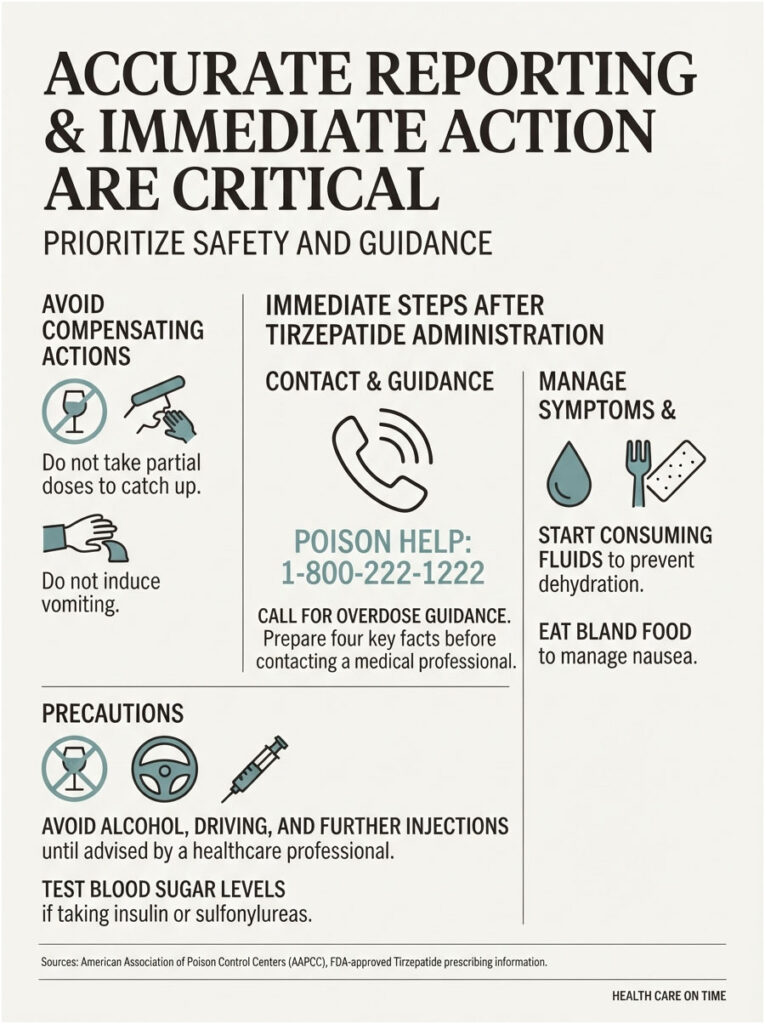
The next hour matters less for treatment than for information. No drug reverses tirzepatide, so the goal is accurate reporting, early symptom control, and one phone call.
Stop, and do not try to even it out
The worst possible response is a compensating action. Do not inject a partial dose to balance the schedule, and do not attempt to draw out what was already injected.
Do not make yourself vomit either. Tirzepatide goes under the skin rather than into the stomach, so nothing you swallow or bring back up affects it.
Write down the four facts you will be asked for
Whoever you call wants the same four items. Having them ready changes the quality of advice you get.
- Your prescribed dose and your usual injection day
- The strength and exact time of each injection you actually gave
- Every other medication you take, especially insulin, sulfonylureas, and blood pressure drugs
- Whether this was brand Mounjaro or a compounded tirzepatide drawn from a vial
Across the readers HealthCareOnTime serves, this is the step people skip when they are rattled. Write it on paper before you dial.
Call Poison Help at 1-800-222-1222
The Mounjaro prescribing information advises contacting the Poison Help line at 1-800-222-1222, or a medical toxicologist, for overdose management guidance. The service is free, staffed by specialists, and answers around the clock in every state.
Your prescriber is the other correct call, and they hold context Poison Control does not: your history, your tolerance, your full medication list. Either call is right. Calling both beats calling neither.
Test your blood sugar now if you take insulin or a sulfonylurea
One action can prevent a serious outcome, and it applies to a specific group. If you take insulin, glipizide, glimepiride, or glyburide alongside Mounjaro, test immediately.
Keep testing every two to four hours while awake for 48 hours. Put fast-acting carbohydrates within arm’s reach: juice, regular soda, glucose tabs, or hard candy.
Get ahead of the nausea with fluids and bland food
Symptoms build rather than hit instantly, which hands you a useful head start. Begin sipping water and an electrolyte drink now, small amounts on a schedule rather than large glasses when thirsty.
Eat plain and small: toast, crackers, rice, broth, plain yogurt. Skip fried, greasy, and heavily spiced food for several days.
Three things to avoid
Alcohol worsens both dehydration and low blood sugar, so skip it entirely until symptoms clear. Do not drive while dizzy, shaky, or foggy.
Do not take your next scheduled injection until a clinician tells you when to resume.
What Counts as a Double Dose of Mounjaro
Mounjaro (tirzepatide) is built around one injection per week. The pen, the titration schedule, and the label all assume seven days between doses.
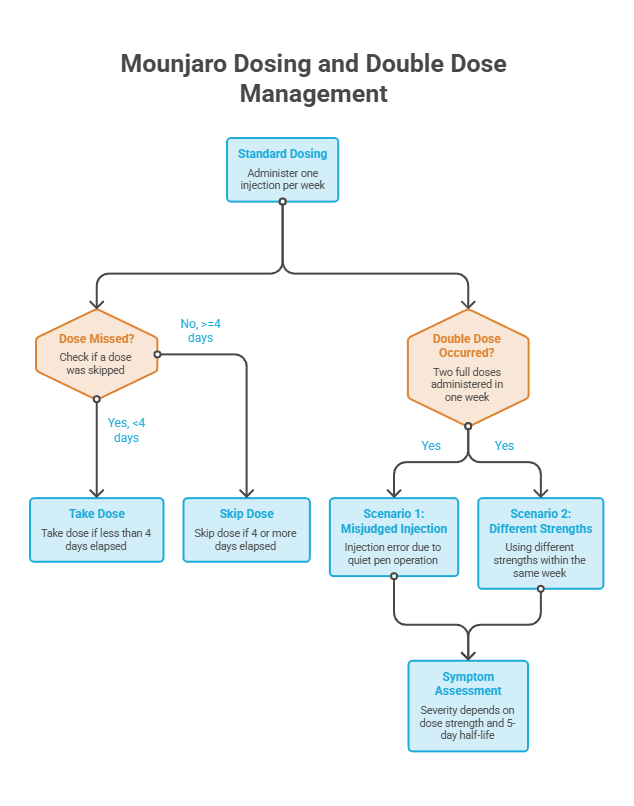
So the definition is simpler than people expect. Any time two full doses land inside the same weekly slot, you have doubled.
The once-weekly rule and the 72-hour floor
One hard number settles most cases. The prescribing information allows you to change your weekly injection day as long as at least 3 days (72 hours) separate two doses.
Tighter than 72 hours falls outside what the label permits. That is the cleanest test for whether you made a dosing error or simply shifted your day.
A second number is worth knowing for the opposite situation. If you miss a dose, the FDA prescribing information says to take it if fewer than four days have passed; if four or more days have elapsed, skip it and resume your regular schedule.
Both rules exist for one reason. Doses stacked too closely do not behave like two separate doses. They add.
Four situations that all count as doubling
Our medical reviewers sort real-world reports into four patterns.
- Two injections in the same session, usually minutes apart, because the first appeared not to deliver.
- Two injections one to three days apart, from a forgotten log or a crowded refrigerator shelf.
- Two different strengths in the same week, common during a titration step when an old pen and a new pen are both on hand.
- A drawn dose measured wrong from a vial, where the volume pulled was several times the intended amount.
The “I don’t think it went in” repeat injection
Mounjaro pens are deliberately quiet and nearly sensation-free. There is no satisfying mechanical thunk, and the volume is tiny.
Each multi-dose vial or single-patient-use KwikPen holds 2.4 mL and provides four doses of 0.6 mL each. Six tenths of a milliliter under the skin leaves almost nothing to see.
Fix this procedurally rather than by feel. Hold the pen in place for the full count in the instructions for use, then read the dose window instead of inspecting the injection site.
Two different strengths in the same week
This pattern carries more risk than a plain repeat, because the totals get bigger. Someone finishing a 7.5 mg pen who also opens a new 10 mg pen has taken 17.5 mg in one week, above the 15 mg weekly maximum.
Keep only your current strength in the refrigerator. Move the next strength in on step-up day and dispose of the old pen the same day.
Why a 5-day half-life changes the math
Half-life is how long your body takes to clear half of a drug. Tirzepatide’s half-life is approximately 5 days.
That is long, and it is precisely why the drug works once weekly. It also means a mistake does not wash out overnight.
Tirzepatide reaches peak concentration at roughly 24 to 48 hours, so symptoms after a double dose may persist for several days and last longer than with shorter-acting GLP-1 medications. Plan for a rough two-day climb, then a slow week of tapering.
Where your specific dose puts you
The strength you doubled matters more than anything else on this page. Doubling a 2.5 mg starter dose and doubling a 15 mg maintenance dose are not the same event.
Read the fourth column as how long noticeable symptoms usually last, not how long tirzepatide stays in your body. Appetite suppression routinely outlasts the nausea by several days.
| Dose You Doubled | Total Received That Week | Expected Symptom Intensity | How Long Symptoms Usually Last | First Call to Make |
| 2.5 mg | 5 mg | Mild to moderate nausea, loose stools, low appetite | 2 to 4 days | Prescriber or pharmacist, same day |
| 5 mg | 10 mg | Moderate nausea, vomiting possible, fatigue | 3 to 6 days | Poison Help, 1-800-222-1222 |
| 7.5 mg | 15 mg | Moderate to strong stomach symptoms, dehydration possible | 4 to 7 days | Poison Help, 1-800-222-1222 |
| 10 mg | 20 mg, above the 15 mg weekly max | Strong nausea and vomiting likely, real dehydration risk | 5 to 10 days | Poison Help, within the hour |
| 12.5 mg | 25 mg | Strong to severe stomach symptoms, kidney strain possible | 7 to 12 days | Poison Help, within the hour |
| 15 mg | 30 mg, twice the weekly max | Severe stomach symptoms likely, monitored care often advised | 7 to 14 days | Poison Help now; ER if vomiting continues |
| Compounded vial, 10-fold measuring error | Roughly 10 times intended | Severe, hospital-level care common | Often beyond 2 weeks | 911 or nearest emergency room |
Symptom Timeline, Hour 0 Through Day 14
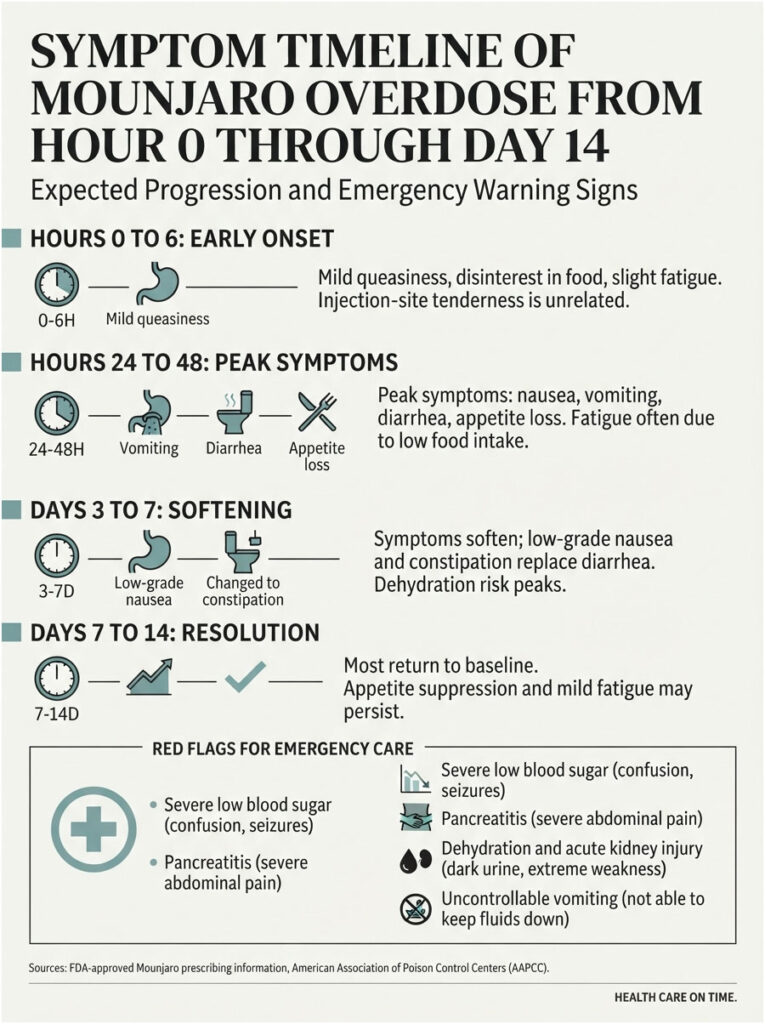
Knowing what is expected removes most of the fear, and it makes genuine warning signs far easier to spot. Here is how a Mounjaro overdose from a single doubled dose typically unfolds.
Hours 0 to 6
Most people feel close to normal. Mild queasiness, a sudden disinterest in food, and slight fatigue are common and not alarming by themselves.
Injection-site tenderness has nothing to do with the double dose. It is a local reaction, not a measure of how much drug you received.
Hours 24 to 48, the peak window
Symptoms concentrate here. Nausea usually hits its worst point, and vomiting or diarrhea may begin.
Appetite tends to disappear almost completely. Reflux, burping, bloating, and a heavy feeling after even small meals are all typical.
Fatigue in this window often comes from low intake rather than the drug. Keeping fluids and light carbohydrates moving helps more than rest alone.
Days 3 to 7, the long tail
Symptoms soften without vanishing. Many people describe a low-grade nausea that comes and goes with meals.
Constipation frequently replaces diarrhea during this stretch. Dehydration risk peaks here, because early vomiting has already drawn down reserves while tirzepatide blunts thirst and appetite cues.
Days 7 to 14, the residual phase
By week two, most people are functionally back to baseline. Appetite suppression fades last, with mild fatigue trailing behind it.
Our medical reviewers note this is exactly when patients try to resume their own schedule. Confirm timing with your prescriber instead of guessing.
Red flags that mean emergency care now
Everything above is uncomfortable but expected. The following are not, and they apply whether you took too much Mounjaro by minutes or by days.
Severe low blood sugar
Confusion, slurred speech, inability to stay awake, seizures, or fainting. These need 911, not a phone consultation.
Shakiness, sweating, a racing heart, and sudden intense hunger arrive earlier. Treat with 15 grams of fast carbohydrate, retest in 15 minutes, and call your prescriber.
Pancreatitis
Severe pain high in the abdomen, often boring straight through to the back, usually with persistent vomiting. Pain that makes it impossible to sit still is the classic description.
Acute pancreatitis was rare in tirzepatide trials, occurring at 1 percent or less across all doses, though this symptom pattern warrants emergency evaluation every single time. Lipase and amylase blood tests, plus imaging, are how clinicians confirm it.
Dehydration and acute kidney injury
Dark urine, urinating far less than usual, extreme weakness, dizziness on standing, or a dry mouth fluids will not fix. Kidney injury after a GLP-1 overdose is nearly always downstream of fluid loss, which is why early sipping matters so much.
Our lab partners report that kidney function panels and electrolyte panels are the two tests clinicians order most often after these events.
Vomiting you cannot stop
If nothing stays down for six to eight hours, home management has failed. Urgent care or an emergency room can provide intravenous fluids and anti-nausea medication, which shortens the whole episode considerably.
How Common Is This, and What Actually Happens to People
Dosing errors with this drug class are not rare. The US data is reassuring about outcomes and unflattering about prevention.
What US poison center data shows
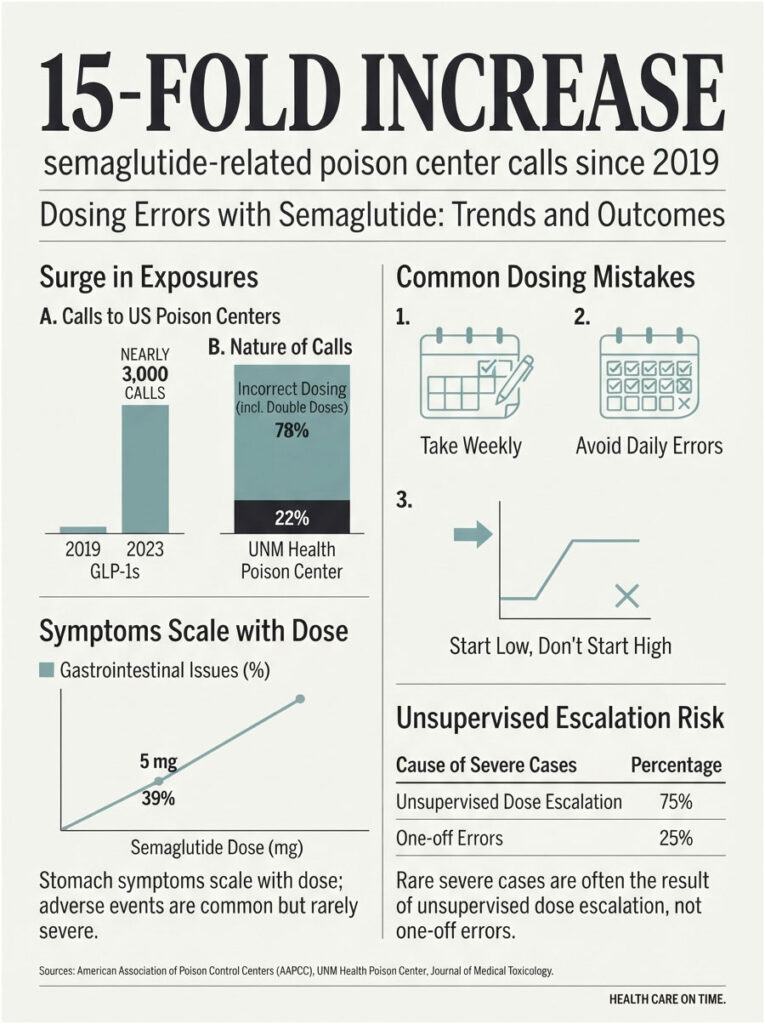
From January to November 2023, US poison centers logged nearly 3,000 calls involving semaglutide, more than a 15-fold increase since 2019, with most calls resulting from dosing errors such as accidental double doses.
State-level numbers sharpen the point. The director of the UNM Health Poison Center reported that 78 percent of that center’s semaglutide calls that year involved incorrect dosing, including double doses and 10-fold errors.
A larger national analysis reached the same conclusion. Researchers at the University of Texas at San Antonio reviewed more than 10,000 GLP-1 receptor agonist exposures reported to the National Poison Data System between 2012 and 2023 and tied the post-2021 surge to preventable dosing mistakes. The two most common mistakes in that dataset were taking the medication daily instead of weekly, and starting immediately at the highest dose instead of following the step-by-step schedule.
Neither is a pharmacology problem. Both are instruction problems.
What the trial numbers say about severity
Stomach symptoms are the expected outcome, and they scale with dose.
| Finding | Figure | Source | Period |
| US poison center calls involving semaglutide | Nearly 3,000, over 15-fold above 2019 | America’s Poison Centers | Jan to Nov 2023 |
| Share of one state center’s calls caused by incorrect dosing | 78 percent | UNM Health Poison Center | 2023 |
| GLP-1 exposures analyzed in national poison data | More than 10,000 | UT San Antonio, National Poison Data System | 2012 to 2023 |
| GLP-1 cases referred for facility management, before vs after weight-loss approval | 23.0 percent rising to 33.5 percent | National Poison Data System analysis | Reported 2026 |
| Women’s share of post-approval GLP-1 poison center cases | 78.2 percent | National Poison Data System analysis | Reported 2026 |
| Gastrointestinal adverse events on tirzepatide, 5 / 10 / 15 mg | 39 percent / 46 percent / 49 percent | Pooled analysis, 10 trials, 6,836 participants | Published in PMC |
| Nausea / diarrhea / vomiting on tirzepatide | 20.4 percent / 16.2 percent / 9.1 percent | Meta-analysis, 6 RCTs, 4,586 patients | Published in PMC |
| Clinically significant hypoglycemia, tirzepatide alone vs added to basal insulin | Under 1 percent vs 6.3 to 13.6 percent | SURPASS-1 and SURPASS-5 | Trial program |
Those dose-response figures come from a pooled review. Gastrointestinal adverse events were dose dependent at 39 percent for 5 mg, 46 percent for 10 mg, and 49 percent for 15 mg, while rates of fatal events, severe hypoglycemia, acute pancreatitis, and gallbladder disease were each 1 percent or lower across all doses.
The six-trial meta-analysis adds symptom-level detail. Across 4,586 patients, nausea occurred in 20.43 percent, diarrhea in 16.24 percent, vomiting in 9.05 percent, and decreased appetite in 9.64 percent.
Put those beside the poison center data and one picture emerges. A double dose amplifies the symptoms this drug already produces at normal doses. It rarely produces a new category of harm.
The rare severe cases, in honest context
Severe outcomes exist and deserve mention without exaggeration. One published case describes a 39-year-old man with no significant other conditions who developed life-threatening hypoglycemia, severe electrolyte abnormalities, pancytopenia, and aspiration pneumonia after unsupervised rapid dose escalation of tirzepatide for weight loss.
Notice the mechanism: unsupervised escalation sustained over time, not one accidental double dose. That distinction is probably the most useful thing on this page for anyone deciding how worried to be tonight.
A national poison data review also included one death, in a patient who had recently undergone liposuction and started tirzepatide three weeks later, presenting ten days after with severe abdominal pain and extensive large intestine damage. Cause and effect cannot be established from a single case report, though the authors flagged the timing around surgery as a clinical question.
The data has real limits, and they run in one direction. Poison center reporting is voluntary, so true exposure numbers are almost certainly higher than the database shows, particularly for people who went straight to an emergency room without calling.
Who Faces Higher Risk After a Double Dose
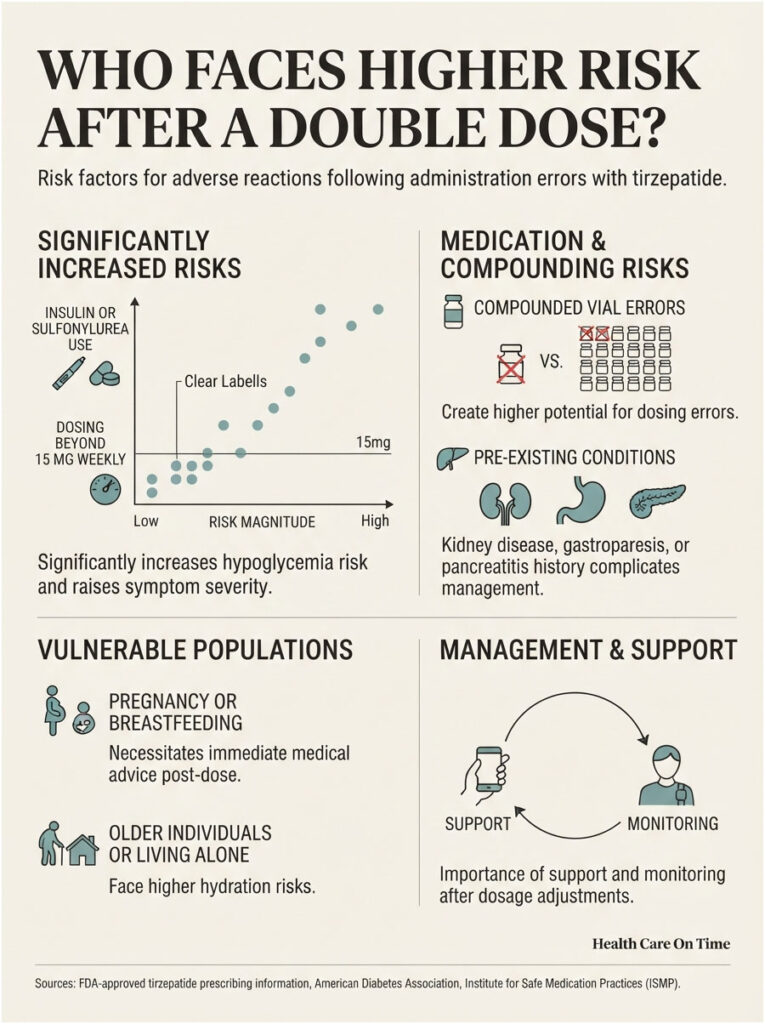
Two people can take the same extra dose and have completely different experiences. These factors move the needle.
If you also take insulin or a sulfonylurea
This is the largest single risk modifier. Tirzepatide’s own effect on insulin release is glucose-dependent, which builds in a natural brake, but that brake does not apply to injected insulin or to a sulfonylurea that forces release regardless of your blood sugar.
Clinical trials showed hypoglycemia risk with tirzepatide primarily alongside concurrent insulin or sulfonylurea use, while monotherapy in SURPASS-1 did not increase that risk.
The size of the gap is worth seeing plainly. In SURPASS-5, clinically significant hypoglycemia (blood glucose under 54 mg/dL) occurred in up to 13.6 percent of patients on tirzepatide plus basal insulin, against a monotherapy rate of 0.4 percent or lower across SURPASS-1 through SURPASS-5.
If that describes you, glucose monitoring after a double dose is not optional. Ask your prescriber whether your insulin or sulfonylurea dose should drop temporarily for the coming week.
If you doubled at 10 mg, 12.5 mg, or 15 mg
Doubling any of these puts you past the 15 mg weekly maximum, and the dose-response data predicts what follows. Symptom rates climb steadily from 5 mg upward.
Call before symptoms start rather than after. Arrange for someone to check on you over the next 48 hours if you live alone.
If you use compounded tirzepatide from a vial
Vials strip away the safety features a pen provides. A published case series found that compounded semaglutide vials allow for large overdoses such as 10-fold dosing errors, with syringes not intended for the drug adding to confusion between milliliters, units, and milligrams.
The scale of that problem is documented. The Washington Poison Center reported that about half of its related calls involve compounded semaglutide and tirzepatide dispensed in vials, where dosing measured in units similar to insulin creates confusion.
One regulatory change matters here. The FDA determined the tirzepatide shortage resolved and upheld that decision in December 2024, after which pharmacies and physicians are no longer permitted to routinely compound or dispense copies of tirzepatide injections. All six Mounjaro dose strengths are available nationally in 2026, though individual pharmacies may still have temporary local gaps.
If you have kidney disease, gastroparesis, or a pancreatitis history
Reduced kidney function narrows your margin for fluid loss. Existing delayed stomach emptying makes severe nausea and vomiting both likelier and harder to manage at home.
A prior pancreatitis episode lowers the threshold for getting evaluated if abdominal pain shows up. Mention any of these on your call.
If you are pregnant, breastfeeding, or planning pregnancy
Tirzepatide is not intended for use during pregnancy, and an accidental double dose is a reason to reach your prescriber the same day rather than waiting it out. Raise it even if you only suspect you might be pregnant.
If you are older, live alone, or have limited support
The practical danger in the first two days is dehydration from symptoms you cannot manage by yourself. Someone available to bring fluids or drive you matters more than any lab value right now.
Your Next Dose, Your Schedule, and the Weight Loss Question
Everyone lands on these questions, and none of the pages currently ranking answer them clearly.
Should you skip next week’s injection
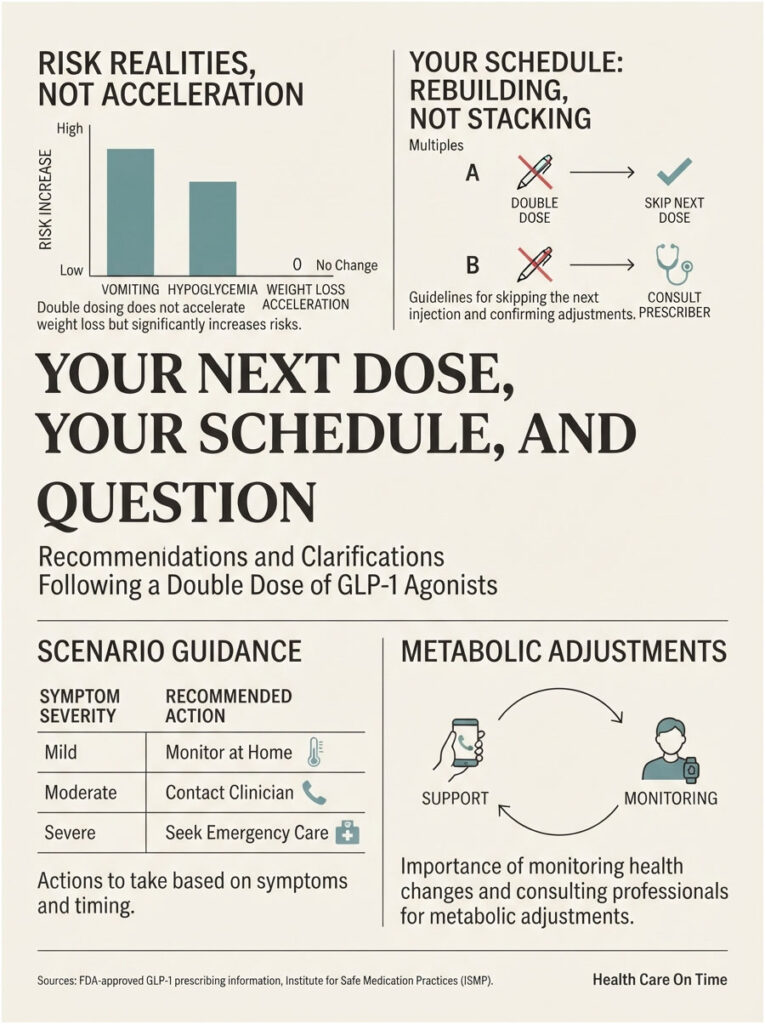
Most prescribers do recommend skipping the next scheduled dose after a same-week double, then resuming the normal weekly rhythm the following week. That lets drug levels fall back toward where they belong instead of stacking a third dose on top.
Do not apply that as a rule on your own. Confirm it with your prescriber or pharmacist, because the right answer shifts with the strength you doubled, the hours between injections, and your other glucose-lowering medication.
Rebuilding correct spacing without stacking again
Once you have guidance, rebuild around the 72-hour minimum. Pick one fixed weekday, set a recurring alarm, and write the date and strength on the pen or its box every time.
Never take two doses in the same week to make up for a missed one. That instruction covers both directions of the error.
Does a double dose speed up weight loss?
No. The titration schedule exists because tolerance to the stomach effects builds over weeks, not because a better result is being withheld from you.
Doubling does not accelerate fat loss. It raises the odds of vomiting, dehydration, and days of lost function, and for anyone on insulin or a sulfonylurea it raises the odds of a hypoglycemic event.
Whatever weight drops during the week after a double dose is mostly fluid plus reduced intake from feeling ill. That is not progress, and it reverses on rehydration.
If your results have stalled, the answer is a titration conversation with your prescriber, not a self-managed increase. Patients booking metabolic panels through HealthCareOnTime often find the more useful next step is measuring what actually changed.
When a prescriber may pause or step you back down
If your symptoms were severe, your clinician may hold treatment for a week or two, or restart you at a lower strength and re-escalate. That is a normal temporary adjustment, not a setback in your treatment.
Match your situation to an action
| Your Scenario | What It Means | Recommended Action | Who to Contact |
| Injected twice within minutes because the first shot seemed not to deliver | Full double exposure; the pen almost always delivered | Do not inject again. Log times and strengths. Start fluids. | Poison Help, 1-800-222-1222 |
| Two doses 2 days apart, no insulin or sulfonylurea | Overlapping drug levels, stomach symptoms likely | Monitor 48 hours; skip the next dose only if told to | Prescriber, same day |
| Two doses in one week and you take insulin or a sulfonylurea | Real hypoglycemia risk | Test glucose now, then every 2 to 4 hours while awake; keep fast carbs at hand | Prescriber or Poison Help, now |
| Doubled at 10 mg or higher | Total exceeds the 15 mg weekly maximum | Call before symptoms start; arrange someone to check on you | Poison Help, now |
| Vomiting past 6 to 8 hours, nothing stays down | Dehydration and kidney strain | Go in for intravenous fluids and anti-nausea medication | Urgent care or ER |
| Severe upper abdominal pain radiating to the back | Possible pancreatitis | Stop the medication and get evaluated immediately | 911 or ER |
| Confusion, seizure, fainting, or unresponsiveness | Possible severe low blood sugar | Call 911. Do not drive yourself. | 911 |
| Compounded vial and unsure how much was drawn | Potentially a large overdose | Bring the vial and syringe with you | 911 or ER |
How to Make Sure This Never Happens Again
Prevention is where the poison center data points hardest, because nearly every reported case was avoidable.
Where the errors actually happen
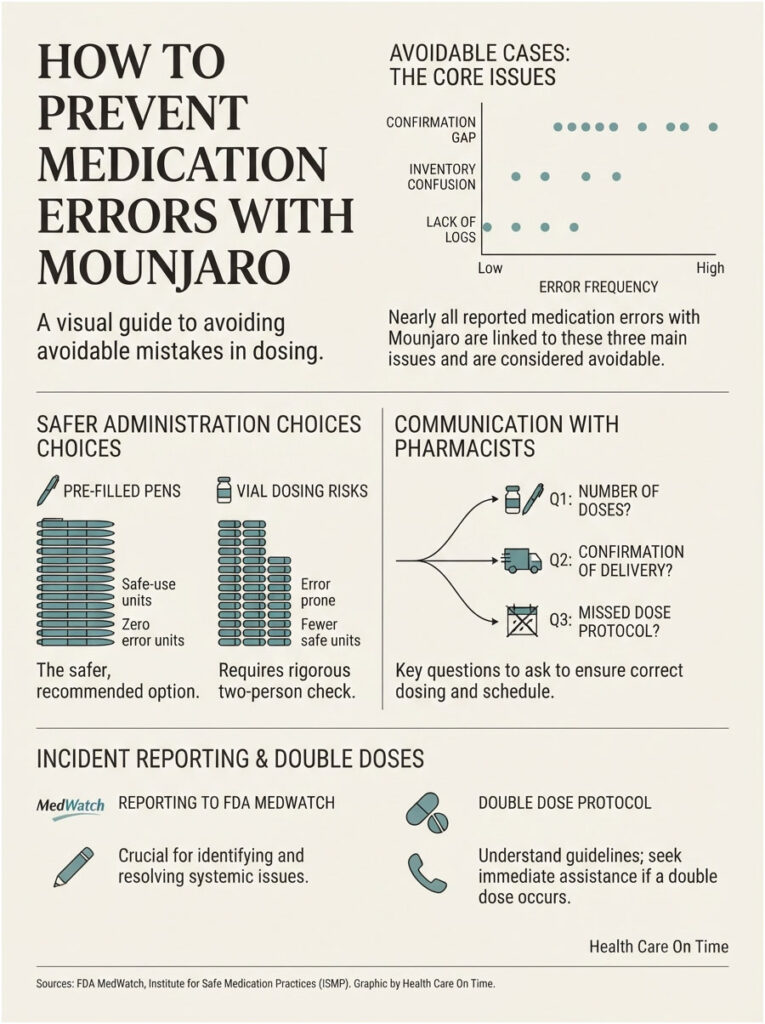
Poison center specialists have noted that the manufactured product comes in a pen with pre-filled doses, which makes a wrong dose less likely than with other formats. The pen is the safer device. Errors cluster around three specific gaps.
First, the confirmation gap: no obvious feedback that the injection delivered. Second, inventory: two strengths sharing a refrigerator during a titration step. Third, the log: no written record of what went in and when.
The compounded vial trap
If you draw doses from a vial with a syringe, treat every dose as a two-person check or a written-checklist step. Confirm the concentration on the label, the volume your prescriber specified, and the syringe markings you are reading.
Units and milliliters are not interchangeable. That one confusion sits behind a large share of the worst reported cases.
Seven habits that prevent a repeat
- One fixed injection day and a recurring phone alarm, not memory.
- A written log with date, time, strength, and site, kept on the refrigerator door.
- Only your current strength stored in the fridge; the next strength stays out until step-up day.
- Photograph the used pen and its dose window right after injecting.
- Count the full hold time in the instructions for use before removing the pen.
- Never re-inject on a suspicion of failure. Log it, then call your pharmacist.
- Drop each pen in a sharps container the day it empties.
What to ask your pharmacist at pickup
Three questions cover almost everything. How many doses are in this pen, how do I confirm the dose actually delivered, and what should I do if I think it did not.
Researchers analyzing the poison data concluded that better education at every step, from the prescriber’s office to the pharmacy counter, could prevent many of these errors. The counter is where you get to ask.
Reporting the error
Consider reporting the incident to the FDA through MedWatch at 1-800-FDA-1088. Individual reports are how device-level and labeling-level problems get spotted and fixed.
Frequently Asked Questions
What counts as a double dose of Mounjaro?
Two full injections inside the same weekly window, whether minutes or days apart. The label permits changing your injection day only if at least 72 hours separate doses, so anything tighter is a dosing error rather than a schedule shift.
Is a double dose of Mounjaro dangerous?
For most people, one accidental double dose brings several days of intensified stomach symptoms rather than a life-threatening event. Risk rises meaningfully if you also take insulin or a sulfonylurea, if you doubled at 10 mg or above, or if you cannot keep fluids down.
How long does a double dose of Mounjaro stay in your system?
Tirzepatide’s half-life runs about five days, and levels peak around 24 to 48 hours after injection. Expect symptoms to build for roughly two days, ease across the first week, and settle fully within one to two weeks.
Should I skip my next Mounjaro dose?
Most prescribers advise skipping the next scheduled injection and resuming the following week, but confirm before acting. The right answer depends on the strength involved, the gap between your two doses, and your other medications.
Can a double dose of Mounjaro cause low blood sugar?
On tirzepatide alone, clinically significant hypoglycemia is uncommon because its insulin effect is glucose-dependent. Combined with insulin or a sulfonylurea, trial rates reached 6.3 to 13.6 percent. If that applies to you, test often and keep fast-acting carbohydrates nearby.
Does a double dose of Mounjaro make you lose weight faster?
No. Extra drug increases nausea, vomiting, and dehydration risk without accelerating fat loss. Weight that drops that week is mostly fluid and reduced intake, and it returns once you rehydrate.
Can you take Mounjaro two days in a row?
No. Two doses one day apart sits well inside the 72-hour minimum and produces overlapping drug levels. Treat it as a double dose, skip any further injection, and call Poison Help at 1-800-222-1222 or your prescriber.
How many hours apart do Mounjaro doses need to be?
At least 72 hours per the prescribing information, and normally a full seven days. The 72-hour figure exists to allow a one-time change of injection day, not as a routine interval.
What if I doubled a compounded tirzepatide dose from a vial?
Treat this more seriously than a pen error, since vial and syringe confusion has produced 10-fold overdoses. Call Poison Help immediately or go to an emergency room, and bring the vial and syringe so clinicians can calculate what you received.
Can a double dose of Mounjaro cause pancreatitis?
Pancreatitis occurred in 1 percent or fewer of patients across tirzepatide trials, so it is rare. Severe upper abdominal pain radiating to the back, especially with persistent vomiting, still needs emergency evaluation and blood testing every time.
Do I call Poison Control or my doctor first?
Either is correct. Poison Help at 1-800-222-1222 answers around the clock with toxicology expertise; your prescriber knows your history and medication list. For confusion, seizures, fainting, or nonstop vomiting, call 911 instead of either.
Does the same guidance apply to Zepbound?
Yes. Zepbound contains the same active ingredient, tirzepatide, on the same weekly schedule, with the same roughly 5-day half-life and the same 72-hour minimum spacing. Everything in this article applies without modification.
Medical disclaimer: This article is general information and does not replace advice from a licensed clinician. It cannot assess your specific dose, medications, or symptoms. If you have taken more Mounjaro than prescribed, call Poison Help at 1-800-222-1222 or contact your prescriber. For confusion, seizures, fainting, chest pain, or vomiting you cannot stop, call 911 or go to the nearest emergency room.
References
- Mounjaro (tirzepatide) US Prescribing Information, Eli Lilly
- Mounjaro and Mounjaro KwikPen label and Instructions for Use, DailyMed, NIH
- FDA-approved Mounjaro label, Drugs@FDA
- FDA Declaratory Order: Resolution of Shortages of Tirzepatide Injection
- Poison Help, America’s Poison Centers
- Tirzepatide-Induced Gastrointestinal Manifestations: A Systematic Review and Meta-Analysis, PMC
- Adverse Events Related to Tirzepatide: pooled analysis of 10 trials, PMC
- Administration errors of compounded semaglutide reported to a poison control center, PubMed
- Managing Hypoglycemia During Tirzepatide Initiation or Uptitration, PMC
- UNM Health Poison Center on increased poison control calls for weight-loss drugs
- Data Show Rise in GLP-1 Poison Center Calls Tied to Dosing Errors, Drug Topics
- UT San Antonio analysis of GLP-1 dosing errors in the National Poison Data System, ScienceDaily
- Poison Control Centers Report Sharp Increase in Calls Related to Semaglutide, NABP
- Mounjaro dosage, availability, and side effects, Drugs.com