Search this question and Google hands back six numbers on one screen: 25, 30, 35, 41, 50, and 52. Every one of them is correct. Not one of them is “a carrot.”
None of that reflects disagreement about carrots. It reflects portion records, and almost no page bothers to explain that.
Table of Contents
So here is the whole picture, pulled from the federal database that every calorie-tracking app quietly copies, along with the part those apps leave out entirely: how much of a carrot your body actually absorbs.
Quick Answer: One medium raw carrot (61 grams) has 25 calories. Per 100 grams, raw carrots carry 41 calories, 9.6 grams of carbohydrate, 2.8 grams of fiber, and about 88 percent water, per USDA FoodData Central. A large carrot (72 grams) has 30 calories, one cup chopped (128 grams) has 52, and ten baby carrots come to roughly 35. Cooking barely moves the calorie count, but it changes how much vitamin A you absorb.
At a Glance
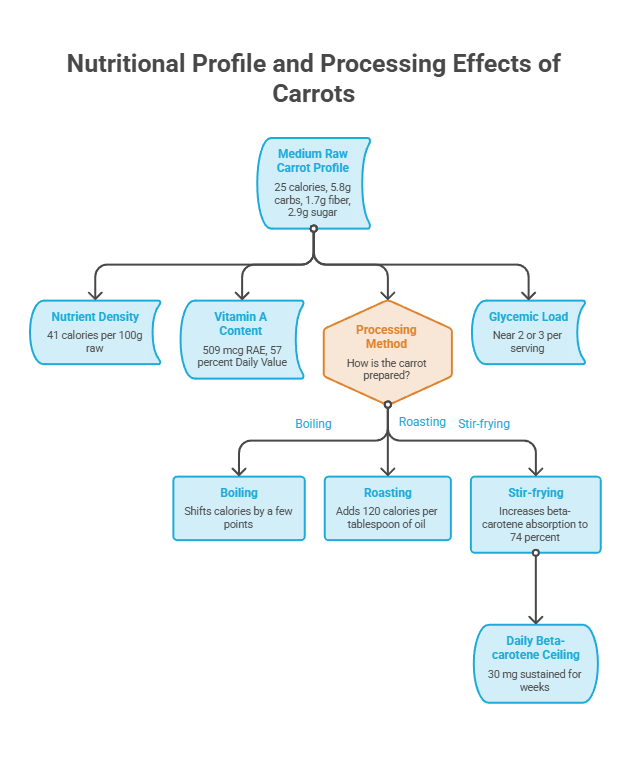
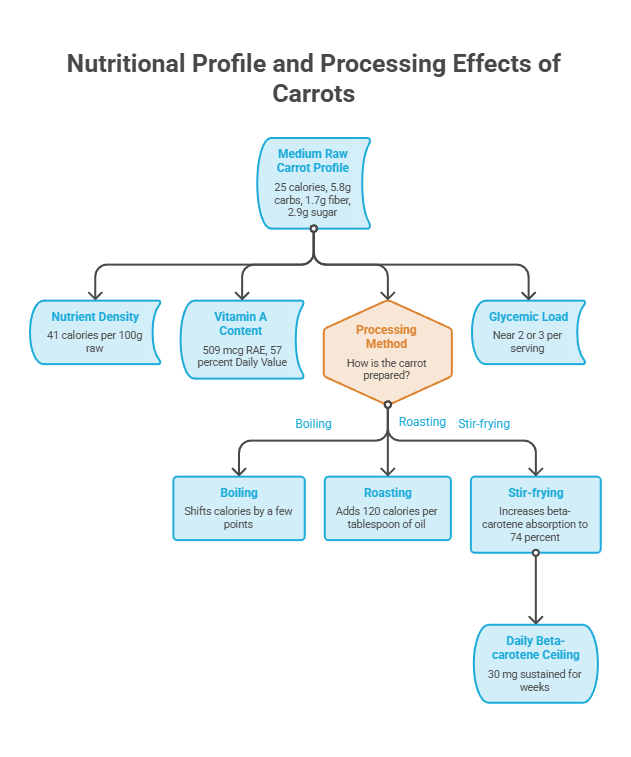
- A medium raw carrot: 25 calories, 5.8 g carbohydrate, 1.7 g fiber, 2.9 g natural sugar
- Per 100 g raw: 41 calories, which is 0.41 calories per gram, among the lowest densities in the produce aisle
- That medium carrot supplies 509 mcg RAE of vitamin A, or 57 percent of the Daily Value, converted from roughly 5 mg of beta-carotene
- Boiling shifts calories by a few points. Roasting in one tablespoon of oil adds about 120
- Glycemic load lands near 2 or 3 per serving, despite a myth that has trailed carrots since 1981
- Absorption of beta-carotene runs about 11 percent from raw carrots and 74 percent from stir-fried
- The real daily ceiling is not calories. It is roughly 30 mg of beta-carotene, sustained for weeks
Carrot Calories by Serving Size, Reconciled
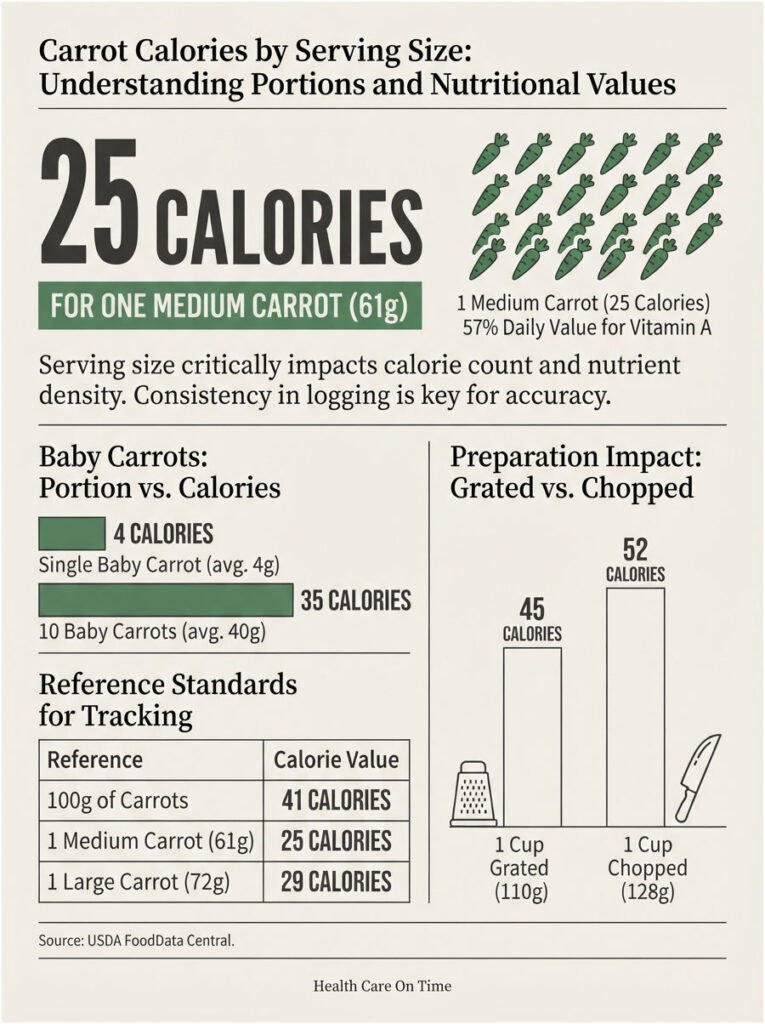
Every figure below traces to the same two USDA records. What changes is the weight of what lands on your plate.
Patients booking tests with us often ask why their tracking app and the bag in the refrigerator differ by ten calories. The answer is almost always portion weight, not a data error.
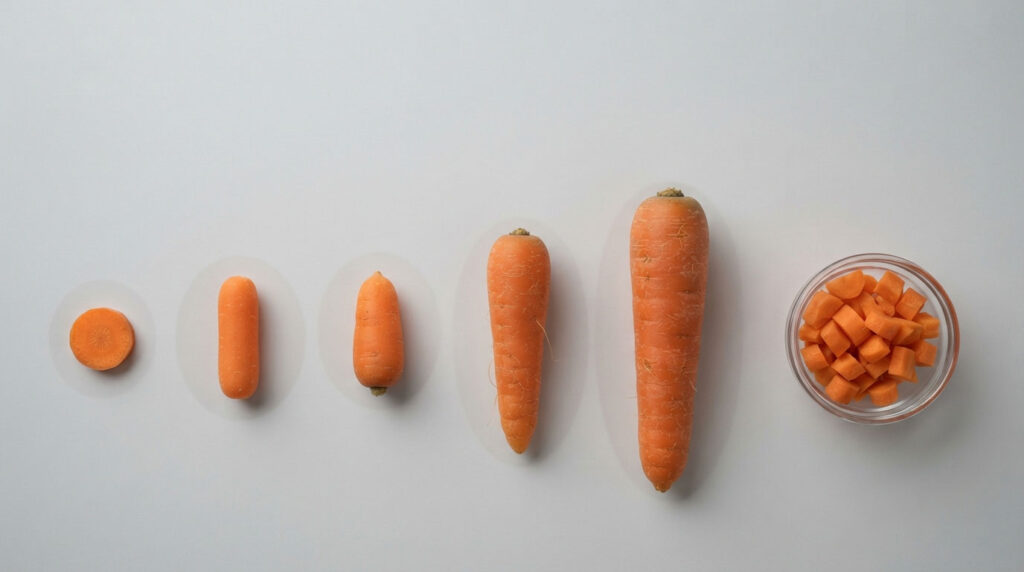
| Serving | Weight | Calories | Carbs (g) | Fiber (g) | Sugars (g) | Vitamin A (% DV) |
| 1 thin slice | 5 g (0.2 oz) | 2 | 0.5 | 0.1 | 0.2 | 5% |
| 1 baby carrot | 10 g (0.4 oz) | 4 | 0.8 | 0.3 | 0.5 | 8% |
| 1 small carrot (5.5 in) | 50 g (1.8 oz) | 21 | 4.8 | 1.4 | 2.4 | 46% |
| 1 medium carrot (7 in) | 61 g (2.2 oz) | 25 | 5.8 | 1.7 | 2.9 | 57% |
| 1 large carrot (7.25 in) | 72 g (2.5 oz) | 30 | 6.9 | 2.0 | 3.4 | 67% |
| 10 baby carrots | 100 g (3.5 oz) | 35 | 8.2 | 2.9 | 4.9 | 77% |
| 1 cup grated | 110 g (3.9 oz) | 45 | 10.5 | 3.1 | 5.2 | 102% |
| 1 cup chopped | 128 g (4.5 oz) | 52 | 12.3 | 3.6 | 6.1 | 119% |
| 100 g reference | 100 g (3.5 oz) | 41 | 9.6 | 2.8 | 4.7 | 93% |
Calculated from USDA FoodData Central, Carrots, raw (FDC 170393) and Carrots, baby, raw (FDC 168568). Percent Daily Value uses the FDA reference of 900 mcg RAE.
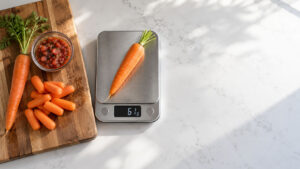
One medium carrot, the number most people want
USDA defines a medium carrot as 61 grams, a little over two ounces, roughly seven inches long. That comes to 25 calories.
Eat two with lunch and you have spent 50 calories while collecting 114 percent of the Daily Value for vitamin A. Very few foods run that ratio.
For readers who prefer ounces, a carrot is about 11.6 calories per ounce. A one-pound bag is 186 calories total.
Baby carrots, and why the bag says something different
Baby carrots carry their own USDA record because they are processed differently. They come in at 35 calories per 100 grams, slightly under the 41 of a whole carrot, largely because peeling and cutting shifts the water-to-solids balance.
A single baby carrot averages about 10 grams and 4 calories. Ten of them, the standard lunchbox handful, land at 35 calories with 2.9 grams of fiber and 690 mcg RAE of vitamin A.
Whole “babies” versus cut-and-peeled
Most bagged baby carrots in American supermarkets are not immature carrots. They are long, slender Imperator-type carrots cut into two-inch segments and tumbled smooth.
True baby carrots, harvested young with tops attached, are a farmers-market item. Nutritionally the two sit close enough that the same record works for tracking.
Cups: grated, chopped, and sliced are not the same weight
This is where most logging errors happen. A cup of grated carrot weighs 110 grams. A cup of chopped carrot weighs 128 grams, because chopped pieces pack tighter with fewer air gaps.
That 18-gram gap is a 7-calorie difference. Trivial once, meaningful for someone logging three cups a day and wondering why the arithmetic drifts.
Sliced coins fall between the two at roughly 122 grams per cup, or 50 calories.
Why five apps give you five answers
FoodData Central holds several data types. SR Legacy carries the classic analytical values most consumer apps use. Foundation Foods carries newer sample-level analyses with variability data. FNDDS carries survey codes built for dietary recall research.
Newer Foundation Foods sampling for raw carrots has produced slightly higher energy figures, closer to 45 calories per 100 grams, because it draws on fresh market samples rather than legacy composites.
Our medical reviewers treat the SR Legacy figures as the working standard, since those are the values wired into most apps and consistent with US food labels.
Which number should you actually log?
Use 41 calories per 100 grams if you weigh your food. Use 25 for a medium carrot if you do not.
Chasing a four-calorie difference between database versions has no practical effect on a deficit. Consistency matters more than precision here, so pick one reference and stay with it.
The Full USDA Nutrition Breakdown
Here is what the 41 calories are built from, and what rides along at no calorie cost.
| Nutrient (per 100 g raw) | Amount | % Daily Value |
| Energy | 41 kcal | 2% |
| Water | 88.29 g | Not applicable |
| Carbohydrate | 9.58 g | 3% |
| Dietary fiber | 2.8 g | 10% |
| Total sugars | 4.74 g | Not applicable |
| Protein | 0.93 g | 2% |
| Total fat | 0.24 g | 0% |
| Potassium | 320 mg | 7% |
| Sodium | 69 mg | 3% |
| Calcium | 33 mg | 3% |
| Vitamin A | 835 mcg RAE | 93% |
| Beta-carotene | 8,285 mcg | Not applicable |
| Alpha-carotene | 3,477 mcg | Not applicable |
| Vitamin C | 5.9 mg | 7% |
| Vitamin K | 13.2 mcg | 11% |
| Folate | 19 mcg | 5% |
Source: USDA FoodData Central, Carrots, raw (FDC 170393). Daily Values per FDA reference amounts for adults.
Macronutrients, and where the calories come from
Water accounts for 88.29 grams of every 100 grams of raw carrot. That single number explains the low calorie density better than anything else on the panel.
The remaining solids split into 9.58 grams of carbohydrate, 0.93 grams of protein, and 0.24 grams of fat. Of the carbohydrate, 2.8 grams is fiber and 4.74 grams is naturally occurring sugar, mostly sucrose with smaller shares of glucose and fructose.
Protein and fat contribute so little that carrots are effectively a carbohydrate-and-water food with a pigment payload attached.
Net carbs, for readers counting them
Subtract fiber and net carbohydrate comes to roughly 6.8 grams per 100 grams, or about 4 grams per medium carrot.
That places carrots at the higher end of non-starchy vegetables but well inside most moderate low-carb plans. Strict ketogenic targets under 20 grams daily leave room for one or two carrots, not a bagful.
Vitamins, and the vitamin A math nobody explains
Raw carrots carry 835 mcg RAE of vitamin A per 100 grams, plus 5.9 mg of vitamin C, 13.2 mcg of vitamin K, 19 mcg of folate, 0.66 mg of vitamin E, and small amounts of thiamin, riboflavin, niacin, and vitamin B6.
Carrots contain no preformed vitamin A whatsoever. Retinol reads as zero. The entire vitamin A value is converted inside your body from plant pigments.
Why 8,285 mcg of beta-carotene becomes 835 mcg RAE
Per 100 grams, raw carrots hold 8,285 mcg of beta-carotene and 3,477 mcg of alpha-carotene. Neither is vitamin A yet.
National Academies conversion factors are 12 to 1 for dietary beta-carotene and 24 to 1 for alpha-carotene. Run it: 8,285 divided by 12 gives 690, and 3,477 divided by 24 gives 145. Add them and you land on 835 mcg RAE, exactly the USDA figure.
Our medical reviewers flag this because readers usually meet an “IU” number instead. The legacy IU value for 100 grams of carrot is roughly 16,706, which looks enormous and means very little without the conversion behind it.
Minerals: 320 mg of potassium, and the sodium that surprises people
Potassium leads at 320 mg per 100 grams, or 195 mg in a medium carrot. Calcium comes to 33 mg, phosphorus 35 mg, magnesium 12 mg, iron 0.30 mg, and zinc 0.24 mg.
Then sodium, at 69 mg per 100 grams. That is naturally occurring rather than added, and it is unusually high for a vegetable. A cup of chopped carrot carries about 88 mg before anything touches it.
For most readers this is a footnote. For someone managing a strict sodium restriction after a cardiology visit, it belongs in the arithmetic.
The compounds that are not on the label
Carrots carry lutein, which pairs with zeaxanthin in retinal tissue. They carry falcarinol and falcarindiol, polyacetylenes that have drawn research attention for effects on colon cells.
Fiber splits into soluble pectin plus insoluble cellulose, hemicellulose, and lignin. Pectin is the fraction that slows gastric emptying, which becomes relevant in the blood sugar section below.
Raw, Boiled, Roasted, Frozen, Canned, and Juiced
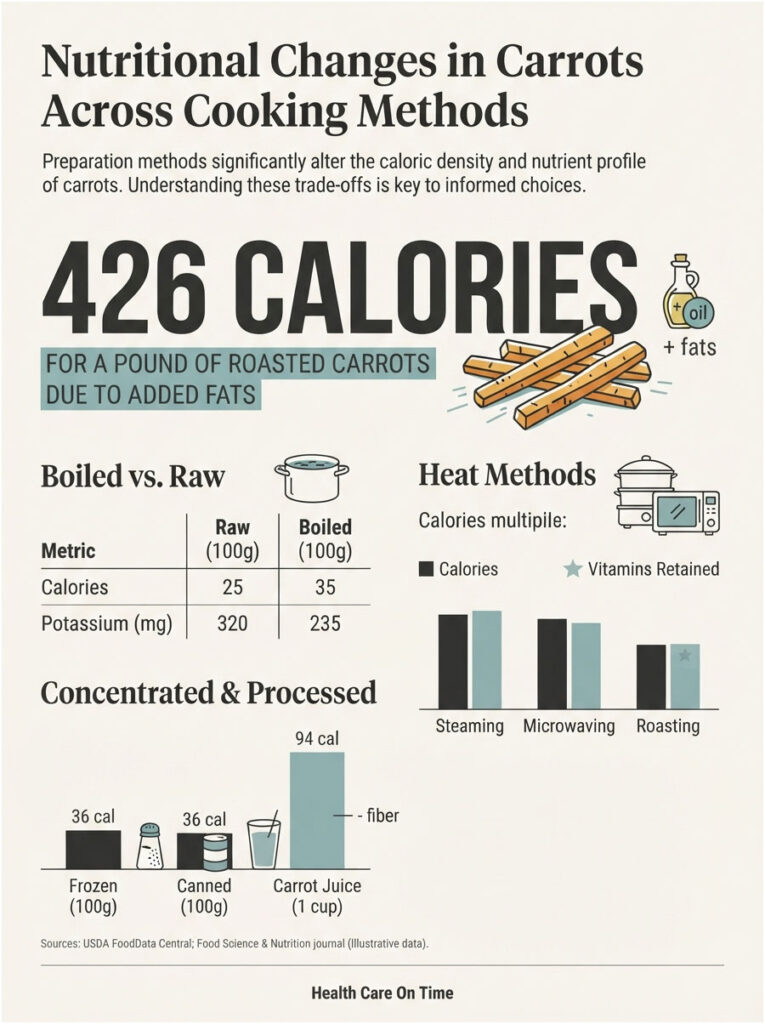
Calories shift modestly across formats. Fiber, sodium, and cooking fat shift dramatically.
Boiled carrots: 35 calories per 100 grams
Boiled, drained carrots without salt come to 35 calories per 100 grams, with 8.22 grams of carbohydrate and 3.0 grams of fiber, per USDA FoodData Central (FDC 170394).
Fiber rises slightly by weight while sugar falls, because sugar leaches into the water and the vegetable loses volume. Half a cup of boiled slices, 78 grams, is 27 calories and 75 percent of the vitamin A Daily Value.
Potassium drops from 320 mg to 235 mg per 100 grams. That loss is real and it ends up in the pot, which argues for steaming or repurposing the liquid in soup.
Steamed and microwaved
Steaming and microwaving cost less potassium and less vitamin C than boiling, because water contact is minimal. Calories are effectively unchanged from raw once you account for water loss.
For readers who want cooked carrots without the mineral leaching, these two methods are the practical middle ground.
Roasted and glazed, where the calories actually arrive
Roasted carrots taste sweeter because heat converts some complex carbohydrate to simple sugar and drives off water. Sugar per gram rises, but the carrot did not manufacture energy.
What changes the count is the pan. One tablespoon of olive oil adds about 120 calories. One tablespoon of butter adds about 100. A honey or brown-sugar glaze can add 50 to 100 more per serving.
A pound of carrots roasted in two tablespoons of oil moves from roughly 186 calories to roughly 426. That is not a carrot problem, but it explains a lot of confused food diaries.
Frozen carrots: 36 calories per 100 grams
Frozen sliced carrots, unprepared, run about 36 calories per 100 grams with 3.3 grams of fiber, close to boiled. Blanching before freezing costs some vitamin C but leaves carotenoids largely intact, since beta-carotene tolerates heat reasonably well.
For readers cooking on a budget, frozen carrots are one of the most defensible swaps in the freezer aisle.
Canned carrots and the sodium trade-off
Calories in drained canned carrots sit near frozen. Sodium is the variable that moves.
Regular canned versions can carry several hundred milligrams per half cup, many times the 58 to 69 mg that occurs naturally. Draining and rinsing removes a meaningful share, and “no salt added” labels remove the issue outright.
Carrot juice: 94 calories per cup, and the fiber goes in the trash
A cup of carrot juice runs about 94 calories, roughly equal to two cups of chopped raw carrot. Vitamin C actually rises per 100 grams, from 5.9 mg to around 8.5 mg.
Fiber collapses from 2.8 grams per 100 grams to about 0.8 grams, because the pulp is discarded. Juicing raises carotenoid absorption, covered next, while stripping out the component that makes carrots filling.
Carrot cake, carrot chips, and other things called carrots
A slice of carrot cake runs about 326 calories with nearly 17 grams of fat. A carrot muffin is close to 342. A cup of fried carrot chips lands near 252.
None of these belongs in the same conversation as a 25-calorie vegetable, yet all three get logged as “carrots” more often than you would guess.
Cooking Changes Absorption More Than It Changes Calories
This is the part that ranking search results almost universally skip, and it is the most useful finding in carrot research.
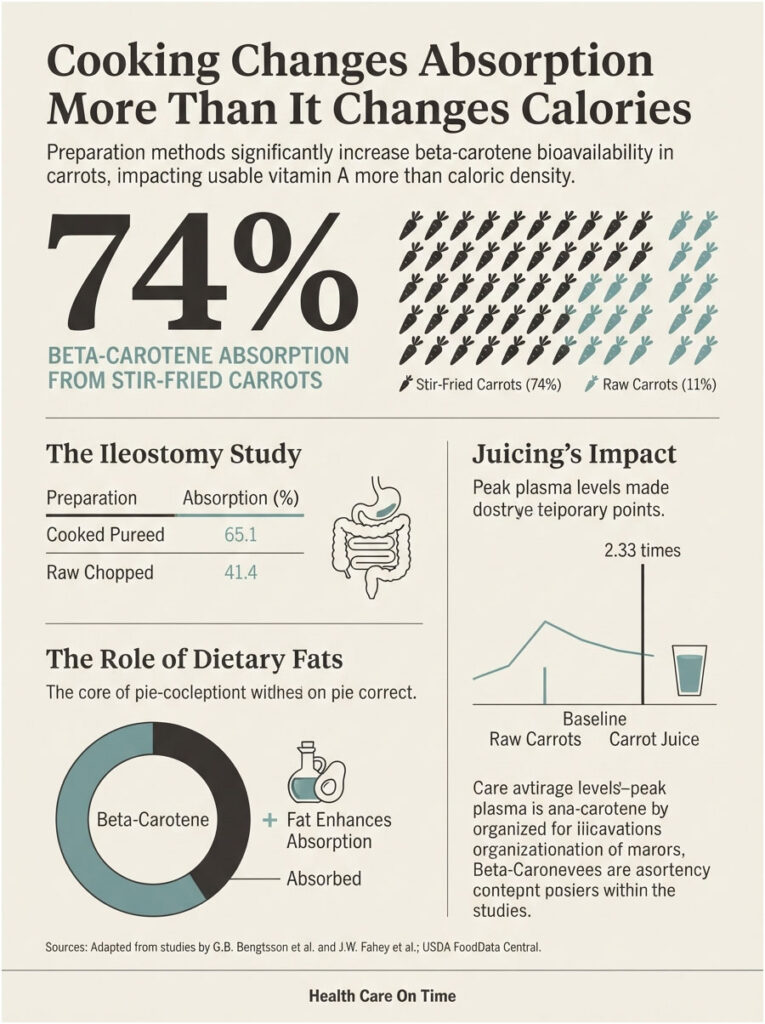
Our lab partners report that plasma carotenoid results frequently come back lower than a patient’s food diary would predict. Preparation method is usually the reason.
The 11 percent versus 74 percent finding
An intrinsic-labelling study in the British Journal of Nutrition measured relative beta-carotene bioavailability at 11 percent from a raw carrot meal and 74 percent from a stir-fried one, a statistically significant gap.
Carrot cell walls are tough. Heat and mechanical disruption break them, releasing carotenoids into digestive fluid where bile salts and dietary fat can carry them across the intestinal wall.
The ileostomy mass-balance data
A trial in the European Journal of Nutrition used ileostomy volunteers, a design that lets researchers measure what actually left the small intestine rather than estimating it from blood levels.
Participants absorbed 65.1 percent of beta-carotene from cooked, pureed carrots and 41.4 percent from raw, chopped carrots. Both test meals delivered 15 mg of beta-carotene alongside yogurt with added sunflower oil.
Juicing does the same thing mechanically
A 2025 crossover trial in Nutrition Research and Practice compared raw carrots against freshly extracted juice.
Peak plasma beta-carotene was 2.33 times higher in the juice group at 1.5 hours, and area under the curve was 2.09 times greater. Heat, blender, or juicer, the mechanism is the same: rupture the cell wall.
Why beta-carotene needs fat on the plate
Beta-carotene is fat-soluble. Without dietary fat in the same meal, absorption falls sharply no matter how the carrot was prepared.
Practically, that means olive oil on roasted carrots, avocado in the salad, or hummus with the raw sticks is not indulgence. It is the delivery system.
What cooking costs you in return
Heat destroys a portion of vitamin C, thiamin, pantothenic acid, vitamin B6, and folate. Boiling also leaches potassium into the water.
So neither raw nor cooked wins outright. Raw carrots deliver more vitamin C and B vitamins. Cooked carrots deliver far more usable vitamin A. Eating both across the week is the honest answer, and it is the one our medical reviewers give.
Orange, Purple, Yellow, Red, and White
Rainbow carrots have moved from farmers markets into mainstream American supermarkets, and readers reasonably ask whether the numbers change.
Do colored carrots have different calories?
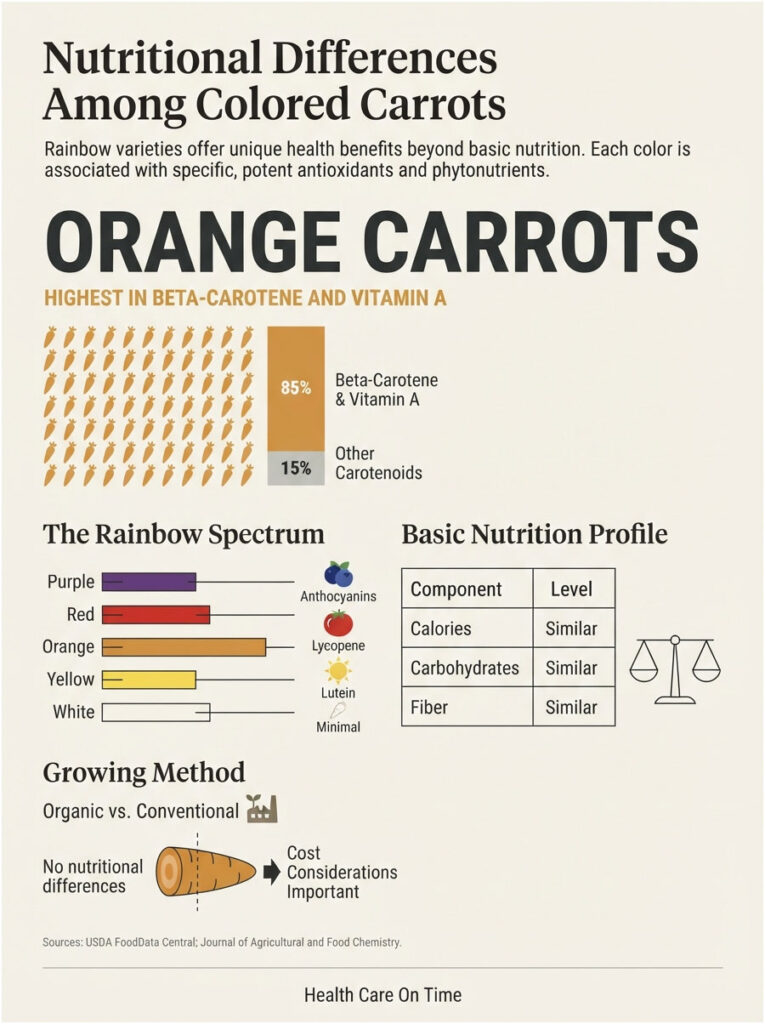
Calories, carbohydrate, and fiber stay close across colors, because the underlying vegetable is the same species. Pigment composition is what differs.
Orange carrots lead in beta-carotene and therefore in vitamin A. Yellow carrots carry more lutein. Red carrots carry lycopene, the pigment associated with tomatoes. Purple carrots add anthocyanins, the same class found in blueberries. White carrots carry almost no carotenoids at all.
If vitamin A is the goal, orange still wins by a wide margin. If antioxidant variety is the goal, mixing colors makes sense.
Organic versus conventional
A 2012 comparison of organic and conventionally grown carrots found no difference in carotenoid content or antioxidant quality. Conventionally grown carrots do carry pesticide residues, which is a separate consideration from nutrient density.
Washing and peeling reduce surface residue. For readers weighing cost, the nutritional case for paying more is weak, and eating more carrots of any kind beats eating fewer organic ones.
Carrots on a Calorie Deficit
Carrots earn their reputation here, though for a slightly different reason than most articles claim.
Calorie density, 0.41 calories per gram
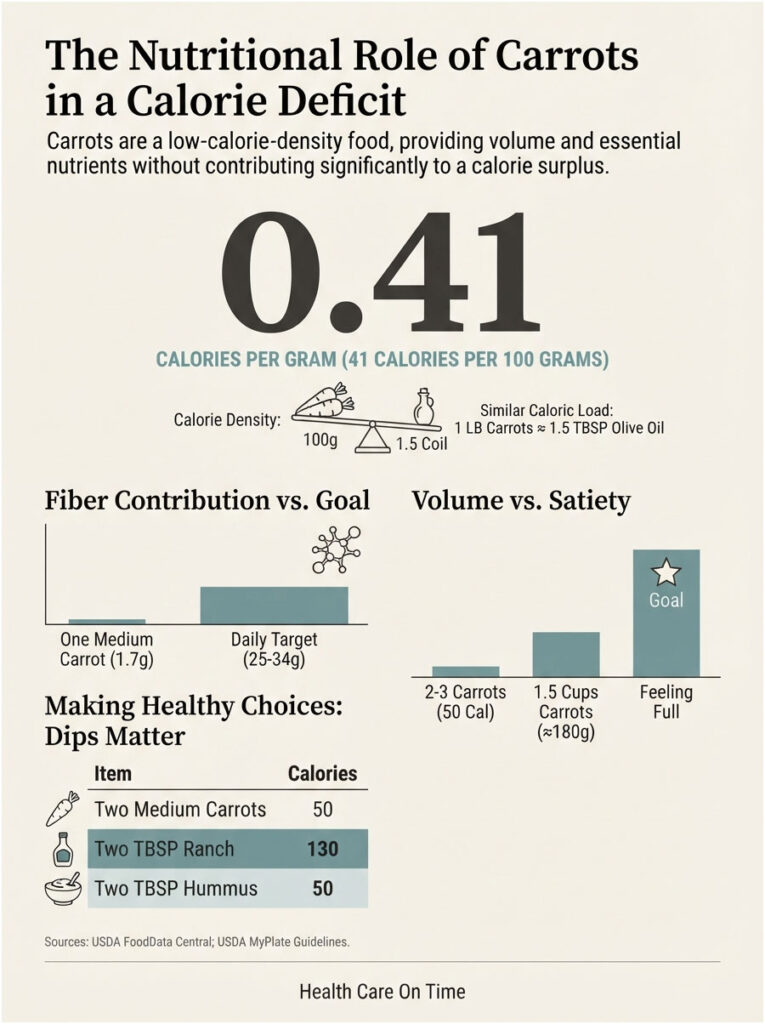
At 41 calories per 100 grams, carrots sit near the bottom of the calorie-density scale. A full pound of raw carrots is 186 calories, roughly the same as a single tablespoon and a half of olive oil.
Volume affects satiety in ways calories alone do not. Filling a third of the plate with carrots displaces higher-density food without shrinking the portion your eyes register.
What one cup of vegetables actually means
Under USDA MyPlate rules, two medium carrots or about twelve baby carrots equals one cup-equivalent of vegetables. Adults are advised to reach 2 to 3 cups daily.
Carrots also fill the red and orange vegetable subgroup, one of the categories Americans most reliably miss.
The dip problem
Two tablespoons of ranch dressing carries roughly 130 calories. Two medium carrots carry 50. The dip is more than twice the vegetable.
Two tablespoons of hummus, at about 70 calories, is a better trade and adds protein plus the fat that improves carotenoid uptake. Peanut butter, at roughly 190 calories per two tablespoons, is a snack with carrots attached rather than the reverse.
Fiber and fullness, with a reality check
A medium carrot has 1.7 grams of fiber. Respectable, not remarkable, and carrots alone will not close a fiber gap against the 25 to 34 gram daily target.
Readers who write to HealthCareOnTime asking why carrots are not keeping them full are usually eating two or three, not the cup and a half that delivers real bulk.
What three cups of vegetables looks like in practice
One cup of grated carrot in a lunch salad is 45 calories. One cup of baby carrots as an afternoon snack with hummus is about 155 calories total. One cup of carrots and broccoli roasted with a teaspoon of oil at dinner is around 95.
That is three cup-equivalents for under 300 calories, including the fat that makes the vitamin A usable. The arithmetic is the point: vegetables are rarely what breaks a deficit.
Carrots, Blood Sugar, and a Myth From 1981
If someone told you carrots spike blood sugar, they were repeating a forty-year-old measurement error.
Glycemic index versus glycemic load, in one paragraph
Glycemic index measures how fast the carbohydrate in a food raises blood glucose, tested at a fixed 50-gram carbohydrate dose. Glycemic load adjusts for how much carbohydrate a normal portion actually contains.
For a food that is 88 percent water and under 10 percent carbohydrate, those two numbers tell opposite stories, and only one of them describes eating.
Where the claim came from
Carrots were first tested in 1981 with five participants, enormous variation between them, and a reference food tested only once. The result came back high, and it became the standard cudgel against the glycemic index concept for years.
A properly standardized retest with ten participants and the reference food tested twice produced a mean glycemic index of 41 with narrow variation, as documented by the University of Sydney glycemic index group. The correction never traveled as far as the error.
What the current numbers say
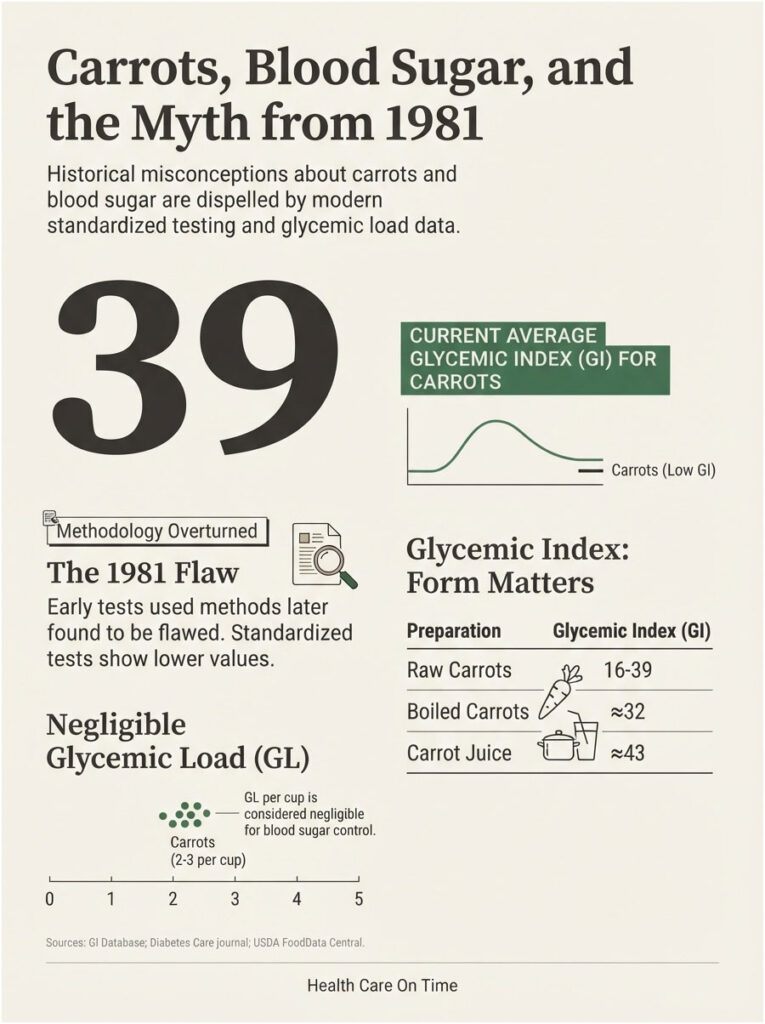
Across studies compiled in the International Tables of Glycemic Index, carrots average around 39, with the 2021 update listing 32. Individual measurements range from 16 in Romanian samples to 35 in Australian raw carrots. Boiled carrots test near 32, fresh carrot juice near 43.
All of those are low, meaning under 55. Glycemic load per cup sits at roughly 2 to 3, close to negligible.
Reaching a 50-gram carbohydrate dose from carrots alone would take about five cups, or a pound and a half at one sitting.
Juice, glaze, and the exceptions worth respecting
Whole carrots are a non-event for blood glucose. Carrot juice deserves more caution, since the pectin that slows absorption has been removed and a cup delivers about 22 grams of carbohydrate.
Honey-glazed carrots are a dessert wearing a vegetable costume. The carrot is not the variable.
Practical guidance for readers tracking glucose
Non-starchy vegetables including carrots belong in a diabetes eating pattern. One cup of carrots counts as roughly one carbohydrate choice at 15 grams.
Patients scheduling glucose panels through HealthCareOnTime commonly ask whether to drop carrots before testing. The answer is no. Long-term control is better assessed through periodic HbA1c testing than through second-guessing individual vegetables.
Is It Safe to Eat Carrots Every Day?
Yes for nearly everyone. There is no calorie ceiling worth worrying about, but there is a pigment ceiling.
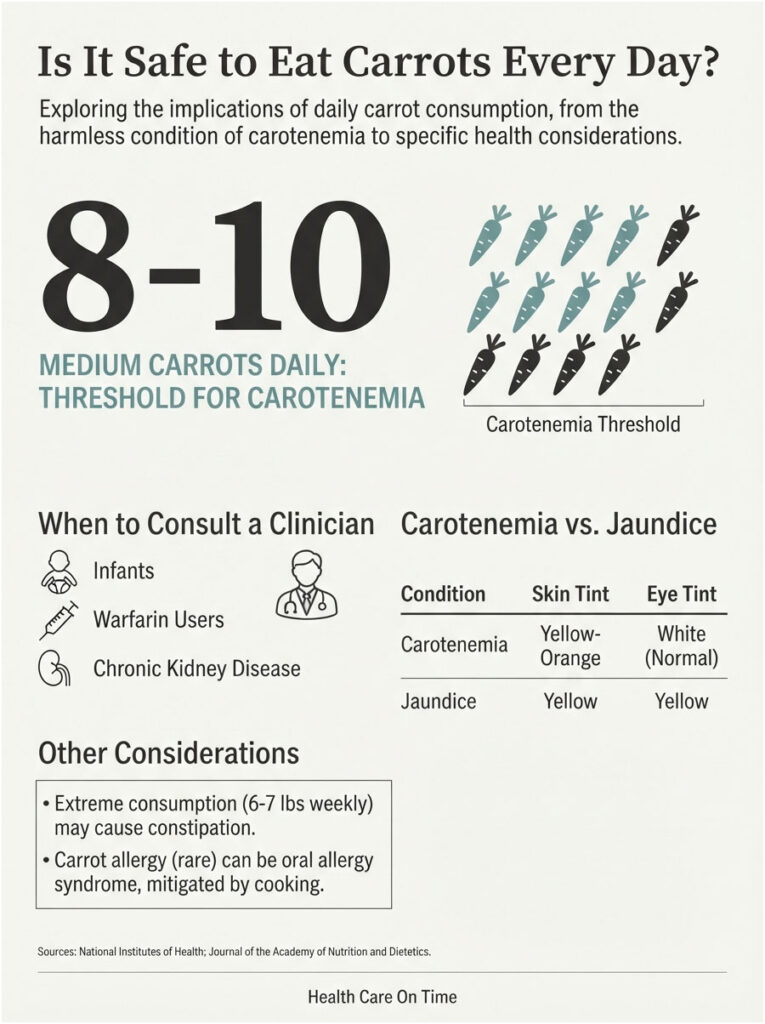
Carotenemia, the orange-palms effect
Carotenemia is a harmless yellow-orange tint caused by carotenoids depositing in fat-rich outer skin layers. It appears first on palms, soles, and the folds beside the nose.
StatPearls places the threshold at sustained intake above roughly 30 mg of beta-carotene daily. A medium carrot supplies about 4 to 5 mg, so the practical trigger is eight to ten carrots a day for several weeks.
Dermatologists at Cleveland Clinic describe the same range and note that conditions which slow beta-carotene conversion, including hypothyroidism, can bring the tint on at lower intakes.
It reverses on its own once intake drops, typically over several weeks.
How to tell it apart from jaundice
Carotenemia leaves the whites of the eyes white. Jaundice turns them yellow.
In cases reviewed across our diagnostic network, that single distinction resolves most of the alarm. If the sclerae are yellow, the question is liver or bile function rather than diet, and it warrants same-week evaluation.
Why this is not vitamin A toxicity
The tolerable upper intake level of 3,000 mcg for vitamin A applies to preformed retinol from supplements, liver, and fortified foods. It does not apply to provitamin A carotenoids from vegetables, per the NIH Office of Dietary Supplements.
The body regulates its own conversion of beta-carotene to retinol. Hypervitaminosis A from eating carrots is not a documented outcome.
Who should check with a clinician first
Infants introduced to large volumes of pureed carrot or squash develop visible carotenemia readily because of body size. It is cosmetic, but worth mentioning to a pediatrician.
Readers taking warfarin should keep vitamin K intake steady rather than low, and carrots contribute 13.2 mcg per 100 grams. Readers with advanced chronic kidney disease and potassium limits should count the 320 mg per 100 grams.
Extreme intakes, in the range of six to seven pounds weekly, have been linked in case reports to constipation and elevated liver enzymes. That is not a normal eating pattern, and it is not what three carrots a day looks like.
Carrot allergy and oral allergy syndrome
Carrot allergy is uncommon but real. It appears most often as oral allergy syndrome in people sensitized to birch pollen or mugwort, producing itching or tingling in the mouth after raw carrots.
Cooking often eliminates the reaction, since the responsible proteins are heat-sensitive. Any swelling, hives, or breathing difficulty needs medical evaluation rather than experimentation.
What Americans Actually Eat
Carrot intake in the United States runs well below what the recommendations assume, and the gap has a documented shape.
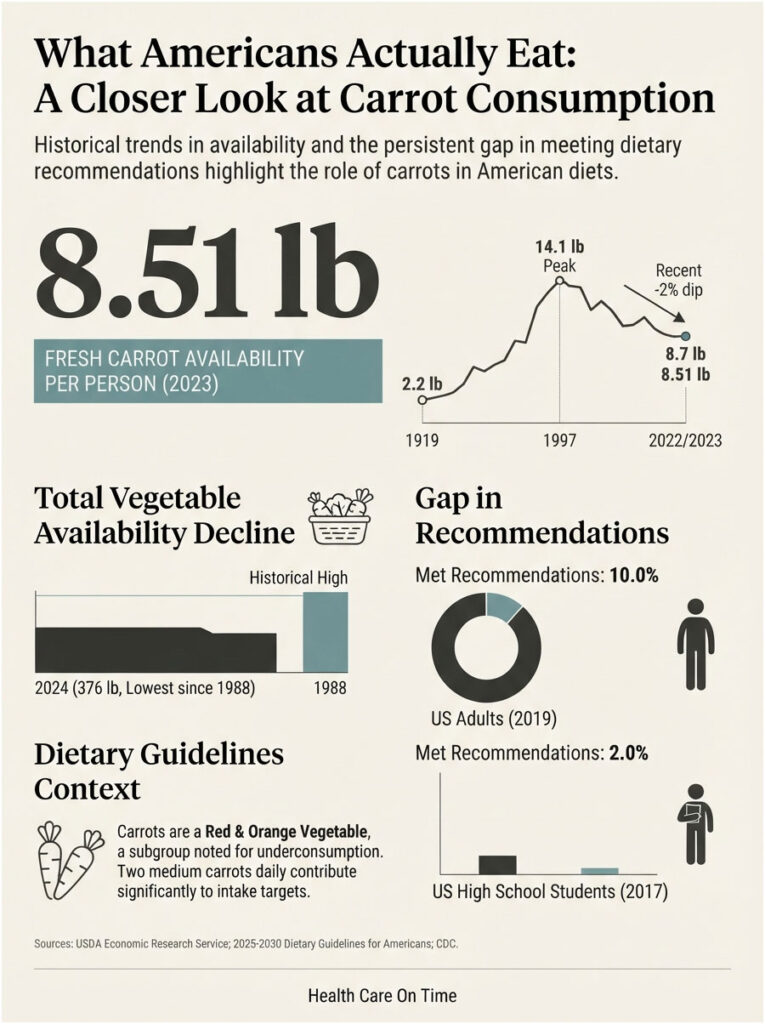
| Metric | Figure | Period | Source |
| Fresh carrot availability per person | 8.51 lb (down 2% from 2022, up 18% from 2018) | 2023 | USDA Economic Research Service |
| Peak fresh carrot availability | 14.1 lb | 1997 | USDA Economic Research Service |
| Fresh carrot availability, historical baseline | 2.2 lb | 1919 | USDA Economic Research Service |
| Total vegetable and pulse availability per person | 376 lb, lowest since 1988 | 2024 | USDA ERS, Vegetables and Pulses Outlook |
| US adults meeting federal vegetable recommendations | 10.0% (range 5.6% Kentucky to 16.0% Vermont) | 2019 BRFSS | CDC, MMWR |
| US high school students meeting vegetable recommendations | 2.0% | 2017 YRBS | CDC, MMWR |
The fresh-cut carrot effect
Availability climbed through the twentieth century and spiked to 14.1 pounds per person in 1997, during the rollout of bagged, cut-and-peeled products, according to USDA ERS.
It then fell for a decade, partly because lighter pre-packaged pieces replaced heavy whole carrots in shopping carts, and partly because processing efficiency cut packinghouse waste. The trend reversed after 2009 and has held near 8 to 9 pounds since.
The gap between availability and intake
Availability is a supply measure. It counts what moved through the system before household spoilage, plate waste, and the bag that went soft in the crisper drawer.
Actual intake runs far lower. Only 10.0 percent of adults met federal vegetable recommendations in the 2019 CDC BRFSS analysis, and the figure for high school students in the 2017 survey was 2.0 percent.
Where carrots sit in the current Dietary Guidelines
USDA and HHS released the 2025 to 2030 Dietary Guidelines for Americans on January 7, 2026, emphasizing whole foods and reduced intake of highly processed products.
Carrots satisfy the red and orange vegetable subgroup, among the categories the US population most consistently underconsumes across every age group. Two medium carrots daily covers a meaningful share of that target for 50 calories.
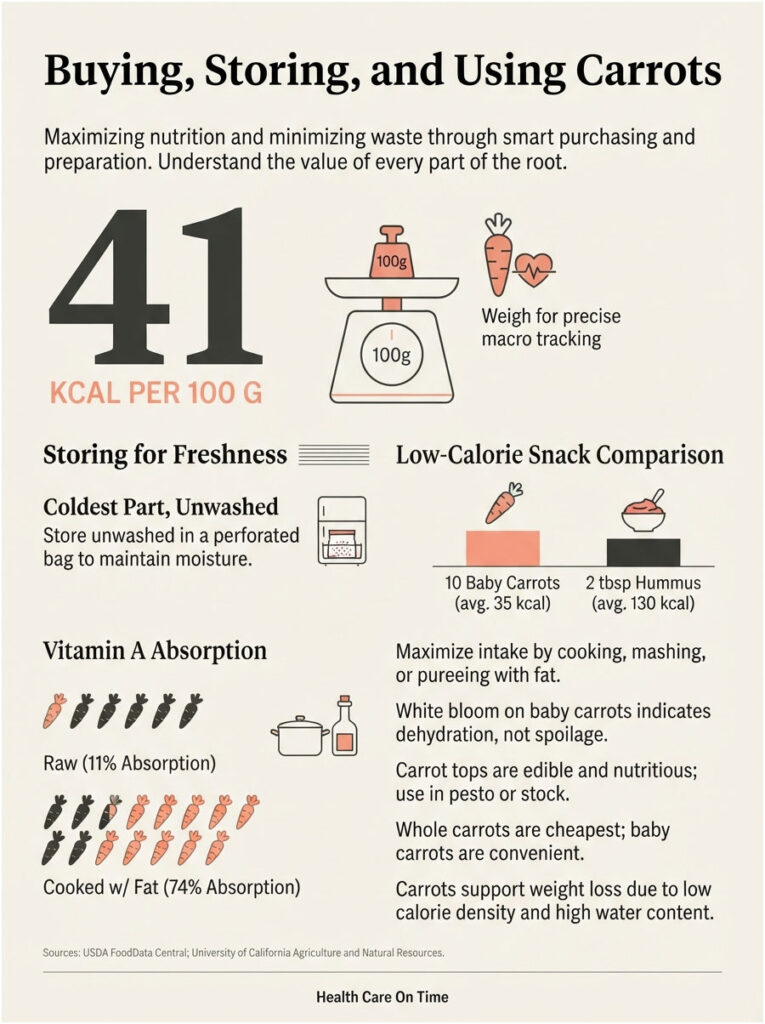
Buying, Storing, and Using Carrots
Our medical reviewers put together the quick-reference below for readers who want the decision rather than the discussion.
| If your goal is… | Then do this | Why it works |
| Maximum vitamin A absorption | Cook, mash, or puree with 1 tsp of oil or another fat | Absorption rises from roughly 11% raw to about 74% stir-fried; beta-carotene requires fat to cross the gut wall |
| Lowest-calorie snack | 10 baby carrots plain, or with 2 tbsp hummus | 35 calories alone, 105 with hummus, versus 165 with 2 tbsp ranch |
| Precise macro tracking | Weigh in grams, log against 41 kcal per 100 g | Removes the small, medium, large ambiguity causing 5 to 10 calorie drift per serving |
| A kids’ lunchbox that gets eaten | Baby carrots plus a yogurt-based dip | The fat carrier improves carotenoid uptake and raises the odds the vegetable is finished |
| A low-sodium diet | Fresh or frozen, or canned labeled no salt added | Fresh carries 69 mg per 100 g naturally; regular canned adds several hundred |
| Steady blood glucose | Whole carrots over juice, paired with protein or fat | Pectin fiber slows absorption; juicing removes roughly 70% of the fiber |
| More fiber per calorie | 1.5 cups chopped, or boiled rather than raw | Boiled reaches 3.0 g per 100 g versus 2.8 g raw, and roasted can reach 3.8 g |
Whole versus baby versus shredded, on price and nutrition
Whole carrots are consistently cheapest per pound and store longest. Baby carrots cost more per pound and dehydrate faster once the bag is open. Pre-shredded carrots have the shortest window, since cutting exposes surface area to oxidation.
Nutritional differences are small. Convenience is what changes behavior, and a bag of baby carrots that gets eaten beats a whole carrot that does not.
Storage that protects the pigment
Keep carrots in the coldest part of the refrigerator, unwashed, in a perforated bag. Remove green tops before storing, since they pull moisture out of the root.
Light and warmth degrade carotenoids slowly. A carrot that has gone limp has lost water, not vitamin A, and it is perfectly good for cooking.
The white bloom on baby carrots
That white film is surface dehydration on the cut face, not chlorine residue or mold. A rinse restores the look, and the carrot is safe either way.
Carrot tops are edible
The greens are edible and carry their own nutrients, closer in profile to parsley than to the root. They work in pesto, stock, and chimichurri.
They taste bitter raw and in quantity, so treat them as an herb rather than a salad green.
Frequently Asked Questions
How many calories are in one medium raw carrot?
A medium raw carrot weighing 61 grams has 25 calories, with 5.8 grams of carbohydrate, 1.7 grams of fiber, and 2.9 grams of natural sugar. It also delivers 509 mcg RAE of vitamin A, which is 57 percent of the Daily Value, per USDA FoodData Central.
How many calories are in 10 baby carrots?
Ten baby carrots weigh roughly 100 grams and come to about 35 calories. That handful carries 8.2 grams of carbohydrate, 2.9 grams of fiber, and 690 mcg RAE of vitamin A, covering 77 percent of the Daily Value. Each individual baby carrot averages 4 calories.
How many calories are in a cup of chopped carrots?
One cup of chopped raw carrot weighs 128 grams and has 52 calories. It supplies 12.3 grams of carbohydrate, 3.6 grams of fiber, 410 mg of potassium, and 119 percent of the vitamin A Daily Value. A cup grated weighs less at 110 grams and comes to 45 calories.
Do cooked carrots have more calories than raw?
Boiled carrots are 35 calories per 100 grams versus 41 raw, so plain cooking slightly lowers the count by weight. What adds calories is the cooking fat. One tablespoon of oil or butter adds 100 to 120 calories to the pan, independent of the carrots.
How much sugar is in one carrot?
A medium carrot contains about 2.9 grams of natural sugar, mostly sucrose. Per 100 grams, raw carrots hold 4.74 grams. That is under a teaspoon per carrot, and it arrives packaged with fiber that slows absorption rather than as free sugar.
Are carrots good for weight loss?
Carrots support a deficit through low calorie density, at 0.41 calories per gram, and high water content near 88 percent. A full pound is only 186 calories. The variable that undoes this is what goes on them, since two tablespoons of ranch outweigh two carrots by more than double.
Do carrots raise blood sugar?
Not meaningfully. Carrots test low on the glycemic index, between 16 and 41 across studies, with a glycemic load near 2 or 3 per cup. Reaching a 50-gram carbohydrate load would require roughly five cups. Carrot juice warrants more caution, since the fiber has been removed.
How many carrots equal one cup of vegetables?
Under USDA MyPlate rules, two medium carrots or about twelve baby carrots equals one cup-equivalent of vegetables. Adults are advised to eat 2 to 3 cups daily. Carrots also fill the red and orange vegetable subgroup, which most Americans consistently underconsume.
How many carrots can you eat in a day?
There is no calorie-based limit. Sustained intake above roughly 30 mg of beta-carotene daily can produce carotenemia, a harmless orange skin tint. At 4 to 5 mg per medium carrot, that means eight to ten carrots daily for several weeks. Three or four a day poses no issue.
Are baby carrots as nutritious as full-size carrots?
Close, with small differences. Baby carrots run 35 calories per 100 grams versus 41, and 690 mcg RAE of vitamin A versus 835. Fiber is nearly identical at 2.9 grams versus 2.8. Trimming and peeling explains most of the gap, not immaturity.
Is carrot juice as good as whole carrots?
It depends on the goal. Juice raises beta-carotene absorption substantially, with plasma levels more than double those from raw carrots in a 2025 crossover trial. It also strips fiber from 2.8 grams to 0.8 grams per 100 grams and concentrates calories to 94 per cup.
Do carrots really improve your eyesight?
Partly. Vitamin A deficiency causes night blindness, and correcting it with carotenoid-rich foods restores function. Carrots will not sharpen already-normal vision or reverse refractive error. Their lutein content does support retinal tissue, which is a different and more modest claim.
Medical Disclaimer: This article is for general education and does not replace individualized medical or dietary advice. Nutrient values vary by carrot variety, growing conditions, season, and preparation method. Readers taking warfarin should keep vitamin K intake consistent rather than restricted and coordinate any dietary change with the prescribing clinician. Readers with chronic kidney disease and potassium limits, or with diabetes adjusting carbohydrate targets, should confirm portions with their care team. Yellow discoloration involving the whites of the eyes is not carotenemia and warrants prompt medical evaluation.
References
- USDA FoodData Central, Carrots, raw (FDC 170393)
- USDA FoodData Central, Carrots, cooked, boiled, drained, without salt (FDC 170394)
- USDA FoodData Central, Carrots, baby, raw (FDC 168568)
- USDA Economic Research Service, Vegetables and Pulses
- USDA ERS, Rising consumption of carrots over the past century influenced by fresh-cut technology
- USDA ERS, Vegetables and Pulses Outlook (VGS-375)
- CDC, Adults Meeting Fruit and Vegetable Intake Recommendations, MMWR
- CDC, Percentage of Adolescents Meeting Federal Fruit and Vegetable Intake Recommendations, MMWR
- NIH Office of Dietary Supplements, Vitamin A and Carotenoids
- British Journal of Nutrition, The effect of food preparation on the bioavailability of carotenoids from carrots using intrinsic labelling
- European Journal of Nutrition, Beta-carotene bioavailability from differently processed carrot meals in human ileostomy volunteers
- Nutrition Research and Practice, Comparative bioavailability of beta-carotene from raw carrots and fresh carrot juice in humans
- StatPearls, Carotenemia
- Cleveland Clinic, Carotenemia: What It Is, Causes and Treatments
- University of Sydney Glycemic Index, Food for Thought on carrots
- Dietary Guidelines for Americans, 2025 to 2030