Most people grab Mucinex to make a cough stop. That instinct is backward. The medicine is built to do the opposite of silencing a cough, and that one misunderstanding is why so many half-used bottles sit in American medicine cabinets while the cough drags on.
Table of Contents
Quick Answer
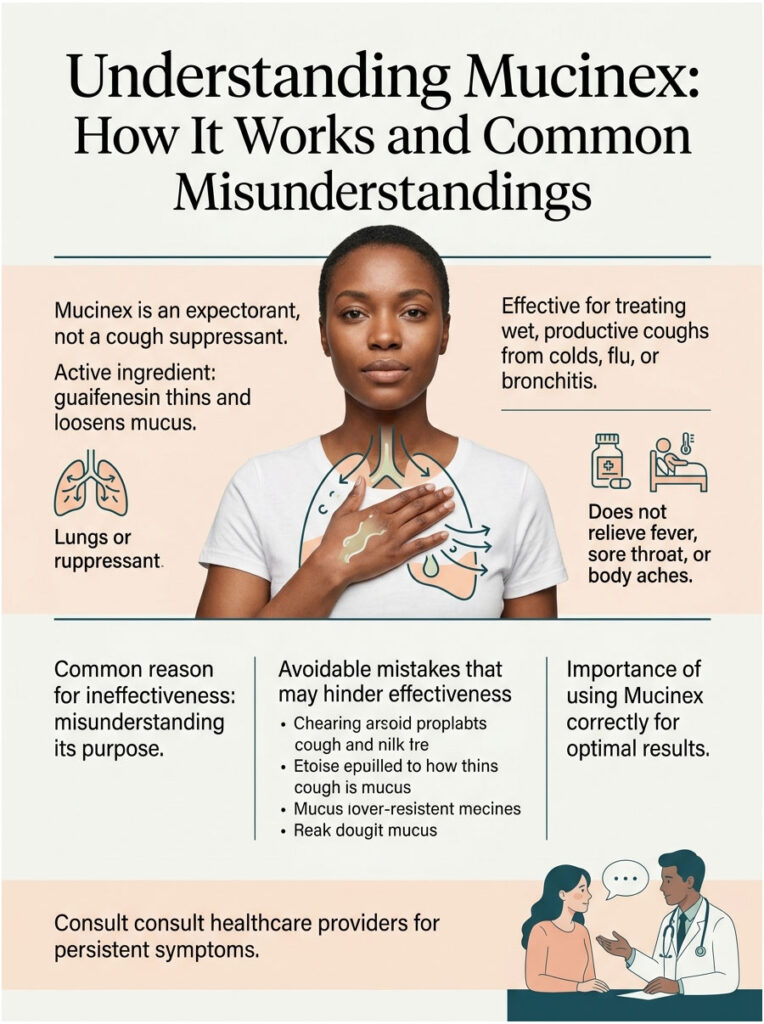
Mucinex is an over-the-counter expectorant. Its active ingredient, guaifenesin, thins and loosens thick mucus in the chest so coughs clear it out more easily. It treats wet, productive chest congestion from colds, flu, or bronchitis. It does not suppress coughing, fight infection, or relieve fever, sore throat, or body aches.
At a Glance
- Mucinex works by loosening mucus, not by stopping a cough.
- It helps a wet, phlegmy cough and does little for a dry, tickly one.
- Drinking water is part of the dose, not an optional extra.
- “Mucinex” is a whole product family, and the formulas are not interchangeable.
- The adult guaifenesin ceiling is 2,400 mg in 24 hours, easy to exceed by accident.
- A cough lasting more than seven days, or one with fever or rash, needs a doctor.
If you have ever wondered why your Mucinex is not working, the answer is usually one of seven avoidable mistakes. This guide walks through what the medicine actually does, then fixes each error in plain language.
What Mucinex Actually Is (And What It Is Not)
Mucinex is a brand name, not a single drug. Behind every standard Mucinex product sits one workhorse ingredient: guaifenesin. Understanding that ingredient clears up most of the confusion.
The Active Ingredient Explained
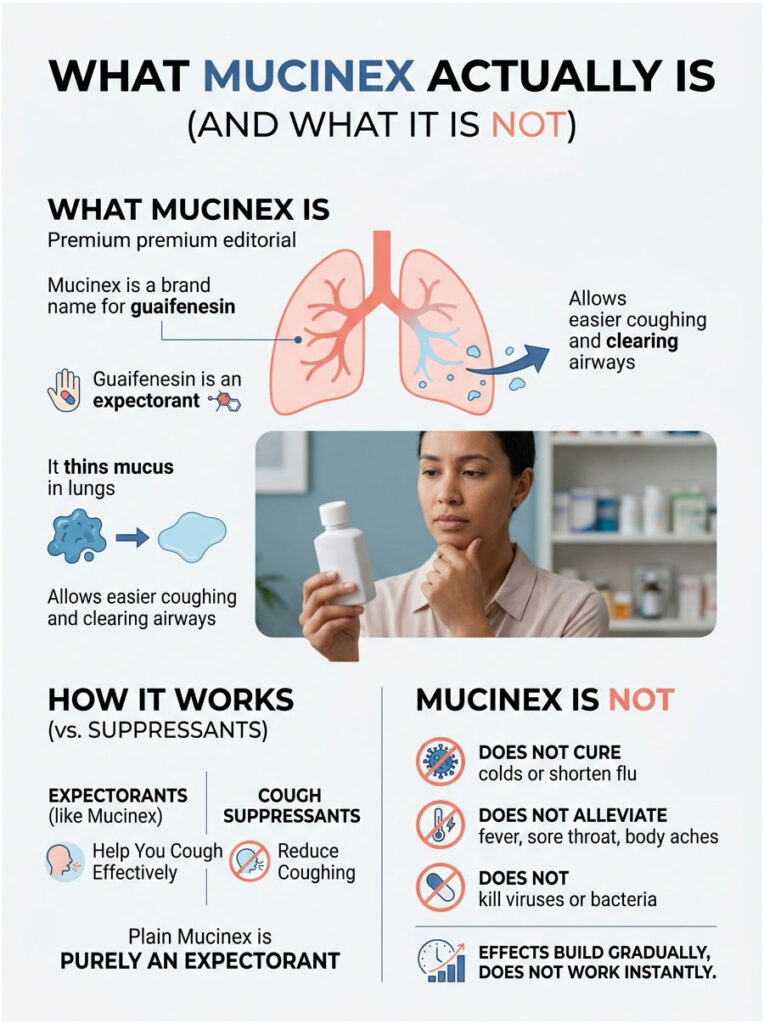
Guaifenesin belongs to a class of medicines called expectorants. According to Mayo Clinic, it works by thinning the mucus or phlegm in the lungs.
Thinner mucus is less sticky and easier to move. When you cough, your airways can finally push that loosened mucus up and out instead of straining against a thick, glue-like wall.
Patients booking respiratory checkups through HealthCareOnTime often describe the feeling as a cough that is “stuck.” That stuck sensation is exactly what guaifenesin targets.
Expectorant Versus Cough Suppressant
Here is the distinction that trips up the most people. An expectorant helps you cough more effectively. A cough suppressant helps you cough less.
Plain Mucinex is purely an expectorant. It will not quiet your cough. In fact, for a day or two it can make your cough feel slightly busier as your body starts clearing the loosened mucus.
A cough suppressant works differently. WebMD notes that dextromethorphan, the suppressant found in Mucinex DM, acts on signals in the brain that trigger the cough reflex. Plain Mucinex contains no such ingredient.
What Mucinex Does Not Treat
This is where expectations need a reset. Mucinex does not cure a cold, shorten the flu, or kill any virus or bacteria. The CDC emphasizes that most coughs and colds are viral and that over-the-counter products manage symptoms rather than cure the illness.
It does not reduce a fever. It does not soothe a sore throat or relieve body aches. Those jobs belong to other ingredients entirely, such as acetaminophen or a decongestant.
Mucinex also does not work instantly. Clinical labeling cited by Drugs.com reports that immediate-release guaifenesin reaches peak blood levels within roughly 45 minutes, and the mucus-thinning benefit builds gradually from there with adequate fluids.
Our medical reviewers note that when patients call a single product a “cold cure,” that mismatch alone explains much of the disappointment people feel with Mucinex.
The Mucinex Product Family: Why “Which One” Matters
Walk down a US pharmacy aisle and you will see a dozen boxes with the word Mucinex on them. They are not the same medicine in different colors. They contain different active ingredients aimed at different symptoms.
Plain Mucinex, DM, D, and Fast-Max
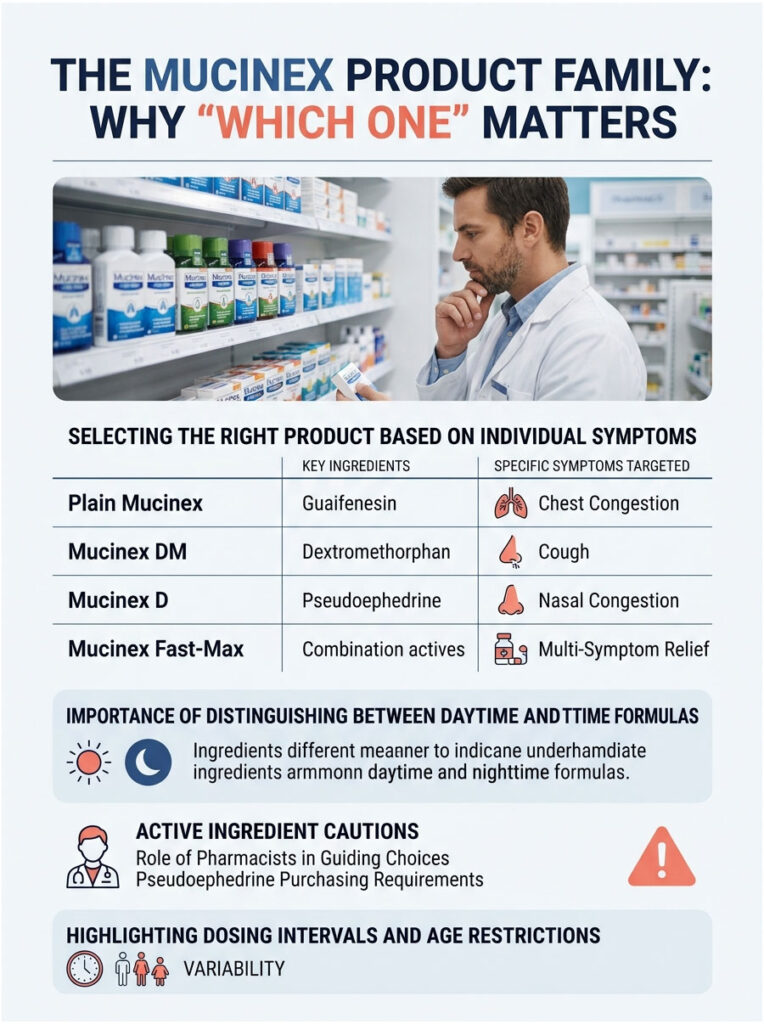
Standard Mucinex contains only guaifenesin. It is the right pick when your single biggest problem is thick chest mucus.
Mucinex DM adds dextromethorphan, a cough suppressant. As GoodRx explains, the “DM” formula loosens mucus and quiets the cough reflex at the same time, which suits a cough that disrupts sleep.
Mucinex D swaps in pseudoephedrine, a nasal decongestant. It targets chest congestion plus a stuffy, blocked nose. Because pseudoephedrine can be misused, GoodRx notes that Mucinex D is kept behind the pharmacy counter and requires a photo ID to purchase.
Multi-symptom products like Mucinex Fast-Max stack several ingredients together, often including acetaminophen for fever and aches. More ingredients means more chances for overlap with whatever else you are taking.
Daytime Versus Nighttime Formulas
Mucinex also splits products into day and night versions. Nighttime formulas frequently add a sedating ingredient, while daytime ones avoid it.
Pharmacists in our diagnostic network point out a simple rule: read the active-ingredient panel, not the marketing on the front. Two boxes that look nearly identical can behave very differently in your body.
Table 1: Mucinex Product Comparison
| Product | Active Ingredient(s) | Best For | Dosing Interval | Key Caution |
| Mucinex (Maximum Strength ER) | Guaifenesin only | Thick chest mucus, wet cough | Every 12 hours | Swallow whole, never crush |
| Mucinex DM | Guaifenesin + dextromethorphan | Wet or dry cough disrupting sleep | Every 12 hours (ER) | May cause drowsiness or dizziness |
| Mucinex D | Guaifenesin + pseudoephedrine | Chest congestion plus stuffy nose | Every 12 hours | Can raise blood pressure; photo ID required |
| Mucinex Fast-Max Cold & Flu | Guaifenesin + acetaminophen + others | Several cold and flu symptoms at once | Every 4 hours | Watch acetaminophen totals from all sources |
| Children’s Mucinex (Mini-Melts, etc.) | Guaifenesin (some add dextromethorphan) | Wet cough in eligible children | Per label, age-dependent | Not for children under age 4 |
In questions sent to our medical team, “which Mucinex should I buy” is one of the most frequent. The honest answer is that it depends entirely on which symptoms you actually have.
7 Common Mistakes Most People Make With Mucinex
Mucinex is one of the most-used OTC medicines in American homes. It is also one of the most misused. Before the detail, here is the quick list:
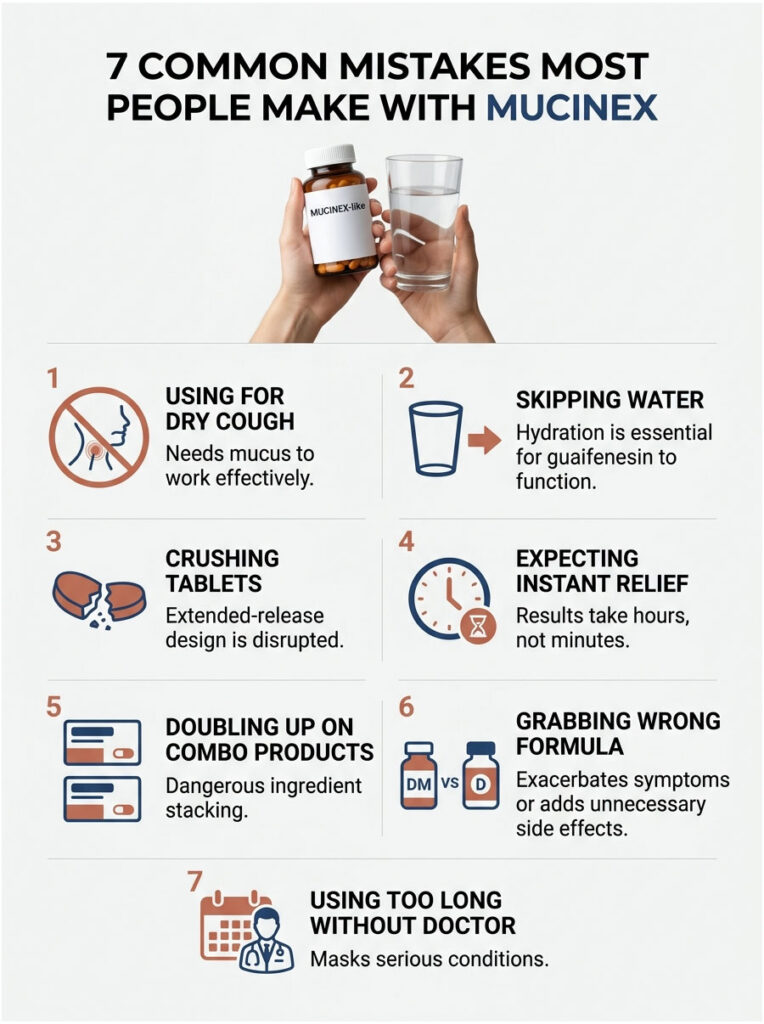
- Using it for a dry, non-productive cough
- Skipping water with the dose
- Crushing or splitting extended-release tablets
- Expecting instant relief
- Doubling up on combination products
- Grabbing the wrong formula for the symptom
- Using it too long without seeing a doctor
Now the fix for each one.
Mistake 1: Using It for a Dry, Non-Productive Cough
This is the big one. People reach for Mucinex to calm a dry, hacking cough, then conclude the medicine “does not work.”
Guaifenesin needs mucus to act on. If your cough is dry and tickly with no phlegm, an expectorant has nothing to thin. A wet, rattly cough is its proper target.
For a stubbornly dry cough, a product with a suppressant, such as Mucinex DM, tends to be the better match. Matching the cough type to the formula is half the battle.
Mistake 2: Skipping Water
Guaifenesin does not work in a vacuum. It pulls more water into your airway secretions, and it needs available fluid to do that.
Mayo Clinic advises drinking plenty of water while taking guaifenesin to help loosen mucus in the lungs. Take the tablet with a full glass, and keep sipping through the day.
Our lab partners frequently see how easily a sick person slides into mild dehydration. A dehydrated body gives guaifenesin almost nothing to work with, and the medicine underperforms.
Mistake 3: Crushing or Splitting Extended-Release Tablets
Extended-release Mucinex is a bilayer tablet engineered to release the drug slowly over 12 hours. Crushing, chewing, or splitting it destroys that design.
Drugs.com is direct about this: do not crush, chew, or break the extended-release tablet. Swallow it whole with a full glass of water.
Break it apart and you release a 12-hour dose all at once, which raises the odds of nausea, stomach upset, and dizziness. If swallowing pills is hard, ask a pharmacist about a liquid or granule form instead.
Mistake 4: Expecting Instant Relief
Mucinex is not a fast-acting painkiller. The guaifenesin reaches its peak in the blood within roughly 45 minutes, but the felt benefit, looser and easier-to-clear mucus, builds over hours.
People who expect a dramatic change in 15 minutes often take a second dose too soon. That does not speed things up. It only pushes you toward the daily ceiling faster.
Give the medicine time, pair it with fluids, and judge results over a day, not over a coffee break.
Mistake 5: Doubling Up on Combination Products
This mistake can be genuinely dangerous. Guaifenesin hides inside dozens of multi-symptom cold and flu products.
Take a Mucinex product and a separate nighttime cold medicine, and you may be stacking the same ingredients without realizing it. WebMD warns that many combination cold products contain guaifenesin and urges checking every label.
The risk grows with combination formulas. A Fast-Max product carrying acetaminophen, taken alongside a separate pain reliever, can quietly push acetaminophen into a harmful range. Our medical reviewers consider label-stacking one of the most underrated home-medicine hazards.
Mistake 6: Grabbing the Wrong Formula for the Symptom
Buying Mucinex D when you only have chest mucus means taking a decongestant your body did not need, one that can nudge up blood pressure.
Buying plain Mucinex when your real complaint is a blocked nose means missing the ingredient that would actually help. The “simpler is better” rule applies: choose the product whose ingredients match your symptoms, and nothing extra.
Across the patients our diagnostic network serves, mismatched formula choice is a quiet but common reason an OTC medicine seems to fail.
Mistake 7: Using It Too Long Without Seeing a Doctor
Mucinex is built for short-term, temporary relief. It is not a medicine to take week after week while a cough lingers.
WebMD advises stopping guaifenesin and contacting a provider if a cough lasts longer than seven days, keeps returning, or comes with a fever, rash, or persistent headache. Those can signal a more serious illness.
A cough that refuses to quit deserves a proper evaluation, not another OTC bottle.
Table 2: Guaifenesin Dosing and Safety Data (USA Labeling)
| Formulation | Typical Adult Dose | Frequency | Max Per 24 Hours | Minimum Age | Source |
| Immediate-release tablet / liquid | 200 to 400 mg | Every 4 hours as needed | 2,400 mg | 12 years | WebMD / Drugs.com |
| Extended-release tablet (Mucinex) | 600 to 1,200 mg | Every 12 hours | 2,400 mg | 12 years (ER) | Drugs.com |
| Children 6 to 11 years | 100 to 200 mg | Every 4 hours | 1,200 mg | 6 years | WebMD |
| Children 2 to 5 years | 50 to 100 mg | Every 4 hours | 600 mg | Provider-directed | WebMD |
| Any OTC cough/cold product | Not applicable | Not applicable | Not applicable | 4 years | Mayo Clinic |
That 2,400 mg daily ceiling matters most when guaifenesin is coming from more than one product. Add up every source before you dose.
How to Use Mucinex Correctly, Step by Step
Used the right way, Mucinex is a reliable tool for chest congestion. Three habits separate a useful dose from a wasted one.
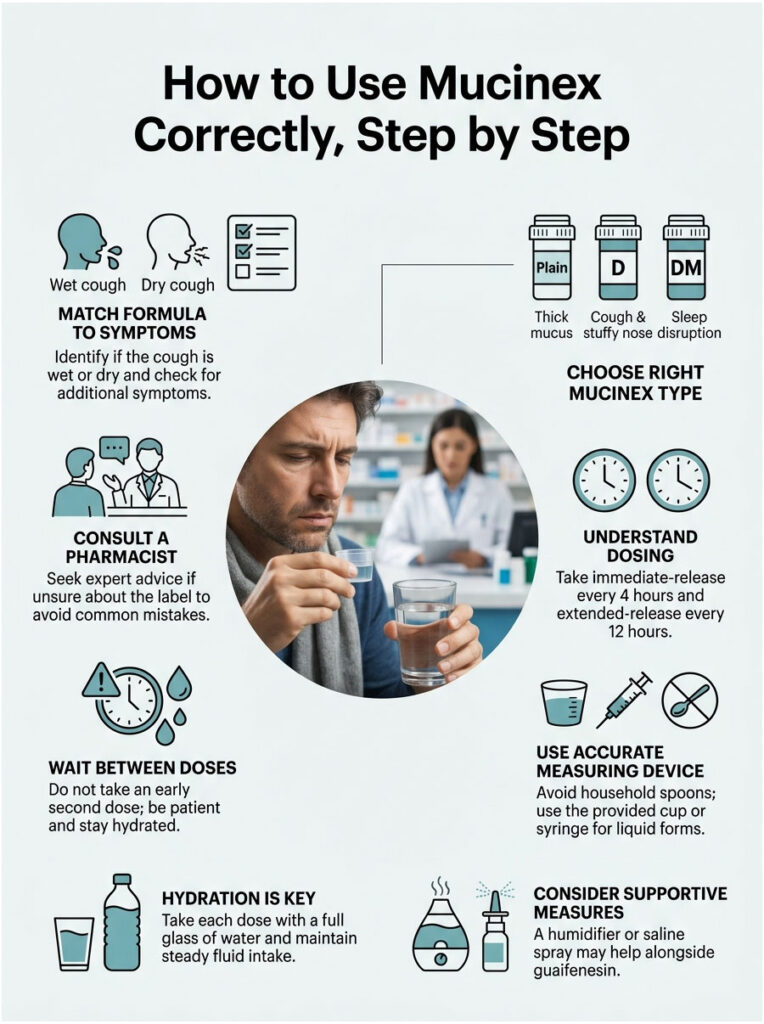
Match the Formula to Your Symptoms
Start with an honest symptom check. Is your cough wet or dry? Is your nose blocked? Do you also have fever or aches?
Thick chest mucus alone points to plain Mucinex. A cough plus a stuffy nose points to Mucinex D. A cough wrecking your sleep points to Mucinex DM. Several symptoms at once may justify a multi-symptom product, with a careful look at every active ingredient.
When the label confuses you, a pharmacist is a free and expert resource. Asking takes two minutes and prevents most of the seven mistakes above.
Dose and Time It Correctly
Immediate-release guaifenesin is taken every four hours as needed. Extended-release Mucinex is taken every 12 hours. Mixing those schedules up leads to either underdosing or overdosing.
Wait the full interval between doses. If one dose feels weak, the answer is not an early second dose. It is patience plus water, or a conversation with a healthcare professional.
Liquid forms need an accurate measuring device. WebMD cautions that a household spoon is not accurate and can deliver the wrong dose. Use the cup or syringe supplied with the product.
Follow the Hydration Rule
Treat water as part of the prescription. Take each dose with a full glass, and keep fluids steady through the day.
Hydration does two jobs at once. It gives guaifenesin the water it needs to thin mucus, and it lowers the chance of the dehydration-linked dizziness and headache that can follow OTC cough medicines.
Patients commonly ask us whether a humidifier or saline spray helps too. Healio lists both as reasonable supportive measures alongside guaifenesin, and our medical reviewers agree they pair well with it.
Lesser-Known and Off-Label Uses
Mucinex has one well-known job, clearing chest mucus, and one surprising one that draws steady curiosity.
The Fertility Question
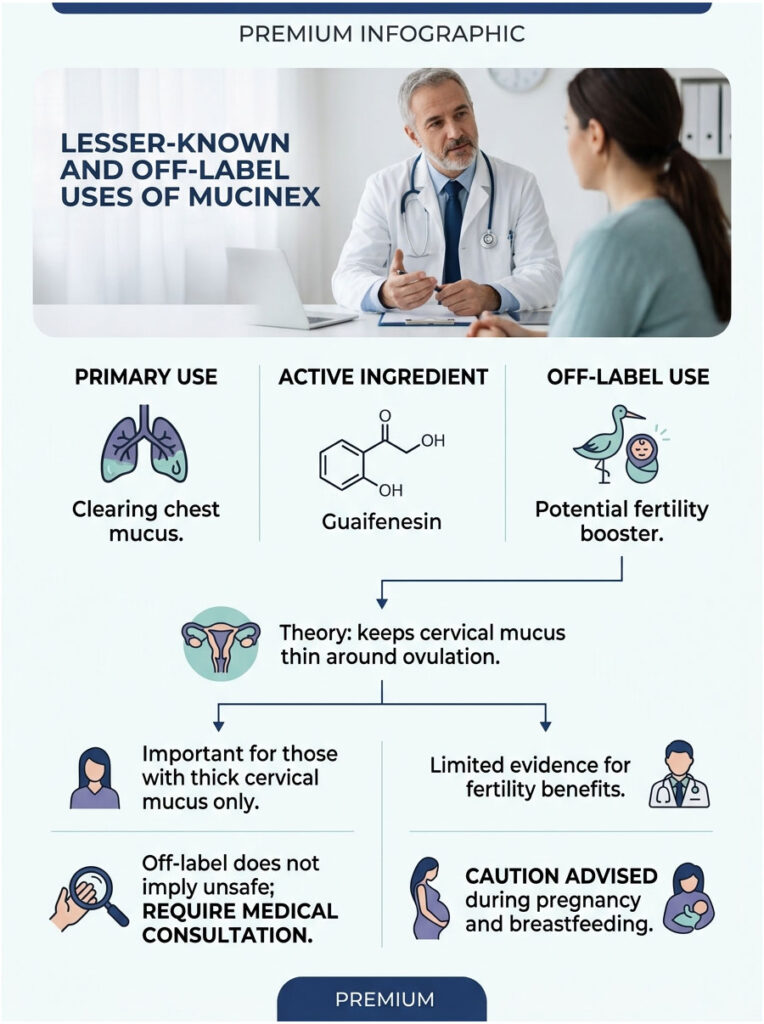
Some people take guaifenesin hoping to boost fertility. The theory has a basis. Drugs.com notes that guaifenesin may help keep cervical mucus thin around ovulation, which can help sperm travel more freely.
This is an off-label use, meaning it is not an FDA-approved purpose for the drug. Evidence is limited, and the people most likely to see any benefit are those whose only fertility barrier is unusually thick cervical mucus.
Off-Label Use Still Needs a Doctor
Off-label does not mean unsafe, but it does mean the use has not been studied to the depth of an approved one. Anyone considering guaifenesin for fertility should treat it as a decision to make with a doctor, not a self-experiment, since dosing, timing, and individual risk all need professional input.
The same caution applies to taking it during pregnancy or breastfeeding. Drugs.com states it is not known whether guaifenesin can harm an unborn baby or pass into breast milk, so a provider should weigh in before use.
Side Effects and Safety: What to Watch For
Mucinex is generally well tolerated. Many people take it with no side effects at all. Still, knowing the range of possible reactions helps you use it safely.
Common, Mild Reactions
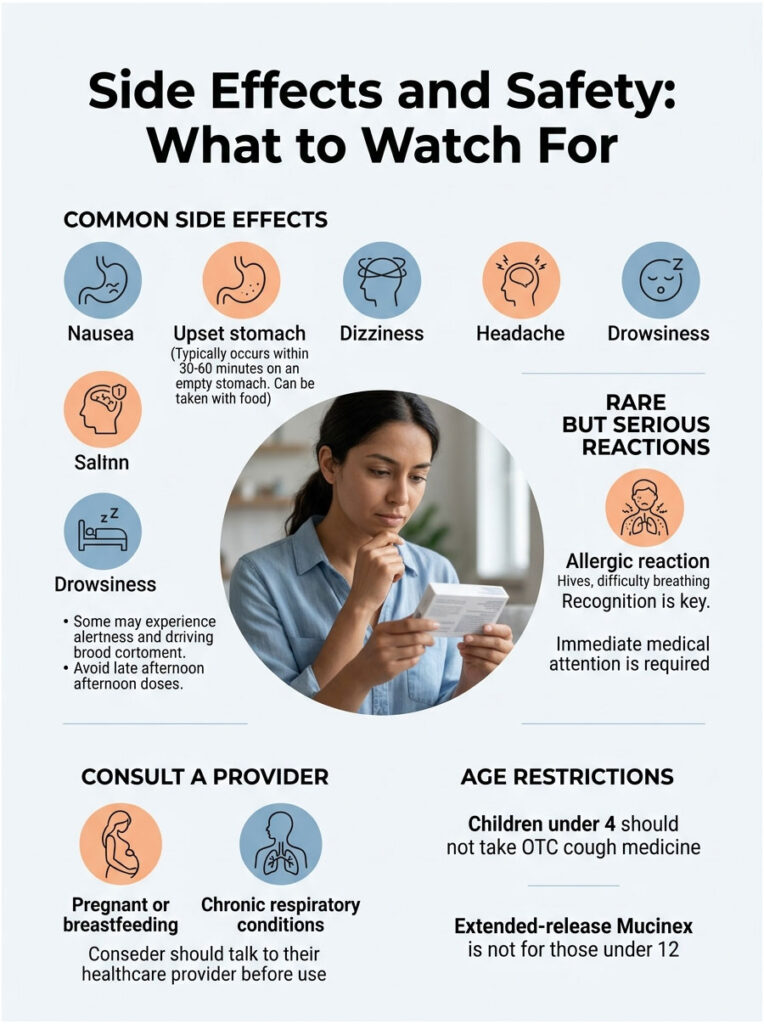
The most common side effects are mild and short-lived. They include nausea, an upset stomach, dizziness, headache, and sometimes drowsiness or trouble sleeping.
Stomach upset tends to appear within 30 to 60 minutes, especially on an empty stomach. Drugs.com notes that Mucinex can be taken with food if it bothers your stomach.
A few people find guaifenesin keeps them slightly alert. If that happens to you, avoid a dose late in the afternoon.
Rare but Serious Reactions
Serious reactions are uncommon but worth recognizing fast. A severe allergic reaction is the main concern.
Drugs.com advises getting emergency help for signs of an allergic reaction such as hives, difficulty breathing, or swelling of the face, lips, tongue, or throat. These need immediate medical attention.
Stop the medicine right away if any of these appear. Do not wait to see if they pass.
Who Should Check With a Provider First
Some groups should talk to a doctor or pharmacist before starting Mucinex. That includes people who are pregnant or breastfeeding.
It also includes anyone with a chronic cough from asthma, COPD, emphysema, or smoking, and anyone with kidney or liver disease. Mayo Clinic notes that a chronic cough may need a different kind of medicine altogether.
Children are a special case. No OTC cough or cold medicine should be given to a child under age 4, and extended-release Mucinex is generally not for children under 12.
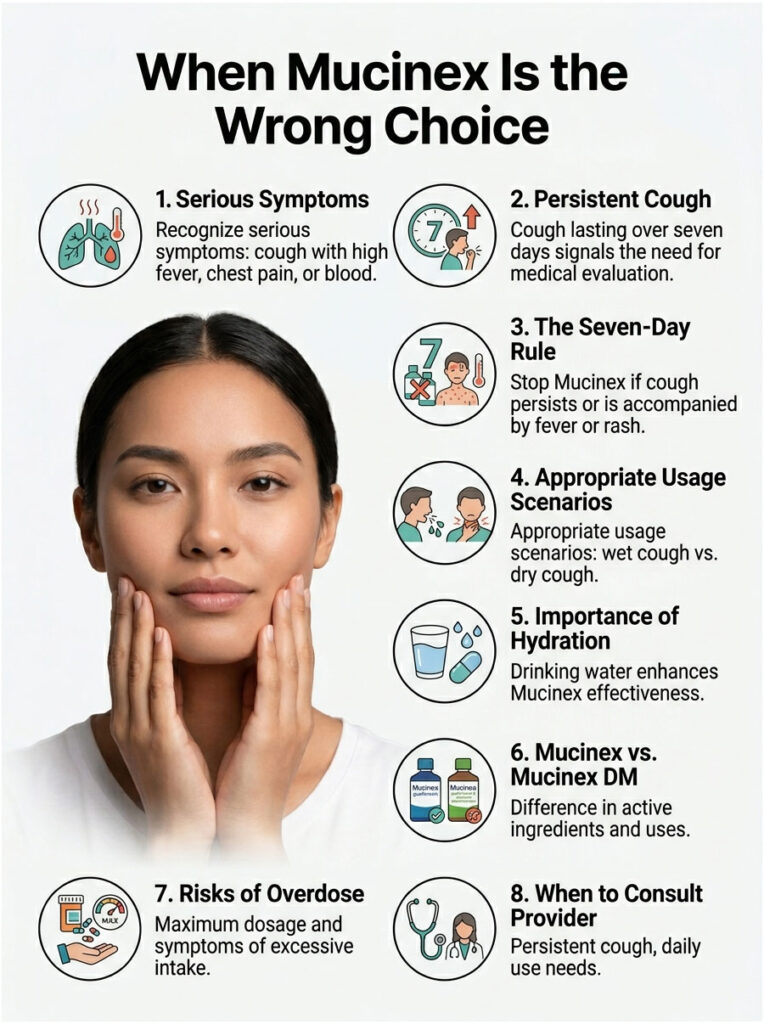
When Mucinex Is the Wrong Choice
Sometimes the smartest move is to put the Mucinex box down. Certain situations call for a different medicine or a doctor’s visit instead.
Symptoms That Signal Something More Serious
A cough is usually minor. But a cough paired with high fever, chest pain, shortness of breath, or coughing up blood is not a job for an expectorant.
A cough that has lasted for weeks, rather than days, also points away from OTC self-treatment. So does a cough that keeps returning after seeming to clear.
The Seven-Day Rule
Drug labeling for guaifenesin sets a clear boundary. If a cough lasts more than seven days, returns, or comes with a fever, rash, or lasting headache, stop the medicine and see a healthcare provider.
Across patients our diagnostic network serves, a respiratory checkup or relevant lab work often pinpoints what an OTC medicine never could. Listening to that seven-day signal is one of the most useful safety habits a person can build.
Table 3: When to Use Mucinex and When to Act Differently
| Scenario | Likely Issue | Recommended Action |
| Wet, phlegmy cough from a recent cold | Chest congestion | Plain Mucinex plus plenty of fluids is appropriate |
| Dry, tickly cough with no mucus | Non-productive cough | Choose a suppressant formula such as Mucinex DM, not plain Mucinex |
| Cough plus a fever above 100.4 F | Possible infection | Skip self-treatment; contact a healthcare provider |
| Cough lasting more than 7 days | Possible underlying condition | Stop the medicine and seek medical evaluation |
| Already taking a multi-symptom cold product | Risk of ingredient overlap | Check every label; do not stack guaifenesin or acetaminophen |
The pattern is simple. Mucinex fits short-term wet congestion. Anything longer, feverish, or unclear belongs in front of a clinician.
Frequently Asked Questions
Is Mucinex a cough suppressant or an expectorant?
Plain Mucinex is an expectorant. Its active ingredient, guaifenesin, thins mucus so coughs clear it more easily. It does not suppress coughing. Only the “DM” version adds dextromethorphan, a true cough suppressant that quiets the cough reflex in the brain.
Does Mucinex work for a dry cough?
Plain Mucinex works poorly for a dry cough. Guaifenesin needs mucus to thin, and a dry, non-productive cough has little or none. For a dry, irritating cough, a product containing dextromethorphan, such as Mucinex DM, is usually the better choice.
How long does Mucinex take to work?
Guaifenesin reaches its peak blood level within roughly 45 minutes, but the felt benefit builds gradually over hours as mucus loosens. Drinking enough water speeds and supports that effect. Judge results across a full day rather than expecting relief within minutes.
Can you take too much Mucinex?
Yes. The adult ceiling for guaifenesin is 2,400 mg in 24 hours. Exceeding it raises the risk of nausea, vomiting, and dizziness. The bigger danger is accidental stacking, since guaifenesin hides in many combination cold products, so add up every source.
Should you drink water with Mucinex?
Yes, water is part of how Mucinex works. Guaifenesin pulls fluid into airway mucus to thin it, so it needs available water to act. Mayo Clinic advises drinking plenty of fluids while taking guaifenesin. Skipping water is a common reason the medicine underperforms.
Can you crush or split Mucinex tablets?
No. Extended-release Mucinex tablets must be swallowed whole. Crushing, chewing, or splitting them releases a 12-hour dose all at once, increasing side effects like nausea and dizziness. If swallowing tablets is difficult, ask a pharmacist about liquid or granule forms instead.
What is the difference between Mucinex D and Mucinex DM?
Both contain guaifenesin. Mucinex D adds pseudoephedrine, a decongestant for a stuffy nose, and is sold behind the pharmacy counter. Mucinex DM adds dextromethorphan, a cough suppressant. Choose D for nasal congestion and DM to quiet a disruptive cough.
Is Mucinex a decongestant?
Plain Mucinex is not a decongestant. It is an expectorant that loosens chest mucus but does nothing for a blocked nose. Mucinex D is the version that includes a decongestant, pseudoephedrine, which narrows nasal blood vessels to ease a stuffy nose.
Can you take Mucinex with NyQuil?
Plain Mucinex and NyQuil can generally be taken together because they contain different ingredients, per Drugs.com. However, Mucinex DM and NyQuil should not be combined, since both contain dextromethorphan. Always check every label, and ask a pharmacist when unsure.
Can children take Mucinex?
Some Mucinex products are made for children, but age limits are strict. No OTC cough or cold medicine should be given to a child under age 4. Extended-release Mucinex is generally not for children under 12. Always follow the pediatric label or a provider’s advice.
Why is my Mucinex not working?
The usual reasons are a dry cough that has no mucus to thin, too little water, expecting instant results, or the wrong formula for your symptoms. Review those four points first. If a cough still persists beyond seven days, see a healthcare provider.
Can you take Mucinex every day?
Mucinex is designed for short-term, temporary relief, not daily long-term use. If you feel you need it every day, that signals an ongoing issue worth investigating. Stop after about seven days and consult a provider if the cough continues or returns.
Disclaimer
This article is for general informational purposes only and does not constitute medical advice. It is not a substitute for professional diagnosis or treatment. Always read the product label and consult a qualified healthcare provider or pharmacist before taking Mucinex or any medication, especially if you are pregnant, breastfeeding, managing a chronic condition, or giving medicine to a child.
References
- Mucinex Uses, Dosage & Side Effects — Drugs.com
- Guaifenesin (Mucinex, Robitussin, and others): Uses, Side Effects, Dosing — WebMD
- Guaifenesin (oral route) — Mayo Clinic
- Mucinex Patient Tips: 7 Things You Should Know — Drugs.com
- Mucinex D vs. Mucinex DM: Which Should You Take? — GoodRx
- Mucinex: Uses, Side Effects & Dosage — Healio
- Treatment of Respiratory Viruses — CDC