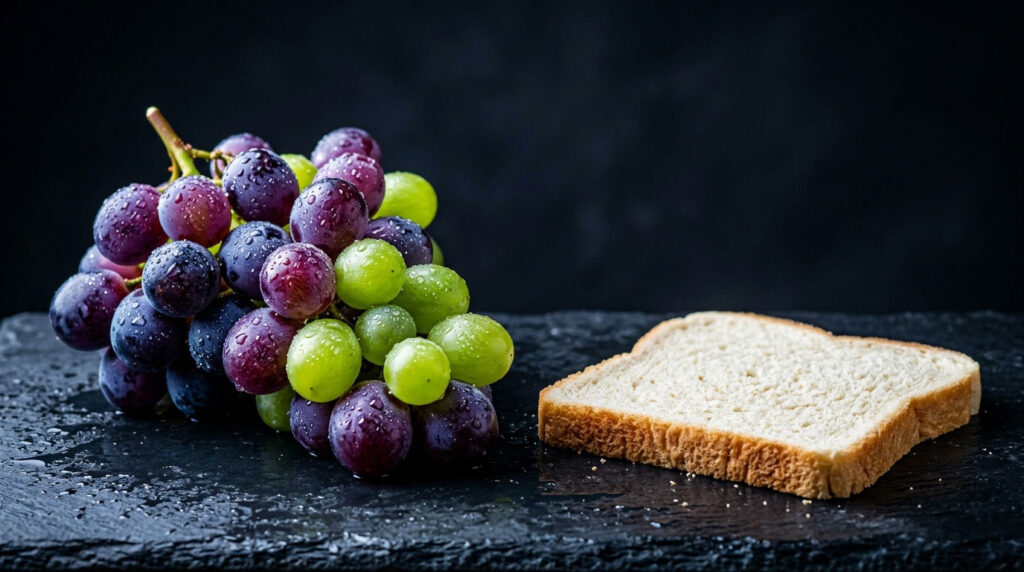
A handful of grapes tastes like nature’s candy, which is exactly why so many people with diabetes quietly cut them out. Here’s the part that surprises them: grapes score lower on the glycemic index than a slice of white bread. That one fact flips the whole question on its head.
Table of Contents
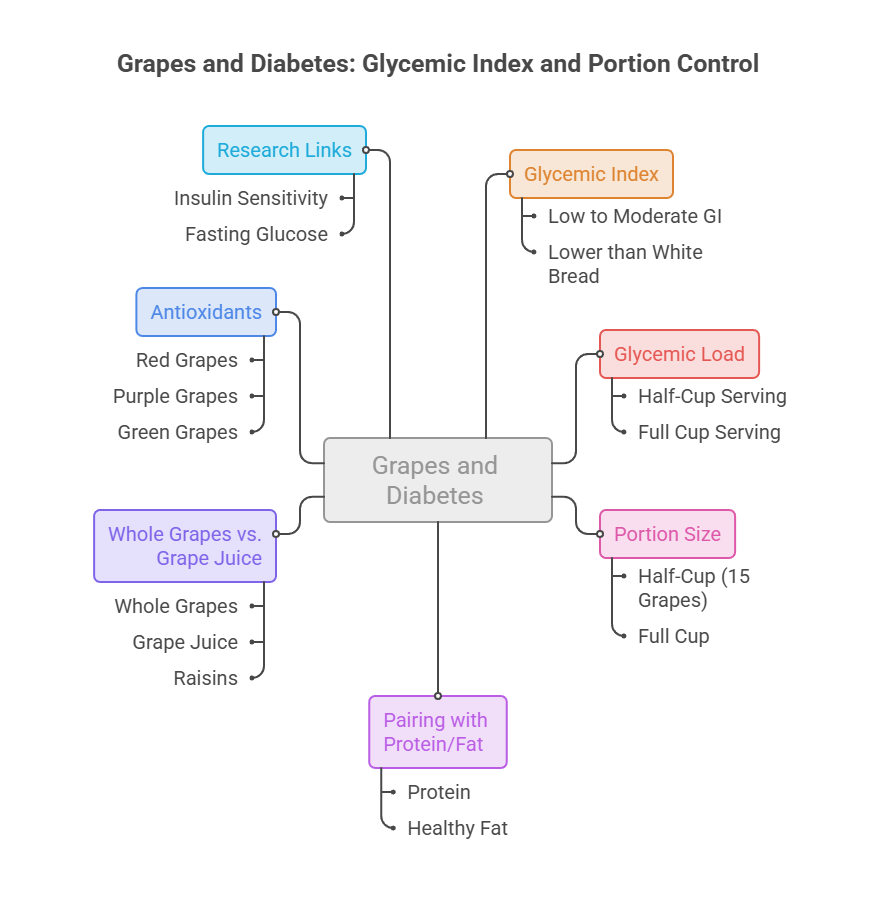
Quick Answer: Yes, people with diabetes can eat grapes. Grapes have a low to moderate glycemic index (roughly 49 to 53), and a small serving carries a low glycemic load. The deciding factor is portion size. A half-cup (about 15 grapes) fits most diabetes meal plans, while a full cup pushes the glycemic load into moderate territory. Pair grapes with protein or fat, and skip the grape juice.
At a Glance
- Grapes are a low to moderate GI fruit, not the blood-sugar bomb many people fear.
- A half-cup serving (about 15 grapes) keeps the glycemic load low.
- Whole grapes beat grape juice and raisins for blood-sugar control by a wide margin.
- Red and purple grapes carry more antioxidants than green ones.
- Pairing grapes with protein or healthy fat blunts the sugar rise.
- Research links grapes to better insulin sensitivity, though not to lower fasting glucose.
Can People With Diabetes Eat Grapes?
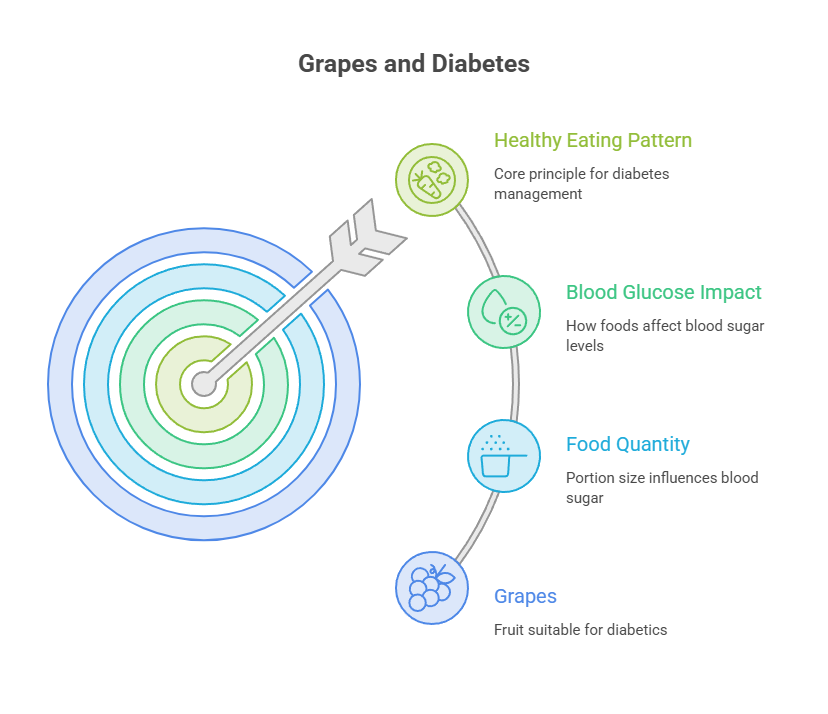
The answer is yes. The American Diabetes Association places fresh fruit, grapes included, squarely inside a healthy eating pattern for people managing diabetes. No fruit is off-limits by default.
That runs against a stubborn myth. Plenty of people assume anything sweet is dangerous for blood sugar, so grapes get banned on sight. The science tells a more useful story.
What matters isn’t whether a food tastes sweet. It’s how fast and how high that food pushes your blood glucose, and in what quantity you eat it. Grapes happen to land in a friendlier zone than their candy-like flavor suggests.
Why “Natural Sugar” Still Counts as Carbs
Let’s be straight about one thing, though. Grapes are mostly carbohydrate, and carbs raise blood sugar. The sugar in a grape (a mix of glucose and fructose) is real sugar, even when it arrives naturally.
Your body doesn’t issue a free pass just because the sugar came from a plant instead of a packet. A cup of grapes carries about 27 grams of carbohydrate, and your bloodstream takes that load seriously.
The difference between grapes and jelly beans comes down to the package. Grapes deliver their sugar alongside water, fiber, vitamins, potassium, and antioxidants. That bundle slows things down and adds value candy never will.
Patients booking blood-sugar panels through HealthCareOnTime often ask whether a diabetes diagnosis means quitting fruit for good. The short answer is no. The longer answer is about portions, pairings, and timing, which the rest of this guide walks through.
What’s Actually Inside a Grape?
Before judging grapes by their sweetness alone, it helps to see the full nutrition picture. There’s more going on than sugar.
A one-cup serving of grapes (about 151 grams) holds roughly 104 calories, 27 grams of carbohydrate, a little over a gram of fiber, and about a gram of protein. The fat content is essentially zero.
Grapes are also about 81 percent water, which is part of why they feel refreshing and fill you up for relatively few calories. That high water content dilutes the sugar per bite compared with a dense food like a cookie.
On the micronutrient side, grapes supply vitamin K, vitamin C, several B vitamins, and potassium. The potassium matters for people with diabetes because blood-pressure control is a core part of protecting the heart and kidneys over the long haul.
| Nutrient (per 1 cup, 151 g) | Amount | Why It Matters for Diabetes |
| Calories | ~104 | Modest for a satisfying snack |
| Carbohydrates | 27.3 g | Counts toward your meal carb budget |
| Sugars | ~23 g | Natural, paired with water and fiber |
| Fiber | ~1.4 g | Low, so pairing helps slow absorption |
| Potassium | ~288 mg | Supports blood-pressure control |
| Vitamin K | ~22 mcg | Bone and vascular health |
The fiber is the one soft spot. Grapes don’t carry much, which is exactly why how you eat them (portion and pairing) does the heavy lifting for blood-sugar control.
Grapes and Blood Sugar: The Glycemic Index and Load Explained
To understand grapes and diabetes, you need two numbers, not one. The glycemic index gets all the attention, but glycemic load is the figure that actually predicts what happens at your kitchen table.
What GI and GL Actually Measure
The glycemic index ranks a carbohydrate food on a scale of 0 to 100 by how quickly it raises blood glucose. Low is 55 or below, medium is 56 to 69, and high is 70 or above. White bread and potatoes sit high; most fruits sit lower.
Grapes carry a glycemic index in the range of 49 to 53, depending on variety and ripeness. That puts them in low to medium territory, well under refined starches and sweets.
Glycemic load goes a step further by factoring in how much carbohydrate you actually eat. You calculate it by multiplying the GI by the grams of carbohydrate in your serving, then dividing by 100. A GL of 10 or below is low; 11 to 19 is moderate; 20 or more is high.
This is where portion size takes over the conversation. The same grape can deliver a low glycemic load or a moderate one, depending entirely on how many you put in the bowl.
How Portion Size Changes Everything
A small handful of grapes (around 10 grapes) carries roughly 8 grams of carbohydrate and a glycemic load near 4. That’s gentle, the kind of snack that barely registers on a continuous glucose monitor for most people.
Scale up to a full cup (about 151 grams), and you’re looking at roughly 27 grams of carbohydrate and a glycemic load somewhere around 12 to 14. That nudges into the moderate zone.
Our medical reviewers point out that this single dynamic explains most of the confusion around grapes. The fruit didn’t change. The serving did.
The table below shows how grape type and portion shift the numbers. Use it as your at-a-glance reference before reaching for a second handful.
| Grape Type / Portion | Serving Size | Carbohydrates | Glycemic Load | Blood Sugar Impact |
| Small handful (10 grapes) | ~49 g | ~8 g | ~4 | Minimal |
| Green grapes, half cup | ~75 g | ~14 g | ~5 to 6 | Low |
| Red grapes, half cup | ~75 g | ~14 g | ~6 to 7 | Low |
| Any grapes, three-quarter cup | ~113 g | ~20 g | ~9 to 10 | Low to moderate |
| Black grapes, one cup | ~151 g | ~27 g | ~11 | Moderate |
| Any grapes, one full cup | ~151 g | ~27 g | ~12 to 14 | Moderate |
The takeaway is simple. Keep grapes to a half-cup or so, and the glycemic load stays comfortably low. The fruit works against you only when the portion balloons.
How Many Grapes Can a Diabetic Eat per Day?
This is the question that sends people to Google at 9 p.m. with a bowl of grapes already in hand. There’s no single number for everyone, but there are sensible ranges by situation.
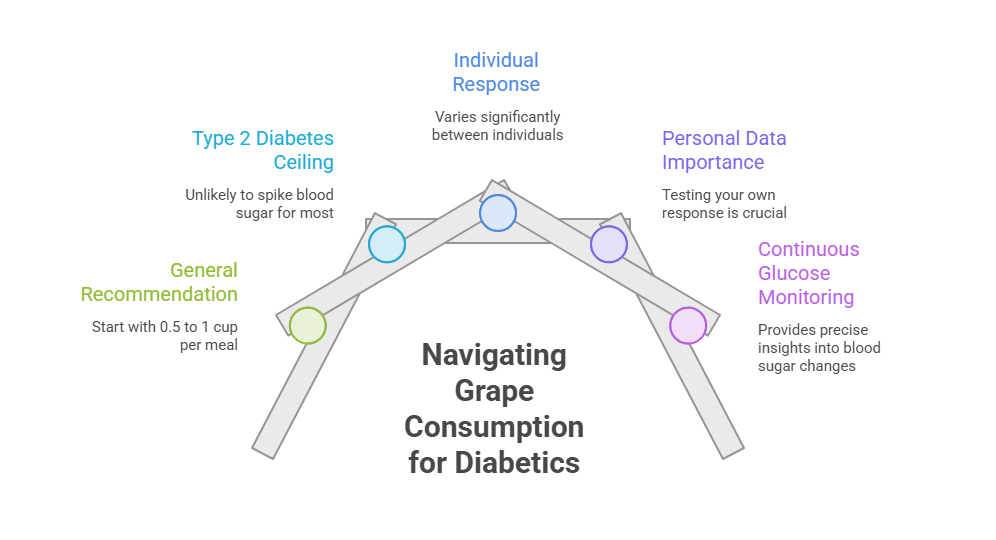
A reasonable starting point for most people with well-controlled diabetes is a half-cup to one cup, eaten with a meal rather than alone. Registered dietitians frequently cite a one-cup ceiling as unlikely to spike blood sugar for the average person with Type 2 diabetes.
Individual response varies, though. Two people can eat the identical bowl and see different glucose readings an hour later. That’s why testing your own response matters more than any chart. Among patients who wear continuous glucose monitors, the same half-cup of grapes might lift one person 15 points and another 35, which is exactly why personal data beats generic rules.
Type 2 Diabetes Portion Guide
If you have Type 2 diabetes and decent control, a half-cup to one cup of grapes fits comfortably into a meal that already includes protein, fat, and fiber. The other foods on the plate slow grape-sugar absorption.
The smarter move is to fold those grapes into your total carbohydrate budget for that meal, not treat them as a freebie on top. A half-cup of grapes equals roughly one carbohydrate serving (about 15 grams).
Type 1 Diabetes and Carb Counting
For Type 1 diabetes, the math is more precise because insulin dosing depends on it. Count a half-cup of grapes as about 15 grams of carbohydrate and dose accordingly.
Grapes digest fairly quickly, so timing your insulin and checking your blood sugar an hour or two afterward helps you learn your personal pattern. In cases reviewed by our medical team, patients who log grape portions against their post-meal readings dial in their dosing far faster.
Gestational Diabetes and Prediabetes
During pregnancy with gestational diabetes, carbohydrate control gets tighter, and tolerance can shift through the day (mornings are often the trickiest). A half-cup of grapes, roughly 12 to 15 grapes, paired with protein is a prudent portion.
For prediabetes, grapes are genuinely useful. Swapping sugary snacks for whole fruit is one of the lifestyle moves that can lower the odds of progressing to Type 2 diabetes. Spread your intake across the day rather than eating a large bunch at once.
The decision table below maps the most common situations to a recommended portion and one smart habit each.
| Your Situation | Recommended Grape Portion | Smart Move |
| Type 2 diabetes, stable control | Half cup to 1 cup with a meal | Pair with nuts, cheese, or yogurt |
| Type 1 diabetes | ~15 g carbs per half cup, dose to match | Test blood sugar 1 to 2 hours after |
| Gestational diabetes | Half cup (12 to 15 grapes) max | Eat with protein, never on its own |
| Prediabetes | Three-quarter to 1 cup, spread out | Replace juice and candy with whole grapes |
| Blood sugar running high | Delay grapes or pair with fat | Skip eating grapes solo on an empty stomach |
The Health Benefits of Grapes for Diabetes
Grapes aren’t just tolerable for people with diabetes. They bring real nutritional upside, much of it tied to the compounds that give red and purple grapes their color.
Resveratrol, Polyphenols, and Insulin Sensitivity
Grapes are loaded with polyphenols, plant compounds with antioxidant and anti-inflammatory effects. The most famous is resveratrol, concentrated in the skin of red and purple grapes.
Research suggests resveratrol can improve insulin sensitivity and dial down chronic inflammation, both of which sit at the heart of Type 2 diabetes. Chronic inflammation and insulin resistance feed off each other, and antioxidants help interrupt that loop.
This is also why grape color matters. Red, purple, and black grapes carry more of these protective compounds than green grapes, which makes them a slightly better pick when you have the choice.
What the Research Really Found (The Honest Version)
Here’s where many articles oversell. The evidence on grapes and blood sugar is encouraging but mixed, and you deserve the full picture before you build a habit around it.
The 29-Trial Meta-Analysis
A systematic review and meta-analysis published in Phytotherapy Research pooled 29 randomized controlled trials covering 1,297 participants. It found that grapes and grape products significantly reduced insulin resistance, measured by HOMA-IR, with a weighted mean difference of about negative 0.54.
That’s a meaningful signal for insulin sensitivity. But the same analysis found grapes did not improve two other markers that matter: fasting insulin and HbA1c, the three-month blood-sugar average, showed no significant change.
More striking, the change in fasting blood glucose actually leaned slightly in favor of the control groups. So grapes appear to help with how the body uses insulin, while not lowering long-term glucose averages in these trials.
The honest read is this. Grapes are a reasonable, even beneficial fruit choice, but they’re not a treatment and won’t fix elevated blood sugar on their own. Our medical reviewers note that no single food earns that title, and anyone promising otherwise is overstating the data.
Heart and Cholesterol Benefits
Diabetes raises cardiovascular risk, so heart-friendly foods do double duty. Grapes deliver here too.
In a human study using grape powder equivalent to roughly 1.5 cups of whole grapes daily, participants saw about a 6 percent drop in total and LDL cholesterol, along with improved gut microbiome diversity. Better cholesterol and a healthier gut both support long-term metabolic health.
Grapes also supply potassium, which helps with blood pressure, and a dose of vitamin K and vitamin C. For a fruit this sweet, the nutrient return is solid.
Grapes, Weight, and Type 2 Diabetes
Body weight sits at the center of Type 2 diabetes, and grapes can help on that front in a quiet way. At about 104 calories a cup and 81 percent water, they satisfy a sweet craving for far fewer calories than cookies, candy, or ice cream.
Swapping a processed dessert for a measured bowl of grapes trims calories without leaving you feeling deprived. Over weeks and months, that kind of swap supports the gradual weight loss that improves insulin sensitivity and blood-sugar control.
A Note on Eye and Nerve Health
People with diabetes face higher risk of eye and nerve complications over time, driven partly by oxidative stress. The antioxidants in grapes won’t reverse those risks, but a diet rich in colorful plant foods supports the body’s defenses against that damage.
Think of grapes as one small, pleasant contributor to a broader pattern of antioxidant-rich eating, not a standalone shield. The bigger protective factors remain blood-sugar control, blood pressure, and regular checkups.
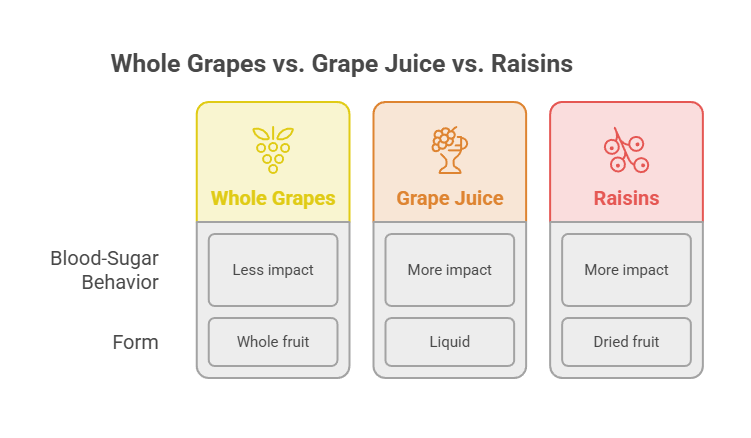
Whole Grapes vs Grape Juice vs Raisins
If you take one practical lesson from this article, make it this one. The form of the grape changes its blood-sugar behavior more than almost anything else.
Why Juice Is the Real Blood-Sugar Trap
Grape juice strips out the fiber and concentrates the sugar. A single cup of grape juice carries around 36 grams of sugar, often more than you’d get from eating a cup of whole grapes, and it hits your bloodstream faster with nothing to slow it down.
Store-bought juices frequently add sugar on top of that. Across the patients we serve, fruit juice is one of the most common hidden drivers of high readings, precisely because it feels healthy while behaving like soda.
The fix is easy. Eat the whole fruit. You get the fiber, you chew instead of gulp, and your blood sugar thanks you.
Raisins: Concentrated Sugar, Smaller Portions
Raisins are just dried grapes, but drying removes the water and shrinks the volume dramatically. That means the sugar gets packed into a much smaller bite, and it’s easy to eat far more grapes’ worth than you realize.
A quarter-cup of raisins delivers roughly the carbohydrate of a full cup of fresh grapes. Raisins aren’t forbidden, but the portions need to be tiny, and they pair best with nuts.
What About Wine, Jelly, and Other Grape Products?
Grapes turn up in plenty of processed forms, and most of them behave very differently from the fresh fruit. Grape jelly and jam are mostly added sugar, so a single tablespoon can carry more sugar than a whole serving of grapes.
Wine is its own conversation. A glass holds less sugar than juice, but the alcohol can lower blood sugar hours later, sometimes unpredictably, so anyone on insulin or sulfonylureas should be cautious and never drink on an empty stomach. When in doubt, the fresh fruit is the simplest, safest way to enjoy grapes.
The table below compares the three forms side by side, with carbohydrate, sugar, fiber, and glycemic load. The pattern is clear at a glance.
| Food (Serving) | Sugar | Carbohydrates | Fiber | Glycemic Load | Source |
| Whole grapes (1 cup, 151 g) | ~23 g | 27.3 g | ~1.4 g | ~12 to 14 (moderate) | USDA FoodData Central |
| Grape juice, unsweetened (1 cup, 240 ml) | ~36 g | ~37 g | 0 g | ~19 (high) | USDA FoodData Central |
| Raisins, seedless (quarter cup, ~40 g) | ~26 g | ~31 g | ~1.5 g | ~18 (high) | USDA FoodData Central |
| Red grapes (100 g) | 15.5 g | 18 g | 0.9 g | ~8 (low) | USDA FoodData Central |
| Green grapes (100 g) | 15 g | 17 g | 0.9 g | ~5 (low) | USDA FoodData Central |
Same fruit, three very different blood-sugar outcomes. Whole and fresh wins every time.
The Diabetes Picture in America (Why Portion Habits Matter)
Small daily food choices add up, and the scale of diabetes in the United States shows why getting them right matters so much.
According to the CDC’s National Diabetes Statistics Report released in January 2026, more than 40 million Americans, about 12 percent of the population, are living with diabetes. Roughly 1 in 8 adults is affected, and around 11 million of them don’t yet know they have it.
The prediabetes numbers are even larger. The CDC reports that 115.2 million American adults, more than 2 in 5, have prediabetes, and about 8 in 10 of them are unaware of it. Type 2 diabetes accounts for 90 to 95 percent of all diagnosed cases.
| United States Diabetes Statistic | Figure | Source |
| Adults living with diabetes | 40+ million (~12%) | CDC, 2026 |
| Adults with prediabetes | 115.2 million (2 in 5) | CDC, 2026 |
| Prediabetic adults who are unaware | About 8 in 10 | CDC, 2026 |
| Share of cases that are Type 2 | 90 to 95% | CDC / NIDDK |
| Annual new diabetes diagnoses | ~1.5 million | ADA, 2026 |
For tens of millions of people in that prediabetes group, swapping sugary processed snacks for a sensible portion of whole fruit is exactly the kind of change that can slow or stop the slide toward Type 2 diabetes.
How to Eat Grapes Safely With Diabetes
Knowing grapes are fine is one thing. Eating them in a way that protects your blood sugar is another. These habits make the difference.
Pair Them With Protein or Fat
Never let grapes fly solo if you can help it. Eating them alongside protein or healthy fat slows digestion and softens the glucose rise.
Try grapes with a small handful of almonds, a slice of cheese, a spoon of nut butter, or a scoop of Greek yogurt. The combination turns a quick sugar hit into a steadier release.
Watch Your Timing
Grapes on an empty stomach hit harder and faster than grapes after a balanced meal. The same portion behaves very differently depending on what else is in your system.
If you want grapes as a standalone snack, a mid-meal moment or right after eating is gentler than first thing in the morning on nothing.
Freeze Them
Frozen grapes are a small trick with a real payoff. They take longer to eat, so you naturally slow down and feel satisfied with fewer, which keeps your portion in check.
They also make a genuinely nice cold treat in summer, a smarter swap for ice cream or popsicles loaded with added sugar.
Measure, Don’t Eyeball
Grazing straight from the bag is how a half-cup quietly becomes two cups. Portion your grapes into a small bowl or bag first, then put the rest away.
This one habit does more for blood sugar than any fancy rule. Your eyes are not a measuring cup, especially in front of the TV.
Watch for Hidden Grape Sugar
Grapes show up in places that fly under the radar. Trail mix, fruit salads, grape jelly, sauces, and wine all carry grape sugar, often concentrated and easy to overconsume.
Our lab partners report that people frequently underestimate these hidden sources when reviewing what nudged their readings up. Read labels, and count what’s actually in the bowl.
Mistakes to Avoid With Grapes and Diabetes
A few common missteps turn a friendly fruit into a blood-sugar problem. Sidestep these.
Eating on an Empty Stomach
This is the big one. Grapes alone, with no protein or fat to slow them, produce the sharpest spike. Always pair when blood-sugar control is your goal.
Treating “Low GI” as “Unlimited”
A low glycemic index does not mean limitless servings. Eat enough of any carbohydrate and the glycemic load climbs into moderate or high territory. Portion discipline still rules.
Skipping the Carb Count
Grapes are carbohydrate, and they belong in your carb tally for the meal. Forgetting to count them, especially when eating straight from the bag, is an easy way to overshoot your target without noticing.
Reaching for Juice and Raisins Instead
When the craving hits, whole fresh grapes are the move. Juice and raisins concentrate the sugar and drop the fiber, exactly the wrong trade for blood sugar.
Frequently Asked Questions
Are grapes high in sugar?
Grapes contain natural sugar, about 23 grams per cup, but their low to moderate glycemic index keeps the blood-sugar impact modest at sensible portions. A cup of grapes actually has less sugar than a large mango or a big banana. Portion size, not sugar alone, drives the effect.
How many grapes can a diabetic eat per day?
For most people with well-controlled diabetes, a half-cup to one cup (roughly 15 to 30 grapes) eaten with a meal is reasonable. A half-cup counts as one carbohydrate serving, about 15 grams. Your own glucose response varies, so test after eating to learn your personal limit.
Do grapes raise blood sugar quickly?
Grapes can raise blood sugar fairly quickly when eaten alone, because they’re low in fiber and high in water and natural sugar. Pairing them with protein or fat slows that rise considerably. The effect stays mild at a half-cup portion but grows with larger servings.
Are red or green grapes better for diabetics?
Both are fine choices. Red and purple grapes hold more antioxidants, especially resveratrol, which may support insulin sensitivity, so they edge out green grapes slightly. Green grapes have a marginally lower glycemic load. The difference is small; portion size matters far more than color.
Can prediabetics eat grapes?
Yes. For people with prediabetes, swapping sugary snacks for whole fruit like grapes is a smart step that can help lower the risk of progressing to Type 2 diabetes. Stick to a three-quarter to one-cup portion, spread it out, and choose whole grapes over juice.
Are grapes safe for gestational diabetes?
Grapes can fit a gestational diabetes plan in controlled portions, generally a half-cup (12 to 15 grapes) paired with protein. Carbohydrate tolerance is often lowest in the morning, so save grapes for later in the day and always check with your prenatal care team.
What is the best time to eat grapes with diabetes?
After or during a balanced meal is best, since the protein, fat, and fiber already on your plate slow grape-sugar absorption. Avoid grapes first thing on an empty stomach, when they spike blood sugar fastest. A post-meal snack is gentler than a standalone one.
Are raisins bad for diabetics?
Raisins aren’t off-limits, but they’re concentrated. A quarter-cup of raisins packs roughly the carbohydrate of a full cup of fresh grapes, with a higher glycemic load. Keep portions very small, pair them with nuts, and reach for fresh grapes when you can.
Is grape juice ok for diabetics?
Grape juice is the form to limit most. A cup holds around 36 grams of sugar with no fiber, so it raises blood sugar fast, and store versions often add more sugar. Choose whole grapes instead. If you do drink juice, keep it to a few ounces with food.
Can I eat grapes at night if I have diabetes?
You can, but pair them with protein or fat and keep the portion small, around a half-cup. Grapes eaten alone before bed may nudge blood sugar up overnight. A few grapes with a handful of nuts is a steadier evening snack.
Which fruit is worst for blood sugar?
No fruit is truly off-limits, but dried fruits and fruit juices hit hardest because they concentrate sugar and lose fiber. Among whole fruits, very large portions of high-sugar options like ripe mango or banana raise blood sugar more than a measured serving of grapes.
Do frozen grapes affect blood sugar differently?
Freezing doesn’t change a grape’s carbohydrate or sugar content, so the blood-sugar effect is essentially the same. The practical benefit is behavioral. Frozen grapes take longer to eat, which naturally slows you down and helps keep your portion smaller.
Disclaimer: This article is for general educational purposes and isn’t a substitute for personalized medical advice. Blood-sugar responses to grapes vary from person to person. Talk with your doctor, a registered dietitian, or your diabetes care team before making changes to your diet, and monitor your own glucose readings to learn what works for your body.
References
- Centers for Disease Control and Prevention, National Diabetes Statistics Report
- Centers for Disease Control and Prevention, Prediabetes Statistics
- American Diabetes Association, Statistics About Diabetes
- National Institute of Diabetes and Digestive and Kidney Diseases, Diabetes Statistics
- Phytotherapy Research, Systematic Review and Meta-Analysis of Grapes and Glycemic Response (PubMed)
- USDA FoodData Central