Your belly button is easy to ignore right up until it starts to throb. That small dimple sits over some of the busiest real estate in your body: the lower end of your stomach, coils of small intestine, part of your colon, and your appendix. So when pain shows up there, it can mean almost anything, from a pocket of trapped gas to a problem that belongs in an operating room.
Table of Contents
Most belly button pain turns out to be minor and short-lived. The real skill is telling which signs mean wait it out and which ones mean go now. This guide walks through every common cause, shows how the location and feel of the pain narrow it down, lists the red flags that demand the ER, and lays out exactly what to do at each step.
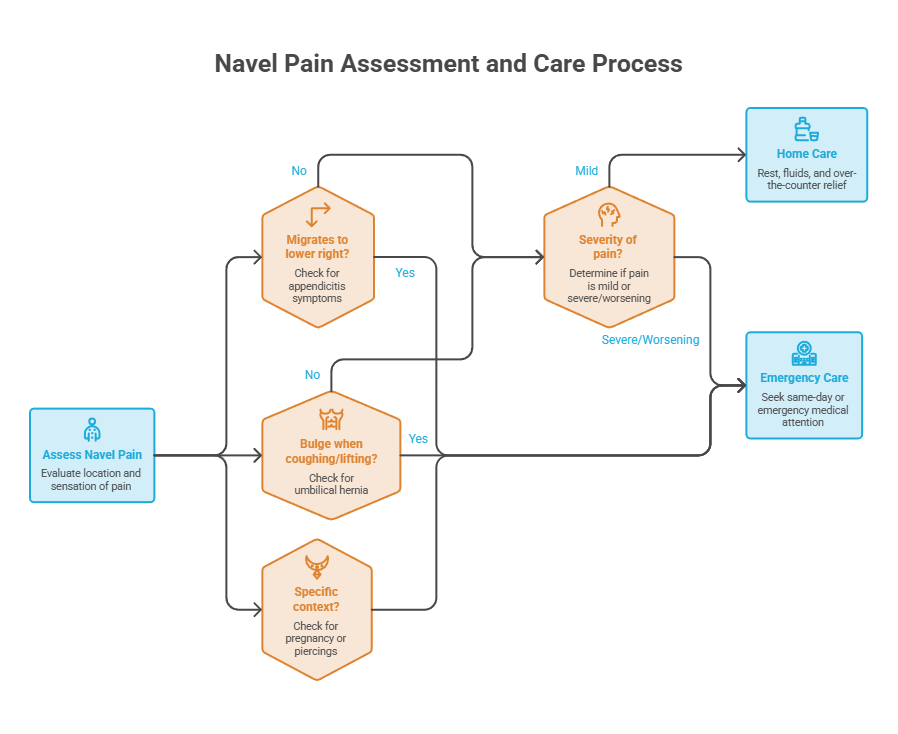
Quick Answer: Belly button pain (periumbilical pain) usually comes from something minor like gas, indigestion, constipation, or a stomach bug, and it often clears within a day or two. Sometimes it signals an umbilical hernia, a skin infection, or early appendicitis. Get emergency care if the pain turns severe, shifts to your lower right side, or comes with fever, vomiting, a firm bulge, or trouble passing stool or gas.
At a Glance
- Most navel pain is short-lived and tied to digestion.
- Where it hurts and how it feels help pinpoint the cause.
- Pain that migrates to the lower right can signal appendicitis.
- A bulge that hurts when you cough or lift suggests an umbilical hernia.
- Pregnancy and belly button piercings bring their own causes.
- Mild cases respond to rest, fluids, and over-the-counter relief.
- Severe, worsening, or red-flag pain needs same-day or emergency care.
What Belly Button Pain Actually Is
Doctors call pain in and around the navel periumbilical pain. The word simply means discomfort in the umbilical region, the central zone of your abdomen that surrounds the belly button.
Anatomy is what makes this spot so tricky. According to Healthline, the area behind your belly button holds parts of your stomach, your small and large intestine, and your pancreas. Pain can rise from the skin itself, from the abdominal wall, or from any of those deeper organs.
That overlap explains why one symptom has so many possible causes. Our medical reviewers note that patients often assume the worst when navel pain hits, when the likeliest culprit is something as ordinary as last night’s dinner.
The Periumbilical Region: What Sits Behind Your Navel
Picture a clock face centered on your belly button. The stomach and pancreas sit a little above it, the small intestine loops directly behind it, and the first stretch of colon wraps around the sides.
The appendix hangs lower and to the right, which leads to a quirk worth knowing. Early appendix irritation is often felt first near the navel because of how the abdomen’s nerves are wired, only later settling into its true location.
The navel is also a patch of skin. It marks the scar where your umbilical cord was cut at birth, and deep innie belly buttons can trap sweat, lint, and bacteria, which sets up a different kind of problem.
How Navel Pain Feels: Sharp, Dull, Cramping, or Pulling
The character of the pain points your doctor in a direction, even though it is not a diagnosis on its own. Cramping or a dull, gassy ache usually means digestion, while a burning sensation can suggest indigestion or an ulcer higher up.
Sharp, pulling pain that flares when you move, cough, or lift hints at the abdominal wall, often a hernia. Steady pain that keeps building over hours, especially alongside fever or vomiting, is the pattern clinicians watch most closely.
Pain behind the belly button can also be constant or come and go. Some people feel it only when they press the area, stretch, or even urinate. Jotting down these details before a visit helps your provider separate minor causes from serious ones faster.
The Most Common Causes of Belly Button Pain
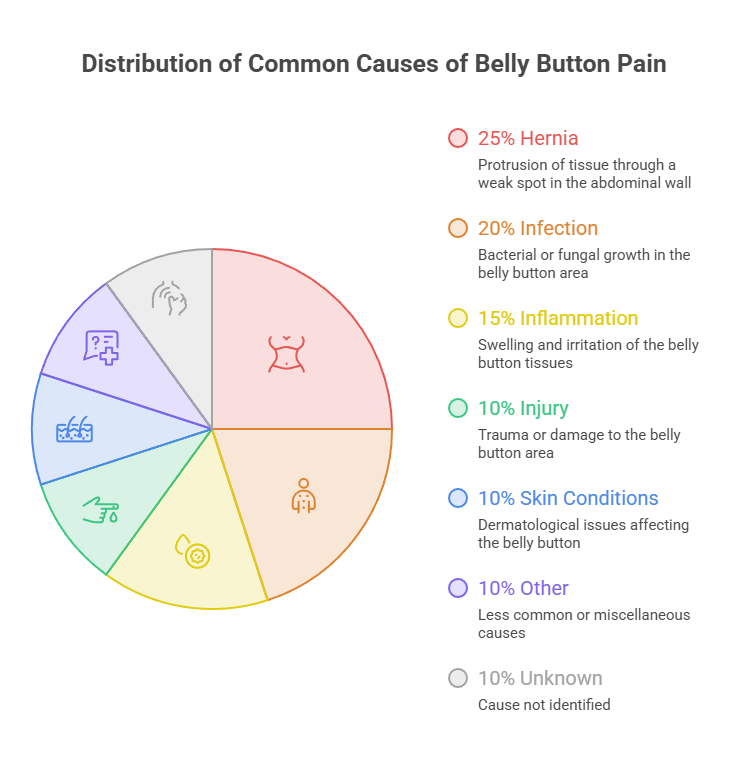
Belly button pain is a symptom, not a condition, so the list of explanations runs long. Across the abdominal cases our diagnostic partners review, the same handful of causes show up again and again. Here are the ones worth recognizing.
Digestive Causes: Gas, Indigestion, Constipation, and Stomach Bugs
Digestion is the first place to look. Trapped gas, indigestion, and constipation build pressure in the intestines that loop right behind the navel, producing cramping or a dull, bloated ache.
Indigestion (dyspepsia) tends to feel like burning or painful fullness in the upper belly that can radiate down toward the belly button. Constipation, defined as fewer than three bowel movements a week with hard stool, presses on nearby nerves and can trigger sharp navel pain.
Gastroenteritis, the stomach flu, inflames the digestive tract after a virus or contaminated food. It ranks among the more common causes of pain behind the belly button and usually clears on its own within a few days. Longer-term conditions such as irritable bowel syndrome and inflammatory bowel disease can also center discomfort near the navel.
Food intolerances belong on this list too. Lactose intolerance and gluten sensitivity can inflame and irritate the gut, leaving the navel area sore. Keeping a simple food diary often reveals the trigger.
Peptic Ulcers
A peptic ulcer is an open sore in the lining of the stomach or the upper small intestine. The pain is typically a gnawing or burning feeling around the belly button that can reach up toward the breastbone.
Peptic ulcers often trace back to infection with Helicobacter pylori bacteria or to long-term use of drugs like ibuprofen or aspirin. Burning navel pain that worsens on an empty stomach, or that keeps returning, is worth raising with a doctor.
Umbilical Hernia: The Bulge That Hurts When You Cough or Lift
An umbilical hernia happens when tissue or part of the intestine pushes through a weak spot in the abdominal wall near the belly button. Its signature is a soft bulge that may appear or grow when you cough, lift, strain, or stand.
The pain tends to track with activity, flaring during effort and easing with rest. Most adult umbilical hernias are acquired, driven by repeated rises in abdominal pressure from obesity, pregnancy, fluid buildup, or chronic coughing.
One line matters more than the rest. A bulge that suddenly turns firm, very painful, red, or discolored may be trapped (incarcerated) or losing its blood supply (strangulated). Those symptoms point to an emergency that needs urgent surgical care.
Appendicitis: Pain That Starts at the Navel and Shifts Lower Right
Appendicitis is the cause everyone fears, and the worry is well founded. In the classic pattern, pain begins in the middle of the abdomen near the belly button, then shifts to the lower right side as it intensifies, joined by nausea, vomiting, and loss of appetite.
The complication is that the textbook version is not a given. Only about half of people with appendicitis show the classic presentation, and children, older adults, and pregnant patients are less likely to follow it.
This unpredictability is exactly why our medical reviewers treat severe or steadily worsening navel pain as a reason to seek care rather than wait. A delayed appendix can rupture and spread infection through the abdomen.
Belly Button Infection, Omphalitis, and Piercing Problems
The navel is skin, and skin gets infected. Bacteria or fungi can settle in, especially in moist, deep belly buttons or around a new or irritated piercing. This kind of navel infection, sometimes called omphalitis, brings redness, swelling, and discomfort when pressed.
Telltale signs include itching, a strong odor, crusting, or discharge that may run white, yellow, or bloody. Mild cases often settle with gentle cleaning and keeping the area dry.
Patients who contact HealthCareOnTime about a smelly, sore navel are often surprised it is a straightforward skin issue. Spreading redness, pus, warmth, or fever, however, calls for a clinician and possibly antibiotics.
Gallstones and Pancreatitis
Two upper-abdominal organs can send pain toward the navel. Gallstones can block the flow of bile and trigger sharp pain in the upper right belly that sometimes radiates toward the belly button, often peaking after a fatty meal.
Pancreatitis, inflammation of the pancreas, can cause periumbilical pain that bores through to the back, paired with nausea, vomiting, and fever. Gallstones and heavy alcohol use are common triggers.
Neither belongs on a wait and see list when pain is intense. Both can escalate quickly, so persistent upper-belly or navel pain with vomiting deserves prompt evaluation.
Pregnancy-Related Navel Pain
Pregnancy reshapes the abdomen, and the belly button feels every bit of it. As the uterus grows, it stretches the muscles and skin around the navel, producing a pulling or aching sensation that is common in the second and third trimesters.
Rising levels of the hormone relaxin loosen ligaments and connective tissue, which can leave the belly button tender or sore. For most pregnancies, this is a normal part of the experience.
The exception carries weight. Sudden, severe, or one-sided pain during pregnancy should be reported to your provider right away, since it can point to something beyond routine stretching.
Women’s Causes: Ovarian Cysts and UTIs
Because the female reproductive organs sit close by, they can refer pain toward the navel. An ovarian cyst that grows large or ruptures can cause sharp, one-sided pain that radiates toward the belly button, often with bloating or pelvic pressure.
Urinary tract infections are a frequently missed source of lower abdominal and navel discomfort. Bladder irritation creates inflammation that can spread into the surrounding belly, usually with burning urination.
Our medical reviewers point out that appendicitis can mimic these conditions in women, which is one reason a careful exam matters. When pain is escalating, evaluation beats guesswork.
Small Bowel Obstruction and Post-Surgical Adhesions
A blockage in the small intestine can cause intense, crampy pain around the belly button, along with vomiting, bloating, and an inability to pass gas or stool. A bowel obstruction is a serious condition that needs immediate medical care, and treatment often involves surgery.
Past abdominal surgery raises the risk. Laparoscopic (keyhole) procedures often use the navel as an entry point, so soreness there during healing is expected, and scar-tissue bands called adhesions can later tug on organs or block the bowel. An incisional hernia can also form at an old surgical site, so new or feverish pain after an operation always warrants a call to your surgeon.
The table below sets the most common causes side by side, comparing how they feel, where they hurt, and how urgent they tend to be.
| Cause | Typical pain type | Where it hurts | Other key symptoms | Urgency |
| Gas / indigestion | Cramping or burning | Around or above navel | Bloating, belching, fullness | Low, self-care |
| Constipation | Dull, sharp with pressure | Around navel, lower belly | Hard stool, fewer than 3 BMs/week | Low, self-care |
| Gastroenteritis | Crampy, in waves | Behind navel, whole belly | Diarrhea, nausea, low fever | Low to moderate |
| Peptic ulcer | Gnawing, burning | Navel up to breastbone | Worse when hungry, bloating | Moderate |
| Umbilical hernia | Sharp, pulling with effort | At the navel | Soft bulge, worse with cough/lift | Moderate, urgent if firm |
| Appendicitis | Dull then sharp, worsening | Navel shifting lower right | Fever, vomiting, no appetite | Emergency |
| Belly button infection | Sore, tender to touch | Skin of the navel | Redness, odor, discharge | Moderate |
| Gallstones | Sharp, after fatty meals | Upper right toward navel | Nausea, vomiting | Moderate to urgent |
| Pancreatitis | Boring, radiates to back | Upper belly and navel | Vomiting, fever | Emergency |
| Small bowel obstruction | Severe, crampy | Around the navel | Vomiting, bloating, no gas/stool | Emergency |
A few numbers put the serious causes in perspective. Appendicitis is common over a lifetime: the lifetime risk runs about 8.6% for men and 6.7% for women, and in the United States it carries roughly a 1 in 15 lifetime risk, with an estimated 378,000-plus cases in a recent year.
Umbilical hernias are also widespread. In adults, their incidence ranges from about 23% to 50%, and they are roughly three times more common in women, largely because of pregnancy and childbirth. According to Healthgrades, surgeons repair about 175,000 umbilical hernias in the United States every year.
How the Location and Type of Pain Point to the Cause
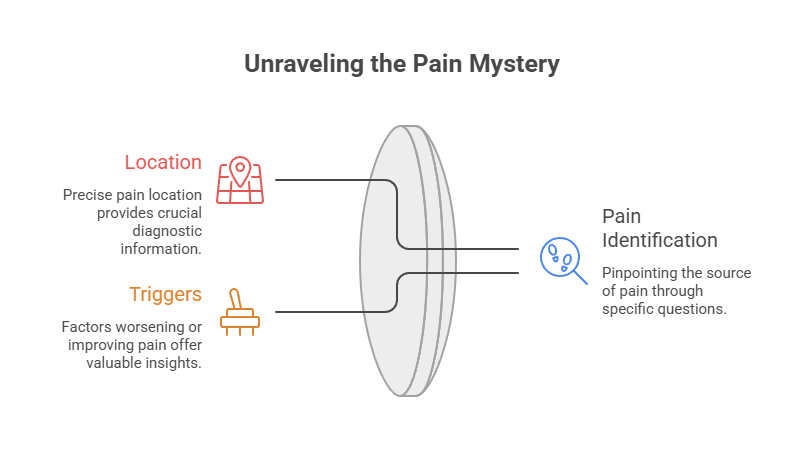
You do not need a medical degree to collect useful clues. Two questions answer most of it: where exactly does it hurt, and what makes it better or worse?
Above, Below, Left, or Right of the Navel
Pain centered right at the navel most often comes from the small intestine looping behind it, which usually points to gas, indigestion, or early appendicitis. Pain just above the navel leans toward the stomach and pancreas, so think indigestion, ulcers, or pancreatitis.
Pain that drifts to the lower right is the appendicitis warning zone, especially when it started near the navel and migrated. Lower-left pain is more often constipation or a colon issue, while one-sided pain in women can involve an ovary.
Treat these as tendencies, not rules. Our medical reviewers stress that pain location is one input among several, which is why companion symptoms like fever or vomiting carry so much weight.
Pain When Pressed vs. With Movement vs. Constant
How the pain behaves is as telling as where it sits. Pain only when you press the area often points to the skin or abdominal wall, meaning a minor infection, irritation, or a small hernia.
Pain that spikes with coughing, lifting, or straining is the hernia signature. Pain that worsens with any movement, and rebound tenderness (pain that feels worse when pressure is released), are findings clinicians link with appendicitis.
Constant pain that climbs over hours, rather than easing, is the pattern that should move you toward care. Pain that ebbs and flows with meals or bowel movements is usually more benign.
When There Is No Bulge and No Other Symptoms
A common worry is sharp belly button pain with no visible bulge. The absence of a lump does not rule a hernia out, since small or early hernias can hurt before anything shows, yet far more often this pattern reflects gas, a muscle strain, or skin irritation.
When the pain is mild, has no bulge, and arrives without fever, vomiting, or bowel changes, watchful waiting at home is reasonable. Pain that returns again and again, even without a bulge, is still worth a medical opinion.
Red Flags: When Belly Button Pain Is an Emergency
Most navel pain is not an emergency. The judgment worth having is spotting the small set of signs that flip a watch-and-wait situation into a call-911 situation.
The Warning Signs That Mean Go Now
Seek emergency care if belly button pain comes with any of the following. Read these as a checklist, not a menu, because even one can matter.
- Severe pain, or pain that keeps getting worse instead of better.
- Pain that shifts to or settles in the lower right abdomen.
- A high fever, especially with chills.
- Repeated vomiting, or vomiting blood.
- A bulge near the navel that turns firm, very tender, or discolored.
- Blood in your stool, or black, tarry stools.
- Inability to pass gas or stool, a rigid or swollen belly, fainting, or dizziness.
Why a Delayed Appendix or Trapped Hernia Is Dangerous
Time is the enemy with both. An inflamed appendix can rupture, spilling infection into the abdominal cavity and causing peritonitis, a life-threatening complication. Roughly one in three appendicitis cases already shows a perforated appendix by the time the person reaches the hospital.
A trapped hernia runs the same race against the clock. Once tissue gets stuck and its blood supply is cut off, it can start to die within hours, which is why a hard, painful, color-changed bulge is a true emergency.
A few rarer causes of periumbilical pain, such as mesenteric ischemia or an abdominal aortic aneurysm, are also emergencies that need immediate attention. When the picture is unclear, our medical reviewers favor an ER visit over a wait at home.
What the Numbers Say About Belly Button Pain
Belly button pain rarely appears in statistics by name, because it is a symptom. The conditions behind it, though, are well measured in the United States, and the figures show how common (and how serious) each one tends to be.
| Condition | Key US statistic | Source |
| Appendicitis (lifetime risk) | About 8.6% in men, 6.7% in women | NIH (StatPearls) |
| Appendicitis (lifetime odds) | Roughly 1 in 15 people | Annals of Surgery |
| Umbilical hernia repairs | About 175,000 per year | Healthgrades / NIDDK |
| Umbilical hernia (adult incidence) | Roughly 23% to 50% of adults | NIH (StatPearls) |
| Constipation | About 16 of every 100 US adults | NIDDK |
| Irritable bowel syndrome | About 4.7% to 6.1% of US adults | Gastroenterology (2023) |
| Inflammatory bowel disease | About 1.3%, near 3.1 million adults | CDC |
Two figures reward a closer read. Digestive issues drive most everyday navel pain, and they are remarkably common. The National Institute of Diabetes and Digestive and Kidney Diseases reports that about 16 out of every 100 US adults deal with constipation, a frequent and usually harmless source of pain around the belly button.
Irritable bowel syndrome adds to that load. A 2023 study in Gastroenterology found that Rome IV irritable bowel syndrome affects roughly 4.7% to 6.1% of US adults, with abdominal pain near the navel a common feature. The reassuring message in these numbers is plain: the conditions that cause the most navel pain are, far more often than not, the manageable ones.
What to Do Next: Home Care, OTC Relief, and When to See a Doctor
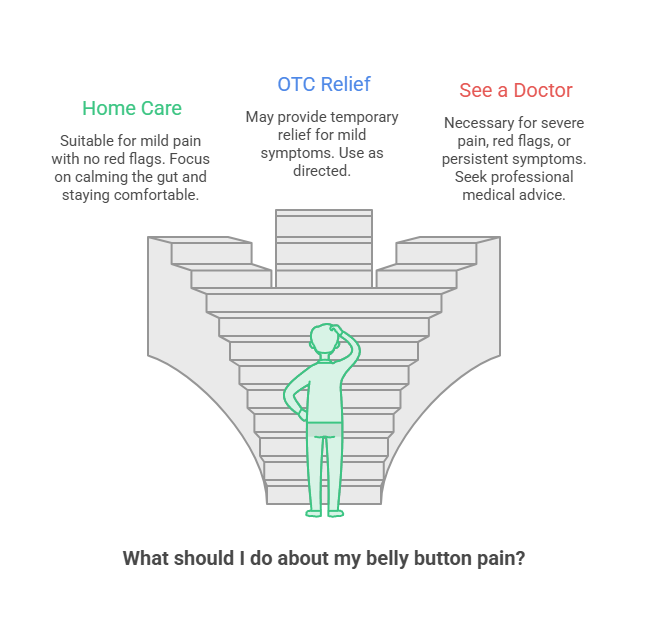
For mild, digestion-related belly button pain with no red flags, home is usually the place to start. The aim is to calm the gut, stay comfortable, and watch how things shift over the next day or two.
Safe Home Care for Mild Navel Pain
Start simple. Rest, sip water through the day, and favor light, bland foods over greasy or spicy meals that irritate the gut. Gentle walking helps move trapped gas and ease bloating.
A warm compress over the navel can relax tense abdominal muscles and soothe cramping. When constipation is the issue, more fiber and fluids often handle it within a day or two.
For a sore or smelly navel, clean it gently and keep it dry, with extra care around a piercing. Our medical reviewers remind patients that home care suits mild, improving symptoms, not pain that is severe or climbing.
OTC Options and What to Avoid
Over-the-counter relief depends on the cause. Acetaminophen (Tylenol) can ease general pain, antacids or simethicone target indigestion and gas, and a stool softener or mild laxative addresses constipation.
One caution bears repeating. Nonsteroidal anti-inflammatory drugs like ibuprofen (Advil, Motrin) and aspirin can irritate the stomach lining, so they are a poor pick if an ulcer or stomach upset is suspected. Long-term use of these drugs is itself a known cause of peptic ulcers.
When appendicitis seems possible, skip pain medicine and food and go in for evaluation, since masking symptoms can blur the picture. The table below maps common situations to the right action and a realistic timeframe.
| Scenario | Recommended action | Timeframe |
| Mild pain with gas, bloating, or recent overeating | Rest, water, light food, gentle walk, OTC antacid | Self-care, 24 to 48 hours |
| Navel pain with no bulge, slowly improving | Monitor symptoms, continue home care | Watch for 1 to 2 days |
| Pain when pressed plus a soft bulge | Book a primary care or surgical visit | Within a few days |
| Redness, odor, or discharge from the navel | Clean and dry; see a clinician if spreading | Within 1 to 3 days |
| Sudden or severe pain during pregnancy | Contact your OB provider immediately | Same day |
| Pain shifting lower right with fever or vomiting | Go to the ER (possible appendicitis) | Now |
| Firm, painful, or discolored bulge | Go to the ER (possible trapped hernia) | Now |
How Doctors Diagnose and Treat Belly Button Pain
A visit for navel pain is mostly detective work. The goal is to match your symptoms, history, and exam findings to the right cause, then treat that cause rather than the pain alone.
The Exam and Tests
A doctor begins by pressing different areas of your abdomen to find where it hurts most and to feel for a bulge or rigidity. For suspected appendicitis, they check specific signs.
McBurney’s point is one of them. According to the Cleveland Clinic, providers locate it by drawing a line from a bony point near your hip to your belly button, and tenderness about one-third of the way along that line is a classic appendicitis clue.
Tests then fill the gaps. Blood work checks for infection, urinalysis rules out a UTI, and imaging such as ultrasound or a CT scan can confirm appendicitis, a hernia, gallstones, or an obstruction.
What to Track Before Your Visit
A clear symptom story speeds up diagnosis. Before you go, note when the pain started, where it sits, and whether it is sharp, dull, or cramping.
Add what makes it better or worse, any fever, vomiting, or bowel changes, and whether a bulge appears with coughing or lifting. Patients booking tests with HealthCareOnTime who arrive with these notes often help their providers reach answers sooner.
Treatments by Cause
Treatment follows the diagnosis, and it spans a wide range. Constipation and indigestion respond to diet changes, fiber, fluids, and OTC remedies, while gastroenteritis usually needs only rest and hydration as it runs its course.
Skin infections may call for topical or oral antibiotics, and gallstones or appendicitis often require surgery. For appendicitis, removing the appendix (appendectomy) is the standard treatment, and most are now done laparoscopically with small incisions and a quicker recovery.
Adult umbilical hernias are typically repaired surgically to head off complications. Our medical reviewers note that early evaluation often means simpler treatment, which is the strongest argument against sitting on pain that will not settle.
How to Prevent Belly Button Pain
You cannot prevent every cause, but you can shorten the odds on the common ones. Most prevention comes down to steady digestion, good hygiene, and protecting the abdominal wall.
For digestion, eat enough fiber, drink water through the day, and move regularly to keep things flowing and cut gas and constipation. Smaller, slower meals reduce indigestion, and limiting greasy or highly processed food eases the gut lining.
For the skin, clean the navel gently and dry it well, and follow proper aftercare for any piercing to prevent infection. To guard against hernias, our medical reviewers suggest keeping a healthy weight, lifting with care, and managing a chronic cough, since each one lowers the abdominal pressure that drives them.
Frequently Asked Questions
Why does your belly button hurt when you press it?
Pressing on tender skin or an inflamed spot can hurt for several reasons, including a minor skin infection, a small umbilical hernia, trapped gas, or abdominal-wall irritation. Mild, brief tenderness is usually harmless. Pain that is sharp, worsening, or paired with a bulge or fever deserves a prompt medical check.
Is belly button pain a sign of appendicitis?
It can be. Classic appendicitis often starts as a dull ache near the navel, then shifts to the lower right abdomen within hours and intensifies. Fever, nausea, vomiting, and loss of appetite tend to follow. Since only about half of cases follow this pattern, any severe or rapidly worsening pain warrants urgent evaluation.
Can gas or bloating cause belly button pain?
Yes, and it is one of the most common causes. Trapped gas, constipation, and indigestion build pressure in the intestines that loop right behind the navel, producing cramping or a dull ache. This type usually eases with passing gas or a bowel movement, gentle movement, and time. Persistent or severe pain needs a closer look.
Why does belly button pain happen during pregnancy?
As the uterus grows, it stretches the abdominal muscles and skin around the navel, and rising relaxin loosens ligaments, creating a pulling or sore feeling that is common in the second and third trimesters. This is usually normal. Sudden, severe, or one-sided pain should be reported to a provider without delay.
What does it mean if your belly button hurts and smells or leaks?
Discharge, odor, redness, or crusting around the navel often points to a skin infection, bacterial or fungal, sometimes called omphalitis, or to an infected piercing. Deep navels trap moisture and bacteria. Gentle cleaning and keeping the area dry help mild cases. Spreading redness, pus, or fever calls for a doctor and possible antibiotics.
How do you know if belly button pain is serious?
Watch for red flags: pain that is severe or steadily worsening, pain shifting to the lower right, a firm or discolored bulge, high fever, repeated vomiting, blood in stool, fainting, or an inability to pass gas or stool. Any of these means same-day or emergency care. Mild, improving pain can usually be watched at home.
Can a belly button piercing cause pain years later?
Yes. Old piercings can develop irritation, trapped bacteria, scar tissue, or a small cyst long after healing, and jewelry friction or a snag can reignite soreness. Redness, swelling, warmth, or discharge suggests infection. Keep the area clean and dry, avoid harsh products, and see a clinician if symptoms persist or worsen.
Why does your belly button hurt when you cough or lift?
Pain triggered by coughing, lifting, or straining is a hallmark of an umbilical hernia, where tissue pushes through a weak spot in the abdominal wall. You may notice a soft bulge that comes and goes. A bulge that turns firm, painful, or discolored is an emergency and needs immediate care.
What home remedies help belly button pain?
For mild, digestion-related pain, rest, sip water, and eat light, bland foods. A warm compress can ease muscle tension and cramping, and gentle walking helps move gas. Over-the-counter acetaminophen or an antacid may help. Keep the navel clean and dry. Skip these steps and seek care if any red-flag symptoms appear.
When should you go to the ER for belly button pain?
Go to the emergency room for severe or rapidly worsening pain, pain that moves to the lower right with fever and vomiting, a firm or discolored bulge, blood in stool or vomit, fainting, a rigid abdomen, or no ability to pass gas or stool. These can signal appendicitis, a trapped hernia, or an obstruction.
Can stress or anxiety cause belly button pain?
Yes. Stress and anxiety can upset digestion and tense the abdominal muscles, producing cramping or a dull ache around the navel, and they can worsen conditions like IBS. Children especially may feel stress as stomachaches near the belly button. If pain recurs or disrupts daily life, a medical evaluation is wise.
Why does a child’s belly button hurt?
In kids, navel pain often comes from gas, constipation, or a passing stomach virus, and stress can play a part too. The bigger concern is appendicitis, which frequently begins near the navel before moving lower right with fever and vomiting. If pain is severe, persistent, or worsening, have your child evaluated promptly.
Disclaimer: This article is for general education and is not a substitute for professional medical advice, diagnosis, or treatment. Our medical reviewers urge you to contact a qualified clinician about any personal symptoms. If you suspect appendicitis, a trapped hernia, or another emergency, call 911 or go to the nearest emergency room.
References
- Periumbilical Pain: Causes of Pain Around the Belly Button, Healthline https://www.healthline.com/health/periumbilical-pain
- Appendicitis, Cleveland Clinic https://my.clevelandclinic.org/health/diseases/8095-appendicitis
- Appendicitis, StatPearls (NIH / National Library of Medicine) https://www.ncbi.nlm.nih.gov/books/NBK493193/
- Umbilical Hernia, StatPearls (NIH / National Library of Medicine) https://www.ncbi.nlm.nih.gov/books/NBK459312/
- The Global Incidence of Appendicitis, Annals of Surgery https://journals.lww.com/annalsofsurgery/fulltext/2017/08000/the_global_incidence_of_appendicitis__a_systematic.8.aspx
- Prevalence and Burden of Rome IV IBS in the United States, Gastroenterology (2023) https://www.gastrojournal.org/article/S0016-5085(23)04889-8/fulltext
- Inflammatory Bowel Disease Facts and Stats, CDC https://www.cdc.gov/inflammatory-bowel-disease/php/facts-stats/index.html
- What Does Belly Button Pain Mean?, Healthgrades https://resources.healthgrades.com/right-care/symptoms-and-conditions/belly-button-pain