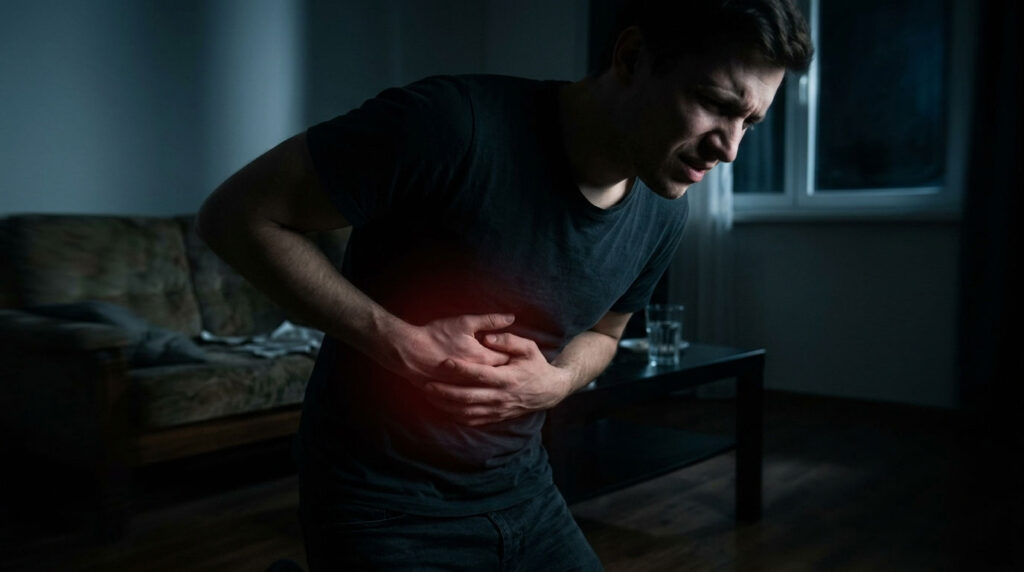
Abdominal pain sends more American adults to the emergency room than any other symptom. So when an ache settles in under your left ribs, the spike of worry you feel is understandable. The reassuring truth is that most of the time, the cause is something minor and self-limiting.
Table of Contents
Quick Answer
Upper left abdominal pain is discomfort felt below your left ribs, in the area between your rib cage and your navel. Most cases come from digestive issues such as trapped gas, gastritis, or acid reflux. Less often the source is the spleen, pancreas, or left kidney, and rarely the heart or lung. Seek emergency care for sudden severe pain, fever, vomiting blood, fainting, or chest tightness with shortness of breath.
At a Glance
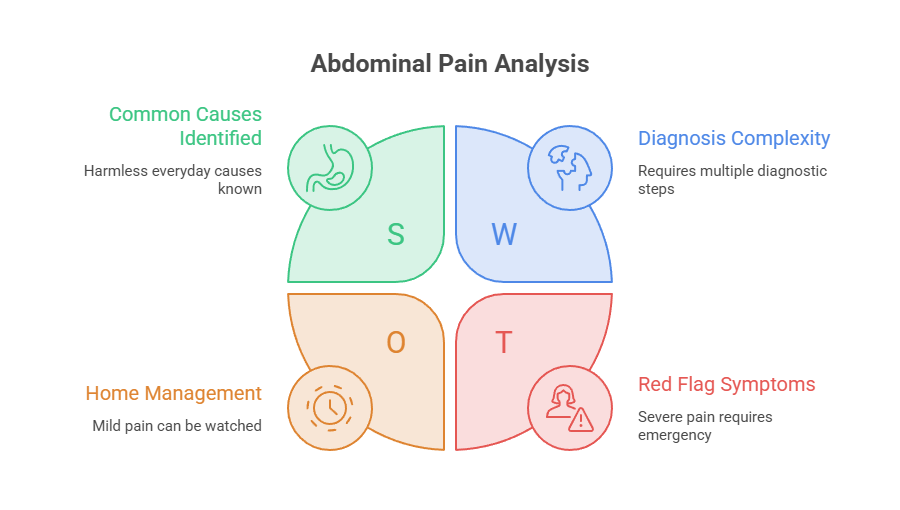
- The left upper quadrant holds your stomach, spleen, the tail of your pancreas, part of your colon, your left kidney, and the lower-left lung.
- Trapped gas and gastritis are the most common everyday causes, and both are usually harmless.
- Red flags that mean call 911: sudden severe pain, pain after an injury, vomiting blood, black tarry stools, fainting, or chest tightness with breathlessness.
- Abdominal pain is the single most common reason American adults visit the emergency room.
- Diagnosis usually combines a physical exam, blood and urine tests, and imaging such as ultrasound or CT.
- Mild pain with no warning signs can often be watched safely at home for 24 to 48 hours.
What Counts as Upper Left Abdominal Pain?
The phrase sounds technical, but the location is easy to picture. Doctors divide the belly into four quadrants, and the upper left one packs in several organs that can each produce a different kind of ache.
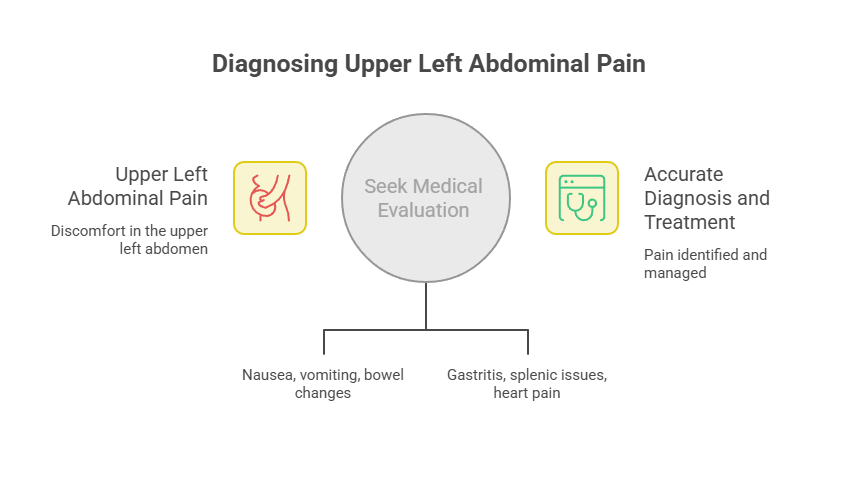
Our medical reviewers note that the large majority of upper left abdominal pain turns out to be digestive in origin. That is welcome news for anyone bracing for a worst-case diagnosis.
Finding the Left Upper Quadrant
Look down at your stomach. Picture a vertical line running through your belly button and a horizontal line crossing it, splitting your abdomen into four squares.
The top-left square, sitting just under your ribs on your left side, is your left upper quadrant, often shortened to LUQ. Pain here can sit high near the ribs or lower toward the navel, and it can drift toward your back or your left side.
Which Organs Sit There
This patch of the body is crowded. According to Healthline, the upper left abdomen contains the spleen, the left kidney, part of the pancreas, the stomach, part of the colon, and the lower portion of the left lung.
With so much packed into one zone, identifying the source takes a little detective work. The pain’s character, its timing, and the symptoms traveling with it usually point you in the right direction.
What the Pain Can Feel Like
Upper left abdominal pain comes in many forms. It can be sharp and stabbing, dull and achy, crampy and wavelike, or burning and gnawing.
It may stay in one spot or spread to your back, your shoulder, or your chest. Some pain arrives suddenly, while other types build slowly over days. Each pattern hints at a different cause, which is why describing it accurately to a clinician matters so much.
The Most Common Causes of Upper Left Abdominal Pain
The causes span a wide range, from a harmless pocket of gas to a true emergency. Grouping them by organ system makes the picture far clearer.
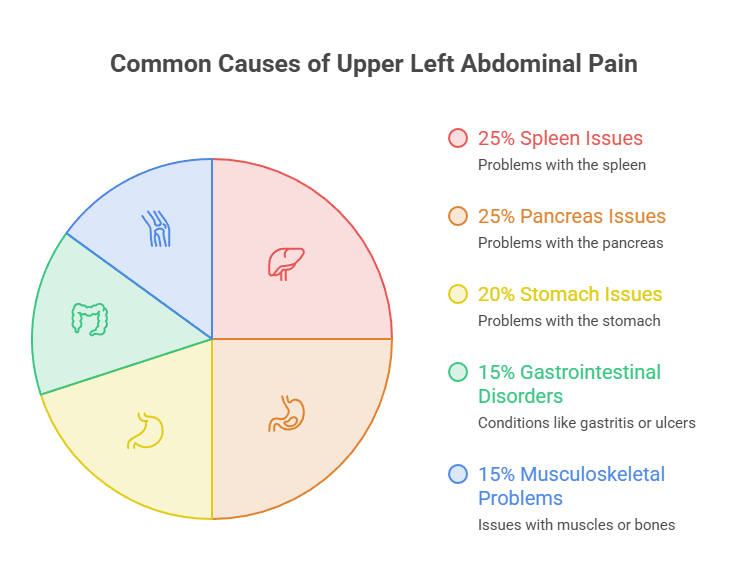
Digestive Causes
Your digestive tract is the most frequent troublemaker in this region, and the conditions below account for most cases people see.
Trapped Gas and Constipation
Gas stuck in the upper colon or the stomach can push outward and create surprisingly fierce pain. Trapped wind in the stomach or the left side of the colon can cause pain in the left upper quadrant or even the chest, and on rare occasions it gets mistaken for a heart attack.
Constipation backs things up and stretches the bowel, producing a crampy, heavy, full feeling. Both usually ease once you pass gas or have a bowel movement.
Gastritis and Stomach Ulcers
Gastritis is inflammation of the stomach lining, while an ulcer is an open sore in it. Because the stomach sits high on the left under the ribs, the pain lands right where you would expect.
According to Northwell Health, gastritis tends to cause sharp or burning pain that often worsens after eating or during stress, eases on an empty stomach, and is commonly triggered by excess alcohol, prolonged NSAID use, or bacterial infection.
Patients booking blood tests through HealthCareOnTime often ask whether burning after meals means an ulcer. The honest answer is that only a proper workup can tell the difference.
Two factors drive most stomach inflammation: a common bacterium called Helicobacter pylori, and regular use of pain relievers like ibuprofen and aspirin (NSAIDs). Per MedlinePlus from the NIH, roughly 30 to 40 percent of people in the United States pick up an H. pylori infection, usually in childhood, and it is the main cause of peptic ulcers. Most carriers never develop symptoms at all.
Acid Reflux and GERD
When stomach acid splashes back up into the esophagus, it creates a burning sensation that can sit in the upper left abdomen and the chest. It typically flares after large meals, when bending over, or when lying down at night.
Diverticulitis and IBS
The colon makes a sharp bend in the upper left abdomen called the splenic flexure. Inflamed pouches there (diverticulitis) or an irritable bowel can both cause left-sided cramping, bloating, and changes in bowel habits. These tend to be ongoing or recurring rather than sudden.
Spleen-Related Causes
The spleen lives high in the left upper quadrant, tucked behind the ribs. It filters blood and supports your immune system, so when it acts up, the pain is distinctly left-sided.
An enlarged spleen (splenomegaly) can follow infections like mononucleosis, liver disease, or certain blood cancers. According to Providence, an enlarged spleen can be caused by infections, liver disease, and some types of cancer.
A far more dangerous problem is a ruptured spleen, usually after a car crash, a sports collision, or another blow to the left side. This is a medical emergency. Across the cases our diagnostic network sees, sudden severe pain right after an injury is the pattern that demands the fastest response.
Pancreas: Acute Pancreatitis
The tail of the pancreas reaches into the left upper quadrant, so inflammation of this organ can register as upper left pain. Pancreatitis pain is typically severe and steady, radiates straight through to the back, and often worsens after eating or drinking alcohol.
Our lab partners report that a raised blood lipase level is one of the clearest early signals of pancreatitis, which is why doctors order it quickly when they suspect it. Gallstones and heavy alcohol use are the two leading triggers.
Kidney Causes
Your left kidney sits toward the back of this region. A kidney stone moving down the ureter creates sharp, cramping pain that comes in waves and can shoot toward your groin or lower back. As stones migrate through the ureter, they can become obstructed, which intensifies the pain.
A kidney infection (pyelonephritis) brings pain along with fever, chills, and a burning feeling when you urinate. Both deserve prompt medical attention, particularly when fever is present.
Muscle, Rib, and Nerve Causes
Not every pain comes from an internal organ. The rib cage, the muscles between the ribs, and the nerves running along them are common and frequently overlooked sources.
Costochondritis is inflammation of the cartilage joining the ribs to the breastbone, and a bruised or cracked rib behaves the same way. This pain is sharp, stays in one spot, and worsens when you press on it, twist, or breathe deeply.
Shingles can also strike here before any rash shows up. It affects the nerves and usually causes one-sided pain under the ribs or wrapping around to the back in a stripe-like band.
Heart and Lung Causes
This is the category people fear most. While it is less common, it is real, because the heart and the lower-left lung sit close enough to refer pain into the upper left abdomen.
Pain in the upper left abdomen can occasionally signal a heart attack or another life-threatening event, with classic warning signs including chest tightness, pressure, or pain that may spread to the jaw, neck, back, or arm. Pericarditis (swelling of the sac around the heart), pleurisy, and pneumonia in the left lung can also produce pain in this zone, often worse with each breath.
The table below pulls these causes together so you can match what you are feeling to its most likely source.
| Likely Cause | Organ Involved | Pain Type & Common Triggers | Other Symptoms | Urgency |
| Trapped gas | Stomach, colon | Crampy, bloated; after eating, eases with passing gas | Belching, fullness | Low |
| Constipation | Colon | Crampy, heavy; infrequent stools | Bloating, straining | Low |
| Gastritis or ulcer | Stomach | Burning, gnawing; worse when empty or after NSAIDs/alcohol | Nausea, low appetite | Low to moderate |
| Acid reflux (GERD) | Stomach, esophagus | Burning; worse lying down or after meals | Sour taste, chest burning | Low |
| Diverticulitis | Colon (splenic flexure) | Crampy, persistent left-sided pain | Fever, bowel changes | Moderate |
| Enlarged spleen | Spleen | Dull ache, fullness; worse on deep breath | Fatigue, fever if infected | Moderate |
| Ruptured spleen | Spleen | Sudden, severe; after trauma | Dizziness, fainting, left shoulder pain | Emergency |
| Acute pancreatitis | Pancreas | Severe, steady; radiates to back, worse after eating/alcohol | Nausea, vomiting, fever | Emergency |
| Kidney stone | Left kidney | Sharp, wavelike; radiates to groin or back | Blood in urine, nausea | Moderate to high |
| Costochondritis or rib injury | Rib cartilage, muscle | Sharp, localized; worse on movement, breath, or pressing | Tenderness over ribs | Low |
| Heart attack or angina | Heart | Pressure, tightness; may spread to jaw or arm | Shortness of breath, sweating | Emergency |
How Common Is This, and How Serious?
Abdominal pain is far from rare. It is one of the most frequent reasons Americans seek urgent care, and the numbers make that plain.
Per CDC data, stomach and abdominal pain is the single most common reason people visit the emergency room in the United States, making up roughly 12 percent of adult ED visits and over 13 million visits a year.
A recent national analysis confirms the trend is rising. According to an NHAMCS study in Academic Emergency Medicine, abdominal pain accounted for an estimated 9.46 million emergency department visits per year on average, and the visit rate has been climbing across all adult age groups.
Most of these visits are not catastrophes. The serious causes still carry real weight, and pancreatitis is a clear example.
As StatPearls reports, acute pancreatitis accounts for an estimated 200,000 to 275,000 hospital admissions each year in the US, making it the leading cause of gastrointestinal hospitalization, with about 80 percent of cases mild and mortality ranging from roughly 3 percent in mild disease to 20 percent in severe forms.
| Metric | US Figure | Source |
| Most common reason adults visit the ER | Abdominal pain (~12% of visits) | CDC / NHAMCS |
| Average annual ED visits for abdominal pain | ~9.46 million per year | NHAMCS (Wu, 2025) |
| Acute pancreatitis hospitalizations per year | 200,000 to 275,000 | StatPearls |
| Americans affected by kidney stones | About 1 in 11 | NHANES (NIH) |
| US population carrying H. pylori | 30 to 40 percent | NIH MedlinePlus |
| Lifetime peptic ulcer disease prevalence | About 1 in 12 | AAFP |
| Acute pancreatitis cases that are mild | Roughly 80 percent | StatPearls |
For context on the other common players, a national NIH study reports that kidney stones affect about 1 in 11 people in the United States. And the American Academy of Family Physicians notes that peptic ulcer disease affects roughly 1 in 12 Americans, with most ulcers tied to either H. pylori or NSAID use.
How to Tell What’s Causing Your Pain
You cannot diagnose yourself from a screen, but you can gather strong clues before you ever pick up the phone. In symptom reviews handled by our medical team, the timing of the pain often narrows the cause faster than its exact location does.
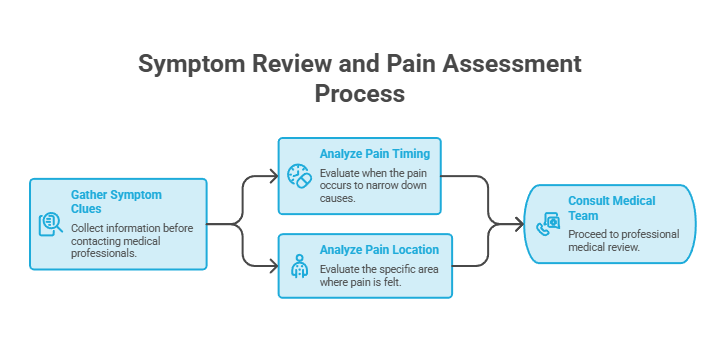
Pain That Comes and Goes vs Constant Pain
Pain that arrives in waves, peaks, then fades usually points to a hollow organ contracting, such as the bowel during gas or a ureter passing a kidney stone. Steady pain that does not let up is more concerning and leans toward inflammation, like gastritis or pancreatitis.
Sudden pain that hits maximum intensity within minutes always deserves attention, especially after an injury.
Pain After Eating
When the pain shows up tells a story. Pain that flares after fatty meals or alcohol raises suspicion for the pancreas, while burning pain worse on an empty stomach hints at an ulcer.
Reflux and gastritis both tend to act up during or shortly after meals. If the pattern is reliably tied to food, the stomach or pancreas is a sensible first place to look.
Left Side Pain Under Ribs When Breathing
Pain that sharpens with a deep breath or a cough generally points away from the digestive organs. The ribs, the muscles between them, the lining of the lung, and the spleen are the usual suspects. Spleen pain is felt in the upper left abdomen and can be noticed when coughing or when the area is pressed.
Symptoms That Point to a Specific Organ
Look at the company the pain keeps. Fever suggests an infection somewhere, blood in your urine points to the kidney, and vomiting blood or passing black stools points to a bleeding stomach.
Stress is also a genuine source of belly pain. The brain-gut connection means stress hormones can trigger muscle tension, spasms, and cramping in the stomach area, often felt as a tight, nervous stomach.
When Upper Left Abdominal Pain Is an Emergency
This is the part that matters most. Patients commonly ask us whether to head to the ER or wait it out, and the red-flag list below is the answer we point them to.
Call 911 Right Away If
Some symptoms cannot wait for an appointment. Per guidance echoed by medical reviewers at Ubie, you should seek urgent care for sudden severe pain, pain after trauma, fever, persistent vomiting, blood in vomit or stool, shortness of breath, or fainting.
Add chest pressure or tightness that spreads to your arm, jaw, or back, especially with sweating or breathlessness, since that pattern can signal a heart attack.
See a Doctor Within a Day or Two If
Not every concerning symptom is a 911 call, but many still need prompt attention. Book a same-day or next-day visit if the pain is moderate but persistent, if you have a low-grade fever, or if you notice changes in your stools or urine.
The same applies to pain that keeps you from eating or sleeping normally. Earlier evaluation usually means simpler treatment.
When Watchful Waiting Is Reasonable
Mild pain with no warning signs can often be observed at home. For mild symptoms without red flags, rest, hydration, and light meals over 24 to 48 hours while monitoring is a sensible starting point, with a medical visit if the pain lasts or keeps returning.
If the pain eases after passing gas or a bowel movement and does not come back, it was very likely something minor.
| Your Situation | What It May Mean | What to Do Now |
| Sudden severe pain, especially after a fall or blow | Possible spleen rupture or internal bleeding | Call 911 immediately |
| Chest tightness with breathlessness and sweating | Possible heart attack | Call 911 immediately |
| Severe steady pain radiating to the back, with vomiting | Possible acute pancreatitis | Go to the ER |
| Fever plus worsening pain, unable to keep fluids down | Possible kidney or spleen infection | Same-day urgent or ER care |
| Vomiting blood or passing black, tarry stools | Possible bleeding ulcer | Go to the ER |
| Mild crampy pain that eases after passing gas | Likely trapped gas | Self-care, monitor 24 to 48 hours |
| Burning pain after meals, no red flags | Likely gastritis or reflux | OTC antacid; see a doctor if it persists |
How Doctors Diagnose the Cause
Because the list of suspects is long, doctors work through it methodically rather than guessing. The process is usually quick and starts with conversation.
What to Tell Your Doctor
Walk in ready to describe four things: when the pain started, what it feels like, what makes it better or worse, and what other symptoms you have noticed. Mention any recent injury, your alcohol intake, and any regular use of NSAIDs.
These details do a surprising amount of the diagnostic work, so the more specific you are, the faster the path to answers.
The Physical Exam
Your doctor will gently press different parts of your belly to find tender spots, check for guarding, and feel for any enlarged organ or mass. The exam often reveals whether the pain sits in the abdominal wall or deeper inside.
Blood and Urine Tests
Lab work fills the gaps the exam cannot reach. A complete blood count flags infection or anemia, a lipase test points to the pancreas, and kidney function and urine tests reveal stones or infection.
These results frequently steer the next decision, which is why HealthCareOnTime makes booking common panels straightforward for people who want clarity before a specialist visit.
Imaging and Endoscopy
When tests suggest a structural problem, imaging confirms it. A careful look at the organs in this region, paired with labs and a thorough examination, lets a clinician narrow what is otherwise a wide differential diagnosis.
Ultrasound and CT scans show the spleen, pancreas, and kidneys clearly, while an endoscopy lets a doctor look directly at the stomach lining when an ulcer or gastritis is suspected.
Treatment and Relief Options
Treatment depends entirely on the cause, so a single answer does not exist. The options run from a glass of water at home to admission for IV care.
Self-Care for Mild Cases
For everyday gas, mild reflux, or minor gastritis, simple steps go a long way. Rest, stay hydrated, eat smaller and blander meals, and try an over-the-counter antacid or a gas-relief product.
Avoid known triggers like alcohol, spicy or fatty foods, and NSAID pain relievers if you suspect your stomach is the source. A heating pad and light walking can also relieve gas and muscle pain.
Medical Treatment by Cause
Once a doctor pins down the cause, targeted treatment follows. Treatment may include pain relief, antacids or other over-the-counter medicines, and surgery in severe cases.
Gastritis and ulcers often need acid-reducing medicines (PPIs) plus antibiotics when H. pylori is present. Pancreatitis usually means hospital care with fasting, IV fluids, and pain control, while a large kidney stone may need a procedure to break it up.
What Not to Do
Skip the urge to push through severe or worsening pain at home. Avoid taking more NSAIDs if a stomach problem is likely, and do not eat heavily if pancreatitis is suspected, since food stimulates the very organ that needs rest.
Special Situations
Upper left abdominal pain does not behave the same way in everyone. A few groups deserve extra care.
During Pregnancy
Pregnancy adds its own list of causes. Upper abdominal pain in pregnancy can come from indigestion, urinary tract infections, or pressure from the growing uterus on nearby organs, while an ectopic pregnancy that bleeds internally is a medical emergency.
Any new or significant abdominal pain during pregnancy should be checked by a provider promptly rather than waited out.
In Children
Young children often cannot point to exactly where it hurts, which widens the list of possibilities to almost any cause of a tummy ache. Constipation and gas are common, but persistent pain, fever, or a child who seems unusually unwell warrants medical evaluation.
In Older Adults
Pain that seems mild in an older adult can mask something serious. According to research on ED practice patterns, abdominal pain is the most common reason older adults visit the emergency room, and it carries high morbidity and mortality despite often appearing nonspecific. A lower threshold for getting checked is wise.
How to Lower Your Risk
You cannot prevent every cause, but you can shrink the odds for several common ones. Small, steady habits do most of the work.
Go easy on alcohol and avoid routine NSAID use to protect both your stomach and your pancreas. Stay well hydrated to discourage kidney stones, and eat a fiber-rich diet to keep your bowels moving and gas at bay.
Wear a seatbelt to guard the spleen against injury, and manage stress, since the gut responds directly to it. If a past infection like mononucleosis enlarged your spleen, follow your doctor’s advice on avoiding contact sports until it returns to its normal size.
Frequently Asked Questions
What organ is in the upper left side of the abdomen?
Several organs share this space. The stomach, the spleen, the tail of the pancreas, part of the colon, the left kidney, and the lower portion of the left lung all sit here. That crowding is exactly why upper left abdominal pain has so many possible causes and benefits from careful evaluation.
When should I worry about upper left abdominal pain?
Worry when the pain is sudden and severe, follows an injury, or comes with fever, vomiting blood, black stools, fainting, or chest tightness and breathlessness. Those signs can point to a ruptured spleen, pancreatitis, a bleeding ulcer, or a heart problem, all of which need emergency care right away.
Can trapped gas cause pain under the left ribs?
Yes, and it happens often. Gas trapped in the upper colon or stomach can press outward and create sharp or crampy pain under the left ribs. It is usually harmless and eases once you pass gas or have a bowel movement, though severe gas pain occasionally mimics more serious conditions.
Is upper left abdominal pain a sign of a heart attack?
It can be, though it is not the most common cause. The heart sits close enough to refer pain into the upper left abdomen. Treat it as urgent if the pain comes with chest pressure, breathlessness, sweating, or pain spreading to your jaw, neck, or arm, and call 911.
Why does my upper left abdomen hurt after eating?
Pain after meals usually involves the stomach or pancreas. Gastritis, ulcers, and reflux flare as the stomach fills and produces acid, while pancreatitis pain often worsens after eating or drinking alcohol. If burning pain after meals keeps returning, a doctor can test for the underlying cause.
What does spleen pain feel like?
Spleen pain typically sits high on the far left, under the ribs, as a dull ache or a sense of fullness, and it may sharpen when you take a deep breath or cough. An enlarged spleen can also bring fatigue and early fullness when eating, while a ruptured spleen causes sudden, severe pain.
Can stress or anxiety cause upper left abdominal pain?
Yes. The gut and brain are closely linked, so stress hormones can trigger muscle tension and spasms in the stomach area. This often feels like tightness, cramping, or a nervous stomach. Stress-related pain is common, but persistent or severe pain still deserves a medical check to rule out other causes.
Why does it hurt under my left rib cage when I breathe?
Pain that worsens with breathing usually points away from the digestive organs. Costochondritis, a bruised or cracked rib, pleurisy, or pneumonia in the left lung are common reasons, and the spleen can do this too. If breathing is difficult or the pain is severe, seek prompt medical attention.
Is upper left abdominal pain a sign of pancreatitis?
It can be, since the tail of the pancreas reaches into this area. Pancreatitis pain is typically severe and steady, radiates to the back, and worsens after eating or alcohol, often with nausea and vomiting. This is a medical emergency, so go to the ER if these symptoms appear together.
How do I know if it’s my kidney?
Kidney pain tends to start more toward the back and side rather than the front of the belly. A stone causes sharp, wavelike pain that may travel to the groin, often with blood in the urine. A kidney infection adds fever, chills, and burning during urination. Both need medical care.
What home remedies help upper left abdominal pain?
For mild pain with no red flags, rest, drink water, eat small bland meals, and try an over-the-counter antacid or gas-relief product. A heating pad and gentle movement can ease gas and muscle pain. Avoid alcohol and NSAIDs. If the pain lasts beyond a day or two, see a doctor.
Should I go to the ER or urgent care for left-side pain?
Choose the ER for sudden severe pain, pain after trauma, vomiting blood, fainting, high fever, or chest tightness with breathlessness. Urgent care suits moderate, persistent pain without those danger signs. When unsure, err on the side of caution, since some causes of upper left abdominal pain are time-sensitive.
Disclaimer
This article is for general informational purposes only and is not a substitute for professional medical advice, diagnosis, or treatment. Always consult a qualified healthcare provider about any symptoms or health concerns. If you think you may be experiencing a medical emergency, call 911 or your local emergency number immediately.
References
- CDC, National Center for Health Statistics: Emergency Department Visits for Chest Pain and Abdominal Pain
- Academic Emergency Medicine: Trends in ED Abdominal Pain Visits, 2007-2019 (NHAMCS)
- NCBI: Emergency Department Practice Patterns for Older Adults With Abdominal Pain
- StatPearls (NCBI): Acute Pancreatitis
- NIH MedlinePlus: Helicobacter pylori Infections
- American Academy of Family Physicians: Peptic Ulcer Disease and H. pylori
- NIH (PubMed): Prevalence of Kidney Stones in the United States
- Healthline: Upper Left Abdominal Pain Under Ribs
- Northwell Health: Pain Under the Left Rib Cage, 21 Causes
- Providence: Left-Side Stomach Pain, When to See a Doctor