Yes. Plain Tylenol (acetaminophen) has no known interaction with hydroxychloroquine (Plaquenil), and the US prescribing label doesn’t list acetaminophen anywhere in its drug interaction section.
Table of Contents
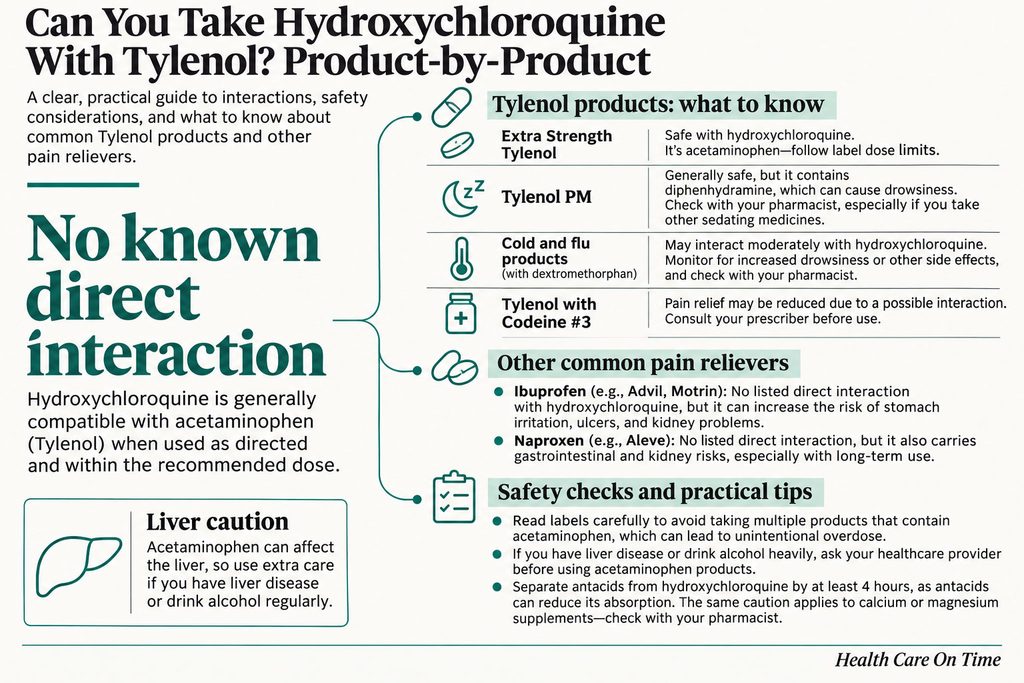
Quick answer: You can take hydroxychloroquine with Tylenol. Acetaminophen and hydroxychloroquine have no listed interaction, and you don’t need to space the doses apart. Stay under the acetaminophen limit on the box (no more than 4,000 mg a day from all products), and check combination products: Tylenol #3 (codeine) and cold medicines with dextromethorphan do interact, and antacids, magnesium and calcium need a 4-hour gap.
The Tylenol name now sits on sleep aids, cold medicines and prescription codeine tablets as well as plain acetaminophen, and those products don’t all behave the same way next to hydroxychloroquine.
Why Tylenol and hydroxychloroquine don’t clash
Hydroxychloroquine is an old drug, and in the US label its approved adult uses are malaria, rheumatoid arthritis, systemic lupus and chronic discoid lupus; doctors also prescribe it off label for conditions such as Sjogren’s syndrome. It was first approved in the United States in 1955, and its US prescribing label has a long list of drugs that do interact with it: medicines that prolong the QT interval on an ECG, insulin and other diabetes drugs, digoxin, cyclosporine, methotrexate, seizure medicines, cimetidine, rifampicin, praziquantel, ampicillin, and antacids. Acetaminophen isn’t on that list. Neither is ibuprofen, naproxen or any vitamin.
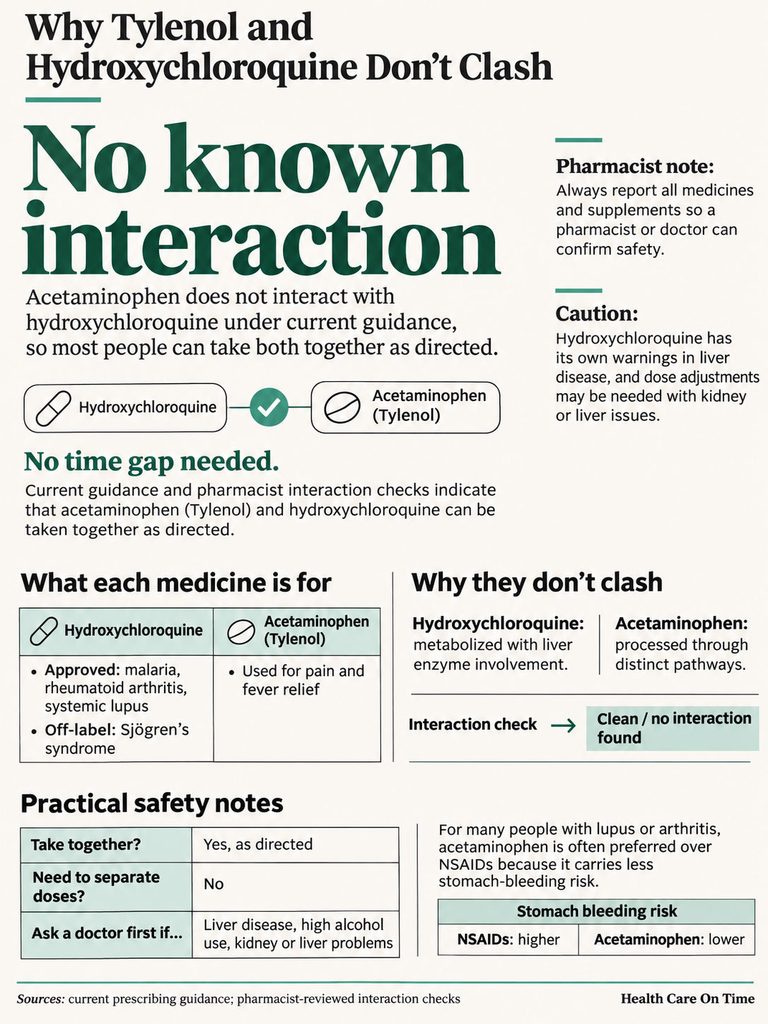
On the chemistry side, the two drugs don’t compete in an obvious way. Acetaminophen is broken down mostly in the liver through its own pathways, while hydroxychloroquine is handled by several liver enzymes (CYP2C8, CYP3A4 and CYP2D6) and leaves the body slowly. A standard interaction check comes back clean, and the government’s patient drug sheet on hydroxychloroquine skips acetaminophen entirely; the one over-the-counter product it singles out is cimetidine (Tagamet HB).
That same sheet asks you to tell your doctor and pharmacist about every prescription and nonprescription drug, vitamin and supplement you take, and the habit pays off with hydroxychloroquine more than with most drugs. Filling everything at one pharmacy lets its software compare a new product against the whole list, including the cough syrup or sleep aid you’d otherwise forget to mention.
When a pharmacist calls a pair “no known interaction,” the claim is narrow: nobody has found a way the two drugs change each other’s levels or effects enough to matter. Each drug keeps its own risks. Acetaminophen still has a daily ceiling, and hydroxychloroquine still has its own warnings about the eyes, heart rhythm and blood sugar.
Acetaminophen has a practical edge for people with lupus or rheumatoid arthritis. It doesn’t carry the stomach-bleeding risk that comes with NSAIDs, and at recommended doses it’s generally safe for the kidneys, which matters for anyone whose doctor is watching for lupus kidney involvement.
No time gap is needed between the two. Take hydroxychloroquine the way the label directs, with food or milk, and take Tylenol whenever you need it. Swallowing them at the same breakfast is fine.
Hydroxychloroquine has a liver warning of its own, but it’s narrow. The label ties it to porphyria cutanea tarda, a rare metabolic disorder, where liver injury has been reported, sometimes within days to a month of starting the drug, and it tells doctors to avoid hydroxychloroquine in porphyria.
Two groups should still check with a doctor first: people with liver disease, because acetaminophen can make liver disease worse, and people who drink three or more alcoholic drinks a day. Hydroxychloroquine’s label also says the dose may need to be lowered in liver or kidney disease, so these are the same patients a rheumatologist already watches more closely.
Every Tylenol product and common pain reliever, checked
In the table, “no listed interaction” means nothing turns up in the US Plaquenil label, the product’s own Drug Facts panel or a standard pharmacist interaction check.
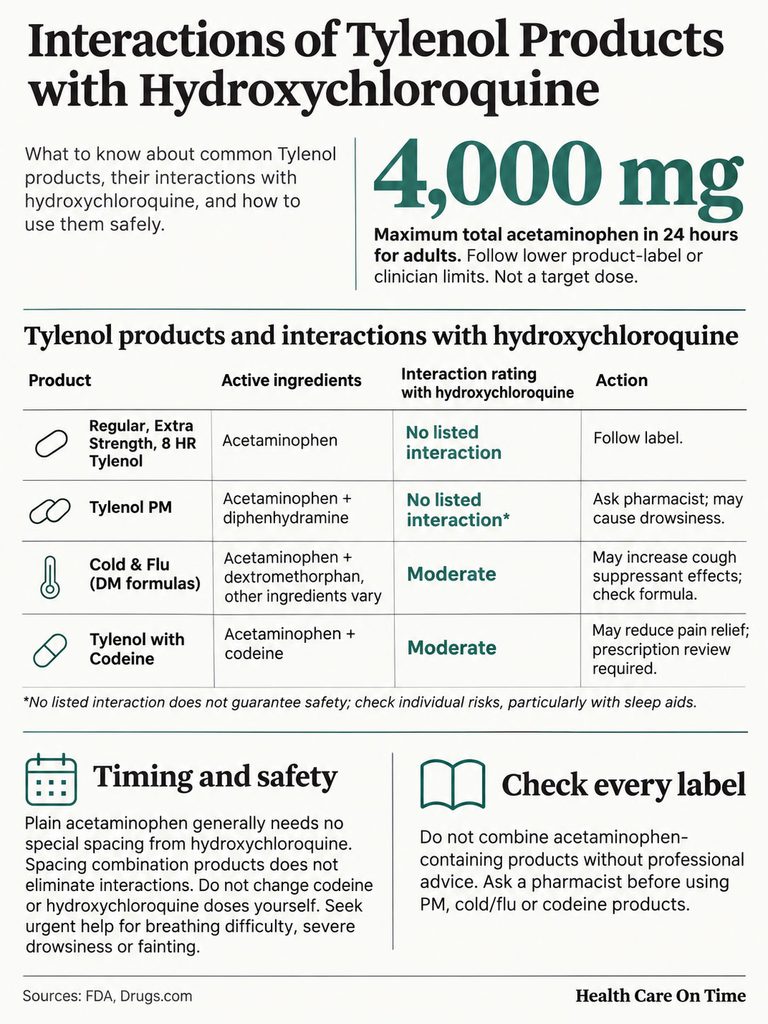
| Product | What’s in it | Interaction with hydroxychloroquine | What to do |
| Tylenol Extra Strength | Acetaminophen 500 mg | No listed interaction | Take as directed; Extra Strength max is 6 caplets (3,000 mg) in 24 hours on the label |
| Tylenol 8 HR Arthritis Pain | Acetaminophen 650 mg, extended release | No listed interaction | 2 caplets every 8 hours, no more than 6 caplets in 24 hours |
| Tylenol PM Extra Strength | Acetaminophen 500 mg + diphenhydramine 25 mg | No listed interaction with either ingredient | Max 2 caplets in 24 hours; don’t add other acetaminophen or diphenhydramine products |
| Tylenol Cold and Flu type products | Acetaminophen + dextromethorphan + phenylephrine; Severe versions add guaifenesin | Moderate: hydroxychloroquine may raise dextromethorphan levels | Ask a pharmacist; watch for drowsiness or dizziness; count the acetaminophen |
| Tylenol with Codeine #3 | Acetaminophen 300 mg + codeine 30 mg | Moderate: hydroxychloroquine may reduce codeine’s effect | Tell the prescriber you take hydroxychloroquine; report poor pain relief or withdrawal-type symptoms |
| Ibuprofen (Advil, Motrin) | NSAID | No listed interaction | OK for most people; extra caution with kidney disease, high blood pressure, heart failure or stomach bleeding history |
| Naproxen (Aleve) | NSAID | No listed interaction; label allows other antirheumatic drugs | Same NSAID cautions as ibuprofen |
| Low-dose aspirin | Salicylate | Label says salicylates may be used with hydroxychloroquine | Keep to the dose your doctor set; above 325 mg a day aspirin acts like an NSAID on the kidneys |
| Antacids, magnesium supplements, milk of magnesia | Magnesium or aluminum salts | Moderate: can reduce hydroxychloroquine absorption | Separate by at least 4 hours |
| Calcium carbonate (Tums, Caltrate) | Calcium carbonate | Moderate: can reduce absorption | Separate by at least 4 hours |
| Multivitamin, vitamin C, vitamin B12 | Vitamins | No listed interaction for multivitamins | Fine; if the multivitamin contains calcium or magnesium, use the 4-hour gap |
| Vitamin D3 | Cholecalciferol | No listed interaction | Fine at the dose your doctor recommends |
| Zinc | Zinc salt | Not named in the US label | Generally fine; multi-mineral blends with magnesium or calcium need the 4-hour gap |
Tylenol PM
Tylenol PM Extra Strength contains 500 mg of acetaminophen and 25 mg of diphenhydramine per caplet. The directions are 2 caplets at bedtime, and the box tells you not to take more than 2 caplets in 24 hours. Diphenhydramine, the Benadryl ingredient, has no listed interaction with hydroxychloroquine.
The more common mistake is doubling up. Someone takes Extra Strength Tylenol during the day for joint pain, then two Tylenol PM at night, and loses track of the total. The PM label itself says not to use it with any other product containing acetaminophen or diphenhydramine. If you take sedatives or tranquilizers, or you have glaucoma, an enlarged prostate or a breathing problem such as emphysema, the label tells you to ask a doctor or pharmacist before using it at all. It also warns that you’ll be drowsy, and that you shouldn’t drink alcohol, drive or run machinery after taking it.
Cold and flu products with dextromethorphan
Many Tylenol cold and flu products, along with store brands sold as “daytime cold and flu,” combine acetaminophen with dextromethorphan (a cough suppressant) and phenylephrine (a decongestant). Dextromethorphan with hydroxychloroquine is rated a moderate interaction, because hydroxychloroquine may raise blood levels and effects of dextromethorphan. The likely reason is that dextromethorphan relies on the CYP2D6 enzyme, and the Plaquenil label reports that hydroxychloroquine has the potential to inhibit CYP2D6 in lab studies.
The effects to report are drowsiness, dizziness, trouble breathing, sleep problems and diarrhea, and a pharmacist may suggest a dose change, a product without dextromethorphan, or closer watching. Phenylephrine and acetaminophen had no listed interaction with hydroxychloroquine in the same check.
Count the acetaminophen in these products too. Multi-symptom cold medicines usually contain it, and taking one with regular Tylenol is the classic way people go over the daily limit without meaning to. DayQuil is the usual example: it contains acetaminophen too, so the wait after a Tylenol dose depends on how much acetaminophen you’ve already had that day, and hydroxychloroquine doesn’t change that math.
Tylenol #3 and the codeine problem
Tylenol with Codeine No. 3 is a prescription tablet with 300 mg of acetaminophen and 30 mg of codeine. The acetaminophen in it is fine with hydroxychloroquine; the codeine needs more thought.
Codeine itself is a weak painkiller. Your body turns some of it into morphine through the CYP2D6 enzyme, and that morphine does most of the work. The codeine label carries a boxed warning about drugs that affect CYP450 enzymes: when a CYP2D6 inhibitor is taken with codeine, codeine levels go up while morphine levels go down, so pain relief can drop and some people get withdrawal-type symptoms. When the inhibitor is stopped, the reverse happens, with more morphine and a risk of serious, even fatal, breathing problems.
The label describes hydroxychloroquine’s CYP2D6 effect only from lab studies, but codeine and hydroxychloroquine are rated a moderate interaction in pharmacist references, with three possible effects: codeine may work less well; someone already taking codeine who starts hydroxychloroquine may notice sweating, chills, restlessness, tremor, a fast heartbeat or nausea; and someone taking both who suddenly stops hydroxychloroquine may see codeine’s side effects grow, including drowsiness, dizziness and trouble breathing.
Hydroxychloroquine also leaves the body slowly, with a whole-blood half-life of 40 to 50 days in long-term use, so if it’s stopped, any change in how codeine behaves would likely play out over several weeks rather than overnight.
A short course of Tylenol #3 after dental work or an injury can still make sense for someone on hydroxychloroquine. The person writing the codeine prescription should know about the hydroxychloroquine, though, and you should report pain relief that feels much weaker than expected, or unusual sleepiness or slow breathing. Alcohol is off limits while taking codeine.
Ibuprofen, naproxen and aspirin alongside hydroxychloroquine
Ibuprofen (Advil, Motrin) and naproxen (Aleve) don’t appear in the Plaquenil label’s interaction section, an ibuprofen check comes back empty, and the dosing section of the label goes further by allowing corticosteroids, salicylates and other antirheumatic agents alongside hydroxychloroquine. Rheumatologists use the combination constantly, and NSAIDs sit next to prednisone and immunosuppressants on the Johns Hopkins Lupus Center’s list of drugs antimalarials can be paired with.
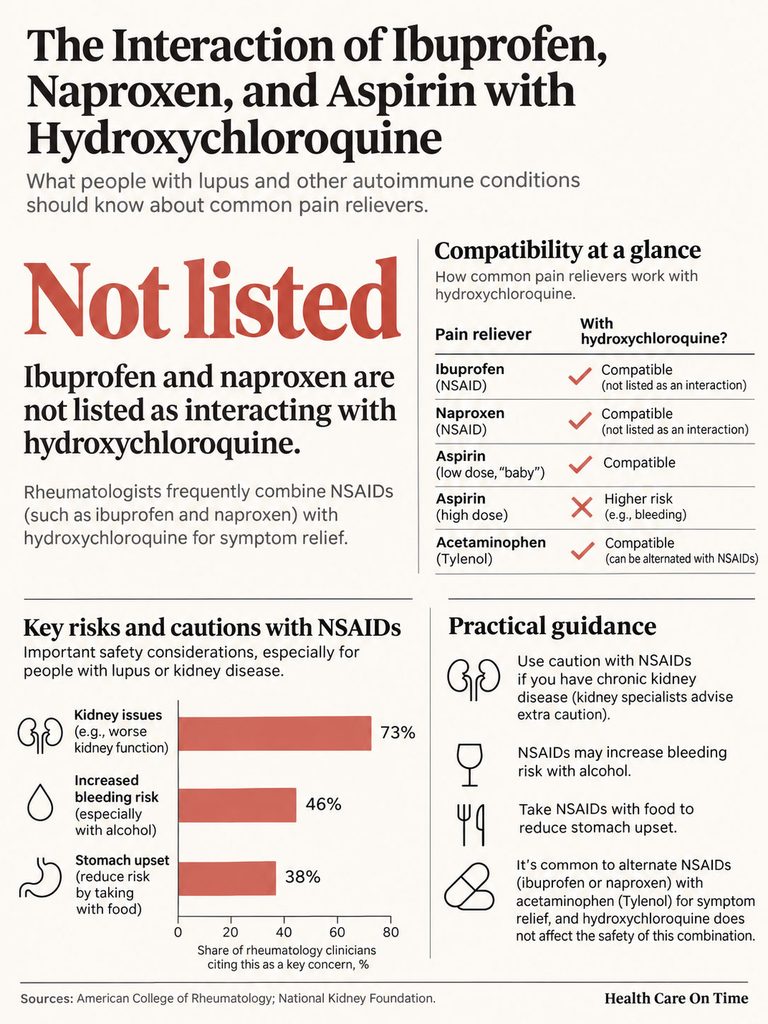
The trouble with NSAIDs comes from their own side effects, and those land harder in lupus. NSAIDs cut the amount of blood flowing through the kidneys, which can cause acute kidney injury or worsen chronic kidney disease, more so at higher doses or with long-term use, and kidney specialists tell people with chronic kidney disease to avoid them, particularly once eGFR falls below 60. Lupus can inflame the kidneys (lupus nephritis), and anyone taking an ACE inhibitor, an ARB or a water pill for blood pressure is already in the group told to be careful, along with people who have heart disease, heart failure or high blood pressure. Then there’s the stomach: NSAIDs raise the risk of bleeding, alcohol makes that worse, and taking each dose with food helps.
If your doctor has you on a baby aspirin, for example because of clotting risk, the label’s allowance for salicylates covers it. Above 325 mg a day, aspirin starts acting like an NSAID on the kidneys and raises bleeding risk.
Some people get through a rough day by alternating the two classes, a dose of Tylenol and then ibuprofen a few hours later. Hydroxychloroquine doesn’t change how Tylenol and ibuprofen are combined safely: each drug stays inside its own daily limit, and the kidney, heart and stomach cautions above still decide whether ibuprofen belongs in the rotation at all.
Which pain Tylenol helps, and which pain it won’t touch
Acetaminophen turns down pain signals in the brain and lowers fever, but it doesn’t lower inflammation, so it usually works best for headaches and pain from bone damage, while NSAIDs usually work best for pain caused by inflammation. In practice, that means Tylenol is a good fit for a tension headache, a fever with a cold, or sore muscles after a long day. Morning stiffness in rheumatoid arthritis that eases by midday is a good test case:
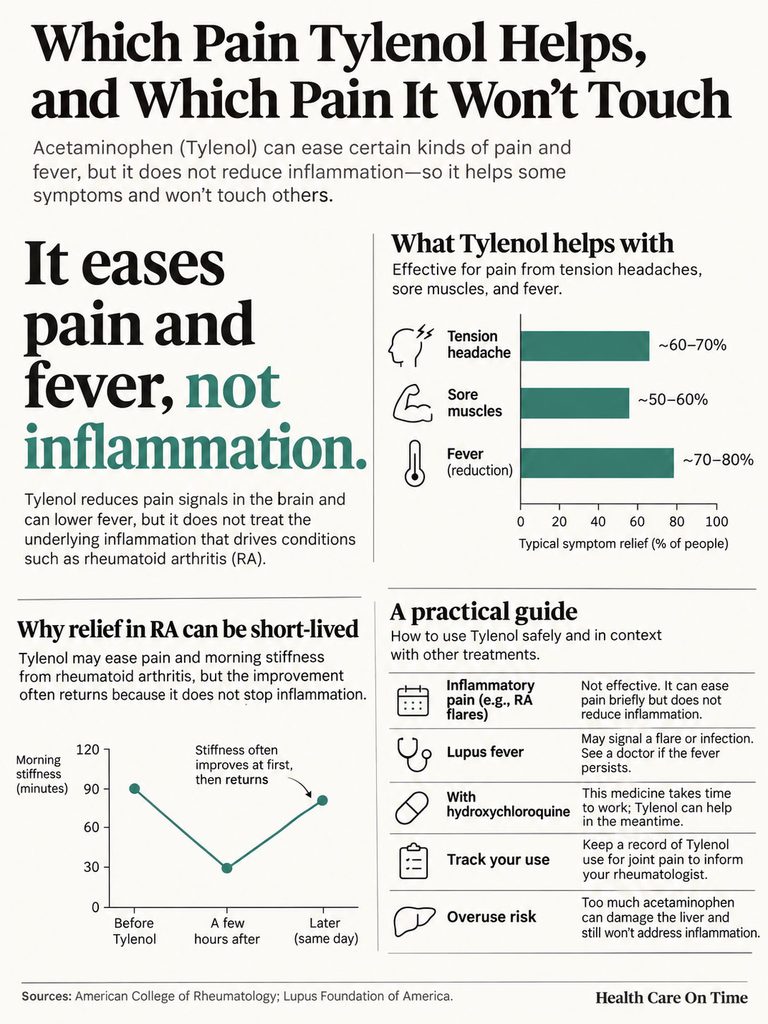
Tylenol may take the edge off the ache, but it won’t loosen the joints the way treating the inflammation does, so the stiffness tends to come back the next morning anyway. A hot, swollen, stiff joint during a lupus or RA flare is different, because that pain comes from active inflammation, and acetaminophen may barely dent it.
Tylenol does bring a fever down, but in someone with lupus a fever can come from a flare or from an infection, and the Tylenol label itself says to stop and ask a doctor if fever gets worse or lasts more than 3 days. A fever that keeps coming back, or one that arrives with a rash, chest pain or new joint swelling, calls for a phone call rather than another dose.
Hydroxychloroquine is slow to start working. People may feel some benefit after about a month, the full effect can take up to three months, and doctors sometimes bridge that gap with a steroid. During those first weeks, a lot of people reach for over-the-counter pain relief while waiting for the main treatment to kick in.
If you find yourself needing Tylenol most days for joint swelling, jot down how often and for what, since that record helps more at an appointment than a vague sense that the pain is about the same. Treat that pattern as information for your rheumatologist rather than a reason to keep raising the dose. It can mean the disease isn’t controlled yet, the dose needs review, or another treatment would work better. Pushing acetaminophen closer to its daily ceiling won’t fix inflammation, and it adds liver risk.
Supplements: magnesium, calcium, vitamins C, D, B12 and zinc
Most supplements are fine with hydroxychloroquine, with one exception: anything that works like an antacid.
Antacids and kaolin reduce the absorption of chloroquine, a closely related drug, and because the same effect can’t be ruled out for hydroxychloroquine, the label asks for at least 4 hours between them; in practice, take antacids 4 hours before or 4 hours after your dose. The same rule applies to magnesium oxide and to calcium carbonate; both are rated moderate interactions, because these minerals can bind the drug in the gut and lower how much gets absorbed.
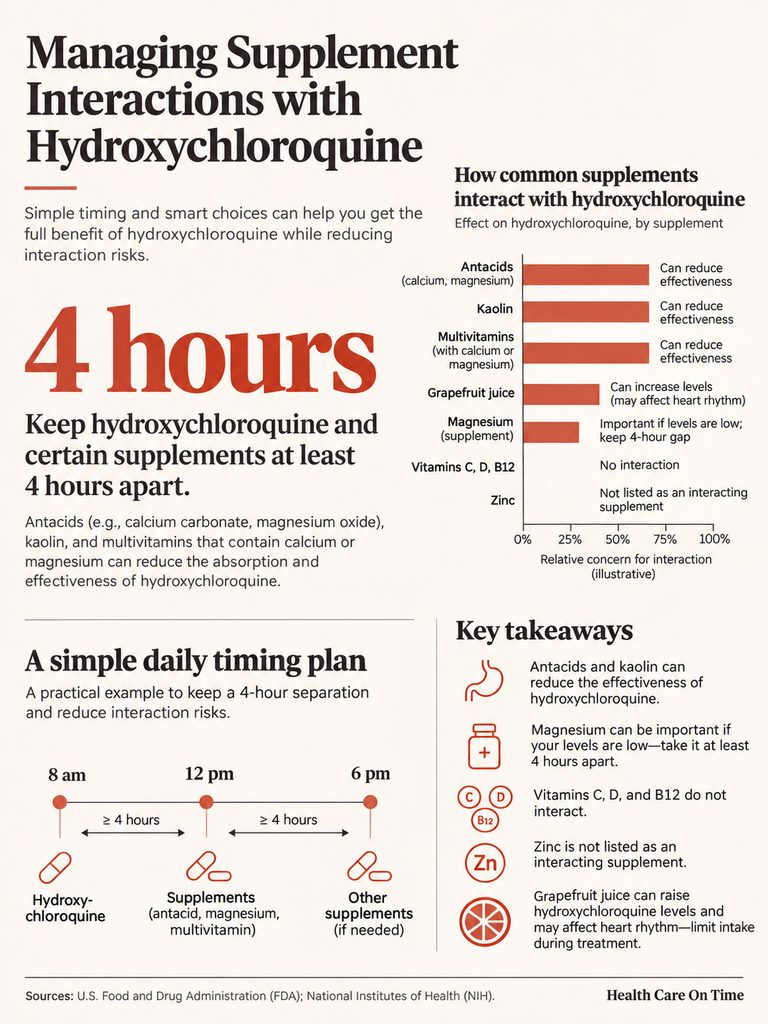
The label also lists low blood magnesium (hypomagnesemia), along with low potassium, as a risk factor for the heart rhythm problem hydroxychloroquine can cause, and it tells doctors to correct electrolyte problems before starting the drug. So if your doctor has you on magnesium because your levels run low, keep taking it; just move it at least 4 hours away from your hydroxychloroquine dose. Magnesium oxide, citrate and hydroxide all appear on hydroxychloroquine interaction lists. People often pick glycinate to avoid the loose stools some magnesium forms cause, but it’s still magnesium, so give it the same 4-hour gap.
Plain vitamins cause no trouble: neither a standard multivitamin nor vitamin D3 has a listed interaction with hydroxychloroquine. Vitamin C, vitamin B12 and zinc aren’t named in the US label’s interaction section. The one catch is the “with minerals” multivitamin or a bone-health formula: many contain calcium carbonate or magnesium, which brings the 4-hour rule back.
Grapefruit is the food to watch rather than any vitamin. Grapefruit juice can raise hydroxychloroquine levels enough to affect heart rhythm, so limiting it during treatment is the usual advice.
A simple daily timing plan
A schedule that works for many people looks like this:
- Breakfast: hydroxychloroquine with food or milk, plus vitamin D, vitamin C or B12 if you take them.
- Any time: Tylenol when you need it, breakfast included.
- Afternoon or evening (4+ hours later): magnesium, calcium, a mineral multivitamin, or an antacid such as Tums or milk of magnesia.
- Twice-daily dosing: if you take hydroxychloroquine morning and evening, put minerals in the middle of the gap, or ask a pharmacist to map it out with you.
Acetaminophen limits that matter more than the interaction
For most people on hydroxychloroquine, the danger with Tylenol is simply taking too much acetaminophen.
The FDA’s ceiling for adults is 4,000 mg a day from all medicines combined, and more than 600 prescription and over-the-counter medicines contain acetaminophen. Product labels are often stricter than that ceiling. The Extra Strength Tylenol label says 2 caplets every 6 hours and no more than 6 caplets (3,000 mg) in 24 hours unless a doctor directs otherwise, and the Tylenol 8 HR Arthritis label caps you at 6 caplets of 650 mg (3,900 mg). The box number is the one to follow unless a doctor sets a different limit, so for Extra Strength that means 6 caplets of Tylenol 500 mg in a day at most.
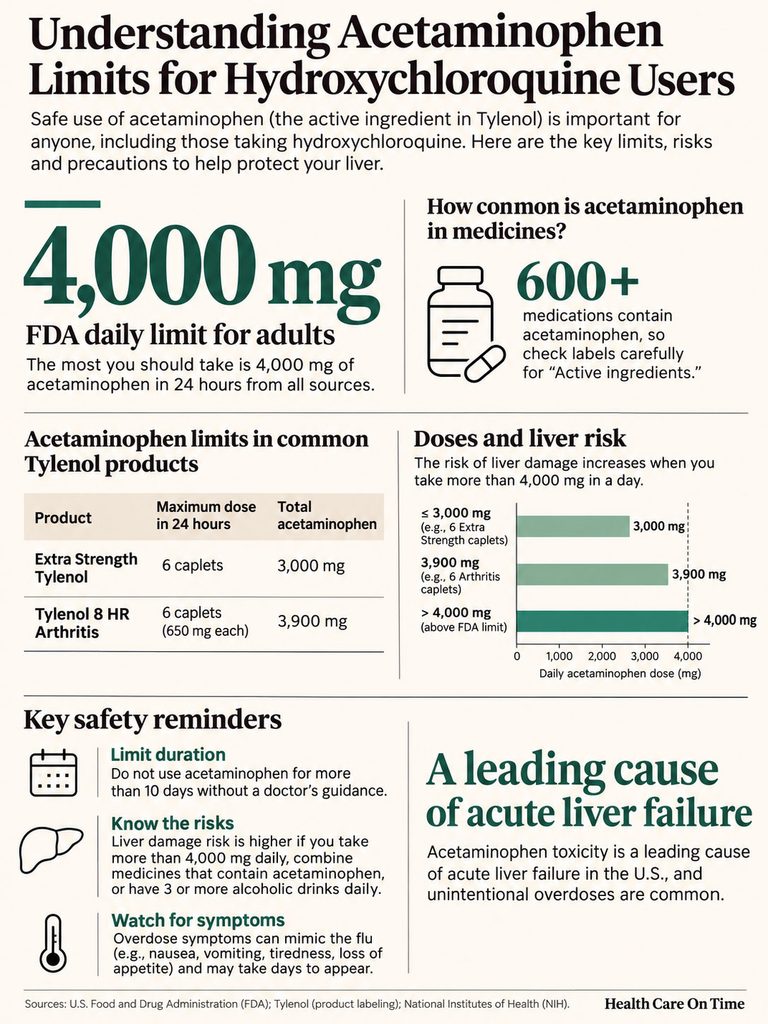
Both labels also tell you not to use the product for more than 10 days unless a doctor directs you to. People with lupus or rheumatoid arthritis often need pain relief for longer than that, which is fine, but daily use past 10 days should be something your doctor knows about and agrees with.
The liver warning on every acetaminophen box lists three situations that raise the risk of severe liver damage: more than 4,000 mg in 24 hours, taking it with other drugs that contain acetaminophen, and having 3 or more alcoholic drinks every day while using it. Overdose doesn’t always feel like an emergency. Early symptoms (nausea, vomiting, belly pain, confusion and yellow skin or eyes) can look like the flu, some people have no symptoms at all, and signs may take several days to appear.
Spotting acetaminophen you didn’t know you were taking
Read the label of every over-the-counter and prescription drug you take, know which of them contain acetaminophen, and use only one acetaminophen product at a time. On over-the-counter boxes, look at the “Active ingredients” line at the top of the Drug Facts panel. On pharmacy bottles, the name may be shortened to APAP, Acetaminoph, Acetaminop, Acetamin or Acetam, which is easy to miss if you’re scanning for the word Tylenol.
Products that often hide it include nighttime pain relievers, multi-symptom cold and flu medicines, and prescription pain pills that pair acetaminophen with codeine, hydrocodone or oxycodone. If you take hydroxychloroquine and several other prescriptions, ask the pharmacist to flag every acetaminophen-containing product on your profile.
Federal and journal figures put numbers on both sides of this: how many people live with arthritis or lupus, and how much harm acetaminophen mistakes cause.
| Measure | US figure | Source |
| Adults with diagnosed arthritis | 53.2 million (21.2%), 2019 to 2021 | CDC MMWR, 2023 |
| Adults with rheumatoid arthritis | About 10.6 million (15.8% of adults with diagnosed arthritis), 2017 to March 2020 | CDC Preventing Chronic Disease, 2025 |
| People with systemic lupus | About 204,000; 9 in 10 are women | CDC lupus data |
| Medicines that contain acetaminophen | More than 600 | FDA |
| Acetaminophen poisoning, yearly | About 56,000 ER visits, 2,600 hospital stays, 500 deaths; about half unintentional | StatPearls, NIH, 2026 |
| Retinal damage in long-term hydroxychloroquine users | 7.5% of 2,361 people on the drug 5+ years | JAMA Ophthalmology, 2014 |
| Cumulative retinal damage by years of use | 2.5% at 10 years, 8.6% at 15 years (3,325 patients) | Annals of Internal Medicine, 2023 |
| Lupus flare risk after stopping hydroxychloroquine | Adjusted hazard ratio 1.56 vs staying on it (1,460 patients) | Annals of the Rheumatic Diseases, 2022 |
Acetaminophen toxicity is the leading cause of acute liver failure in the United States, and about half of poisonings are unintentional. A typical pattern is a person taking a full dose of Tylenol for a flare, then a cold medicine, then a prescription combination tablet, each with acetaminophen listed in small print.
Medicines that really do interact with hydroxychloroquine
The drugs that do clash with hydroxychloroquine are a different group, and several are over the counter or common prescriptions:
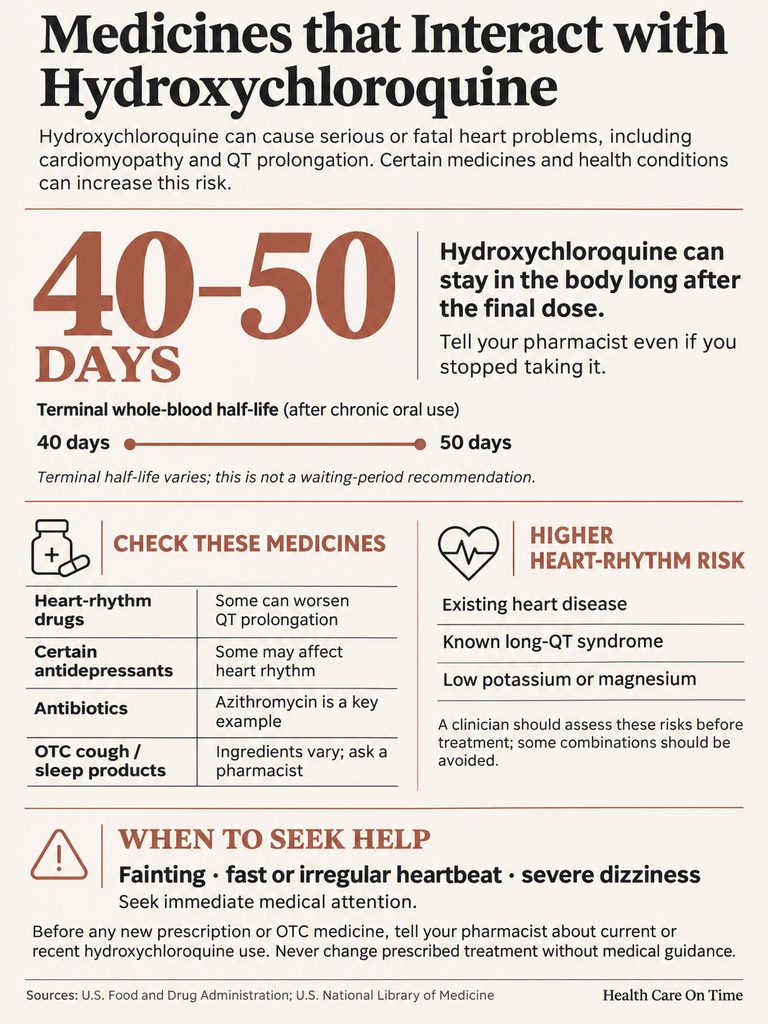
- Cimetidine (Tagamet HB): raised exposure to chloroquine about twofold in studies, and the label says to avoid it with hydroxychloroquine. Famotidine (Pepcid) isn’t named in the label.
- QT drugs: medicines that prolong the QT interval, such as certain antibiotics, antidepressants and antipsychotics. The label doesn’t recommend combining them with hydroxychloroquine because of the risk of dangerous heart rhythms.
- Insulin and diabetes pills: hydroxychloroquine can lower blood sugar, sometimes severely, and diabetes doses may need to come down.
- Digoxin and cyclosporine: blood levels can rise.
- Methotrexate: sometimes prescribed with hydroxychloroquine for rheumatoid arthritis, but the label says side effects may increase, so doctors monitor the pair.
- Seizure medicines may work less well, and mefloquine raises seizure risk.
- Rifampicin: avoid it, because hydroxychloroquine may stop working.
Heart rhythm is why pharmacists get careful about adding anything new. The label reports fatal and life-threatening heart problems, including cardiomyopathy and QT prolongation, and it advises against using hydroxychloroquine in people with QT risk factors such as heart disease or uncorrected low potassium or magnesium. Get medical attention right away for sudden dizziness, lightheadedness, fainting, shortness of breath or heart palpitations while on the drug. If you already take a heart rhythm medicine, an antidepressant or an antibiotic such as azithromycin, ask before adding anything over the counter, sleep aids and cough medicines included.
The long half-life also means that a drug started a week after stopping hydroxychloroquine can still meet meaningful amounts of it in the blood. When you bring a new prescription to the pharmacy, mention hydroxychloroquine even if you stopped it recently.
Real situations and what to do
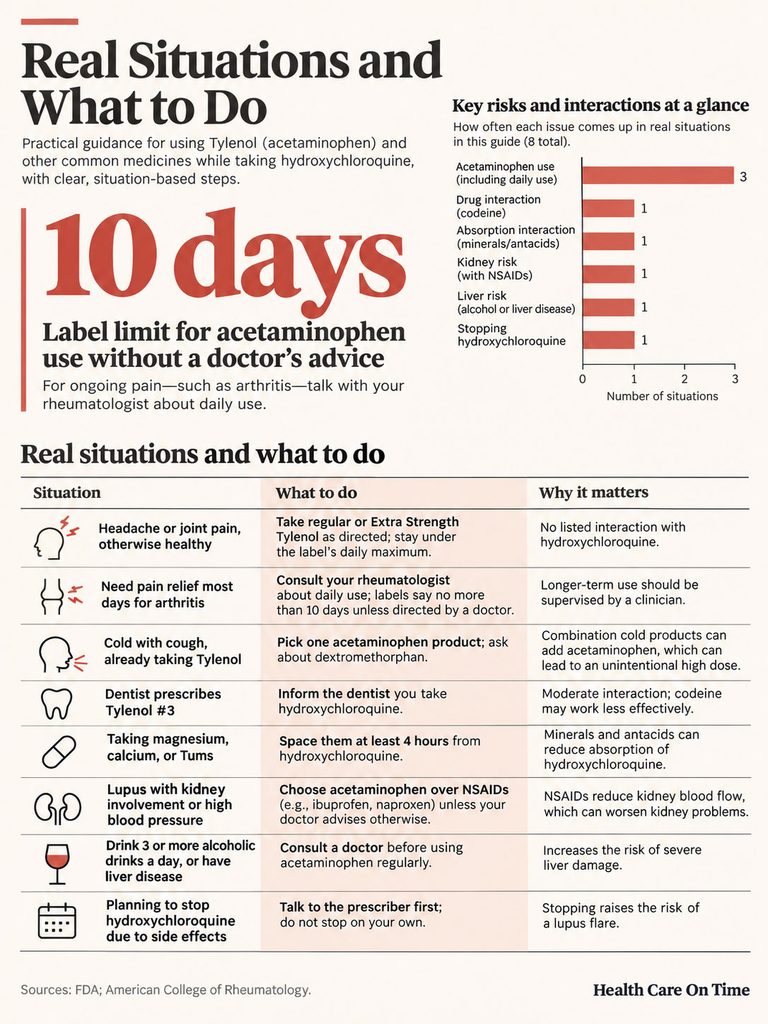
| Situation | What to do | Why |
| Headache or joint pain, otherwise healthy | Take regular or Extra Strength Tylenol as the box directs | No listed interaction; stay under the label’s daily maximum |
| Need pain relief most days for arthritis | Talk to your rheumatologist about daily use | Labels say no more than 10 days unless a doctor directs |
| Cold with cough, already taking Tylenol | Pick one acetaminophen product; ask about dextromethorphan | Combination products add acetaminophen; hydroxychloroquine may raise dextromethorphan levels |
| Dentist prescribes Tylenol #3 | Tell the dentist you take hydroxychloroquine | Moderate interaction; codeine may work less well |
| Taking magnesium, calcium or Tums | Space them at least 4 hours from hydroxychloroquine | Minerals and antacids can reduce absorption |
| Lupus with kidney involvement or high blood pressure | Choose acetaminophen over NSAIDs unless your doctor says otherwise | NSAIDs reduce kidney blood flow |
| Drink 3 or more alcoholic drinks a day, or have liver disease | Ask a doctor before using acetaminophen regularly | Raises the risk of severe liver damage |
| Planning to stop hydroxychloroquine because of side effects | Talk to the prescriber first; don’t stop on your own | Stopping raises lupus flare risk |
Long-term safety checks that come with hydroxychloroquine
Taking Tylenol doesn’t change any of the routine monitoring for hydroxychloroquine, which centers on the eyes and on whether the drug is still needed.
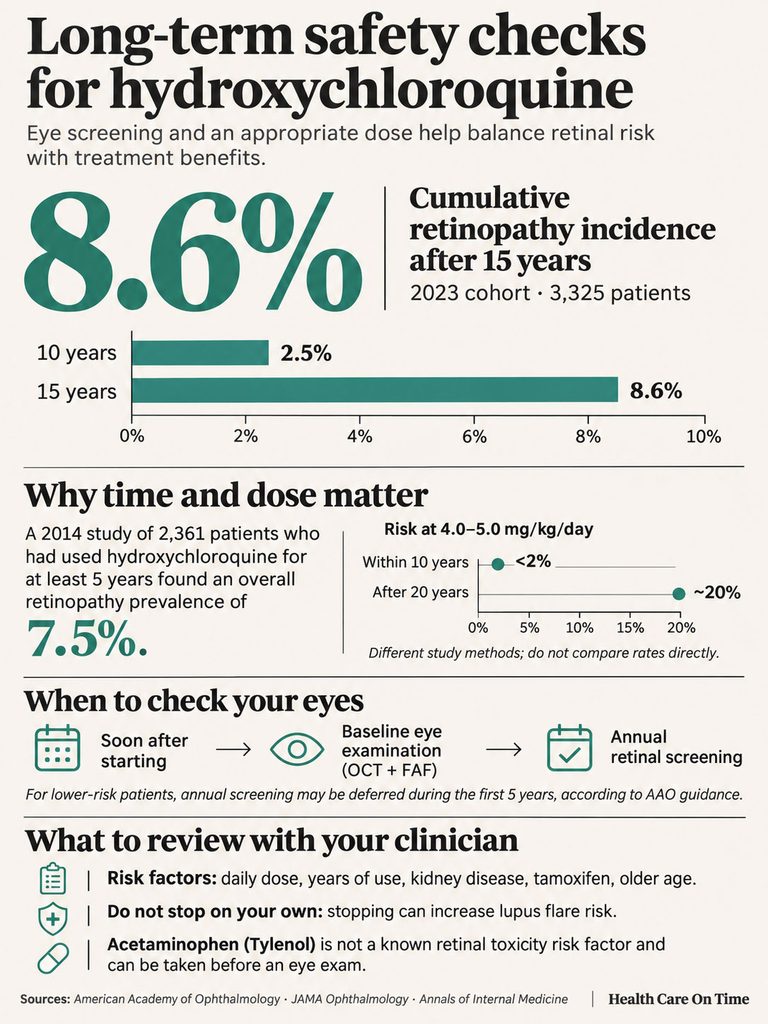
The main long-term risk is damage to the retina. In a 2014 study of 2,361 people who had used hydroxychloroquine for at least 5 years, 7.5% had signs of retinal toxicity. At doses of 4.0 to 5.0 mg per kg of body weight, the rate stayed below 2% in the first 10 years but rose to almost 20% after 20 years. A larger 2023 study from Massachusetts General Hospital followed 3,325 patients and found a cumulative rate of 2.5% at 10 years and 8.6% at 15 years, with much higher rates in people taking more than 6 mg per kg.
The American Academy of Ophthalmology updated its screening recommendations in a 2025 revision. The dose advice stays at 5.0 mg per kg of real body weight or less, and under 400 mg a day for people with severe obesity. A baseline eye exam with OCT and fundus autofluorescence is advised soon after starting, then yearly screening, which may be deferred during the first 5 years if there are no major risk factors such as kidney disease, tamoxifen use or starting the drug at an older age.
Stopping the drug carries its own risk. In lupus, hydroxychloroquine protects against flares long term, and the SLICC cohort study of 1,460 patients found that reducing the dose raised flare risk (adjusted hazard ratio 1.20) and stopping raised it more (1.56). The Johns Hopkins Lupus Center describes antimalarials as a kind of “lupus life insurance” and notes that some patients stay on them for life.
Neither the AAO guidance nor the Plaquenil label links acetaminophen to retinal risk, so there’s no reason to stop Tylenol before an eye exam. The risk factors they list are dose per kilogram, years of use, kidney disease, tamoxifen and starting at an older age.
When a headache, a cold or a new prescription raises questions, adjust the other medicine with your pharmacist’s help rather than skipping hydroxychloroquine.
When to call your doctor or pharmacist
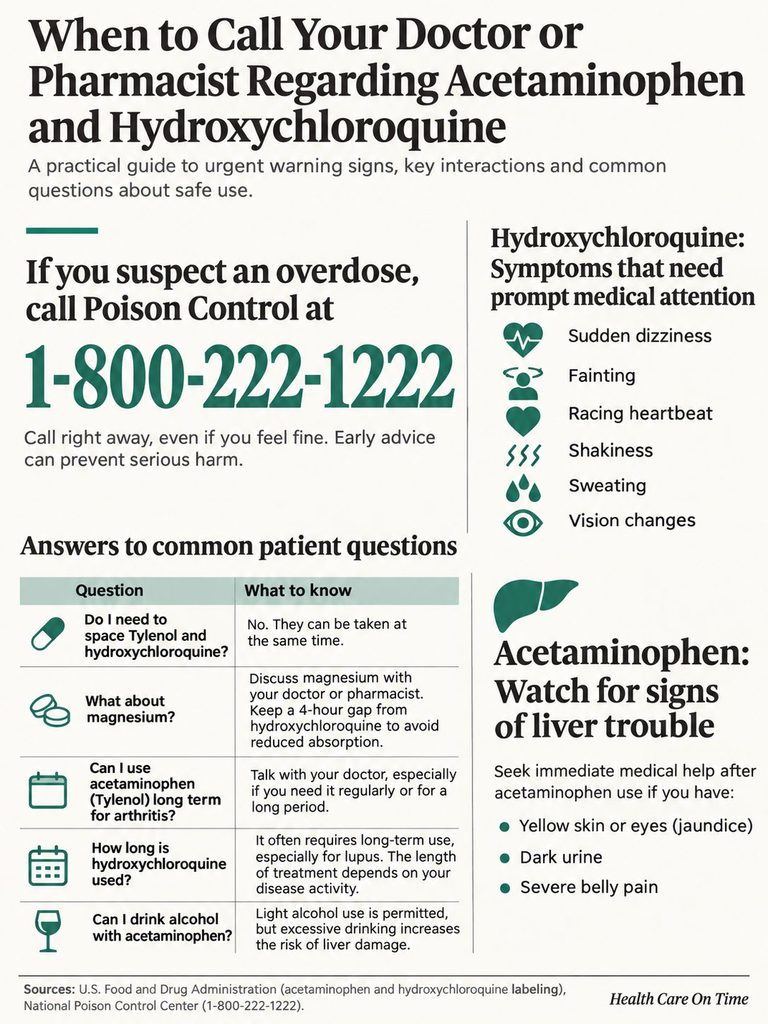
Get medical help right away if you have signs of liver trouble after taking acetaminophen (yellow skin or eyes, dark urine, belly pain, or vomiting that won’t stop), or if you suspect you took too much, even without symptoms. Poison Control is 1-800-222-1222. On hydroxychloroquine, sudden dizziness, fainting, a racing or pounding heartbeat, shakiness and sweating from low blood sugar, or any change in vision also need a prompt call.
Questions worth bringing to your next appointment:
- “Is it OK to take Tylenol every day for joint pain like this, and what’s the most per day?”
- “With these kidney numbers, should ibuprofen and Aleve be avoided?”
- “Could you check this cold medicine and this sleep aid against the Plaquenil?”
- “If stronger pain relief is ever needed, what works with Plaquenil instead of codeine?”
- “When is the next eye exam due, and should the dose change now that the weight has changed?”
Frequently Asked Questions
Can I take magnesium if I’m on hydroxychloroquine?
Yes, but keep them at least 4 hours apart. Magnesium can reduce how much hydroxychloroquine your gut absorbs. If your doctor prescribed magnesium to fix low levels, don’t stop it; low magnesium is itself a heart rhythm risk factor on hydroxychloroquine, so the goal is good spacing rather than skipping either one.
Is it okay to take 2 Tylenol every day for arthritis?
Two Extra Strength caplets (1,000 mg) is well under the 4,000 mg daily ceiling. Still, Tylenol labels say not to use the product for more than 10 days unless a doctor directs you to, so long-term daily use should be cleared with your doctor first. That conversation matters more if you have liver disease, drink alcohol regularly or take other acetaminophen products. In people without liver disease, acetaminophen at recommended doses isn’t likely to harm the liver, and it’s generally easier on the kidneys and stomach than NSAIDs, which helps when pain needs treating most days.
How long should a person be on hydroxychloroquine?
Often for years. In lupus, many people stay on it long term, some for life, because stopping raises flare risk. Your rheumatologist decides based on disease activity, side effects and eye exam results.
Do I need to space Tylenol and hydroxychloroquine apart?
No. You can take them at the same time, even with the same meal. The 4-hour gap only applies to antacids, magnesium and calcium products.
Can I take Tylenol and ibuprofen together while on hydroxychloroquine?
Hydroxychloroquine doesn’t change the answer. Neither drug has a listed interaction with it, so the usual rules for combining acetaminophen and ibuprofen apply. Keep each within its own label limit, take ibuprofen with food, and skip ibuprofen if you have kidney disease, uncontrolled high blood pressure, heart failure or a history of stomach bleeding.
Can I take Tylenol PM every night on hydroxychloroquine?
No interaction stops you, but the label limits Tylenol PM to 2 caplets in 24 hours and says to ask a doctor if sleeplessness lasts more than 2 weeks. Nightly use for weeks is worth a conversation about the cause of the poor sleep.
Does Tylenol make hydroxychloroquine less effective?
There’s no evidence that it does. Acetaminophen isn’t listed as affecting hydroxychloroquine levels. The products that can reduce absorption are antacids and calcium or magnesium supplements.
Can I drink alcohol if I take Tylenol and hydroxychloroquine?
Light drinking isn’t banned by either label, but acetaminophen labels warn that 3 or more alcoholic drinks a day raises the risk of severe liver damage. If you drink that much, talk to your doctor before using Tylenol regularly, and ask whether alcohol affects your other lupus or arthritis medicines, such as methotrexate. Skip alcohol completely on days you take Tylenol PM or a codeine tablet, since both labels rule it out.
What pain reliever is safest with Plaquenil?
For most people, acetaminophen is the simplest choice, because it has no listed interaction with Plaquenil and is easy on the stomach and kidneys at recommended doses. NSAIDs such as ibuprofen and naproxen are also compatible with Plaquenil, but they carry kidney, blood pressure and stomach risks of their own. Codeine products need the prescriber to know about the hydroxychloroquine.
What if I took an antacid at the same time as my hydroxychloroquine?
One dose taken together may simply mean less of the drug got absorbed that day. Don’t take an extra hydroxychloroquine tablet to make up for it. Go back to spacing them 4 hours apart, and if it keeps happening, ask your pharmacist for a schedule that fits your day.
Medical disclaimer: This article is for general information and isn’t a substitute for advice from your doctor or pharmacist. Drug labels change, and your own health conditions and other medicines can change which pain relievers are safe for you. Don’t start, stop or change the dose of hydroxychloroquine or any other prescription without talking to your prescriber.
References
- Plaquenil (hydroxychloroquine sulfate) tablets, US prescribing information, revised 10/2024: https://www.drugs.com/pro/plaquenil.html
- MedlinePlus, Hydroxychloroquine (revised 01/15/2025): https://medlineplus.gov/druginfo/meds/a601240.html
- Drug interaction report, hydroxychloroquine and Tylenol: https://www.drugs.com/drug-interactions/hydroxychloroquine-with-tylenol-1298-0-11-12.html
- Drug interaction report, hydroxychloroquine and ibuprofen: https://www.drugs.com/drug-interactions/hydroxychloroquine-with-ibuprofen-1298-0-1310-0.html
- Drug interaction report, hydroxychloroquine and Tylenol with Codeine #4: https://www.drugs.com/drug-interactions/hydroxychloroquine-with-tylenol-with-codeine-4-1298-0-48-8461.html
- Drug interaction report, Benadryl and hydroxychloroquine: https://www.drugs.com/drug-interactions/benadryl-with-hydroxychloroquine-896-1617-1298-0.html
- Drug interaction report, Daytime Cold and Flu and hydroxychloroquine: https://www.drugs.com/drug-interactions/daytime-cold-flu-with-hydroxychloroquine-59-11020-1298-0.html
- Drug interaction report, magnesium oxide and hydroxychloroquine: https://www.drugs.com/drug-interactions/mag-ox-with-quineprox-1516-921-1298-4617.html
- Drug interaction report, calcium carbonate and hydroxychloroquine: https://www.drugs.com/drug-interactions/caltrate-600-with-iron-and-vitamin-d-with-quineprox-2932-13186-1298-4617.html
- Drug interaction report, Plaquenil and multivitamin: https://www.drugs.com/drug-interactions/plaquenil-with-vitamins-1298-4616-1661-5999.html
- Drug interaction report, hydroxychloroquine and vitamin D3: https://www.drugs.com/drug-interactions/hydroxychloroquine-with-thera-d-2000-1298-0-646-15981.html
- Tylenol with Codeine prescribing information: https://www.drugs.com/pro/tylenol-with-codeine.html
- Tylenol PM Extra Strength product label: https://tylenol.com/products/tylenol-pm-extra-strength-caplet
- Tylenol Extra Strength Caplets product label: https://www.tylenol.com/products/tylenol-extra-strength-caplets
- DailyMed, Tylenol 8 HR Arthritis Pain label (Nov 2024): https://dailymed.nlm.nih.gov/dailymed/drugInfo.cfm?setid=3af22fc8-e4e0-4863-8696-6bc1257047cb
- FDA, Don’t Overuse Acetaminophen (2024): https://www.fda.gov/consumers/consumer-updates/dont-overuse-acetaminophen
- Acetaminophen Toxicity. StatPearls, NCBI Bookshelf (updated March 2026): https://www.ncbi.nlm.nih.gov/books/NBK441917/
- National Kidney Foundation, Pain Medicines and Kidney Disease (Feb 2025): https://www.kidney.org/kidney-topics/pain-medicines-analgesics
- Johns Hopkins Lupus Center, Treating Lupus with Anti-Malarial Drugs: https://www.hopkinslupus.org/lupus-treatment/lupus-medications/antimalarial-drugs/
- Almeida-Brasil CC et al. Flares after hydroxychloroquine reduction or discontinuation: SLICC inception cohort. Ann Rheum Dis 2022;81:370-378: https://soar.suny.edu/entities/publication/5033ce83-0f10-4bca-bce1-098840b614a1
- Melles RB, Marmor MF. The risk of toxic retinopathy in patients on long-term hydroxychloroquine therapy. JAMA Ophthalmol 2014: https://www.pubmed.gov/25275721/
- Jorge AM et al. Hydroxychloroquine dose and retinopathy incidence. Ann Intern Med 2023 (Mass General summary): https://advances.massgeneral.org/rheumatology/journal.aspx?id=2447
- Marmor MF et al. AAO Recommendations on Screening for Hydroxychloroquine Retinopathy (2025 Revision). Ophthalmology 2026;133:439-450: https://www.ndcn.ox.ac.uk/publications/publication_modal/2341386
- CDC, People with Lupus: https://www.cdc.gov/lupus/data-research/
- CDC MMWR, Prevalence of Diagnosed Arthritis, United States, 2019-2021: https://www.cdc.gov/mmwr/volumes/72/wr/mm7241a1.htm
- CDC Preventing Chronic Disease, arthritis types among US adults (2025): https://www.cdc.gov/pcd/issues/2025/24_0393.htm