No study has shown that drinking peppermint tea lowers blood pressure. The November 2026 headlines about peppermint and blood pressure come from a small trial of swallowed peppermint oil, a far more concentrated product than anything in a tea bag.
Table of Contents
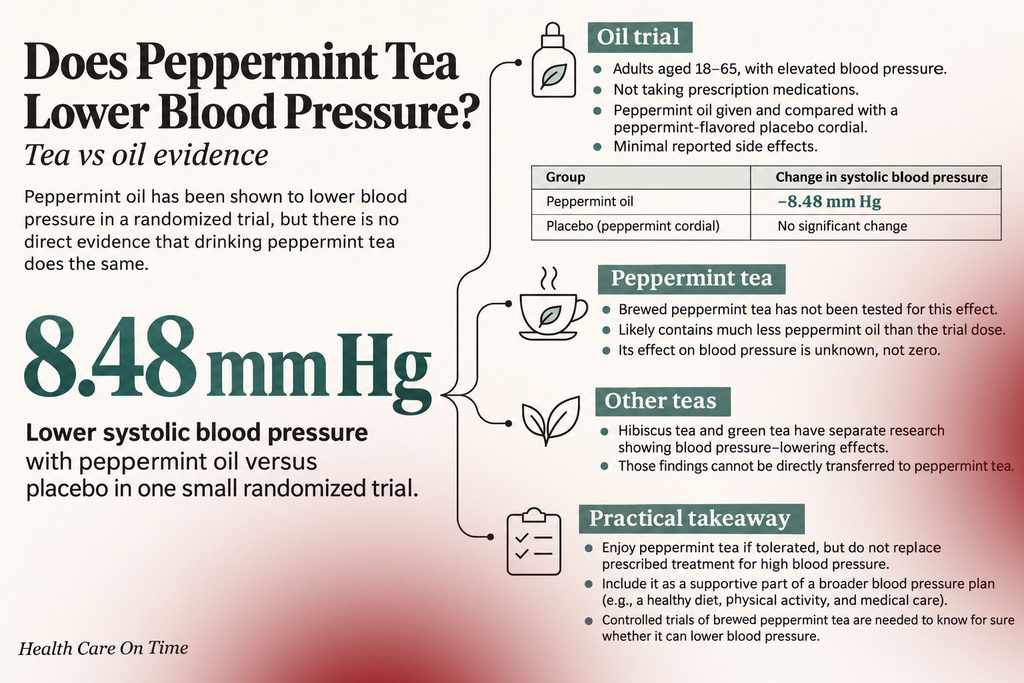
Quick answer: There’s no good evidence that brewed peppermint tea lowers blood pressure. A 2026 randomized trial found that small twice-daily doses of peppermint oil, mixed into water, left systolic pressure about 8.5 mm Hg lower than a mint-flavored placebo after 20 days in 40 adults with mildly high readings. That trial did not test tea. Peppermint tea is caffeine-free and appears safe for most adults, but it can worsen reflux and should never replace prescribed blood pressure medicine.
What the peppermint oil trial actually tested
The study behind the news is a randomized, placebo-controlled trial published in PLOS One in April 2026 by researchers at the University of Lancashire in the UK. Headlines followed on November 25, 2026, when the university’s summary of the results described oil lowering blood pressure in 20 days, and plenty of people read “peppermint,” pictured the tea in their cupboard and wondered whether their evening cup counts.
Who was in it
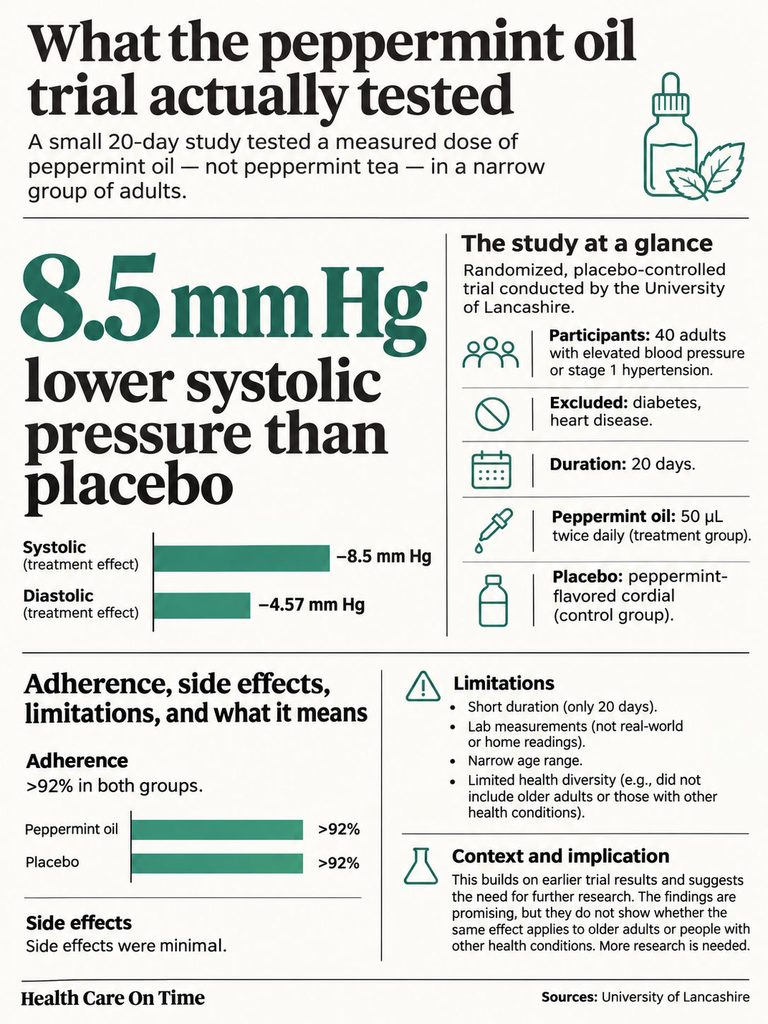
Forty adults between 18 and 65 were randomly assigned to one of two groups, and 38 finished the study (18 in the peppermint group, 20 on placebo). Everyone had either elevated blood pressure or stage 1 hypertension under the American Heart Association categories, and nobody was taking prescription blood pressure medicine. People with diabetes, known heart disease, secondary hypertension or a BMI above 40 were left out. The average age was about 35, which is younger than most Americans who are told their pressure is creeping up.
What they took, and what the placebo was
The peppermint group took 50 microliters of pure peppermint oil twice a day, morning and evening, stirred into 100 milliliters of water (about 3.4 ounces). That’s 100 microliters a day, roughly one-fiftieth of a teaspoon, and the university’s summary describes the oil as food-grade.
For the comparison group, the researchers chose a peppermint-flavored cordial with no peppermint oil, menthol or other peppermint-derived ingredients on its label, served in the same amount and the same way. Both groups tasted mint twice a day for almost three weeks. Only one group swallowed concentrated oil, and only that group’s numbers moved, which tells tea drinkers something useful: the minty flavor on its own did nothing measurable.
The results in numbers
After 20 days, average systolic pressure in the oil group went from 130.05 to 121.97 mm Hg. In the placebo group it sat at 130.93 at the start and 131.05 at the end. After adjusting for starting values, the oil group’s systolic reading was 8.48 mm Hg lower than placebo (95% confidence interval 14.24 to 2.73 mm Hg lower), and that’s the “8.5 points” in the headlines. Diastolic pressure was 4.57 mm Hg lower, and resting heart rate was 8.92 beats per minute lower. LDL cholesterol, body measurements and blood counts did not differ between groups in any meaningful way.
Side effects were minimal. One person in the oil group had a minor problem, which the authors tied to disliking the taste, and adherence ran above 92% in both arms.
You might expect people to work out which drink they had, given how strong peppermint oil tastes, yet when asked at the end only 47.4% guessed their group correctly, about what pure chance would produce. So the result is unlikely to come from people simply expecting a benefit. A UK charitable trust paid for the work and had no role in the design or analysis.
The same team had run a similar 20-day trial in 36 healthy adults a few years earlier, published in Sport Sciences for Health in 2023. With the same dose and the same mint cordial as placebo, systolic pressure came out 4.53 mm Hg lower and diastolic 3.83 mm Hg lower than placebo, with no side effects in either group. Triglycerides also fell by 0.30 mmol/L (about 27 mg/dL) in that study, though in the newer trial in people with high readings, LDL and triglycerides didn’t change significantly.
What the authors could not show
The study ran for only 20 days, so nobody knows whether the drop lasts, fades or grows. Pressure was measured in a lab, clinic-style, instead of with 24-hour ambulatory monitoring, which is the more reliable way to see what pressure does through a normal day and night. The researchers didn’t measure any of the pathways that might explain the effect, such as nitric oxide or blood vessel function. And because the participants were fairly young, unmedicated and free of diabetes and heart disease, the authors say it’s unclear whether the results apply to people with more advanced hypertension or other conditions.
Nobody older than 65 could join, while CDC survey data put hypertension at 71.6% of US adults aged 60 and older. The readers most interested in this question are often older and already taking two or three medicines, and they’re the group the trial left out.
Both peppermint trials come from one research group, with small samples. Other teams would need to repeat the result in larger groups followed for months before peppermint oil could be called a blood pressure tool.
Why a cup of peppermint tea is a different thing
For tea, everything comes down to dose. Peppermint tea is just dried peppermint leaves steeped in hot water. The leaves contain essential oil, mostly menthol and menthone, and some of it ends up in your cup, which is why the tea smells and tastes the way it does, but how much gets there is far less obvious.
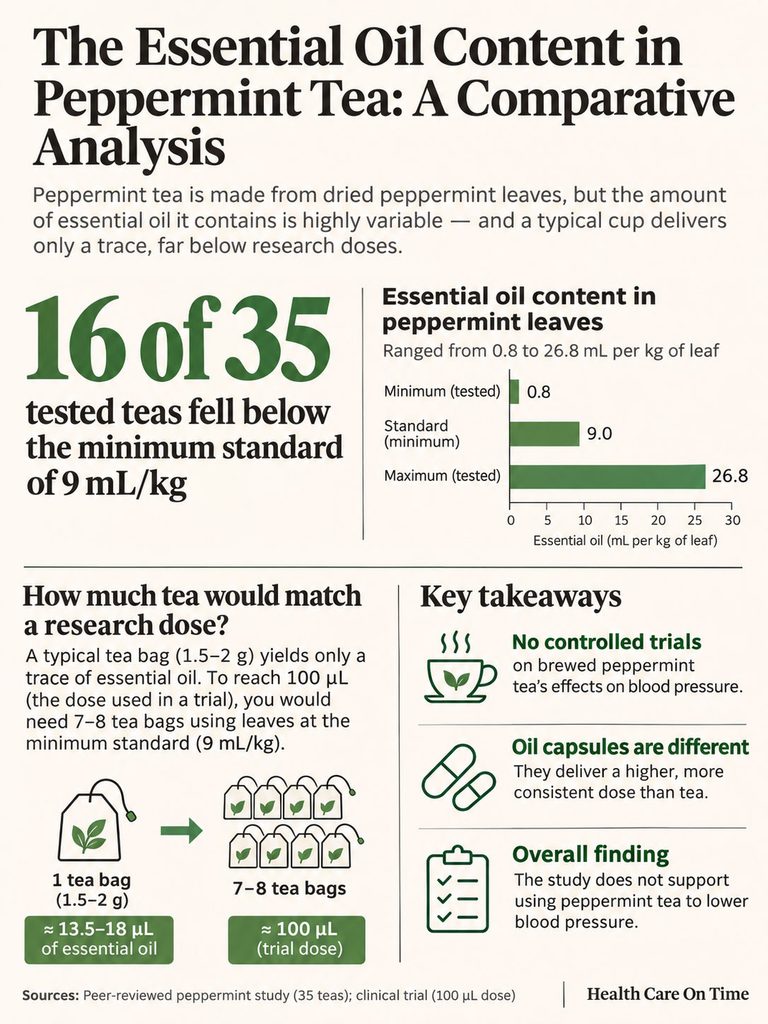
A 2026 laboratory analysis of 35 commercial peppermint teas, published in the journal Beverages, measured how much essential oil the dried leaf in each product held. The range was enormous: from 0.8 to 26.8 milliliters of oil per kilogram of leaf. Sixteen of the 35 fell below the European Pharmacopoeia minimum of 9 milliliters per kilogram for cut peppermint leaf, and some samples had oil so low in menthol that it looked more like a different mint. A typical tea bag, by the authors’ count, holds 1 gram or 1.5 to 2 grams of leaf.
A 1.5-gram bag of leaf that just meets the European minimum holds about 13.5 microliters of oil in total, and that’s before any of it is brewed. Even a 2-gram bag of the richest leaf in the analysis would hold about 54 microliters. The trial gave 100 microliters a day of pure oil, delivered straight into water. Hot water pulls only part of the oil out of the leaf, and some of what does come out escapes as steam; the researchers who tested the teas expect only trace amounts of essential oil in a brewed infusion, though they didn’t measure the cup itself.
So a cup of tea likely delivers a small fraction of one trial dose. Exactly how small hasn’t been measured.
Menthol content also varies so much from brand to brand that two “peppermint” teas on the same shelf may not be comparable at all.
Drinking more doesn’t close the gap. Matching the trial’s 100 microliters would take the entire oil content of seven or eight standard bags at the European minimum, and that assumes every drop leaves the leaf and lands in your mug, which brewing never achieves. You’d be drinking quart after quart of tea and still falling short, with heartburn as the more likely result than a lower reading.
The closest thing to a leaf study is a 2011 Brazilian study of 25 university students who drank a blended peppermint leaf juice twice a day for 30 days. Some of them had lower readings afterward, but the study had no comparison group and didn’t report the changes in mm Hg, so it can’t tell you whether peppermint did anything. As of late 2026, no randomized controlled trial appears to have tested brewed peppermint tea on blood pressure, and research on the leaf in any form is thin; most peppermint studies have tested the oil, largely for irritable bowel syndrome.
Peppermint oil capsules from the pharmacy aren’t a shortcut to the trial result either. Most are enteric-coated so they pass through the stomach before opening, a design meant to limit heartburn in people taking them for digestive symptoms. The trial used plain oil stirred into water. Those capsules come in a different form at a different dose, with no blood pressure data behind them.
| Feature | Peppermint oil in the 2026 trial | A cup of brewed peppermint tea | Practical takeaway |
| What it is | Pure essential oil, stirred into 100 mL of water | 1 to 2 grams of dried leaf steeped in hot water | Different products with very different strength |
| Amount of peppermint oil | 100 microliters a day (50 microliters twice daily) | Leaf holds about 0.8 to 54 microliters per bag before brewing; only trace amounts expected in the cup | Tea gives a small, unmeasured fraction of the trial dose |
| Tested on blood pressure in a randomized trial | Yes: 40 adults, 20 days | No randomized trial found | No proven blood pressure effect from tea |
| Systolic result | 8.48 mm Hg lower than placebo | Unknown | Don’t count tea toward your blood pressure goal |
| Who was studied | Ages 18 to 65, average about 35, elevated or stage 1, no BP medicine | Not studied | Results may not apply to older adults or people on medication |
| Side effects in the study | One minor event (taste) | Not studied for blood pressure; NCCIH says tea appears safe | Watch for heartburn with either |
| How long the effect was followed | 20 days | Not studied | Long-term effect unknown |
What an 8-point drop would mean, if it held up
An 8-point drop in systolic pressure isn’t trivial. In a Lancet meta-analysis of 123 trials with more than 600,000 people, every 10 mm Hg reduction in systolic pressure cut the risk of major cardiovascular events by 20%, stroke by 27% and heart failure by 28%.
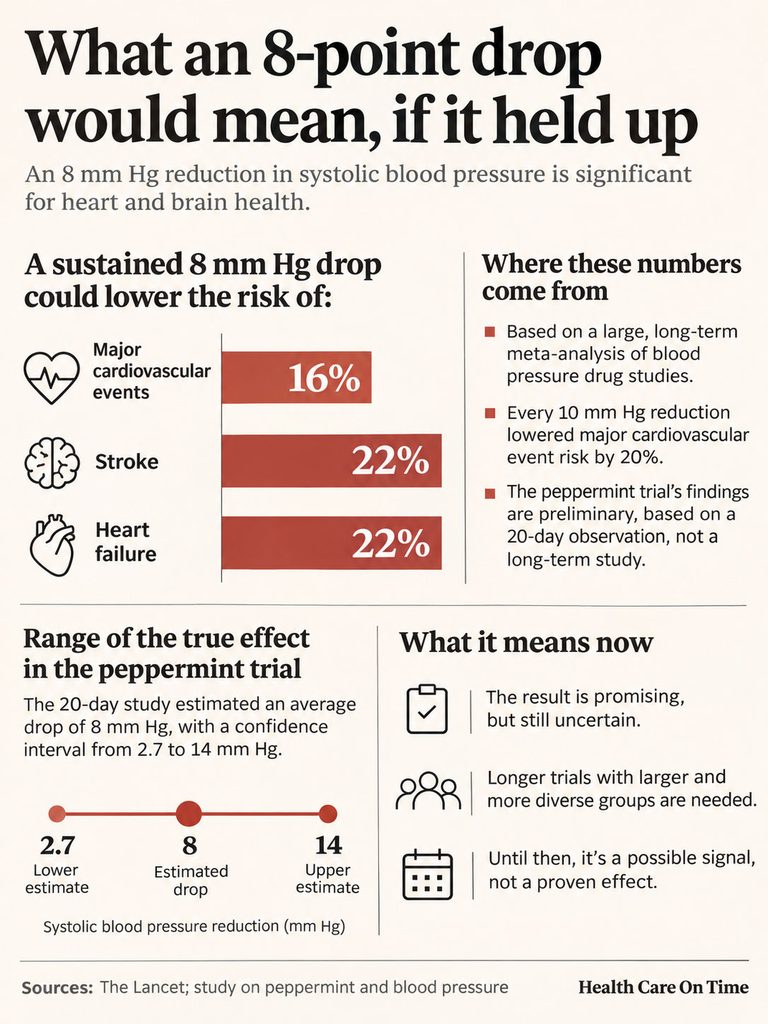
Those risk numbers, though, come from blood pressure drugs taken for years, with heart attacks and strokes counted as outcomes, while the peppermint trial measured a reading after 20 days.
A short-term change in a lab reading stays a promising signal until someone shows it lasts and translates into fewer heart attacks and strokes.
With so few people, the confidence interval is wide: the true effect could plausibly be as small as about 2.7 mm Hg or as large as about 14 mm Hg.
What would change the picture is a longer trial in older adults, including some already on medicine, with home or 24-hour readings and enough people to narrow that range. Until then, the oil is an interesting lead. The tea isn’t even that yet, because the study hasn’t been done.
How peppermint might affect blood pressure
Peppermint is rich in menthol and plant compounds called flavonoids, and the trial authors point to both as possible reasons for the effect they saw. They also list several pathways that could be involved, including nitric oxide (a molecule that helps blood vessels relax), the health of the vessel lining and the nervous system’s control of heart rate. None of these were measured, so they remain ideas to test.
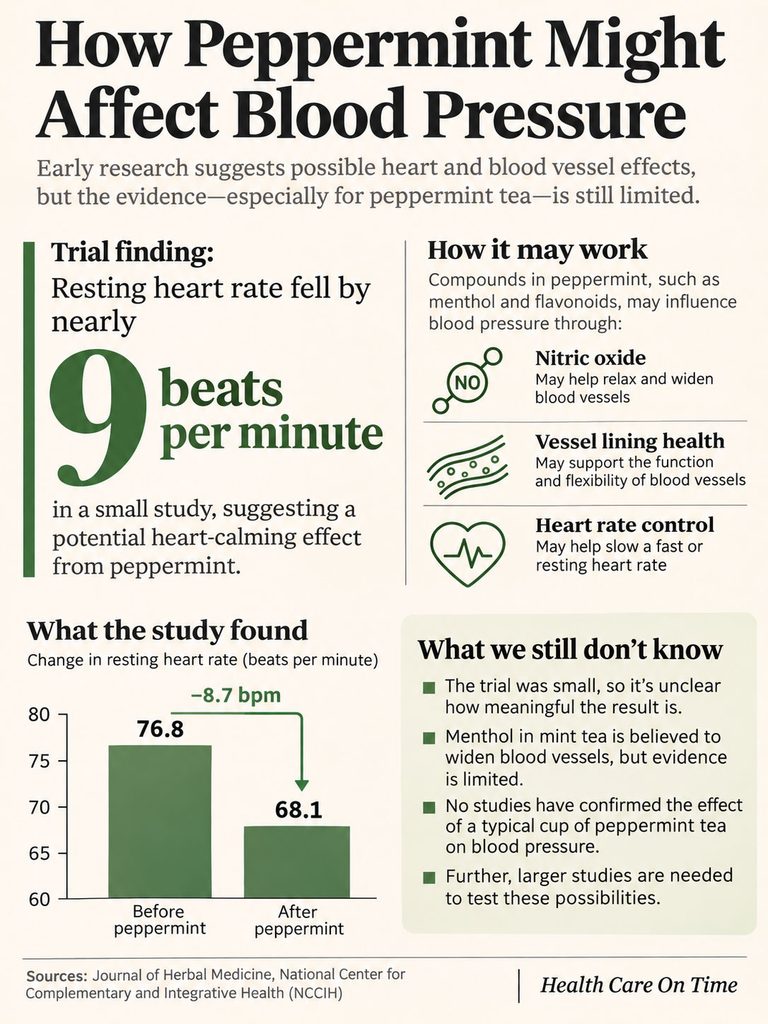
The drop in resting heart rate, close to 9 beats per minute, hints that something beyond simple vessel widening may be going on. In a group this small, it could also be chance.
You may have heard that menthol in mint tea widens blood vessels. Even if menthol does act on vessels in some way, a cup carries very little of it, and no study has tested whether the small amount in a cup does anything to blood pressure in people.
Teas that have been tested for blood pressure
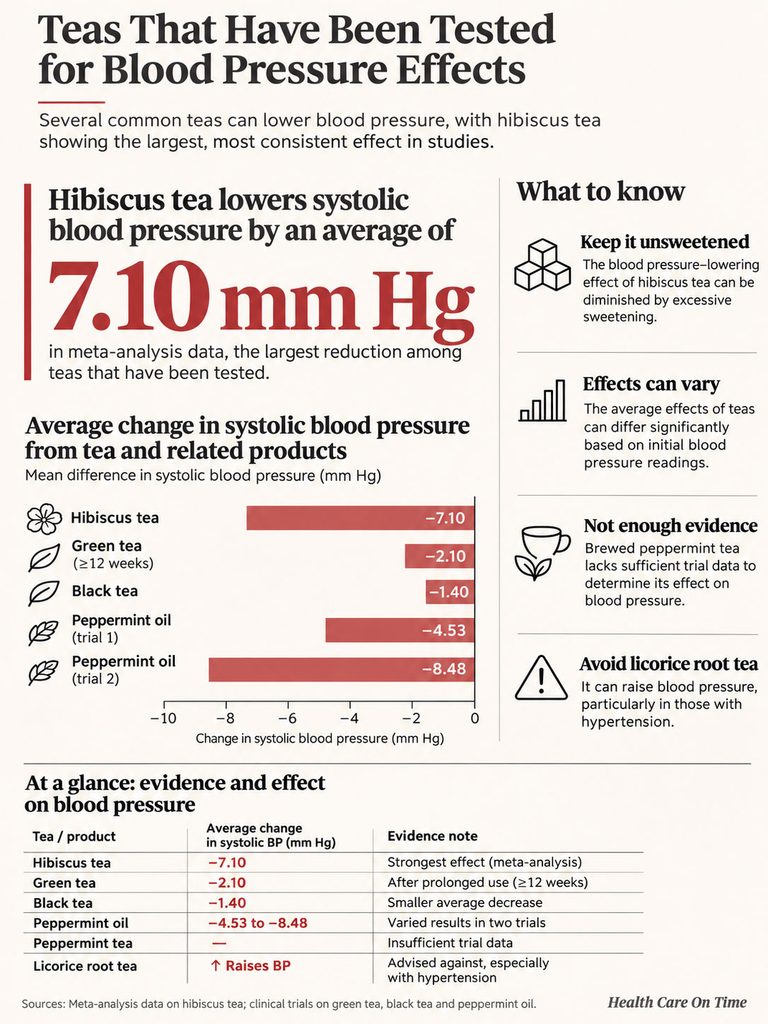
If you’re choosing a tea partly for your blood pressure, it helps to know which ones have trial data behind them. Hibiscus has the strongest record among herbal teas, regular green and black tea show smaller but steadier effects over months, and outside the tea aisle, beets and pomegranate both have more human blood pressure data than peppermint.
| Drink or product | Type of evidence | Average change in systolic pressure | Source |
| Peppermint oil, 100 microliters a day | 1 randomized trial, 40 adults with elevated or stage 1 BP, 20 days | 8.48 mm Hg lower than placebo | PLOS One, 2026 |
| Peppermint oil, same dose | 1 randomized trial, 36 healthy adults, 20 days | 4.53 mm Hg lower than placebo | Sport Sciences for Health, 2023 |
| Brewed peppermint tea | No randomized trial | No data | None |
| Hibiscus tea or extract | Meta-analysis of 17 trials | 7.10 mm Hg lower than placebo, with very inconsistent results across trials | Nutrition Reviews, 2021 |
| Green tea | Meta-analysis, part of 25 trials with 1,476 people | About 2.1 mm Hg lower | British Journal of Nutrition, 2014 |
| Black tea | Same meta-analysis | About 1.4 mm Hg lower | British Journal of Nutrition, 2014 |
| Licorice root tea | Safety warnings | Can raise blood pressure; NCCIH links even small amounts of glycyrrhizin to severe effects in people with hypertension | NCCIH |
In the hibiscus meta-analysis, the drop was largest in people who started with higher readings, but the trials disagreed with each other a great deal, so the average hides a wide spread. Green and black tea worked best when people kept drinking them for 12 weeks or longer, with systolic readings about 2.6 mm Hg lower in a 2014 tea meta-analysis; tea taken for less than a week did nothing measurable.
Of all the herbal teas, licorice root is the one people with high blood pressure should steer clear of. NCCIH warns that even small amounts of glycyrrhizin from licorice root products have been linked to severe adverse effects in people with hypertension, heavy salt intake, or heart or kidney disease. Some herbal blends include licorice root for sweetness, so read the box. Hibiscus has a catch of its own. It’s tart, and plenty of people sweeten it heavily, which chips away at the reason for drinking it.
Is peppermint tea safe every day or at bedtime?
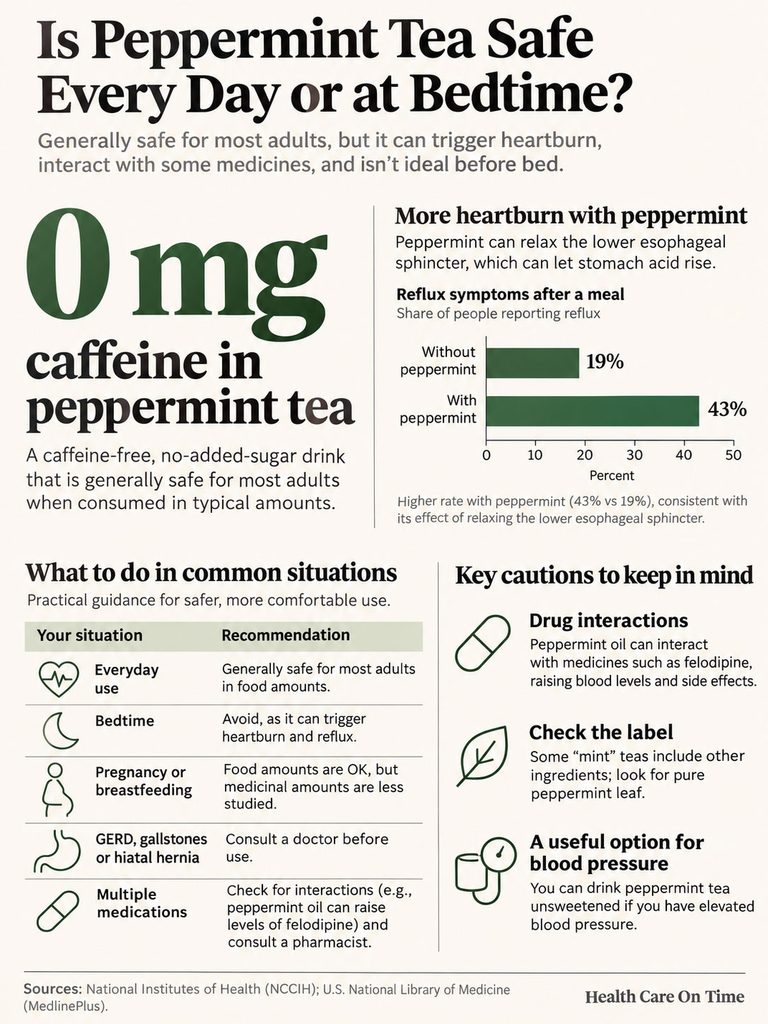
For most adults, yes. Peppermint tea appears to be safe, though the long-term safety of consuming large amounts of peppermint leaf hasn’t been studied. Pure peppermint tea contains no caffeine, so it won’t keep you up, and unsweetened it adds no sugar, which makes it an easy swap for soda or sweet tea.
Food amounts of peppermint, a cup of tea included, are likely safe during pregnancy and breastfeeding. Medicinal amounts, such as oil supplements, are a different matter, and little is known about their safety in pregnancy.
Heartburn and reflux at night
Peppermint relaxes the lower esophageal sphincter, the ring of muscle that keeps stomach acid out of the esophagus. If you already have reflux, a big mug of peppermint tea right before lying down is a common trigger, because lying flat makes it easier for acid to travel upward once that valve loosens. Memorial Sloan Kettering’s peppermint monograph lists GERD, gallstones, gallbladder inflammation and a hiatal hernia as reasons to check with a doctor before using peppermint at all. Swallowed peppermint oil brings its own list, with heartburn first, then nausea, belly pain and dry mouth.
If you love an evening cup but get reflux, try drinking it earlier and finishing well before you lie down, and switch to a non-mint herbal tea at night if the burning keeps coming back.
Medicines to ask about
Peppermint oil has been reported to raise the blood levels of felodipine, a calcium channel blocker prescribed for high blood pressure, which can increase its side effects. In lab studies, peppermint oil blocked several liver enzymes that break down medicines (including CYP3A4), though how much that matters in real patients isn’t known. There’s also a published case of a kidney transplant patient whose cyclosporine level dropped after drinking an herbal tea containing peppermint.
Most of those reports involve concentrated oil, and an ordinary cup or two of tea is a much smaller exposure. Still, if you take felodipine, cyclosporine or several daily medicines, mention peppermint at your next pharmacy or doctor visit, especially before adding oil capsules of any kind. Bring the tea box or supplement bottle with you. The ingredient list answers most of the pharmacist’s questions.
Check what is in the bag
Some “mint” teas are blends of peppermint and spearmint, some add green or black tea (which brings caffeine), and some add licorice root. Spearmint is a separate species (peppermint itself is a natural cross of spearmint and water mint), and the tea analysis found some products sold as peppermint with carvone-rich, low-menthol oil, the kind of profile that points to a different mint. If you want plain peppermint, look for a single ingredient: peppermint leaf. Nothing else.
A spoonful of honey or sugar in each of several daily cups adds up over a week, and bottled mint teas are often sweetened, so check the label for added sugar.
Peppermint tea by situation
| Your situation | What to do about peppermint tea | Why |
| Elevated BP (120 to 129 systolic), no medicine | Drink it if you enjoy it, unsweetened; focus on sodium, activity and weight | No trial shows tea lowers BP; lifestyle steps have strong evidence |
| Stage 1, in a 3- to 6-month lifestyle trial | Fine as a caffeine-free drink; don’t count it as treatment; track home readings | The guideline decision on medicine depends on your average readings |
| Taking blood pressure medicine | Keep taking every dose; one or two cups of tea is generally fine; ask about felodipine | Peppermint oil raised felodipine levels in reports |
| GERD, hiatal hernia or gallstones | Skip it near bedtime or ask your doctor first | Peppermint relaxes the valve that keeps acid down |
| Taking cyclosporine or many daily medicines | Ask your pharmacist before drinking it daily | A transplant patient had a lower cyclosporine level after peppermint tea |
| Thinking about peppermint oil for BP | Talk to your doctor first; never use aromatherapy oil | One small 20-day trial; diffuser oils are not made to be swallowed |
| Readings often low, or dizzy on standing | Tea isn’t the issue; ask your doctor about low blood pressure | Low readings need their own workup, and the foods to limit with low blood pressure differ from the high blood pressure list |
Don’t swallow aromatherapy oil
The trial used a food-grade oil in carefully measured microliter doses. The small brown bottles sold for diffusers are a different product. Essential oil products aren’t well regulated, so what’s in a bottle and how strong it is can be unclear, and choking on an oil and breathing it into the lungs can cause pneumonia. The researchers’ own summary warns against swallowing essential oils that weren’t made for oral use, and against dropping prescribed medicine because of their findings.
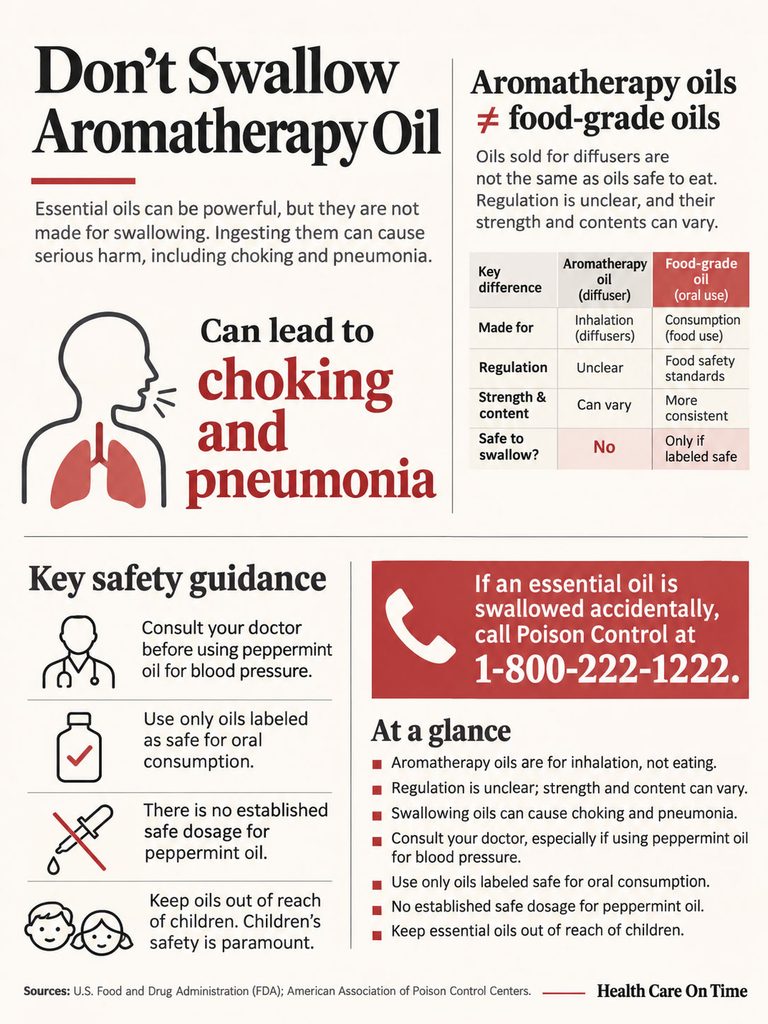
No one has worked out a safe or useful peppermint oil dose for blood pressure, and a single 20-day study can’t set one. If you’re curious about trying it, talk it through with your doctor first, and keep checking your readings either way.
A bottle marked for aromatherapy or external use is not food, and neither is a diffuser blend. If a product doesn’t say it’s meant to be taken by mouth, treat it as unsafe to swallow.
If someone swallows an essential oil by accident, especially a child, call Poison Control at 1-800-222-1222. Help is free and available around the clock.
Where peppermint tea fits in a blood pressure plan
Peppermint tea can be a pleasant, caffeine-free part of your day, and the measurable gains in a blood pressure plan come from elsewhere.
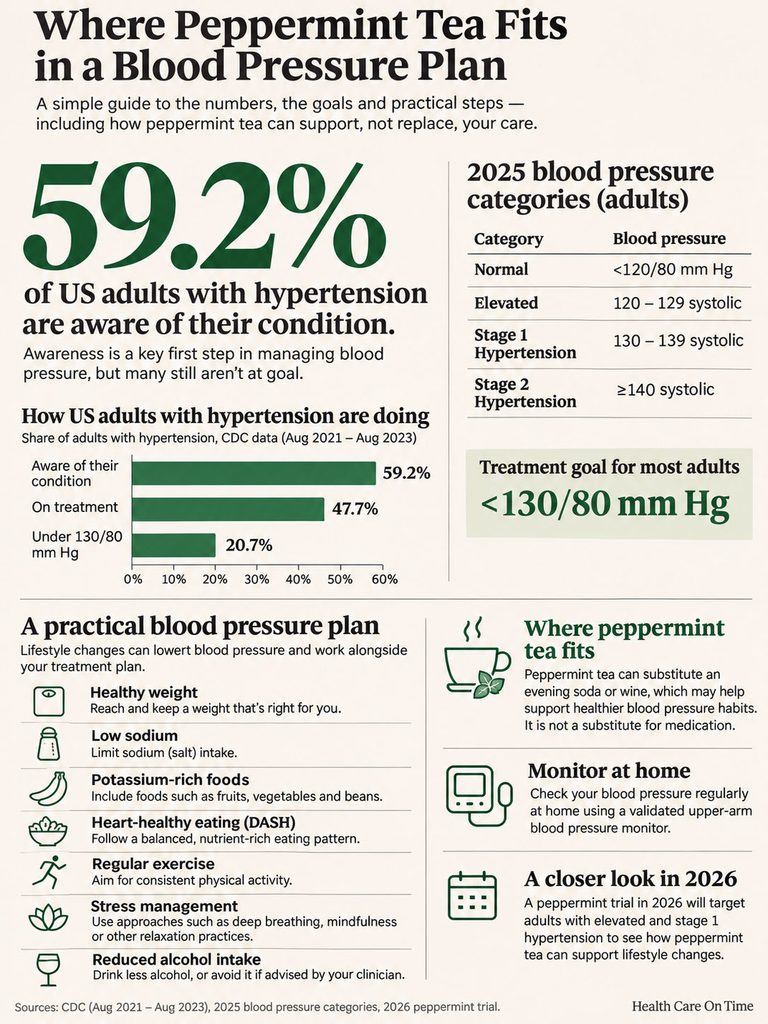
The 2025 American Heart Association and American College of Cardiology guideline keeps the same categories: normal is under 120/80 mm Hg; elevated is 120 to 129 systolic with diastolic under 80; stage 1 hypertension is 130 to 139 systolic or 80 to 89 diastolic; and stage 2 is 140 or higher systolic or 90 or higher diastolic. The treatment goal for most adults is under 130/80.
The 2026 peppermint trial enrolled people in exactly those two middle bands, elevated and stage 1. Adults with stage 1 hypertension and a lower 10-year cardiovascular risk (under 7.5% on the PREVENT calculator) start with a 3- to 6-month trial of lifestyle changes, and medicine comes in if the average stays at 130/80 or higher. People with heart disease, a prior stroke, diabetes, chronic kidney disease or higher predicted risk may start medicine sooner, and an average of 140/90 or higher calls for medicine alongside lifestyle changes.
The steps with a strong recommendation behind them are reaching or keeping a healthy weight, cutting sodium, eating more potassium-rich food, following a heart-healthy eating pattern such as DASH, getting regular moderate exercise, managing stress, and cutting back on alcohol or stopping it.
Each of those steps does a modest amount by itself, and they add up over months; for lower-risk adults they make up the whole first-line plan. Swapping an evening soda or a second glass of wine for a cup of peppermint tea can be one small, practical part of that, and it’s a better reason to drink the tea than hoping for a lower reading.
If you already take blood pressure medicine, nothing in the peppermint research changes that. Keep every dose. A cup of tea alongside it is fine for most people, but don’t lower or skip a pill because your home numbers look better after a few weeks of a new habit. Talk to your prescriber first, with your log in hand.
Home readings carry a lot of weight in these decisions, and smartwatches and other cuffless devices shouldn’t be relied on for them. For home checks, choose an upper-arm blood pressure monitor that has been validated for accuracy and comes with the right cuff size for your arm.
Most Americans with high blood pressure are a long way from that 130/80 goal. In CDC survey data from August 2021 to August 2023, about one in five adults with hypertension had it under control.
| Measure | Figure | Source |
| US adults with hypertension (130/80 or higher, or on medicine) | 47.7% | CDC NCHS Data Brief 511, Aug 2021 to Aug 2023 |
| Men with hypertension | 50.8% | CDC NCHS Data Brief 511 |
| Women with hypertension | 44.6% | CDC NCHS Data Brief 511 |
| Adults 60 and older with hypertension | 71.6% | CDC NCHS Data Brief 511 |
| Adults with hypertension who know they have it | 59.2% | CDC NCHS Data Brief 511 |
| Adults with hypertension whose pressure is under 130/80 | 20.7% | CDC NCHS Data Brief 511 |
How to tell whether a drink is changing your numbers
If you want to know whether peppermint tea, hibiscus tea or anything else does something for you, the answer has to come from careful home readings, not from how relaxed you feel after a cup.
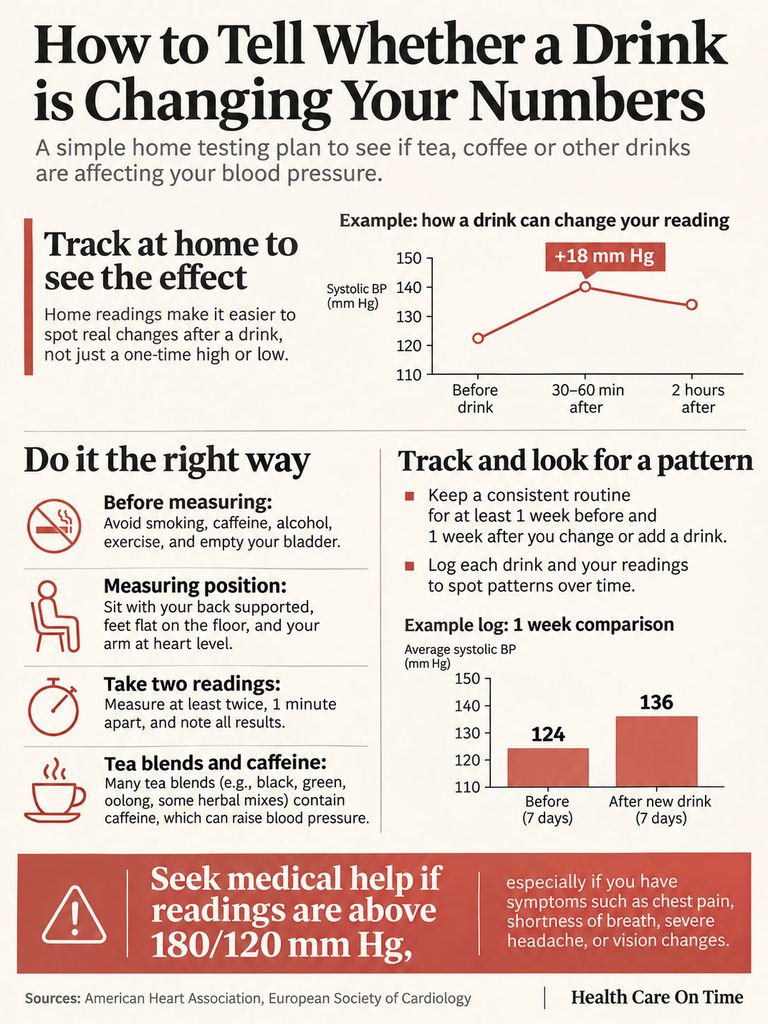
Before you measure, the American Heart Association’s home measurement sheet says to skip smoking, caffeinated drinks, alcohol and exercise for 30 minutes, empty your bladder, and sit quietly for more than 5 minutes without talking. Sit with your back supported, feet flat and legs uncrossed, with your arm resting on a table at heart level and the cuff on bare skin above the elbow. Take at least two readings 1 minute apart. Write all of them down.
Plain peppermint tea doesn’t break the caffeine rule, but a mint blend that includes green or black tea does, so check the box if you like a cup while you take your readings.
To test a change fairly, take readings at the same times each day for a week before you change anything, and keep the routine the same for several weeks after the change. Then compare the averages. Blood pressure swings from reading to reading. One low number after a cup of tea tells you very little. Note what you drank and when, right next to each reading, so patterns are easy to spot later. Bring the log to your next appointment, since your clinician can use it alongside office readings to decide whether your plan is working.
A reading above 180/120 mm Hg counts as severe. If you get one and feel fine, wait a few minutes, measure again and call your health care professional if it stays that high. Call 911 if a reading above 180/120 comes with chest pain, shortness of breath, back pain, numbness, weakness, vision changes or trouble speaking.
Questions worth asking your doctor
Bring these to your next visit, along with a week of home readings and a list of every medicine and supplement you take.
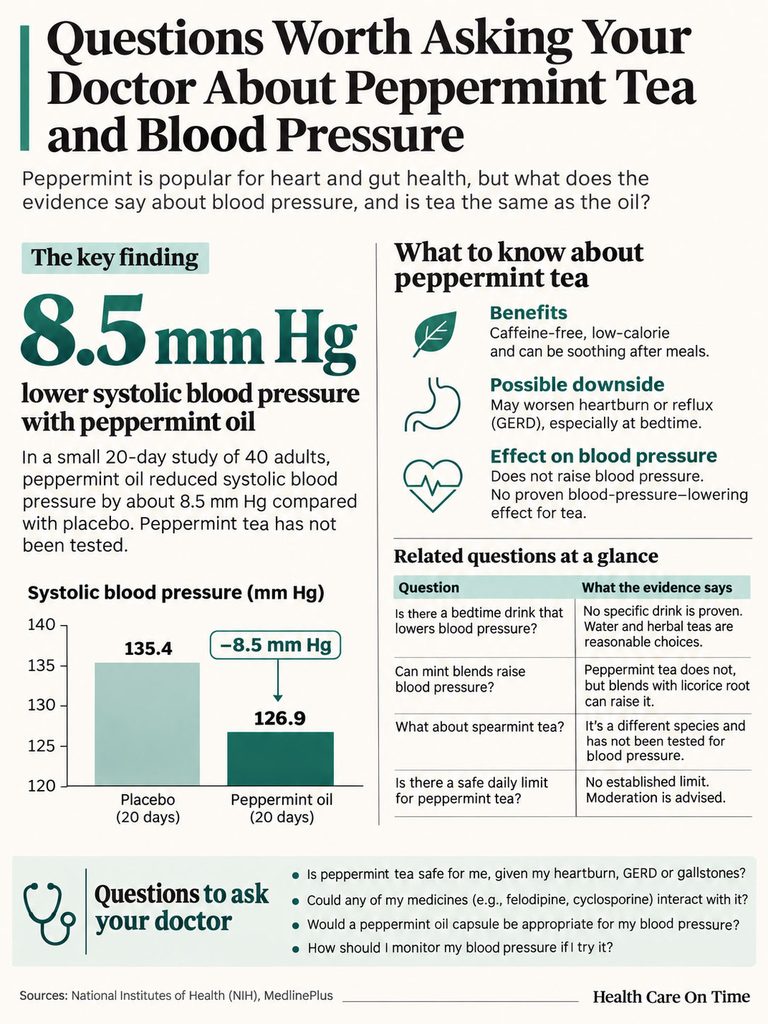
- These home readings keep landing in the 130s. Is it time for medicine, or can lifestyle changes come first?
- Is a daily cup of peppermint tea okay with the pills on this list?
- Could peppermint change how felodipine works, or any of the others?
- Is peppermint oil worth trying, or is one study too little to go on?
- The reflux gets worse at night. Should the tea stop after dinner?
- How often should blood pressure be checked at home, and what number means calling the office?
Frequently Asked Questions
Is peppermint good for blood pressure?
The oil may be. Peppermint oil lowered systolic pressure by about 8.5 mm Hg versus placebo in one small 20-day trial of 40 adults. As a tea, nobody knows. Brewed peppermint tea has not been tested, and a cup likely holds only a small fraction of that oil dose, so it shouldn’t be counted on to lower blood pressure.
Is there a downside to peppermint tea?
For most people the main one is heartburn. Peppermint relaxes the muscle that keeps stomach acid down, so it can worsen reflux, especially at bedtime. People with GERD, gallstones or a hiatal hernia should check with a doctor, and anyone on felodipine or cyclosporine should mention it to a pharmacist.
What are the benefits of drinking mint tea?
Most of the solid evidence for peppermint is about the oil, not the tea. A 2022 review of 10 studies with 1,030 participants found peppermint oil improved overall IBS symptoms and belly pain better than placebo. Peppermint tea itself has rarely been studied. Its practical benefits are simpler: it’s caffeine-free, has no calories or sodium when unsweetened, and fits easily into a day without adding sugar. Many people also find a warm cup soothing after a meal, though the research on tea and digestion is thin.
What can you drink at night to lower blood pressure?
No bedtime drink has been shown to lower blood pressure overnight. Water and caffeine-free herbal teas are sensible choices, and hibiscus tea has the most trial evidence among herbal teas, with an average systolic drop of 7.10 mm Hg across 17 trials, though results varied widely and came over weeks of regular use. Peppermint tea is fine as a calm, caffeine-free option if it doesn’t give you heartburn. Skipping the nightcap may matter more than what you pour instead, since cutting back on alcohol is one of the steps the AHA guideline strongly recommends.
Can peppermint tea raise blood pressure?
Plain peppermint tea hasn’t been linked to higher blood pressure. Check blends, though: mint teas that include licorice root can raise it in sensitive people, and blends with green or black tea add caffeine.
Is spearmint tea the same as peppermint tea for blood pressure?
No. Spearmint is a separate species, one parent of the peppermint hybrid, and both oil trials used peppermint only. Neither tea has been tested on blood pressure in a randomized trial.
How many cups of peppermint tea a day is safe?
There isn’t an official limit. Peppermint tea appears safe, but the long-term safety of large amounts of peppermint leaf hasn’t been studied. A few cups a day is a common, food-level amount; cut back if you notice heartburn.
Should you try peppermint oil capsules for blood pressure?
Not without talking to your doctor. The evidence is one small trial over 20 days, plus an earlier one in healthy adults, both from the same research group. Peppermint oil capsules are mostly sold for digestive complaints, and there’s no established dose for blood pressure. Never swallow aromatherapy or diffuser oil. If your readings are high, the proven steps (less sodium, more activity, weight control, less alcohol and, when needed, medicine) should come first, ahead of any supplement.
Does peppermint tea interact with blood pressure medication?
Plain tea in normal amounts isn’t known to cause problems for most people on blood pressure medicine. The documented concerns involve peppermint oil, which raised blood levels of felodipine in reports and blocked several drug-processing liver enzymes in lab studies. If you take felodipine, cyclosporine or several daily medicines, ask your pharmacist whether daily peppermint tea is fine for you.
Is peppermint tea good for low blood pressure?
Nothing suggests it raises or lowers readings in people with low blood pressure. If you get dizzy or lightheaded, especially when you stand up, ask your doctor to look for the cause.
Medical disclaimer: This article is for general information and isn’t a substitute for advice from your doctor or pharmacist. Don’t stop or change any blood pressure medicine based on this content. If you have a very high reading with chest pain, shortness of breath, weakness, numbness, vision changes or trouble speaking, call 911.
References
- Sinclair J, Sant B, Du X, et al. Effects of peppermint (Mentha x piperita L.) oil on cardiometabolic outcomes in patients with pre- and stage 1 hypertension: a placebo randomized controlled trial. PLoS One. 2026;21(4):e0344538. https://uhra.herts.ac.uk/id/eprint/26851/2/journal.pone.0344538.pdf
- ScienceDaily (University of Lancashire). Peppermint oil significantly lowers blood pressure in just 20 days. November 25, 2026. https://www.sciencedaily.com/releases/2026/11/261123231553.htm
- Sinclair J, Murray H, Smith V, et al. Effects of peppermint oil (Mentha piperita L.) on cardiometabolic and other health related outcomes: a placebo randomized controlled trial. Sport Sciences for Health. 2023. https://knowledge.lancashire.ac.uk/id/eprint/47964/3/Peppermint%20paper_RCT.pdf
- Raal A, Lodi R, Lepiku M, et al. Quality and safety assessment of commercial peppermint teas based on essential oil yield and composition. Beverages. 2026;12(3):38. https://www.mdpi.com/2306-5710/12/3/38
- Barbalho SM, et al. Investigation of the effects of peppermint (Mentha piperita) on the biochemical and anthropometric profile of university students. Ciência e Tecnologia de Alimentos. 2011;31(3):584-588. https://www.scielo.br/j/cta/a/wSDHwc9RV7svZ8xg4H5YJyb/?lang=en
- National Center for Complementary and Integrative Health. Peppermint Oil. Last updated May 2025. https://www.nccih.nih.gov/health/peppermintoil
- National Center for Complementary and Integrative Health. Licorice Root. https://www.nccih.nih.gov/health/licoriceroot
- Memorial Sloan Kettering Cancer Center. Peppermint (integrative medicine herb monograph). https://www.mskcc.org/cancer-care/integrative-medicine/herbs/peppermint
- Brown G. Counsel patients with GERD about certain foods. Pharmacy Times. July 16, 2019. https://www.pharmacytimes.com/view/counsel-patients-with-gerd-about-certain-foods-
- National Capital Poison Center. Essential oils. https://www.poison.org/articles/essential-oils
- American Heart Association. Top Things to Know: 2025 High Blood Pressure Guideline. https://professional.heart.org/en/science-news/2025-high-blood-pressure-guideline/top-things-to-know
- American Heart Association. How to measure your blood pressure at home (patient sheet, 2025). https://www.heart.org/-/media/GRFW-Files/Know-Your-Risk/measuring-your-blood-pressure-at-home-English.pdf
- CDC National Center for Health Statistics. Hypertension prevalence, awareness, treatment, and control among adults: United States, August 2021 to August 2023. NCHS Data Brief No. 511. https://www.cdc.gov/nchs/products/databriefs/db511.htm
- Ellis LR, Zulfiqar S, Holmes M, et al. A systematic review and meta-analysis of the effects of Hibiscus sabdariffa on blood pressure and cardiometabolic markers. Nutrition Reviews. 2021. https://www.pubmed.gov/34927694/
- Liu G, Mi XN, Zheng XX, et al. Effects of tea intake on blood pressure: a meta-analysis of randomised controlled trials. British Journal of Nutrition. 2014;112:1043-1054. https://www.cambridge.org/core/services/aop-cambridge-core/content/view/AD10B8AF38E3184FCFDDC9778F833835/S0007114514001731a.pdf/effects_of_tea_intake_on_blood_pressure_a_metaanalysis_of_randomised_controlled_trials.pdf
- NIHR Evidence. Lowering blood pressure reduces the risk of heart disease, stroke and death (summary of Ettehad D, et al. The Lancet). https://evidence.nihr.ac.uk/alert/lowering-blood-pressure-reduces-the-risk-of-heart-disease-stroke-and-death/