
She did not cry at her father’s funeral. She organized the catering, printed the programs, and drove her aunt to the airport on four hours of sleep. Eleven months later she fell apart in a Kroger because the deli counter had his favorite ham.
Table of Contents
A colleague of hers lost her mother the same spring and cried for three straight weeks, then went back to work and felt steady. Both women grieved the same amount. Only one of them has ADHD, and only one of them spent a year convinced something was wrong with her.
Quick Answer
People with ADHD often do grieve differently, though not because they feel less. Three traits reshape the experience: emotional dysregulation makes grief waves more intense and less predictable, executive dysfunction makes the practical tasks of loss overwhelming, and altered time perception scrambles the expected timeline. Grief may arrive late, hit harder, and last longer. It is a difference in shape, not in depth of love.
At a Glance
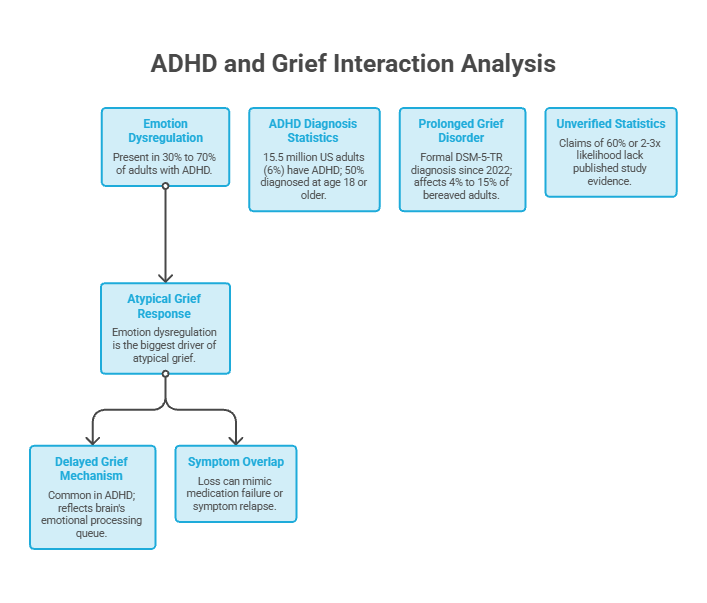
• An estimated 15.5 million US adults, about 6.0% of the adult population, have a current ADHD diagnosis, and roughly half were not diagnosed until age 18 or older.
• Research places significant emotion dysregulation in 30% to 70% of adults with ADHD, which is the biggest single driver of atypical grief responses.
• Delayed grief with ADHD is common and rarely means avoidance; it usually reflects how the brain queues emotional processing.
• Grief and ADHD worsen each other, so a loss can look exactly like a medication failure or a symptom relapse.
• Prolonged grief disorder became a formal DSM-5-TR diagnosis in 2022 and affects an estimated 4% to 15% of bereaved adults.
• Several widely shared ADHD grief statistics, including a 60% figure and a “2 to 3 times more likely” claim, trace back to no published study.
What Grief Actually Looks Like When You Have ADHD
Grief is not one emotion. It is a months-long project involving feelings, memory, paperwork, social obligation, and the slow rebuilding of daily routine. ADHD affects nearly every one of those systems.
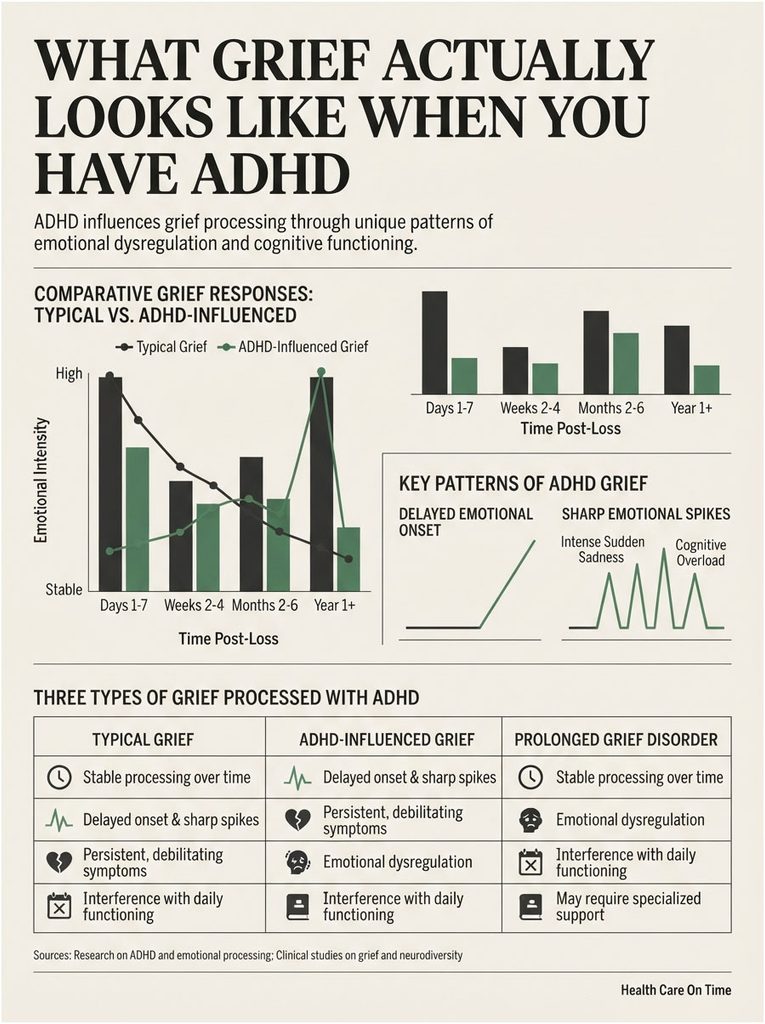
That is where the difference shows up. Not in whether the loss registers, but in when it registers, how loudly, and how much of ordinary life stays standing while it happens.
Signs your grief may be moving through an ADHD brain
These are the patterns people describe most often when grieving with ADHD:
- Feeling numb or oddly calm for weeks, then being flattened months later
- Crying at a commercial but staying dry-eyed at the funeral
- Reaching for the phone to call the person, then remembering again
- Functioning normally at work while mail, bills, and paperwork pile up untouched
- Losing all sense of how long it has been since the death
- Sudden, disproportionate reactions to small reminders
- Pulling away from people out of fear you are grieving incorrectly
- Anniversary dates hitting as hard as the first week
None of these mean the grief is defective. They mean it is running on different hardware.
The honest answer researchers can give right now
The literature here is thinner than the topic deserves. No large prospective study has followed bereaved adults with diagnosed ADHD against a matched group over several years.
What exists is strong evidence about the parts. Emotion regulation in ADHD is well studied. Prolonged grief disorder is well studied. The overlap is being inferred from both bodies of work rather than measured head-on.
Our medical reviewers flag this openly, because the gap matters. When someone searches for confirmation that their reaction is not broken, they deserve to know which claims rest on research and which rest on clinical observation.
Three grief categories worth separating
Most confusion comes from collapsing three different things into one word. Typical grief hurts badly and gradually loosens its grip.
ADHD-influenced grief follows a stranger path but still moves toward integration. Prolonged grief disorder is a clinical condition where the acute phase never resolves and daily functioning stays impaired past twelve months.
Knowing which one you are in changes what help you should be looking for, and it changes who you should be looking for it from.
| Grief Feature | Common Response Without ADHD | Common Response With ADHD | Why ADHD Changes It | Red Flag for Prolonged Grief Disorder |
| Emotional onset | Distress typically begins within hours to days | Numbness or flat affect for weeks, then sudden onset | Working memory and interoception delay emotional labeling | Complete absence of grief response past 6 months with functional decline |
| Timeline shape | Gradual downward slope with bad days | Sharp spikes, long flat stretches, no visible slope | Time perception deficits remove the internal sense of how long | No reduction in intensity at all between month 3 and month 12 |
| Crying and expression | Predictable triggers, socially timed | Ambushed by minor triggers, dry at services | Emotional dysregulation raises reactivity to low-level cues | Emotional pain so intense that daily activity stops entirely |
| Daily functioning | Reduced for weeks, then recovers | Collapses in specific domains: bills, laundry, replies | Executive dysfunction removes the scaffolding grief was leaning on | Inability to work or care for self past 12 months |
| Memory of the deceased | Steady, painful, present | Intermittent forgetting followed by re-shock | Out-of-sight processing re-triggers the loss repeatedly | Preoccupation so constant that nothing else can be thought about |
| Social contact | Withdrawal, then gradual return | Sharp withdrawal driven by rejection sensitivity | Fear of judgment about grieving wrong | Refusal of all contact, loss of identity or sense of purpose |
| Duration of acute phase | Roughly 6 to 12 months | Often longer, with strong anniversary reactions | Delayed start pushes the whole curve backward | Persistent, disabling symptoms 12 months or more after the death |
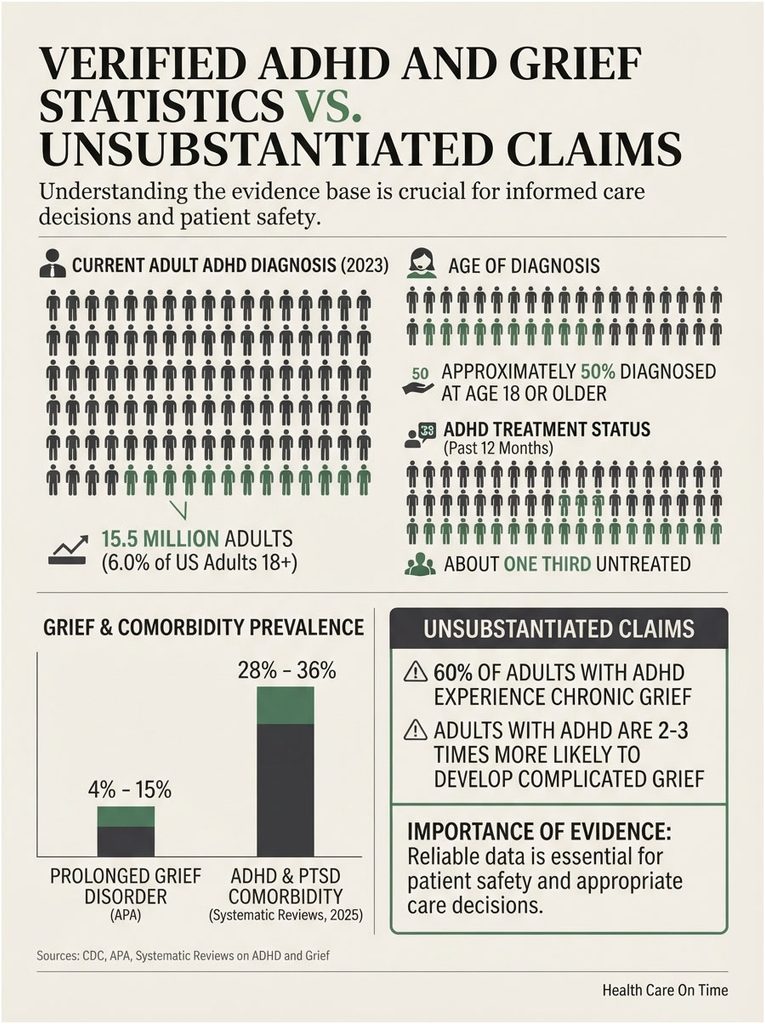
The prevalence context matters. CDC analysis of National Center for Health Statistics Rapid Surveys System data collected in October and November 2023 found an estimated 15.5 million US adults, or 6.0%, had a current ADHD diagnosis, with approximately half receiving that diagnosis at age 18 or older.
That last detail is the quiet one. A large share of grieving American adults with ADHD did not know they had it when their earlier losses happened, and spent years assuming their reaction was a character flaw.
The Six ADHD Traits That Reshape Grief
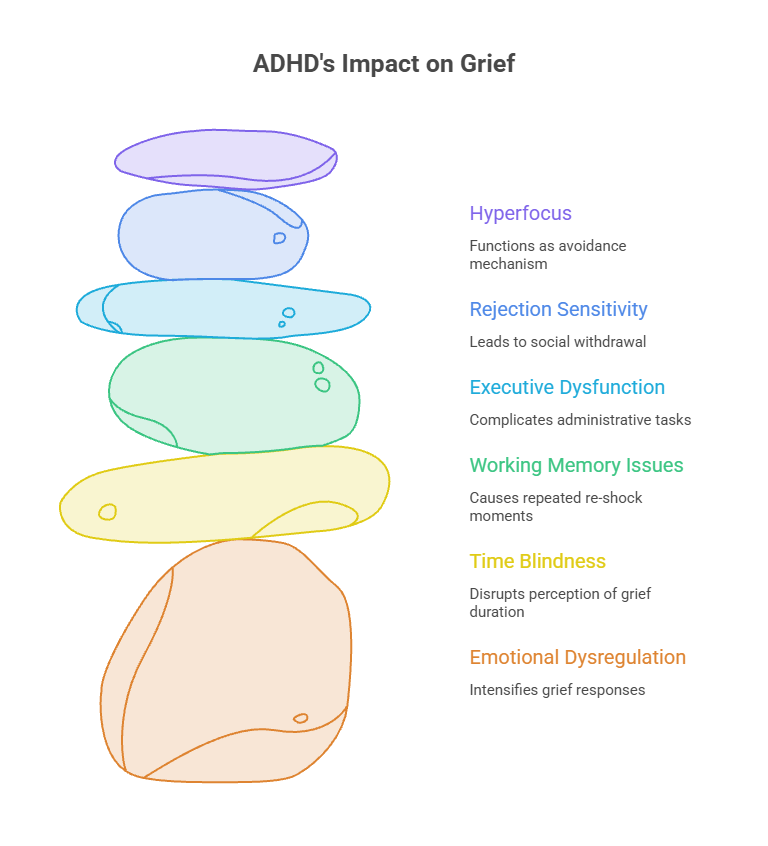
Emotional dysregulation turns the volume knob
Emotional dysregulation means difficulty modulating the intensity and duration of an emotional response. It is not in the diagnostic criteria for ADHD, yet a large body of research treats it as a core feature anyway.
An influential analysis by Shaw and colleagues in the American Journal of Psychiatry concluded that 30% to 70% of adults with ADHD, and 25% to 45% of children with the condition, experience significant emotion dysregulation. Researchers describing the same review note that emotion dysregulation is altered in 34% to 70% of affected adults and is now discussed as a possible fourth core symptom.
Apply that to bereavement. The same trigger that produces a lump in a neurotypical throat can produce a two-hour shutdown, and the return to baseline takes considerably longer.
Time blindness breaks the grief timeline
ADHD involves a weak internal clock. Most people with ADHD describe time as binary: now, and not now.
Grief runs on a calendar that assumes you can feel elapsed duration. Without that sense, “it has been six months, you should be doing better” lands as noise. Six months and six days can feel identical from the inside.
This is also why anniversary reactions can be so violent. The date arrives with no emotional runway, and the loss presents as if it happened that morning.
Working memory creates the “I forgot they died” ambush
People with ADHD frequently describe reaching for the phone to call the person who died, six weeks or six months later. This is not denial and it is not a memory disorder.
It reflects how ADHD handles anything outside the immediate field of attention. The knowledge is stored, but it does not sit in the foreground the way it does for many neurotypical mourners.
The consequence is re-shock. Instead of one loss processed continuously, the loss gets rediscovered dozens of times, each rediscovery carrying a smaller version of the original impact.
Executive dysfunction collides with the paperwork of death
American death arrives with an administrative workload. Death certificates, funeral home contracts, Social Security notification, bank and credit card closures, life insurance claims, employer benefits, sometimes probate.
It is a project management assignment delivered at the worst possible moment. Task initiation, sequencing, and follow-through are already effortful with ADHD on a good day, and grief drops available executive capacity further.
Patients contacting us for routine lab work during a bereavement period mention this collision often, describing four months of unopened mail alongside otherwise intact daily function. The failure is domain-specific rather than global, and that pattern confuses families badly, because the person clearly is not incapacitated.
Rejection sensitivity pushes people to withdraw
Many adults with ADHD report intense pain in response to perceived criticism or rejection. In grief that becomes a specific fear: that other people are grading how you mourn.
Too composed at the service and you look cold. Falling apart at a Tuesday standup eight months later and you look dramatic. Both readings produce the same outcome, which is withdrawal from the exact support network that helps grief resolve.
What rejection sensitive dysphoria is, and what it is not
Rejection sensitive dysphoria is a descriptive clinical term, not a DSM-5-TR diagnosis. It came out of ADHD clinical practice and is widely used by patients and clinicians, but it has not been validated as a distinct disorder.
The underlying phenomenon of heightened reactivity to social rejection cues is real and supported by the emotion dysregulation literature. The label is useful shorthand. It is not something a clinician can code, and any article claiming otherwise is wrong.
Hyperfocus can turn grief into a project
The flip side of attention difficulty is attention lock. Some people with ADHD respond to a death by pouring themselves into one narrow channel: researching the illness for weeks, building an elaborate photo archive, or rewriting the obituary eleven times.
This is not automatically unhealthy. Sustained attention on the person who died can be genuinely integrative work.
It becomes a problem when it functions as avoidance of everything else, or when it locks into replaying the final hospital days on a loop. The distinction is whether the focus is moving somewhere or circling.
What the Numbers Really Show, and Which Ones Are Made Up
The verified USA picture
| Statistic | Figure | Population | Source |
| Current adult ADHD diagnosis | 15.5 million adults, 6.0% | US adults 18+, 2023 | CDC MMWR, NCHS Rapid Surveys System |
| Diagnosed at age 18 or older | Approximately 50% | US adults with current ADHD | CDC MMWR, NCHS Rapid Surveys System |
| Untreated in past 12 months | About one third | US adults with current ADHD | CDC MMWR, NCHS Rapid Surveys System |
| Significant emotion dysregulation | 30% to 70% | Adults with ADHD | Shaw et al., Am J Psychiatry, 2014 |
| Prolonged grief disorder | 4% to 15% | Bereaved adults | American Psychiatric Association |
| PGD under strict DSM-5-TR criteria | 3.3% to 6.8% | General bereaved population samples | Rosner et al.; Frontiers in Psychiatry, 2024 |
| PGD after violent or unnatural loss | Pooled estimate near 49% | Bereaved by killing, suicide, disaster, accident | Djelantik et al., 2020 |
| ADHD and PTSD comorbidity | 28% to 36% | Adults | Systematic Reviews, 2025 |
| Close relatives bereaved per US death | Approximately 9 | US kinship network modeling | Verdery et al., 2020 |
Several of these deserve unpacking. The American Psychiatric Association estimates that 4% to 15% of bereaved adults experience the persistent symptoms of prolonged grief disorder, with risk rising when the death was sudden or occurred under unnatural circumstances.
The range is wide because measurement is contested. A German general population study of 2,509 people, of whom 1,071 reported losing someone close, found point prevalence between 4.7% and 6.8% depending on which criteria set and diagnostic algorithm was applied. Grief researchers argued in 2025 that prevalence estimates in at-risk bereaved groups are probably inflated, partly because most rely on self-report questionnaires rather than clinician assessment.
The ADHD and PTSD overlap belongs here because traumatic loss is a shared pathway. A 2025 systematic review of 21 studies found ADHD and PTSD comorbidity in adults ranging between 28% and 36%, with co-occurring ADHD linked to greater psychosocial impairment and more severe PTSD symptoms.
The ADHD grief statistics circulating with no research behind them
Two claims appear repeatedly across ADHD grief content, social posts, and even pages ranking on page one. The first is that 60% of adults with ADHD experience chronic feelings of grief or sadness. The second is that people with ADHD are two to three times more likely to develop complicated grief.
Neither figure traces to a published study. No peer-reviewed source, no cohort, no sample size, no citation attached where they appear. They read as plausible because the underlying idea is plausible.
This matters more than it sounds. Our medical team treats unsourced prevalence figures as a patient safety issue, because people use numbers like these to decide whether to seek care or to conclude their outcome is already determined.
The defensible position is this. ADHD very likely raises the risk of complicated grief through mechanisms that are well documented individually. Nobody has quantified that risk yet, and pretending otherwise does grieving people no favors.
Grief Also Makes ADHD Worse, and It Runs Both Ways
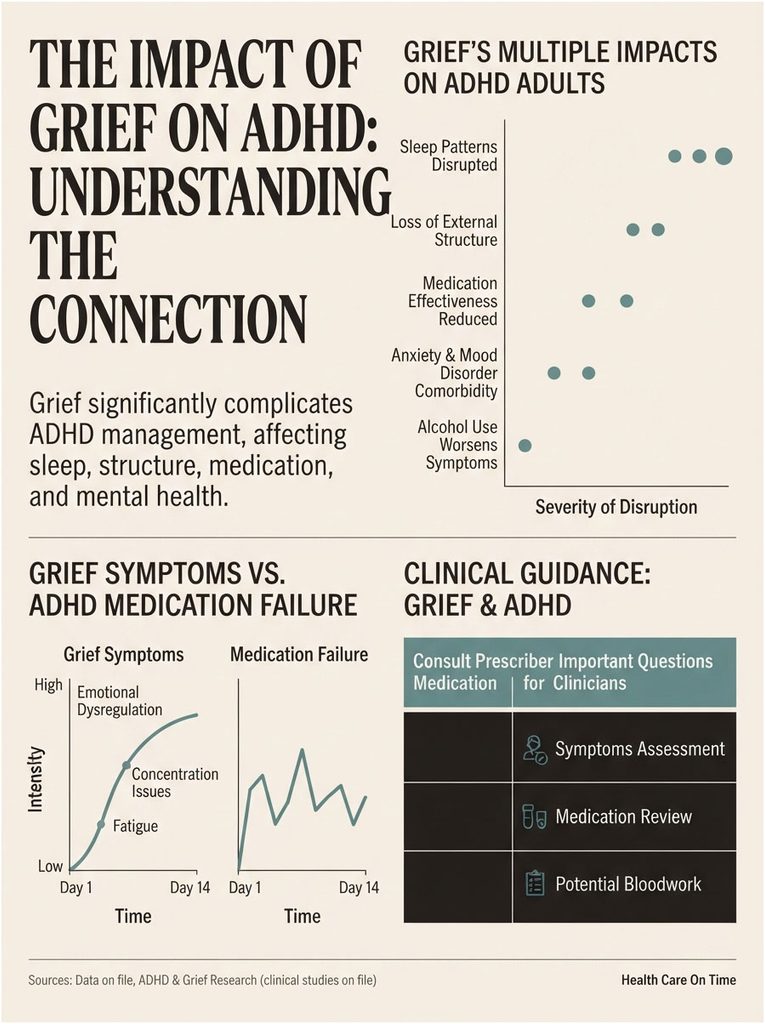
Sleep, food, and the collapse of external structure
Most functional adults with ADHD run on scaffolding. Alarms, shared calendars, a partner who remembers things, a commute that imposes shape on the day. Death removes chunks of that scaffolding overnight.
Sleep goes first. Grief disrupts sleep in nearly everyone, and ADHD-related delayed sleep phase problems compound it. Sleep loss then degrades attention, working memory, and emotional control, which are already the weak points.
Eating turns irregular, which for anyone on stimulant medication interacts directly with appetite suppression and dose timing. Our lab partners see the downstream version of this in bereaved patients, through the fatigue workups, thyroid panels, iron studies, and vitamin D tests ordered when someone reports months of exhaustion after a loss.
When grief looks like a medication failure
Six weeks after a death, an adult with ADHD may present with worse focus, missed deadlines, higher irritability, and a conviction that the medication stopped working. Every one of those is also a grief symptom.
Prescribers see this pattern constantly. The clinical question is whether the ADHD treatment plan genuinely failed, or whether bereavement is loading the same circuits from a different direction.
Baseline comorbidity makes the picture harder to read. NCHS data on adult ADHD visits to US health centers documented anxiety disorders in 51.2% of visits and mood disorders in 48.8%, so a grieving adult with ADHD is frequently carrying at least one other condition already.
A word on alcohol and other quick fixes
Grief plus dysregulation plus disrupted sleep is a setup for reaching toward anything that flattens the feeling fast. Alcohol is the common one, and it makes both sleep architecture and next-day emotional control measurably worse.
There is no useful lecture here, only a marker. If intake has changed noticeably since the death, that is worth naming out loud to a clinician rather than tracking privately.
Questions to ask your prescriber
Do not adjust or stop ADHD medication on your own during grief. Bring specific questions to the appointment instead.
Useful ones: whether current symptoms fit grief better than undertreated ADHD, whether sleep or appetite changes warrant a timing or dose review, whether new symptoms overlap with known side effects, and how soon a follow-up should happen rather than waiting for the standard interval.
Patients ask us often whether bloodwork should come first. A basic panel covering thyroid function, iron status, and vitamin D can rule out common physical contributors to post-loss fatigue, which gives the prescriber a cleaner picture to work from.
When Grief Becomes a Diagnosable Condition
Prolonged grief disorder in plain English
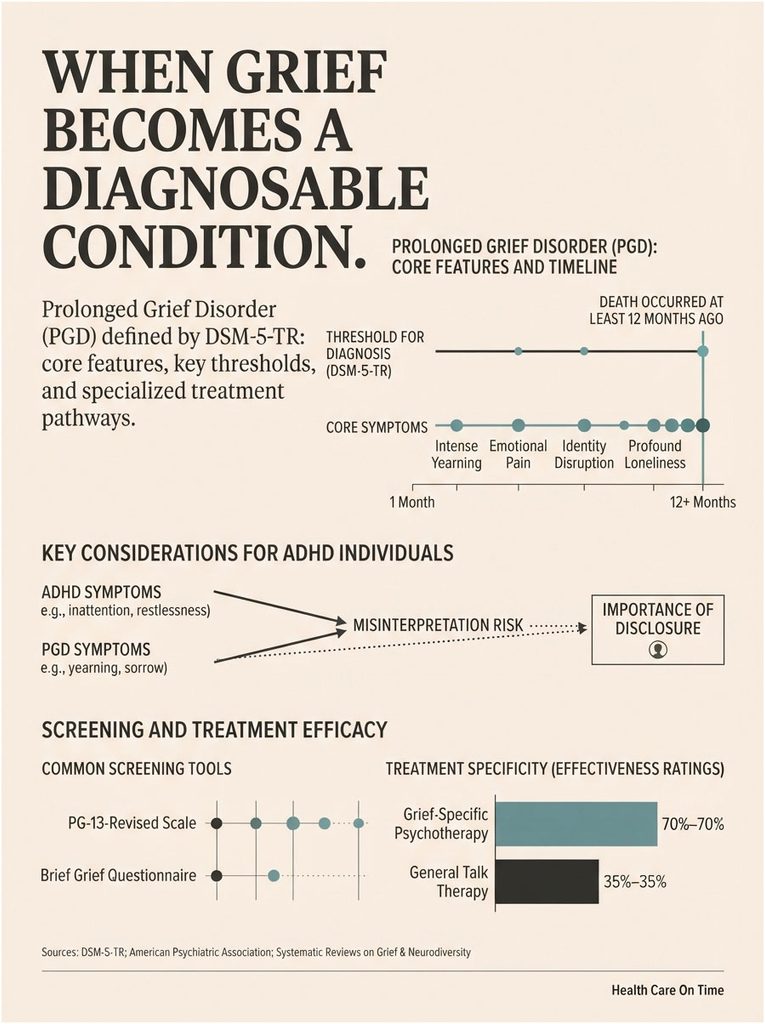
Prolonged grief disorder entered the DSM-5-TR in 2022. It describes grief that stays in the acute, disabling phase well past the point where most people begin reintegrating.
The core features are persistent intense yearning for the person who died, or persistent preoccupation with thoughts of them, plus symptoms such as identity disruption, disbelief, avoidance of reminders, intense emotional pain, difficulty re-engaging with life, emotional numbness, a sense that life is meaningless, and profound loneliness.
Two thresholds define it for adults. The death occurred at least twelve months ago, and the symptoms cause clinically significant distress or impairment. The ICD-11 version uses a six-month minimum instead, which is one reason prevalence estimates differ between systems.
Why the ADHD overlap is easy to misread
Here is the trap. Several PGD criteria describe things ADHD produces anyway: difficulty re-engaging with routine, emotional numbness, avoidance behavior, a shaky sense of identity.
A grieving adult with untreated ADHD can appear to meet more criteria than they actually do. A grieving adult with well-managed ADHD can be waved off because they are still holding down a job.
This needs a clinician who understands both conditions. Our medical reviewers consistently recommend disclosing an ADHD diagnosis at the first grief appointment rather than the third, because it changes how every answer should be interpreted.
Screening tools a US clinician may use
Two are common. The PG-13-Revised is a thirteen-item self-report scale developed alongside the DSM-5-TR criteria. The Brief Grief Questionnaire is a five-item screener used for faster triage in primary care.
Neither is a diagnosis. Both are ways to decide whether a full assessment is warranted, and both are quick enough to fit into a standard appointment.
Treatments with evidence behind them
Grief-specific psychotherapy outperforms general talk therapy for this condition. In a randomized controlled trial published in JAMA in 2005, complicated grief treatment produced a response rate of 51% compared with 28% for interpersonal psychotherapy, with faster time to response and a number needed to treat of 4.3.
The follow-up work reinforced it. A second randomized trial in older adults with a mean age of 66 found the response rate to grief-focused treatment was more than twice that of interpersonal psychotherapy, and a later four-site study examined whether antidepressant medication added benefit when given with or without the grief-focused protocol.
The practical takeaway is specificity. Prolonged grief disorder symptoms show little response to treatments designed for depression, and untreated PGD predicts worse outcomes when someone is being treated for PTSD. Supportive counseling from a generalist is a different intervention than the one tested in those trials, and it is reasonable to ask which one you are being offered.
Grief Support Built for an ADHD Brain
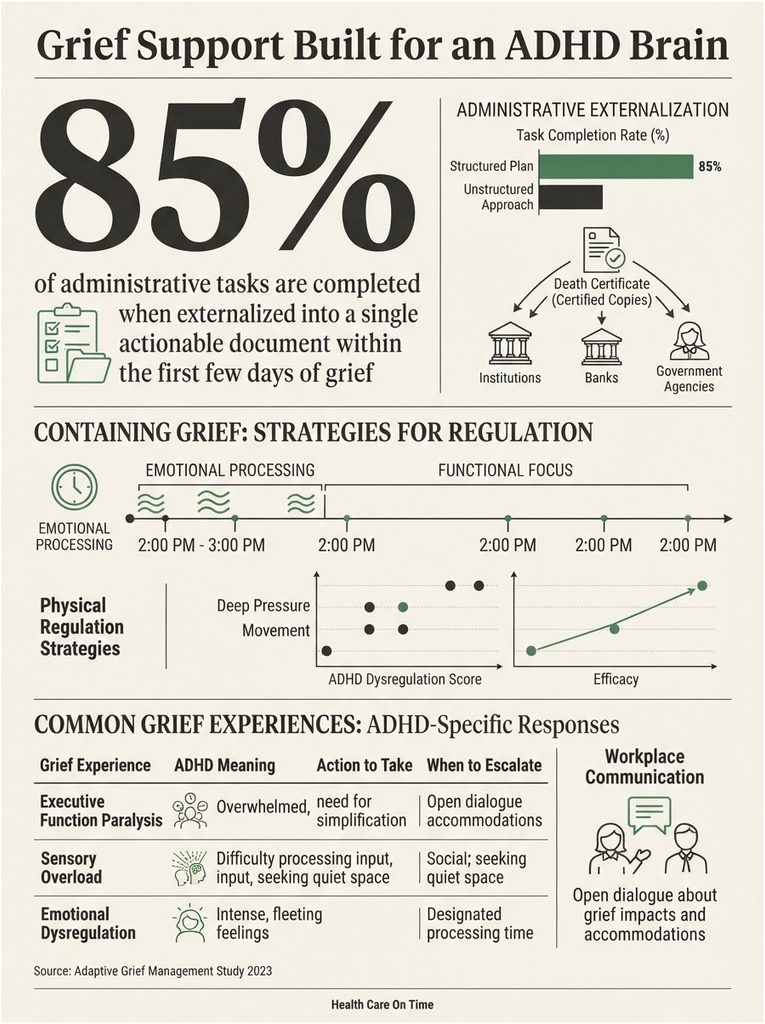
The first two weeks: externalize the admin
Do not try to hold the death-related task list in your head. Get it out and into something visible within the first few days.
One document, one place. Every item gets a single next physical action, not a category. “Call Social Security at 1-800-772-1213” is actionable. “Handle benefits” is not.
Order 10 to 12 certified copies of the death certificate at once, because almost every institution wants an original and reordering later is its own executive task. Then start handing pieces away.
When people say “let me know if you need anything,” the ADHD-compatible reply is to send them one specific item off the list. Most will say yes, and the ones who do not were never going to help anyway.
Month one through month six: contain grief instead of scheduling it away
Suppressing grief until a convenient moment does not work, and neither does letting it flood every hour. The middle path is containment: a defined time and place where grief gets full access.
Some people use a daily fifteen-minute window with a timer. Others use a physical object, a playlist, a walking route, or a notebook that exists only for this.
The container gives the emotion somewhere legitimate to go, which reduces how often it breaks in sideways during a meeting or a school pickup.
Body-first regulation for a dysregulated day
When emotional dysregulation is running the day, cognitive strategies land poorly. Physical ones work faster.
Movement is the most reliable: a walk outdoors, stairs, anything rhythmic for ten to twenty minutes. Slow exhales lengthen the parasympathetic response. Cool water on the face and wrists can interrupt a rising wave. Deep pressure input helps some people substantially.
None of this processes grief. It buys back enough regulation that processing becomes possible.
Scripts for asking people for specific help
Vague requests fail because they push executive load back onto you. Specific requests succeed.
Try: “Could you sit with me while I make three phone calls Thursday at 2?” Or: “Can you take the funeral home paperwork? Here is the folder.” Or, to a manager: “Grief is affecting my focus. Could we move the Q3 deadline two weeks and check in Friday?”
Patients ask us how much to disclose at work. Naming the impact and the specific accommodation usually goes further than naming the diagnosis.
| What You Are Experiencing | What It Often Means | Do This First | When to Escalate |
| Felt nothing for weeks, now flooded | Delayed emotional processing, common with ADHD | Name it as delayed grief, not coldness; start a grief container | If flooding stops all daily function for more than a few days |
| Keep forgetting they died, then re-shocked | Working memory and out-of-sight processing | Create one physical reminder object rather than avoiding all reminders | If re-shock episodes increase rather than decrease after 6 months |
| Bills and paperwork untouched for weeks | Executive dysfunction under load, not laziness | Hand the highest-consequence item to a named person this week | If a legal deadline, foreclosure, or benefit lapse is approaching |
| Medication feels like it stopped working | Grief loading the same circuits ADHD treatment targets | Book a prescriber review; log sleep, food, and dose timing for 7 days | If you are considering stopping or self-adjusting |
| Withdrawing because you grieve “wrong” | Rejection sensitivity in a grief context | Tell one low-stakes person one true thing this week | If isolation has run several weeks with no contact at all |
| Locked into researching or replaying the death | Hyperfocus that has stopped moving forward | Set a hard time boundary around it and add one outward activity | If it displaces sleep, work, or caregiving for weeks |
| No improvement at all past 12 months | Possible prolonged grief disorder | Ask a clinician about a PG-13-R or Brief Grief Questionnaire screen | Immediately, if functioning remains fully impaired |
| Thoughts of not wanting to be here | Grief-related distress that needs support now | Call or text 988, the Suicide and Crisis Lifeline | Immediately, without waiting for an appointment |
Children and Teens With ADHD Who Are Grieving
Childhood bereavement in the United States is common. Modeling from the Childhood Bereavement Estimation Model indicates an average of 1,089 American children became newly bereaved each day in 2022.
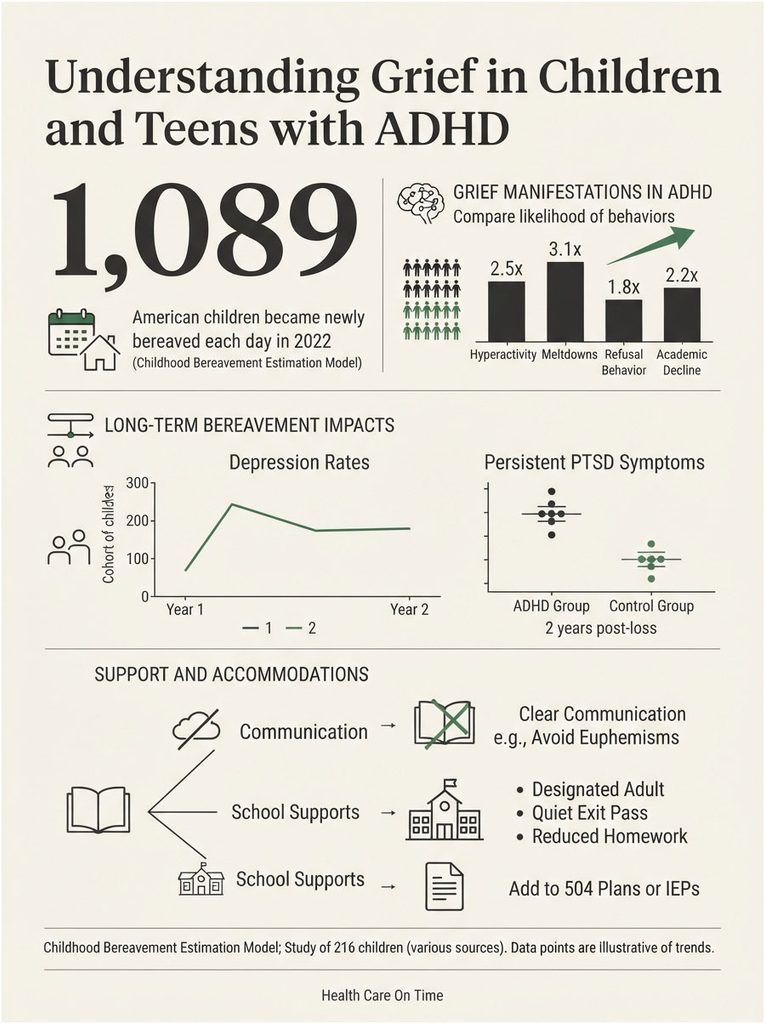
Grief in a child with ADHD often does not look like sadness. It looks like escalating hyperactivity, more frequent meltdowns, refusal behavior, or a sudden academic drop that adults read as a discipline problem.
A seven-year prospective study from the University of Pittsburgh followed 216 children aged 7 to 17 bereaved by sudden parental death against 172 demographically similar nonbereaved children, finding higher rates of depression in the first two years and higher rates of PTSD at all time points, with results holding even after adjusting for pre-existing psychiatric conditions.
Grief educators also note that bereavement can intensify pre-existing conditions including ADHD, and that behavioral and mental health effects in children sometimes do not surface until one or two years after the death. That delay is why the second-year check-in matters as much as the first-month one.
What to say and what to skip
Use plain, literal language. “Died” rather than “passed away,” “went to sleep,” or “we lost him.” Children with ADHD take language at face value, and softened phrasing produces confusion or fear about sleeping.
Answer the question asked, then stop. Repeat the same answer when it is asked again next week, because repetition is how the information settles.
Skip anything that assigns a schedule to the feelings. “You will feel better soon” sets a deadline the child will then fail.
School supports worth asking for
Request a meeting rather than waiting for the school to notice. Reasonable asks include a designated adult and a quiet exit pass, temporary reduction in homework volume, extended deadlines, advance warning about assignments involving family trees or parent interviews, and a written note to every teacher so the child never has to explain again.
If the child already has a 504 plan or IEP, grief-related supports can be added as temporary accommodations. If they do not, a written request to the school counselor starts the process.
How to Support Someone With ADHD Through a Loss
What helps: specific offers instead of open ones, repeated check-ins past the three-month mark when everyone else has stopped, tolerance for grief arriving out of order, and quietly taking over discrete administrative tasks.
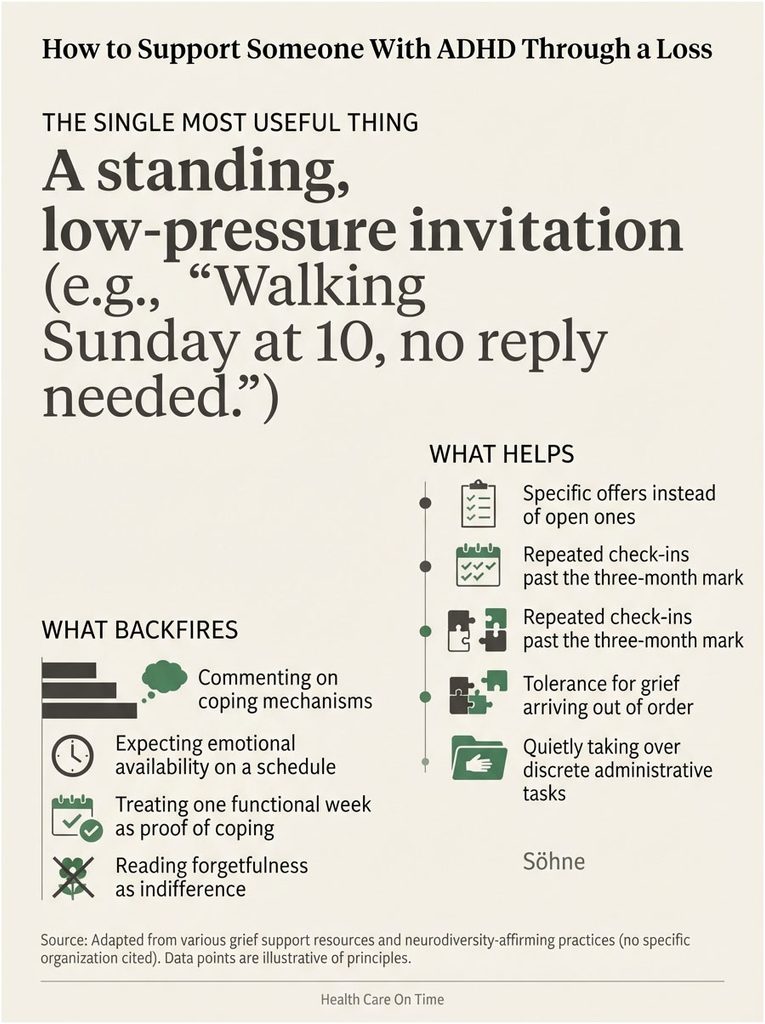
What backfires: commenting on how well or badly they seem to be coping, expecting emotional availability on a schedule, treating one functional week as proof they are fine, and reading forgetfulness or flat affect as indifference toward the person who died.
The single most useful thing is a standing, low-pressure invitation. Not “call me if you need anything,” which requires initiation they do not currently have. Something closer to “walking Sunday at 10, no reply needed, show up if you want.”
The USA Practicalities Nobody Explains
Bereavement leave is not a federal right
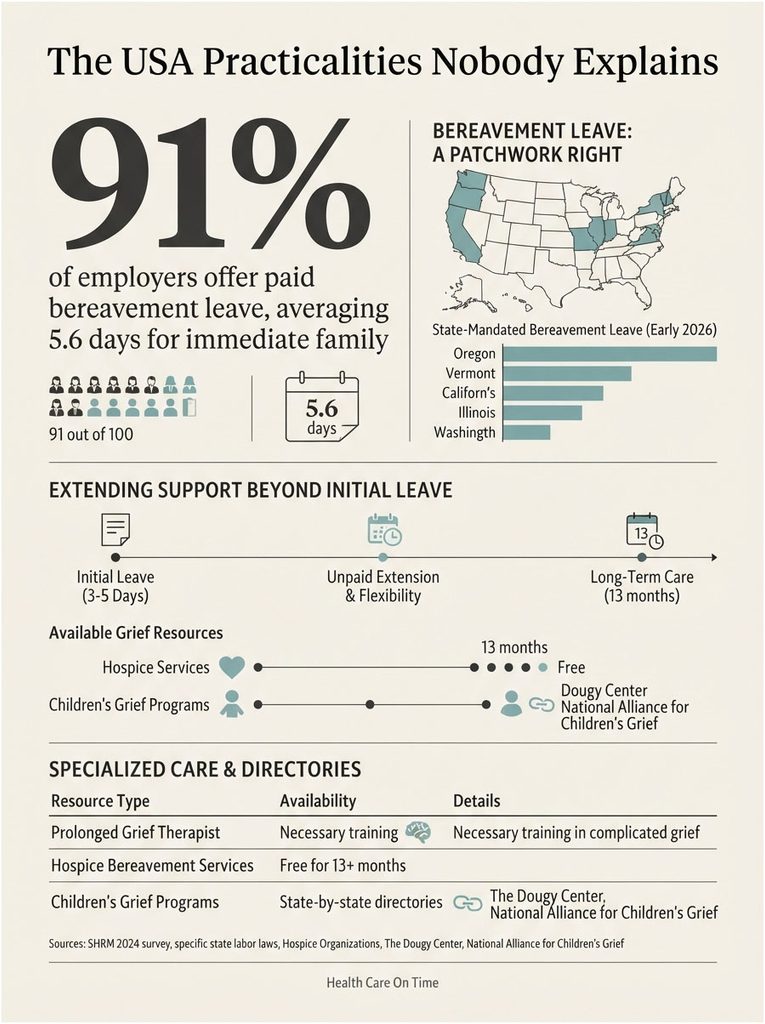
There is no federal law requiring bereavement leave, and the Family and Medical Leave Act does not cover grieving a death by itself. As of early 2026, six states, California, Illinois, Maryland, Oregon, Vermont, and Washington, required employers to offer some form of bereavement leave, with terms differing significantly between them.
Most workers rely on employer policy. SHRM’s 2024 Employee Benefits Survey found 91% of employers offer bereavement leave, with an average around 5.6 days for immediate family and most companies clustering in the 3 to 5 day range.
For an ADHD brain that has not started processing yet on day five, that window is functionally zero. Plan around it. Ask about unpaid extension, remote days, or reduced hours before the paid days get spent entirely on funeral logistics.
Finding grief-specialized care and paying for it
Ask directly whether a therapist has training in prolonged grief disorder treatment or complicated grief treatment. General grief counseling is not the same protocol as the one tested in the trials cited above.
Free and low-cost options exist and are widely underused. Hospice organizations provide bereavement services to families for at least thirteen months after a death, and many extend support groups to the wider community regardless of whether hospice was involved.
The Dougy Center and the National Alliance for Children’s Grief maintain state-by-state directories of children’s grief programs, most of them free. For adults, employer assistance programs typically cover several sessions at no cost, which is often enough to get an assessment started.
What Improvement Actually Looks Like
Recovery from grief is not the absence of pain. It is the return of capacity: being able to think about the person without the whole day collapsing, and being able to plan something in the future.
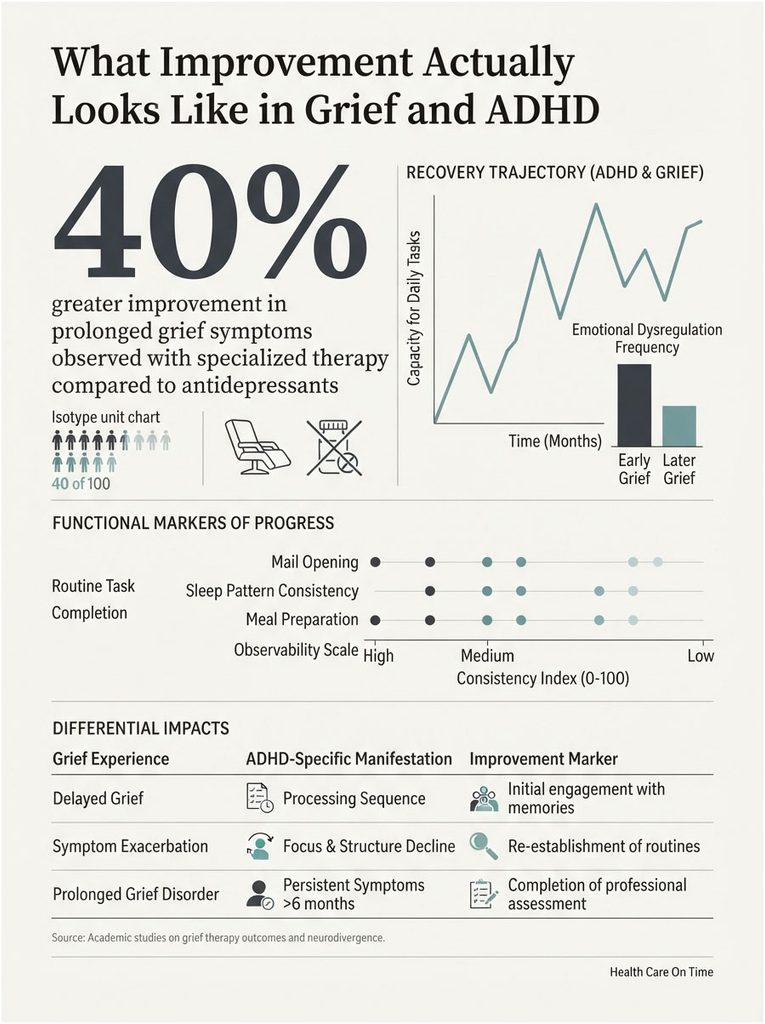
With ADHD, expect that return to be uneven. Two good weeks followed by a terrible one is not backsliding, it is the same non-linear pattern the grief started with.
The markers worth watching are functional rather than emotional. Is mail getting opened. Is sleep roughly regular. Are there stretches where the loss is present but not occupying everything. Those move before the sadness does.
Frequently Asked Questions
Do people with ADHD grieve differently from everyone else?
Often yes, in shape rather than depth. Emotional dysregulation, executive dysfunction, and altered time perception change when grief arrives, how intensely it hits, and how much daily function survives it. Research on the components is solid, though no large study has yet measured ADHD grief directly against a matched comparison group.
Why did I feel nothing when my loved one died?
Emotional numbness right after a death is common in everyone and can last longer with ADHD. Identifying and labeling an emotion is itself an executive task, so processing may queue behind immediate logistics. Feeling nothing at the funeral does not mean you loved the person less.
Is delayed grief real, or am I just avoiding it?
Delayed grief is a real and recognized pattern. With ADHD it usually reflects processing sequence rather than avoidance, especially when the weeks after a death are packed with tasks. Avoidance involves actively steering away from reminders. Delay involves the feelings arriving on their own schedule.
How long does grief last if you have ADHD?
There is no fixed duration. Acute grief commonly runs six to twelve months, and with ADHD the whole curve may start later and extend further. Length alone is not a problem. Persistent, disabling impairment beyond twelve months is what warrants a clinical conversation.
Can grief make my ADHD symptoms worse?
Yes, and this is one of the most common patterns. Grief disrupts sleep, appetite, and daily structure, which are the three supports ADHD depends on most. Focus, working memory, and emotional control all degrade further. Many people mistake this for medication no longer working.
Should I stop my ADHD medication while grieving?
Do not change anything without your prescriber. Grief alters sleep, appetite, and stress response in ways that affect how medication feels, and stopping abruptly usually makes function worse. Book a review, bring a week of notes on sleep and dose timing, and let the prescriber assess it.
Why do I keep forgetting that they are gone?
This reflects how ADHD handles information outside immediate attention, not a memory disorder. You reach for the phone, then remember. Each rediscovery carries a smaller version of the original shock. It typically eases over months, and a small physical reminder helps more than avoidance does.
Is rejection sensitive dysphoria an official diagnosis?
No. It is a descriptive term from ADHD clinical practice, not a DSM-5-TR diagnosis. The underlying heightened reactivity to rejection cues is well supported by emotion dysregulation research. Clinicians cannot code it, so expect the conversation to be framed around emotional dysregulation instead.
How do I know if I have prolonged grief disorder?
Two thresholds apply for adults: at least twelve months since the death, and persistent intense yearning or preoccupation plus significant impairment in daily life. Screening tools such as the PG-13-Revised or Brief Grief Questionnaire help a clinician decide whether full assessment is warranted. Self-diagnosis is not reliable here.
Does grief therapy work better than antidepressants for grief?
For prolonged grief disorder symptoms specifically, grief-focused psychotherapy has the stronger evidence. Trial data showed a 51% response rate for complicated grief treatment against 28% for standard interpersonal psychotherapy. Antidepressants may still be appropriate when depression coexists, which is a separate clinical decision.
How do I help a child with ADHD who lost a parent?
Expect grief to show up as behavior rather than sadness: more hyperactivity, meltdowns, or a sudden academic drop. Use literal language, keep routines stable, and request school accommodations in writing. Keep watching past the first year, since effects sometimes surface twelve to twenty-four months later.
How much bereavement leave am I entitled to in the US?
No federal law requires it, and FMLA does not cover grieving a death on its own. Six states mandate some form of leave. Otherwise it depends on your employer, where 3 to 5 paid days is typical. Ask about unpaid extension or reduced hours early rather than after the days run out.
Medical Disclaimer
This article is for general informational purposes and does not replace evaluation, diagnosis, or treatment by a licensed clinician. ADHD, grief, and prolonged grief disorder can present similarly and require professional assessment to distinguish between them. Never start, stop, or adjust any medication without speaking to your prescriber. If you are struggling with thoughts of suicide or in emotional crisis, call or text 988 to reach the Suicide and Crisis Lifeline in the United States, available 24 hours a day.
References
- Attention-Deficit/Hyperactivity Disorder Diagnosis, Treatment, and Telehealth Use in Adults, CDC MMWR, NCHS Rapid Surveys System
- General Prevalence of ADHD in Adults, CHADD National Resource Center on ADHD
- Emotional Dysregulation Is Part of ADHD, American Psychological Association Monitor on Psychology
- Evidence of Emotion Dysregulation as a Core Symptom of Adult ADHD, PLOS One
- Emotion Dysregulation in Adults With ADHD: A Meta-Analysis, BMC Psychiatry
- Prolonged Grief Disorder, American Psychiatric Association
- Prolonged Grief Disorder in ICD-11 and DSM-5-TR: Differences in Prevalence and Diagnostic Criteria, Frontiers in Psychiatry
- Prevalence Rates of Prolonged Grief Disorder Are Overestimated, European Journal of Psychotraumatology
- Treatment of Complicated Grief: A Randomized Controlled Trial, JAMA
- Treatment Study Results, Columbia University Center for Prolonged Grief
- ADHD and PTSD Adult Comorbidity: A Systematic Review, Systematic Reviews
- Increased Rates of Depression and Impairment in Youths Bereaved by Sudden Parental Death, University of Pittsburgh Department of Psychiatry
- An Overview of Bereavement and Grief Services in the United States, HHS ASPE Report to Congress
- Bereavement, Psychiatry Online Textbook Chapter
- Understanding and Responding to Grief and Bereavement in Youth, Psychiatry Advisor
- Bereavement Leave Laws: State-by-State Guide