The activity carrying the strongest official warning in ankylosing spondylitis is not an exercise. It is a chiropractic adjustment.
Table of Contents
Most people arrive at this question braced for a long list of banned movements. The real list is shorter than the internet suggests, and the items on it are not the ones most articles emphasize.
Quick Answer: With ankylosing spondylitis, avoid these:
- Spinal manipulation and mechanical traction
- Contact and collision sports, active disease or not
- Fast or heavily loaded trunk rotation
- Deep spinal flexion under load, such as weighted sit-ups
- End-range hip stretching after hip replacement
- Balance-limit drills without a rail or wall
Strength training and high-intensity cardio are not on the list. Risk tracks with spinal fusion and bone density, not with the diagnosis alone.
At a Glance
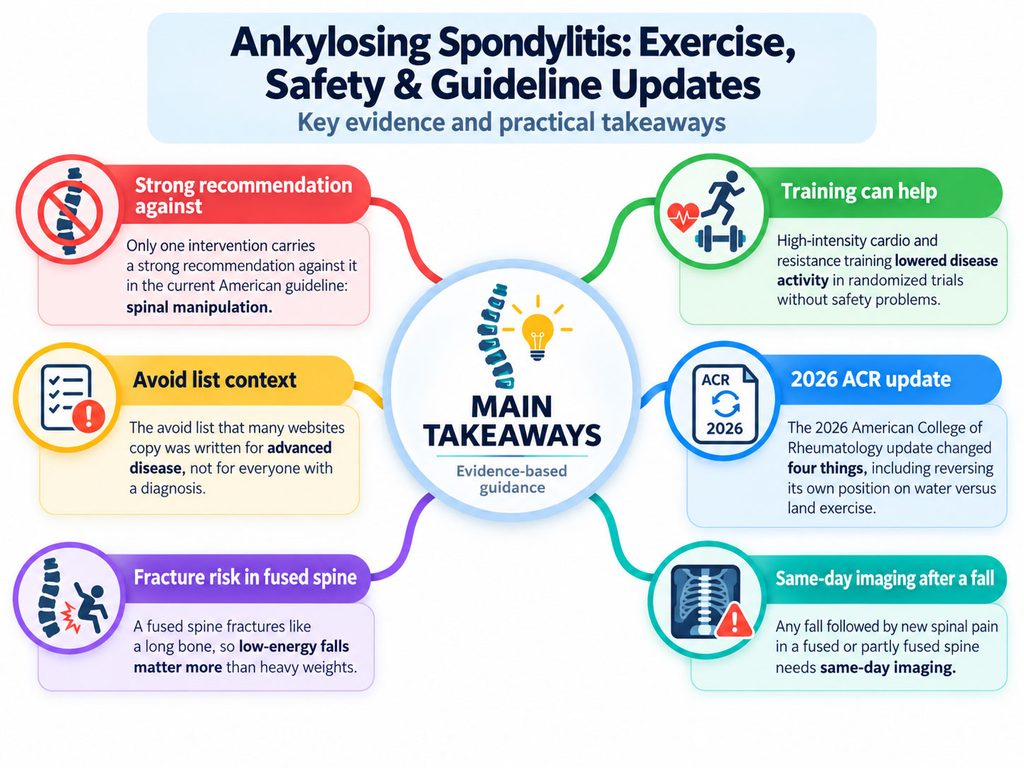
- Only one intervention carries a strong recommendation against it in the current American guideline, and it is spinal manipulation.
- The avoid list every website copies was written for advanced disease, not for everyone with a diagnosis.
- A fused spine fractures like a long bone, which is why low-energy falls matter more than heavy weights.
- High-intensity cardio and resistance training lowered disease activity in randomized trials without safety problems.
- The 2026 American College of Rheumatology update changed four things, including reversing its own position on water versus land exercise.
- Any fall followed by new spinal pain in a fused or partly fused spine needs same-day imaging.
Why Ankylosing Spondylitis Changes the Rules of Exercise
Ankylosing spondylitis is inflammatory arthritis that begins in the sacroiliac joints where the spine meets the pelvis, then works upward. It belongs to a wider family called axial spondyloarthritis, or axSpA, which also covers people whose joint damage has not yet appeared on plain X-rays.
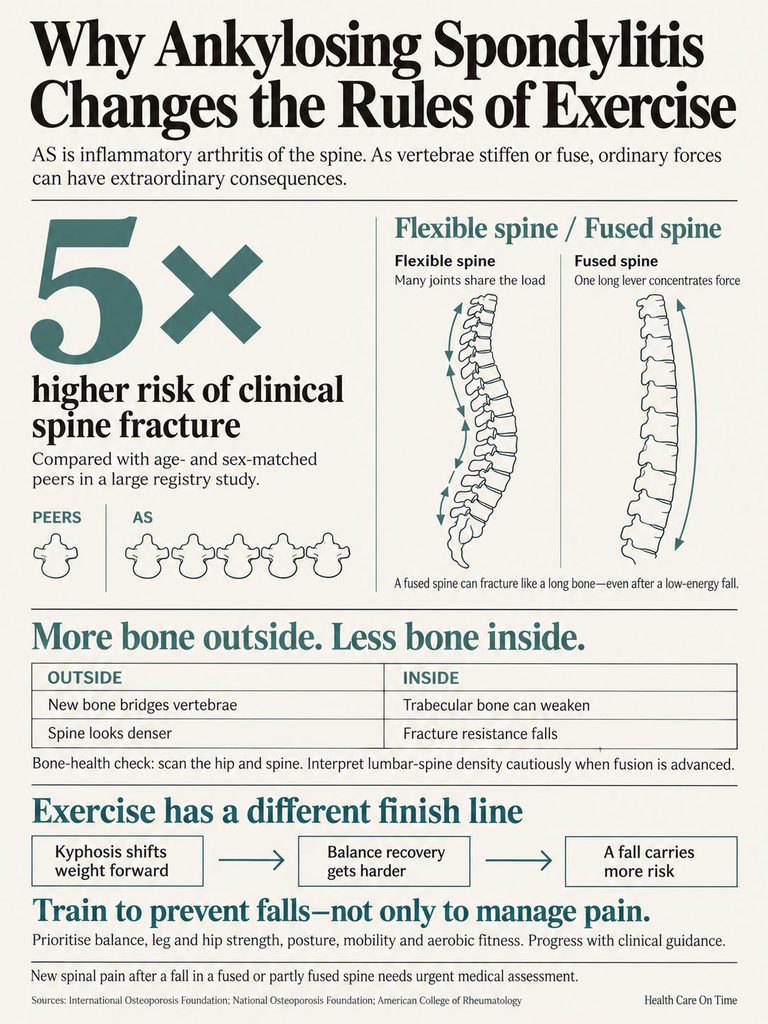
Inflammation is only half the mechanism. Over years, the body answers it by laying down new bone at the vertebral margins, forming bridges called syndesmophytes. Enough of those and the spine fuses into a single rigid column, sometimes described as bamboo spine.
Our medical reviewers note that this is where most online exercise advice goes wrong. It treats the condition as one thing with one rulebook, when a 28-year-old with a flexible spine and a 62-year-old fused from sacrum to skull face entirely different consequences from the same movement.
A fused spine breaks like a long bone, not like a spine
A healthy spine handles force by spreading it across two dozen mobile segments. A fused spine cannot. Force concentrates wherever motion still exists, and the bone fails there.
Fractures in an ankylosed spine typically cross all three spinal columns at once, running either through the vertebral body or through the disc and the ossified ligaments beside it. That makes them unstable in a way ordinary compression fractures are not, as described in a 2025 review in the Journal of Spine Surgery.
The neck absorbs the worst of it. Cervical vertebrae are small, that region stays mobile longest, and a fused thoracic spine turns the head into a long lever arm. People with AS are close to 3.5 times more likely to sustain a cervical fracture than the general population, according to a multicenter analysis in Frontiers in Immunology.
The bone density problem hiding under the extra bone
There is a real paradox here. The disease that adds bone along the outside of the spine strips mineral from the inside of it at the same time.
Chronic inflammation drives bone loss while new bone forms along the ligaments. A standard hip DXA scan can miss the problem entirely, and a spine reading can be falsely reassuring because the surface bone inflates the number.
The American College of Rheumatology now advises scanning the spine as well as the hips once syndesmophytes or fusion are present. Patients who book bone health and inflammatory marker panels through HealthCareOnTime often ask why their scan results seem to contradict how their back feels. This mismatch is usually the reason.
Balance, posture, and where your eyes point
Progressive kyphosis pushes the head forward and down. The center of gravity shifts ahead of the feet, the line of sight drops below the horizon, and remaining upright takes conscious effort.
Reported fall rates in spondyloarthritis run from 13% to 25% a year across the three cohorts pooled in a systematic review of 441 patients. A separate nine-year cohort found 34% of AS patients had fallen in the previous year, with reduced cervical rotation predicting who fell, published in Frontiers in Medicine.
Combine a brittle spine with an elevated fall rate and the logic behind the avoid list becomes clear. The goal is not protecting inflamed joints from effort. The goal is not hitting the ground.
The Short List: What to Actually Avoid
Nine rules cover it. Two apply to everyone with the diagnosis. The rest activate once fusion, low bone density, or hip surgery enters the picture.
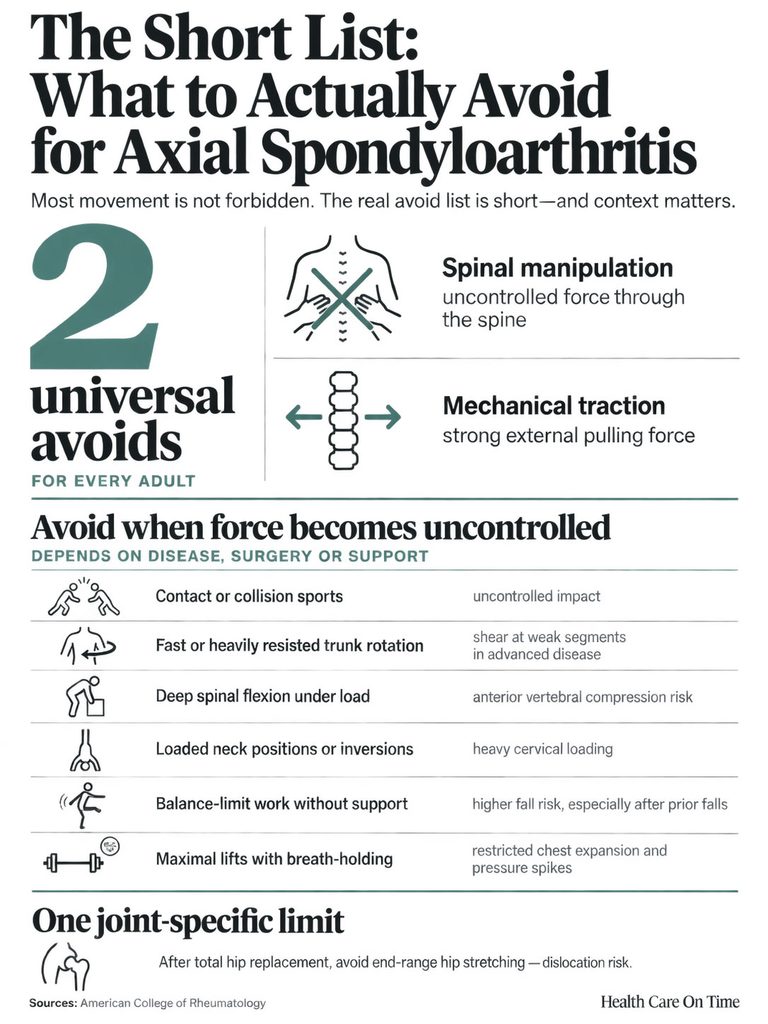
1. Spinal manipulation and mechanical traction
This is the hard no, and it belongs first. The 2026 ACR, Spondylitis Association of America, and SPARTAN guideline strongly recommends against spinal manipulation in adults with axial spondyloarthritis. It is the only physical intervention in the entire document carrying a strong recommendation against it.
The wording changed in a way worth catching. The 2019 version limited the warning to people with spinal fusion or advanced spinal osteoporosis. The current version dropped that qualifier.
The same update added a new conditional recommendation against mechanical traction. High-velocity thrust techniques applied to a spine that may be fused, osteoporotic, or both can produce the exact fracture the patient walked in hoping to prevent. Massage and soft-tissue work sit in a different category and remain acceptable.
2. Contact and collision sports
Football, hockey, rugby, boxing, wrestling, and martial arts sparring all deliver force you did not choose to a spine that cannot dissipate it.
The 2026 guideline added a specific recommendation for counseling patients on the dangers of contact sports. It appears twice, once for active disease and once for inactive disease, with the same answer both times. Feeling well does not restore a rigid spine’s shock absorption.
Throwing a ball around the yard is not the same as a competitive league. The variable that matters is whether another person can reach you at speed.
3. Fast or heavily resisted trunk rotation
Rotational medicine ball slams, loaded Russian twists, heavy cable woodchops, and power-focused golf swing drills load the spine in the plane it tolerates worst once segments begin fusing.
The 2016 consensus statement in Seminars in Arthritis and Rheumatism flagged high-velocity or strongly resisted exercise in advanced disease, naming trunk flexion and rotation specifically. That paper is the origin of nearly every avoid list circulating online.
Slow, unloaded rotation is different. Gentle seated twists for mobility are routine physical therapy, not a hazard.
4. Deep spinal flexion under load
Full sit-ups, weighted crunches, rounded-back deadlifts, and toe-touch stretches while holding a weight all compress the front of the vertebral bodies while the spine is bent forward.
With reduced bone density, that combination is how wedge fractures happen. Our medical reviewers note this is the modification patients push back on hardest, because core work feels like the thing protecting their back.
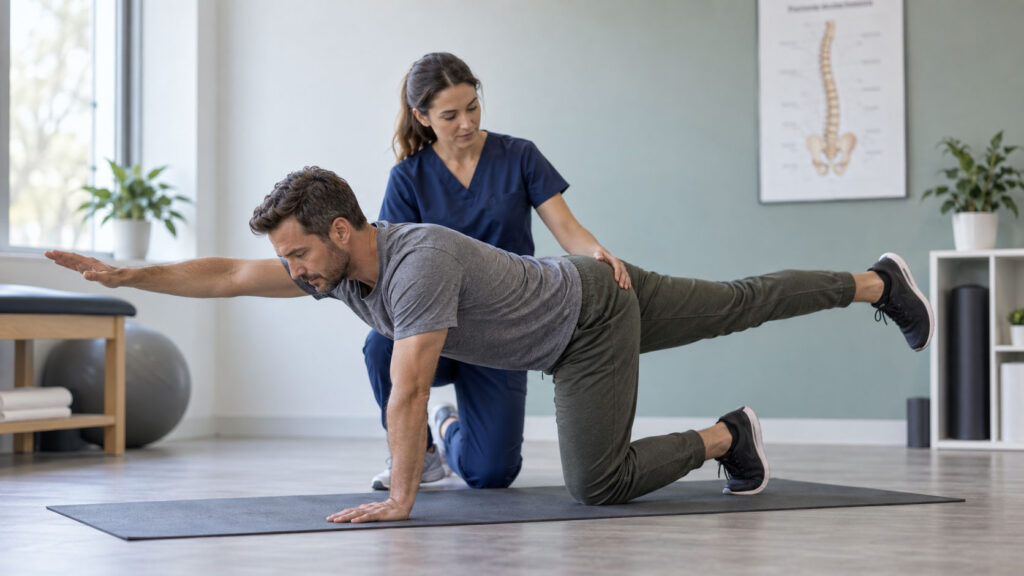
The training effect survives the swap. Dead bugs, bird dogs, side planks, and standing anti-rotation presses build the same muscles without folding the spine under load.
5. End-range hip stretching after total hip replacement
Hip involvement is common in AS, and total hip arthroplasty is a frequent endpoint. After that operation, aggressive end-range mobility work becomes a dislocation risk rather than a mobility gain.
The 2016 consensus statement listed excessive end-range mobility gain following hip replacement among its cautions. Deep lunges, forced pigeon pose, and passive over-pressure into flexion or internal rotation are the usual culprits.
Your surgeon’s precautions override any general advice, and they differ depending on whether the approach was anterior or posterior.
6. Loaded neck positions and inversions
Heavy back squats and yoke carries drive load down through a cervical spine that may be the last mobile segment you have. Headstands, shoulder stands, and inversion tables create the same problem with gravity reversed.
Front squats, belt squats, and leg press remove the bar from the neck while keeping the leg work intact. That is a substitution rather than a subtraction.
7. Balance-limit work without support
Single-leg stands on unstable surfaces, BOSU drills, slacklines, and high box jumps deliberately push balance toward failure. That is sound training in a spine that bends and poor training in a spine that snaps.
Balance work itself is valuable, and the 2026 guideline strongly supports fall evaluation and counseling. The fix is doing it beside a countertop, a rail, or a wall rather than in open floor space.
8. Breath-holding and maximal lifts
AS stiffens the costovertebral joints, which restricts how far the ribcage can expand. Maximal single-rep attempts with a long breath hold stack an intrathoracic pressure spike on top of that restriction.
Working at moderate loads for eight to twelve repetitions with normal breathing captures nearly all of the strength benefit. Deliberate deep breathing work, meanwhile, belongs in the program rather than out of it.
9. Anything you cannot bail out of safely
Downhill skiing on ice, technical mountain biking, ladder work at height, and trampolines share one feature. When it goes wrong, you do not choose how you land.
This rule is clinical judgment rather than a cited recommendation, and it should be labeled that way. It also scales with your own fusion and bone density more than any other. Across the patients HealthCareOnTime serves, this is the rule people over-apply, quitting hiking outright when the honest answer was trekking poles and a flatter trail.
| Activity or Movement | Why It Carries Risk | Who It Applies To | Safer Substitute | Strength of Evidence |
| Spinal manipulation (chiropractic thrust) | Direct force on a rigid or osteoporotic spine; fracture and neurologic injury | All adults with axSpA | Massage, soft-tissue work, TENS | Strong recommendation against (ACR 2026) |
| Mechanical spinal traction | Distraction across fused or brittle segments | All adults with axSpA | Supervised active stretching | Conditional recommendation against (ACR 2026) |
| Contact and collision sports | Uncontrolled external force; 66% of AS cervical fractures follow minor trauma | All, active or inactive disease | Swimming, path cycling, doubles pickleball | Conditional recommendation for counseling (ACR 2026) |
| Loaded, fast trunk rotation | Shear across the weakest remaining mobile segment | Advanced disease, syndesmophytes, low bone density | Pallof press, slow unloaded rotation | Expert consensus (Millner 2016) |
| Deep flexion under load (weighted sit-ups, rounded deadlift) | Anterior vertebral compression with reduced bone density | Anyone with osteopenia or osteoporosis on DXA | Dead bug, bird dog, side plank, neutral-spine hip hinge | Expert consensus plus fracture epidemiology |
| End-range hip stretch after THA | Prosthetic dislocation | Post total hip arthroplasty only | Surgeon-approved arc, pain-free range | Expert consensus (Millner 2016) |
| Barbell back squat, inversions | Axial load through a mobile cervical segment | Cervical involvement or fusion | Front squat, belt squat, leg press | Expert consensus |
| Unsupported balance-limit drills | Fall rate 13% to 25% per year in spondyloarthritis | Kyphosis, reduced cervical rotation, prior falls | Same drills beside a rail or wall | Strong recommendation for fall evaluation (ACR 2026) |
| Maximal lifts with breath holding | Restricted chest expansion plus pressure spike | Reduced chest expansion | 8 to 12 reps at moderate load, normal breathing | Expert consensus |
The Longer List Nobody Talks About: What You Should Not Avoid
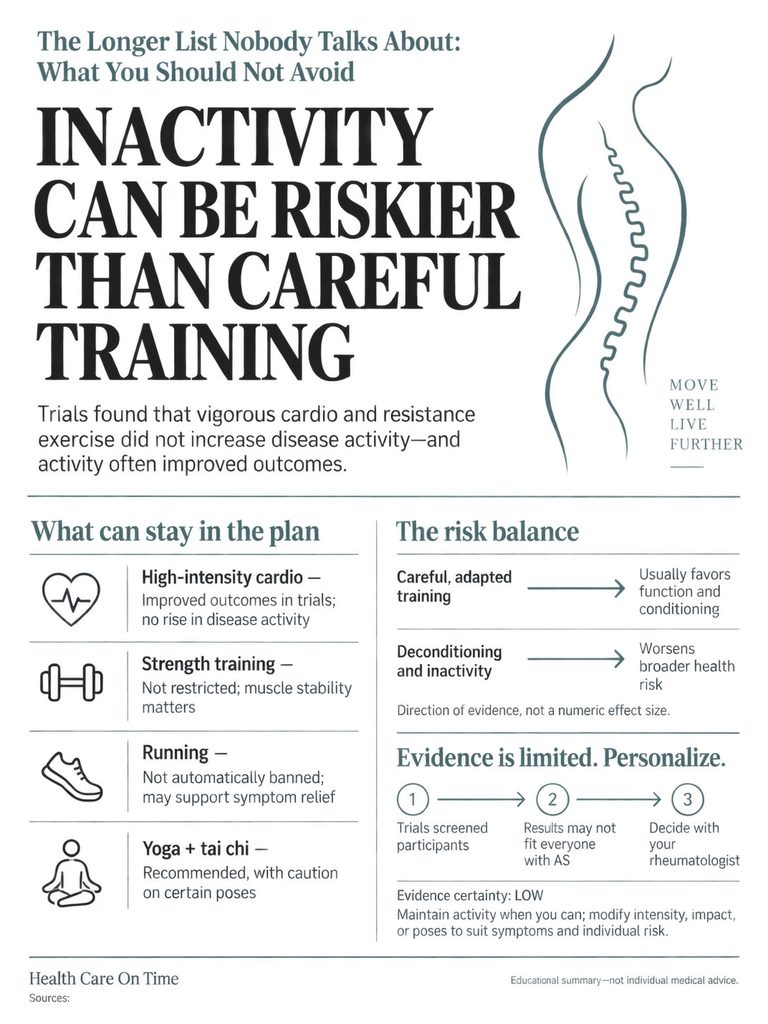
Here is the part almost every article skips. Evidence that exercise harms people with AS is thin. Evidence that avoiding it harms them is not.
High-intensity cardio does not raise disease activity
A multicenter randomized trial of 100 patients tested three months of supervised high-intensity cardiorespiratory and strength exercise against no intervention. Disease activity fell in the exercise group, with a between-group ASDAS difference of 0.6, reported in the British Journal of Sports Medicine.
The earlier pilot recorded no adverse events at all, alongside improved peak oxygen uptake and reduced arterial stiffness, in PLOS ONE. Cardiovascular disease is a genuine excess risk in inflammatory arthritis, which makes fitness gain part of the treatment rather than a side benefit.
A secondary analysis in Physical Therapy found the same program improved fatigue, mood, vitality, and general health at three months. Those gains had faded by twelve months once supervision stopped, which is a statement about maintenance, not about danger.
Strength training is not on any avoid list
No major guideline restricts resistance training in axial spondyloarthritis. The restrictions concern specific loaded positions, not the act of lifting.
Muscle matters more here than in most conditions, because muscle holds a kyphotic posture upright and catches you during a stumble. In cases reviewed by our medical team, patients who abandoned the gym after diagnosis frequently lost the exact tissue that had been keeping them stable.
Running is not automatically banned
Several ranking pages tell readers to skip running because it is high impact. That is an inference drawn from the impact label, not a finding from a study.
Recent network analyses of exercise modalities in AS include running among approaches producing symptom relief. A 2026 review of 42 randomized trials in BMJ Open Sport and Exercise Medicine found a moderate pooled effect of exercise on disease activity, with a standardized mean difference of -0.46.
Flat, even ground with supportive shoes is the safer version. Reconsider if you have significant hip involvement, documented osteoporosis, or advanced fusion, and pool running or cycling becomes the swap.
Yoga and tai chi moved into the recommended column
For years the standard line was to treat yoga cautiously because of the twists. The 2026 guideline now conditionally recommends both yoga and tai chi over nonspecific exercise.
That endorsement covers the practice, not every pose. Headstands, deep forward folds, and forced spinal twists still fall under rules four, six, and three above.
Deconditioning is the more likely harm
Inactivity in AS produces stiffness, weakness, worse balance, reduced chest expansion, and higher cardiovascular risk. Every one of those raises fracture risk instead of lowering it.
The question worth asking is not whether a movement is theoretically risky. It is whether the version of you who does nothing ends up safer than the version who trains carefully. Usually not.
How strong is this evidence, honestly
Two caveats belong here, because no competing page states either one.
First, the 2026 guideline grades most of its exercise recommendations as very low certainty evidence, and its authors say plainly that shared decision-making with your rheumatologist is strongly encouraged for that reason. Strong recommendation does not always mean strong evidence; the spinal manipulation statement is graded very low certainty and rests largely on the severity of the potential harm.
Second, the high-intensity exercise trials were conducted in Scandinavia and screened out participants with established coronary heart disease or other conditions limiting exercise capacity. They show that supervised high-intensity work was safe and effective in a selected population. They do not prove it is safe for someone with advanced fusion, severe osteoporosis, and untreated cardiac disease.
What the 2026 US Guideline Changed
The American College of Rheumatology board approved the updated axial spondyloarthritis guideline on May 31, 2026, developed jointly with the Spondylitis Association of America and SPARTAN. Four changes matter for exercise decisions, and almost no patient-facing page has caught up with them.
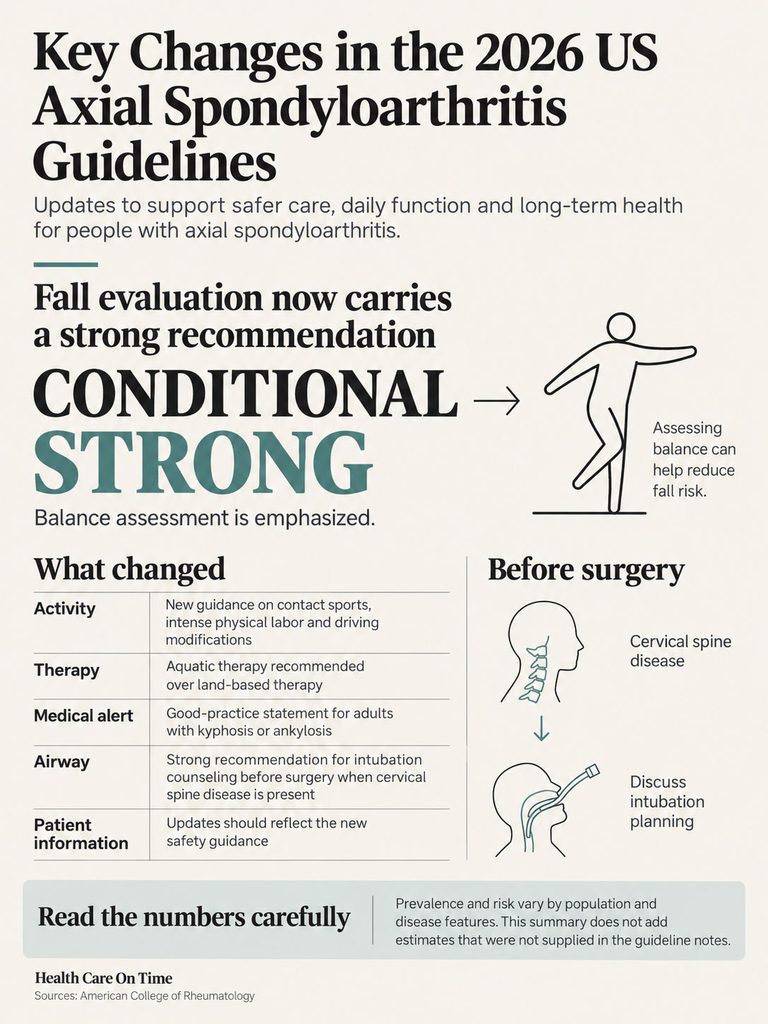
Contact sports got named for the first time
Earlier versions said nothing specific about sport participation. The 2026 document adds counseling recommendations on contact sports, on intense physical labor, and on driving modifications, three questions never formally addressed before.
Fall evaluation moved from conditional to strong
In 2019, fall evaluation and counseling was conditional. In 2026 it is strong, the largest single upgrade in the non-drug section. Fall prevention is now core care rather than an optional add-on, which is reasonable grounds for asking your rheumatologist for a formal balance assessment.
Water moved ahead of land
The 2019 guideline conditionally recommended land-based physical therapy over aquatic therapy. The 2026 guideline recommends the reverse, aquatic over land-based, and separately recommends aquatic exercise over weight-bearing exercise.
Nearly every page currently ranking for this topic reflects the older position or takes none at all. If you have advanced disease, low bone density, or painful hips, the pool now carries guideline backing it did not have two years ago.
Two new statements nobody is covering
The guideline added an ungraded good practice statement advising adults with kyphosis or ankylosis to wear a medical alert bracelet, so first responders know they are handling a brittle, fused spine before they move anyone.
It also strongly recommends intubation counseling before any surgery under general anesthesia in people with cervical spine disease. A fused neck cannot be positioned normally for airway management, and the anesthesiologist needs that information in advance rather than in the moment.
| Statistic | Figure | Population | Source |
| Axial spondyloarthritis prevalence | About 1% of adults, up to 2.7 million people | US adults | NHANES 2009 to 2010, via Spondylitis Association of America |
| Ankylosing spondylitis prevalence | Roughly 0.55% | US adults | NHANES 2009 to 2010 |
| Undiagnosed among at-risk patients meeting ASAS criteria | 24% of 514 patients | US rheumatology practices, ages 18 to 44 | Strand et al., Arthritis Care and Research, 2013 |
| Spinal fracture incidence in AS | 10% to 15% | AS patients | Journal of Spine Surgery, 2025 review |
| Cervical fractures caused by minor trauma | 66% of cases; C6-7 involved in 50.6% | Surgically managed AS cervical fractures | Cureus systematic review, 2026 |
| In-hospital mortality after AS spinal fracture | 6.6%, adverse events in 29.4%, spinal cord injury in 21.1% | US inpatient cohort | Global Spine Journal analysis |
How Your Stage Changes the List
Stage matters more than diagnosis. Here is how the nine rules shift across the course of the disease.
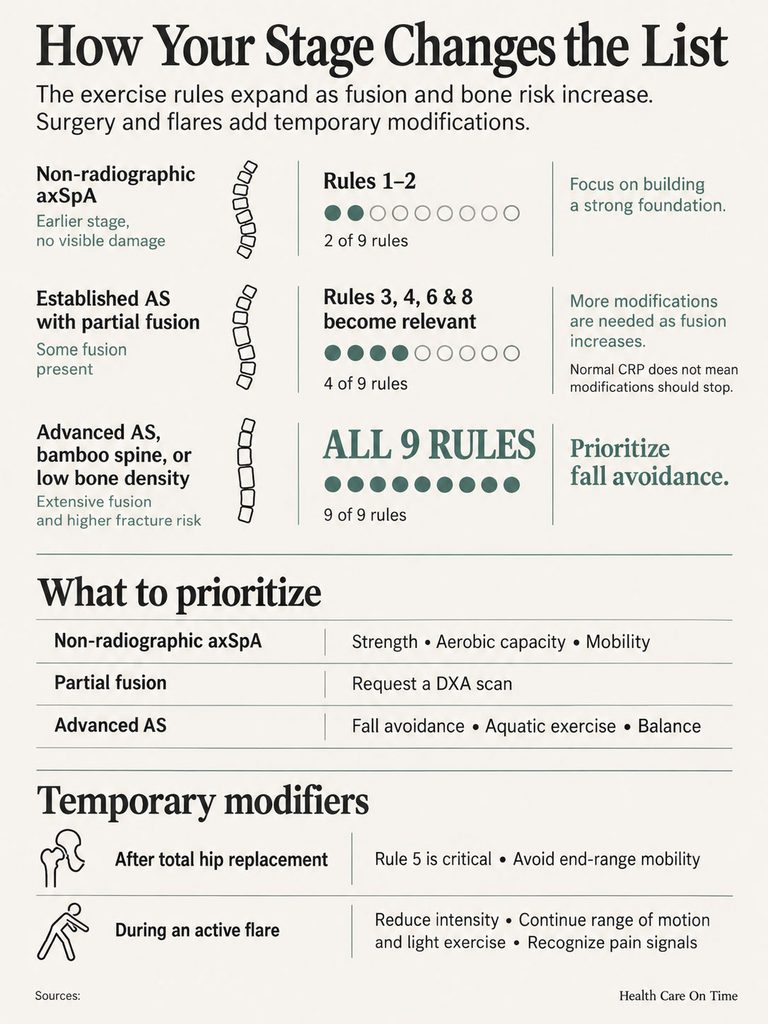
Non-radiographic axSpA and early disease
Your spine is still flexible and your bone density is probably normal. Rules one and two apply. Most of the others do not yet.
This is the window where building strength, aerobic capacity, and mobility pays the largest long-term return. Restricting yourself now, on advice written for advanced disease, costs you reserve you will want in twenty years.
Established AS with partial fusion
Rules three, four, six, and eight come into play. Request a DXA scan covering spine and hips if you have not had one, because bone density now drives several of these decisions rather than symptoms alone.
Patients who order inflammatory marker panels through HealthCareOnTime often ask whether a normal CRP means the modifications can stop. It does not. Structural change and inflammatory activity move on separate clocks, and a quiet CRP tells you nothing about how much of your spine has fused.
Advanced AS, bamboo spine, or low bone density
All nine rules apply, and fall avoidance dominates every other consideration. Aquatic exercise, supported balance work, and stationary cycling become the core of a program rather than the consolation prize.
This is also the group the 2016 consensus statement was actually written for, including its cautions about exercise that heavily challenges balance, postural stability, or cardiorespiratory function.
After total hip replacement
Rule five applies specifically and permanently. Your surgeon’s precautions define the safe arc, and the general principle is that mobility work should stop short of end range even when the joint feels capable of more.
During an active flare
Nothing gets permanently removed during a flare, but intensity comes down. Range of motion work, walking, and warm-water exercise generally continue. Heavy resistance and interval work generally pause.
Soreness that eases after ten minutes of movement is the normal AS pattern. Pain that starts during a movement and stays afterward is a stop signal rather than something to train through.
Stop Signals and What to Do Next
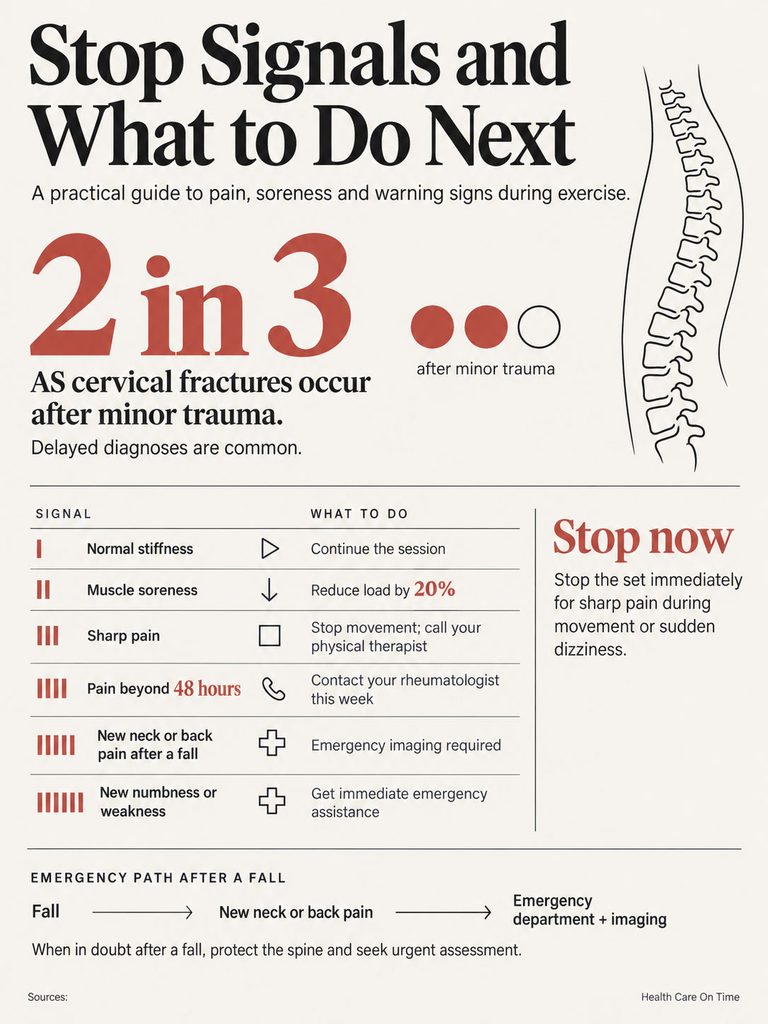
Stop the set immediately
Sharp, localized pain during a loaded or rotational movement. New numbness or tingling into an arm or leg. Sudden dizziness or a balance failure. Chest tightness out of proportion to the effort.
Call your rheumatologist this week
Pain persisting more than 48 hours after a session. Morning stiffness running noticeably longer than your usual baseline for several days. New hip or heel pain that changes how you walk.
Go to the emergency department, even if the fall looked minor
This rule matters more than anything else on the page, and no competing article states it plainly. In a fused or partly fused spine, new spinal pain after any fall gets imaged, regardless of how trivial the fall seemed.
Two thirds of AS cervical fractures follow minor trauma. Delayed and missed diagnoses are a documented problem in this population, and these fractures are unstable when they do occur.
Tell the triage nurse three things: that you have ankylosing spondylitis, that your spine is fused or partly fused, and that you need imaging rather than a soft-tissue diagnosis. Ask that nobody force your neck into a standard collar position, because a fused spine will not go there and the attempt itself can cause harm.
| Scenario | What It Likely Means | Recommended Action |
| Stiffness that eases after 10 minutes of warm-up | Normal AS pattern, not injury | Continue the session, keep the warm-up |
| Muscle soreness 24 to 48 hours after a new routine | Ordinary delayed onset soreness | Reduce load about 20%, continue training |
| Sharp pain during a loaded twist or bend | Mechanical strain on a vulnerable segment | Stop that movement, substitute an unloaded version, call your physical therapist |
| Pain still present beyond 48 hours | Possible flare or soft-tissue injury | Pause loaded work, contact your rheumatologist this week |
| Any fall followed by new neck or back pain | Possible unstable fracture until proven otherwise | Emergency department today, request imaging, state that you have AS |
| New numbness, weakness, or bladder or bowel change | Possible spinal cord involvement | Call 911 or go to the emergency department immediately |
Building a Week That Actually Works
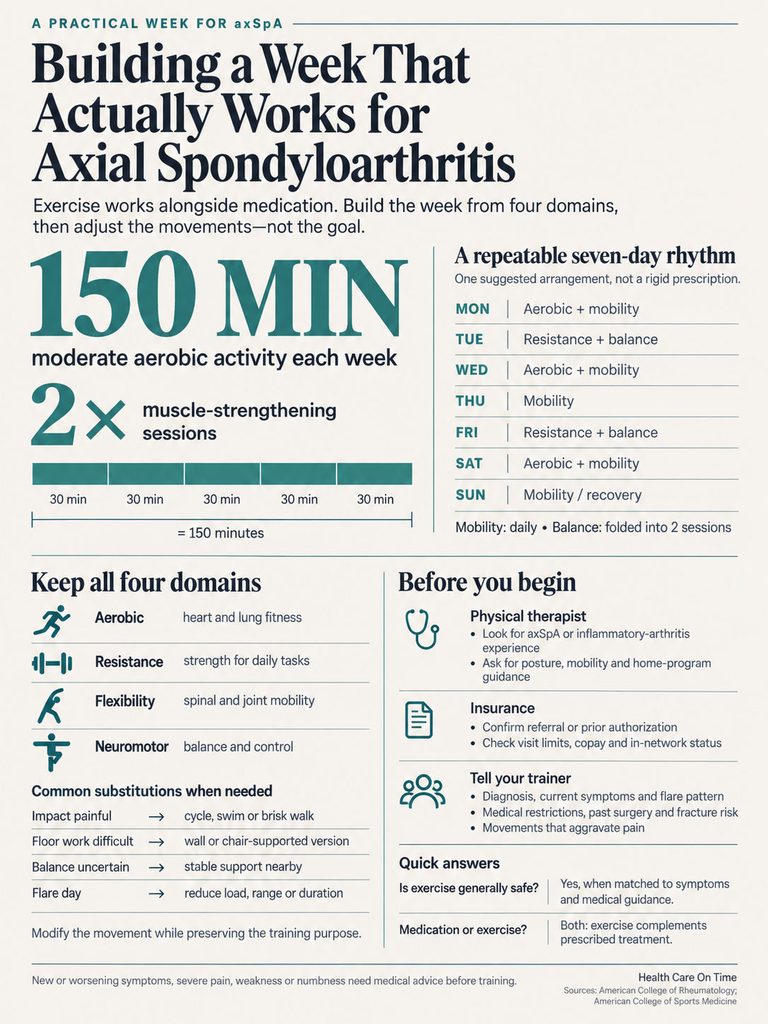
The four domains
International guidance frames exercise in axSpA across four areas: aerobic, resistance, flexibility, and neuromotor. A week touching all four outperforms a week that does one thing thoroughly.
Aerobic work protects the heart and lungs. Resistance work protects posture and bone. Flexibility work protects the range you still have. Neuromotor work protects you from the fall that causes the fracture.
A workable week
The federal physical activity target for US adults is 150 minutes of moderate aerobic activity per week plus two muscle-strengthening sessions. That target applies here, and it is a reasonable destination rather than a starting line.
Build toward three aerobic sessions of 20 to 40 minutes at a pace where you can talk but not sing. Add two resistance sessions covering legs, back, and shoulders at moderate load. Include ten minutes of spinal and hip mobility work daily, ideally in the morning when stiffness peaks.
Finish with two short balance sessions beside a countertop and two sets of deep breathing to work the chest wall. That totals roughly five hours a week, and it can be built up from far less.
Modify, do not delete
Sit-up becomes dead bug. Back squat becomes front squat or leg press. Russian twist becomes Pallof press. Toe touch becomes hip hinge with a neutral spine. Trail run becomes flat-path run or pool running.
Each swap keeps the training effect and removes the specific hazard. Our medical reviewers note that patients who learn to substitute rather than eliminate stay active years longer than those who cut whole categories.
Finding the right help in the US
Ask for a physical therapist with experience in axial spondyloarthritis specifically, not general low back pain. The Spondylitis Association of America maintains referral resources, and the American Physical Therapy Association’s Find a PT directory lets you filter by orthopedic specialty.
The 2026 guideline strongly recommends physical therapy in active disease and supports repeat courses rather than a single one-time referral, which is useful language to quote when requesting reauthorization. Most commercial plans and Medicare Part B cover medically necessary outpatient physical therapy, though copays, visit caps, and prior authorization rules vary widely by plan.
If cost is the barrier, ask specifically about a one-time evaluation with a home program instead of a full course. Several of the studied programs were built around supervised sessions plus independent work, and the independent portion is what carries the benefit long term.
What to hand your personal trainer
Three facts are enough for a competent trainer to program around: the diagnosis, whether your spine is fused and at which levels, and your most recent DXA result.
Add the nine rules above and the substitution list. A trainer who cannot work within those constraints is not the right trainer for this condition.
Frequently Asked Questions
Can I lift weights with ankylosing spondylitis?
Yes. No major guideline restricts resistance training in axial spondyloarthritis. The limits are specific positions, mainly loaded deep spinal flexion, fast loaded rotation, and heavy bars across the neck. Moderate loads for eight to twelve repetitions with normal breathing suit most people, and strength directly supports posture and fall resistance.
Is running bad for ankylosing spondylitis?
Not automatically. Running appears among the exercise modalities linked to symptom relief in recent analyses, and no guideline bans it. Flat, even surfaces with supportive shoes are the safer version. Reconsider if you have significant hip involvement, documented osteoporosis, or advanced fusion, and switch to cycling or pool running instead.
Should I see a chiropractor if I have ankylosing spondylitis?
No. The 2026 American College of Rheumatology guideline strongly recommends against spinal manipulation in adults with axial spondyloarthritis, and it is the only physical intervention carrying a strong recommendation against it. Manipulating a rigid or osteoporotic spine risks fracture and neurologic injury. Massage and soft-tissue therapy remain acceptable.
Can I do yoga with ankylosing spondylitis?
Yes, with pose selection. The 2026 guideline conditionally recommends yoga over nonspecific exercise. Skip headstands, shoulder stands, deep forward folds, and forced spinal twists. Gentle backbends, hip openers within a pain-free range, and breathing work suit the condition well. Tell the instructor your diagnosis before class starts.
Are sit-ups and crunches safe with AS?
Full sit-ups and weighted crunches are the movements most worth replacing, because they compress the front of the vertebral bodies while the spine is bent forward. Dead bugs, bird dogs, side planks, and standing anti-rotation presses train the same muscles without that position. The core work stays; only its shape changes.
Should I exercise during a flare?
Keep moving, lower the intensity. Range of motion work, walking, and warm-water exercise usually help during a flare, while heavy resistance and interval training can wait. Stiffness easing after ten minutes of movement is expected. Pain that begins during a movement and persists afterward means stop that specific exercise.
Is swimming better than walking for AS?
The 2026 guideline conditionally recommends aquatic exercise over weight-bearing exercise, reversing its 2019 position. Water removes fall risk and joint loading while allowing full range of motion. Walking still counts and provides bone loading that swimming does not, so most sensible programs include both rather than choosing between them.
Can I play football, hockey, or martial arts with AS?
These are the clearest activities to avoid. The 2026 guideline recommends counseling on the dangers of contact sports, and that advice applies whether disease is active or inactive. A fused spine cannot distribute impact force, and two thirds of cervical fractures in AS follow trauma most people would describe as minor.
Is CrossFit safe with ankylosing spondylitis?
It depends entirely on programming. Standard CrossFit includes several movements on the avoid list: kipping pull-ups, loaded rotation, high-repetition deep flexion, and box jumps with fall potential. A coach willing to scale and substitute can build safe sessions. A class requiring you to match everyone else’s pace cannot.
How much exercise is too much with AS?
Intensity is rarely the limiting factor. A randomized trial of three months of supervised high-intensity exercise reduced disease activity without safety problems. The practical ceiling is how you feel two days later. Pain persisting beyond 48 hours after a session means reduce volume, not abandon the activity.
Do I need a medical ID bracelet if my spine is fused?
The 2026 guideline includes a good practice statement advising exactly that. Adults with kyphosis or ankylosis should wear a medical alert bracelet so first responders know before moving you that they are handling a brittle, fused spine. It is among the cheapest safety measures available in this condition.
Can exercise replace my biologic medication?
No. Exercise reduces disease activity, fatigue, and cardiovascular risk, and it belongs in every treatment plan. It does not halt structural progression the way TNF inhibitors and IL-17 inhibitors do. Treat exercise as a co-treatment alongside medication, and never stop or taper a biologic without your rheumatologist’s involvement.
Medical disclaimer: This article is for general education and does not replace individualized advice from your rheumatologist or physical therapist. Exercise restrictions in ankylosing spondylitis depend on how much of your spine has fused, your bone density, hip involvement, and any prior surgery, all of which vary widely between people carrying the same diagnosis.
Most exercise recommendations in current guidelines rest on low or very low certainty evidence, which is precisely why shared decision-making with your own clinician matters. Speak with your care team before starting or changing an exercise program, and seek emergency care for new spinal pain following any fall.
References
- 2026 Update of the ACR/SAA/SPARTAN Recommendations for the Treatment of Axial Spondyloarthritis, American College of Rheumatology
- Millner et al., Exercise for ankylosing spondylitis: an evidence-based consensus statement, Seminars in Arthritis and Rheumatism 2016
- Sveaas et al., High intensity exercise for 3 months reduces disease activity in axial spondyloarthritis, British Journal of Sports Medicine 2020
- Sveaas et al., Efficacy of high intensity exercise on disease activity and cardiovascular risk, PLOS ONE 2014
- Sveaas et al., High-Intensity Exercise Improves Fatigue, Sleep, and Mood in Axial Spondyloarthritis, Physical Therapy 2020
- Reporting of exercise interventions in spondyloarthritis research, BMJ Open Sport and Exercise Medicine 2026
- Strand et al., Prevalence of Axial Spondyloarthritis in United States Rheumatology Practices, Arthritis Care and Research 2013
- New Rate of Prevalence of Spondyloarthritis, Spondylitis Association of America
- Risk-stratified management of ankylosing spondylitis-related spinal fractures, Journal of Spine Surgery 2025
- Systematic Review of Surgical Management of Cervical Spine Fractures in Ankylosing Spondylitis, Cureus
- Instantaneous death risk and conditional survival in cervical fracture patients with ankylosing spondylitis, Frontiers in Immunology 2022
- Spinal Fracture in Patients With Ankylosing Spondylitis, Global Spine Journal
- Prevalence and risk factors for falls in patients with spondyloarthritis: a systematic review
- Cervicothoracic mobility restrictions, fall risk and fear of falling in ankylosing spondylitis, Frontiers in Medicine 2023
- ACR-SPARTAN-SAA axSpA Guidelines, SPARTAN Group
- Best Types of Exercises for Ankylosing Spondylitis, Cleveland Clinic