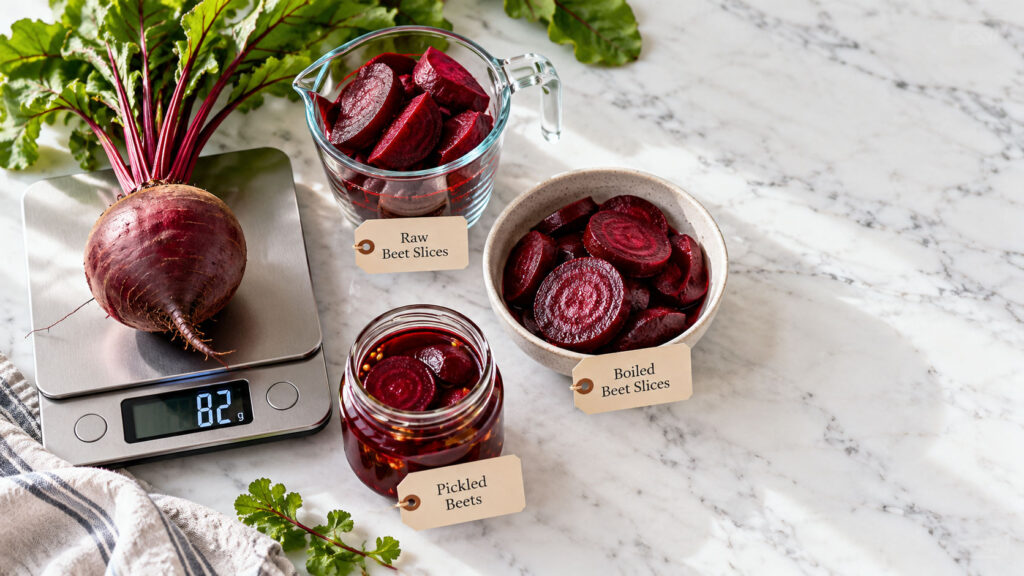
Look up beet calories on three websites and you’ll likely get three answers: 35, 43, and 58. All three are correct. Each describes a different amount of beet, and almost no page tells you which is which.
Table of Contents
That matters if you track what you eat. Below is every number you need, taken from USDA FoodData Central and turned into real servings you can measure in an American kitchen.
Quick Answer: Raw beets have 43 calories per 100 grams (3.5 ounces), according to USDA FoodData Central. One medium 2-inch beet (82 g) has about 35 calories, and 1 cup of raw slices (136 g) has about 58. A half cup of boiled slices (85 g) has 37 calories. Cooking barely changes calories by weight, but pickled beets jump to 65 calories per 100 grams because of added sugar.
At a Glance
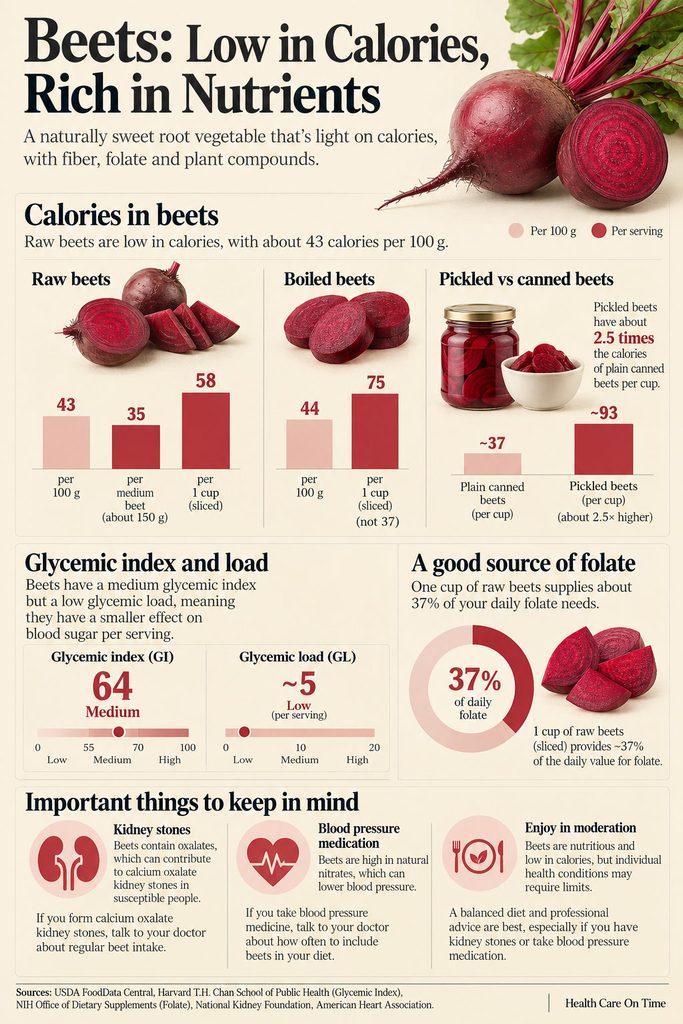
- Raw beets: 43 calories per 100 g, 35 per medium beet, 58 per cup.
- Boiled beets: 44 calories per 100 g, but a full cup of slices is about 75 calories, not 37.
- Pickled beets have about 2.5 times the calories of plain canned beets per cup.
- Beets have a medium glycemic index (64) but a low glycemic load (about 5 per serving).
- One cup of raw beets supplies about 37% of your daily folate.
- People who form calcium oxalate kidney stones or take blood pressure medicine should talk to their doctor about regular beet intake.
How Many Calories Are in Beets? The USDA Numbers by Serving
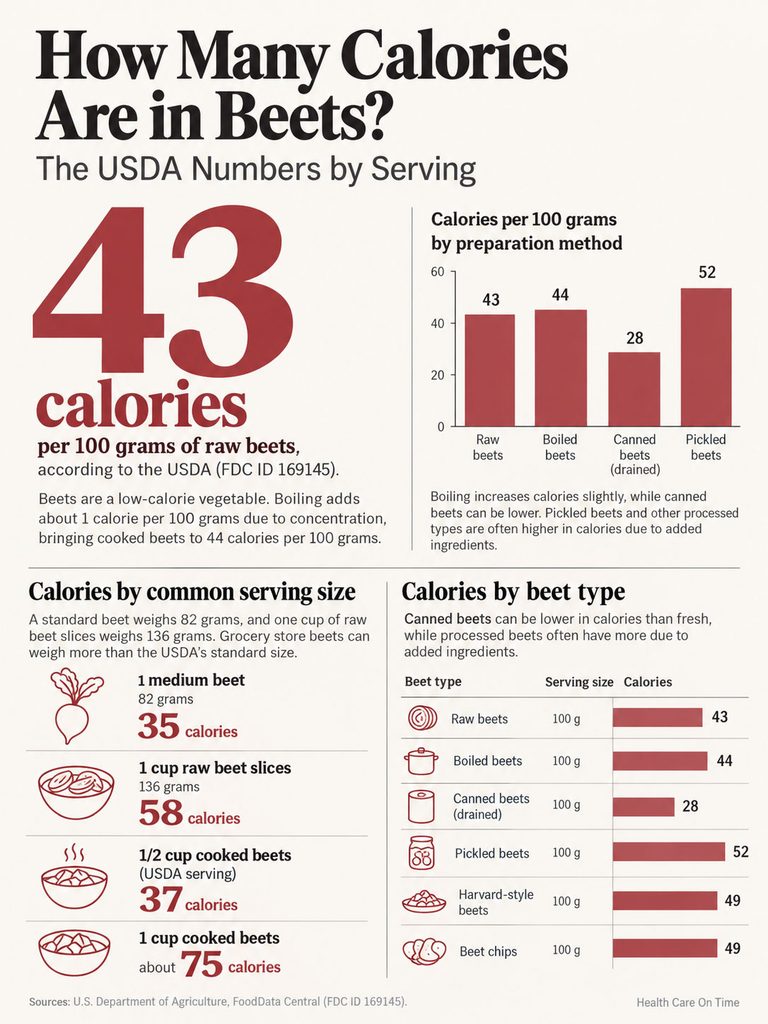
The base number is simple. USDA’s SR Legacy entry for raw beets (FDC ID 169145) lists 43 calories per 100 grams. Nearly every calorie app pulls from this one record.
The trouble starts when that number gets converted into beets, cups, and ounces. Sites pick different servings, then drop the gram weight. Our nutrition team rebuilt each serving from USDA gram weights so you can see exactly where each number comes from.
How we calculated these numbers: Every per-serving value in this article starts from the USDA per-100-gram figure, multiplied by USDA’s own gram weight for that serving. Where USDA has no entry (roasted beets, oversized beets), we show the math and say so.
Calories per 100 Grams: Raw vs Boiled
Per 100 grams (about 3.5 ounces):
- Raw beets (FDC 169145): 43 calories, 9.56 g carbs, 2.8 g fiber, 6.76 g sugar, 1.61 g protein, 0.17 g fat
- Boiled, drained beets (FDC 169146): 44 calories, 9.96 g carbs, 2.0 g fiber, 7.96 g sugar, 1.68 g protein, 0.18 g fat
Boiling adds 1 calorie per 100 grams. Beets lose a little water as they cook, so each gram gets slightly more concentrated. Nothing is added; the beet just shrinks.
Calories in One Beet: Small, Medium, and Large
USDA uses a 2-inch beet weighing 82 grams as its standard “1 beet.” That beet has about 35 calories, 7.8 g carbs, 2.3 g fiber, and 5.5 g sugar.
Grocery store beets often run bigger. At 43 calories per 100 grams:
- Small beet (about 1.5 inches, 50 g): about 22 calories
- Medium beet (2 inches, 82 g): about 35 calories
- Large beet (3 inches, 160 g to 200 g): about 69 to 86 calories
A big 3-inch farmers’ market beet can carry more than double USDA’s “1 beet.” If you weigh only one food in your kitchen, make it beets.
Calories per Cup, and the Half-Cup Labeling Trap
One cup of raw beet slices weighs 136 grams and has about 58 calories, 13 g carbs, 3.8 g fiber, and 9.2 g sugar.
Cooked beets are where people get tripped up. USDA’s standard cooked serving is a half cup of slices (85 g) at 37 calories. Some online nutrition libraries list that same 37-calorie figure under a “1 cup slices” label. A true full cup of boiled slices weighs about 170 grams and has roughly 75 calories.
Patients who track meals often ask us why their app shows boiled beets as “lower” than raw. This label mix-up is usually the reason. Check the gram weight, not just the word “cup.”
Every Beet Type Compared
The table below pulls USDA values for the forms of beets Americans actually buy. Sodium is included because that’s where canned and pickled beets differ most.
Table 1: Beet Calories by Type and Serving (USDA Data)
| Beet type (USDA entry) | Calories per 100 g | Common serving (grams) | Calories per serving | Sodium per serving |
| Raw (FDC 169145) | 43 | 1 cup slices (136 g) | 58 | 106 mg |
| Raw, medium beet | 43 | 1 beet, 2-inch (82 g) | 35 | 64 mg |
| Boiled, no salt (FDC 169146) | 44 | ½ cup slices (85 g) | 37 | 65 mg |
| Boiled, no salt, full cup | 44 | 1 cup slices (170 g) | 75 | 131 mg |
| Canned, drained solids | 31 | 1 cup diced (157 g) | 49 | about 305 mg |
| Canned, no salt added, with liquid | 28 | 1 cup (246 g) | 69 | 52 mg |
| Pickled, canned (FDC 170480) | 65 | 1 cup slices (227 g) | 148 | 338 mg |
| Harvard beets, canned (FDC 170479) | 73 | 1 cup slices (about 246 g) | 180 | about 400 mg |
| Beet greens, raw (FDC 170375) | 22 | 1 cup (38 g) | 8 | 86 mg |
| Beet chips (branded, USDA) | 500 | 1 oz (28 g) | 140 | 70 mg |
Two things stand out. Plain canned beets are actually lower in calories by weight than fresh, since they hold more water. And processed versions (pickled, Harvard-style, chips) climb fast because of added sugar, starch, or oil.
Full Beet Nutrition Facts Beyond Calories
Calories are only part of the story. Beets pack solid nutrition into a small calorie budget, plus two compound groups that never appear on a Nutrition Facts label.
Macros: Carbs, Fiber, Sugar, Protein, and Fat
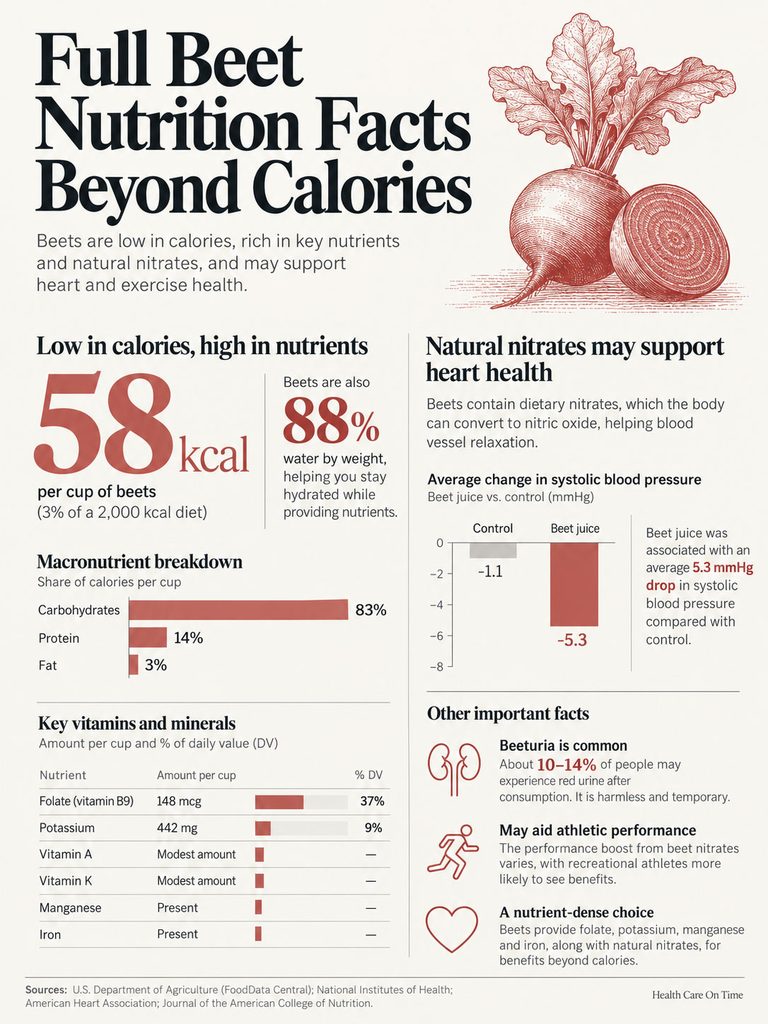
About 83% of the calories in raw beets come from carbohydrates, 14% from protein, and 3% from fat. Beets are about 88% water by weight, which explains the low calorie count.
Per cup of raw beets (136 g):
- Total carbs: 13.0 g
- Fiber: 3.8 g (about 14% of the 28 g Daily Value)
- Total sugars: 9.2 g, all naturally occurring
- Net carbs: about 9.2 g (total carbs minus fiber)
- Protein: 2.2 g
- Fat: 0.2 g
There’s no cholesterol and almost no saturated fat. Beets fit easily inside the American Heart Association’s heart-healthy eating pattern.
Vitamins and Minerals That Stand Out
Beets aren’t a “do everything” vegetable. They’re strong in a few nutrients and modest in the rest.
Folate: The Headline Nutrient
Raw beets carry 109 micrograms of folate per 100 grams. One cup supplies about 148 mcg, roughly 37% of the 400 mcg Daily Value set by the FDA.
Folate supports red blood cell formation and DNA production. The NIH Office of Dietary Supplements notes it’s especially important before and during early pregnancy. Folate leaches into cooking water, so raw, roasted, or steamed beets keep more of it than boiled ones.
Potassium, Manganese, and Iron
One cup of raw beets delivers about:
- Potassium: 442 mg (about 9% DV)
- Manganese: 0.45 mg (about 20% DV)
- Iron: 1.1 mg (about 6% DV)
- Magnesium: 31 mg (about 7% DV)
- Vitamin C: about 6.7 mg (about 7% DV)
Beets aren’t a meaningful source of vitamin A or vitamin K. Beet greens are different: far richer in both, at only 22 calories per 100 grams.
Dietary Nitrates and Betalains: What Labels Don’t Show
Beets are one of the richest food sources of dietary nitrate. Bacteria in your mouth convert nitrate to nitrite, and your body turns that into nitric oxide, which helps blood vessels relax.
That’s why beet juice shows up in blood pressure research. A 2024 meta-analysis in Clinical Nutrition ESPEN (Grönroos et al.) pooled 11 trials with 349 adults with high blood pressure and found systolic pressure fell by about 5.3 mmHg on average. An earlier 2017 meta-analysis in Advances in Nutrition covering 22 trials found average drops of about 3.6 mmHg systolic and 1.3 mmHg diastolic.
One practical detail: strong antibacterial mouthwash can blunt this effect, because it kills the mouth bacteria that start the conversion.
Beets also get their red color from betalains, pigments with antioxidant activity in lab studies. Human outcome data on betalains is still early, so treat bold claims about them with caution.
Beets for Athletes
Nitrate’s effect on blood vessels is also why endurance athletes drink beet juice before training. Most studies give the dose 2 to 3 hours before exercise. Results are mixed: recreational athletes tend to see more benefit than elite ones, and some people respond much more than others.
Table 2: Beet Nutrition and Research Data at a Glance
| Nutrient or metric | Amount | % DV or context | Source |
| Calories (raw, 1 cup) | 58 kcal | about 3% of 2,000 kcal | USDA FoodData Central, FDC 169145 |
| Fiber (raw, 1 cup) | 3.8 g | 14% DV | USDA FoodData Central |
| Total sugars (raw, 1 cup) | 9.2 g | 0 g added sugar | USDA FoodData Central |
| Folate (raw, 1 cup) | 148 mcg DFE | 37% DV | USDA; NIH ODS (400 mcg DV) |
| Potassium (raw, 1 cup) | 442 mg | 9% DV | USDA; FDA (4,700 mg DV) |
| Glycemic index / load | GI 64 / GL about 5 | Medium GI, low GL | International GI Tables |
| Systolic BP change with beet juice | about -5.3 mmHg | 11 trials, 349 adults with hypertension | Grönroos et al., Clin Nutr ESPEN, 2024 |
| Oxalate (½ cup beets) | about 76 mg | Low-oxalate diets often cap at 50 to 100 mg/day | Published oxalate tables; University of Chicago guidance |
| Beeturia (red urine after beets) | 10% to 14% of people | Usually harmless | Medical literature reviews |
Does Cooking Change Beet Calories? Raw vs Boiled vs Roasted vs Canned
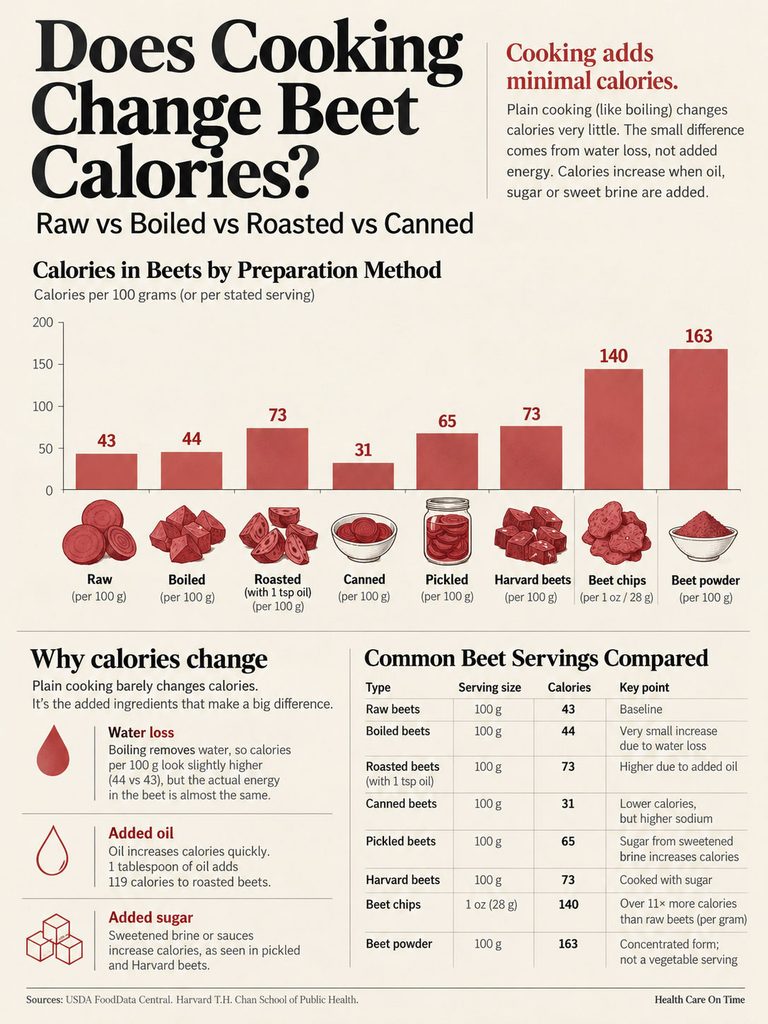
Short answer: cooking itself adds almost no calories. What you cook beets with, and how much water they lose, changes the number.
Why Boiled Beets Look “Higher” per Gram but “Lower” per Half Cup
Boiled beets have 44 calories per 100 grams versus 43 raw. That’s a rounding-level difference from mild water loss.
The bigger effect is serving size. A half cup of boiled slices (85 g, 37 calories) looks lower than a cup of raw slices (136 g, 58 calories), but that compares different amounts. Gram for gram, they’re nearly identical.
Roasted Beets: The Calories Come From the Oil
USDA doesn’t keep a separate entry for roasted beets. Roasting drives off more water than boiling, so calories per gram rise slightly, but the real change comes from oil.
One tablespoon of olive oil adds about 119 calories. Toss a pound of beets in two tablespoons and you’ve added roughly 240 calories to the batch. Split into four servings, each picks up about 60 extra calories, more than the beets themselves.
Want roasted flavor with fewer calories? Wrap whole beets in foil, roast them dry, then add a teaspoon of oil or a splash of vinegar after peeling.
Canned Beets: Fewer Calories, More Sodium
Canned beets, drained, have just 31 calories per 100 grams. That’s lower than fresh because canned beets hold more water.
The tradeoff is salt. Regular canned beets carry about 194 mg of sodium per 100 grams, more than double raw beets. Some store brands list 500 mg per cup, about 21% of the daily limit. No-salt-added cans drop to 21 mg per 100 grams.
Patients managing blood pressure often ask our team whether canned vegetables “count.” They do. Pick no-salt-added cans, or rinse regular canned beets under running water first.
Pickled and Harvard Beets: The Added-Sugar Problem
Pickled beets jump to 65 calories per 100 grams, with 11.1 g of sugar. A cup of pickled slices (227 g) has about 148 calories and 25 g of sugar, mostly from the sweetened brine.
Harvard beets are cooked in a sugar, vinegar, and cornstarch sauce. Canned versions land at 73 calories per 100 grams and about 180 calories per cup. A homemade recipe from the University of Maine Cooperative Extension lists 160 calories per 152-gram serving, with 17 g of added sugar.
Beet Chips and Beet Powder: Calorie Density Explodes
Remove the water and the math flips. One branded beet chip in USDA’s database lists 140 calories per ounce, about 500 calories per 100 grams. That’s more than 11 times raw beets.
Beet powder follows the same logic. It’s dried, concentrated beet, so a few teaspoons can match a whole beet’s sugar with none of the fullness. Fine as a supplement or color booster, but don’t count it as a vegetable serving.
Are Beets Good for Weight Loss?
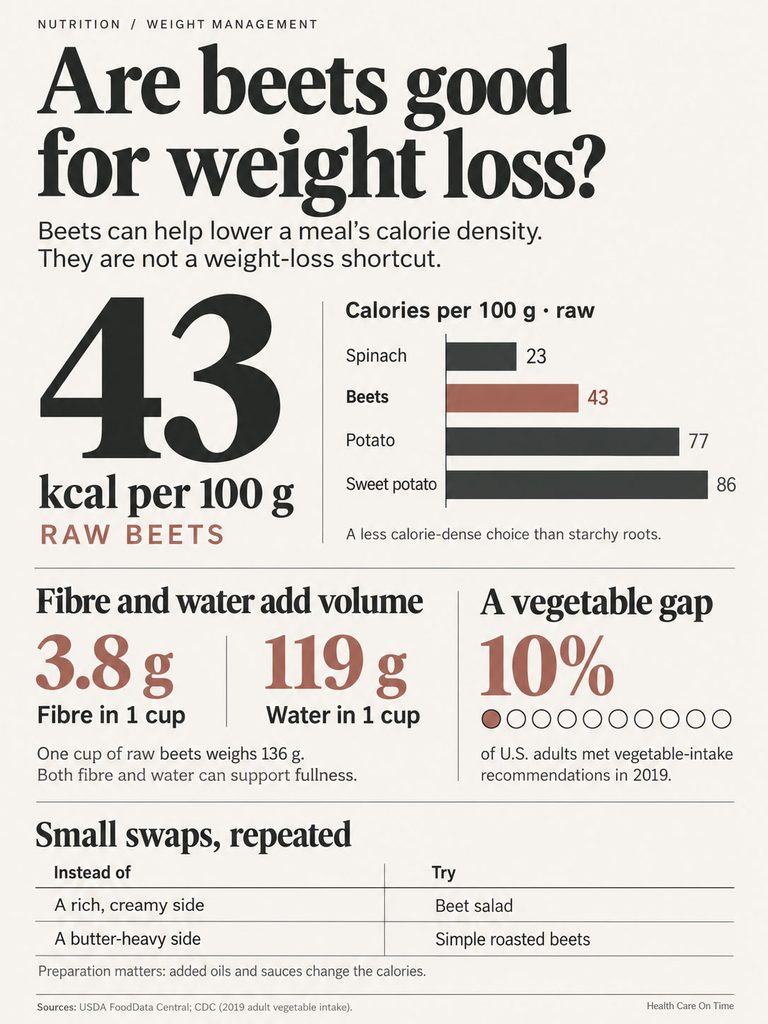
Beets can be a smart part of a weight loss plan. The reason isn’t any fat-burning effect; it’s calorie density.
Calorie Density Compared With Other Vegetables
Calorie density is how many calories a food packs into each gram. Lower density lets you eat a bigger, more filling portion for fewer calories.
Here’s where raw beets sit, per 100 grams (USDA):
- Spinach: 23 calories
- Cauliflower: 25 calories
- Carrots: 41 calories
- Beets: 43 calories
- Sweet potato: 86 calories
- Boiled potato: 86 calories
Beets sit in the middle: a bit higher than leafy greens, about half the calories of starchy roots. Our guides on carrot calories and cauliflower calories break those numbers down the same way.
Fiber, Water, and Feeling Full
With 3.8 g of fiber and about 119 g of water per cup, raw beets add volume to a meal at little energy cost. Fiber slows digestion, and water adds weight in your stomach. Both help you feel satisfied.
Most American adults fall short here. The CDC reports that only about 1 in 10 adults eats the recommended amount of vegetables. Swapping one calorie-dense side for beets is an easy way to close that gap.
Smart Swaps for Beet Lovers
Across patients we work with, small swaps tend to stick better than big diet overhauls. A few that work well:
- Swap a 1-ounce bag of potato chips (about 150 calories) for a cup of raw beet slices with hummus (58 calories plus the dip).
- Swap pickled beets for plain roasted beets with a splash of vinegar; you keep the tang and cut about 90 calories per cup.
- Swap beet juice for whole beets most days; an 8-ounce glass of bottled beet juice typically runs 77 to 140 calories with little fiber.
Are Beets Too Sugary? Carbs, Glycemic Index, and Diabetes
Beets taste sweet, so people assume they’re “high sugar.” The numbers say otherwise once you see the full picture.
Sugar per Serving in Context
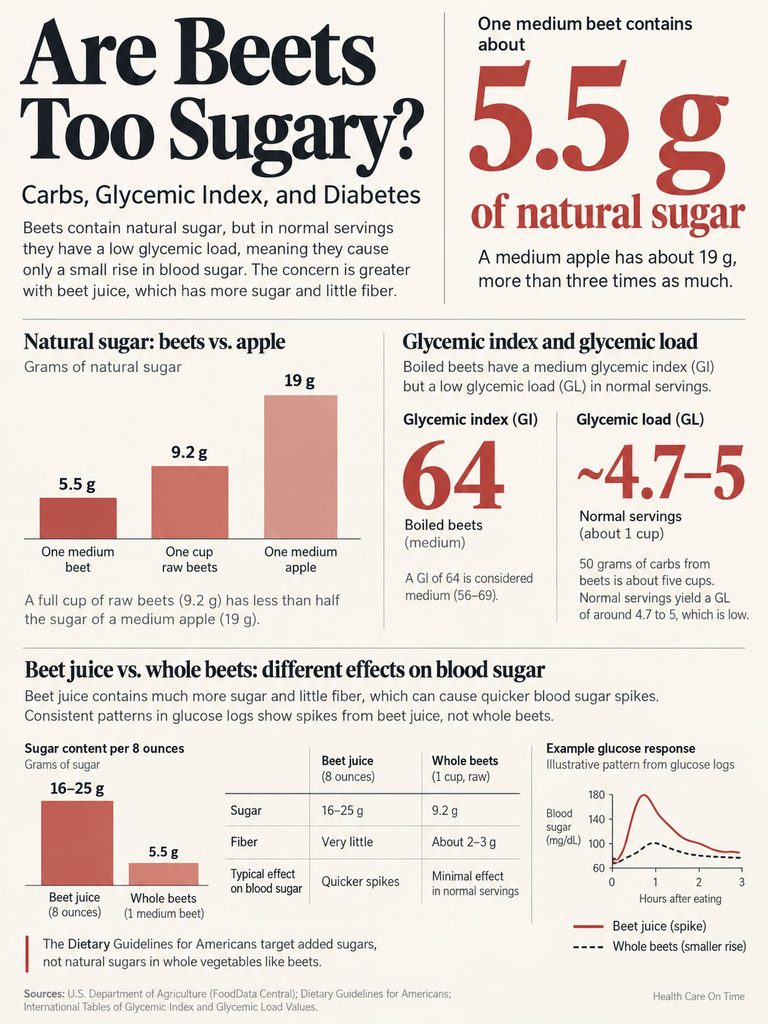
One medium beet has about 5.5 g of natural sugar. A medium apple (182 g) has about 19 g. Even a full cup of raw beets, at 9.2 g, has less than half the sugar of that apple.
None of the sugar in plain beets is added sugar. The Dietary Guidelines for Americans, 2025-2030, target added sugars, not the natural sugars that come packaged with fiber in whole vegetables.
GI 64 vs Glycemic Load About 5: What It Means for You
The glycemic index (GI) measures how fast a food raises blood sugar compared with pure glucose, using a fixed 50-gram carb portion. Boiled beets score 64, which is “medium.”
But 50 grams of carbs from beets is about five cups. Nobody eats that in one sitting. Glycemic load (GL) adjusts for a normal serving, and beets land around 4.7 to 5, firmly in the low range (10 or under).
Our medical reviewers see this GI-only mistake often. A medium GI paired with a low GL means a normal serving of whole beets has a small effect on blood sugar for most people.
Beet Juice vs Whole Beets for Blood Sugar
Juice is where caution makes sense. Bottled beet juice usually has 16 to 25 grams of sugar per 8 ounces and very little fiber, so that sugar reaches your bloodstream faster.
The CDC’s National Diabetes Statistics Report counts about 40 million Americans with diabetes and over 115 million with prediabetes. If you’re in either group:
- Choose whole beets over juice.
- Stick to a half cup to 1 cup per meal.
- Pair beets with protein or fat, such as goat cheese, walnuts, or salmon, to slow absorption.
- Count beets as part of your meal’s carbs.
In glucose logs that patients share with our care team, the pattern is consistent: the spike comes from the juice glass, not the side salad. Our guides on potatoes for diabetics and sweet potatoes for blood sugar use the same GI vs GL approach.
Who Should Limit Beets? Oxalates, Beeturia, and Blood Pressure Meds
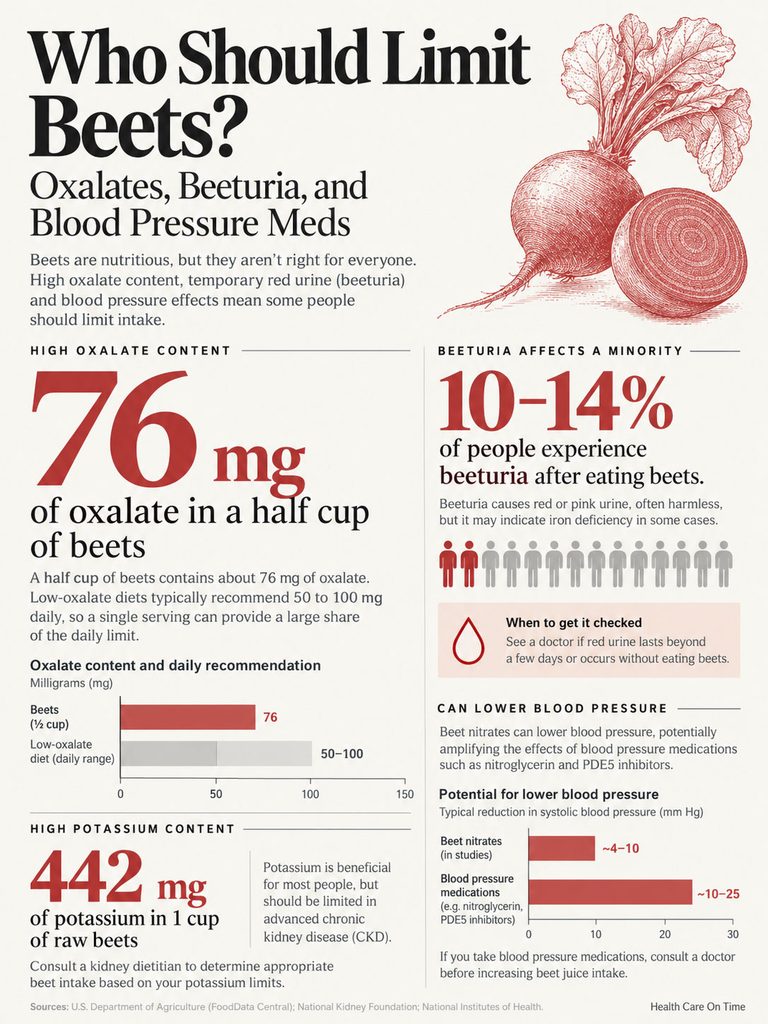
Beets are safe for most people. A few groups should watch portions or check with a doctor first.
Calcium Oxalate Kidney Stones
Beets are high in oxalate, a natural compound that can bind with calcium in urine and form stones. A half cup of beets carries about 76 mg of oxalate. Many low-oxalate diets, such as the one used by the University of Chicago, target 50 to 100 mg per day in total.
The National Kidney Foundation lists beets among foods stone formers may need to limit. It also stresses that you shouldn’t cut dietary calcium. Eating calcium-rich foods with beets helps bind oxalate in your gut before it reaches your kidneys. Our raw vs cooked spinach guide covers how boiling and draining lower oxalate in high-oxalate vegetables.
Beeturia: Red Urine Is Usually Harmless
About 10% to 14% of people notice pink or red urine after eating beets. This is beeturia, caused by betalain pigments passing through unchanged.
It’s usually harmless, but it shows up more often in people with iron deficiency. If you get beeturia and also feel unusually tired or short of breath, ask your doctor about a CBC and iron panel. Red urine without beets, or lasting more than a day or two after you stop eating them, needs a medical check.
Low Blood Pressure and Certain Medications
Because beet nitrates can lower blood pressure a few points, large daily amounts of beet juice may add to the effect of blood pressure medicines. The same applies to nitrate heart drugs such as nitroglycerin and to PDE5 inhibitors like sildenafil. Ask your doctor before starting a daily beet juice habit if you take any of these.
Potassium Limits in Chronic Kidney Disease
A cup of raw beets has 442 mg of potassium. That’s helpful for most people, but those with advanced chronic kidney disease are often told to limit potassium. Your kidney dietitian can tell you how beets fit your daily target.
How to Fit Beets Into Your Day
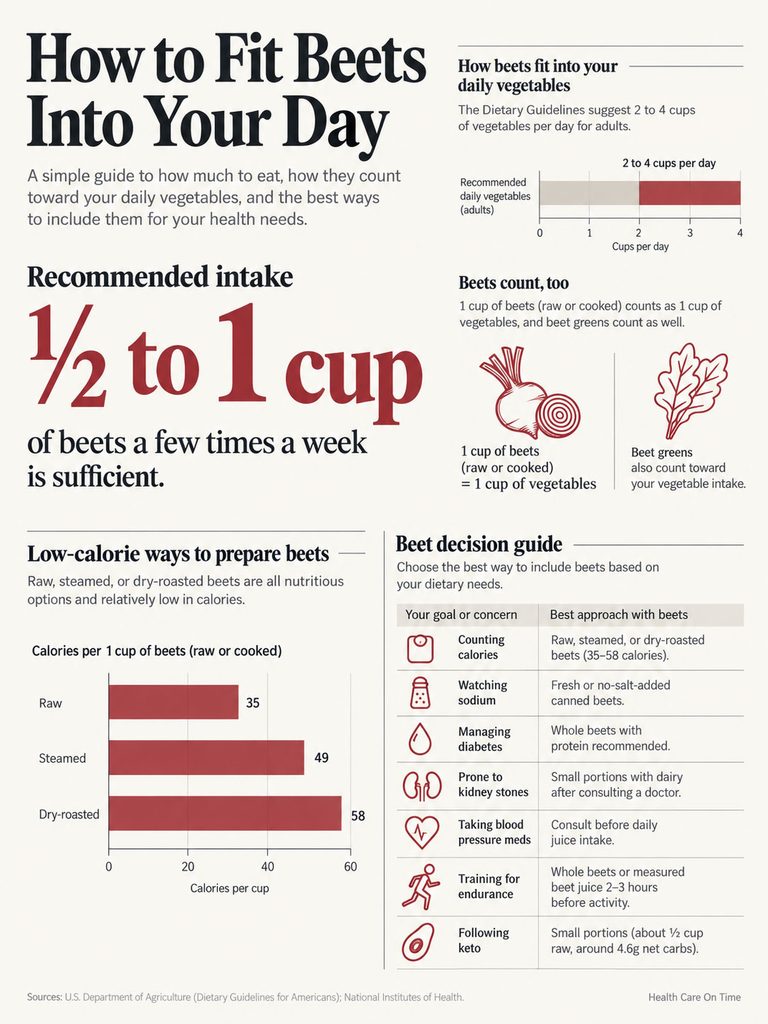
You don’t need many beets to benefit. A half cup to 1 cup a few times a week is plenty for most people.
Serving Targets Under the Dietary Guidelines
The Dietary Guidelines for Americans, 2025-2030, released in January 2026, encourage a wide variety of vegetables. For most adults, total vegetable needs fall between 2 and 4 cups a day, depending on age, sex, and activity.
A cup of raw or cooked beets counts as 1 cup of vegetables. Beet greens count too; 2 cups of raw greens equal 1 cup of vegetables.
Low-Calorie Ways to Prep Beets
These methods keep beets close to their USDA calorie baseline:
- Shred raw beets into salads or slaws with lemon juice.
- Steam whole beets for 30 to 40 minutes, then peel; steaming keeps more folate than boiling.
- Dry-roast in foil and add oil only at the end, measured by the teaspoon.
- Quick-pickle at home using vinegar, water, and spices with little or no sugar.
- Sauté beet greens with garlic for an 8-calorie-per-cup side.
Table 3: Your Beet Decision Guide
| If you are… | Best beet choice | Why |
| Counting calories | Raw, steamed, or dry-roasted beets | 35 to 58 calories per serving with no added oil or sugar |
| Watching sodium or blood pressure | Fresh beets or no-salt-added canned | Regular canned beets carry about 300 mg sodium per cup |
| Managing diabetes or prediabetes | ½ to 1 cup whole beets with protein | Low glycemic load (about 5); skip juice and pickled beets |
| Prone to calcium oxalate stones | Small portions, paired with dairy, after asking your doctor | ½ cup has about 76 mg oxalate |
| Taking BP meds, nitrates, or PDE5 inhibitors | Whole beets in normal portions; ask before daily juice | Nitrate effect can add to these drugs |
| Training for endurance sports | Whole beets or measured beet juice 2 to 3 hours before activity | Dietary nitrate may support exercise efficiency |
| Following keto or very low carb | Small portions, about ½ cup | About 4.6 g net carbs per half cup raw |
Frequently Asked Questions
How many calories are in one medium beet?
A medium 2-inch beet weighing 82 grams has about 35 calories, according to USDA FoodData Central. Larger 3-inch beets from farmers’ markets can weigh 160 to 200 grams and run 69 to 86 calories. Weighing your beets once gives a far more accurate count than guessing by size.
How many calories are in a cup of beets?
One cup of raw beet slices (136 g) has about 58 calories. A full cup of boiled beet slices (170 g) has about 75 calories. Many apps show 37 calories, but that’s USDA’s half-cup serving of boiled slices. Always check the gram weight attached to the serving.
Do cooked beets have more calories than raw beets?
Barely. Raw beets have 43 calories per 100 grams and boiled beets have 44. The 1-calorie difference comes from water lost during cooking. Calories only rise meaningfully when you add oil, butter, sugar, or sweet glazes during cooking or roasting.
How many calories are in canned beets?
Plain canned beets, drained, have 31 calories per 100 grams, about 49 calories per cup diced. That’s slightly lower than fresh because canned beets hold more water. Regular canned beets can carry about 300 mg of sodium per cup, so choose no-salt-added cans or rinse them first.
How many calories are in pickled beets?
Canned pickled beets have 65 calories per 100 grams, according to USDA. A cup of pickled slices has about 148 calories and 25 grams of sugar, mostly from the sweetened brine. That’s roughly 2.5 times the calories of plain canned beets. Homemade low-sugar pickles cut this sharply.
Are beets high in sugar?
Not compared with most fruit. A medium beet has about 5.5 grams of natural sugar, while a medium apple has about 19 grams. Plain beets contain zero added sugar. Pickled beets, Harvard beets, and bottled beet juice are where sugar climbs, so read those labels carefully.
How many net carbs are in beets?
One cup of raw beets has about 13 grams of total carbs and 3.8 grams of fiber, leaving about 9.2 grams of net carbs. A half cup has about 4.6 grams. That fits most moderate low-carb plans, though strict keto followers usually keep beets to small portions.
Are beets good for weight loss?
Beets can help because they’re low in calorie density: 43 calories per 100 grams, with fiber and plenty of water to help you feel full. They work best as a swap for higher-calorie sides or snacks. No single food causes weight loss; your overall eating pattern matters most.
Can people with diabetes eat beets?
Yes, in normal portions. Beets have a medium glycemic index of 64 but a low glycemic load of about 5 per serving, so a half cup to 1 cup of whole beets has a modest effect on blood sugar. Pair them with protein and limit beet juice, which has little fiber.
How many calories are in beet juice?
Most bottled 100% beet juices in the U.S. range from about 77 to 140 calories per 8-ounce serving, with 16 to 25 grams of sugar. Values vary widely by brand and whether apple or other juices are blended in. Check the Nutrition Facts panel on the bottle you buy.
Are golden beets lower in calories than red beets?
USDA doesn’t publish separate data for golden beets, so their calories and carbs are generally treated as similar to red beets. The main difference is pigment. Golden beets carry yellow betaxanthins instead of red betacyanins, so they don’t stain your hands and are less likely to cause red urine.
Is it safe to eat beets every day?
For most healthy adults, yes. A daily serving of whole beets is a nutritious habit. People who form calcium oxalate kidney stones, have advanced kidney disease, or take blood pressure medicines, nitrates, or PDE5 inhibitors should ask their doctor first, especially before drinking beet juice daily.
Disclaimer: This article is for general education and isn’t medical advice. Nutrition values come from USDA FoodData Central and may vary by variety, size, and brand. If you have kidney stones, chronic kidney disease, diabetes, low blood pressure, or take heart or blood pressure medicines, talk with your doctor or a registered dietitian before making major diet changes.
References
- USDA FoodData Central: Beets, raw (FDC 169145)
- USDA FoodData Central: Beets, cooked, boiled, drained (FDC 169146)
- USDA FoodData Central: Beets, pickled, canned, solids and liquids (FDC 170480)
- USDA FoodData Central: Beets, harvard, canned, solids and liquids (FDC 170479)
- USDA FoodData Central: Beet greens, raw (FDC 170375)
- NIH Office of Dietary Supplements: Folate Fact Sheet
- Grönroos R, et al. Beetroot juice and blood pressure in hypertension: meta-analysis. Clinical Nutrition ESPEN, 2024
- Bahadoran Z, et al. The Nitrate-Independent Blood Pressure-Lowering Effect of Beetroot Juice. Advances in Nutrition, 2017
- Benjamim CJR, et al. Nitrate Derived From Beetroot Juice Lowers Blood Pressure in Patients With Arterial Hypertension. Frontiers in Nutrition, 2022
- National Kidney Foundation: Calcium Oxalate Stones
- CDC MMWR: Adults Meeting Fruit and Vegetable Intake Recommendations
- CDC: National Diabetes Statistics Report
- Dietary Guidelines for Americans, 2025-2030
- University of Maine Cooperative Extension: Harvard Beets Nutrition Label