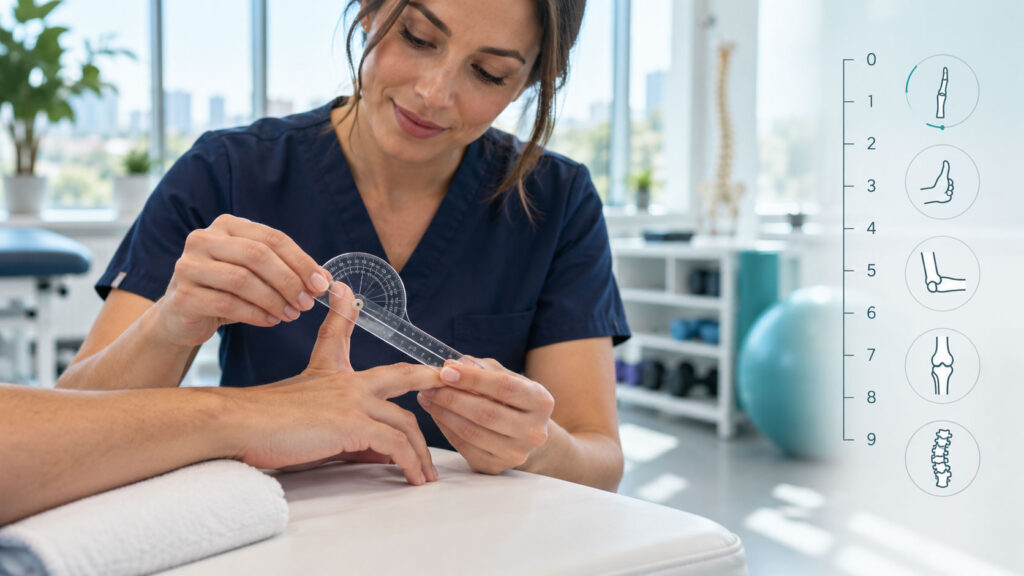
Here’s a fact that surprises most people: somewhere between 1 in 10 and 3 in 10 adults can bend at least some joints further than “normal.” Yet only a small fraction of them have a medical condition behind it.
Table of Contents
So when a doctor, physical therapist, or online quiz hands you a Beighton score, the number matters. But it’s the first page of the story, not the last.
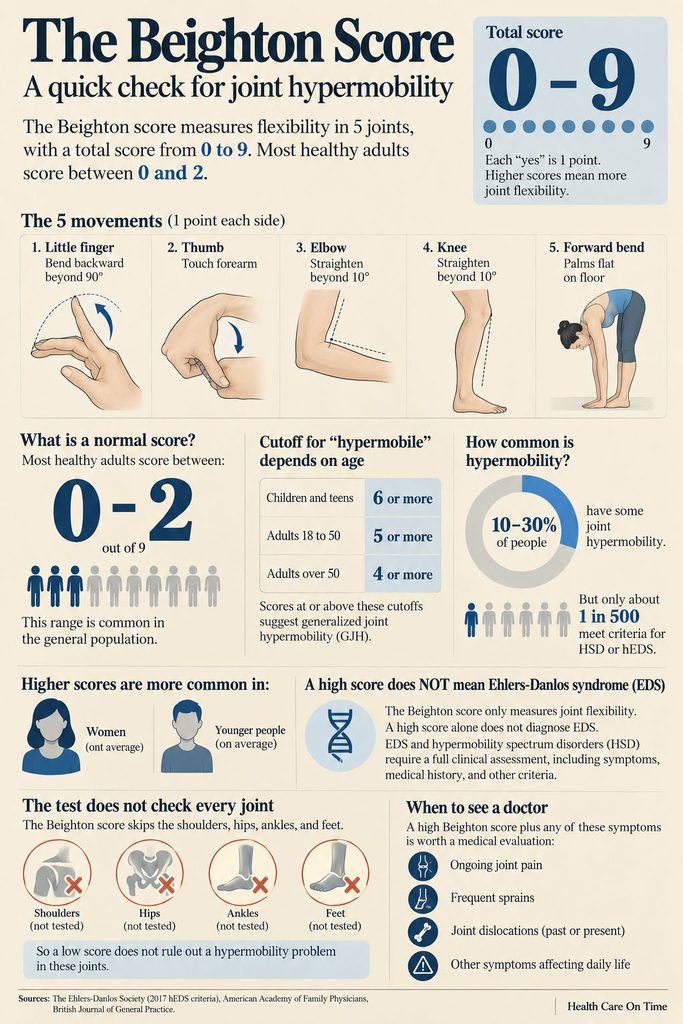
Quick Answer: The Beighton score is a 9-point screening test for generalized joint hypermobility. It checks 5 moves: pinky fingers, thumbs, elbows, knees, and bending forward with palms flat on the floor. Each positive move earns 1 point. Under the 2017 criteria, a positive score is 6 or more for children and teens, 5 or more for adults up to age 50, and 4 or more after age 50. It screens; it does not diagnose.
At a Glance
- The Beighton score runs from 0 to 9, and most healthy adults score between 0 and 2.
- The cutoff for “hypermobile” depends on age: 6+ for kids, 5+ for adults 18 to 50, 4+ over 50.
- A high score alone does not mean you have Ehlers-Danlos syndrome (EDS).
- About 10% to 30% of people have some joint hypermobility, but only about 1 in 500 meet criteria for HSD or hEDS.
- Women and younger people score higher on average.
- The test skips shoulders, hips, ankles, and feet, so a low score doesn’t rule out a problem.
- Joint pain, frequent sprains, or dislocations plus a high score are worth a doctor visit.
What Is the Beighton Score?
The Beighton score is a 9-point physical exam that measures how far 5 joint areas bend past their usual range. Doctors use it to screen for generalized joint hypermobility. A higher number means looser joints, and the cutoff for “hypermobile” depends on your age.
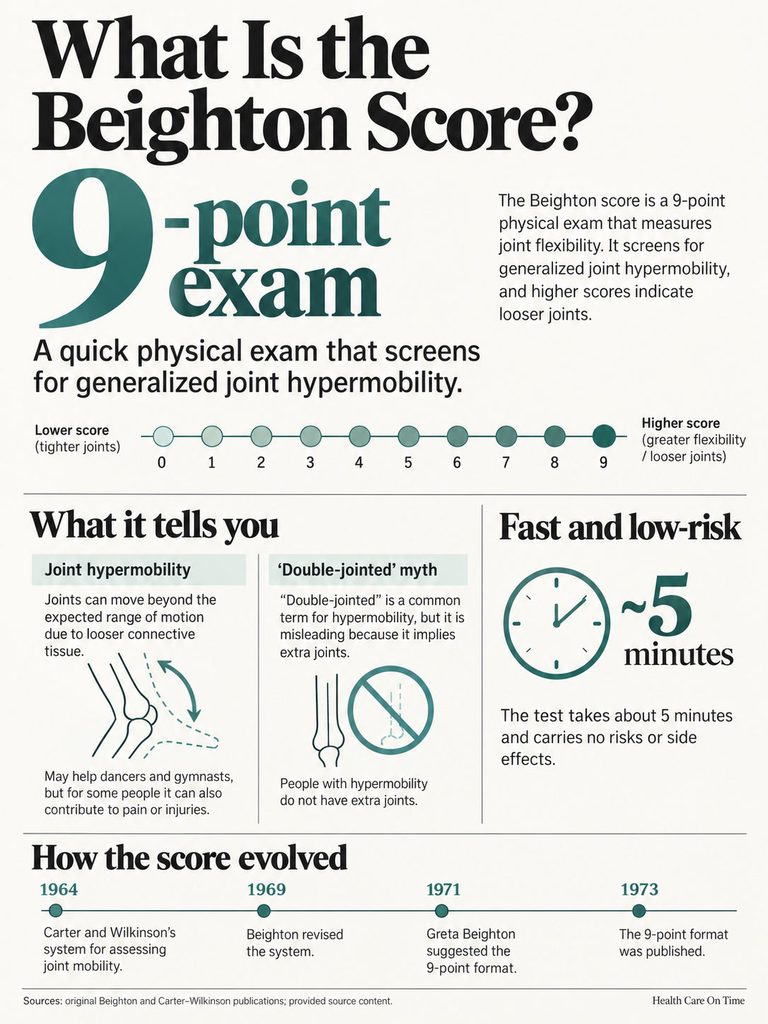
The test takes about 5 minutes. There are no needles, scans, or lab work. According to Cleveland Clinic, it carries no risks or side effects, and you learn your result on the spot.
Where the Test Came From
The Beighton score grew out of an earlier system built by Carter and Wilkinson in 1964. Peter Beighton and Horan revised it in 1969.
Greta Beighton suggested the 9-point format in 1971, and the method was published in 1973 by Beighton, Solomon, and Soskolne, as described by Life in the Fast Lane. More than 50 years later, it’s still the most widely used hypermobility screen in the world.
What “Joint Hypermobility” Actually Means
Joint hypermobility means a joint moves beyond the range expected for it. It usually comes from looser connective tissue, the collagen-based “rope” that holds bones together at the joint.
For many people, this causes no trouble. Dancers, gymnasts, and swimmers often gain an edge from it. For others, loose joints bring pain, sprains, dislocations, and fatigue.
Hypermobile vs. “Double-Jointed”
“Double-jointed” is the everyday phrase for hypermobility. Nobody actually has two joints where one should be.
Patients who ask our team about this test often say, “I’ve been double-jointed my whole life.” That’s a useful clue. In fact, “Do you consider yourself double-jointed?” is one of the official questions doctors pair with the Beighton score.
How the Beighton Test Is Done (Step by Step)
The Beighton test uses 5 movements. Four are checked on both the left and right sides, worth 1 point per side. The fifth, the forward bend, counts once.
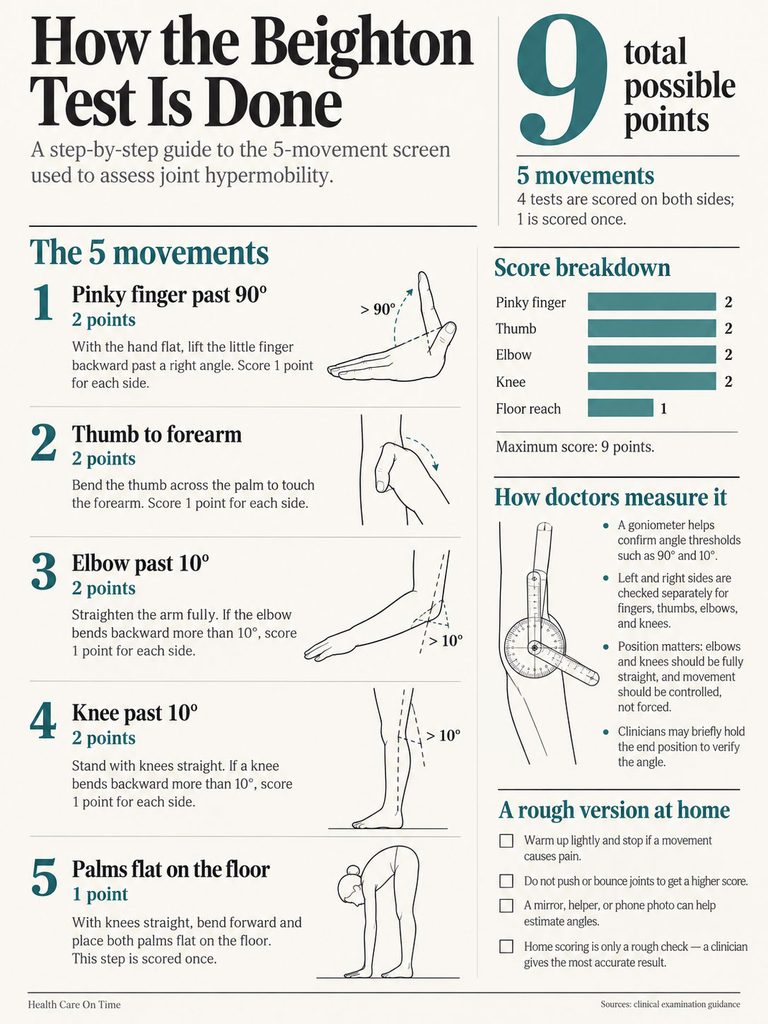
That’s where the 9 comes from: 4 paired moves times 2 sides, plus 1.
How to Calculate Your Beighton Score
- Bend each pinky finger back. Past 90 degrees? Add 1 point per hand.
- Press each thumb toward the forearm. Touches? Add 1 point per side.
- Straighten each elbow. Bends back more than 10 degrees? Add 1 point per side.
- Straighten each knee. Bends back more than 10 degrees? Add 1 point per side.
- Bend forward with knees locked. Palms flat on the floor? Add 1 point.
- Total your points (0 to 9) and compare with your age cutoff.
The 5 Moves in Detail
Pinky Finger Bend Past 90 Degrees (2 points)
You rest your forearm and palm flat on a table. The examiner gently bends your little finger backward at the knuckle.
If it bends past 90 degrees, pointing straight up from the back of the hand or beyond, you get 1 point for that hand. Then the other side.
Thumb to Forearm (2 points)
With your arm out in front and wrist bent down, the examiner presses your thumb toward the inside of your forearm.
If the thumb touches the forearm, you score 1 point. Both hands are checked.
Elbow Bend Past 10 Degrees (2 points)
You stretch your arms straight out to the side, palms up. The examiner checks whether each elbow bends backward more than 10 degrees past straight.
Each elbow that overextends earns 1 point.
Knee Bend Past 10 Degrees (2 points)
You stand or lie with legs straight. Looking from the side, the examiner checks whether each knee bows backward more than 10 degrees.
Doctors call this genu recurvatum. One point per knee.
Palms Flat on the Floor (1 point)
You stand with feet together and knees locked. Then you bend forward at the waist.
If both palms rest flat on the floor, you get 1 point. This is the only move scored once, and the only one you do actively.
How Doctors Measure It
Many providers use a goniometer, a hinged ruler that measures joint angles. The 2017 criteria call for standardized testing to cut down on false positive scores, as noted in NCBI GeneReviews.
Most moves are passive. The examiner moves your joint while you relax. Our medical reviewers point out that timing matters too: you’ll often score higher in the afternoon or after exercise than first thing in the morning.
Can You Do It at Home?
Yes, you can try a rough version at home. Keep it safe:
- Warm up for 5 minutes with light walking.
- Never force a joint. Let it rest at its natural end point.
- Use a mirror or a partner to judge angles.
- Stop right away if anything hurts.
- Write down your score and bring it to your doctor.
Home scores are easy to get wrong by a point or two, because angles are hard to judge by eye. Treat your result as a conversation starter, not a verdict.
What Your Beighton Score Results Mean
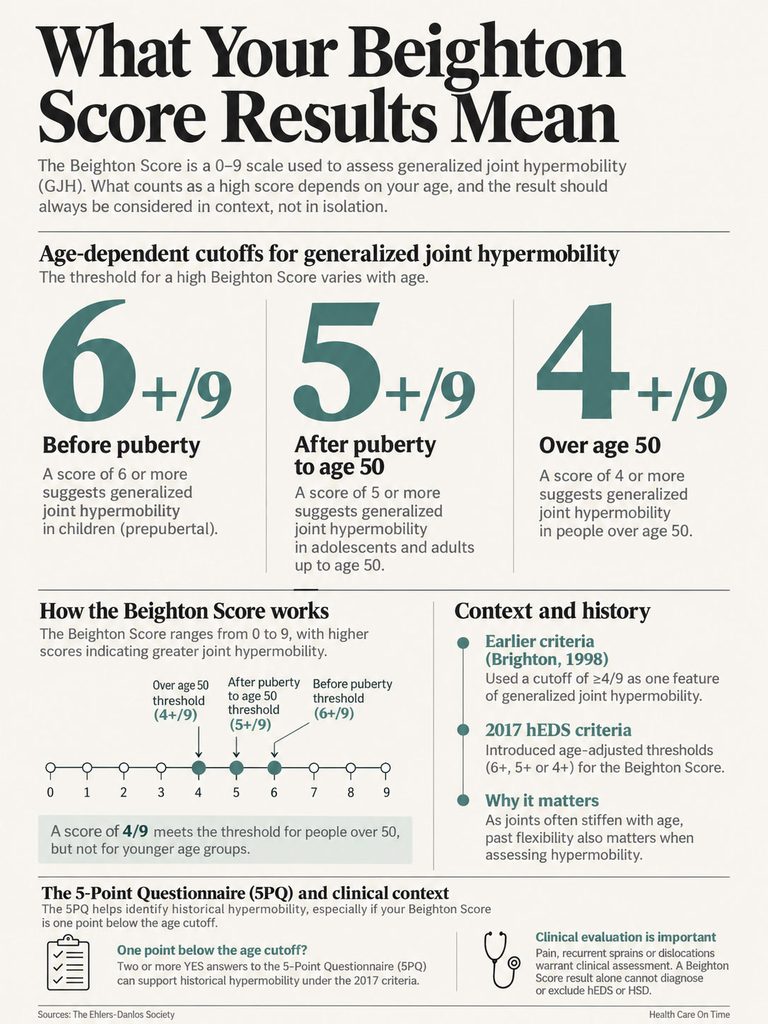
Your number only makes sense next to your age. A score of 5 means something different for a 12-year-old than for a 60-year-old.
Score-by-Score Breakdown (0 to 9)
Our medical reviewers see the question “Is my score high?” more than any other on this topic. Here’s how to read each range, using the 2017 hEDS cutoffs from The Ehlers-Danlos Society.
| Beighton Score | Kids and Teens (5 to 17) | Adults (18 to 50) | Adults (Over 50) | What It Usually Means |
| 0 to 2 | Not hypermobile | Not hypermobile | Not hypermobile | Typical range; most healthy adults land here |
| 3 | Not hypermobile | Not hypermobile | One point below cutoff; 5-Point Questionnaire may count | Mild flexibility; localized hypermobility possible |
| 4 | Below cutoff | One point below cutoff; 5PQ may count | Meets GJH cutoff | Borderline for younger adults; positive over 50 |
| 5 | One point below cutoff; 5PQ may count | Meets GJH cutoff | Meets GJH cutoff | Generalized joint hypermobility in adults |
| 6 | Meets GJH cutoff | Meets GJH cutoff | Meets GJH cutoff | Generalized hypermobility at every age |
| 7 to 9 | Meets GJH cutoff | Meets GJH cutoff | Meets GJH cutoff | Marked hypermobility; worth a full evaluation if symptoms exist |
A score at or above your cutoff means you meet the definition of generalized joint hypermobility (GJH). It does not, by itself, mean you have a disorder.
Why the Cutoff Changes With Age
Joints naturally stiffen with age. The original Beighton research found range of motion drops quickly through childhood and more slowly through adult life.
That’s why the bar is 6 for kids and 4 for people over 50. A 55-year-old who still scores 4 is more unusual than a 10-year-old who scores 5.
A review in PMC adds that the Beighton score isn’t reliable in children under 5, and that the pediatric cutoff of 6 applies until skeletal maturity.
Older Cutoffs You Might Still See
Many websites say “4 or more means hypermobile.” That number comes from the older 1998 Brighton criteria and long-standing British practice.
Cleveland Clinic, for example, still lists 4 or more points as positive. The 2017 age-based cutoffs are stricter and are the ones used today to diagnose hEDS. If your doctor and an online source disagree, that’s usually why.
The 5-Point Questionnaire Bonus Point
Some people used to be very flexible but lost range with age, injury, or surgery. To account for that, doctors use the 5-Point Questionnaire (5PQ), created by Hakim and Grahame in 2003:
- Can you now (or could you ever) place your hands flat on the floor without bending your knees?
- Can you now (or could you ever) bend your thumb to touch your forearm?
- As a child, did you amuse friends by twisting your body into strange shapes, or could you do the splits?
- As a child or teen, did your shoulder or kneecap dislocate more than once?
- Do you consider yourself double-jointed?
If you answer yes to 2 or more, and your Beighton score sits just 1 point below your age cutoff, a doctor can still diagnose generalized joint hypermobility. On its own, the 5PQ shows about 85% sensitivity and specificity against the Beighton score, according to Pulse.
If you score 2 or more points below the cutoff, the questionnaire can’t close the gap.
Three Example Scores, Read Step by Step
These example scenarios show how clinicians typically interpret real numbers.
Example 1: A 16-Year-Old Dancer Who Scores 7
She gets both pinkies, both thumbs, both elbows, and palms to the floor. Her knees stay straight. Total: 7.
That’s above the teen cutoff of 6, so she has generalized joint hypermobility. If she has no pain or injuries, nothing more is needed beyond smart strength training for dance.
Example 2: A 34-Year-Old With Ankle Sprains Who Scores 4
He gets both thumbs and both pinkies, but nothing else. Total: 4, one point under the adult cutoff of 5.
He answers yes to 3 questions on the 5PQ. That combination lets a doctor diagnose generalized joint hypermobility, and his repeated sprains make a physical therapy referral sensible.
Example 3: A 58-Year-Old With Knee Replacements Who Scores 3
Surgery has removed her knee points. She scores both pinkies and one thumb. Total: 3, one under the over-50 cutoff of 4.
She recalls doing the splits as a child and calls herself double-jointed: 2 yes answers. Her history now counts, and a doctor can assess her for hypermobility despite the low number.
How Common Is a High Beighton Score?
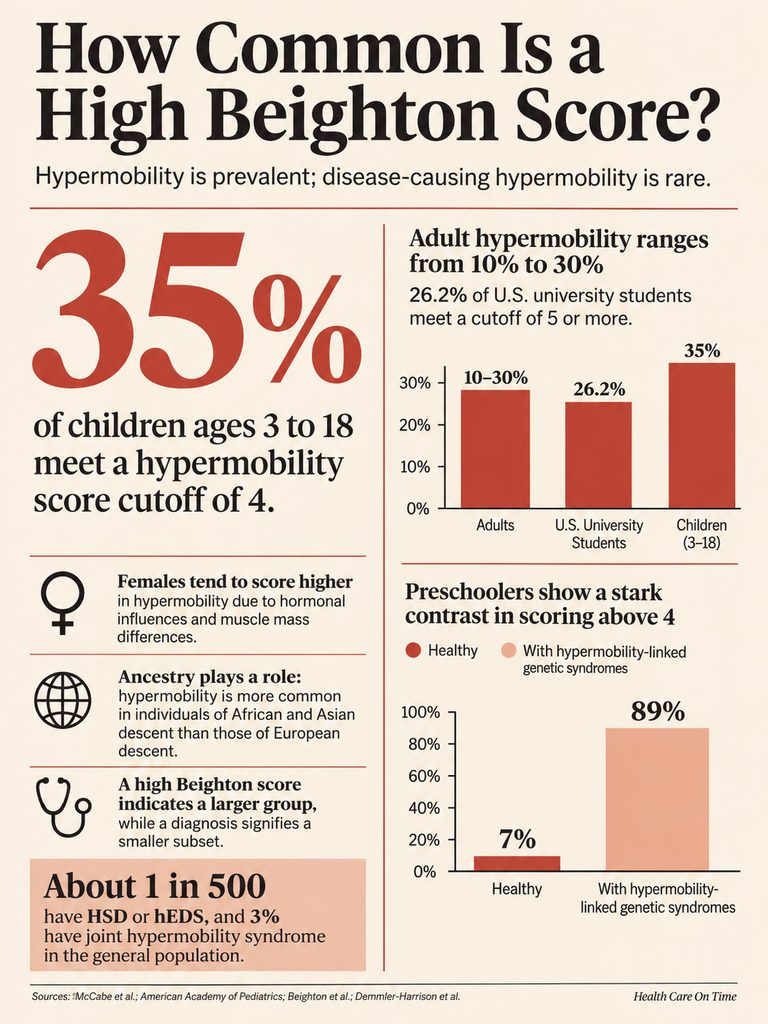
Hypermobility is common. Hypermobility that causes disease is not. That gap is the single most useful thing to understand about your result.
Hypermobility in Adults vs. Children
Kids are far bendier than adults. Studies using a cutoff of 4 report that roughly 35% of children and teens ages 3 to 18 meet the mark, while adult figures range from 10% to 30%, per a review in PMC.
In the United States, a study of healthy university students found 26.2% met a cutoff of 5 or more, as cited in PeerJ.
Why Women Score Higher
At every age, females tend to be more hypermobile than males, a pattern first documented in the original Beighton research. Hormones such as estrogen and relaxin likely play a role, along with differences in muscle mass.
This is one reason hypermobility-related conditions are diagnosed far more often in women.
Background Matters Too
Research also shows differences by ancestry. Generalized hypermobility has been reported more often in people of African and Asian descent than in people of European descent, per the PeerJ review.
That’s part of why one fixed cutoff doesn’t fit everyone, and why clinicians use judgment rather than the number alone.
Key Hypermobility Statistics
| Statistic | Figure | Source |
| Adults with some joint hypermobility | 10% to 30% | PMC review (Reuter and Fichthorn) |
| People meeting criteria for HSD or hEDS | About 1 in 500 | PMC hypermobility review |
| General population with joint hypermobility syndrome | About 3% | Cleveland Clinic |
| US university students with GJH (cutoff 5+) | 26.2% | PeerJ, citing Russek and Errico |
| Children and teens with GJH (cutoff 4+) | About 35% | PMC review |
| Preschoolers scoring above 4: healthy vs. with hypermobility-linked genetic syndromes | 7% vs. 89% | Preschool hypermobility study (EM Consulte) |
| Test agreement at cutoff 6 (same / different examiner) | Kappa 0.75 / 0.78 | Journal of Rheumatology |
The takeaway: a high score puts you in a big group. A diagnosis puts you in a much smaller one.
Beighton Score, HSD, and hEDS: How They Connect
Think of joint hypermobility as a spectrum. On one end sits harmless flexibility. On the other sits hypermobile Ehlers-Danlos syndrome. The Beighton score helps doctors place you on that line.
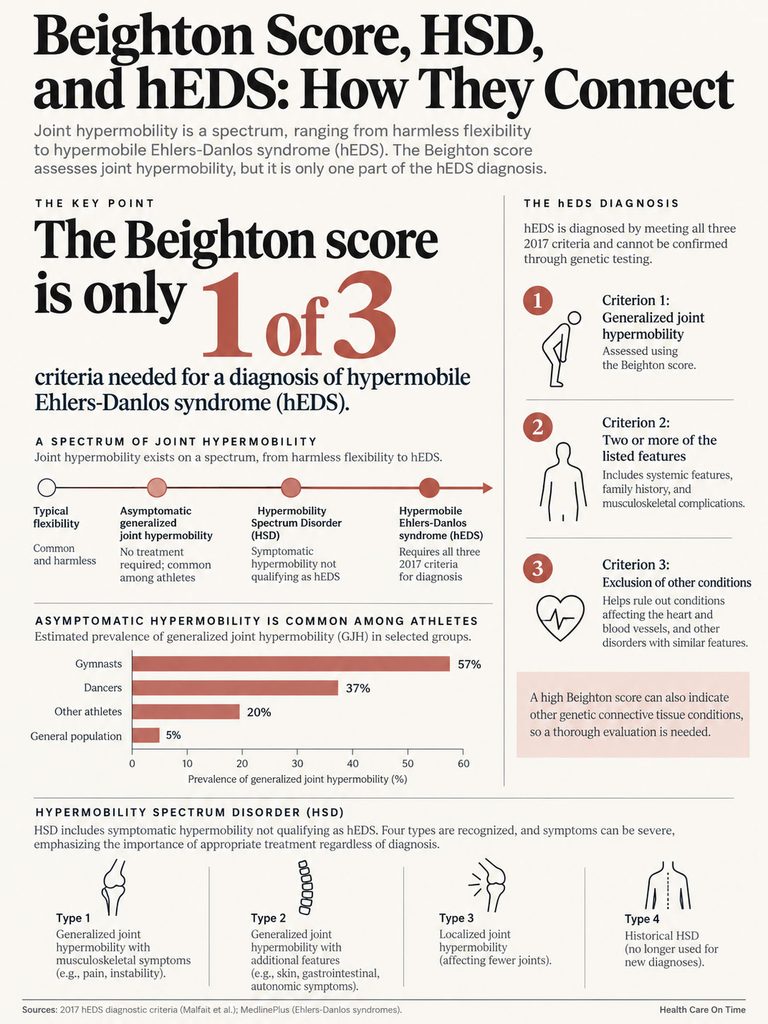
In cases reviewed by our medical team, the most common mix-up is assuming a high score equals EDS. It doesn’t. The score covers only Criterion 1 of 3.
Asymptomatic Joint Hypermobility
If you meet the cutoff but have no pain, injuries, or other symptoms, you have asymptomatic generalized joint hypermobility.
This is not a disease and needs no treatment. Plenty of athletes and performers live their whole lives here.
Hypermobility Spectrum Disorder (HSD)
HSD is the diagnosis for symptomatic hypermobility that doesn’t meet criteria for hEDS or another EDS type. There are 4 recognized types:
- Generalized HSD: Beighton score meets the cutoff, plus musculoskeletal problems.
- Peripheral HSD: Hypermobility mostly in the hands and feet.
- Localized HSD: One joint or a small group of joints.
- Historical HSD: You used to be hypermobile (positive 5PQ) but your current score is lower.
HSD isn’t automatically “milder” in how much it hurts. Symptoms can be just as real. The Ehlers-Danlos Society stresses that getting proper treatment matters more than the label.
Hypermobile Ehlers-Danlos Syndrome (hEDS)
hEDS requires all 3 of the 2017 criteria at once:
- Criterion 1: Generalized joint hypermobility, using the age-based Beighton cutoffs.
- Criterion 2: At least 2 of these: specific body features (soft or stretchy skin, unusual scars, stretch marks, hernias, and more), a first-degree relative with hEDS, or musculoskeletal complications such as long-term pain or repeated dislocations.
- Criterion 3: Other causes ruled out, including other connective tissue disorders and other EDS types.
hEDS is the only one of the 13 EDS subtypes diagnosed purely by clinical exam. The others can be confirmed with genetic testing. There’s still no blood test for hEDS.
Other Conditions a High Score Can Point To
A high Beighton score also appears in other genetic connective tissue conditions, including:
- Classical and vascular EDS
- Marfan syndrome
- Osteogenesis imperfecta
- Loeys-Dietz syndrome
- Down syndrome
That’s why Criterion 3 exists. Some of these conditions affect the heart and blood vessels, so ruling them out really matters. MedlinePlus offers a plain-language overview of the EDS family.
How Accurate Is the Beighton Score?
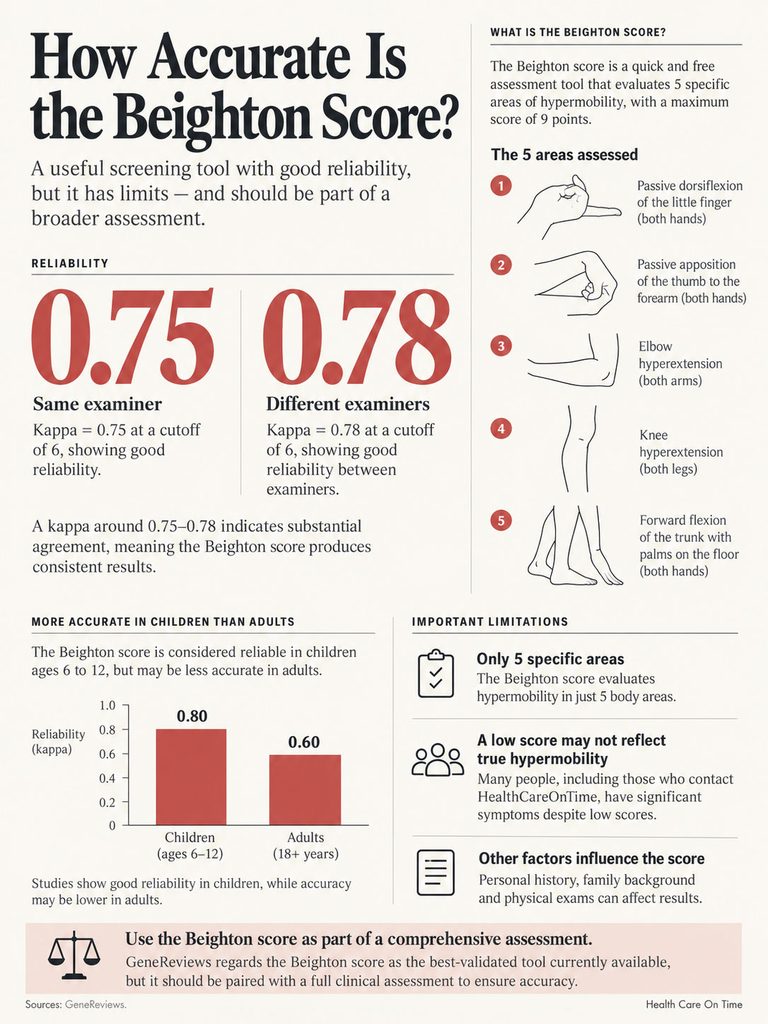
The Beighton score is quick, free, and fairly consistent. It’s also limited. Knowing those limits helps you read your result with clear eyes.
Reliability Data
When trained examiners follow the same method, results agree well. One study found agreement (kappa) of 0.75 for the same examiner and 0.78 between different examiners at a cutoff of 6.
Medical News Today reports the test looks reliable in children ages 6 to 12 but may be less so in adults. GeneReviews still calls it the best-validated tool available.
What the Test Misses
The Beighton score checks only 5 areas. It does not look at:
- Shoulders, a very common site of instability
- Hips
- Ankles and feet
- Wrists beyond the thumb
- The jaw (TMJ)
- Joint stability, meaning whether joints slip or pop out
So someone with loose shoulders and unstable ankles could score a 2 and still have real hypermobility problems. Across the questions readers send HealthCareOnTime, this “low score, lots of symptoms” pattern comes up often.
Factors That Skew Your Score
Several things can push your number up or down without changing your underlying tissue:
- Training: Yoga, dance, and gymnastics can raise some moves, especially the forward bend.
- Warm-up: Warm muscles let joints travel further.
- Age: Scores drop over time.
- Injury or surgery: A fused joint or replaced knee lowers what you can score.
- Tight hamstrings or back pain: These can block the palms-to-floor move, even in a loose-jointed person.
- Examiner technique: Pushing too hard or too gently changes the result.
This is why doctors pair the score with your history, family background, and a full physical exam.
What to Do After a High Score
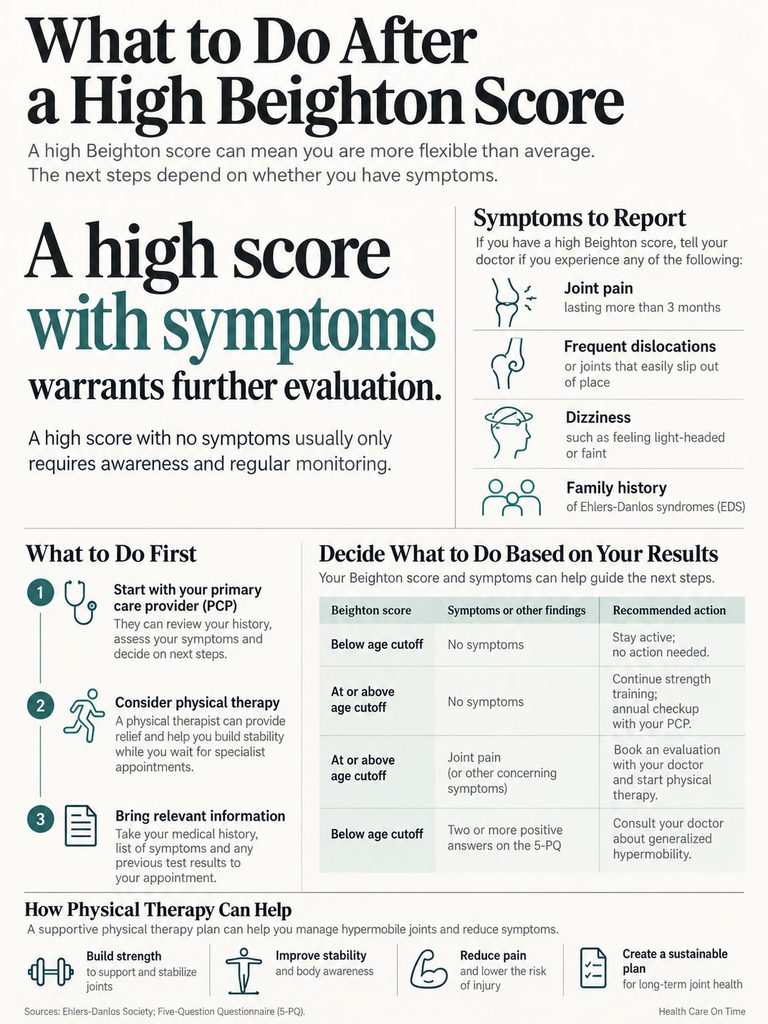
A high score with no symptoms needs little more than awareness. A high score with symptoms deserves a closer look.
Symptoms Worth Reporting
Our clinical reviewers suggest raising a high Beighton score with a doctor if you also have:
- Joint pain in several joints lasting more than 3 months
- Frequent sprains, especially ankles
- Joints that slip partly out of place (subluxation) or fully dislocate
- Fatigue that rest doesn’t fix
- Dizziness or a racing heart when you stand up
- Stomach or bowel problems with no clear cause
- Easy bruising, slow-healing cuts, or wide scars
- A parent, sibling, or child with EDS or HSD
Which US Doctor to See
Most people start with their primary care provider (PCP). From there, the path often looks like this:
- Rheumatologist: Evaluates joint pain and rules out arthritis and autoimmune disease.
- Clinical geneticist: Assesses for hEDS and other connective tissue disorders and orders genetic tests when needed.
- Physical therapist: Measures your score, builds a strengthening plan, and works on joint stability.
- Cardiologist: May order an echocardiogram if a connective tissue disorder is suspected.
Wait times for US genetics clinics can run several months. Starting with your PCP and a physical therapist can bring relief while you wait.
How to Prepare for the Appointment
Bring these to make the visit count:
- Your home Beighton score and the date you checked it
- Your answers to the 5-Point Questionnaire
- A list of injuries, sprains, and dislocations with rough dates
- A symptom log covering at least 2 weeks
- Family history of EDS, Marfan syndrome, aneurysms, or early heart problems
- Photos of unusual scars or stretch marks
Your Next-Step Decision Guide
| Your Situation | Recommended Action | Who to See |
| Score below your age cutoff, no symptoms | No action needed; stay active and strong | None required |
| Score at or above cutoff, no symptoms | Keep up strength training; watch for new pain | Annual checkup with PCP |
| Score at or above cutoff, joint pain over 3 months | Book an evaluation; start a PT program | PCP, then physical therapist or rheumatologist |
| Score 1 point below cutoff, 2+ yes answers on 5PQ | Ask your doctor to review for generalized hypermobility | PCP or rheumatologist |
| Frequent dislocations or subluxations at any score | Get evaluated soon; protect the joint | Orthopedic specialist plus physical therapist |
| High score plus dizziness, fainting, or racing heart on standing | Get checked for autonomic problems such as POTS | PCP, then cardiologist |
| High score plus stretchy skin, odd scars, or family history of EDS | Request a connective tissue evaluation | Clinical geneticist |
| Sudden chest pain, severe headache, or family history of aneurysm | Call 911 or go to the ER right away | Emergency care |
Living Well With Hypermobile Joints
Most people with hypermobility do well with the right habits. The goal is to build muscle support around loose joints.
- Strength training: Slow, controlled moves. Strong muscles act like a built-in brace.
- Skip end-range stretching: Hypermobile people rarely need more flexibility. Avoid pushing joints past their limit.
- Low-impact exercise: Swimming, cycling, Pilates, and walking are usually well tolerated.
- Joint-friendly gear: Supportive shoes, ankle braces for sports, and ergonomic grips help.
- Posture habits: Don’t lock your knees or elbows when standing or carrying things.
- Pacing: Fatigue is real. Planned rest breaks help prevent flare-ups.
A physical therapist familiar with hypermobility can tailor a plan to your joints and goals.
Frequently Asked Questions
What is a normal Beighton score?
Most healthy adults score between 0 and 2 out of 9. Anything below your age-based cutoff (6 for children and teens, 5 for adults up to 50, 4 for adults over 50) is considered within the normal range. A score of 3 in a younger adult usually reflects mild, everyday flexibility rather than a medical concern.
What does a Beighton score of 4 mean?
It depends on your age. For adults over 50, a score of 4 meets the cutoff for generalized joint hypermobility. For adults 18 to 50, it sits 1 point below the cutoff, so 2 or more yes answers on the 5-Point Questionnaire could still qualify. For children, 4 is below the cutoff of 6.
Is a Beighton score of 5 considered hypermobile?
Yes, for adults. Under the 2017 criteria, a score of 5 or more confirms generalized joint hypermobility for people from puberty up to age 50, and it’s above the cutoff for those over 50. For children and teens, 5 is 1 point under the cutoff of 6, so it’s borderline.
Can you have EDS with a low Beighton score?
It’s possible to have HSD or symptoms with a low score, since the test skips shoulders, hips, and feet. For an hEDS diagnosis, though, you must meet the age cutoff or fall 1 point below it with a positive 5-Point Questionnaire. Other EDS types are confirmed by genetic testing, not the score.
Does a high Beighton score mean you have EDS?
No. A high score only meets 1 of the 3 criteria for hEDS. You also need specific physical features, family history, or musculoskeletal complications, plus other conditions ruled out. Many people with high scores have no symptoms and no disorder. Only about 1 in 500 people meet criteria for HSD or hEDS.
Can I do the Beighton test at home?
You can try it at home to get a rough idea. Warm up first, never force a joint, and use a mirror or partner to judge angles. Home results are often off by a point or two. Bring your number to a doctor or physical therapist, who can measure angles accurately with a goniometer.
What is a good Beighton score for children?
For children and teens ages 5 to 17, a score of 6 or more indicates generalized joint hypermobility under the 2017 criteria. Scores below 6 are common and usually normal, because children are naturally flexible. The test isn’t considered reliable for kids under 5, so doctors rely on other methods for toddlers.
Can your Beighton score change over time?
Yes. Scores usually drop with age as connective tissue stiffens. Injury, surgery, or arthritis can also lower your score. Regular yoga, dance, or warm muscles can raise it slightly. That’s why doctors use age-based cutoffs and the 5-Point Questionnaire to capture how flexible you were in the past.
Can stretching or yoga raise your Beighton score?
Training can raise some moves, especially the palms-to-floor bend, which depends on hamstring flexibility. It rarely changes moves like the thumb-to-forearm or elbow hyperextension, which reflect ligament laxity. Hypermobile people generally don’t need extra stretching; strengthening is more helpful for joint stability and pain.
What kind of doctor does the Beighton test?
Primary care providers, rheumatologists, clinical geneticists, sports medicine doctors, orthopedic specialists, and physical therapists all use the Beighton test. In the US, many people start with a PCP or physical therapist. If a connective tissue disorder is suspected, a referral to a geneticist or rheumatologist usually follows.
Is the Beighton test painful?
The test shouldn’t hurt. Each move takes the joint to its natural end point without force. If you already have joint pain, some positions may feel uncomfortable. Tell the examiner right away if anything hurts. There are no needles or scans, and Cleveland Clinic notes the test carries no risks or side effects.
Does insurance cover a hypermobility evaluation in the US?
Most US health plans cover office visits with a PCP, rheumatologist, or physical therapist when you have symptoms, though copays and referral rules vary. Genetic testing for other EDS types often needs prior authorization. Call your insurer before booking and ask about specialist referrals and genetic test coverage.
Disclaimer: This article is for general information only and is not medical advice. The Beighton score is a screening tool, not a diagnosis. Always talk with a licensed healthcare provider about joint pain, injuries, or concerns about Ehlers-Danlos syndrome or hypermobility spectrum disorder. If you have sudden severe chest pain or headache, call 911.
References
- Cleveland Clinic: Beighton Score
- The Ehlers-Danlos Society: HSD vs. hEDS, the 2017 Diagnostic Criteria
- NCBI GeneReviews: Hypermobile Ehlers-Danlos Syndrome
- PMC: Hypermobility, HSD, hEDS, and Beighton Score Cutoffs
- PMC: Generalized Joint Hypermobility Among American University Students
- PeerJ: Reuter and Fichthorn, Generalized Joint Hypermobility Study
- EM Consulte: Assessing Joint Hypermobility in Preschool-Aged Children
- Medical News Today: What Is a Beighton Score?
- Pulse: Toolbox, The Beighton Score
- Journal of Rheumatology: Beighton Score Reproducibility
- Life in the Fast Lane: Beighton Score History
- BMJ Case Reports: Video Demonstration of the Beighton Score
- MedlinePlus: Ehlers-Danlos Syndrome