Here’s a detail most spa menus leave out. The massage machines the FDA has cleared for cellulite carry a narrow label: a temporary reduction in how cellulite looks. Not removal. Not fat loss. Temporary.
Table of Contents
That one word sums up decades of research. Anti-cellulite massage can make your thighs look smoother for a short time, and it often feels great. Whether it’s worth your money depends on what you expect, so this guide covers what studies measured, how long results last, and what each option costs.
Quick answer: Yes, but only for a short time. Anti-cellulite massage can make dimpled skin look smoother for hours to a few weeks by moving fluid and boosting blood flow. It cannot break down fat or cut the fibrous bands that pull skin inward. Even FDA-cleared massage devices are cleared only for a temporary reduction in appearance, and results fade within about a month of stopping. Treatments that release the bands last one to five years.
At a Glance
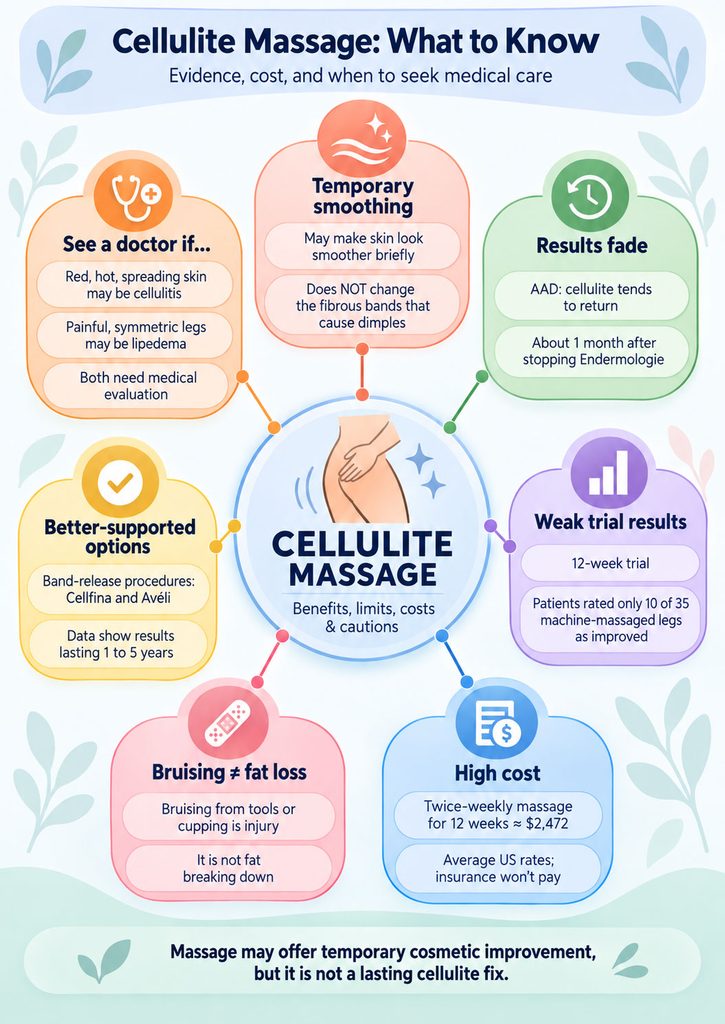
- Anti-cellulite massage can make skin look smoother briefly, but it doesn’t change the fibrous bands that cause dimples.
- The American Academy of Dermatology (AAD) says cellulite tends to return within about a month of stopping Endermologie.
- In a 12-week trial, patients rated only 10 of 35 machine-massaged legs as improved.
- Twice-weekly massage for 12 weeks costs about $2,472 at average US rates, and insurance won’t pay for it.
- Bruising from tools or cupping is injury, not fat breaking down.
- Band-release procedures like Cellfina and Avéli have data showing results lasting one to five years.
- Red, hot, spreading skin may be cellulitis. Painful, symmetric legs may be lipedema. Both need a doctor.
Does Anti-Cellulite Massage Work? The Honest Verdict
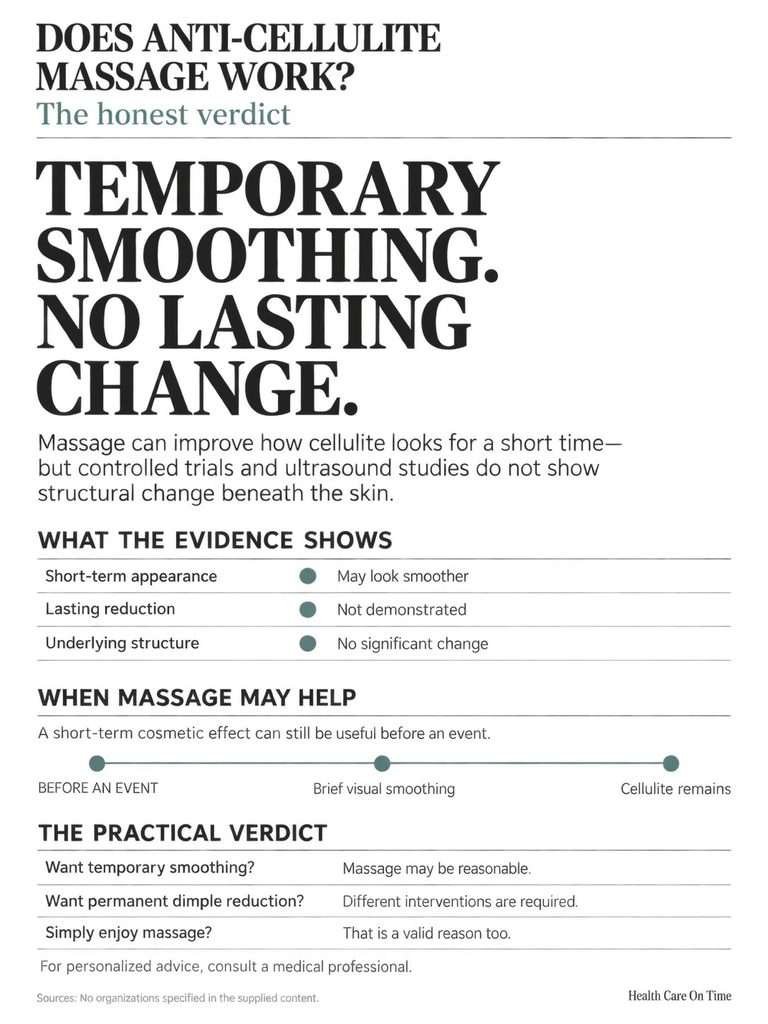
Patients booking tests through HealthCareOnTime often ask some version of this question before a wedding or a beach trip. The honest answer has two parts. Massage changes how cellulite looks for a short time, and it does nothing to the structure that causes it.
Here’s what anti-cellulite massage can do:
- Reduce puffiness by pushing trapped fluid out of the tissue for a short time.
- Increase blood flow to the skin, which can make it look firmer and more even for a few hours.
- Ease muscle tension and help you relax, a real benefit even if the dimples stay.
Here’s what it can’t do:
- Break up, melt, or burn fat cells.
- Cut or loosen the fibrous bands that tug the skin downward.
- Keep results going once you stop your sessions.
Our medical team reviewed the controlled trials on massage for cellulite for this guide. None tracked results long enough to show a lasting change. The one that looked beneath the skin with ultrasound found no change at all.
So if you enjoy massage and want slight, short-term smoothing before an event, it can help. If you want dimples gone for good, massage is the wrong tool.
What Cellulite Actually Is (and Why Massage Can’t Reach the Cause)
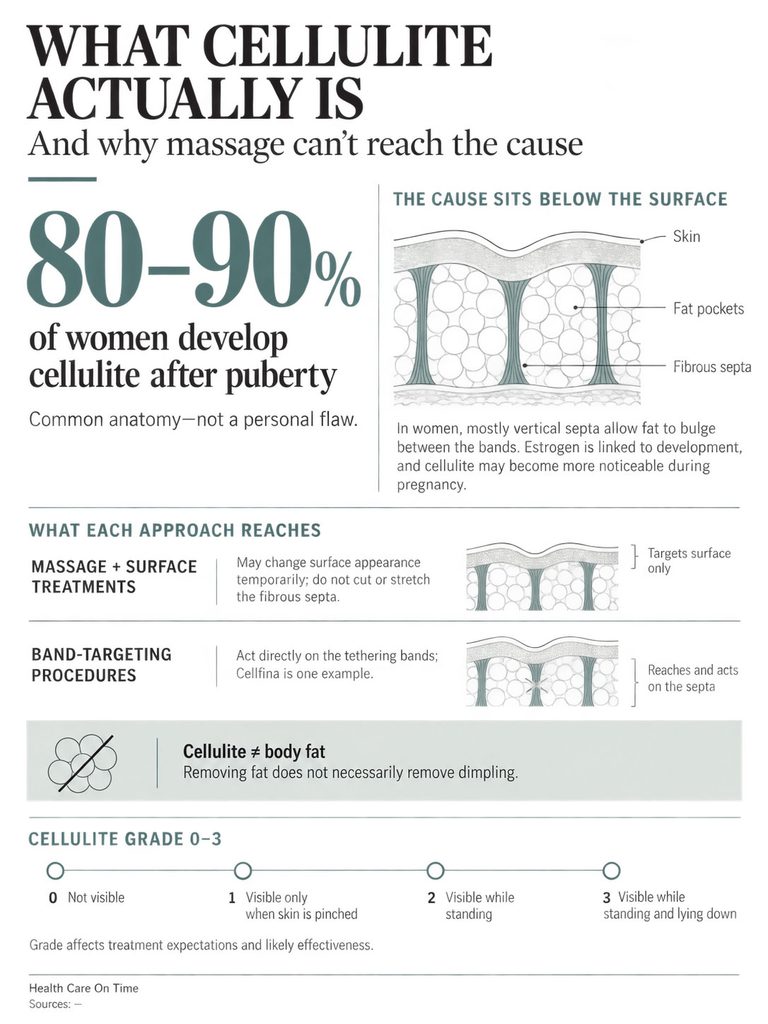
Cellulite isn’t a disease or a sign of poor health. It’s present in an estimated 80% to 90% of women after puberty, which makes it closer to normal anatomy than a flaw.
Fibrous Bands, Fat Pockets, and Fluid
Under your skin, fat sits in small pockets separated by bands of connective tissue called septa. These bands anchor the skin to deeper layers. When a band is short or stiff, it pulls the skin down while the fat around it pushes up, and you see a dimple.
Men’s connective tissue bands tend to crisscross and hold fat down well, while women’s bands run vertically and let fat bulge toward the surface. That’s a big reason cellulite is so much more common in women.
Hormones play a part too. Estrogen appears to be involved, which may help explain why cellulite usually starts after puberty and sometimes worsens in pregnancy.
Why Pressure on the Skin Can’t Cut a Band Underneath
Septa are tough, fibrous tissue. Rubbing, rolling, or suctioning the skin moves fluid and blood around them, but it doesn’t cut or stretch them in any lasting way.
That’s why the procedures with the longest-lasting results all work by cutting or releasing those bands directly. Cellfina, for example, uses a needle placed just under the skin to break up the tough bands behind the dimples.
Cellulite Is Not the Same as Fat
This trips up a lot of people. The AAD points out that cellulite differs from fat, and that treatments that remove fat well often have no effect on cellulite.
Losing extra weight makes cellulite less visible for some people, though loose skin after weight loss can make it more noticeable. Adding muscle can make skin look smoother and firmer.
Cellulite Grades: Why Your Starting Point Matters
Doctors often grade cellulite on a 0-to-3 scale first described in 1978, known as the Nürnberger-Müller scale. The grade depends on when the dimples show up.
- Grade 0: No dimpling standing or lying down; pinching makes folds, not a lumpy “mattress” look.
- Grade 1: Skin looks smooth at rest, but dimples appear when you pinch it.
- Grade 2: Dimples show when you stand but fade when you lie down.
- Grade 3: Dimples show whether you’re standing or lying down.
Your grade shapes what’s realistic. Mild, pinch-only cellulite is where a short burst of smoothing from massage is most likely to satisfy you. Visible dimples that show at rest usually come from specific tight bands, and no amount of rubbing changes those.
Band-release procedures work best on distinct dimples and less well on diffuse, rippled texture. So even the procedures that last have limits, and a good provider will tell you which type you have.
What the Research Shows About Massage for Cellulite
Research on massage for cellulite is older, smaller, and thinner than most people expect. Here’s what the key studies actually measured, in plain numbers.
Vacuum-Roller Massage (Endermologie)
Endermologie uses a machine that lifts skin with suction while rollers knead it. Each session lasts about 45 minutes, and providers say many sessions are needed to see results.
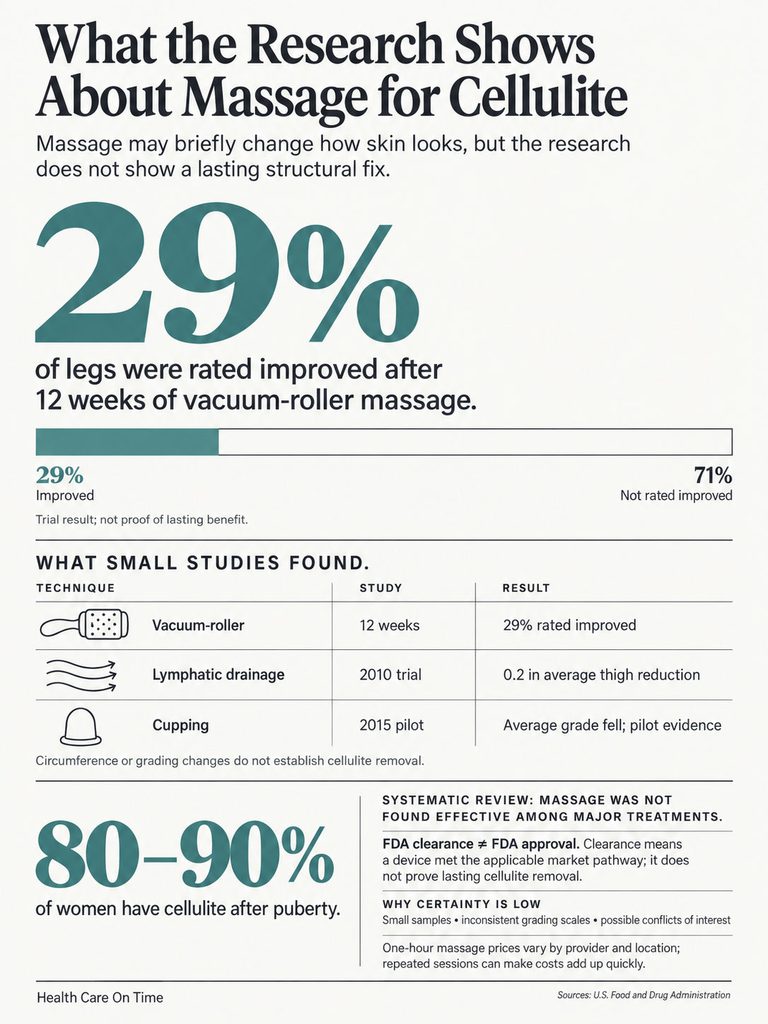
The best-known trial ran 12 weeks. Of 69 women enrolled, 52 finished, and each woman served as her own control while receiving twice-weekly Endermologie or a twice-daily aminophylline cream.
When patients rated their own results, only 10 of 35 Endermologie-treated legs looked better, and just 3 of 35 cream-treated legs did. That’s roughly 2 in 7.
FDA-Cleared Is Not FDA-Approved
Some popular guides still call Endermologie “FDA-approved.” That’s not accurate. The FDA cleared it as a medical device with little potential to cause harm, but the agency hasn’t said it works.
The clearance wording is telling. Endermologie and VelaSmooth were each cleared under a 510(k) for a “temporary reduction in the appearance of cellulite.”
Even a band-release device started out that way. Avéli’s first clearance covered only a temporary reduction, backed by three months of data. In 2022, the FDA extended its indication to long-term reduction based on one year of follow-up. Massage devices have never earned that upgrade.
Manual Lymphatic Drainage
Lymphatic drainage uses light, rhythmic strokes to move fluid toward the lymph nodes. It’s a real medical therapy for lymphedema, and it’s all over social media as a cellulite fix.
A 2010 randomized trial split 60 women into three groups. Mechanical massage, lymphatic drainage, and connective tissue massage each cut thigh circumference by about 0.2 inch (0.5 cm) on average. Thigh fat thickness fell by roughly 0.07 to 0.12 inch (1.66 to 3.03 mm).
The study compared three massage types against each other, with no untreated group. So it can’t show how much of that small change came from the massage itself.
A smaller study went further. Fifteen women finished 14 weekly lymphatic drainage sessions. Hip size fell about 0.1 inch (0.3 cm), thigh size didn’t change, ultrasound showed nothing different, and skin elasticity on the buttocks got worse.
Cupping
Dry cupping glides suction cups over the skin. In a 2015 pilot, 40 women received 10 sessions over five weeks on their thighs, and their average cellulite grade fell from 2.4 to 1.68.
The catch: it used a before-and-after design and assessed cellulite just three days after treatment. There was no control group. The NIH says cupping research is too limited to support scientific conclusions.
The Big Picture
The newest systematic review, published in Aesthetic Plastic Surgery, pooled randomized trials of every major cellulite treatment. It included 24 trials with 2,084 patients, and average follow-up was just 3.33 weeks.
Massage, grouped as mechanical stimulation, was not among the treatments the review found effective. Shock wave therapy, radiofrequency, and one injectable stood out.
An earlier evidence review found even less. It identified just one randomized trial comparing massage techniques for cellulite.
Our medical reviewers note one pattern across all of this work. The shorter the follow-up, the better massage looks.
Why the Evidence Is So Thin
Cellulite research has three recurring problems. Studies are small, often under 70 people. Many use a woman’s other leg as the comparison, which makes true blinding hard. And trials grade cellulite on different scales, so results rarely line up.
Many device studies are also funded by the companies that sell the device. That doesn’t make the results wrong, but it’s a good reason to look for independent confirmation before paying for a package.
| Statistic | Figure | Source |
| Women with cellulite after puberty | 80% to 90% | 2023 review, NIH PubMed Central |
| Women who felt they needed treatment | 78% | Dermatologic Surgery, 2023 |
| Women who heard embarrassing remarks about their cellulite | More than 40% | Dermatologic Surgery, 2023 |
| Scope of newest cellulite treatment review | 24 trials, 2,084 patients, 3.3-week mean follow-up | Aesthetic Plastic Surgery, 2025 |
| Legs patients rated improved after 12 weeks of twice-weekly Endermologie | 10 of 35 (29%) | Plastic and Reconstructive Surgery, 1999 |
| Average thigh change after 3 massage types | About 0.2 inch (0.5 cm) | J Eur Acad Dermatol Venereol, 2010 |
| Hip change after 14 weekly lymphatic drainage sessions | About 0.1 inch (0.3 cm); thighs unchanged | Anais Brasileiros de Dermatologia, 2014 |
| Time for cellulite to return after stopping Endermologie | About 1 month | American Academy of Dermatology |
| Average one-hour massage price | $103 at a therapist’s office; $85 at a franchise | AMTA |
| Liposuction for lipedema, first year tracked | 29,644 procedures | ASPS, 2024 |
How Long Do Anti-Cellulite Massage Results Last?
This is the question no spa brochure answers. Based on the studies above, here’s the realistic timeline:
- Right after a session, skin looks pinker and smoother as blood flow rises. This part fades within hours.
- During a regular plan, less puffiness can make dimples look shallower, but only while sessions continue.
- Three days after treatment was the latest point the 2015 cupping study checked.
- About three weeks was the average follow-up across 24 cellulite treatment trials.
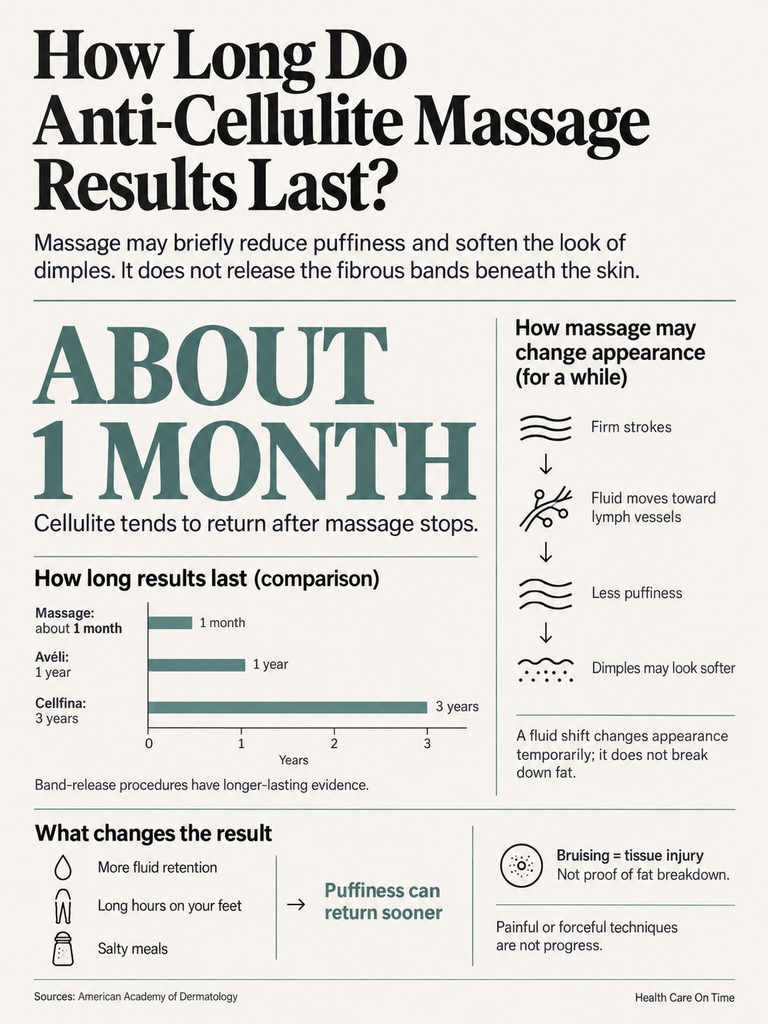
- About one month after stopping Endermologie is when, according to the AAD, cellulite tends to return.
For comparison, band-release procedures have been tracked much longer. Avéli has data showing benefits through one year, and Cellfina’s pivotal study found no drop in benefit at three years.
Fluid Shifts and Blood Flow
Why the short window? Firm strokes push fluid out of the tissue toward your lymph vessels. Less fluid means less puffiness, so dimples look shallower for a while.
Pressure also brings a rush of blood to the skin. That makes it look firmer and more even until circulation settles back down.
Your body refills that fluid on its own schedule. Long hours on your feet, salty meals, hormone shifts, and hot weather all bring the puffiness back. That’s why providers sell twice-weekly packages: the look only holds while you keep going.
Why Bruising Isn’t “Breaking Up Fat”
Some tools and techniques come with the idea that bruises prove fat is breaking down or toxins are leaving. They don’t. A bruise is blood leaking from damaged small vessels under the skin.
Our clinical reviewers see this claim often, and it’s the one worth pushing back on hardest. If a massage or tool leaves you bruised, that’s injury, not progress. Ease up or stop.
At-Home Anti-Cellulite Tools: Rollers, Guns, Brushes, and Cups
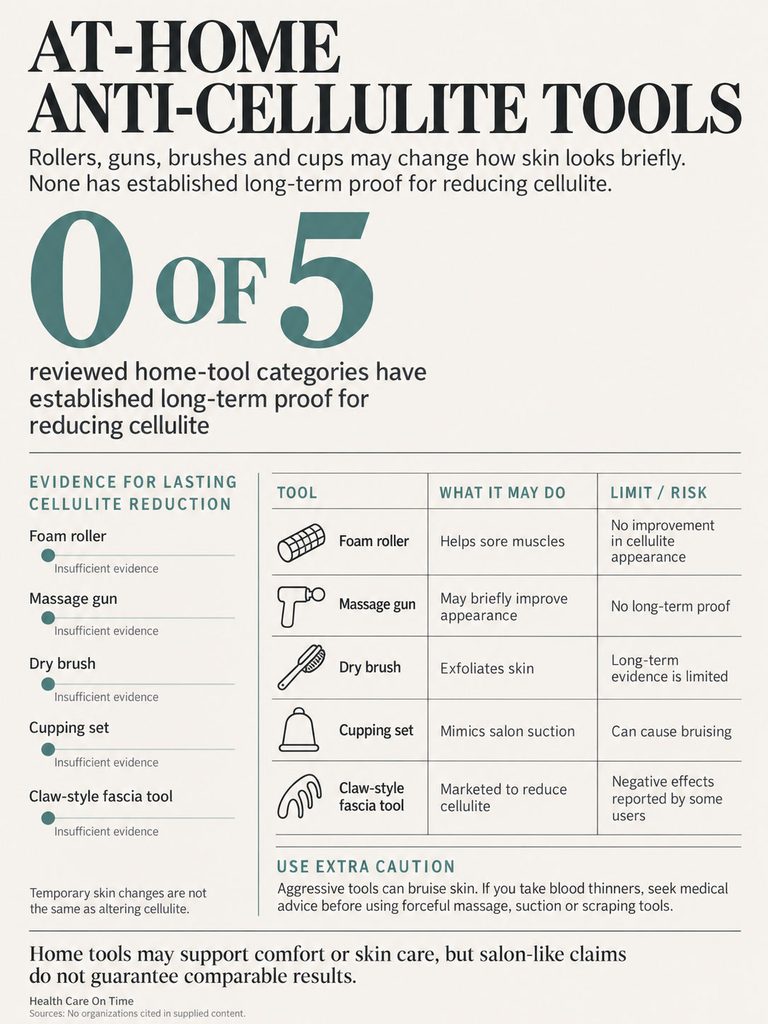
Home tools promise salon results for the price of one session. Here’s how each stacks up.
Foam Rollers
The American Council on Exercise says foam rollers won’t improve how cellulite looks. They’re still useful for tight, sore muscles, just not for dimples.
Massage Guns
Percussion guns boost blood flow where you aim them, which may briefly change how skin looks. There’s no substantial proof that handheld vibrating massagers do much for cellulite, especially long term.
Keep them off bony areas, varicose veins, and bruises.
Dry Brushing
Brushing dry skin before a shower exfoliates and can leave legs feeling softer. There’s no substantial evidence that it does much for cellulite over time.
Cupping Sets
Home cupping kits copy the technique from the 2015 pilot, with the same limits. Suction strong enough to leave round marks can also bruise.
Claw-Style Fascia Tools
Rigid tools with plastic claws are marketed to “blast” fat and cellulite. A 2019 study, partly funded by one tool’s maker, followed 33 women using it five days a week for 12 weeks. Some participants reported irritability, nausea, headaches, and bruising.
Patients on blood thinners who book routine INR checks with us are a group we’d steer away from aggressive tools entirely. Easy bruising plus deep pressure is a bad mix.
Anti-Cellulite Massage vs. Treatments That Last Longer
Massage is one option among many. This table compares it with the treatments you’re likely to hear about, using US prices where published data exist.
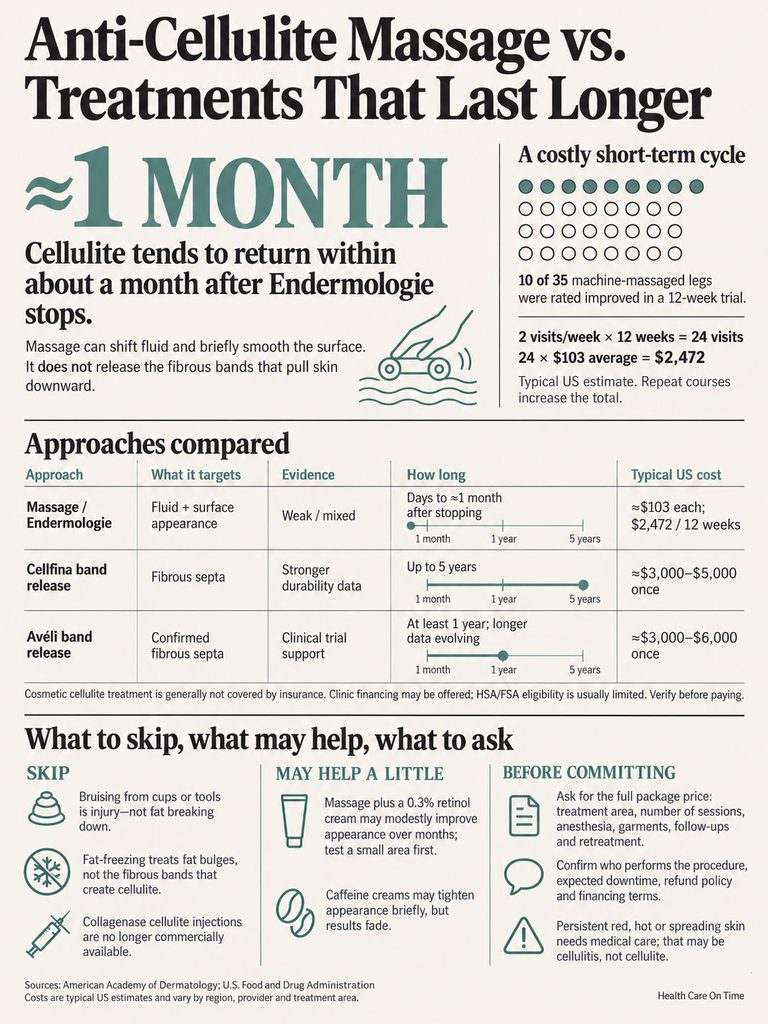
| Option | What It Targets | Evidence Strength | How Long Results Last | Typical US Cost |
| Manual anti-cellulite massage | Fluid and blood flow near the skin | Weak; one small trial of massage types, no untreated group | Temporary; not tracked past a few weeks | $85 to $103 per hour |
| Manual lymphatic drainage | Fluid in the tissue | Weak; 15-woman study, hips down 0.1 inch, thighs unchanged | Not measured after sessions end | $85 to $103 per hour |
| Vacuum-roller massage (Endermologie) | Fluid, skin surface | Mixed; 10 of 35 legs improved in a 12-week trial | Fades within about 1 month of stopping | About $2,472 for 24 sessions at average massage rates |
| At-home tools (roller, gun, brush, cups, claw tools) | Skin surface, blood flow | Very weak to none | No long-term data | Up to about $89 for a popular claw tool |
| Acoustic wave therapy | Collagen, stiff bands | Moderate; a standout in the 24-trial review | Several sessions needed; durability less defined | About $500 per session; series up to $3,000 |
| Liposuction | Fat volume | Not recommended for cellulite (AAD) | Can make dimpling more obvious | $4,300 to $7,500 surgeon fee |
| Subcision with Cellfina | Cuts fibrous bands | Moderate; multicenter pivotal study | No loss of benefit at 3 years | About $3,770 average |
| Avéli targeted band release | Finds and releases specific bands | Moderate; single-arm study, 1-year data | At least 1 year | $3,000 to $5,000 typical |
The Cost Math
A one-hour massage at a therapist’s office averaged $103 in 2025, and $85 at a franchise. Copy the 1999 trial’s schedule of twice weekly for 12 weeks, and that’s 24 sessions, or about $2,472.
After all that spending, the AAD says the effect fades within a month. Keeping it up twice a week would cost close to $900 a month.
Now compare one-time band release. Cellfina averages $3,770 based on 133 RealSelf reviews, with prices ranging from $2,500 to $8,000. Its pivotal study found no drop in benefit out to three years. Spread over three years, that’s about $105 a month.
US practices typically quote Avéli at $3,000 to $5,000 per treatment. Acoustic wave therapy averages about $500 a session, and a full series can reach $3,000. Whatever you choose, ask for the full package price in writing before you book, since per-session prices can hide the real total.
This isn’t a push toward procedures. Band release means local anesthesia, bruising, soreness, and paying the full price up front. Satisfaction also varies: RealSelf members give Cellfina an unusually low 20% “Worth It” rating. It’s simply the fair comparison.
Does Insurance, an HSA, or an FSA Cover It?
Almost never. Cellulite treatment is considered cosmetic, so health insurance doesn’t cover it.
Tax-advantaged accounts follow IRS rules. IRS Publication 502 excludes costs meant to improve general health or relieve discomfort unrelated to a specific medical condition. It counts cosmetic surgery only when it corrects a deformity from a congenital problem, an accident, or a disfiguring disease.
Massage therapy can be HSA- or FSA-eligible with a letter of medical necessity. That generally means a diagnosed medical condition, which cellulite isn’t.
What’s Off the Table
Some articles still recommend collagenase injections for cellulite. The maker of Qwo, the only one approved for cellulite, stopped producing and selling it in December 2022 over concerns about bruising and prolonged skin discoloration. In clinical trials, 84% of people treated had bruising at injection sites.
Fat-freezing isn’t a fix either. The AAD says cryolipolysis removes small fat pockets but can’t get rid of cellulite, and liposuction isn’t recommended because it can make dimpling more obvious.
Creams That Pair With Massage
If you massage at home, your cream can add a little. The AAD says caffeine products may make cellulite less obvious with daily use, and a 0.3% retinol product may help after six months or more.
Test any cream on a small area for 48 hours first, and avoid aminophylline products if you use an asthma inhaler.
How to Try Anti-Cellulite Massage Safely
If you still want to try it, and plenty of people do, here’s how to get the most from it without getting hurt.
What a Professional Session Looks Like
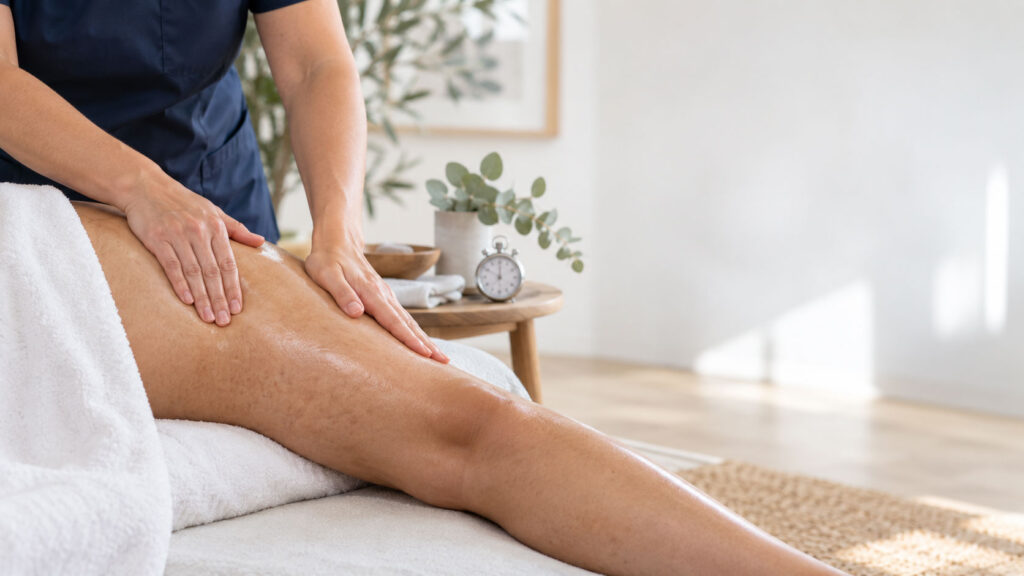
A typical manual anti-cellulite massage starts with oil and long, gliding strokes toward the lymph nodes. The therapist then moves to kneading, grasping and working larger folds of skin much like bread dough. Many finish with “pinch-and-roll,” lifting a fold of skin and rolling it between the fingers.
Machine sessions swap hands for suction and rollers and usually run about 45 minutes. Either way, pressure should feel firm but never painful.
Questions to Ask Before You Book
- Is the device FDA-cleared, and what is its cleared use? If the answer includes “temporary,” take it at its word.
- How many sessions do you recommend, and what does the full package cost?
- What happens to my results when I stop?
- Can you show before-and-after photos taken in the same lighting and pose?
- Is the therapist state-licensed, and is a physician involved for device treatments?
- What should I do if I bruise?
A provider who promises permanent results or fat loss from massage is claiming something the research doesn’t support.
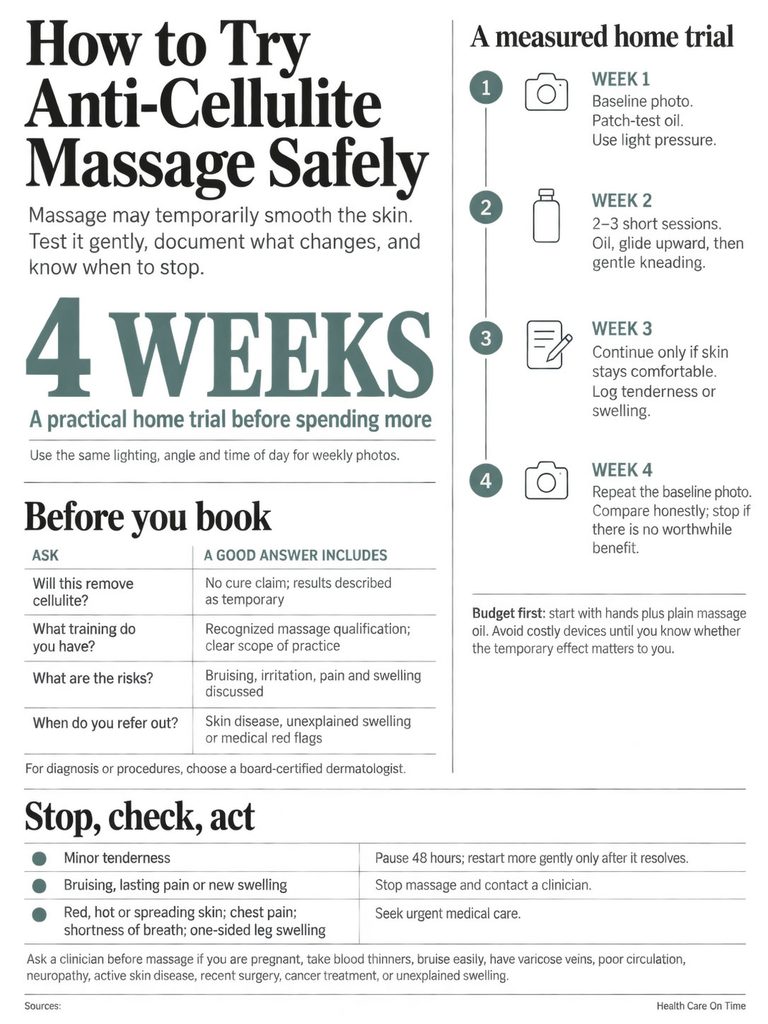
A Simple 4-Week Home Routine
- Take photos first, in the same light, pose, and time of day.
- Warm your skin in the shower, then apply oil or lotion so your hands glide.
- Use firm but comfortable strokes upward, toward your heart, for 10 to 15 minutes per area.
- Gently knead and lift the skin. Stop if anything hurts.
- Repeat 3 to 5 times a week.
- Retake your photos at week 4 under the same conditions.
If matched photos show no difference after four weeks, you have your answer. That’s more reliable than how your legs look right after a session.
Who to See in the US
For hands-on massage, choose a state-licensed massage therapist, and check your state board’s license lookup. For devices and procedures, the AAD advises consulting a dermatologist who treats cellulite, since results depend on the skill and experience of whoever performs the treatment. The AAD’s online Find a Dermatologist tool lets you search by location and procedure, and a board-certified plastic surgeon is the other qualified choice for band release.
Who Should Skip It or Ask a Doctor First
Cleveland Clinic lists cellulitis, deep vein thrombosis, heart disease, and kidney failure among conditions where lymphatic massage may not be safe. It also says providers avoid cancerous tissue and radiation-damaged skin. Check with your doctor first if you have:
- A history of blood clots
- Varicose veins or fragile skin in the area
- A blood thinner prescription or a bleeding disorder
- An active rash, skin infection, or open wound
- A pregnancy, since clot risk rises during pregnancy
Signs to Stop Right Away
Stop and get care if one leg suddenly becomes swollen, warm, and painful. Call 911 for chest pain or trouble breathing, which can signal a clot that has traveled to the lungs.
| Scenario | Recommended Action | What to Expect |
| Event within 7 days | Home or professional massage 1 to 2 days before, plus a caffeine cream | Mild smoothing that lasts days, not weeks |
| You want results for a year or more | See a board-certified dermatologist or plastic surgeon about band release or acoustic wave | $3,000 to $5,000 one-time, or about $500 per wave session |
| You take a blood thinner or bruise easily | Ask your prescriber first; light strokes only; skip cupping and claw tools | Deep pressure raises bruising risk |
| Bruising after a tool or cupping | Stop until fully healed; lighten pressure for good | Bruising is injury, not fat breakdown |
| Red, warm, painful, spreading skin, with or without fever | No massage; same-day medical care | Possible cellulitis needing antibiotics |
| One leg suddenly swollen and painful | No massage; urgent evaluation | Doctors may check for a blood clot |
| Painful, symmetric legs that stop sharply at the ankles | See your doctor and ask about lipedema | Different diagnosis and care plan |
| Cellulite distress affecting eating or social life | Talk with your doctor or a mental health professional | Support first, treatment later if wanted |
| Budget under $100 | Home massage with oil, plus strength training | Temporary smoothing; firmer muscle over months |
When It Isn’t Cellulite: Cellulitis and Lipedema
Two conditions get confused with cellulite, and neither should be handled with massage alone. Some leg swelling needs a medical workup too.
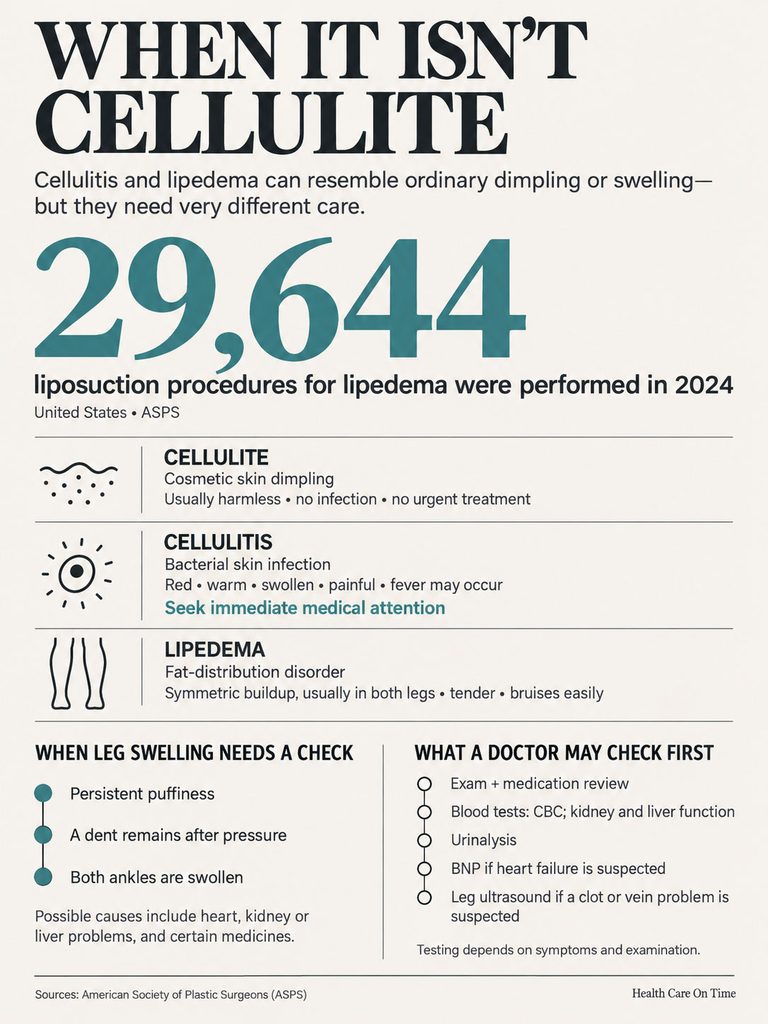
Cellulite vs. Cellulitis
The names sound alike, but they’re unrelated. Cellulitis is a bacterial skin infection. The skin turns red, warm, swollen, and painful, and the redness often spreads. Fever can follow.
Never massage an area that might be infected. It needs same-day medical care.
Lipedema
Lipedema is a fat disorder often mistaken for stubborn cellulite. It typically causes symmetric fat buildup in the legs, sometimes the arms, hips, or buttocks, while sparing the feet and hands. It’s often tender and bruises easily.
In cases seen across our diagnostic network, leg changes written off as cellulite sometimes turn out to need a real medical workup. ASPS counted 29,644 liposuction procedures performed for lipedema alone in 2024.
If your legs ache, feel heavy, or end in a sharp “cuff” at the ankles, ask your doctor about lipedema before spending on cellulite treatments.
Leg Swelling That Needs a Workup
Puffiness that leaves a dent when you press it, swelling that keeps building through the day, or swelling in both ankles isn’t a cellulite problem. Heart, kidney, liver, and vein conditions can all cause it, and so can some blood pressure medicines.
Patients commonly ask us which tests a doctor might order first. Depending on your symptoms, that can include a basic metabolic panel for kidney function, a liver panel with albumin, a thyroid (TSH) test, and a urine test for protein. Sudden swelling in one leg is different: it calls for same-day evaluation, often with an ultrasound, to rule out a blood clot.
Cellulite, Body Image, and Deciding Whether to Treat It
Cellulite is cosmetic, not medical, but it still affects how people feel. A 2023 study in Dermatologic Surgery noted earlier research in which over 40% of women had heard embarrassing remarks about their cellulite, and 78% felt they needed treatment.
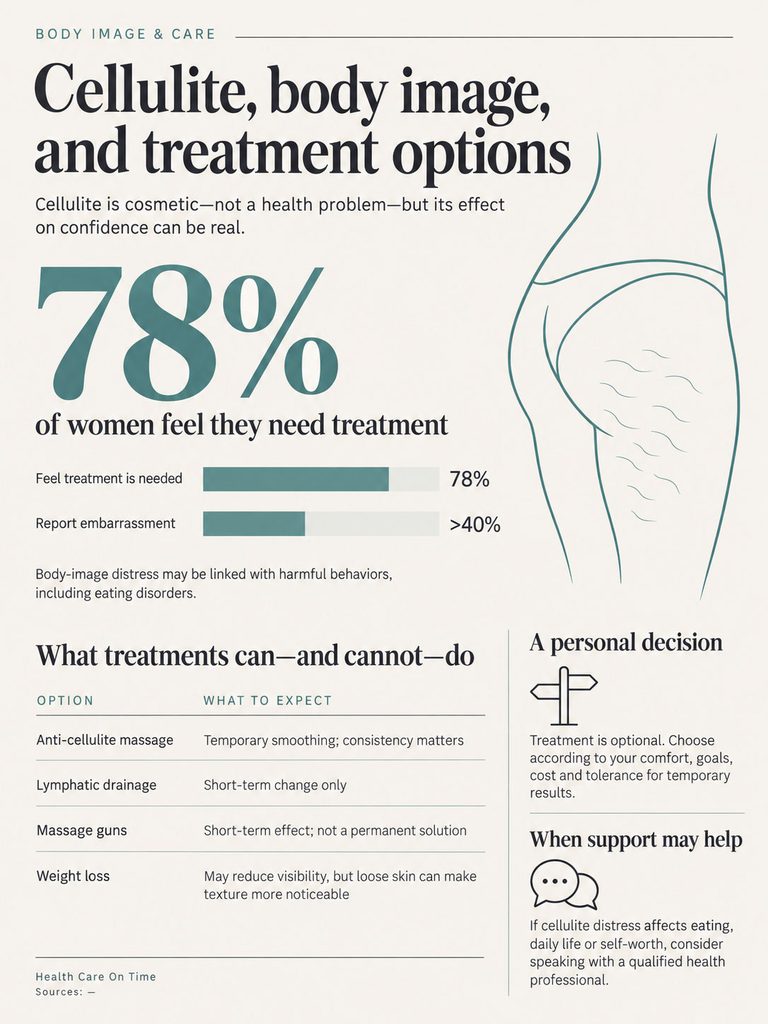
The same study linked cellulite dissatisfaction to intentional vomiting, compulsive eating, and using weight-loss drugs without medical advice. If cellulite is changing how you eat or keeping you off the beach, talking with your doctor or a mental health professional may help more than another treatment.
Treating cellulite is a personal choice. So is leaving it alone.
Frequently Asked Questions
How long does it take for anti-cellulite massage to show results?
You may see slightly smoother skin right after a session, mostly from less puffiness and more blood flow. Studies that found changes used 5 to 12 weeks of regular sessions. The AAD says cellulite tends to return within about a month after sessions stop.
How often should you do anti-cellulite massage?
Trials used two sessions a week, and home routines often run 3 to 5 times a week for 10 to 15 minutes per area. Consistency matters more than pressure. Because results fade when you stop, think of massage as ongoing upkeep, not a one-time fix.
Can massage break down fat cells?
No. There’s no evidence that massage breaks down, melts, or removes fat cells. Massage moves fluid and blood, which changes how skin looks for a short time. Even procedures that do remove fat, like liposuction and fat-freezing, don’t fix cellulite.
Does lymphatic drainage massage get rid of cellulite?
Not permanently. In a study of 15 women who had 14 weekly sessions, hip size fell about 0.1 inch, thigh size didn’t change, and ultrasound showed no difference under the skin. Lymphatic drainage may ease puffiness briefly, but the dimples come back.
Do massage guns help with cellulite?
Massage guns raise blood flow where you use them, which may make skin look a little smoother for a few hours. No controlled studies show they reduce cellulite. They’re useful for sore muscles. Keep them away from varicose veins, bruises, and bony spots.
Does dry brushing reduce cellulite?
Dry brushing removes dead skin and can make your legs feel softer. There’s no solid evidence it changes cellulite, especially long term. If you enjoy it, use a soft brush with light pressure, and skip irritated, sunburned, or broken skin.
Does cupping work for cellulite?
A 2015 pilot found lower cellulite grades after 10 cupping sessions. It had no control group and checked results only three days later. The NIH says cupping research overall is too limited for firm conclusions. Cupping can also leave bruise-like marks that last days.
Is Endermologie FDA-approved?
No, it’s FDA-cleared, which is different. Clearance means the device is low risk and similar to one already sold. Its cleared use is a temporary reduction in the appearance of cellulite, and the AAD notes the FDA hasn’t said it works.
Is it normal to bruise after a cellulite massage?
Mild tenderness can happen, but bruising means the pressure damaged small blood vessels. It isn’t a sign that fat is breaking down or that toxins are leaving. Lighten up, and talk to a doctor if you bruise easily or take a blood thinner.
Can men get cellulite?
Yes, but it’s much less common. Men’s connective tissue bands usually form a crisscross pattern that holds fat flatter, while women’s tend to run vertically. When men do have cellulite, the same limits apply: massage smooths it briefly but doesn’t change the bands.
Does losing weight get rid of cellulite?
Sometimes it helps, and sometimes it doesn’t. The AAD says losing extra weight makes cellulite less visible for some people, but loose skin after weight loss can make it more noticeable. Building muscle through strength training can help skin look firmer.
What is the longest-lasting cellulite treatment in the US?
Band-release procedures last longest. Cellfina showed no loss of benefit at three years in its pivotal study, and its maker reports an FDA indication now covering five years. Avéli is cleared for long-term reduction based on one-year data. Both cost thousands of dollars.
Disclaimer: This article is for general education and isn’t medical advice. Talk with a licensed healthcare provider before starting any new treatment, especially if you have a clotting disorder, take blood thinners, are pregnant, or have heart, kidney, or skin conditions. Get emergency care for sudden leg swelling with pain, chest pain, or trouble breathing.
References
- American Academy of Dermatology: Cellulite treatments, what really works?
- Lim SK, et al. Comparative Analysis of Cellulite Treatment Modalities: A Systematic Review. Aesthetic Plastic Surgery, 2025
- Collis N, et al. Cellulite Treatment: A Myth or Reality. Plastic and Reconstructive Surgery, 1999
- Bayrakci Tunay V, et al. Mechanical massage, manual lymphatic drainage, and connective tissue manipulation in women with cellulite. J Eur Acad Dermatol Venereol, 2010
- Longitudinal evaluation of manual lymphatic drainage for gynoid lipodystrophy, 2014
- Luebberding S, et al. Cellulite: An Evidence-Based Review. American Journal of Clinical Dermatology, 2015
- Arslan M, et al. Dry cupping therapy decreases cellulite in women: A pilot study, 2015
- NIH National Center for Complementary and Integrative Health: Cupping
- FDA 510(k) Summary K212399: Avéli
- FDA 510(k) Summary K100230: SmoothShapes XV
- Revelle Aesthetics: Avéli extended FDA clearance, 2022
- Treatment for cellulite, review including Cellfina 3-year data
- Endo: Cease production and sale of Qwo, December 2022
- Bass LS, et al. Cellulite Pathophysiology and Psychosocial Implications. Dermatologic Surgery, 2023
- Cellulite review, 2023, NIH PubMed Central
- Cleveland Clinic: Lymphatic Drainage Massage
- American Council on Exercise: Foam Rolling for Cellulite
- Fascia manipulation study, Cogent Medicine, 2019
- American Massage Therapy Association: Massage Profession Research Report
- IRS Publication 502: Medical and Dental Expenses
- RealSelf: Cellfina Cost
- RealSelf: Acoustic Wave Therapy Cost
- Lipedema Foundation: Lipedema vs. Cellulite
- American Society of Plastic Surgeons: 2024 Procedural Statistics Report