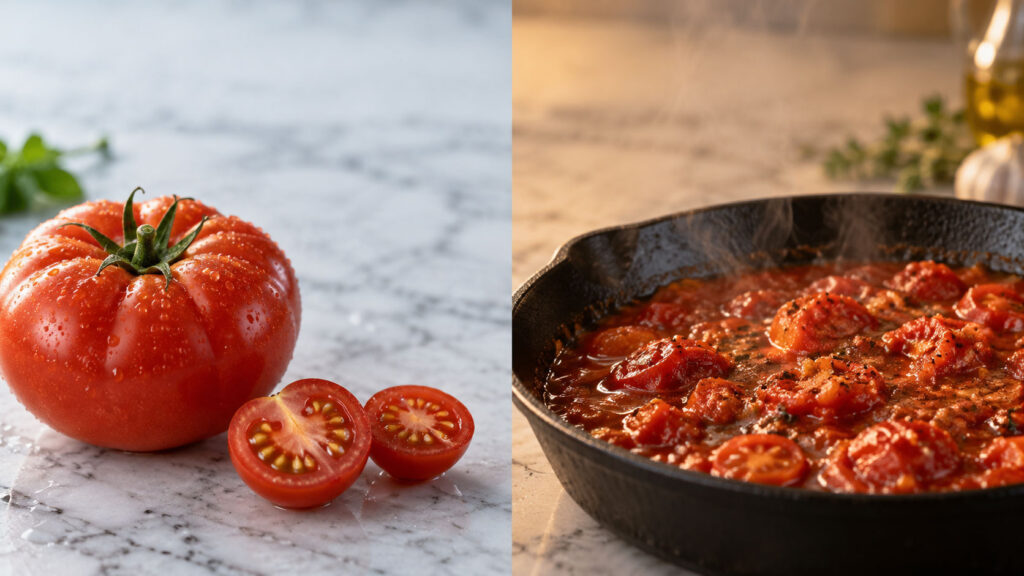
Almost every health article on this question uses the same two numbers: 7,300 micrograms of lycopene in a cup of cooked tomatoes against 4,600 in a cup of raw. Both figures come straight from USDA and both are accurate. The conclusion built on top of them is not.
Table of Contents
Quick Answer
Cooked tomatoes carry modestly more lycopene by weight, about 3,041 micrograms per 100 grams against 2,573 for raw, roughly 18 percent more according to USDA. Cooking does not create lycopene, and high heat destroys it. What cooking reliably does is loosen lycopene from the cell walls so your body can absorb it, and that only pays off when there is fat in the same meal.
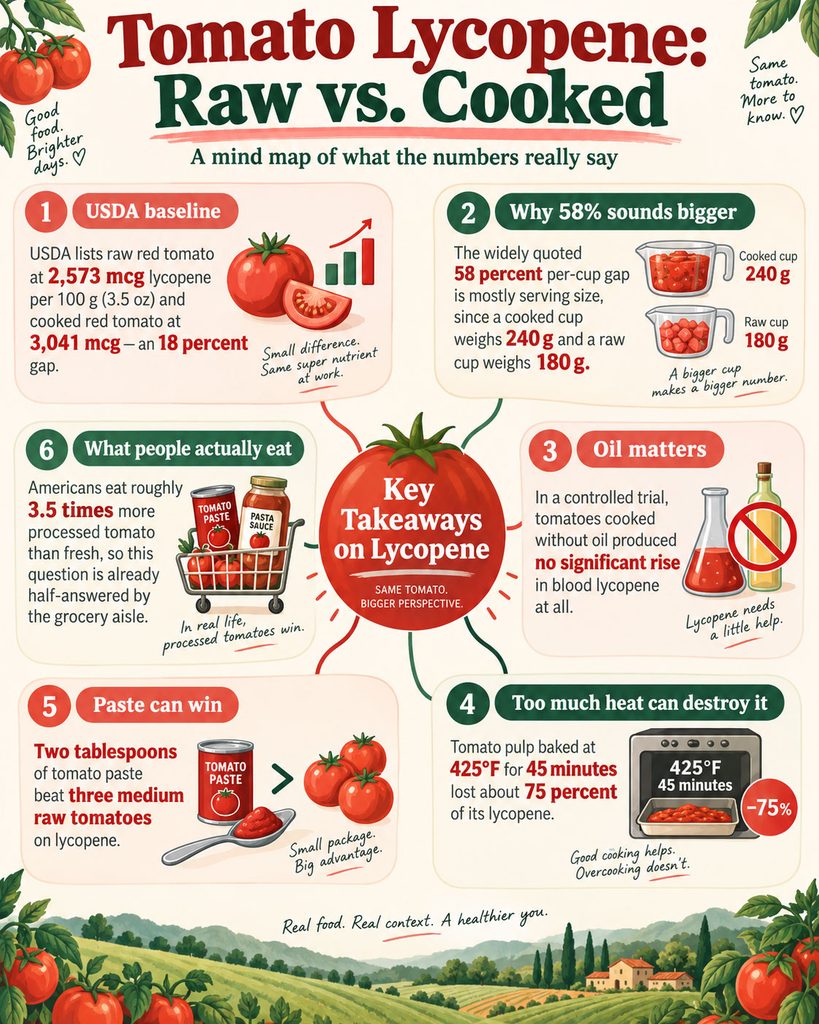
The five rules that actually decide your lycopene intake:
- Cook with oil in the pan, because without fat the lycopene largely passes through you
- Keep the heat moderate, around 350 degrees F, since 425 degrees F for 45 minutes destroys about 75 percent of it
- Chop, crush or blend, because breaking cells does part of what heat does
- Leave the skin on, since lycopene concentrates in the peel
- Use tomato paste or no-salt canned tomatoes when you want density, not fresh slices
At a Glance
• USDA lists raw red tomato at 2,573 mcg lycopene per 100 g (3.5 oz) and cooked red tomato at 3,041 mcg, an 18 percent gap
• The widely quoted 58 percent per-cup gap is mostly serving size, since a cooked cup weighs 240 g and a raw cup weighs 180 g
• In a controlled trial, tomatoes cooked without oil produced no significant rise in blood lycopene at all
• Tomato pulp baked at 425 degrees F for 45 minutes lost about 75 percent of its lycopene
• Two tablespoons of tomato paste beat three medium raw tomatoes on lycopene
• Americans eat roughly three and a half times more processed tomato than fresh, so this question is already half-answered by the grocery aisle
The Short Answer, With the Actual Numbers
Lycopene is the carotenoid pigment that turns a ripe tomato red. It is fat soluble, it is not converted to vitamin A in the body, and tomatoes plus tomato products supply more than 80 percent of the lycopene in the American diet, according to University of Illinois food scientist John Erdman.
So the raw versus cooked question is not academic. For most people in the United States, it decides where nearly all their lycopene comes from.
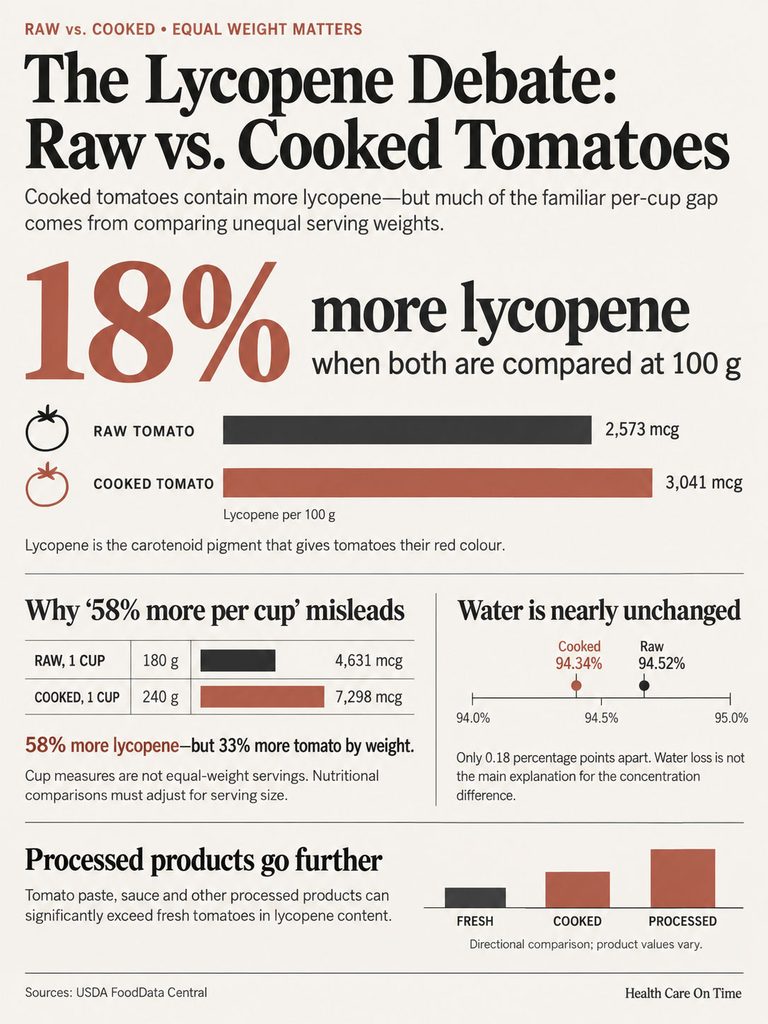
Lycopene per 100 grams, raw against cooked
Start with the same weight of food, because that is the only fair starting point. USDA FoodData Central lists raw red ripe tomato, year-round average, at 2,573 mcg of lycopene per 100 grams, which is about 3.5 ounces.
The separate USDA entry for cooked red ripe tomato works out to 3,041 mcg per 100 grams. That is a difference of 468 mcg, or 18 percent.
Eighteen percent is a real edge. It is also nowhere near the two-to-five-times figure that circulates on wellness blogs and podcast clips.
Lycopene per cup, and the serving-size trap
Now look at where the famous numbers come from. USDA gives a cup of chopped raw tomato as 180 grams, about 6.3 ounces, and a cup of cooked tomato as 240 grams, about 8.5 ounces.
Multiply through and you get 4,631 mcg for the raw cup and 7,298 mcg for the cooked cup. Round those and you have the 4,600 and 7,300 figures repeated across page one of Google.
The cooked cup wins by 58 percent. It also weighs 33 percent more.
Our medical reviewers see this pattern constantly in nutrition comparisons, where two servings both called one cup are not the same amount of food.
Where the 58 percent gap really comes from
Break the multiplier apart. A 33 percent larger serving times an 18 percent higher concentration gives 1.58, which is exactly the gap you see. The arithmetic closes perfectly.
Roughly two thirds of the headline advantage is portion size. Only the remaining 18 percent has anything to do with what heat did to the tomato.
There is a second problem with the standard explanation. The reason usually given for the concentration difference is water loss during cooking.
Check the water content. Raw tomato is 94.52 percent water. USDA cooked tomato is 94.34 percent water.
The two are essentially identical, so evaporation cannot be doing the work it is credited with.
| Tomato Form | Typical Serving | Lycopene per 100 g | Lycopene per Serving | Vitamin C per 100 g | Calories per 100 g |
| Raw, red, ripe | 1 medium, 123 g (4.3 oz) | 2,573 mcg | 3,165 mcg | 13.7 mg | 18 |
| Cooked, red, ripe | 1 cup, 240 g (8.5 oz) | 3,041 mcg | 7,298 mcg | 22.8 mg | 18 |
| Canned, packed in juice | 1 cup, 240 g (8.5 oz) | 2,537 mcg | 6,089 mcg | 12.6 mg | 17 |
| Crushed, canned | 1/2 cup, 121 g (4.3 oz) | 5,106 mcg | 6,178 mcg | 9.2 mg | 32 |
| Tomato sauce, no salt added | 1/2 cup, 122 g (4.3 oz) | 13,895 mcg | 16,952 mcg | 7.0 mg | 24 |
| Tomato puree | 1/2 cup, 125 g (4.4 oz) | 21,754 mcg | 27,193 mcg | 10.6 mg | 38 |
| Tomato paste, no salt added | 2 tbsp, 33 g (1.2 oz) | 28,764 mcg | 9,492 mcg | 21.9 mg | 82 |
| Ketchup | 1 tbsp, 17 g (0.6 oz) | 12,062 mcg | 2,051 mcg | 4.1 mg | 101 |
Source: USDA FoodData Central, SR Legacy, with composition values compiled in Advances in Nutrition. Serving weights are USDA reference weights.
The table shows the real hierarchy. Fresh cooked tomato beats fresh raw tomato by a modest margin, and both are dwarfed by anything that has had water removed industrially.
Readers who want the full portion-weight breakdown for every size of tomato will find it in the HealthCareOnTime guide to tomato calories and USDA nutrition.
What Heat Actually Does to a Tomato
Three separate things happen when a tomato meets a hot pan, and most articles blend them into one claim. Separating them is what makes the answer usable in a real kitchen.
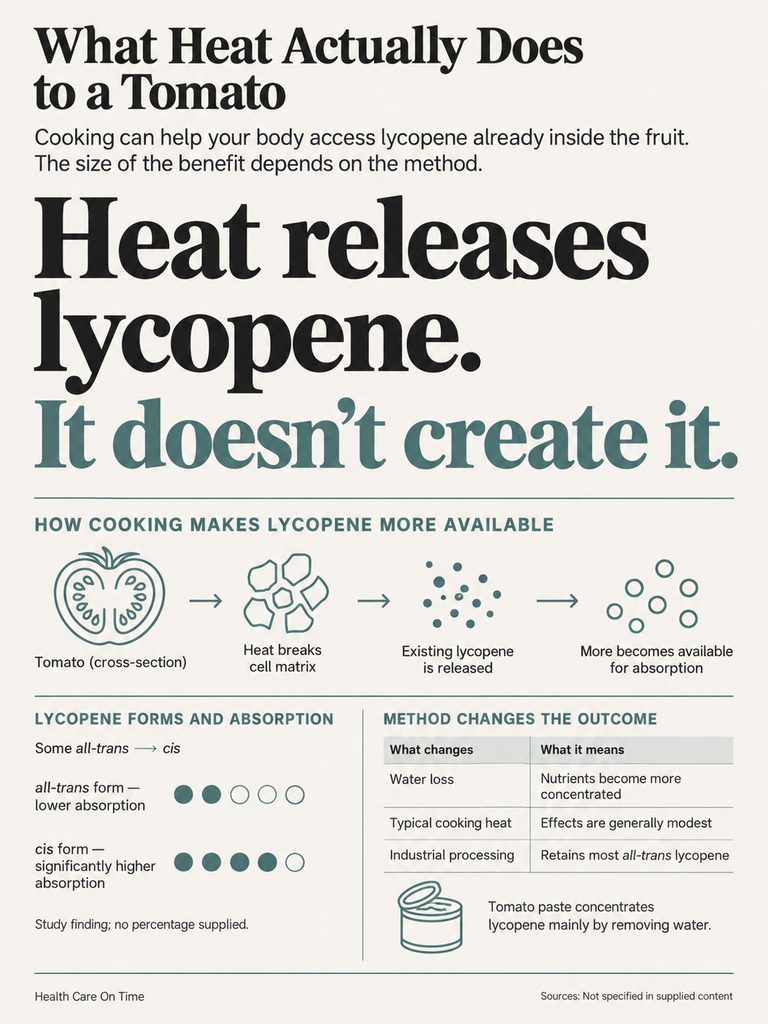
Cooking does not make lycopene
This sounds obvious, but the language on most pages implies otherwise. Phrases like cooking increases lycopene suggest heat is generating something new.
It is not. Every molecule of lycopene in a cooked tomato was already in the raw tomato. Everything from here is about release, concentration, shape, or loss.
Effect one, breaking the cell matrix
Inside a raw tomato, most lycopene sits in crystalline form inside chromoplasts, wrapped in plant cell walls your digestive enzymes handle poorly. Heat softens pectin, ruptures cells, and frees the pigment.
This is the most important of the three effects. It changes how much reaches your bloodstream rather than how much sits on the plate.
A 2026 review in Molecules frames it the same way, noting that thermal processing promotes release from the plant matrix while excessive processing degrades the carotenoid. Both halves of that sentence matter.
Chopping and blending do some of this work without heat. That is why tomato juice and finely diced raw tomato behave better than a thick slice.
Effect two, water loss and concentration
When water evaporates, everything left behind gets denser per gram. This is the entire reason tomato paste looks so impressive on a nutrition panel.
Paste is not a superfood version of tomato. It is tomato with most of the water removed, so the same lycopene now occupies far less weight.
The catch is that this barely applies to a tomato you saute for six minutes in a covered pan. As the USDA water figures show, a cooked tomato is still about 94 percent water.
Effect three, isomerization from all-trans to cis
Lycopene exists in different geometric shapes. Raw red tomatoes carry roughly 90 to 95 percent of theirs as the straight all-trans form, and heat can bend some of that into curved cis forms that dissolve more readily into the mixed micelles your gut uses to absorb fat.
This is the mechanism every competitor page cites. It is real, and it is smaller than advertised at home cooking temperatures.
Cornell food scientist Rui Hai Liu heated tomatoes to 190 degrees F, or 88 degrees C, for 2, 15 and 30 minutes. Trans-lycopene measured in the samples rose 54, 171 and 164 percent, while cis-lycopene rose only 6, 17 and 35 percent, published in the Journal of Agricultural and Food Chemistry in 2002.
Commercial products tell the same story. An analysis published in Foods found industrial tomato paste still running 79 to 91 percent all-trans lycopene after full factory processing.
If a commercial retort cannot flip the ratio, a skillet will not either. The isomer shift from home cooking is measurable and modest.
The cleanest proof that cis form matters came from a different angle. Ohio State researchers compared red tomato juice against juice from tangerine tomatoes, a naturally cis-rich variety, in a randomized crossover trial in Molecular Nutrition and Food Research. Absorption from the cis-rich juice was about 8.5 times higher, with fractional absorption of 47.7 percent against 4.98 percent from ordinary red tomato juice.
Note that second number. From standard red tomato juice, participants absorbed roughly 5 percent of the lycopene they drank.
Cooking Can Destroy Lycopene Too
Here is the part missing from every page currently ranking on this question. Lycopene is a long chain of conjugated double bonds, which is exactly what makes it a strong antioxidant and a fragile molecule.
Heat it hard enough for long enough and it breaks apart. This is not a fringe claim, it is basic food chemistry with published numbers behind it.
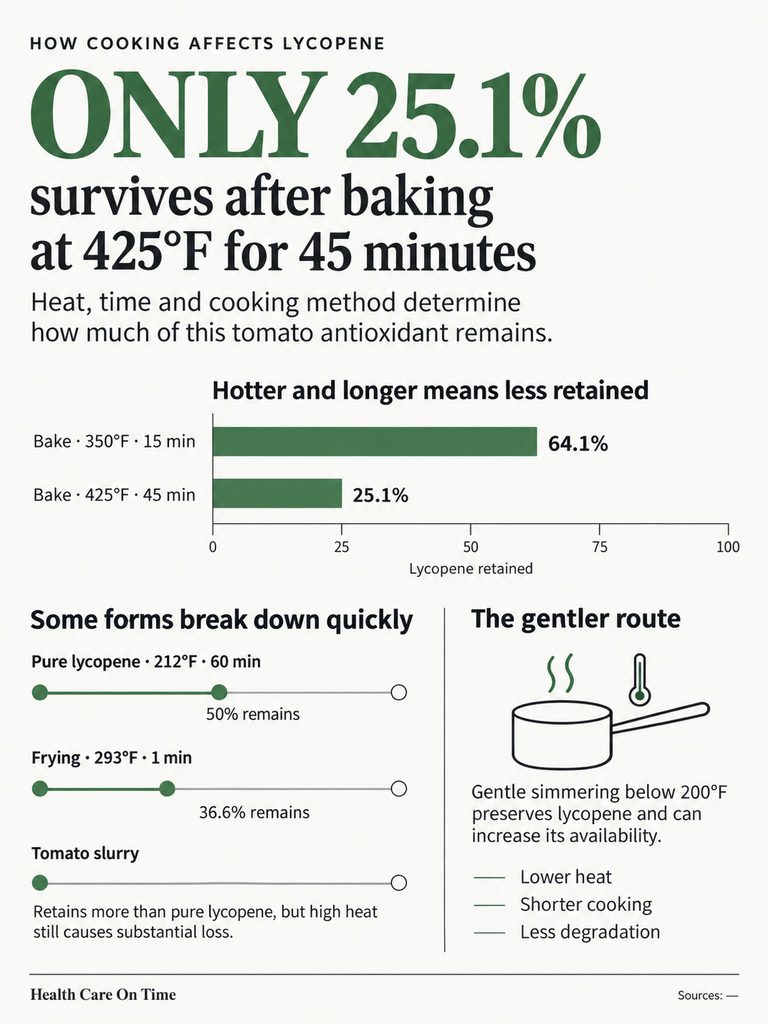
Researchers at Louisiana State University tested pure lycopene and tomato slurry across realistic kitchen conditions. Their results appeared in the Journal of Food Science in 2006.
Pure lycopene lost half its content after 60 minutes at 212 degrees F, after 20 minutes at 257 degrees F, and in under 10 minutes at 302 degrees F. Those are ordinary oven and skillet temperatures.
In actual tomato slurry, partly protected by the food matrix, losses were slower but still large. Baking at 350 degrees F for 15 minutes retained 64.1 percent. Push it to 425 degrees F for 45 minutes and only 25.1 percent survived.
Frying was worse per minute of exposure. One minute at 293 degrees F retained 36.6 percent, and one minute at 329 degrees F retained 35.5 percent.
Why a gentle simmer beats a hot sheet pan
Put the Cornell and Louisiana State results side by side and a working rule appears. Below roughly 200 degrees F, lycopene survives and becomes more available. Above roughly 300 degrees F, degradation starts outrunning the benefit.
A marinara held at a bare simmer for half an hour sits in the good zone. Cherry tomatoes blistered under a 450 degree F broiler until they blacken do not.
Patients who book nutrition panels through HealthCareOnTime often assume any cooking counts as an upgrade. Temperature and duration decide whether it is.
| Cooking Method | Temperature | Time | Lycopene Retained | Source |
| Gentle heating (whole tomato) | 190 F / 88 C | 2 min | Increased vs raw | Dewanto and Liu, J Agric Food Chem, 2002 |
| Gentle heating (whole tomato) | 190 F / 88 C | 30 min | Increased vs raw | Dewanto and Liu, J Agric Food Chem, 2002 |
| Microwave, high power | Not reported | 1 min | 64.4% | Mayeaux et al., J Food Sci, 2006 |
| Baking (tomato slurry) | 350 F / 177 C | 15 min | 64.1% | Mayeaux et al., J Food Sci, 2006 |
| Baking (tomato slurry) | 350 F / 177 C | 45 min | 37.3% | Mayeaux et al., J Food Sci, 2006 |
| Baking (tomato slurry) | 425 F / 218 C | 15 min | 51.5% | Mayeaux et al., J Food Sci, 2006 |
| Baking (tomato slurry) | 425 F / 218 C | 45 min | 25.1% | Mayeaux et al., J Food Sci, 2006 |
| Frying (tomato slurry) | 293 F / 145 C | 1 min | 36.6% | Mayeaux et al., J Food Sci, 2006 |
| Frying (tomato slurry) | 329 F / 165 C | 1 min | 35.5% | Mayeaux et al., J Food Sci, 2006 |
The 2002 Cornell work reported percentage increases rather than retention, because gentle heating raised extractable lycopene rather than reducing it.
Fat Is the Switch, Not Heat
If you take one thing from this comparison, take this. The difference between cooked tomatoes helping your lycopene status and doing almost nothing is whether there was oil in the pan.
The trial that separated cooking from fat
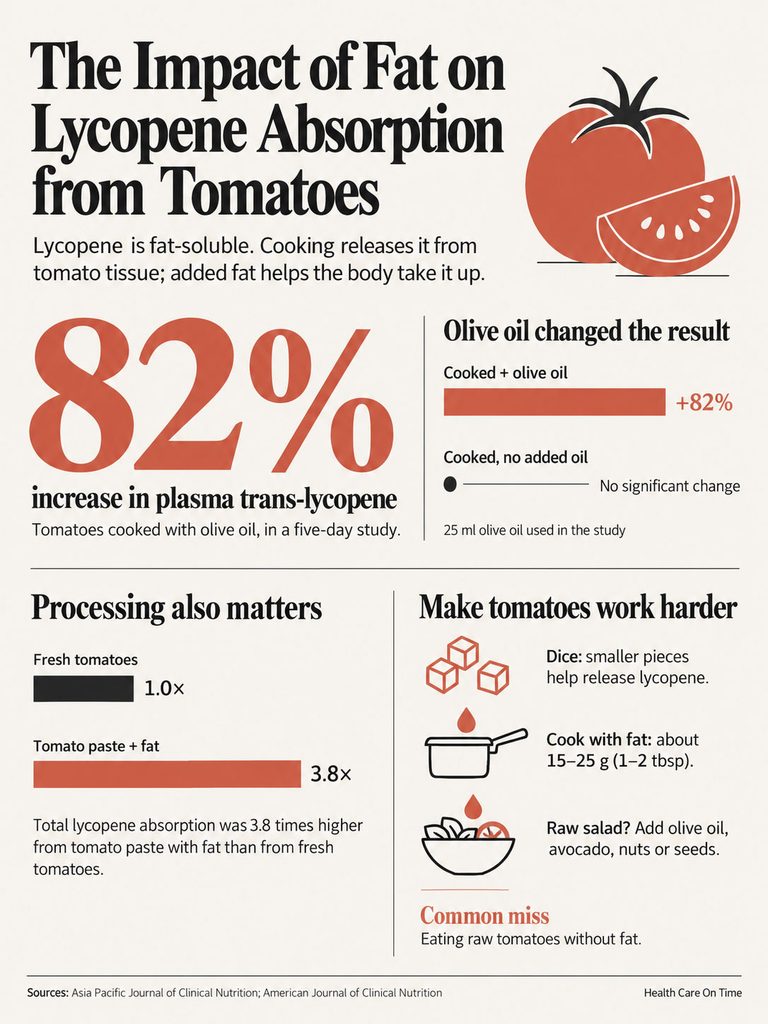
Australian researchers ran the experiment nobody on page one of Google mentions. Healthy volunteers spent five days on a low-lycopene diet, then five days eating one daily meal of 470 grams of tomatoes, a little over a pound.
Eleven participants had their tomatoes cooked with 25 mL of extra virgin olive oil, just under two tablespoons. Twelve had identical tomatoes cooked with no oil at all.
The oil group showed an 82 percent rise in plasma trans-lycopene and a 40 percent rise in cis-lycopene. The no-oil group showed no significant change in trans-lycopene, with a P value of 0.684.
Read that again. A pound of cooked tomatoes daily for five days, with no fat, did not measurably move the main form of lycopene in blood.
The study appeared in the Asia Pacific Journal of Clinical Nutrition in 2005 with 23 total participants, so it is small. The size of the effect and the cleanness of the split still make it the most useful trial on this question.
Paste against fresh at a matched dose
German researchers at Heinrich Heine University tested a different comparison. They gave volunteers 23 mg of lycopene, either from fresh tomatoes or from tomato paste, each served with 15 grams of corn oil.
Same dose, same fat, different food matrix. Peak lycopene in the chylomicron fraction was 2.5 times higher from paste, and total absorption over time was 3.8 times higher, reported in the American Journal of Clinical Nutrition in 1997.
That result isolates the matrix effect from everything else. Processing genuinely changes how much gets in, even at matched dose and matched fat.
How much oil is actually enough
The trials used 15 to 25 grams of fat, which is roughly one to two tablespoons of oil. That is a normal amount for a pan of vegetables or a pot of pasta sauce.
Nothing needs to be drowned. Half an avocado, a handful of nuts, cheese on the pizza, or the olive oil already in your salad dressing all qualify.
Across the readers HealthCareOnTime serves, the most common lycopene mistake is not undercooking. It is a plate of dry sliced tomatoes on a fat-free salad.
What this means for a naked salad
Raw tomato in an undressed salad is close to a worst case. The lycopene is still crystalline inside intact cells, and there is no fat to carry it across the intestinal wall.
Adding olive oil to that same salad fixes half the problem with no cooking at all. Dicing the tomatoes finely instead of slicing them fixes a good part of the other half.
What Raw Tomatoes Win
Framing this as a contest with a loser misreads the food. Raw tomatoes hold real advantages that cooking cannot give back.
Water, volume and fullness
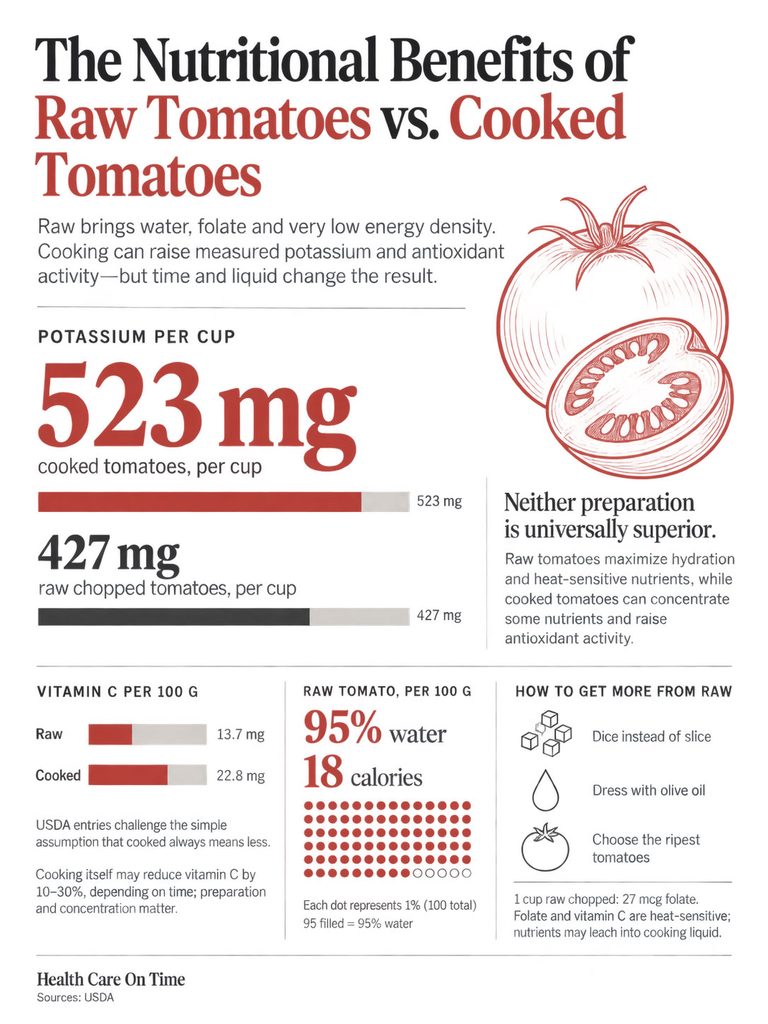
Raw tomato is about 95 percent water and 18 calories per 100 grams. A large sliced tomato adds bulk and moisture to a meal for almost no energy cost.
That matters more for how people actually eat than a few hundred micrograms of any single pigment. Our nutrition reviewers would rather see someone eat more tomatoes in whatever form they enjoy than optimize one carotenoid and eat fewer.
The vitamin C question, and a USDA reading nobody explains
Every competing article states that raw tomatoes hold more vitamin C. Then USDA lists raw red tomato at 13.7 mg per 100 grams and cooked red tomato at 22.8 mg per 100 grams.
The cooked entry has 66 percent more. That is the opposite of the standard claim, and it sits in the same database everyone quotes for lycopene.
The explanation is not that cooking builds vitamin C. It is that the USDA raw and cooked tomato entries are two independent laboratory analyses of two different sets of tomatoes, not a before-and-after measurement of one batch.
The raw entry is a year-round average blending summer field tomatoes with winter greenhouse and imported fruit, which drags vitamin C down. The cooked entry came from a separate sampling exercise entirely.
Any comparison built by subtracting one USDA line from another is unreliable for heat-sensitive nutrients. In cases reviewed by our medical team, this is the single most common source of contradictory nutrition claims online.
What the controlled experiment found
For a real answer on vitamin C, you need one batch of tomatoes measured before and after heating. Cornell did exactly that.
At 190 degrees F, vitamin C fell 10 percent at two minutes, 15 percent at fifteen minutes, and 29 percent at thirty minutes. Total antioxidant activity in the same samples rose 28, 34 and 62 percent.
So cooking does cost vitamin C, by roughly 10 to 30 percent depending on how long you cook. It is a genuine trade, just a smaller one than the claim that cooking destroys vitamin C implies.
Potassium, folate and the rest of the panel
A cup of raw chopped tomato delivers about 427 mg of potassium and 27 mcg of folate. The USDA cooked cup runs higher on potassium, at 523 mg.
Folate is heat sensitive and water soluble, so it behaves like vitamin C. If you simmer tomatoes in a liquid you go on to eat, as in soup or sauce, much of what leaches out stays in the bowl.
How to eat raw tomatoes better
If you prefer them raw, three adjustments close most of the gap. Dice rather than slice, so more cells are broken.
Dress with olive oil rather than a fat-free vinaigrette, because that is the step that decides absorption. And pick the deepest red fruit on the shelf, since color tracks lycopene content closely.
A caprese salad with olive oil is not a weak lycopene meal. An undressed tomato slice on a sandwich is.
How Much Lycopene Americans Actually Get
Context changes what advice makes sense. If most people were already at high intake, chasing an 18 percent difference would be pointless.
They are not.
| Statistic | Figure | Source |
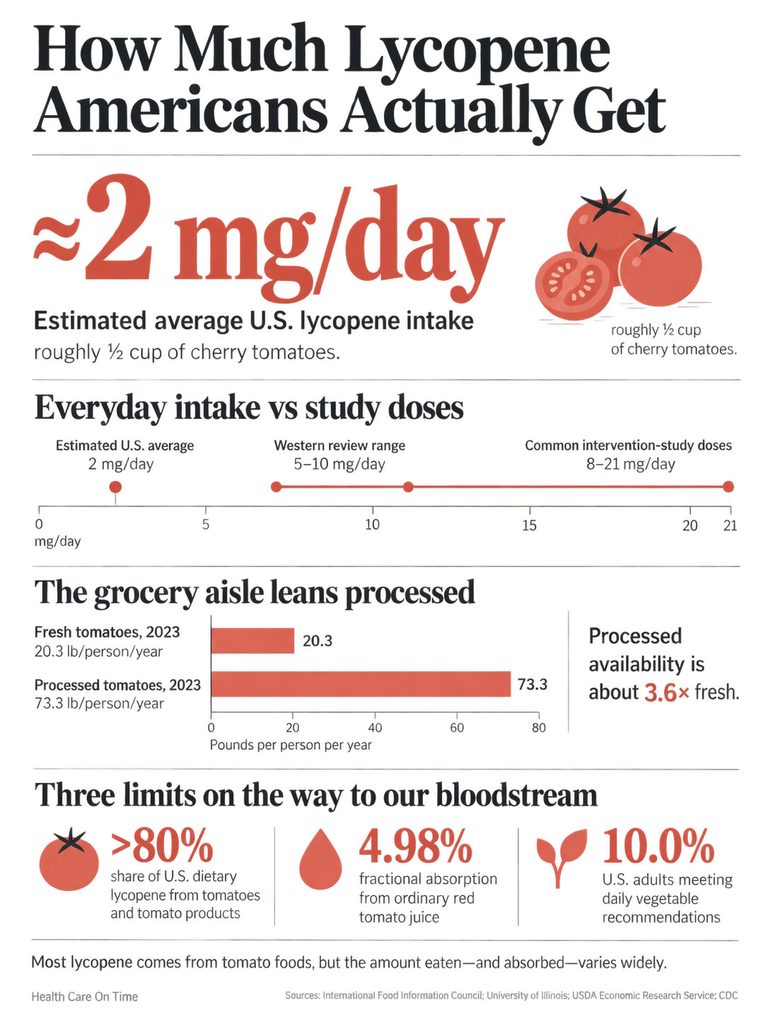
| Estimated average US lycopene intake | About 2 mg/day, roughly a half cup of cherry tomatoes | International Food Information Council |
| Alternative Western intake estimate | 5 to 10 mg/day | Published US and European intake reviews |
| Share of US dietary lycopene from tomatoes and tomato products | More than 80% | J. Erdman, University of Illinois |
| Fractional absorption from ordinary red tomato juice | 4.98% | Cooperstone et al., Mol Nutr Food Res, 2015 |
| US per capita fresh tomato availability | About 20.3 lb per year (2023) | USDA Economic Research Service |
| US per capita processed tomato availability | About 73.3 lb per year (2023) | USDA Economic Research Service |
| US adults meeting daily vegetable recommendations | 10.0% | CDC, MMWR |
| Lycopene doses used in intervention studies | Commonly 8 to 21 mg/day | Published trial ranges |
Figures reflect the most recent published values available at the time of writing.
Two things stand out. Americans eat roughly three and a half times more processed tomato than fresh, so the cooked-versus-raw question is already half-settled by the food supply.
And typical intake sits below the doses used in most research. Whichever estimate you accept, there is room to move.
The Practical Rules for Getting More Lycopene
Six moves that work
Cook with fat in the pan, not drizzled on afterward. Oil present during cooking is what the trial data tested, and it costs nothing to do it that way.
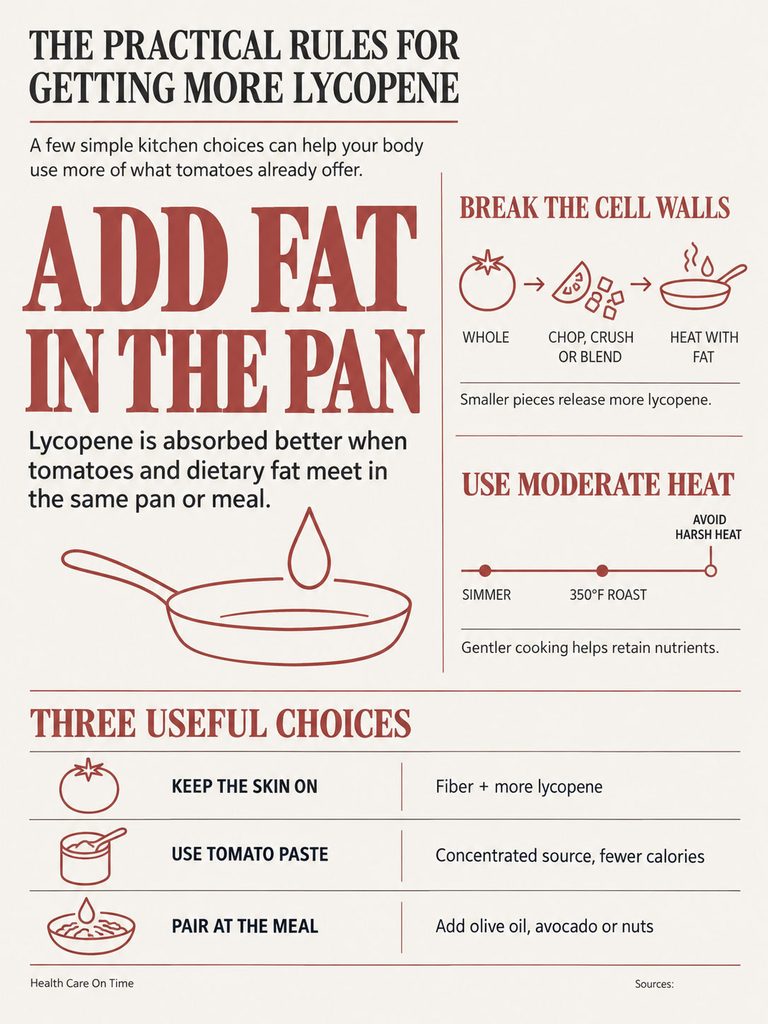
Keep the temperature moderate. A simmer or a 350 degree F roast preserves far more than a hard sear or a 425 degree F blast.
Chop, crush or blend. Mechanical disruption does part of what heat does, which is why juice and finely diced tomato beat thick slices.
Keep the skin on. Lycopene concentrates in the peel, so peeling throws away a meaningful share of it along with fiber.
Reach for paste when you want density. Two tablespoons of no-salt-added tomato paste carries about 9.5 mg of lycopene, more than three medium raw tomatoes, for 27 calories.
Eat tomatoes as part of a meal rather than alone. Absorption depends on the fat and bile present at the same time.
Canned, jarred and paste, ranked honestly
Canned tomatoes are not a compromise. They are picked ripe, processed quickly, and the heat treatment does the cell-wall work for you before the can is opened.
Paste is the most lycopene-dense option per calorie and per dollar in the American grocery store. Puree is close behind. Plain canned crushed or diced tomatoes sit in the middle.
Ketchup is weakest in practice, not because its concentration is low but because a tablespoon is only a tablespoon. You would need about five tablespoons to match two tablespoons of paste, and you would be adding roughly 750 mg of sodium and 15 grams of sugar to get there.
How to read a US tomato product label
Three lines on the Nutrition Facts panel tell you most of what you need. Sodium is the first, because standard jarred marinara commonly runs 400 to 700 mg per half cup while no-salt-added paste has almost none.
Added sugars is the second. Many national-brand pasta sauces carry 6 to 12 grams per half cup, which is the main reason a healthy-looking sauce can behave like a dessert.
Potassium is the third, and it is the line most people skip. Tomato paste supplies about 1,014 mg per 100 grams.
Lycopene itself never appears on a US label, since FDA does not require it and there is no Daily Value for it. The ingredient list is your proxy: tomato paste or tomato puree listed first means more lycopene than water listed first.
When to be cautious
Potassium deserves a real flag rather than a footnote. Heart failure and chronic kidney disease protocols routinely list tomato products among the foods to limit when serum potassium runs high.
If you take an ACE inhibitor, an ARB, spironolactone, or you have reduced kidney function, that outweighs any lycopene consideration. Our medical reviewers treat it as the deciding factor, and the HealthCareOnTime guide to tomatoes and heart health covers the medication interactions in detail.
Sodium matters for anyone tracking blood pressure. Swapping standard sauce for no-salt-added versions removes several hundred milligrams per serving with zero lycopene cost, which pairs with the targets in our blood pressure chart by age.
| Your Situation | Do This | Why It Works |
| Want the most lycopene per calorie | Stir 2 tbsp no-salt tomato paste into sauce, chili or soup | About 9.5 mg lycopene for 27 calories and near-zero sodium |
| Eating a raw salad | Dice the tomato finely and use an olive oil dressing | Fat enables absorption, chopping breaks cells without heat |
| Making pasta sauce | Simmer with 1 to 2 tbsp olive oil, keep it below a rolling boil | Matches the conditions that raised plasma lycopene 82% |
| Roasting vegetables | Use 350 degrees F and pull them before they blacken | Retention falls from 64% to 25% between mild and harsh roasting |
| Short on time | Microwave chopped tomatoes 1 minute with a teaspoon of oil | Retained 64.4% in testing, comparable to a 15-minute bake |
| Watching sodium | Buy no-salt-added cans or paste and season at home | Removes 400 to 700 mg sodium per serving, keeps the lycopene |
| On an ACE inhibitor, ARB or spironolactone | Ask your prescriber before adding daily tomato paste | Paste supplies about 1,014 mg potassium per 100 g |
| Managing acid reflux | Take smaller portions of cooked tomato with fat, spread across the week | Concentrates lycopene into less volume of acidic food |
| Feeding a picky eater | Blend paste or puree into dishes they already accept | Delivers lycopene without changing texture they refuse |
| On a tight grocery budget | Buy canned crushed tomatoes and paste in bulk | Cheapest lycopene per serving in the US food supply |
General guidance only. Medication and kidney questions belong with your own prescriber.
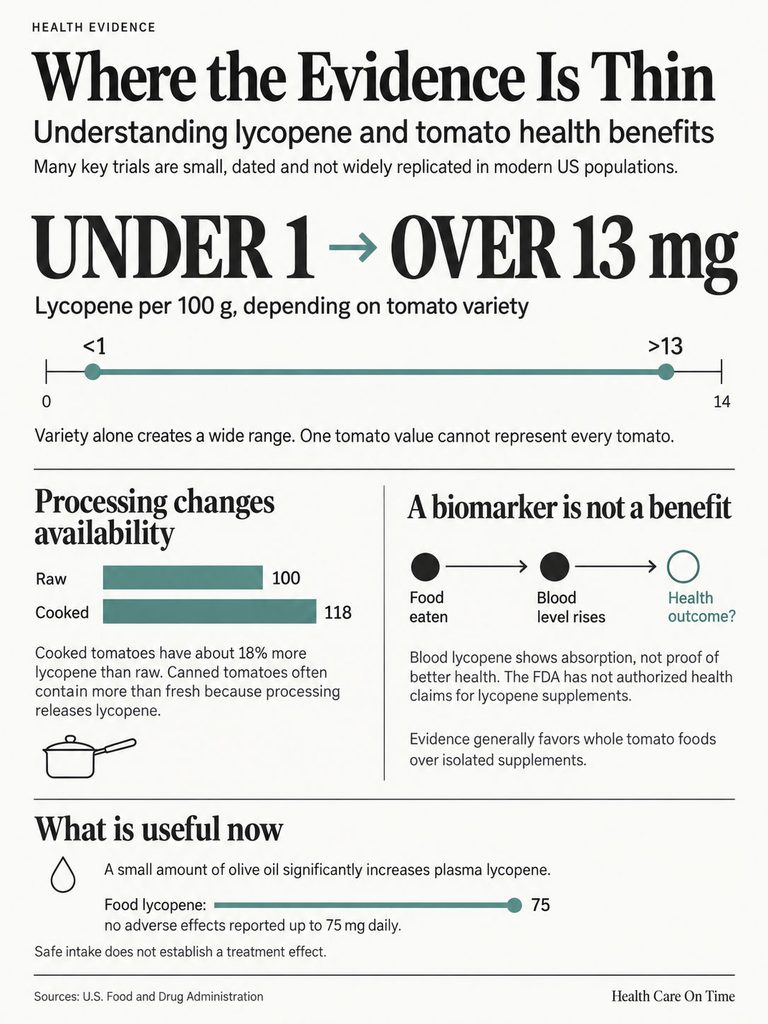
Where the Evidence Is Thin
Trust runs on limits as much as on findings, so here are the honest ones.
The key trials are old and small
Gartner is from 1997. Fielding is from 2005 with 23 participants. Mayeaux is from 2006. The Cornell heating study is from 2002.
None have been replicated at scale in modern US populations. The mechanisms are well established and the direction of effect is consistent across studies, but the exact percentages should be read as approximations rather than fixed constants.
Tomato variety changes everything
Published lycopene values for fresh tomatoes range from under 1 mg to over 13 mg per 100 grams depending on cultivar, ripeness, growing conditions and season. The USDA 2,573 mcg figure is a national average, not a measurement of the tomato in your kitchen.
A deep red Roma at peak ripeness and a pale February slicer are not the same food. Redder generally means more lycopene, which makes color the most practical shopping cue available.
Blood lycopene is a marker, not an outcome
Raising plasma lycopene proves absorption happened. It does not prove a health benefit followed.
FDA reviewed the lycopene evidence and, in November 2005, declined to authorize health claims for lycopene as an ingredient or a supplement, allowing only a heavily qualified statement about tomatoes and tomato sauce. That position reflects how uncertain the outcome data remains two decades later.
More lycopene is not automatically healthier
Chasing a single compound is a poor way to build a diet. Trials using whole tomato foods have generally outperformed trials using isolated lycopene, which suggests the rest of the tomato contributes something.
For what the outcome research actually shows across cardiovascular and metabolic endpoints, the HealthCareOnTime review of tomato health benefits covers it properly. Readers who write in asking whether to buy a lycopene supplement usually get pointed back to food first.
Frequently Asked Questions
Which has more lycopene, raw or cooked tomatoes?
Cooked, by about 18 percent per 100 grams according to USDA, at 3,041 mcg against 2,573 mcg. The larger 58 percent per-cup difference exists because a cooked cup weighs 240 grams while a raw cup weighs 180 grams. Absorption, not content, is where cooking makes the bigger difference.
Does cooking tomatoes destroy vitamin C?
It reduces it. Cornell researchers measured losses of 10, 15 and 29 percent after heating tomatoes at 190 degrees F for 2, 15 and 30 minutes. A cup of raw tomato still supplies roughly 25 mg of vitamin C, so cooked tomatoes remain a reasonable source even after the loss.
How long should I cook tomatoes to get the most lycopene?
Around 15 to 30 minutes at a gentle simmer hits the sweet spot in published data. Longer cooking at higher temperatures destroys lycopene faster than it releases it. Tomato pulp baked at 425 degrees F for 45 minutes retained only 25 percent of its original content.
Do I really need oil to absorb lycopene?
Effectively yes. In a controlled trial, participants eating 470 grams of tomatoes daily cooked without oil showed no significant change in plasma trans-lycopene, while a matched group eating the same tomatoes cooked with 25 mL of olive oil showed an 82 percent rise. One to two tablespoons of any dietary fat is enough.
Is tomato paste better than fresh tomatoes?
For lycopene density, clearly. Paste carries about 28,764 mcg per 100 grams against 2,573 for fresh, roughly 11 times more, because most of the water is gone. Fresh tomatoes still win on volume, hydration and versatility, so both belong in a normal week.
Are canned tomatoes as good as fresh?
For lycopene, canned tomato products generally beat fresh, since processing breaks the cell matrix and removes water. The main trade-off is sodium in salted varieties and jarred sauces. Choosing no-salt-added cans removes that concern while keeping the lycopene advantage intact.
Does microwaving tomatoes destroy lycopene?
One minute of high-power microwaving retained 64.4 percent of lycopene in tomato slurry, roughly matching 15 minutes of baking at 350 degrees F. Microwaving is a sensible middle option, faster than roasting and gentler than frying. Add a little oil before microwaving to improve absorption.
How many tomatoes do I need for 10 mg of lycopene?
About 390 grams of raw tomato, roughly three medium tomatoes or 14 ounces. Two tablespoons of tomato paste gets you to 9.5 mg in a single spoonful. A half cup of no-salt tomato sauce delivers close to 17 mg.
Do cherry tomatoes have more lycopene than large tomatoes?
Analyses often find cherry and Roma types testing higher per gram than vine or large slicing varieties, though results vary widely by cultivar and growing conditions. Color is the better everyday guide than size. The deeper the red, the more lycopene the fruit typically holds.
Does peeling tomatoes reduce lycopene?
Yes. Lycopene concentrates in the skin, so peeled tomatoes lose a meaningful share along with fiber and some phenolic compounds. When a recipe allows it, leaving the skin on is the better choice for both nutrition and texture.
Is ketchup a decent source of lycopene?
Per 100 grams ketchup is lycopene rich at about 12,062 mcg, but nobody eats 100 grams of ketchup. A standard tablespoon supplies roughly 2,051 mcg along with added sugar and about 150 mg of sodium. It contributes, but it is not a plan.
Can you get too much lycopene?
Intakes up to 75 mg per day from food or supplements have not shown adverse effects in studies, and the European Food Safety Authority set an acceptable daily intake of 0.5 mg per kilogram of body weight. Very high intakes can produce lycopenodermia, a harmless orange skin tint that fades once intake drops.
Medical Disclaimer
This article is for general information and does not replace personalized medical or dietary advice. Nutrient values are averages and vary by variety, ripeness, growing conditions and preparation method. If you take an ACE inhibitor, an ARB, a potassium-sparing diuretic such as spironolactone, or you have chronic kidney disease or heart failure, talk with your prescriber before adding concentrated tomato products to your routine. Speak with a licensed clinician or registered dietitian about your individual situation.
References
- USDA FoodData Central, SR Legacy tomato composition data
- Nutrient composition of raw tomatoes and tomato products, USDA SR Legacy summary, Advances in Nutrition
- Dewanto V, Wu X, Adom KK, Liu RH. Thermal processing enhances the nutritional value of tomatoes, Journal of Agricultural and Food Chemistry, 2002, summarized by Cornell Chronicle
- Mayeaux M, Xu Z, King JM, Prinyawiwatkul W. Effects of cooking conditions on the lycopene content in tomatoes, Journal of Food Science, 2006
- Fielding JM, Rowley KG, Cooper P, O Dea K. Increases in plasma lycopene concentration after consumption of tomatoes cooked with olive oil, Asia Pacific Journal of Clinical Nutrition, 2005
- Gartner C, Stahl W, Sies H. Lycopene is more bioavailable from tomato paste than from fresh tomatoes, American Journal of Clinical Nutrition, 1997
- Cooperstone JL, et al. Enhanced bioavailability of lycopene when consumed as cis-isomers from tangerine compared to red tomato juice, Molecular Nutrition and Food Research, 2015
- Tomato-derived lycopene: phytochemistry, bioavailability and applications, Molecules, 2026
- Lycopene isomer composition of tomato and tomato products, Foods, 2019
- How Healthy Are Tomatoes? University of Illinois Department of Food Science and Human Nutrition
- What is Lycopene? International Food Information Council