
A single slice of watermelon on a hot afternoon feels harmless. Then someone with diabetes spots the glycemic index chart, sees the number 76, and quietly sets the plate back down.
Table of Contents
That hesitation is understandable, but it misreads the science. Watermelon does contain sugar, yet the way that sugar behaves inside your body tells a far more reassuring story than one alarming number suggests.
Across the diabetes questions our diagnostic network fields each summer, watermelon ranks among the most common. People want a clear answer, not a vague “it depends.” The good news is that the data supports a confident, specific reply once you separate the index number from the real-world portion.
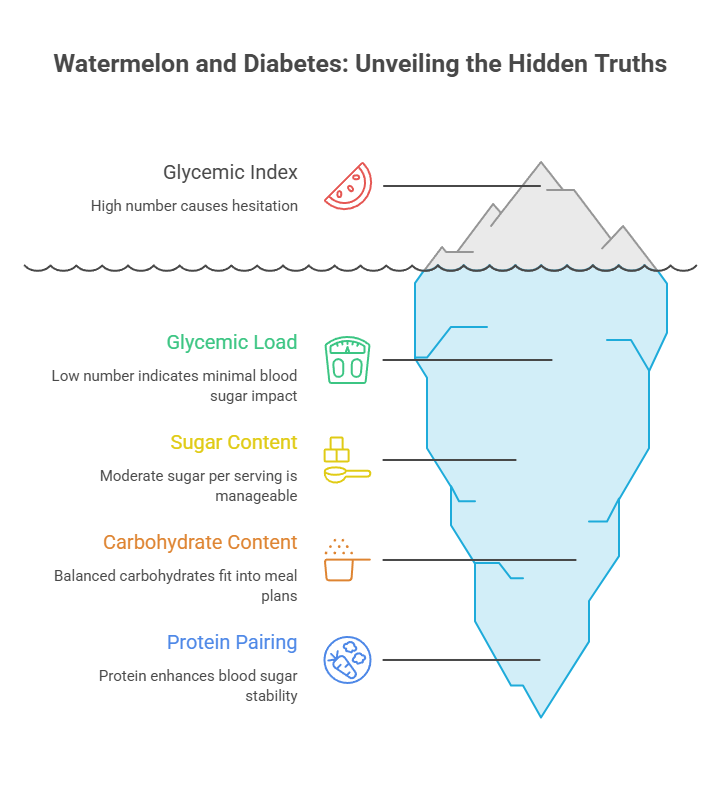
Quick Answer: Yes, most people with diabetes can eat watermelon. One cup of diced watermelon holds about 9.4 grams of natural sugar and 11.5 grams of carbohydrates. Its glycemic index is high (around 76), but its glycemic load per serving is only about 5, which is low. A 1-cup portion paired with protein fits comfortably into a diabetes meal plan.
At a Glance
- One cup of diced watermelon: roughly 46 calories, 9.4 g sugar, 11.5 g carbs, 92% water.
- High glycemic index (around 76) but low glycemic load (around 5) per standard serving.
- The sugar in watermelon is natural fructose, not added sugar.
- A safe starting portion for most diabetics is 1 to 1.25 cups, paired with protein.
- Watermelon juice and oversized wedges raise blood sugar faster than whole fruit.
- Lycopene in watermelon may support heart health, a genuine concern for people with diabetes.
Watermelon Sugar Content: The Carb and Calorie Breakdown
Watermelon earns its sweet reputation honestly, but the totals are smaller than most people expect. The fruit is overwhelmingly water, and that single fact changes how its sugar lands in your bloodstream.
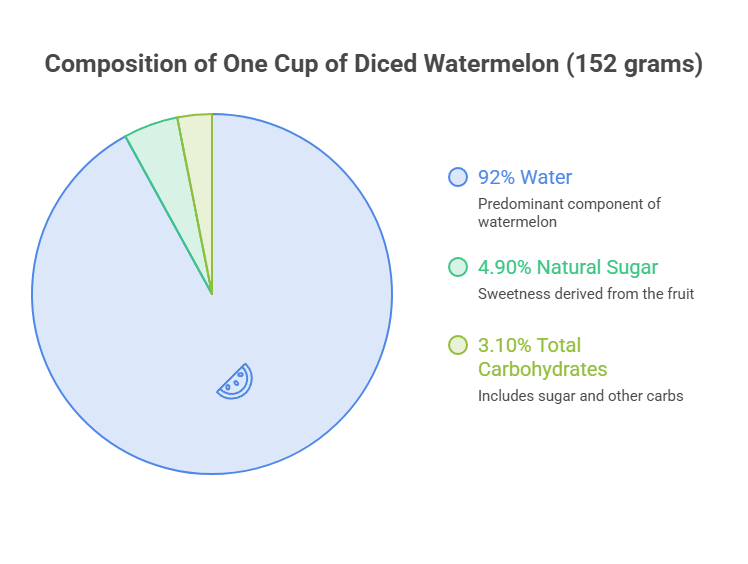
One cup (152 grams) of diced watermelon contains about 9.42 grams of natural sugar and 11.5 grams of total carbohydrates. A larger wedge of roughly 286 grams climbs to about 17.7 grams of sugar and 21.6 grams of carbs.
That same cup delivers only around 46 calories. The reason traces back to composition: watermelon is about 92% water by weight, so each bite carries far less sugar than its taste implies.
Put differently, the sweetness you taste is concentrated flavor riding on a very dilute amount of actual sugar. A teaspoon of table sugar holds about 4 grams; a full cup of watermelon delivers roughly 9.4 grams spread across 152 grams of fruit and water.
This is why nutrition experts often describe watermelon as nutrient-dense rather than sugar-dense. The carbohydrate per gram of food is low, even though the fruit registers as distinctly sweet on the tongue.
Natural Sugar Versus Added Sugar
For blood sugar management, the source of sugar matters as much as the amount. The fructose in watermelon arrives bundled with water, vitamins, and antioxidants, a completely different package from the refined sugar in soda or candy.
The American Diabetes Association does not ask people with diabetes to give up whole fruit. Its guidance is to choose fresh, frozen, or canned fruit without added sugars, and to count those carbohydrates toward your daily total.
Our medical reviewers note that patients routinely confuse “contains sugar” with “spikes sugar.” Those are two separate questions, and watermelon is a textbook case of why the difference matters so much.
Added sugars, the kind found in sodas and packaged sweets, deliver fast carbohydrate with no fiber, water, or micronutrients to slow them down. The fructose in whole watermelon behaves differently because the surrounding food matrix moderates how quickly it reaches the blood.
Federal dietary guidance focuses on cutting added sugars to less than 10% of daily calories. Whole fruit sits outside that target, which is one reason the ADA keeps fruit firmly on the approved list for people managing blood sugar.
How Watermelon Stacks Up Against Other Fruits
A little context goes a long way. Set beside other popular fruits, watermelon’s per-serving sugar load is modest, and its glycemic load sits near the bottom of the fruit bowl.
Table 1: Watermelon Versus Common Fruits (Per Standard 1-Cup Serving)
| Fruit | Sugar (g) | Total Carbs (g) | Glycemic Index | Glycemic Load | Diabetic Verdict |
| Watermelon (diced) | 9.4 | 11.5 | ~76 | ~5 | Safe in moderation |
| Banana (sliced) | 18.0 | 27.0 | ~51 | ~13 | Watch portion |
| Mango (chunks) | 23.0 | 25.0 | ~51 | ~12 | Watch portion |
| Red grapes | 23.0 | 27.0 | ~59 | ~11 | Limit serving |
| Strawberries (halved) | 7.4 | 11.7 | ~41 | ~3 | Excellent choice |
| Apple (sliced) | 13.0 | 17.0 | ~36 | ~6 | Good choice |
| Blueberries | 15.0 | 21.0 | ~53 | ~9 | Good in moderation |
Watermelon carries less sugar per cup than banana, mango, or grapes, and its glycemic load lands close to a sliced apple. The high glycemic index is real, but on its own it badly overstates the risk.
Glycemic Index Versus Glycemic Load: Why Watermelon Confuses Everyone
Here sits the single biggest source of watermelon anxiety, and the part most articles rush past. Two numbers measure two different things, and watermelon scores high on one while scoring low on the other.
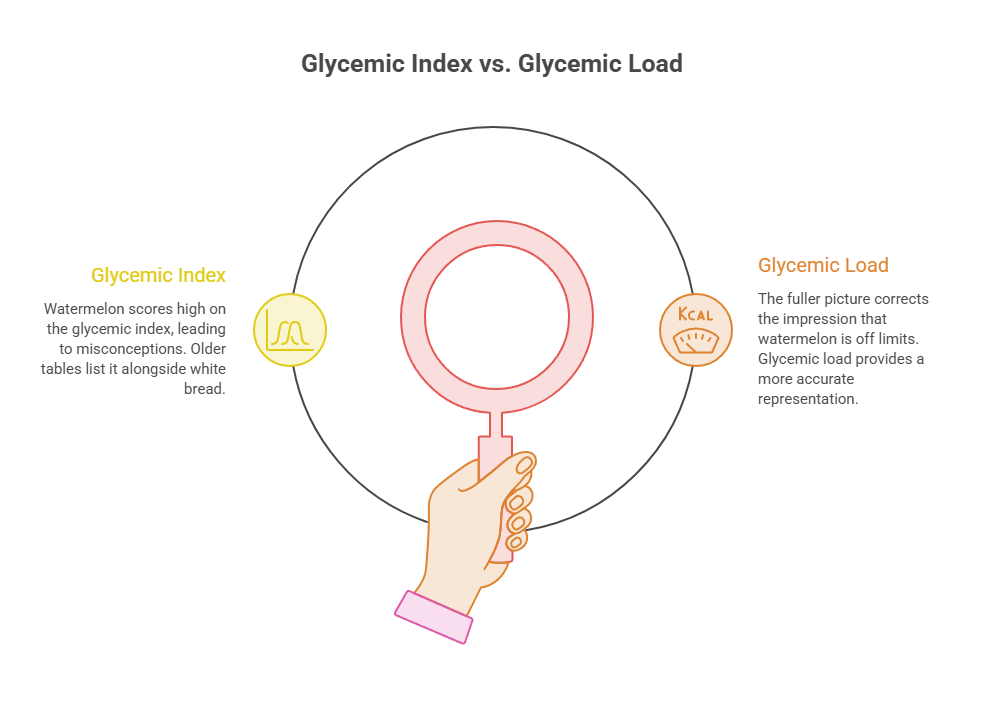
Older glycemic index tables, still copied across the internet, list watermelon near the top alongside white bread. That single data point, repeated for years without context, is why so many people with diabetes assume the fruit is off limits. The fuller picture corrects that impression.
What the Glycemic Index Measures
The glycemic index ranks how quickly a food raises blood glucose, on a scale where pure glucose equals 100. Watermelon’s high score, reported across sources at roughly 72 to 80, means the sugar it does deliver enters the blood quickly.
That speed is what frightens people. Yet the glycemic index is tested using a fixed 50-gram dose of carbohydrate, and reaching that dose with watermelon would mean eating a very large amount in one sitting.
To hit 50 grams of carbohydrate from watermelon, you would need to eat well over four cups at once. Almost no one eats fruit that way, which means the laboratory testing condition barely resembles a real serving on a real plate.
Why the Glycemic Load Tells the Real Story
The glycemic load corrects for portion size, and it flips the picture entirely. Harvard Health explains that although watermelon has a high glycemic index of 80, a normal serving contains so little carbohydrate that its glycemic load is just 5, which falls in the low range.
The scale is straightforward: a glycemic load under 10 is low, 11 to 19 is medium, and 20 or higher is high. Watermelon’s serving load of around 5 means a sensible portion is unlikely to trigger the dramatic spike its index number implies.
Some nutrition researchers argue that people with diabetes should weigh both numbers together rather than reacting to the index alone. The index tells you about speed; the load tells you about the actual dose you eat. Acting on speed without dose is how watermelon got its undeserved bad reputation.
The 92% Water Dilution Effect
So why the gap between the two scores? The answer is water. Because watermelon is about 92% water, the actual carbohydrate density per gram is very small.
Reaching the carbohydrate dose used in glycemic index testing would take several cups at once. In real life, a single serving spreads a little fast sugar across a large, hydrating volume, which softens its effect.
Our lab partners report that patients who track their own glucose are often surprised at how gently a measured cup of watermelon registers, well below what the index number led them to expect.
How Much Watermelon Can a Diabetic Safely Eat?
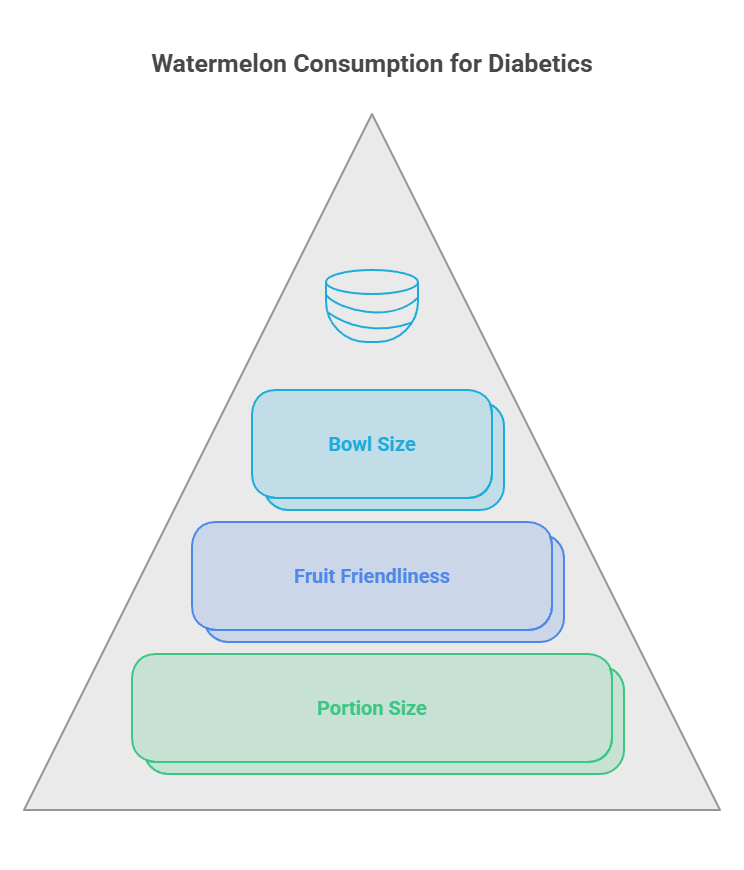
This is the question that actually matters at the dinner table, and the honest answer is that portion size decides nearly everything. The fruit is friendly; the size of the bowl is the real variable.
The One-Cup Rule and Carb Counting
For most adults managing type 2 diabetes, a starting portion of 1 to 1.25 cups of diced watermelon is reasonable. That keeps carbohydrates around 11 to 14 grams, which fits neatly within a standard 15-gram carb serving.
If your care team has set a per-meal carbohydrate budget, count watermelon against it the same way you would bread or rice. The fruit is not a free food, but in carb terms it is inexpensive.
A practical way to picture this: one cup of diced watermelon costs roughly the same carbohydrate as a small apple or half a banana. That puts it in the easy-to-fit category for most meal plans rather than the splurge category.
Best Times to Eat Watermelon
Timing can soften the impact. Eating watermelon alongside a meal that already contains protein, fat, and fiber slows digestion and flattens the rise in blood sugar.
A small serving after exercise is another smart window, since active muscles pull glucose from the blood more readily. Patients booking A1C and glucose panels through HealthCareOnTime often ask about fruit at night, and a measured portion with dinner usually beats fruit eaten alone late in the evening.
Type 1, Type 2, and Gestational Diabetes
Same fruit, different math. People with type 1 diabetes who count carbs and dose insulin can include watermelon by matching their insulin to the carbohydrate content of the portion.
Those managing gestational diabetes often work with tighter targets, so a smaller serving of about half a cup paired with protein makes a cautious starting point. Mayo Clinic and the ADA both stress individualized planning, so confirm your portions with your obstetric or diabetes care team.
Type 2 diabetes covers the widest range of responses. Someone newly diagnosed and managing through diet may tolerate watermelon differently than someone on insulin or multiple medications. This is where personal glucose testing earns its keep, since the right portion is the one your own readings confirm.
Table 2: Watermelon Portion, Sugar, and Carb Impact
| Portion | Sugar (g) | Total Carbs (g) | Estimated Glucose Impact | Source Basis |
| 1/2 cup (76 g) | 4.7 | 5.8 | Minimal | USDA nutrient data |
| 1 cup diced (152 g) | 9.4 | 11.5 | Low (GL ~5) | USDA / Harvard Health |
| 1.5 cups (228 g) | 14.1 | 17.3 | Low to moderate | USDA nutrient data |
| 1 wedge (286 g) | 17.7 | 21.6 | Moderate | Healthline nutrient data |
| 2 cups (304 g) | 18.8 | 23.0 | Moderate (GL ~10) | USDA / glycemic data |
| 8 oz watermelon juice | ~20.0 | ~23.0 | Higher, faster | Glycemic review (juice GI ~51) |
The pattern stands out at a glance. Whole fruit at one to one and a half cups stays gentle, while juice and oversized wedges climb in a hurry.
For a sense of scale, the CDC reports that more than 38 million Americans live with diabetes and roughly 98 million adults have prediabetes, which makes everyday food choices like this one genuinely consequential.
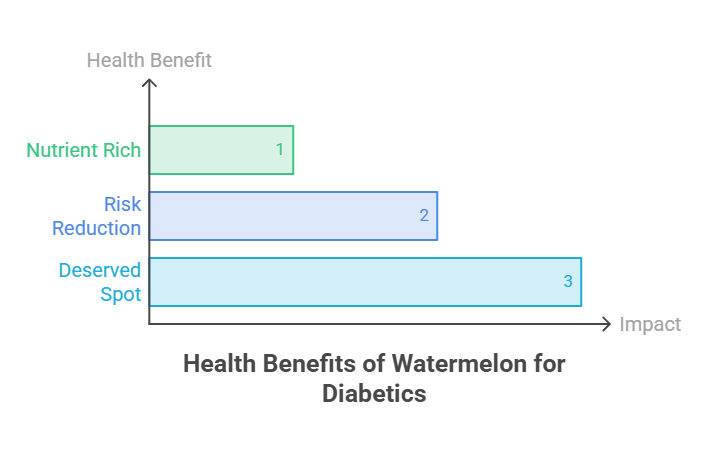
Health Benefits Beyond the Sugar Question
Watermelon is not merely tolerable for people with diabetes; it brings nutrients that target risks tied to the condition itself. The fruit earns its spot rather than just dodging the penalty.
Lycopene and Cardiovascular Protection
Watermelon ranks among the richest dietary sources of lycopene, the antioxidant responsible for the flesh’s deep red color. This matters because adults with diabetes are roughly twice as likely to develop cardiovascular disease, including heart attack and stroke.
Research suggests lycopene may help reduce free-radical damage and support healthier cholesterol patterns. For a group already carrying elevated heart risk, that antioxidant bonus is far from trivial.
Watermelon actually contains more lycopene per serving than raw tomatoes, the food most people associate with the antioxidant. That makes a measured bowl of watermelon a quiet contributor to cardiovascular protection, not just a sweet indulgence.
Hydration, L-Citrulline, and Vitamins
The high water content pulls double duty, keeping you hydrated while helping you feel full on very few calories. Watermelon also supplies L-citrulline, an amino acid linked to healthy blood vessel function, along with vitamins A and C.
Vitamin A supports vision and organ health, and vitamin C contributes to immune function. None of this replaces medical treatment, but it makes watermelon a nutrient-positive snack rather than empty sweetness.
Weight Management Support
Excess weight worsens insulin resistance, so a sweet food that satisfies cravings for almost no calories is genuinely useful. A full cup of watermelon costs only about 46 calories while delivering real volume and sweetness.
Across patients we serve, swapping a heavy dessert for a measured bowl of watermelon is one of the easier habits to keep going through a hot summer.
The high water and fiber content also help with fullness, so a watermelon snack can curb the urge to reach for something heavier later. For anyone working to lose a few pounds to improve insulin sensitivity, that satisfying-but-light quality is a practical advantage.
When Watermelon Becomes a Problem
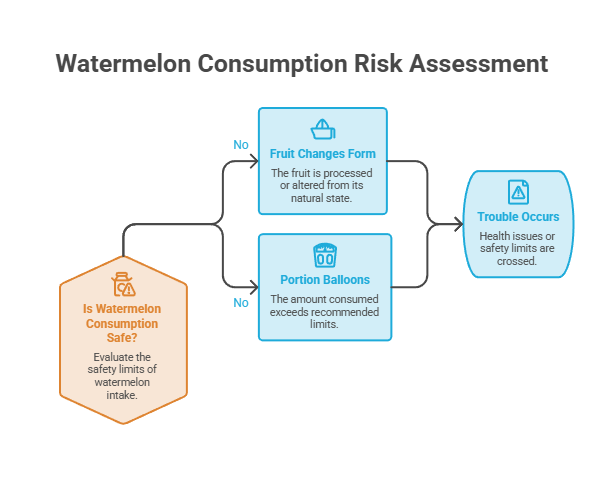
Watermelon’s safety has clear limits, and they are easy to cross without realizing it. Trouble starts when the fruit changes form or the portion balloons.
Watermelon Juice and Smoothies
Juicing strips away the structure that makes whole watermelon gentle. Liquid carbohydrates digest faster, so the same sugar reaches the bloodstream more abruptly.
Watermelon juice carries a glycemic index near 51 and a higher glycemic load than whole fruit, and store-bought versions often come from concentrate with even denser sugar. For blood sugar control, the whole fruit beats the glass almost every time.
Smoothies present a similar issue, even homemade ones. Blending breaks down the fruit’s structure and often combines several servings of fruit into a single drink, stacking carbohydrate that would never fit on a plate. If you blend watermelon, keep the portion to a single serving and add protein or fat to slow it down.
Oversized Portions and Stacked Carbs
That reassuring glycemic load of 5 applies to one cup. Eat three or four cups at once and the load climbs into medium or high territory, where a genuine spike becomes likely.
Stacking is the other trap. A large bowl of watermelon piled on top of a carb-heavy plate of rice or bread adds up fast, even when each item alone looked harmless.
This is why portion awareness beats fruit avoidance. The problem is rarely the watermelon by itself; it is the watermelon added to a meal that already used up the carbohydrate budget. Plan the fruit into the meal, not on top of it.
Dried and Candied Watermelon
Dried watermelon concentrates the sugar into a tiny volume, removing the water that was protecting you. Candied watermelon layers refined sugar on top of that, which cancels the fruit’s natural advantage completely.
Reading Your Own Response
Diabetes is deeply individual, and your own data is the most reliable guide. Checking blood glucose before eating, then again one to two hours after a watermelon serving, shows precisely how your body reacts.
Anyone using a continuous glucose monitor can watch this play out in real time. Our medical reviewers encourage this kind of self-testing, since individual responses can stray from the average more than any chart predicts.
Smart Ways to Eat Watermelon With Diabetes
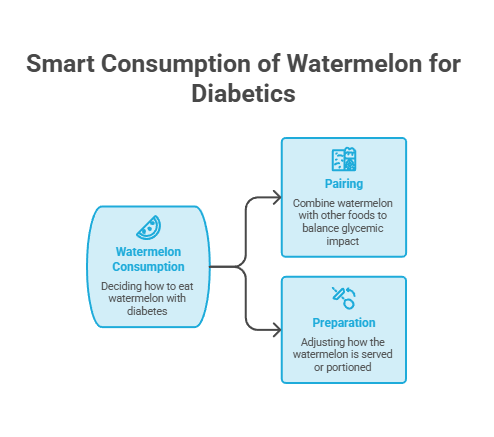
The line between a problem and a treat usually comes down to a few simple habits. Pairing and preparation do most of the heavy lifting.
Pair It With Protein and Fat
Eating watermelon with protein or healthy fat slows the sugar’s entry into the blood. The classic combination is watermelon with feta cheese, though nuts, Greek yogurt, or a hard-boiled egg work just as well.
This simple pairing turns a fast-acting fruit into a balanced mini-meal. The protein and fat act as a brake on the glucose response.
The mechanism is digestion speed. Protein and fat slow how fast the stomach empties, which spreads the watermelon’s sugar over a longer window instead of dumping it into the blood all at once. A handful of almonds or a slice of cheese is often all it takes.
Diabetic-Friendly Preparations
Watermelon shines in savory dishes that already include protein and fat. A salad of watermelon, feta, mint, and olive oil is both satisfying and balanced.
A watermelon and cucumber salsa over grilled chicken or fish adds sweetness without juicing, and a chilled watermelon gazpacho makes a refreshing low-calorie starter. Each keeps the fruit whole and the portion in check.
A few more low-spike ideas worth trying: skewer watermelon cubes with mozzarella and basil, fold diced watermelon into a green salad with grilled shrimp, or freeze cubes for a slow-eating treat that naturally limits how fast you finish the portion.
Mistakes That Catch People Off Guard
The most common error is eyeballing the portion straight from a cut wedge. A casual slice can easily run two or three cups, which quietly triples the carbohydrate you intended to eat. Dicing into a measuring cup once or twice trains your eye for good.
Another frequent slip is treating watermelon as a beverage on hot days. Sipping watermelon water or agua fresca all afternoon delivers a steady stream of fast sugar that whole fruit never would. Patients commonly ask us about these summer drinks, and the safer move is to eat the fruit and hydrate with plain water.
Table 3: Watermelon Decision Guide for Diabetics
| If This Is Your Situation | Recommended Action | Why It Works |
| Craving dessert after dinner | 3/4 to 1 cup diced with 1 oz feta or nuts | Protein and fat blunt the glucose rise |
| Post-workout snack | 1 cup diced watermelon alone | Active muscles absorb glucose efficiently |
| Managing gestational diabetes | 1/2 cup paired with protein, then test | Smaller dose fits tighter glucose targets |
| Wanting a cold summer drink | Eat the whole fruit, skip the juice | Whole fruit has a lower, slower glucose impact |
| Blood sugar already running high | Delay watermelon, choose berries instead | Strawberries carry a lower glycemic load |
| Type 1, counting carbs | Dose insulin for about 11 g carbs per cup | Accurate carb matching keeps glucose stable |
| Unsure of your own response | Test glucose before and 1 to 2 hours after | Personal data beats general averages |
Frequently Asked Questions
How much watermelon can a diabetic eat per day?
Most people with diabetes can safely eat 1 to 1.25 cups of diced watermelon, holding about 11 to 14 grams of carbohydrates. Count it toward your daily carb budget and pair it with protein for the gentlest blood sugar response.
Does watermelon spike blood sugar?
A normal one-cup serving rarely causes a sharp spike because its glycemic load is only about 5. Watermelon’s glycemic index is high, but the small carbohydrate amount per serving keeps the real-world impact low when portions stay reasonable.
Why does watermelon have a high glycemic index but a low glycemic load?
The glycemic index measures how fast sugar enters the blood, while glycemic load also accounts for how much carbohydrate sits in a serving. Watermelon is 92% water, so a normal portion holds very little carbohydrate, keeping the load low.
Is watermelon juice bad for diabetics?
Watermelon juice raises blood sugar faster than whole fruit because liquid carbohydrates digest quickly. Juice has a glycemic index near 51 and a higher glycemic load, and concentrate versions add more sugar. Whole watermelon is the safer choice.
Can type 2 diabetics eat watermelon at night?
A measured serving with or after dinner is generally fine, since the surrounding meal slows digestion. Eating fruit alone late at night may produce a larger swing, so pairing it with protein or fat is the smarter approach.
Is watermelon good for gestational diabetes?
Watermelon can fit a gestational diabetes plan in smaller portions of about half a cup paired with protein. Glucose targets during pregnancy are tighter, so testing your response and confirming portions with your care team is recommended.
Which is better for diabetics, watermelon or mango?
Watermelon usually wins per serving. One cup of watermelon holds about 9.4 grams of sugar versus roughly 23 grams in a cup of mango, and watermelon’s glycemic load is lower, making it the gentler choice for blood sugar.
Does watermelon raise insulin?
Any carbohydrate triggers some insulin release, and watermelon’s fast-acting sugar prompts a quick but small response in a normal portion. The low glycemic load means the insulin demand stays modest as long as serving size is controlled.
Can prediabetics eat watermelon?
Yes. People with prediabetes can include watermelon in moderate portions as part of a balanced diet. Choosing whole fruit over juice and pairing it with protein supports steadier blood sugar while still allowing a sweet treat.
Does watermelon affect A1C levels?
A single serving of watermelon has no meaningful effect on A1C, which reflects average blood sugar over two to three months. Only consistently large portions or frequent juice intake would push those readings higher over time.
Can I eat watermelon seeds and rind with diabetes?
Yes. The seeds are safe and add a little protein and magnesium, while the white rind contains extra L-citrulline with even less sugar than the red flesh. Neither poses a blood sugar concern.
Is frozen watermelon okay for diabetics?
Frozen watermelon with no added sugar is perfectly fine and makes a refreshing low-calorie treat. Check labels on packaged frozen products to confirm there are no added sweeteners or syrups.
Medical Disclaimer: This article is for general informational purposes and does not replace personalized medical advice. Blood sugar responses vary by individual, medication, and overall health. Always consult your physician or a registered dietitian before changing your diet or diabetes management plan. If you experience symptoms of very high or very low blood sugar, seek medical care promptly.
References
- American Diabetes Association: Watermelon Season and Diabetes
- Harvard Health: The Lowdown on Glycemic Index and Glycemic Load
- Healthline: Diabetes and Watermelon, Is It Safe to Eat?
- Healthgrades: Can People With Diabetes Eat Watermelon?
- CDC: National Diabetes Statistics Report
- USDA FoodData Central: Watermelon, Raw