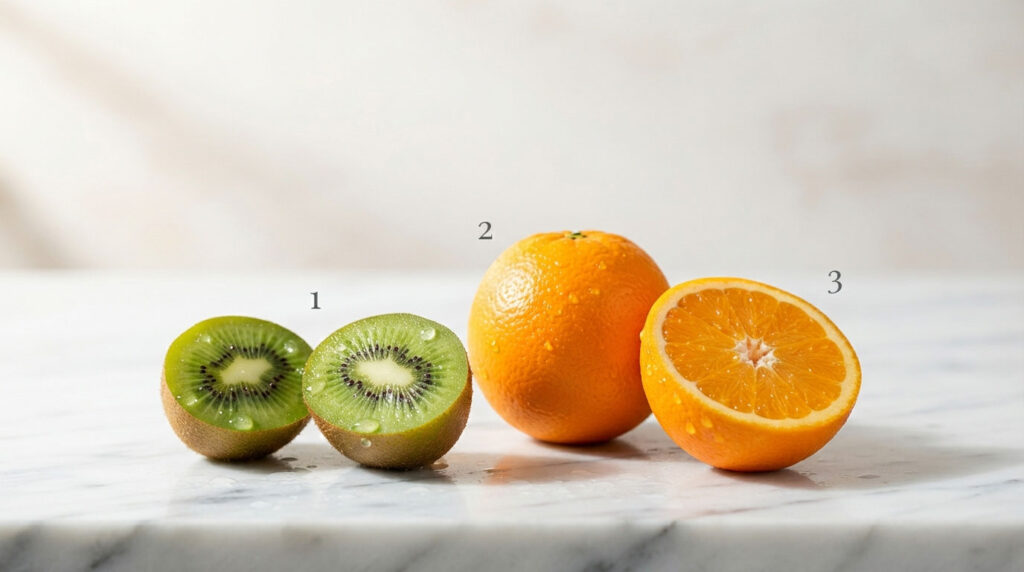
Oranges get all the vitamin C glory. Walk through any grocery store in cold season and the signs practically shout it at you. Here’s the twist: an orange isn’t even the vitamin C champion in the fruit bowl.
Table of Contents
A kiwi beats it, and gold kiwi isn’t close. Readers ask us this one constantly at HealthCareOnTime, usually surprised by the answer. So our nutrition team pulled the latest USDA and NIH numbers to settle it for good.
This guide gives you the verdict first, then the real numbers, the fuller nutrition picture, and how to squeeze the most vitamin C out of whichever fruit you choose.
| Quick answer: Kiwi has more vitamin C than orange. Green kiwi delivers about 93 mg per 100 grams versus roughly 53 mg for orange, making kiwi about 75% higher by weight. Gold (SunGold) kiwi goes even further at around 161 mg per 100 grams, nearly triple an orange. A single kiwi can cover your full daily vitamin C target, while it takes a medium-to-large orange to do the same. |
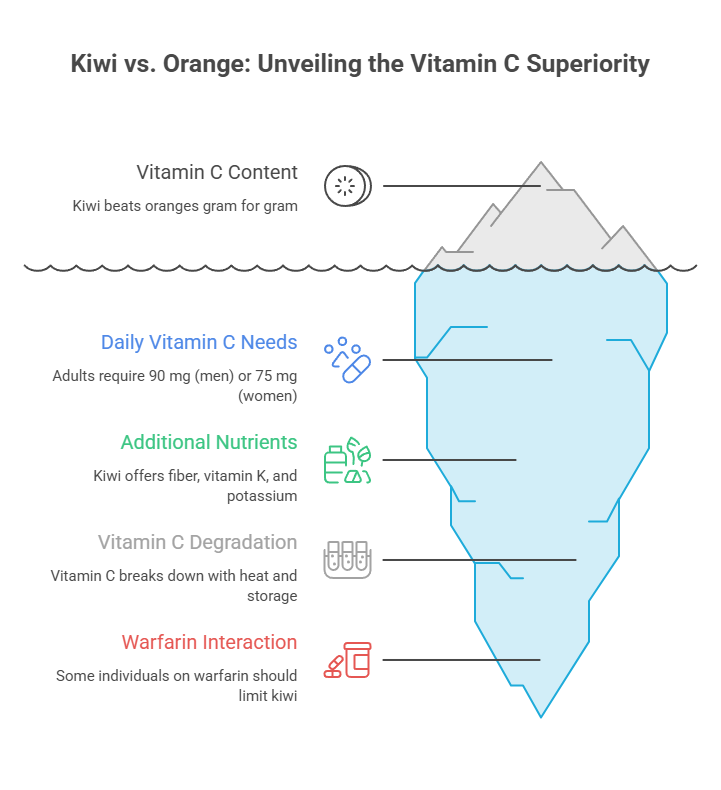
| At a Glance Gram for gram, both kiwi types beat oranges on vitamin C, and gold kiwi wins by a wide margin.One medium green kiwi supplies most of a day’s vitamin C; one gold kiwi supplies more than a full day.Oranges are larger, so a whole orange still delivers a solid vitamin C dose per fruit.Adults need 90 mg (men) or 75 mg (women) of vitamin C daily, per the NIH.Kiwi also brings more fiber, vitamin K, and potassium; oranges bring more folate and vitamin A.Vitamin C breaks down with heat and storage, so fresh and raw beats cut-up or cooked.A few people, including those on warfarin, should watch their kiwi intake. |
The Short Answer, Kiwi Wins (and by How Much)
Let’s not bury the verdict. On vitamin C per gram, kiwi outperforms orange every time, whether you reach for the fuzzy green type or the smooth gold one.
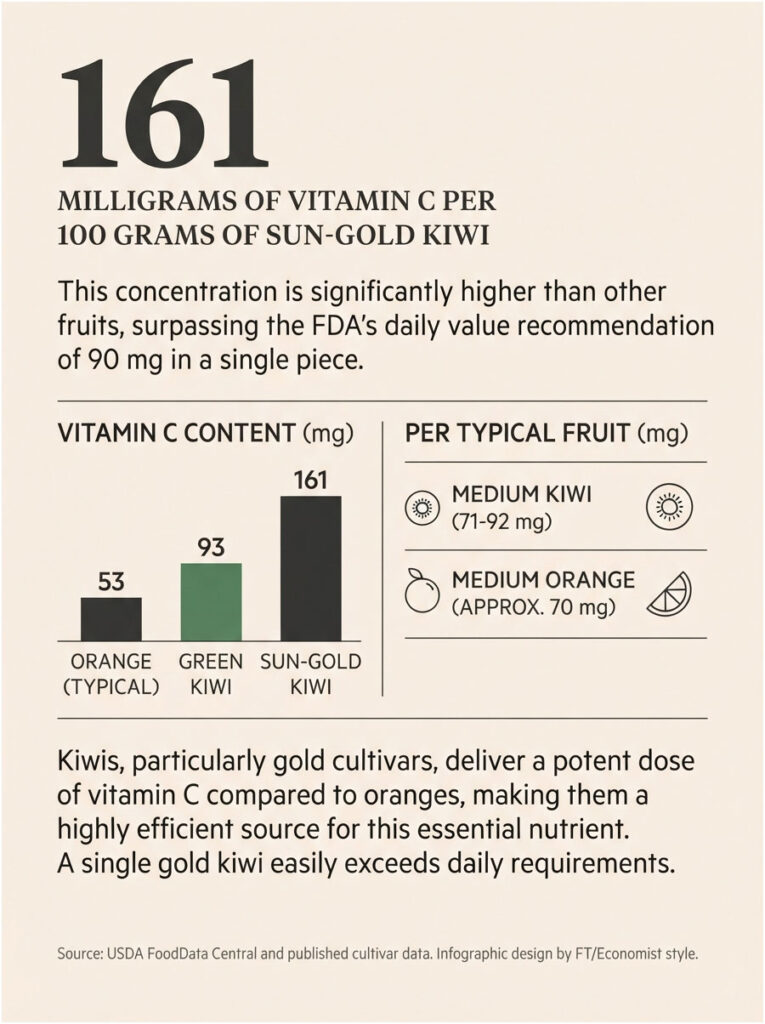
In a 100-gram serving, kiwifruit and orange contain about 92.7 mg and 53.2 mg of vitamin C, respectively. That’s kiwi coming in roughly 75% higher by weight before you even consider the gold variety.
Gold kiwi changes the math entirely. Gold kiwifruit reaches roughly 161 mg of vitamin C per 100 grams, nearly tripling the orange’s content. For a fruit most Americans think of as a smoothie garnish, that’s a remarkable number.
Per 100 Grams vs Per Fruit, Why Both Matter
Here’s the honest complication our nutrition team always flags. Oranges are bigger than kiwis, so comparing them by weight tells only half the story.
Per 100 grams, kiwi wins clearly. But a whole orange weighs more than a whole kiwi, so a single orange still delivers a respectable dose per fruit. A medium orange provides roughly 70 mg of vitamin C, while one medium kiwi lands around 71 to 92 mg depending on size and variety.
That’s why the table below shows both numbers. Look at the per-100-gram column to judge concentration, and the per-fruit column to judge what you actually get when you eat one.
| Fruit / Variety | Vitamin C per 100g | Per Typical Fruit or Serving | % Daily Value (per 100g) |
| Gold kiwi (SunGold) | ~161 mg | ~130 mg per fruit | ~179% |
| Green kiwi (Hayward) | ~93 mg | ~64 mg per medium fruit | ~103% |
| Navel orange | ~59 mg | ~83 mg per medium fruit | ~66% |
| Orange (raw, all varieties) | ~53 mg | ~70 mg per medium fruit | ~59% |
| Orange juice, fresh | ~50 mg | ~100 mg per 8-oz glass | ~56% |
Daily Value here is the FDA’s 90 mg label standard. Notice that a single gold kiwi clears your whole day, and even a modest green kiwi gets you most of the way there. Values come from USDA FoodData Central and published cultivar data.
How Much Vitamin C Do You Actually Need?
Before crowning a winner in your grocery cart, it helps to know the target you’re aiming for. Most Americans need far less vitamin C than the megadose supplement industry implies.
RDA, Daily Value, and the Upper Limit
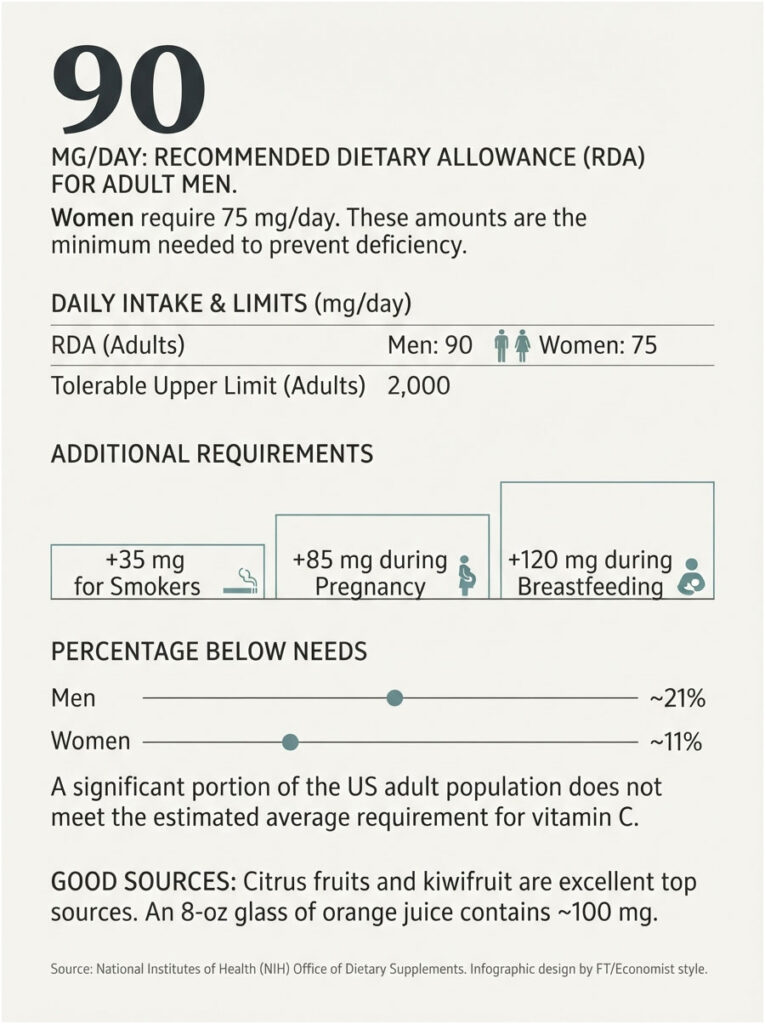
The official numbers are modest. The Recommended Dietary Allowance for adults is 90 mg per day for men and 75 mg per day for women. That’s it. One kiwi or one good-sized orange lands you in range.
There’s a ceiling too. The tolerable upper limit for adults is 2,000 mg per day, set because higher intakes can cause osmotic diarrhea. You’d have to eat a truly absurd amount of fruit to approach it, which is one reason food sources are safer than pills.
The good news for both fruits: deficiency is rare in the United States, and citrus fruits and kiwifruit are named among the best food sources of vitamin C. Whichever you choose, you’re picking a winner.
| Metric | Figure | Source |
| RDA, adult men / women | 90 mg / 75 mg | NIH ODS |
| Tolerable upper limit (adults) | 2,000 mg/day | NIH / Nat. Academies |
| FDA Daily Value (food labels) | 90 mg | FDA |
| Extra needed for smokers | +35 mg/day | NIH ODS |
| Vitamin C in 8-oz orange juice | ~100 mg | USDA / Nat. Academies |
| US adults below vitamin C needs (nonsmokers) | ~21% men, ~11% women | Nat. Academies DRI |
Smokers, Pregnancy, and Who Needs More
A few groups need extra. Adult smokers require an additional 35 mg per day because of the oxidative stress from tobacco. Secondhand smoke exposure raises needs too.
Pregnancy and breastfeeding push the target up as well. Pregnant people should aim for about 85 mg a day, and those breastfeeding around 120 mg. For anyone in these groups, a daily kiwi is an easy way to cover the gap.
One question we get a lot: does everyone need a supplement? Not usually. Patients ask us this often, and for most people eating fruit daily, the honest answer is that food does the job.
(Internal link opportunity: our full guide to daily vitamin C requirements.)
Gold Kiwi vs Green Kiwi vs Orange
Not all kiwis are equal, and the difference matters more than the difference between orange varieties. If squeezing the most vitamin C from each bite is the goal, the type you buy counts.
Why SunGold Gold Kiwi Tops the Chart
Gold kiwi, sold widely under the Zespri SunGold name, is the standout. Its smooth, hairless skin and sweeter, tropical taste hide a serious vitamin C payload.
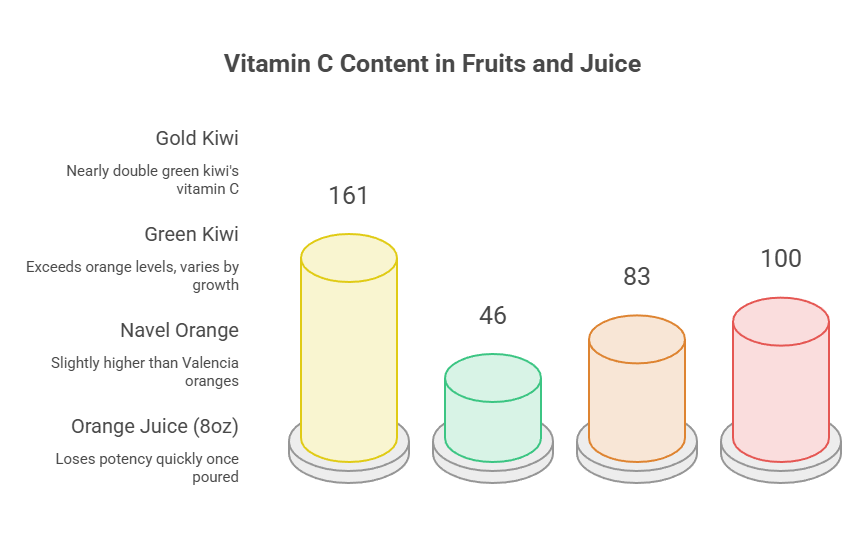
At roughly 161 mg per 100 grams, gold kiwi carries almost double the vitamin C of green kiwi and close to three times that of an orange. Two gold kiwifruit deliver over 300 mg of vitamin C, well beyond the baseline recommendation.
Green kiwi, the familiar fuzzy Hayward type, still beats oranges comfortably. Our nutrition team notes one caveat worth knowing: some studies of the Hayward variety have measured a wider range, from 38 to 54 mg per 100 grams, depending on growing conditions, ripeness, and storage. Even at the low end, it holds its own.
Navel vs Valencia Oranges and Orange Juice
Oranges vary too, though less dramatically. Navel oranges, the easy-peel snacking type, tend to run slightly higher in vitamin C than Valencia oranges, the classic juicing fruit.
Because navel oranges are also larger, a single one can deliver around 83 mg of vitamin C, edging close to a full day’s need on its own. Valencia oranges land a bit lower per fruit but shine when juiced.
Speaking of juice, fresh orange juice is a strong vitamin C source. An 8-ounce glass of orange juice from frozen concentrate supplies about 100 mg of vitamin C. The catch, as you’ll see below, is that juice loses potency fast once it’s poured and sitting.
Why Kiwi Seems to Hold Its Vitamin C Well
There’s a common claim that kiwi’s vitamin C is somehow “better” than an orange’s. The truth is more measured, and worth stating carefully.
Both fruits pair vitamin C with natural plant compounds. Oranges carry bioflavonoids like hesperidin, and kiwi carries its own mix of flavonoids and polyphenols alongside vitamin E. These compounds have antioxidant roles, though claims that they dramatically boost vitamin C absorption are not firmly settled.
What is well established is simpler. Vitamin C from whole fruit is absorbed about as well as vitamin C from a pill, and both fruits deliver it in a fresh, raw, water-rich form that’s easy to eat. That’s the real reason both are excellent sources, no marketing spin required.
Beyond Vitamin C, the Fuller Nutrition Picture
Vitamin C is the headline, but nobody eats fruit for a single nutrient. When you widen the lens, kiwi and orange each carry real strengths, and the “best” one depends on what else you want from it.
Fiber, Potassium, Vitamin K, Folate, and Calories
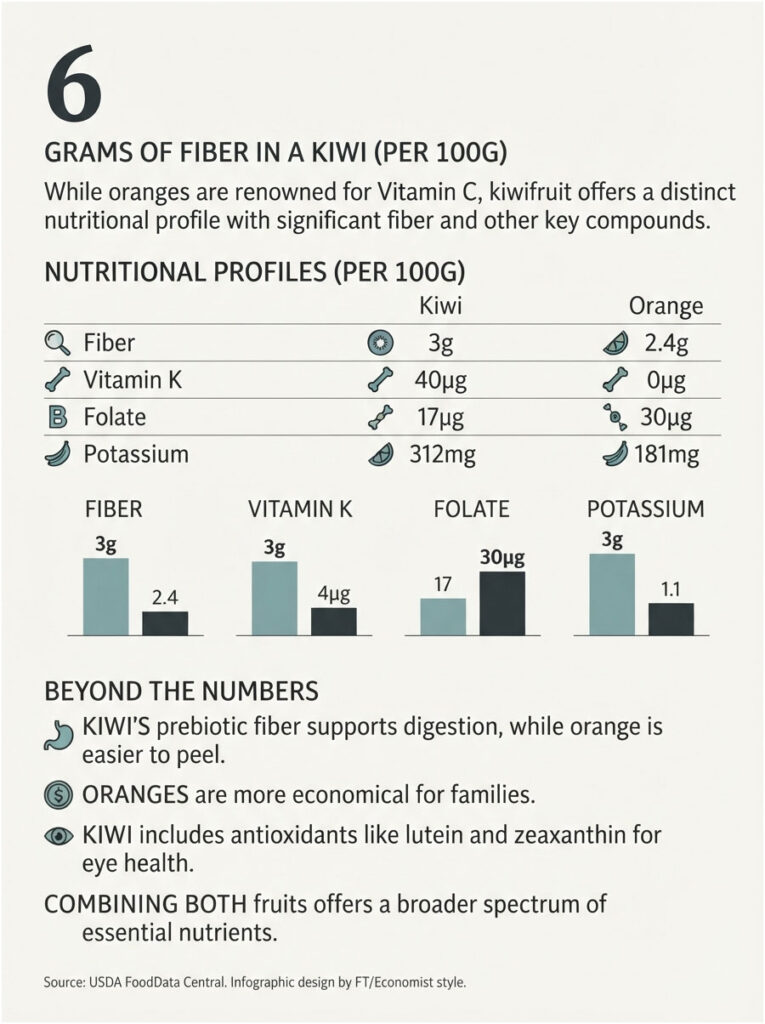
The two fruits diverge in interesting ways. Kiwi tends to bring more fiber and vitamin K, while oranges lead on folate. Both are low in calories and naturally fat-free.
Kiwifruit provides about 61 calories per 100 grams versus 47 for orange, along with slightly more protein and fiber, while orange carries more folate, calcium, and vitamin A. Neither is a diet-buster, so calorie count shouldn’t tip your decision much.
Where the Orange Still Wins
Oranges aren’t the loser here, just the runner-up on vitamin C. They offer more folate, useful for cell growth and especially valued in pregnancy, plus more vitamin A for eye health.
Oranges also win on size and sweetness for many people. They’re easy to peel, familiar, and often cheaper per fruit, which matters when you’re feeding a family and want everyone to actually eat them.
Where Kiwi Pulls Ahead
Kiwi’s edge goes beyond vitamin C. It provides vitamin K, potassium, folate, and prebiotic fiber, a broader nutritional profile than orange in several respects. That fiber supports digestion, and the actinidin enzyme in kiwi helps break down protein.
Kiwi also carries antioxidants oranges lack, including lutein and zeaxanthin, two compounds linked to eye health. Paired with its vitamin E, kiwi offers an antioxidant mix that complements its vitamin C nicely.
The Numbers Side by Side
For a quick head-to-head beyond vitamin C, here’s how a 100-gram serving of each fruit stacks up on the nutrients people ask us about most.
| Nutrient (per 100g) | Green Kiwi | Orange | Winner |
| Vitamin C | 92.7 mg | 53.2 mg | Kiwi |
| Calories | 61 kcal | 47 kcal | Orange (fewer) |
| Fiber | ~3.0 g | ~2.4 g | Kiwi |
| Vitamin K | ~40 mcg | ~0 mcg | Kiwi |
| Folate | ~25 mcg | ~30 mcg | Orange |
| Potassium | ~312 mg | ~181 mg | Kiwi |
The pattern is clear. Kiwi edges ahead on fiber, vitamin K, and potassium, while the orange keeps a slim lead on folate and comes in a touch lower in calories. Neither is a wrong choice, and eating both covers more ground than either alone.
Does This Actually Help With Colds and Immunity?
Here’s where we have to be straight with you, even though it dents the “eat kiwi to dodge colds” pitch. The vitamin C and immunity story is more modest than marketing suggests.
What the Evidence Really Says
The cold-prevention claim mostly doesn’t hold up. For most people, taking vitamin C regularly does not reduce the chances of catching a cold, though it might slightly shorten a cold’s duration and severity, and taking it only after symptoms start doesn’t appear to help.
That said, vitamin C is genuinely essential for immune function, collagen, and iron absorption. Being deficient absolutely hurts your defenses. The nuance is that topping up beyond adequate levels doesn’t buy most people extra protection.
So the honest framing we give readers is this. Eat kiwi and oranges because they’re nutritious, delicious, and easily cover your needs, not because they’ll build a force field against every sniffle.
The Two-Gold-Kiwi Study and the Kiwi-vs-Supplement Trial
Some research does point to real benefits at higher fruit intakes. In a study of adults with a history of severe respiratory infections, eating two gold kiwifruit per day, providing about 300 mg of vitamin C, raised blood vitamin C to the optimal range and led to measurable reductions in fatigue and low mood.
There’s also a smart question about whether fruit beats a pill. Researchers tested exactly that. A randomized crossover trial compared kiwifruit-derived vitamin C to a synthetic tablet and found no meaningful difference in how much reached the bloodstream.
The takeaway is reassuring. Real fruit works just as well as a supplement for raising vitamin C, and it delivers fiber and other nutrients a pill can’t.
(Internal link opportunity: foods that genuinely support immune health.)
Why Vitamin C Matters Beyond Colds
Colds get the attention, but vitamin C earns its keep in quieter ways every day. Understanding them makes both fruits easier to appreciate.
Collagen and Skin
Vitamin C is a required cofactor for making collagen, the protein that keeps skin, blood vessels, and connective tissue strong. Without enough, wounds heal slowly and skin loses resilience, which is why severe deficiency, known as scurvy, shows up as bleeding gums and poor healing.
Iron Absorption
Vitamin C also helps your body absorb iron from plant foods, a real benefit for vegetarians and anyone prone to low iron. Pairing a vitamin C-rich fruit like kiwi with an iron source such as spinach or beans boosts how much iron you actually take in.
Everyday Antioxidant Defense
As a water-soluble antioxidant, vitamin C helps neutralize free radicals that can damage cells over time. It works alongside the other antioxidants in both fruits, part of why a produce-rich diet is linked to better long-term health.
Our nutrition team frames the payoff simply. The benefit of hitting your vitamin C target daily is steady and cumulative, not a dramatic overnight boost, which is exactly why a regular habit of fruit beats an occasional megadose.
Kiwi vs Orange for Weight Loss and Blood Sugar
Two questions come up a lot with these fruits: which is better if you’re watching your weight, and which is gentler on blood sugar. Both are reasonable picks, with small differences.
For weight management, both are low in calories and high in water and fiber, which help you feel full. Green kiwi’s extra fiber gives it a slight edge for satiety, though the gap is small enough that taste and preference should decide.
For blood sugar, both are moderate on the glycemic scale and fine for most people in normal portions. Green kiwi tends to carry a bit less sugar per fruit than a sweet orange, so it’s a sensible default if you’re keeping an eye on glucose. As always, whole fruit beats juice, which delivers sugar faster with less fiber.
Getting the Most Vitamin C From Either Fruit
Buying the right fruit is only step one. How you store and prepare it decides how much vitamin C actually reaches you, since this vitamin is famously fragile.
Eat It Raw, Store It Cool, Cut It Fresh
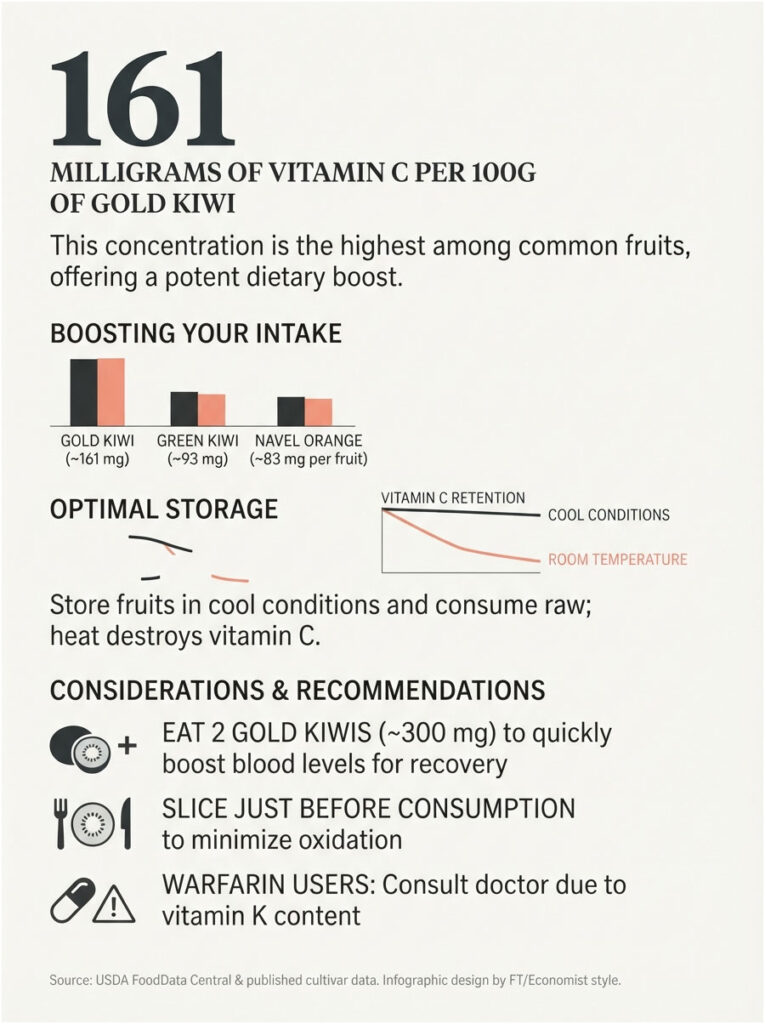
Vitamin C hates heat and time. The vitamin C content of food can be reduced by prolonged storage and by cooking, because ascorbic acid is water soluble and destroyed by heat. That’s a point in fruit’s favor, since we usually eat both kiwi and oranges raw.
Practical habits help. Keep both fruits cool, slice them right before eating rather than hours ahead, and drink orange juice soon after pouring. A kiwi sliced into a lunchbox at 7 a.m. will have lost some vitamin C by noon.
Our nutrition team tells readers to think of vitamin C like a melting ice cube. The longer it sits exposed to air, heat, and light, the more quietly slips away.
Can You Eat Kiwi Skin?
Yes, and it’s a free upgrade. Kiwi skin is edible and adds fiber, with the vitamin C staying roughly steady whether you eat the skin or not.
If green kiwi’s fuzz puts you off, gold kiwi has smoother skin that’s much easier to eat. Give either a good wash first, then bite in like you would an apple or a plum.
| Scenario | Recommended Action | Why |
| Want the most vitamin C per bite | Choose gold (SunGold) kiwi | ~161 mg per 100g, highest of these fruits |
| Recovering, want a big vitamin C boost | Eat 2 gold kiwi (~300 mg) | Raises blood vitamin C toward saturation |
| Dislike fuzzy texture | Pick a navel orange or smooth gold kiwi | Navel gives ~83 mg per fruit; gold skin is edible |
| Watching blood sugar | Green kiwi (moderate GI, more fiber) | Fewer sugars than orange, extra fiber |
| Meal-prepping fruit ahead | Slice fresh, eat soon, store cool | Vitamin C fades with cutting and storage |
| Taking warfarin (blood thinner) | Ask your doctor before eating lots of kiwi | Kiwi’s vitamin K can affect warfarin |
How to Buy and Ripen Each Fruit
A little shopping know-how protects both the flavor and the vitamin C. Ripeness and freshness affect how much of that vitamin actually survives to your plate.
Picking Kiwi
Choose kiwi that yields slightly to gentle pressure, the same give as a ripe pear. Rock-hard kiwi is underripe and can taste sharp, while overly soft or bruised fruit is past its prime.
To ripen firm kiwi, leave it on the counter for a few days, and speed it up by storing it in a paper bag with an apple or banana. Once ripe, move it to the fridge, where it holds for a week or more.
Picking Oranges
Pick oranges that feel heavy for their size, a sign they’re juicy inside. Firm skin with no soft spots is ideal, and color isn’t a reliable ripeness cue since some ripe oranges still show green patches.
Oranges keep well at room temperature for about a week, or up to two weeks refrigerated. Eat cut oranges promptly, since exposed flesh loses vitamin C the longer it sits.
A Simple Day of Eating
Want an easy target? One gold kiwi at breakfast alone covers an adult’s full daily vitamin C, with room to spare. Prefer green kiwi or oranges? Two servings across the day still put you comfortably over the line.
Mixing the two is the smartest move of all. A kiwi in the morning and an orange as an afternoon snack blends kiwi’s fiber and vitamin K with the orange’s folate, giving you more than vitamin C alone.
Easy Ways to Eat More of Both
Meeting your vitamin C target is easy when the fruit is ready to grab. A few simple habits make kiwi and oranges part of the routine instead of an afterthought.
Slice a kiwi in half and scoop it with a spoon for a no-mess snack, or add rounds to yogurt and oatmeal. Toss orange segments into a salad, or keep a bowl of easy-peel navels on the counter where the family will actually see them.
For a fast vitamin C hit, blend a green or gold kiwi with an orange into a quick smoothie, and drink it right away before the vitamin C fades. Our nutrition team’s rule of thumb: buy a few days’ worth, keep it visible, and eat it fresh.
Kiwi and Oranges for Kids
Both fruits are easy wins for children, who often need coaxing toward produce. Vitamin C needs are lower for kids, so a small serving goes a long way.
Oranges tend to be the easier sell, sweet, familiar, and simple to segment into snack-sized pieces. Sliced kiwi, especially the sweeter gold type, can win over kids who like its bright color and soft texture.
One safety note our team passes along: introduce kiwi carefully in young children, since it can occasionally trigger allergic reactions. Start with a small amount and watch for any response, particularly around the mouth.
Who Should Be Careful
For nearly everyone, both fruits are a healthy daily habit. A small number of people, though, have reasons to go easy, and it’s worth knowing if that’s you.
Kiwi allergy is real and sometimes tied to latex-fruit syndrome, so people allergic to latex may react to kiwi. Symptoms can range from an itchy mouth to more serious reactions, and anyone affected should avoid it.
Kiwi is also relatively high in vitamin K, which can interfere with the blood thinner warfarin. If you take it, keep your vitamin K intake steady and talk with your clinician rather than suddenly loading up on kiwi.
Both fruits contain natural oxalates, which matter for people prone to certain kidney stones. And while both are fine for most people managing blood sugar, portion still counts, since fruit contains natural sugars.
| Disclaimer: This article is for general education, not medical or nutritional advice. Vitamin C content varies by variety, ripeness, and storage, and individual needs differ. If you take medications like warfarin, have a fruit allergy, or are considering supplements, talk with a qualified healthcare provider before making changes. |