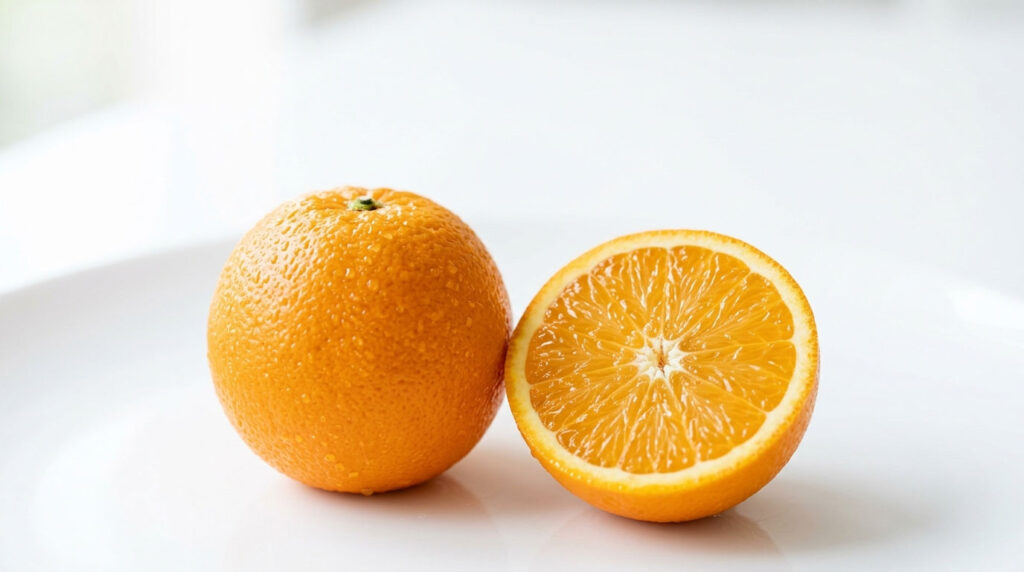
Here’s something that surprises most people counting calories: a whole orange has fewer calories than a single tablespoon of olive oil, yet it can cover most of your daily vitamin C in one sitting.
Table of Contents
Quick Answer
A medium orange (about 131 grams, 2 5/8 inches across) has roughly 62 calories. A small orange has about 45 calories, and a large one about 87. Per 100 grams, oranges carry around 47 calories. Nearly all of that energy comes from natural carbohydrates, alongside about 3 grams of fiber and 70 milligrams of vitamin C, which covers most of an adult’s daily need.
At a Glance
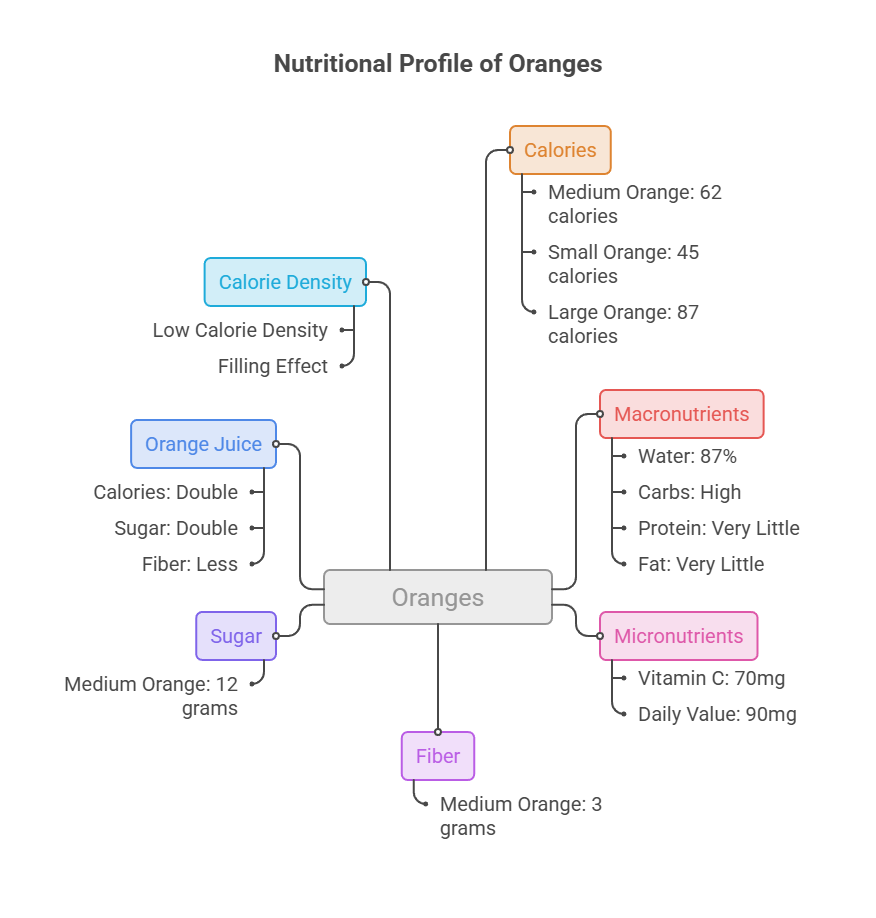
- A medium orange has about 62 calories, a small one about 45, and a large one about 87.
- Oranges are mostly water (about 87%) and carbs, with very little protein or fat.
- One medium orange delivers roughly 70mg of vitamin C, most of the 90mg Daily Value.
- You get about 3 grams of fiber and 12 grams of natural sugar in a medium orange.
- One cup of orange juice has nearly double the calories and sugar of a whole orange, with far less fiber.
- Oranges have very low calorie density, which makes them filling for the calories.
How Many Calories Are in an Orange?
The number people search for most has a clean answer, though it shifts a little with size. Our nutrition team works from USDA FoodData Central, the federal reference lab database, to keep these figures accurate.
The Short Answer
According to USDA FoodData Central, a medium orange has about 62 calories, a small orange around 45 calories, and oranges carry roughly 47 calories per 100 grams. A large orange comes in at about 86 calories.
Those numbers hold across the common commercial oranges you find at any US grocery store. The slight differences come down to weight and water content, not anything exotic.
Calories by Serving Size
Size is the single biggest factor in how many calories an orange delivers. A produce bin holds a wide range, from a tennis-ball small to a softball large.
Patients tracking their diet often ask us how to count an orange when the package has no label. The table below gives you the USDA-based numbers for each common size, so you can match what’s in your hand.
| Serving Size | Weight | Calories | Carbs | Sugar | Fiber | Vitamin C |
| Small orange | 96 g | ~45 | 11.3 g | 9.0 g | 2.3 g | 51 mg |
| Medium orange | 131 g | ~62 | 15.4 g | 12.2 g | 3.1 g | 70 mg |
| Large orange | 184 g | ~87 | 21.6 g | 17.2 g | 4.4 g | 98 mg |
| Per 100 grams | 100 g | ~47 | 11.8 g | 9.3 g | 2.4 g | 53 mg |
| Orange sections (1 cup) | 180 g | ~85 | 21.2 g | 16.8 g | 4.3 g | 96 mg |
A half orange, then, runs about 31 calories for a medium fruit. Even the largest oranges stay under 90 calories, which is why they sit near the top of most nutritionists’ snack lists.
Full Orange Nutrition Breakdown (USDA)
Calories tell only part of the story. The real value of an orange shows up when you look at what those 62 calories actually buy you.
Macronutrients
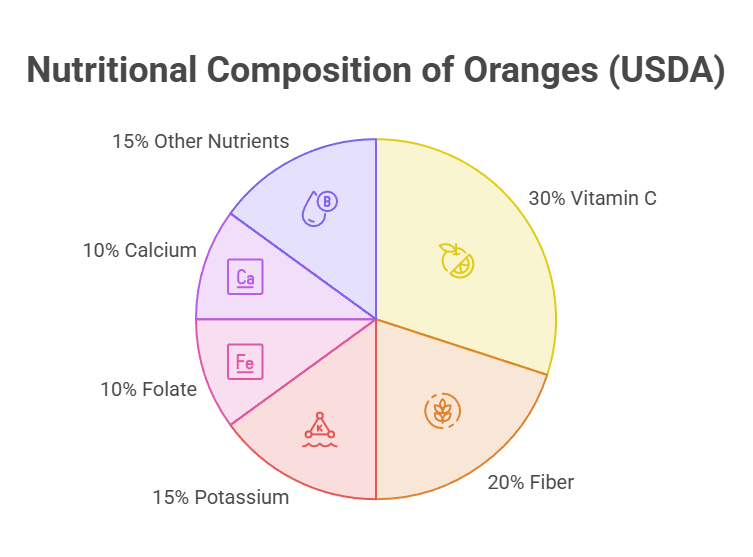
Oranges are a carbohydrate food, plain and simple. A medium orange provides about 15.4 grams of carbohydrates, 3.1 grams of fiber, 12.2 grams of natural sugar, and 1.2 grams of protein, with negligible fat.
The sugar is a mix of fructose, glucose, and sucrose, the natural sugars found in whole fruit. Our dietitian reviewers point out that the 3 grams of fiber matter here, because fiber slows how fast that sugar hits your bloodstream.
Vitamins and Minerals
This is where oranges earn their reputation. The same medium orange that costs you 62 calories is loaded with micronutrients.
A medium orange supplies roughly 70mg of vitamin C, 237mg of potassium, and 30 micrograms of folate. It also brings small amounts of calcium, thiamin, and magnesium to the table.
How Much Vitamin C and What It Does
Vitamin C is the headline nutrient, and oranges are one of the most reliable food sources. A medium orange’s 70mg covers most of the 90mg Daily Value set by the FDA.
According to Healthline, a single orange can supply around 92% of your daily vitamin C, a nutrient your body uses for immune function, collagen synthesis, and iron absorption. For many adults, especially women whose requirement is 75mg, one orange handles the full day.
Water Content and Calorie Density
The reason an orange fills you up for so few calories comes down to water. Oranges are about 87% water, with carbohydrates making up most of the rest.
That high water and fiber content gives oranges very low calorie density, meaning a lot of food volume for little energy. In diet reviews handled by our team, low-calorie-density foods like oranges are the ones that help people feel satisfied without overshooting their targets.
The table below lays out the full nutrition profile of a medium orange with Daily Value percentages, sourced from USDA data.
| Nutrient | Amount per Medium Orange (131g) | % Daily Value | Source |
| Calories | 62 | 3% | USDA FoodData Central |
| Total carbohydrate | 15.4 g | 6% | USDA FoodData Central |
| Dietary fiber | 3.1 g | 11% | USDA FoodData Central |
| Total sugars | 12.2 g | n/a | USDA FoodData Central |
| Protein | 1.2 g | 2% | USDA FoodData Central |
| Total fat | 0.2 g | 0% | USDA FoodData Central |
| Vitamin C | 70 mg | 78% | USDA FoodData Central |
| Potassium | 237 mg | 5% | USDA FoodData Central |
| Folate | 30 mcg | 8% | USDA FoodData Central |
| Calcium | 52 mg | 4% | USDA FoodData Central |
Calories by Orange Variety
Not every orange is the same, and the type you pick changes the numbers slightly. The differences are modest, but worth knowing if you track closely.
Navel oranges, the seedless, easy-peel favorite, tend to run a touch higher because they are often larger. One navel orange (140 grams) provides about 73 calories, 16.5 grams of carbohydrates, 2.8 grams of fiber, 1.3 grams of protein, and 12 grams of sugar.
Valencia oranges, the classic juicing orange, sit close to the standard 62-calorie medium. Blood oranges are similar in calories but pack extra anthocyanins, the pigments that give them their crimson color and antioxidant punch.
Cara cara oranges, a pink-fleshed navel type, match regular navels closely on calories while adding lycopene. Mandarins and clementines are smaller, so they come in lower, around 35 to 50 calories each, which makes them an easy grab-and-go option. Across the readers HealthCareOnTime serves, the variety matters far less than portion size for daily calorie math.
How Oranges Compare to Other Fruits
Putting an orange next to other common fruits shows why it lands on so many healthy-eating lists. It is low in calories and unusually high in vitamin C for its size.
An orange beats an apple, a banana, and a cup of grapes on calories per typical serving, while running circles around all of them on vitamin C. Only strawberries, another vitamin C star, come in lower on calories.
The table below compares one common serving of each fruit, using USDA reference values. Our nutrition team uses comparisons like this to help readers swap higher-calorie snacks for lighter ones.
| Fruit (typical serving) | Calories | Carbs | Sugar | Fiber | Vitamin C |
| Orange, medium (131g) | ~62 | 15.4 g | 12.2 g | 3.1 g | 70 mg |
| Apple, medium (182g) | ~95 | 25 g | 19 g | 4.4 g | 8 mg |
| Banana, medium (118g) | ~105 | 27 g | 14 g | 3.1 g | 10 mg |
| Grapes, 1 cup (151g) | ~104 | 27 g | 23 g | 1.4 g | 4 mg |
| Strawberries, 1 cup (144g) | ~46 | 11 g | 7 g | 3.0 g | 85 mg |
The takeaway is simple. If you want the most vitamin C for the fewest calories among everyday fruits, oranges and strawberries lead the pack.
Whole Orange vs Orange Juice
If there’s one swap that changes the calorie picture, it’s reaching for juice instead of fruit. The two are not interchangeable, even though both count as a serving of fruit.
The Calorie and Sugar Gap
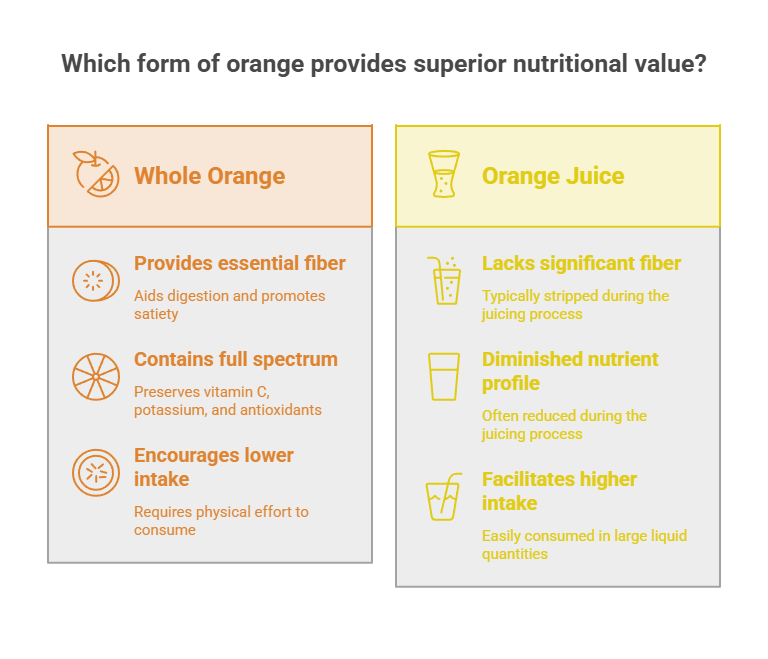
Juice concentrates the sugar and calories of several oranges into one easy-to-drink glass. According to Healthline, a cup of orange juice has significantly less fiber and about twice the calories and carbs of a whole orange, with the carbs being mostly fruit sugar.
In real numbers, one cup of orange juice contains around 110 to 122 calories and about 21 grams of sugar. That’s close to two whole oranges in a single serving, and it goes down in seconds.
Why Fiber Makes the Whole Fruit More Filling
The fiber stripped out during juicing is exactly what makes a whole orange more satisfying. Fiber slows digestion and blunts the blood sugar response.
Our nutrition team notes that juice is far easier to overconsume than fruit, since chewing and the fiber load of a whole orange naturally signal fullness. The American Heart Association recommends limiting fruit juice to no more than 1 cup per day for adults to avoid excess sugar.
The comparison below shows the two side by side, using one medium orange against one cup of juice.
| Measure | Medium Orange (131g) | 1 Cup Orange Juice (248g) |
| Calories | ~62 | ~110 |
| Total sugar | ~12 g | ~21 g |
| Fiber | ~3 g | ~0.5 g |
| Vitamin C | ~70 mg | ~120 mg |
| Counts as | 1 fruit serving | 1 fruit serving |
| Fills you up | More (fiber + chewing) | Less (quick to drink) |
There’s a tradeoff worth naming. Orange juice does deliver over 100% of the daily vitamin C in a single cup, so it is nutrient-rich, just calorie-dense. For most goals, the whole fruit wins.
Health Benefits of Oranges
Beyond the calorie count, oranges bring real benefits that make them more than a sweet snack. The science here is well established.
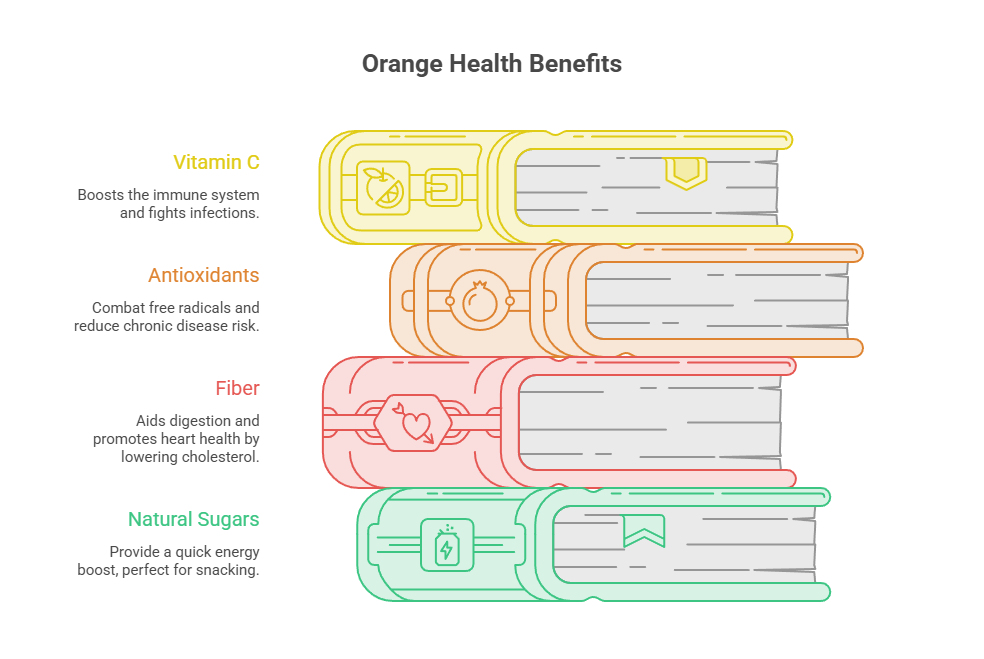
Vitamin C and Immune Support
The standout is vitamin C, and oranges deliver it in spades. Your body cannot make or store vitamin C, so a daily food source matters.
Vitamin C supports immune cells, helps build collagen for skin and connective tissue, and boosts how well your body absorbs iron from plant foods. One orange handles most of that daily job.
Fiber and Digestion
The 3 grams of fiber in a medium orange do quiet, useful work. As Healthline notes, getting enough fiber supports a healthy digestive system, helps with regularity, and fuels beneficial gut bacteria.
That same fiber slows sugar absorption, which is why a whole orange is gentler on blood sugar than its juice. Our dietitian reviewers often suggest pairing fruit with a protein or fat to steady energy further.
Potassium and Heart Health
Oranges are a respectable source of potassium, the mineral that helps regulate blood pressure and fluid balance. A medium orange offers about 237mg.
Potassium works against the blood-pressure-raising effect of sodium, so potassium-rich foods like oranges fit naturally into a heart-healthy eating pattern.
Flavonoids and Antioxidants
Oranges carry more than the nutrients on the label. They are rich in flavonoids and other plant compounds that act as antioxidants.
These compounds, including hesperidin, have been studied for their roles in heart and vascular health. Blood oranges and cara caras add pigment-based antioxidants on top of the standard profile.
Are Oranges Good for Weight Loss?
This is one of the most common questions we field about oranges, and the answer is a confident yes for most people. The reasons go back to calorie density.
Low Calorie Density and Satiety
At roughly 62 calories with 3 grams of fiber and high water content, a medium orange offers a lot of food for very little energy. That combination helps you feel full.
Foods like oranges let you eat a satisfying volume while keeping your calorie total in check. In diet reviews handled by our team, swapping a processed sweet snack for a whole orange is one of the easiest wins people make.
Whole Fruit vs Juice for Weight Goals
The whole-fruit advantage shows up clearly in research. Harvard research indicates that whole fruit consumption is linked to a lower risk of type 2 diabetes, while fruit juice consumption is associated with higher risk.
For weight management, the fiber and chewing of a whole orange win every time over the quick calories of juice. The table below matches common goals to the smarter choice.
| Your Goal | Recommended Choice | Why |
| Lose or manage weight | Whole orange | Low calories, high fiber, more filling |
| Steady blood sugar | Whole orange, paired with protein | Fiber slows sugar absorption |
| Fast vitamin C boost | Whole orange or small juice (4 to 6 oz) | Both are rich; fruit adds fiber |
| Post-workout carbs | Whole orange or diluted juice | Quick natural carbs plus potassium |
| Limit added sugar | Whole orange | No added sugar; juice can be sweetened |
| Hydration with nutrients | Whole orange | About 87% water plus fiber |
Oranges and Blood Sugar
Oranges have a relatively low glycemic index, generally in the 31 to 51 range, because their fiber buffers sugar absorption. That makes a whole orange a reasonable fruit choice for many people watching blood sugar.
If you live with diabetes, the whole fruit is the smarter pick over juice, and pairing it with a protein or healthy fat slows the rise further. Our dietitian reviewers suggest treating one medium orange as a single fruit serving and spacing fruit through the day rather than stacking it.
How to Pick, Store, and Enjoy Oranges
Getting the most from oranges starts in the produce aisle and ends with a few easy serving ideas. The good news is that oranges are forgiving and store well.
Choose oranges that feel heavy for their size, which signals juiciness, with firm, smooth skin. Color is not a reliable ripeness cue, since some ripe oranges have a slight green tinge.
According to USDA SNAP-Ed, oranges keep at room temperature for up to one week and in the refrigerator for up to three weeks. Eat them whole as a snack, segment them into salads, yogurt, or oatmeal, or zest the peel to brighten dishes without adding calories.
If you crave juice, keep the portion to 4 to 6 ounces and pair it with a protein-rich breakfast to slow the sugar. Patients tracking their diet often find that this small portion satisfies the craving while protecting their calorie budget.
Frequently Asked Questions
How many calories are in one orange?
One medium orange has about 62 calories, based on USDA data. A small orange has roughly 45 calories and a large one about 87. The exact number depends on the orange’s size and water content, but nearly all of the calories come from natural carbohydrates, with very little fat or protein.
How many calories are in a medium orange?
A medium orange, about 131 grams or 2 5/8 inches across, contains approximately 62 calories. Along with those calories you get about 15 grams of carbohydrates, 3 grams of fiber, 12 grams of natural sugar, and 70mg of vitamin C, which covers most of an adult’s daily requirement.
How many calories are in a large orange?
A large orange, around 184 grams, has roughly 87 calories. It also provides about 22 grams of carbohydrates, more than 4 grams of fiber, and close to 98mg of vitamin C, which exceeds the full Daily Value. Even at the larger end, an orange stays under 90 calories.
How many calories are in a navel orange?
One navel orange weighing about 140 grams has roughly 73 calories. Navel oranges tend to be a bit larger than the average orange, so they run slightly higher in calories. They also supply about 16.5 grams of carbohydrates, nearly 3 grams of fiber, and 12 grams of natural sugar.
How much sugar is in an orange?
A medium orange contains about 12 grams of natural sugar. This is fruit sugar (fructose, glucose, and sucrose), not added sugar, and it comes packaged with about 3 grams of fiber that slows its absorption. That fiber is why a whole orange affects blood sugar more gently than orange juice.
How many carbs are in an orange?
A medium orange has about 15 grams of total carbohydrates. Of that, roughly 12 grams are natural sugar and 3 grams are dietary fiber. Because the fiber is subtracted to find net carbs, a medium orange has around 12 grams of net carbs, making it a moderate-carb whole food.
How much vitamin C is in an orange?
A medium orange provides about 70mg of vitamin C, which covers most of the 90mg Daily Value and meets or exceeds the daily requirement for many adults. A large orange can supply close to 100mg, more than a full day’s worth. This makes oranges one of the most reliable vitamin C foods.
Are oranges good for weight loss?
Yes, oranges suit most weight-loss plans well. A medium orange has only about 62 calories yet offers fiber and high water content, so it fills you up for very little energy. Choosing whole oranges over juice helps, since the fiber adds satiety and slows sugar absorption.
Which has more calories, an orange or orange juice?
Orange juice has far more. One cup of orange juice contains about 110 calories and 21 grams of sugar, nearly double a whole medium orange, with much less fiber. The whole fruit is more filling and gentler on blood sugar, so it is the better choice for most goals.
Is it OK to eat an orange every day?
For most people, yes. An orange a day is a low-calorie, nutrient-rich habit that supports vitamin C intake, fiber goals, and hydration. If you have diabetes or are watching carbs, account for the natural sugar, and pair the orange with protein to steady your blood sugar.
How many calories are in half an orange?
Half a medium orange has about 31 calories. Half a large orange is closer to 43 calories. The half also provides roughly 1.5 grams of fiber and about 35mg of vitamin C, still a meaningful contribution toward your daily needs for very few calories.
Do oranges have any fat or protein?
Oranges contain almost no fat, only about 0.2 grams in a medium fruit, and very little protein, around 1.2 grams. They are essentially a carbohydrate and water food. Their value comes from fiber, vitamin C, potassium, folate, and antioxidant plant compounds rather than from protein or fat.
Disclaimer
This article is for general informational purposes only and is not a substitute for professional medical or nutritional advice. Nutrition values are based on USDA FoodData Central and may vary by an orange’s size, variety, and ripeness. If you have diabetes, kidney disease, or other conditions affecting your diet, consult a qualified healthcare provider or registered dietitian.
References
- USDA FoodData Central: Oranges, raw, all commercial varieties
- NIH Office of Dietary Supplements: Vitamin C Fact Sheet
- Healthline: Oranges, Nutrition Facts and Health Benefits
- Healthline: Orange Juice, Nutrition Facts, Calories and Benefits
- USDA SNAP-Ed: Oranges, Seasonal Produce Guide
- American Heart Association: Healthy Eating
- Harvard T.H. Chan School of Public Health: The Nutrition Source, Fruits