
The enzyme that made papaya famous probably stops working the moment it hits your stomach.
That sounds like bad news. It is not. Papaya does real work on a bloated gut. The reason just has almost nothing to do with the story printed on the back of every papaya enzyme bottle in America.
Table of Contents
Walk down the supplement aisle at any Walgreens and you will find papaya chewables sold as a post-meal fix. Scroll TikTok and you will find people eating papaya on an empty stomach to “reset” their digestion. Both are built on the same shaky assumption. Here is what the research actually supports, and what it does not.
| Quick Answer: Yes, papaya is good for digestion and bloating for most people, but not for the reason you have been told. One cup of ripe papaya (140 grams) is 88 percent water, carries 2.5 grams of fiber, and is a lab-tested low-FODMAP fruit, so it eases constipation bloat without feeding gas-producing bacteria. Papain, the enzyme papaya is famous for, loses most of its punch in stomach acid. Give it 7 to 14 days. |
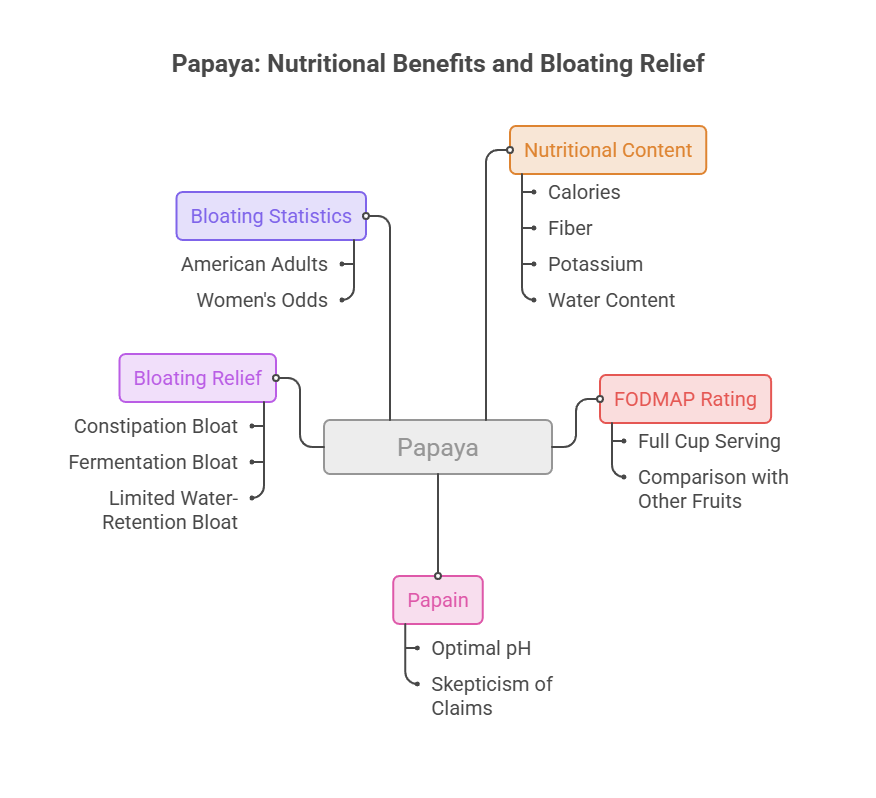
| At a Glance One cup of cubed papaya delivers 62 calories, 2.5 grams of fiber, 264 milligrams of potassium, and is roughly 88 percent water.Papaya is one of the few sweet fruits rated low FODMAP at a full 1-cup serving, unlike apples, pears, mangoes, and watermelon.Papain works best at a pH of 6.0 to 7.0. Your stomach is far more acidic than that, which is why enzyme claims deserve skepticism.The single controlled human trial on papaya and bloating used a 20 mL concentrate for 40 days, not fresh fruit.Papaya helps constipation bloat and fermentation bloat. It does very little for water-retention bloat.Nearly 1 in 7 American adults report bloating in any given week, and women carry more than twice the odds. |
Bloating Is Not One Problem, and That Changes the Papaya Answer
Ask ten Americans what bloating feels like and you get ten different descriptions. Tight and gassy. Heavy and stuck. Puffy and swollen. Those are not the same condition, and papaya does not treat them equally.
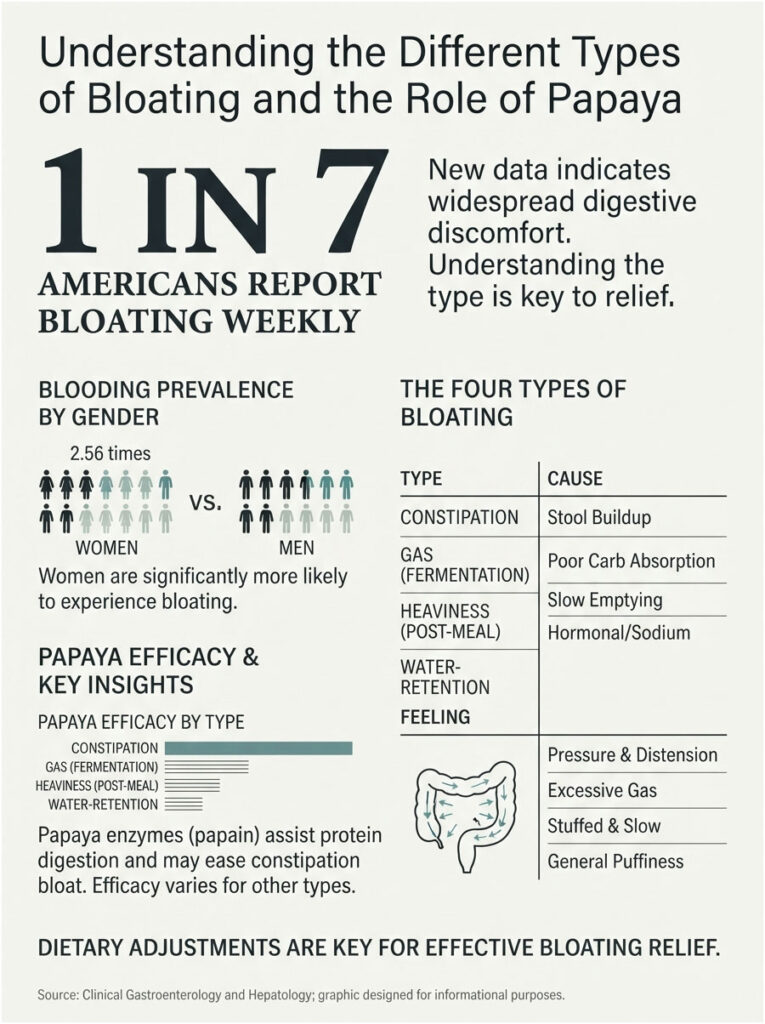
This is common enough to be a public health story. A national survey of 88,795 American adults published in Clinical Gastroenterology and Hepatology found that nearly 1 in 7 reported bloating in the past week, with women showing 2.56 times the odds of men. The Rome Foundation Global Epidemiology Study00826-0/fulltext) put the number higher, finding that 18 percent of US adults report bloating at least once a week.
Our medical reviewers see the same confusion in the questions readers send us. People reach for one remedy to treat a symptom that has four different engines behind it.
The Four Kinds of Bloat Americans Actually Get
Constipation Bloat
Stool is sitting in the colon. Pressure builds, the abdomen distends, and gas has nowhere to go. Plenty of people who feel bloated are simply backed up, even if they still have a daily bowel movement.
Fermentation Gas Bloat
Poorly absorbed carbohydrates reach the large intestine intact. Bacteria ferment them, gas volume climbs, and the intestinal wall stretches. That stretch is what you feel. This is the bloat that follows an apple, a bowl of beans, or a sugar-free mint.
Post-Meal Heaviness
A large or fatty meal slows gastric emptying. The stomach sits full and tight for hours. This is what people mean when they say their stomach feels like a stone.
Water-Retention Bloat
Sodium load, hormonal shifts, and fluid balance. The belly looks puffy but there is no extra gas and no constipation. This one is not a digestion problem at all, which is why so many food-based fixes fail against it.
| Type of Bloating | What Is Actually Driving It | Does Papaya Help? | Why or Why Not | What Works Faster |
| Constipation bloat | Slow transit, low fiber, low fluid | Yes, meaningfully | 2.5 g fiber plus 88% water per cup improves stool bulk and softness | Kiwi (2 per day), prunes, hydration, walking |
| Fermentation gas bloat | High-FODMAP foods feeding gut bacteria | Yes, indirectly | Papaya is low FODMAP, so swapping it in removes the trigger | Removing the offending food, low-FODMAP trial |
| Post-meal heaviness | Delayed gastric emptying, large or fatty meal | Modestly, at best | Papain is largely inactivated by stomach acid, so the effect is small | Smaller meals, less fat, 10-minute walk after eating |
| Water-retention bloat | High sodium, hormonal fluid shifts | Barely | 264 mg potassium per cup helps sodium balance, but this is not a gut issue | Sodium reduction, hydration, time |
| Air-swallowing bloat | Gum, straws, carbonation, eating fast | No | Papaya does nothing about swallowed air | Slowing down, dropping carbonation and gum |
| Disease-driven bloat | Celiac, IBD, SIBO, gastroparesis, ovarian pathology | No | Food cannot fix a structural or immune problem | Medical evaluation and testing |
Read that table again before you buy anything. If your bloating tracks with cramping in the lower belly and irregular stools, the pattern matters more than the fruit.
What Is Actually Inside a Cup of Papaya
Strip away the marketing and papaya is a modest fruit with three genuinely useful properties. It is mostly water, it carries a moderate fiber load, and it is unusually gentle on a reactive gut.
The USDA lists raw papaya at 43 calories per 100 grams, with 10.8 grams of carbohydrate, 7.8 grams of natural sugar, and 1.7 grams of fiber. Scale that to the way Americans actually eat it, and one cup of cubes (145 grams) delivers 62 calories, 2.5 grams of fiber, 88.3 milligrams of vitamin C, 264 milligrams of potassium, and 11.3 grams of sugar.
| Nutrient (per 1 cup, 145 g) | Amount | % Daily Value | Why It Matters When You Are Bloated |
| Water | About 88% of weight | Not applicable | Softens stool and supports transit; dehydration is a top driver of constipation bloat |
| Dietary fiber | 2.5 g | 9% | Adds bulk without the heavy fermentable load of beans or dried fruit |
| Potassium | 264 mg | 6% | Works against sodium-driven fluid retention, the puffy kind of bloat |
| Vitamin C | 88.3 mg | 98% | Supports gut lining integrity; papaya is one of the densest fruit sources in the produce aisle |
| Total sugar | 11.3 g | Not applicable | Almost entirely glucose and fructose in balanced ratio, which absorbs cleanly |
| Calories | 62 | 3% | Light enough to eat daily without displacing other food |
Water and Fiber, the Unglamorous Heroes
Papaya is around 88 percent water by weight. That matters more than any enzyme claim, because water is the thing most constipated Americans are short on.
The fiber number looks unimpressive next to a cup of black beans. That is exactly the point. Papaya adds bulk gently, without dumping a fermentable load into a gut that is already producing too much gas.
Why the Sugar Profile Is Unusual
Papaya’s sugar is made almost entirely of glucose and fructose, with essentially no sucrose. That balanced glucose-to-fructose ratio is one reason papaya absorbs more cleanly than fruits carrying excess free fructose.
Our team broke down the full nutrient panel in a separate piece if you want the per-portion math: how many calories are in papaya, straight from USDA data.
The Papain Story, and Why Most Articles Get It Wrong
Here is the claim you have read a hundred times. Papaya contains papain. Papain digests protein. Therefore papaya fixes bloating. Every step in that chain is true. The conclusion still does not follow.
What Papain Actually Is
Papain is a cysteine protease, an enzyme that cleaves peptide bonds and chops proteins into smaller peptides and amino acids. It is the active ingredient in supermarket meat tenderizer, and it is genuinely powerful in a lab beaker.
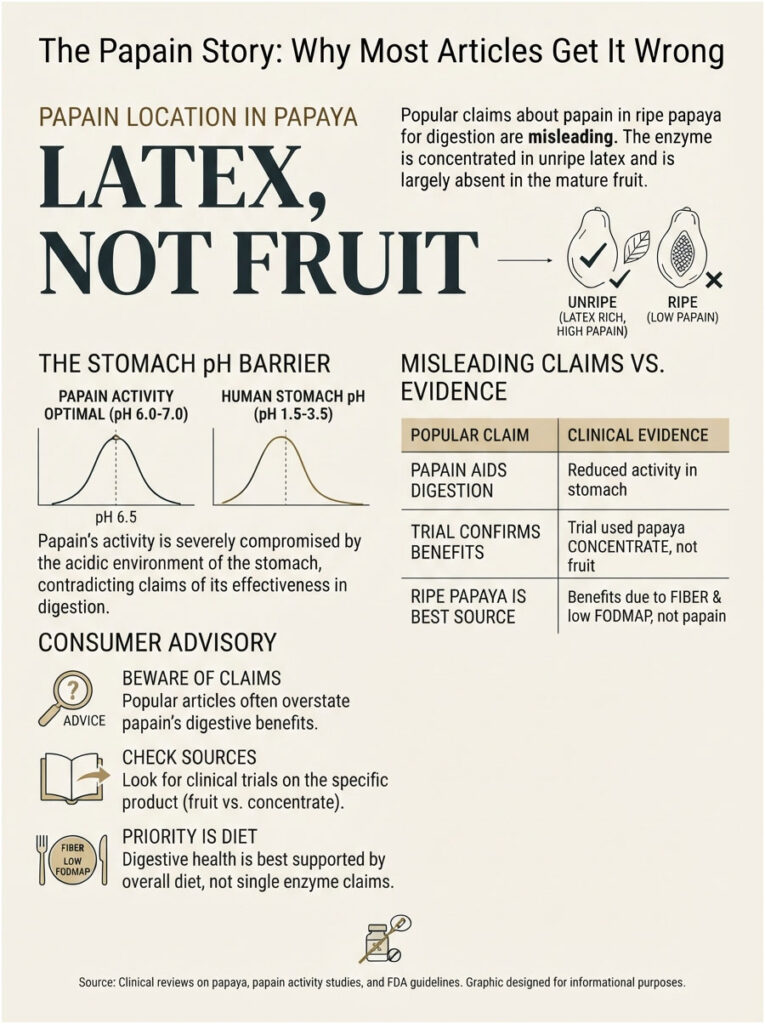
Where it comes from matters more than most articles admit. Papain’s richest source is the latex collected from the skin of the unripe, green fruit, not the sweet orange flesh sitting in your fridge.
Problem One: Ripe Papaya Has Far Less Papain Than You Think
The papaya you buy at Kroger, Costco, or your local H Mart is picked and shipped for sweetness. As papaya ripens, the milky latex that carries the papain thins out dramatically.
You are eating the version of the fruit with the least enzyme in it. Nobody selling papaya enzyme tablets is in a hurry to point that out.
Problem Two: Your Stomach Is the Wrong pH for Papain
This is the part that gets left out of every top-ranking article. Papain has an optimal working pH of 6.0 to 7.0, and papain solutions become unstable below pH 2.8, losing significant activity.
A working stomach runs far more acidic than that. Pharmaceutical researchers have gone to the trouble of building enteric-coated papain particles precisely because papain would remain almost inactive and lose its structural integrity at the low pH of the stomach, meaning too little would reach the intestine to digest proteins.
WebMD’s monograph on papaya says it plainly. Papain is changed in the stomach, so it is not clear whether it is effective as a medicine when taken by mouth.
The science is not fully closed. Some research suggests cysteine proteases survive stomach acidity and reach the colon with activity intact, while other work reports that papain suffers irreversible damage at the low pH it meets during passage through the stomach. What is settled is that the confident claim you keep reading is not supported by the evidence behind it.
Problem Three: The Human Trial Used a Concentrate, Not Fruit
The one controlled study everyone cites did not test fruit at all. It tested 20 mL of a standardized papaya concentrate, taken daily for 40 days. That is a different product with a different dose and a different manufacturing process.
Patients booking digestive tests with us often arrive convinced that a bowl of fruit salad delivers what a clinical-grade concentrate delivered. It does not, and pretending otherwise is how people waste two months on the wrong fix.
| Form of Papaya | Papain Content | Human Evidence for Bloating | Best Use | Main Caution |
| Ripe orange-fleshed fruit | Low | Indirect (fiber, water, low FODMAP status) | Daily eating, 1 cup per serving | Very little; this is the safest form |
| Green (unripe) papaya | High, latex-rich | None for bloating specifically | Cooked, as in Thai green papaya salad | Avoid in pregnancy; the latex acts as a uterine stimulant |
| Papaya enzyme tablets or chewables | Standardized but variable | Weak; mostly extrapolated from lab data | Occasional post-meal use | Acid degradation unless enteric-coated |
| Papaya concentrate (Caricol type) | Standardized and high | The only controlled trial showing bloating relief | Short-course use under guidance | Not fresh fruit; benefits faded after washout |
| Papaya leaf extract | Different compound profile | Pilot data only, in dyspepsia and constipation | Not a first-line choice | Limited safety data; skip during pregnancy |
So Is the Enzyme Claim Useless?
Not useless. Overstated. Papain almost certainly does something in the gut lumen, and a 2021 paper in Neurogastroenterology & Motility documented region-specific effects of papain on gastric motility.
But if you are eating ripe papaya and feeling better, the enzyme is probably not why. Our medical reviewers would rather you know that than keep paying for a mechanism that may be inactivated before it does any work.
The Real Reason Papaya Helps a Bloated Gut
Papaya’s strongest evidence has nothing to do with enzymes. It is about what papaya does not contain.
What FODMAPs Do to Your Belly
FODMAPs are short-chain carbohydrates that many people absorb poorly. When they reach the colon undigested, bacteria ferment them, gas volume rises, and the gut wall stretches.
Most sweet fruits are minefields here. Apples and pears carry excess fructose and sorbitol. Mango has a low-FODMAP serving of roughly 40 grams, about a fifth of a cup, which is a slice.
Papaya’s Lab-Tested Serving Size
Papaya is the outlier. Monash University testing rates ripe papaya as low FODMAP at up to 140 grams, roughly 1 cup diced, per meal. Some Monash entries clear yellow papaya at servings up to 500 grams.
This is not fringe guidance. Kaiser Permanente’s own low-FODMAP patient handout lists 1 cup of papaya among the approved fruit servings.
| Fruit | Low-FODMAP Serving Limit | What Pushes It Over | Bloating Risk at a Typical American Portion |
| Papaya (ripe, yellow) | About 1 cup (140 g), with some testing clearing far more | Little to nothing at normal portions | Low |
| Blueberries | Up to about 500 g | Rarely reached in practice | Low |
| Mango | About 40 g (one slice) | Excess fructose | High |
| Apple | Small portions only | Excess fructose plus sorbitol | High |
| Pear | Small portions only | Fructose and sorbitol | High |
| Watermelon | Small portions only | Fructose, fructans, and polyols | High |
| Dried papaya | Best limited or avoided | Concentrated sugars | Moderate to high |
The Fruit Swap That Does More Than the Enzyme Ever Could
Here is the practical version. If you eat an apple every afternoon and feel gassy by four o’clock, papain is irrelevant to your problem. Swapping that apple for a cup of papaya removes the fermentable load entirely.
The papaya is not treating the bloat. It is replacing what caused it. Across the patients we serve, that distinction is the single most useful thing we can hand someone.
Fiber, Water, and Transit Time
The rest is unglamorous plumbing. Water softens stool. Fiber adds bulk. Bulk plus softness equals movement, and movement relieves the pressure you are reading as bloating.
Most American adults fall short of the 25 to 34 grams of daily fiber the Dietary Guidelines recommend for adults. A cup of papaya covers 2.5 of those grams without the gas penalty that beans or dried fruit bring.
What the Evidence Actually Shows
Our team pulled the studies rather than the press releases. Here is what holds up under scrutiny.
The 2013 Papaya Trial, Read Carefully
The study everyone cites is Muss and colleagues, published in Neuro Endocrinology Letters. It was a double-blind, placebo-controlled trial in volunteers with chronic indigestion and gastrointestinal dysfunction. Participants took 20 mL of a papaya preparation daily for 40 days, and the treatment group showed statistically significant improvements in constipation and bloating.
Two details get buried in the retellings. The heartburn analysis fell short of significance because too few participants had that symptom, and none of the significant benefits survived the washout phase.
That last point matters. The effect did not stick once people stopped taking it, which tells you papaya concentrate manages a symptom rather than correcting the cause.
Papaya Leaf Extract and Functional Dyspepsia
A separate pilot study in the Journal of Gastroenterology and Hepatology looked at Carica papaya leaf extract in functional dyspepsia and constipation. Pilot means small, exploratory, and not yet confirmed. It is a signal, not a verdict.
What Gastroenterologists Actually Recommend
The AGA Clinical Practice Update on belching, abdominal bloating, and distention00823-5/fulltext) is the authoritative US reference. It issued 15 best-practice advice statements and recommends Rome IV criteria for diagnosing primary abdominal bloating and distention.
Papaya does not appear in it. That is not a knock on the fruit. It is a reminder of where any single food sits in the treatment hierarchy.
| What the Research Found | The Number | Study Design and Population | Source |
| US adults bloated in the past 7 days | 13.9% (about 1 in 7) | Online national survey, 88,795 US adults | Clinical Gastroenterology and Hepatology (Oh et al.) |
| Odds of bloating, women vs men | 2.56 times higher | Same national survey | Clinical Gastroenterology and Hepatology |
| US adults bloated at least weekly | 18% | Rome Foundation Global Epidemiology Study | Gastroenterology (Ballou et al.) |
| Adults with a gas symptom in the past 24 hours | 89% | 5,978 adults across the US, UK, and Mexico | Neurogastroenterology & Motility (Palsson et al.) |
| Papaya dose in the one controlled bloating trial | 20 mL daily for 40 days | Double-blind, placebo-controlled | Neuro Endocrinology Letters (Muss et al.) |
| Fiber in 1 cup of cubed papaya | 2.5 g | Food composition analysis | USDA FoodData Central |
| Lab-tested low-FODMAP papaya serving | 140 g (about 1 cup) | Laboratory FODMAP testing | Monash University |
| Papain’s optimal working pH | 6.0 to 7.0 | Enzyme characterization data | Sigma-Aldrich technical documentation |
Grading the Evidence Honestly
The low-FODMAP status of papaya is the strongest claim in this article. It is lab-tested, reproducible, and independently confirmed by clinical dietetics programs.
The fiber-and-water mechanism is well established, though it is not papaya-specific. Any fruit with a similar profile would do the same job.
The papaya-concentrate trial is real but narrow, and its findings do not automatically transfer to fresh fruit. And the claim that ripe papaya relieves bloating because of its papain content is the weakest of the four, which is unfortunate, because it is the one every marketer leads with.
When Papaya Makes Bloating Worse
Papaya is not universally gentle, and pretending otherwise would be dishonest.
Too Much, Too Fast
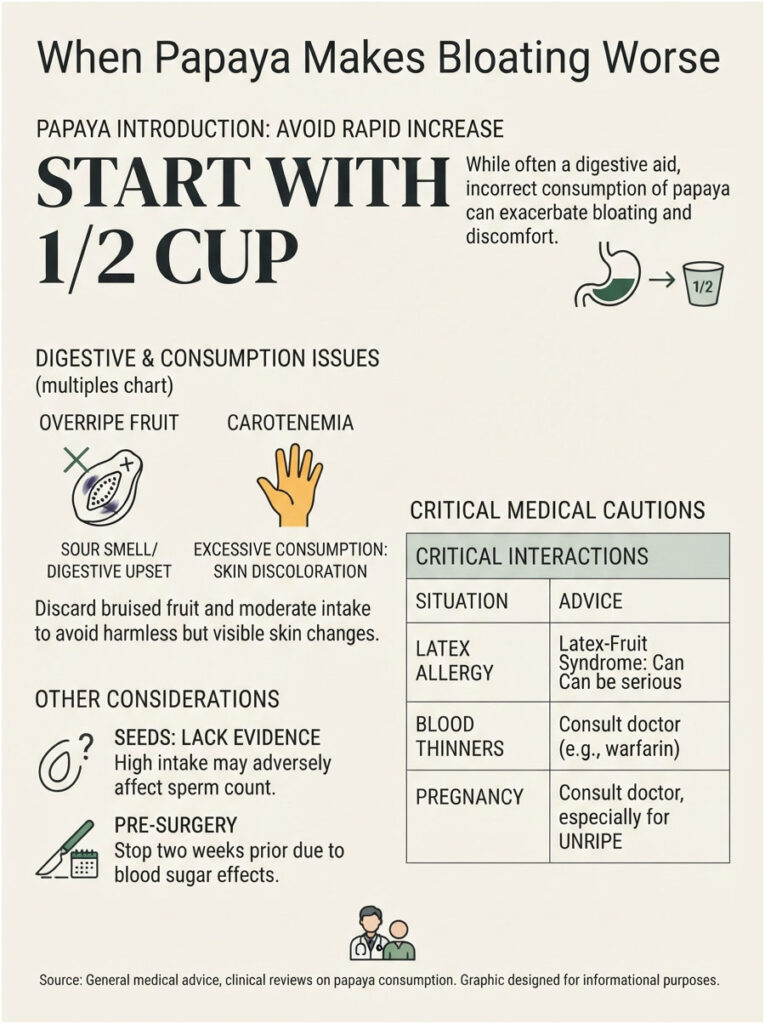
Papaya is a source of dietary fiber, and adding fiber too quickly can cause gas and bloating, especially in a gut that is not used to it. Half a papaya in one sitting is a fiber jump, not a remedy.
Start with half a cup. Build to a full cup over one to two weeks.
Overripe Fruit and a Sensitive Gut
Fruit past peak ripeness has a different sugar and aroma profile and can sit badly with reactive guts. If your papaya is bruised, mushy, or smells sharply sour, throw it out.
Latex-Fruit Syndrome
This one is not trivial. If you have a latex allergy, papaya deserves real caution because of cross-reactivity, and people allergic to fig or kiwi may also react to papain. Reactions run from mouth itching and rash to breathing difficulty.
Papaya Seeds Are Not a Home Remedy
Blended papaya seeds circulate online as a parasite cleanse. There is no good human evidence for that, and some research links high seed intake to reduced sperm count and motility in animal models. Skip the seeds.
Carotenemia
Very high papaya intake can tint your palms and the soles of your feet yellow-orange. It is harmless and reverses when you cut back, but it is a signal you are overdoing it.
Who Should Ask a Doctor First
During Pregnancy
Unripe papaya is possibly unsafe by mouth during pregnancy, and there is evidence that unprocessed papain may affect fetal development. Ripe fruit in normal food amounts is treated differently, but clear it with your OB before making it a daily habit.
On Blood Thinners
Papaya may interact with warfarin. Talk to your prescriber before adding it daily.
Before Surgery
Fermented papaya can lower blood sugar, and standard guidance is to stop papaya products two weeks ahead of a procedure.
With Papain Supplements
Papain taken by mouth is possibly safe at doses up to 1,200 mg daily for up to 9 weeks, but very large amounts can cause severe throat and stomach damage. This is a real ceiling, not a formality.
How to Actually Use Papaya for Bloating: A 14-Day Test
Skip the enzyme pills. Run the fruit like an experiment and let the data decide.
How Much: The One-Cup Rule
One cup of cubed ripe papaya, 140 to 145 grams. That is the Monash-tested low-FODMAP serving, it is 62 calories, and it delivers enough fiber to matter without triggering a gas spike.
Do not eat three cups on day one. That is how people conclude papaya “does not work for them” when the portion was the problem.
When: Before, With, or After a Meal
There is no strong evidence that timing changes the outcome, despite the empty-stomach advice flooding social feeds. Consistency and hydration matter far more.
If your bloat is post-meal heaviness, try papaya as a light dessert. If your bloat is constipation-driven, a morning cup with a full glass of water works better for most people.
What to Pair It With, and What to Skip
Pair with plain water, Greek yogurt, or cottage cheese. The protein slows things down and turns a light snack into something that carries you.
Skip pairing it inside a fruit salad full of apple, pear, mango, and watermelon. That reintroduces every FODMAP you just worked to avoid.
The 14-Day Protocol
Days 1 through 4: half a cup daily. Log bloating severity from 0 to 10 each evening, plus how many bowel movements you had.
Days 5 through 14: a full cup daily. Keep logging. Add a 10-minute walk after your largest meal, which does more for gastric emptying than any fruit will.
Day 14: compare your average score against your baseline week. If nothing moved, papaya is not your answer and the cause sits elsewhere.
Patients commonly ask us how long to give it. Fourteen days is the honest window. Anything promising overnight results is selling something.
How to Pick and Ripen a Papaya at a US Grocery Store
Most American stores stock two types. Maradol papayas are large, football-sized, and usually Mexican-grown. Hawaiian Solo papayas are small, pear-sized, and sweeter.
Look for skin that is mostly yellow with little green, heavy for its size, and yielding to gentle thumb pressure. Ripen green ones on the counter in a paper bag, then refrigerate once soft.
| Your Situation | Recommended Action | Expected Timeline | Escalate If |
| Bloated and constipated, fewer than 3 bowel movements a week | 1 cup papaya daily plus 2 extra glasses of water | 5 to 10 days | No change by day 14 |
| Bloated after apples, pears, mango, or watermelon | Swap that fruit for 1 cup of papaya | 2 to 5 days | Symptoms continue on low-FODMAP fruit |
| Heavy and stuffed after big or fatty meals | Smaller portions, papaya as dessert, 10-minute walk | 3 to 7 days | Heaviness lasts more than 4 hours |
| Diagnosed IBS with bloating | Keep papaya at 1 cup, run a supervised low-FODMAP trial | 2 to 6 weeks | Pain worsens or you lose weight |
| Puffy and swollen after salty restaurant food | Cut sodium and hydrate; papaya is a minor helper only | 24 to 72 hours | Swelling reaches legs, ankles, or face |
| Papaya itself makes you gassier | Drop to half a cup or stop; suspect a fiber jump or latex sensitivity | Immediately on stopping | Itching, swelling, or breathing trouble |
| Pregnant and constipated | Ripe fruit only, never green papaya; ask your OB first | Ask before starting | Any cramping after eating papaya |
| On warfarin or another anticoagulant | Talk to your prescriber before daily papaya | Not applicable | Unusual bruising or bleeding |
| Bloating that never fully goes away | Stop self-treating and get evaluated | Not applicable | Immediately |
Papaya vs the Other Bloating Fixes Americans Try
| Remedy | Mechanism | How Fast | Evidence Strength | Best For |
| Papaya (1 cup) | Fiber, water, low-FODMAP swap | 5 to 14 days | Moderate | Constipation bloat and FODMAP bloat |
| Pineapple (bromelain) | Protease, anti-inflammatory | Unclear | Weak for bloating | Not a first choice for gas |
| Kiwi (2 per day) | Fiber plus actinidin | 3 to 7 days | Stronger than papaya for constipation | Constipation-dominant bloating |
| Ginger | Speeds gastric emptying | 30 to 60 minutes | Moderate | Post-meal heaviness and nausea |
| Peppermint oil capsules | Relaxes gut smooth muscle | Days to weeks | Moderate in IBS | Cramping and spasm-driven bloat |
| Simethicone (Gas-X) | Breaks up gas bubbles | Minutes | Symptom relief only | Acute gas pressure |
Papaya vs Pineapple
Both are proteolytic. Bromelain comes from pineapple stems and is better studied for inflammation and swelling. Papain has a broader activity range on paper.
For bloating specifically, neither has strong whole-fruit evidence, and pineapple is harder on FODMAP-sensitive guts at larger servings. Papaya is the safer everyday pick.
Papaya vs Kiwi
Kiwi wins on constipation. Two kiwifruit daily has more direct human evidence for stool frequency than papaya does, and kiwi carries actinidin, its own protease.
If constipation is your primary driver, kiwi is the better first move. Papaya is the better everyday fruit swap.
Papaya vs Papaya Enzyme Chewables
The chewables cost more, deliver no fiber, no water, and no potassium, and their active ingredient faces the acid problem described above. Our lab partners see far more value in the whole fruit.
When Bloating Is Not a Food Problem
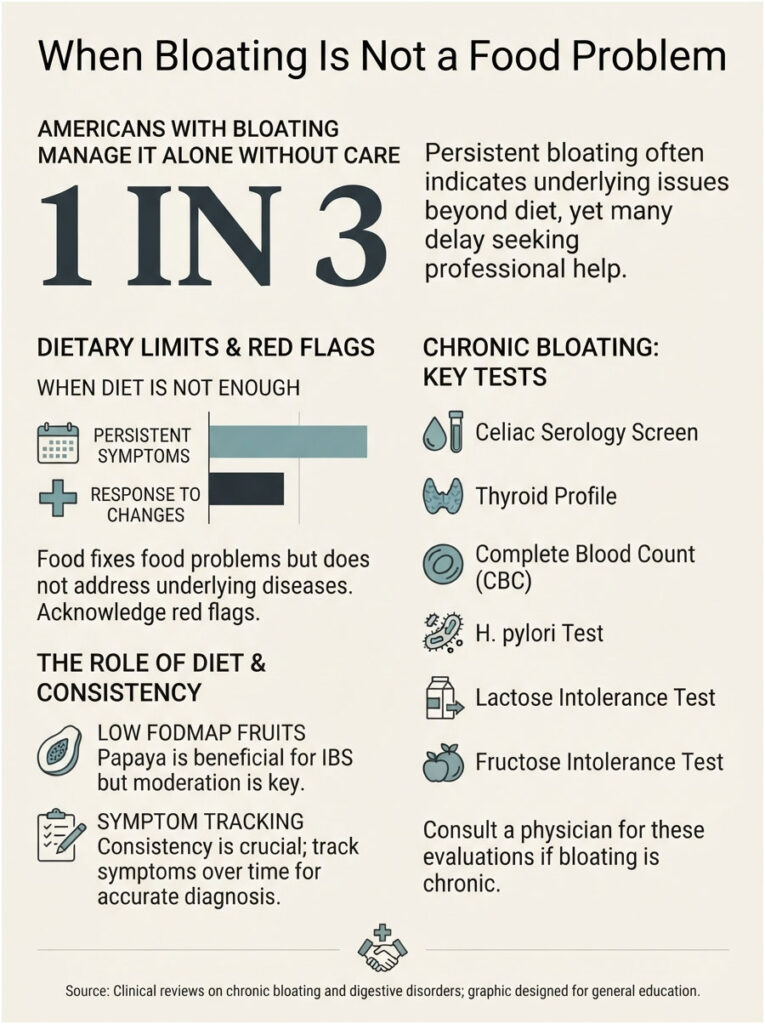
Food fixes food problems. It does not fix disease, and this is where self-treatment turns from unhelpful into risky.
Red Flags That Mean Stop Self-Treating
- Bloating that never resolves, day or night, rather than coming and going
- Unintentional weight loss
- Blood in the stool, or black, tarry stools
- Persistent vomiting
- Pain that wakes you from sleep
- New, persistent bloating after age 50
- Fever, or a family history of colon or ovarian cancer
Any one of these means a physician, not a fruit bowl.
The Tests Worth Asking For
In cases reviewed by our medical team, chronic bloating that resists dietary change usually traces back to something measurable. A celiac serology screen rules out an immune cause that mimics food intolerance almost perfectly.
A thyroid profile matters because an underactive thyroid slows the entire gut, and constipation-driven bloating is a classic early sign. A complete blood count checks for the anemia that often accompanies undiagnosed celiac disease or slow gastrointestinal blood loss.
An H. pylori test addresses upper-gut symptoms, and lactose or fructose intolerance testing settles the question of whether specific sugars are the trigger. These are inexpensive, widely available, and far more useful than another month of guessing.
The Statistic Worth Sitting With
Nearly one third of Americans with bloating who have not sought care are managing it alone or feel uncomfortable raising it with their provider. That is the single most fixable number in this article.
If your bloating has lasted more than a few weeks, get the underlying causes ruled out rather than guessing. A fruit is a reasonable experiment. It is not a diagnosis.
Frequently Asked Questions
Does papaya make you poop?
Often, yes. A cup of papaya delivers 2.5 grams of fiber and is roughly 88 percent water, a combination that softens stool and speeds transit. It is gentler than prunes and less aggressive than a fiber supplement. Most people notice a change within 5 to 10 days of daily use, not overnight.
How long does papaya take to reduce bloating?
Give it 7 to 14 days of consistent daily intake at one cup. Constipation-driven bloating responds fastest, sometimes within 5 days. Gas bloating improves only if papaya is replacing a high-FODMAP fruit you were already eating. If nothing shifts by day 14, the cause is not dietary.
Should you eat papaya on an empty stomach?
There is no strong evidence that an empty stomach produces better results, despite what social media claims. For constipation, a morning cup with a full glass of water works well because it pairs fiber with fluid. For post-meal heaviness, eating it after dinner is fine. Consistency beats timing.
Is papaya better before or after a meal?
Neither has been shown superior in controlled research. The enzyme argument for eating it after a protein-heavy meal falls apart once you account for papain’s inactivation in stomach acid. Pick whichever timing you will actually stick to for two weeks, then track your symptoms.
Can papaya cause gas and bloating?
Yes, in three situations. If you jump from almost no fiber to two cups a day, your gut will protest. If the fruit is overripe, sensitive guts react. And if you have a latex allergy, papaya can trigger cross-reactivity. Start with half a cup and build slowly.
Is papaya low FODMAP and safe for IBS?
Papaya is one of the friendlier fruits for IBS. Monash University lab testing rates ripe papaya as low FODMAP at up to 140 grams, about one cup, per meal. Kaiser Permanente’s low-FODMAP patient handout lists the same serving. Stay within that portion and it should be well tolerated.
Is green papaya better than ripe papaya for digestion?
Green papaya carries far more papain, but that does not make it a better choice. Unripe papaya is latex-rich, harder on the esophagus in quantity, and unsafe during pregnancy. For everyday digestive support, ripe orange-fleshed papaya is the safer and far more practical form.
Do papaya enzyme tablets actually work?
The evidence is thin. Papain works best at a pH of 6.0 to 7.0, well above stomach acidity, and enteric coating exists specifically because papain degrades in the stomach. Tablets also strip out the fiber, water, and potassium that make the whole fruit useful. Most people get more from the fruit.
Is papaya or pineapple better for bloating?
Papaya, for most people. It is rated low FODMAP at a full one-cup serving, is higher in water, and is gentler on a sensitive gut. Pineapple’s bromelain has better anti-inflammatory data, but for bloating specifically, neither enzyme has convincing whole-fruit evidence behind it.
Can you eat papaya every day?
For most healthy adults, yes. One cup a day is 62 calories, 11.3 grams of natural sugar, and nearly a full day of vitamin C. Very high intakes can cause loose stools or a harmless yellow-orange tint to the palms. People on blood thinners or diabetes medication should check with a doctor first.
Is papaya safe during pregnancy?
Ripe papaya in normal food amounts is generally considered acceptable, but unripe or semi-ripe papaya is not. Green papaya latex can act as a uterine stimulant, and there is evidence that unprocessed papain may affect fetal development. Skip green papaya and papain supplements entirely, and clear ripe papaya with your OB.
Why does my papaya smell bad?
Ripe papaya develops aroma compounds that many Americans read as sour milk or gym socks. The smell intensifies as the fruit passes peak ripeness. Chilling it and adding a squeeze of fresh lime cuts the odor substantially. If the smell is sharply fermented, the fruit has turned and should be discarded.
| Medical Disclaimer: This article is for general education and is not a substitute for professional medical advice, diagnosis, or treatment. Papaya is a food, not a therapy, and it cannot diagnose or treat any gastrointestinal condition. Always consult a qualified physician before making dietary changes, especially if you are pregnant, taking anticoagulants or diabetes medication, have a latex allergy, or have persistent digestive symptoms. If you experience unexplained weight loss, blood in your stool, persistent vomiting, or bloating that does not fluctuate, seek medical evaluation promptly. |
References
- Abdominal Bloating in the United States: Results of a Survey of 88,795 Americans, Clinical Gastroenterology and Hepatology01020-5/fulltext)
- Prevalence and Associated Factors of Bloating: Rome Foundation Global Epidemiology Study, Gastroenterology00826-0/fulltext)
- AGA Clinical Practice Update on Evaluation and Management of Belching, Abdominal Bloating, and Distention, Gastroenterology00823-5/fulltext)
- Gas-Related Symptoms in the General Population, Neurogastroenterology & Motility
- Papaya Preparation (Caricol) in Digestive Disorders, Neuro Endocrinology Letters, via PubMed
- Region-Specific Effects of the Cysteine Protease Papain on Gastric Motility, Neurogastroenterology & Motility
- Development of Enteric Submicron Particle Formulation of Papain for Oral Delivery, National Library of Medicine
- Papain: Enzyme Properties and Optimal pH, Sigma-Aldrich Technical Documentation
- USDA FoodData Central, Raw Papaya Nutrient Profile
- Low FODMAP Diet Patient Handout, Kaiser Permanente
- Monash University Low FODMAP Program
- Papaya: Uses, Side Effects, Precautions, and Interactions, WebMD
- Papain: Uses, Side Effects, and Dosing, WebMD
- Papaya Enzyme: What It Is, Benefits, and Side Effects, GoodRx
- How Many Calories in Papaya? Full USDA Nutrition Breakdown, HealthCareOnTime