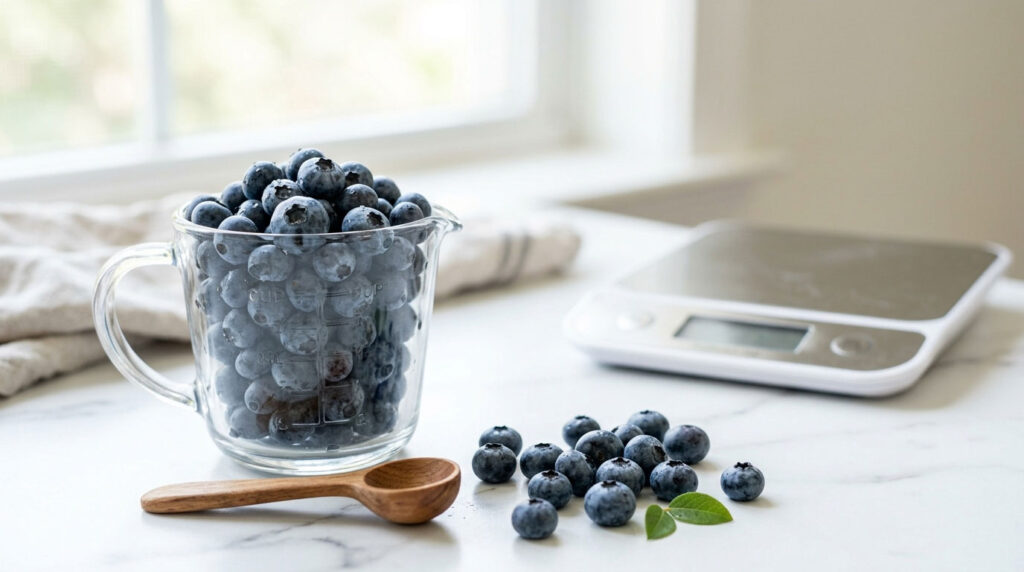
Here’s a number that puts things in perspective: a whole cup of fresh blueberries costs you fewer calories than a single tablespoon of olive oil. You get a sweet, satisfying snack and a heavy dose of antioxidants, all for under 90 calories.
Table of Contents
That low-calorie, high-payoff math is exactly why blueberries earn their “superfruit” reputation. So let’s break down the real numbers, straight from USDA data, for every serving size and every form you’ll find at the store.
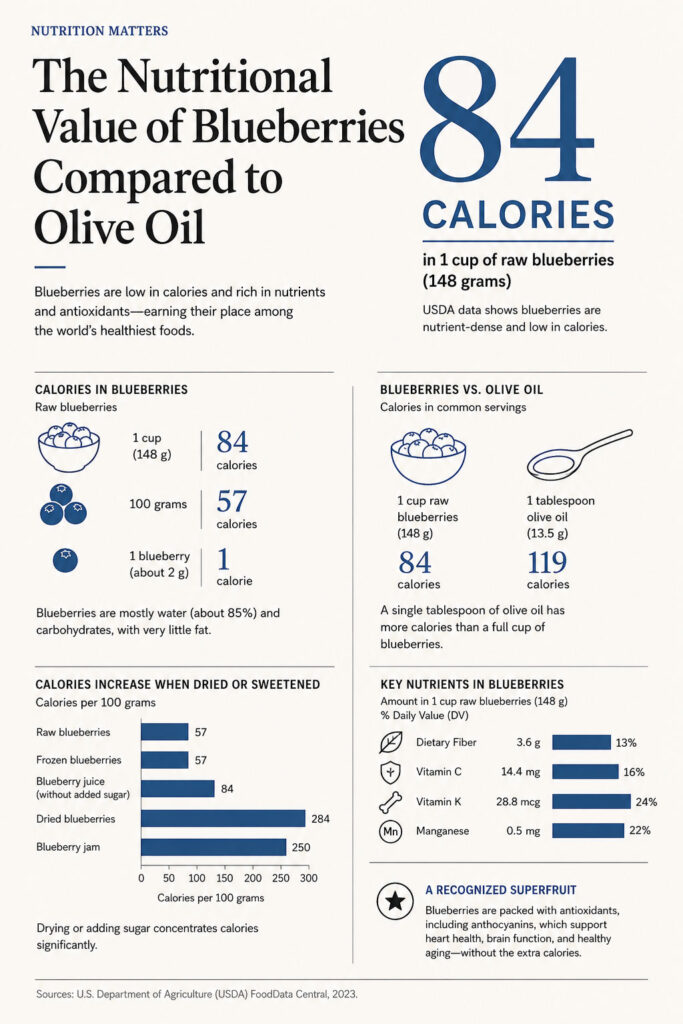
Quick Answer: One cup of raw blueberries (148 grams) has about 84 calories, according to USDA data. A 100-gram serving has 57 calories, and a single blueberry is roughly 1 calorie. Blueberries are low in calories and fat, made mostly of water and carbs, and they deliver fiber, vitamin C, vitamin K, and manganese. Their calorie count rises sharply when they’re dried or sweetened.
At a Glance
- A cup of blueberries has about 84 calories; 100 grams has 57 calories; one berry is about 1 calorie.
- The carbs are mostly natural sugar and fiber, with almost no fat or protein.
- One cup delivers roughly 24% of the Daily Value for vitamin K and 22% for manganese.
- Dried and sweetened blueberries pack far more calories than fresh or plain frozen.
- Blueberries fit weight-loss and blood-sugar-aware diets thanks to their low calorie density and fiber.
- A half cup to one cup a day is a sensible, research-backed serving.
How Many Calories Are in Blueberries?
Blueberries are one of the lowest-calorie fruits you can keep in your kitchen. The exact count depends entirely on how much you eat, so the most useful answer is one tied to real serving sizes.
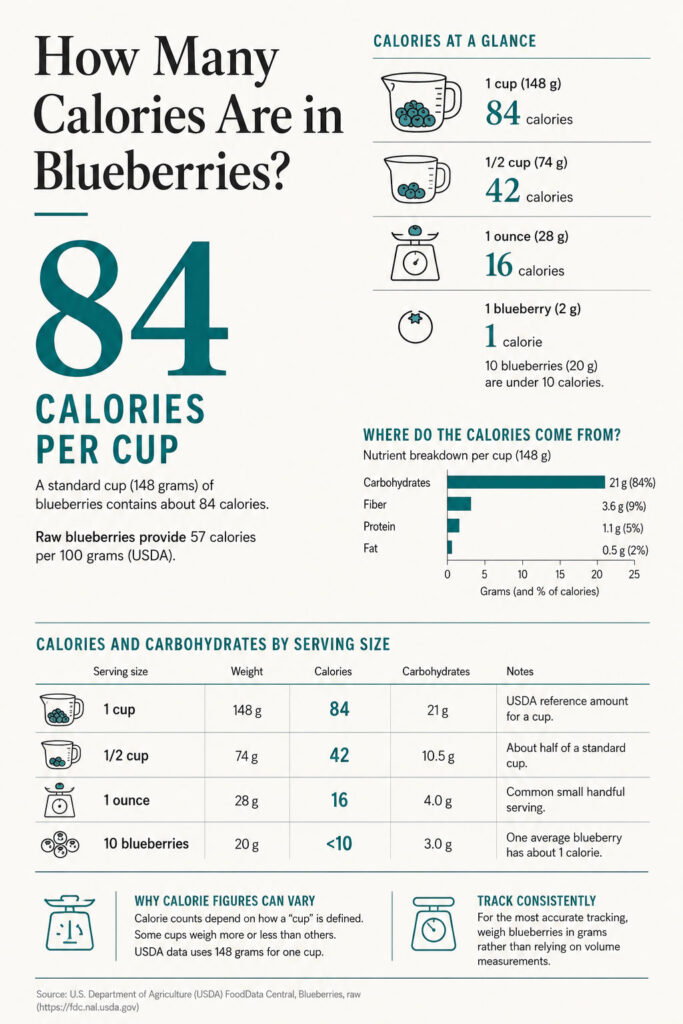
The single most-searched figure is the per-cup number, so start there. A standard cup of fresh blueberries holds about 84 calories, which makes a generous handful a genuinely light snack.
For smaller or larger portions, the math scales cleanly from the USDA base value. That base figure is what every reliable calorie tracker is quietly built on.
Calories by Serving Size
The USDA lists raw blueberries at 57 calories per 100 grams. That’s the anchor number, and everything else is a simple multiple of it.
Scale it up to a full cup and you land at 84 calories for one cup (148 grams). A half cup is about 42 calories, and a single ounce sits near 16 calories.
Down at the smallest level, the numbers get almost playful. One average blueberry is roughly 1 calorie, so a 10-berry nibble costs under 10 calories. Patients tracking intake with our nutrition resources usually want this per-cup figure first, then the smaller breakdowns for precise logging.
Where Those Calories Come From
It helps to know what’s actually generating the calories in a blueberry. The answer is almost entirely carbohydrate, with a rounding error of fat and protein.
A gram of carbohydrate carries about 4 calories, and a cup of blueberries holds roughly 21 grams of carbs. Do that math and you get most of the 84-calorie total, with the small remainder from trace protein and fat.
This is why blueberries behave like a “free” food for many people. There’s no hidden fat or oil driving the number up, just natural fruit sugar and fiber.
Why the “Cup” Number Sometimes Varies
You’ll see slightly different per-cup figures across the web, and there’s a simple reason. It comes down to how many grams a “cup” is assumed to weigh.
The USDA standard cup of blueberries is 148 grams, which yields about 84 calories. Many packaged-food labels round a cup to 140 grams instead, which lands closer to 80 calories.
Neither is wrong; they’re just different reference weights. For the most consistent tracking, our nutrition team suggests weighing berries in grams rather than relying on volume, since berry size varies a lot. The table below lays out the calories for the serving sizes people search most.
| Serving Size | Weight (g) | Calories | Carbs (g) |
| 1 blueberry | 1.5 | ~1 | 0.2 |
| 10 blueberries | 15 | ~9 | 2.2 |
| 1 ounce | 28 | ~16 | 4.1 |
| Half cup | 74 | ~42 | 10.7 |
| 1 cup | 148 | ~84 | 21.4 |
| 100 grams | 100 | ~57 | 14.5 |
Full USDA Nutrition Breakdown
Calories tell only part of the story. What makes blueberries worth those calories is the mix of carbs, fiber, vitamins, and antioxidants packed into each small berry.
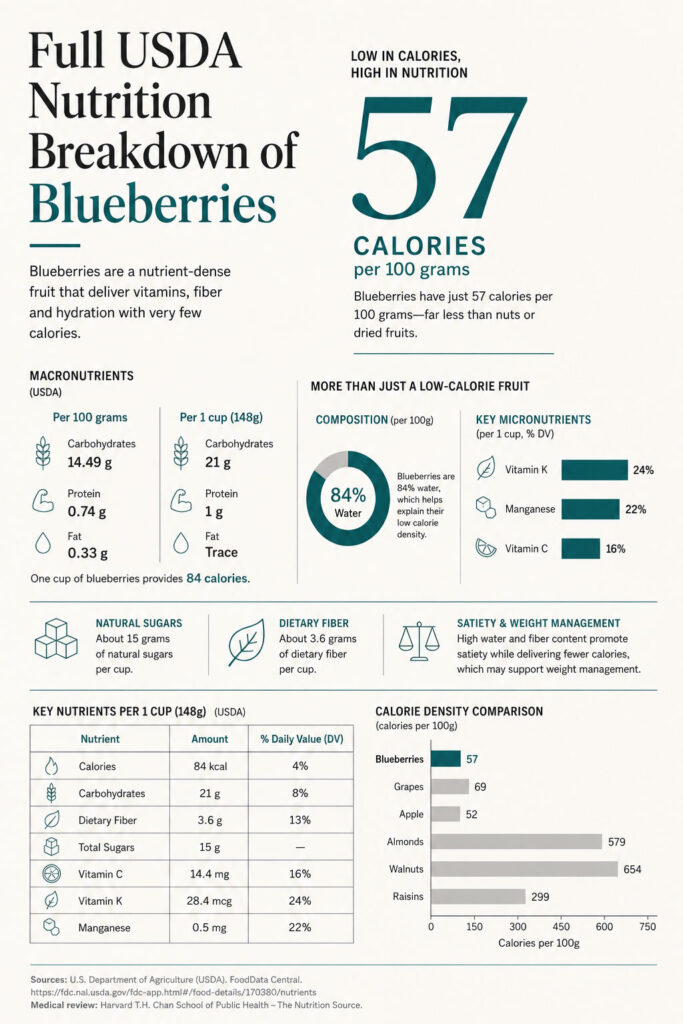
The profile is straightforward: lots of water, a modest amount of carbohydrate, and very little fat or protein. That composition is what keeps the calorie count so low.
All the figures here trace back to USDA FoodData Central, the government database that nutrition labels and apps rely on. Its values are public-domain averages, so treat them as solid reference points rather than exact counts for your specific berries.
Macronutrients
Blueberries are almost entirely carbohydrate when it comes to their calorie content. The USDA puts raw blueberries at 14.49 grams of carbohydrate, 0.74 grams of protein, and 0.33 grams of fat per 100 grams.
For a full cup, that works out to roughly 21 grams of carbs, about 1 gram of protein, and a trace of fat. The calories break down to about 90% carbs, 5% protein, and 5% fat.
The carbohydrate itself splits between natural sugars and fiber. A cup provides around 15 grams of natural sugar and close to 3.6 grams of fiber, which softens how that sugar hits your system.
Fiber and Water Content
Two unsung components explain why blueberries are so filling for their calorie cost. Fiber and water make up a big share of each berry.
Raw blueberries carry 2.4 grams of fiber per 100 grams, which adds up to about 3.6 grams in a cup. That’s a meaningful step toward the 25 to 38 grams most adults need daily.
The berries are also mostly water. Blueberries are about 84% water, and that high water content is the main reason their calorie density stays so low.
Vitamins and Minerals
This is where blueberries punch above their weight. For such a low-calorie food, they deliver a respectable set of micronutrients.
Blueberries are an excellent source of vitamin C, vitamin K, and manganese. One cup covers roughly 24% of the Daily Value for vitamin K and about 22% for manganese, plus around 16% for vitamin C.
They also supply small amounts of potassium, copper, and vitamin E, along with a little of every essential amino acid. Across the diagnostic panels our lab partners run, micronutrient-rich whole foods like these are a simple way to round out everyday nutrition. The table below highlights the key per-cup numbers.
| Nutrient (per 1 cup, 148g) | Amount | Source |
| Calories | 84 kcal | USDA |
| Total carbohydrate | 21.4 g | USDA |
| Dietary fiber | 3.6 g (about 13% DV) | USDA |
| Total sugars | 15 g | USDA |
| Vitamin C | 14 mg (about 16% DV) | USDA |
| Vitamin K | 29 mcg (about 24% DV) | USDA |
| Manganese | 0.5 mg (about 22% DV) | USDA |
Calorie Density: The Real Advantage
Calorie density means how many calories sit in a given weight of food, and it’s where blueberries win. A food this watery and fibrous carries very few calories per bite.
At 57 calories per 100 grams, blueberries are far less calorie-dense than nuts, granola, or dried fruit. That lets you eat a satisfying volume while keeping the total low.
This single trait is why blueberries fit so neatly into weight management. Our medical reviewers note that low-calorie-density foods help people feel full on fewer calories, which is the quiet engine behind most successful eating plans.
Blueberry Carbs, Sugar, and Glycemic Impact
For anyone counting carbs or watching blood sugar, the calorie number is only the first question. The next is what those carbs actually do once they’re inside you.
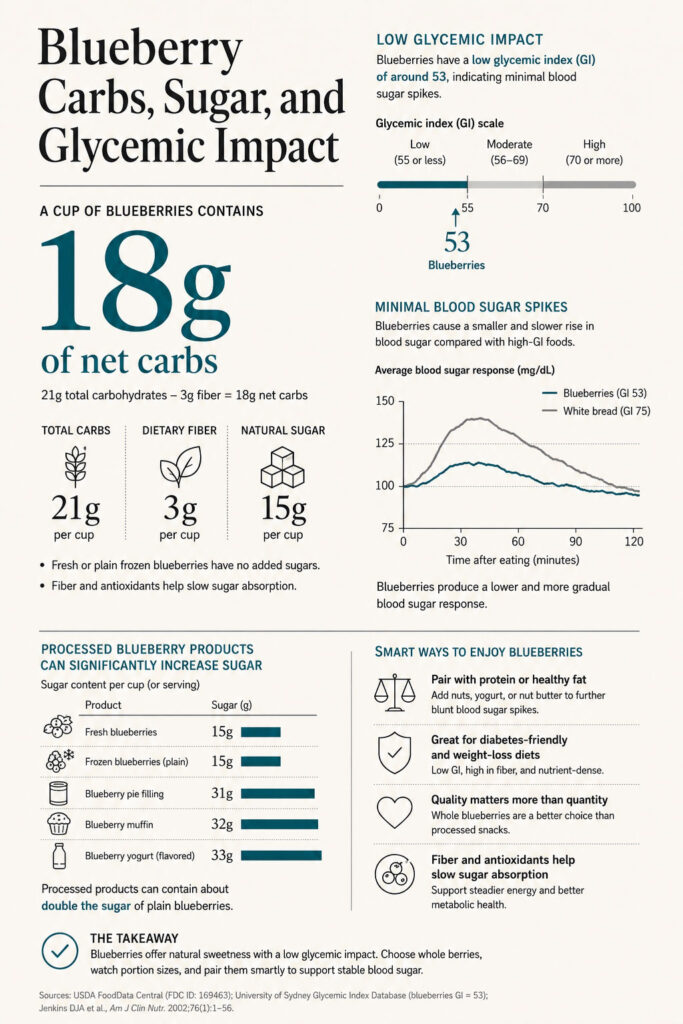
Blueberries are sweet, so it’s fair to ask whether they spike blood sugar. The short answer is that they’re gentler than their taste suggests, thanks to fiber and a low glycemic ranking.
That balance is why blueberries appear in so many diabetes-friendly and weight-loss eating plans. The context matters more than the raw sugar number on its own.
Carbs and Net Carbs
A cup of blueberries contains roughly 21 grams of total carbohydrate. Subtract the fiber, which your body doesn’t fully digest, and the net carbs come to about 18 grams.
That puts blueberries in a middle lane for low-carb eaters. One average serving of raw blueberries contains about 18 grams of net carbs, so a smaller portion fits more easily into a strict keto target.
For most people, though, those carbs arrive bundled with fiber and antioxidants, which is a far better deal than the carbs in processed snacks. Quality matters here, not just quantity.
Natural Sugar vs Added Sugar
The sugar in fresh blueberries is entirely natural, and that distinction is important. The predominant sugars in blueberries are fructose and glucose, the same simple sugars found across whole fruits.
A cup carries about 15 grams of natural sugar, with no added sugar in the fresh or plain frozen versions. That changes fast with sweetened and dried products, which can more than double the sugar load.
So the sugar itself isn’t the concern with fresh berries; it’s what gets added during processing. Reading the ingredient label is the whole game.
Glycemic Index and Blood Sugar
Glycemic index measures how quickly a food raises blood sugar, and blueberries score on the lower end. They’re commonly cited with a glycemic index around 53, which falls in the low range.
The fiber and antioxidants help slow sugar absorption, smoothing out the rise. The fiber and anthocyanins slow glucose absorption, helping prevent blood sugar spikes.
Patients managing blood sugar with us frequently ask whether blueberries are off-limits, and for most they aren’t. Pairing a modest portion with protein or fat slows things further, which is worth confirming with your own clinician or a test panel that tracks your levels.
Calories by Form: Fresh vs Frozen vs Dried
Not all blueberries carry the same calories, and the gap between forms surprises people. A small handful of dried blueberries can pack the calories of several cups of fresh ones.
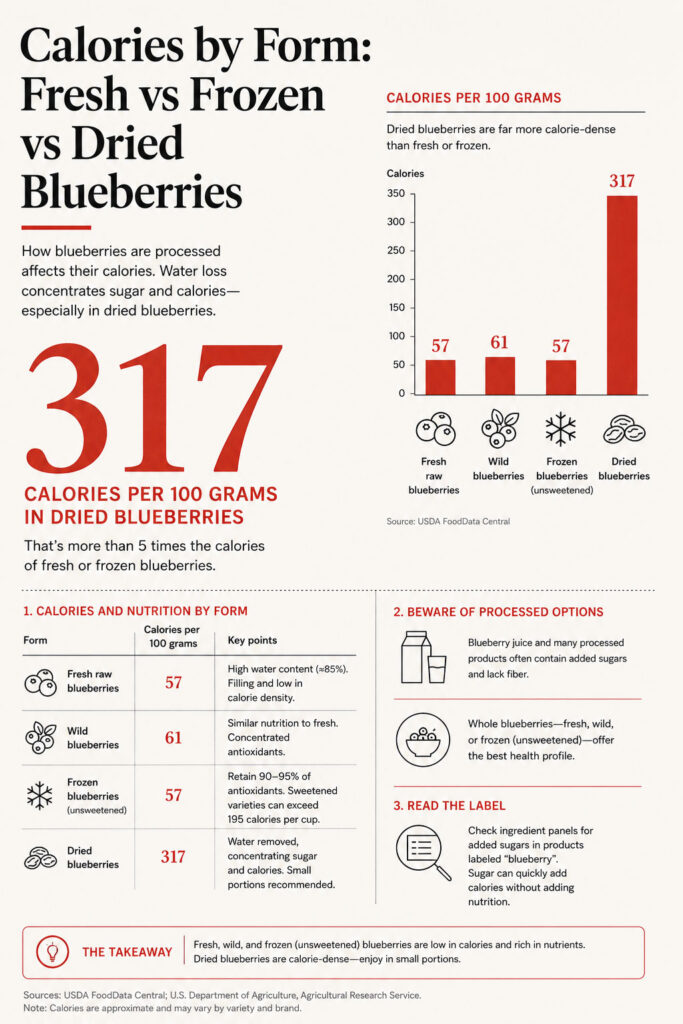
The reason is water. Fresh and plain frozen blueberries are mostly water, while drying removes it and concentrates everything, calories included.
Knowing these differences helps you match the form to your goal. Fresh for volume, frozen for value, dried only in small amounts.
Fresh Raw Blueberries
Fresh raw blueberries are the baseline and the lightest option. They sit at 57 calories per 100 grams and about 84 calories per cup.
Their high water content keeps them filling and low in calorie density. That’s what makes them an easy yes for snacking, cereal, or salads without much calorie cost.
Wild (lowbush) blueberries, the smaller variety often sold frozen, are similar. Wild raw blueberries come in around 61 calories per 100 grams, with even more concentrated antioxidants per berry.
Frozen Blueberries
Plain frozen blueberries are nutritionally close to fresh, which is great news for your budget. Freezing locks in nutrients at peak ripeness.
Frozen blueberries retain about 90 to 95% of their antioxidant content, and freezing may even increase anthocyanin availability by breaking down cell walls. Unsweetened frozen berries match fresh at roughly 57 calories per 100 grams.
The trap is the sweetened kind. One cup of sweetened frozen blueberries can contain about 195 calories, more than double the fresh version, because of the added sugar. Our medical reviewers note that “frozen” and “sweetened” are very different products on a label.
Dried Blueberries
Dried blueberries are where calories climb steeply. Removing the water shrinks the berries and concentrates the sugar and calories into a much smaller volume.
Dried sweetened blueberries contain about 317 calories per 100 grams, with roughly 80 grams of carbohydrate. A small quarter-cup can rival a full cup of fresh berries on calories.
That doesn’t make them off-limits, just easy to over-eat. Measuring a small portion keeps dried blueberries from quietly blowing past your calorie target.
Blueberry Juice and Processed Products
Blueberry juice, muffins, jams, and syrups belong in a separate category. They often strip out the fiber and add sugar, flipping the berry’s healthy profile on its head.
A glass of sweetened blueberry juice can carry the sugar of several cups of fresh fruit with little of the fiber. The whole berry is almost always the better choice.
When a product puts “blueberry” on the front, the ingredient panel tells the real story. Added sugars near the top of the list are a warning sign worth heeding.
How Blueberries Compare to Other Fruits
Putting blueberries next to other popular fruits helps you see where they land. They’re low-calorie, though not the very lowest, and that’s perfectly fine.
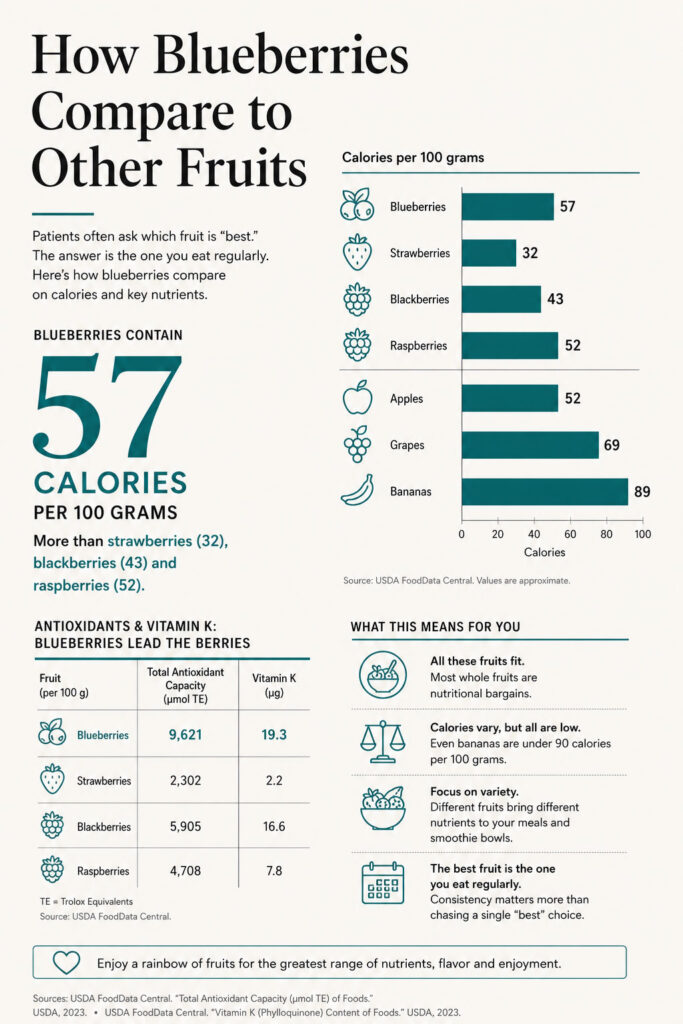
The point of comparison isn’t to crown a winner. Most whole fruits are nutritional bargains, and variety beats fixating on a single “best” berry.
Still, the numbers are useful for planning a bowl or a smoothie. Here’s how blueberries stack up per 100 grams against fruits Americans reach for most.
Strawberries are the lightest of the common berries at about 32 calories per 100 grams, followed by blackberries near 43 and raspberries around 52. Blueberries come in at 57 calories per 100 grams, a touch higher but with a denser antioxidant and vitamin K profile.
Step outside the berry family and blueberries still look light. An apple sits near 52 calories per 100 grams, grapes around 69, and a banana about 89. Patients commonly ask us which fruit is “best,” and the honest answer is that the one you’ll eat regularly usually wins.
Health Benefits Behind the Calories
Low calories alone wouldn’t make blueberries special. What sets them apart is how much nutrition rides along with those few calories.
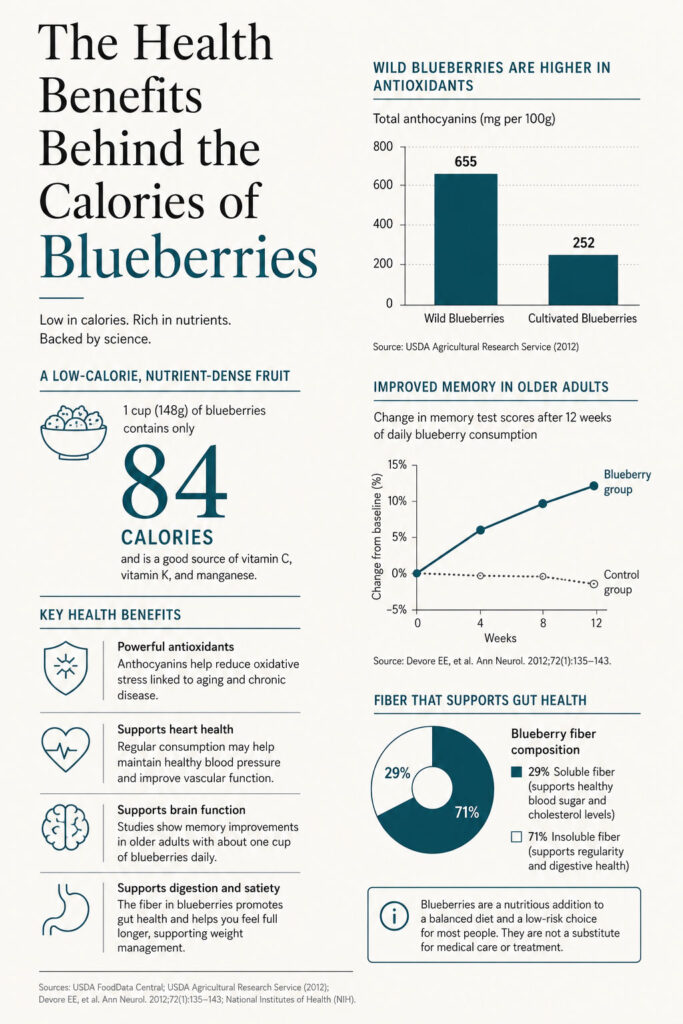
The research on blueberries has grown steadily, and much of it centers on their antioxidant compounds. Those compounds are also what give the berries their deep blue color.
None of this is a cure-all, and whole-diet patterns matter more than any single food. Still, few snacks deliver this much for so little.
Antioxidants and Anthocyanins
Blueberries are famous for their antioxidants, especially anthocyanins. These are the pigments behind the blue-purple hue, and they double as protective plant compounds.
Anthocyanins are linked to reduced oxidative stress, which is tied to aging and chronic disease. Wild blueberries tend to carry even higher concentrations than cultivated ones.
This antioxidant density is why a modest serving still delivers value. You don’t need to eat pounds of them to benefit.
Heart and Brain Research
Some of the most interesting blueberry research looks at the heart and brain. Population studies and small trials have connected regular berry intake with cardiovascular and cognitive benefits.
Research from the USDA Human Nutrition Research Center found memory improvements with about one cup of blueberries daily in older adults. That’s a realistic, everyday serving, not a megadose.
The evidence is promising rather than settled, and blueberries aren’t a substitute for medical care. They’re simply a smart, low-risk addition to a balanced diet.
Fiber and Digestion
The fiber in blueberries supports more than blood sugar control. It also feeds healthy digestion and helps you feel full.
Blueberry fiber is about 29% soluble and 71% insoluble, where soluble fiber improves digestion and insoluble fiber helps with regularity. That combination supports gut health on both fronts.
Because fiber slows eating and digestion, it stretches the satisfaction from a small calorie count. That’s a quiet advantage for anyone managing weight.
How to Fit Blueberries Into Your Diet
The best part about blueberries is how easily they slot into real meals. Their low calorie count gives you room to be generous without guilt.
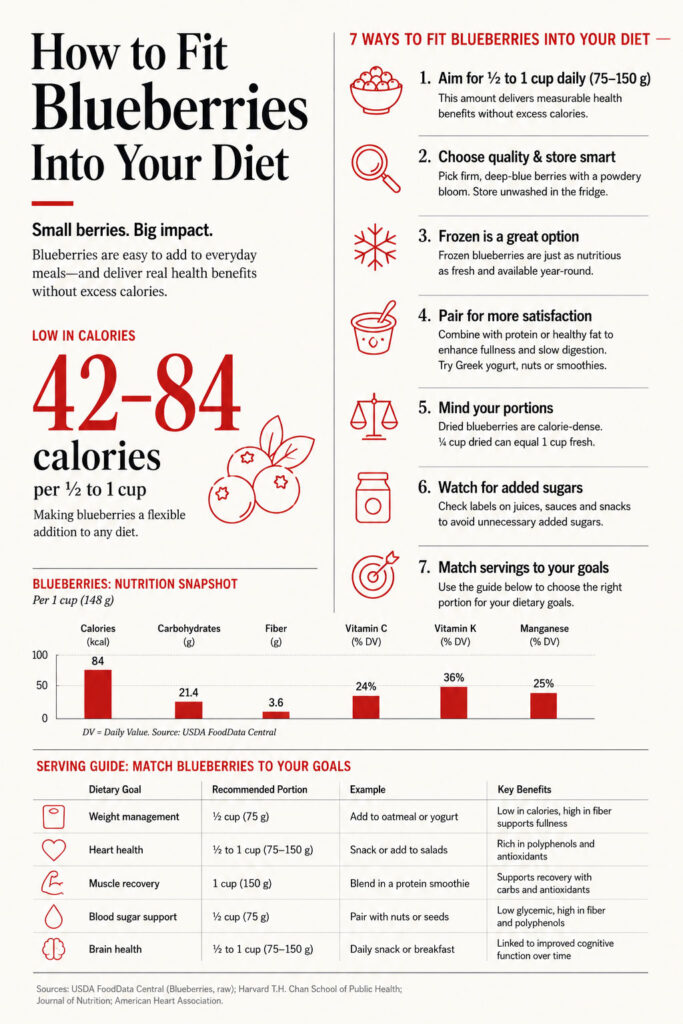
The key is choosing the right form and pairing them well. A little planning turns blueberries from a treat into a genuinely useful diet tool.
Portion awareness still matters, especially with dried berries and smoothies. Calories from fruit are still calories, even healthy ones.
Smart Serving Sizes
For most goals, a half cup to a full cup is the sweet spot. That delivers real nutrition at 42 to 84 calories, which fits almost any plan.
Research suggests just a half to one cup (75 to 150 grams) daily provides measurable benefits, and more isn’t necessarily better. There’s no need to overdo it.
If you’re watching calories closely, weigh your portion rather than eyeballing it. Berry size varies enough to throw off a casual estimate.
Buying and Storing for Freshness
Getting the most from your berries starts at the store. A few simple habits keep them fresh and cut waste.
Look for firm, deep-blue berries with a silvery, powdery coating called the bloom, which signals freshness. Store them unwashed in the fridge and rinse only right before eating, since moisture speeds spoilage.
Frozen is a smart year-round backup, often cheaper and just as nutritious. Keeping a bag in the freezer means you always have a low-calorie option on hand.
Pairings That Add Staying Power
Blueberries shine when paired with protein or healthy fat. The combination slows digestion and keeps you fuller longer.
Try a cup stirred into plain Greek yogurt, scattered over oatmeal, or blended into a smoothie with unsweetened protein. Each adds staying power without much extra sugar.
A handful tossed onto a salad adds sweetness and antioxidants for almost no calories. Patients commonly ask us for low-effort swaps, and this is one of the easiest to keep up.
Watch-Outs
A few habits can quietly turn a healthy fruit into a calorie problem. Awareness is the simplest fix.
Watch added sugar in sweetened frozen and dried products, keep dried-berry portions small, and be honest about smoothie creep, where berries plus juice plus sweeteners stack up fast. The whole, fresh berry is the safest default.
When in doubt, go for fresh or plain frozen and measure your serving. The table below maps common goals to a sensible serving.
| Your Goal or Situation | Recommended Serving | Why It Works |
| Weight loss or calorie control | 1 cup fresh (about 84 cal) as a snack | Low calorie density and fiber keep you full |
| Managing blood sugar | Half to 1 cup with protein or fat | Low glycemic index; pairing slows the sugar rise |
| Pre or post workout fuel | 1 cup in a smoothie or with yogurt | Quick natural carbs plus antioxidants |
| Curbing a sweet craving | Half cup frozen, eaten slowly | Natural sweetness with no added sugar |
| Adding daily antioxidants | Half to 1 cup, fresh or plain frozen | Anthocyanins; frozen retains most nutrients |
Frequently Asked Questions
How many calories are in one cup of blueberries?
One cup of raw blueberries (148 grams) has about 84 calories, based on USDA data. Most of those calories come from natural carbohydrates, with about 15 grams of sugar and 3.6 grams of fiber. It’s a low-calorie, filling snack option.
How many calories are in 100 grams of blueberries?
A 100-gram serving of raw blueberries has 57 calories, according to the USDA. That portion is a little over two-thirds of a cup and contains about 14.5 grams of carbohydrate, 2.4 grams of fiber, and almost no fat or protein.
How many calories in a single blueberry?
A single average blueberry contains roughly 1 calorie. Since one berry weighs about 1.5 grams, a 10-berry handful adds up to under 10 calories, which makes blueberries one of the lightest snacks you can grab.
How many calories in a half cup of blueberries?
A half cup of fresh blueberries (about 74 grams) has roughly 42 calories. It provides about 1.8 grams of fiber and 10.7 grams of carbohydrate, making it a smart, low-calorie portion for snacking or topping oatmeal and yogurt.
Are blueberries good for weight loss?
Yes. Blueberries are low in calories and high in water and fiber, so they fill you up without many calories. At about 84 calories per cup, they satisfy a sweet craving while supporting a calorie deficit, especially when eaten fresh rather than dried.
How many carbs and how much sugar are in blueberries?
One cup of blueberries has about 21 grams of carbohydrate, including roughly 15 grams of natural sugar and 3.6 grams of fiber. Net carbs come to about 18 grams. The sugar is natural, not added, and the fiber helps slow its absorption.
Do frozen blueberries have the same calories as fresh?
Plain, unsweetened frozen blueberries have about the same calories as fresh, near 57 per 100 grams, and they keep most of their antioxidants. Sweetened frozen blueberries are very different, with roughly 195 calories per cup because of added sugar.
How many calories are in dried blueberries?
Dried blueberries are calorie-dense, with sweetened versions around 317 calories per 100 grams. Removing the water concentrates the sugar and calories, so a small quarter-cup can match a full cup of fresh berries. Keep dried portions small.
How much fiber is in blueberries?
Raw blueberries contain 2.4 grams of fiber per 100 grams, or about 3.6 grams per cup. That’s a useful share of the 25 to 38 grams adults need daily, and it includes both soluble and insoluble fiber for digestion and fullness.
Are blueberries OK for diabetics?
For most people managing diabetes, blueberries can fit in moderation. They have a low glycemic index (around 53), and their fiber slows sugar absorption. A half-cup portion paired with protein is a common approach, but personal targets vary, so check with your clinician.
How many blueberries should you eat a day?
A half cup to one cup daily (about 75 to 150 grams) is a research-backed serving that delivers measurable benefits. That’s roughly 42 to 84 calories. More than that is fine for most people, but it isn’t necessarily better for your health.
Which has fewer calories, blueberries or strawberries?
Strawberries are lower, at about 32 calories per 100 grams versus 57 for blueberries. Both are low-calorie, fiber-rich berries, so the difference is small in practice. Blueberries offer more vitamin K and a denser antioxidant profile per serving.
Disclaimer: This article is for general nutrition education and is not medical or dietary advice. Calorie and nutrient values are USDA averages and vary with berry size, variety, ripeness, and form. For personalized guidance on weight, blood sugar, or any health condition, consult a licensed clinician or registered dietitian.
References
- U.S. Department of Agriculture: FoodData Central
- USDA via FatSecret: Blueberries, raw, calories per 100g
- USDA via MyFoodData: Blueberries nutrition facts
- Foodstruct: Blueberry nutrition, glycemic index, calories, and net carbs
- NutriScan: Blueberries: calories, nutrition, and health benefits
- USDA via Eat This Much: Blueberries, frozen, sweetened
- USDA via MyFoodData: Blueberries, wild, raw (Alaska Native)