Fiber for IBS usually helps when you pick the right type and add it slowly. Soluble, gel-forming fiber such as psyllium and oats has the best evidence, while wheat bran and fast-fermenting fibers like inulin are the ones most likely to leave you bloated.
Table of Contents
Quick answer: Soluble fiber is the best-supported fiber for IBS. The American College of Gastroenterology gives it a strong recommendation, and a 2026 review of 30 trials found psyllium raised the odds of symptom relief by about half. Insoluble wheat bran showed no clear benefit. Add fiber slowly, about 2 to 3 grams a day at a time, choose low-FODMAP servings, and drink plenty of water.
Does fiber help IBS or make it worse?
Both happen, which is why the advice sounds contradictory. For most people with irritable bowel syndrome, the more common problem is too little fiber, since a low intake can make constipation and belly pain worse; the average person eats about 16 grams a day, and adding roughly 10 grams is a reasonable goal. Yet the wrong type, or too much at once, brings on the gas and cramping that push people back toward a low-fiber diet.
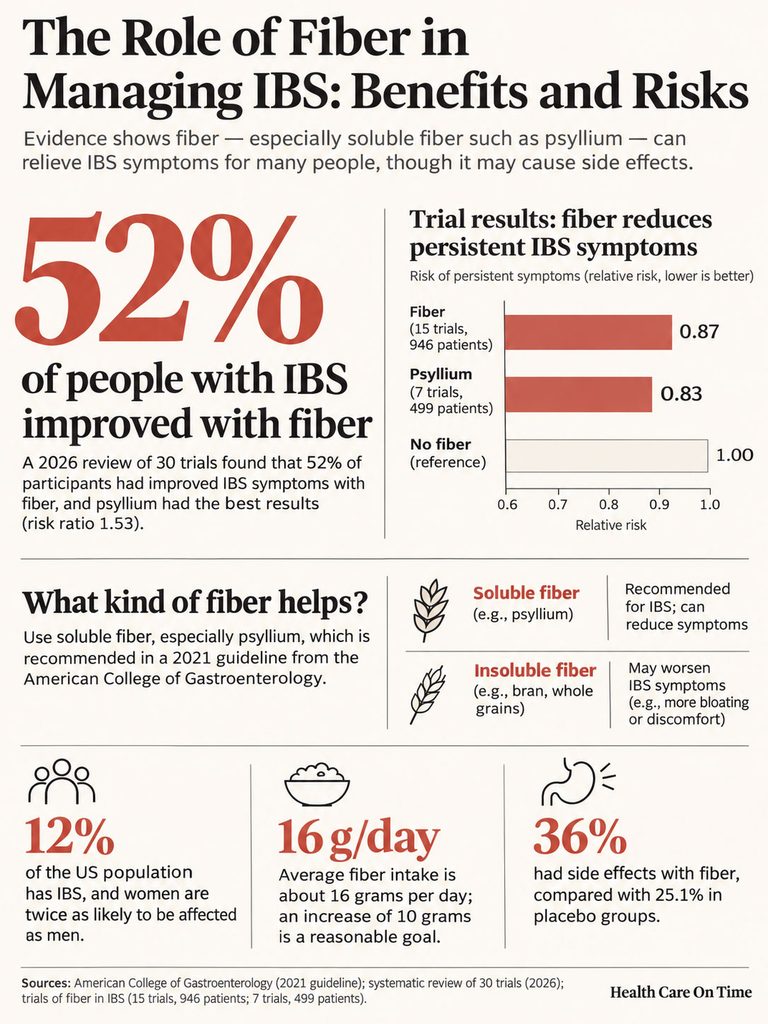
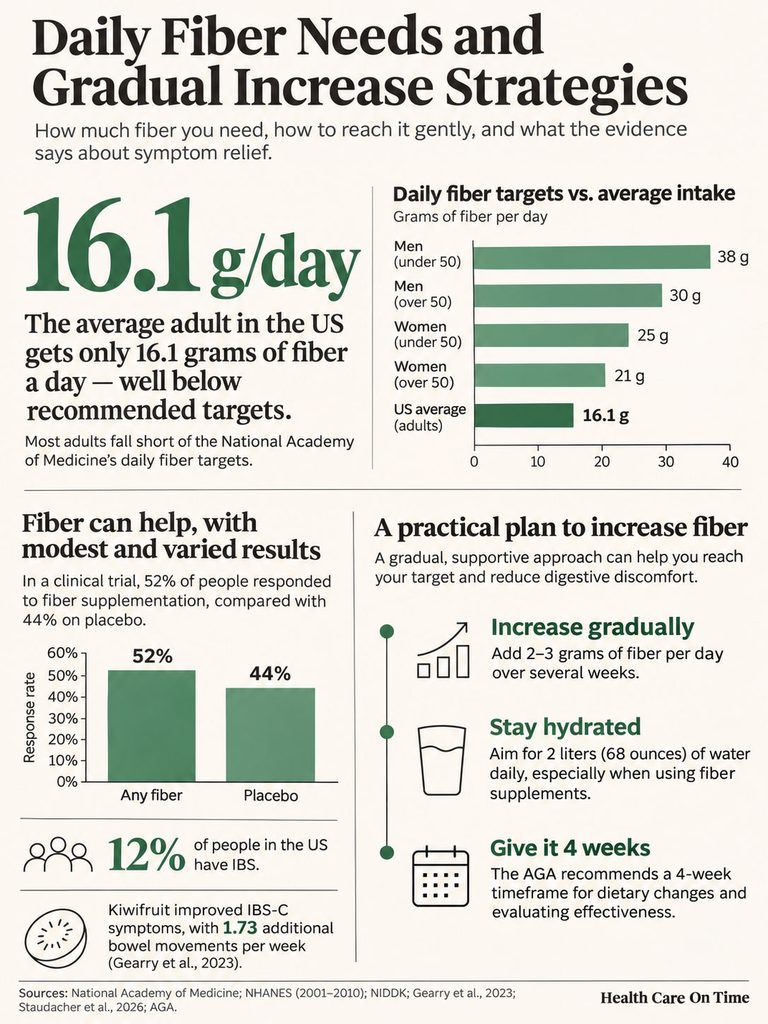
IBS affects about 12% of people in the US, and women up to twice as often as men, so a lot of people have been handed the same three words, “eat more fiber,” without being told which kind or how fast.
US gastroenterology groups agree on the main point. The American College of Gastroenterology’s 2021 guideline recommends soluble, but not insoluble, fiber for overall IBS symptoms, a strong recommendation backed by moderate-quality evidence. Pooled across 15 randomized trials with 946 patients, fiber lowered the risk that symptoms would persist (relative risk 0.87), and psyllium, also sold as ispaghula husk, did a little better on its own at 0.83 across 7 trials with 499 patients. That works out to about 7 people taking psyllium for 1 to benefit. Wheat bran, tested in 6 trials with 411 patients, never reached a significant result. Insoluble fiber may even worsen bloating and abdominal pain, a point the American Gastroenterological Association makes in its 2022 expert review, which steers people with constipation-predominant IBS toward soluble fiber in particular.
Side effects showed up often in those trials, in about 36% of people on fiber, but the 25.1% rate on placebo was close enough that the gap wasn’t statistically significant.
What the 2026 review of 30 trials added
Guidelines had been leaning on older pooled analyses until August 2026, when Heidi Staudacher and colleagues published a fresh systematic review and meta-analysis of 30 randomized trials and 1,904 people with IBS. Wheat bran was the most tested fiber (7 trials), followed by psyllium (6), inulin-type fructans (5) and beta-galacto-oligosaccharides, or B-GOS (2).
Across the 16 trials that measured clinical response, 52% of people improved on fiber and 44% on a control, a risk ratio of 1.21, and psyllium again came out ahead at 1.53. Combined symptom scores from 9 trials told a weaker story, with no significant effect for fiber as a group except B-GOS, and the results varied a lot from one trial to the next. The researchers also couldn’t sort most results by IBS subtype, because few trials reported them that way, and every trial tested supplements against placebo rather than whole-food fiber from oats or kiwifruit.
Like the 2021 guideline, the newer review supports psyllium for a meaningful share of people and finds nothing for wheat bran, so the type of fiber you pick deserves more attention than the total grams.
Soluble vs insoluble fiber, and why fermentation matters more
Soluble fiber dissolves in water and turns into a gel, while insoluble fiber stays intact and mostly adds bulk. Oats, peas, beans, apples, bananas, avocados, citrus fruits, carrots, barley and psyllium are good soluble sources; whole-wheat flour, wheat bran, nuts, beans and vegetables such as cauliflower, green beans and potatoes lean insoluble. Beans land on both lists because most plant foods contain a mix.
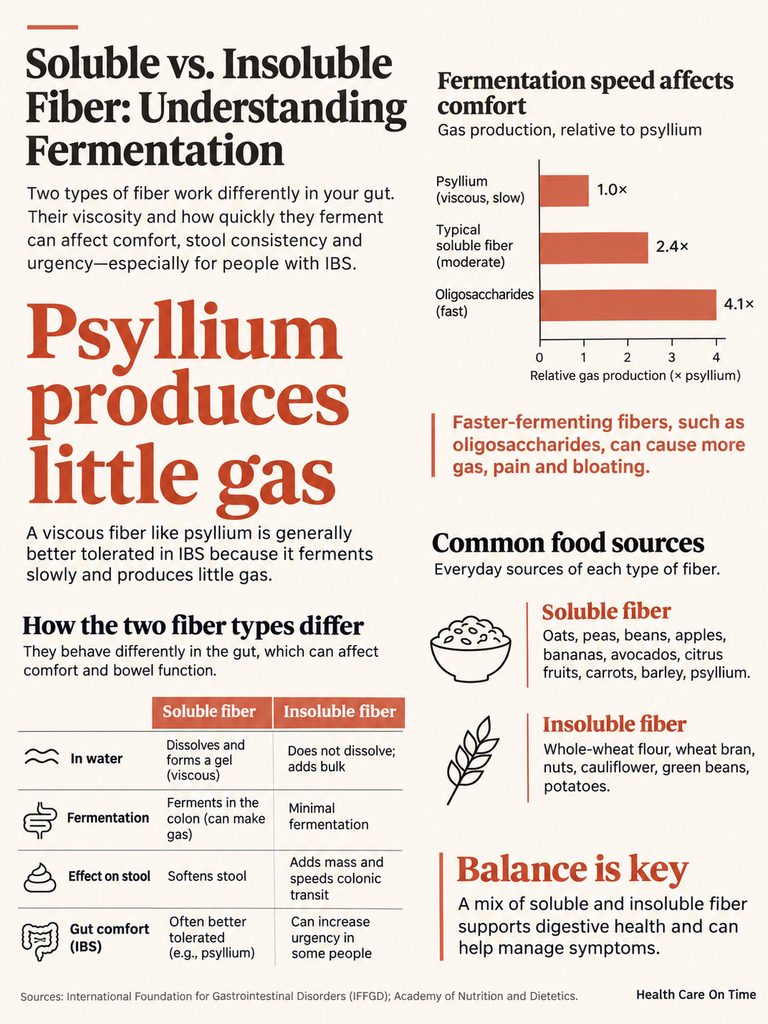
For a sensitive gut, viscosity (how thick a fiber gets in water) and fermentation speed (how fast gut bacteria break it down) often predict comfort better than solubility does.
Viscous, gel-forming fiber
Psyllium is the textbook case. It’s long-chain, moderately viscous and only moderately fermented, so it produces little gas, and because bacteria barely break it down, its gel survives the trip through the large bowel and helps normalize stool form, softening hard stools and firming loose ones. A 2017 review in the International Journal of Molecular Medicine recommended this type of fiber for IBS-D, IBS-M and IBS-C alike.
Fast-fermenting fiber
Short-chain fibers act very differently. Oligosaccharides, the “O” in FODMAP, ferment so fast that gas builds up quicker than the gut can absorb it, and the trapped gas causes pain and bloating. Wheat bran contains fructans, and products built on FOS or inulin are high in FODMAPs, so both are poor picks for IBS. Longer-chain fibers ferment slowly and usually go down more easily.
Insoluble fiber adds stool mass and speeds colonic transit by mechanically stimulating the bowel wall. In someone whose stool already moves too fast, that extra push can make urgency worse.
18 gentle high-fiber foods, with grams per low-FODMAP serving
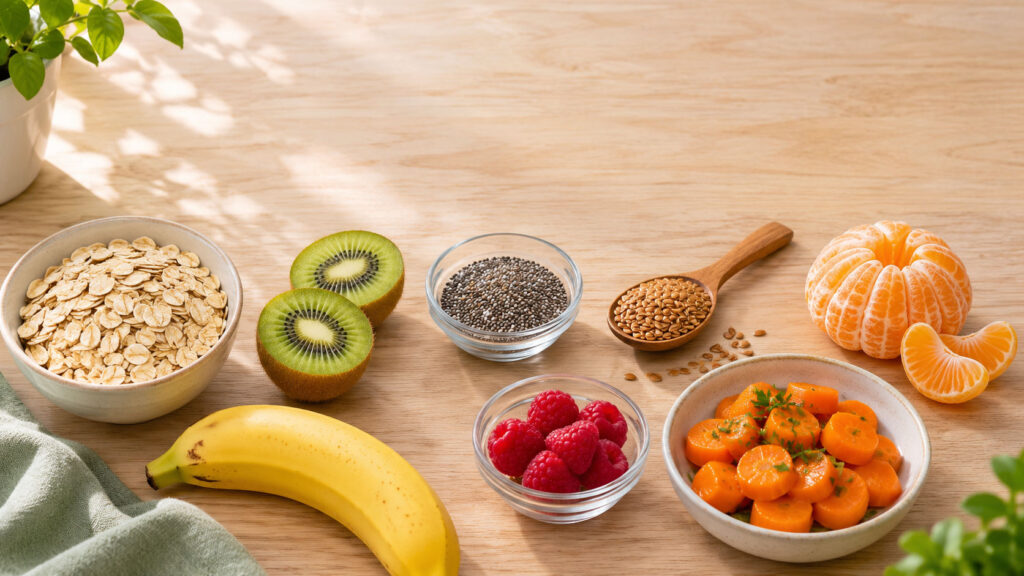
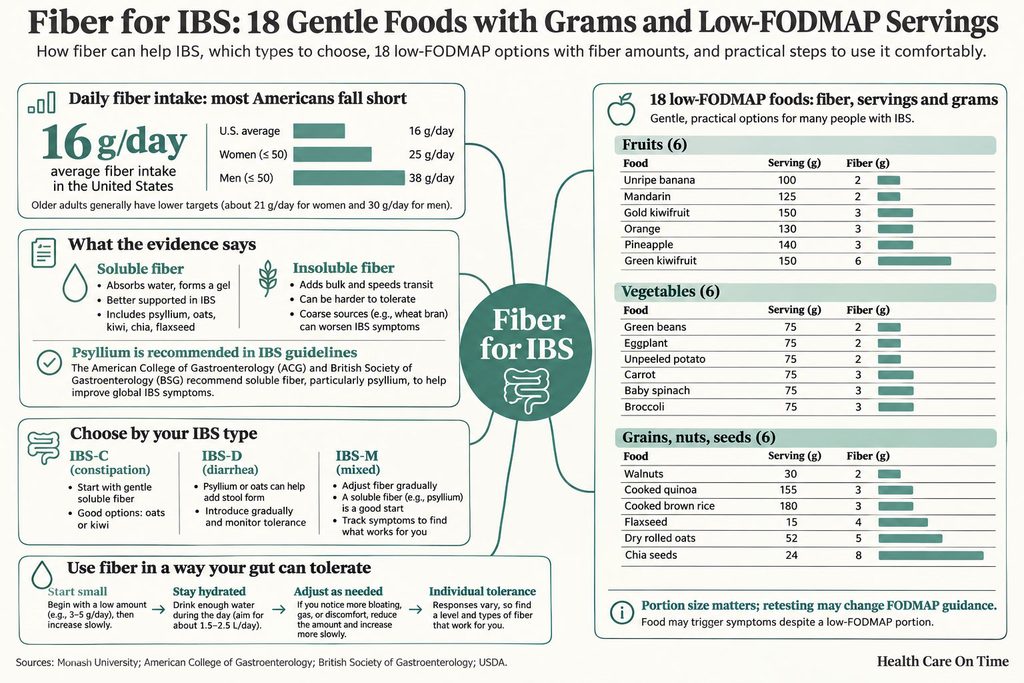
Each serving below is one that Monash University lab-tested and published as low in FODMAPs. The fiber grams come from USDA FoodData Central SR Legacy values per 100 grams, multiplied out to the exact weight of that serving.
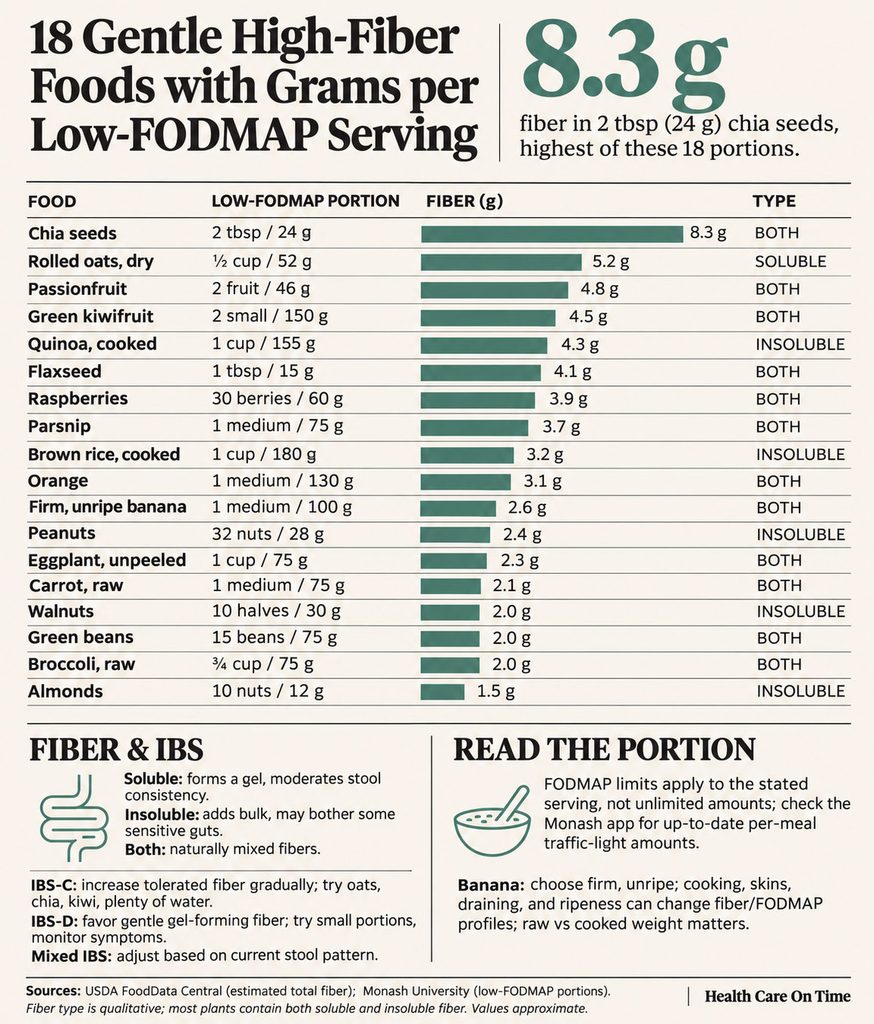
| Food | Low-FODMAP serving (Monash) | Fiber per serving (USDA) | Main fiber type | Usually suggested for |
| Chia seeds | 2 tablespoons (24 g) | 8.3 g | Mostly insoluble (85 to 93%), forms a gel | IBS-C; try for bloating |
| Rolled oats, dry | 1/2 cup (52 g) | 5.3 g | Soluble | IBS-C and IBS-D |
| Green kiwifruit, peeled | 2 small (150 g) | 4.5 g | Both (flesh and seeds) | IBS-C |
| Quinoa, cooked | 1 cup (155 g) | 4.3 g | Mostly insoluble (whole grain) | IBS-C |
| Flaxseed (linseed) | 1 tablespoon (15 g) | 4.1 g | Both, forms a gel | IBS-C |
| Raspberries | 30 berries (60 g) | 3.9 g | Both (seeds are insoluble) | IBS-C; blend for IBS-D |
| Buckwheat groats, cooked | 3/4 cup (135 g) | 3.6 g | Mostly insoluble (whole grain) | IBS-C |
| Orange, peeled | 1 medium (130 g) | 3.1 g | Soluble | IBS-C and IBS-D |
| Brown rice, cooked | 1 cup (180 g) | 2.9 g | Mostly insoluble (whole grain) | IBS-C |
| Banana, firm | 1 medium (100 g) | 2.6 g | Soluble | IBS-D and IBS-C |
| Chickpeas, canned, rinsed | 1/4 cup (42 g) | 2.6 g | Both | Both, small portions |
| Peanuts | 32 nuts (28 g) | 2.4 g | Mostly insoluble | IBS-C; peanut butter for IBS-D |
| Carrot | 1 medium (75 g) | 2.1 g | Soluble | IBS-C and IBS-D |
| Walnuts | 10 halves (30 g) | 2.0 g | Mostly insoluble | IBS-C |
| Green beans | 15 beans (75 g) | 2.0 g | Mostly insoluble | IBS-C; well cooked for IBS-D |
| Lentils, boiled | 1/4 cup (23 g) | 1.8 g | Both | Both, small portions |
| Spinach, raw | 1 1/2 cups (75 g) | 1.7 g | Mostly insoluble | IBS-C; cooked or blended for IBS-D |
| Potato with skin | 1/2 medium (75 g) | 1.6 g | Both (skin is insoluble) | Both; peel it for IBS-D |
How to read the table
Treat each serving as a ceiling for one sitting while your gut is touchy, because going well past it, or piling several borderline foods onto one plate, raises the total FODMAP load. These servings were published in January 2021, and the Monash FODMAP app carries any later updates. Ripeness counts for bananas. Monash tested firm, less ripe ones, so a spotty banana isn’t the same food here.
Because the grams are USDA values, a few won’t match Monash’s own charts. Monash lists firm tofu as a 6-gram serving, for example, but USDA data for firm tofu works out to well under 2 grams at the same weight, so tofu didn’t make this list.
Chia tops the table, yet roughly 85 to 93% of its fiber is insoluble, which is why it sits in the IBS-C column despite the gel it forms in liquid. Canned chickpeas and lentils appear only at a few spoonfuls, since NIDDK counts beans and lentils as high-FODMAP in normal portions.
The last column describes general patterns. Soluble, gel-forming foods tend to suit both main subtypes, while whole grains, nuts and skins tend to suit constipation better and often become tolerable in IBS-D once they’re peeled, cooked, blended or ground into a smooth butter.
Fiber for IBS-C (constipation-predominant)
Constipation affects more than half of people with IBS, so this is the group fiber helps most often, and expert advice favors soluble fiber for them specifically. Oats, psyllium, chia and flaxseed are reasonable first choices. Two tablespoons of flaxseed a day, 2 kiwifruit a day and psyllium are common foods for constipation relief that also fit IBS-C. Prunes need more care, since dried fruit in large amounts is high-FODMAP and prunes bloated about a third of people in the US trial below. Keep some soluble fiber in the mix as well, so stools don’t turn hard and dry.
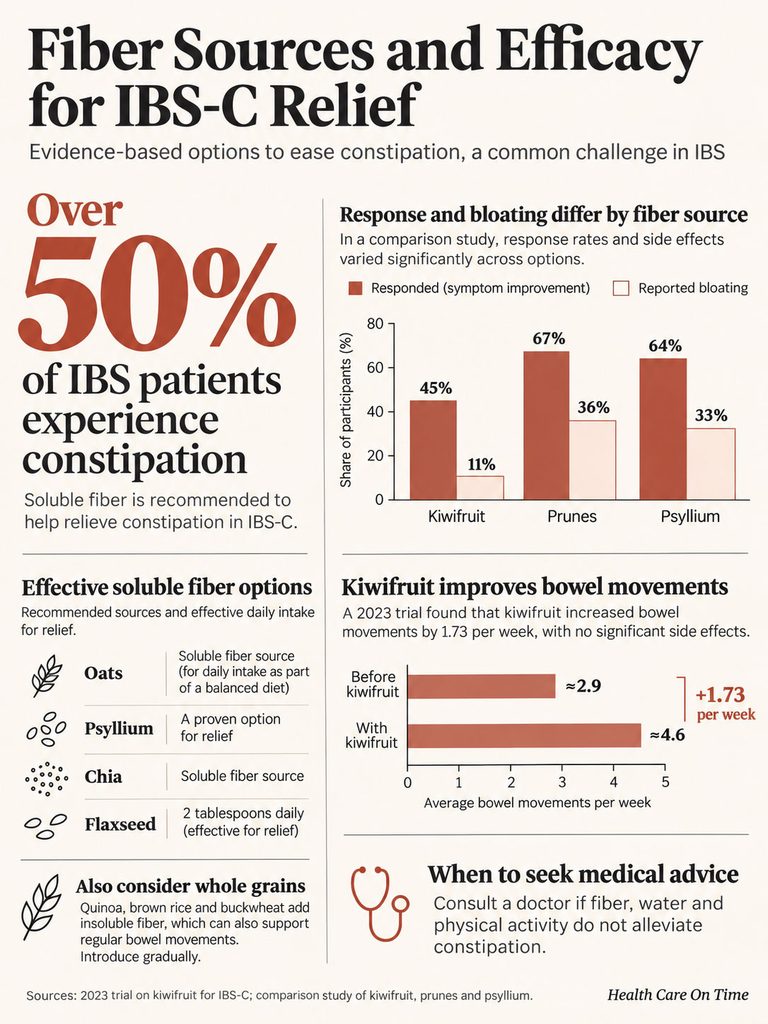
Green kiwifruit has been tested directly in IBS-C. In a 2023 trial, 61 people with IBS-C ate 2 green kiwifruit a day or took 7.5 grams of psyllium for 4 weeks before switching to the other. Kiwifruit added an average of 1.73 complete bowel movements per week and improved abdominal comfort scores, with no significant side effects.
A smaller US comparison at Michigan Medicine gave 79 adults with chronic constipation 2 kiwifruit, 100 grams of prunes or 12 grams of psyllium a day. About 45%, 67% and 64% responded, a difference that wasn’t significant. Side effects separated the groups more clearly. Abdominal pain hit 33% of the psyllium group and bloating hit 36% of the prune group, against bloating in only 11% of kiwifruit eaters. These volunteers had chronic constipation rather than IBS-C specifically, and that kiwifruit grower Zespri helped pay for the study.
Whole grains like quinoa, brown rice and buckwheat add mostly insoluble fiber, which can help move stool along. Bring them in after the gentler soluble sources have settled, one at a time, so that if something goes wrong you know which food caused it.
When fiber, water and activity together still leave you straining, ask your doctor about a pelvic floor problem, where the abdominal and pelvic muscles don’t coordinate during a bowel movement and extra fiber won’t help.
Fiber for IBS-D (diarrhea-predominant)
With loose stools, adding fiber can sound backward, yet soluble fiber soaks up water and can make loose, watery stools more solid. Gel-forming sources fit best: oats, firm bananas, peeled potatoes, carrots, citrus and psyllium. Insoluble foods become easier when you change their texture, so puree beans, swap whole nuts for nut butter, and blend berries or spinach into a smoothie. During a flare, softer, well-cooked, lower-residue foods sit better than coarse or bulky ones, and raw or whole versions can come back later.
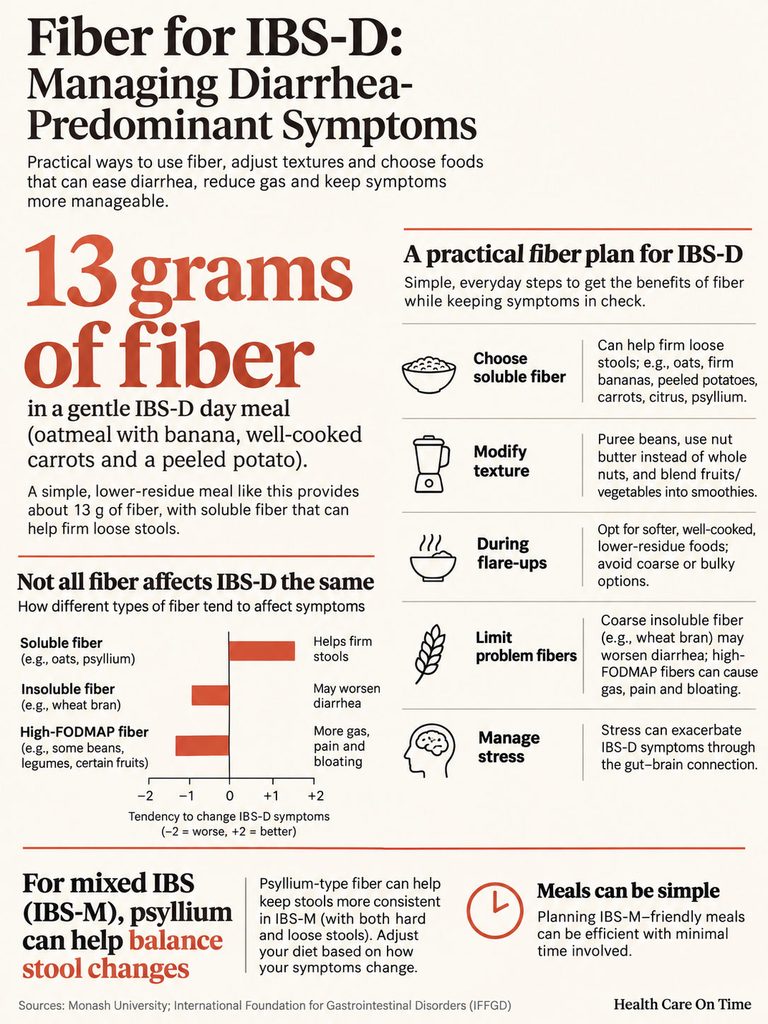
Coarse insoluble fiber such as wheat bran speeds colonic transit, the opposite of what loose stools need, and bulky raw vegetables can worsen pain or diarrhea in a flare. High-FODMAP fibers add a second problem by producing gas fast in a gut that’s often more sensitive than average, which brings more pain and bloating, and stress can sharpen that sensitivity through the gut-brain connection behind anxiety and diarrhea.
A gentle IBS-D day might start with oatmeal and a sliced firm banana, move to lunch with well-cooked carrots and a peeled potato, and include an orange in the afternoon. From the table, the oats, banana, carrot and orange alone add about 13 grams of fiber, and none of them is coarse or high-FODMAP.
If you have mixed IBS (IBS-M)
Mixed IBS swings between hard and loose stools, sometimes in the same week. Psyllium-type fiber is often the most practical choice, since its gel can soften hard stools and firm up loose ones, and the 2017 review recommended it for all three subtypes. Keep that base steady. Then adjust the food around it by the week you’re having: oats and kiwifruit when things are slow, and bananas, peeled potatoes and cooked carrots when they run loose. It sounds fussy. In practice it takes about a minute of planning.
Why fiber made your IBS worse
When a “high-fiber” push ends in cramps, the cause is usually on this list.
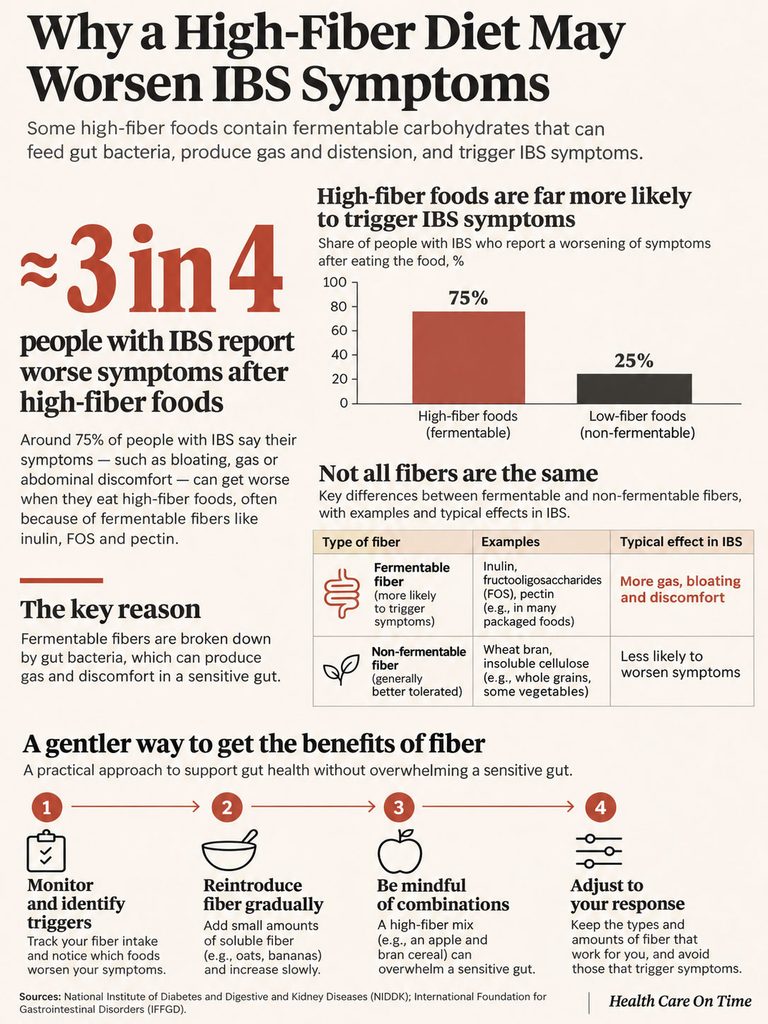
- Wheat bran. It’s the fiber most often sold for regularity, but it’s insoluble, coarse and contains fructans. It’s not recommended for IBS, and in the ACG analysis it didn’t beat placebo.
- Inulin, chicory root and FOS. These fast-fermenting fibers turn up in fiber bars, cereals, protein shakes and “prebiotic” drinks. Look for inulin, chicory root fiber, FOS or oligofructose on the ingredient list, and skip supplements built on them. Read the back of the box. The front rarely tells you.
- Going too fast. A short stretch of bloating and changed bowel habits is common at the start, which is why raising fiber by no more than 5 grams a day each week is the usual ceiling. A sudden jump can bring on loose stools even without IBS, for the same reasons too much fiber causes diarrhea.
- Not enough fluid. Fiber works best when it absorbs water, and a psyllium dose needs at least 8 ounces of liquid.
- Big servings of high-FODMAP foods. Apples, pears, mango, beans in large portions, wheat and rye are high in fiber and also high in FODMAPs.
A large apple with a bowl of bran cereal looks like a model breakfast, but together they hand a sensitive gut a lot of fermentable carbohydrate at once. Packaged “high-fiber” foods carry a similar trap, because readily fermentable fibers such as inulin, FOS and pectin are often added to them, so a snack bar can look like the healthy choice while delivering the kind of fiber most likely to cause gas.
If any of these set you back, return to the last amount that felt fine and rebuild slowly with soluble sources.
Keeping fiber up on the low-FODMAP diet
The low-FODMAP diet and fiber pull in opposite directions at first. Many of the foods cut during the strict phase (wheat and rye products, beans, apples, pears) are major fiber sources, so intake can quietly drop just when your gut needs steady input, and getting enough fiber takes some planning.
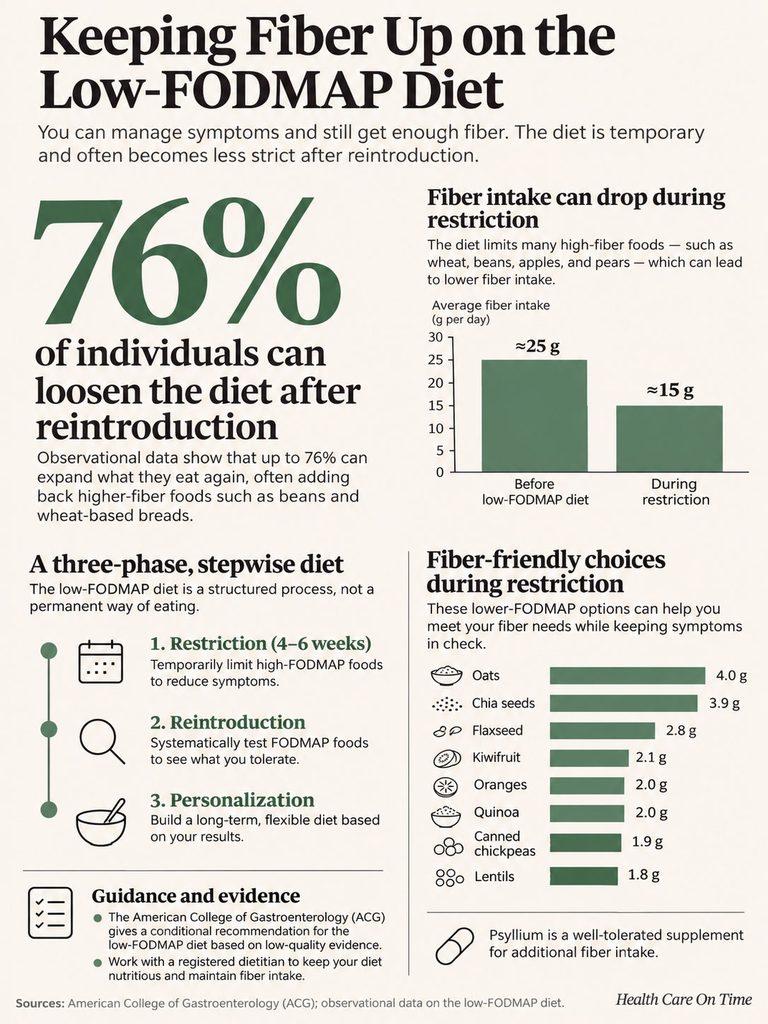
The ACG gives the diet only a conditional recommendation based on very low-quality evidence, a weaker endorsement than soluble fiber gets. It runs in three phases. Restriction comes first and should last no more than 4 to 6 weeks; reintroduction follows, with single FODMAP foods tested in rising amounts over 3 days while you track symptoms; and personalization builds a long-term diet from what you tolerated. Observational data suggest up to 76% of people can loosen the diet after reintroduction. For fiber, that’s encouraging, because the foods that come back during reintroduction often include higher-fiber ones that were cut at the start, such as larger servings of beans or some wheat-based breads. The aim of the last phase is a wider, more varied diet than the strict phase allows, with fiber back near its usual level.
During restriction, the food table does most of the work. Oats, chia, flaxseed, kiwifruit, oranges, quinoa and small servings of canned chickpeas and lentils can keep fiber close to normal without breaking the diet, and psyllium is one of the better-tolerated supplements if you need more. A registered dietitian who knows digestive conditions can plan swaps like these around your own food list.
How much fiber you need, and how fast to add it
For general health, the National Academy of Medicine target is 25 grams a day for women 50 or younger and 21 grams after 50, and 38 grams for men 50 or younger and 30 grams after 50. US adults averaged 16.1 grams a day in NHANES survey data from 2001 to 2010, so most people have a real gap to close.
| Measure | Number | Source |
| People in the US with IBS | About 12% | NIDDK |
| Average US adult fiber intake | 16.1 g per day | NHANES 2001 to 2010 (McGill et al., 2016) |
| Daily fiber target, age 50 or younger | 25 g women, 38 g men | National Academy of Medicine, via Mayo Clinic |
| Fiber vs placebo, 15 trials (946 people) | Relative risk of persistent symptoms 0.87 | ACG guideline, 2021 |
| Psyllium vs placebo, 7 trials (499 people) | Relative risk 0.83; 7 treated for 1 to benefit | ACG guideline, 2021 |
| Wheat bran vs placebo, 6 trials (411 people) | Relative risk 0.90; not significant | ACG guideline, 2021 |
| Any fiber supplement, 16 trials (1,293 people) | 52% responded vs 44% on control | Staudacher et al., Gastroenterology, 2026 |
| Psyllium response, same 2026 review | Risk ratio 1.53 | Staudacher et al., Gastroenterology, 2026 |
| Side effects in fiber trials | 36% on fiber vs 25.1% on placebo | ACG guideline, 2021 |
| 2 green kiwifruit daily, IBS-C (61 people) | 1.73 more complete bowel movements per week | Gearry et al., Am J Gastroenterol, 2023 |
A week-by-week ramp-up
Add fiber in small steps of about 2 to 3 grams a day, spread over a few weeks, to keep gas and bloating down. With the USDA numbers from the food table, a 4-week plan could look like this:
- Week 1: add one firm banana a day (about 2.6 grams).
- Week 2: keep the banana and add one medium orange (about 3.1 grams), for roughly 5.7 extra grams a day.
- Week 3: stir 1 tablespoon of flaxseed into breakfast (about 4.1 grams), bringing the extra fiber to about 9.8 grams a day.
- Week 4: hold steady and judge. If bloating is calm and stools are better, keep going; if not, drop back to the last week that felt fine.
By the end, you’re close to that extra 10 grams a day, and no single week added more than about 4 grams. Someone with IBS-C might swap the banana for kiwifruit.
Drink more as you go. About 2 liters (about 68 ounces) of water a day is a reasonable target, and each psyllium dose needs at least 8 ounces of liquid on its own.
The AGA review advises setting a time limit for any diet change and moving on if it doesn’t work. The kiwifruit and psyllium trials above each ran 4 weeks, so a month is a reasonable window to judge a change at home.
Fiber supplements for IBS
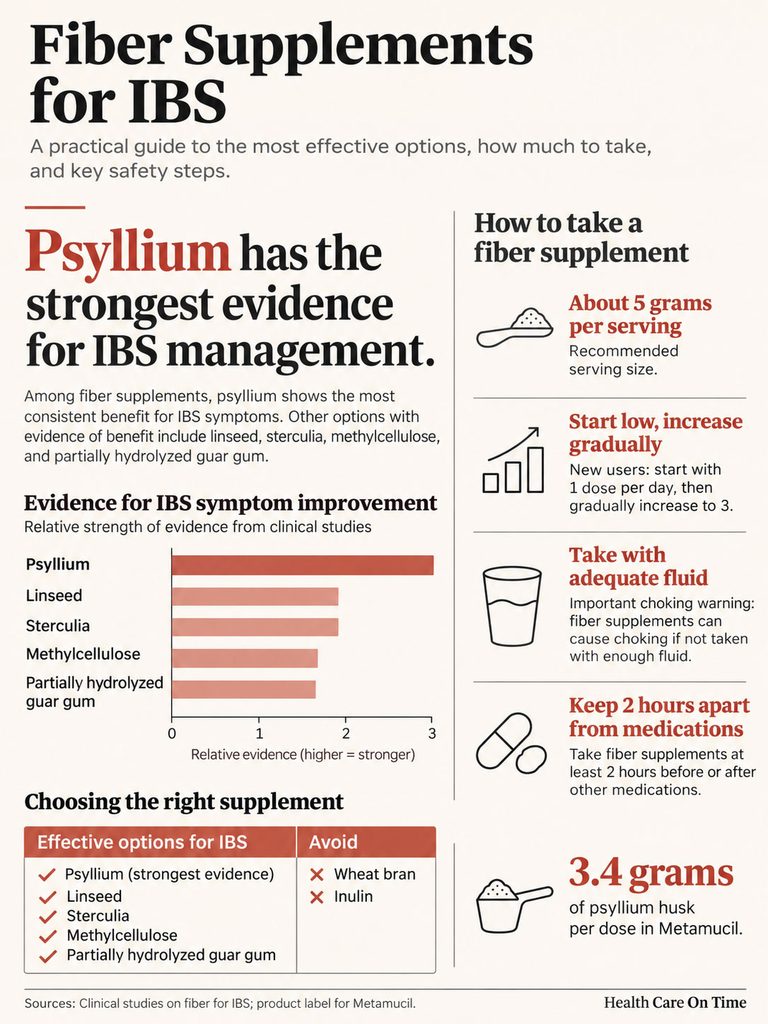
When food alone isn’t enough, psyllium has the best evidence for IBS. Linseed (flaxseed), sterculia, methylcellulose (Citrucel) and partially hydrolyzed guar gum (sold as Sunfiber) are other reasonable options, most at about 5 grams of fiber per serving, while supplements made from wheat bran or inulin are best avoided.
On the Metamucil Drug Facts label, each dose holds about 3.4 grams of psyllium husk, and new users are told to start with 1 dose a day and work up gradually to 3. The label also carries a choking warning: without enough fluid, the powder can swell and block the throat, so anyone with trouble swallowing shouldn’t use it. Take it at least 2 hours before or after other medicines, because bulk fiber can change how they’re absorbed.
What to do next: a decision guide
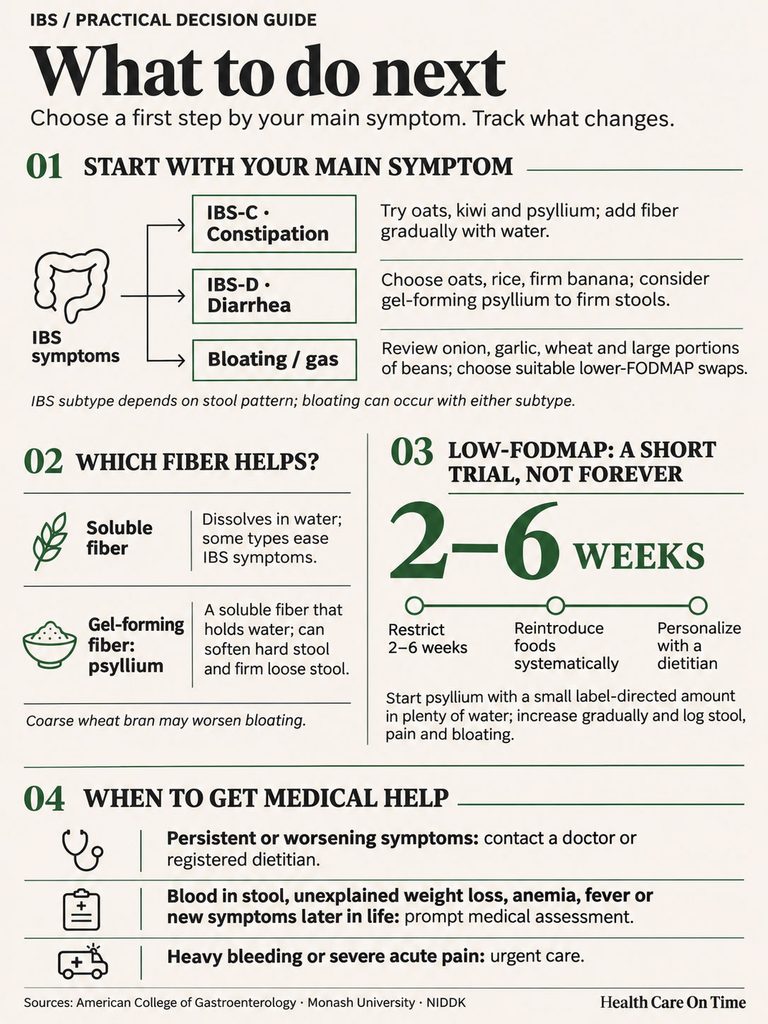
| If this is you | Try this | Why |
| IBS-C and eating little fiber | Oats, 2 green kiwifruit or 1 tablespoon of flaxseed; add psyllium if needed | Soluble fiber is favored for IBS-C; kiwifruit added 1.73 bowel movements per week in IBS-C |
| IBS-D or urgent loose stools | Oats, firm banana, peeled potato, carrots, psyllium; cook or blend vegetables | Gel-forming fiber adds form to loose stools; coarse fiber can speed transit |
| Bloating got worse after adding fiber | Drop back to the last amount that felt fine; check labels for inulin, chicory root or FOS | Fast-fermenting fibers make gas quickly; jumps of more than 5 g a day per week cause trouble |
| Following the low-FODMAP diet | Use the Monash servings in the table; keep restriction to 4 to 6 weeks | Many high-fiber foods are high-FODMAP; AGA limits the strict phase to 4 to 6 weeks |
| Starting psyllium | 1 dose (about 3.4 g) a day with at least 8 oz of liquid, 2 hours apart from other drugs | Metamucil label directions and choking warning |
| No change after about 4 weeks | See a registered dietitian or your doctor about other treatments | AGA advises switching approaches when a diet trial doesn’t help |
| Bleeding, weight loss or black stools | See a doctor before changing your diet | These are alarm features that need a medical check |
When to see a doctor first
Fiber is something to try once IBS has been diagnosed, and new or alarming symptoms need a medical check before any diet experiment. The ACG guideline lists these alarm features:
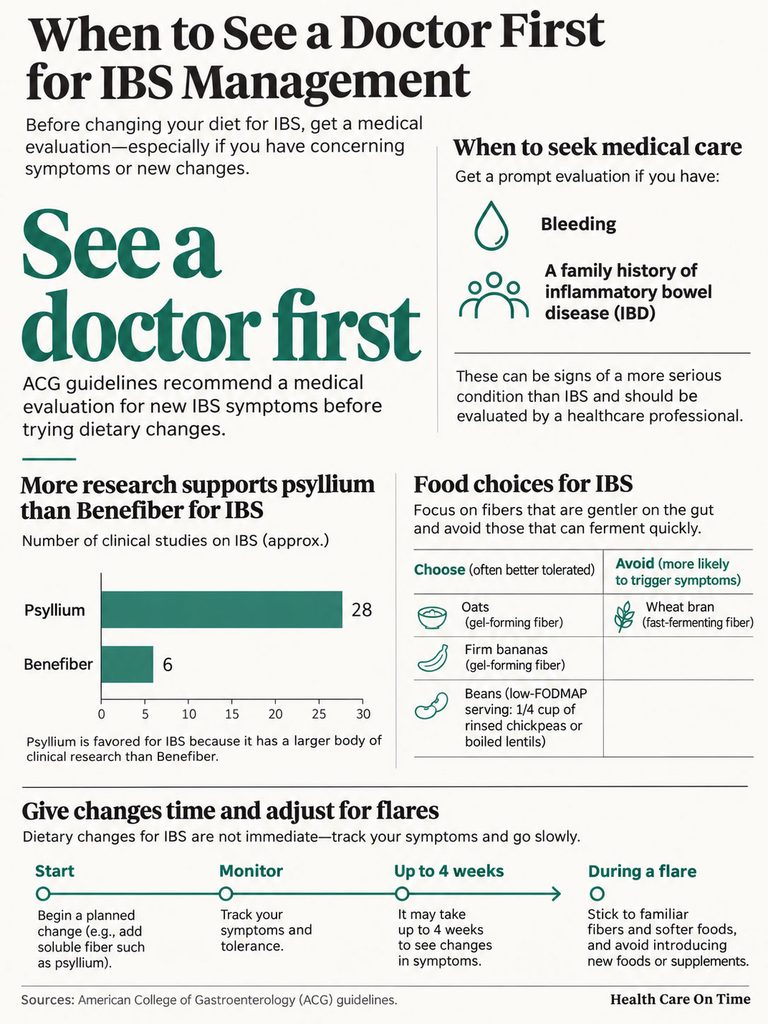
- Rectal bleeding
- Black, tarry stools
- Unintentional weight loss
- Symptoms that start at an older age
- A family history of inflammatory bowel disease, colon cancer or another serious bowel disease
Bleeding and a family history matter partly because inflammatory bowel disease can look like IBS early on and needs very different treatment.
Questions to bring to the appointment:
- Which IBS subtype fits these symptoms, and does that change which fiber to try first?
- Should celiac disease or anything else be ruled out before adding more fiber?
- Is psyllium safe with the medicines already on the prescription list, and how far apart should the doses be?
- Would a referral to a GI dietitian help with the low-FODMAP diet and fiber at the same time?
- How long should a fiber trial last before switching to something else?
- If cramping doesn’t ease with fiber, would an antispasmodic such as dicyclomine make sense?
Frequently Asked Questions
Is fiber bad for IBS?
It helps more people than it hurts. Soluble fiber, especially psyllium, carries a strong ACG recommendation, while wheat bran and fast-fermenting fibers like inulin are the likeliest to cause bloating and pain.
Is fiber good for IBS with diarrhea?
It can be, if you choose gel-forming types that soak up water and firm loose stools. Oats, firm bananas, peeled potatoes, carrots and psyllium are good starting points, and coarse wheat bran is better left out.
Is soluble fiber good for IBS-C?
Yes, and it’s the type experts favor for constipation-predominant IBS. Psyllium has the strongest trial record of any single fiber.
Is oatmeal good for IBS?
Rolled oats suit many people with IBS. Half a cup of dry rolled oats (52 grams) is a Monash-tested low-FODMAP serving with about 5.3 grams of fiber, mostly soluble, by USDA figures, so start there before trying bigger bowls. Flavored instant packets and “high-fiber” oat products need a look at the label, because processed high-fiber foods often contain added inulin or FOS, and some sweeteners ending in “-ol” are high in FODMAPs.
Can I eat beans or lentils with IBS?
Small amounts work for most people. A low-FODMAP serving is 1/4 cup of rinsed canned chickpeas (42 grams) or 1/4 cup of boiled lentils (23 grams). Larger portions are high in FODMAPs and give many people gas, and pureed beans tend to sit better if your stools run loose.
How long until fiber helps IBS?
Give any change about 4 weeks, the length of the kiwifruit and psyllium trials. Some people notice easier or firmer stools within days, and the Metamucil label says it generally produces a bowel movement in 12 to 72 hours. Mild bloating in the first week or two is common and often fades as your gut adjusts. If nothing has improved after a month, or things are clearly worse, stop and talk with your doctor or a dietitian about other options.
Is psyllium better than Benefiber for IBS?
Psyllium has much more IBS research behind it. Benefiber is made from wheat dextrin, a fermentable fiber that people troubled by gas and bloating are often told to cut back on, while psyllium came out ahead in the 2026 review.
Should I take fiber during an IBS flare?
You can usually keep a fiber you already tolerate, such as psyllium or oats, but a flare is a poor time to try something new. Lean on softer, well-cooked, lower-residue foods, and bring raw or whole foods back once things settle.
Medical disclaimer: This article is for general education and does not replace advice from your doctor, pharmacist or registered dietitian. IBS symptoms can overlap with other conditions. See a clinician for new, severe or changing bowel symptoms, and check with a pharmacist before starting a fiber supplement if you take other medicines.
References
- Lacy BE, Pimentel M, Brenner DM, et al. ACG Clinical Guideline: Management of Irritable Bowel Syndrome. Am J Gastroenterol. 2021;116(1):17-44. https://pubmed.ncbi.nlm.nih.gov/33315591/
- Staudacher HM, Rucco V, Mancell S, Dimidi E, Whelan K. Fiber Supplementation in Irritable Bowel Syndrome: A Systematic Review and Meta-Analysis of Randomized Controlled Trials. Gastroenterology. Published online August 14, 2026. https://pubmed.ncbi.nlm.nih.gov/42600900/
- Chey WD, Hashash JG, Manning L, Chang L. AGA Clinical Practice Update on the Role of Diet in Irritable Bowel Syndrome: Expert Review. Gastroenterology. 2022;162:1737-1745. https://www.spg.pt/wp-content/uploads/2023/03/The-role-of-diet-in-irritable-bowel-syndrome-IBS.pdf
- El-Salhy M, Ystad SO, Mazzawi T, Gundersen D. Dietary fiber in irritable bowel syndrome (Review). Int J Mol Med. 2017;40(3):607-613. https://pmc.ncbi.nlm.nih.gov/articles/PMC5548066/
- Muir J. An Overview of Fiber and Fiber Supplements for Irritable Bowel Syndrome. Gastroenterol Hepatol. 2019;15(7):387-389. https://pmc.ncbi.nlm.nih.gov/articles/PMC6676347/
- Gearry R, Fukudo S, Barbara G, et al. Consumption of 2 Green Kiwifruits Daily Improves Constipation and Abdominal Comfort. Am J Gastroenterol. 2023;118(6):1058-1068. https://cris.unibo.it/retrieve/3519181a-c5e5-468c-b545-f2c6e5a0da71/Gearry_2023.pdf
- Michigan Medicine. Does Kiwifruit Help Chronic Constipation? https://michiganmedicine.org/health-lab/does-kiwifruit-help-chronic-constipation
- National Institute of Diabetes and Digestive and Kidney Diseases. Eating, Diet, & Nutrition for Irritable Bowel Syndrome. https://www.niddk.nih.gov/health-information/digestive-diseases/irritable-bowel-syndrome/eating-diet-nutrition
- National Institute of Diabetes and Digestive and Kidney Diseases. Definition & Facts for Irritable Bowel Syndrome. https://www.niddk.nih.gov/health-information/digestive-diseases/irritable-bowel-syndrome/definition-facts
- Mayo Clinic. Dietary fiber: Essential for a healthy diet. https://www.mayoclinic.org/dietary-fiber/art-20043983
- Mayo Clinic News Network. Home remedies: Irritable bowel syndrome. October 14, 2016. https://newsnetwork.mayoclinic.org/discussion/home-remedies-irritable-bowel-syndrome/
- Varney J, Muir J. Fiber in the Management of Irritable Bowel Syndrome (IBS). International Foundation for Gastrointestinal Disorders, 2021. https://iffgd.org/wp-content/uploads/129-Fiber-in-IBS.pdf
- Varney J. Getting enough fibre. Monash University FODMAP blog, January 14, 2021. https://www.monashfodmap.com/blog/getting-enough-fibre
- US Department of Agriculture. FoodData Central, SR Legacy (FDC IDs 173904, 170554, 169414, 168153, 169097, 167755, 173944, 170393, 170026, 168917, 169704, 173801, 172421, 172430, 170187, 168462, 169961, 170686). https://fdc.nal.usda.gov/
- McGill CR, Birkett A, Fulgoni VL III. Healthy Eating Index-2010 and food groups consumed by US adults who meet or exceed fiber intake recommendations, NHANES 2001-2010. Food Nutr Res. 2016;60:29977. https://pmc.ncbi.nlm.nih.gov/articles/PMC4838991/
- Kulczyński B, Kobus-Cisowska J, Taczanowski M, et al. The Chemical Composition and Nutritional Value of Chia Seeds: Current State of Knowledge. Nutrients. 2019;11(6):1242. https://pmc.ncbi.nlm.nih.gov/articles/PMC6627181/
- GI Nutrition Foundation. Fiber in IBD and IBS. https://www.ginutritionfoundation.org/fiber-in-ibd-and-ibs
- DailyMed. Metamucil Therapy for Regularity (psyllium husk powder) label. https://dailymed.nlm.nih.gov/dailymed/drugInfo.cfm?setid=12d030b0-df97-4dd6-88ba-e9fe863c95ea