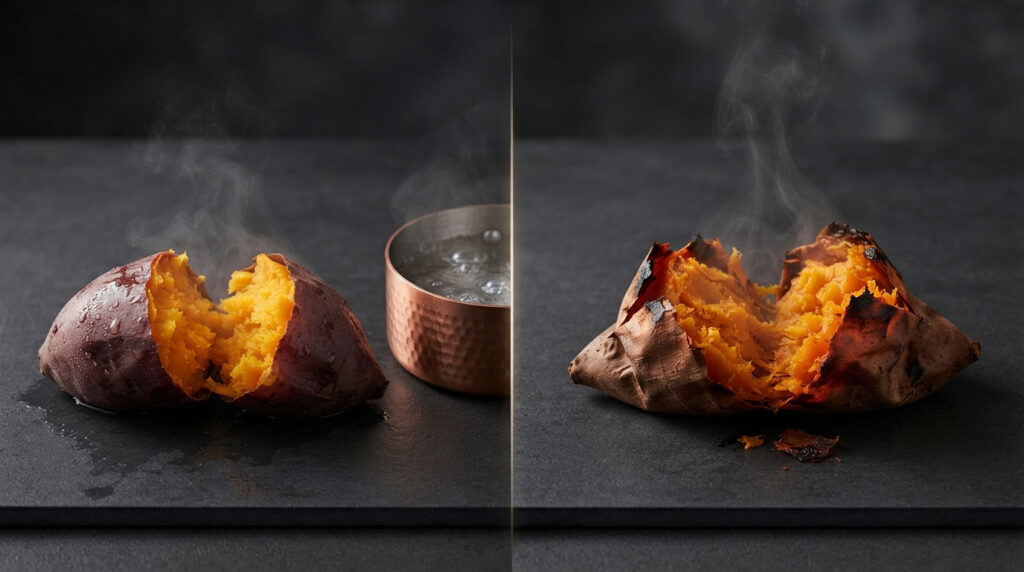
The USDA’s own database says a baked sweet potato carries more than twice the potassium of a boiled one. That number gets used to end this argument. It is also misleading, and the reason why changes the answer for most kitchens.
Table of Contents
Quick Answer
Boiling wins on blood sugar and beta-carotene retention. Baking wins on potassium, vitamin C, and fiber per bite, though much of that edge comes from water loss and from keeping the skin on. For most people the bigger decision is not oven versus pot. It is whether you peel and cube the root first, which strips more nutrition than either cooking method does.
Sweet potato advice online has settled into one storyline: boil it, and you are being virtuous. The published research is messier, more contradictory, and more useful than that.
Patients booking metabolic panels through HealthCareOnTime raise this question constantly, usually right after a fasting glucose result nudges into the prediabetes band. They deserve real numbers, not a slogan.
At a Glance
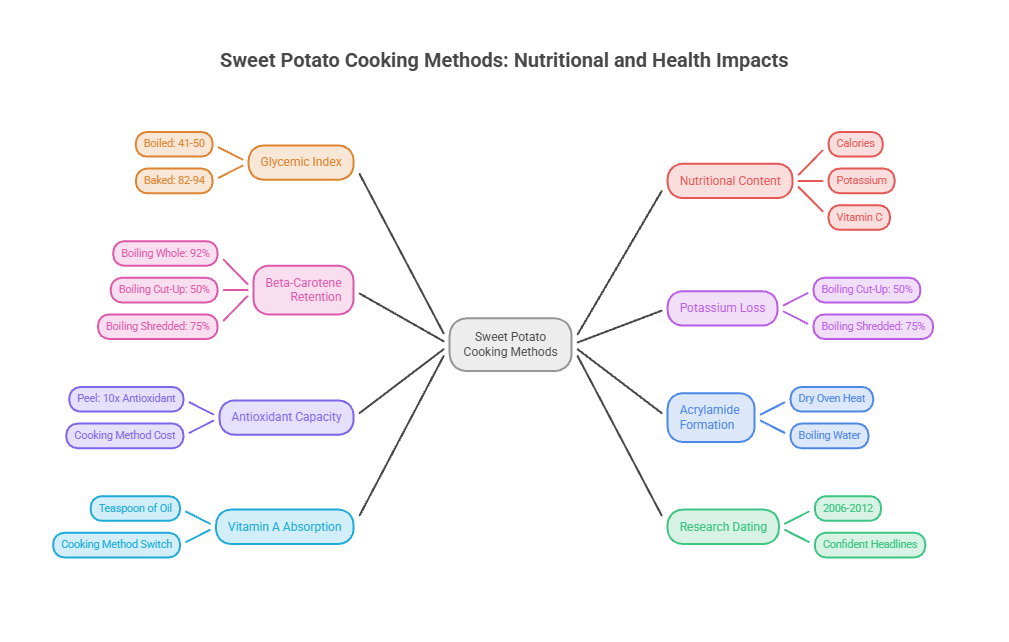
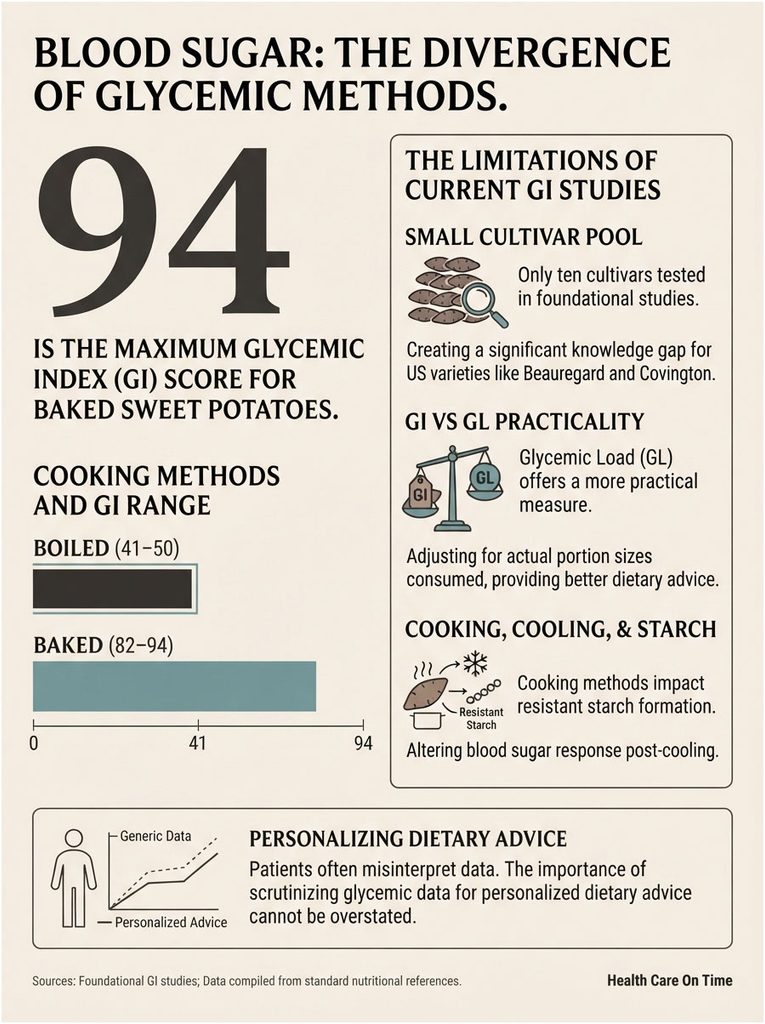
- Boiled sweet potato scored a glycemic index of 41 to 50 in the most-cited study; baked scored 82 to 94.
- Per 3.5 ounces (100 g), USDA lists baked in skin at 90 calories, 475 mg potassium, and 19.6 mg vitamin C, versus boiled without skin at 76 calories, 230 mg potassium, and 12.8 mg vitamin C.
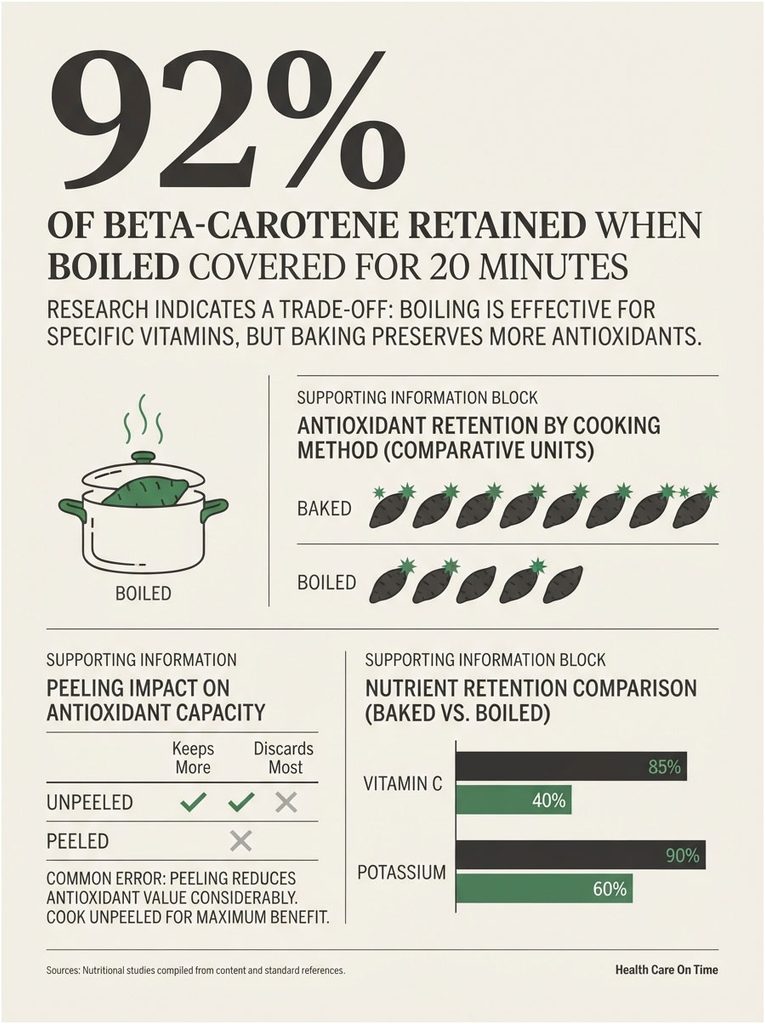
- Boiling whole with the lid on preserved 92 percent of beta-carotene in one true-retention analysis.
- Boiling cut-up cubes stripped 50 percent of the potassium; shredded pieces lost 75 percent.
- The peel carries roughly ten times the antioxidant capacity of the flesh, so peeling costs more than either cooking method.
- Acrylamide forms in dry oven heat and does not form in boiling water.
- A teaspoon of oil moves vitamin A absorption further than switching methods does.
- Most of the anchor research here dates from 2006 to 2012, which matters when you read confident headlines built on it.
What Actually Changes Inside a Sweet Potato When You Cook It
Every claim in this debate traces back to four physical processes. Once those are clear, the contradictory headlines stop contradicting each other.
Water leaves in the oven and enters in the pot
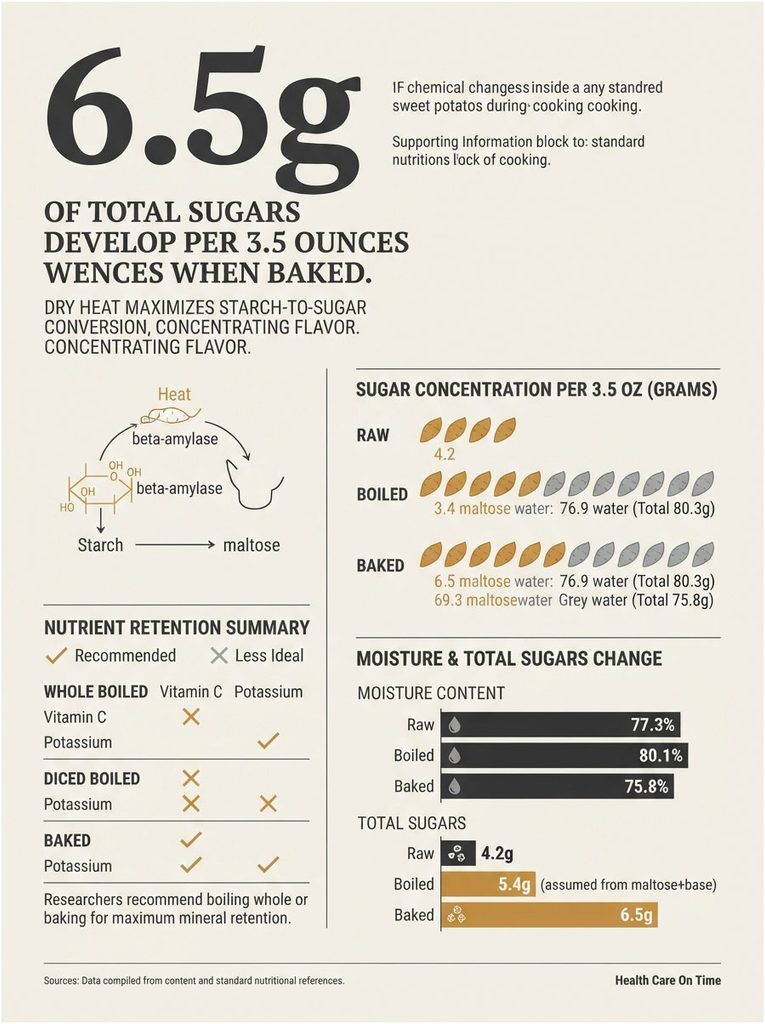
An oven pulls moisture out. A pot lets the root hold or gain it. USDA lists raw sweet potato at 77.3 percent water, boiled at 80.1 percent, and baked in skin at 75.8 percent.
That shift concentrates everything left behind in the baked version. Nothing was created. The same nutrients simply occupy less mass.
A registered dietitian quoted by Health.com framed it neatly: a baked or roasted potato behaves like a raisin, with the water gone and more sugar left behind alongside the fiber.
Heat turns starch into sugar, and dry heat does it faster
Sweet potatoes carry beta-amylase, an enzyme that clips starch into maltose. It works fastest inside a specific temperature window that a slow oven bake occupies for far longer than a quick boil does.
The USDA numbers show it plainly. Raw sweet potato contains no measurable maltose. Boiled contains about 3.4 grams per 3.5 ounces, baked about 3.1 grams.
Total sugars climb from 4.2 grams raw to 5.7 boiled and 6.5 baked per 3.5 ounces. That caramel flavor of a baked sweet potato is starch conversion, quantified.
Water-soluble nutrients leave with the cooking water
Vitamin C, several B vitamins, and potassium all dissolve. Pour the water down the drain and part of the vegetable goes with it.
This is the honest cost of boiling, and it is the one thing pro-boiling articles skip past.
Why cut surfaces matter more than temperature
USDA Agricultural Research Service scientists in Madison, Wisconsin tested this directly on tubers. Boiling cubed pieces dropped potassium by 50 percent and shredded pieces by 75 percent, while soaking alone changed almost nothing.
Their practical conclusion was blunt. People who want the most minerals should boil whole or bake, roast, or microwave. People who need less potassium should boil small pieces.
Surface area is the variable that moves the numbers. A whole boiled sweet potato in its skin loses very little. A diced one surrenders half its potassium into water most cooks throw away.
Our nutrition reviewers keep returning to this point because it is the finding that reframes the entire question. The knife does more damage than the oven.
Baked vs Boiled Sweet Potato: The USDA Numbers Side by Side
Here is the comparison no page on the first results screen prints. All values come from USDA FoodData Central Standard Reference Legacy entries, normalized to 3.5 ounces (100 grams) of cooked food.
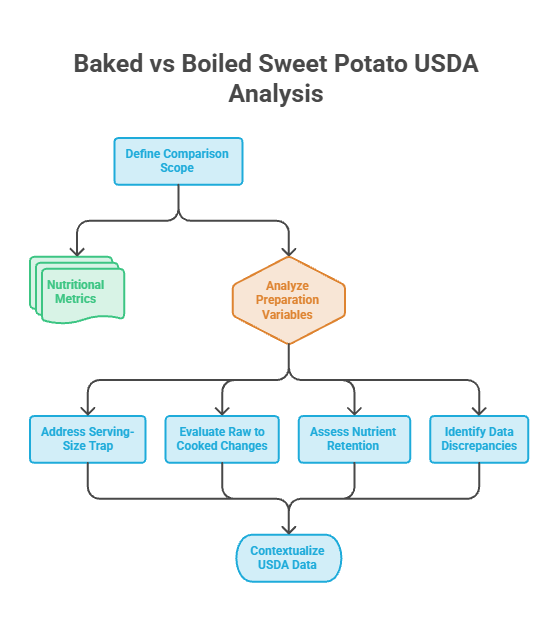
| Nutrient (per 3.5 oz cooked) | Boiled, peeled | Baked, skin on | Raw, reference | What the gap actually means |
| Calories | 76 kcal | 90 kcal | 86 kcal | Baked is denser because water left, not because energy was added |
| Water | 80.1 g | 75.8 g | 77.3 g | The 4-point spread drives most of the other differences |
| Carbohydrate | 17.7 g | 20.7 g | 20.1 g | Same carbs per root, concentrated differently |
| Total sugars | 5.7 g | 6.5 g | 4.2 g | Both methods convert starch to sugar; the oven does more of it |
| Maltose | 3.4 g | 3.1 g | 0 g | Proof the sweetness comes from cooking, not the vegetable |
| Fiber | 2.5 g | 3.3 g | 3.0 g | The skin accounts for most of the baked advantage |
| Protein | 1.4 g | 2.0 g | 1.6 g | Concentration effect, not a real protein gain |
| Potassium | 230 mg | 475 mg | 337 mg | Boiling leached it out; baking held and concentrated it |
| Vitamin A | 787 mcg RAE | 961 mcg RAE | 709 mcg RAE | Both deliver well over a full day’s requirement |
| Beta-carotene | 9,444 mcg | 11,509 mcg | 8,509 mcg | Neither method destroys much of it |
| Vitamin C | 12.8 mg | 19.6 mg | 2.4 mg | The raw figure is a known database outlier |
| Vitamin E | 0.94 mg | 0.70 mg | 0.26 mg | The single clear boiling win in this table |
| Magnesium | 18 mg | 27 mg | 25 mg | Another leaching loss |
Table 1. Source: USDA FoodData Central SR Legacy entries 168484 (boiled), 168483 (baked in skin), 168482 (raw).
Why the baked column looks better than it should
Read that table quickly and baking looks like a rout. Read it carefully and three problems surface.
First, the two USDA entries are not the same preparation. The boiled entry is peeled. The baked entry keeps its skin. Peel and method sit tangled together in every comparison built on these numbers.
Second, these are separate laboratory analyses on separate batches, not a controlled experiment. Baking cannot manufacture potassium, yet the baked figure sits 41 percent above raw. Some of that is skin, some is water loss, some is batch variation.
Third, the raw vitamin C value of 2.4 mg per 3.5 ounces is an outlier. The newer USDA Foundation Foods entry for raw orange-flesh sweet potato lists 14.8 mg. Cooking does not create vitamin C, so treat that row as directional only.
Our medical reviewers flag this pattern often across nutrition content: two database entries get compared as though they were an experiment, and a myth is born.
The serving-size trap that inflates boiled calories
USDA lists one cup of mashed boiled sweet potato at 328 grams (11.6 ounces) and 249 calories. One cup of baked comes to 200 grams (7.1 ounces) and 180 calories.
Compare those cups and boiled appears to carry 38 percent more calories. It does not. Mashed food packs denser into a measuring cup. You are weighing the scoop, not the vegetable.
The HealthCareOnTime full USDA calorie breakdown for sweet potatoes works through the per-serving math in detail, including small, medium, and large gram weights.
What one raw sweet potato becomes either way
A medium raw sweet potato, five inches long, weighs about 130 grams (4.6 ounces). Bake it and it comes out near 114 grams, a loss of roughly 12 percent.
That baked root delivers about 103 calories and 542 mg of potassium. Boiled whole in its skin, the same root lands near 99 calories and roughly 400 mg of potassium.
Four calories apart. The potassium gap is real, but boiling whole rather than cubed shrinks it substantially.
That is the honest headline. Per actual sweet potato, rather than per convenient database entry, these two methods land far closer than any page on the first results screen suggests.
Blood Sugar: Where the Two Methods Genuinely Split
This is the one area where the difference is large, documented, and clinically meaningful. It is also the area where the evidence deserves more scrutiny than it usually gets.
The glycemic index numbers everyone quotes
A team at the University of the West Indies tested ten cultivars across four cooking methods in ten healthy adults. Boiled samples scored lowest at 41 to 50, while baked reached 82 to 94 and roasted 79 to 93.
That single 2011 paper is the entire evidence base behind nearly every article on this topic.
| Preparation | Glycemic index | Population or cultivar tested | GI category |
| Boiled | 41 to 50 | Ten Jamaican cultivars, 10 adults, mean age 27 | Low |
| Boiled 30 minutes | About 46 | Pooled glycemic index database values | Low |
| Boiled 8 minutes | About 61 | Pooled glycemic index database values | Medium |
| Fried | 63 to 77 | Ten Jamaican cultivars, same study | Medium to high |
| Roasted | 79 to 93 | Ten Jamaican cultivars, same study | High |
| Baked | 82 to 94 | Ten Jamaican cultivars, same study | High |
| Steamed or baked, skin on | Not different from raw | Beauregard, NC State, 12 subjects | Low |
| Baked or microwaved flesh | Medium band | Beauregard, NC State, 12 subjects | Medium |
Sources: Journal of Nutrition and Metabolism (2011); North Carolina State University thesis research on the Beauregard cultivar.
Why those numbers may not describe the sweet potato in your cart
Ten cultivars named Dor, Ganja, Watson, and Fire on Land. Ten non-diabetic volunteers averaging 27 years old. No American varieties tested.
The sweet potato in a US grocery store is almost certainly Beauregard, Covington, Jewel, or Garnet. Beauregard alone accounts for a large share of the domestic crop.
Research at North Carolina State University tested Beauregard specifically. Steamed skin, baked skin, and dehydrated flesh showed no statistically significant difference from raw sweet potato, while baked and microwaved flesh landed in the medium glycemic index range.
That is a far narrower gap than 41 versus 94. Patients who write to us after reading the Jamaican figures are often surprised to learn no US cultivar appeared in that trial.
Neither study is large. Ten and twelve subjects respectively, both more than a decade old, neither replicated in an American diabetic population. Treat the direction as reliable and the exact numbers as approximate.
Glycemic load changes the practical picture
Glycemic index rates a fixed 50-gram carbohydrate dose. Glycemic load adjusts for what you actually put on the plate.
A 3.5-ounce boiled portion carries about 15 grams of available carbohydrate. At a glycemic index of 46, that is a glycemic load near 7, which sits in the low band.
A 4-ounce baked medium carries about 20 grams available. At a glycemic index of 82, glycemic load lands near 16, which is medium. A real difference, though neither reading is a sugar bomb, and pairing either with protein or fat compresses the gap further.
Cooling changes the math again
Cooked starch partly recrystallizes into resistant starch during refrigeration, and resistant starch digests slowly. Sweet potato salad made from yesterday’s boiled root behaves differently in the bloodstream than the same root eaten steaming hot.
The effect is well documented across the potato family and applies to both cooking methods equally. The HealthCareOnTime guide on sweet potatoes and blood sugar covers portion sizes and a two-day home glucose self-test protocol.
Vitamins, Minerals, and Antioxidants: Who Keeps More
Beta-carotene and vitamin A favor boiling
Retention research is fairly consistent here. True retention reached 92 percent when medium roots were boiled covered for 20 minutes with the lid on, and 88 percent without the lid at 30 minutes.
A separate analysis comparing methods head to head found carotene retention highest with boiling at 79 to 89 percent, followed by baking at 56 to 78 percent, with drying lowest.
A broader review of provitamin A crops pointed the same direction, reporting 80 to 90 percent retention after 20 to 30 minutes of boiling.
Either way, a single medium root clears the daily vitamin A requirement several times over. This gap matters less than it sounds.
Vitamin C and potassium favor baking
Both dissolve in water. Both stay put in dry heat. That is not a scandal; it is the trade-off you accept when you pick up a pot.
The size of that loss sits almost entirely under your control, which the cooking protocol section covers.
The antioxidant claim page-one articles get wrong
The widely repeated line is that boiling preserves antioxidants best. The peer-reviewed picture refuses to cooperate.
A study of three American-grown flesh colors, Beauregard, O’Henry, and 414-purple, found chlorogenic acid and total polyphenol content decreasing in the order steaming, baking, microwaving, boiling, then raw. Boiling finished last among cooked methods, not first.
A six-genotype study reached a similar conclusion: baking produced the highest phenolic levels in every genotype tested, and the authors advised using different cooking methods while keeping the peels.
Both studies also found that heat raised measurable antioxidant activity above raw. Cooking a sweet potato is not the loss most people assume it is.
The peel is doing most of the work
Here is the finding that should reorganize how you think about this. Sweet potato peel carries close to ten times the antioxidant capacity of the flesh, comparable to blueberries, and baking removes over two-thirds of it while microwaving and boiling are gentler.
Sit with that ratio. Peeling a sweet potato discards more antioxidant value than any decision you make afterward about the oven.
In cases reviewed across our nutrition team, the single most common preparation error is not baking. It is peeling.
| What the research measured | Result | Source | Study year |
| Beta-carotene true retention, boiled 20 min, lid on | 92 percent | J. Food Composition and Analysis | 2006 |
| Carotene retention, boiling versus baking | 79 to 89% vs 56 to 78% | J. Food Sci. and Technology Nepal | 2020 |
| Potassium lost, tubers boiled as cubes | 50 percent | Journal of Food Science, USDA ARS | 2008 |
| Potassium lost, tubers boiled shredded | 75 percent | Journal of Food Science, USDA ARS | 2008 |
| Polyphenol ranking by cooking method | Steam, bake, microwave, boil, raw | Antioxidants (3 US cultivars) | 2022 |
| Beta-carotene micellization, oil-cooked vs boiled | 73 percent vs 16 percent | Bechoff et al., in vitro digestion | 2011 |
| Acrylamide, oven-baked sweet potato fries at 374F | Up to 327 mcg/kg | Nguyen et al., vegetable fries | 2022 |
| US per capita vegetable and pulse availability | 376 lb, lowest since 1988 | USDA Economic Research Service | 2024 |
| US adults with diabetes and prediabetes | 40.1 M and 115.2 M | CDC National Diabetes Statistics Report | 2026 |
Table 2. Research findings and US population data, with source and publication year shown for each figure.
Three Things Worth Knowing That No Competitor Mentions
Fat is the real switch for vitamin A
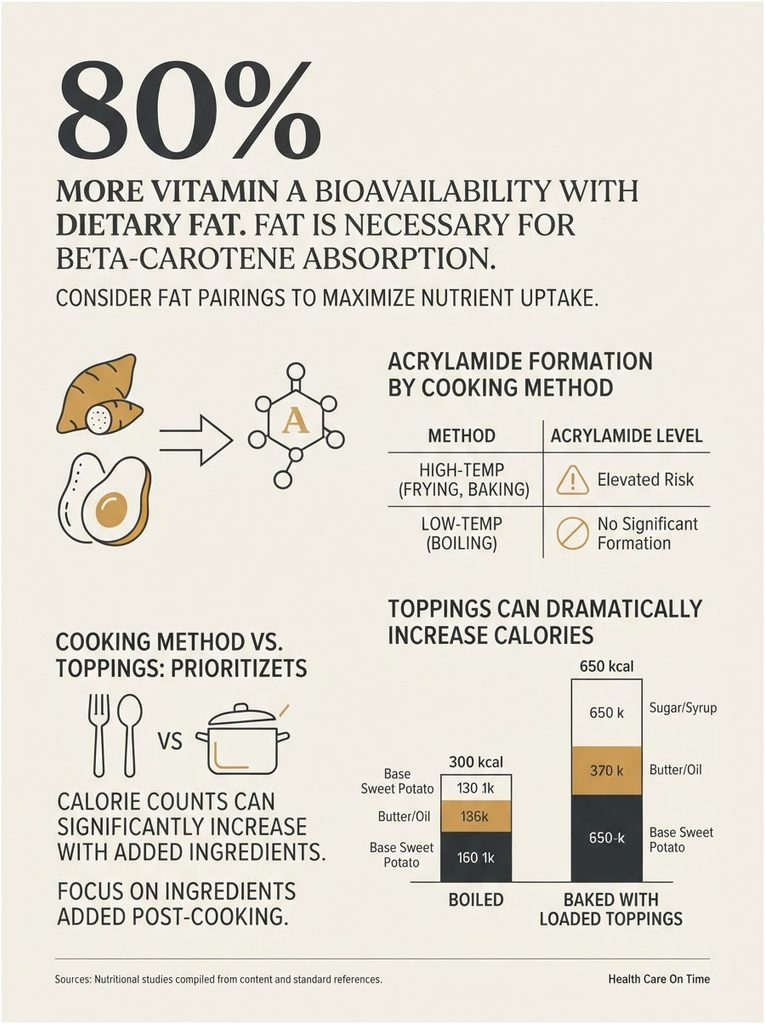
Beta-carotene is fat-soluble. Without dietary fat present at the same meal, very little of it crosses into your bloodstream regardless of how the root was cooked.
An in vitro digestion study of sweet potato products measured the gap directly. Micellarized all-trans beta-carotene reached 73 percent in an oil-cooked product versus 16 percent in a boiled porridge.
Extension nutrition guidance echoes it: adding a small amount of olive oil or canola oil to boiled sweet potato increases beta-carotene bioavailability.
A teaspoon of olive oil or a pat of butter does more for your vitamin A status than the entire baked-versus-boiled debate.
Acrylamide forms in dry heat, not in water
Acrylamide is a byproduct of browning in starchy foods. The FDA notes it forms during high-temperature cooking such as frying, roasting, and baking, and monitors levels because of potential health effects. The National Toxicology Program classifies it as reasonably anticipated to be a human carcinogen.
Analysis of home-cooked potato dishes recorded that acrylamide has not been detected in unheated or boiled foods. Water caps surface temperature at 212F, below the threshold where the reaction runs.
The measured risk sits with cut, high-surface-area preparations rather than whole roots. Oven-baked sweet potato fries reached up to 327 micrograms per kilogram at 374F for 14 minutes, and blanching or an acetic acid dip before baking cut formation by as much as 99 percent.
Federal guidance for home cooks is practical: cook starchy foods to golden yellow rather than golden brown, and soak cut pieces in water before roasting.
What goes on top outranks both methods
A plain baked sweet potato runs about 90 calories per 3.5 ounces. The USDA candied version runs 164.
Brown sugar, marshmallow, and butter erase every distinction discussed above. Our reviewers see this repeatedly in patient food logs: the cooking method was never the problem, the topping was.
The Verdict, Category by Category
Neither method sweeps. Scored honestly across the eight things people actually care about, the tally lands close, and the tie-breakers are personal rather than universal.
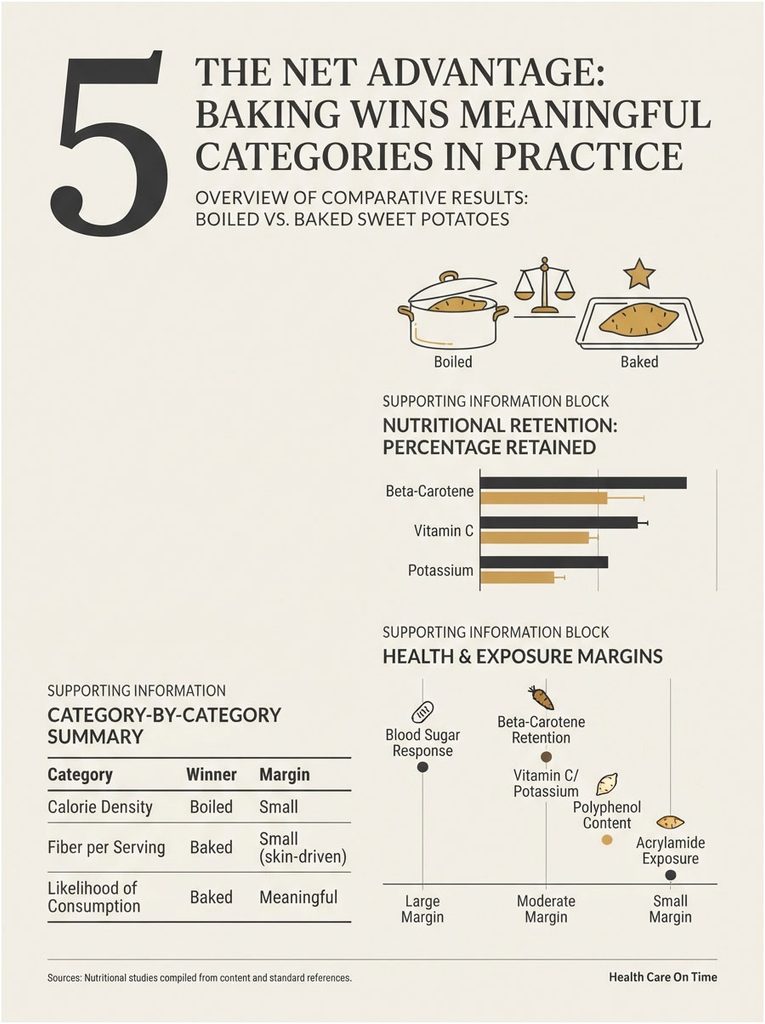
| Category | Winner | Margin |
| Blood sugar response | Boiled | Large |
| Beta-carotene retention | Boiled | Moderate |
| Vitamin C and potassium retention | Baked | Moderate |
| Calorie density | Boiled | Small |
| Polyphenol content | Baked | Small to moderate |
| Acrylamide exposure | Boiled | Small, dose-dependent |
| Fiber per serving | Baked | Small, driven by skin |
| Likelihood you actually eat it | Baked | Meaningful in practice |
Scored across the categories US readers most often ask about. Four wins each, with different people weighting the rows differently.
That last row is not a joke. US per capita vegetable and pulse availability fell to 376 pounds in 2024, the lowest level in over 35 years. The Dietary Guidelines for Americans continue to count orange-flesh sweet potato toward the red and orange vegetable group, and most Americans fall well short of it.
A baked sweet potato you look forward to beats a boiled one you push around the plate. Optimizing a food you skip returns nothing.
So Which Should You Cook Tonight?
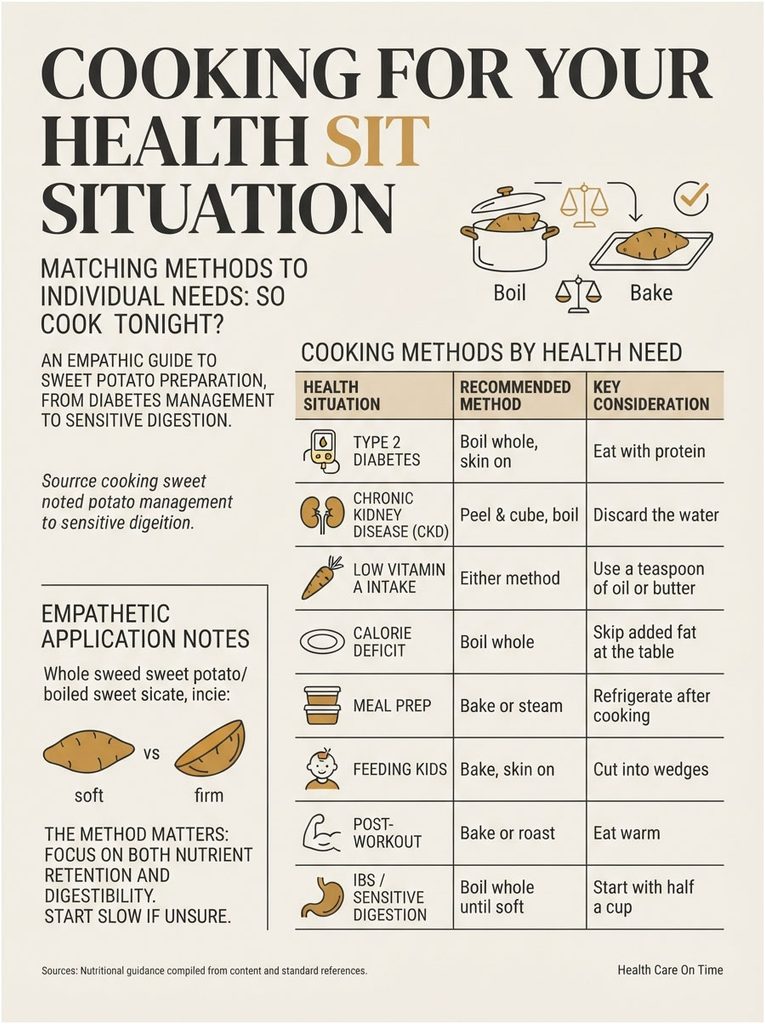
| If this is your situation | Do this | Why it works |
| Type 2 diabetes or prediabetes | Boil whole with skin on, 20 to 25 minutes, eat with protein | Lowest measured glycemic index and glycemic load of any method |
| CKD stage 3 to 5 or high potassium | Peel, cube small, boil, discard the water | Cubed boiling removes about half the potassium; shredding removes more |
| Low vitamin A intake | Either method, always with a teaspoon of oil or butter | Fat raises beta-carotene absorption far more than method choice |
| Calorie deficit or weight management | Boil whole, skip added fat at the table | Boiled runs 76 calories per 3.5 oz versus 90 baked, and holds more water |
| Meal prep for the week | Bake or steam, then refrigerate | Chilling builds resistant starch; baked pieces reheat with better texture |
| Feeding kids who reject vegetables | Bake, skin on, cut into wedges | Caramelized flavor drives intake; a vegetable eaten beats one optimized |
| Post-workout refueling | Bake or roast, eat warm | A higher glycemic response is an advantage for glycogen replacement |
| IBS or sensitive digestion | Boil whole until fully soft, start with half a cup | Wet heat softens cell walls; sweet potato carries mannitol, so portion matters |
| Concerned about acrylamide | Boil, steam, or bake to golden not brown | No acrylamide forms in water; browning intensity drives formation in dry heat |
Table 3. Match your situation to a method. Always confirm renal and diabetes dietary changes with your own clinician.
How to Cook a Sweet Potato Without Wasting Its Nutrition
The boiling protocol that keeps the most
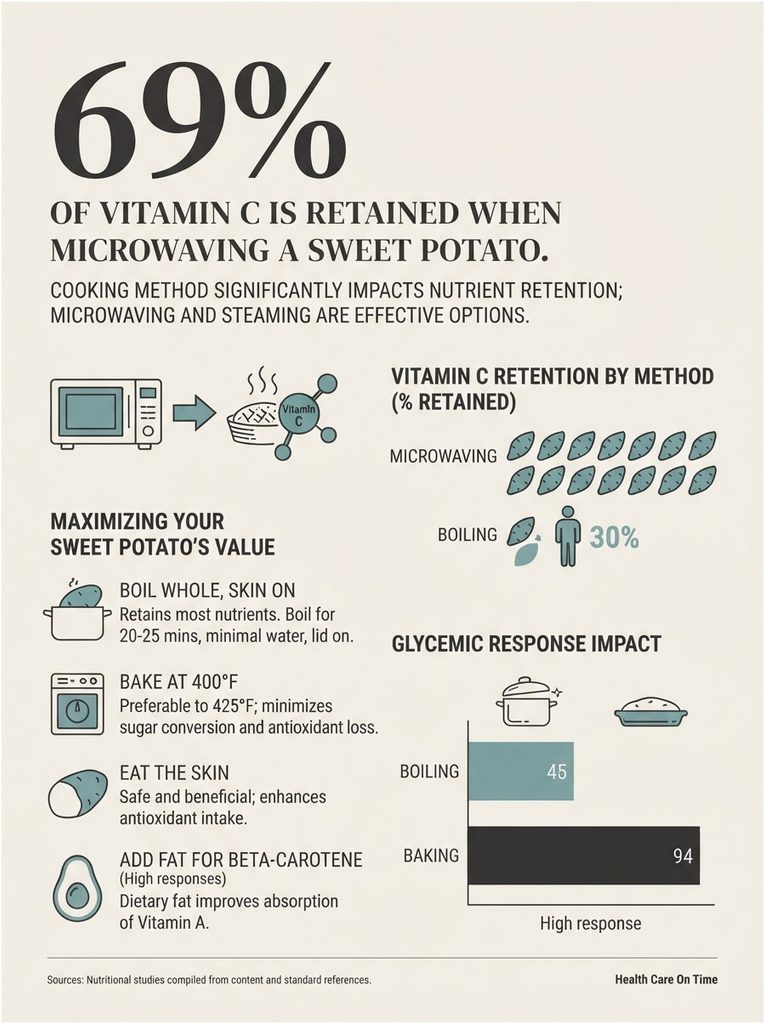
Scrub the skin, do not peel it. Leave the root whole. Use just enough water to cover, put the lid on, and cook 20 to 25 minutes until a knife slides through cleanly.
Lid on matters. That single detail carried a four-point retention advantage in the beta-carotene research.
Save the cooking liquid for soup or for mashing if you want the leached potassium and vitamin C back on the plate. If kidney disease means you need less potassium, do the exact opposite of everything in this paragraph.
The baking protocol that loses the least
Bake at 400F rather than 425F, and pull it when the flesh yields rather than when the skin blackens. Longer and hotter means more sugar conversion, more antioxidant loss in the peel, and more browning chemistry.
Keep the skin on and eat it. Pierce it a few times to prevent bursting, which avoids adding cut surface area.
Steaming and microwaving deserve more credit
Steaming topped the polyphenol rankings in the three-cultivar study. Microwaving showed the highest radical-scavenging activity in the same work and retained 69 percent of vitamin C in the cream-fleshed genotype, the highest among all cooking methods tested.
Microwaving a whole sweet potato takes eight minutes, loses almost nothing to water, and skips the browning chemistry entirely. It is the most underrated option on this list, and the one our team recommends most often to patients short on time.
Frequently Asked Questions
Does boiling sweet potatoes remove nutrients?
Some, yes. Potassium, vitamin C, and part of the B vitamins dissolve into the water. How much depends almost entirely on cut size. Boiling whole with the skin on loses very little; boiling cubes strips about half the potassium. Beta-carotene holds up well either way, at 79 to 89 percent retention.
Is boiled or baked sweet potato better for weight loss?
Boiled, by a small margin. USDA lists boiled at 76 calories per 3.5 ounces against 90 for baked, and the higher water content supports fullness at lower energy density. The gap per whole root is only a few calories, so toppings and portion size matter considerably more than method.
Should you peel sweet potatoes before boiling them?
No. The peel carries roughly ten times the antioxidant capacity of the flesh plus much of the fiber, and leaving it intact sharply reduces mineral leaching into the water. The one exception is chronic kidney disease, where peeling and cubing before boiling is a deliberate strategy to lower potassium.
Do baked sweet potatoes have more sugar than boiled?
Slightly. USDA lists 6.5 grams of total sugar per 3.5 ounces baked versus 5.7 grams boiled, with raw at 4.2 grams. Both methods convert starch into maltose through enzyme activity. The oven’s longer, drier heat runs that conversion further and removes water, concentrating the result.
Is baked sweet potato bad for people with diabetes?
Not bad, but higher impact. Baked scored 82 to 94 on the glycemic index in the most-cited study versus 41 to 50 boiled, though research on the American Beauregard cultivar found a much narrower gap. Portion size, added protein or fat, and total meal composition influence your reading more than method alone.
How long should you boil sweet potatoes to keep the most nutrients?
Twenty to 25 minutes, whole, skin on, lid on, in minimal water. Retention research recorded 92 percent beta-carotene preservation at 20 minutes covered, dropping to 88 percent at 30 minutes uncovered. Longer boiling also lowers glycemic index, so a 30-minute boil trades slight retention for better blood sugar behavior.
Can you eat the skin of a boiled sweet potato?
Yes, and you should. Boiled skin is soft, edible, and holds the highest concentration of antioxidants and fiber in the whole root. Scrub it under running water first to remove grit. Trim any bruised, sprouted, or green patches before cooking, as with any root vegetable.
Does boiling lower the potassium in sweet potatoes?
Substantially, if you cut them first. USDA research on tubers found boiling cubed pieces removed 50 percent of potassium and shredded pieces 75 percent, while soaking alone did almost nothing. Boiling whole preserves most of it. This makes cubed boiling a useful technique on a potassium-restricted renal diet.
Is microwaving sweet potato better than baking or boiling?
It performs well and gets overlooked. Microwaving takes about eight minutes, adds no water for nutrients to escape into, and skips extended browning. One study measured the highest radical-scavenging activity in microwaved samples and 69 percent vitamin C retention, the best result among the methods tested.
Does cooling a cooked sweet potato lower its glycemic index?
Yes, modestly. Cooked starch partly recrystallizes into resistant starch during refrigeration, digesting more slowly and reaching the colon largely intact. This effect is documented across the potato family. A chilled sweet potato salad typically produces a gentler glucose response than the same root eaten hot.
Which cooking method gives the most vitamin A?
Both clear a full day’s requirement several times over, so absorption matters more than retention here. Beta-carotene needs dietary fat to cross into your bloodstream. One digestion study measured 73 percent uptake from an oil-cooked preparation against 16 percent from a boiled one. Add a teaspoon of oil.
How current is the research behind these numbers?
Mixed, and worth knowing. The glycemic index and retention anchors date from 2006 to 2012, with small subject counts. The polyphenol and acrylamide work is from 2022. No large modern trial has compared these methods head to head in an American diabetic population, so read confident headlines accordingly.
Medical Disclaimer
This article is for general information and does not replace personalized medical or dietary advice. Anyone managing diabetes, chronic kidney disease, or a potassium restriction should discuss cooking methods and portion sizes with their physician or a registered dietitian before changing their diet. Nutrient database values reflect population averages and may not match your individual situation or the specific variety you buy.
References
- USDA FoodData Central, sweet potato baked in skin (FDC 168483)
- USDA FoodData Central, sweet potato boiled without skin (FDC 168484)
- USDA FoodData Central, sweet potato raw (FDC 168482)
- Bahado-Singh et al., Processing Method and Glycemic Indices of Ten Sweet Potato Cultivars, Journal of Nutrition and Metabolism
- Allen, Characterization of the Glycemic Index of Raw and Thermally Processed Sweet Potatoes, NC State University
- Bethke and Jansky, Effects of Boiling and Leaching on Potassium and Other Minerals in Potatoes, Journal of Food Science
- USDA Agricultural Research Service, cooking method and potato mineral content
- Changes in Antioxidant Properties and Phenolics in Sweet Potatoes Due to Heat Treatments, Antioxidants
- Household Processing Methods and Bioactive Compounds in Sweetpotato Genotypes, Antioxidants
- Retention of Beta-Carotene in Boiled, Mashed Orange-Fleshed Sweet Potato, Journal of Food Composition and Analysis
- Retention of Provitamin A Carotenoids in Staple Crops Targeted for Biofortification
- Impact of Processing on Retention of Beta Carotene of Sweet Potatoes, Journal of Food Science and Technology Nepal
- Bechoff et al., Retention and Bioaccessibility of Beta-Carotene in Blended Foods Containing Orange-Fleshed Sweet Potato Flour
- FDA, Acrylamide in Food
- NIEHS, Acrylamide fact sheet and home-cooking guidance
- Nguyen et al., Formation and Mitigation of Acrylamide in Oven Baked Vegetable Fries
- USDA Economic Research Service, Vegetables and Pulses Outlook VGS-375
- Effects of Baking and Boiling on Nutritional and Antioxidant Properties of Sweet Potato Cultivars, Plant Foods for Human Nutrition