
In a two-year randomized trial, 44.96% of people taking doxycycline reported stomach or intestinal upset. In the placebo group, the figure was 44.80%.
Table of Contents
Two years of daily antibiotic, and the gap was 0.16 percentage points. That result should change how you read every side-effect list you find online.
Some of what people feel on doxycycline is the drug. A surprising share of it is not.
Quick Answer
Common doxycycline side effects are nausea, stomach upset, sun sensitivity, and yeast infections. Most begin in the first few days and fade within 48 hours of the last dose. Burning chest pain when swallowing means the pill got stuck. Seek emergency care for facial swelling, blistering rash with fever, vision changes, or yellowing skin.
At a Glance
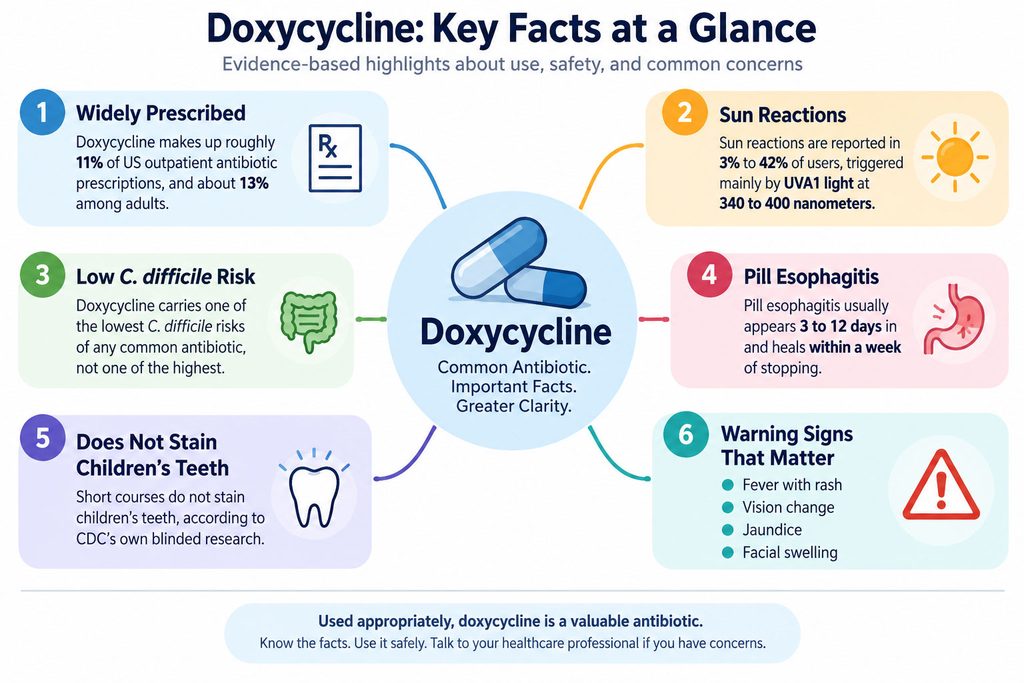
• Doxycycline makes up roughly 11% of US outpatient antibiotic prescriptions, and about 13% among adults
• Sun reactions are reported in 3% to 42% of users, triggered mainly by UVA1 light at 340 to 400 nanometers
• Doxycycline carries one of the lowest C. difficile risks of any common antibiotic, not one of the highest
• Pill esophagitis usually appears 3 to 12 days in and heals within a week of stopping
• Short courses do not stain children’s teeth, according to CDC’s own blinded research
• The warning signs that matter: fever with rash, vision change, jaundice, facial swelling
What Doxycycline Actually Does in Your Body
Doxycycline belongs to the tetracycline family. It blocks bacterial protein synthesis, stopping bacteria from multiplying rather than killing them outright.
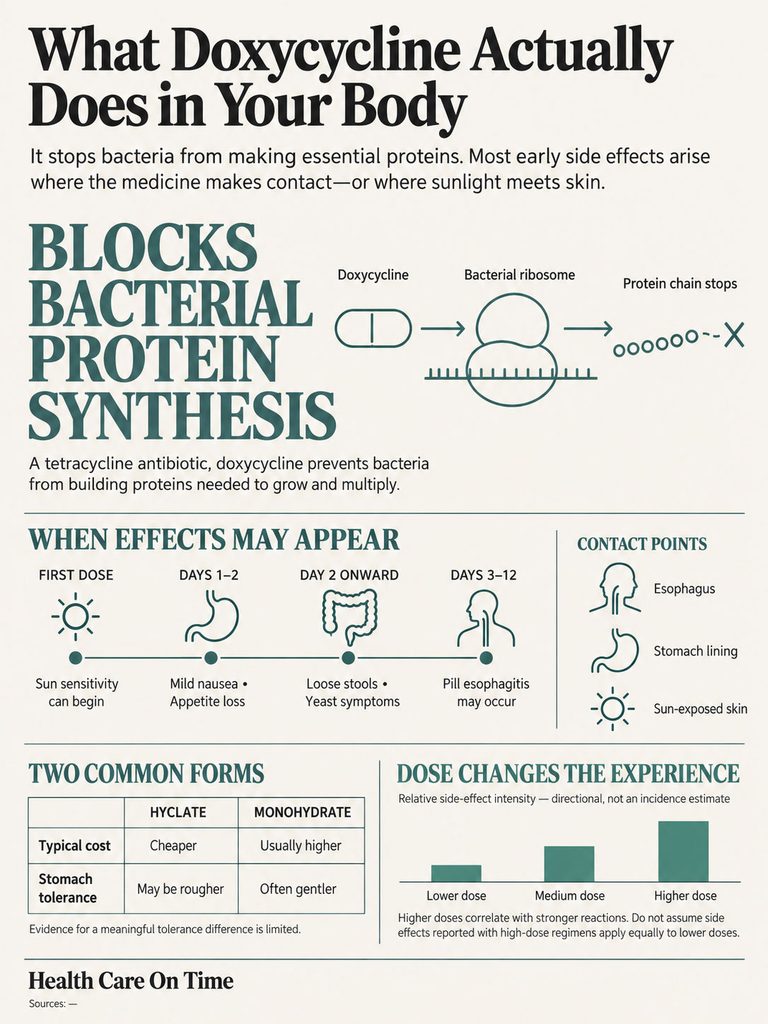
That mechanism explains the side-effect pattern. Doxycycline is not broadly toxic to human cells at normal doses.
Most of what goes wrong happens at a point of contact. The esophagus, the stomach lining, or sun-exposed skin.
Our medical reviewers note that patients often expect antibiotic side effects to feel systemic, like a flu coming on. Doxycycline rarely works that way, which is why the fixes are usually mechanical rather than medical.
What to Expect in the First Week
Day one to two brings nausea or appetite loss in a meaningful share of people. It is usually mild and often improves as the course continues.
Day two onward is when loose stools and yeast symptoms tend to surface. Both are expected and neither is a reason to stop.
Day three to twelve is the window for pill esophagitis, if it happens at all. Sun sensitivity has no reliable window and can begin with the very first dose.
Anything sudden, severe, or involving your face, breathing, or vision sits outside this pattern entirely and needs immediate attention.
Hyclate vs Monohydrate, and Whether It Changes How You Feel
Two salt forms are sold in the US. Doxycycline hyclate is cheaper and more widely dispensed. Doxycycline monohydrate is often described as gentler on the stomach.
The comparative evidence is thin. Both deliver the same active molecule at the same dose, and head-to-head tolerability trials are limited.
Formulation does matter, though. Delayed-release tablets such as Doryx dissolve lower in the digestive tract, cutting esophageal contact time.
If your stomach cannot tolerate one product, ask about the other before giving up on the drug class.
Why the Dose Matters More Than the Drug
A 40 mg anti-inflammatory dose for rosacea behaves very differently from 100 mg twice daily for pneumonia. Both differ again from a single 200 mg dose taken after a sexual exposure.
Sun sensitivity in particular appears to track with dose. Higher daily amounts have been linked to stronger reactions in the published reviews.
Patients booking tests with us often describe side effects they read about on high-dose regimens, then worry while taking a low-dose acne prescription. The risk profiles are not the same document.
The Common Side Effects, and How Common They Really Are
Stomach Upset, Nausea, and the Placebo Problem
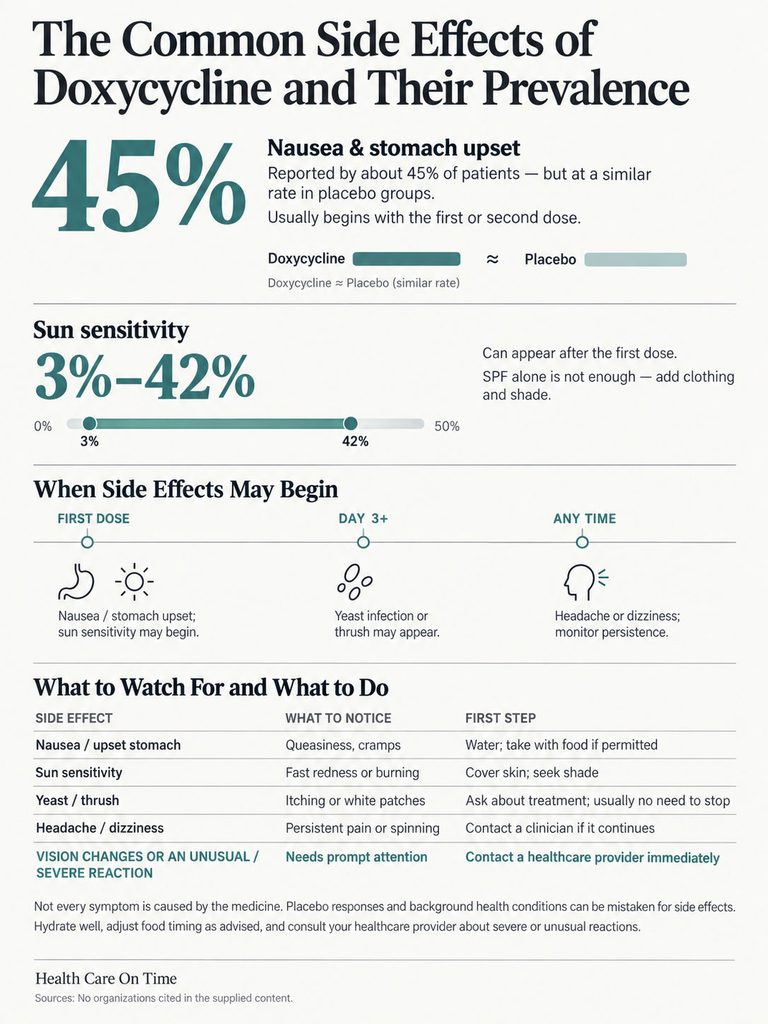
Nausea, appetite loss, and general queasiness top the complaint list. They typically start with the first or second dose.
Here is what almost no side-effect page tells you. Much of that queasiness would have happened without the drug.
In the N-TA³CT randomized trial published in JAMA in 2020, 261 US patients took either doxycycline 100 mg twice daily or a matching placebo for two full years.
The posted trial results show gastric or intestinal upset in 58 of 129 doxycycline patients (44.96%) and 56 of 125 placebo patients (44.80%). Serious or unexpected events were slightly lower in the doxycycline arm.
This does not mean doxycycline never upsets your stomach. It means a large portion of what gets blamed on the antibiotic is background noise, and that noise is louder in people already sick with an infection.
Other trials do find a real signal. In the IPERGAY study, cited in CDC’s 2024 doxy-PEP guidelines, gastrointestinal side effects hit 53% in the doxycycline group versus 41% in the comparison group.
Real, but far smaller than that 53% looks standing alone. The practical takeaway: try food and water first before concluding the drug is the problem.
Sun Sensitivity, and Why SPF Alone Is the Wrong Advice
Doxycycline makes skin dramatically more reactive to ultraviolet light. People describe a sunburn arriving after 20 minutes outdoors, sometimes with burning or stinging before any redness shows.
A systematic review in Skin Pharmacology and Physiology found phototoxic reactions reported in 3% to 42% of patients. The range is that wide because study designs varied enormously, and this review dates to 2017, so treat the figures as a rough band rather than a precise rate.
One finding from that review deserves more attention than it gets. The triggering wavelength is mainly UVA1, spanning 340 to 400 nanometers.
Here is why that matters practically. SPF numbers measure UVB protection only.
A high-SPF sunscreen with weak UVA coverage will spare you an ordinary sunburn while doing almost nothing about a doxycycline reaction. Look for “broad spectrum” plus zinc oxide, titanium dioxide, or avobenzone.
Reapply every two hours. Long sleeves, a wide-brim hat, and shade during peak hours do more than any bottle.
Reactions can begin after the first dose. Symptoms usually clear 10 to 14 days after stopping, though nail lifting takes longer.
Yeast Infections and Thrush
Any antibiotic that disrupts normal bacterial populations lets yeast overgrow. On doxycycline that means vaginal itching and discharge, or white patches in the mouth.
Harvard Health lists both among the expected common effects. Uncomfortable, not dangerous, and treatable with standard antifungal products.
Patients commonly ask us whether a yeast infection means the antibiotic should stop. It does not. Treat the yeast, finish the course.
Headache, Dizziness, and Fatigue
Mild headache and lightheadedness show up across the long-term safety literature. A systematic review of 67 studies on doxycycline courses of eight weeks or longer ranked headache and dizziness third, behind digestive and skin effects.
The distinction that matters is between an ordinary headache and one that is new, persistent, worse lying flat, or paired with any vision change.
That second pattern is covered below and needs same-day attention, not watchful waiting.
| Side Effect | How Common | When It Starts | What It Feels Like | First Step |
| Nausea or stomach upset | Very common; 45% in trials, similar in placebo groups | Dose 1 to 2 | Queasy, appetite loss, mild cramping | Take with food and a full glass of water |
| Sun sensitivity | 3% to 42% depending on dose and UV exposure | Any time, including first dose | Burning or stinging before visible redness | Broad-spectrum UVA sunscreen, cover up, avoid peak sun |
| Pill esophagitis | Uncommon; tetracyclines among top causes | Day 3 to 12 | Sharp burning behind breastbone when swallowing | Full glass of water, upright 30 minutes, call prescriber |
| Vaginal or oral yeast | Common | Day 3 onward | Itching, discharge, or white oral patches | Antifungal treatment; keep taking doxycycline |
| Mild diarrhea | Common | Day 2 onward | Loose stools, no fever, no blood | Hydrate; continue unless severe |
| Headache or dizziness | Uncommon to common | Variable | Dull, mild, transient | Monitor; escalate if vision changes |
| Rash without fever | Uncommon | Day 2 to 10 | Flat or raised, itchy, non-blistering | Call prescriber before next dose |
| Rash with fever or blistering | Rare | Day 5 to 21 | Peeling, mouth or eye sores, feeling very unwell | Stop and seek emergency care |
Pill Esophagitis: The One Most People Cause Themselves
This is the most preventable doxycycline injury. It also sends the most people to an emergency room convinced they are having a heart attack.
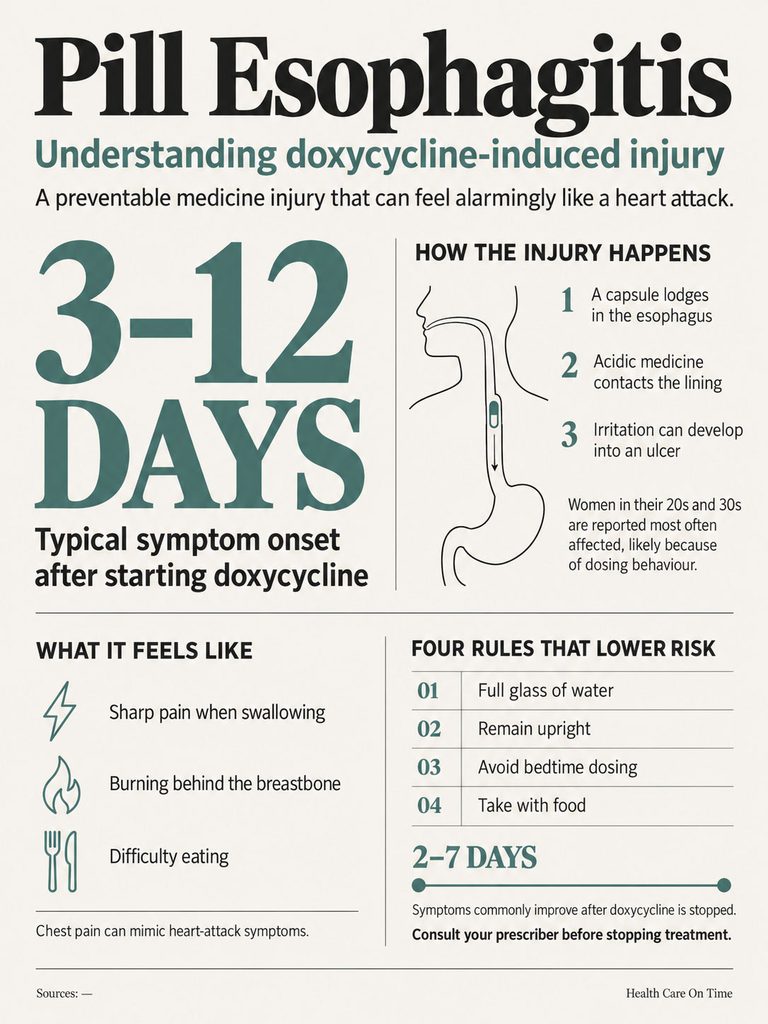
The capsule lodges in the esophagus instead of passing into the stomach. Doxycycline is acidic, so it dissolves there and burns a small ulcer into the lining.
What It Feels Like and When It Shows Up
Sharp pain on swallowing, a burning ache behind the breastbone, and sometimes real difficulty getting food down. Eating makes it worse.
Published case reports put typical onset at 3 to 12 days after starting. Injuries usually sit in the middle third of the esophagus, with healthy-looking tissue on either side.
Over four decades, more than 650 cases of pill-induced esophagitis involving 30 drugs have been documented. Roughly half involve tetracycline, doxycycline, or clindamycin.
True incidence is unknown. The often-quoted figure of 3.9 cases per 100,000 comes from a Swedish study published in 1978, and most cases never reach a doctor at all.
Why Women in Their Twenties and Thirties Dominate the Case Series
In one series of 48 drug-induced esophagitis patients, 70.9% were women, averaging around 35 years old. Doxycycline-specific case reports show the same skew.
The explanation is probably behavioral, not biological. Doxycycline is heavily prescribed for acne and rosacea in exactly this group.
And acne prescriptions get taken at bedtime, often with a small sip of water, followed immediately by lying down. That is the exact setup for an esophageal ulcer.
The Four Rules That Prevent Nearly All of It
Take each dose with a full 8-ounce glass of water. Not a sip.
Stay upright, sitting or standing, for at least 30 minutes afterward. Gravity is doing the work here.
Never take your last dose right before bed. If you must dose at night, do it 30 to 60 minutes before lying down.
Take it with food unless told otherwise. Food carries the capsule through and buffers stomach irritation.
These four rules are printed on nearly every pharmacy label and ignored by a large share of patients. In cases reviewed across our diagnostic network, the story is almost always identical: small sip of water, straight to bed.
How Long It Takes to Heal After Stopping
In a five-patient case series of doxycycline esophagitis, symptoms improved within 2 to 7 days of stopping. Follow-up endoscopy was completely normal in every case at 3 to 4 weeks.
Do not stop on your own, though. Call your prescriber, because the fix is usually a different formulation or better technique rather than abandoning treatment.
Three Doxycycline Warnings That the Evidence Does Not Support
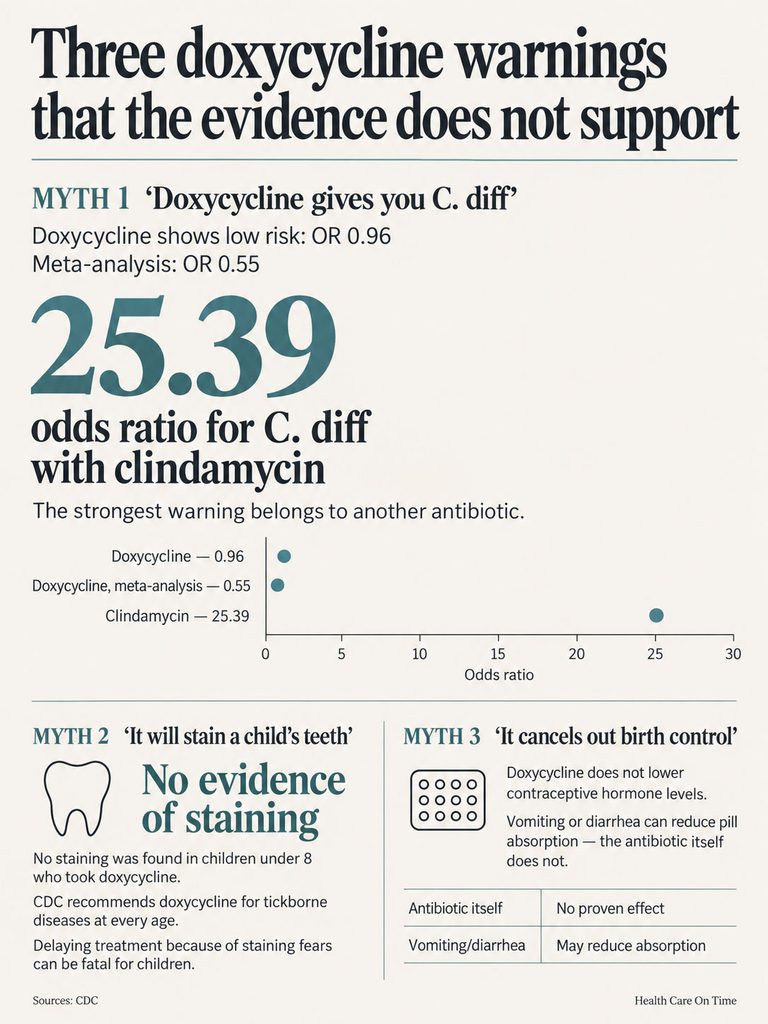
Myth 1: “Doxycycline Gives You C. diff”
Nearly every side-effect page lists Clostridioides difficile colitis as a doxycycline danger. The data point the other way.
If C. diff risk is what worries you, doxycycline is one of the safer antibiotics your doctor could pick. Here is what the research shows.
A case-control study in Open Forum Infectious Diseases examined 159,404 US cases of community-associated C. diff against 797,020 controls, across 27 antibiotics.
Doxycycline landed at an adjusted odds ratio of 0.96 (95% CI 0.89 to 1.02), not statistically significant. Minocycline showed an actual protective effect at 0.79. Clindamycin came in at 25.39.
A meta-analysis in Clinical Infectious Diseases went further, putting doxycycline at an odds ratio of 0.55 (95% CI 0.40 to 0.75) versus other antibiotics.
A separate national analysis of 36.6 million outpatients used doxycycline as the baseline comparator precisely because its risk is so low. Measured against it, clindamycin ran 8.81 times higher and cefdinir 5.86 times higher.
None of this makes C. diff impossible. It does mean the warning has been copied from page to page without anyone checking the numbers.
Myth 2: “It Will Stain a Child’s Teeth”
Every tetracycline label has carried a warning against use under age 8 since 1970. That warning came from older tetracyclines, which stained teeth in 23% to 92% of young recipients in early studies.
Doxycycline binds calcium far less readily. Researchers tested the question directly rather than assuming.
CDC and Indian Health Service investigators compared 58 children who had received doxycycline before age 8, an average of 1.8 courses each, against 213 children who never had.
Blinded dentists examined permanent teeth for staining and enamel defects. Objective tooth color was measured with a spectrophotometer. No differences turned up on any measure.
CDC now names doxycycline the treatment of choice for children of all ages with suspected tickborne rickettsial disease. The American Academy of Pediatrics reports that reviews and comparative trials have not found a staining risk under 8.
The stakes here are not academic. Children are roughly five times more likely than adults to die from Rocky Mountain spotted fever, and hesitation over tooth staining has delayed treatment.
Myth 3: “It Cancels Out Birth Control”
This one traces back to older, broader-spectrum antibiotics thought to disrupt the gut bacteria that recycle estrogen. Rifampin genuinely does lower contraceptive levels.
Doxycycline does not share that mechanism. Pharmacokinetic studies have not shown meaningful reductions in hormone levels, and most modern guidance no longer recommends backup contraception for tetracyclines.
One real caveat. Vomiting or severe diarrhea from any cause can reduce absorption of an oral contraceptive pill.
That is a reason to use backup. The trigger is the illness, not the antibiotic.
The Serious Reactions, With Real Numbers
Severe Skin Reactions and the Fever-Plus-Rash Rule
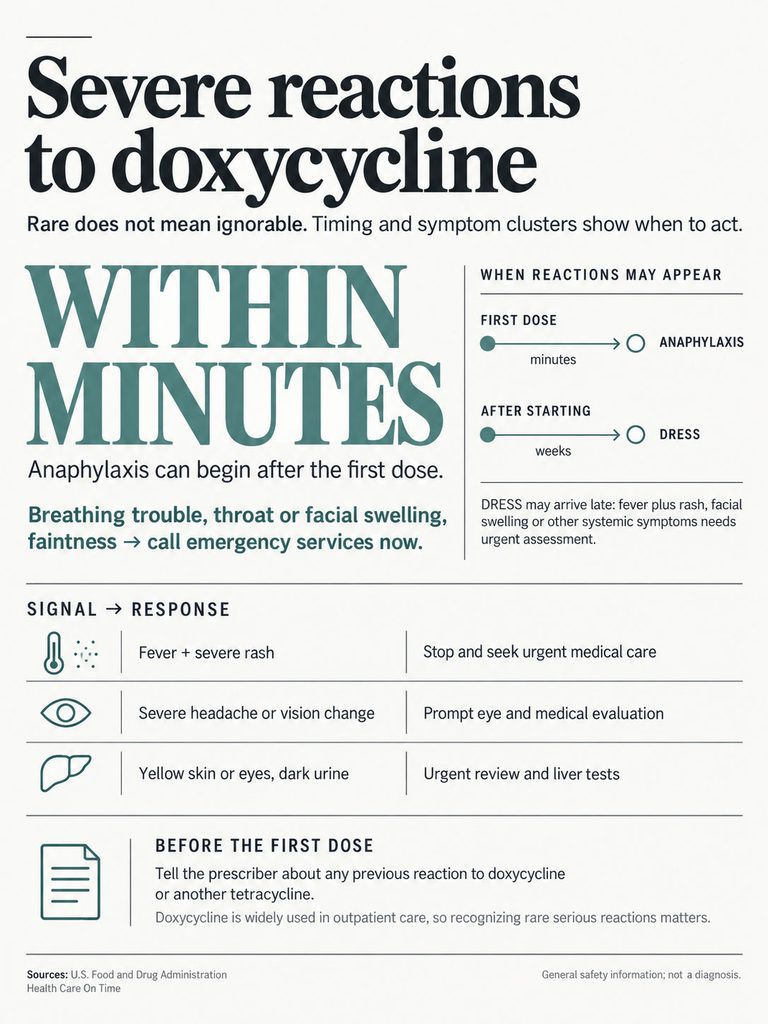
Stevens-Johnson syndrome, toxic epidermal necrolysis, DRESS, and exfoliative dermatitis all appear on the Mayo Clinic drug monograph for doxycycline. All are rare.
One rule separates a nuisance rash from an emergency. Fever.
A rash alone, with no fever and no mouth or eye involvement, warrants a phone call. Keep an eye on it and let your prescriber decide.
A rash with fever, swollen lymph nodes, mouth or eye sores, skin pain, blistering, or peeling is an emergency. So is a rash alongside feeling profoundly unwell.
DRESS is the deceptive one. It often surfaces two to six weeks after starting a drug, long after most people stop connecting symptoms to a medication they may have already finished.
Increased Pressure Around the Brain
Tetracyclines can raise pressure inside the skull, a condition called pseudotumor cerebri or intracranial hypertension. Left untreated, it can permanently damage vision.
A University of Utah cohort of 960 patients aged 12 to 50 prescribed tetracycline-class antibiotics found 45 subsequent diagnoses. That works out to an estimated 63.9 cases per 100,000 person-years, against under 1 per 100,000 in the general population.
The absolute risk stays small. The relative jump is large enough to justify the label warning.
Highest risk sits with women of childbearing age who carry excess weight or have a prior history. Combining doxycycline with isotretinoin pushes it higher, since isotretinoin causes the same problem on its own.
Symptoms to act on: a new persistent headache, blurred or double vision, brief vision blackouts when you change position, or a pulsing sound in one ear. Any of these means same-day eye assessment to check for optic disc swelling.
Liver Injury and When to Test
Hepatotoxicity from doxycycline is reported but uncommon. The drug clears substantially through the intestine rather than the kidneys, which is why it is often chosen for patients with reduced kidney function.
Signs worth a blood test: unusual fatigue with nausea, pain under the right ribs, dark urine, pale stools, or yellowing of the eyes or skin.
An ALT and AST panel settles the question quickly and cheaply. Our lab partners report that liver enzyme panels rank among the most common follow-up tests ordered when an antibiotic reaction is suspected.
Anaphylaxis and the First-Dose Window
True doxycycline allergy is uncommon but real. Hives, swelling of the lips, tongue, or throat, wheezing, or trouble breathing means calling 911, not calling the office.
Most anaphylactic reactions hit within minutes to an hour of a dose, usually on first or second exposure.
Tell your prescriber about any previous reaction to tetracycline, minocycline, or doxycycline before you start.
| Statistic | Figure | Population | Source |
| US outpatient antibiotic prescriptions, one year | 236.4 million | All ages, community pharmacies | CDC Antibiotic Use, 2022 data |
| Doxycycline share of outpatient antibiotic prescriptions | ~11% overall; 13% adults, 2% children | US outpatient visits | Outpatient stewardship analysis, 2025 |
| GI upset, doxycycline vs placebo over 2 years | 44.96% vs 44.80% | 254 US adults | N-TA³CT, JAMA 2020 |
| Phototoxic reaction rate | 3% to 42% (2017 review) | Pooled published reports | Skin Pharmacol Physiol 2017;30:76-80 |
| C. diff odds ratio, doxycycline | 0.96 (95% CI 0.89–1.02), not significant | 159,404 US cases | Open Forum Infect Dis 2023;10(8) |
| Pseudotumor cerebri incidence, tetracycline users | 63.9 per 100,000 person-years vs under 1 general | 960 patients aged 12–50 | University of Utah Health cohort |
| Dental staining, doxycycline before age 8 | No difference vs unexposed controls | 58 exposed, 213 unexposed | Todd et al., J Pediatr 2015 |
| Serious adverse events, doxy-PEP trial | 5 grade 3 events, 0 serious attributed | 501 participants | Luetkemeyer, NEJM 2023 |
How Long Doxycycline Side Effects Last
The 48-Hour Rule for Stomach Symptoms
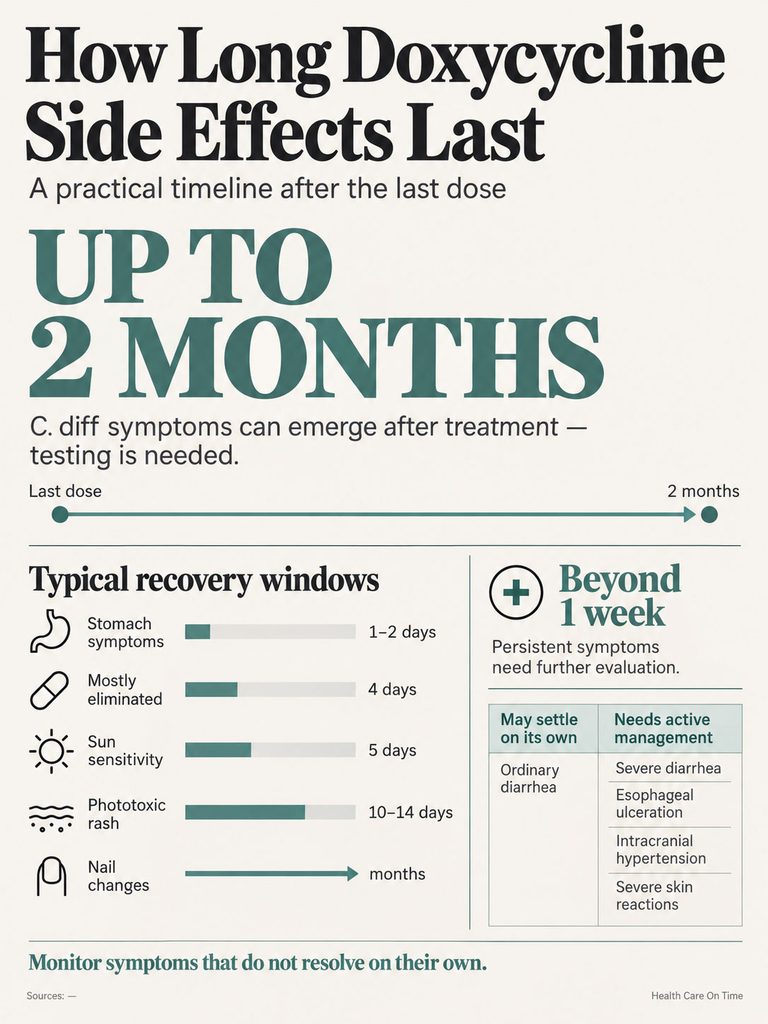
Nausea, appetite loss, and mild cramping usually settle within one to two days of the last dose. Many people improve before the course even ends, as the body adjusts.
If digestive symptoms are still going strong a week after finishing, something else is driving them. That deserves evaluation rather than patience.
Sun Sensitivity After the Last Dose
Doxycycline has a half-life of roughly 18 to 22 hours in most adults, so the drug is largely gone within about four days. Skin reactivity lags behind that.
Keep sun precautions running for at least five days after your final dose.
If a phototoxic rash has already appeared, expect 10 to 14 days for it to resolve. Nail changes take longer, sometimes months as the nail grows out.
The C. diff Exception
Diarrhea that develops during or shortly after a course usually reflects ordinary microbiome disruption and clears on its own.
C. diff behaves differently. It can appear up to two months after your last dose.
Watery diarrhea several times a day, cramping, fever, or blood or mucus in the stool needs testing, no matter how long ago the antibiotic finished.
What Does Not Resolve on Its Own
Three things need active management rather than time.
Esophageal ulceration needs a treatment change and sometimes acid suppression. Intracranial hypertension needs drug withdrawal plus monitoring, since pressure can stay elevated for weeks afterward.
Severe skin reactions need hospital care. None of these three fix themselves by waiting them out.
What to Do Right Now, Sorted by Symptom
Keep Taking It and Adjust How You Take It
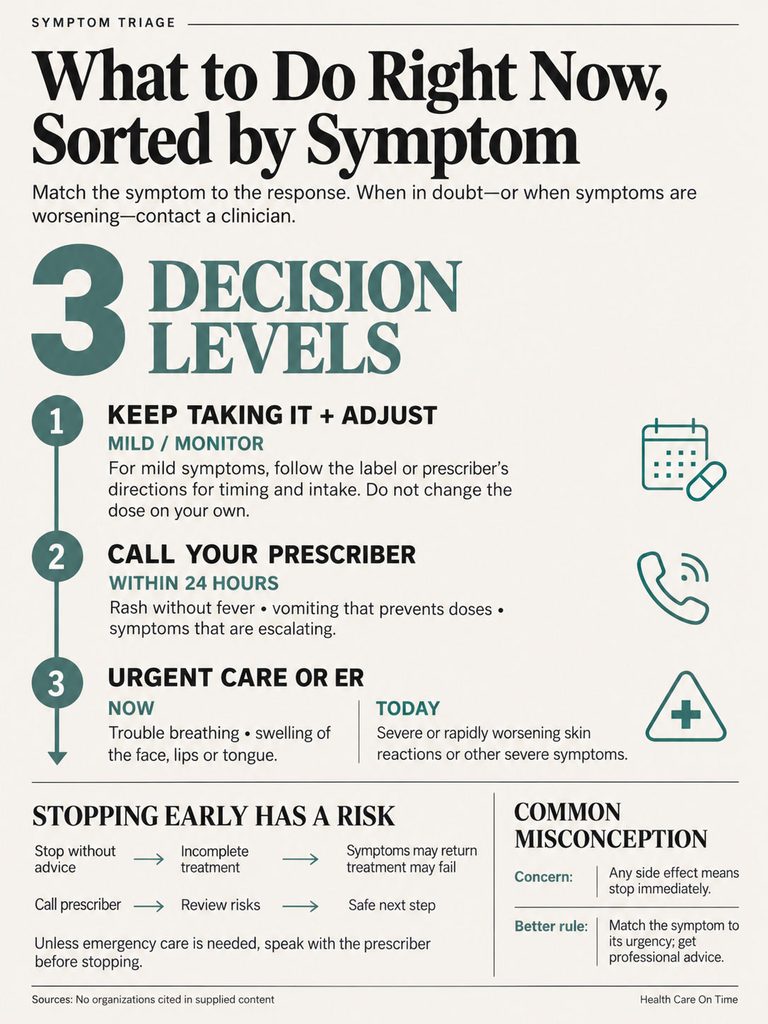
Mild nausea, loose stools without fever, and manageable yeast symptoms all call for a change in technique, not a stop.
Add food. Add water. Move your dose earlier in the evening.
Call Your Prescriber Within 24 Hours
A rash without fever, painful swallowing, vomiting that stops you keeping doses down, or symptoms still escalating past day four all warrant a same-day or next-day call.
Your prescriber has options: monohydrate instead of hyclate, a delayed-release form, a lower dose, or a different antibiotic class.
Go to Urgent Care or the ER Today
Facial or throat swelling. Breathing difficulty. Blistering or peeling skin. Rash with fever. Vision changes. Severe headache with visual symptoms. Yellowing of the eyes or skin. Bloody diarrhea with fever.
None of these should wait for an appointment.
Why Stopping Early Is Its Own Risk
Abandoning a course midway leaves the infection partly treated and encourages resistance. For Lyme disease or Rocky Mountain spotted fever, an incomplete course carries serious consequences.
Patients commonly ask us whether they can just stop and see what happens. The better move is a fast call to the prescriber, who can adjust rather than abandon.
| Scenario | Recommended Action | Timeframe | Why |
| Mild nausea after doses | Take with food and full water glass | Continue treatment | Placebo data show much of this is not drug-driven |
| Burning chest pain when swallowing | Call prescriber; keep upright after doses | Within 24 hours | Likely esophageal ulcer; heals in days once corrected |
| Sunburn after brief exposure | Cover up, broad-spectrum UVA sunscreen, notify prescriber | Same-day precautions | UVA1 reaction escalates with repeat exposure |
| Vaginal itching or oral white patches | Antifungal treatment, finish antibiotic | Within a few days | Yeast overgrowth is expected and self-limited |
| Rash without fever | Call prescriber before next dose | Within 24 hours | Separates benign eruption from early severe reaction |
| Rash with fever, blistering, or mouth sores | Stop and go to emergency care | Immediately | Possible SJS, TEN, or DRESS |
| New headache with blurred or double vision | Urgent eye assessment | Same day | Rule out raised intracranial pressure |
| Watery diarrhea with fever, up to 2 months later | Contact provider for C. diff testing | Within 24 hours | C. diff can present long after the course ends |
| Facial swelling or breathing difficulty | Call 911 | Immediately | Possible anaphylaxis |
Groups Who Need Different Advice
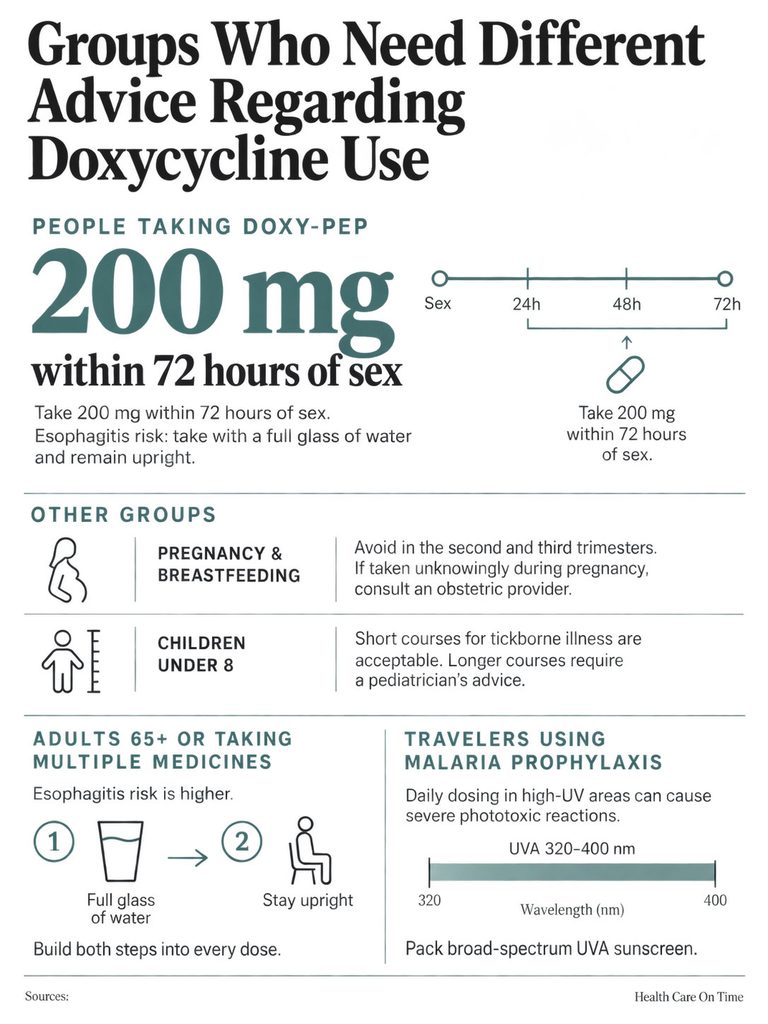
People Taking Doxy-PEP
In June 2024, CDC published clinical guidelines recommending 200 mg of doxycycline within 72 hours of sex for men who have sex with men and transgender women who had a bacterial STI diagnosed in the previous 12 months.
This is a completely different exposure pattern from a 10-day course. Doses are intermittent, sometimes several times a week, and continue indefinitely.
In the DoxyPEP trial of 501 participants across San Francisco and Seattle, five grade 3 adverse events and no serious adverse events were attributed to doxycycline.
The practical risk for this group is esophagitis. A single 200 mg dose taken fast, often late at night, is exactly the scenario that produces ulcers.
Water and upright time matter more here, not less.
Pregnancy and Breastfeeding
Doxycycline is generally avoided in the second and third trimesters over theoretical effects on fetal bone and tooth development.
If you took it before knowing you were pregnant, discuss the exposure with your obstetric provider rather than assuming harm occurred.
Children Under 8
Short courses for tickborne illness are backed by both CDC and AAP, as covered above. Longer courses in this age group still deserve a specific conversation with the pediatrician.
Adults Over 65 and People on Multiple Medications
Older adults more often have swallowing difficulty, slower esophageal motility, and long medication lists. All three raise pill esophagitis risk.
Doxycycline prescribing in US long-term care facilities rose 71% between 2013 and 2021, which makes administration technique a growing concern in that setting.
For anyone in this group, a seated dose with a full glass of water and a 30-minute upright interval is worth building into a routine rather than remembering ad hoc.
Travelers on Malaria Prophylaxis
Malaria prophylaxis means daily doxycycline in high-UV destinations, often for weeks running. This combination produces the most severe phototoxic reactions described in the literature.
Pack a broad-spectrum UVA sunscreen before you leave rather than relying on what is stocked locally.
Timing, Food, and Interactions That Change How You Feel
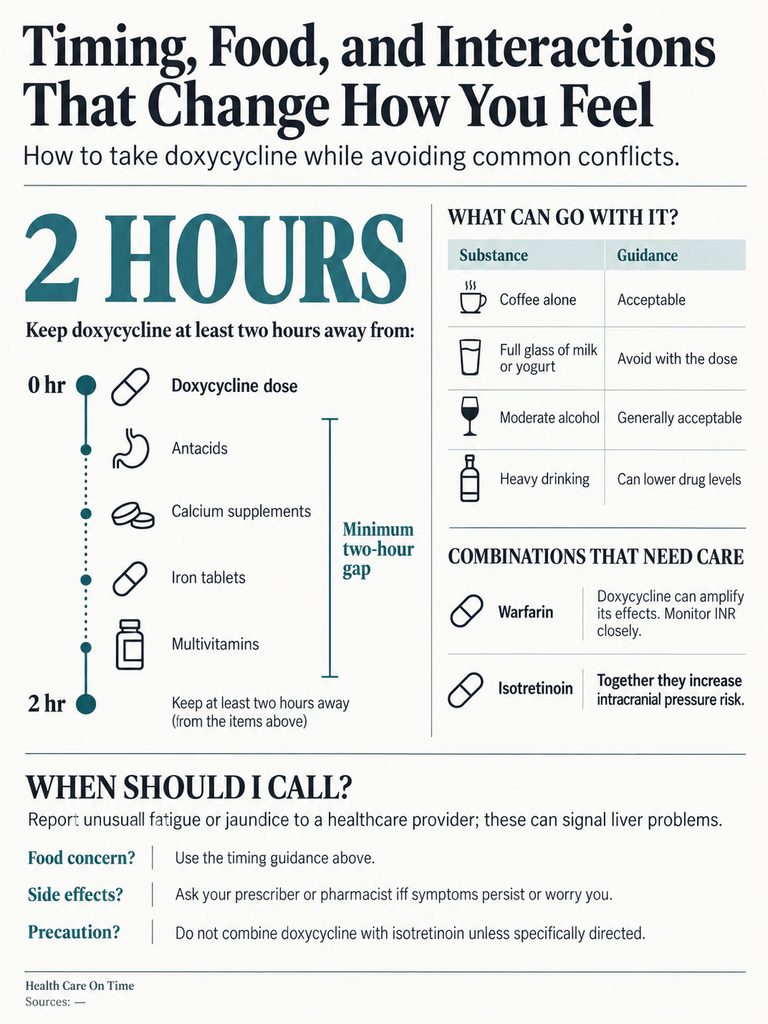
The Two-Hour Rule
Calcium, magnesium, aluminum, iron, and zinc bind doxycycline in the gut and block absorption. This is not a small effect. It can substantially cut how much drug reaches your bloodstream.
Separate doxycycline from antacids, calcium supplements, iron tablets, and multivitamins by at least two hours in either direction.
Dairy, Coffee, and What Actually Matters
Dairy reduces doxycycline absorption, though less dramatically than with older tetracyclines. A splash of milk in coffee is not the problem some sources make it.
A full glass of milk or a yogurt taken alongside the capsule is worth avoiding. Space it out by an hour or two.
Coffee itself does not interact. Coffee as your only fluid with the pill absolutely does, because a few ounces of hot liquid will not carry a capsule through the esophagus.
Warfarin, Isotretinoin, and Other Combinations to Flag
Doxycycline can amplify warfarin’s effect and raise bleeding risk. INR monitoring should be tightened during a course and shortly after.
Isotretinoin plus doxycycline compounds intracranial pressure risk and is generally avoided. If a dermatologist prescribes one, mention the other.
| Substance | Effect on Doxycycline | Minimum Gap | If You Skip the Gap |
| Antacids (calcium, magnesium, aluminum) | Binds drug, blocks absorption | 2 hours either side | Reduced levels, possible treatment failure |
| Iron supplements | Binds drug, blocks absorption | 2 hours either side | Reduced drug levels |
| Calcium supplement or glass of milk | Moderate absorption reduction | 1 to 2 hours | Lower peak levels |
| Multivitamins with zinc or magnesium | Binds drug | 2 hours either side | Reduced drug levels |
| Warfarin | May increase anticoagulant effect | No gap; monitor INR instead | Elevated INR, bleeding risk |
| Isotretinoin | Additive intracranial pressure risk | Avoid combination | Higher pseudotumor cerebri risk |
| Bismuth subsalicylate | Binds drug | 2 hours either side | Reduced absorption |
Frequently Asked Questions
How long do doxycycline side effects last?
Stomach symptoms usually resolve within 48 hours of your last dose. Sun sensitivity can persist about five days after the drug clears, and an existing phototoxic rash takes 10 to 14 days to fade. C. diff diarrhea is the exception and can appear up to two months later.
Should I take doxycycline with food?
Yes, unless your prescriber says otherwise. Food reduces nausea and helps the capsule move through the esophagus. Absorption drops slightly with food, but the tolerability gain outweighs it for most people. Avoid pairing it with a large serving of dairy or a calcium supplement.
Why do I have to stay upright for 30 minutes?
Doxycycline is acidic. If the capsule lodges in the esophagus, it dissolves there and burns an ulcer into the lining. Staying upright with a full glass of water lets gravity carry the pill into the stomach. This one habit prevents most doxycycline esophagitis cases.
Can I go in the sun while taking doxycycline?
Briefly and carefully. Phototoxic reactions are reported in 3% to 42% of users and can start after the first dose. The trigger is UVA1 light, so use a broad-spectrum sunscreen with zinc oxide, titanium dioxide, or avobenzone, plus clothing and shade. SPF alone is not enough.
Does doxycycline cause yeast infections?
Frequently. Antibiotics disrupt normal bacterial populations, letting yeast overgrow in the vagina or mouth. Symptoms include itching, discharge, or white oral patches. Standard over-the-counter antifungal treatment usually resolves it. This is not a reason to stop the antibiotic course early.
Can doxycycline make me tired or dizzy?
Mild headache, dizziness, and fatigue appear in the long-term safety literature but rank below digestive and skin effects. A headache that is new, persistent, worse lying flat, or paired with any vision change is a different problem and needs same-day medical assessment.
What happens if I stop doxycycline early?
The infection may not clear, and partially treated bacteria are more likely to develop resistance. For Lyme disease, Rocky Mountain spotted fever, or pneumonia, an incomplete course carries real risk. Call your prescriber instead. Changing formulation or dose often solves the problem without abandoning treatment.
Does doxycycline affect birth control?
Current evidence says no. The concern came from older, broader-spectrum antibiotics and from rifampin, which works differently. Doxycycline has not been shown to meaningfully lower contraceptive hormone levels. Severe vomiting or diarrhea from any cause can reduce absorption, which is a separate reason for backup protection.
Can doxycycline damage my liver?
Liver injury is reported but uncommon. Watch for unusual fatigue with nausea, right-sided rib pain, dark urine, pale stools, or yellowing of the eyes or skin. An ALT and AST blood panel answers the question quickly. Report any of these symptoms to your prescriber promptly.
Is chest pain when swallowing an emergency?
It is usually pill esophagitis rather than a cardiac event, especially if it burns and worsens when you swallow. Call your prescriber within 24 hours. If chest pain comes with shortness of breath, sweating, or arm or jaw pain, treat it as cardiac and call 911.
Does doxycycline stain adult teeth?
No. Tetracycline staining happens during tooth formation, which finishes by around age 8. Adult teeth are not at risk. Even in young children, CDC research comparing 58 exposed with 213 unexposed found no staining or enamel differences from short courses.
Can I drink alcohol while taking doxycycline?
Moderate alcohol does not trigger the dangerous interaction seen with metronidazole. Heavy or chronic drinking can speed doxycycline metabolism and lower drug levels. Alcohol also worsens nausea and stomach irritation. Keeping intake light during a course is the sensible approach.
Medical Disclaimer
This article is for general information and does not replace advice from a licensed healthcare provider. Doxycycline dosing, duration, and side-effect risk vary by condition, age, kidney and liver function, pregnancy status, and other medications. Never start, stop, or change a prescription based on information found online. If you are experiencing difficulty breathing, facial swelling, blistering rash with fever, sudden vision changes, or yellowing of the skin or eyes, seek emergency care immediately.
References
- Effect of Doxycycline on Aneurysm Growth Among Patients With Small Infrarenal Abdominal Aortic Aneurysms, JAMA 2020;323:2029-2038
- N-TA³CT posted adverse event results, ClinicalTrials.gov NCT01756833
- CDC Clinical Guidelines on the Use of Doxycycline Postexposure Prophylaxis, MMWR Recomm Rep 2024;73(2)
- Goetze S, et al. Phototoxicity of Doxycycline: A Systematic Review, Skin Pharmacol Physiol 2017;30:76-80
- Miller AC, et al. Comparison of Different Antibiotics and the Risk for Community-Associated C. difficile Infection, Open Forum Infect Dis 2023;10(8):ofad413
- Tariq R, et al. Low Risk of Primary C. difficile Infection With Tetracyclines, Clin Infect Dis 2018;66:514
- Antibiotic-Specific Risk for Community-Acquired C. difficile Infection in the United States, Antimicrob Agents Chemother
- Todd SR, et al. No Visible Dental Staining in Children Treated With Doxycycline for Suspected Rocky Mountain Spotted Fever, J Pediatr 2015
- American Academy of Pediatrics: When can doxycycline be used in young children?
- Luetkemeyer AF, et al. Postexposure Doxycycline to Prevent Bacterial Sexually Transmitted Infections, N Engl J Med 2023
- Chan PA, et al. Safety of Longer-Term Doxycycline Use, Sex Transm Dis 2023;50:701-712
- Doxycycline-Associated Ulcerative Esophagitis: A Report of a Rare Case
- Esophageal Ulceration Following the Ingestion of a Single Dose of Doxycycline
- Mayo Clinic: Doxycycline (oral route)
- Harvard Health: Doxycycline, a commonly prescribed broad-spectrum antibiotic
- CDC: Outpatient Antibiotic Prescriptions, United States
- Outpatient antibiotic stewardship during the COVID-19 era
- Tetracyclines May Predispose Patients to Pseudotumor Cerebri, Review of Optometry