Here’s a puzzle from USDA’s own nutrient tables: a cup of boiled red bell pepper is listed with more vitamin C than a cup of raw red bell pepper. Heat breaks vitamin C down, so something else is going on. Sorting out that puzzle is the fastest way to the real answer.
Table of Contents
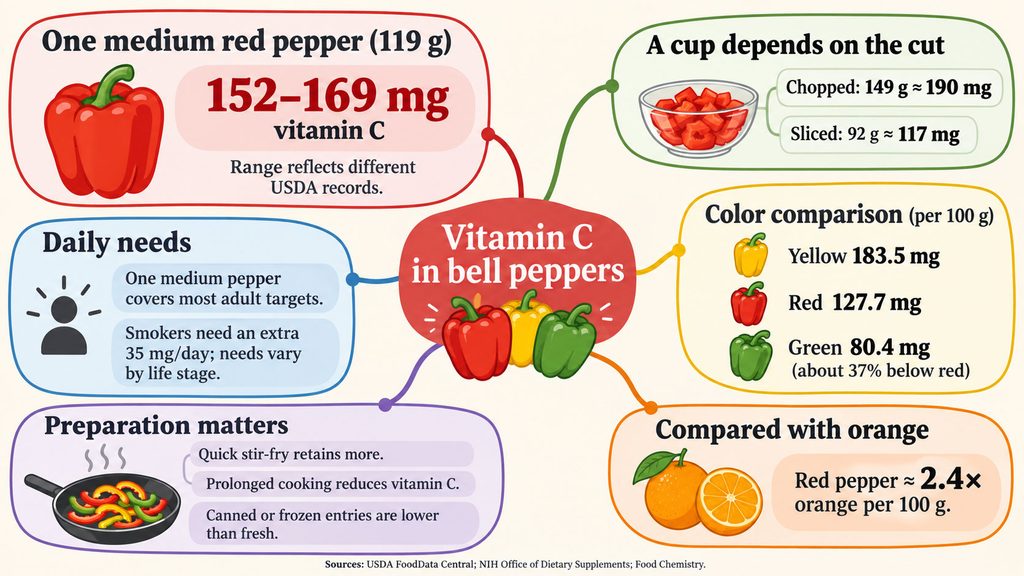
Quick Answer: A medium raw red bell pepper (about 119 grams, or 4.2 ounces) has roughly 152 mg of vitamin C based on USDA’s SR Legacy data, or about 169 mg based on USDA’s newer Foundation Foods data. That’s 169% to 187% of the 90 mg Daily Value. A cup of chopped raw red pepper gives about 190 mg. Cooking lowers these numbers, and long cooking in water lowers them the most.
At a Glance
- A medium red bell pepper has 152 to 169 mg of vitamin C, depending on which USDA record you use.
- “One cup” can mean 190 mg (chopped) or 117 mg (sliced). The weight of the cup is what changes.
- Yellow bell peppers top red for vitamin C; green peppers carry about 37% less than red.
- Per 100 grams, red pepper has about 2.4 times the vitamin C of an orange.
- A quick stir-fry keeps most vitamin C; half an hour of heat can cut it in half or more.
- Canned and frozen red peppers hold far less vitamin C than fresh ones.
- One medium pepper meets the daily target for nearly every adult, smokers included.
How Much Vitamin C Is in a Red Bell Pepper, by Serving
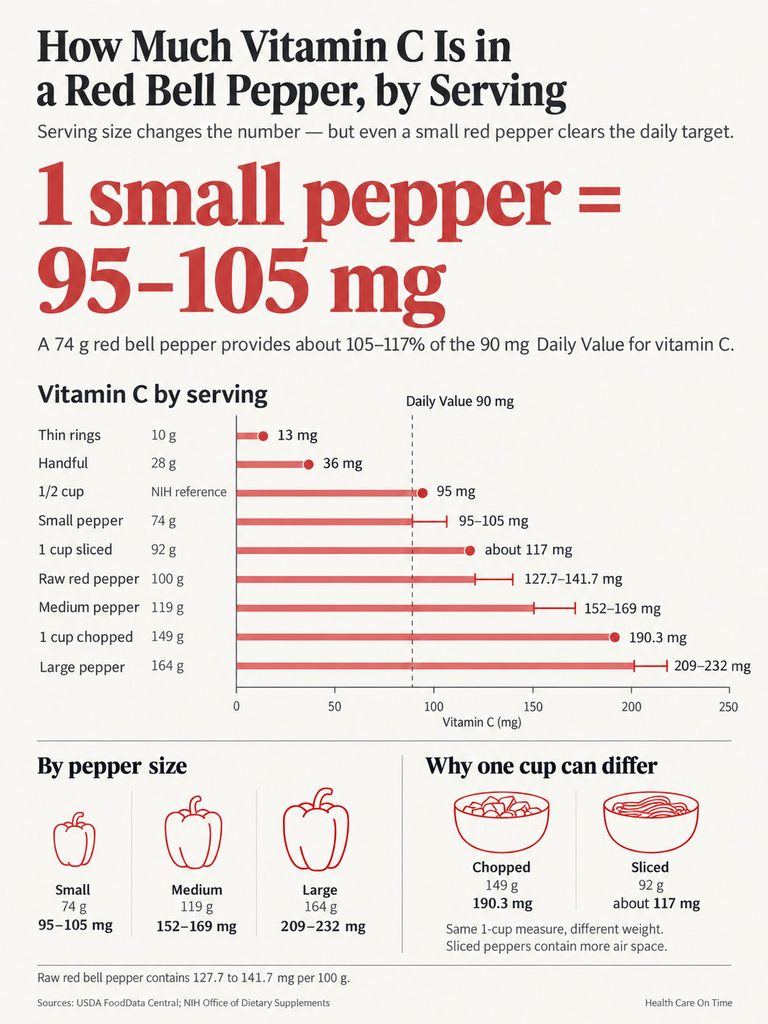
The answer changes with the serving. A ring, a cup, and a whole pepper land in very different places. Our nutrition review team rebuilt every figure below from USDA gram weights, so you can match the number to what’s actually on your plate.
Per 100 Grams
USDA FoodData Central lists raw red bell pepper at 127.7 mg of vitamin C per 100 grams in its SR Legacy record, FDC ID 170108. This is the figure most nutrition apps and older websites use.
USDA’s newer Foundation Foods record, FDC ID 2258590, reports 141.7 mg of vitamin C per 100 grams. That’s about 11% higher. Both are official USDA numbers. They simply come from different pepper samples tested at different times.
For reference, 100 grams is about 3.5 ounces, or a little over four-fifths of a medium pepper.
Per Pepper: Small, Medium, and Large
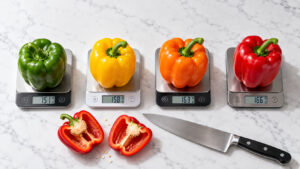
USDA assigns reference weights of about 74 grams for a small pepper, 119 grams for a medium, and 164 grams for a large. Multiply those by the two USDA values and you get:
- Small (74 g, 2.6 oz): about 95 mg (SR Legacy) to 105 mg (Foundation)
- Medium (119 g, 4.2 oz): about 152 mg to 169 mg
- Large (164 g, 5.8 oz): about 209 mg to 232 mg
So even a small red pepper clears the 90 mg Daily Value by itself.
Per Cup: The Chopped vs Sliced Trap
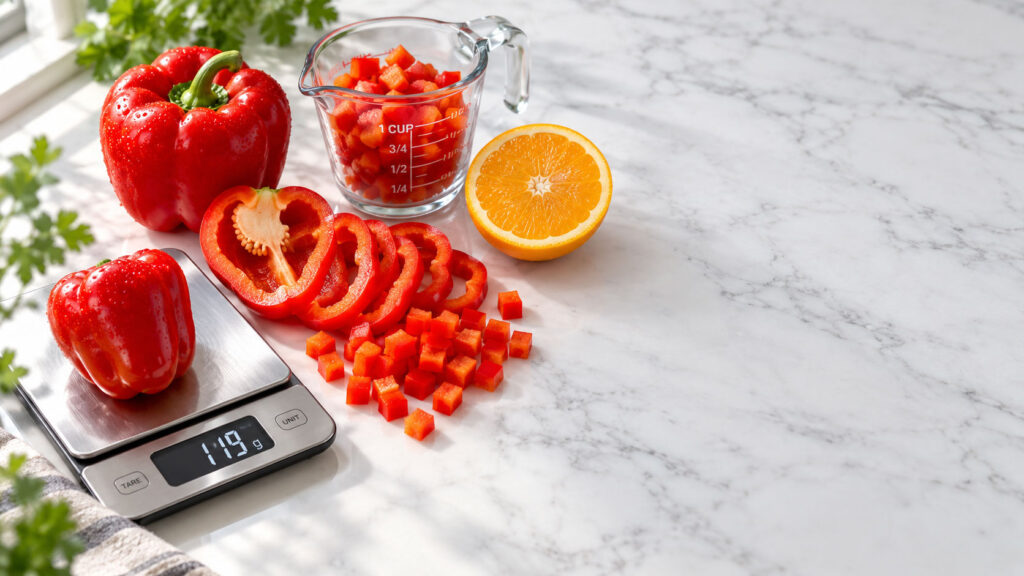
This is where a lot of online numbers go sideways. USDA’s cup of chopped raw red pepper weighs 149 grams and carries 190.3 mg of vitamin C. A cup of sliced strips weighs only about 92 grams.
The reason is simple geometry. Small diced pieces fill a measuring cup tightly, while long strips leave air pockets. The sliced cup holds about 40% less pepper, so it holds about 40% less vitamin C, roughly 117 mg.
The NIH Office of Dietary Supplements uses a half-cup serving and lists raw sweet red pepper at 95 mg, which lines up with half of USDA’s chopped cup.
Per Ring and Per Handful
Small portions still count. A thin ring cut across a pepper weighs around 10 grams and adds about 13 mg of vitamin C.
A handful of strips on a snack plate, about 1 ounce (28 grams), gives about 36 mg. That’s nearly half of what an adult woman needs in a day, from a snack most people never think twice about.
Why Websites Disagree: 150 vs 170 vs 190 mg
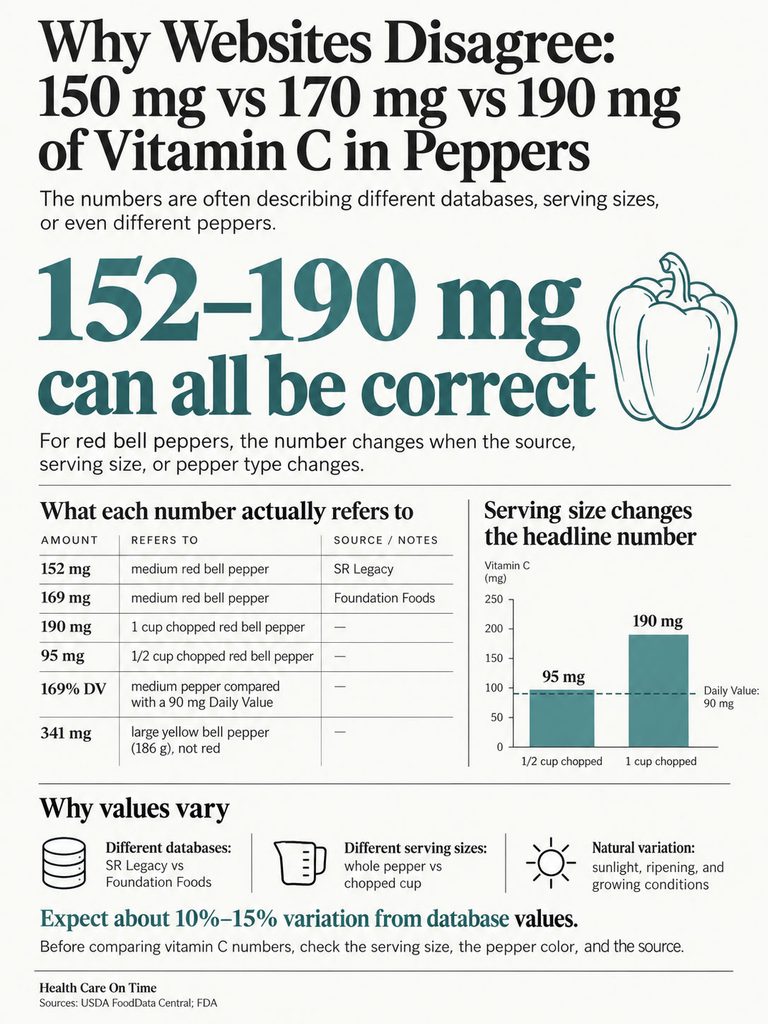
Search this question and you’ll find 150 mg, 169%, “up to 190 mg,” and even 341 mg. Patients who book vitamin panels through HealthCareOnTime often ask which figure to trust. Most of them are correct; they just describe different things.
SR Legacy vs Foundation Foods
USDA maintains two main databases for raw foods. SR Legacy is the older one that thousands of apps and websites copied years ago. Foundation Foods is newer, built on fresh lab samples with more detail about where and how each sample was collected.
Run 119 grams through SR Legacy and you get about 152 mg. Run it through Foundation and you get about 169 mg. That’s the whole “150 to 170 mg” range you see repeated online, including on supplement sellers’ blogs that quote it without saying where it came from.
Serving Size Mix-Ups
The 190 mg figure describes a chopped cup, not a whole pepper. The 95 mg figure describes a half cup. The “169%” figure that appears on major health sites refers to a medium pepper measured against the 90 mg Daily Value.
The eye-catching 341 mg figure belongs to a different pepper altogether. USDA lists a large yellow bell pepper, weighing 186 grams, at 341.3 mg.
Natural Variation
Real peppers don’t match a database exactly. Vitamin C shifts with sunlight, growing season, variety, how long the pepper ripened on the plant, and how long it sat after harvest. Peppers grown under strong light tend to run higher.
Read any single number as an average. A spread of about 10% to 15% in either direction is normal.
Table 1: Red Bell Pepper vs Other Vitamin C Foods
| Food | Typical serving | Vitamin C per serving (mg) | % Daily Value (90 mg) | Vitamin C per 100 g (mg) |
| Red bell pepper, raw | 1 medium (119 g) | 152 | 169% | 127.7 |
| Red bell pepper, raw | 1 cup chopped (149 g) | 190 | 211% | 127.7 |
| Yellow bell pepper, raw | 1 large (186 g) | 341 | 379% | 183.5 |
| Green bell pepper, raw | 1 cup chopped (149 g) | 120 | 133% | 80.4 |
| Orange, raw | 1 medium | 70 | 78% | 53.2 |
| Kiwifruit, green, raw | 1 medium | 64 | 71% | 92.7 |
| Broccoli, raw | 1 cup chopped (91 g) | 81 | 90% | 89.2 |
| Strawberries, raw | 1 cup halves (152 g) | 89 | 99% | 58.8 |
| Grapefruit, pink/red | 1 cup sections (230 g) | 72 | 80% | 31.2 |
Sources: USDA SR Legacy/SR28 and NIH Office of Dietary Supplements. Per-100 g values calculated by HealthCareOnTime from USDA household measures.
Red Bell Pepper vs Other Vitamin C Foods
Red Pepper vs Orange
Oranges get the vitamin C fame. Red peppers get the vitamin C numbers.
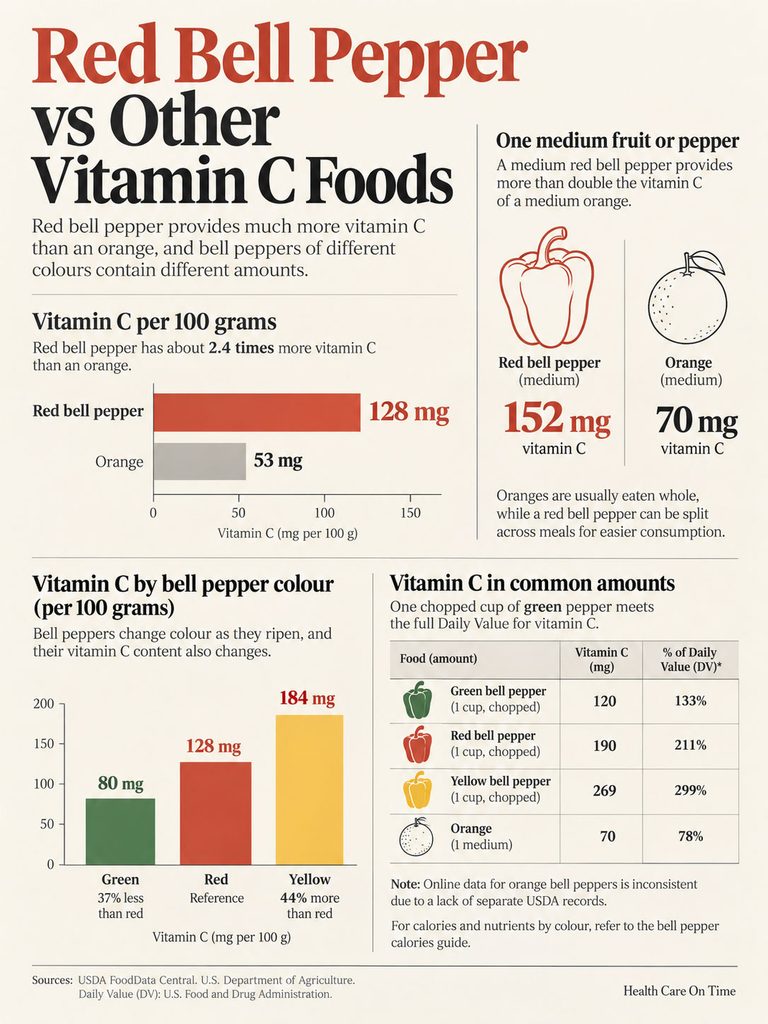
Per 100 grams, raw red pepper has about 128 mg and an orange has about 53 mg, so the pepper carries roughly 2.4 times as much. Compare typical servings and the pepper still wins: a medium red pepper (152 mg) has a little more than double a medium orange (about 70 mg).
The orange does have one real-world advantage. People happily eat a whole orange as a snack; fewer people eat a whole raw pepper. Our dietitian reviewers suggest an easy workaround: split one pepper across two meals, half at lunch and half at dinner.
Yellow vs Red vs Green
Every bell pepper starts green. Depending on the variety, it ripens to red, yellow, or orange, and its vitamin C level changes along the way. USDA data per 100 grams:
- Yellow: about 183.5 mg
- Red: about 127.7 mg
- Green: about 80.4 mg
That puts green about 37% below red and yellow about 44% above it. Green is still an excellent source, since one chopped cup covers the full Daily Value.
USDA’s SR Legacy database has no separate record for raw orange bell peppers, which is why orange-pepper figures online are all over the map. For calories, carbs, and the rest of the nutrient panel by color, see our bell pepper calories guide.
Does Cooking Destroy Vitamin C in Red Peppers?
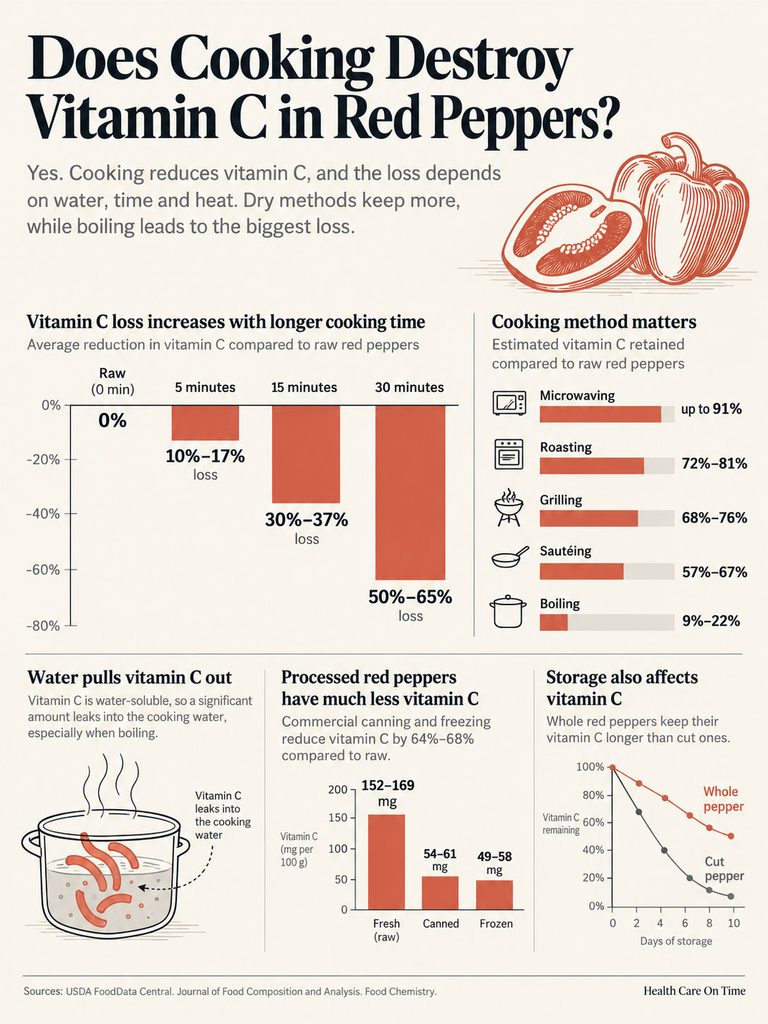
Cooking lowers vitamin C, but the size of the drop depends on three things: water, time, and heat. First, though, the USDA puzzle from the top of this article.
The USDA Cooked-Pepper Paradox
USDA’s household-measure vitamin C table lists red pepper this way:
- Raw, chopped: 190.3 mg per 149 g cup, or 127.7 mg per 100 g
- Boiled and drained: 230.8 mg per 135 g cup, or about 171 mg per 100 g
- Sautéed: 172.6 mg per 106 g cup, or about 163 mg per 100 g
Taken at face value, boiling “adds” vitamin C. It doesn’t. The raw and cooked entries were measured on separate batches of peppers in separate analyses. Nobody tested the same peppers before and after cooking.
Cooked peppers also shed water and shrink, so each gram of cooked pepper contains more pepper than each gram of raw. A higher per-gram number can reflect that shrinkage rather than any real gain. Our medical reviewers flag this every time readers line up raw and cooked USDA entries side by side.
What Before-and-After Studies Show
When researchers measure the same vegetables before and after heating, vitamin C falls, and it keeps falling the longer the heat lasts. In one five-vegetable heating study, losses averaged about 10% to 17% after 5 minutes, 30% to 37% after 15 minutes, and 50% to 65% after 30 minutes, with pepper showing the largest loss of the group.
A separate study comparing cooking methods found vitamin C retention ranging anywhere from zero to about 91%, with microwaving generally keeping the most and boiling keeping the least.
The NIH reaches the same practical conclusion. It notes that vitamin C dissolves in water and breaks down with heat, and that steaming or microwaving can reduce cooking losses.
Method by Method
Using those before-and-after findings, here’s roughly what a medium red pepper that starts near 152 mg keeps. These are estimates; cut size, pan temperature, and timing all move the result.
- Raw: the full 152 mg.
- Quick stir-fry or sauté, 3 to 5 minutes: loses around 10% to 17%, leaving about 126 to 137 mg.
- Short microwaving or steaming: usually the best of the cooked methods, since there’s little water for vitamin C to escape into.
- Roasting, 20 to 30 minutes: losses can approach one third to one half as time goes on.
- Boiling with the water poured off: usually the largest loss, especially with small pieces and long simmers.
Why Water Hurts More Than Heat
Vitamin C is water soluble. Drop cut pepper into simmering water and the vitamin seeps out into the pot. Pour that water down the drain and the vitamin C goes with it.
Dry methods like grilling, roasting, and stir-frying still break some vitamin C down, but nothing leaks away into liquid. If you do simmer peppers, keep the liquid as part of a soup, sauce, or chili.
Cooking has an upside, too. Research on several pepper types found that microwaving raised measured antioxidant activity two to ten times above raw peppers, likely because heat frees other antioxidant compounds. Carotenoids, the pigments that make red peppers red, also absorb better alongside a little fat. So cooked peppers still earn a place in your week.
Canned, Jarred Roasted, and Frozen Peppers
Commercial processing takes a bigger bite than a home stir-fry. USDA lists:
- Canned red peppers, solids and liquid: 65.1 mg per 140 g cup, about 46.5 mg per 100 g
- Frozen chopped red peppers, not cooked: 55.8 mg per 95 g, about 58.7 mg per 100 g
- Frozen red peppers, boiled: 55.6 mg per 135 g cup, about 41.2 mg per 100 g
That puts canned red peppers about 64% below raw, and frozen peppers that are then boiled about 68% below raw, per 100 grams. Jarred roasted red peppers are roasted first and packed afterward, so expect them near or below the canned figure.
These products still contribute some vitamin C. They just can’t carry your whole day the way a fresh pepper can.
Storage After Buying and After Cutting
Vitamin C also fades slowly in storage, faster once a pepper is cut and exposed to air and light. Whole peppers generally keep well in the crisper drawer for about a week or two.
Once cut, store pieces in a sealed container and use them within a few days. For the most vitamin C, slice peppers close to mealtime.
How Much Vitamin C Do You Actually Need?
One red pepper looks like a lot next to daily targets. Here’s how the math works for different people.
Daily Targets by Group
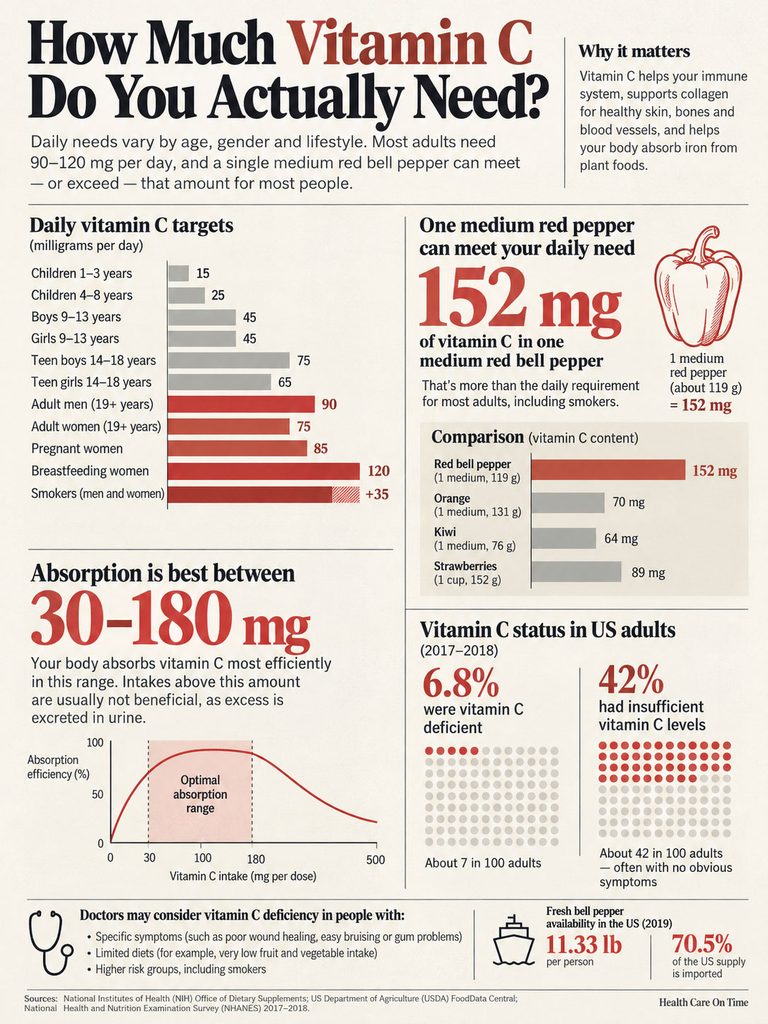
The National Academies sets the Recommended Dietary Allowance (RDA). According to the NIH, adult targets run from 90 to 120 mg a day, and targets for infants through teens run from 15 to 115 mg depending on age. Women’s RDA is 75 mg, and smokers need 35 mg more than nonsmokers.
| Group | RDA (mg/day) | Does a medium red pepper (152 mg) cover it? |
| Women 19+ | 75 | Yes, about twice over |
| Men 19+ | 90 | Yes, about 1.7 times over |
| Teen girls 14 to 18 | 65 | Yes |
| Teen boys 14 to 18 | 75 | Yes |
| Pregnancy, 19+ | 85 | Yes |
| Breastfeeding, 19+ | 120 | Yes |
| Smokers | RDA plus 35 | Yes (125 mg for men, 110 mg for women) |
| Adult upper limit | 2,000 | Not realistic from peppers alone |
Source: NIH Office of Dietary Supplements. The FDA Daily Value used on food labels is 90 mg.
Why One Pepper Is Enough
Your body absorbs vitamin C well at normal food amounts, roughly 70% to 90% at intakes of about 30 to 180 mg a day, according to the NIH. At intakes above about 1 gram a day, absorption falls below half.
In practice, three peppers don’t give you three times the benefit. Past a certain point, extra vitamin C simply leaves in urine. One medium red pepper, plus the other fruits and vegetables you already eat, is plenty. The NIH notes that five varied servings of fruits and vegetables a day can supply more than 200 mg of vitamin C.
Who Runs Low in the US
True deficiency is uncommon, but national data show it hasn’t gone away. The latest CDC-led NHANES analysis found deficiency in 6.8% of US adults in 2017 to 2018, essentially unchanged from 7.0% in the mid-2000s, with smokers and people eating little vitamin C at double the risk.
Smokers stand out most. In 2003 to 2004 NHANES data, 18% of male smokers and 15.3% of female smokers were deficient, compared with 5.3% and 4.2% of male and female nonsmokers.
A broader measure is even more striking. One NHANES analysis covering 2003 to 2006 found about 42% of US adults had less-than-adequate blood vitamin C levels, even though most had no obvious symptoms.
Table 2: US Vitamin C and Bell Pepper Statistics
| Measure | Figure | Source |
| US adults with vitamin C deficiency, NHANES 2017 to 2018 | 6.8% | Powers et al., J Appl Lab Med, 2023 (CDC) |
| US deficiency, NHANES 2003 to 2004 (age 6+) | 7.1% | Schleicher et al., Am J Clin Nutr, 2009 |
| Male smokers deficient, 2003 to 2004 | 18.0% | Schleicher et al., Am J Clin Nutr, 2009 |
| Female smokers deficient, 2003 to 2004 | 15.3% | Schleicher et al., Am J Clin Nutr, 2009 |
| US adults with insufficient vitamin C, 2003 to 2006 | 41.8% | Crowell et al., Nutrients, 2021 |
| Extra vitamin C smokers need daily | 35 mg | NIH Office of Dietary Supplements |
| Fresh bell pepper availability per person, 2019 | 11.33 lb | USDA data via The Packer |
| Share of US fresh bell pepper supply imported, 2020 | 70.51% | USDA trade data via The Packer |
Across lab orders placed through our diagnostic network, vitamin C is rarely a first-line test. Doctors usually order it when signs like bleeding gums, easy bruising, or slow-healing cuts appear alongside a very limited diet.
Getting the Most Vitamin C From Red Peppers
Buying and Storing
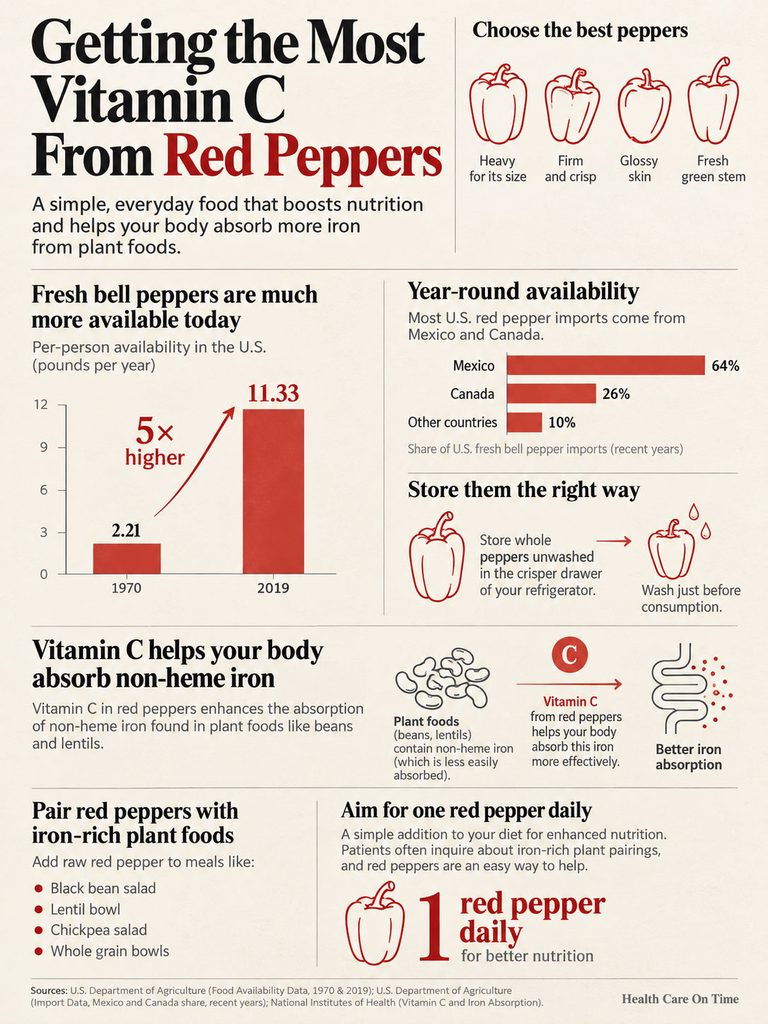
Choose peppers that feel heavy for their size, with firm, glossy skin and a fresh green stem. Wrinkled skin or soft spots mean the pepper has lost water and probably some vitamin C.
Americans eat far more bell peppers than they used to. USDA figures show per-person availability of fresh bell peppers has grown about fivefold since 1970, reaching 11.33 pounds in 2019, with imports driving much of that growth. Most imports come from Mexico and Canada, so red peppers stay on shelves year-round, while US-grown supply peaks in summer and early fall.
Keep whole peppers unwashed in the crisper drawer. Wash and cut them right before you eat them.
Pairing With Iron-Rich Foods
Vitamin C helps your body absorb non-heme iron, the kind found in beans, lentils, spinach, tofu, and fortified cereals. Adding raw red pepper to those meals is one of the simplest ways to get more iron from plant foods, according to the NIH iron fact sheet.
Patients booking iron and ferritin tests with us often ask what to eat alongside iron-rich plants. Raw red pepper strips with a black bean salad, or diced pepper stirred into a lentil bowl, is an easy answer. Our iron in spinach guide covers more pairings.
Easy Ways to Eat One Pepper a Day
- Slice half a pepper into strips and dip them in hummus.
- Stir a quarter pepper, diced, into eggs during the last minute of cooking.
- Add chopped raw pepper to salads, salsa, tacos, or grain bowls.
- Layer sliced pepper into sandwiches and wraps.
- Toss peppers into a stir-fry at the end instead of simmering them in sauce.
Pitfalls and Cautions
Supplement Pitches Built on Pepper Math
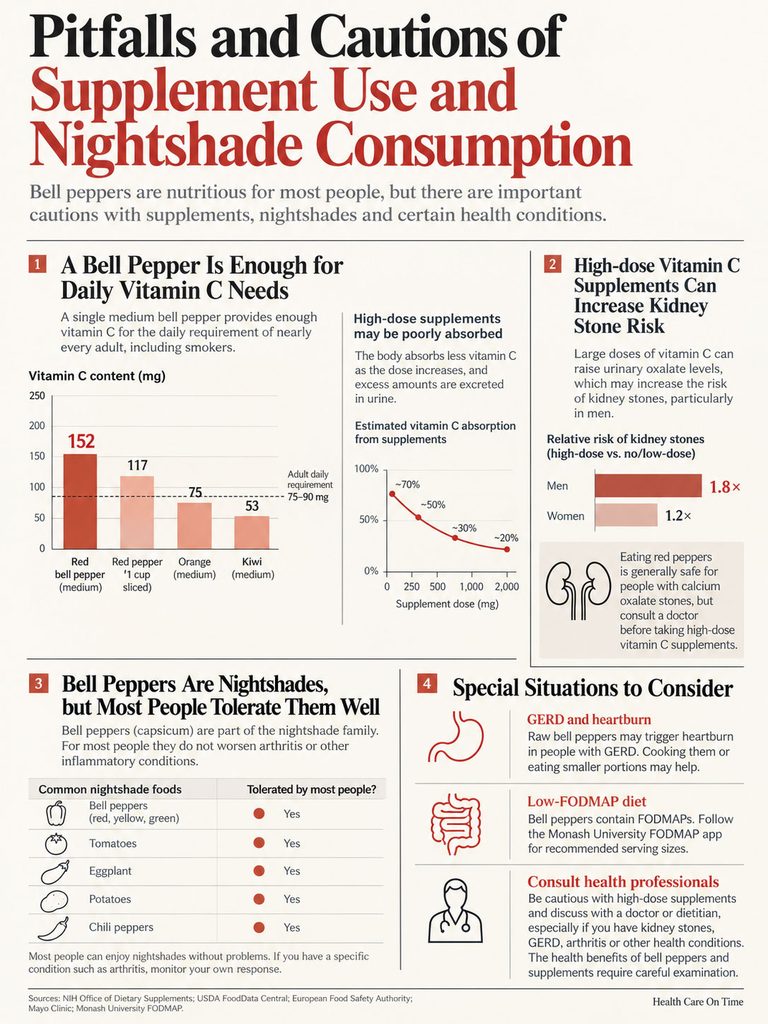
Some websites use red pepper figures as a lead-in to high-dose vitamin C pills. The logic falls apart quickly. If a single pepper covers your day, a 500 mg tablet mostly adds vitamin C your body absorbs poorly.
There are medical reasons to take a supplement, but that’s a conversation for your doctor or dietitian. For more on what bell peppers can and can’t do for your health, see our bell pepper health benefits article.
Nightshades, Heartburn, and FODMAPs
Bell peppers belong to the nightshade family. Most people handle them well, and there’s no strong evidence that they worsen arthritis in the general population. If you see a consistent pattern of symptoms after eating them, keep a simple food log and bring it to your next appointment.
Raw peppers can set off heartburn in some people with GERD. Cooked peppers or smaller portions are often easier. If you follow a low-FODMAP diet, check the Monash University FODMAP app for tested serving sizes, since limits differ by pepper color.
Kidney Stones and High-Dose Vitamin C
Vitamin C from food isn’t a known kidney stone risk. The concern is high-dose supplements, which can raise oxalate levels in urine. A large Swedish study of men published in JAMA Internal Medicine found roughly double the kidney stone risk among those taking vitamin C supplements, most often 1,000 mg tablets.
If you’ve had calcium oxalate stones, red peppers are generally fine to eat. Check with your doctor before taking vitamin C pills.
What to Do Next
Our medical reviewers built this quick guide around the questions readers send us most often about peppers and vitamin C.
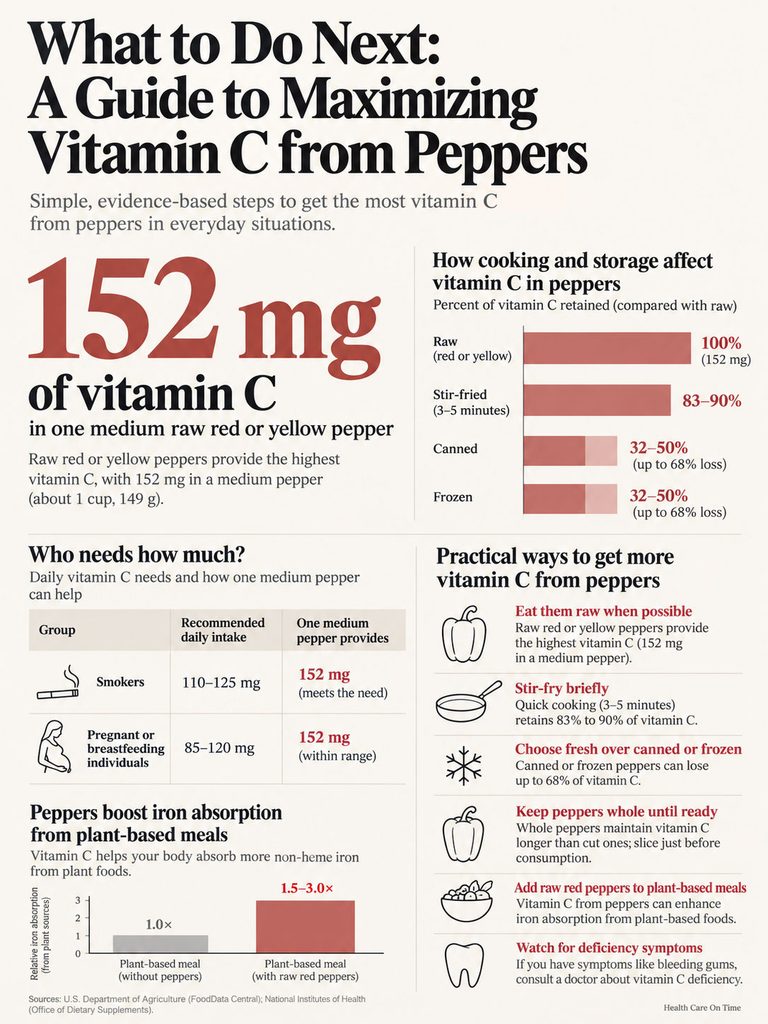
Table 3: Vitamin C and Red Peppers, Decision Guide
| Scenario | Recommended action | Why |
| You want the most vitamin C | Eat red or yellow pepper raw, sliced just before eating | Raw keeps all 152 mg in a medium red pepper |
| You only enjoy peppers cooked | Stir-fry or microwave for 3 to 5 minutes | Short, dry cooking keeps roughly 83% to 90% |
| You smoke | Target 110 to 125 mg a day; one medium pepper covers it | Smokers need 35 mg more and are 3 to 4 times more likely to be deficient |
| You’re pregnant or breastfeeding | One medium pepper covers 85 mg or 120 mg | Food sources are safe; skip high-dose pills unless advised |
| You’re getting iron from plants | Add raw red pepper to bean, lentil, or spinach meals | Vitamin C boosts non-heme iron absorption |
| You’ve had kidney stones | Eat peppers freely; avoid 1,000 mg supplements | Stone risk links to pills, not food |
| You mostly buy canned or frozen peppers | Add a fresh fruit or raw vegetable source daily | Processing cuts vitamin C by about 64% to 68% |
| You have bleeding gums, easy bruising, or slow healing | See your doctor and ask about vitamin C and a CBC | These can signal deficiency or other conditions |
Frequently Asked Questions
How much vitamin C is in one red bell pepper?
A medium raw red bell pepper (119 grams) has about 152 mg of vitamin C using USDA’s SR Legacy data, or about 169 mg using USDA’s newer Foundation record. A small pepper gives about 95 mg and a large one about 209 mg. Every size meets or beats the 90 mg Daily Value.
Is a red bell pepper higher in vitamin C than an orange?
Yes. Per 100 grams, raw red pepper has about 128 mg of vitamin C and an orange has about 53 mg, roughly a 2.4-to-1 gap. By typical serving, a medium red pepper (152 mg) has a little more than twice the vitamin C of a medium orange (about 70 mg).
Does cooking red peppers destroy vitamin C?
Cooking lowers vitamin C but doesn’t erase it. A quick 3 to 5 minute stir-fry keeps most of it. Long cooking, especially boiling with the water poured off, causes the biggest losses. Before-and-after lab studies show drops of about 50% to 65% after 30 minutes of heating.
Do roasted red peppers in a jar have vitamin C?
They do, but much less than fresh peppers. Jarred roasted peppers are cooked and then packed, and both steps reduce vitamin C. USDA lists canned red peppers at about 46.5 mg per 100 grams, around 64% below raw. Use them for flavor rather than as your main vitamin C source.
Which color bell pepper has the most vitamin C?
In USDA data, yellow bell peppers lead at about 183.5 mg per 100 grams. Red follows at about 127.7 mg, and green comes in at about 80.4 mg. All three are strong sources. Even green peppers deliver more vitamin C per 100 grams than an orange does.
How much vitamin C is in 1 cup of chopped red pepper?
A cup of chopped raw red pepper weighs about 149 grams and has about 190 mg of vitamin C. A cup of sliced strips weighs closer to 92 grams and gives about 117 mg. The gap comes from how tightly the pieces fill the measuring cup, not from the pepper itself.
Is one red pepper a day enough vitamin C?
For nearly everyone, yes. A medium red pepper gives about 152 mg, which covers the RDA for women (75 mg), men (90 mg), pregnancy (85 mg), breastfeeding (120 mg), and smokers (110 to 125 mg). The other fruits and vegetables you eat add more on top.
Can you get too much vitamin C from peppers?
It’s very unlikely. The adult upper limit is 2,000 mg a day, which would take about 13 medium red peppers. Your body also absorbs a smaller share as intake rises and flushes extra out in urine. Problems with very high intakes nearly always involve supplements rather than food.
Do frozen bell peppers keep their vitamin C?
Frozen peppers keep some vitamin C, but less than fresh ones. USDA lists frozen chopped red peppers at about 58.7 mg per 100 grams before cooking and about 41.2 mg after boiling. Adding them near the end of cooking, without extra water, helps hold on to what’s left.
Does vitamin C in peppers drop after cutting?
Yes, gradually. Cutting exposes the pepper’s flesh to air and light, which slowly break vitamin C down. Cut peppers stay fresh for a few days in a sealed container in the fridge, but slicing right before eating keeps the most vitamin C. Whole peppers hold up for about one to two weeks.
Does eating red peppers help iron absorption?
Yes. Vitamin C helps your body absorb non-heme iron from plant foods such as beans, lentils, tofu, spinach, and fortified cereals. Adding raw red pepper to those meals is an easy, food-based way to get more iron out of what you’re already eating.
Disclaimer: This article is for general education and does not replace medical advice. Nutrient values are USDA averages and vary with pepper size, variety, ripeness, storage, and cooking. If you have symptoms of vitamin C deficiency, a history of kidney stones, are pregnant, or take supplements or medications, talk with your doctor or a registered dietitian before changing your diet or supplement routine.
References
- USDA FoodData Central: Peppers, sweet, red, raw (SR Legacy, FDC ID 170108)
- USDA FoodData Central: Peppers, bell, red, raw (Foundation Foods, FDC ID 2258590)
- USDA National Nutrient Database SR28: Vitamin C Content of Foods (NIH ODS)
- NIH Office of Dietary Supplements: Vitamin C Health Professional Fact Sheet
- NIH Office of Dietary Supplements: Iron Health Professional Fact Sheet
- Powers et al. Serum Vitamin C Status of the US Adult Population, NHANES 2017 to 2018. J Appl Lab Med, 2023
- Schleicher et al. Serum Vitamin C and the Prevalence of Vitamin C Deficiency in the United States, NHANES 2003 to 2004. Am J Clin Nutr, 2009
- Crowell et al. Insufficient Vitamin C Levels Among Adults in the United States, NHANES 2003 to 2006. Nutrients, 2021
- Thomas et al. Ascorbic Acid Supplements and Kidney Stone Incidence Among Men. JAMA Intern Med, 2013
- Igwemmar et al. Effect of Heating on Vitamin C Content of Selected Vegetables. Int J Sci Tech Res, 2013
- Lee et al. Effect of Different Cooking Methods on the Content of Vitamins and True Retention in Selected Vegetables. Food Sci Biotechnol, 2018
- Effect of Boiling, Steaming, Stir-Frying and Microwave Cooking on the Antioxidant Potential of Peppers. Cogent Food & Agriculture, 2020
- The Packer: Fresh Bell Pepper Per-Capita Consumption Keeps Climbing (USDA data)