About 3 in 10 people admitted to one Boston hospital for leg “cellulitis” didn’t have cellulitis at all. Their antibiotic wasn’t failing. The diagnosis was.
Table of Contents
That’s one reason Keflex sometimes seems to do nothing. The other reasons are just as fixable, once you know which one you’re facing.
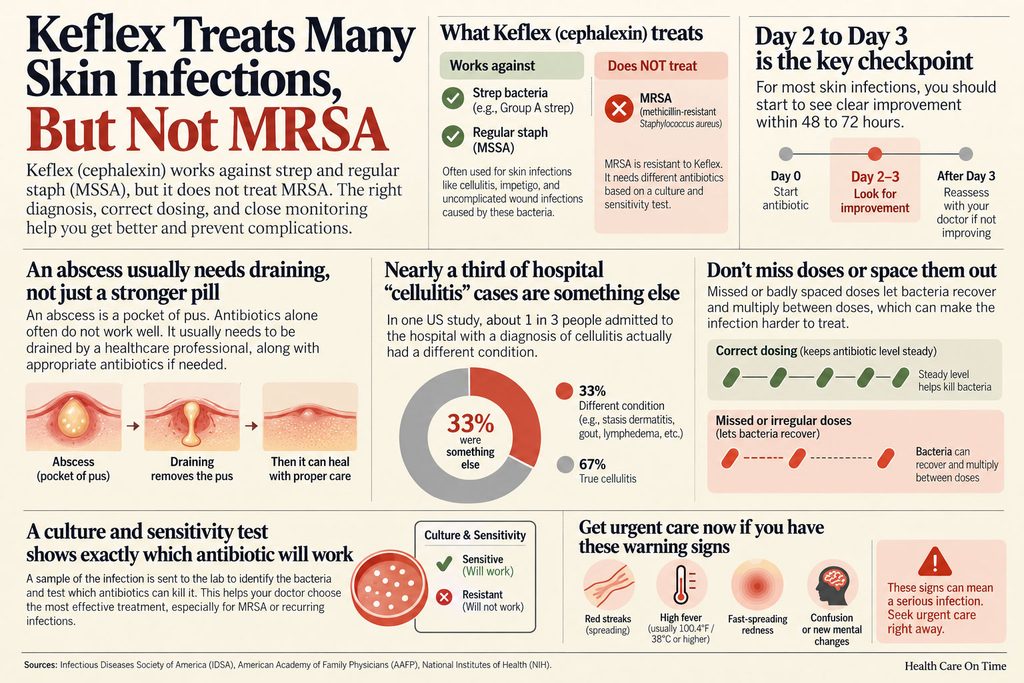
Quick Answer: Most infections start to improve within 48 to 72 hours on Keflex (cephalexin). Redness can look slightly worse on day one before it gets better. If you see no improvement by day three, or things get worse at any point, call your doctor. Common reasons Keflex isn’t working include MRSA, an abscess that needs draining, a wrong diagnosis, missed doses, or a deeper infection.
At a Glance
- Keflex works against strep and regular staph, but it does not treat MRSA.
- Day two to day three is the key checkpoint for most infections.
- An abscess (pocket of pus) usually needs draining, not just a stronger pill.
- Nearly a third of hospital “cellulitis” cases in one US study were something else.
- Missed or badly spaced doses let bacteria recover between doses.
- A culture and sensitivity test shows exactly which antibiotic will work.
- Red streaks, high fever, fast-spreading redness, or confusion mean urgent care now.
What Keflex Is and How It Works
Keflex is the brand name for cephalexin, a first-generation cephalosporin antibiotic. It has been in use since the 1970s and is still one of the most prescribed antibiotics in the United States.

Our medical reviewers see it prescribed most often for skin infections, urinary tract infections (UTIs), strep throat, and some bone and ear infections.
How Cephalexin Kills Bacteria
Bacteria need a strong outer wall to survive. Cephalexin blocks the enzymes that build that wall. Without it, the bacteria swell, leak, and burst.
This only works on bacteria that are actively growing. It also leaves your body fast, mostly through your kidneys within hours. Miss a dose, and the level can drop low enough for surviving bacteria to regroup.
What Keflex Covers and What It Misses
Keflex is a good match for:
- Streptococcus bacteria (the usual cause of cellulitis and strep throat)
- Methicillin-sensitive Staphylococcus aureus (MSSA, regular staph)
- Many strains of E. coli, Klebsiella, and Proteus that cause bladder infections
Keflex does not reliably treat:
- MRSA (methicillin-resistant staph)
- Pseudomonas (common in swimmer’s ear and some foot wounds)
- Enterococcus (a frequent cause of some UTIs)
- ESBL-producing bacteria (resistant gut bacteria)
- Viruses of any kind, including colds, flu, and most sore throats
If your infection comes from a bug on the second list, Keflex can be taken perfectly and still fail.
Why Doctors Prescribe It So Often
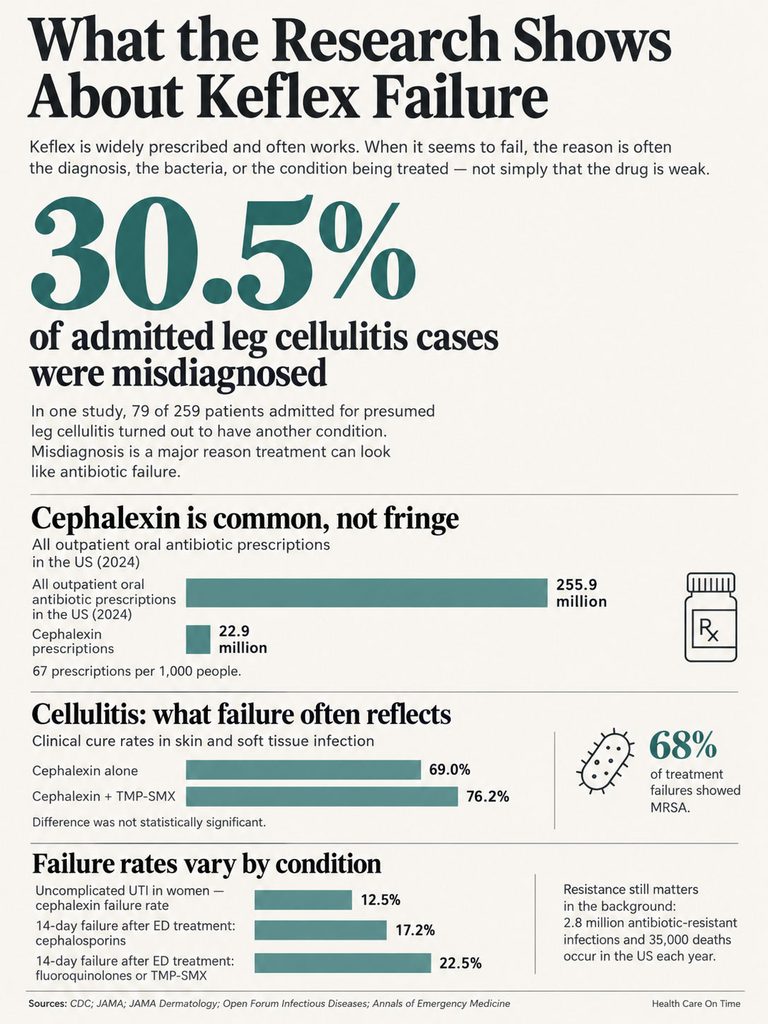
Keflex is cheap, well tolerated, and safe for most adults and children. US pharmacies dispensed 255.9 million outpatient oral antibiotic prescriptions in 2024, and cephalexin made up 22.9 million of them, according to CDC outpatient prescribing data.
That’s about 67 prescriptions for every 1,000 Americans. With that many courses, some will fail. The real question is why, and what comes next.
How Long Keflex Takes to Work
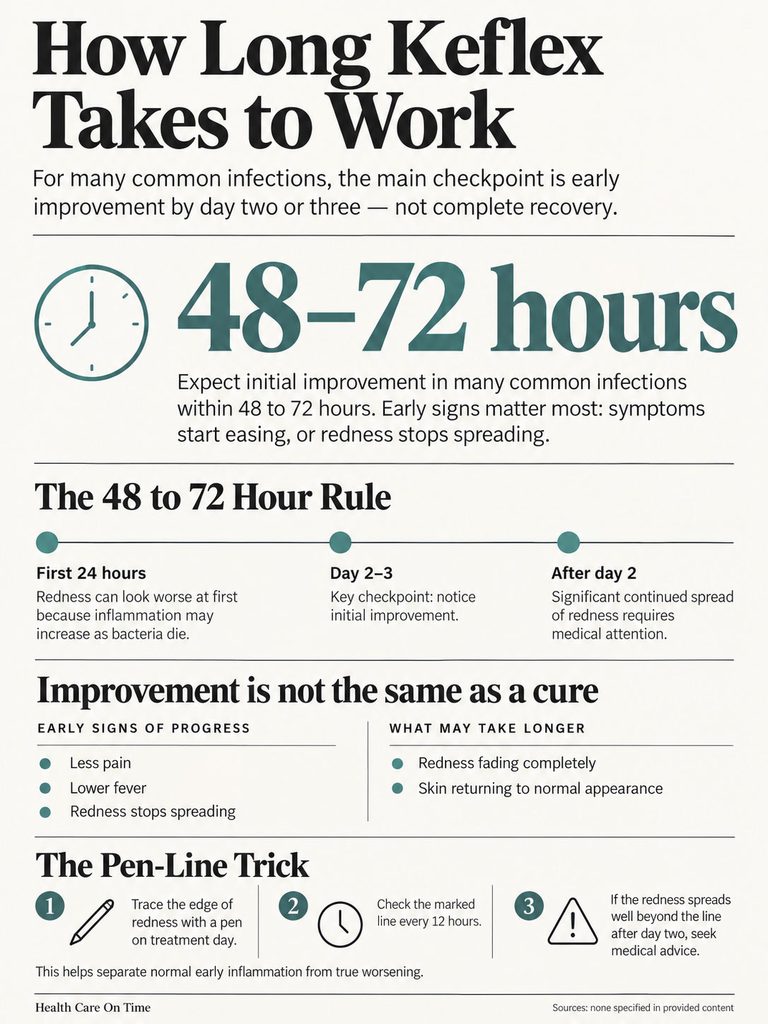
For most common infections, expect the first clear signs of improvement within 48 to 72 hours.
The 48 to 72 Hour Rule
By day two or three, you should notice at least one of these:
- Less pain or tenderness
- Fever coming down
- Redness no longer spreading
- Less swelling, warmth, or drainage
- Easier, less painful urination (for a UTI)
Improvement is not the same as cure. Redness can take a week or more to fade fully, even when the drug is working well. What matters early is direction: holding steady or shrinking.
Why Redness Can Look Worse on Day One
This catches many patients off guard. In the first 24 hours of treatment for cellulitis, the red area can spread a little as dying bacteria trigger extra inflammation.
Patients who message our team on day one often ask if this means the drug has failed. Usually it hasn’t. The warning sign is spread that continues past 48 hours, or spread you can see within hours.
Timeline by Infection Type
- Bladder infection (UTI): burning often eases within 24 to 48 hours.
- Strep throat: fever and pain usually improve in 24 to 48 hours. The FDA label calls for at least 10 days of treatment for strep.
- Cellulitis: pain and fever improve in 48 to 72 hours. Redness can take 7 to 10 days to fade.
- Bone or joint infection: improvement is slow, and treatment often runs for weeks.
The Pen-Line Trick
On the day you start Keflex, trace the edge of the red area with a ballpoint pen. Write the date and time next to it, and take a photo in good light.
Check it every 12 hours. If redness pushes well past the line after day two, call your provider. Your doctor gets hard evidence instead of guesswork.
7 Reasons Your Infection Isn’t Clearing on Keflex
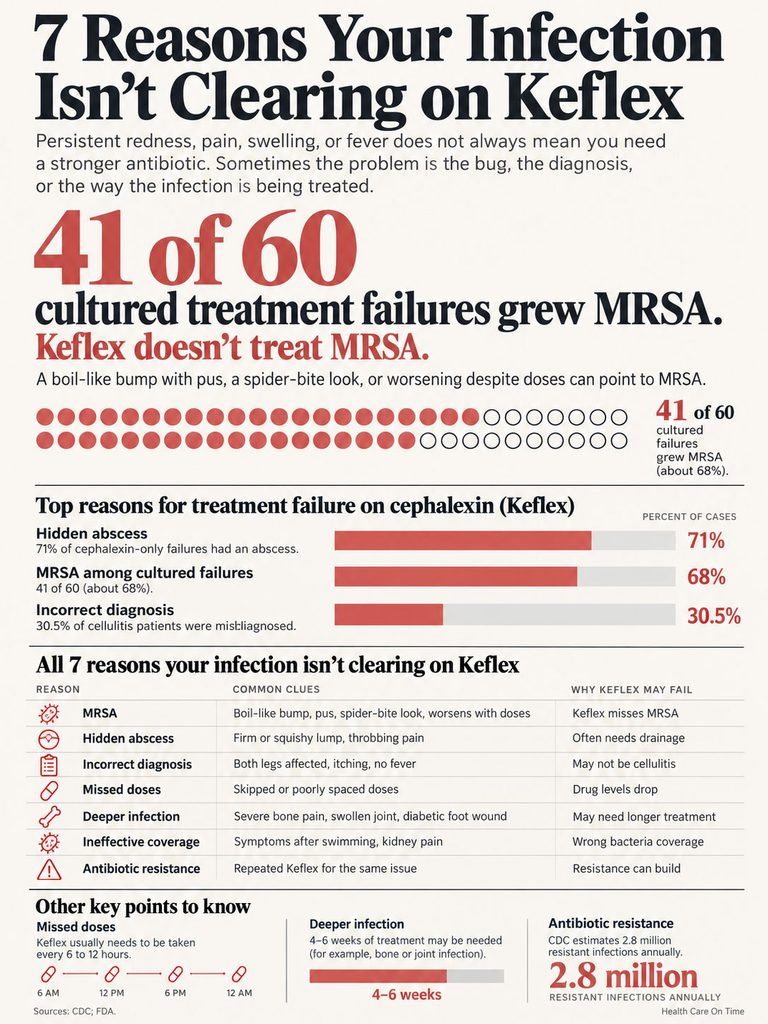
- The bacteria is MRSA.
- There’s an abscess that needs draining.
- It was never a bacterial infection.
- Doses are missed or spaced wrong.
- The infection is deeper than it looks.
- Keflex can’t reach that bug or body site.
- Resistance has built up from repeat courses.
Here’s how they compare. Use the clues column to spot which fits your situation.
| Reason | Clues You’ll Notice | How Often (Data) | What Usually Fixes It |
| 1. MRSA | Boil-like bump, pus, looks like a “spider bite,” worse despite doses | 41 of 60 cultured treatment failures (68%) grew MRSA in a 500-patient JAMA trial | Culture, then switch to TMP-SMX, doxycycline, or clindamycin |
| 2. Hidden abscess | Firm or squishy lump under red skin, pus, throbbing pain | About 71% of cephalexin-only failures in the same trial had an abscess or pus drainage | Incision and drainage by a clinician |
| 3. Not a bacterial infection | Both legs affected, itching, no fever, swelling worse when standing | 79 of 259 (30.5%) hospital “cellulitis” patients were misdiagnosed | Correct diagnosis (stasis dermatitis, gout, DVT, eczema, fungus) |
| 4. Missed or poorly spaced doses | Skipped doses, taking it twice a day when told four times | FDA label: 250 mg every 6 hours or 500 mg every 12 hours, 7 to 14 days | Take on schedule; ask about weight-based dosing |
| 5. Deeper infection | Deep bone pain, swollen joint, diabetic foot wound, very severe pain | Bone infections often need 4 to 6 weeks of targeted treatment | Imaging, blood tests, specialist care, often IV antibiotics |
| 6. Keflex can’t reach that bug | Ear drainage after swimming, kidney pain, prostate symptoms | No reliable activity against Pseudomonas, Enterococcus, ESBL bacteria | Culture-guided switch to a better-matched drug |
| 7. Resistance from repeat courses | Third course in a row, infection keeps coming back | CDC: 2.8 million antibiotic-resistant infections in the US each year | Culture and sensitivity before any more antibiotics |
1. The Bacteria Is MRSA
MRSA is staph that survives cephalexin and its relatives. It’s common in everyday community settings, not just hospitals.
In a 2017 JAMA trial of 500 patients across five US emergency departments, 60 treatment failures had material available for culture. Of those, 41 (68%) grew MRSA.
MRSA skin infections often start as a painful red bump that people mistake for a spider bite. If yours has pus or a center filling with fluid, ask your provider directly whether MRSA has been considered.
2. There’s an Abscess That Needs Draining
This is the reason most patients never hear about. An abscess is a walled-off pocket of pus with almost no blood supply, so antibiotics struggle to get inside.
In the same JAMA trial, 10 of the 28 failures on cephalexin alone had an abscess, and 10 more developed pus drainage. That’s about 71% of failures pointing to a collection that needed hands-on treatment.
The IDSA skin infection guideline lists incision and drainage as the main treatment for abscesses. A quick bedside ultrasound can reveal one hiding under red skin.
3. It Was Never a Bacterial Infection
Plenty of conditions look like cellulitis but aren’t infections, so no antibiotic helps. A JAMA Dermatology study from Massachusetts General Hospital found 79 of 259 patients (30.5%) admitted for leg cellulitis were misdiagnosed.
The authors estimated this drives 50,000 to 130,000 unnecessary US hospitalizations a year. Common look-alikes include:
- Stasis dermatitis: red, itchy, scaly skin on both lower legs from poor vein circulation
- Gout: a sudden hot, red, swollen joint, often the big toe
- Deep vein thrombosis (DVT): a leg clot causing swelling and warmth
- Contact dermatitis: a reaction to a cream, bandage, or plant
- Fungal infection: ringworm or athlete’s foot with a scaly edge
- Viral illness: most sore throats, colds, and ear pain in adults
A useful clue: true cellulitis almost always affects one leg. Redness on both legs at once points away from infection.
4. Doses Are Missed or Spaced Wrong
The FDA label lists the usual adult dose as 250 mg every 6 hours or 500 mg every 12 hours, for 7 to 14 days. Serious infections can need up to 4 grams a day.
Patients commonly tell us they took a “four times a day” prescription three times a day because the midday dose was hard to remember. That gap can be enough to stall progress.
Body size matters too. Larger adults sometimes need higher doses, so it’s fair to ask your prescriber whether your dose fits your weight.
5. The Infection Is Deeper Than It Looks
Sometimes the skin is only the surface. Infection can reach muscle, bone, or a joint.
Watch for deep, aching bone pain, a swollen joint that’s hard to move, or a diabetic foot wound that won’t heal. These need imaging, blood work, and often weeks of targeted treatment.
The rarest but most serious deep infection is necrotizing fasciitis. Its hallmark is pain far worse than the skin looks. That is an emergency.
6. Keflex Can’t Reach That Bug or Body Site
Swimmer’s ear is often caused by Pseudomonas, which Keflex doesn’t cover. Some UTIs come from Enterococcus or ESBL bacteria, which also escape it.
Location matters as well. Prostate and kidney infections may need drugs that build up better in those tissues. Flank pain, high fever, or pelvic pain in men should be mentioned right away.
7. Resistance From Repeat Courses
Each round of antibiotics gives tougher bacteria a chance to survive. If you’ve taken Keflex two or three times in a row for the same problem, another round of the same drug is unlikely to help.
CDC’s national estimate puts the toll at more than 2.8 million antibiotic-resistant infections and 35,000 deaths in the US each year. A culture before your next course is the smart move.
What the Research Shows About Keflex Failure
Keflex isn’t a weak antibiotic. The data shows that failure usually comes from the wrong match, not the wrong drug.
| Statistic | Figure | Source |
| US outpatient oral antibiotic prescriptions (2024) | 255.9 million total; cephalexin 22.9 million (67 per 1,000 people) | CDC Outpatient Antibiotic Prescriptions, 2024 |
| Clinical cure, uncomplicated cellulitis | 69.0% cephalexin alone vs 76.2% cephalexin plus TMP-SMX (P = .09, not significant) | Moran et al., JAMA 2017 (n = 500) |
| MRSA among cultured treatment failures | 41 of 60 (68%) | Moran et al., JAMA 2017 |
| Leg cellulitis misdiagnosed in admitted patients | 79 of 259 (30.5%) | Weng et al., JAMA Dermatology 2017 |
| Cephalexin failure, uncomplicated UTI in women | 12.5% (cefdinir failed nearly twice as often) | Open Forum Infectious Diseases 2025 (n = 367) |
| 14-day failure, outpatient kidney infection | 17.2% cephalosporins vs 22.5% fluoroquinolones or TMP-SMX | COPY-ED study, Annals of Emergency Medicine |
| Antibiotic-resistant infections in the US | 2.8 million infections and 35,000 deaths per year | CDC Antibiotic Resistance Threats Report (2019 baseline) |
The Cellulitis Trial That Changed Practice
The JAMA trial tested whether adding MRSA coverage to cephalexin helped people with simple cellulitis (no pus, no abscess on ultrasound). It didn’t, at least not by a statistically meaningful margin.
That’s why many doctors still start with Keflex alone for plain cellulitis. Most of these infections are caused by strep, which Keflex handles well.
Keflex for UTIs: Better Than Its Reputation
Keflex used to be seen as a second-tier UTI drug. Newer lab methods changed that, since US labs now use cefazolin results to predict how cephalexin will perform against common UTI bacteria.
A 2025 study of 367 women with simple UTIs found cephalexin failed in 12.5% of cases, about half the failure rate of cefdinir. If Keflex isn’t working for your UTI, the specific bacteria is the likely issue, and a urine culture can identify it.
What This Evidence Can’t Tell You
Three limits are worth knowing:
- Age of the data. The JAMA trial enrolled patients from 2009 to 2012. MRSA rates vary by region and have shifted since.
- Single-center findings. The misdiagnosis figure came from one large Boston hospital. Rates elsewhere may differ.
- Older resistance totals. The CDC’s 2.8 million figure is a national baseline, not a live count.
Our medical reviewers treat these numbers as strong guides, not exact predictions for every patient.
Special Situations: Kids, Pregnancy, Older Adults, and Kidney Disease
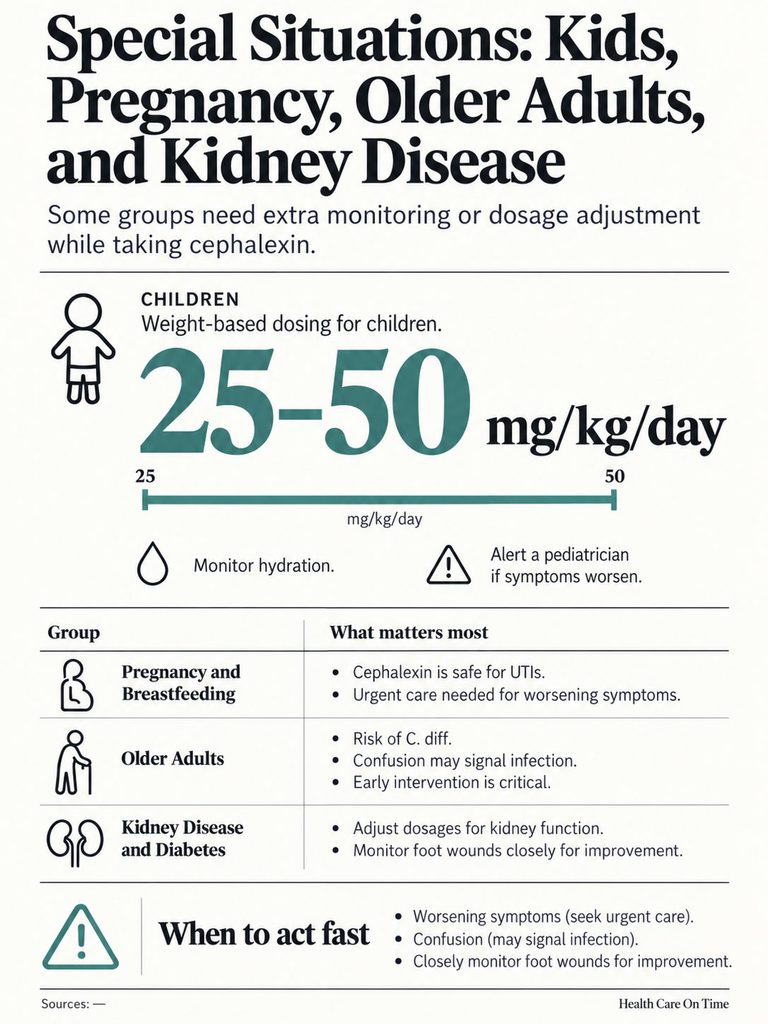
The basic 48 to 72 hour rule applies to everyone. But some groups need extra care.
Children
Kids’ doses are based on weight. The FDA label lists 25 to 50 mg per kilogram per day, split into several doses, with higher amounts for ear infections. Liquid doses must be measured with the syringe or cup from the pharmacy, not a kitchen spoon.
Call your pediatrician sooner, within 24 to 48 hours, if a child stops drinking, has fewer wet diapers, or seems unusually sleepy.
Pregnancy and Breastfeeding
Cephalexin is one of the antibiotics most often used in pregnancy, including for UTIs, which need prompt treatment to protect against kidney infection. Small amounts pass into breast milk, and it’s generally considered compatible with breastfeeding.
If a UTI isn’t improving while you’re pregnant, call your OB the same day. Fever or back pain in pregnancy needs urgent care.
Older Adults
People over 65 face higher risks of C. diff diarrhea and of infections that look mild but spread quickly. Confusion may be the only early sign of a worsening infection in an older adult.
Kidney Disease and Diabetes
Because cephalexin leaves through the kidneys, the FDA label calls for dose changes in people with reduced kidney function. Make sure your prescriber has recent kidney test results.
People with diabetes heal more slowly and are prone to deep foot infections. A foot wound that isn’t improving by day three deserves a same-day visit.
What Your Doctor Will Do Next
If Keflex isn’t working, don’t just wait it out, and don’t start leftover antibiotics from the medicine cabinet.
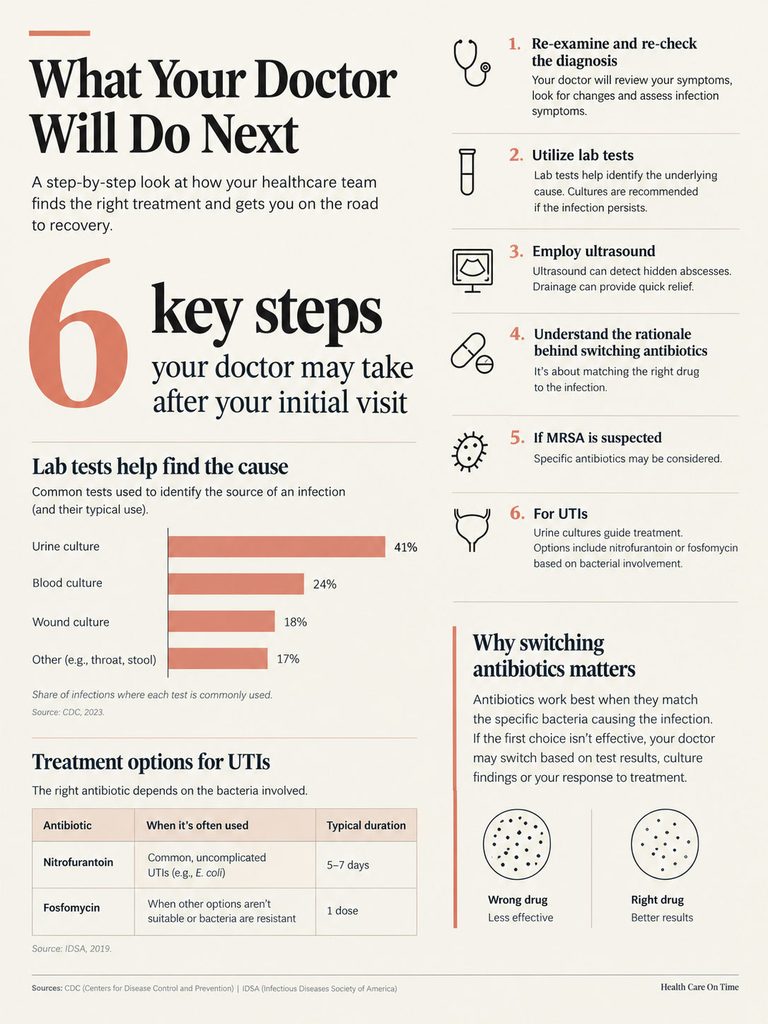
Re-examine and Re-check the Diagnosis
Your provider will look at the infection again, compare it to your pen line or photos, and ask about fever, pain, and how you’ve taken your doses. They’ll also ask whether this could be something other than an infection.
Lab Tests That Find the Real Cause
Across lab orders reviewed by our team, these tests are the most useful when an antibiotic isn’t working:
- Wound culture and sensitivity: a swab of pus identifies the bacteria and which antibiotics kill it. Results usually take 2 to 3 days.
- Urine culture: the same idea for UTIs, ideally collected before a new antibiotic starts.
- Complete blood count (CBC): a high white blood cell count can signal spreading infection.
- C-reactive protein (CRP): an inflammation marker that can be tracked over time.
- Blood cultures: checked if you have fever, chills, or signs of bloodstream infection.
Patients booking these tests through HealthCareOnTime often ask whether a culture is worth it after only a few days. If the infection is worsening or keeps coming back, it usually is.
Ultrasound for Hidden Abscesses
An ultrasound can show a pus pocket that a physical exam misses. If one is found, a clinician can numb the area, open it, and drain it. Many people feel relief within a day.
Switching Antibiotics: Common Next Choices
Your doctor won’t simply pick a “stronger” drug. They’ll pick a better-matched one.
If MRSA Is Suspected
- Trimethoprim-sulfamethoxazole (TMP-SMX, Bactrim): often used for MRSA skin infections
- Doxycycline: another MRSA option for adult skin infections
- Clindamycin: covers MRSA and strep in many areas, but carries a higher risk of C. diff
If It’s a UTI
A urine culture guides the switch. Options may include nitrofurantoin, fosfomycin, or another antibiotic, depending on the bacteria and whether the kidneys are involved.
Red Flags: When to Go to the ER Instead
Some signs mean the infection may be spreading into your blood or deeper tissue. Go to an emergency room or call 911 if you notice:
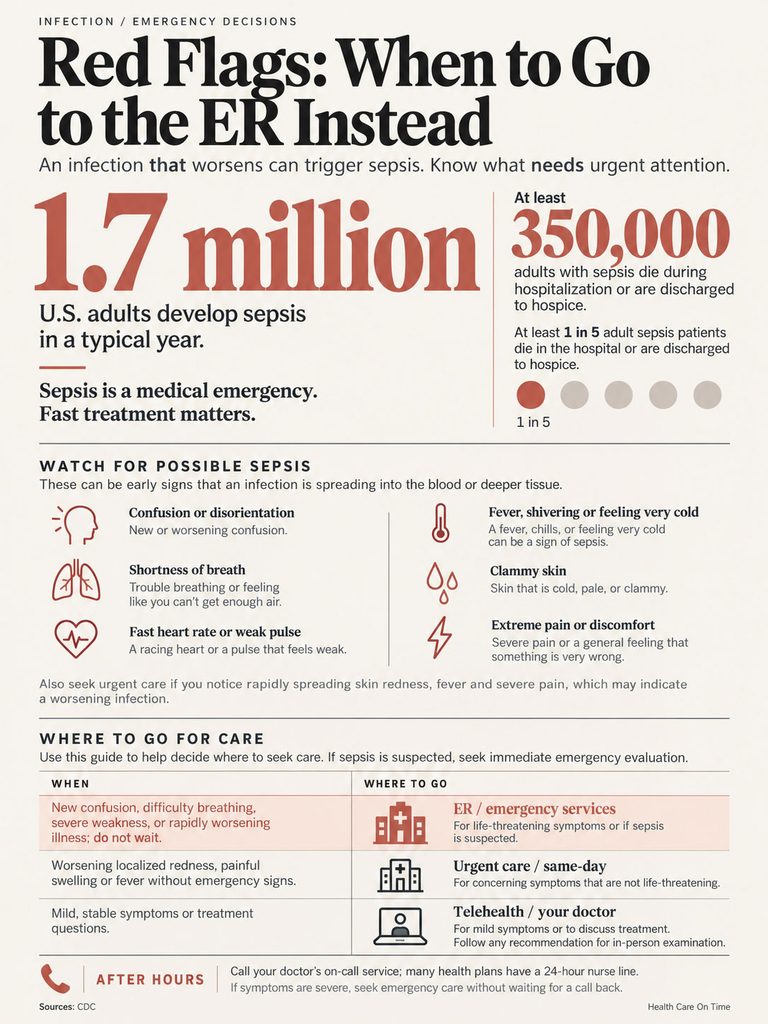
- Red streaks running away from the infection (a sign of lymphangitis)
- Redness spreading quickly, visible within hours
- Fever of 100.4°F or higher with chills or shaking
- Confusion, dizziness, or extreme sleepiness
- Fast heartbeat or fast breathing
- Pain far worse than the skin looks
- Skin turning dark purple, gray, or black, or forming blisters
- Infection near the eye, with swelling, eye pain, or trouble moving the eye
- Vomiting that stops you from keeping Keflex down
These can be early signs of sepsis. According to the CDC, at least 1.7 million US adults develop sepsis each year, and at least 350,000 die during their hospitalization or are discharged to hospice. Fast treatment saves lives.
Telehealth, Urgent Care, or ER?
Not every failing course needs an emergency room. Here’s a simple way to choose:
- Telehealth: fine for a day-three check on a small, stable patch you can show on camera, or UTI burning without fever or back pain.
- Urgent care: a growing lump that may need draining, or redness creeping slowly past your pen line with no fever.
- Emergency room: any red-flag sign listed above, or you simply feel very sick.
If you’re unsure, call your doctor’s after-hours line. Many US health plans also run a free 24-hour nurse line, printed on the back of your insurance card.
Mistakes That Make Keflex Fail
Our medical team sees the same patterns again and again.
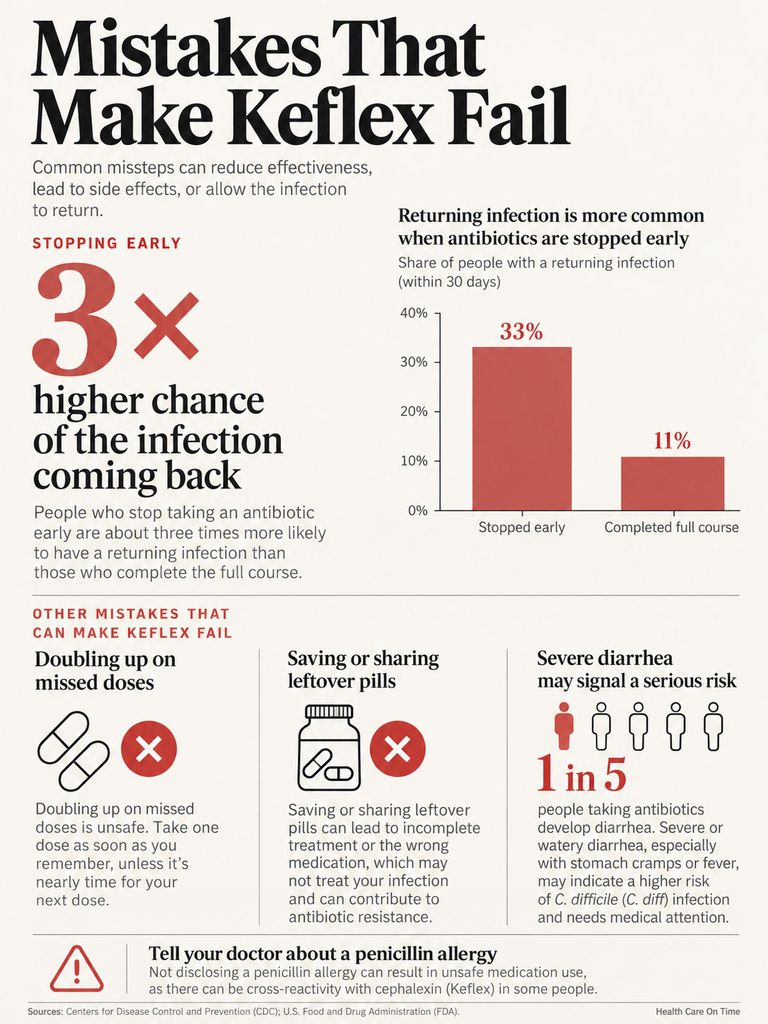
Stopping early. Feeling better by day four doesn’t mean every bacterium is gone. Stopping early is a common reason infections return.
Doubling up after a missed dose. Take a missed dose when you remember, unless the next one is almost due. Never take two at once.
Saving or sharing pills. Leftovers mean a course wasn’t finished, and someone else’s antibiotic may be the wrong drug for your infection.
Ignoring severe diarrhea. Mild loose stools are common on Keflex. Watery diarrhea three or more times a day, especially with cramps or fever, can signal C. diff. The CDC lists antibiotic use as a major risk factor.
Not mentioning a penicillin allergy. Cephalexin shares part of its structure with amoxicillin. Many people labeled penicillin-allergic take it safely, but your prescriber needs the full history.
Side Effect or Worsening Infection? How to Tell
Some Keflex side effects get mixed up with an infection that’s getting worse. Knowing the difference saves you a panicked trip, or prompts the right one.
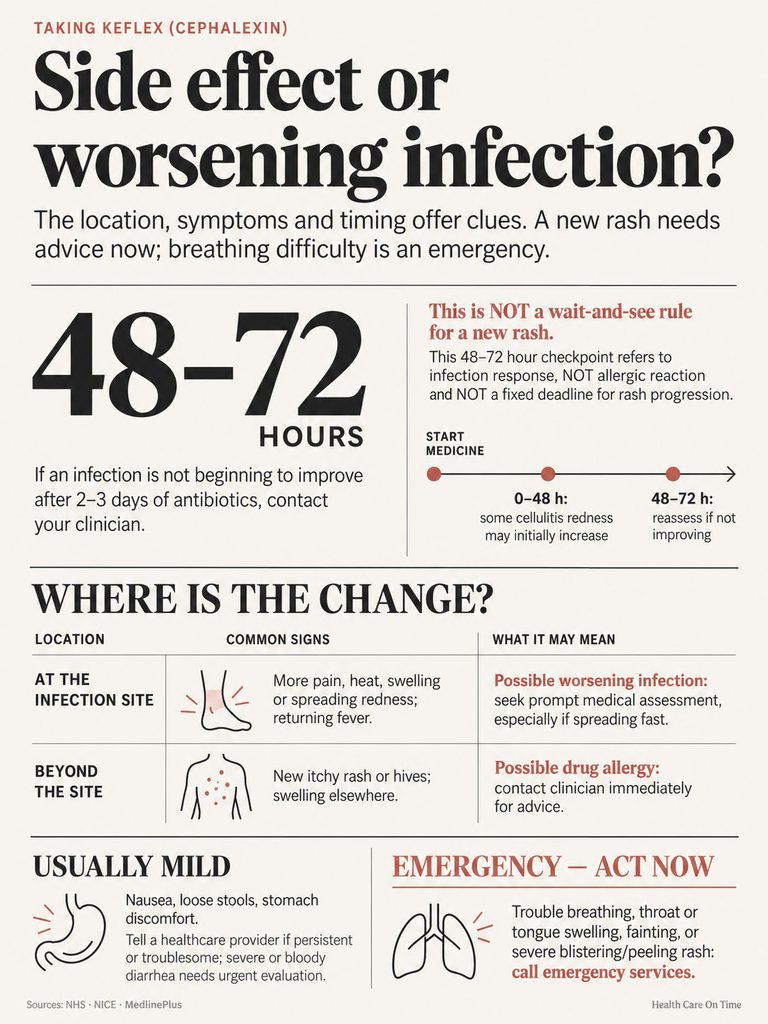
Common, Usually Mild Side Effects
- Nausea or an upset stomach (taking doses with food can help)
- Mild, loose stools
- Headache or tiredness
- Vaginal yeast infection (itching and thick white discharge)
These don’t mean the antibiotic has failed. Mention them at your follow-up, or call your pharmacist if they bother you.
Signs of an Allergic Reaction
A new rash spreading over your body, hives, lip or tongue swelling, or wheezing points to an allergy, not a failing antibiotic. Stop Keflex and get emergency help if you have swelling or trouble breathing.
A rash that stays at the infection site and keeps growing is different. That’s more likely the infection itself, and the 48 to 72 hour rule applies.
Signs the Infection Itself Is Worsening
The infected area grows bigger, hotter, or more painful. A lump starts to form. A fever returns after it had gone down. These point back to the seven reasons above, not to a side effect.
Our medical reviewers suggest one simple question: is the problem at the infection site, or somewhere new? Problems at the site usually mean the infection. Whole-body problems often mean the drug.
Your Action Plan: What to Do Today
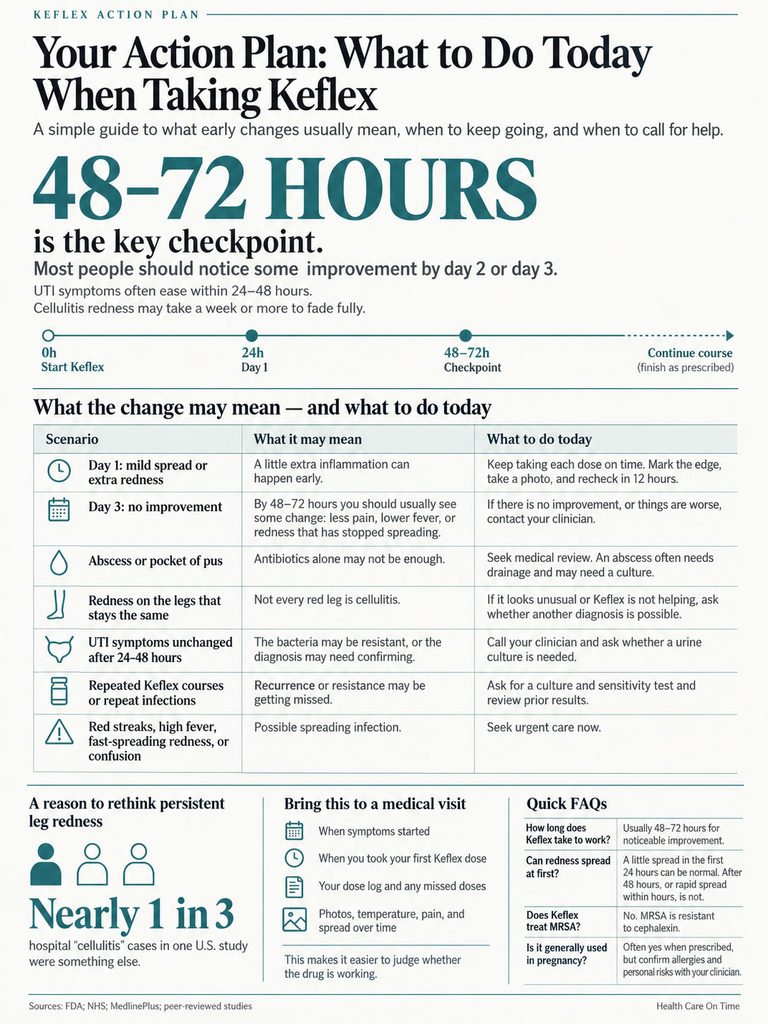
| Scenario | What It May Mean | Recommended Action |
| Day 1, redness spread slightly past your pen line | Normal early inflammation as bacteria die | Keep taking Keflex on schedule; recheck in 12 hours |
| Day 3, no improvement at all | Wrong bug, abscess, or wrong diagnosis | Call your provider today for a recheck |
| A lump with pus is forming | Abscess, possibly MRSA | Same-day visit for drainage and a wound culture |
| Redness on both legs, itchy, no fever | Possibly stasis dermatitis or another non-infection | Ask about other diagnoses before more antibiotics |
| UTI burning unchanged after 48 hours | Resistant bacteria or a non-UTI cause | Request a urine culture before switching drugs |
| Third Keflex course for the same problem | Resistance or an underlying cause | Ask for culture and sensitivity testing first |
| Red streaks, fever over 100.4°F, or confusion | Spreading infection or early sepsis | Go to the ER or call 911 now |
Before any follow-up, write down when symptoms started, when you began Keflex, how many doses you’ve taken, and what your photos show. That five-minute record makes the visit faster and more useful.
Frequently Asked Questions
How long does Keflex take to work?
Most people notice improvement within 48 to 72 hours, such as less pain, lower fever, or redness that stops spreading. UTI symptoms often ease within 24 to 48 hours. Cellulitis redness can take a week or more to fade fully, even when the antibiotic is working. Keep taking every dose until the course is finished.
Is it normal for redness to spread on Keflex at first?
A little spread in the first 24 hours can be normal, as dying bacteria trigger extra inflammation. Mark the edge with a pen and check every 12 hours. Spread that continues past 48 hours, or spreads quickly within hours, is not normal. Contact your provider promptly in either case.
Does Keflex treat MRSA?
No. MRSA is resistant to cephalexin and other drugs in its family. If your doctor suspects MRSA, common options include trimethoprim-sulfamethoxazole, doxycycline, or clindamycin. A boil-like bump with pus, or an infection worsening despite regular doses, should prompt a direct question about MRSA testing.
What should I do if Keflex isn’t working after 3 days?
Call your doctor the same day. Keep taking Keflex until you speak with them, unless you have a reaction. Expect a recheck, possibly a culture or ultrasound, and a review of the diagnosis. If you have red streaks, high fever, confusion, or fast-spreading redness, go to the ER instead.
What antibiotic is stronger than Keflex?
“Stronger” isn’t really how doctors choose. They pick the antibiotic that matches the bacteria and the body site. For MRSA, that may be Bactrim or doxycycline. For a resistant UTI, it depends on the urine culture. A culture and sensitivity test is the best way to find the right match.
Can I take Keflex twice a day instead of four times?
Only if your prescriber says so. The FDA label allows 500 mg every 12 hours for some infections, but others need doses every 6 hours to keep drug levels high enough. Changing the schedule yourself can lower effectiveness. Ask your pharmacist for help if the schedule is hard to follow.
Should I stop Keflex if it’s not working?
Don’t stop on your own. Call your doctor first. They may switch you to a different antibiotic, add one, or keep you on Keflex while waiting for test results. Stopping without a plan can leave the infection partly treated. A serious allergic reaction is the exception and needs emergency care.
Does Keflex work for UTIs?
Yes, for many simple bladder infections. A 2025 study found cephalexin failed in about 12.5% of uncomplicated UTIs in women, better than cefdinir. It doesn’t cover Enterococcus or ESBL bacteria, though. If burning hasn’t improved within 48 hours, ask for a urine culture.
Can I take Keflex if I’m allergic to penicillin?
Often, but not always. Cephalexin shares part of its structure with amoxicillin, so the risk depends on the reaction you had. A mild rash years ago is different from hives, swelling, or trouble breathing. Tell your prescriber exactly what happened. Allergy testing can clarify an old penicillin label.
Why does my infection keep coming back after Keflex?
Common reasons include an untreated abscess, resistant bacteria, stopping the course early, or an underlying problem like poor circulation, diabetes, or athlete’s foot creating skin cracks. After two or more failed courses, ask for a culture and a look at what’s letting the infection return.
Is diarrhea on Keflex dangerous?
Mild loose stools are a common side effect and usually harmless. Watery diarrhea three or more times a day, especially with cramps, fever, or blood, may be C. diff, a serious gut infection linked to antibiotics. Call your doctor right away, and avoid anti-diarrhea medicine unless they approve it.
Is Keflex safe during pregnancy?
Cephalexin is one of the antibiotics most commonly used in pregnancy, including for bladder infections. Untreated UTIs in pregnancy can lead to kidney infection, so treatment matters. If symptoms aren’t improving within 48 hours, or you develop fever or back pain, contact your OB the same day.
Disclaimer: This article is for general education and is not a substitute for professional medical advice, diagnosis, or treatment. Never start, stop, or change an antibiotic without talking to a licensed healthcare provider. If you have signs of a spreading infection, such as red streaks, high fever, confusion, or fast-spreading redness, seek emergency care or call 911 right away.
References
- Centers for Disease Control and Prevention: Outpatient Antibiotic Prescriptions, United States, 2024
- Centers for Disease Control and Prevention: Antibiotic Resistance Threats in the United States
- Moran GJ et al. Effect of Cephalexin Plus Trimethoprim-Sulfamethoxazole vs Cephalexin Alone on Clinical Cure of Uncomplicated Cellulitis. JAMA. 2017;317:2088-2096
- Weng QY et al. Costs and Consequences Associated With Misdiagnosed Lower Extremity Cellulitis. JAMA Dermatology. 2017;153(2):141-146
- US Food and Drug Administration: KEFLEX (cephalexin) Prescribing Information
- Cefdinir vs Cephalexin for Uncomplicated UTI. Open Forum Infectious Diseases. 2025;12(10):ofaf501
- Cephalosporins for Outpatient Pyelonephritis in the Emergency Department (COPY-ED), University of Maryland Emergency Medicine summary
- Infectious Diseases Society of America: Skin and Soft Tissue Infections Practice Guideline
- Centers for Disease Control and Prevention: About Sepsis
- Centers for Disease Control and Prevention: About C. diff
- MedlinePlus (NIH): Cephalexin Drug Information