A cup of raw Brussels sprouts has fewer calories than a medium apple. Yet a restaurant side of crispy, glazed sprouts can top 400 calories. The sprout is rarely the problem; the oil, the glaze, and the bacon are.
Table of Contents
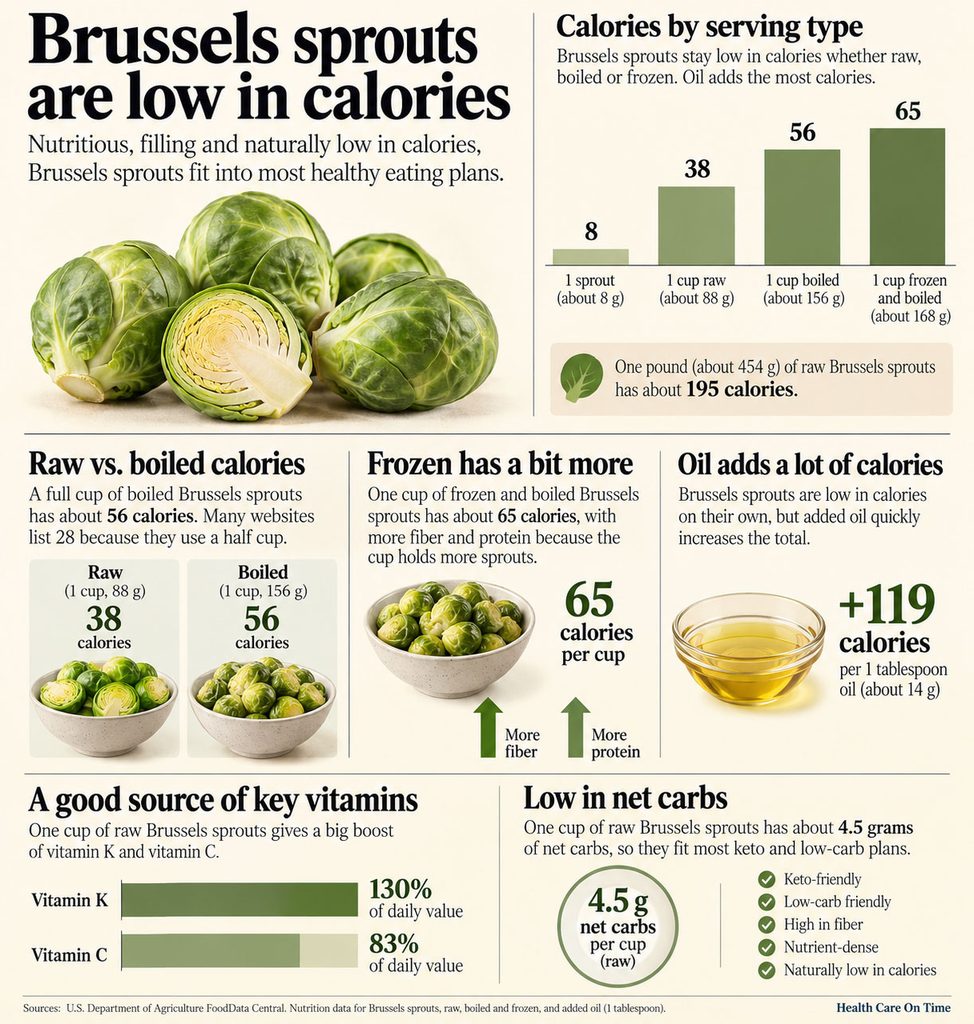
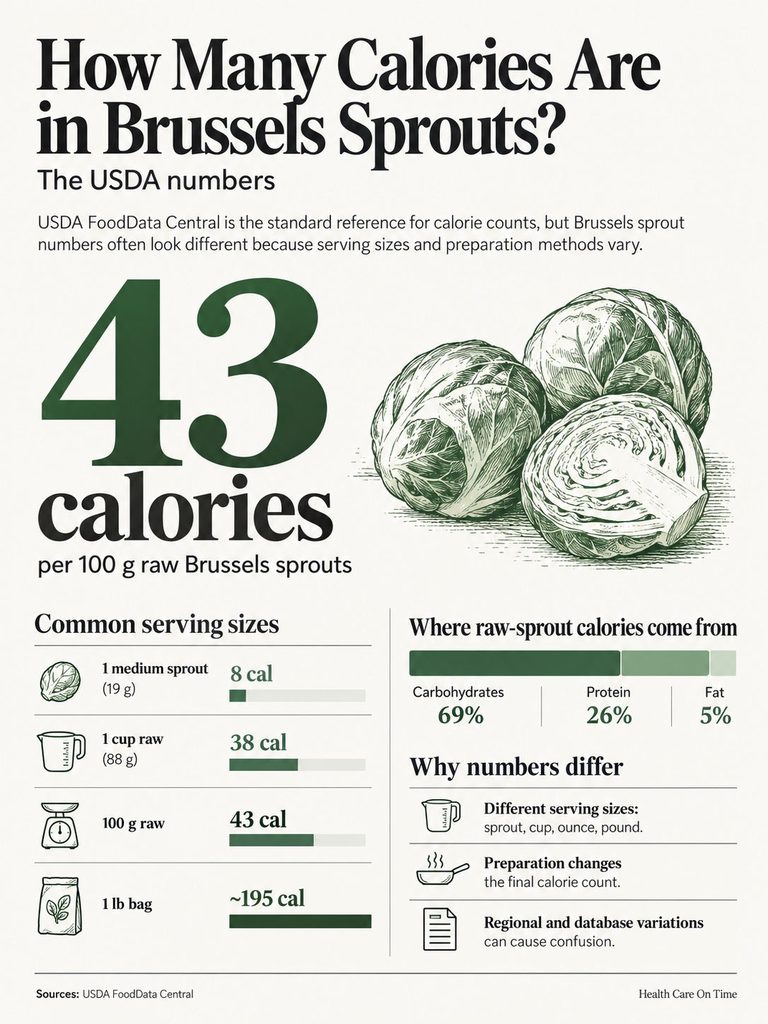
Quick Answer: Raw Brussels sprouts have 43 calories per 100 grams, about 38 calories per cup (88 g), and roughly 8 calories per sprout, according to USDA FoodData Central. One cup of boiled sprouts has about 56 calories, and one cup of frozen sprouts, boiled, has about 65. Each tablespoon of olive oil used for roasting adds about 119 calories.
At a Glance
- Raw: 43 calories per 100 g, 38 per cup, about 8 per sprout, about 195 per pound.
- Boiled: about 56 calories per full cup; many websites show 28 because they list a half cup.
- Frozen and boiled: about 65 calories per cup, with more fiber and protein because the cup holds more sprouts.
- Oil is the real calorie driver; 1 tablespoon adds about 119 calories.
- One raw cup gives about 130% of your daily vitamin K and 83% of your daily vitamin C.
- Net carbs are about 4.5 g per raw cup, so sprouts fit most keto and low-carb plans.
How Many Calories Are in Brussels Sprouts? The USDA Numbers
The most trusted calorie data in the US comes from USDA FoodData Central, the federal food composition database. Dietitians, nutrition apps, and food label makers all build on it.
Our medical review team checked every figure below against USDA entries for raw, boiled, and frozen Brussels sprouts. Here’s what the data shows.
Calories per 100 Grams, Cup, Ounce, and Single Sprout
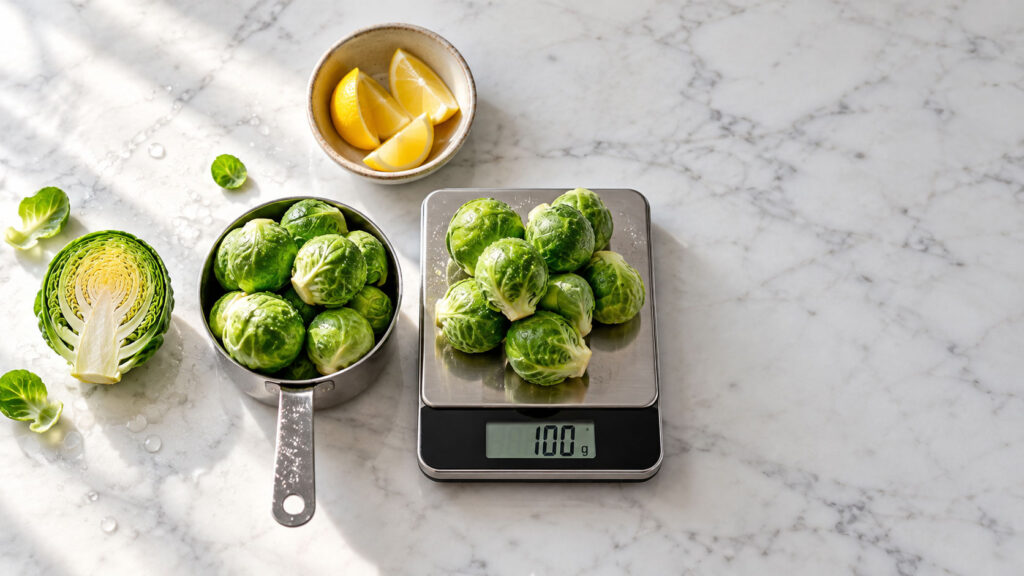
Raw Brussels sprouts contain 43 calories per 100 grams (about 3.5 ounces). That’s the baseline number most databases start from.
A standard US cup of whole raw sprouts weighs about 88 grams and has about 38 calories. A single medium sprout weighs roughly 19 grams, so it lands at about 8 calories.
If you weigh food in ounces, raw sprouts come to about 12 calories per ounce. A 1-pound bag from the grocery store holds roughly 195 calories in total, before any oil or seasoning.
Brussels Sprouts Calories by Form and Serving
| Form | Serving (US / grams) | Calories | Total Carbs | Fiber | Protein |
| Raw, 1 medium sprout | 1 sprout / 19 g | 8 | 1.7 g | 0.7 g | 0.6 g |
| Raw, whole | 1 cup / 88 g | 38 | 7.9 g | 3.3 g | 3.0 g |
| Raw | 3.5 oz / 100 g | 43 | 9.0 g | 3.8 g | 3.4 g |
| Raw | 1 lb / 454 g | 195 | 40.6 g | 17.3 g | 15.3 g |
| Boiled, drained, no salt | ½ cup / 78 g | 28 | 5.5 g | 2.0 g | 2.0 g |
| Boiled, drained, no salt | 1 cup / 156 g | 56 | 11.1 g | 4.1 g | 4.0 g |
| Frozen, boiled, drained | 1 cup / 155 g | 65 | 12.9 g | 6.4 g | 5.6 g |
| Roasted, typical recipe (1 tbsp oil per lb) | 1 cup raw / 88 g + oil | 62 | 7.9 g | 3.3 g | 3.0 g |
| Roasted, heavy oil (1 tbsp per cup) | 1 cup raw / 88 g + oil | 157 | 7.9 g | 3.3 g | 3.0 g |
Source: USDA FoodData Central. Roasted figures combine USDA raw sprouts with USDA olive oil (119 calories per tablespoon).
Why Different Websites Show Different Numbers
If you’ve searched this before, you’ve probably seen 28, 38, 43, 56, and 65 calories all quoted as “the” answer. They’re all correct; they simply measure different things.
The biggest source of confusion is serving size. Several popular health sites list 28 calories for cooked sprouts, but that USDA figure is for a half cup (78 g). A full cup of boiled sprouts is about 56 calories.
The second source is weight. Cooked sprouts soften and pack tighter, so a cup of cooked sprouts holds nearly twice the weight of a cup of raw ones. More weight in the cup means more calories in the cup, even though boiling adds nothing.
The third source is region. Some calorie databases mix in UK supermarket labels, which use different testing methods and count fiber differently. For US readers, USDA data is the reference point that matches American Nutrition Facts labels.
Where the Calories Come From
In raw Brussels sprouts, about 69% of calories come from carbohydrates, 26% from protein, and only 5% from fat.
That protein share is unusually high for a vegetable. It’s one reason sprouts feel more filling than a salad with the same calorie count.
Brussels Sprouts Nutrition Facts Beyond Calories
Calories tell only part of the story. Per calorie, Brussels sprouts deliver one of the densest vitamin and fiber packages in the produce aisle.
Carbs, Net Carbs, and Fiber
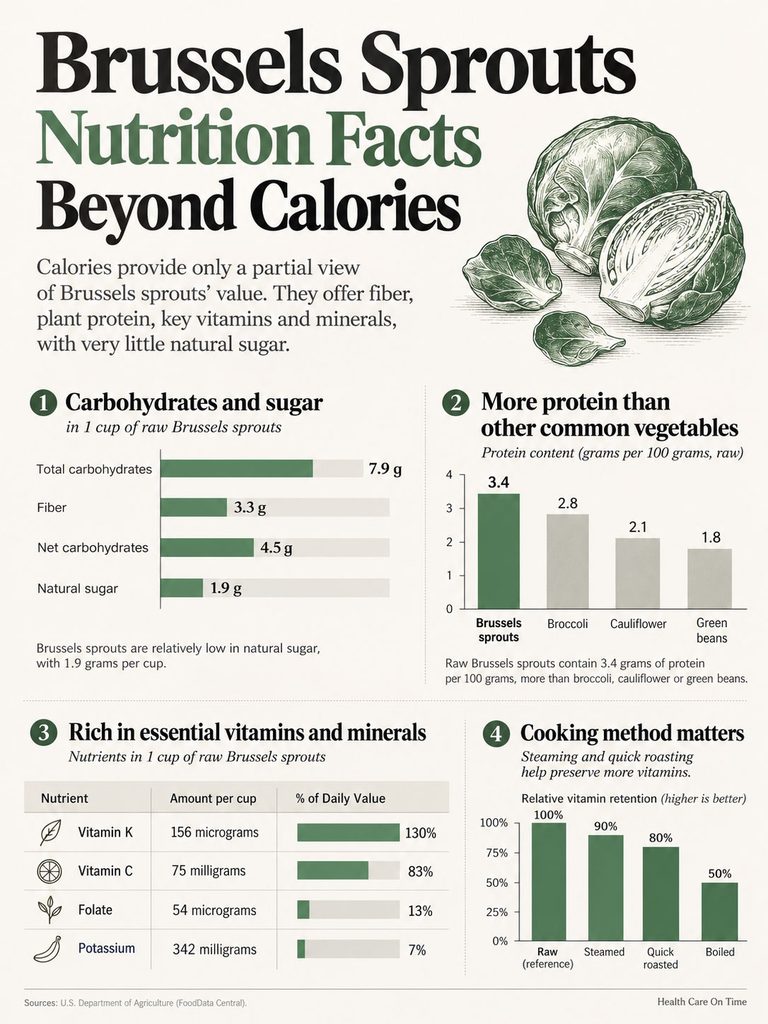
One cup of raw sprouts has 7.9 grams of total carbs and 3.3 grams of fiber. Subtract fiber from carbs and you get about 4.5 grams of net carbs.
Natural sugar is low, around 1.9 grams per cup. There’s no added sugar unless a recipe brings it in through honey, maple syrup, or balsamic glaze.
The FDA sets the Daily Value for fiber at 28 grams. One cup of boiled sprouts covers about 15% of that, and a cup of frozen sprouts covers about 23%.
Protein: High for a Vegetable
Raw sprouts deliver 3.4 grams of protein per 100 grams. That’s more than broccoli (2.8 g), cauliflower (1.9 g), or green beans (1.8 g) by the same weight.
Sprouts won’t replace chicken or beans. But in a plant-forward meal, a big side adds a meaningful protein bump for very few calories.
Vitamins and Minerals That Stand Out
Vitamin K
One cup of raw sprouts provides about 156 micrograms of vitamin K. The Daily Value is 120 micrograms, so that’s roughly 130% DV in a single cup.
According to the NIH Office of Dietary Supplements, vitamin K helps your blood clot normally and supports healthy bones. This same vitamin is why people on certain blood thinners need to pay attention, covered further below.
Vitamin C
A raw cup gives about 75 milligrams of vitamin C, which is 83% of the 90 mg Daily Value. By weight, raw sprouts carry more vitamin C than oranges.
Vitamin C drops with long boiling, since it leaks into the cooking water. The NIH vitamin C fact sheet notes that cooking with less water and shorter heat time keeps more of the vitamin. Steaming, quick roasting, and microwaving are your best bets.
Folate and Potassium
One cup raw supplies about 54 micrograms of folate (about 13% DV) and 342 milligrams of potassium (about 7% DV).
Folate supports healthy cell growth and matters especially before and during pregnancy. Potassium helps offset the effect of sodium on blood pressure.
How Cooking Changes Brussels Sprouts Calories
Here’s where most people get surprised. The sprout itself barely changes in calories when you cook it. What changes is everything you add.
Patients who book nutrition-related lab work through HealthCareOnTime often ask why their “healthy veggie side” isn’t moving their numbers. When our team looks closer, the answer is usually the oil and glaze, not the vegetable.
Boiled and Steamed
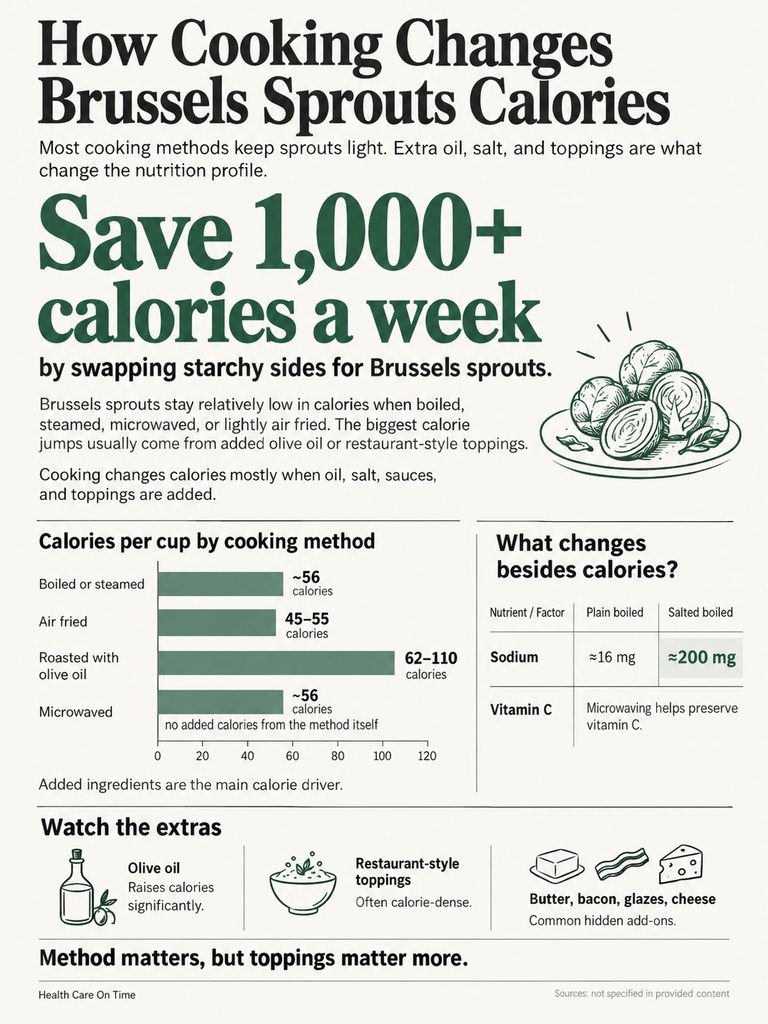
Boiling and steaming add zero calories. One cup of boiled sprouts lands at about 56 calories, simply because the cup holds more sprout by weight.
Steamed sprouts come out nearly identical. Steaming also keeps more vitamin C and more of the natural compounds that give sprouts their slightly bitter edge.
Sodium: The Hidden Cost of Salted Water
Boiling sprouts in salted water changes one number sharply: sodium. USDA data shows a cup of unsalted boiled sprouts has about 16 milligrams of sodium, while the salted version jumps to about 200 milligrams.
That’s still modest, but it adds up across a full meal. If you’re watching blood pressure, salt at the table where you can see and control the amount.
Roasted With Olive Oil
Roasting is the most popular way Americans cook Brussels sprouts, and it’s where calories climb fastest. Olive oil has about 119 calories per tablespoon, and every drop on the tray ends up in your serving.
Here’s the simple math for one cup of raw sprouts:
- 1 teaspoon of olive oil: 38 + 40 = about 78 calories
- 1 tablespoon of olive oil: 38 + 119 = about 157 calories
- 2 tablespoons of olive oil: 38 + 238 = about 276 calories
Most home recipes call for 1 to 3 tablespoons of oil per pound of sprouts. A pound is about 5 cups raw, so a typical serving lands somewhere between 62 and 110 calories per cup. That’s very reasonable; it only gets out of hand when oil is poured without measuring.
Air Fried
An air fryer needs far less oil to get crispy edges. Many cooks use 1 to 2 teaspoons of oil for a full pound of sprouts, or a few sprays from an oil mister.
That keeps air-fried sprouts at roughly 45 to 55 calories per cup, close to plain sprouts. For anyone tracking calories, the air fryer is the clear winner for crunch.
Microwaved
Microwaving a cup of sprouts with a tablespoon of water for 3 to 4 minutes adds no calories and keeps vitamin C losses low. It’s the fastest weeknight option, and the texture improves with a quick finish in a hot skillet.
Restaurant-Style Sprouts
Restaurant sides often combine several calorie add-ons. Here’s what each common topping adds:
- 1 tablespoon of butter: about 102 calories
- 1 slice of cooked bacon: about 43 calories
- 1 tablespoon of balsamic glaze: about 40 calories
- 1 tablespoon of honey: about 64 calories
- 1 tablespoon of grated parmesan: about 22 calories
- Deep frying: sprouts soak up oil and can pass 250 calories per cup
Stack a few together and a side of sprouts can rival a small order of fries. When eating out, ask for the glaze on the side or choose roasted over fried.
Brussels Sprouts vs Other Popular Side Dishes
For perspective, here’s how a cup of plain roasted sprouts (typical recipe, about 62 calories) compares with other common American sides, using USDA averages:
- Mashed potatoes with milk and butter, 1 cup: about 237 calories
- Macaroni and cheese, 1 cup: about 300 to 400 calories
- Small order of french fries: about 230 calories
- Corn on the cob with butter, 1 ear: about 155 calories
- Steamed broccoli, 1 cup: about 55 calories
Swapping one starchy side for sprouts a few nights a week can save 1,000 calories or more over a week without changing anything else.
Fresh vs Frozen Brussels Sprouts: Which Is Best?
Both fresh and frozen sprouts are excellent choices. The differences come down to convenience, texture, and how the numbers look per cup.
Why Frozen Shows More Calories per Cup
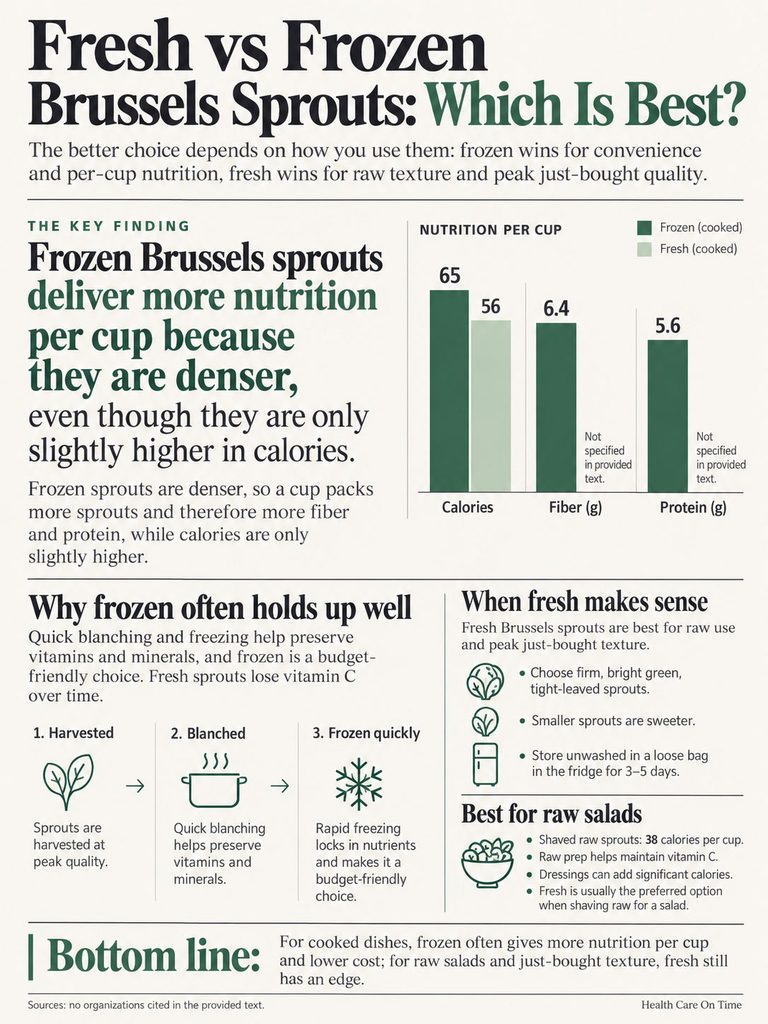
USDA lists one cup of frozen sprouts, boiled and drained, at about 65 calories. Fresh boiled sprouts are about 56 per cup.
That gap isn’t because frozen sprouts are richer. Frozen sprouts are usually smaller and pack more tightly, so a cup holds more food. Per 100 grams, frozen cooked sprouts are about 42 calories versus 36 for fresh boiled.
The upside: that same cup of frozen sprouts also delivers about 6.4 grams of fiber and 5.6 grams of protein, more than a cup of fresh.
Nutrient Retention in Frozen Sprouts
Frozen vegetables are usually blanched and frozen within hours of harvest. That locks in most vitamins and minerals.
Fresh sprouts sitting in a fridge for a week slowly lose vitamin C. Frozen is a smart, budget-friendly choice, especially outside the fall and winter peak season.
How to Pick and Store Fresh Sprouts
Choose firm, bright green sprouts with tight leaves and no yellow spots. Smaller sprouts, about 1 inch across, tend to taste sweeter and cook more evenly.
Store them unwashed in a loose plastic bag in your fridge’s crisper drawer. They keep best for 3 to 5 days, and flavor turns stronger and more sulfur-like the longer they sit.
Sprouts on the stalk, common at US farmers’ markets from September through February, often stay fresh a few days longer. Trim the stem end and peel off any loose outer leaves right before cooking.
Shaved and Raw
Shaved raw sprouts in salads keep every bit of their vitamin C. Calories stay at about 38 per cup, but watch the dressing, since 2 tablespoons of a creamy dressing can add 120 to 150 calories.
Are Brussels Sprouts Good for Weight Loss?
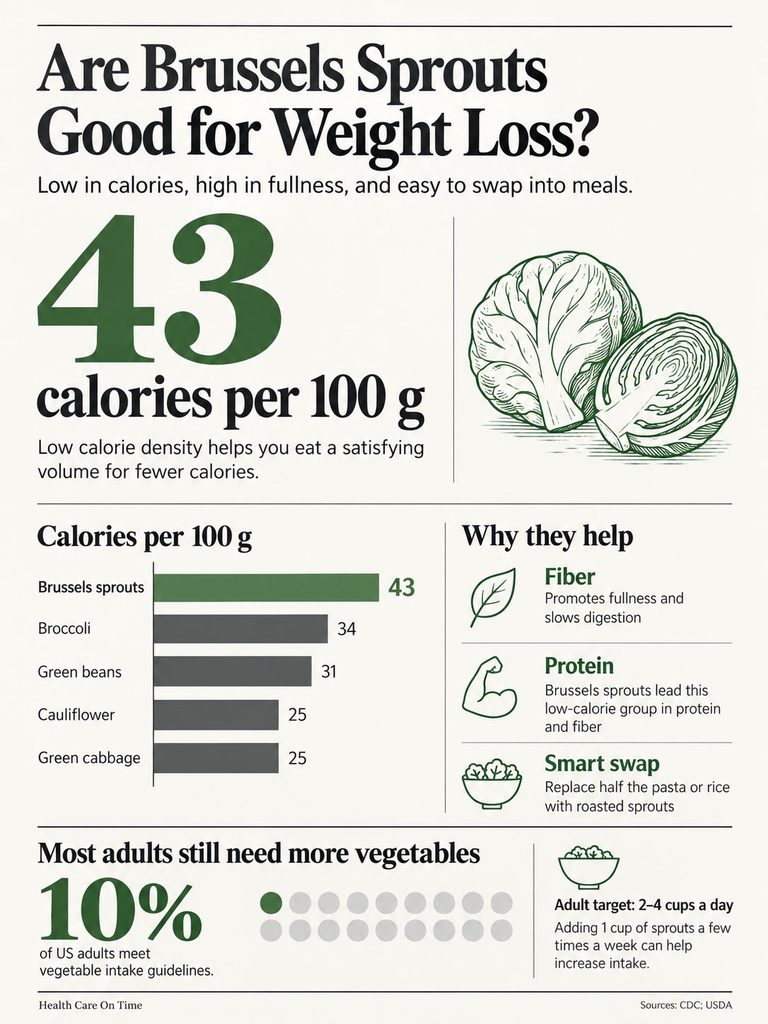
Yes. Brussels sprouts are one of the more useful vegetables for weight management, mainly because they fill you up for very few calories.
Calorie Density and Fullness
Calorie density means how many calories a food packs per bite. At 43 calories per 100 grams, sprouts sit in the lowest tier, alongside leafy greens and broccoli.
Their fiber and protein slow digestion and help you feel satisfied longer. The Mayo Clinic notes that high-fiber foods tend to be more filling and are linked with healthier body weight.
A swap our nutrition reviewers suggest often: replace half the pasta or rice on a plate with roasted sprouts. Portion size stays the same, and calories drop sharply.
How Sprouts Compare to Other Low-Calorie Vegetables
Per 100 grams raw, USDA data puts Brussels sprouts at 43 calories, broccoli at 34, green beans at 31, cauliflower at 25, and green cabbage at 25.
Sprouts are slightly higher in calories than these, but they also lead the group in protein and fiber. For fullness, that trade-off works in their favor.
US Vegetable Intake and Brussels Sprouts Facts
| Stat | Figure | Source |
| US adults meeting vegetable intake guidance | About 10% | CDC MMWR |
| Daily vegetable target for most adults | 2 to 4 cups | USDA MyPlate |
| Weekly “other vegetables” target (2,000-calorie diet) | 4 cups | Dietary Guidelines for Americans |
| Daily Value for vitamin K | 120 mcg | FDA |
| Daily Value for vitamin C | 90 mg | FDA |
| Calories per 100 g raw: sprouts vs broccoli vs cauliflower | 43 / 34 / 25 | USDA FoodData Central |
That first stat stands out. Only about 1 in 10 American adults eats enough vegetables. Adding a cup of sprouts to dinner a few nights a week is a small, practical fix.
Health Benefits Backed by Research
Beyond the numbers, Brussels sprouts bring real health value. Here’s what the science supports, and where it’s still uncertain.
Fiber and Gut Health
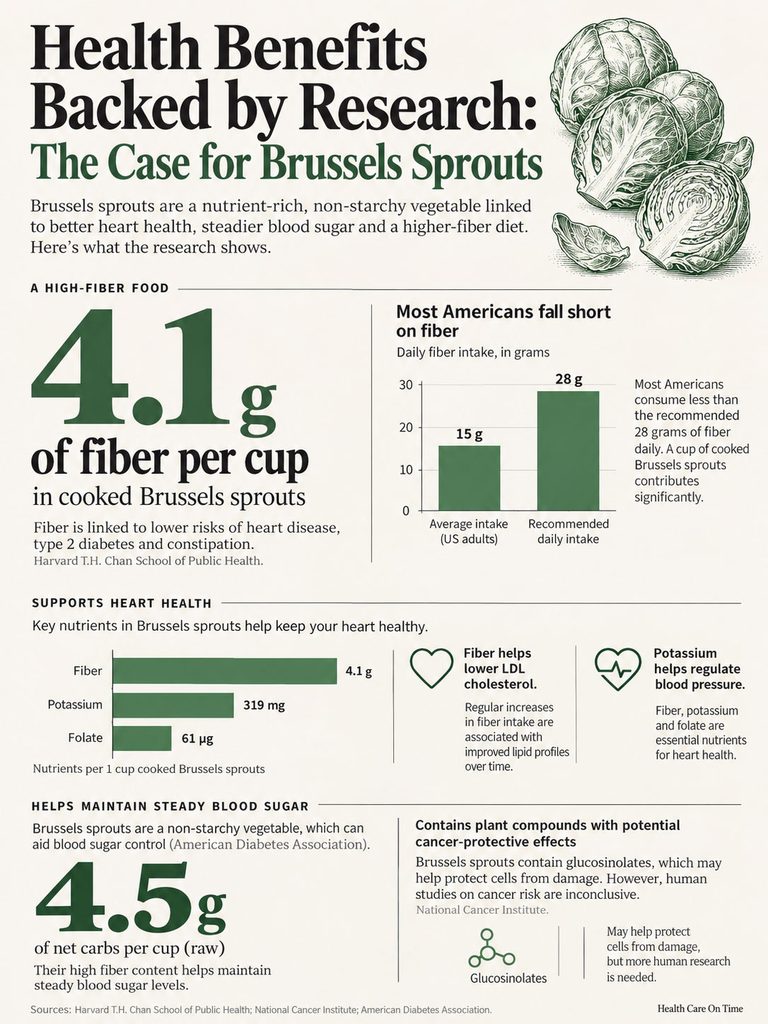
Fiber feeds the helpful bacteria in your gut and keeps digestion regular. The Harvard T.H. Chan School of Public Health links higher fiber intake with lower risk of heart disease, type 2 diabetes, and constipation.
Most Americans eat well below the 28-gram target. A cup of cooked sprouts is an easy step closer.
Cruciferous Compounds
Brussels sprouts belong to the cruciferous family, along with broccoli, cabbage, and kale. They contain glucosinolates, natural compounds that break down into substances like sulforaphane and indole-3-carbinol when you chop or chew them.
Lab and animal studies suggest these compounds may help protect cells from damage. The National Cancer Institute notes, though, that human studies on cancer risk are mixed. Eat sprouts for overall health, not as a cancer treatment.
Blood Sugar Control
The American Diabetes Association classifies Brussels sprouts as a non-starchy vegetable, the group it encourages people with diabetes to fill half their plate with.
With about 4.5 grams of net carbs per raw cup and steady fiber, sprouts cause only a small rise in blood sugar. In A1C and glucose panels processed through our lab partners, patients who build meals around non-starchy vegetables often report easier blood sugar control, alongside medication and activity.
Heart Health
Potassium, fiber, and folate all play a part in heart health. Fiber helps lower LDL cholesterol, and potassium helps balance sodium’s effect on blood pressure.
No single vegetable fixes cholesterol. But in lipid panels reviewed across our diagnostic network, steady gains in fiber intake tend to show up as gradual improvement over several months.
Side Effects and Who Should Be Careful
Brussels sprouts are safe for nearly everyone. A few groups should keep these points in mind.
Gas and Bloating
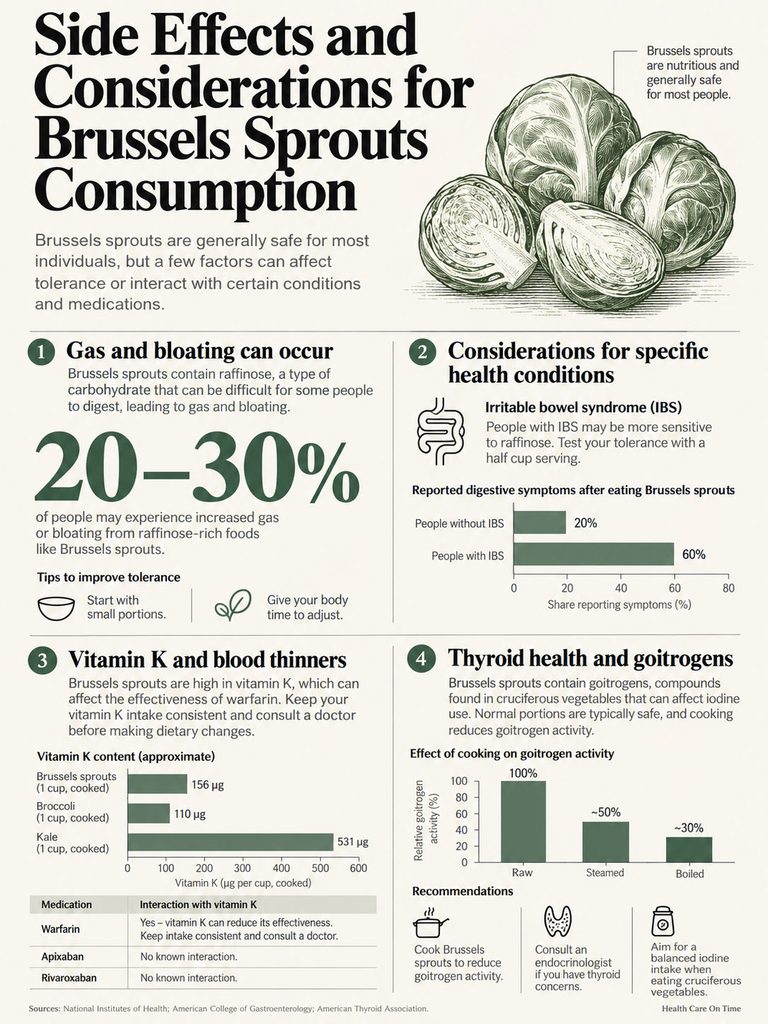
Sprouts contain raffinose, a sugar your small intestine can’t fully digest. Gut bacteria break it down instead, which produces gas.
The National Institute of Diabetes and Digestive and Kidney Diseases lists Brussels sprouts among common gas-causing foods. Start with small portions, cook them well, and increase slowly to let your gut adjust.
People with IBS may tolerate a few sprouts but react to larger servings. A half cup is a reasonable test portion.
Blood Thinners and Vitamin K
If you take warfarin (Coumadin), vitamin K matters. Warfarin works by blocking vitamin K, so big swings in how much you eat can change how well the drug works.
You don’t have to avoid sprouts. The NIH advises keeping vitamin K intake consistent from week to week. Talk to your doctor before making big changes, and keep your scheduled INR blood tests.
Newer blood thinners like apixaban (Eliquis) and rivaroxaban (Xarelto) don’t interact with vitamin K the same way. Confirm with your prescriber which applies to you.
Thyroid Concerns
Cruciferous vegetables contain goitrogens, compounds that can interfere with iodine use in very large amounts. For most people eating normal portions with enough iodine in their diet, this isn’t a concern.
Cooking reduces goitrogen activity. If you have a thyroid condition, normal servings of cooked sprouts are generally fine, but check with your endocrinologist before eating large raw amounts daily.
How to Eat Brussels Sprouts Without Adding Hundreds of Calories
You can keep sprouts crispy and flavorful without the calorie spike. Many patients tell our team the right method made them enjoy sprouts for the first time.
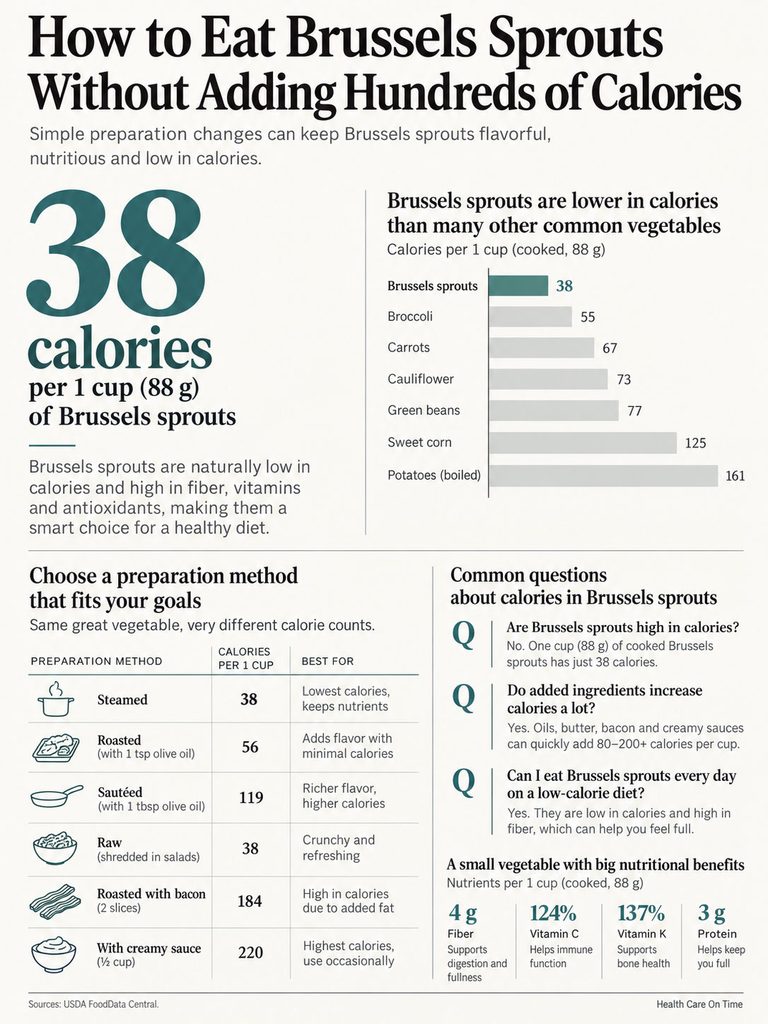
- Measure the oil. Use 1 tablespoon per pound of sprouts, not a free pour.
- Use an oil spray or mister. A light coating gives browning with a fraction of the calories.
- Roast hot. Set the oven to 425°F, cut sprouts in half, and place them flat side down. High heat brings out natural sweetness, so you need less glaze.
- Finish with acid, not sugar. A squeeze of lemon or a splash of plain balsamic vinegar (about 14 calories per tablespoon) beats honey glaze.
- Add flavor that’s light. Garlic, chili flakes, smoked paprika, and black pepper add almost no calories.
- Use bacon as a garnish. One crumbled slice over a full tray adds smoky flavor for about 43 calories total.
- Try the air fryer. At 375°F for 12 to 15 minutes, you’ll get crisp edges with just a teaspoon or two of oil.
If Your Goal Is X, Do Y
| Your Goal | Best Prep Method | Approx. Calories per Cup |
| Weight loss | Steamed or air fried with oil spray | 40 to 60 |
| Keto or low carb | Roasted with 1 to 2 tbsp olive oil per pound, no glaze | 62 to 90 |
| Low sodium diet | Steamed, seasoned with lemon and garlic, no salted water | 38 to 56 |
| Taking warfarin | Any method, similar portion on a regular schedule | Varies by prep |
| Sensitive gut or IBS | Well cooked, ½ cup portion, increase slowly | 28 |
| High-protein meal prep | Frozen sprouts, steamed, paired with chicken or beans | 65 |
Frequently Asked Questions
How many calories are in 10 Brussels sprouts?
Ten medium raw Brussels sprouts weigh about 190 grams and contain roughly 80 calories, based on USDA data of 43 calories per 100 grams. Very large sprouts can push that closer to 100. Cooking adds no calories on its own, but oil, butter, or glaze will raise the total quickly.
How many calories are in one Brussels sprout?
A single medium Brussels sprout weighs about 19 grams and has around 8 calories. Small sprouts may be closer to 5 calories, and extra-large ones can reach 12. That makes them easy to count if you track food by piece rather than by cup or gram weight.
Do roasted Brussels sprouts have more calories than raw?
The sprouts don’t gain calories when roasted; the oil does. One cup of raw sprouts tossed with a full tablespoon of olive oil rises from 38 to about 157 calories. Using one tablespoon per pound, as most recipes do, keeps each cup closer to 62 calories.
How many calories are in air fried Brussels sprouts?
Air-fried Brussels sprouts usually contain about 45 to 55 calories per cup when cooked with a light oil spray or one to two teaspoons of oil per pound. That’s barely above plain sprouts. Air frying gives crispy edges with far less fat than oven roasting or pan frying.
Are Brussels sprouts keto friendly?
Yes. One cup of raw Brussels sprouts has about 7.9 grams of total carbs and 3.3 grams of fiber, leaving roughly 4.5 grams of net carbs. Most keto plans allow 20 to 50 grams of net carbs daily, so a cup fits easily. Skip honey and sugary glazes.
How many net carbs are in Brussels sprouts?
Raw Brussels sprouts have about 5.2 grams of net carbs per 100 grams and about 4.5 grams per cup. Boiled sprouts have about 7 grams of net carbs per full cup, because a cooked cup holds more sprout by weight. Net carbs equal total carbs minus dietary fiber.
Are frozen Brussels sprouts as healthy as fresh?
Yes. Frozen Brussels sprouts are blanched and frozen soon after harvest, which preserves most vitamins and minerals. A cup of frozen, boiled sprouts has about 65 calories, 6.4 grams of fiber, and 5.6 grams of protein. They’re often cheaper than fresh and available year-round.
Can you eat Brussels sprouts every day?
Most healthy adults can eat Brussels sprouts daily as part of a varied diet. Start with smaller portions if you notice gas or bloating. If you take warfarin, daily sprouts are usually fine as long as your vitamin K intake stays steady and your doctor knows about your diet.
Why do Brussels sprouts cause gas?
Brussels sprouts contain raffinose, a natural sugar the small intestine can’t fully digest. Bacteria in the large intestine ferment it, which produces gas. Their high fiber adds to the effect. Cooking sprouts well, eating smaller portions, and increasing intake slowly helps most people reduce bloating.
Can you eat Brussels sprouts if you take warfarin?
Yes, in most cases. The key is consistency, not avoidance. Warfarin works against vitamin K, so sudden large changes in intake can affect your INR. Eat similar amounts of vitamin K foods each week, keep INR tests on schedule, and tell your doctor before major diet changes.
Are Brussels sprouts better than broccoli for weight loss?
Both are excellent. Broccoli has slightly fewer calories (34 per 100 grams versus 43), but Brussels sprouts offer more protein and fiber, which may keep you fuller. The best choice is the one you’ll eat regularly, cooked with minimal added oil and no sugary toppings.
How many calories are in a pound of Brussels sprouts?
A 1-pound bag of raw Brussels sprouts (454 grams) contains about 195 calories, 17 grams of fiber, and 15 grams of protein, based on USDA data. Roasting the whole pound with one tablespoon of olive oil brings the total to roughly 314 calories, or about 62 per cup.
Disclaimer: This article is for general educational purposes and is not a substitute for professional medical advice. Nutrition values are based on USDA FoodData Central and may vary by sprout size, variety, and preparation. If you take blood thinners, have diabetes or a thyroid condition, or follow a medical diet, consult your doctor or a registered dietitian before changing your eating habits.
References
- USDA FoodData Central: Brussels sprouts, raw, boiled, and frozen
- NIH Office of Dietary Supplements: Vitamin K Fact Sheet
- NIH Office of Dietary Supplements: Vitamin C Fact Sheet
- FDA: Daily Value on the Nutrition and Supplement Facts Labels
- CDC MMWR: Adults Meeting Fruit and Vegetable Intake Recommendations
- USDA MyPlate: Vegetables
- Dietary Guidelines for Americans
- American Diabetes Association: Non-Starchy Vegetables
- Harvard T.H. Chan School of Public Health: Fiber
- Mayo Clinic: Dietary Fiber, Essential for a Healthy Diet
- National Cancer Institute: Cruciferous Vegetables and Cancer Prevention
- NIDDK: Eating, Diet, and Nutrition for Gas in the Digestive Tract