The Brussels sprouts on your plate today are not the ones your grandparents pushed around their dinner plates. In the 1990s, Dutch plant scientists found the two compounds that made sprouts so bitter, and seed companies bred most of them out. That’s a big part of why roasted sprouts went from punchline to restaurant favorite.
Table of Contents
Here’s the twist most articles skip. Those bitter compounds belong to the same chemical family, glucosinolates, that gives Brussels sprouts their health reputation. So what do the studies actually show, and how much of it holds up?
Quick Answer: One cooked cup of Brussels sprouts gives you more than a full day’s vitamin K and vitamin C, about 4 grams of fiber, and some of the highest glucosinolate levels of any common vegetable. Human studies link them to lower DNA damage markers, less arterial calcium, and lower risk of some cancers. Most of that evidence is observational or small. Steam or microwave them to keep the most benefit.
At a Glance
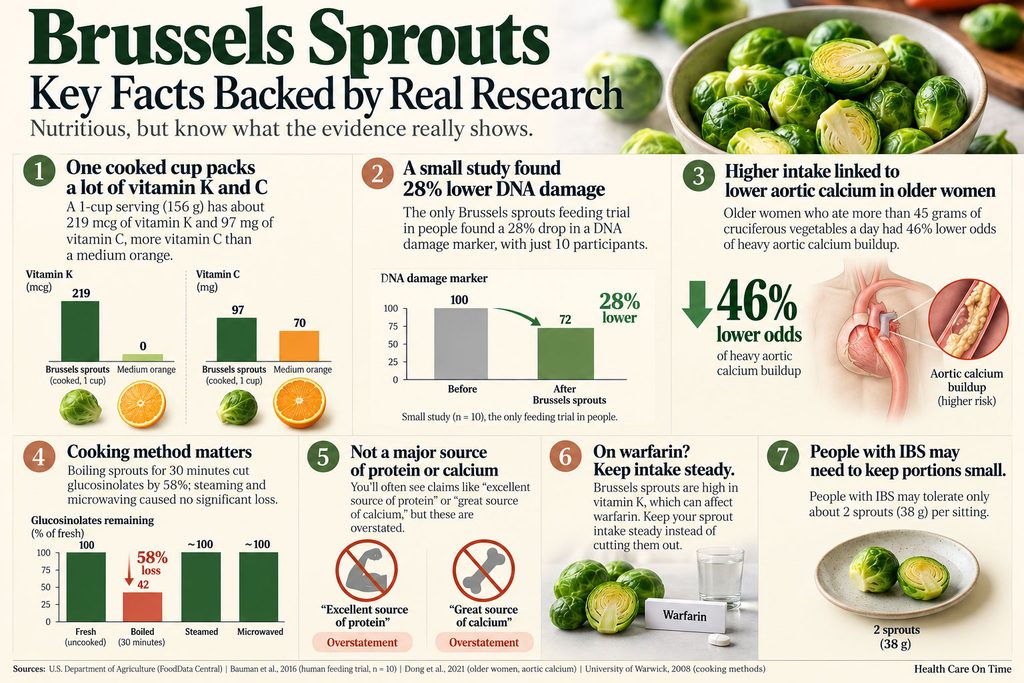
- One cooked cup (156 g) has about 219 mcg of vitamin K and 97 mg of vitamin C, more vitamin C than a medium orange.
- The only Brussels sprouts feeding trial in people found a 28% drop in a DNA damage marker, with just 10 participants.
- Older women eating more than 45 grams of cruciferous vegetables a day had 46% lower odds of heavy aortic calcium buildup.
- Boiling sprouts for 30 minutes cut glucosinolates by 58%; steaming and microwaving caused no significant loss.
- “Excellent source of protein” and “great source of calcium” are overstatements you’ll see elsewhere.
- On warfarin? Keep your sprout intake steady instead of cutting them out.
- People with IBS may tolerate only about 2 sprouts (38 g) per sitting.
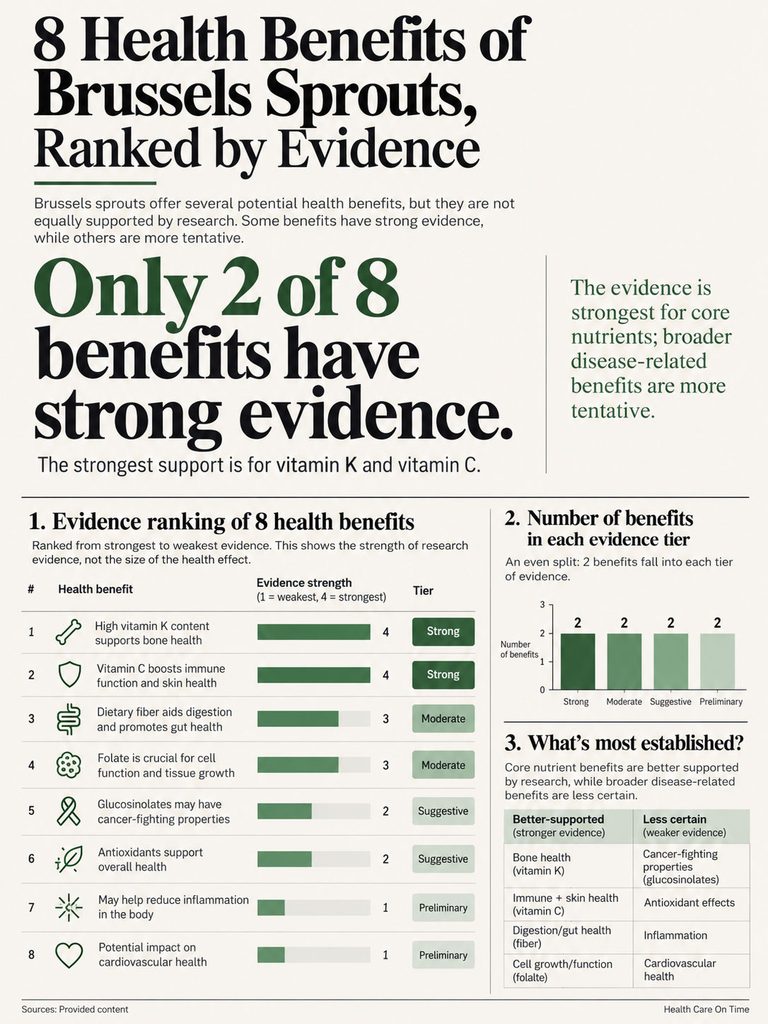
8 Health Benefits of Brussels Sprouts, Ranked by Evidence
The main health benefits of Brussels sprouts come from vitamin K, vitamin C, fiber, folate, and glucosinolates. Ranked from strongest to most preliminary human evidence, they:
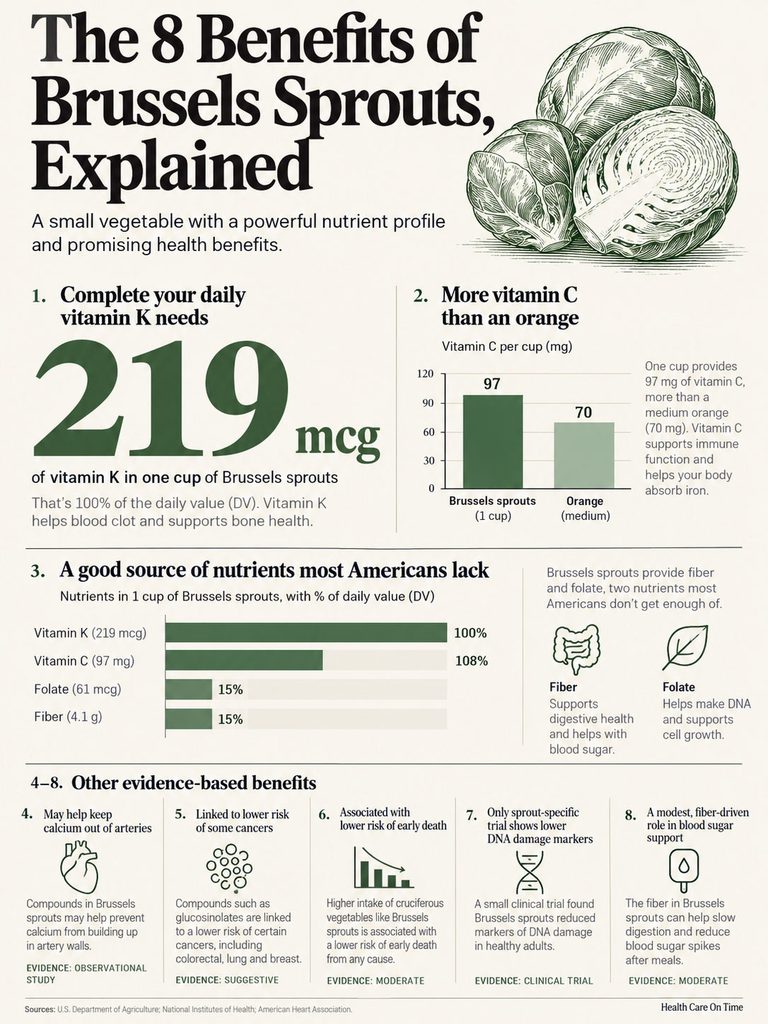
- Cover your full daily vitamin K needs in one cup
- Deliver more vitamin C per cup than a medium orange
- Supply fiber and folate most Americans fall short on
- Are linked to less calcium buildup in your arteries
- Are linked to lower risk of some cancers
- Are linked to lower risk of early death in large studies
- Lowered a DNA damage marker in a small human trial
- May play a modest, fiber-driven role in blood sugar control
How We Graded the Evidence
Our medical reviewers sorted each claim into four tiers. Strong means the nutrient content is measured directly or the effect is backed by large meta-analyses. Moderate means consistent results from big observational studies. Suggestive means mixed or lower-quality pooled data. Preliminary means small or early trials that haven’t been repeated at scale.
What Makes Brussels Sprouts Different From Other Vegetables
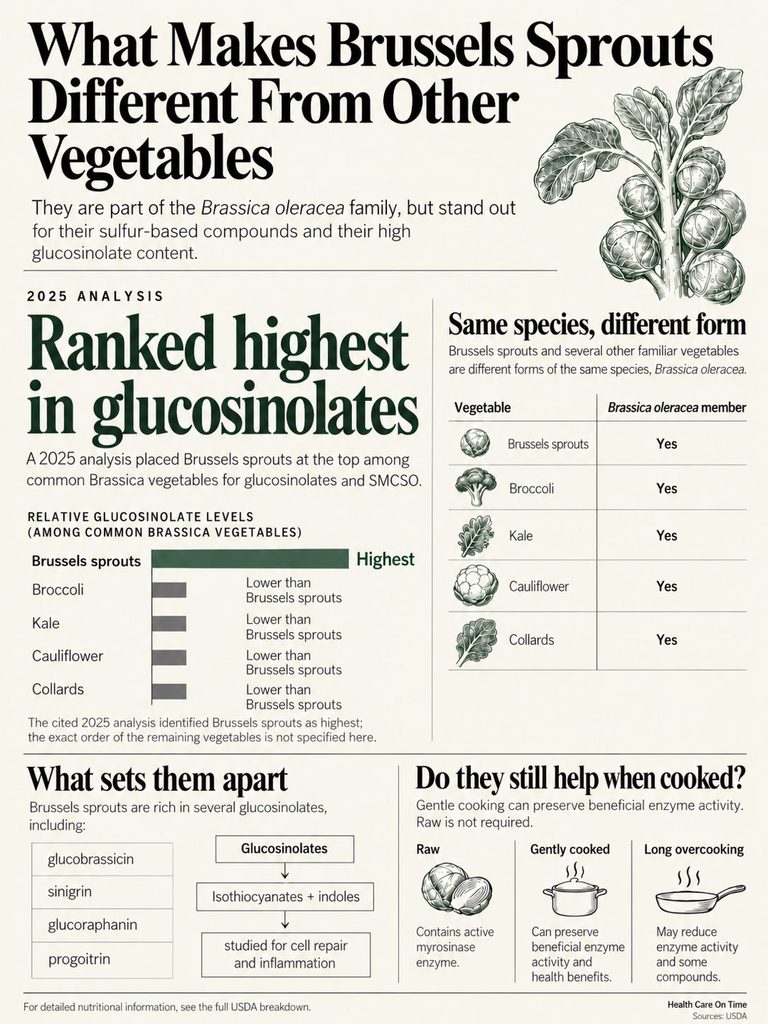
Brussels sprouts are tiny cabbages from the same plant species as broccoli, kale, cauliflower, and collards (Brassica oleracea). Together, these make up most of the cruciferous vegetables Americans eat. What sets the group apart is a set of sulfur compounds called glucosinolates.
The Glucosinolate Family
Brussels sprouts carry several kinds: glucobrassicin, sinigrin, glucoraphanin, and progoitrin. On their own, these compounds do very little. The action starts when they break down into isothiocyanates and indoles, which researchers study for effects on cell repair and inflammation.
Highest Levels Among Common Crucifers
A 2025 analysis from Edith Cowan University measured seven popular Brassica vegetables. Brussels sprouts ranked first for total glucosinolates and first for S-methyl-L-cysteine sulfoxide (SMCSO), a sulfur compound under study for heart and metabolic health. They beat broccoli, kale, and cabbage on both counts.
That doesn’t make sprouts “better” than broccoli in every way. It does mean that, gram for gram, they’re one of the most concentrated sources of the compounds the research focuses on.
The Myrosinase Switch
Glucosinolates need an enzyme called myrosinase to become active. Myrosinase sits in separate plant cells and only meets glucosinolates when a sprout is cut, chewed, or crushed. Heat destroys the enzyme, though your gut bacteria can still handle some of the conversion.
Patients commonly ask us whether this means sprouts must be eaten raw. Not quite. As the cooking section shows, gentle cooking keeps most of the benefit.
For the full calorie and macro breakdown by serving size, see How Many Calories in Brussels Sprouts? Full USDA Breakdown.
The 8 Benefits, Explained
Before the details, here’s the whole picture in one place: what each benefit rests on and how strong that evidence really is.
| Benefit | Key compound | Best human evidence | Study type and size | Evidence grade |
| Daily vitamin K coverage | Vitamin K1 | USDA nutrient data vs NIH intake targets | Nutrient analysis | Strong |
| Vitamin C supply | Vitamin C | USDA nutrient data vs NIH RDA | Nutrient analysis | Strong |
| Fiber and folate | Fiber, folate | Fiber meta-analyses; folate and neural tube data | Large meta-analyses (general) | Strong for nutrients, indirect for sprouts |
| Less arterial calcium | Vitamin K1 (proposed) | Blekkenhorst, Br J Nutr 2020 | Cross-sectional, 684 women | Moderate, cannot prove cause |
| Lower risk of some cancers | Glucosinolates | Umbrella review, Food and Function 2022 | 41 meta-analyses, 303 studies | Suggestive |
| Lower risk of early death | Whole cruciferous group | Shanghai cohorts; Aune 2017 meta-analysis | Cohorts, 134,796+ adults | Moderate, observational |
| Lower DNA damage marker | Glucosinolates (sinigrin proposed) | Verhagen, Carcinogenesis 1995 | Controlled trial, 10 men | Preliminary |
| Blood sugar support | Fiber | Halvorsen 2021 meta-analysis | Cohort meta-analysis | Weak to modest |
1. Covers Your Full Daily Vitamin K Needs in One Cup
Evidence grade: Strong (nutrient content).
According to USDA FoodData Central record 169971, one cup of boiled Brussels sprouts (156 g) provides about 219 mcg of vitamin K1. The NIH Office of Dietary Supplements sets adequate intake at 90 mcg for women and 120 mcg for men. One cup covers both, nearly twice over.
Vitamin K helps your blood clot normally. It also activates proteins that bind calcium in bone and help keep it out of soft tissue such as artery walls.
Vitamin K1 and Bone Health
Observational studies link higher vitamin K intake with lower hip fracture risk, but trials of vitamin K supplements for bone density have been mixed. The fair summary: your bones need vitamin K, and Brussels sprouts are one of the easiest ways to get it. Don’t expect sprouts alone to reverse bone loss.
2. More Vitamin C Per Cup Than a Medium Orange
Evidence grade: Strong (nutrient content).
That same cooked cup delivers about 97 mg of vitamin C, roughly 108% of the Daily Value. A medium orange gives about 70 mg. The NIH RDA is 75 mg for women and 90 mg for men, plus an extra 35 mg if you smoke.
Vitamin C supports immune cells, helps you build collagen for skin and wound healing, and boosts absorption of plant-based (non-heme) iron. Pairing sprouts with beans or lentils is a simple way to get more iron out of a meatless meal.
3. Fiber and Folate Most Americans Fall Short On
Evidence grade: Strong for the nutrients, indirect for sprouts.
One cooked cup gives about 4 grams of fiber. The Dietary Guidelines for Americans target 14 grams per 1,000 calories, about 25 to 34 grams a day for most adults. Most Americans fall well short.
Fiber feeds the bacteria in your colon, softens stool, and is linked in large meta-analyses to lower heart disease risk. Sprouts also contain fructans, a fermentable fiber gut bacteria love. That’s good for your microbiome, and it’s also the reason for gas, covered below.
A Quiet Folate Boost
The same cup provides about 94 mcg of folate, close to a quarter of the daily value for most adults. Folate helps make new cells and DNA. Pregnant women need 600 mcg a day to lower the risk of neural tube defects, so sprouts make a useful food source alongside the prenatal vitamin the CDC recommends.
For more on crucifers and digestion, see Is Cabbage Good for Gut Health and Digestion?
4. May Help Keep Calcium Out of Your Arteries
Evidence grade: Moderate, but cannot prove cause and effect.
This is one of the more interesting findings, and none of the top-ranking pages mention it. Researchers at Edith Cowan University and the University of Western Australia studied 684 older women averaging about 75 years old. Their cruciferous vegetables included Brussels sprouts, cabbage, cauliflower, and broccoli.
Women eating more than 45 grams a day of these vegetables had 46% lower odds of extensive calcium buildup in the abdominal aorta than women eating little or none. That’s only two or three Brussels sprouts. Total vegetable intake and other vegetable types showed no such link.
The catch: this was a cross-sectional study, a single snapshot in time. It shows an association, not proof that sprouts prevent calcification. The researchers point to vitamin K, which activates a protein that helps block calcium from settling in vessel walls. Our medical team views this as promising, especially for older women, but not settled. Spinach research points the same way; see our science-backed spinach benefits guide.
5. Linked to Lower Risk of Some Cancers
Evidence grade: Suggestive.
This is the claim you’ll see most often, and the one most often overstated. The best overall look comes from a 2022 umbrella review in Food and Function, which pooled 41 meta-analyses covering 303 studies and more than 13 million people.
Every significant result pointed toward lower risk with more cruciferous vegetables. Yet when the authors graded the strength of evidence, only four outcomes reached “suggestive”: gastric cancer, lung cancer, endometrial cancer, and death from any cause. None reached the top tier.
Why the caution? These are observational studies. People who eat lots of Brussels sprouts often exercise more, smoke less, and eat less processed meat. Researchers adjust for that, but they can’t erase it. These studies also measured the whole cruciferous group, not sprouts alone.
6. Linked to Lower Risk of Early Death in Large Studies
Evidence grade: Moderate, observational.
Two large Chinese cohorts, the Shanghai Women’s and Men’s Health Studies, followed 134,796 adults. Fruit and vegetable intake overall was tied to lower death risk, and the dose-response pattern was especially clear for cruciferous vegetables.
A 2017 meta-analysis in the International Journal of Epidemiology, co-authored by Harvard researchers, reached a similar conclusion. Cruciferous vegetables were among the specific groups linked to lower cardiovascular and all-cause mortality.
That’s association, not proof. But it shows up across very different populations, which makes it harder to dismiss.
7. The Only Sprout-Specific Human Trial: Lower DNA Damage
Evidence grade: Preliminary.
Most articles on Brussels sprouts benefits quote studies on broccoli or crucifers in general. There is a feeding trial using Brussels sprouts themselves. It’s old and small, but it’s real.
In a 1995 study in Carcinogenesis, 10 healthy, non-smoking Dutch men first ate a diet free of cruciferous vegetables for 3 weeks. Then five stayed on that diet while five ate 300 grams of cooked Brussels sprouts a day for 3 more weeks.
In the sprouts group, urine levels of 8-oxodG, a marker of oxidative DNA damage, fell by 28%. The control group saw no change.
A 1997 follow-up crossover trial added a twist. Four of five men again showed a drop. In the five women, sprouts had no measurable effect. Nobody has explained the sex difference, and no larger trial has followed up.
What 300 Grams a Day Actually Looks Like
A medium raw sprout weighs about 19 grams. So the trial dose was roughly 14 to 16 sprouts, close to two cooked cups, every day for three weeks. Few people eat that much. The study shows a biological effect is possible, not that one holiday side dish will protect your DNA.
8. A Modest, Fiber-Driven Role in Blood Sugar
Evidence grade: Weak to modest.
A 2021 meta-analysis by Halvorsen and colleagues found that higher intake of certain vegetables, including cruciferous ones, was linked to lower type 2 diabetes risk. The likeliest reason is plain: fiber slows digestion and softens blood sugar spikes.
A cooked cup has about 7 grams of net carbs, which makes sprouts a natural fit for the American Diabetes Association’s Diabetes Plate method, where half the plate is non-starchy vegetables. There’s no trial showing sprouts lower A1C on their own.
Claims That Go Too Far
In nutrition questions our team receives, readers often repeat claims they’ve seen on other sites. Some don’t hold up.
“An Excellent Source of Protein”
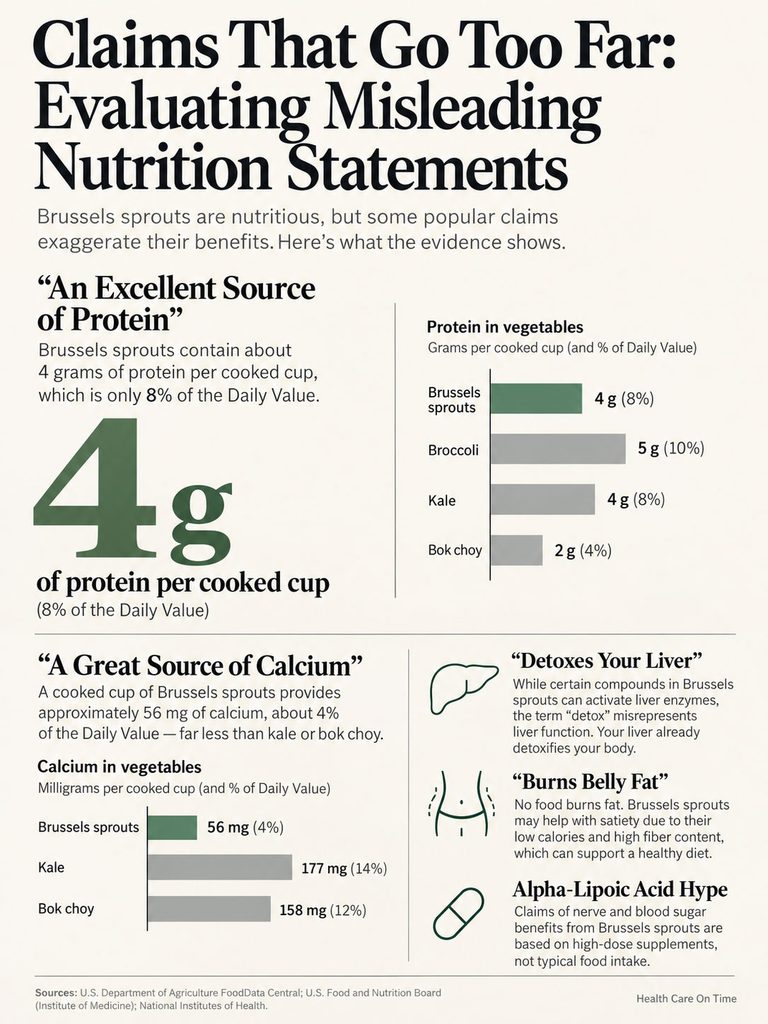
One major health site describes Brussels sprouts this way. A cooked cup has about 4 grams of protein, 8% of the Daily Value. That’s decent for a vegetable but not “excellent.” One large egg has about 6 grams.
“A Great Source of Calcium”
A cooked cup has about 56 mg of calcium, roughly 4% of the Daily Value. Kale and bok choy are far better plant sources. For calcium, sprouts are a minor player.
“Detoxes Your Liver”
Glucosinolate breakdown products do switch on liver enzymes that process foreign chemicals, in lab and small human studies. That part is real. But “detox” implies flushing out vague toxins, which isn’t how your liver works. Your liver and kidneys already do that job daily.
“Burns Belly Fat”
No food burns fat. Brussels sprouts are low in calories and high in fiber, so they help you feel full on fewer calories. That’s the honest version, and it’s true of most non-starchy vegetables.
Alpha-Lipoic Acid Hype
Some pages credit the alpha-lipoic acid in sprouts with nerve and blood sugar benefits. The studies behind that used supplements at 600 mg or more a day. Food supplies tiny amounts in comparison, so the supplement research doesn’t carry over to a side dish.
Why Today’s Sprouts Taste Milder, and What That Means for Your Health
If you hated Brussels sprouts as a kid and like them now, your taste buds may not be the only thing that changed.
The 1990s Breeding Shift
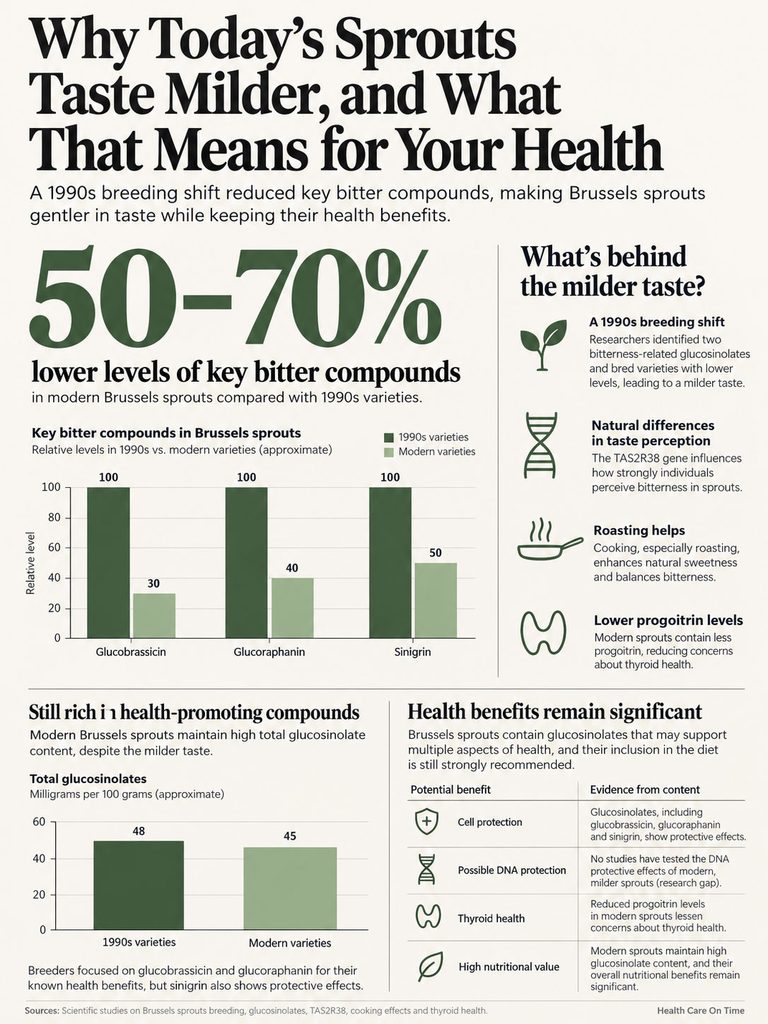
Between 1989 and 1995, a team led by Dutch scientist Hans van Doorn identified two glucosinolates, sinigrin and progoitrin, as the main sources of bitterness. Seed companies then searched old seed stocks for low-bitterness lines and crossbred them with high-yield modern plants. By the 2010s, most commercial sprouts were noticeably milder.
The Open Question Nobody Answers
Breeders have said that the bitter compounds aren’t the ones behind the health benefits. That’s mostly fair, since glucobrassicin and glucoraphanin get most of the research attention.
But sinigrin isn’t a bystander. In lab work on Brussels sprouts extracts, the fraction that best shielded DNA from oxidative damage contained sinigrin, and sinigrin alone showed protective effects. The Dutch human trials didn’t report which sprout varieties they used.
So do today’s milder sprouts deliver the same DNA effect? Nobody has tested it. Our medical reviewers flag this as a real gap in the research, not a reason to skip sprouts. Modern sprouts still top the glucosinolate rankings.
Your Genes Decide the Bitterness
A gene called TAS2R38 controls how strongly you taste certain bitter compounds. People with two “taster” copies find crucifers much harsher than people with none. If sprouts still taste bitter to you, roasting brings out sweetness, and lemon or a little parmesan balances the bite.
Less Progoitrin Is Good News for Your Thyroid
Progoitrin breaks down into goitrin, which can interfere with iodine uptake at very high doses. Breeding it down made modern sprouts even less of a thyroid concern. For the full crucifer and thyroid picture, see Is Kale Good for Thyroid Health?
How to Cook Brussels Sprouts to Keep the Benefits
How you cook sprouts can matter as much as how many you eat.
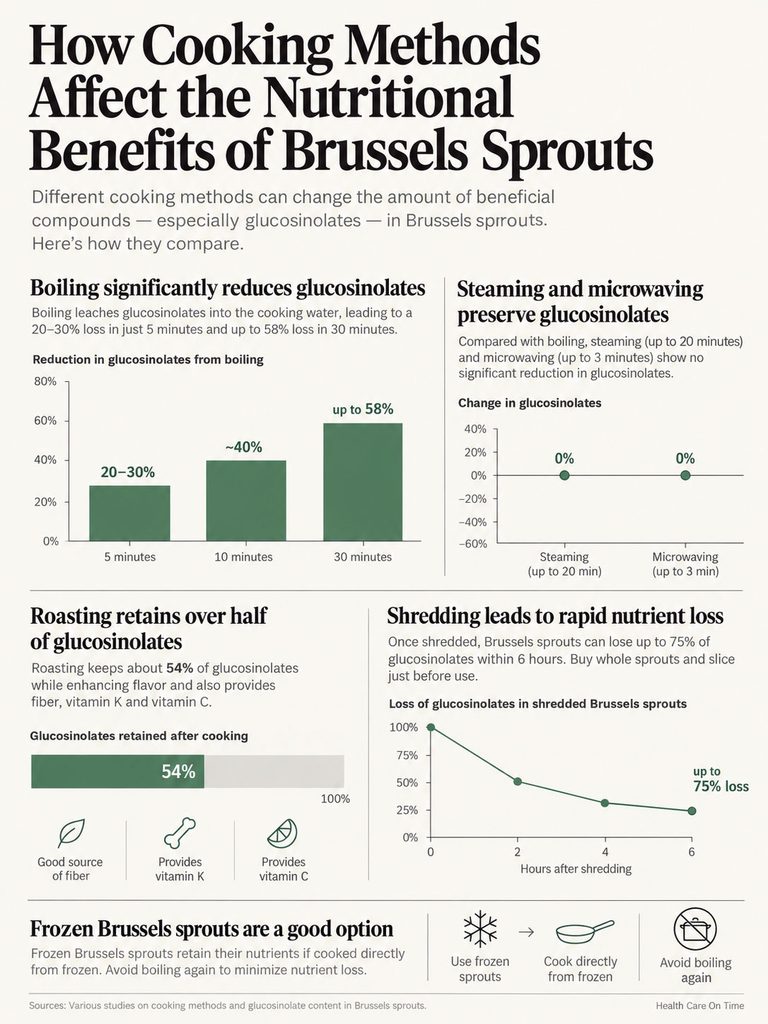
Boiling: The Biggest Loss
University of Warwick researchers found that boiling Brassica vegetables for 5 minutes cut glucosinolates by 20 to 30%, and 10 minutes cut them by 40 to 50%. After 30 minutes of boiling, Brussels sprouts had lost 58%. The compounds leach into the water you pour down the drain.
Steaming and Microwaving: Minimal Loss
The same team found no significant glucosinolate loss from steaming for up to 20 minutes, microwaving for up to 3 minutes, or stir-frying for up to 5 minutes. A Newcastle University study of Brussels sprouts alone found that steamed sprouts measured higher in glucosinolates than raw ones, while boiled sprouts kept about 65%.
Roasting: Tastiest, but Lower Retention
That Newcastle work found roasting kept about 54% of glucosinolates. Roasted sprouts still give you fiber, vitamin K, and a good share of vitamin C, so they’re far from a bad choice. You’re trading some glucosinolates for flavor that actually gets you to eat them.
A practical middle ground: steam sprouts for 4 to 5 minutes, then finish them in a hot skillet or a 425°F oven for a few minutes to crisp the edges.
The Bagged Shaved-Sprouts Problem
Here’s a detail almost nobody mentions. In the Warwick work, finely shredded Brassicas lost up to 75% of their glucosinolates within 6 hours of shredding. Pre-shaved bagged sprouts may sit for days before you buy them.
For a shaved sprout salad, buy whole sprouts and slice them right before eating.
Frozen vs Fresh
Frozen sprouts are blanched before freezing, which costs some glucosinolates and vitamin C. They’re still a solid option, especially out of season. Cook them straight from frozen by steaming or roasting rather than boiling them a second time.
How Many Brussels Sprouts Should You Eat?
There’s no official target for Brussels sprouts. But the studies give useful reference points:
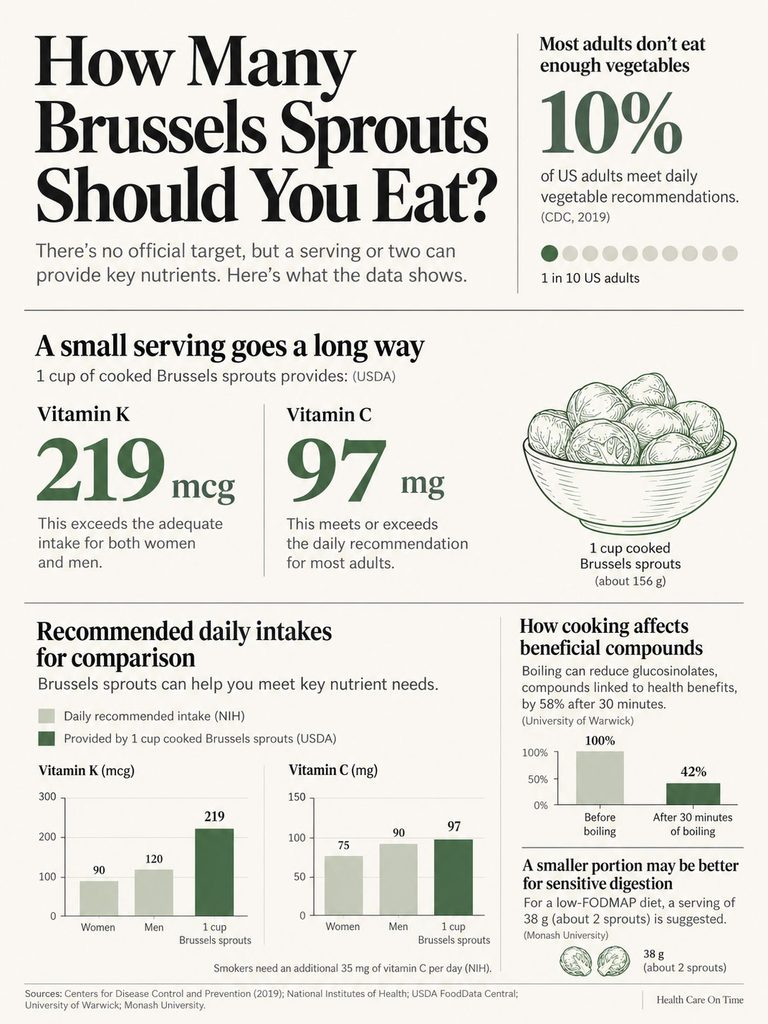
- About 45 grams a day (2 to 3 sprouts) matched the lower arterial calcium odds in older women.
- About 300 grams a day (14 to 16 sprouts) was the dose in the DNA damage trial.
- A realistic goal is one cooked cup (about 8 sprouts) a few times a week, rotated with other crucifers.
The bigger issue is that most Americans eat too few vegetables of any kind. Our editorial team cross-checked the key numbers below so you can see where sprouts fit.
| Statistic | Figure | Source |
| US adults meeting daily vegetable recommendations | 10.0% | CDC MMWR, BRFSS 2019 data |
| Adequate intake of vitamin K | 90 mcg (women), 120 mcg (men) | NIH Office of Dietary Supplements |
| RDA for vitamin C | 75 mg (women), 90 mg (men), plus 35 mg for smokers | NIH Office of Dietary Supplements |
| Vitamin K in 1 cup cooked Brussels sprouts | About 219 mcg | USDA FoodData Central 169971 |
| Vitamin C in 1 cup cooked Brussels sprouts | About 97 mg | USDA FoodData Central 169971 |
| Glucosinolate loss after 30 minutes of boiling | 58% | University of Warwick |
| Scale of 2022 cruciferous umbrella review | 41 meta-analyses, 303 studies, 13+ million people | Food and Function, 2022 |
| Monash low-FODMAP serving | 38 g (about 2 sprouts) | Monash University FODMAP |
With only one in ten US adults hitting the vegetable target, adding a cup of sprouts a few times a week does far more good than worrying over steamed versus roasted.
Who Should Be Careful With Brussels Sprouts
Brussels sprouts are safe for nearly everyone. A few groups need a smarter approach rather than avoidance.
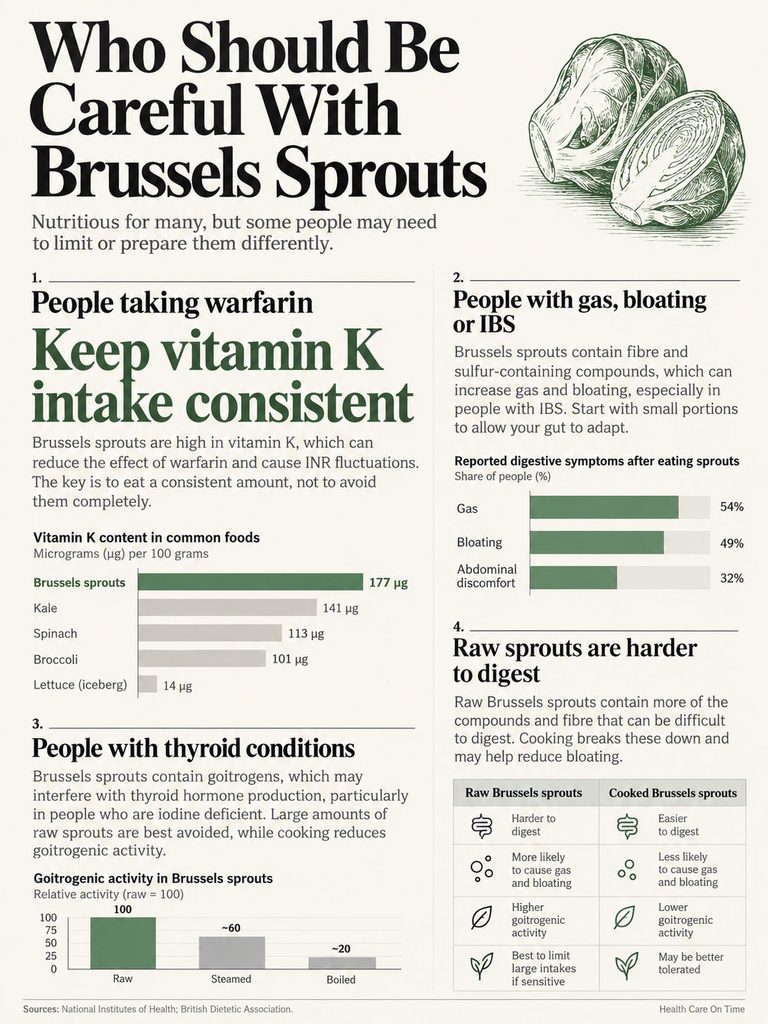
People Taking Warfarin
Warfarin works by blocking vitamin K, so big swings in vitamin K intake can move your INR. Patients on blood thinners often ask us whether they have to give up sprouts. They don’t. The key is consistency: eat a similar amount each week and tell your care team before making a big change.
Across lab panels reviewed by our network, unexplained INR shifts often trace back to sudden diet changes around the holidays, exactly when Brussels sprouts show up in bulk. Newer anticoagulants such as apixaban and rivaroxaban don’t interact with vitamin K. See our warfarin guide for more.
Gas, Bloating, and IBS
Sprouts contain fructans and raffinose, carbohydrates your small intestine can’t fully digest. Gut bacteria ferment them in the colon and produce gas. That’s normal, and many people adapt when they increase portions slowly.
People with IBS have a lower threshold. Monash University lists 38 grams, about 2 sprouts, as a low-FODMAP serving, while the separate FODMAP Friendly program passes up to 75 grams. Readers managing IBS frequently tell us that starting small and testing upward works best.
Thyroid Conditions
At normal food amounts, Brussels sprouts aren’t a thyroid risk for people with enough iodine. The concern applies mainly to very large raw intakes combined with iodine deficiency. If you have hypothyroidism, cook your sprouts and take levothyroxine on an empty stomach as directed.
Raw Sprouts
Raw shaved Brussels sprouts are popular in salads. Rinse whole sprouts under running water, peel off loose outer leaves, and slice just before serving. Raw sprouts are also harder to digest, so cooked ones may sit better if you’re prone to bloating.
Your Brussels Sprouts Action Plan
Match your situation to a simple next step.
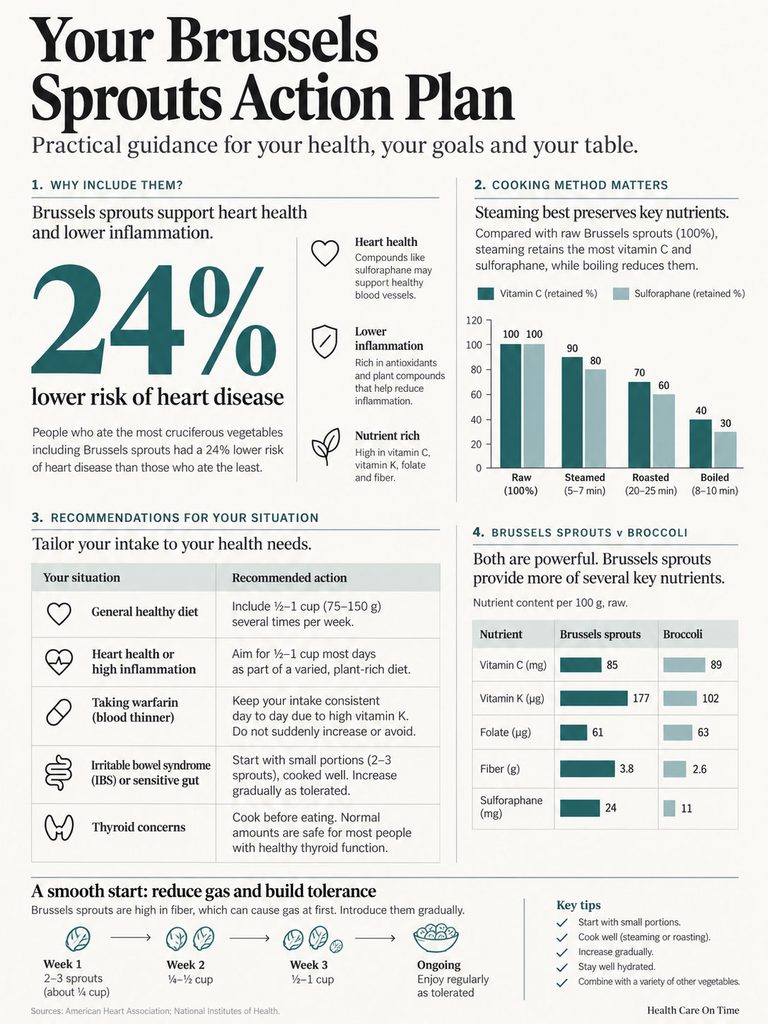
| Scenario | Recommended action | Why |
| You take warfarin | Eat a steady amount weekly (for example, 1 cup twice a week) and tell your clinic before big changes | Steady vitamin K keeps INR stable |
| You have IBS | Start at 2 sprouts (38 g) per meal; increase slowly if tolerated | Fructans trigger symptoms above low-FODMAP thresholds |
| Sprouts taste bitter to you | Roast at 425°F, add lemon or parmesan, choose small, tight sprouts | TAS2R38 genes raise bitter sensitivity; roasting adds sweetness |
| You want the most glucosinolates | Steam 4 to 5 minutes or microwave 2 to 3 minutes | No significant glucosinolate loss with either method |
| You buy bagged shaved sprouts | Buy whole sprouts and slice right before eating | Shredded Brassicas lost up to 75% of glucosinolates in 6 hours |
| You’re an older woman with heart risk factors | Aim for 45+ g of crucifers daily (2 to 3 sprouts or ½ cup broccoli) | Linked to 46% lower odds of heavy aortic calcium |
| You’re pregnant or planning to be | Add sprouts as a folate source alongside your prenatal vitamin | About 94 mcg folate per cooked cup |
| You have a thyroid condition | Eat sprouts cooked, keep iodine intake adequate, take thyroid meds as directed | Cooking cuts goitrin; modern sprouts are already low in progoitrin |
Start simple. Pick one cooking method you enjoy, eat sprouts two or three times a week, and rotate them with broccoli, cabbage, and kale. Wondering how sprouts stack up? Our broccoli vs cauliflower comparison shows how much crucifers differ, and our high CRP guide explains the inflammation marker behind many “anti-inflammatory food” claims.
“`Frequently Asked Questions
Is it OK to eat Brussels sprouts every day?
Yes, for most people. A daily serving of about one cup is safe and nutritious. If you take warfarin, keep your daily amount steady so your INR stays stable. If you get gas or bloating, start with a few sprouts and build up gradually, since your gut bacteria adapt over a couple of weeks.
Are Brussels sprouts healthier raw or cooked?
Both have value. Raw sprouts keep active myrosinase and more vitamin C. Lightly steamed or microwaved sprouts keep nearly all their glucosinolates and are easier to digest. Long boiling is the one method to avoid, since 30 minutes cut glucosinolates by 58% in University of Warwick testing.
Are roasted Brussels sprouts still healthy?
Yes. Roasting kept about 54% of glucosinolates in one study, less than steaming, but you still get the fiber, vitamin K, and much of the vitamin C. Go easy on oil, bacon, and sugary glazes, which can triple a cup’s calories. Steaming first, then a short roast, balances flavor and nutrients.
Which is healthier, Brussels sprouts or broccoli?
They’re close. Brussels sprouts rank higher in total glucosinolates and vitamin K, while broccoli is richer in glucoraphanin, the precursor to sulforaphane. Broccoli also has a larger low-FODMAP serving, so it suits sensitive stomachs better. Eating both gives you a wider mix of compounds than choosing one.
Do Brussels sprouts help reduce inflammation?
Possibly, but the evidence is indirect. Cruciferous vegetable intake is linked to lower inflammation markers in observational studies, and lab work shows glucosinolate breakdown products calm inflammatory pathways. No trial has shown Brussels sprouts alone lower CRP in people. Think of them as one part of an anti-inflammatory eating pattern.
Are Brussels sprouts good for your heart?
The evidence leans yes. Large cohorts link cruciferous vegetables to lower cardiovascular death, and a study of 684 older women tied higher intake to 46% lower odds of heavy aortic calcium buildup. Fiber helps too. These are associations rather than trial results, so pair sprouts with other proven heart habits.
Can I eat Brussels sprouts if I take warfarin?
Yes, in consistent amounts. Warfarin works against vitamin K, so sudden jumps in intake can lower your INR. Choose a regular weekly pattern, keep it steady, and let your anticoagulation clinic know about major diet changes. If you take apixaban or rivaroxaban instead, vitamin K doesn’t affect those drugs.
Why do Brussels sprouts make me gassy?
Sprouts contain fructans and raffinose, carbohydrates your small intestine can’t break down. Bacteria in your colon ferment them and release gas. Smaller portions, thorough chewing, and slowly increasing intake usually help. If you have IBS, stay near Monash’s 38-gram low-FODMAP serving, about 2 sprouts, and test upward from there.
Are Brussels sprouts bad for your thyroid?
Not at normal amounts. Their goitrin-forming compound, progoitrin, was largely bred down in the 1990s, and cooking lowers it further. Thyroid problems from crucifers have mainly been reported with very large raw intakes alongside iodine deficiency. If you have a thyroid condition, cooked sprouts in normal servings are fine.
Do Brussels sprouts help you lose weight?
They can help indirectly. A cooked cup has about 56 calories and 4 grams of fiber, so sprouts add volume and fullness with few calories. No food burns fat directly. Swapping a starchy side for sprouts a few nights a week is a realistic, research-supported way to trim total calorie intake.
Are frozen Brussels sprouts as healthy as fresh?
Close, though not identical. Blanching before freezing costs some vitamin C and glucosinolates. Frozen sprouts are still a strong choice, often picked at peak ripeness and cheaper out of season. Steam or roast them straight from frozen rather than boiling, which would strip out more water-soluble compounds.
Why do Brussels sprouts taste less bitter than they used to?
In the 1990s, Dutch researchers identified sinigrin and progoitrin as the main bitter compounds, and seed companies bred low-bitterness varieties. Better cooking helped too, as roasting replaced boiling. Your genes also matter: people with certain versions of the TAS2R38 gene taste cruciferous bitterness much more strongly than others.
Disclaimer: This article is for general information only and isn’t a substitute for medical advice. If you take warfarin or another blood thinner, are pregnant, or have a thyroid condition, IBS, or kidney disease, talk with your healthcare provider before making major changes to your diet. HealthCareOnTime content is reviewed for accuracy but can’t account for your individual health history.
References
- USDA FoodData Central: Brussels sprouts, cooked, boiled, drained, without salt (FDC 169971)
- NIH Office of Dietary Supplements: Vitamin K Fact Sheet for Health Professionals
- NIH Office of Dietary Supplements: Vitamin C Fact Sheet for Health Professionals
- NIH Office of Dietary Supplements: Folate Fact Sheet for Health Professionals
- Verhagen H, et al. Reduction of oxidative DNA-damage in humans by Brussels sprouts. Carcinogenesis, 1995
- Verhagen H, et al. Effect of Brussels sprouts on oxidative DNA-damage in man. Cancer Letters, 1997
- Blekkenhorst LC, et al. Cruciferous vegetable intake is inversely associated with extensive abdominal aortic calcification in elderly women. British Journal of Nutrition, 2020
- Li YZ, et al. Cruciferous vegetable consumption and multiple health outcomes: an umbrella review. Food and Function, 2022
- Zhang X, et al. Cruciferous vegetable consumption and mortality: Shanghai Women’s and Men’s Health Studies. American Journal of Clinical Nutrition, 2011
- Aune D, et al. Fruit and vegetable intake and the risk of cardiovascular disease, total cancer and all-cause mortality. International Journal of Epidemiology, 2017
- Halvorsen RE, et al. Fruit and vegetable consumption and the risk of type 2 diabetes. BMJ Open Diabetes Research and Care, 2021
- University of Warwick: Research says boiling broccoli ruins its anti-cancer properties, 2007
- Hill C, et al. SMCSO and glucosinolate levels in Australian-sourced Brassica vegetables before and after domestic cooking. Journal of Food Composition and Analysis, 2025
- Newcastle University: Determination of glucosinolates and specific metabolites in Brussels sprouts and human tissues
- Zhu C, Poulsen HE, Loft S. Inhibition of oxidative DNA damage in vitro by extracts of Brussels sprouts
- Society of Chemical Industry: Brussels, a bittersweet story
- CDC MMWR: Adults meeting fruit and vegetable intake recommendations, United States, 2019
- Dietary Guidelines for Americans
- Monash University FODMAP Diet
- FODMAP Everyday: Low FODMAP Brussels sprouts (Monash vs FODMAP Friendly serving data)