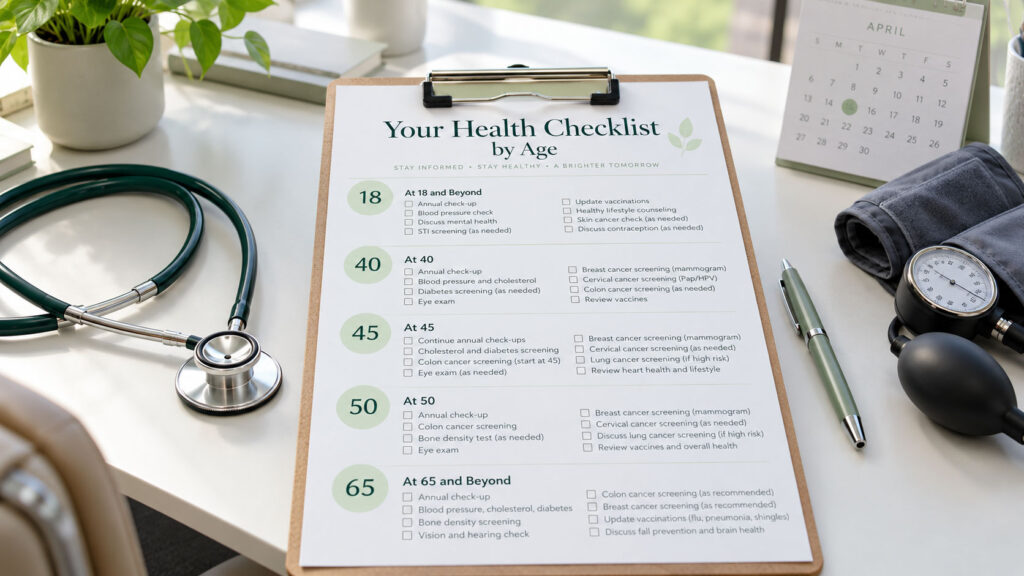
Half of the “screenings by age” lists online still give advice that changed years ago. Some tell you to start colon checks at 50, others push a yearly PSA test at 45, and a few still ask women for monthly breast self-exams.
Table of Contents
Meanwhile, fewer Americans are getting screened at all. Only 51% of adults 21 and older say they had a routine medical appointment or cancer screening in the past year, a 10-point drop from 2024, according to the Prevent Cancer Foundation.
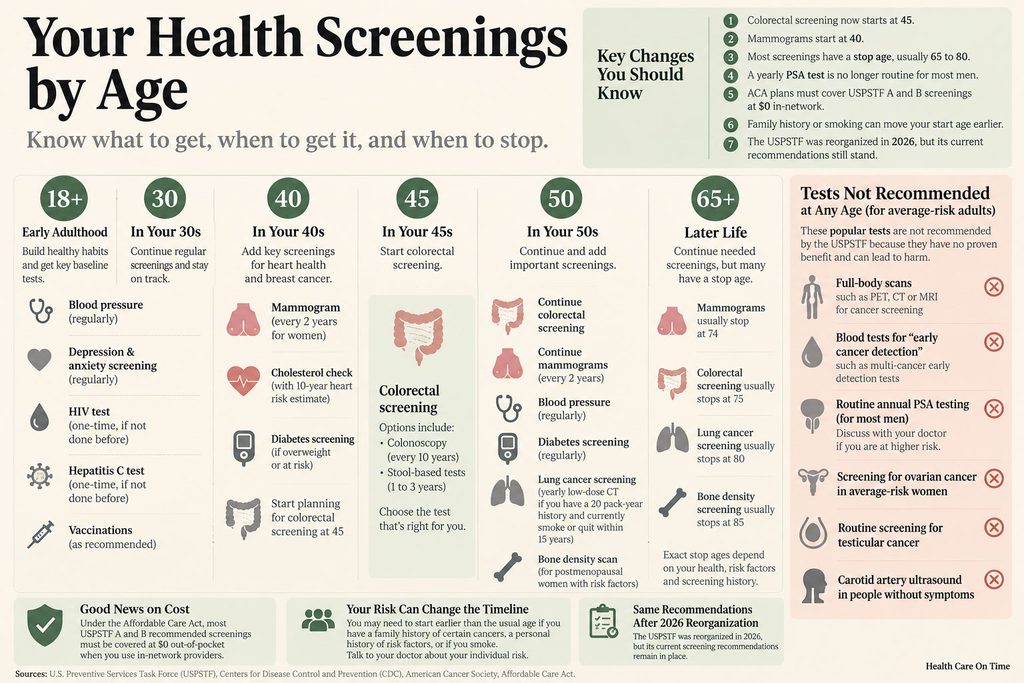
Quick Answer: Most adults need these health screenings by age: blood pressure, depression, and anxiety from 18; HIV (15 to 65) and hepatitis C (18 to 79) at least once; cervical screening from 21; diabetes from 35 if overweight; mammograms every 2 years from 40; colorectal screening from 45; lung CT from 50 for heavy smokers; a PSA talk at 55; and bone density for women at 65.
At a Glance
- Colorectal screening now starts at 45, and mammograms start at 40.
- Most screenings have a stop age, usually between 65 and 80.
- A yearly PSA test is no longer routine for most men.
- ACA plans must cover USPSTF A and B screenings at $0 in-network.
- Family history or smoking can move your start age years earlier.
- The USPSTF was reorganized in 2026, but its current recommendations still stand.
- Several popular tests, like full-body scans, aren’t recommended at any age.
How Health Screening Recommendations Work
A screening test looks for disease in people who feel fine. The goal is to catch a problem before it causes symptoms, when treatment is simpler and outcomes are better.
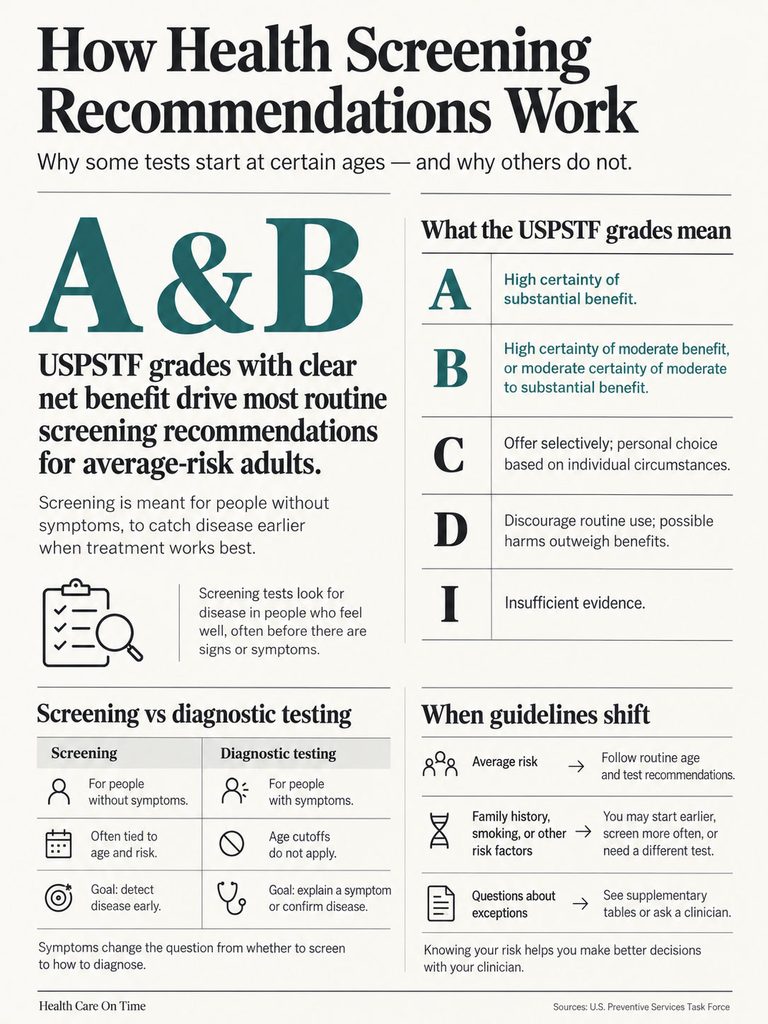
The ages in this guide come mainly from the U.S. Preventive Services Task Force (USPSTF), an independent panel that reviews the evidence for each test. Groups like the American Cancer Society (ACS) and ACOG sometimes set slightly different ages, and we note those where they matter.
What the USPSTF Grades Mean
The task force grades every recommendation. An “A” or “B” means the evidence shows clear benefit, so your doctor should offer the test. A “C” means the benefit is small and the choice is personal.
A “D” means the test does more harm than good for that group. An “I” means there isn’t enough evidence to decide either way.
Patients booking lab work with HealthCareOnTime often ask why a test their parent had is “not recommended” for them. The grade usually explains it.
Screening vs. Diagnostic Testing
Everything below applies to people without symptoms. Rectal bleeding, a breast lump, unexplained weight loss, or chest pain move you out of screening territory.
That’s a diagnostic workup, and age limits don’t apply. Call your doctor rather than waiting for your next scheduled screening.
Average Risk vs. High Risk
The standard ages assume average risk. A parent with colon cancer, a BRCA gene change, a long smoking history, or certain medications can move your start date earlier or change the test you need.
We cover those exceptions in the decision table later in this guide.
Health Screenings by Age: The Complete Checklist
Here is the full list of recommended health screenings for adults at average risk, with start age, frequency, and stop age in one place. Our medical review team built this table from current USPSTF statements and cross-checked each row.
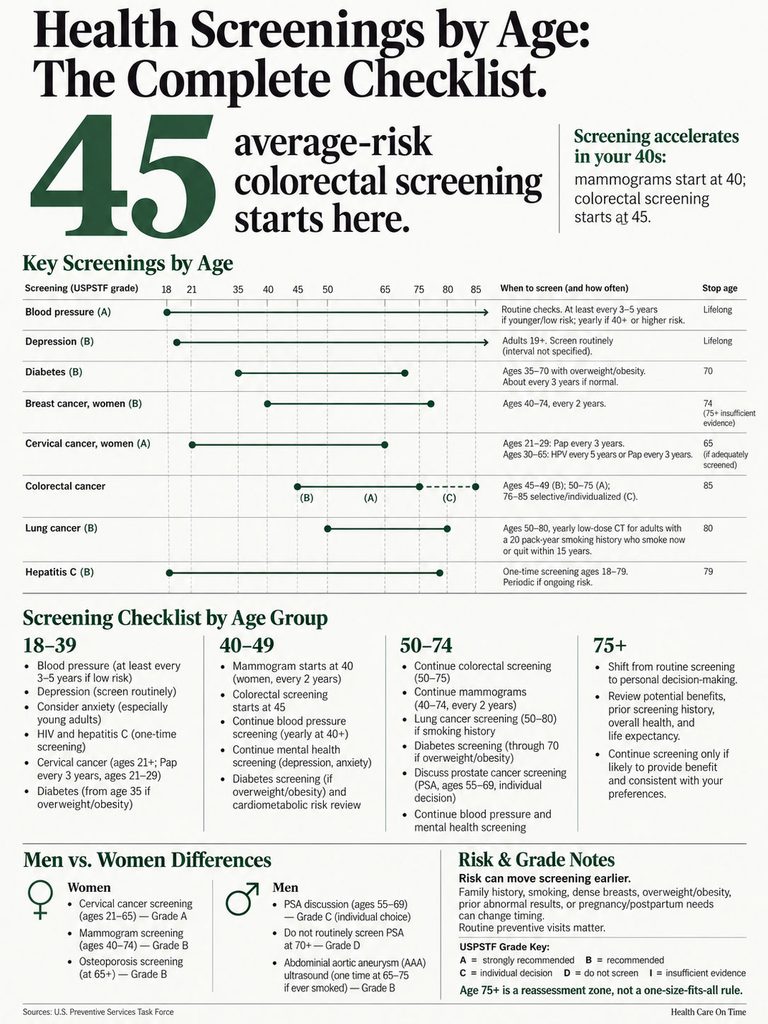
| Screening | Who | Start Age | How Often | Stop Age | USPSTF Grade |
| Blood pressure | All adults | 18 | Yearly at 40+ or if at risk; every 3 to 5 years at 18 to 39 if normal | None | A |
| Depression | All adults | 18 | At routine visits | None | B |
| Anxiety | Adults | 18 | At routine visits | 64 | B |
| HIV | Everyone | 15 | At least once; more often if at risk | 65 (routine) | A |
| Hepatitis C | All adults | 18 | Once | 79 | B |
| Cervical cancer | Women with a cervix | 21 | Pap every 3 years (21 to 29); HPV test every 5 years (30 to 65) | 65, after normal results | A |
| Chlamydia and gonorrhea | Sexually active women | Any | Yearly | 24 (routine) | B |
| Diabetes / prediabetes | Adults with overweight or obesity | 35 | Every 3 years | 70 | B |
| Cholesterol and statin check | Adults | 40 | Every 5 years if normal | 75 | B |
| Breast cancer (mammogram) | Women | 40 | Every 2 years | 74 | B |
| Colorectal cancer | All adults | 45 | Every 1 to 10 years, by test | 75 (then individual to 85) | A / B |
| Lung cancer (low-dose CT) | 20+ pack-years, smoke now or quit within 15 years | 50 | Yearly | 80 | B |
| Prostate cancer (PSA) | Men | 55 | Shared decision | 69 | C |
| Osteoporosis (DEXA) | Women 65+ and at-risk postmenopausal women | 65 (earlier if at risk) | Per results | None set | B |
| Abdominal aortic aneurysm | Men who ever smoked | 65 | Once (ultrasound) | 75 | B |
Ages 18 to 39
Your twenties and thirties are about setting baselines. Most screenings at this age are quick checks during a routine visit, plus a few one-time blood tests.
Everyone
Get your blood pressure checked. The USPSTF recommends hypertension screening for all adults 18 and older using an office blood pressure reading. If you’re under 40 with normal readings and no risk factors, every 3 to 5 years is enough.
Ask about mental health screening too. The task force recommends anxiety screening for adults, including during pregnancy and after birth, and depression screening covers all adults.
Two blood tests belong on every adult’s list at least once. The USPSTF recommends a hepatitis C test for adults 18 to 79 and an HIV test for everyone 15 to 65, according to the CDPH summary of USPSTF A and B recommendations.
Your doctor should also ask about alcohol and drug use. These are short questionnaires, not blood tests, and they’re part of standard adult preventive care.
Women
Cervical screening starts at 21 with a Pap test every 3 years. At 30, you can switch to an HPV test every 5 years, which many guidelines now prefer.
Sexually active women 24 and younger should get a yearly chlamydia and gonorrhea test. These infections often cause no symptoms but can affect fertility later.
If close relatives had breast, ovarian, or related cancers, ask for a BRCA risk assessment. It’s a short questionnaire that decides whether genetic counseling makes sense.
Men
There is no routine screening unique to men in this age group. The USPSTF does not recommend routine testicular exams for men without symptoms.
Any new lump, swelling, or heaviness still deserves a prompt visit. Our reviewers see this question often, and the answer is simple: symptoms always override the schedule.
Ages 40 to 49
This is the decade where the list grows fastest. Two major screenings start here, and both were moved earlier in the last few years.
Mammograms now start at 40. In April 2024, the task force lowered its start age and now recommends a mammogram every two years for women 40 to 74.
Colorectal screening starts at 45. The USPSTF recommends screening for adults 45 to 49 and for all adults 50 to 75. You can choose a yearly stool test (FIT), a stool DNA test every 1 to 3 years, or a colonoscopy every 10 years.
Diabetes screening often begins in this decade or earlier. The task force advises screening adults 35 to 70 who have overweight or obesity, usually with an A1C or fasting glucose test.
From 40, your doctor should also check cholesterol and estimate your 10-year heart risk. That number decides whether a statin makes sense for you.
Ages 50 to 64
Lung cancer screening enters the picture for people with a heavy smoking history. The USPSTF recommends a yearly low-dose CT scan for adults 50 to 80 with at least a 20 pack-year smoking history who still smoke or quit within the last 15 years.
A pack-year equals one pack a day for one year. So 20 pack-years could mean one pack daily for 20 years, or two packs daily for 10.
Men between 55 and 69 should have a conversation about PSA testing. This is a “C” grade, meaning it’s your call after weighing a small chance of benefit against the risk of false alarms and overtreatment.
Postmenopausal women under 65 may need a bone density test early. The task force recommends screening younger postmenopausal women whose fracture risk is raised on a clinical risk assessment.
Ages 65 to 74
Every woman needs a bone density scan at 65. The USPSTF’s January 2025 statement recommends osteoporosis screening for all women 65 and older. The reason is plain: about 27.1% of women 65 and older have osteoporosis, compared with 5.7% of men.
For men, the task force says the evidence is too thin to weigh benefits against harms. Ask anyway if you have risk factors like long-term steroid use.
Men 65 to 75 who ever smoked need a one-time ultrasound for abdominal aortic aneurysm. This bulge in the body’s main artery causes no symptoms until it ruptures.
Cervical screening can usually stop at 65 if your recent results were normal. Medicare also covers a yearly Annual Wellness Visit, a good time to review this whole list.
Ages 75 and Older
Screening becomes personal after 75. The question shifts from “what age am I?” to “how healthy am I, and how long would the benefit take to show up?”
Colorectal screening from 76 to 85 is decided case by case. Lung CT stops at 80. The USPSTF hasn’t found enough evidence to recommend mammograms after 75, so many women decide with their doctor based on overall health.
Families of older patients often ask our team whether stopping a screening means “giving up.” It doesn’t. It means the test’s risks now outweigh a benefit that may take a decade to appear.
What Changed: 5 Screening Rules Most Lists Still Get Wrong
Our medical team reviewed the pages currently ranking for this topic. Several still publish outdated ages, which can push readers to start too late or test too often.
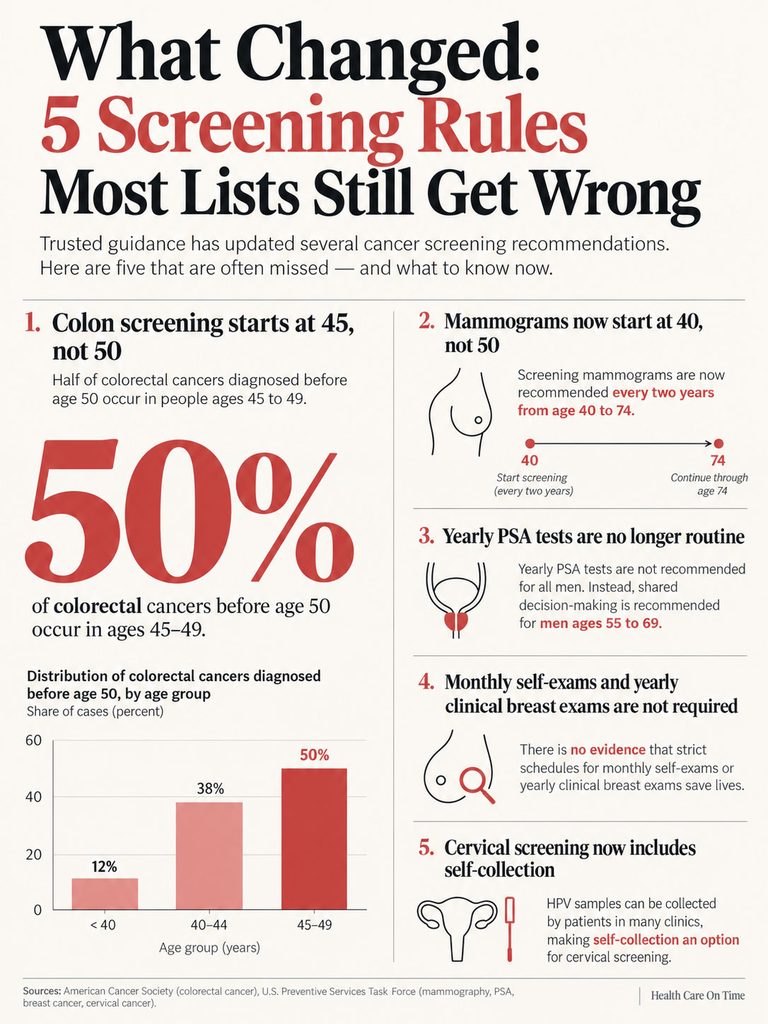
Colon Screening Starts at 45, Not 50
The task force dropped the start age in 2021, and the reason is urgent. Half of all colorectal cancers diagnosed before 50 occur in people 45 to 49, an age group already eligible for screening, according to the American Cancer Society.
For adults under 50, colorectal cancer is now the leading cause of cancer death. A list that still says “start at 50” leaves out five years when screening can prevent cancer entirely.
Mammograms Start at 40, Not 50
Older pages often say mammograms are optional until 50. That changed with the 2024 update to every-two-years screening from 40 to 74.
Yearly PSA Tests Are No Longer Routine
Some health system pages still tell men to get a PSA and rectal exam every year from 45. The USPSTF calls PSA testing a shared decision for men 55 to 69 and recommends against routine testing at 70 and older.
Men at higher risk, including Black men and those with a father or brother diagnosed young, should talk with their doctor earlier, often around 40 to 45.
Monthly Self-Exams and Yearly Clinical Breast Exams Aren’t Required
Monthly breast self-exams on a strict schedule haven’t been shown to save lives. The USPSTF also rates the yearly clinical breast exam as “I,” meaning not enough evidence.
Knowing how your breasts normally look and feel still matters. Report any change, but don’t treat a calendar exam as a substitute for a mammogram.
Cervical Screening Now Includes Self-Collection
You can now collect your own HPV sample in many clinics instead of having a speculum exam. Recent updates from the ACS and federal women’s health guidelines support this option for average-risk adults.
We break down every change in our guide to cervical cancer screening guideline updates.
Proof Screening Works, and Where Americans Fall Behind
Screening is one of the few areas in medicine where the payoff is measurable. In the National Lung Screening Trial, low-dose CT cut lung cancer deaths by 20% in high-risk adults, as noted in a 2024 NHIS analysis.
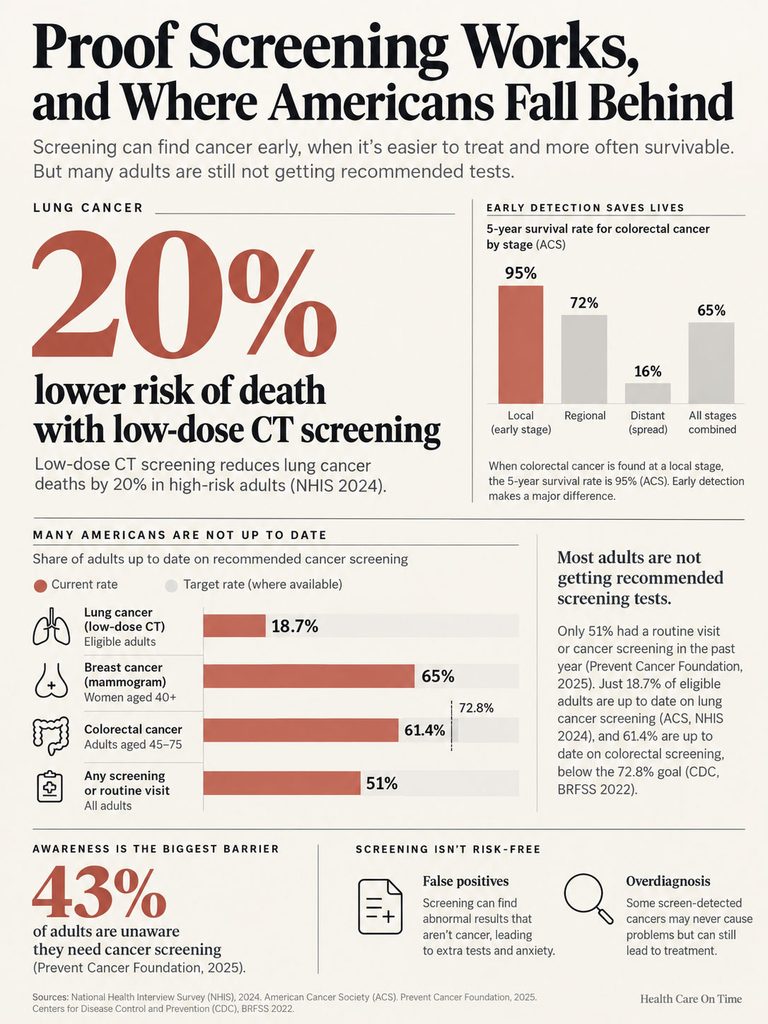
For colon cancer, stage at diagnosis changes everything. The ACS puts 5-year survival for local-stage colorectal cancer at 95%.
Yet the gaps are wide, as this data shows.
| Screening Metric | Latest U.S. Figure | Source |
| Adults with a routine visit or cancer screening in the past year | 51% (down 10 points from 2024) | Prevent Cancer Foundation, 2025 |
| Women 40+ up to date on mammograms | 65% | Prevent Cancer Foundation, 2025 |
| Adults 45 to 75 up to date on colorectal screening | 61.4% (goal: 72.8%) | CDC, BRFSS 2022 |
| Adults 45 to 49 up to date on colorectal screening | 33.7% (up from 20.8% in 2019) | JAMA, NHIS 2023 |
| Eligible adults up to date on lung CT | 18.7% of 12.8 million | ACS, NHIS 2024 |
| New colorectal cancer cases projected | 158,850 cases, 55,230 deaths | ACS, 2026 |
| Colorectal incidence change, ages 20 to 49 | Rising 3% per year | ACS, 2026 |
| Share of new colorectal cases in adults under 65 | 45% (up from 27% in 1995) | ACS, 2026 |
Colorectal Screening Gaps
According to the CDC, only 61.4% of adults 45 to 75 were up to date on colorectal screening, short of the Healthy People 2030 goal of 72.8%. About 28 million adults in that age range had never been screened.
The newest age group is catching up. Up-to-date screening among adults 45 to 49 rose from 20.8% in 2019 to 33.7% in 2023, per a JAMA analysis, but that still leaves two in three behind.
The cancer itself is shifting younger. Adults under 65 now account for about 45% of new colorectal cancer cases, up from 27% in 1995.
Lung Screening Gaps
Lung CT is the most underused screening on this list. About 12.8 million Americans were eligible in 2024, yet only 18.7% were up to date, according to an ACS report in JAMA.
The same researchers estimated that full uptake could prevent about 62,110 lung cancer deaths over five years. A separate University of Kentucky study put 2024 uptake slightly higher, at 24.5%.
Why People Skip Screening
Awareness is the biggest barrier. In the 2025 Prevent Cancer Foundation survey, 43% of people said they didn’t know they needed to be screened.
Convenience matters too. Among people behind on screening, 42% said an at-home test would make them more likely to get it done. Patients often tell us a mailed FIT kit was the push they needed.
The Honest Downsides
Screening isn’t risk-free. False positives cause worry and follow-up tests, and some cancers found by screening would never have caused harm.
That’s why stop ages exist and why PSA testing is a personal choice. More testing isn’t always better; the right test at the right age is.
Screenings You Probably Don’t Need
Popular doesn’t mean proven. These tests are widely marketed, but major U.S. guidelines don’t recommend them for healthy adults without symptoms.
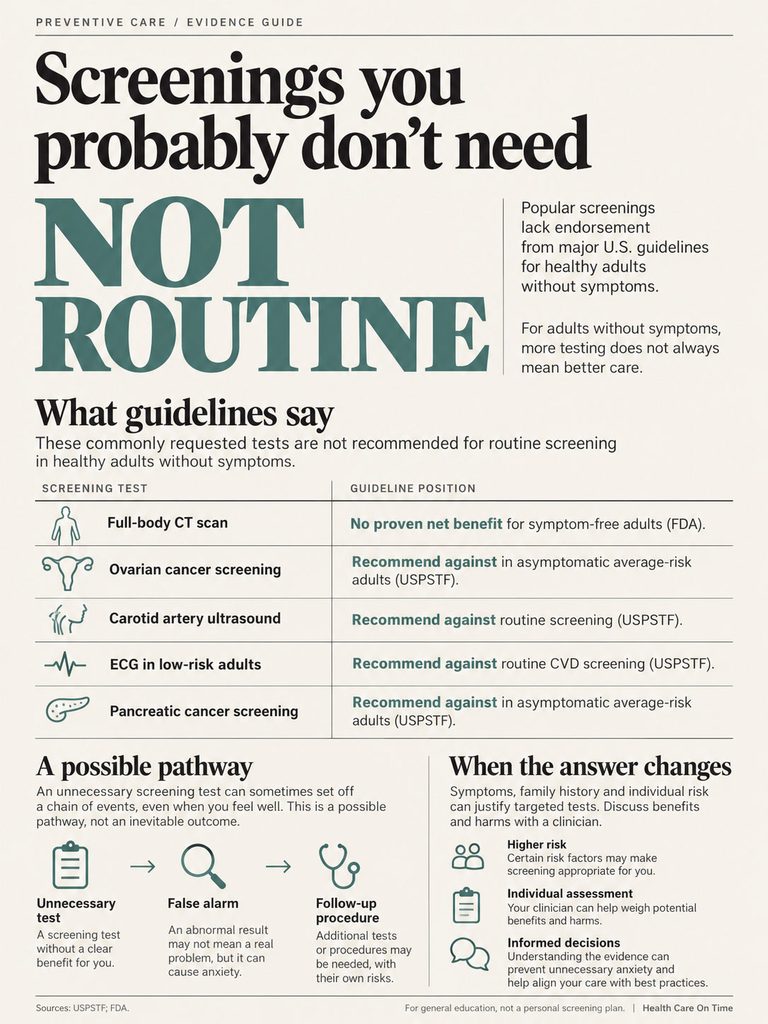
- Full-body MRI or CT scans. No major U.S. medical group recommends them. They often find harmless spots that lead to biopsies and anxiety.
- Yearly ECG for low-risk adults. The USPSTF recommends against resting or exercise ECGs for people at low heart risk.
- Routine vitamin D tests. There isn’t enough evidence that screening healthy adults improves outcomes.
- Ovarian cancer screening. CA-125 blood tests and ultrasounds don’t lower death rates in average-risk women, and false positives can lead to surgery.
- Routine thyroid ultrasounds. These tend to find small cancers that would never have caused harm.
In requests our team reviews, these tests come up almost weekly. If you’re at higher risk for any of these conditions, a targeted test may make sense, so ask your doctor first.
Are These Recommendations Still Valid After the Task Force Shake-Up?
Yes, the current recommendations remain in force. Still, you may have seen headlines about the USPSTF, so here’s what happened.
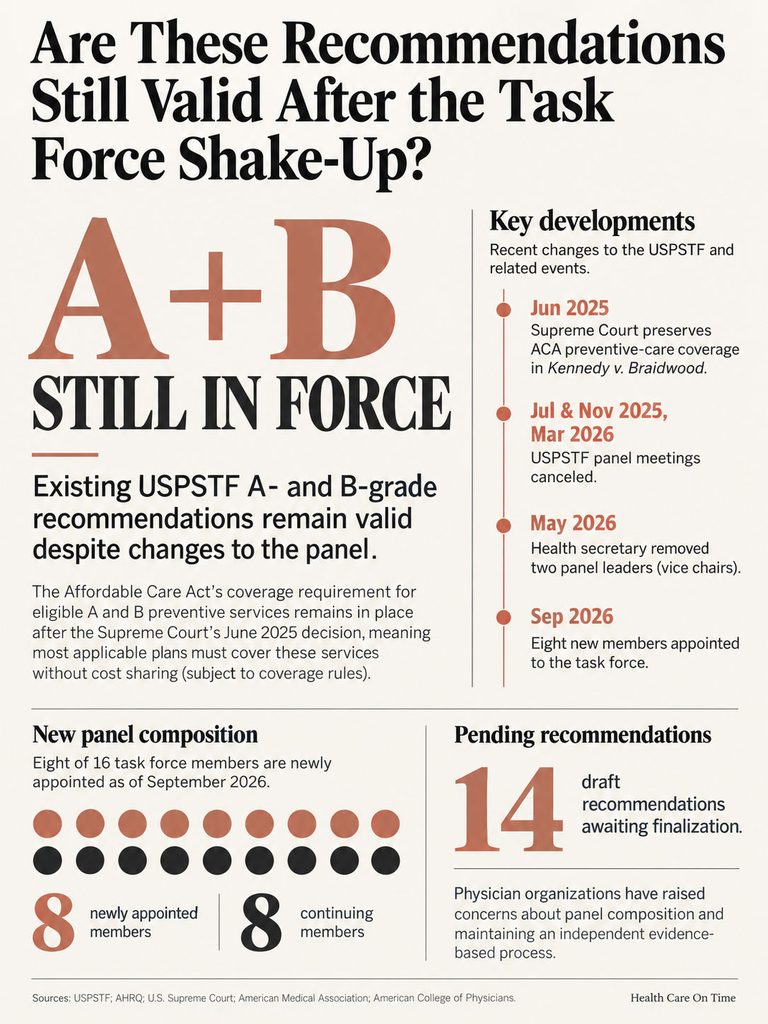
The panel normally meets three times a year, but its July and November 2025 meetings and its March 2026 meeting were all canceled, as FABBS reported. In May 2026, the health secretary removed the panel’s two vice chairs.
In September 2026, eight new members were appointed, and 14 draft recommendations were still waiting to be finalized, according to Healio. Medical groups have raised concerns about the new makeup of the panel.
What matters for you: existing A and B recommendations didn’t disappear. In June 2025, the Supreme Court upheld the ACA coverage requirements tied to the task force’s recommendations, as Fierce Healthcare noted. Our team will update this guide if any screening age changes.
What Insurance and Medicare Cover at No Cost
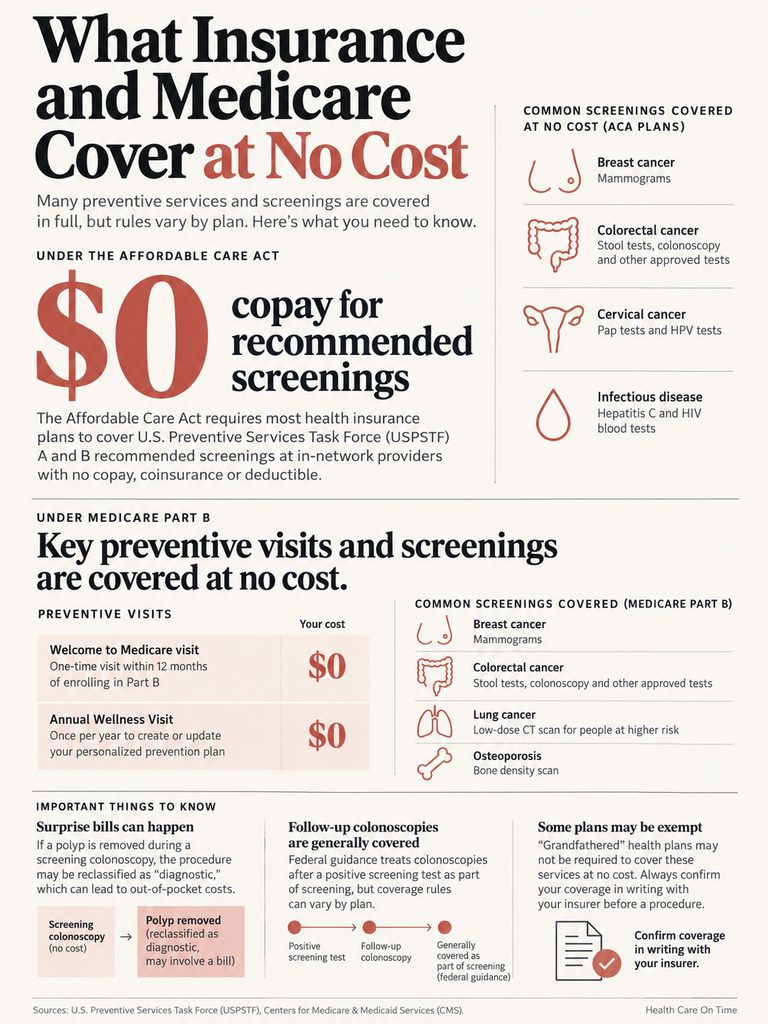
Most screenings on this list should cost you nothing. The catch is knowing the rules.
ACA Marketplace and Employer Plans
Under the Affordable Care Act, most private plans must cover USPSTF A and B screenings with no copay or deductible when you use an in-network provider. That includes mammograms, colorectal screening, cervical tests, and the hepatitis C and HIV blood tests.
“Grandfathered” plans that existed before March 2010 may be exempt. Call the number on your insurance card and ask about each test by name.
Medicare
Medicare Part B covers a one-time “Welcome to Medicare” visit within your first 12 months, then a yearly Annual Wellness Visit. Most screenings, including mammograms, colorectal tests, lung CT, and bone density scans, are covered at no cost when your doctor accepts assignment.
If you’re comparing plans, our guide to 5-star Medicare Advantage plans explains how quality ratings affect your options.
The Colonoscopy Billing Trap
Here’s where people get surprise bills. If a polyp is removed during a screening colonoscopy, some plans have tried to reclassify the procedure as “diagnostic.”
Current federal guidance generally treats a follow-up colonoscopy after a positive stool test as part of screening. Rules vary by plan type, so ask your insurer to confirm coverage in writing before your procedure.
When to Start Screening Earlier
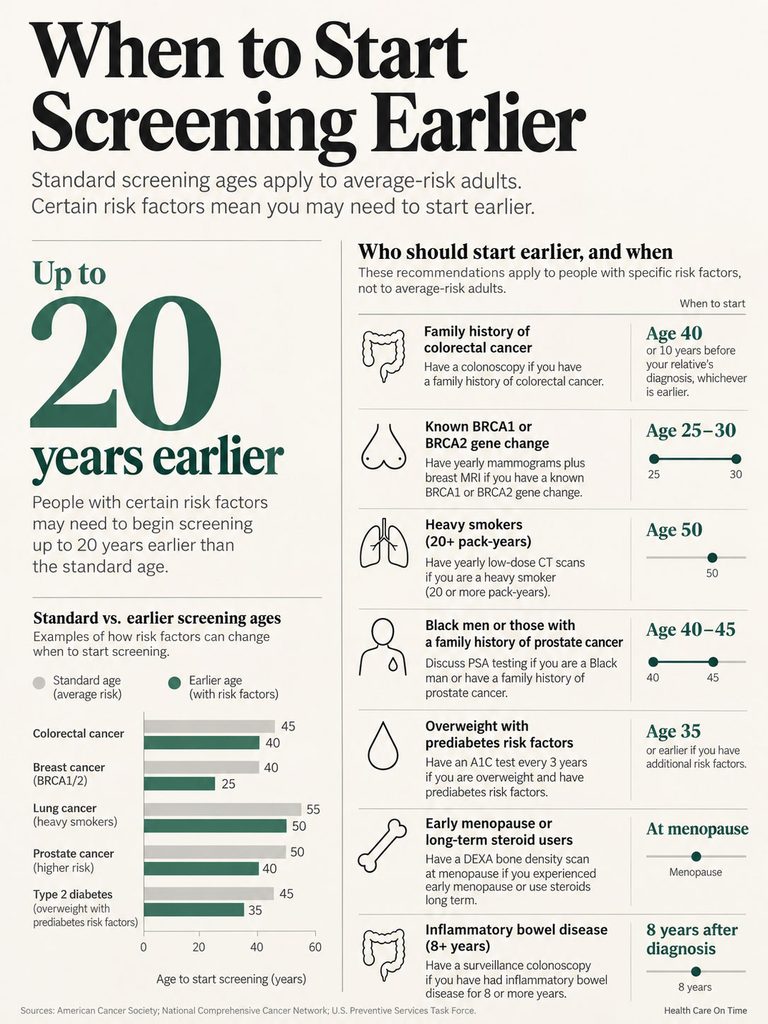
Standard ages fit average-risk adults. If any of these situations apply to you, your timeline changes.
| If This Applies to You | Recommended Action | Typical Start Age |
| Parent, sibling, or child had colorectal cancer | Colonoscopy every 5 years | 40, or 10 years before the relative’s diagnosis age |
| Known BRCA1 or BRCA2 gene change | Yearly mammogram plus breast MRI | 25 to 30 |
| Heavy smoker (20+ pack-years) | Yearly low-dose CT | 50 |
| Black man, or father or brother with prostate cancer | PSA discussion | 40 to 45 |
| Overweight with prediabetes risk factors | A1C or fasting glucose every 3 years | 35, or earlier with more risk factors |
| Early menopause or long-term steroid use | DEXA bone density scan | At menopause |
| Inflammatory bowel disease for 8+ years | Surveillance colonoscopy | 8 years after diagnosis |
Family History Is the Biggest Shift
A first-degree relative with colon cancer roughly doubles your risk. Write down who had what, and at what age, before your next visit.
This single page of notes can move your first colonoscopy up by a decade. In cases our reviewers see, missing family history is the most common reason someone starts too late.
Symptoms Skip the Line
If you notice blood in your stool, read our guide on mucus and blood in stool and contact your doctor. Don’t wait until you’re 45.
How to Get Your Screenings Done This Year
A checklist only helps if you use it. These steps take about 20 minutes to set up.
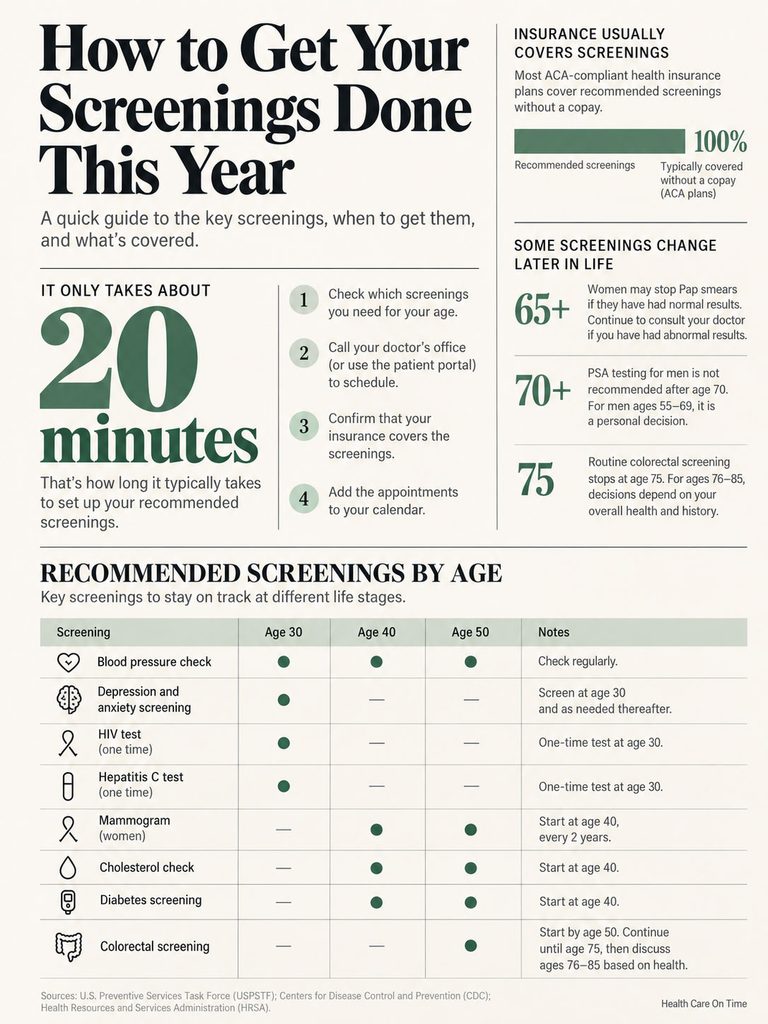
- Find your row. Use the main table above and circle each screening for your age and sex.
- Write down your family history. Note cancers, heart disease, and diabetes in parents and siblings, with ages.
- Call your insurer. Ask which screenings are covered at $0 and which in-network labs or imaging centers to use.
- Book one visit. A routine physical or Medicare Annual Wellness Visit can cover most items at once.
- Choose your colon test. If a colonoscopy feels like a barrier, ask about a mailed FIT kit.
- Get your results in writing. Keep a simple file with dates so you know when each test is due again.
- Set reminders. Many people tie screening to their birthday month.
If your doctor orders blood work, HealthCareOnTime can help you book lab tests like a lipid panel, A1C, or hepatitis C test near you. Our team has seen patients finish their whole yearly list in one morning this way.
Frequently Asked Questions
What health screenings should I get at 30?
At 30, you need a blood pressure check, depression and anxiety screening, and one-time HIV and hepatitis C tests if you haven’t had them. Women should continue cervical screening, now with the option of an HPV test every 5 years. Ask about earlier tests if your family history includes cancer or diabetes.
What screenings do I need at 40?
At 40, women should start mammograms every 2 years. Everyone should get a cholesterol check with a 10-year heart risk estimate, and adults with overweight should already be getting diabetes screening. Colorectal screening follows at 45, so 40 is a good time to plan which test you’ll choose.
What screenings should I get at 50?
At 50, continue colorectal screening, mammograms, blood pressure, and diabetes checks. If you have a 20 pack-year smoking history and smoke now or quit within 15 years, start yearly low-dose CT. Postmenopausal women with risk factors should ask about a bone density scan.
At what age do you stop getting a colonoscopy?
Routine colorectal screening stops at 75 for most adults. From 76 to 85, the decision depends on your health and past results. After 85, the USPSTF does not recommend screening. If you’ve had polyps, your doctor may set a different schedule.
Do I need a Pap smear after 65?
Usually not. Women over 65 can stop cervical screening if they’ve had several normal results in a row and no history of serious precancer. If you’ve never been screened or had a recent abnormal result, keep testing. Women who had a full hysterectomy for noncancer reasons don’t need it.
Is a PSA test still recommended?
For men 55 to 69, PSA testing is a personal decision made with your doctor. It can find some cancers early but also leads to false alarms and treatment of slow cancers that wouldn’t have caused harm. The USPSTF recommends against routine PSA testing at 70 and older.
Are health screenings free with insurance?
Most are. ACA-compliant plans must cover USPSTF A and B screenings with no copay when you use in-network providers. Medicare covers most of the same tests plus a yearly wellness visit. Follow-up testing after an abnormal result may have a cost, so ask your plan beforehand.
What blood tests should I get every year?
No single blood test is required yearly for every healthy adult. Common ones include a lipid panel every 5 years if normal, an A1C every 3 years if you’re at risk for diabetes, and one-time HIV and hepatitis C tests. Your doctor may add others based on medications or conditions.
Should I get a full-body MRI scan?
Full-body scans aren’t recommended for screening by any major U.S. medical group. They often find harmless spots that lead to more tests and anxiety without proven benefit. Spend that money on the evidence-based screenings in this guide instead.
How often should cholesterol be checked?
Most adults with normal results need a cholesterol check every 5 years. From 40 to 75, your doctor should use the result to estimate heart risk and decide about statins. If you have diabetes, high blood pressure, or a family history of early heart disease, you’ll likely need it more often.
Do men need a bone density test?
Not routinely. The USPSTF says there isn’t enough evidence to recommend bone density screening for all men. Men with risk factors, such as long-term steroid use, low testosterone, or a past fracture from a minor fall, should ask their doctor whether a DEXA scan makes sense.
Is a yearly physical necessary if I feel fine?
Feeling fine is exactly when screening works best, since most early cancers and high blood pressure cause no symptoms. A yearly visit isn’t strictly required for every test, but it’s the easiest way to stay on schedule, update your family history, and catch anything you’ve missed.
Disclaimer: This article is for general education and is not a substitute for advice from your own doctor. Screening ages and intervals apply to adults at average risk without symptoms. If you have symptoms, a strong family history, or a known genetic risk, talk with a healthcare professional about a personal screening plan.
References
- USPSTF: Final Recommendation Statement, Osteoporosis to Prevent Fractures
- California Department of Public Health: USPSTF A and B Recommendations
- American Cancer Society: Colorectal Cancer Statistics, 2026
- CDC Preventing Chronic Disease: Colorectal Cancer Screening Among Adults 45 to 75, BRFSS 2022
- JAMA via Patient Care: Colorectal Screening in Adults 45 to 49, 2019 to 2023
- AuntMinnie: ACS Report on Lung Cancer Screening Uptake, 2024
- University of Kentucky Markey Cancer Center: Lung Screening Rates, JAMA Internal Medicine
- NIH PMC: Lung Cancer Screening Eligibility and Completion, NHIS 2024
- Prevent Cancer Foundation: 2025 Early Detection Survey
- STAT: Kennedy Names Eight New USPSTF Members
- Fierce Healthcare: Kennedy Appoints 8 New USPSTF Members
- Healio: HHS Appoints Eight New Members to USPSTF
- FABBS: U.S. Preventive Services Task Force Faces Overhaul