
Weigh three pears from the same grocery bin and you will get three different calorie counts, sometimes off by 45 calories from each other. That single fact explains why your tracking app, the shelf label, and the health blog you read last week all disagree.
Table of Contents
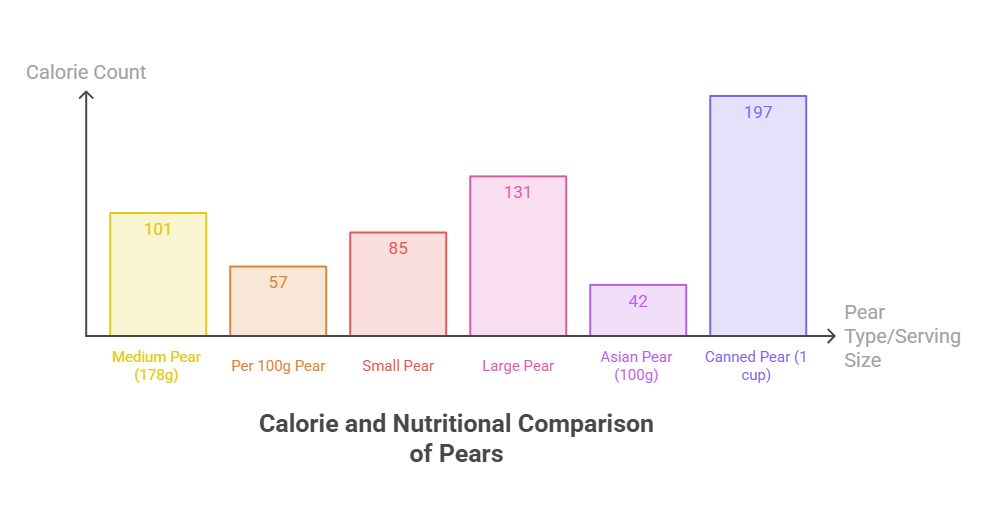
Quick Answer: One medium pear (178 grams, about 6.3 ounces) contains roughly 101 calories, according to USDA FoodData Central. That same pear delivers 27 grams of carbohydrate, 5.5 grams of dietary fiber, 17 grams of natural sugar, and almost no fat. Raw pear measures 57 calories per 100 grams. A small pear runs about 85 calories, a large one about 131.
At a Glance
- A medium pear (178 g) has 101 calories; the per-100-gram figure is 57 calories.
- Calories in a pear range from 85 (small) to 131 (large), a 46-calorie spread on the same fruit.
- One medium pear supplies 5.5 g of fiber, close to 20 percent of the 28 g Daily Value set by the FDA.
- Asian pears are the outlier at roughly 42 calories per 100 grams, about 26 percent below European varieties.
- One cup of pears canned in heavy syrup carries 197 calories, nearly double a fresh medium pear.
- Pear has a glycemic index near 38, which places it in the low-GI category.
- Roughly 84 percent of a raw pear is water, which is why it fills you up for so few calories.
Pear Calories by Size: The Exact USDA Numbers
Most articles answer this question with one number and move on. That number only helps if the pear in your hand weighs exactly what USDA assumed it would.
The USDA baseline: 57 calories per 100 grams
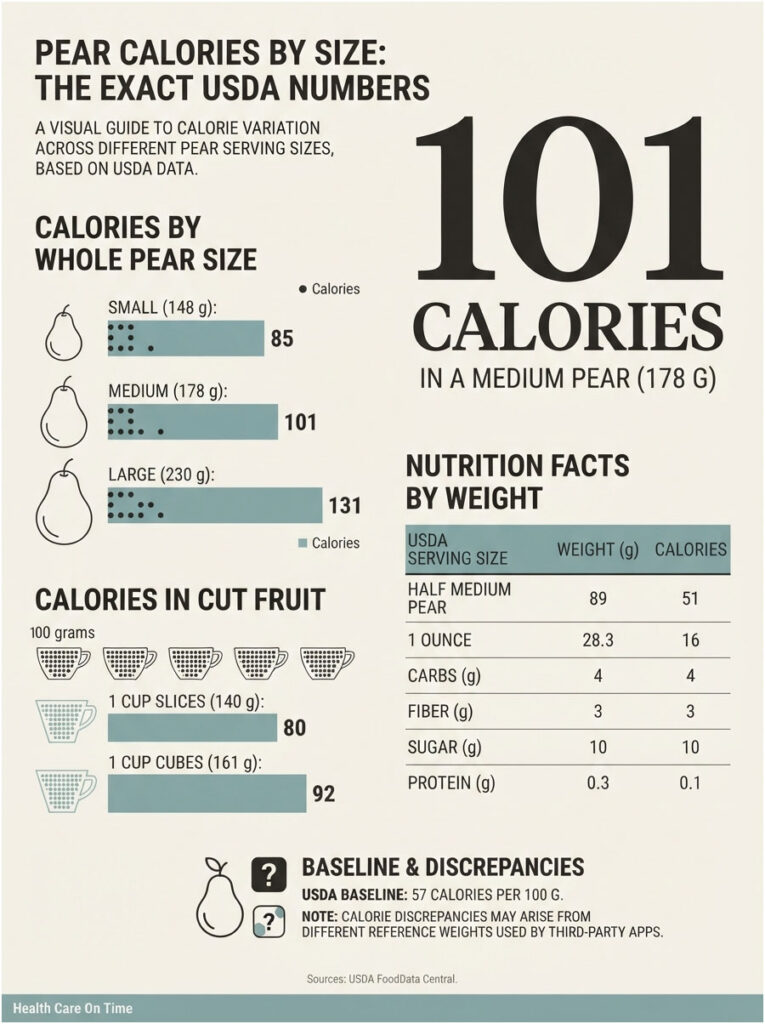
Every reliable pear calorie figure traces back to one reference entry: raw pears, listed in USDA FoodData Central at 57 calories per 100 grams. Everything else is arithmetic from there.
That entry also lists 15.2 g of carbohydrate, 3.1 g of fiber, 9.8 g of sugar, 0.36 g of protein, and 0.14 g of fat per 100 grams. Scale it to your fruit and you have your answer.
Our medical reviewers point patients toward the per-100-gram figure first, because it is the only version that survives contact with a kitchen scale.
Small, medium, and large pears compared
USDA assigns reference weights of 148 g for a small pear, 178 g for a medium, and 230 g for a large. Those translate to about 85, 101, and 131 calories.
The gap matters more than people expect. Swapping a small pear for a large one every afternoon adds roughly 46 calories a day, which compounds quietly over a year of daily snacking.
Sliced, cubed, and half-pear servings
Cut fruit changes the math because volume measures capture different amounts of flesh. One cup of pear slices weighs 140 g and holds 80 calories. One cup of cubes weighs 161 g and holds 92 calories.
Half a medium pear, roughly 89 g, comes in at 51 calories. A single ounce is 16 calories, which is the number you want when you are portioning pear into yogurt or oatmeal.
Table 1: Calories in a Pear by Serving Size (USDA Data)
| Serving | Weight (g) | Weight (oz) | Calories | Carbs (g) | Fiber (g) | Sugar (g) |
| 1 oz | 28 | 1.0 | 16 | 4.3 | 0.9 | 2.7 |
| Half a medium pear | 89 | 3.1 | 51 | 13.5 | 2.7 | 8.7 |
| 1 cup, slices | 140 | 4.9 | 80 | 21.3 | 4.3 | 13.7 |
| Small pear | 148 | 5.2 | 85 | 22.5 | 4.5 | 14.5 |
| 1 cup, cubes | 161 | 5.7 | 92 | 24.5 | 4.9 | 15.8 |
| NLEA label serving | 166 | 5.9 | 95 | 25.3 | 5.1 | 16.2 |
| Medium pear | 178 | 6.3 | 101 | 27.1 | 5.5 | 17.4 |
| Large pear | 230 | 8.1 | 131 | 35.0 | 7.1 | 22.5 |
| Reference amount | 100 | 3.5 | 57 | 15.2 | 3.1 | 9.8 |
Calculated from the USDA FoodData Central entry for raw pears (FDC ID 169118). Figures round to the nearest whole calorie.
Why your app says 96 and this page says 101
Open MyFitnessPal and you may see 96 calories for a medium pear. CalorieKing lists 103. Both are defensible, and neither contradicts the 101 figure.
The difference is the reference weight, not the food. FatSecret’s medium pear uses the 166 g NLEA label serving. CalorieKing starts from a 7 oz pear as purchased, which yields about 6.3 oz of edible fruit once stem, core, and seeds come off.
How USDA calorie factors change the math
A second, smaller source of drift sits underneath. USDA applies food-specific Atwater factors to fruit rather than the blanket 4/4/9 formula, so any database that recalculates calories from macronutrients lands a few points high.
Multiply 27.1 g of carbs by 4 and you reach 108 calories before protein and fat are even added. USDA’s fruit-specific calculation returns 101. Patients tracking to the calorie ask us about this gap constantly, and it explains most of the confusion online.
Full USDA Nutrition Breakdown of One Medium Pear
The calorie count is the headline. The rest of the label is where a pear earns its place in an American diet that runs chronically short on fiber and potassium.
Macronutrients: carbs, fiber, and very little else
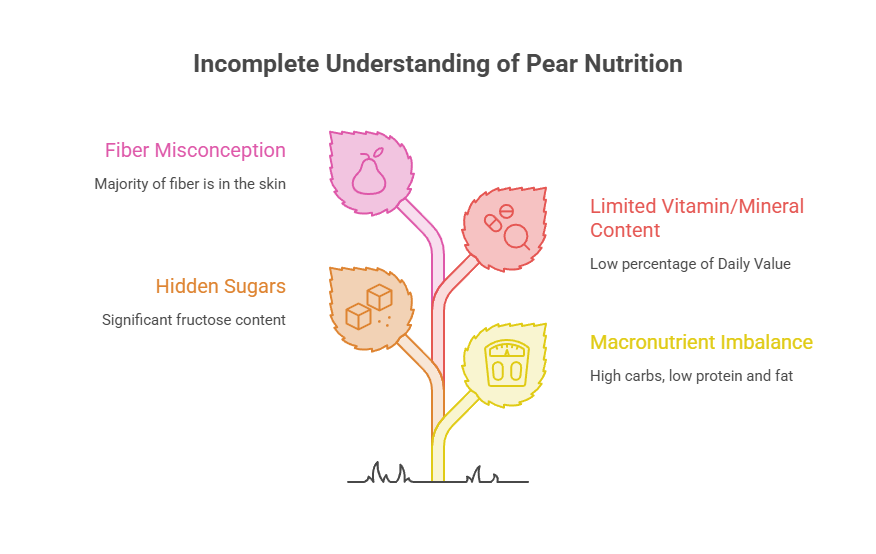
A medium pear is 27.1 g of carbohydrate, 0.64 g of protein, and 0.25 g of fat. By calorie share, that works out to roughly 96 percent carbohydrate, 2 percent protein, and 2 percent fat.
Pears are naturally sodium-free (about 1.8 mg per medium fruit) and cholesterol-free. That profile is one reason the Dietary Guidelines for Americans place whole fruit at 2 cups per day for a 2,000-calorie eating pattern.
Net carbs for keto and low-carb trackers
Subtract 5.5 g of fiber from 27.1 g of total carbs and a medium pear leaves 21.6 g of net carbohydrate. On a strict 20 g daily ketogenic target, a whole pear does not fit.
Half a pear at 10.8 g net carbs is workable for looser low-carb plans. Across patients we serve who track macros, splitting the fruit and pairing it with fat is the compromise that tends to stick.
The sugar question: 17 grams, none of it added
Seventeen grams of sugar sounds alarming until you check the source. None of it is added sugar, and the FDA Nutrition Facts label reflects that with a zero on the added sugars line.
The composition runs roughly 11.4 g fructose, 4.6 g glucose, and 1.3 g sucrose per medium pear. Fiber and water surround those sugars inside an intact cell matrix, which slows how quickly they reach your bloodstream.
Patients booking HbA1c and fasting glucose panels through HealthCareOnTime ask about fruit sugar more than any other food question. Whole fruit behaves nothing like the same grams of sugar poured out of a bottle.
Vitamins and minerals worth counting
Pears are not a micronutrient powerhouse, and any page claiming otherwise is overselling. What they do provide, they provide reliably.
One medium pear delivers about 206 mg of potassium (4 percent DV), 7.6 mg of vitamin C (8 percent DV), and 7.9 mcg of vitamin K (7 percent DV). Smaller amounts of calcium, magnesium, folate, and choline round out the panel.
Copper, the nutrient nobody mentions
The standout is copper. A medium pear carries roughly 0.15 mg, close to 16 percent of the Daily Value, making it the highest-percentage micronutrient in the fruit.
Copper supports iron metabolism, connective tissue, and nerve function. The NHANES analysis of pear eaters found higher usual copper intake among consumers than non-consumers, alongside more fiber, magnesium, potassium, and vitamin C.
Eighty-four percent water, and why that matters
A medium pear holds about 149 g of water inside 178 g of fruit. That is 84 percent by weight, and it is doing quiet work on your appetite.
Foods high in water and fiber carry low energy density, meaning you get a large volume of food for a small calorie cost. That is the mechanism behind most of the weight-related findings on pears.
Where the fiber actually lives
Peel a pear and you strip out a meaningful share of its fiber along with most of its antioxidant content. Cleveland Clinic dietitians specifically flag the skin as the fiber-dense portion of the fruit.
The pectin in pears is a soluble fiber that feeds gut bacteria and slows carbohydrate absorption. Eating the skin is the easiest way to collect the full 5.5 g.
Do Pear Calories Change by Variety?
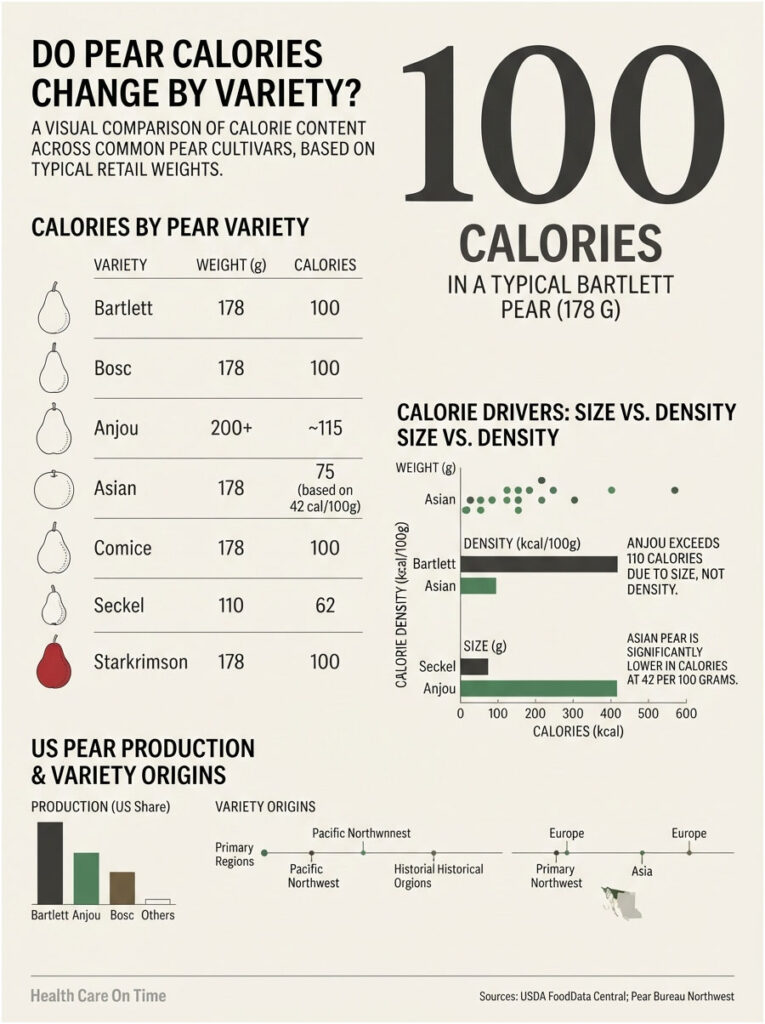
Ask ten shoppers whether a Bosc has more calories than a Bartlett and you will get ten guesses. Among European pear varieties the honest answer is that differences are too small to matter. Asian pears are a different story.
Bartlett, the American standard
Bartlett is the pear most Americans picture: bell-shaped, green turning yellow, soft when ripe. It is the traditional canning pear and the most widely planted variety in the country.
A medium Bartlett lands close to the 100-calorie mark with roughly 5.5 g of fiber. Nutritionally it is the reference point every other variety gets measured against.
Bosc, firmer and denser
Bosc pears wear that russeted bronze skin and stay firm even when ripe, which makes them the baking favorite. The firmer flesh means marginally less water per gram.
In practice, a medium Bosc lands within a few calories of a Bartlett of the same weight. Choose it for texture, not for a calorie advantage.
Green and Red Anjou
Anjou pears are rounder, without a distinct neck, and they hold their shape in salads. Green Anjou stays green when ripe, while Red Anjou deepens toward burgundy.
Anjous tend to run a little larger at retail, so an individual fruit can reach 110 calories or more simply because it weighs more. Per gram, the density is essentially identical to Bartlett.
Asian pear, the lowest-calorie option on the shelf
Here is the varietal gap that actually matters. Asian pears (also sold as nashi or apple pears) come in near 42 calories per 100 grams against 57 for European pears, roughly 26 percent lower.
A medium Asian pear around 122 g lands near 51 calories with about 4.4 g of fiber. That is close to half the calories of a European pear for a comparable fiber load.
Comice, Seckel, Forelle, and Starkrimson
Comice is the dessert pear, unusually juicy and soft. Seckel is the tiny one, often called the sugar pear, and its small size makes it a built-in portion control at roughly 50 calories.
Forelle and Starkrimson are small to medium and calorie-comparable to Bartlett per gram. Our medical team reviewed the separate USDA entries for named varieties and found no difference large enough to change a dietary recommendation.
Where American pears come from
Roughly 85 percent of the fresh US pear crop grows in the Pacific Northwest, with Oregon leading production and Washington close behind. Pears have been Oregon’s official state fruit since 2005.
USDA recorded total US pear production of 510,500 tons in 2024. Peak domestic supply runs late summer through winter, with imports from Argentina and Chile filling the spring gap.
Table 2: Pear Calories by Variety
| Variety | Typical Retail Weight | Calories | Fiber (g) | Best Use |
| Bartlett (yellow) | 178 g | 101 | 5.5 | Fresh eating, canning, sauces |
| Red Bartlett | 178 g | 101 | 5.5 | Salads, cheese boards |
| Bosc | 178 g | 101 | 5.5 | Baking, poaching, roasting |
| Green Anjou | 180 to 200 g | 103 to 114 | 5.5 to 6.1 | Salads, snacking, grilling |
| Red Anjou | 180 to 200 g | 103 to 114 | 5.5 to 6.1 | Snacking, slaws |
| Comice | 190 to 210 g | 108 to 120 | 5.8 to 6.4 | Dessert, cheese pairing |
| Seckel | 85 to 95 g | 49 to 54 | 2.6 to 2.9 | Kids’ snacks, pickling |
| Asian pear | 120 to 130 g | 50 to 55 | 4.3 to 4.7 | Raw, slaws, stir-fries |
Calories derived from USDA per-100-gram values applied to typical retail weight ranges. Asian pear figures use the separate USDA entry for Asian pears. Individual fruit varies.
Fresh vs Canned vs Dried vs Juice: Where Pear Calories Multiply
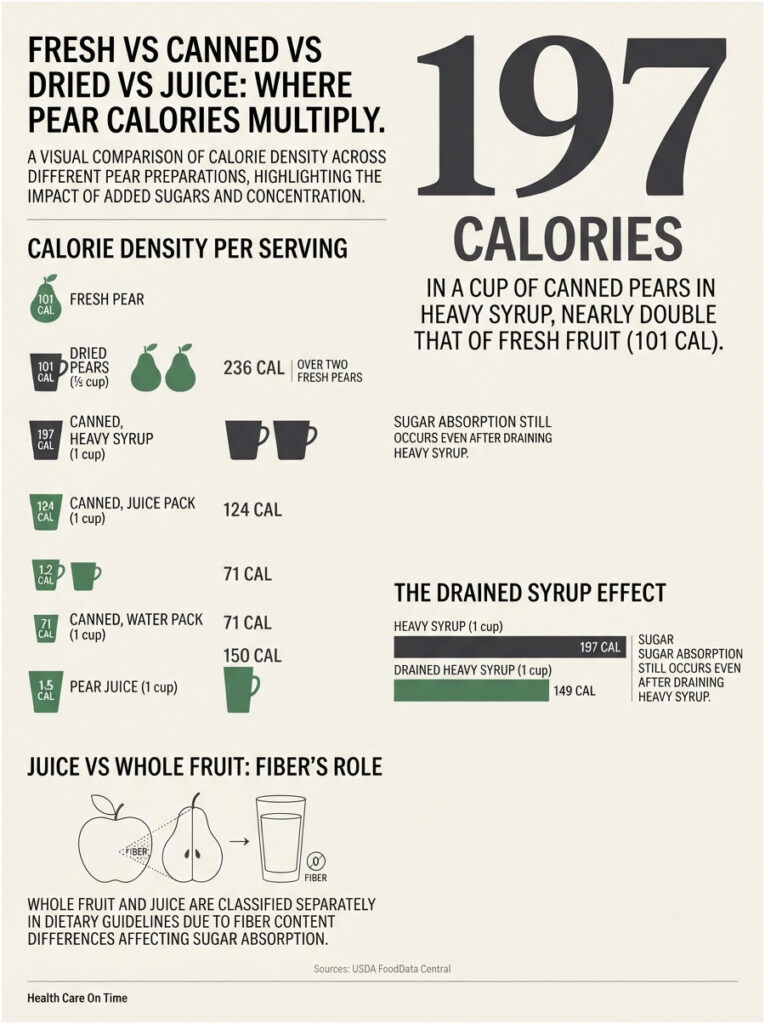
This is the section that changes grocery habits. The same fruit, processed four ways, spans a calorie range of nearly 200.
Canned in heavy syrup nearly doubles the count
One cup of pears canned in heavy syrup carries about 197 calories against 101 for a fresh medium pear. Extra heavy syrup pushes a cup of halves to roughly 258 calories.
The fruit did not change. The syrup did. Reading the panel takes four seconds and saves close to 100 calories per serving.
Juice pack and water pack compared
Juice pack sits in the middle at roughly 124 calories per cup, solids and liquids together. Water pack drops to about 71 calories per cup, the lowest canned option on the shelf.
Draining helps as well. Heavy-syrup pears drained of liquid fall to about 149 calories per cup, though the fruit has already absorbed sugar during processing.
Dried pears: same fruit, four times the density
Remove the water and everything concentrates, calories included. Half a cup of dried pear runs about 236 calories, more than two fresh medium pears.
Dried fruit is not a problem food; it is a portion trap. Weighing it once, then eyeballing that amount afterward, solves the issue in about thirty seconds.
Pear juice and nectar strip out the fiber
One cup of pear nectar contains roughly 150 calories with almost no fiber. The pectin that slowed sugar absorption in the whole fruit is gone.
Whole fruit and its juice are not interchangeable, and the Dietary Guidelines treat them as separate categories for exactly this reason.
Table 3: Pear Calories by Form
| Pear Form | Serving | Calories | Fiber (g) | Sugar (g) |
| Fresh, raw, medium | 1 pear (178 g) | 101 | 5.5 | 17.4 |
| Canned, water pack | 1 cup | 71 | 4.0 | 14.6 |
| Canned, extra light syrup | 1 cup | 120 | 4.0 | 26.0 |
| Canned, juice pack | 1 cup | 124 | 4.0 | 30.5 |
| Canned, heavy syrup | 1 cup | 197 | 4.3 | 43.0 |
| Pear nectar | 1 cup | 150 | 1.5 | 39.4 |
| Dried pear | 1/2 cup | 236 | 6.8 | 44.9 |
Values from USDA reference entries for canned, dried, and nectar pear products.
What 100 Calories of Pear Actually Does for You
A calorie count without context is trivia. Here is what the research says those 101 calories buy in an American diet.
Fiber, fullness, and the NHANES weight finding
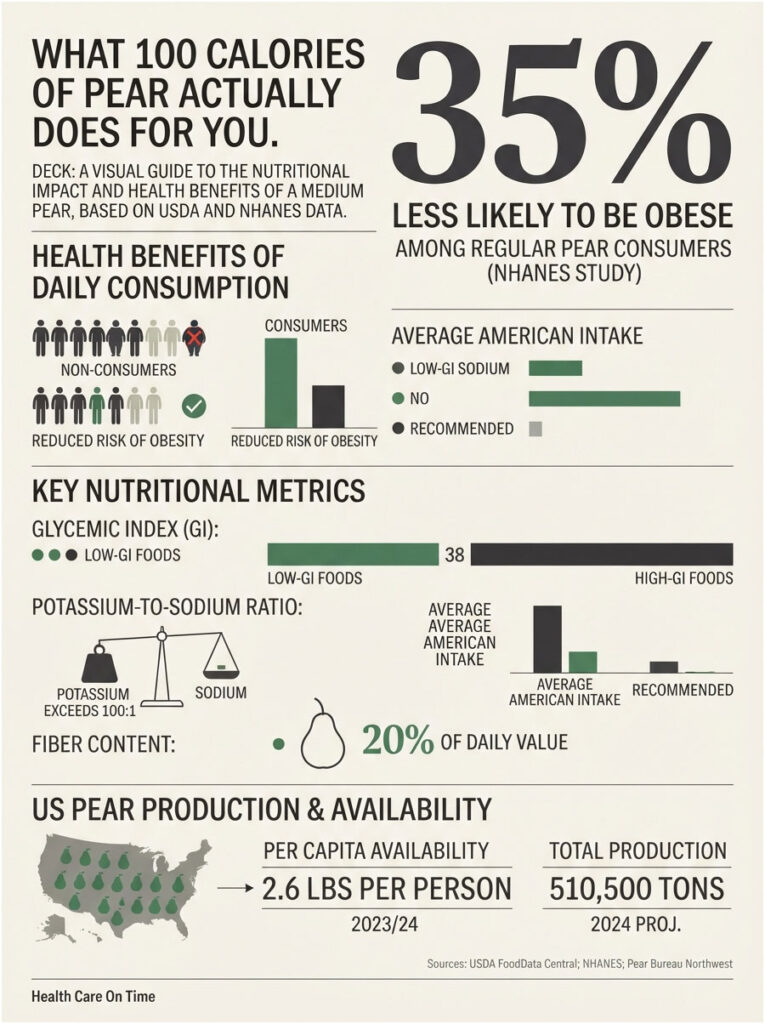
The largest population study on pears analyzed 24,808 US adults across NHANES cycles from 2001 to 2010. Adult pear consumers weighed less than non-consumers and were 35 percent less likely to be obese.
Researchers found no difference in total energy intake or physical activity between the groups, which pointed toward fiber as the probable driver. Pear eaters also scored higher on the Healthy Eating Index.
Association is not causation, and pear eaters likely differ in other habits too. Our medical reviewers read this finding as supportive rather than settled.
Blood sugar: a glycemic index near 38
Pear carries a glycemic index around 38, comfortably under the 55 threshold that defines a low-GI food. Its glycemic load sits near 4 per 100 grams, which is minimal.
USA Pears cites Diabetes Care for the 38 figure. Ripeness shifts the number more than variety does, with softer fruit registering slightly higher.
Patients managing type 2 diabetes who book HbA1c panels with us often assume all fruit is off the table. A whole pear eaten with the skin is one of the more forgiving choices available.
Heart markers and the quercetin in the peel
Pear skin contains quercetin, a flavonoid studied for effects on inflammation and blood pressure. A 12-week trial in 40 adults with metabolic syndrome had participants eat two medium pears daily.
That group showed improvement in cardiovascular risk factors including blood pressure and waist circumference, with reductions of up to 0.3 inches (0.7 cm) around the waist. The sample was small, so treat the result as preliminary.
Potassium, sodium, and the balance most Americans miss
At 206 mg of potassium against 1.8 mg of sodium, a pear runs a potassium-to-sodium ratio above 100 to 1. The average American diet runs the opposite direction.
CDC surveillance consistently shows sodium intake above recommended levels and potassium intake below. Whole fruit is one of the simplest corrections available.
Table 4: Pear Data and Research Findings, United States
| Finding | Figure | Population or Sample | Source |
| Lower obesity likelihood in pear consumers | 35% less likely | 24,808 US adults | O’Neil, Nicklas, Fulgoni, NHANES 2001 to 2010 |
| Waist reduction, 2 pears daily for 12 weeks | Up to 0.3 in (0.7 cm) | 40 adults with metabolic syndrome | Clinical trial cited by Healthline |
| Glycemic index of a medium pear | 38 (low category) | Standard GI testing protocol | Diabetes Care, via USA Pears |
| Fiber Daily Value per medium pear | About 20% of 28 g DV | US labeling reference | FDA Nutrition Facts label standard |
| Per capita fresh pear availability | 2.6 lb per person, 2023/24 | US population | USDA Economic Research Service |
| Total US pear production | 510,500 tons, 2024 | US growers | USDA National Agricultural Statistics Service |
Pear vs Apple vs Banana: The Calorie and Fiber Face-Off
The most common follow-up is whether a pear beats the fruit sitting next to it in the bowl.
Calories per medium fruit, side by side
A medium pear at 101 calories sits between a medium apple at 95 and a medium banana at 105. On calories alone, all three are interchangeable.
Berries and stone fruit come in lower. A cup of strawberries is 49 calories, a medium peach about 58.
Fiber per fruit, where the pear pulls ahead
Fiber is where the pear separates itself. At 5.5 g it beats a medium apple (4.4 g) and roughly doubles a medium banana (3.1 g).
That advantage matters because most American adults fall well short of the 28 g Daily Value. One pear closes about a fifth of that gap in a single snack.
Which fruit fits which goal
Reach for a pear when you want fiber and staying power, a banana before a workout, berries for the lowest calorie density, and an Asian pear when you want volume for almost nothing.
Table 5: Common Fruits Compared
| Fruit | Typical Weight | Calories | Fiber (g) | Sugar (g) | Glycemic Index |
| Pear, medium | 178 g | 101 | 5.5 | 17.4 | About 38 (low) |
| Apple, medium | 182 g | 95 | 4.4 | 19.0 | About 36 (low) |
| Banana, medium | 118 g | 105 | 3.1 | 14.4 | About 51 (low to medium) |
| Navel orange, medium | 140 g | 73 | 2.8 | 12.0 | About 43 (low) |
| Strawberries | 1 cup (152 g) | 49 | 3.0 | 7.4 | About 41 (low) |
| Peach, medium | 150 g | 58 | 2.3 | 12.6 | About 42 (low) |
| Asian pear, medium | 122 g | 51 | 4.4 | 8.6 | Low, not well established |
Glycemic index values are approximate and shift with ripeness, preparation, and testing method.
How to Fit Pears Into Your Calorie Target
Knowing the number is step one. Making it work inside a real daily target is where most people stall.
On 1,200, 1,500, and 2,000 calories a day
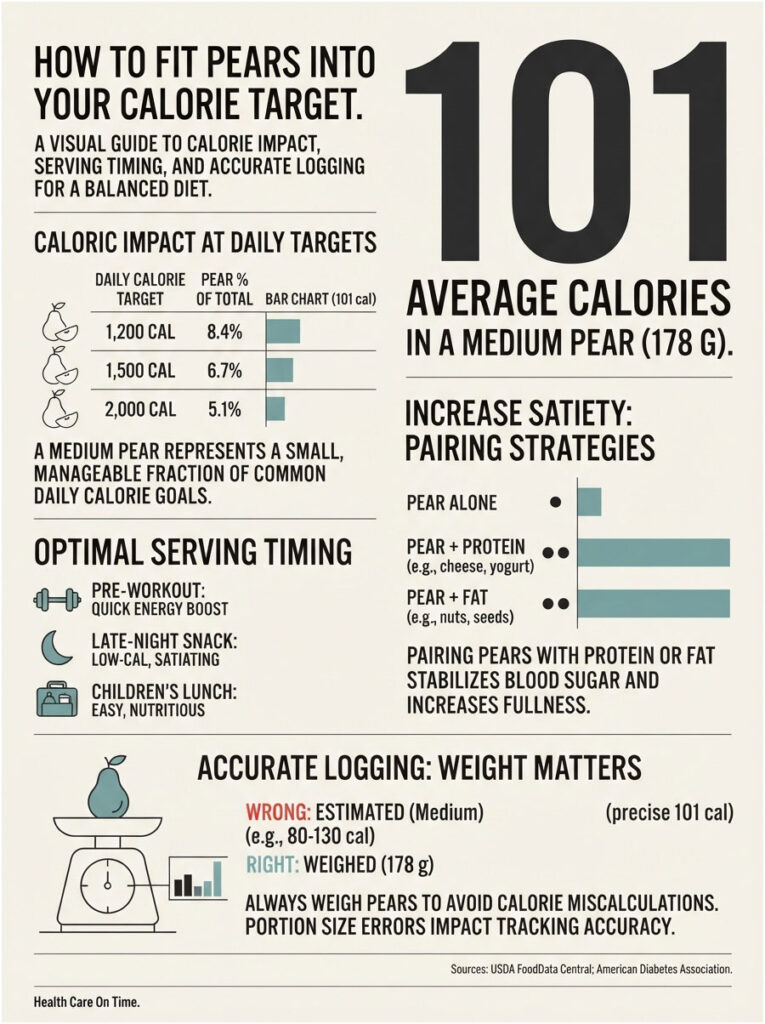
At 1,200 calories, one medium pear consumes about 8.4 percent of your daily budget. At 1,500 it drops to 6.7 percent, and at 2,000 it is roughly 5 percent.
Two pears a day fits comfortably inside a 2,000-calorie pattern and still lands within the 2-cup fruit recommendation. At 1,200 calories, one pear plus a lower-calorie fruit is the more workable split.
Pairing a pear so it holds you longer
Fruit on its own empties the stomach quickly. Adding protein or fat slows gastric emptying and flattens the glucose curve.
A medium pear with one tablespoon of natural peanut butter lands near 195 calories. With one ounce of sharp cheddar, roughly 215. With plain Greek yogurt, about 200 with real protein attached.
Timing: pre-workout, post-dinner, and bedtime
A pear 45 to 60 minutes before moderate exercise supplies accessible carbohydrate without much digestive load. Its low glycemic index avoids the spike-and-crash pattern of a sports drink.
For a late-night sweet craving, half a chilled pear at 51 calories usually settles it. Patients tell us evening fruit substitution is one of the easier swaps to keep going long term.
Portion habits that keep your app honest
Log by weight, not by adjective. Enter “pear, raw” from the USDA database, then type in the gram weight from your scale.
The 30-calorie error hiding in “one pear”
Logging every pear as “1 medium” while actually eating large fruit understates intake by roughly 30 calories each time. Repeat that daily and your tracker drifts far enough to explain a stalled plateau.
Table 6: Your Situation, Your Pear Serving
| Your Situation | Recommended Pear Serving | Calorie Impact | Why It Works |
| Calorie deficit at 1,200/day | 1 small pear (148 g), skin on | 85 cal, 7% of budget | High volume, 4.5 g fiber, strong satiety per calorie |
| Type 2 diabetes or prediabetes | 1 medium pear with 1 oz cheese | 101 + 115 = 216 cal | GI 38 plus protein and fat blunts the glucose rise |
| Keto or strict low-carb | Half a medium pear (89 g) | 51 cal, 10.8 g net carbs | Keeps net carbs inside a 20 to 30 g daily ceiling |
| Constipation or low fiber intake | 1 large pear (230 g), unpeeled | 131 cal, 7.1 g fiber | Pectin plus insoluble fiber, 25% of the 28 g DV |
| Pre-workout fuel | 1 medium pear, 45 to 60 min prior | 101 cal, 27 g carbs | Steady carbohydrate release without a sharp spike |
| Kid’s lunchbox | 1 Seckel pear or half a Bartlett | About 50 cal | Right-sized portion, no cutting or browning issues |
| Late-night sweet craving | Half a chilled pear with cinnamon | 51 cal | Satisfies sweetness at a fraction of dessert calories |
| Pregnancy snack | 1 medium pear with Greek yogurt | About 200 cal | Adds folate, potassium, fiber, and protein together |
Mistakes That Wreck Your Pear Calorie Math
Logging “1 pear” without a weight
This is the largest single source of error. Retail pears run anywhere from 120 g to over 250 g, a swing of more than 70 calories on the same food.
A $12 kitchen scale eliminates the problem permanently. Weigh the fruit, subtract nothing for the core if you eat around it, and log the gram figure.
Peeling away the part that matters
The skin holds a significant share of the fruit’s fiber and most of its antioxidant content, including quercetin. Peeling saves you almost no calories and costs you the nutrient that makes a pear worth choosing.
If texture is the objection, try a firmer variety like Bosc or an Asian pear. Both hold thinner, less noticeable skin than a fully ripe Bartlett.
Treating canned as equivalent to fresh
A cup of heavy-syrup pears is not a stand-in for fresh fruit at nearly double the calories. Choose water pack or juice pack, then drain and rinse before eating.
Rinsing canned fruit removes a meaningful portion of the surface syrup. It takes fifteen seconds and it is the highest-return habit in this entire article.
Assuming juice counts as fruit
Pear nectar delivers the sugar without the fiber that governs how your body handles it. Whole fruit and juice belong in different columns of your food log.
Ignoring ripeness and how you store it
Pears do not ripen well on the tree, which is why they arrive at US grocery stores firm. Total calories barely move as they soften, but the starch-to-sugar conversion nudges the glycemic response upward.
Check ripeness by pressing gently at the neck near the stem rather than squeezing the body, which only bruises the fruit. Ripen at room temperature, then move to the refrigerator to hold that stage for several more days.
Frequently Asked Questions
How many calories are in one medium pear?
A medium pear weighing 178 grams (6.3 ounces) contains about 101 calories per USDA FoodData Central. It also provides 27.1 g of carbohydrate, 5.5 g of fiber, 17.4 g of natural sugar, and 0.64 g of protein. Fat is negligible at 0.25 g.
How many calories are in a large pear?
A large pear at USDA’s 230-gram reference weight contains roughly 131 calories. That includes 35 g of carbohydrate and 7.1 g of dietary fiber, about 25 percent of the 28-gram Daily Value. Grocery pears often exceed this weight, so a scale is worth using.
How many calories are in half a pear?
Half a medium pear weighs about 89 grams and contains roughly 51 calories. You get 13.5 g of carbohydrate, 2.7 g of fiber, and 8.7 g of sugar. Half a pear is a practical portion for low-carb plans or late-evening snacks.
Is a pear more calories than an apple?
Slightly. A medium pear (178 g) has about 101 calories against roughly 95 for a medium apple (182 g). The pear wins on fiber, delivering 5.5 g compared with the apple’s 4.4 g. For satiety per calorie, the pear has the edge.
How many calories are in a cup of sliced pears?
One cup of raw pear slices weighs 140 grams and contains about 80 calories. That serving supplies 21.3 g of carbohydrate, 4.3 g of fiber, and 13.7 g of sugar. Cubed pear packs denser, so a cup of cubes (161 g) reaches about 92 calories.
How many calories are in a pear without the skin?
Peeling removes roughly 10 percent of the fruit’s weight, bringing a medium peeled pear to about 91 calories. The calorie saving is minor, but you lose a meaningful share of the fiber and most of the antioxidants. Eating the skin is the better trade.
Do canned pears have more calories than fresh pears?
Usually yes, sometimes dramatically. One cup of pears in heavy syrup contains about 197 calories against 101 for a fresh medium pear. Water-pack canned pears are the exception at roughly 71 calories per cup. Check the panel and rinse when possible.
How many calories are in an Asian pear?
A medium Asian pear weighing about 122 grams contains roughly 51 calories. Asian pears average 42 calories per 100 grams versus 57 for European varieties, mainly because of higher water content. Fiber stays competitive at about 4.4 g per fruit.
Are pears good for weight loss?
Evidence is supportive rather than conclusive. A NHANES analysis of 24,808 US adults found pear consumers were 35 percent less likely to be obese than non-consumers. The mix of 84 percent water, 5.5 g of fiber, and roughly 100 calories creates high satiety at low energy density.
How many net carbs are in a pear on keto?
A medium pear contains 21.6 g of net carbohydrate after subtracting 5.5 g of fiber from 27.1 g total. That exceeds most strict ketogenic daily limits. Half a pear at 10.8 g net carbs is the more realistic option on a moderate low-carb plan.
Do pears raise blood sugar?
Less than most fruits. Pear registers a glycemic index near 38, below the 55 low-GI threshold, with a glycemic load around 4 per 100 grams. Fiber and water slow sugar absorption. Ripeness affects the response more than variety does.
How many pears can you eat in a day?
For most healthy adults, one to two medium pears daily fits within the Dietary Guidelines recommendation of 2 cups of fruit for a 2,000-calorie pattern. That contributes roughly 200 calories and 11 g of fiber. Anyone managing diabetes or kidney disease should confirm portions with their clinician.
Medical Disclaimer: Nutrition values on this page reflect USDA reference averages. Individual fruit varies by variety, growing conditions, ripeness, and size, so actual calories in a pear may differ from the figures shown. This content is provided for general education and does not replace personalized medical or dietary advice. Anyone managing diabetes, chronic kidney disease, hereditary fructose intolerance, or a fiber-restricted condition should discuss fruit intake with a licensed healthcare provider before making changes.
References
- USDA FoodData Central, Pears, raw (FDC ID 169118)
- USDA FoodData Central home
- Dietary Guidelines for Americans, 2020 to 2025
- FDA, Daily Value on the Nutrition and Supplement Facts Labels
- USDA SNAP-Ed Connection, Seasonal Produce Guide: Pears
- USDA Economic Research Service, per capita fresh pear use
- O’Neil CE, Nicklas TA, Fulgoni VL, Fresh Pear Consumption and Weight Parameters in Adults, NHANES 2001 to 2010
- EurekAlert, adult fresh pear consumers and lower body weight
- Cleveland Clinic, health benefits of pears
- Healthline, health and nutrition benefits of pears
- Medical News Today, pear types, calories, and nutrition
- USA Pears, pears and diabetes
- USA Pears, pear nutrition facts
- Northwest Horticultural Council, pear fact sheet
- Agricultural Marketing Resource Center, pears commodity profile