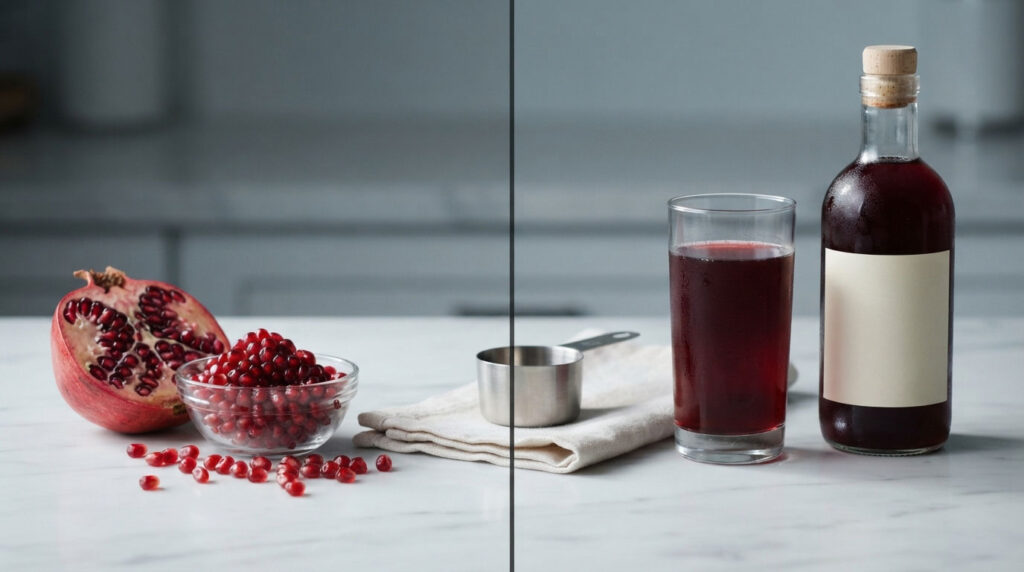
Quick Answer
Whole pomegranate arils are healthier for most Americans. One cup delivers 7 grams of fiber and 23.9 grams of sugar, while 8 ounces of 100% juice delivers zero fiber and about 32 grams of sugar. Juice earns its place in one narrow case: a measured polyphenol dose for blood pressure support, capped near one cup daily.
Table of Contents
Here is the detail that trips up almost everyone comparing the two. Punicalagin, the compound pomegranate built its reputation on, barely exists in the ruby arils you spoon out at home.
It lives in the rind and the white pith. Commercial presses crush all of it together, pushing those polyphenols straight into the bottle.
So the processed version can out-measure the whole version on the one compound everyone cares about. That single fact reframes a debate most health articles settle in a throwaway sentence.
At a Glance
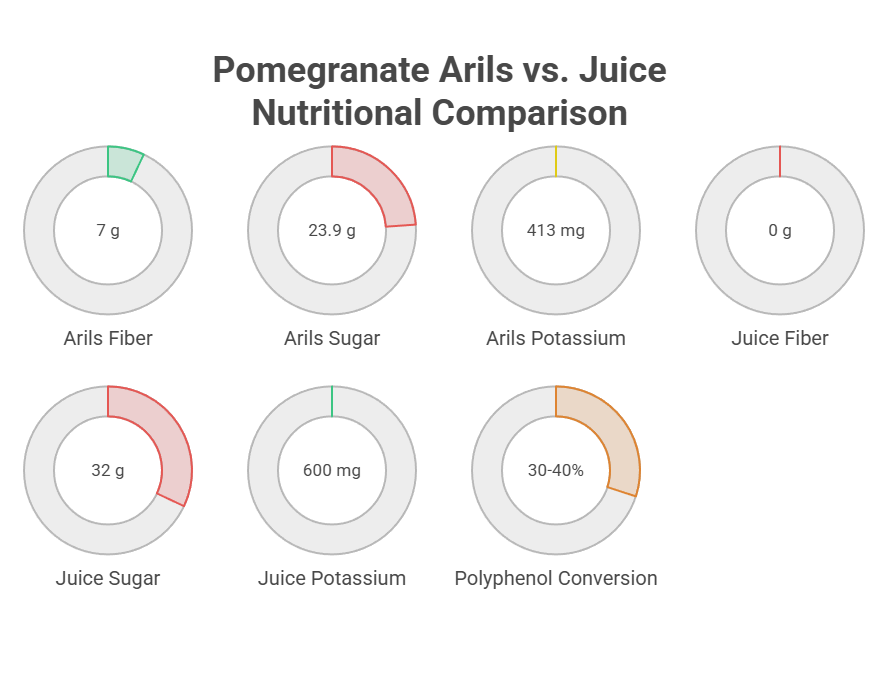
- One cup of arils: 145 calories, 7 g fiber, 23.9 g sugar, 413 mg potassium
- Eight ounces of 100% juice: about 150 calories, 0 g fiber, 32 g sugar, 600 mg potassium
- Juicing removes fiber completely and degrades most vitamin C
- Commercial pressing extracts punicalagins from the rind, so bottled juice can beat arils on that compound
- The blood pressure benefit peaks near 8 ounces daily and stalls above it
- Roughly 30 to 40 percent of people lack the gut bacteria to convert pomegranate polyphenols into their active form
- Anyone on warfarin, a statin, or blood pressure medication should clear either form with a pharmacist
The Short Answer, Sorted by What You Actually Want
Most people asking this question already have a goal. The honest answer shifts depending on that goal, so start here rather than with nutrition tables.

When Whole Arils Win
For weight management, blood sugar control, and general daily nutrition, arils win without much argument. Fiber slows sugar absorption and forces you to chew, which caps intake naturally.
Eating a cup of arils takes eight to twelve minutes. Drinking a cup of juice takes about forty seconds, and the sugar reaches your bloodstream on that same schedule.
Patients booking metabolic panels with us often ask whether natural fruit sugar gets a free pass. It does on quality. It does not on speed, and speed is what your pancreas responds to.
When Juice Wins
For blood pressure specifically, juice has the stronger clinical record, largely because juice is what researchers put in the trials. It also delivers a repeatable dose, which arils cannot match since fruit size and ripeness swing widely.
Juice wins on availability too. Fresh pomegranates are seasonal, while bottled juice sits on shelves in July.
Athletes get a third case. Liquid polyphenols absorb faster around a training window than a bowl of arils eaten with a meal.
The Third Option Most Comparisons Skip
Standardized pomegranate extract capsules exist, and they solve the sugar problem outright. A 250 mg capsule can carry 75 mg of punicalagin with zero grams of sugar.
Research supports the format. A randomized, double-blind, placebo-controlled trial in healthy adults aged 25 to 55 found that a punicalagin-enriched extract measurably shifted gut microbial metabolite production over four weeks.
The tradeoff is regulatory. Supplements are not reviewed by the FDA for effectiveness before sale, so potency varies by brand and third-party testing matters.
Our medical reviewers treat extracts as a targeted tool, not a food replacement. Arils bring fiber, vitamin C, folate, and satiety that no capsule reproduces.
What Actually Changes When a Pomegranate Becomes Juice
Juicing is not a neutral act. It strips some nutrients completely, concentrates others, and adds one compound that was never really in the arils to begin with.
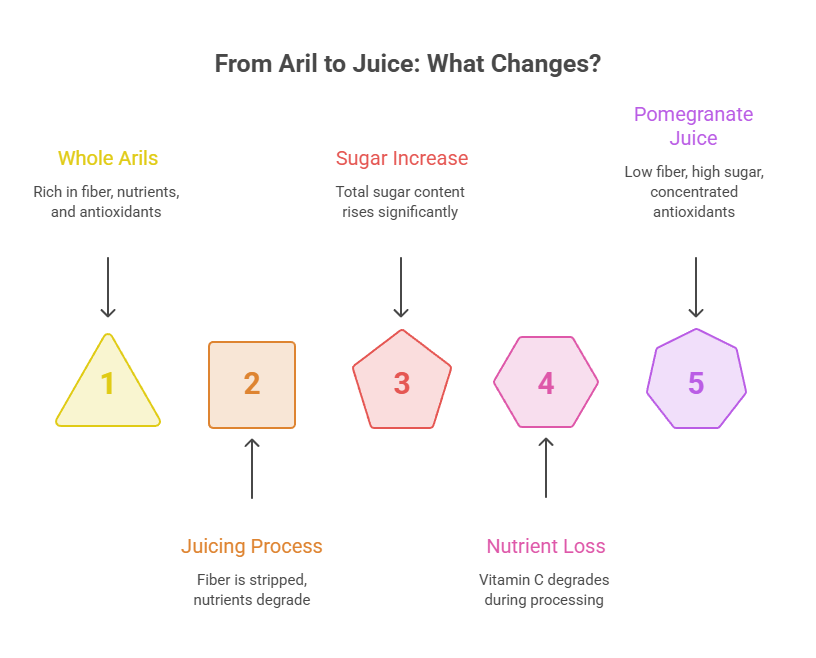
Table 1: Whole Arils vs 100% Pomegranate Juice, Side by Side
| Nutrient or Factor | 1 Cup Arils (174 g) | 8 fl oz 100% Juice | Practical Difference | Who Should Care Most |
| Calories | 145 | 150 | Nearly identical | Weight management |
| Total sugar | 23.9 g | 32 g | Juice carries 34% more | Diabetes, prediabetes |
| Dietary fiber | 7 g | 0 g | Complete loss in juicing | Blood sugar, gut health, satiety |
| Vitamin C | 17.8 mg | Trace to low | Heat and light degrade it | Immune support |
| Potassium | 413 mg | 600 mg | Juice runs 45% higher | Kidney disease, hypertension |
| Punicalagin source | Arils only, moderate | Arils plus pressed rind, high | Juicing extracts more | Antioxidant seekers |
| Time to consume | 8 to 12 minutes | 40 seconds | Satiety signaling differs sharply | Appetite control |
| Cost per serving | $1.25 to $2.50 in season | $1.00 to $1.50 | Juice cheaper off-season | Budget shoppers |
Figures reflect USDA FoodData Central values for raw arils and Nutrition Facts panels from leading US bottled brands.
The Fiber That Does Not Survive the Press
One medium pomegranate carries roughly 6 grams of fiber, about 21 percent of the daily value most American adults never reach. That fiber sits physically bound inside the aril’s seed and flesh.
Juicing separates liquid from solids by design. The fiber lands in the pulp discard, which is why every 100% pomegranate juice label reads zero grams.
This matters more than the sugar number. Fiber slows glucose absorption, feeds colonic bacteria, and triggers fullness signals that liquid calories bypass entirely.
Across follow-up consultations in our diagnostic network, people who switch from juice to arils rarely report feeling deprived. The chewing does most of the satisfaction work.
Sugar Load and Speed of Delivery
The sugar in both forms is intrinsic fruit sugar, not added sugar. That distinction is real and matters for long-term metabolic risk.
It changes nothing about absorption speed. Eight ounces of juice delivers roughly 32 grams of sugar with nothing slowing it, which is close to the sugar in a 12-ounce can of soda.
Portion math makes the gap concrete. One 8-ounce glass takes the arils from about two to three medium pomegranates, which almost nobody eats in a single sitting.
That is the real mechanism behind this entire debate. Juice removes the natural stopping point.
Vitamin C, Heat, and Shelf Stability
Vitamin C is fragile. It breaks down with heat, light, and oxygen, all three of which appear in commercial pasteurization and bottling.
Potassium and the polyphenol fraction hold up far better. Minerals are heat-stable, and the tannin family behind pomegranate’s astringent bite survives processing largely intact.
The loss profile is uneven, then. Fiber goes to zero, vitamin C drops substantially, and the antioxidant load mostly carries through.
From Concentrate vs Not From Concentrate
“From concentrate” means water was evaporated off for cheaper shipping, then added back before bottling. That extra heat step costs additional vitamin C and volatile flavor compounds.
“Not from concentrate” skips evaporation. It costs more and tastes closer to fresh, though the polyphenol difference is smaller than the price gap suggests.
Either way, confirm the label reads 100% juice. A “pomegranate blend” is usually apple or white grape juice wearing a pomegranate costume.
The Punicalagin Reversal Most Articles Get Backwards
Pomegranate’s headline antioxidants are ellagitannins, a family that includes punicalagin. These hydrolyzable tannins break down into ellagic acid in the body, according to research catalogued by the National Institutes of Health.
Here is the part that gets skipped everywhere. Punicalagin concentrates in the peel and the white membrane, not in the aril juice sacs.
Industrial juicing presses the entire fruit. That crushing extracts punicalagins from the husk and membrane and releases them into the juice in large quantities.
The result runs against intuition. Commercial bottled juice frequently tests higher in punicalagin than hand-eaten arils, and higher than juice you squeeze yourself from arils alone.
Our lab partners see this reflected in antioxidant capacity assays, where whole-pressed commercial juice consistently outscores hand-extracted aril juice. The rind is doing the heavy lifting.
That does not crown juice the winner. It does mean the standard claim that juice is a hollowed-out version of the fruit is only half true.
Do You Eat the Seed or Just the Juice Sac?
Each aril is a hard seed wrapped in a translucent juice sac. Plenty of people spit out the seed, which costs them most of the fiber.
Eat both. The seed supplies the insoluble fiber that drives the satiety and glucose benefits, and the crunch is the point.
Anyone with diverticulitis flares or a history of bowel obstruction should ask their gastroenterologist first. For everyone else, the seed is the nutritional payload.
What the Research Actually Shows
Pomegranate has been studied heavily, and the evidence is stronger in some places than the marketing implies. Blood pressure has the most consistent data.
Table 2: Key Research Findings on Pomegranate and Cardiovascular Markers
| Finding | Number | Study Type and Size | Source |
| Systolic BP reduction from juice | 5.02 mmHg drop | Meta-analysis, 14 clinical trials, 573 adults | Phytotherapy Research, 2023 |
| Optimal dose effect | 6.11 mmHg drop at 300 mL or less daily | Same meta-analysis, dose subgroup | Phytotherapy Research, 2023 |
| Higher dose effect | No significant systolic change above 300 mL daily | Same meta-analysis, dose subgroup | Phytotherapy Research, 2023 |
| Pooled effect across all pomegranate forms | 3.52 mmHg systolic, 1.50 mmHg diastolic | Meta-analysis, 33 randomized trials, 1,490 adults aged 20 to 75 | Published January 2026 |
| Earlier pooled juice estimate | 4.96 mmHg systolic, 2.01 mmHg diastolic | Meta-analysis, 8 randomized controlled trials | Pharmacological Research, 2017 |
| US total fruit intake | 1.06 cup equivalents daily, about 65% from whole fruit | NHANES, 16,628 US children and adults | National Health and Nutrition Examination Survey |
Blood Pressure and the Dose Ceiling Nobody Mentions
A 2023 systematic review pooled 14 clinical trials covering 573 people and found pomegranate juice lowered systolic pressure by an average of 5.02 mmHg.
Then it surfaced something health articles routinely skip. Daily intake at or below 300 mL produced a 6.11 mmHg systolic drop, while intake above 300 mL produced no statistically significant systolic effect at all.
More juice did not mean more benefit. It meant less.
A second pattern appeared on duration. The blood pressure advantage faded after roughly two months of continuous daily intake, which points toward physiological adaptation.
A larger 2026 pooled analysis of 33 randomized controlled trials across 1,490 adults aged 20 to 75, covering juice doses from 50 to 500 mL daily plus extracts and seed oil, reported smaller effects at 3.52 mmHg systolic and 1.50 mmHg diastolic.
For context, a 5 mmHg systolic reduction across a population meaningfully shifts stroke and heart disease risk. For one person with mild hypertension, it is a useful nudge, not a substitute for medication.
Inflammation Markers
That same 2026 analysis reported reductions in interleukin-6 and intercellular adhesion molecule 1, two markers tied to vascular inflammation.
Those are surrogate endpoints, not clinical outcomes. Lower IL-6 is encouraging, but no trial has shown that drinking pomegranate juice prevents a heart attack.
Across the inflammatory panels processed through our network, dietary polyphenol intake reads as a supporting factor rather than a primary driver. Sleep quality, body composition, and smoking status move those numbers far harder.
Why the Same Glass Works for Your Neighbor and Not for You
Ellagitannins are poorly absorbed on their own. Gut bacteria must convert them into smaller compounds called urolithins, and urolithin A is the metabolite linked to mitochondrial and cellular benefits.
That conversion depends entirely on which bacterial species live in your colon. Genera including Gordonibacter and Ellagibacter perform the work, and not everyone hosts them in useful numbers.
A 2026 phytochemistry review identifies this microbiota-driven conversion as a major determinant of systemic bioactivity and a leading explanation for why trial results scatter so widely between individuals.
This loops back to fiber in a way that favors arils. Fiber feeds the bacterial populations that run the conversion, so a higher-fiber diet supports the machinery that makes pomegranate polyphenols usable at all.
Juice delivers more raw ellagitannin. Arils help build the system that processes it. That is not a small distinction.
What a Federal Case Taught Everyone About Pomegranate Claims
This topic carries a documented history of overselling, and American readers deserve the full picture.
POM Wonderful invested more than $35 million across 100-plus studies at 44 institutions, then advertised that its juice and supplements could treat, prevent, or reduce the risk of heart disease, prostate cancer, and erectile dysfunction.
The Federal Trade Commission filed an administrative complaint in September 2010. In January 2013 the Commission found deceptive claims across 36 advertisements and promotional materials, and required competent, reliable scientific evidence for any future health or efficacy claim.
The D.C. Circuit Court of Appeals affirmed on January 30, 2015, while modifying the evidence standard to require at least one randomized controlled trial rather than two.
The takeaway is not that pomegranate is worthless. The takeaway is that the distance between “polyphenols show activity in trials” and “this juice prevents cancer” is a legal and scientific canyon.
Patients frequently ask our team whether a food can replace a prescription. On this topic, a federal appeals court has already answered.
The American Grocery Aisle Reality: Cost, Season, and Time
Nutrition tables assume both options are equally available. In the United States they are not.
California grows the overwhelming majority of American pomegranates, with roughly 30,000 bearing acres in the San Joaquin Valley. The domestic season runs October through January, peaking October to December.
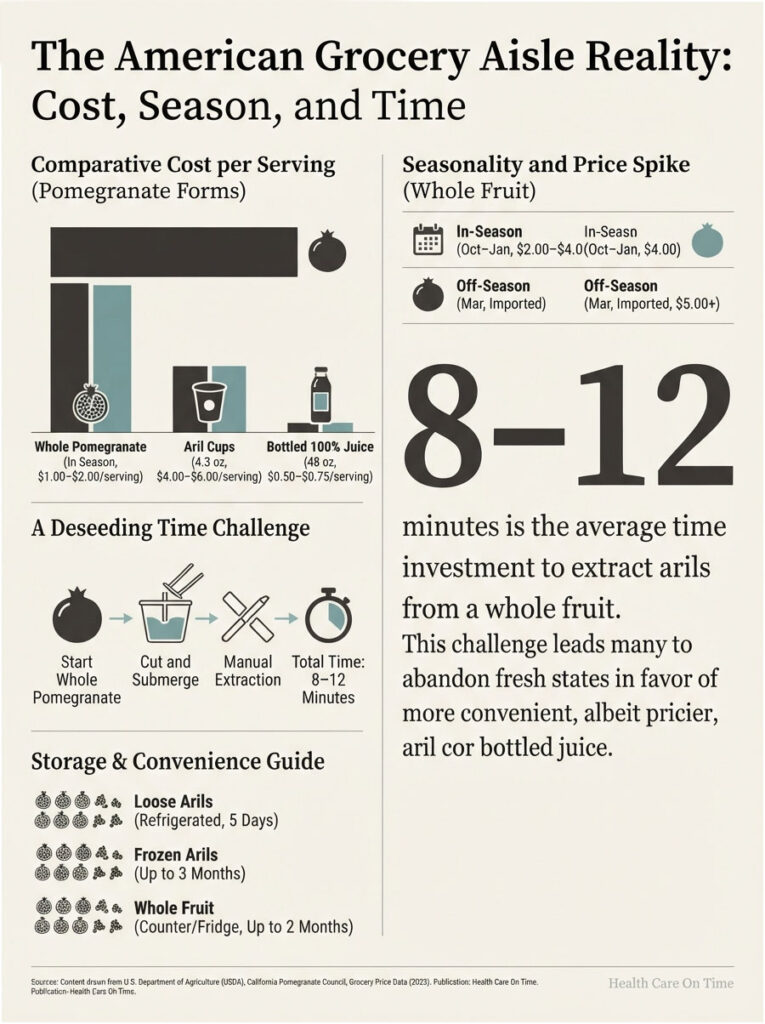
That leaves eight months a year when fresh domestic fruit is gone or imported at a premium. Bottled juice has no such gap.
Price Per Serving, Run Honestly
A whole pomegranate typically runs $2.00 to $4.00 in season and yields 1.5 to 2 cups of arils. That works out to roughly $1.25 to $2.50 per one-cup serving.
Ready-to-eat aril cups cost more per ounce, usually $4.00 to $6.00 for a 4.3-ounce container holding about 100 calories. Convenience carries a real markup.
Bottled 100% juice lands near $6.00 to $9.00 for a 48-ounce bottle, or roughly $1.00 to $1.50 per 8-ounce pour. Store brands price lower.
Off-season the math flips hard. A single imported pomegranate can hit $5.00 in March, at which point juice is both cheaper and better tasting.
The Ten-Minute Deseeding Problem
Getting arils out of a pomegranate is genuinely annoying, and this is where most people quit. Score the rind along its natural ridges, break it open under water in a bowl, and the arils sink while the pith floats.
Budget eight to twelve minutes the first few attempts, five once you find the rhythm. Skip the tapping-with-a-spoon method, which bruises the arils and stains everything within three feet.
Readers who write to HealthCareOnTime about abandoning whole fruit almost always cite this step rather than taste.
Storing and Freezing So the Season Lasts
Whole pomegranates keep two to three weeks on the counter and up to two months in the refrigerator crisper. The thick rind is built for storage.
Loose arils hold five days refrigerated in a sealed container. Frozen, they last up to three months with almost no texture loss.
Freeze them spread flat on a sheet pan first, then transfer to a bag. That single step keeps them from fusing into one solid brick and turns a four-month season into a year-round supply.
Who Should Pick Which
The right answer depends on your health status more than on any nutrition table. This is where generic advice breaks down.
Table 3: Which Form Fits Your Situation
| If This Is You | Better Choice | Practical Daily Amount | Why |
| Type 2 diabetes or prediabetes | Whole arils | 1/2 cup with a protein-containing meal | Fiber blunts the glucose rise; juice delivers 32 g sugar unopposed |
| Managing high blood pressure | 100% juice | 8 oz, capped, taken in cycles | Trial evidence favors juice; benefit peaks at or below 300 mL and stalls above |
| Chronic kidney disease | Whole arils, portion-limited | 1/2 cup, cleared with your nephrologist | Juice carries 600 mg potassium per 8 oz versus 413 mg per cup of arils |
| Taking warfarin | Neither, without clearance | Discuss with your prescriber first | A published case report links pomegranate juice changes to shifting INR values |
| Taking simvastatin or atorvastatin | Whole arils, moderate | 1/2 cup, spaced from your dose | Lab studies show CYP3A4 inhibition; human evidence is weaker but caution costs nothing |
| Endurance athlete | 100% juice | 8 oz, 60 to 90 minutes pre-session | Faster polyphenol absorption; the carbohydrate load becomes fuel rather than a liability |
| Child aged 4 to 13 | Whole arils | 4 to 8 oz juice maximum if used at all | Federal guidance caps 100% juice and directs most fruit intake to whole fruit |
| Weight loss goal | Whole arils | 1 cup as a dessert replacement | 7 g fiber, longer eating time, stronger satiety per calorie |
Diabetes and Prediabetes
Roughly one in three American adults has prediabetes, which makes this the largest group on the list. Arils are the clear pick.
Half a cup supplies about 3.5 grams of fiber alongside 12 grams of sugar, and that fiber genuinely reshapes the absorption curve. Pair it with Greek yogurt, cottage cheese, or nuts to flatten the response further.
If you want juice anyway, hold it to 4 ounces and never on an empty stomach. Our medical reviewers consistently see better post-meal readings when polyphenol-rich juices ride alongside protein and fat.
High Blood Pressure
This is juice’s strongest case, and it comes with a specific dosing rule. Stay at or below 8 ounces daily, since the trial data shows benefit shrinking above that line.
Because the effect appeared to fade after roughly two months, cycling makes sense. Six weeks on and two weeks off is a reasonable pattern to raise with your physician.
Track it properly. A home cuff and a two-week baseline will tell you more about whether this works for your body than any meta-analysis can.
Kidney Disease and the Potassium Question
Eight ounces of pomegranate juice carries roughly 600 mg of potassium. For healthy kidneys that is an asset, since potassium relaxes blood vessels and helps the body clear sodium.
For someone with stage 3 or higher chronic kidney disease, that same 600 mg is a load damaged kidneys cannot fully clear. Serum potassium climbs, and elevated potassium carries cardiac rhythm risk.
Arils are the safer form at 413 mg per cup, though portion control still applies. This belongs in a conversation with your nephrologist, not a blog comment section.
If You Take Warfarin, Statins, or Blood Pressure Medication
The picture here deserves a balanced read, because online coverage swings between panic and dismissal.
Laboratory studies show pomegranate juice inhibiting CYP3A4 and CYP2C9, the same liver and intestinal enzymes grapefruit juice blocks. Those enzymes metabolize a large share of prescription drugs.
Human evidence is thinner. A published case report describes a 64-year-old woman stable on 4 mg of warfarin daily who drank pomegranate juice two to three times weekly; when she stopped, her INR fell below therapeutic range and her dose required an increase.
One case is not proof of a general effect. It is enough to justify consistency, which is the actual clinical advice: pick a pattern and hold it rather than swinging between daily glasses and none.
For statins, concern centers on simvastatin and atorvastatin, both CYP3A4 substrates. For ACE inhibitors like lisinopril, the concern is additive, since pomegranate lowers pressure on its own and stacked effects can drop it too far.
A five-minute call to your pharmacist settles this against your specific medication list. That call is free at every major US pharmacy chain.
Athletes and Recovery
Liquid polyphenols reach circulation faster than solid food, which matters when timing around exertion. Eight ounces taken 60 to 90 minutes before endurance work matches the protocol used in most exercise studies.
The 38 grams of carbohydrate that count against juice everywhere else become useful fuel here. Context changes the verdict entirely.
Post-session, either form works. Arils in a recovery bowl deliver the same polyphenols with fiber attached.
Kids and Teens
Federal guidance is direct. The Dietary Guidelines for Americans cap 100% juice between one-half and 1.25 cups daily depending on age and sex, and specify that at least half of total fruit intake come from whole fruit.
The American Academy of Pediatrics goes further: no juice before 12 months, 4 ounces daily for ages 1 to 3, 4 to 6 ounces for ages 4 to 6, and up to 8 ounces for ages 7 and older.
Arils are a choking consideration for toddlers under three. For school-age kids they are an easy sell, since the crunch and the color do the persuading without any parental lecture.
How to Buy and Use Each One Well
Small execution details separate a good choice from a wasted one.
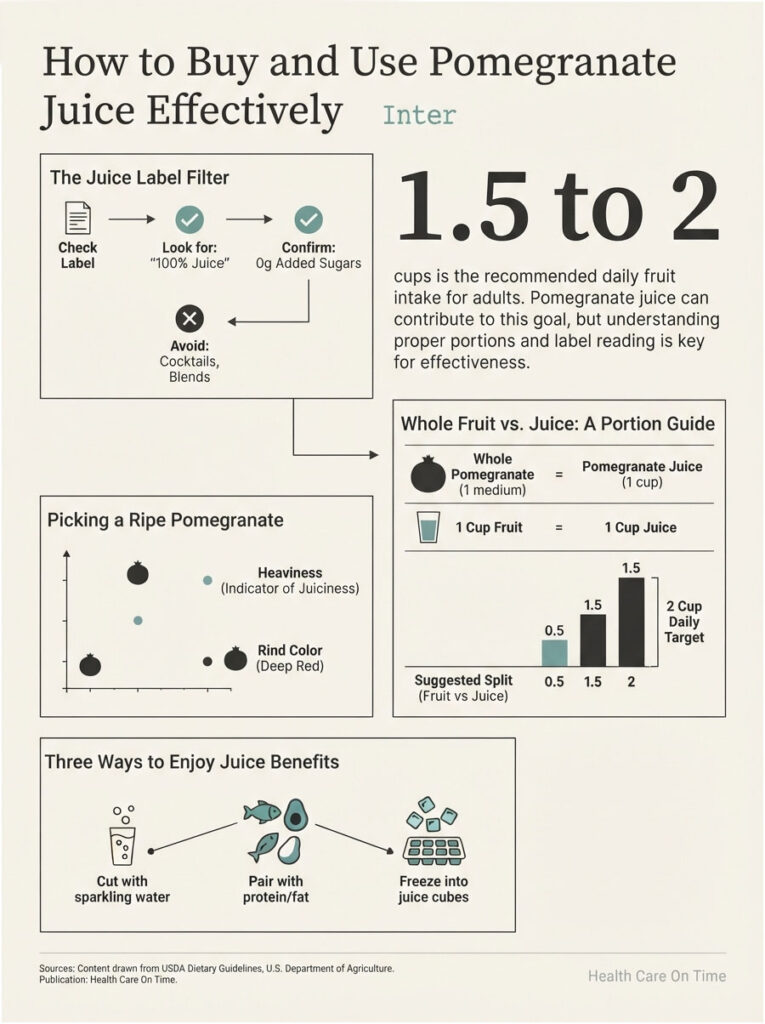
Reading a Juice Label in Ten Seconds
Find the phrase “100% juice” on the front panel. If it reads cocktail, blend, beverage, or drink, added sugar or cheaper filler juices are in the bottle.
Check the ingredient list second. It should read pomegranate juice, or pomegranate juice from concentrate, and nothing beyond that.
Check the added sugars line third. It should read 0 g. Anything above zero means the product is sweetened no matter what the front label implies.
Picking a Pomegranate That Is Actually Ripe
Weight is the single best signal. A ripe pomegranate feels heavy for its size, because heavy means plump arils rather than dried-out ones.
The rind should be deep red to red-brown, firm, and slightly squared off rather than perfectly round. Perfectly spherical fruit is usually underripe.
Surface scratches are fine and often signal good sun exposure. Soft spots, splits, and any give under thumb pressure are not.
Portion Guardrails That Work
Under MyPlate rules, one cup of 100% juice counts as one cup-equivalent of fruit, the same as one cup of fresh arils. Most adults need 1.5 to 2 cups of fruit daily.
Federal guidance directs the majority of that toward whole fruit. A workable split is one cup of arils plus a 4-ounce juice pour, or two cups of arils and no juice at all.
NHANES data puts Americans at just 1.06 cup equivalents of total fruit per day, well under target. Most readers have room to add either form.
Three Ways to Get Juice Benefits Without the Sugar Spike
Cut it. Four ounces topped with sparkling water gives you the polyphenols at half the sugar in a drink that lasts twice as long.
Pair it. Drinking juice alongside protein or fat slows gastric emptying and softens the glucose curve measurably.
Freeze it. Pomegranate juice ice cubes dropped into plain water or unsweetened tea spread one serving across an entire afternoon.
How Pomegranate Stacks Up Against Other Popular Juices
Against cranberry juice, pomegranate wins on blood pressure thanks to higher potassium and polyphenol content, while cranberry holds the edge on urinary tract health.
Against orange juice, pomegranate carries more polyphenols but far less vitamin C, since OJ delivers a full day’s requirement in 8 ounces.
Against grape juice, the two run close on antioxidant capacity, with grape juice usually carrying slightly more sugar per ounce.
Five Mistakes That Cancel the Benefit
- Drinking juice on an empty stomach. Nothing slows absorption, producing the sharpest glucose response of any consumption pattern. Pair it with food, every time.
- Assuming more is better. The blood pressure data shows benefit peaking at or below 300 mL daily and disappearing above it. Doubling your intake works against you.
- Buying a “pomegranate blend.” These are typically apple or white grape juice with a splash of pomegranate for color and shelf appeal. You buy the sugar and skip the polyphenols.
- Discarding every scrap of pith. The white membrane is bitter, so nobody eats it plain, but it holds the highest punicalagin concentration in the fruit. A few fragments mixed into your arils cost you nothing.
- Treating juice as medication. A federal appeals court has already ruled on what happens when pomegranate claims outrun the evidence. Food supports treatment; it does not replace it.
Across the cardiovascular panels our network processes, the people who see real movement in their numbers changed several things at once. Pomegranate belongs in that stack, not at the center of it.
Frequently Asked Questions
Is it better to eat pomegranate or drink the juice?
Eating whole arils is better for most people. You get 7 grams of fiber per cup, roughly 25 percent less sugar than an equivalent glass, and natural portion control. Juice is the better pick only for a measured polyphenol dose targeting blood pressure, or when fresh fruit is out of season.
How much pomegranate juice per day is safe?
Eight ounces daily is the practical ceiling for healthy adults. Research shows the blood pressure benefit peaking at or below that amount and disappearing at higher intakes. Federal dietary guidance caps 100% juice between one-half and 1.25 cups per day depending on age and sex.
Does pomegranate juice raise blood sugar?
Yes. Eight ounces delivers about 32 grams of sugar with zero fiber to slow absorption, producing a faster glucose rise than the same sugar eaten as whole arils. Drinking it with protein or fat, or diluting it with sparkling water, softens that response noticeably.
How many pomegranate seeds equal one glass of juice?
Roughly two to three medium pomegranates yield one 8-ounce glass, which works out to about 2.5 to 3 cups of arils. That gap explains the entire debate: almost nobody eats three cups of arils at once, but a glass of juice disappears in under a minute.
Can diabetics drink pomegranate juice?
In small amounts with food, yes, though whole arils are the safer default. Half a cup of arils supplies about 12 grams of sugar with 3.5 grams of fiber attached. If you want juice, hold it to 4 ounces, pair it with a meal, and check your own glucose response.
Does bottled pomegranate juice still have antioxidants?
Yes, and often more punicalagin than fresh arils. Commercial pressing crushes the whole fruit, extracting polyphenols from the rind and white membrane where those compounds concentrate. Vitamin C degrades during pasteurization, but the tannin and anthocyanin fraction survives processing largely intact.
Is pomegranate juice bad for your kidneys?
Not for healthy kidneys. For chronic kidney disease, the 600 mg of potassium in 8 ounces becomes a problem, since damaged kidneys clear potassium poorly and elevated levels carry cardiac rhythm risk. Whole arils at 413 mg per cup are the lower-potassium option. Ask your nephrologist.
Can you drink pomegranate juice while taking warfarin?
Check with your prescriber first. Lab studies show pomegranate juice inhibiting drug-metabolizing enzymes, and a published case report documented INR changes when a patient altered her intake. If cleared, the practical rule is consistency: a steady small amount beats swinging between daily glasses and none.
Do pomegranate seeds have more antioxidants than juice?
Per serving, usually less. Arils carry anthocyanins and a moderate ellagitannin load, while commercial juice picks up extra punicalagin from the pressed rind. Per gram of sugar consumed, arils still come out ahead, and their fiber feeds the gut bacteria that convert those polyphenols into usable form.
Does pomegranate juice count as a serving of fruit?
Yes. USDA rules count one cup of 100% juice as one cup-equivalent of fruit, identical to one cup of fresh arils. Federal guidance still recommends that at least half of total fruit intake come from whole fruit, since juice contributes no dietary fiber at all.
Are pomegranate extract capsules better than juice or fruit?
They are different, not better. Extracts deliver concentrated punicalagin with zero sugar, which suits people managing blood glucose. They also skip the fiber, vitamin C, and folate that whole arils provide, and supplement potency varies by brand since the FDA does not review effectiveness before sale.
Why is pomegranate juice so expensive?
It takes two to three whole pomegranates to produce a single 8-ounce glass. California supplies most US production from roughly 30,000 bearing acres with a season running October through January, so processors store and press fruit for year-round supply. Labor-intensive hand harvesting accounts for the rest.
Medical Disclaimer
This article is for informational purposes only and does not constitute medical advice, diagnosis, or treatment. Pomegranate juice may interact with warfarin, statins, ACE inhibitors, and other prescription medications. Anyone with diabetes, kidney disease, or hypertension should consult a licensed physician or registered dietitian before making dietary changes. Never stop or adjust prescribed medication based on dietary information found online.
References
- USDA FoodData Central, Nutrient Composition Database
- Dietary Guidelines for Americans, 2020-2025
- USDA MyPlate, Fruit Group Recommendations
- National Institutes of Health, Pomegranate Ellagitannins (NCBI Bookshelf)
- Impact of Pomegranate Juice on Blood Pressure: A Systematic Review and Meta-Analysis (PubMed)
- Potential Interaction Between Pomegranate Juice and Warfarin (PubMed)
- Effects of Pomegranate Juice on Blood Pressure, Pharmacological Research
- Phytochemical Diversity of Punica granatum L. and Its Multi-Target Biological Functions, Nutrients 2026
- Randomized Trial of Standardized Pomegranate Extract on the Gut Microbiome (NIH)
- Federal Trade Commission, POM Wonderful Deceptive Advertising Ruling
- Cleveland Clinic Health Essentials, The Health Benefits of Pomegranates
- Pomegranate Council, California Production and Season
- Socioeconomic Gradient in Consumption of Whole Fruit and 100% Fruit Juice, NHANES