Alzheimer’s blood tests with a posted US price cost a few hundred dollars, and the four FDA-cleared tests don’t publish a price at all. Whether you pay anything depends mostly on your symptoms and your plan.
Table of Contents
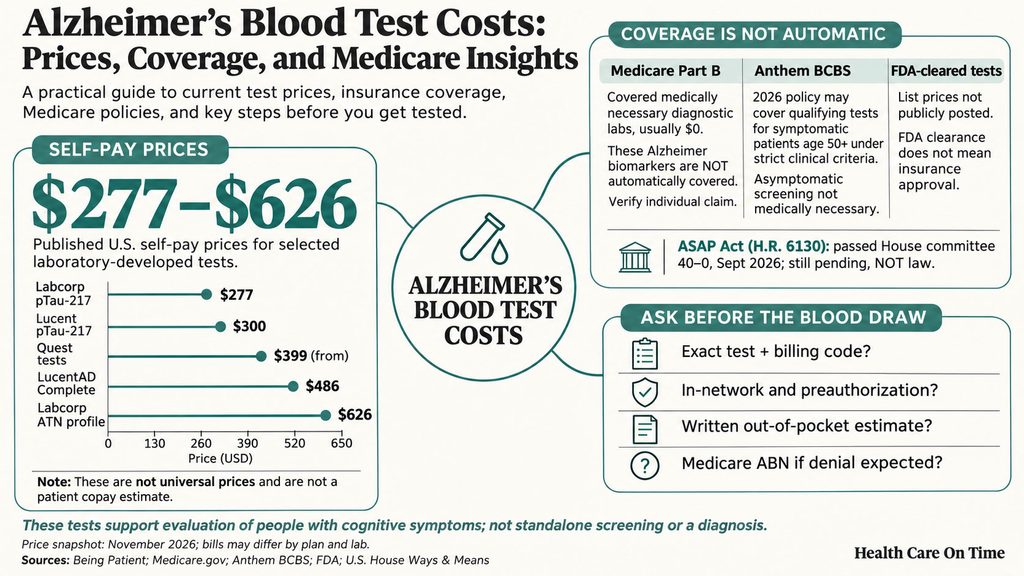
Quick Answer: Lab-developed Alzheimer’s blood tests list for roughly $277 to $626 (Labcorp, Lucent Diagnostics, Quest from $399). The four FDA-cleared tests (Lumipulse, Elecsys pTau181, Elecsys pTau217 and PrecivityAD2) have no public price. Medicare has no national coverage policy for these tests yet, and screening without symptoms isn’t covered. Anthem began covering PrecivityAD2 for eligible members on October 1, 2026. The FDA-cleared tests need a doctor’s order.
What Each Alzheimer’s Blood Test Costs Right Now
Prices below were checked in November 2026 and change often. The number on a lab’s website is the self-pay list price, which can be quite different from what an insurer gets billed.
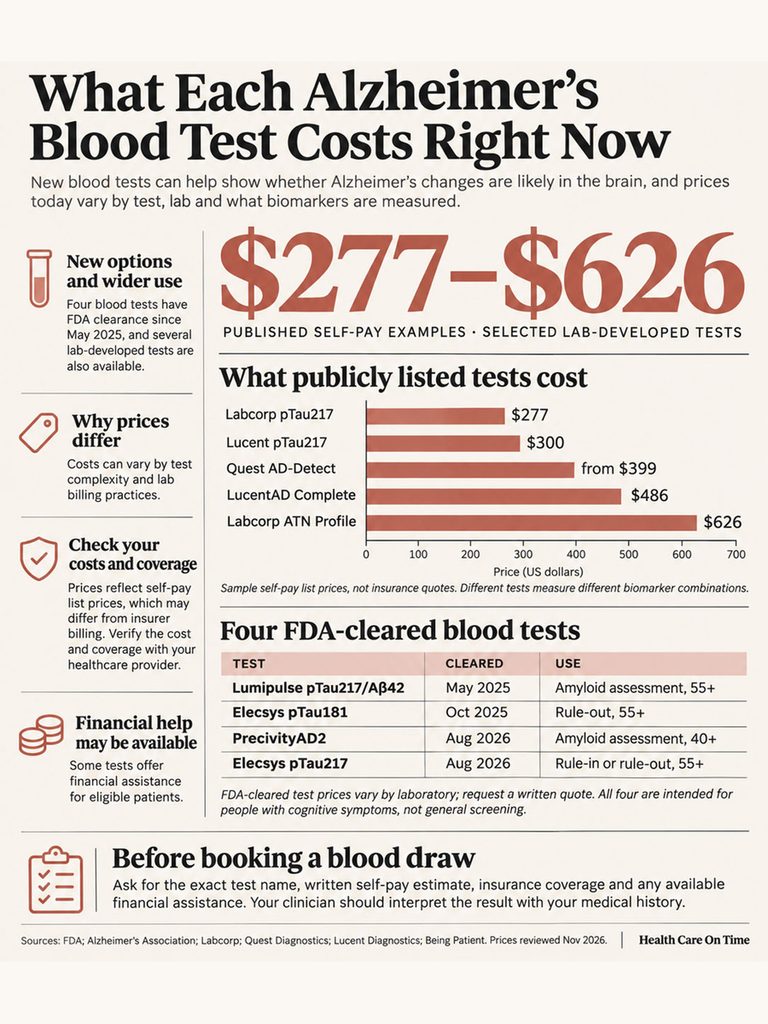
Four of these tests have been cleared by the FDA through its 510(k) pathway, all since May 2025. The rest are lab-developed tests (LDTs) that labs like Labcorp and Quest run in their own certified labs without FDA review; they’ve been around longer, and they’re the only ones with posted prices.
| Test (maker) | What it measures | FDA status | Who it’s meant for | Listed price | Coverage picture |
| Lumipulse G pTau217/β-Amyloid 1-42 Plasma Ratio (Fujirebio) | Ratio of pTau217 to amyloid beta 42 | Cleared May 16, 2025 | Adults 55+ with memory or thinking symptoms, specialty care | Not publicly listed | No national Medicare policy; plan by plan |
| Elecsys pTau181 (Roche) | pTau181 | Cleared Oct 13, 2025 | Adults 55+ with symptoms, primary care, to rule out Alzheimer’s | Not publicly listed | No national Medicare policy; plan by plan |
| PrecivityAD2 (C2N Diagnostics) | Amyloid beta 42/40 ratio plus %p-tau217 | Cleared Aug 20, 2026 (lab version also offered) | Adults 40+ with symptoms | Not publicly listed; financial aid and 6-month interest-free plan | Anthem BCBS covers eligible members from Oct 1, 2026; maker’s FAQ says not covered by Medicare |
| Elecsys pTau217 (Roche) | pTau217 | Cleared Aug 24, 2026 | Adults 55+ with symptoms, primary and specialty care | Not publicly listed; Labcorp and Quest to offer it | Plan by plan |
| Lucent pTau-217 test (Lucent Diagnostics) | pTau217 | Lab-developed, not FDA-cleared | Sold by the lab; ordering rules vary | $300 | Not covered by Medicare |
| LucentAD Complete (Lucent Diagnostics) | pTau217, amyloid beta 42/40, NfL, GFAP | Lab-developed | Sold by the lab; ordering rules vary | $486 | Not covered by Medicare |
| Labcorp pTau-217 / ATN Profile | pTau217 alone, or amyloid ratio + pTau181 + NfL | Lab-developed | Sold by the lab; ordering rules vary | $277 / $626 | Not covered by Medicare |
| Quest AD-Detect tests | Amyloid ratio, pTau181, pTau217, NfL, combinations | Lab-developed | Doctor’s order required since March 2026 | From $399 | Not covered by Medicare |
Elecsys pTau181 and Elecsys pTau217 are separate Roche tests, cleared ten months apart for different jobs, so check which one is on the order.
The FDA-cleared tests
Lumipulse came first, cleared on May 16, 2025, for adults 55 and older who already have symptoms and are being seen in a specialized care setting. Roche’s Elecsys pTau181 followed in October 2025 as a primary care tool, built mainly to rule Alzheimer’s out. Then August 2026 brought two more in one week: C2N’s PrecivityAD2 on August 20, the first cleared for people as young as 40, and Roche’s Elecsys pTau217 on August 24, which works for both ruling in and ruling out.
None of the four makers publishes a patient price. That’s normal for cleared lab assays. The maker sells the test kit or the instrument time to hospitals and reference labs, and each lab then sets its own charge and bills insurance. Two people having the same Elecsys pTau217 test could be billed very different amounts depending on which lab draws the blood. Eli Lilly’s pTau217 test for clinicians is in the same spot, with no price posted online.
Lab-developed tests with posted prices
The posted prices come from labs selling their own versions. Lucent Diagnostics lists its single pTau-217 test at $300 and its four-marker LucentAD Complete at $486. Labcorp’s single pTau-217 test is $277, and its ATN profile, which combines the amyloid ratio, pTau181 and the nerve-damage marker NfL, is $626. Quest’s AD-Detect family starts at $399. Most of the spread comes from how many markers a test measures. The single pTau217 tests sit at the bottom of the range, while panels that add the amyloid ratio, NfL or GFAP land at the top, so it’s fair to ask the doctor whether the extra markers will change anything before paying for them.
Quest used to sell AD-Detect straight to consumers online. That option ended in March 2026, so a clinician now has to order it.
Out-of-pocket costs can run well past the posted prices. Self-pay charges at some companies range from $300 to $1,750, with financial help sometimes available, so a cash quote before the draw tells you where your lab falls.
Why the Cleared Tests Don’t Come With a Price Tag
Once a test is cleared, insurers have an FDA review to point to when they decide whether to cover it, and those decisions follow slowly.
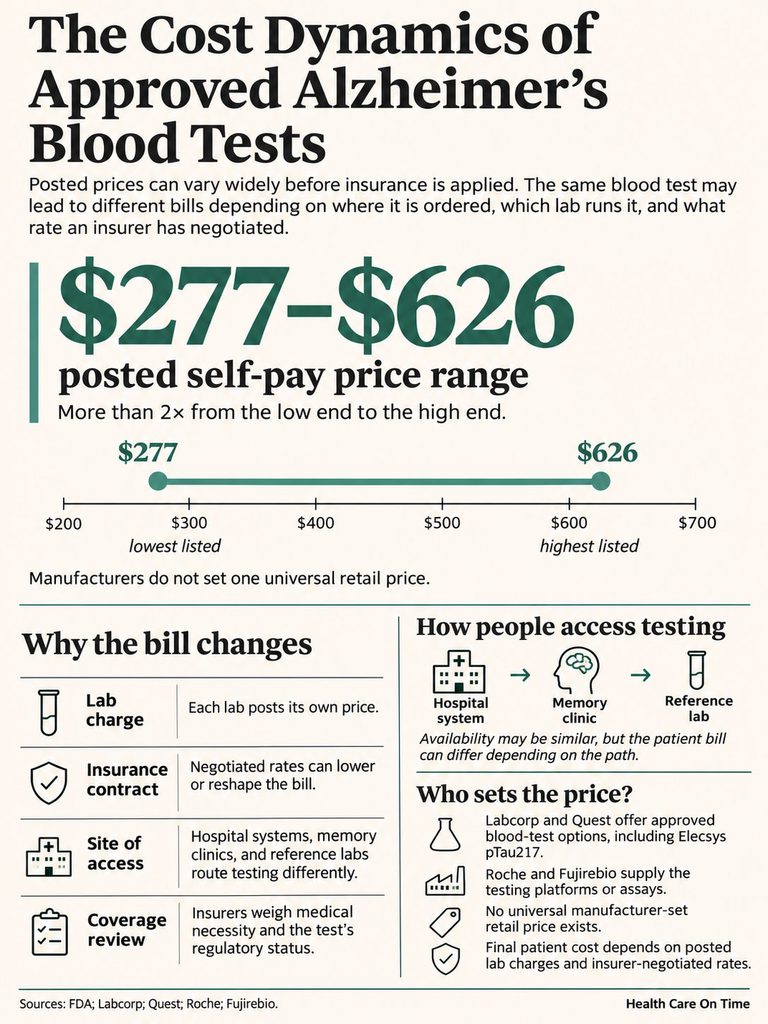
You’ll usually reach the cleared tests through a hospital system, a memory clinic or a large reference lab that has added the assay to its menu; Labcorp and Quest have both said they’ll offer Elecsys pTau217. In practice your bill reflects that lab’s own charge and your plan’s negotiated rate, not a number set by Roche or Fujirebio.
Does Medicare Pay for an Alzheimer’s Blood Test?
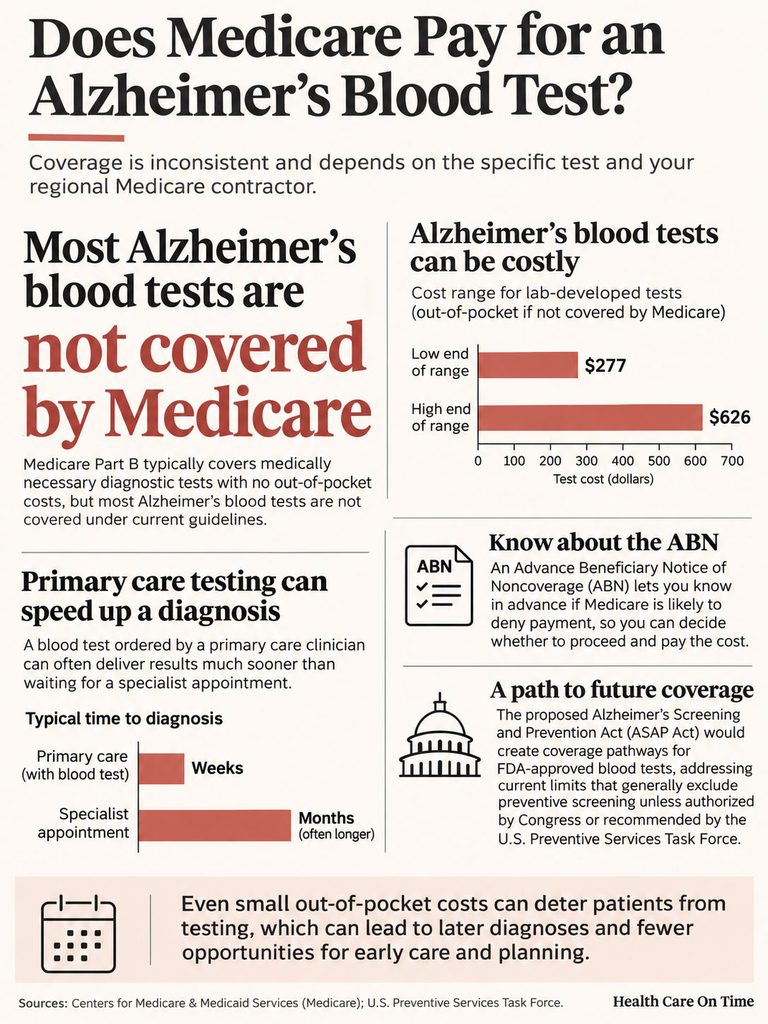
Medicare sometimes pays, though rarely in a predictable way. There’s no national Medicare coverage decision for Alzheimer’s blood biomarker tests as of November 2026, so payment depends on the lab, the specific test and the regional contractor that processes the claim.
The Part B lab rule, and where it stops helping
Medicare Part B covers medically necessary diagnostic lab tests ordered by your provider, and for covered tests you usually pay nothing. No deductible, no 20% coinsurance. It’s the same rule that lets a thyroid test ordered during a memory workup cost you nothing.
The $0 applies only to covered tests, though. Medicare pays for a lab test only when it accepts that the test is reasonable and necessary, and most Alzheimer’s blood tests haven’t been through that review. C2N’s patient FAQ, for example, states that its Precivity tests aren’t currently covered by Medicare or Medicaid. In practice, Medicare may pay for biomarker blood tests once a person already shows symptoms of cognitive decline, and it doesn’t pay for testing before symptoms. Lab-developed tests without FDA review are the least likely to be paid.
Medicare Advantage plans can apply their own coverage rules on top of Original Medicare’s, so for members of those plans, the plan’s own answer is the one that counts.
The ABN form you may be asked to sign
When a lab expects Medicare won’t pay, it should hand you an Advance Beneficiary Notice of Noncoverage (ABN) before the blood draw. The form lists the test and an estimated cost, and signing it means you agree to pay if Medicare turns the claim down.
Read the estimate on that form carefully. If it’s blank or vague, ask the lab for a self-pay price in writing, and ask whether the same test is cheaper at a different lab your doctor can send to. You can also refuse the test at that point; the ABN exists so you can decide before you owe anything.
Why a small bill still keeps people from testing
Cost shapes who gets tested at all, and clinicians say even $50 to $100 out of pocket is enough to make some patients skip a test. That matters for a disease where as many as half of people living with it or at risk for it haven’t been diagnosed. Getting in to see a specialist is the other barrier. Waits to see a neurologist run 12 to 18 months even in large metro areas, and memory clinic waits of 6 to 12 months are common, which is why a blood test ordered in primary care is drawing so much interest.
A test that a primary care doctor can order, with results back in a week or two, can move the rest of the workup forward by months.
Testing without symptoms and the ASAP Act
Screening a person who has no memory or thinking problems is a separate issue. Under current law, Medicare can only cover preventive screening that Congress has authorized or that the U.S. Preventive Services Task Force recommends, and no Alzheimer’s blood test has either.
The Alzheimer’s Screening and Prevention Act (ASAP Act) would create a Medicare pathway for FDA-approved blood biomarker screening tests. A House committee advanced the bill in fall 2026, and supporters expected a possible floor vote after the midterm elections. Until a version of it becomes law, someone without symptoms who wants a test will almost always pay out of pocket. For a sense of scale, a Florida man with a family history of dementia paid about $250 for his test.
Private Insurance and Medicaid
Commercial insurers are moving test by test. Anthem’s own biomarker policy, in its December 2025 version, labeled plasma Alzheimer’s markers investigational, which in insurance terms means not covered. That started to change for an FDA-cleared test in 2026.
Anthem’s October 2026 change
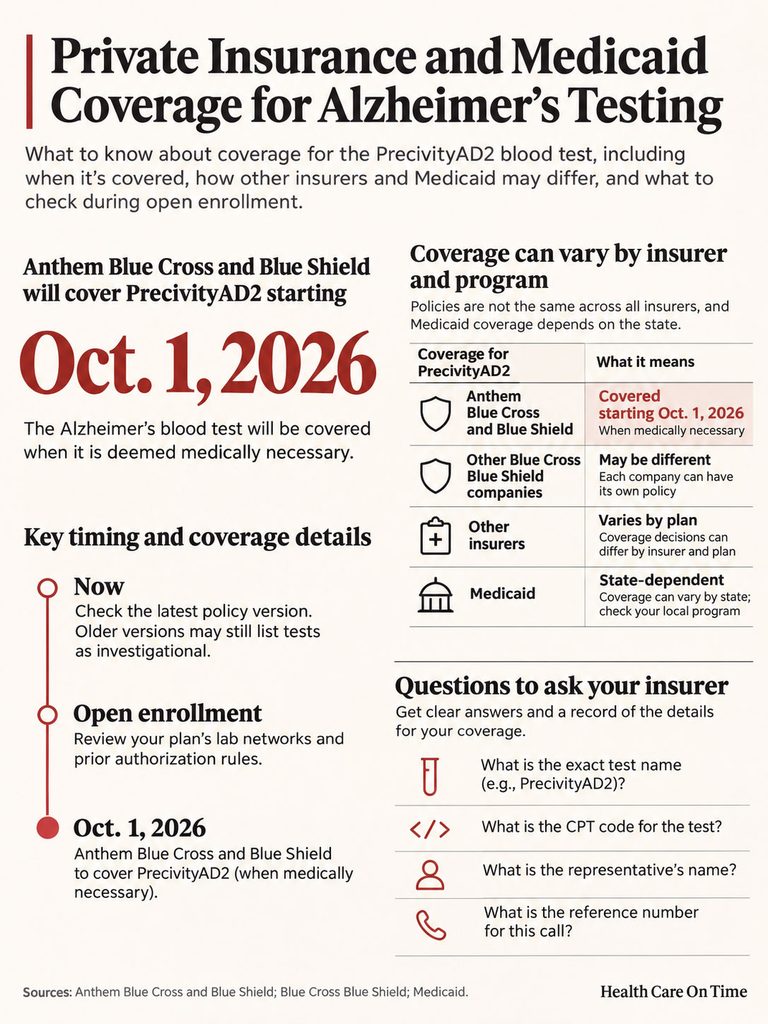
Anthem Blue Cross and Blue Shield began covering PrecivityAD2 for eligible members on October 1, 2026, in the 14 states where it sells coverage.
Coverage applies to eligible members when the test is judged medically necessary, so expect criteria such as documented symptoms. Policy pages can trail behind the news, too: the version of Anthem’s biomarker policy reachable online in November 2026 was the one published in December 2025, which still listed plasma Alzheimer’s tests as investigational. If you’re an Anthem member, ask for the current policy number and its effective date before the test. Members of other Blue Cross Blue Shield companies shouldn’t assume the same rule applies, because each company writes its own medical policy.
Coverage at other carriers is decided plan by plan, and Medicaid coverage depends on your state program. If memory testing is likely in the next year, look hard at lab networks and prior authorization rules during open enrollment; comparing plan details closely is far easier then than after a denial.
Questions to ask your insurer before the test
Several of these tests have similar names, and “the Alzheimer’s blood test” can mean any of them to a claims representative. Call the member services number on your card with the exact test name and, if your doctor’s office can give it, the CPT code. These questions get clearer answers than “is it covered?”:
- “Does this plan cover the PrecivityAD2 test (or Elecsys pTau217, or Lumipulse) for someone with documented memory symptoms?”
- “Is prior authorization needed, and does the doctor’s office submit it?”
- “Is the lab the doctor is sending this to in network for this test?”
- “If it’s covered, does the deductible apply, and what’s the coinsurance?”
- “Which medical policy number covers Alzheimer’s biomarker testing, and when did it take effect?”
- “If the blood test is positive or indeterminate, will the plan pay for a follow-up PET scan?”
- “If the claim is denied, how do we appeal, and how long does that take?”
Write down the representative’s name and a reference number for the call. Denials for new tests are common, and a call log makes an appeal easier.
Blood Test vs PET Scan vs Spinal Tap: What a Diagnosis Costs
A blood test rarely replaces the whole diagnostic workup, so its price is only one line on the bill. A typical evaluation starts with a cognitive screening, basic labs to rule out other causes, and sometimes an MRI. Low B12 and thyroid problems can both affect memory, so a thyroid level and the vitamin blood tests that rule out deficiency are routine parts of the workup and usually covered.
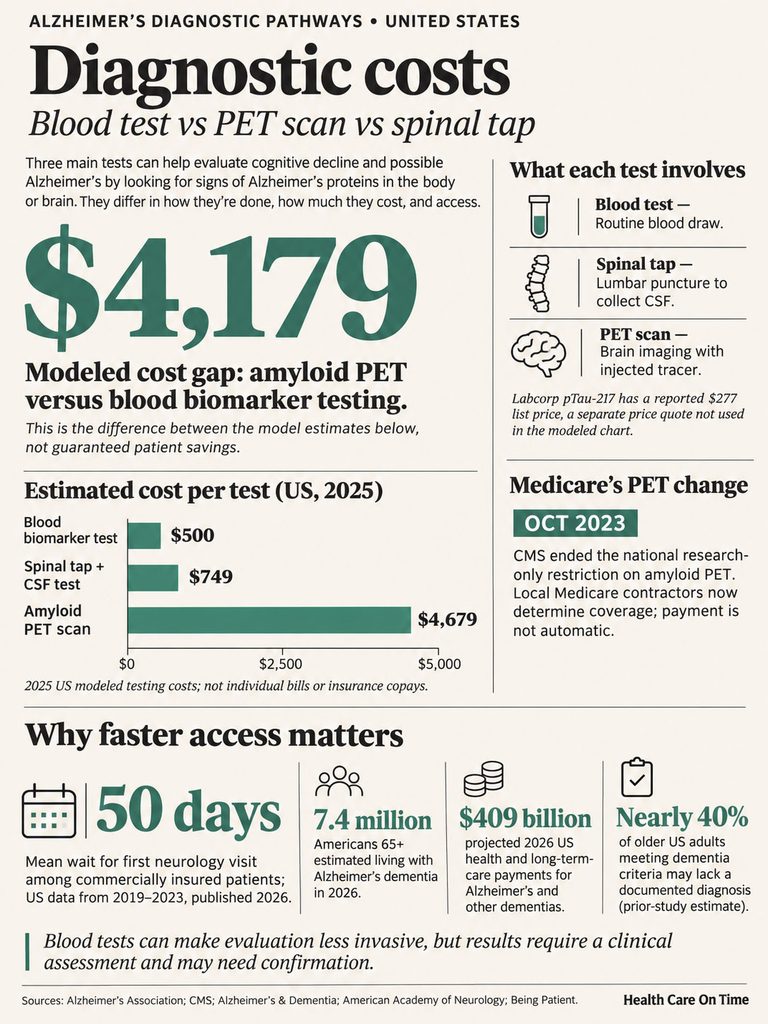
The expensive part has traditionally been confirming amyloid in the brain. An amyloid PET scan or a lumbar puncture (spinal tap) to measure proteins in cerebrospinal fluid (CSF) was the only way to do that before blood tests arrived. Medicare ended its restrictive coverage-with-evidence rule for amyloid PET in October 2023 and lifted the one-scan-per-lifetime limit, leaving coverage decisions to its regional contractors. Out of pocket, an amyloid PET scan averages $3,000 or more, and some estimates put PET or spinal tap costs upward of $10,000.
A self-pay Labcorp pTau-217 test at $277 costs less than a tenth of that PET average. A negative result from a well-validated test can spare a person a scan entirely, and a clearly positive one can speed a referral. In the Lumipulse study, fewer than 20% of results came back indeterminate, and those are the people most likely to still need PET or CSF testing. A blood draw also spares you the procedure visit and recovery time of a spinal tap, or the trip to an imaging center that has the PET tracer on hand.
| Measure | Figure | Source |
| Americans living with Alzheimer’s | Nearly 7 million, projected to reach nearly 13 million | FDA, May 2025 |
| Share of Americans 65+ with Alzheimer’s | About 10% | FDA Commissioner, May 2025 |
| People with or at risk for Alzheimer’s who remain undiagnosed | As many as half | University of Michigan, via AHCJ, April 2026 |
| Out-of-pocket amyloid PET scan | $3,000 or more on average | NeurologyLive, October 2023 |
| Self-pay Alzheimer’s blood tests at some companies | $300 to $1,750 | Harvard Health, September 2025 |
| Alzheimer’s share of Medicare spending | About 20% | Alzheimer’s Impact Movement, via AHCJ |
| Estimated US cost of dementia in 2025 | $781 billion | USC Schaeffer Center, via AHCJ |
| Wait to see a neurologist, even in big metro areas | 12 to 18 months | Global Alzheimer’s Platform Foundation, via AHCJ |
Can You Order an Alzheimer’s Blood Test Yourself?
Less easily than a few years ago. The FDA-cleared tests are labeled for health care professionals evaluating people with symptoms, and Quest’s consumer version of AD-Detect ended in March 2026. A few companies still sell Alzheimer’s blood tests direct to consumers.
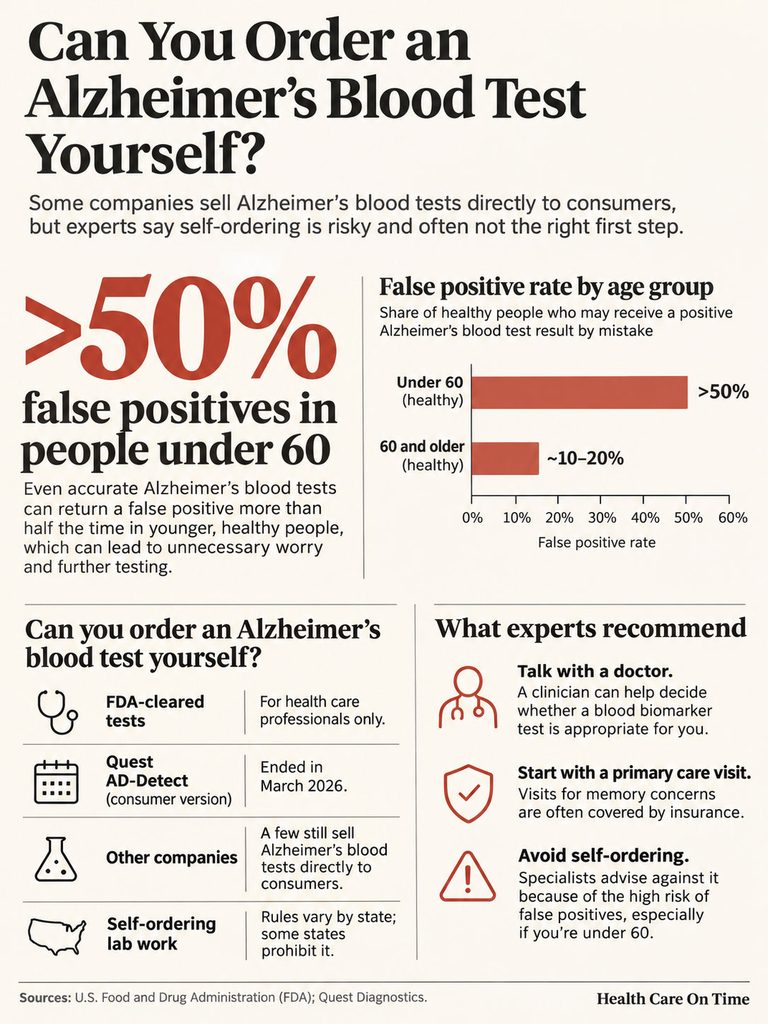
Rules on self-ordering lab work vary, and a few states don’t allow ordering your own blood tests at all. Even where it’s legal, Alzheimer’s specialists generally advise against it. The tests were built and validated in older adults with symptoms; in healthy people under 60, amyloid buildup is uncommon enough that even accurate tests can return false positives more than half the time. A doctor who knows your history can judge whether a result makes sense and what to do with it.
If cost is the reason you’re considering a consumer route, ask your primary care doctor first. A visit for memory concerns, plus standard labs, is usually covered, and the doctor can decide whether a blood biomarker test is the right next step.
What the Result Can and Can’t Tell You
An Alzheimer’s blood test estimates the likelihood that amyloid plaques are present in your brain. It doesn’t diagnose Alzheimer’s by itself, and when the FDA cleared Lumipulse it stated plainly that the test isn’t meant as a stand-alone or screening tool. A doctor weighs the result with your symptoms, your history, cognitive testing and other findings.
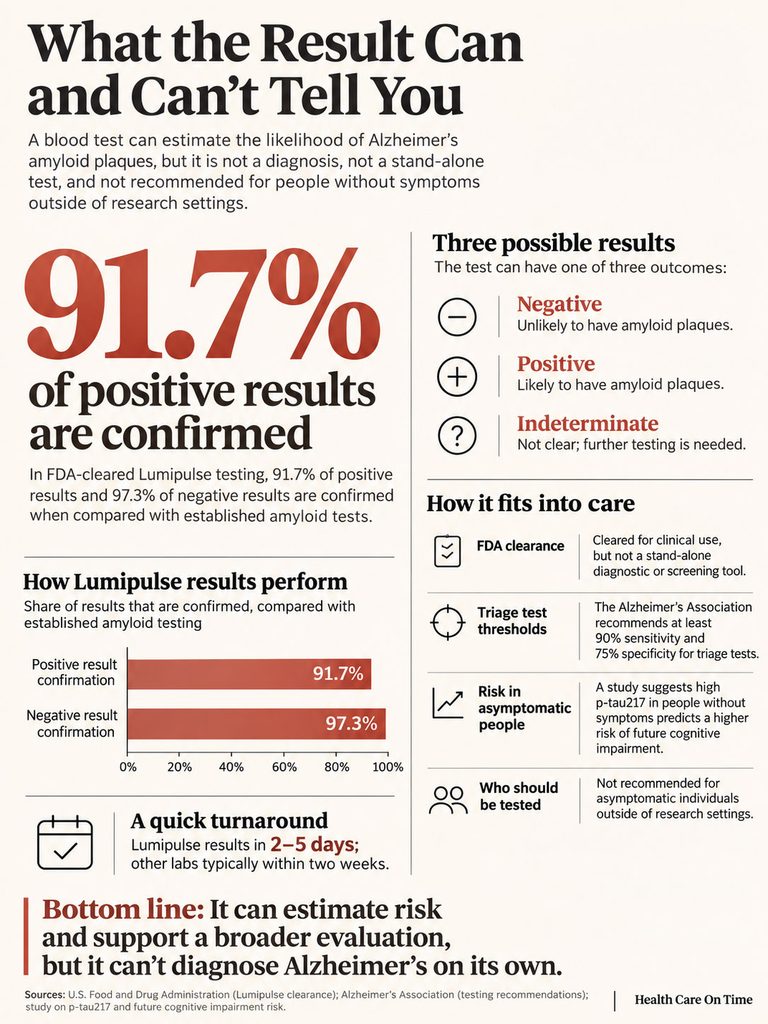
Accuracy varies by test, and this is where paying for an FDA-cleared assay can matter. In the FDA’s review of Lumipulse, which used 499 samples from adults with cognitive impairment, 91.7% of positive results were confirmed by PET or CSF and 97.3% of negatives matched a negative scan or CSF test. Roche’s pTau181 test got 97.9% of negative results right in a 312-person study. PrecivityAD2, tested in 1,142 people, reached 97.6% for ruling in and 93.1% for ruling out.
The Alzheimer’s Association’s 2025 clinical practice guideline sets two bars. A triage test should reach at least 90% sensitivity and 75% specificity, with positives confirmed by PET or CSF. A test that replaces PET or CSF outright needs at least 90% for both. The guideline panel warned that many commercially available tests don’t meet those thresholds, especially with a single cutoff, so the lowest list price says little about how well a test performs.
Turnaround is quick. Lumipulse results usually come back within about 2 to 5 days, and other labs typically report within two weeks.
Three possible results
A negative result means amyloid plaques are unlikely, so memory problems probably have another cause, such as sleep apnea, medication effects, depression, a vitamin deficiency or thyroid disease. If symptoms persist, a memory recheck in about six months is a reasonable next step.
A positive result means plaques are likely. If you’re in the early stage, the next step is often a specialist visit to discuss amyloid-targeting drugs like lecanemab (Leqembi) or donanemab (Kisunla), and some patients will still need a PET scan or spinal tap to confirm eligibility.
An indeterminate or intermediate result can’t sort you either way. Expect a referral for PET or CSF testing, or a repeat test later.
Results in people without symptoms
A large October 2026 study looked at whether p-tau217 predicts trouble in people whose thinking was still normal. The researchers pooled six studies covering 2,684 cognitively unimpaired older adults, about 478 of whom later developed cognitive impairment. People with very high p-tau217 had an estimated 38% chance of impairment within five years and 78% within ten, although the ten-year estimate rests on much less data. The authors still don’t recommend these tests for people without symptoms outside research.
How to Keep the Bill Down
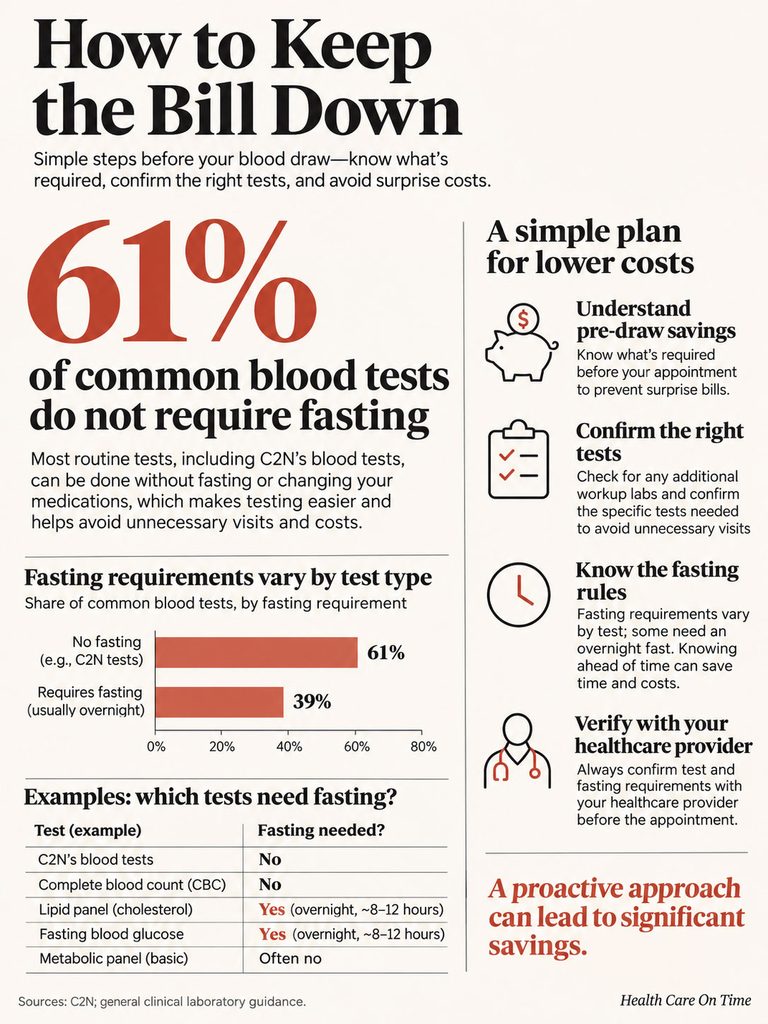
The biggest savings come before the blood draw. A few steps cut most surprise bills:
- Get the order through a doctor who’s evaluating symptoms, since that’s the only route with a realistic chance of insurance payment.
- Ask the doctor’s office, “Which lab will this go to, and is it in network for our plan?”
- On Original Medicare, ask the lab, “Will you bill Medicare for this, or should we expect an ABN, and what’s the dollar estimate on it?”
- Ask, “What’s the self-pay price, and can we get that in writing?” A cash price can differ from the amount billed to an insurer.
- Apply for the maker’s patient aid if you qualify. C2N runs a financial assistance program based on medical and financial need, and you have up to 30 days after your first bill to apply; it also offers a six-month interest-free payment plan.
- Keep copies of the order, any ABN or prior authorization approval, and each bill; an appeal goes faster when the paperwork is in one place.
The draw itself is simple. C2N’s tests need no fasting or medication changes, the same as other blood tests that don’t require fasting. The exception is when the doctor adds workup labs to the same visit, since some of those need an overnight fast; checking which blood tests require fasting and for how long before the appointment avoids a wasted trip.
Matching Your Situation to a Next Step
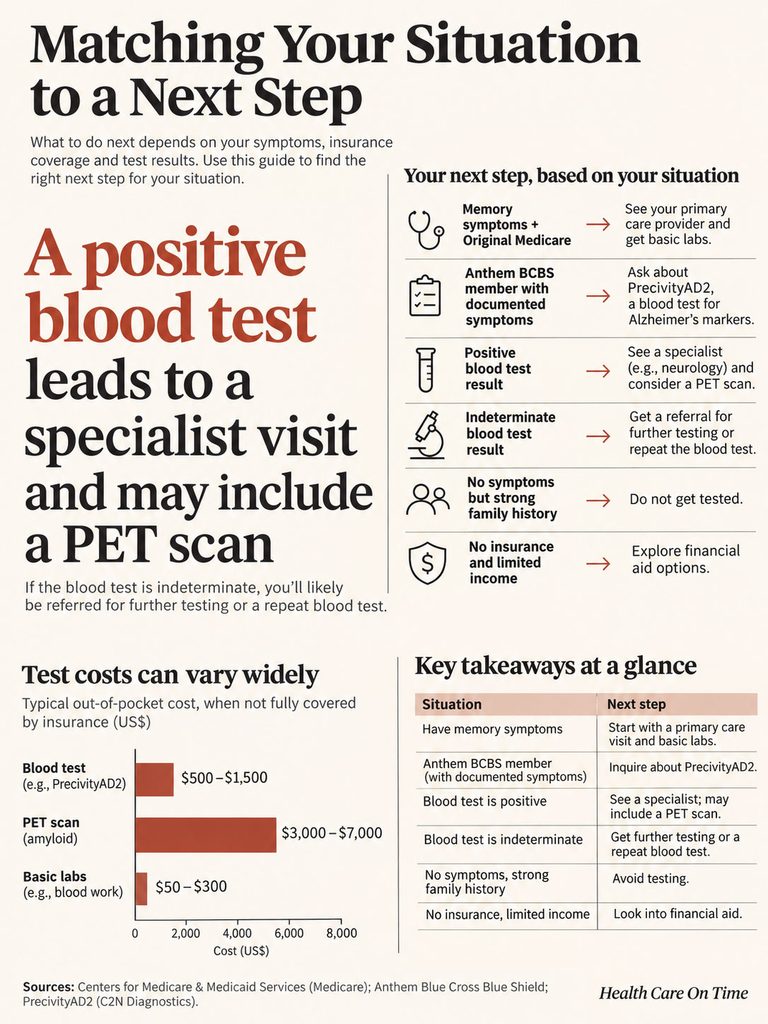
Where you start depends mostly on whether you have symptoms and what coverage you carry.
| Your situation | Sensible next step | What you’re likely to pay |
| Memory symptoms, Original Medicare, no workup yet | Primary care visit with cognitive screening and basic labs (B12, thyroid); ask whether the lab will bill Medicare for an FDA-cleared blood test | Basic diagnostic labs usually $0; blood biomarker test depends on lab, get the ABN estimate |
| Anthem BCBS member with documented symptoms | Ask the doctor about PrecivityAD2 and confirm the current medical policy and prior authorization | Covered for eligible members since Oct 1, 2026, subject to deductible and coinsurance |
| Positive blood test, early stage, considering Leqembi or Kisunla | Specialist visit; PET or spinal tap may still be needed to confirm eligibility | Amyloid PET averages $3,000+ out of pocket without coverage; Medicare contractors decide PET coverage |
| Indeterminate result | Specialist referral for PET or CSF testing, or a repeat blood test later | Depends on which confirmatory test and plan |
| No symptoms, strong family history | Testing isn’t recommended; ask about prevention trials, which use these tests to find participants | Not covered by Medicare; posted lab prices run $277 to $626 if a doctor orders one |
| No insurance coverage and limited income | Ask the ordering office to check maker financial aid and payment plans before the draw | Varies; C2N offers income-based aid and a 6-month interest-free plan |
When to See a Doctor Sooner
Don’t wait on a blood test if memory or thinking problems come on suddenly, over hours or days. Sudden confusion, trouble speaking, weakness on one side or a severe headache need emergency care (call 911), because they can signal a stroke, infection or medication reaction. Book a prompt appointment if someone is getting lost in familiar places, missing bills, repeating the same questions or having personality changes. Those changes deserve a full evaluation whether or not a blood test is part of it.
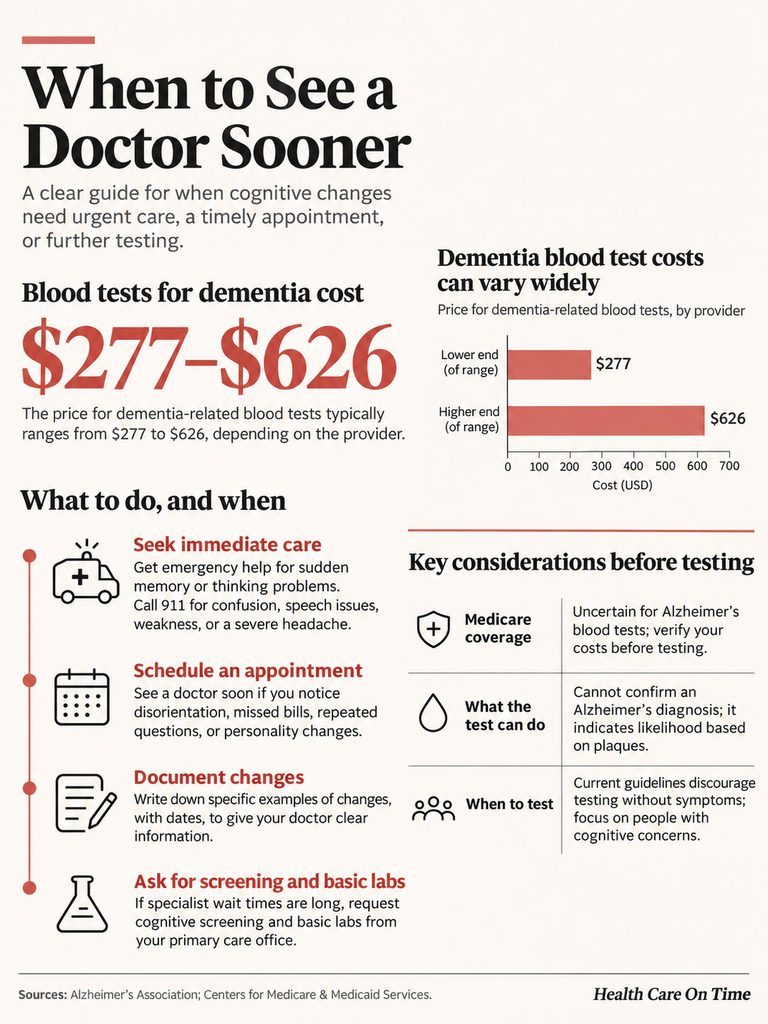
If you’re the one noticing changes in a parent or partner, write down examples with dates, like a missed bill, a repeated question or a wrong turn on a familiar drive. A list like that gives the doctor something concrete to work with, and it documents why a test was medically necessary if the insurer later asks.
If the specialist wait is long, ask the primary care office to start the cognitive screening and basic labs now, so the workup is underway before the appointment.
Frequently Asked Questions
How much does a blood test for dementia cost?
Posted self-pay prices for Alzheimer’s blood tests run from about $277 (Labcorp pTau-217) to $626 (Labcorp ATN profile), with Lucent at $300 or $486 and Quest from $399. The FDA-cleared tests don’t list a price, because each lab sets its own charge. Your share could be $0 with good coverage or the full list price without it, so ask the lab for a written estimate before the draw.
Does Medicare cover the Alzheimer’s blood test?
Not reliably. Medicare Part B pays for medically necessary diagnostic lab tests, usually at $0 to you, but there’s no national Medicare policy for Alzheimer’s blood biomarker tests, and many labs don’t expect Medicare to pay. Screening people without symptoms isn’t covered at all. If Medicare likely won’t pay, the lab should give you an ABN with a cost estimate before drawing blood. Medicare Advantage plans decide case by case. The ASAP Act, still pending in Congress in November 2026, would create a coverage pathway for FDA-approved screening tests.
Can a blood test confirm Alzheimer’s?
No single test does that. A blood test shows whether amyloid plaques are likely, and the strongest ones match PET scans closely. A doctor still confirms the diagnosis using symptoms, cognitive testing and other results, and some people need a PET scan or spinal tap too.
How long does it take to get results?
Usually within two weeks, and Lumipulse results often come back in about 2 to 5 days.
Do you need to fast before an Alzheimer’s blood test?
Usually not. C2N says no fasting or medication changes are needed for its Precivity tests.
Can you order an Alzheimer’s blood test without a doctor?
A few companies still sell them directly, but the FDA-cleared tests need a clinician’s order, and Quest stopped consumer sales of AD-Detect in March 2026. Experts advise against self-testing, because false positives are common in healthy people.
What age do you have to be for an Alzheimer’s blood test?
It depends on the test. Lumipulse, Elecsys pTau181 and Elecsys pTau217 are cleared for adults 55 and older, while PrecivityAD2 is cleared for adults as young as 40. All four are meant for people who already have memory or thinking symptoms, not for healthy people of any age.
Is a blood test cheaper than a PET scan?
Usually by a wide margin. Posted blood test prices are in the hundreds of dollars, while an amyloid PET scan averages $3,000 or more out of pocket. A blood test can’t always replace a scan, though.
Should people without symptoms get tested?
Current guidance says no, outside of research. The FDA-cleared tests are approved only for people with memory or thinking symptoms, Medicare won’t pay for screening, and in healthy younger adults false positives are common. A 2026 study found very high p-tau217 levels in cognitively normal older adults predicted a 38% chance of impairment within five years, but the researchers themselves don’t recommend testing people without symptoms yet. With a strong family history, a prevention trial is the more useful route.
Medical disclaimer: This article is for general information and isn’t medical, legal or financial advice. Test prices, FDA status and insurance coverage change often; confirm costs with the ordering lab and your insurer before testing. Talk with a licensed health care professional about memory or thinking concerns, and call 911 for sudden confusion, weakness or trouble speaking.
References
- U.S. Food and Drug Administration. FDA clears first blood test used in diagnosing Alzheimer’s disease. May 16, 2025. https://www.fda.gov/news-events/press-announcements/fda-clears-first-blood-test-used-diagnosing-alzheimers-disease
- Being Patient. Your guide to Alzheimer’s blood tests: pricing, accuracy, and where to get one. Updated August 25, 2026. https://beingpatient.com/how-much-is-an-alzheimers-blood-test/
- Harvard Health Publishing. The new Alzheimer’s blood test: what it means for diagnosis. September 1, 2025. https://www.health.harvard.edu/mind-and-mood/the-new-alzheimers-blood-test-what-it-means-for-diagnosis
- Medicare.gov. Diagnostic laboratory tests. https://www.medicare.gov/coverage/diagnostic-laboratory-tests
- C2N Diagnostics. Patient and caregiver FAQs (PrecivityAD). https://precivityad.com/patient-caregiver-faq
- Association of Health Care Journalists. A simple blood test could detect Alzheimer’s earlier, but Medicare doesn’t cover it. April 3, 2026. https://healthjournalism.org/blog/2026/04/a-simple-blood-test-could-detect-alzheimers-earlier-but-medicare-doesnt-cover-it/
- Bay News 9. Medicare could cover FDA-approved blood tests for Alzheimer’s screening. October 2026. https://baynews9.com/fl/tampa/health/2026/10/06/medicare-could-cover-fda-approved-blood-tests-for-alzheimers
- Clinical Lab Products. Anthem establishes coverage of C2N Diagnostics’ blood test for Alzheimer’s disease evaluation. July 14, 2026. https://clpmag.com/lab-management/company-news/anthem-covers-c2n-blood-test-alzheimers-diagnosis/
- Anthem. Medical Policy LAB.00046: Testing for biochemical markers for Alzheimer’s disease. https://www.anthem.com/medpolicies/abcbs/active/mp_pw_e001583.html
- NeurologyLive. CMS expands coverage of PET imaging for confirmation of Alzheimer disease diagnosis. October 13, 2023. https://neurologylive.com/view/cms-expands-coverage-pet-imaging-confirmation-alzheimer-diagnosis
- Palmqvist S, et al. Alzheimer’s Association clinical practice guideline on the use of blood-based biomarkers in the diagnostic workup of suspected Alzheimer’s disease within specialized care settings. Alzheimer’s & Dementia. 2025. https://alz-journals.onlinelibrary.wiley.com/doi/10.1002/alz.70535
- Mass General Brigham, via ScienceDaily. A simple blood test could reveal Alzheimer’s risk 10 years before symptoms. October 30, 2026 (Buckley RF, et al. JAMA. 2026;336(11):950). https://www.sciencedaily.com/releases/2026/10/261029072142.htm
- Mayo Clinic. New FDA-approved blood tests for diagnosing Alzheimer’s disease. July 8, 2025. https://www.mayoclinic.org/diseases-conditions/alzheimers-disease/in-depth/new-blood-tests-alzheimers/art-20585060