If you’ve just started naltrexone and feel queasy, tired or slightly off, you’re in the window where side effects are most likely. They mostly hit in the first days of treatment and fade as your body gets used to the drug, usually within the first few weeks.
Table of Contents
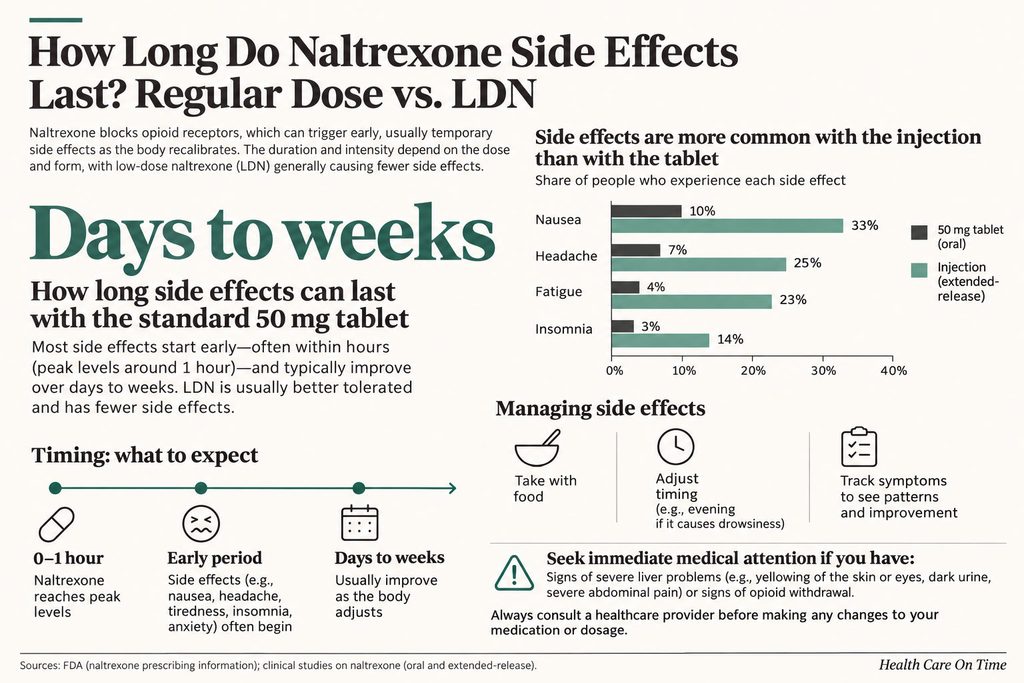
Quick Answer: Common naltrexone side effects (nausea, headache, tiredness, dizziness, trouble sleeping) tend to start early and pass. On the 50 mg tablet they usually appear early in treatment and are transient. With the monthly Vivitrol shot, nausea typically eases within a few days. Low-dose naltrexone (LDN) more often causes vivid dreams or insomnia, which may settle with time or a switch to morning dosing. Liver symptoms or sudden opioid withdrawal need same-day care.
Why Side Effects Hit Early
Naltrexone blocks opioid receptors in the brain and body. Those receptors respond to your own endorphins as well as to opioid drugs, so when a blocker suddenly sits on them, systems that run partly on that signaling (your gut, your sleep, your mood, your energy) have to recalibrate, and that’s the stretch when people feel queasy or foggy.
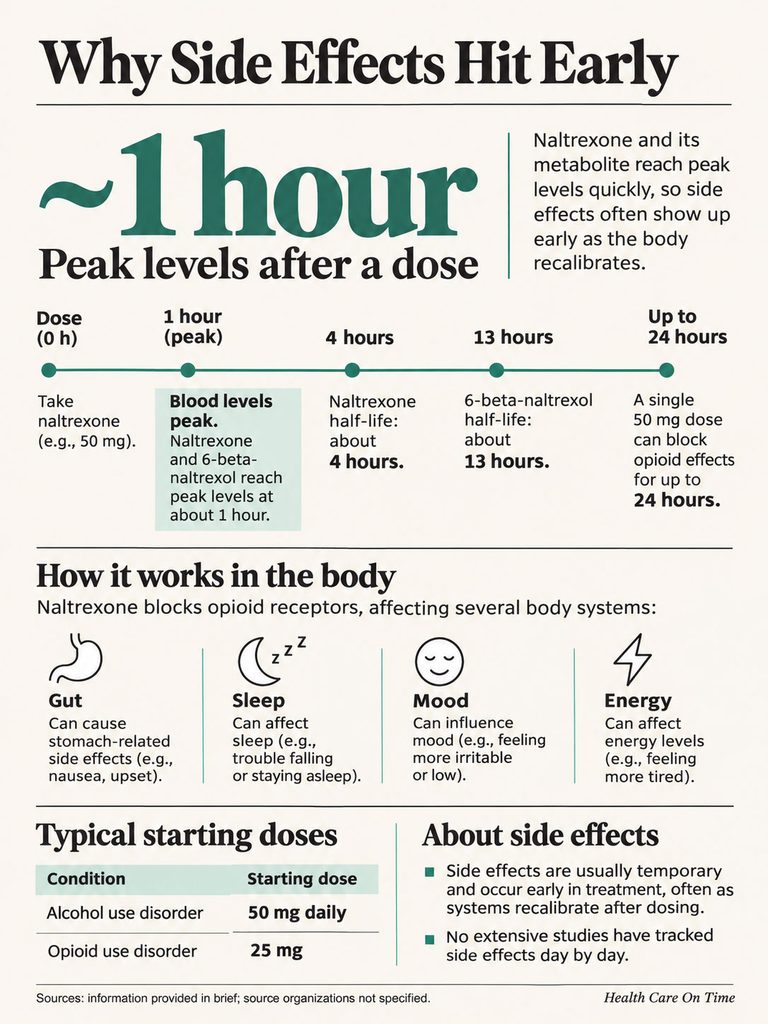
The tablet works fast. Levels of naltrexone and its main active breakdown product, 6-beta-naltrexol, peak within about an hour of a dose, per the FDA-approved prescribing information for naltrexone tablets. Naltrexone itself has a half-life of about 4 hours, while 6-beta-naltrexol lasts longer, with a half-life of about 13 hours, and a single 50 mg dose blocks the effects of an injected opioid for up to 24 hours. So a side effect that peaks an hour or two after the pill is probably tied to the dose itself, which is useful when you’re deciding whether to take it with breakfast or at night.
How you start shapes the first week too. For alcohol use disorder, the usual tablet dose is 50 mg once a day from the beginning, while people treated for opioid use disorder typically begin at 25 mg and move to 50 mg only if no withdrawal symptoms appear.
On timing, the tablet label says side effects usually occur early in the course of treatment and are transient. It gives no day count, and no large study has tracked each symptom day by day.
Side Effect by Side Effect: What to Expect and When
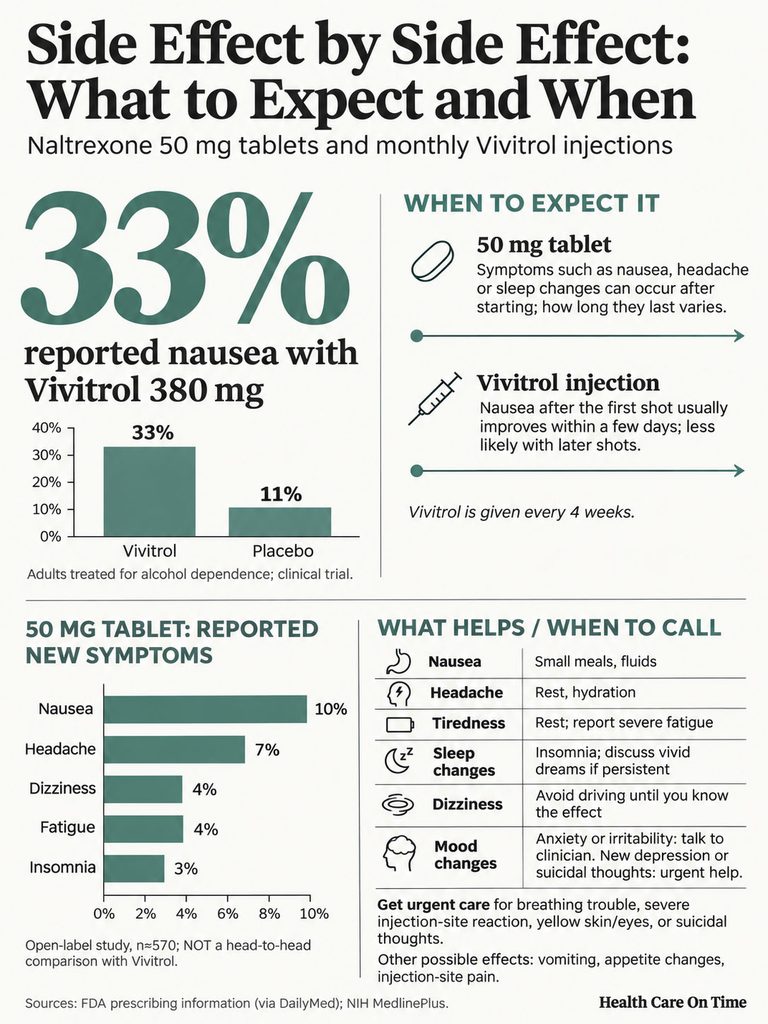
| Side effect | Days 1 to 3 | Weeks 1 to 2 | Past 2 weeks | What helps |
| Nausea (50 mg tablet) | Most likely to start; often worst an hour or two after the dose | Usually easing as the body adjusts | Uncommon; tell your prescriber if it continues | Take with food; try a different time of day with your prescriber’s OK |
| Nausea (Vivitrol shot) | Can start after the first injection | Label: typically subsides within a few days | Less likely with later injections | Small, bland meals for the first few days after each shot |
| Headache | Common early | Often fading | A minority keep having them; worth a call | Fluids, regular meals, a pharmacist-approved pain reliever |
| Tiredness or low energy | Common early | Usually lifting | If still heavy, ask about timing and other causes | Try a different dose time; don’t drive if drowsy |
| Insomnia or vivid dreams (50 mg) | Possible from the first night | Often settling | Ask about switching to a morning dose | Morning dosing, a steady sleep schedule |
| Insomnia or vivid dreams (LDN) | The most typical LDN complaint | May persist longer than on 50 mg | Can resolve with ongoing use or a morning dose | Discuss morning dosing with the prescriber |
| Dizziness | Usually early | Usually gone | Persistent dizziness needs a check | Stand up slowly; avoid driving until you know how you react |
| Anxiety, irritability, “feeling weird” | Common in the first days | Usually calmer | Low mood that deepens needs prompt attention | Track mood daily; call if it gets worse |
Nausea and Vomiting
Nausea is the one people notice first. In the open-label safety study of about 570 people with alcohol use disorder described in the tablet label, 10% had new nausea and 3% had vomiting. The monthly Vivitrol shot runs higher: 33% had nausea in the alcohol trials, compared with 11% on placebo.
Tablet nausea tends to cluster in the hours after a dose, which makes it easier to manage than nausea that comes and goes at random. The tablet can be taken with or without food, so moving it to a meal is allowed and often takes the edge off. For alcohol use the tablet also starts at its full dose rather than climbing in steps, so the stomach adjusts once instead of again with every increase.
Shot nausea is common but usually gone within a few days of the first injection, and later injections are less likely to bring it on at all, per the Vivitrol prescribing information.
Call your doctor if vomiting is severe or won’t stop, or if diarrhea is heavy, since losing that much fluid also makes dizziness worse.
Women should speak up early if nausea is the main problem. In one small, exploratory study of high-dose naltrexone, women had nausea more often than men, and more frequent nausea was linked to women stopping treatment.
Headaches That Linger
In the alcohol trials, 25% of people on the shot had a headache, but so did 18% of people getting a dummy injection, so much of the problem comes from starting treatment and cutting back on alcohol at the same time. On the tablet, the rate was 7%.
Some people keep getting headaches after the first stretch. Bring them up with your prescriber, because dehydration, short nights and swings in coffee intake during early recovery can all make them worse.
Tiredness
Early recovery from heavy drinking brings its own exhaustion, which makes this one hard to pin on the drug alone. Fatigue showed up in 4% of the tablet study group. In the Vivitrol trials, complaints the label groups as asthenic conditions (mostly malaise and fatigue) affected 23% on the shot versus 12% on placebo.
People describe it as feeling flat or heavy in the first week. If tiredness comes with yellowing skin, dark urine or unusual bruising, treat it as a possible liver warning rather than a normal adjustment symptom.
Sleep Problems and Vivid Dreams
The shot trials grouped insomnia and other sleep disorders together and found 14% on Vivitrol against 12% on placebo, a gap small enough to suggest that a lot of the sleep trouble came from the recovery process itself. On the 50 mg tablet, insomnia showed up in 3% of the safety study and somnolence (sleepiness) in 2%.
If you’re on the standard tablet and the dreams or wakefulness start right after an evening dose, ask whether a morning dose is an option. Vivid dreams are much more closely tied to low-dose naltrexone.
Dizziness
On the shot, dizziness or fainting affected 13% versus 4% on placebo, which is why the Vivitrol label advises against driving or operating heavy machinery until you know how the drug affects you. The tablet rate was 4%. Stand up slowly and drink enough fluids, and don’t write off dizziness that keeps going as just part of the deal.
Feeling Anxious, Irritable or “Weird”
The “weird” feeling usually mixes several things at once: mild nausea, a dull headache, unusual tiredness and an edgy mood that’s hard to name. Irritability and tearfulness are on the official list too.
The numbers for the mood part are modest. Nervousness came up in 4% of tablet users and anxiety in 2%, and on the shot, anxiety was only a few points above placebo (12% versus 8%).
Depression that deepens, or any thought of self-harm, needs a call the same day; in the Vivitrol alcohol trials, depressed mood affected 10% on the shot versus 5% on placebo, and suicidal events 1% versus 0%.
Other Effects People Notice
A longer tail of effects comes up less often: stomach pain or cramping, diarrhea, constipation, loss of appetite, muscle or joint pain, rash and changes in energy. People on the shot also mention vomiting, a smaller appetite, sore joints and muscle cramps. Most of these follow the same early pattern as the main side effects, though a rash that spreads, or joint and muscle pain that keeps building instead of easing, should get a call to your prescriber.
How Often Each Side Effect Shows Up
Rates depend heavily on the form of naltrexone and on whether a placebo group was measured alongside it.
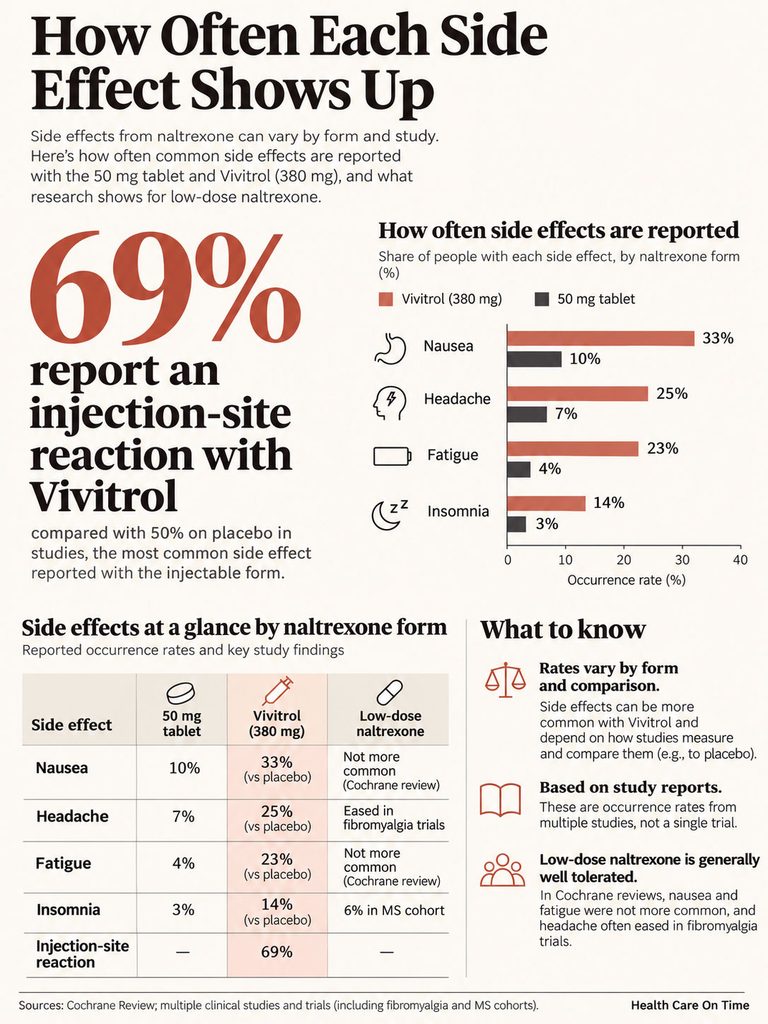
| Side effect | 50 mg tablet (FDA label; open-label, about 570 people) | Vivitrol 380 mg vs placebo (FDA label; alcohol trials) | Low-dose naltrexone (2018 Medical Sciences review) |
| Nausea | 10% | 33% vs 11% | Not more common than placebo in a Cochrane review |
| Headache | 7% | 25% vs 18% | More common than placebo in a 28-person fibromyalgia trial; eased at 3 mg |
| Fatigue | 4% | 23% vs 12% (malaise and fatigue) | Not more common than placebo in a Cochrane review |
| Insomnia or sleep disorder | 3% | 14% vs 12% | 6% insomnia in an MS cohort of 215 |
| Vivid dreams or nightmares | Not listed | Not listed | 5% nightmares in the same MS cohort |
| Dizziness | 4% | 13% vs 4% (dizziness or fainting) | No rate given |
| Anxiety | 2% (plus 4% nervousness) | 12% vs 8% | No rate given |
| Injection-site reaction | Not applicable | 69% vs 50% | Not applicable |
Read the tablet column with some care. Those numbers come from a study without a placebo group, so they show how often people had each problem, not how many of those problems the drug caused, while the shot figures put the placebo rate right beside each one.
Low-Dose Naltrexone (LDN) and Your Sleep
Low-dose naltrexone usually means 1 to 5 mg a day, a tiny fraction of the 50 mg used for alcohol and opioid use disorder. It isn’t FDA-approved for any condition at those doses. Doctors prescribe it off-label for problems such as fibromyalgia, Crohn’s disease and multiple sclerosis, and it’s thought to work differently than the full dose: a brief opioid-receptor blockade that may prompt the body to raise its own endorphin levels, plus a possible calming effect on immune cells in the nervous system.
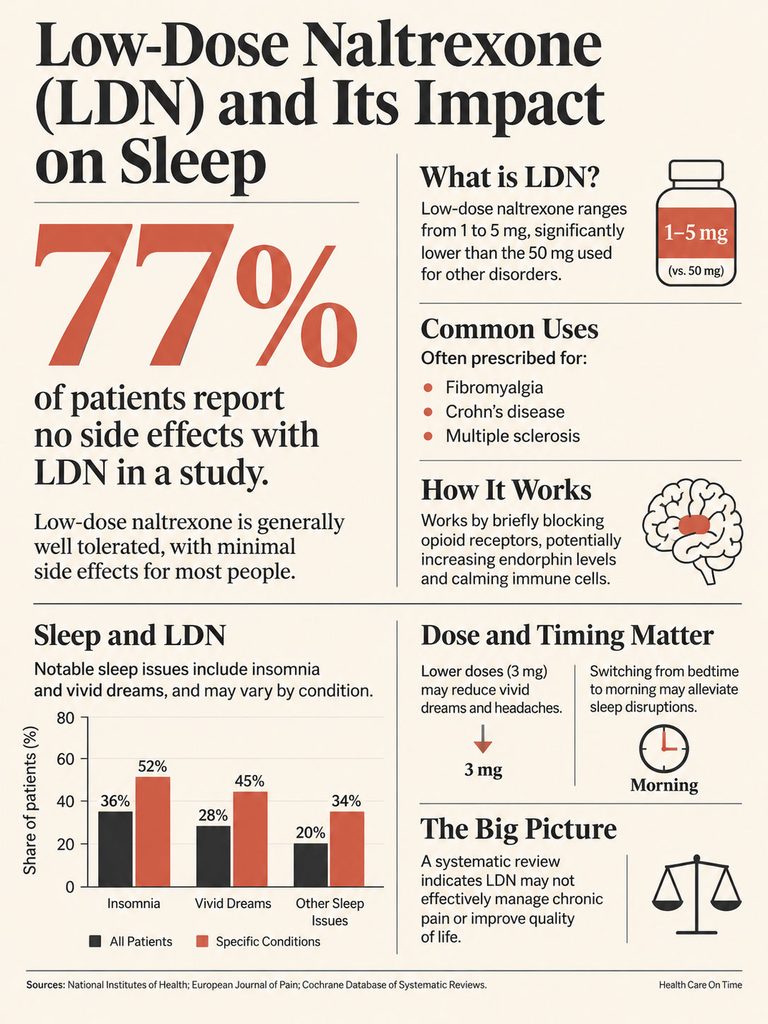
At that dose, stomach upset mostly drops away. A 2018 review of LDN in Medical Sciences cites a Cochrane analysis in which sleep disturbances, fatigue, nausea and headache were not more common on LDN than on placebo, and in a retrospective group of 215 people with MS, 77% had no side effects at all (a figure that relies on memory and may undercount).
What does show up, across very different conditions, is disrupted sleep, and the studies point to two levers. One is dose: in a 28-person fibromyalgia crossover trial, vivid dreams and headaches outnumbered placebo at first and became less of a problem when the dose came down to 3 mg a day. The other is the clock, since four patients in an inflammatory bowel disease study stopped having vivid dreams once they moved the dose from bedtime to morning. The size of the problem varies by group, from 6% with insomnia and 5% with nightmares in the MS cohort to 7 of 17 people with disturbed sleep in a small open-label Crohn’s disease study.
How long it lasts is less clear. Vivid dreaming and insomnia may resolve on their own with continued treatment, or ease after that bedtime-to-morning switch.
Because there’s no FDA label at these strengths to guide adjustments, any change in LDN timing or dose should go through the prescriber.
Whether the side effects are worth putting up with depends partly on benefit, and for pain that evidence is thin. A 2024 systematic review in Pain Management pooled 7 randomized trials with 406 patients taking 2 to 4.5 mg daily and concluded LDN was not effective for chronic pain or quality of life. The trials were small and the authors called for larger ones, but the finding is fair to raise with your prescriber when side effects are bothering you and the benefit is unclear.
The Monthly Shot: Why Some Effects Linger
Vivitrol is a 380 mg extended-release naltrexone injection given into the buttock muscle every 4 weeks by a health care provider, and it’s approved for both alcohol and opioid use disorder. After an injection, naltrexone has an elimination half-life of 5 to 10 days.
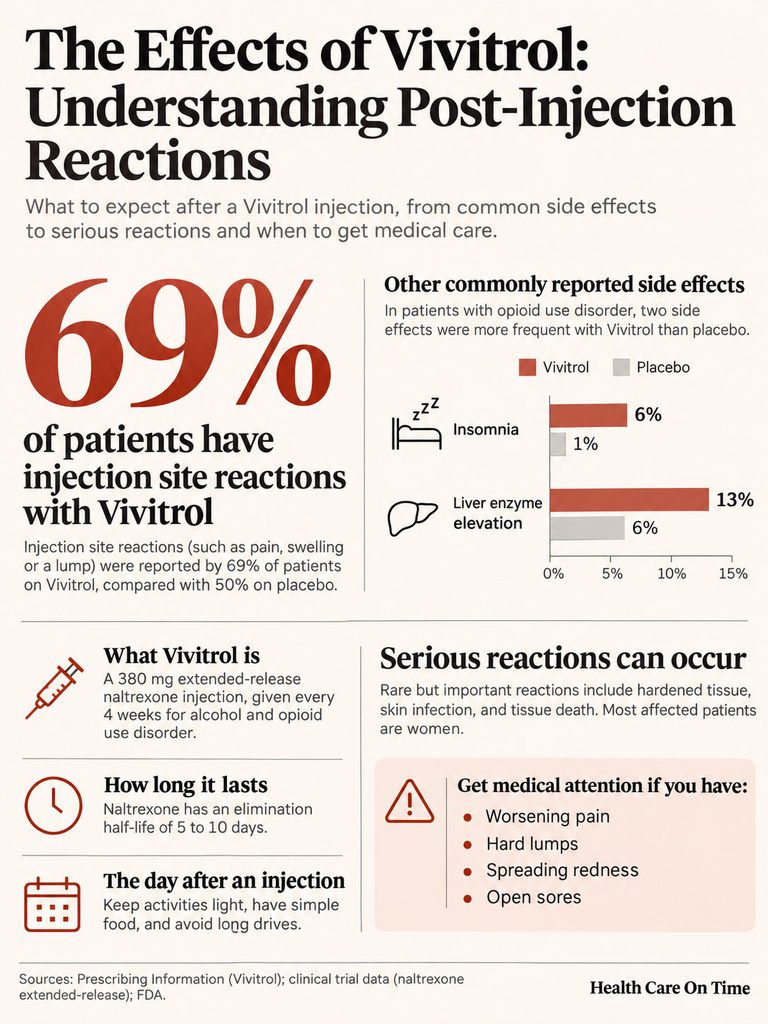
You can’t skip tomorrow’s dose to see if a symptom eases. Whatever the shot causes, it causes for days, so the first injection deserves a little planning: keep the next day or two light, have simple food in the house, and skip long drives if you’ve ever felt dizzy on the drug.
Besides nausea, the injection site itself is the usual complaint. In the alcohol trials, 69% of Vivitrol patients had some kind of injection-site reaction, compared with 50% after placebo injections, mostly pain, tenderness, swelling or bruising that settles.
A small number of cases went much further. Postmarketing reports describe hardened tissue, skin infection, abscess and tissue death, and some of those patients needed surgery; most were women. Pain that keeps getting worse, a growing hard lump, redness spreading out from the spot, or an open sore should be checked.
People treated for opioid use disorder had a somewhat different experience in their trial, with more insomnia (6% on Vivitrol versus 1% on placebo) and more rises in the liver enzyme ALT (13% versus 6%).
How Long Naltrexone Stays in Your System After You Stop
With the tablet, not long. Naltrexone and its breakdown product have half-lives measured in hours, so most of the drug is gone within a few days of the last pill, and the opioid-blocking effect of a 50 mg dose lasts up to about 24 hours.
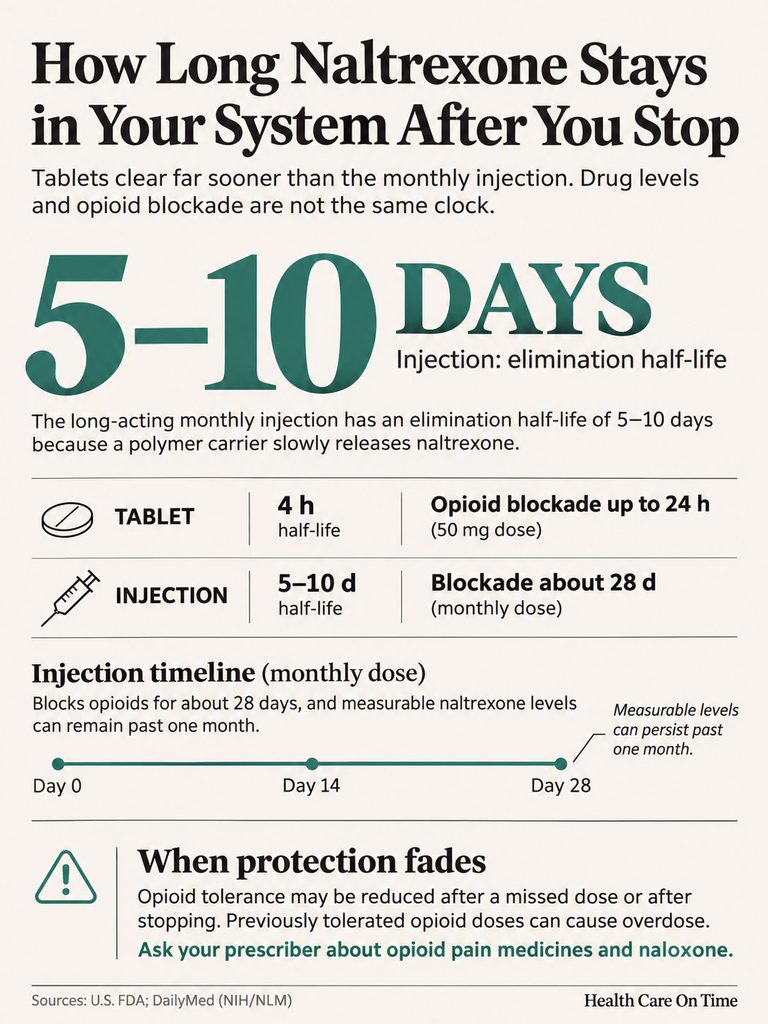
An injection keeps releasing naltrexone for weeks, because its 5-to-10-day half-life depends on the slow breakdown of the drug’s carrier. Toward the end of a dosing interval, or after a missed shot, the block fades while tolerance stays low, which is exactly when opioid sensitivity becomes dangerous.
Is It the Drug or Early Recovery?
Many people start naltrexone in the same weeks they cut back on drinking or come off opioids, and that overlap muddies the picture. Even the tablet’s prescribing information concedes that side effects can be hard to tell apart from withdrawal symptoms, and people getting dummy injections in the Vivitrol trials still had headaches, sleep trouble and anxiety at rates not far below the real drug.
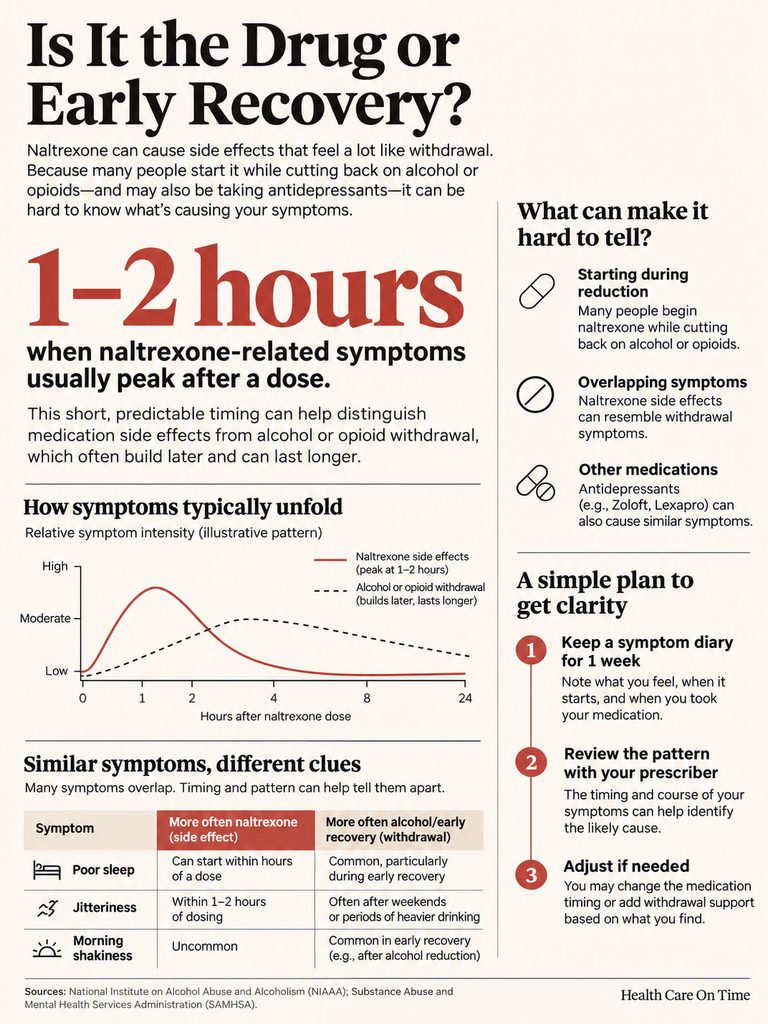
Timing is the most useful clue. Symptoms that rise and fall with each tablet, peaking within an hour or two of the dose, probably come from the medication, while poor sleep and jitteriness after a heavy weekend, or shakiness in the mornings, are more likely the alcohol. If you’re also starting an antidepressant in the same stretch, that adds a third suspect, since Zoloft can make you feel worse in the first weeks and Lexapro can feel weird at first too.
A week of notes helps your prescriber more than a description of one bad day, and the answer may point to a timing change for the drug or to more support for withdrawal.
Making the First Weeks Easier
Small habits do most of the work here, and none of them involve changing your dose on your own.
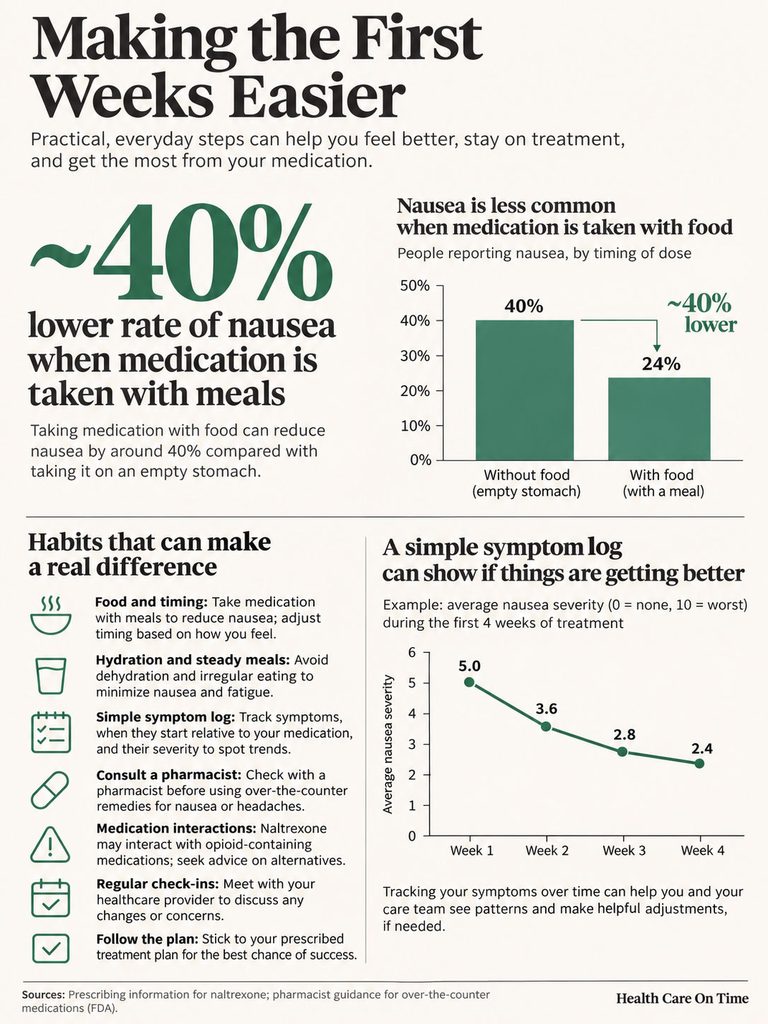
Food and timing. Taking the tablet with a meal often cuts nausea. If it makes you sleepy, an evening dose may suit you; if it keeps you awake, mornings may work better. Clear either change with your prescriber or pharmacist first, because your treatment plan may have a reason for the current timing.
Fluids and steady meals. Dehydration makes headache and dizziness worse. People cutting back on alcohol often eat irregularly at first, and skipped meals make both nausea and fatigue worse.
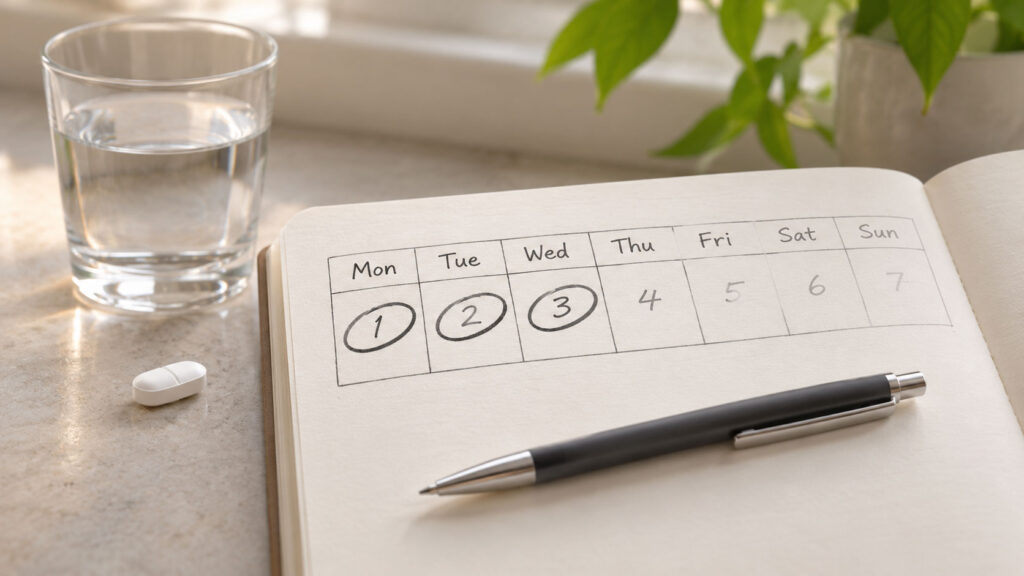
A simple log. Write down each symptom, when it started relative to your dose, and how bad it was on a 1 to 10 scale. After a week you’ll usually see the trend. Two lines a day is plenty.
Over-the-counter help. Ask a pharmacist before adding anything for nausea or headache. Naltrexone blocks opioid-based medicines, so some cough and diarrhea products containing opioids may not work, and taking more to overcome the block is dangerous.
Warning Signs That Can’t Wait
A handful of symptoms call for a same-day call or urgent care, however early in treatment they appear.
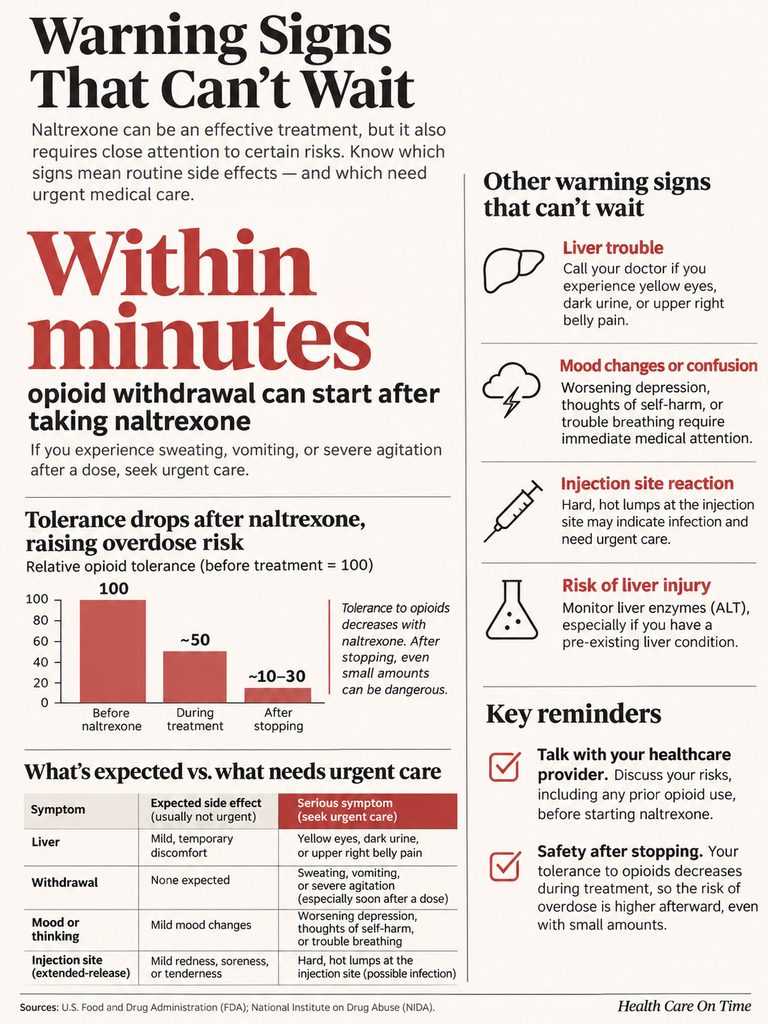
Signs of Liver Trouble
Liver injury from naltrexone at normal doses is rare. ALT levels above three times the upper limit of normal occur in about 1% of people, and the NIH LiverTox database finds no definite link between naltrexone and clinically apparent liver injury. High doses are a different matter: in one study using about 300 mg a day, 5 of 26 people (19%) developed enzyme elevations, compared with none of 24 on placebo, and the tablet label flags a possibly higher risk of liver cell injury with single doses above 50 mg.
Many people taking naltrexone for alcohol use disorder already have some alcohol-related fatty liver disease or other liver stress from drinking, which is one reason prescribers check liver tests before and during treatment.
Call your doctor immediately for:
- pain in the upper right part of your stomach
- dark urine or light-colored stools
- yellowing of your skin or the whites of your eyes
- unusual tiredness, bleeding or bruising
Sudden Opioid Withdrawal
With opioids still in your system, naltrexone can trigger withdrawal within minutes; symptoms usually appear within five minutes of a tablet dose and have lasted for up to 48 hours. You need to be opioid-free for at least 7 to 10 days after short-acting opioids before starting, and people switching from buprenorphine or methadone may be at risk for as long as two weeks. Sudden sweating, vomiting, diarrhea, shaking, goosebumps or severe agitation after a first dose is a medical problem, so get help rather than waiting it out.
Overdose Risk Later On
Naltrexone lowers your tolerance to opioids over time. After you stop it, miss a dose, or reach the end of a Vivitrol dosing interval, a smaller amount of an opioid can be dangerous. Trying to push through the blockade with large opioid doses can cause coma or death. Carrying documentation that you take the medicine helps emergency staff treat you properly.
Mood Changes, Confusion or Trouble Breathing
Worsening depression, suicidal thoughts, confusion, hallucinations or blurred vision need prompt care. On the shot, two cases of a lung inflammation called eosinophilic pneumonia occurred in trials, both needing hospital care, so new shortness of breath that keeps getting worse should be checked.
| Situation | What it may mean | What to do |
| Mild nausea in the first few days | Expected early side effect | Take with food; keep taking unless told otherwise |
| Nausea or headache still strong after 2 weeks | Slow adjustment or another cause | Call your prescriber; ask about timing or other options |
| Vivid dreams or insomnia on LDN | Common low-dose effect | Ask whether a morning dose is right for you |
| Sweating, vomiting, shaking within minutes of a first dose | Precipitated opioid withdrawal | Seek urgent medical care |
| Yellow eyes, dark urine, upper right belly pain | Possible liver injury | Stop and call your doctor the same day |
| Hard, hot or spreading lump at the shot site | Possible infection or tissue damage | Get the site examined promptly |
| Thoughts of self-harm or sharply lower mood | Serious mood side effect | Call 988 or your doctor now |
| Planning to use opioids after stopping or missing a dose | Lowered tolerance, overdose risk | Talk with your prescriber first |
If You’re Thinking About Stopping
Very few people with alcohol use disorder ever take a medicine for it. When the national drug use survey first asked, in 2019, only 1.6% of adults with the disorder were using an approved medication, and the condition is common, with 27.9 million Americans aged 12 and older affected in 2024. People with opioid use disorder fare better, yet in 2022 only 25.1% of adults who needed treatment got medication for it.
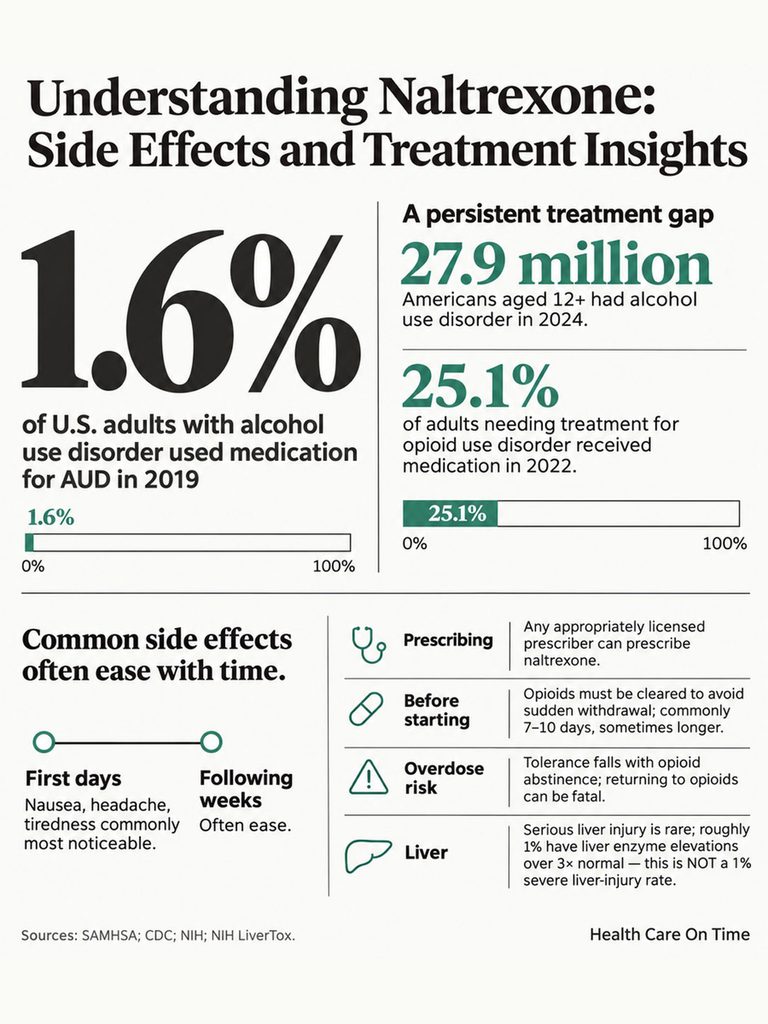
Help doesn’t have to come from an addiction specialist. Any practitioner licensed to prescribe medications can prescribe naltrexone, so a primary care doctor can adjust timing or switch you to another approved option if side effects don’t settle.
Talk to your doctor before you stop, too. For anyone with an opioid history the reason is concrete: tolerance drops while you’re on the drug, so the period right after stopping carries real overdose risk.
Questions worth bringing to your prescriber or pharmacist:
- Would taking this in the morning instead of at night help with the dreams?
- Is the nausea likely to ease, or should we try a different time of day first?
- Should liver tests be checked before the next refill or shot?
- Which headache or stomach medicines are safe with naltrexone?
- If this doesn’t settle in a couple of weeks, what’s the next option?
Frequently Asked Questions
How long until naltrexone side effects wear off?
For most people, nausea, headache and tiredness peak in the first few days and ease over the first few weeks. Nausea after a Vivitrol injection usually passes within a few days.
Why does naltrexone make some people feel weird?
It blocks opioid receptors that your own endorphins use, and your body needs time to adjust. The odd feeling is usually a blend of mild nausea, headache, fatigue and edginess that fades as you adapt.
How can you get rid of naltrexone side effects?
Take the tablet with food, keep meals and fluids steady, and ask your prescriber whether a different time of day would help. For LDN sleep problems, morning dosing has stopped vivid dreams in some patients. Don’t change the dose on your own, and check with a pharmacist before adding any over-the-counter medicine, since opioid-containing products won’t work normally while you’re on it.
How long will you feel tired on naltrexone?
Tiredness is usually worst in the first week. If it lasts beyond a few weeks or comes with yellow skin, dark urine or bruising, call your doctor.
Does low-dose naltrexone have fewer side effects?
Generally, yes. At 1 to 5 mg, nausea and headache are much less of a problem, and one MS group found 77% had no side effects at all. Sleep is the exception, with insomnia, vivid dreams and nightmares as the typical complaints; they often respond to a morning dose or simply to time.
Can naltrexone damage your liver?
Serious liver injury at the standard 50 mg dose is rare, and enzyme rises above three times normal happen in about 1% of people. The risk appears higher at much larger doses. Stop and call your doctor if you notice yellow eyes, dark urine or pain in the upper right abdomen.
Do side effects come back with every Vivitrol shot?
Nausea tends to get less likely with each later injection, though injection-site soreness can happen with any shot. Alternating sides of the buttock each month, as the label directs, gives each site time to recover.
Is it normal to have vivid dreams on naltrexone?
Yes, especially on LDN. Ask about a morning dose if they disturb your sleep.
What happens if you take naltrexone with opioids still in your system?
Withdrawal can start within minutes, with sweating, vomiting, diarrhea and shaking that has lasted up to 48 hours in some cases. That risk is why a gap of 7 to 10 days without short-acting opioids comes first, and a longer one after buprenorphine or methadone. If it happens, get medical care right away.
Medical disclaimer: This article is for general information only and isn’t a substitute for advice from your doctor or pharmacist. Don’t start, stop or change any medication without talking with your health care provider. If you’re having a medical emergency or thoughts of self-harm, call 911 or 988.
References
- Naltrexone Hydrochloride Tablets USP, prescribing information (DailyMed)
- Naltrexone Hydrochloride Tablets, prescribing information, warnings section (MedLibrary)
- VIVITROL (naltrexone for extended-release injectable suspension) prescribing information, Alkermes, revised May 2026
- Naltrexone, MedlinePlus Drug Information, National Library of Medicine
- Naltrexone, LiverTox, NCBI Bookshelf, National Institutes of Health
- Toljan K, Vrooman B. Low-Dose Naltrexone (LDN): Review of Therapeutic Utilization. Medical Sciences, 2018
- Rassi-Mariani V, et al. The use of naltrexone in the treatment of chronic pain: a systematic review. Pain Management, 2024 (IASP summary)
- Suh JJ, et al. Gender Differences in Predictors of Treatment Attrition with High Dose Naltrexone in Cocaine and Alcohol Dependence. American Journal on Addictions, 2008
- Alcohol Use Disorder (AUD) in the United States, NIAAA
- Few are prescribed medications to treat alcohol problems, NIH Research Matters, 2021
- Treatment for Opioid Use Disorder: Population Estimates, United States, 2022 (MMWR via PMC)
- Naltrexone, SAMHSA