Shortness of breath is the warning sign most closely tied to sudden cardiac arrest in women, and in the weeks before a heart attack, unusual tiredness and broken sleep are far more common than chest pain. Because those signs look like ordinary life, they’re easy to explain away.
Table of Contents
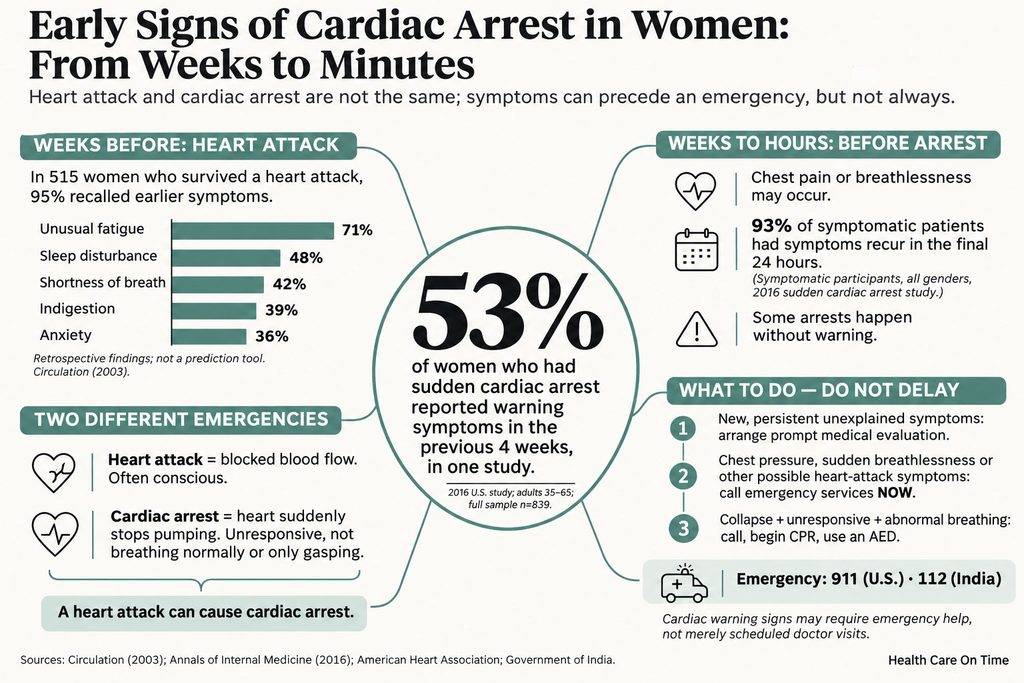
Quick answer: The early signs of cardiac arrest in women are often quiet. In a 2023 US study, shortness of breath was the only warning symptom clearly linked to imminent sudden cardiac arrest in women, while men’s warnings also included chest pain and sweating. Weeks before a heart attack, women most often notice unusual fatigue, sleep trouble and breathlessness. If she collapses and isn’t breathing normally, call 911, start CPR and use an AED.
Two different emergencies, one warning window
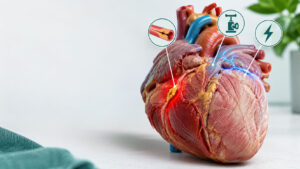
People use “heart attack” and “cardiac arrest” as if they meant the same thing, and the mix-up gets in the way when you’re trying to read early signs. In a heart attack, a coronary artery gets blocked, blood stops reaching part of the heart muscle, and that muscle starts to die if the artery isn’t opened quickly. The heart usually keeps beating, and the woman is usually awake, though she may feel terrible.
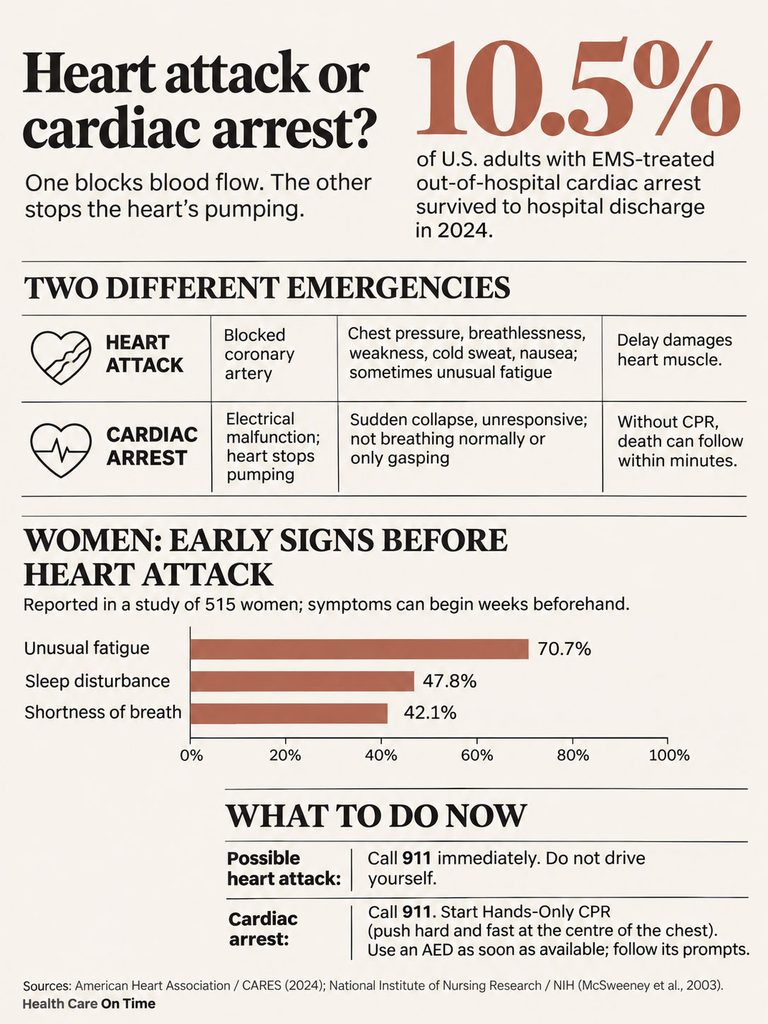
Sudden cardiac arrest is an electrical failure. The heart’s rhythm turns chaotic, most often into ventricular fibrillation, the lower chambers quiver instead of pumping, and blood stops reaching the brain and lungs. Within seconds she’s unresponsive and not breathing, or only gasping. Without CPR and a shock, death follows within minutes.
A heart attack can set off the rhythm problem that causes cardiac arrest, although most heart attacks don’t, and scar tissue from an old heart attack can cause rhythm trouble years later. That overlap is why the slow-building symptoms of coronary disease, the kind women tend to have, are so often the only advance notice before either event. Heart failure, which people also mix up with both, is a slower weakening of the pump over months or years, and knowing how a heart attack, heart failure and cardiac arrest differ tells you which one needs CPR and which needs a phone call.
| Point on the timeline | Heart attack | Sudden cardiac arrest | What women should know |
| What goes wrong | A blocked coronary artery cuts blood flow to part of the heart (a circulation problem) | The heart’s electrical rhythm fails, usually as ventricular fibrillation, and pumping stops | A heart attack can trigger cardiac arrest, but most heart attacks do not |
| Weeks before | Unusual fatigue (70.7%), sleep disturbance (47.8%) and shortness of breath (42.1%) in women, McSweeney 2003 | 53% of women had at least one warning symptom in the 4 weeks before, Marijon 2015 | Chest discomfort before a heart attack showed up in only 29.7% of women |
| Hours before | Symptoms that build over hours, days or weeks, or come on suddenly | Shortness of breath was the only warning symptom tied to arrest in women (odds ratio 2.9), Reinier 2023 | In men, chest pain, breathlessness and sweating were all tied to arrest |
| The moment it happens | Usually awake; heart still beating; breathlessness, weakness, cold sweat, nausea | Sudden collapse, no pulse, not breathing or only gasping | Gasping is not normal breathing; treat it as cardiac arrest |
| First action | Call 911; don’t drive yourself | Call 911 and start Hands-Only CPR right away | EMS can start treatment up to an hour sooner than arriving by car |
| Second action | Stay on the line and follow the dispatcher’s instructions | Use an AED as soon as one arrives; it shocks only when a shock is needed | AED use isn’t limited to trained people |
| Time pressure | The longer the artery stays blocked, the more heart muscle dies | Death within minutes without treatment | Only 10.5% of US adults survived an out-of-hospital cardiac arrest to discharge in 2024 |
Warning signs in the weeks before
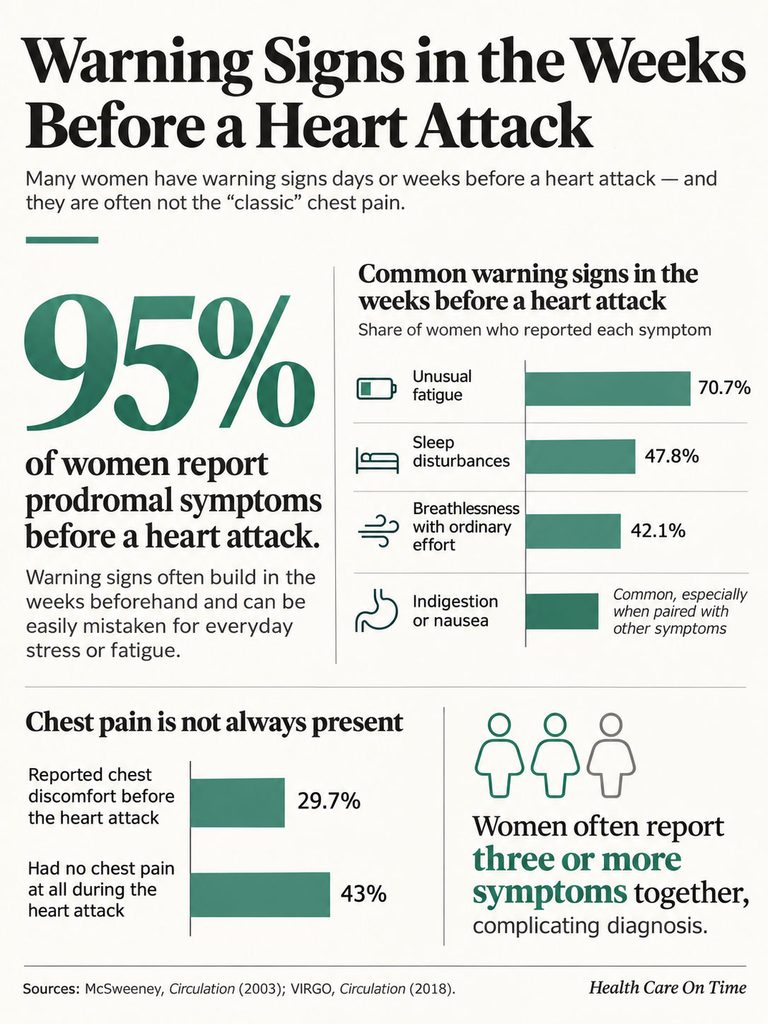
Almost every woman who has a heart attack can, looking back, name something that felt off beforehand. In the largest survey built around that question, Jean McSweeney’s team at the University of Arkansas for Medical Sciences interviewed 515 women from five sites four to six months after their heart attacks, and 95% reported prodromal symptoms: new or changed symptoms that came and went beforehand and faded once the heart attack was treated. The work was published in Circulation in 2003, and it has limits worth knowing. Most of the women were white and older, they were remembering symptoms months later, and the authors wrote that it’s still unknown whether these symptoms predict future events.
Unusual fatigue
Roughly seven in ten women had it, which made fatigue the most common early sign by a wide margin. The kind that matters is new and out of proportion, tiredness that won’t go away or feels excessive: ordinary chores start to feel like heavy work, and it doesn’t lift after a good night or a quiet weekend.
Sleep trouble
Trouble falling asleep, or waking again and again through the night, affected close to half the women in the weeks before. On its own, poor sleep means very little, because most adults go through bad stretches. A woman who normally sleeps well and suddenly doesn’t, while also feeling drained during the day, is a different picture.
Breathlessness with ordinary effort
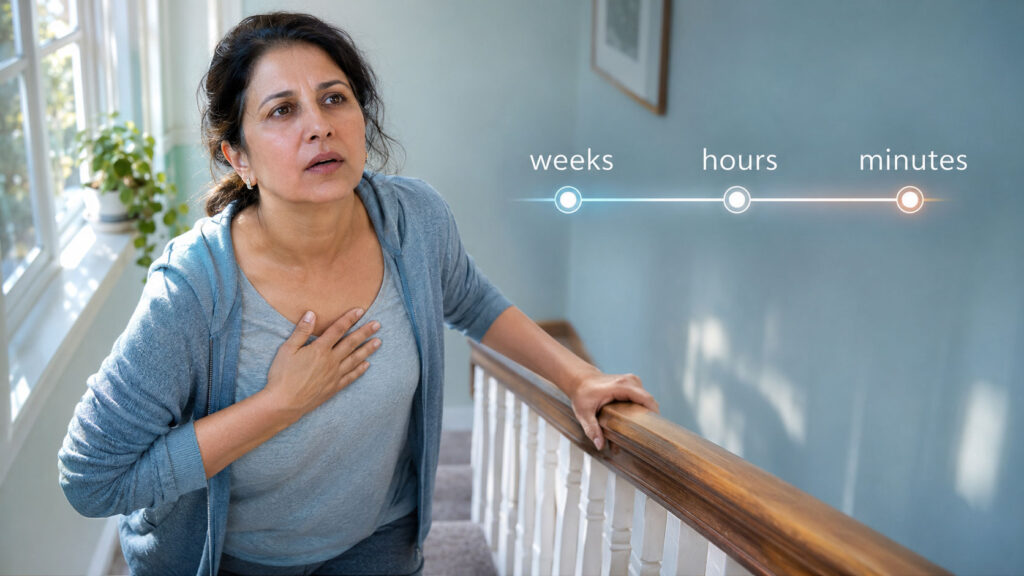
The early version tends to be mild. She gets winded climbing the same stairs she always climbs, or has to stop partway through carrying groceries in from the car, and then it eases with rest. About four in ten women in the survey noticed it beforehand, and during the heart attack itself it was the most common symptom of all, ahead of weakness and fatigue.
Indigestion, nausea and a sense that something is off
Indigestion, heartburn and nausea belong on the list too, and women are more likely than men to have nausea or vomiting and unusual tiredness when a heart attack is coming on. All of these are easy to blame on food or stress, and most of the time that’s correct. They deserve more attention when they’re new, when they return without an obvious trigger, or when they arrive in the same week as fatigue and breathlessness.
Anxiety overlaps with all of this. A racing heart and tight breathing can come from anxiety alone, but a sudden, unexplained sense of dread that shows up with breathlessness is a reason to get checked.
Why chest pain is often missing
Fewer than a third of the women in McSweeney’s survey had chest discomfort in the weeks before, and during the heart attack, 43% had no chest pain at all. When chest discomfort does appear, it often isn’t the crushing pain people expect; women describe pressure, squeezing, fullness or an ache that comes and goes, and pain in the jaw, neck, upper back, shoulders or arms can take its place. A stabbing, pinpoint pain you can press on is a different pattern, and sharp sternum pain more often comes from the chest wall or the gut, though the heart still has to be ruled out.
Younger women are a slightly different story. The VIRGO study, published in Circulation in 2018, interviewed 2,009 women and 976 men aged 18 to 55 who were hospitalized for a heart attack at 103 US hospitals, and most of the women (87%) did feel pain, pressure, tightness or discomfort in the chest. What set them apart was everything else. More women than men had three or more other symptoms at the same time, such as stomach symptoms, palpitations, or pain in the jaw, neck, arms or between the shoulder blades, and with so much going on, the chest symptom was easier for everyone to overlook.
| Finding | Number | Study and year | Who was studied |
| Reported any prodromal (early) symptom before a heart attack | 95% | McSweeney, Circulation (2003) | 515 women, average age 66, surveyed 4 to 6 months after a heart attack |
| Unusual fatigue in the weeks before | 70.7% | McSweeney, Circulation (2003) | Same 515 women |
| Sleep disturbance in the weeks before | 47.8% | McSweeney, Circulation (2003) | Same group |
| Shortness of breath in the weeks before | 42.1% | McSweeney, Circulation (2003) | Same group |
| Chest discomfort in the weeks before | 29.7% | McSweeney, Circulation (2003) | Same group |
| No chest pain during the heart attack | 43% | McSweeney, Circulation (2003) | Same group |
| Warning symptoms in the 4 weeks before sudden cardiac arrest | Women 53%, men 50% | Marijon, Annals of Internal Medicine (2015) | 839 adults aged 35 to 65, Portland, Oregon area |
| Shortness of breath before arrest vs EMS callers who didn’t arrest | 41% vs 22% | Reinier et al., Lancet Digital Health (2023) | 411 people with witnessed sudden cardiac arrest (125 women), Ventura County, California |
| Odds of arrest linked to shortness of breath in women | Odds ratio 2.9 | Reinier et al., Lancet Digital Health (2023) | Same Ventura County group; result held in an Oregon group |
| Three or more symptoms besides chest pain during a heart attack | Women 61.9%, men 54.8% | VIRGO, Circulation (2018) | 2,009 women and 976 men aged 18 to 55, 103 US hospitals |
| Told by a clinician that earlier symptoms weren’t heart-related | Women 53%, men 37% | VIRGO, Circulation (2018) | VIRGO patients who sought care before admission |
The last 24 hours before sudden cardiac arrest
About half of the people who have a sudden cardiac arrest felt something first, women slightly more often than men, and for most of them the symptom came back in the final day.
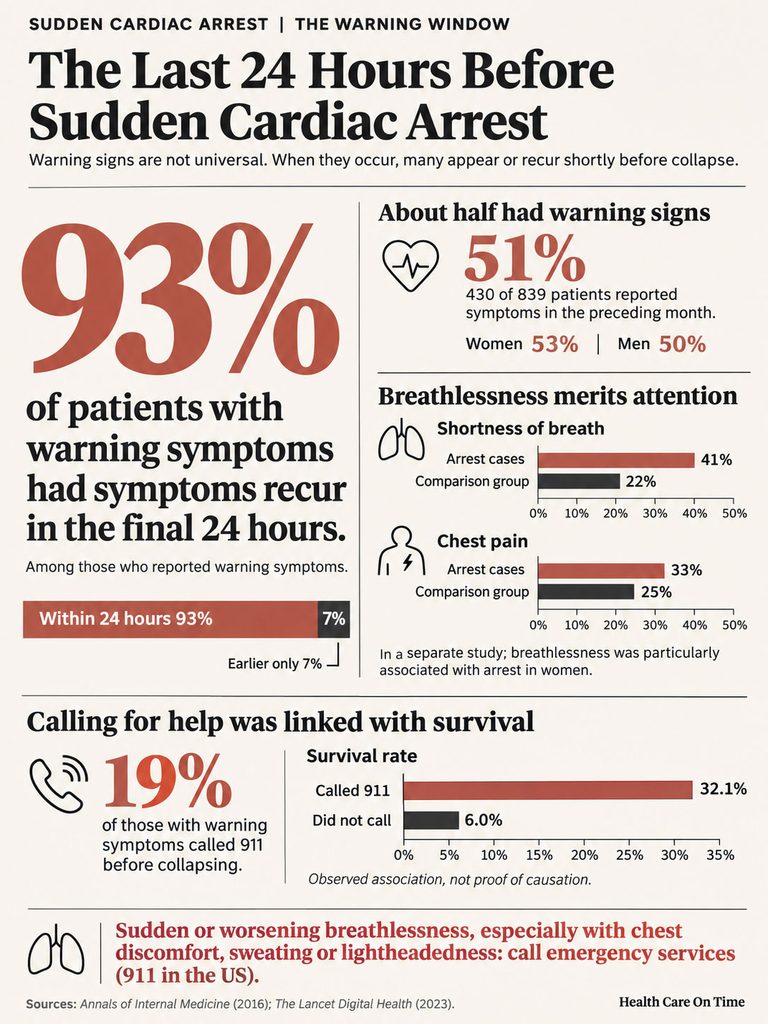
The clearest timing data comes from the Oregon Sudden Unexpected Death Study. Eloi Marijon and colleagues reviewed the four weeks before arrest in 839 people aged 35 to 65 in the Portland area, and just over half had at least one warning symptom, including 53% of the women. Chest pain was the most frequent complaint overall, followed by shortness of breath. Most warnings started more than an hour ahead and about a third started more than a day ahead, and in 93% of those who had symptoms, they returned during the last 24 hours. Women in that group had shortness of breath more often than men and chest pain less often; among patients with known coronary disease, chest pain showed up in 32% of the women and 58% of the men.
Only 19% of people with warning symptoms called 911 before collapsing, yet survival was 32.1% among those who called and 6.0% among those who didn’t, a gap that held after adjusting for other factors. Calling didn’t always buy time (most callers still arrested before responders reached them), and an observational study can’t prove the call itself saved anyone, but the survival difference was more than fivefold.
Breathlessness is common, of course, and most breathless people never arrest. A 2023 Cedars-Sinai study tackled that problem head-on by comparing 411 people with a witnessed sudden cardiac arrest in Ventura County, California, with more than 1,100 people who called EMS for similar complaints and didn’t arrest. It found shortness of breath in 41% of the arrest group and 22% of the comparison group, with chest pain, sweating and seizure-like activity also turning up more often before arrest. In men, chest pain, shortness of breath and sweating were each linked to arrest. In the 125 women, only shortness of breath was, at roughly triple the odds, and the pattern mostly held in a second group of 427 patients from Oregon.
When a warning period exists, it’s usually measured in hours, which is why new or worsening breathlessness in a woman, especially with sweating, lightheadedness or a racing heart, deserves a 911 call instead of a wait to see whether it passes.
What the moment of cardiac arrest looks like
The arrest itself looks nothing like the warning phase. When the heart’s rhythm fails, she collapses suddenly, has no pulse, doesn’t respond when you shake her shoulder and shout, and either isn’t breathing or is only gasping. Those gasps, sometimes called agonal breathing, aren’t normal breathing, and they shouldn’t stop anyone from starting CPR.
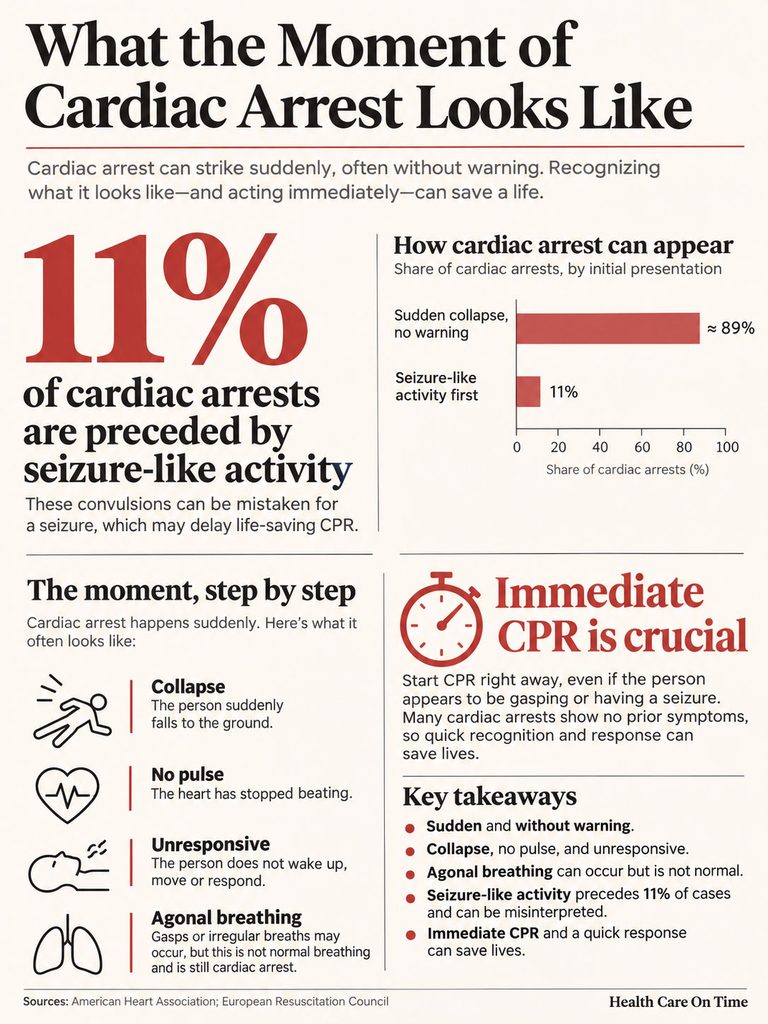
Seizure-like activity came before 11% of arrests in the Ventura County group, and a bystander could easily take it for an ordinary seizure and wait. If she stays unresponsive and isn’t breathing normally, treat it as cardiac arrest. Many arrests come with no warning at all, even in women who never felt a thing beforehand.
Why these signs get brushed off
Women often feel these symptoms and still don’t act, and the people around them, clinicians included, sometimes don’t either.
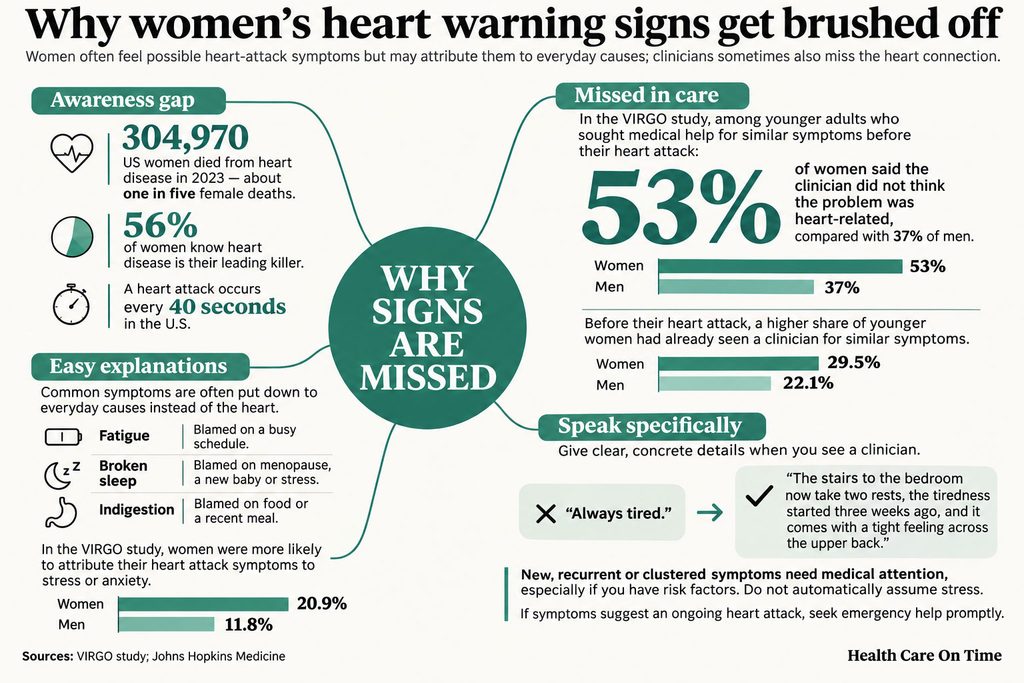
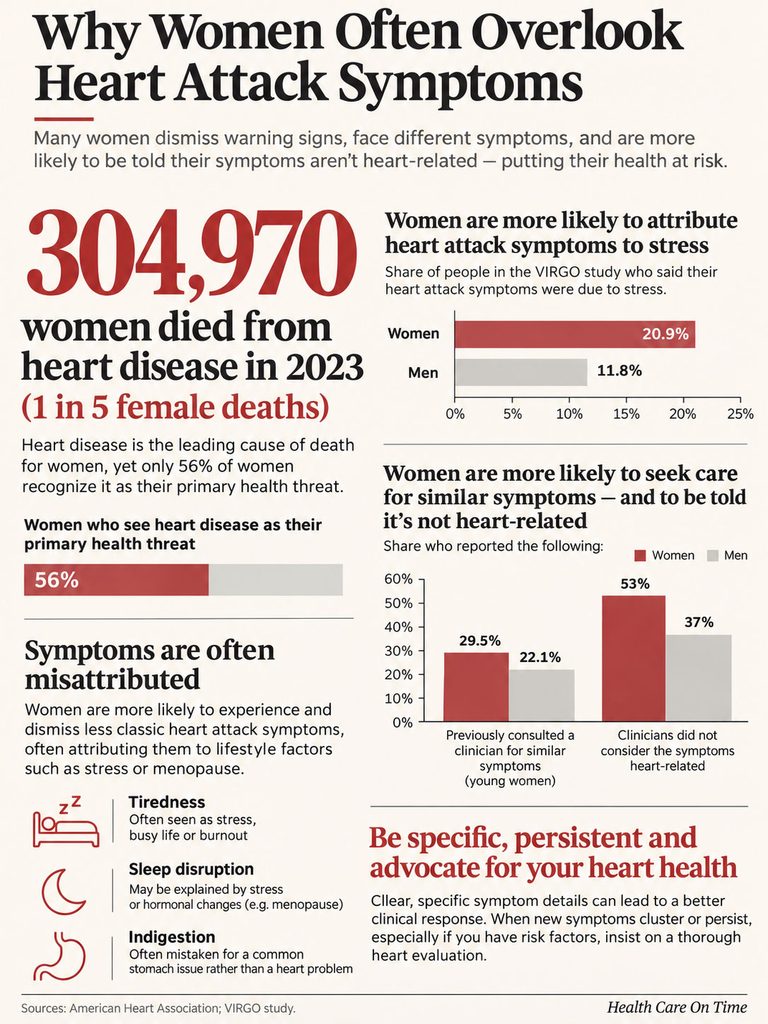
Awareness is part of it. Heart disease killed 304,970 US women in 2023, about 1 in every 5 female deaths. Only about 56% of women know it’s their leading killer, even though someone in the country has a heart attack every 40 seconds. Many still think of heart attacks as a men’s issue, and younger women in particular rarely connect odd symptoms to the heart.
The symptoms also come with ready-made excuses: tiredness gets blamed on a busy schedule, and broken sleep on menopause, a new baby or a stressful job, while indigestion gets blamed on whatever was for dinner. In VIRGO, women were more likely than men to put their heart attack symptoms down to stress or anxiety (20.9% versus 11.8%).
Care that was sought and missed is the harder problem. Before their heart attack, 29.5% of the young women in VIRGO had already seen a clinician for similar symptoms, compared with 22.1% of men, and 53% of those women said the clinician didn’t think the problem was heart-related, compared with 37% of men.
It helps to walk into an appointment with specifics rather than a vague complaint. A vague “always tired” invites a shrug; saying that the stairs to the bedroom now take two rests, that the tiredness started three weeks ago, and that it comes with a tight feeling across the upper back gives a clinician something to work with, and makes it harder to wave off.
Most tired, short-of-breath women aren’t heading for a cardiac event. Still, when symptoms are new, keep returning or cluster together, and especially when she has risk factors, the heart should be checked before anyone settles on stress as the answer.
What raises a woman’s risk
Sudden cardiac arrest usually grows out of an existing heart condition, and coronary artery disease is one of the most common. Damage from a prior heart attack, cardiomyopathy (an enlarged or thickened heart muscle), heart valve disease, heart defects present from birth, and inherited rhythm disorders such as long QT syndrome and Brugada syndrome, electrical types of cardiac disorders that can run in families, can all lead to arrest as well.
Arrest can also happen in women with no known heart disease at all, which is why a normal checkup isn’t a free pass to ignore new symptoms.
The general risk factors are familiar: high blood pressure, high cholesterol, diabetes, obesity, smoking and an inactive lifestyle. A family history of heart disease or sudden cardiac arrest, cocaine or amphetamine use, low potassium or magnesium, obstructive sleep apnea and chronic kidney disease also raise risk. Being male does too, which is one reason arrests in women get less attention than they should.
Some risks fall mainly or only on women:
- High blood pressure that isn’t controlled. More than 58.9 million US women (45.7%) have high blood pressure or take medicine for it, and fewer than 1 in 4 of them (22.8%) have it under control, so knowing normal blood pressure for women by age and checking your own numbers matters.
- Pregnancy complications. High blood pressure develops in 1 in every 8 US pregnancies (13.0%), and women who have it carry twice the risk of heart disease later in life.
- Menopause. Hormonal changes after menopause raise the risk of coronary heart disease, and early menopause before 40 counts as a risk factor of its own.
- Spontaneous coronary artery dissection (SCAD). A tear in the wall of a heart artery that can slow or block blood flow and cause a heart attack, dangerous rhythms or sudden death. It most often affects women in their 40s and 50s, many without the usual risk factors, and it can follow childbirth, usually in the first few weeks after delivery.
SCAD symptoms overlap heavily with the early signs above: chest pain or pressure, pain in the arms, shoulders, back or jaw, shortness of breath, heavy sweating, unusual fatigue, an upset stomach, a racing heartbeat and dizziness. A new mother with those symptoms may assume she’s simply exhausted.
Partners and family can help here, because they often notice the change first: the woman who used to take the stairs two at a time and now stops on the landing, or who keeps saying she can’t catch her breath after the baby’s bath. On average, women have a first heart attack at 72.0, compared with 65.6 for men (based on 2005 to 2014 data), so a woman in her 40s rarely expects one, and SCAD is a reason not to let age settle the question.
Call 911 or call your doctor?
Some early warning signs can wait for an appointment in the next few days, and others can’t wait at all. When it’s an emergency, calling beats driving, because EMS crews can start treatment on arrival, up to an hour sooner than if she’s driven to the hospital, and they can restart a heart that stops on the way. When in doubt, call.
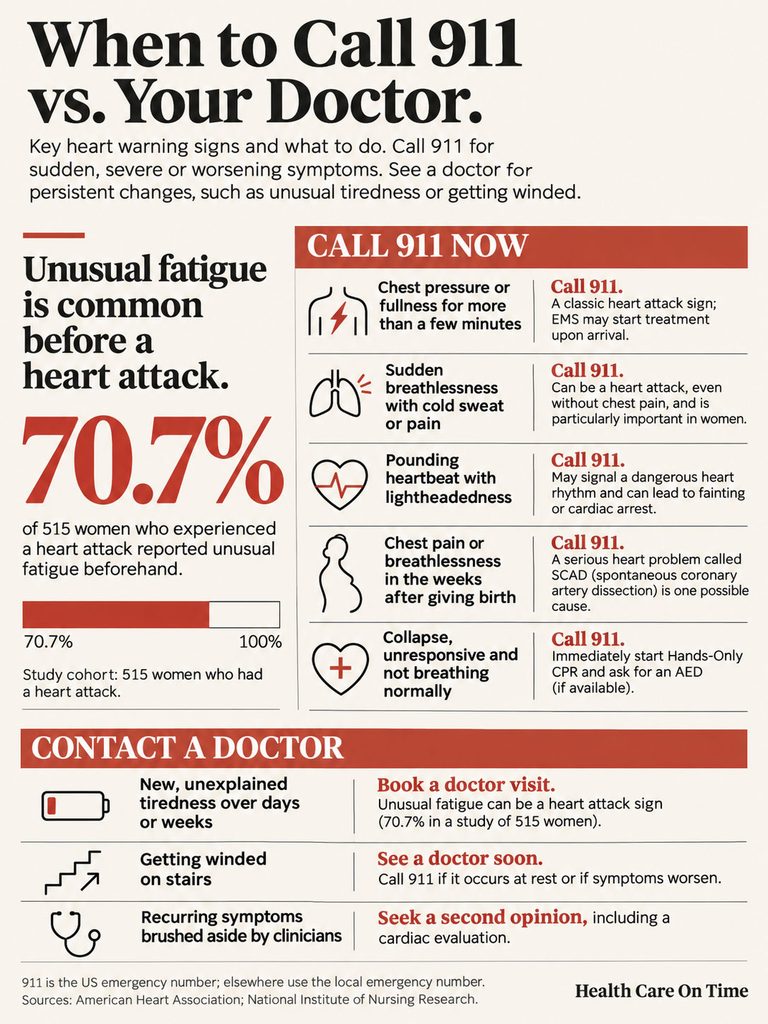
| Situation | What to do | Why it matters |
| New, unexplained tiredness that has lasted days or weeks | Book a doctor visit within days and mention any heart risk factors | Unusual fatigue was the most common early sign in women before a heart attack (70.7%) |
| Getting winded on stairs or a short walk that used to be easy | See a doctor soon; call 911 if it happens at rest or keeps getting worse | Shortness of breath was the one warning symptom tied to sudden cardiac arrest in women |
| Chest pressure, squeezing or fullness lasting more than a few minutes, or fading and coming back | Call 911 now | A classic heart attack sign; EMS starts treatment on arrival |
| Sudden breathlessness with a cold sweat, nausea, or jaw, back or arm pain | Call 911; don’t drive yourself | Women more often have these symptoms, with or without chest pain |
| Pounding or racing heartbeat with lightheadedness, fainting or near fainting | Call 911 | A rhythm problem can cause fainting and can lead to cardiac arrest |
| Chest pain or breathlessness in the first weeks after giving birth | Call 911 | SCAD usually appears in the first few weeks after delivery and can cause sudden death |
| Symptoms keep coming back after a clinician said they weren’t heart-related | Go back, or get a second opinion, and ask directly whether the heart has been checked | In VIRGO, 53% of young women said a clinician dismissed earlier symptoms |
| She collapses and isn’t breathing, or is only gasping | Call 911, start Hands-Only CPR, and send someone for an AED | Immediate CPR can double or triple the chance of survival |
If she collapses: CPR and an AED
Sudden cardiac arrest was mentioned on the death certificates of 380,349 people in the United States in 2023, and most out-of-hospital arrests, 71.0% in 2024 US data, happen at home. The person most likely to save a woman in cardiac arrest is a spouse, an adult child, a roommate or a neighbor. Even so, only 42% of people who had an out-of-hospital arrest in 2024 got CPR from a bystander, and a public AED was used in just 13%.
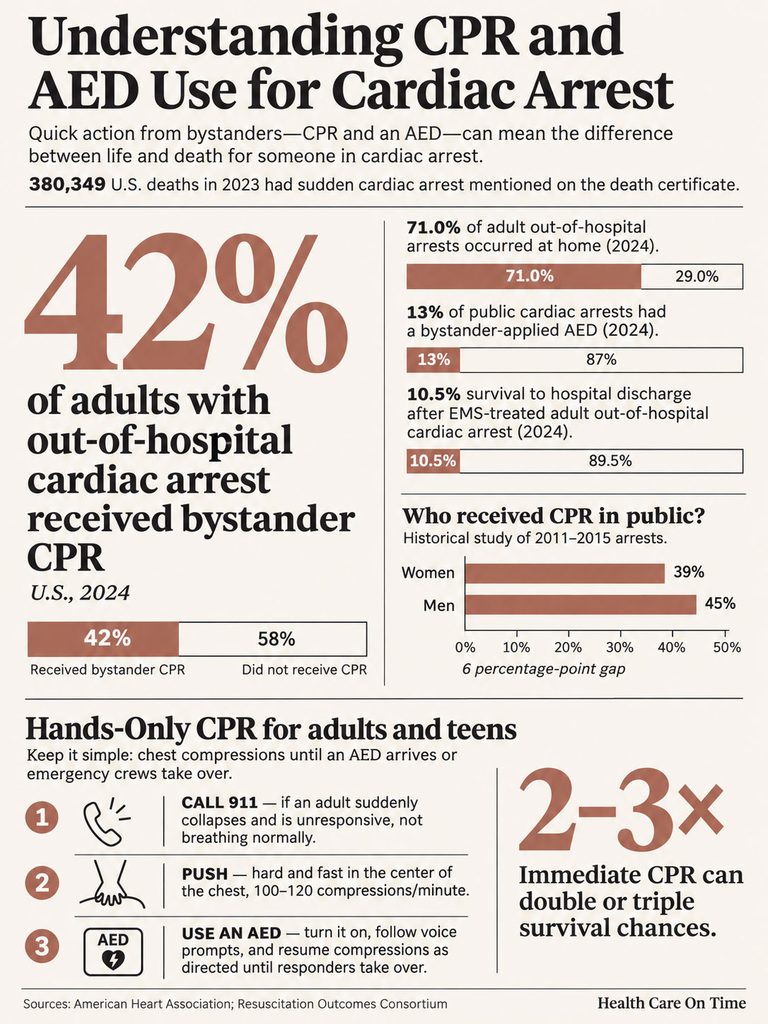
Women face an added gap. In a US registry of 19,331 out-of-hospital cardiac arrests from 2011 to 2015, 39% of women who collapsed in public got bystander CPR, compared with 45% of men, while at home the rates were about the same (35% and 36%), and men had better odds of surviving to hospital discharge. Asked why, people pointed to fear of being accused of inappropriate touching or assault, worry about hurting a woman who seems fragile, and simply not recognizing that a woman could be having a cardiac arrest. The American Heart Association’s 2020 CPR guidelines called for work to break down those gender-related barriers.
None of those worries should slow anyone down. Hands-Only CPR, the version recommended for bystanders who see a teen or adult suddenly collapse, has two steps:
- Call 911, or have someone else call, and send another person to find an AED.
- Push hard and fast in the center of the chest, at 100 to 120 compressions a minute and at least 2 inches deep (but no more than 2.4 inches), letting the chest come back up between pushes.
Keep going until an AED arrives, emergency crews take over, or she starts breathing normally. If someone else is there, take turns, because compressions get shallower as arms tire. Clothing can be moved or cut away to place AED pads on bare skin, which is standard care. The AED talks you through each step and delivers a shock only if the heart rhythm needs one, and AED use isn’t limited to trained people.
Immediate CPR can double or triple a person’s chance of survival.
Among adults treated by EMS for an out-of-hospital arrest in 2024, survival to hospital discharge was 10.5% overall, 15.9% when a bystander saw the collapse, and 18.0% when it happened in front of 911 responders. A woman who calls during the warning phase gives herself the chance to be in that last group.
Questions to ask your doctor
If any of the early symptoms above sound familiar, bring the specifics (when they started, what brings them on, what makes them ease) and questions like these:
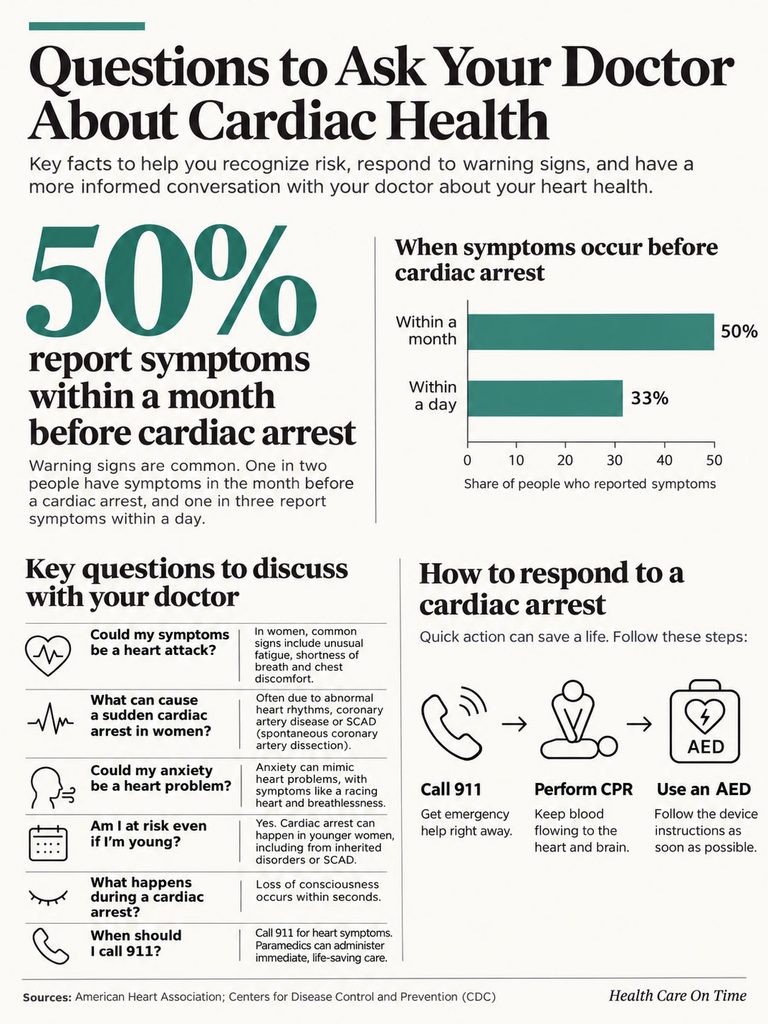
- “Could this tiredness and getting winded be coming from the heart, and what test would show it?”
- “Should these racing-heart spells be caught on an ECG or a heart rhythm monitor?”
- “Does the high blood pressure from that pregnancy still raise the risk today?”
- “A relative died suddenly young. Should anyone in the family be screened for an inherited rhythm problem?”
- “What would have to happen for this to be a 911 call instead of a phone call to the office?”
Frequently Asked Questions
Are there warning signs days before cardiac arrest?
Often, yes. In the Oregon study of adults aged 35 to 65, about half had warning symptoms in the month before sudden cardiac arrest, and roughly a third had symptoms that began more than a day ahead, usually chest pain or shortness of breath. Many arrests still come with no warning, so feeling fine isn’t proof that nothing is wrong, and new symptoms are worth reporting even if they fade.
What are three warning signs of a heart attack in females?
Unusual fatigue, shortness of breath and chest pressure or discomfort are three of the most common. Nausea, a cold sweat and jaw, neck, back or arm pain are frequent too.
How do you stop a cardiac arrest?
In most cases the rhythm needs an electric shock to reset, so a bystander’s job is to keep blood moving until that shock arrives. That means calling 911, pushing hard and fast in the center of the chest, and putting an AED on her as soon as one shows up, since the device checks the rhythm and shocks only when needed. For people at known high risk, doctors may recommend an implantable cardioverter-defibrillator (ICD), which sits under the collarbone and does this automatically.
What causes sudden cardiac arrest in women?
Most cases come from an abnormal rhythm, usually ventricular fibrillation, set off by an underlying heart problem. Coronary artery disease is a leading cause, along with scarring from an earlier heart attack, cardiomyopathy, valve disease, heart defects present from birth and inherited rhythm disorders such as long QT syndrome. SCAD, which mostly affects women and sometimes follows childbirth, can cause a heart attack or sudden death. Low potassium or magnesium, sleep apnea, kidney disease and stimulant drugs add risk, and some arrests happen in women with no known heart disease at all.
Can anxiety feel like a heart problem?
Yes. Anxiety can cause a racing heart, breathlessness and chest tightness, which is exactly why heart symptoms in women so often get filed under stress. A new pattern deserves a heart check before it’s labeled anxiety.
Can young women have cardiac arrest?
Yes. Inherited rhythm disorders, heart defects present from birth and SCAD can all strike well before midlife, and heart attacks happen in women under 55 too.
Is a woman awake during cardiac arrest?
No. She loses consciousness within seconds and either stops breathing or only gasps, so the people around her have to act.
Should you drive a woman with heart symptoms to the ER yourself?
Call 911 instead. Paramedics can start treatment as soon as they arrive and can restart her heart if it stops on the way.
Medical disclaimer: This article is for general information only and isn’t a substitute for advice, diagnosis or treatment from a qualified healthcare professional. If you think you or someone near you is having a heart attack or cardiac arrest, call 911 right away.
References
- American Heart Association. Cardiac Arrest vs. Heart Attack. Updated January 2025.
- American Heart Association. What is CPR?
- American Heart Association. 2026 Heart Disease and Stroke Statistics Update: At-a-Glance. 2026.
- American Heart Association. Top Takeaways From the 2026 Heart Disease and Stroke Statistics. 2026.
- American Heart Association, Go Red for Women. Who gets CPR from bystanders?
- Blewer AL, et al. Gender Disparities Among Adult Recipients of Bystander Cardiopulmonary Resuscitation in the Public. Circulation: Cardiovascular Quality and Outcomes. 2018;11(8):e004710. Duke Scholars record.
- Centers for Disease Control and Prevention. About Heart Attack Symptoms, Risk, and Recovery.
- Centers for Disease Control and Prevention. Women and Heart Disease.
- Johns Hopkins Medicine. Heart Attacks in Women: Expert Q&A.
- Lichtman JH, et al. Sex Differences in the Presentation and Perception of Symptoms Among Young Patients With Myocardial Infarction (VIRGO). Circulation. 2018. Summary: Healio.
- Marijon E, Uy-Evanado A, Dumas F, et al. Warning symptoms are associated with survival from sudden cardiac arrest. Annals of Internal Medicine. Published online December 2015. Summaries: Cardiovascular Business, TCTMD.
- Mayo Clinic. Sudden cardiac arrest: Symptoms and causes. December 2024.
- Mayo Clinic. Spontaneous coronary artery dissection (SCAD). April 2026.
- McSweeney JC, Cody M, O’Sullivan P, et al. Women’s early warning symptoms of acute myocardial infarction. Circulation. 2003;108(21):2619-2623. Abstract, Illinois Wesleyan University Digital Commons.
- Reinier K, Dizon B, Chugh H, et al. Warning symptoms associated with imminent sudden cardiac arrest: a population-based case-control study with external validation. The Lancet Digital Health. 2023. Abstract record, Oregon Health & Science University.