No. Compounded semaglutide can contain the same molecule as Ozempic, but it is a different product made by a pharmacy instead of a drug manufacturer, it has never been tested in clinical trials, and since 2025 it can only be made legally in narrow situations.
Table of Contents
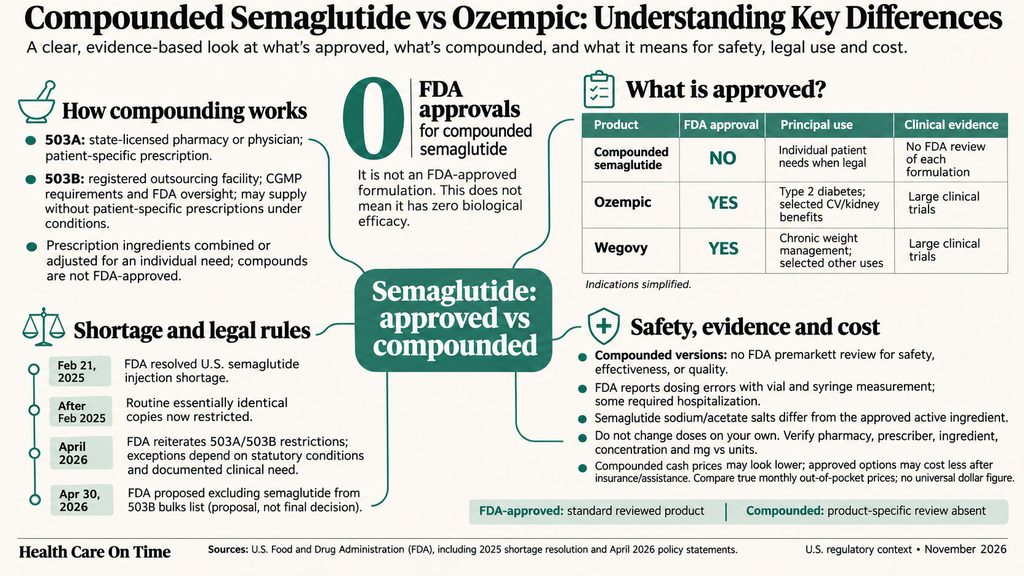
Quick Answer: The biggest differences between compounded semaglutide and Ozempic are FDA approval and quality control. Ozempic is FDA-approved for type 2 diabetes and comes in prefilled pens with a fixed dose. Compounded semaglutide is not FDA-approved, may use salt forms the FDA says have no lawful basis, is often sold in multiple-dose vials, and has no clinical trials behind it. The semaglutide shortage ended in February 2025, so routine copies are no longer allowed.
What compounded semaglutide is, and who makes it
Compounding is the old pharmacy practice of mixing a custom version of a drug, for example one without a dye or preservative a patient is allergic to. Under FDA policy for GLP-1 drugs, a compounded version should only be used when an FDA-approved drug can’t meet a patient’s medical needs or isn’t commercially available.
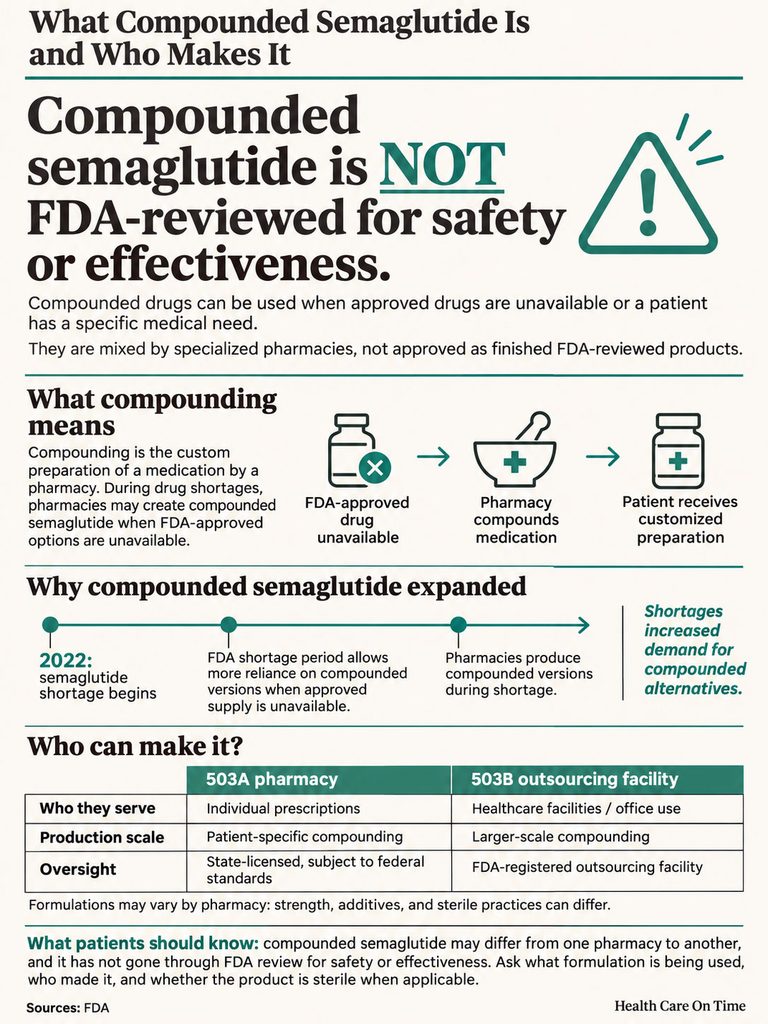
Semaglutide injection products were in shortage from 2022, and while a drug sits on the FDA shortage list, pharmacies may make copies of it, so demand for weight loss pushed a narrow exception into a national market run through telehealth sites, weight-loss clinics and medical spas.
Each pharmacy buys the active ingredient, adds its own inactive ingredients, picks a concentration and fills its own vials. Two vials labeled “semaglutide” can differ in strength, salt form, additives and sterility practices.
503A pharmacies and 503B outsourcing facilities
Federal law splits compounders into two groups. Section 503A covers state-licensed pharmacies and physicians that compound for an individual patient after receiving a prescription, while Section 503B covers outsourcing facilities, which register with the FDA, follow manufacturing-style quality rules, and can make larger batches for health care providers.
Neither type produces an FDA-approved drug. Products from both reach patients without an FDA review of safety, effectiveness or quality.
Compounded semaglutide vs Ozempic vs Wegovy, side by side
Ozempic and Wegovy contain the same molecule but differ in approved uses and doses, and both now come as weekly injections and daily tablets. The table shows where all three stood in November 2026.
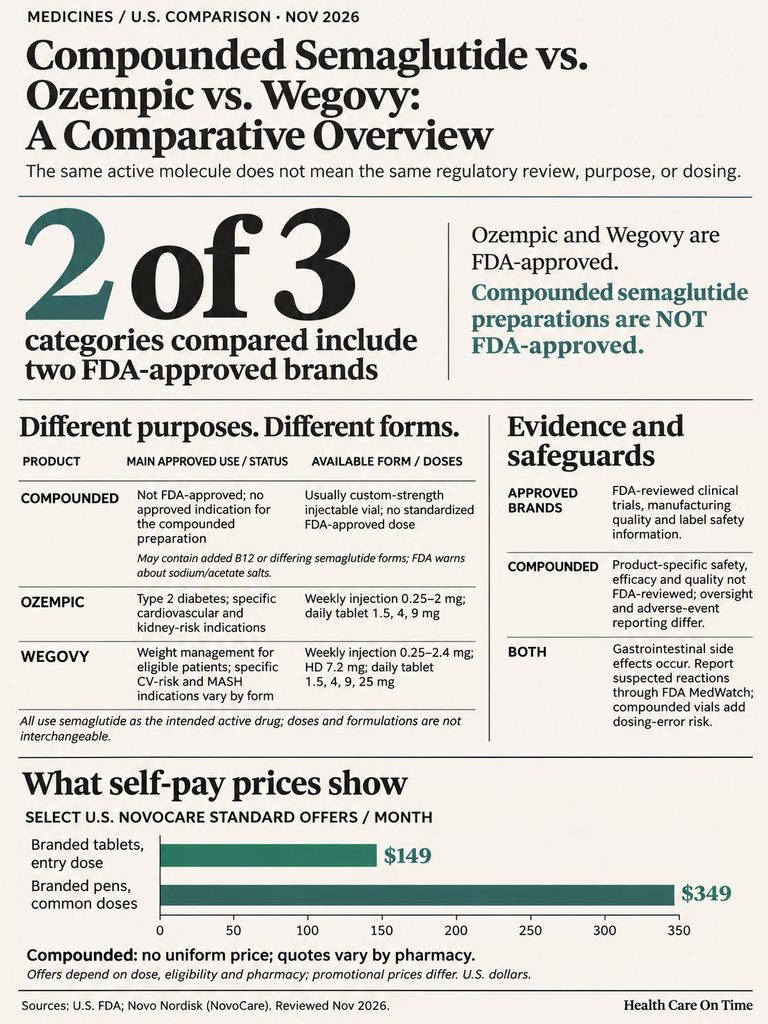
| Feature | Compounded semaglutide | Ozempic | Wegovy |
| FDA approval | Not approved; no FDA review of safety, effectiveness or quality | Injection approved 2017; tablets also approved | Injection approved; tablets approved December 2025 |
| Approved uses | None | Type 2 diabetes; heart risk reduction and kidney protection in type 2 diabetes | Weight reduction (injection from age 12); heart risk reduction in adults with heart disease and excess weight; MASH with F2 to F3 fibrosis |
| Active ingredient | Semaglutide base, or sodium or acetate salts the FDA calls different ingredients | Semaglutide (backbone made by yeast fermentation) | Semaglutide |
| Form and dose | Multiple-dose vials and syringes; concentration varies; often dosed in “units” | Pens delivering 0.25, 0.5, 1 or 2 mg weekly | Pens 0.25 to 2.4 mg, plus 7.2 mg (Wegovy HD); tablets 1.5 to 25 mg |
| Added ingredients | Sometimes vitamin B12 or other unproven add-ons | Fixed, listed inactive ingredients | Fixed, listed inactive ingredients |
| Trial evidence | No randomized trials | Diabetes, heart and kidney outcome trials | 14.9% vs 2.4% weight loss on placebo at 68 weeks (injection); 13.6% vs 2.4% at 64 weeks (tablets) |
| Quality oversight | State boards (503A); FDA rules for outsourcing facilities (503B) | FDA-inspected manufacturing | FDA-inspected manufacturing |
| Side effect tracking | 503A pharmacies need not send adverse events to the FDA | Manufacturer reporting required | Manufacturer reporting required |
| Routine legal status | Copies generally barred since the 2025 shortage ended | Fully available | Fully available |
| Self-pay price (NovoCare) | Set by each seller | Pen: $199 first 2 fills, then $349 (up to 1 mg) or $499 (2 mg) | Pen: $199 first 2 fills, then $349; HD $399; tablets $149 to $299 |
Ozempic’s label covers type 2 diabetes, so prescribing it for weight loss alone is off-label, and insurers that cover Ozempic usually expect a diabetes diagnosis. Wegovy is the semaglutide brand built and approved for weight management.
Is it the same drug? Base, salts and add-ons
Semaglutide base vs sodium and acetate salts
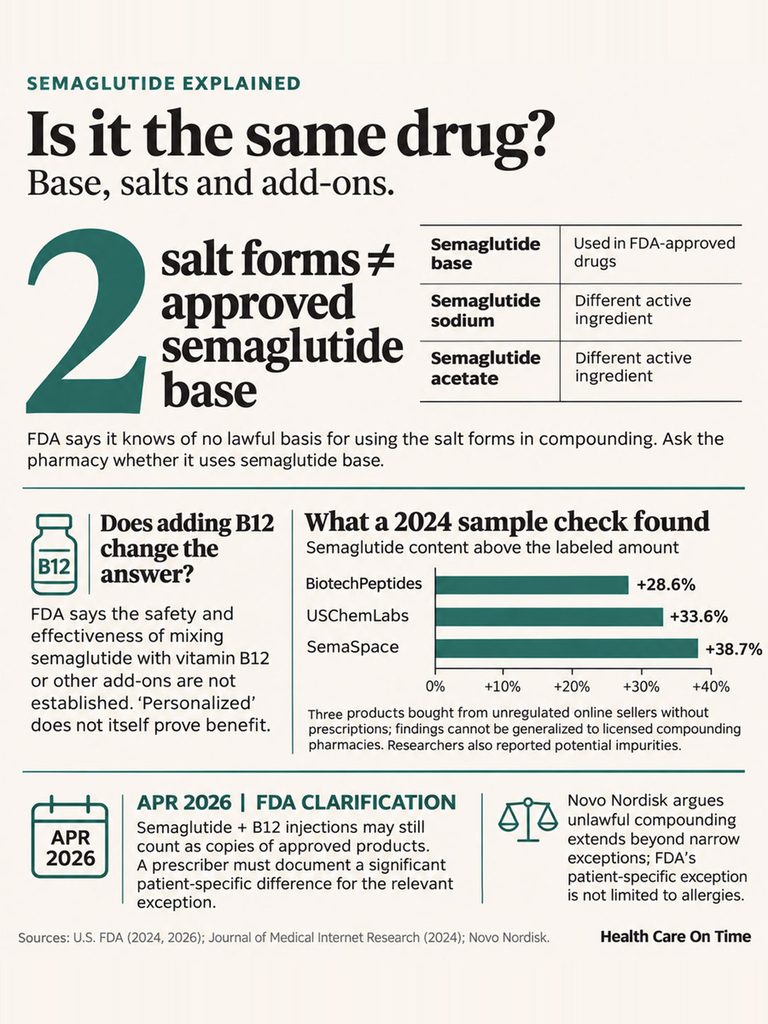
Ozempic and Wegovy use the base form of semaglutide. Some compounders have used semaglutide sodium or semaglutide acetate instead, which the FDA treats as different active ingredients from the approved drugs; the agency has no data on whether these salts act the same way in the body and knows of no lawful basis for compounding with them. A salt can still be sold simply as “semaglutide,” so if you’re using a compounded product, ask the pharmacy in writing which form it uses. The answer you want is semaglutide base.
B12 and other “personalized” extras
Many compounded products add vitamin B12 (cyanocobalamin) or other ingredients and market the mix as personalized, though a vitamin doesn’t change the legal picture much. In April 2026, the FDA said a semaglutide-plus-B12 injection may count as essentially a copy of approved products when both ingredients sit within 10% of commercially available strengths and the route is the same. Researchers who surveyed 75 weight-loss clinics and medical spas in Oklahoma and West Virginia in 2026 found B12 blends common. Their lead author pointed out that most of these add-ons lack good evidence of better safety or effectiveness.
What lab testing has turned up
Independent testing of US compounded semaglutide is thin, and the biggest lab analysis comes from the brand’s maker. A 2024 study in Pharmaceutical Research, written entirely by Novo Nordisk scientists, tested 16 injectable and 8 oral follow-on semaglutide products and found new impurities and impurity patterns in the injectables, including high molecular weight proteins, trace metals and residual solvents, while several oral products held markedly less semaglutide than their labels claimed. Whether those differences change safety or results in patients is still unknown. The company also argues that because the brands are fully available nationwide, making or selling compounded semaglutide is illegal except in rare cases, such as a documented allergy to an inactive ingredient.
Is compounded semaglutide legal now?
For most people who simply want a cheaper version of Ozempic or Wegovy, there’s very little legal room left, and the rules tightened in steps between February 2025 and April 2026.
What ended in 2025
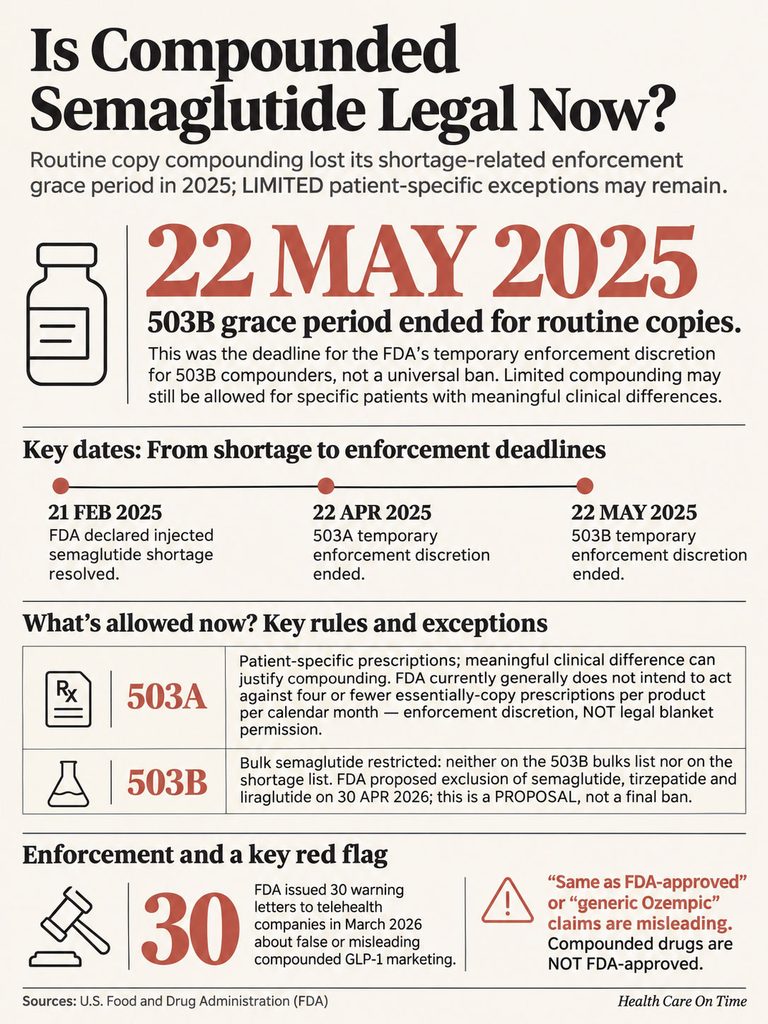
On February 21, 2025, the FDA declared the semaglutide shortage resolved after confirming that Novo Nordisk’s supply could meet present and projected demand, and it gave compounders until April 22, 2025 (503A pharmacies) or May 22, 2025 (503B outsourcing facilities) to stop. A trade group for outsourcing facilities sued. On April 24, 2025, a federal court in Texas denied its request for a preliminary injunction, so both dates stood.
Once a drug leaves the shortage list, the FDA generally considers it commercially available, and compounders can’t regularly make copies of it.
That is often why a supplier suddenly stops shipping or changes the formula, for example by adding a vitamin. If that happens to you, don’t stretch an old vial past its use-by window to bridge the gap. Ask the prescriber about moving to an approved product.
The “essentially a copy” test
The FDA’s April 1, 2026 policy update spells out what counts as a copy. A compounded product qualifies when it has the same active ingredient as an approved product in the same, similar or easily substitutable strength, and the approved product can be given by the same route. The way out is narrow. A prescriber has to determine, and document in the record, that the compounded version contains a change that makes a significant difference for a specific, named patient. That reason has to be medical, such as an allergy to an inactive ingredient in the brand or a dosage form one patient genuinely requires, and cost savings or simple preference don’t qualify.
There’s also a small-volume allowance. For now, the FDA doesn’t intend to act against a 503A compounder that fills four or fewer prescriptions of a given copy in a calendar month, far below what a large telehealth program needs.
The 503B bulks list proposal
Outsourcing facilities can only compound from bulk ingredients if the ingredient is on the 503B bulks list or the drug is in shortage, and semaglutide is on neither. On April 30, 2026, the FDA proposed to formally exclude semaglutide, tirzepatide and liraglutide from that list, finding no clinical need for outsourcing facilities to compound them from bulk substances, with comments open through June 29, 2026. If finalized, large-batch compounding of semaglutide would stay blocked unless the drug returns to the shortage list. The 503A pharmacies are governed by separate rules, which already limited them through the copy test.
Marketing claims the FDA has flagged
Much of the enforcement in 2025 and 2026 has gone after advertising. Warning letters went out in several rounds starting in September 2025, including 30 letters in March 2026 and 25 more in June 2026, mostly to telehealth companies that implied their compounded products matched FDA-approved drugs. The FDA also tells consumers to treat any claim that a compounded drug is “the same as an FDA-approved drug” as a red flag.
Why compounded semaglutide costs less
An approved drug carries the cost of clinical trials, FDA-inspected manufacturing, stability testing, a pen built to deliver an exact dose, and safety monitoring after approval. A compounder skips nearly all of that, buys active ingredient (sometimes from overseas suppliers), mixes it, and ships it in vials with syringes. The FDA has had to set up an import alert to stop GLP-1 ingredients with potential quality problems at the border.
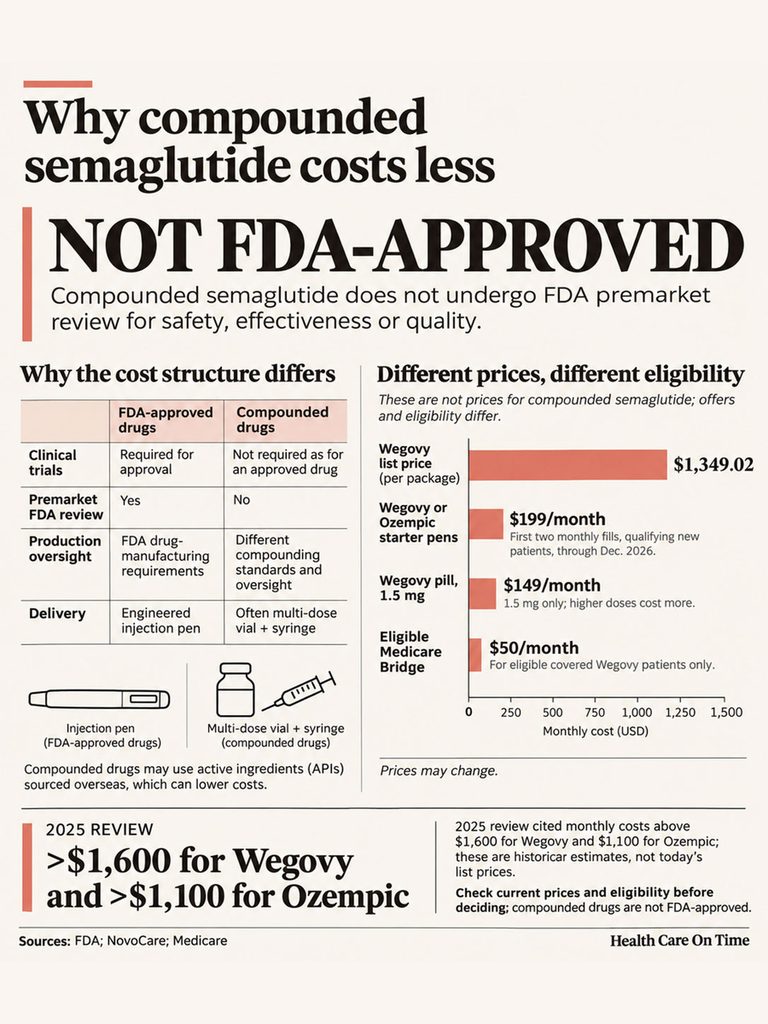
A multiple-dose vial and a box of insulin syringes cost a fraction of an engineered pen. They also move the job of measuring each dose from the factory to the patient.
Using drug-database prices, a 2025 review in the American Journal of Managed Care put the monthly cost of Wegovy at more than $1,600 and Ozempic at more than $1,100. Those numbers drove many people to vials. Wegovy’s list price today is $1,349.02 per package, but the manufacturer’s own pharmacy now sells well below it.
Through NovoCare home delivery, new cash patients pay $199 for each of the first 2 monthly fills of the starter Ozempic or Wegovy pens, an offer running through December 31, 2026, and Wegovy pens cost $349 a month after that. The Wegovy pill is cheaper still, at $149 a month for the 1.5 mg starting dose. Eligible Medicare patients prescribed Wegovy for a covered FDA-approved use may pay $50 a month through the Medicare GLP-1 Bridge program. These prices change often, so check them before you decide.
Safety risks specific to compounded semaglutide
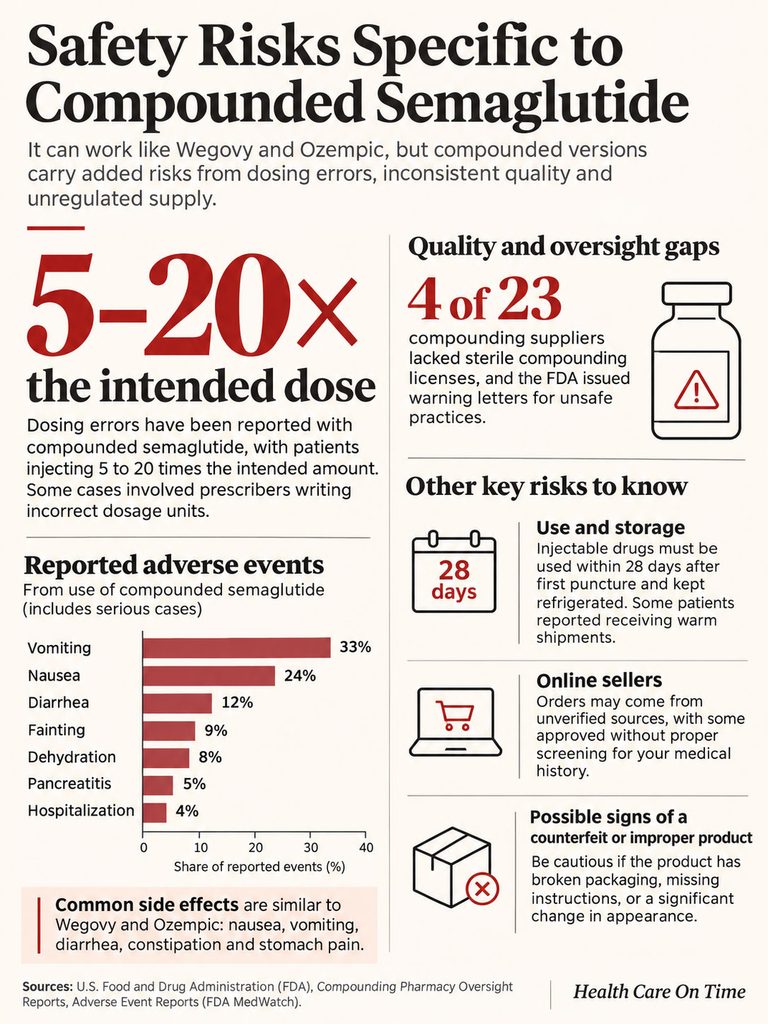
Most side effects tied to compounded semaglutide look like the known side effects of Wegovy and Ozempic, mainly nausea, vomiting, diarrhea, constipation and stomach pain. The extra danger lies in dose measurement, sterility and supply.
Vials, syringes and “units”
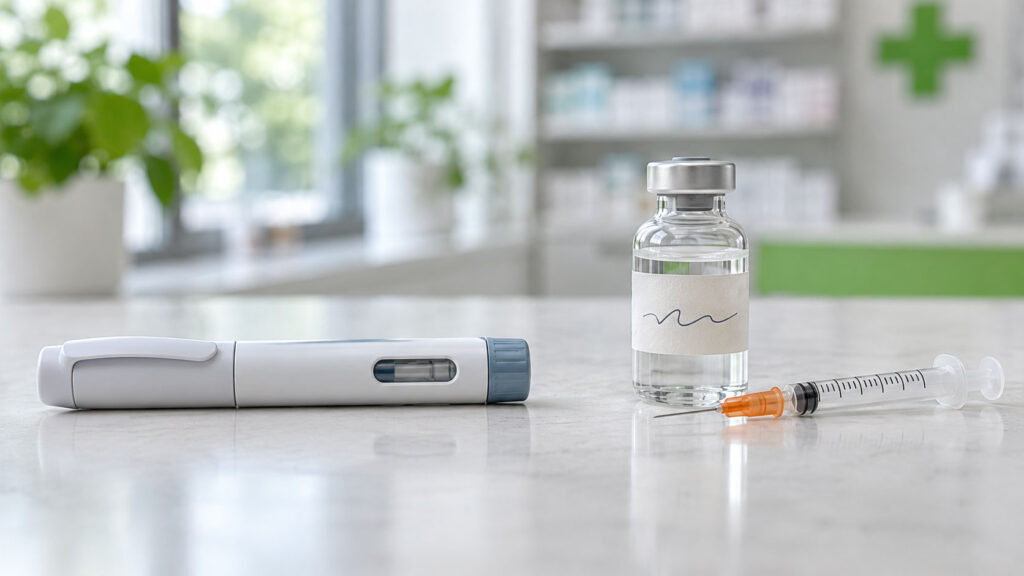
Ozempic and Wegovy injections are dosed in milligrams from pens set to a fixed dose. Compounded semaglutide usually comes in a multiple-dose vial, with instructions that may say to inject a number of “units,” a volume whose meaning changes with the concentration of that particular vial. A pen removes that step entirely.
Most cases in the FDA’s alert on dosing errors involved patients drawing up too much from a vial and injecting five to 20 times the intended amount, and in several, people told to inject 5 units (0.05 milliliter) with a U-100 insulin syringe injected 50 units instead. Prescribers slipped as well when converting milligrams to units, writing 25 units instead of 5 in one case and 20 units instead of 2 in another, which affected three patients. People needed care for vomiting, fainting, headache, dehydration, pancreatitis and gallstones, and some were hospitalized.
Semaglutide has a half-life of about one week, so an overdose can need a prolonged period of observation and treatment.
Adverse event reports
Pharmacies that aren’t outsourcing facilities don’t have to send adverse events to the FDA, so the agency’s counts likely miss cases.
| Measure | Figure | Source and date |
| Adverse event reports linked to compounded semaglutide | 990 | FDA, as of May 31, 2026 |
| Adverse event reports linked to compounded tirzepatide | More than 730 | FDA, as of May 31, 2026 |
| Size of vial dosing errors described by the FDA | 5 to 20 times the intended dose | FDA dosing error alert |
| Telehealth sites that prescribed GLP-1 drugs to a simulated patient | 45 of 49 (91.8%) | JAMA secret shopper study, sites tested August to December 2025 |
| Sites that shipped the drug | 34 of 49 (69.4%) | Same JAMA study |
| Sites that required a video visit | 13 (26.5%) | Same JAMA study |
| Compounding suppliers to clinics and med spas lacking sterile compounding licenses | 4 of 23 | JAMA Health Forum study of 75 businesses in Oklahoma and West Virginia, 2026 |
| FDA warning letters to telehealth companies over compounded GLP-1 claims | 30 in March 2026; 25 in June 2026 | FDA warning letter rounds, March and June 2026 |
The adverse event counts don’t prove that compounding caused each event, since many of the reports describe the ordinary effects of semaglutide.
Sterility, storage and the 28-day rule
Anything injected has to be sterile. Of the 23 suppliers serving the clinics and med spas in the 2026 study, 4 lacked licenses for sterile compounding, and several had recent disciplinary actions or FDA warning letters about sterile practices.
For multiple-dose vials, use one for no more than 28 days after the first puncture, even if medicine is left and even if the compounder’s instructions allow longer, and use a new sterile needle and syringe for every dose. Injectable GLP-1 drugs need refrigeration. The FDA has received complaints of compounded products arriving warm or with weak ice packs; don’t use a shipment that arrives warm.
Online sellers, counterfeits and “research use only” vials
Screening online can be thin even at sellers that look legitimate. When a researcher posing as an eligible patient tried 49 websites, 2 compounded orders were approved within five minutes, and barely half of the sites asked about eating disorder history, which matters for a drug that blunts appetite.
Counterfeit Ozempic pens and semaglutide sold “for research purposes” or “not for human consumption” sit outside the pharmacy system altogether and may hold the wrong ingredient, too much or too little drug, or none at all. If a shipment looks different from earlier ones, or arrives with broken packaging or no instructions, stop and call the pharmacy before using it.
Does compounded semaglutide work as well?
People in the main Wegovy weight trial, who also followed a reduced-calorie diet and added physical activity, lost an average of 14.9% of body weight at 68 weeks on the 2.4 mg injection, against 2.4% on placebo, and the 25 mg tablet produced 13.6% at 64 weeks. A heart outcomes trial of 17,604 adults with heart disease and obesity or overweight found about one-fifth fewer first major heart events on Wegovy (hazard ratio 0.80). Ozempic’s diabetes trials used lower doses, so weight loss was smaller: about 8.4 pounds (3.8 kg) at 0.5 mg and about 10.4 pounds (4.7 kg) at 1 mg over 30 weeks, compared with about 2.6 pounds (1.2 kg) on placebo.
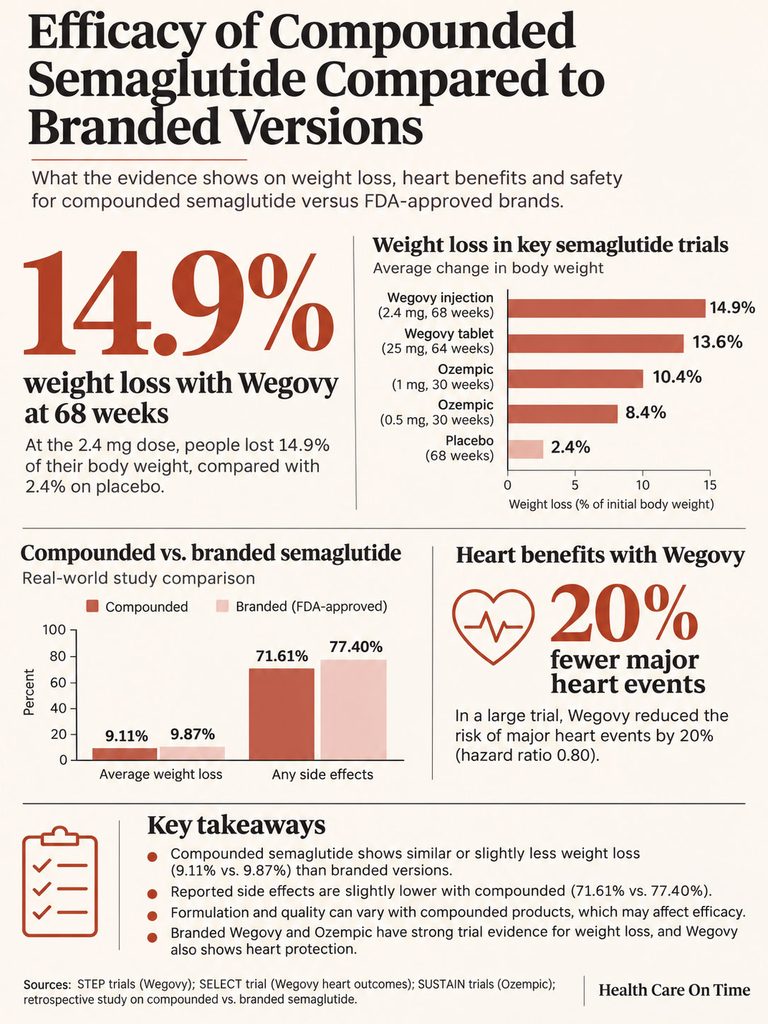
No randomized trial has tested a compounded product. The closest comparison comes from Australia, where a large digital weight-loss service looked back at patients on compounded semaglutide and patients on the branded drug, both on the same dose schedule, and found average four-month weight loss of 9.11% with the compounded product and 9.87% with the brand, a small but statistically significant gap, along with slightly fewer side effects on the compounded version (71.61% vs 77.40% reporting at least one). That is one company’s data, gathered without randomization, and it says little about a vial from any particular US pharmacy.
On that limited evidence, compounded semaglutide may work about as well as the brand or slightly less well, depending on what’s in the vial and how accurately each dose is measured.
What to do in your situation
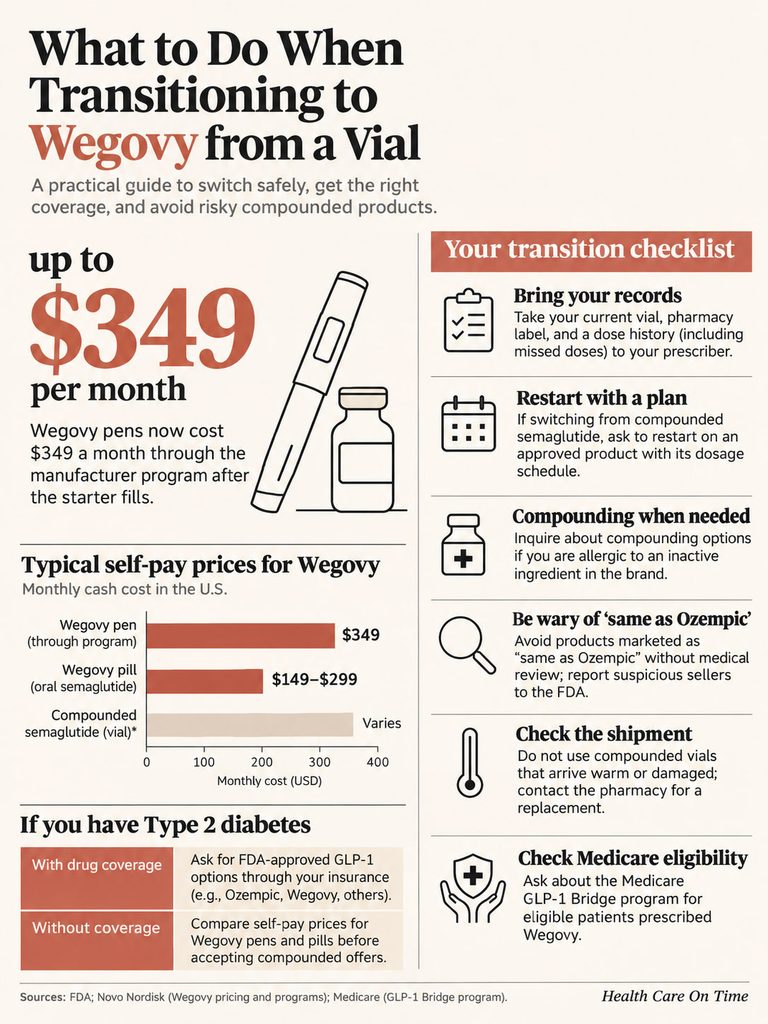
If you’ve been dosing from a vial in units and now have a prescription for a Wegovy pen in milligrams, nothing on either label shows how the two match. Working out that switch is the prescriber’s job. Bring the vial, the pharmacy’s label and a note of the doses you actually took, including any you skipped because of nausea, so the starting dose reflects what your body has really been getting.
| Your situation | What to do | Why |
| Type 2 diabetes with drug coverage | Ask for Ozempic, Wegovy or another FDA-approved GLP-1 through insurance | Approved products have heart and kidney outcome data that compounded versions lack |
| Obesity, no insurance coverage, paying cash | Compare current NovoCare self-pay prices ($199 to $399 for Wegovy pens; $149 to $299 for the pill) before any compounded offer | Brand cash prices dropped in 2026; compounded copies are generally not allowed |
| Already on compounded semaglutide and want to switch | Ask the prescriber to restart you on an approved product using its label dose schedule, and bring the vial label with concentration and dose | Vial “units” don’t convert directly to pen doses; the prescriber has to work out the milligram dose |
| Documented allergy to an inactive ingredient in the brand | Ask whether a 503A pharmacy can compound a version without that ingredient, with the prescriber documenting the reason | This is one of the few situations where the law allows a copy-like product |
| Seller says “same as Ozempic,” skips a medical review, or sells “research use” vials | Don’t buy; report the seller to the FDA through MedWatch | The FDA lists these as red flags for unsafe or illegal products |
| Compounded vial arrived warm or with a damaged seal | Don’t inject it; contact the pharmacy for a replacement | Heat can damage the drug, and the FDA advises against using warm shipments |
| Medicare, prescribed Wegovy for a covered FDA-approved use | Ask about the Medicare GLP-1 Bridge program ($50 a month for eligible patients) | Often cheaper than any cash compounded option |
If you use a compounded product anyway, check the source
The American Diabetes Association recommends against non-FDA-approved compounded GLP-1 products because their content, safety, quality and effectiveness are uncertain, though it accepts that some people will still choose one for financial reasons. For them, the ADA’s advice and the FDA’s red flags suggest these checks.
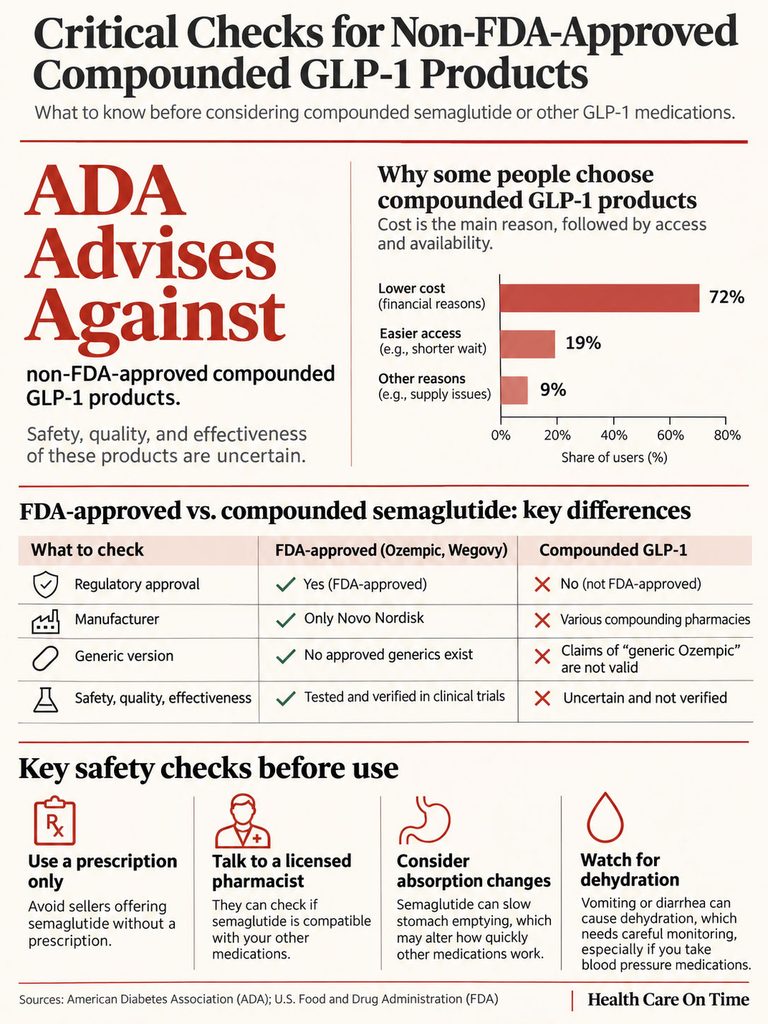
- Confirm the pharmacy is licensed by your state board of pharmacy, or registered with the FDA if it’s an outsourcing facility.
- Look for accreditation from the National Association of Boards of Pharmacy (NABP), which reflects compliance with US Pharmacopeia compounding standards.
- Get it in writing that the product is semaglutide base, not a sodium or acetate salt.
- Insist on a dose written in milligrams, a syringe that matches it, and a chart showing where the plunger should stop.
- Use a prescriber who reviewed your history and can be reached after the medicine arrives.
- Read the label for spelling mistakes, an unfamiliar pharmacy name or an address that doesn’t check out.
Skip any seller that offers semaglutide without a prescription, advertises deep discounts, or calls its product generic Ozempic. Only Novo Nordisk makes FDA-approved semaglutide medicines, so no approved generic exists.
A licensed source also means a pharmacist who can check the vial against everything else you take, which matters because semaglutide slows stomach emptying and can change how some pills are absorbed. Vomiting or diarrhea that leaves you dehydrated deserves extra care if you also take blood pressure medication with a GLP-1.
Questions to ask your doctor or pharmacist
Write these down before the visit so they don’t get lost in a short appointment.
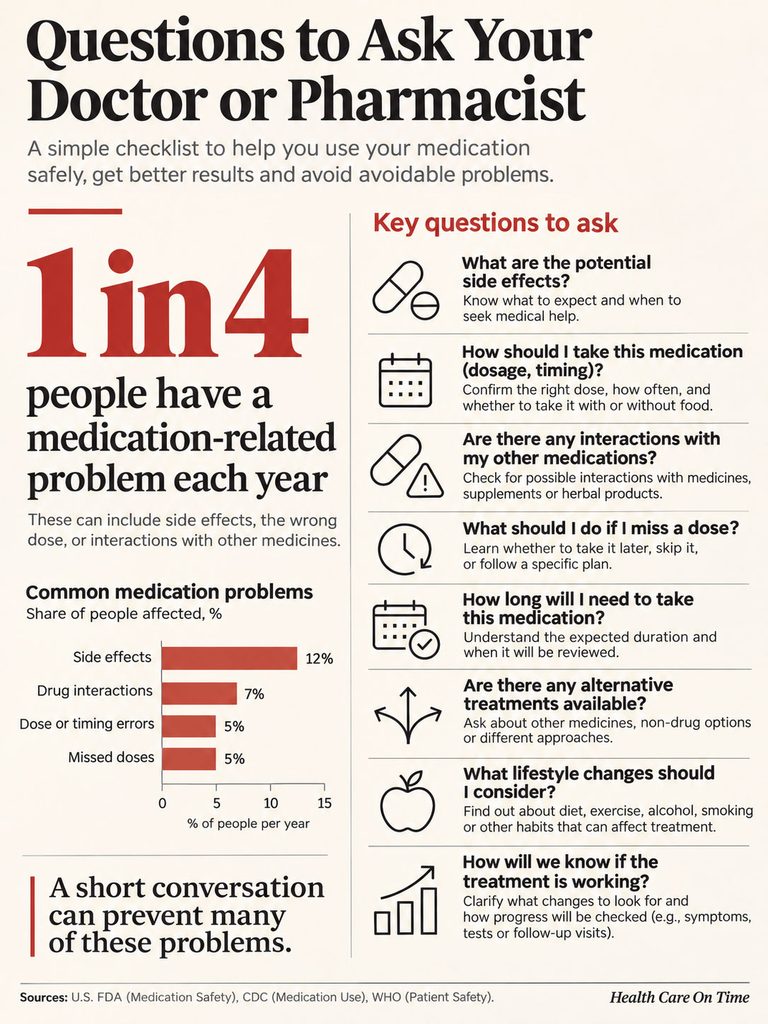
- Is there a medical reason a compounded version fits better than Ozempic or Wegovy here, and will that reason go in the chart?
- Is this semaglutide base, or is it a sodium or acetate salt?
- How many milligrams is this dose, and where exactly should the plunger stop on this syringe?
- Is this pharmacy licensed here, and is it NABP-accredited or registered with the FDA?
- Would the brand cost less now with the NovoCare self-pay prices?
- After months on a vial, what dose does a pen start at?
When to get medical help
Call 911 or go to an emergency room for severe stomach pain that won’t go away (with or without vomiting), which can signal pancreatitis, or for swelling of the face, lips, tongue or throat, trouble breathing, fainting, or a very fast heartbeat. Pain in the upper right abdomen with fever, yellow skin or eyes, or clay-colored stools can point to a gallbladder problem.
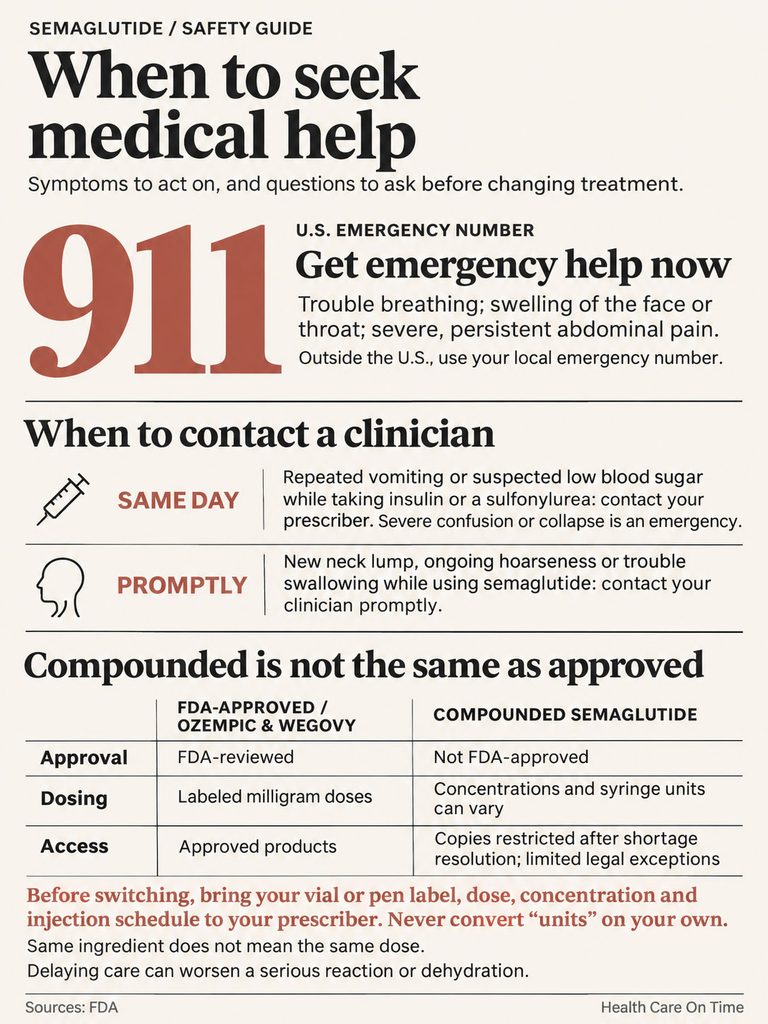
Contact your prescriber or Poison Control the same day if you think you injected the wrong amount, if vomiting or diarrhea keeps you from holding down fluids, or if you take insulin or a sulfonylurea and notice shakiness, sweating, confusion or other signs of low blood sugar. Bring the vial and its label, since the concentration shows how much you actually received.
A lump or swelling in the neck, hoarseness or trouble swallowing needs a prompt appointment, because semaglutide carries a boxed warning about thyroid C-cell tumors.
Frequently Asked Questions
Is semaglutide compounded the same as Ozempic?
No. It may contain the same molecule, but it isn’t FDA-approved, may use a salt form, and has never been tested in trials.
Why is compounded semaglutide cheaper?
Compounders don’t pay for clinical trials, inspected manufacturing or pen devices, and they ship bulk ingredient in vials. The cash gap has narrowed, though, since Wegovy pens now cost $349 a month through NovoCare after the starter fills, and the Wegovy pill costs $149 to $299.
Is semaglutide stronger than Ozempic?
Ozempic is semaglutide, so neither is stronger by nature. Strength depends on dose: Ozempic injections go up to 2 mg weekly, Wegovy to 2.4 mg, and Wegovy HD to 7.2 mg. A compounded vial can be mixed at any concentration, which is part of why “units” cause dosing errors.
Is compounded semaglutide more effective?
There’s no evidence it works better, and no randomized trials exist. The closest data, a retrospective Australian study of one digital weight-loss service, found slightly less weight loss at four months with compounded semaglutide (9.11%) than with the branded drug (9.87%), plus slightly fewer side effects. One company’s results don’t transfer to another pharmacy’s product, so treat any seller’s claim of better results with suspicion, and ask what form and concentration the vial actually holds.
Is compounded semaglutide FDA-approved?
No. No compounded drug is FDA-approved, and none is reviewed for safety, effectiveness or quality before sale, whether it comes from a local pharmacy or an online program.
Is it still legal to get compounded semaglutide?
Only in narrow cases. Since the shortage ended in 2025, pharmacies can’t routinely copy Ozempic or Wegovy. A 503A pharmacy may compound a version for a named patient when a prescriber documents a significant medical difference, such as an allergy to an inactive ingredient in the brand, and the FDA has said it won’t act against a pharmacy filling four or fewer prescriptions of a copy in a calendar month. Saving money doesn’t count as a medical reason, so a program built on cost alone is on weak legal ground.
Is compounded semaglutide with B12 better?
Nothing shows that it is, and the FDA may treat the blend as a copy when both ingredients are within 10% of commercial strengths.
How long can an opened vial of compounded semaglutide be used?
No more than 28 days after the first use, even if medicine remains or the label says otherwise.
Can you switch from compounded semaglutide to Wegovy or Ozempic?
Yes, with a new prescription. Compounded concentrations and “units” vary, so there’s no direct conversion to a pen dose. The approved labels start Wegovy and Ozempic injections at 0.25 mg once weekly for 4 weeks and step up from there, and your prescriber decides where to begin based on how you tolerated the compounded product. Bring the vial label and your dose history to the appointment.
Medical disclaimer: This article is for general information only and is not medical, legal or financial advice. It does not replace a conversation with your doctor or pharmacist, who can weigh your health history, other medicines and current prices. Prices, FDA policies and drug labels change; check current information before making a decision. If you think you’ve injected too much of any medicine, contact Poison Control or call 911.
References
- US Food and Drug Administration. FDA’s Concerns with Unapproved GLP-1 Drugs Used for Weight Loss. Content current as of October 1, 2026.
- US Food and Drug Administration. FDA clarifies policies for compounders as national GLP-1 supply begins to stabilize. Content current as of April 1, 2026.
- US Food and Drug Administration. FDA alerts health care providers, compounders and patients of dosing errors associated with compounded injectable semaglutide products.
- Novo Nordisk. WEGOVY (semaglutide) injection and tablets, Prescribing Information. Revised June 2026.
- Novo Nordisk. OZEMPIC (semaglutide) injection, Prescribing Information. Revised October 2025.
- Novo Nordisk. Compounded “semaglutide” is not FDA-approved. Manufacturer position statement.
- NovoCare. Novocare home delivery: self-pay pricing for Wegovy and Ozempic. Accessed November 2026.
- NovoCare. Price your Wegovy. Accessed November 2026.
- Hach M, et al. Impact of Manufacturing Process and Compounding on Properties and Quality of Follow-On GLP-1 Polypeptide Drugs. Pharm Res. 2024;41(10):1991-2014. Authors employed by Novo Nordisk.
- Talay L, Vickers M. Effectiveness and Side Effect Incidence in a Real-World Digital Weight-Loss Service Using Compounded Semaglutide: A Retrospective Comparative Study. Obesities. 2024;4(4):399-411.
- Chetty AK, et al. Online prescribing of GLP-1 receptor agonists. JAMA. 2026. Summary: AJMC, Online GLP-1 sellers often skip clinician oversight.
- DiStefano MJ, et al. Postshortage Compounded GLP-1 RA Market in 2 States With Potentially High Demand. JAMA Health Forum. 2026. Summary: University of Colorado Anschutz via News-Medical.
- Liu G, Jarema M, Mo M, Stievater T. Navigating Compounded Semaglutide: What Health Care Providers Need to Know. Am J Manag Care. 2025;31(9):480-484.
- Neumiller JJ, et al. Compounded GLP-1 and Dual GIP/GLP-1 Receptor Agonists: A Statement from the American Diabetes Association. Diabetes Care. December 2024.
- Orrick. FDA Moves to Shut the Door on Large-Scale Compounding of GLP-1 Drugs. May 2026.