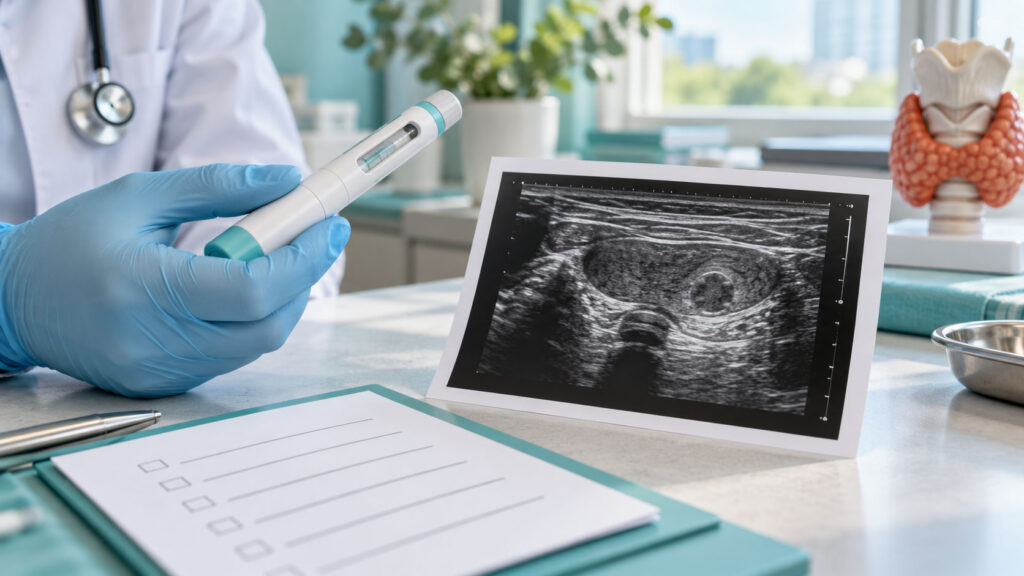
By age 60, about half of all people have a thyroid nodule. At the same time, roughly 1 in 8 American adults say they’re currently taking a GLP-1 drug such as Ozempic, Wegovy, Mounjaro or Zepbound. So it’s no surprise that one of the most common questions behind those prescriptions is a nervous one: if an ultrasound showed a nodule, is the shot off-limits?
Table of Contents
The box on the label sounds scary. It mentions thyroid tumors and cancer. But the warning is far narrower than most people think, and a nodule on its own is not what it’s about.
Quick Answer: Yes, most people with thyroid nodules can take GLP-1 drugs. The FDA boxed warning on Ozempic, Wegovy, Mounjaro, Zepbound and Foundayo only rules them out if you have a personal or family history of medullary thyroid carcinoma (MTC) or multiple endocrine neoplasia type 2 (MEN 2). Benign nodules aren’t a contraindication. Any new or unevaluated nodule should still get a standard workup, just as it would without the drug.
At a Glance
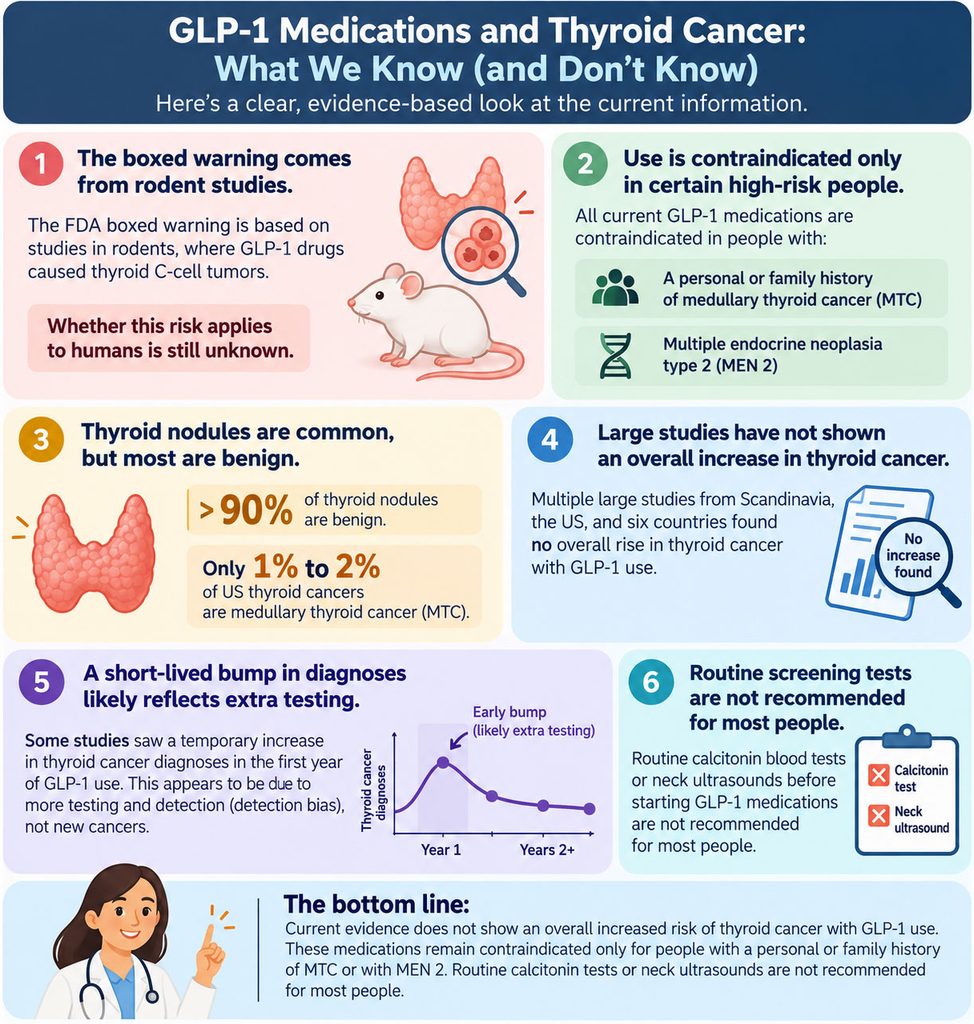
- The boxed warning comes from rodent studies of thyroid C-cell tumors. Whether it applies to humans is still unknown.
- Every current GLP-1 product is contraindicated only in people with a personal or family history of MTC, or with MEN 2.
- Over 90% of thyroid nodules are benign, and MTC makes up only about 1% to 2% of US thyroid cancers.
- Large studies from Scandinavia, the US and six countries found no overall rise in thyroid cancer with GLP-1 use.
- A short-lived bump in diagnoses in the first year looks like extra testing (detection bias), not new cancers.
- Routine calcitonin blood tests or neck ultrasounds before starting are not recommended for most people.
What the FDA Boxed Warning Actually Says
Every GLP-1 drug sold in the US carries the same type of boxed warning, titled “Risk of Thyroid C-Cell Tumors.” A boxed warning is the FDA’s strongest label alert. It doesn’t mean a drug is proven to cause the problem. It means the risk is serious enough that the FDA wants it front and center.
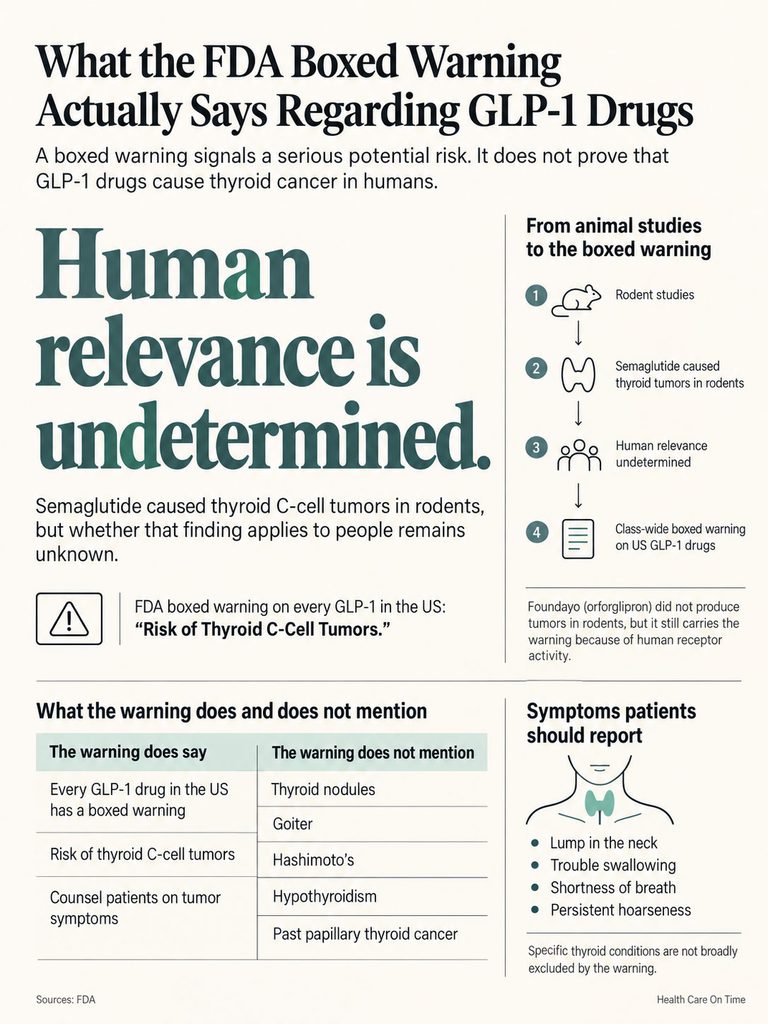
Here’s the core of the Ozempic prescribing information, in plain words. In rodents, semaglutide caused thyroid C-cell tumors that grew with dose and with time on the drug. It’s unknown whether Ozempic causes these tumors, including MTC, in humans, because the human relevance of the rodent findings “has not been determined.”
Why rats, and why it may not carry over to people
C cells (also called parafollicular cells) sit inside the thyroid but do a different job from the follicular cells that make thyroid hormone. They make calcitonin. Rodent C cells carry many GLP-1 receptors, which is one reason the drugs stimulate them so strongly in rats and mice.
The newest drug in the class makes this point clearly. Foundayo (orforglipron), the once-daily pill approved in 2026, “is not pharmacologically active in rats or mice and did not produce tumors in rodents.” Even so, the FDA kept the same class boxed warning on its label, because it acts on the human GLP-1 receptor and the human question is still open.
Who the contraindication actually covers
The labels list two groups who should not take these drugs:
- People with a personal or family history of medullary thyroid carcinoma (MTC)
- People with multiple endocrine neoplasia syndrome type 2 (MEN 2), an inherited condition that raises the risk of MTC
That’s the full list for the thyroid warning. “Thyroid nodule” isn’t on it. Neither is goiter, Hashimoto’s, hypothyroidism, or a past papillary thyroid cancer. As the UT Southwestern Medical Center team puts it, those other thyroid conditions don’t by themselves rule out a GLP-1.
The labels also tell doctors to counsel patients about symptoms of thyroid tumors: a lump in the neck, trouble swallowing, shortness of breath, or hoarseness that won’t go away.
Thyroid Nodules vs Medullary Thyroid Cancer: Not the Same Thing
A lot of the fear around this topic comes from mixing up two very different things. A nodule is a lump. MTC is one rare type of cancer. Most nodules have nothing to do with it.
How common nodules really are
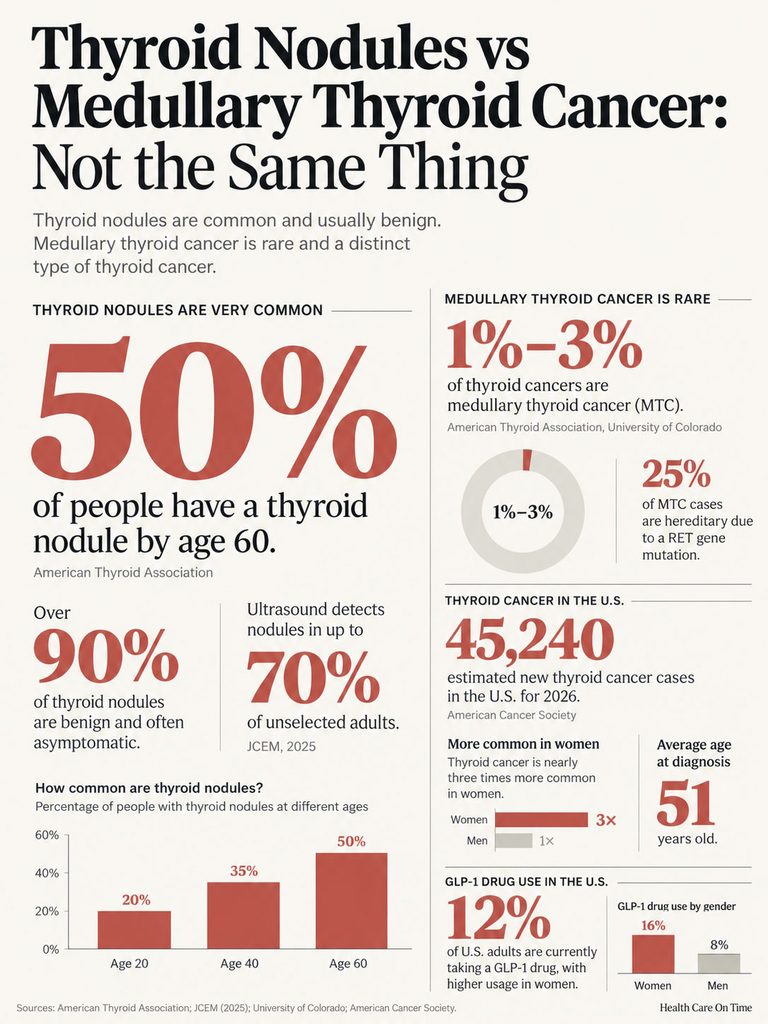
According to the American Thyroid Association, about half of all people have a thyroid nodule by age 60, and over 90% of them are benign. Most cause no symptoms, and thyroid blood tests are usually normal, even in the small share that turn out to be cancer.
When doctors do look closely, they find even more. A 2025 review in the Journal of Clinical Endocrinology & Metabolism notes that ultrasound finds nodules in up to 70% of people in an unselected population, and small thyroid cancers show up in about 12% of autopsies. In other words, many people live their whole lives with tiny thyroid findings that never cause harm.
What medullary thyroid cancer is
MTC starts in the C cells, not in the follicular cells where the common thyroid cancers begin. The ATA’s MTC page says it accounts for about 1% to 2% of thyroid cancers in the United States. Other expert sources, such as the University of Colorado Cancer Center, put it closer to 3%.
About 25% of MTC cases are hereditary, caused by a mutation in the RET gene and usually part of MEN 2A or MEN 2B. The other 75% are sporadic. Because MTC cells release calcitonin, doctors use calcitonin and CEA blood tests as tumor markers.
Our medical content team pulled the key numbers into one place, so you can see how small the MTC slice is compared with nodules overall.
| Thyroid fact | Number | Source |
| People with a thyroid nodule by age 60 | About 1 in 2 | American Thyroid Association |
| Share of nodules that are benign | Over 90% | American Thyroid Association |
| Nodules found on ultrasound in unselected adults | Up to 70% | JCEM review, 2025 |
| Estimated new US thyroid cancer cases in 2026 | About 45,240 (32,000 women, 13,240 men) | American Cancer Society |
| Share of US thyroid cancers that are MTC | About 1% to 2% | American Thyroid Association |
| Share of MTC that is hereditary (MEN 2) | About 25% | American Thyroid Association |
| US adults currently taking a GLP-1 drug | 12% (about 1 in 8) | KFF Health Tracking Poll, Nov 2025 |
The American Cancer Society also reports that thyroid cancer is almost 3 times more common in women, with an average age at diagnosis of 51. Women also use GLP-1 drugs more: the KFF poll found 15% of women currently taking one, versus 9% of men, with the highest use (22%) among adults ages 50 to 64. That overlap is exactly why this question comes up so often.
Your Situation, Your Answer: The Decision Table
Readers often ask us for a simple yes or no. The honest answer depends on which situation you’re in. This table sums up what the labels and the expert sources say for the most common scenarios. Use it to prepare for a talk with your doctor, not to replace one.
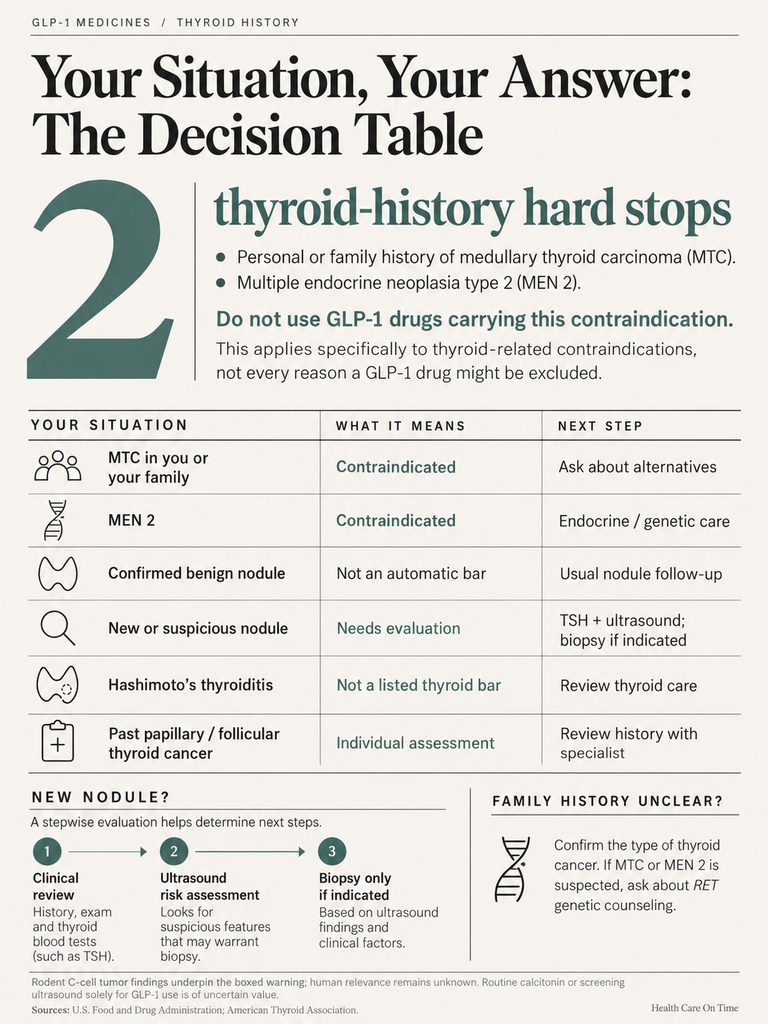
| Your situation | Does the boxed warning apply? | Can GLP-1 drugs be an option? | Next step to discuss with your doctor |
| Benign nodule(s) confirmed, no personal or family MTC or MEN 2 | No | Yes, nodules are not a contraindication | Keep the follow-up ultrasound schedule your doctor already set; no extra tests just for the drug |
| New nodule found, not yet evaluated | No, unless MTC is later confirmed | Usually yes, but finish the workup | Get the standard workup (TSH, ultrasound, biopsy if the nodule’s size and look call for it) |
| Nodule with suspicious ultrasound features or an elevated calcitonin | Not yet known | Hold the decision until results are in | Biopsy and further evaluation; calcitonin above 50 ng/L usually points to MTC |
| Personal history of medullary thyroid cancer | Yes | No, all GLP-1 products are contraindicated | Ask about non-GLP-1 diabetes or weight-loss options |
| Parent, sibling or child with MTC, or known MEN 2 or RET mutation | Yes | No, all GLP-1 products are contraindicated | Genetic counseling and RET testing if not done; discuss alternatives |
| Past papillary, follicular or Hürthle cell thyroid cancer | No | Yes, not contraindicated | Decide with your endocrinologist; keep your cancer follow-up plan |
| Hashimoto’s or hypothyroidism on levothyroxine | No | Yes | Plan pill timing (see below) and recheck TSH as your weight changes |
If your nodule is benign
This is the most common case, and it’s the clearest. Benign nodules are not listed anywhere in the contraindications. The JCEM review authors write that nodules in people taking GLP-1 drugs should be evaluated by current clinical guidelines “independent of GLP-1RA use.” That means you keep the same follow-up plan you’d have anyway.
If your nodule hasn’t been checked yet
A nodule spotted on a CT scan or felt during a physical deserves a normal evaluation first. The labels say patients with nodules found on exam or neck imaging “should also be further evaluated.” In practice, that usually means a TSH blood test and a thyroid ultrasound, with a fine-needle biopsy if the nodule is large enough or looks suspicious. Your doctor may wait for those results before you start, so there’s no confusion later about what caused a finding.
If you or a close relative had MTC, or you have MEN 2
This is the one situation where the answer is a firm no. Every current label lists it as a contraindication. The University of Colorado’s Bryan Haugen, MD, said that until better data exist, he can’t recommend these drugs for people with MTC. If MTC runs in your family and you’ve never had genetic testing, ask about genetic counseling and RET testing.
If you’ve had papillary or follicular thyroid cancer
Papillary, follicular and Hürthle cell cancers make up the vast majority of thyroid cancers, and they start in a different cell type. The boxed warning doesn’t name them. Dr. Haugen described the evidence for papillary cancer as mixed, but said the health risks of uncontrolled weight and blood sugar are often bigger than the risk from a slow-growing, treated thyroid cancer. That trade-off should be made with your endocrinologist.
If you also have Hashimoto’s
Hashimoto’s isn’t a contraindication either. The main practical issue is how your thyroid pill and your GLP-1 fit together. We cover that in detail, drug by drug, in our guide on taking GLP-1 drugs with Hashimoto’s.
Does Each GLP-1 Drug Carry the Same Warning?
Yes. Our editors checked each current US label, and the thyroid language is nearly identical across brands. The main differences are the active ingredient, the form, and one interesting detail about Foundayo.
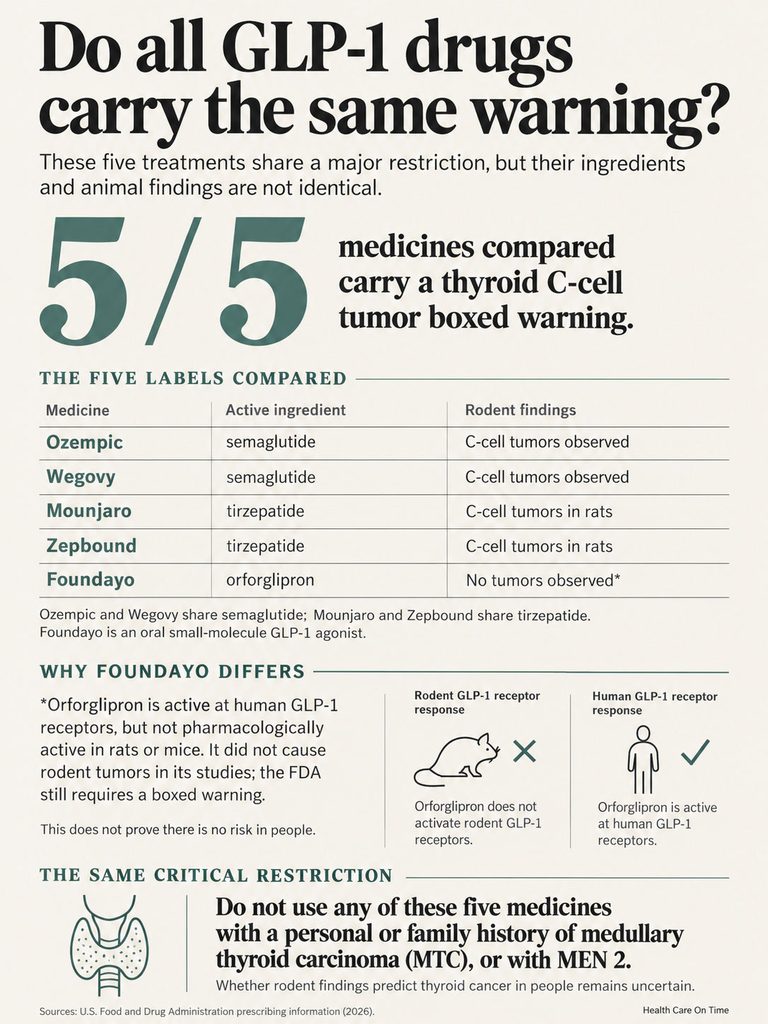
| Drug (maker) | Active ingredient and form | Boxed warning for thyroid C-cell tumors | Contraindicated with MTC or MEN 2 | Rodent tumor finding | Label revised |
| Ozempic (Novo Nordisk) | Semaglutide, weekly injection | Yes | Yes | Tumors in rodents at clinically relevant exposures | 05/2026 |
| Wegovy injection (Novo Nordisk) | Semaglutide, weekly injection | Yes | Yes | Tumors in mice and rats | 06/2026 |
| Wegovy tablets (Novo Nordisk) | Semaglutide, daily pill | Yes (same label) | Yes | Tumors in mice and rats | 06/2026 |
| Mounjaro (Eli Lilly) | Tirzepatide, weekly injection | Yes | Yes | Tumors in male and female rats | 08/2026 |
| Zepbound (Eli Lilly) | Tirzepatide, weekly injection | Yes | Yes | Tumors in male and female rats | 04/2026 |
| Foundayo (Eli Lilly) | Orforglipron, daily pill | Yes | Yes | No tumors; drug not active in rats or mice | 07/2026 |
Ozempic and Wegovy (semaglutide)
Ozempic is approved for type 2 diabetes, and Wegovy for weight loss and heart risk reduction. They share the same active ingredient, and the Wegovy label now covers both the injection and the newer daily tablet. Both carry the full boxed warning and the MTC and MEN 2 contraindication.
Mounjaro and Zepbound (tirzepatide)
Tirzepatide acts on two hormone receptors, GIP and GLP-1. Mounjaro is the diabetes brand and Zepbound is the weight-loss brand. The Mounjaro label states that tirzepatide caused thyroid C-cell tumors in both male and female rats. So if you’ve been asking “can you take Mounjaro with thyroid nodules,” the answer follows the same rule: yes for benign nodules, no for MTC or MEN 2.
Foundayo (orforglipron)
Foundayo is a small-molecule pill rather than a peptide. It didn’t cause rodent tumors because it doesn’t work on rodent GLP-1 receptors. That’s reassuring about the mechanism, but it doesn’t prove human safety, which is why the warning stays.
What the Research Shows About GLP-1s and Thyroid Cancer
Rodent data started the worry. Human data is what matters for you. Over the past few years, several very large studies have looked for a link, and the picture has become much clearer.
The Scandinavian cohort study in the BMJ
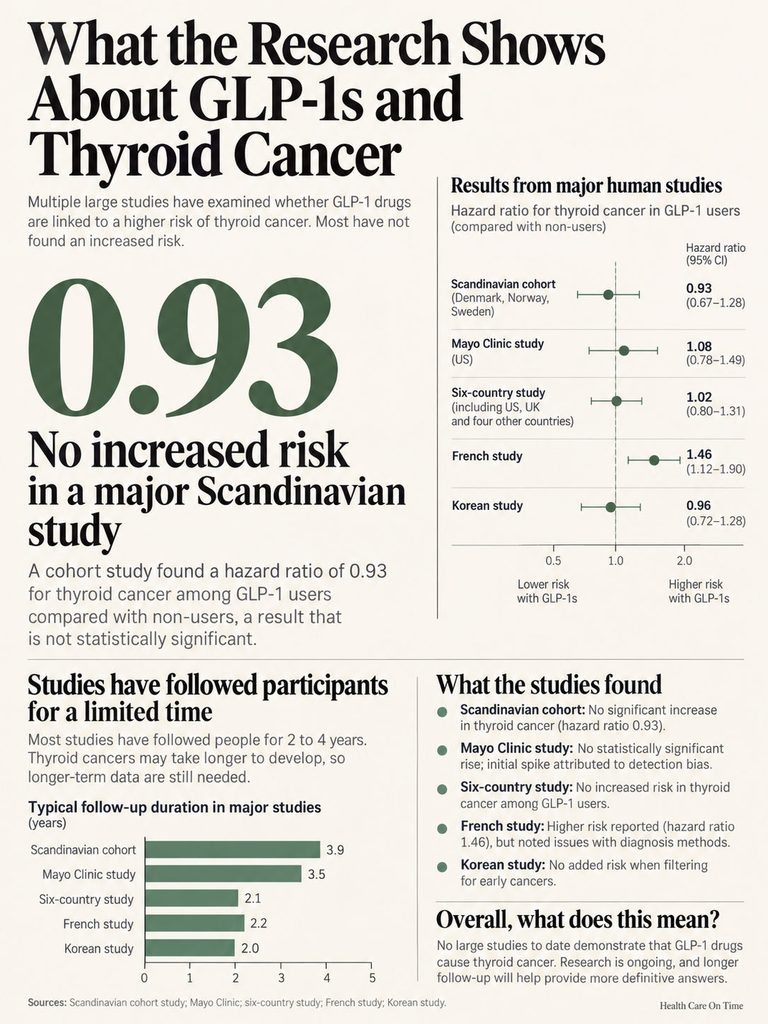
Researchers used national registers from Denmark, Norway and Sweden from 2007 to 2021. They compared 145,410 people starting GLP-1 drugs with 291,667 people starting DPP-4 inhibitors, another diabetes drug class. In the BMJ study, 76 people in the GLP-1 group developed thyroid cancer (1.33 per 10,000 person-years) versus 184 in the comparison group (1.46 per 10,000 person-years).
The hazard ratio was 0.93, meaning no increase. For MTC specifically, the hazard ratio was 1.19, but the confidence interval was wide (0.37 to 3.86) because MTC is so rare. Mean follow-up was 3.9 years.
The Mayo Clinic study and detection bias
A Mayo Clinic study published in JAMA Otolaryngology in 2025 followed more than 351,000 US adults with type 2 diabetes, including 41,112 who started a GLP-1 drug. Overall, there was no statistically significant rise in thyroid cancer (hazard ratio 1.24, confidence interval 0.88 to 1.76). Only 0.17% of GLP-1 users developed thyroid cancer.
There was one notable spike: in the first year, the hazard ratio was 1.85. After that, it faded, and after year two it was 0.78. The team also found GLP-1 users had more thyroid ultrasounds early on. Mayo endocrinologist David Toro Tobon, MD, said it’s “biologically improbable” for these drugs to cause clinically apparent tumors within months of starting.
That pattern has a name: detection bias. People starting a new drug see their doctors more, get more scans, and some small, slow cancers that were already there get found sooner. It looks like a jump in cancer, but it’s really a jump in looking.
A six-country study in the journal Thyroid
A study in the journal Thyroid, highlighted by the American Thyroid Association, pooled six population databases from 2007 to 2023. It compared 92,497 GLP-1 users with 2,484,408 DPP-4 inhibitor users and found no evidence of increased thyroid cancer risk, with follow-up of 1.8 to 3.0 years.
The French study that raised concern
Not every study has been reassuring. A French study reviewed in the JCEM paper reported a higher risk of all thyroid cancers (hazard ratio 1.46) and of MTC (1.78) with 1 to 3 years of use. The JCEM authors pointed out two problems: some MTC cases were classified by calcitonin levels rather than tissue diagnosis, and diagnoses within months of starting fit detection bias better than cancer growth.
A Korean study in the same review found no added risk (hazard ratio 0.98) once a 1-year lag was used to filter out early, already-present cancers. Big diabetes trials also showed no steady calcitonin rise: about 9,340 people in the LEADER trial of liraglutide over 3 years, and 12,831 people in the EXSCEL trial of exenatide.
What the research can’t tell you yet
Our team wants to be clear about the limits. Most of these studies followed people for 2 to 4 years, and thyroid cancers can take longer to develop. Mayo’s Juan Brito, MD, noted in a commentary that a median follow-up of 1.8 to 3.0 years “is insufficient to evaluate long-term risks.” Many studies also included only people with type 2 diabetes, while a growing share of users take these drugs for weight loss alone.
So the fair summary is this: no large human study has shown that GLP-1 drugs cause thyroid cancer, and the early bump looks like extra testing. Long-term data are still coming in, which is why the warning remains.
Do You Need a Calcitonin Test or Ultrasound Before Starting?
For most people, no. This surprises many readers, but the FDA labels are direct about it. They state that routine calcitonin monitoring or thyroid ultrasound “is of uncertain value for early detection of MTC” and may lead to unnecessary procedures, because calcitonin tests have low specificity and thyroid findings are so common.
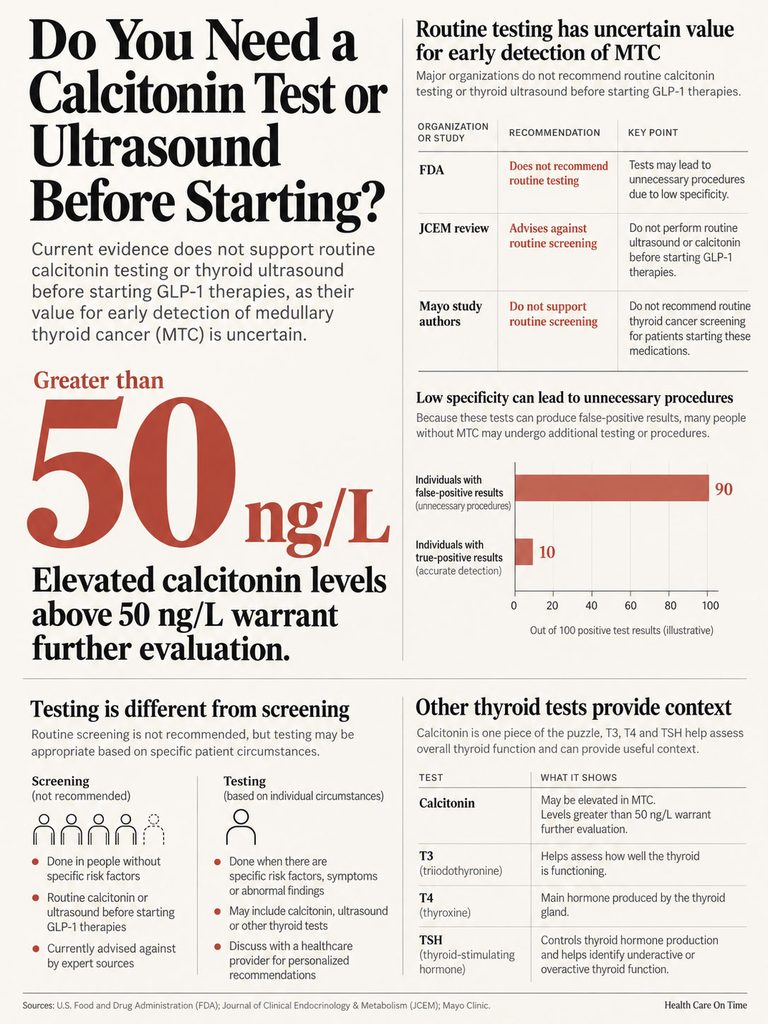
The JCEM review reached the same conclusion: routine screening ultrasound or calcitonin before starting a GLP-1 is not advisable. The Mayo study authors added that their findings “do not support implementing routine thyroid cancer screening” for people starting these drugs.
When testing does make sense
Testing is different from screening. Your doctor may order tests if:
- You have a nodule that hasn’t been evaluated yet
- You have neck symptoms, such as a growing lump or hoarseness
- You have a family history of MTC or MEN 2
- A calcitonin level was already measured and came back high
The labels note that people with MTC “usually have calcitonin values greater than 50 ng/L,” and anyone with an elevated result should be evaluated further. If you want to understand your other thyroid numbers, our explainer on T3, T4 and TSH tests walks through each one.
Symptoms to Report While on a GLP-1
Starting the drug doesn’t mean you should stop paying attention to your neck. The labels list four symptoms to report to your doctor promptly:
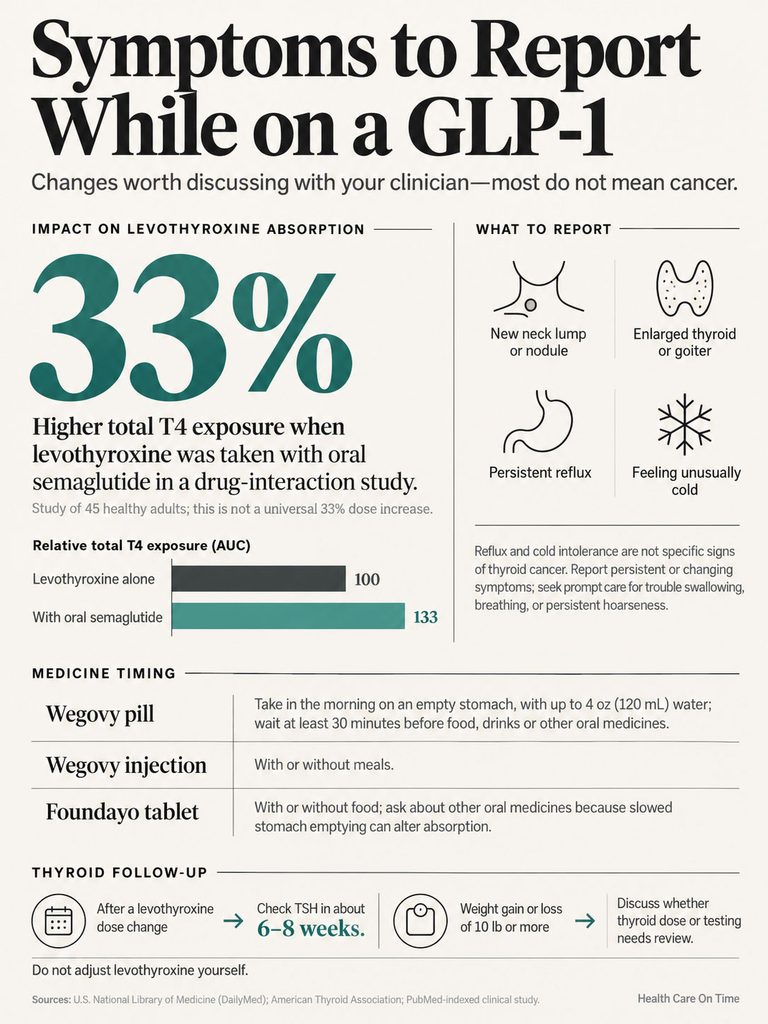
- A lump or swelling in the neck that’s new or growing
- Trouble swallowing (dysphagia)
- Shortness of breath (dyspnea)
- Hoarseness that doesn’t go away
None of these means you have cancer. Nodules, goiter, reflux and even a cold can cause them. But they deserve a check, and your doctor should know you’re on a GLP-1 when you call. If you’re not sure where the thyroid sits or how a goiter feels, our guide to thyroid gland location and common disorders can help.
A note on thyroid pills and timing
Many people with nodules also take levothyroxine. The pill form of Wegovy needs extra care. Its label says to take it on an empty stomach with up to 4 ounces of water, then wait at least 30 minutes before eating or taking other oral drugs. In one study, taking oral semaglutide raised levothyroxine exposure by 33%, so your doctor may check your TSH more often.
Foundayo can be taken with or without food, but its label warns it may still affect how other pills are absorbed. The weekly injections don’t have a timing rule with levothyroxine. UT Southwestern adds that your levothyroxine dose may need adjusting after a weight change of 10 to 20 pounds.
Questions to Ask Your Doctor Before Starting
When our team reviews reader questions, the most useful conversations start with a short list. Bring these to your appointment:
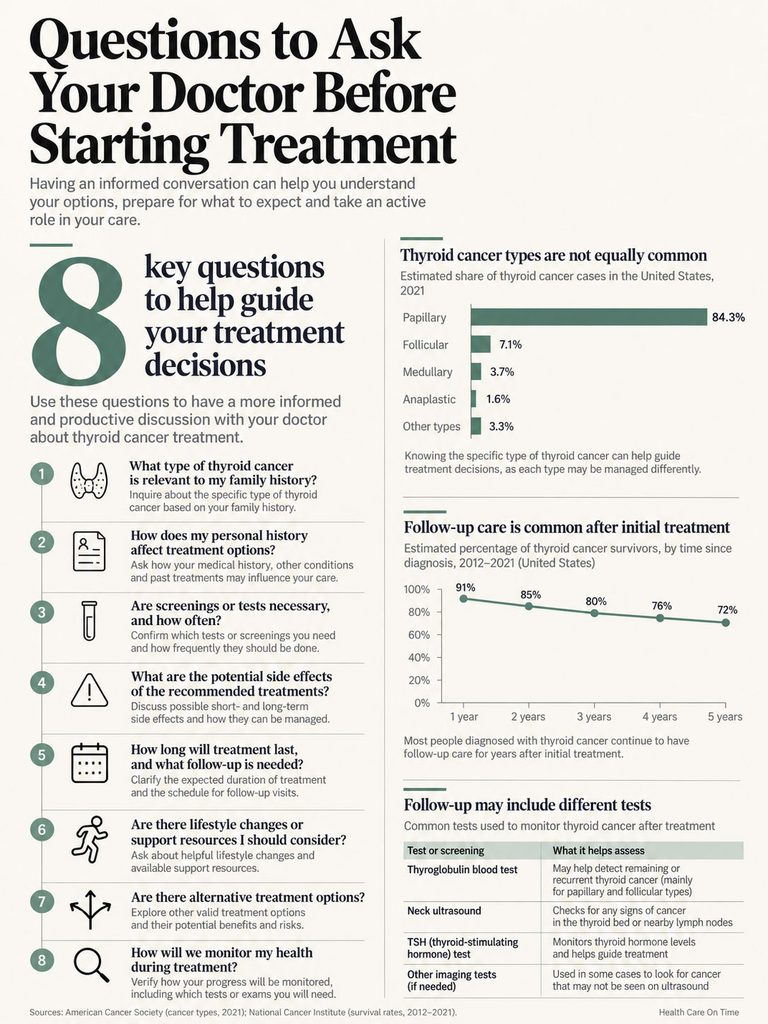
- Has the nodule been fully evaluated, and are any more tests needed before starting?
- Does the family history include medullary thyroid cancer or MEN 2?
- Would a visit with a genetic counselor about RET testing make sense?
- Will the nodule follow-up schedule change while on this drug?
- How should levothyroxine be timed with this GLP-1?
- Which neck symptoms should prompt a call to the office?
- If GLP-1 drugs aren’t a fit, what else can treat diabetes or weight?
Bring a written family history if you can. Many people don’t know the exact type of thyroid cancer a relative had, and that detail matters here. “Thyroid cancer” in a parent is not the same as MTC.
Common Mistakes to Avoid
HealthCareOnTime’s editors see the same misunderstandings again and again. Here are the ones that cause the most worry or the most risk.
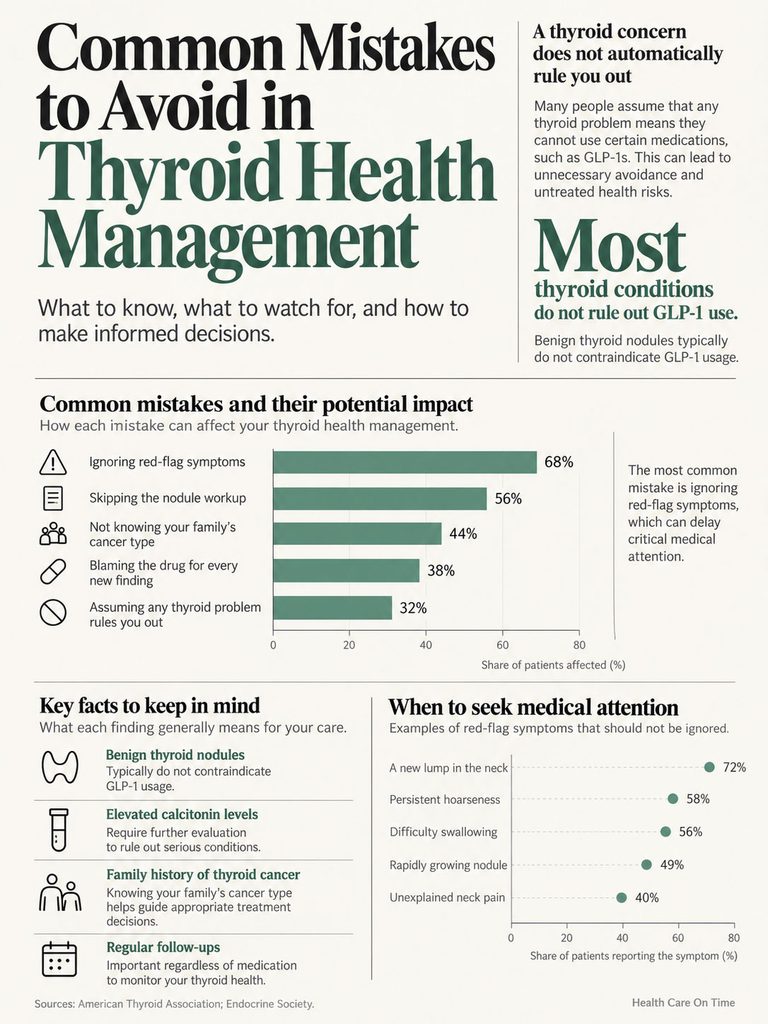
Assuming any thyroid problem rules you out
The warning names MTC and MEN 2. It doesn’t name nodules, goiter, Hashimoto’s or papillary cancer. Skipping a helpful treatment because of a misread label can leave blood sugar, weight and heart risk untreated.
Skipping the nodule workup
The opposite mistake also happens. A new nodule should be evaluated whether or not you take a GLP-1. Don’t let the excitement of starting a new drug push that appointment off.
Not knowing your family’s cancer type
If a relative had “thyroid cancer,” find out which kind. Papillary cancer in your mother doesn’t trigger the contraindication. MTC in your brother does.
Blaming the drug for every new finding
If a small nodule shows up on a scan a few months after you start, it was very likely there before. The Mayo data show early diagnoses are best explained by more testing, not new tumors.
Ignoring red-flag symptoms
Reassuring research doesn’t replace common sense. If you notice a growing neck lump, trouble swallowing or lasting hoarseness, call your doctor. If you’re also dealing with tiredness despite normal labs, our article on thyroid fatigue with normal labs covers other causes worth checking.
Frequently Asked Questions
Can someone with thyroid nodules take GLP-1 drugs?
Yes, in most cases. Thyroid nodules aren’t listed as a contraindication on any US GLP-1 label. The drugs are off-limits only for people with a personal or family history of medullary thyroid carcinoma or with MEN 2. Any nodule should still be evaluated with your doctor’s usual workup, whether or not you start the drug.
Can you take Ozempic if you have thyroid nodules?
Usually, yes. The Ozempic label contraindicates the drug only for people with a personal or family history of MTC or with MEN 2. A benign nodule doesn’t change that. If your nodule hasn’t been checked yet, your doctor will likely want an ultrasound, and possibly a biopsy, before or soon after you start.
Can you take Mounjaro with thyroid nodules?
Yes, if the nodules are benign and you don’t have MTC or MEN 2 in your personal or family history. Mounjaro contains tirzepatide, which caused thyroid C-cell tumors in rats, so it carries the same boxed warning as semaglutide. The rules for who should avoid it are the same.
Can you take Zepbound if you have thyroid nodules?
Zepbound follows the same label rules as Mounjaro, since both contain tirzepatide. Benign nodules aren’t a contraindication. People with a personal or family history of MTC, or with MEN 2, should not take it. Keep your regular nodule follow-up schedule and report any new neck lump, hoarseness or trouble swallowing.
Do GLP-1 drugs cause thyroid cancer in humans?
Large studies haven’t shown that they do. A Scandinavian study of more than 145,000 users found a hazard ratio of 0.93, and a Mayo Clinic study found no significant overall rise. A short-term increase in diagnoses in the first year appears to reflect more testing. Long-term data beyond about 4 years are still limited.
Should you get a thyroid ultrasound before starting a GLP-1?
Not routinely. The FDA labels and the 2025 JCEM review both say screening ultrasounds or calcitonin tests before starting aren’t advisable for most people, because they lead to extra procedures without clear benefit. Testing does make sense if you have a known nodule, neck symptoms, or a family history of MTC or MEN 2.
What calcitonin level is concerning?
The FDA labels say people with medullary thyroid cancer usually have calcitonin levels above 50 ng/L. The labels also warn that calcitonin tests have low specificity, so one result isn’t a diagnosis. Anyone with an elevated calcitonin should be evaluated further by their doctor or an endocrinologist.
Can GLP-1 drugs make existing thyroid nodules grow?
No large study has shown that GLP-1 drugs make ordinary benign nodules grow. The labels don’t list nodule growth as a known effect. Nodules can change size over time on their own, which is why routine follow-up exists. If your doctor sees growth on a repeat ultrasound, it should be evaluated like any other change.
Is it safe to take a GLP-1 after papillary thyroid cancer?
Papillary thyroid cancer isn’t a listed contraindication, because it starts in different cells than MTC. The University of Colorado’s Dr. Haugen calls the evidence mixed, but says the metabolic health risks are often bigger than the risk from a slow-growing thyroid cancer. Make this decision with your thyroid cancer specialist and keep your follow-up plan.
What does MEN 2 mean on a GLP-1 label?
MEN 2 stands for multiple endocrine neoplasia type 2, an inherited condition caused by a RET gene mutation. Nearly everyone with it develops medullary thyroid cancer over time. It can also cause adrenal tumors called pheochromocytomas. Because of the high MTC risk, all GLP-1 labels list MEN 2 as a contraindication.
What should you do if a nodule is found after starting a GLP-1?
Tell your doctor and get the standard evaluation: usually a TSH test and an ultrasound, with a biopsy if the nodule’s size or features call for one. Don’t stop the drug on your own. Most nodules are benign and were likely there before you started. Your doctor will decide whether any change is needed.
Medical Disclaimer: This article is for general education only and isn’t a substitute for professional medical advice, diagnosis or treatment. HealthCareOnTime does not prescribe or provide care in the United States. Talk with your doctor or endocrinologist before starting, stopping or changing any medication, and seek prompt care for a growing neck lump, trouble swallowing or breathing, or lasting hoarseness.
References
- FDA: Ozempic (semaglutide) injection prescribing information, revised 05/2026
- FDA: Wegovy (semaglutide) injection and tablets prescribing information, revised 06/2026
- FDA Label: Mounjaro (tirzepatide) prescribing information
- Eli Lilly: Zepbound (tirzepatide) US prescribing information
- Eli Lilly: Foundayo (orforglipron) US prescribing information, revised 07/2026
- Kelly and Sipos. GLP-1 receptor agonists in patients with thyroid nodules. J Clin Endocrinol Metab, 2025 (PubMed)
- J Clin Endocrinol Metab, 2025, full text
- Pasternak B, et al. GLP-1 receptor agonist use and risk of thyroid cancer: Scandinavian cohort study. BMJ, 2024
- Mayo Clinic: GLP-1RA and thyroid cancer, new study suggests detection bias, not causation, 2025
- American Thyroid Association: Risk of thyroid cancer among GLP1-RA users, 2025
- American Thyroid Association: Thyroid nodules
- American Thyroid Association: Medullary thyroid cancer
- American Cancer Society: Key statistics for thyroid cancer
- KFF Health Tracking Poll: 1 in 8 adults currently taking a GLP-1 drug, Nov 2025
- UT Southwestern Medical Center: GLP-1s and thyroid problems
- University of Colorado Cancer Center: GLP-1 drugs and thyroid cancer