
For stage 4 breast cancer that is hormone receptor-positive and HER2-negative, hormone therapy is usually the first treatment, and it’s almost always paired with a targeted pill. Which hormone drug comes first, and which one replaces it later, depends on menopause status, past treatment and a few gene tests on the tumor or blood.
Table of Contents

Quick Answer: Hormone therapy for breast cancer stage 4 means drugs that block estrogen or lower it, not menopause hormones. First line is usually an aromatase inhibitor (or tamoxifen, or fulvestrant) plus a CDK4/6 inhibitor, with ovarian suppression before menopause. When it stops working, the next choice depends on test results: ESR1 points to an oral SERD such as Wilserdly, Orserdu, Inluriyo or Veppanu, while PIK3CA, AKT1 or PTEN changes point to Piqray, Itovebi or Truqap.
Estrogen blockers, not estrogen
The name trips people up. Hormone therapy for breast cancer works in the opposite direction from menopausal hormone replacement therapy, the estrogen pills, patches and gels used for hot flashes. In a hormone receptor-positive (HR-positive) cancer, estrogen acts like fuel, and these estrogen blockers either block the receptor that takes in the fuel or cut the supply.
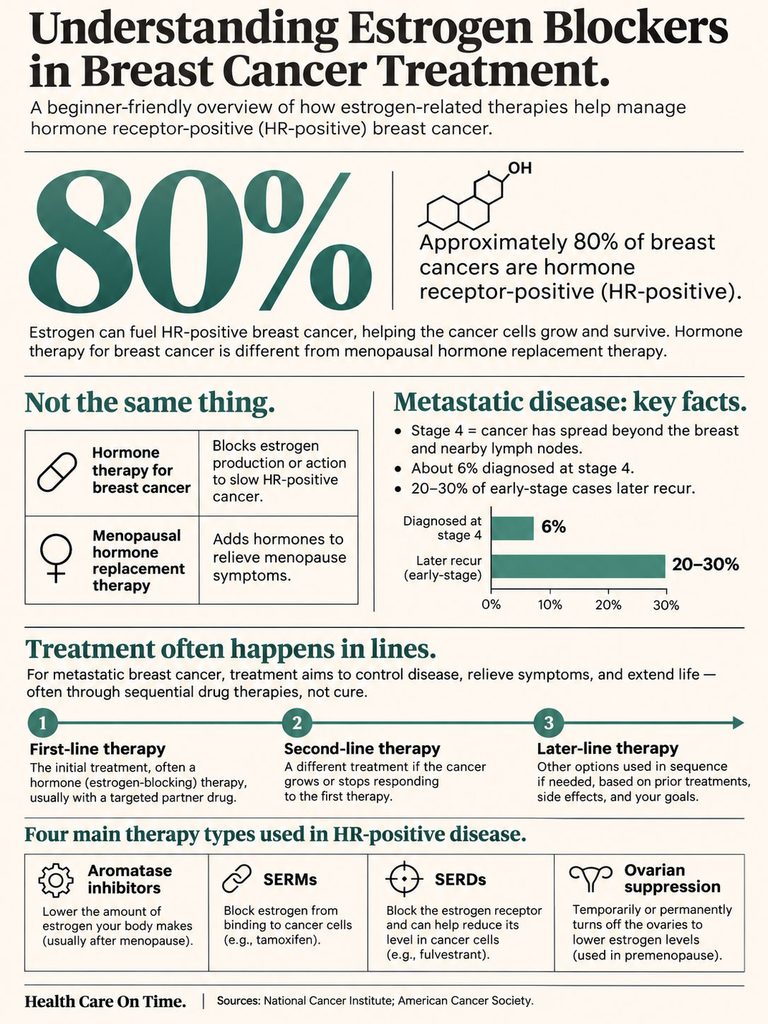
About 80% of people diagnosed with breast cancer have HR-positive disease. Most of those cancers are also HER2-negative, the group covered here. HER2-positive cancer has its own plan, and triple-negative breast cancer has no estrogen receptor for these drugs to act on.
Stage 4 means the cancer has spread beyond the breast and nearby lymph nodes, to places such as bone, liver or lung. Only about 6% of female breast cancers are at a distant stage when first found; far more people get here when an earlier cancer returns, which happens in about 20% to 30% of early-stage cases. The goal shifts at this point. Metastatic breast cancer isn’t considered curable, so treatment aims to keep the cancer under control for as long as possible while protecting daily life, and one hormone drug is usually followed by another rather than given for a fixed number of years. Surgery and radiation still have a role, mostly to ease pain or prevent problems in a specific spot, such as a bone at risk of breaking, but the drugs carry most of the load.
Doctors describe the sequence in “lines.” First line is the first regimen given for stage 4 disease; second line is whatever replaces it after the cancer grows, and so on. Some drugs are approved only for a certain line, or only after a certain earlier drug, which is why the same pill can be right for one person and off-label for another.
Four kinds of drugs do the work:
- Aromatase inhibitors (anastrozole, letrozole, exemestane) are pills that lower how much estrogen the body makes. They work only after menopause, or before menopause when the ovaries are switched off.
- SERMs such as tamoxifen and toremifene sit on the estrogen receptor and block it.
- SERDs and related degraders block the receptor and make the cell break it down. Fulvestrant is a monthly shot, with extra doses at the start; the newer ones are daily pills, including elacestrant (Orserdu), imlunestrant (Inluriyo), vepdegestrant (Veppanu), camizestrant (Etcamah) and giredestrant (Wilserdly).
- Ovarian suppression uses goserelin or leuprolide shots, or surgery to remove the ovaries.
What decides the order
Two people with “stage 4 HR-positive breast cancer” can be offered very different first pills.
Menopause status is the first fork, because aromatase inhibitors and fulvestrant are built for a body whose ovaries no longer make much estrogen. Before menopause, the ovaries have to be shut down for those drugs to work. What happened after the original surgery also counts. If cancer came back while someone was still taking an aromatase inhibitor, or soon after finishing it, the cancer has already shown it can grow despite that drug, and a drug it already progressed on may no longer be an option.
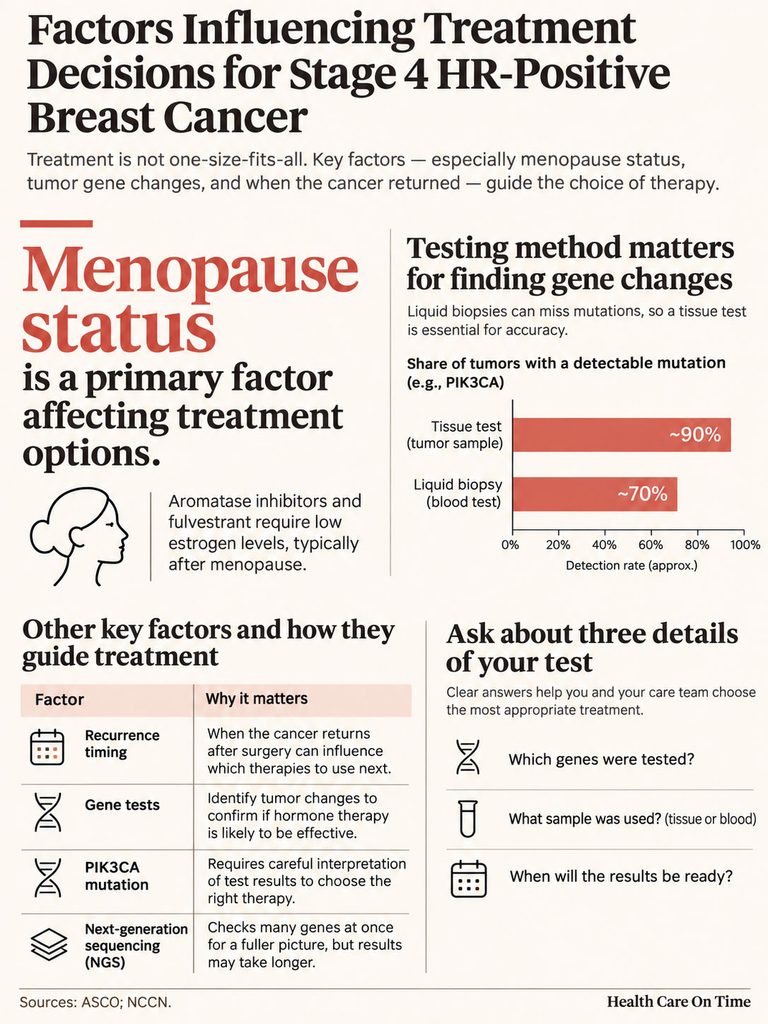
Gene tests fill in the rest. They look for changes in the tumor, either through a blood draw that picks up tumor DNA (a liquid biopsy) or through a tissue sample, and three results steer hormone therapy:
- ESR1, the gene for the estrogen receptor itself. A mutation here lets the receptor switch on without estrogen, which is how a cancer slips past an aromatase inhibitor. These mutations are uncommon at first diagnosis and become more common with treatment, so testing is done at diagnosis and again each time the cancer grows.
- PIK3CA, AKT1 and PTEN, three genes in one growth pathway. A change in any of them can open the door to a PI3K or AKT inhibitor.
- HER2 level. A cancer can be HER2-negative and still show a trace of HER2 (HER2-low or HER2-ultralow), which matters later for one antibody drug.
Blood tests are easy, but they can miss a mutation when only a little tumor DNA is circulating. For PIK3CA, a negative plasma test should be followed by a tissue test, per the alpelisib approval. Asking the same question about any negative blood result is reasonable.
Most of these reports come from next-generation sequencing, a method that reads many genes in one run, and results can take a week or more. Ask which genes were checked, on what sample, and when.
Stage 4 hormone therapy decision table
Every FDA-approved hormone-based combination for HR-positive, HER2-negative stage 4 breast cancer is listed by situation below, current through the November 16, 2026 approval of giredestrant plus everolimus. Each row is an option to discuss, not a ranking. An oncologist may choose differently for reasons a table can’t hold, such as liver function, other illnesses or how fast the cancer is growing.
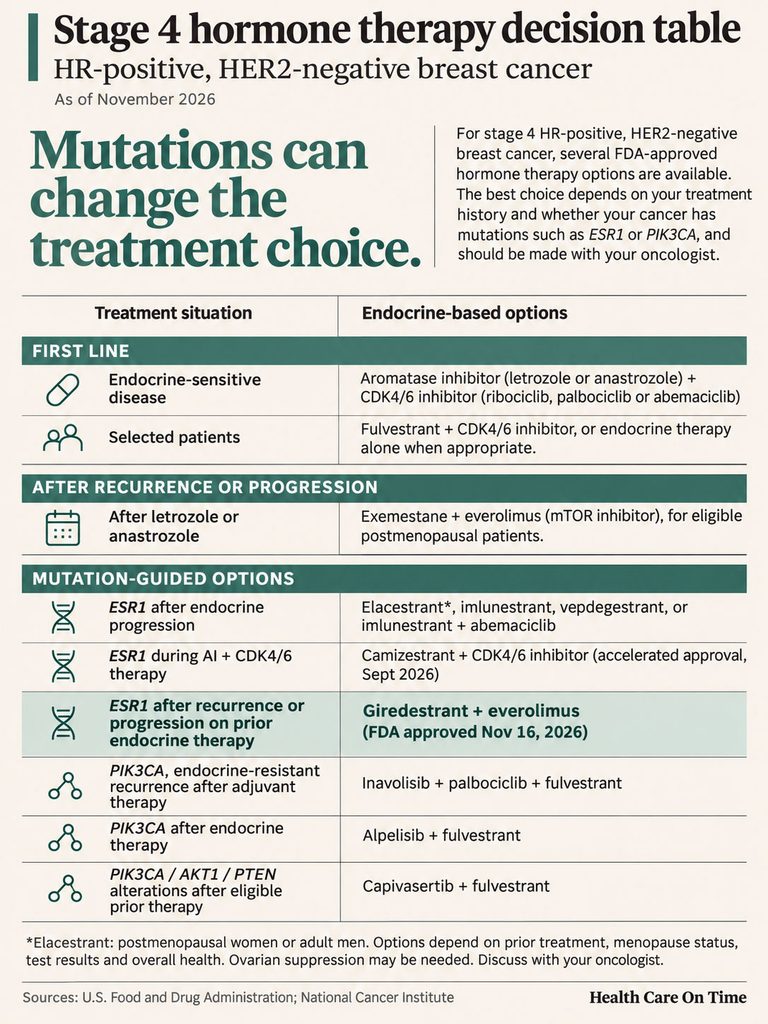
| Situation | Hormone drug | Targeted partner | Who it’s for |
| First line, after menopause | Aromatase inhibitor (letrozole, anastrozole, exemestane) or fulvestrant | CDK4/6 inhibitor (palbociclib, ribociclib or abemaciclib) | Most people starting stage 4 treatment with no prior resistance |
| First line, before menopause | Aromatase inhibitor or tamoxifen, plus ovarian suppression | CDK4/6 inhibitor | Premenopausal women; ovarian suppression is part of the plan |
| First line, men | Tamoxifen, or an aromatase inhibitor with a GnRH agonist | Per each drug’s FDA label; confirm with the oncologist | Men with HR-positive metastatic breast cancer |
| Came back on or after adjuvant hormone therapy, PIK3CA mutation | Fulvestrant | Inavolisib (Itovebi) plus palbociclib | Endocrine-resistant cancer with a PIK3CA mutation |
| ESR1 found on blood test during first line, before scans show growth | Camizestrant (Etcamah) replaces the aromatase inhibitor | Same CDK4/6 inhibitor continues | ESR1 detected during aromatase inhibitor plus CDK4/6 therapy (accelerated approval) |
| After progression, ESR1 mutation | Elacestrant (Orserdu), imlunestrant (Inluriyo) or vepdegestrant (Veppanu) | None | ESR1-mutated cancer after at least one hormone therapy line |
| After progression, ESR1 mutation | Imlunestrant (Inluriyo) | Abemaciclib (Verzenio) | ESR1-mutated cancer after at least one hormone therapy line |
| After progression, ESR1 mutation | Giredestrant (Wilserdly) | Everolimus | ESR1-mutated cancer that recurred during or after adjuvant hormone therapy, or grew on at least one metastatic hormone regimen |
| After progression, PIK3CA mutation | Fulvestrant | Alpelisib (Piqray) | Postmenopausal women and men after a hormone-based regimen |
| After progression, PIK3CA, AKT1 or PTEN change | Fulvestrant | Capivasertib (Truqap) | After at least one metastatic hormone regimen, or recurrence within 12 months of adjuvant therapy |
| After progression, no PIK3CA mutation detected | Fulvestrant | Gedatolisib (Revtorpyk), with or without palbociclib | After at least one hormone therapy line in the metastatic setting |
| After progression, any mutation status | Exemestane or fulvestrant | Everolimus | Older combination still used after earlier hormone therapy |
First-line treatment
After menopause
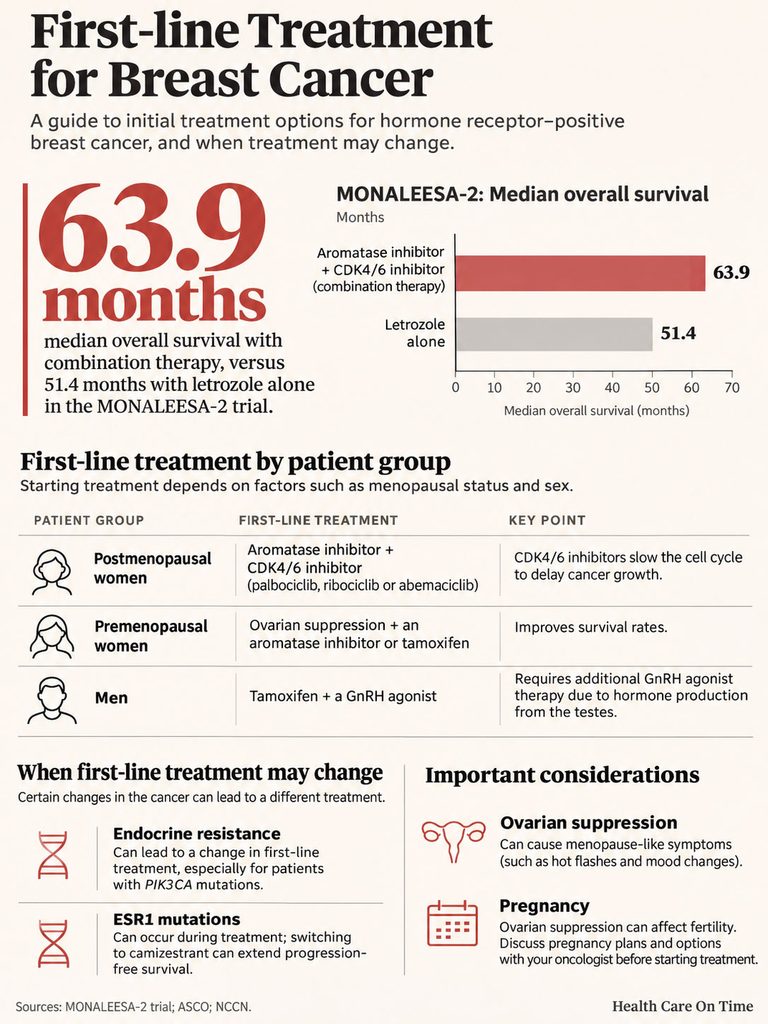
For most postmenopausal women, the first stage 4 regimen is an aromatase inhibitor plus a CDK4/6 inhibitor. Fulvestrant or tamoxifen sometimes takes the aromatase inhibitor’s place, and for some people a PI3K alpha inhibitor is the partner drug instead.
CDK4/6 inhibitors (palbociclib, ribociclib and abemaciclib) slow the cell cycle, the sequence a cancer cell runs through before it divides. The longest follow-up comes from MONALEESA-2, in which 668 postmenopausal women starting first-line treatment got letrozole with or without ribociclib, and after a median of 80 months, median overall survival was 63.9 months with the combination against 51.4 months with letrozole alone. Median progression-free survival, the time before the cancer grew, was 25.3 months versus 16.0 in that final survival analysis.
Most newer trials report progression-free survival instead of overall survival, because survival takes years to measure and people go on to other drugs in between. A longer stretch before the cancer grows is a real benefit, but it isn’t the same thing as living longer, and the gap between the two numbers is one reason labels and guidelines keep shifting.
Those are medians from one trial, in a group of people healthy enough to enroll. Some people do far better, some do worse. The three CDK4/6 drugs also differ in daily use: abemaciclib is taken twice a day and causes diarrhea more often, while palbociclib and ribociclib usually run for 21 days followed by 7 days off.
Before menopause
Premenopausal women get the same backbone plus one more step, switching off the ovaries. Treatment here almost always begins with ovarian suppression plus an aromatase inhibitor, tamoxifen or another hormone drug, and the pairing improves survival compared with either part alone. Suppression is usually a goserelin or leuprolide shot, which can be stopped. Surgery is permanent. Some women choose it anyway, to be done with injections, and radiation aimed at the ovaries is a third, permanent route that’s used less often.
Pregnancy needs a direct conversation too. Giredestrant, imlunestrant, vepdegestrant and gedatolisib all carry embryo-fetal toxicity warnings, and ovarian suppression shots aren’t birth control, so anyone who could become pregnant should ask which method fits alongside treatment.
Ovarian suppression brings on menopause fast, and the symptoms often hit harder than natural menopause. Hot flashes, vaginal dryness and bone loss are common, and adding tamoxifen or an aromatase inhibitor on top can deepen those estrogen-loss effects.
Men
Men with HR-positive metastatic breast cancer most often take tamoxifen. An aromatase inhibitor on its own falls short in men because the testes keep making hormones the body turns into estrogen, which is why men with advanced breast cancer who take one also get a GnRH agonist such as goserelin or leuprolide. Elacestrant and alpelisib are labeled for adult men as well as postmenopausal women. Fulvestrant and toremifene are described for women after menopause, so using them in a man is a label question to raise directly.
Cancer that came back soon after adjuvant therapy
Some people reach stage 4 because cancer returned while they were still on hormone therapy after surgery, or not long after stopping. Doctors call this endocrine resistance. It changes the first choice. If the tumor also carries a PIK3CA mutation, the FDA approved inavolisib (Itovebi) with palbociclib and fulvestrant in October 2024, based on INAVO120, a trial of 325 patients in which median progression-free survival was 15.0 months with the three drugs and 7.3 months with palbociclib and fulvestrant alone.
PI3K drugs raise blood sugar, so glucose checks come with this regimen.
When ESR1 shows up during first-line treatment
An ESR1 mutation lets the estrogen receptor run on its own, so an aromatase inhibitor, which works by cutting estrogen, slowly loses its grip. Tumor DNA carrying the mutation can appear in the blood before the cancer has grown enough to show on a CT or bone scan. A blood test during an aromatase inhibitor plus CDK4/6 inhibitor can therefore catch ESR1 while scans still look stable.
On September 4, 2026, the FDA granted accelerated approval to camizestrant (Etcamah) for that situation. The aromatase inhibitor is swapped for camizestrant, and the same CDK4/6 inhibitor continues at the same dose. In SERENA-6, 315 patients with a newly found ESR1 mutation were randomized, and median progression-free survival from the time of detection was 16 months after switching versus 9.2 months for those who stayed on the aromatase inhibitor.
Accelerated approval comes with conditions. Continued approval may depend on confirmatory trials showing clinical benefit, and the approach needs repeated blood testing during treatment that not every practice does yet. A positive blood result is a reason to talk about switching, and the oncologist will weigh it against how well the current regimen has been going and how someone is tolerating it.
When the first hormone therapy stops working
Hormone therapy almost always stops working at some point, so a change of drugs is the expected path in stage 4 care.
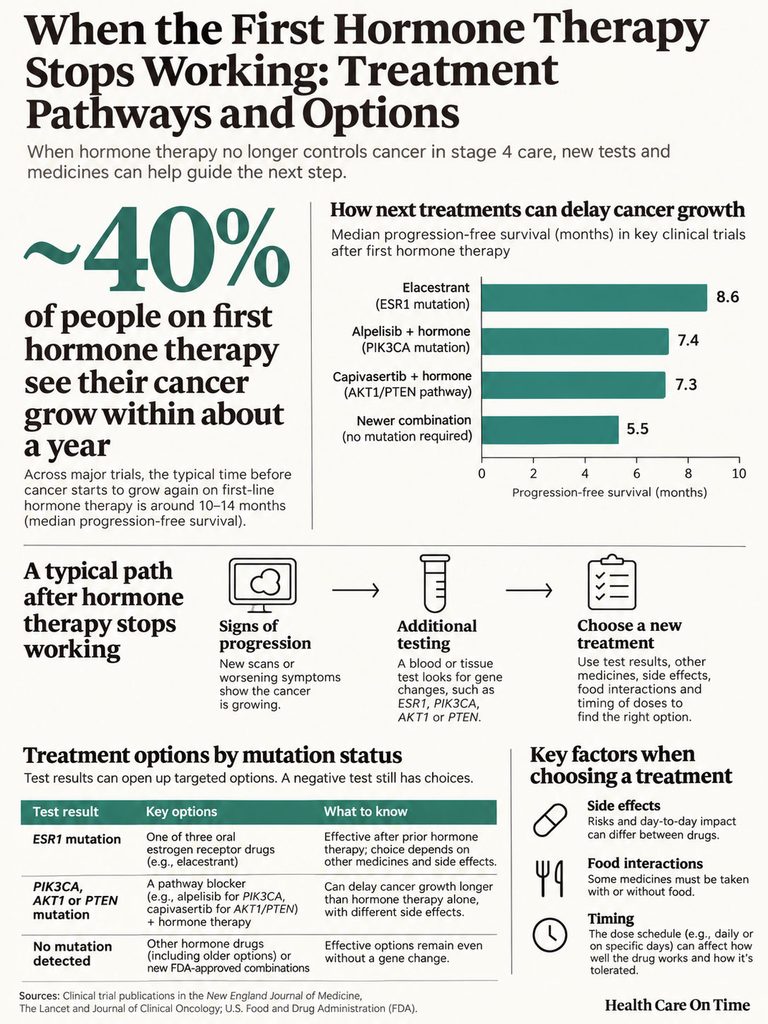
Usually a scan shows growth, or new symptoms lead to a scan, and the oncologist calls it progression. What follows is often another hormone therapy, picked by the gene tests, sometimes with a targeted drug added; a second hormone drug can be followed by a third if that one fails too. Retesting matters here. An ESR1 mutation that wasn’t there at diagnosis may show up now, and a blood test drawn at progression can move someone to a different row of the decision table.
Side effects alone can justify a change too, even when scans look good, and the care team can usually swap one drug for another in the same family.
If an ESR1 mutation is found
Three oral estrogen receptor drugs can be used alone for ESR1-mutated, HR-positive, HER2-negative metastatic breast cancer that grew after at least one line of hormone therapy, and two more regimens pair an oral drug with a partner. None were compared with each other. Each was tested against older hormone therapy, usually fulvestrant or exemestane.
Elacestrant (Orserdu) is the oldest of the group and is labeled for postmenopausal women and adult men. Imlunestrant (Inluriyo) is the only one also approved with a CDK4/6 inhibitor, abemaciclib. Vepdegestrant (Veppanu) is a PROTAC, a drug that tags the receptor so the cell destroys it, and giredestrant (Wilserdly) comes only with everolimus. Picking among them often comes down to whether a partner drug is added, other medicines, food rules and side effects.
How the ESR1 pills differ day to day
Imlunestrant has to be taken on an empty stomach, at least 2 hours before or 1 hour after food, whereas elacestrant and vepdegestrant go with food and giredestrant and camizestrant work either way. Vepdegestrant’s label warns about QTc prolongation, a change in the heart’s electrical rhythm seen on an ECG. Giredestrant’s warns about a slow heart rate. In its trial, elacestrant most often caused muscle and joint pain, nausea, and higher cholesterol and triglycerides; imlunestrant’s list was mostly lab changes, such as lower blood counts and higher liver enzymes, plus fatigue and diarrhea.
For someone who already takes a heart rhythm drug, has trouble with nausea, or eats on an unpredictable schedule, though, these details can settle the choice.
If PIK3CA, AKT1 or PTEN is changed
The PI3K pathway is a growth signal that runs alongside the estrogen receptor. When it’s stuck on, cancer cells keep growing even with estrogen blocked. Two pills pair a pathway blocker with fulvestrant after progression: alpelisib (Piqray), for a PIK3CA mutation, labeled for postmenopausal women and men; and capivasertib (Truqap), an AKT inhibitor that covers a change in any of the three genes, so a tumor with an AKT1 or PTEN change and no PIK3CA mutation still qualifies. Both raise blood sugar. Diarrhea and rash are common with both.
If no mutation is found
A negative test still leaves choices. Fulvestrant alone, or exemestane or fulvestrant with everolimus, has been used for years, and older drugs such as toremifene (Fareston) and megestrol acetate (Megace) remain on the list. In July 2026 the FDA added gedatolisib (Revtorpyk) with fulvestrant, with or without palbociclib, for cancers with no PIK3CA mutation detected after at least one metastatic hormone line. It blocks the PI3K pathway at more than one point, which is how it can work in cancers without a PIK3CA mutation. Unlike the other pathway drugs, it’s an IV infusion, given weekly for three weeks of each four-week cycle, and its label warns about mouth sores, skin reactions and high blood sugar.
In the trial results below, each number is measured against the control arm of its own trial, so a longer number in one row doesn’t prove that drug beats the drug in another row.
| Regimen | Trial (patients analyzed) | Median progression-free survival | Control arm | FDA approval |
| Ribociclib + letrozole, first line | MONALEESA-2 (668) | 25.3 months vs 16.0 | Letrozole alone | Earlier first-line approval; OS data published 2022 |
| Inavolisib + palbociclib + fulvestrant | INAVO120 (325) | 15.0 months vs 7.3 | Palbociclib + fulvestrant | FDA, Oct 10, 2024 |
| Camizestrant + CDK4/6 switch | SERENA-6 (315) | 16 months vs 9.2 | Stay on aromatase inhibitor + CDK4/6 | FDA, Sep 4, 2026 (accelerated) |
| Elacestrant | EMERALD (228 with ESR1) | 3.8 months vs 1.9 | Fulvestrant or aromatase inhibitor | FDA, Jan 27, 2023 |
| Imlunestrant | EMBER-3 (256 with ESR1) | 5.5 months vs 3.8 | Fulvestrant or exemestane | FDA, Sep 25, 2025 |
| Imlunestrant + abemaciclib | EMBER-3 subgroup (159 with ESR1) | 11.1 months vs 5.5 | Imlunestrant alone | FDA, Sep 18, 2026 |
| Vepdegestrant | VERITAC-2 (270 with ESR1) | 5 months vs 2.1 | Fulvestrant | FDA, May 1, 2026 |
| Giredestrant + everolimus | evERA (207 with ESR1) | 10 months vs 5.5 | Hormone therapy + everolimus | FDA, Nov 16, 2026 |
| Alpelisib + fulvestrant | SOLAR-1 (PIK3CA cohort) | 11.0 months vs 5.7 | Fulvestrant | FDA, May 24, 2019 |
| Capivasertib + fulvestrant | CAPItello-291 (289 altered) | 7.3 months vs 3.1 | Fulvestrant | FDA, Nov 16, 2023 |
| Gedatolisib + palbociclib + fulvestrant | VIKTORIA-1 (392 total) | 9.3 months vs 2.0 | Fulvestrant | FDA, Jul 14, 2026 |
Wilserdly plus everolimus, the newest approval
Wilserdly is the brand name for giredestrant, an oral estrogen receptor antagonist made by Genentech. Its November 16, 2026 approval covers adults with ER-positive, HER2-negative, ESR1-mutated locally advanced or metastatic breast cancer, confirmed with an FDA-authorized test, whose disease came back during or after adjuvant hormone therapy or grew on at least one hormone-based regimen for metastatic disease. It’s approved only with everolimus, an mTOR inhibitor long used alongside hormone therapy. Everolimus blocks a step further down the same PI3K growth pathway, so the pairing hits the estrogen receptor and a backup growth signal at the same time. Many people who reach this point have already taken a CDK4/6 inhibitor, and everolimus gives a partner drug from a different class.
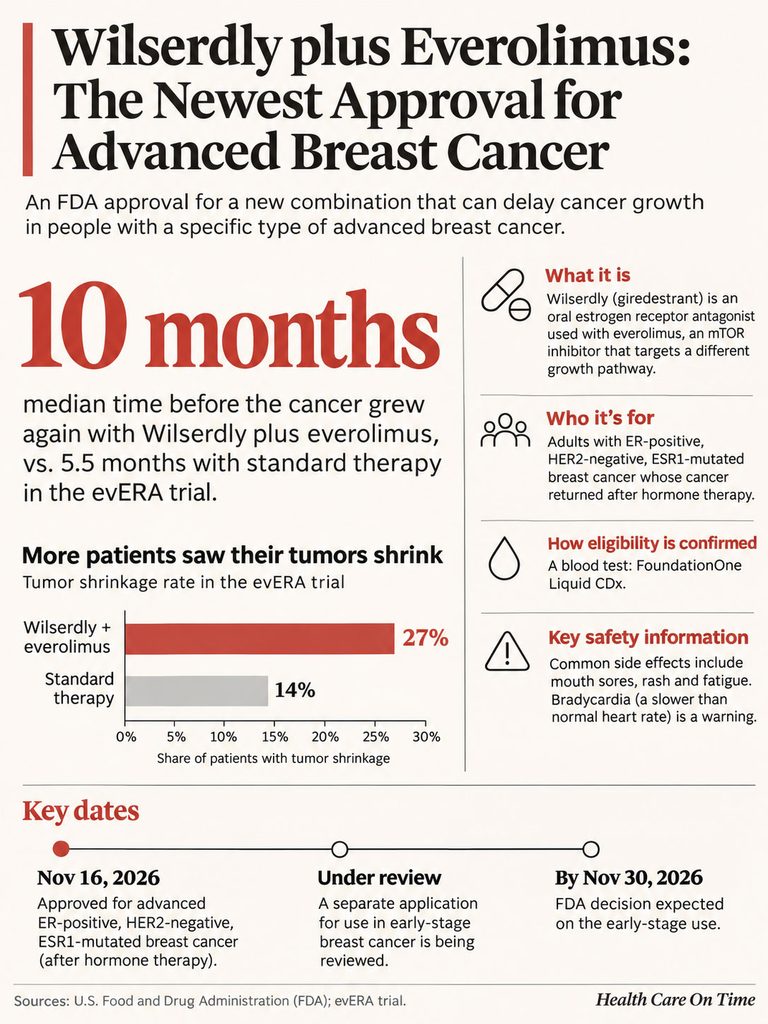
The evERA trial randomized 373 adults, 207 of them with ESR1 mutations. In that group, median progression-free survival was 10 months with giredestrant plus everolimus and 5.5 months with standard hormone therapy plus everolimus, and tumors shrank in 27% versus 14%. Survival data weren’t mature at the time of review, so it isn’t known yet whether people live longer on it.
Eligibility is confirmed with FoundationOne Liquid CDx, a blood test. Side effects seen in 20% or more of patients were mouth sores, rash, fatigue, diarrhea, muscle and joint pain, pneumonitis (lung inflammation) and nausea, several of them mainly from everolimus. A slow heart rate (bradycardia) is on the label as a warning, so heart rate gets checked, and dizziness or fainting calls for a phone call right away.
Giredestrant isn’t a stand-alone first hormone drug for metastatic disease. For stage 4 it’s approved with everolimus, after earlier hormone therapy, and its mechanism differs from tamoxifen’s even though both act on the estrogen receptor. A separate application for early-stage use after surgery (stages 1 to 3), based on the lidERA trial, was under FDA priority review with a decision expected by November 30, 2026, and that decision doesn’t change the stage 4 indication.
When hormone therapy is no longer enough
Eventually the cancer may stop responding to estrogen blockers in any combination, or grow fast enough that the oncologist wants something stronger. Treatment continues, with chemotherapy, antibody-drug conjugates, immunotherapy or PARP inhibitors chosen by the cancer’s features.
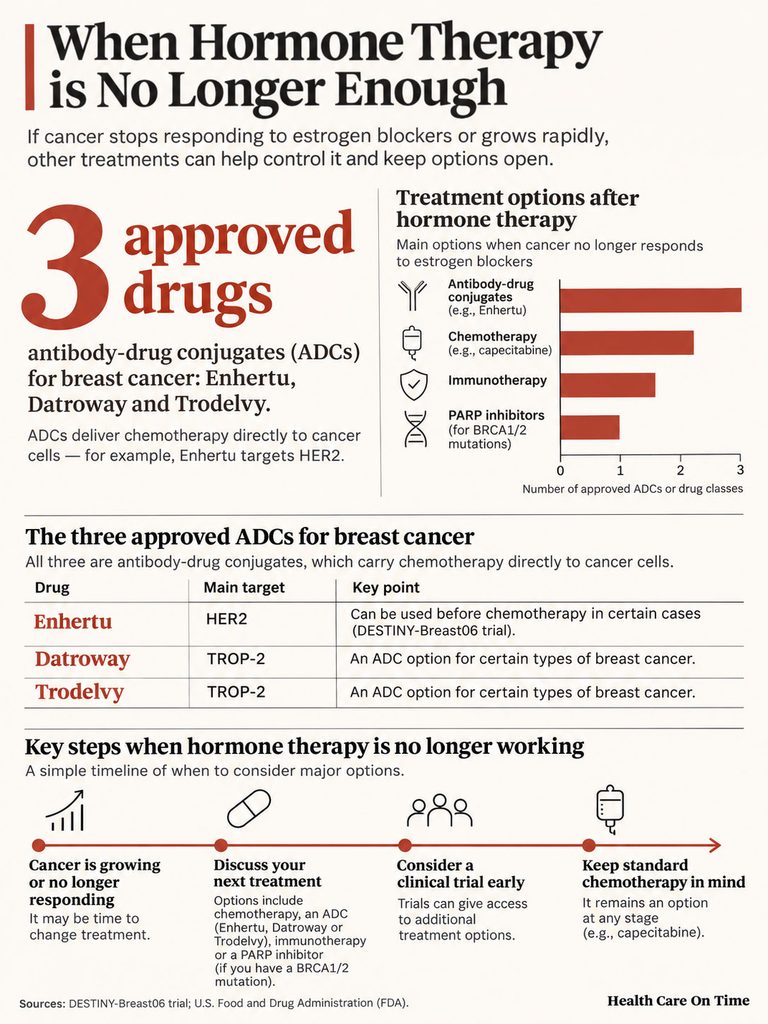
Antibody-drug conjugates carry a chemotherapy drug on an antibody that finds a protein on cancer cells. Enhertu targets HER2, which is why even a trace of HER2 on the pathology report matters. Datroway and Trodelvy target Trop-2, a protein found on many breast cancers regardless of HER2. Three are approved for this cancer type:
- Trastuzumab deruxtecan (Enhertu), for HER2-low or HER2-ultralow cancers that grew on one or more hormone therapies in the metastatic setting. In DESTINY-Breast06, median progression-free survival was 13.2 months versus 8.1 with chemotherapy.
- Datopotamab deruxtecan (Datroway), after prior hormone therapy and chemotherapy. It lengthened progression-free survival (6.9 versus 4.9 months) but didn’t improve overall survival, with medians of 18.6 and 18.3 months.
- Sacituzumab govitecan (Trodelvy), after hormone therapy and at least two other systemic treatments, with median overall survival of 14.4 months versus 11.2 on chemotherapy.
Because DESTINY-Breast06 enrolled people who hadn’t yet had chemotherapy for metastatic disease, Enhertu can come before chemotherapy rather than only after it.
Clinical trials are worth asking about at every turning point, well before the approved drugs run out. Many of the drugs in the tables above were reachable through trials years before approval, and eligibility often depends on which treatments someone has already had, so asking early leaves more options.
PARP inhibitors are reserved for people with an inherited BRCA1 or BRCA2 mutation. Standard chemotherapy stays available at any point, including pills such as capecitabine, one of the comparison drugs in DESTINY-Breast06.
The routine around the pills
Most stage 4 hormone therapy is taken at home, yet a fair amount of clinic time surrounds it. Fulvestrant means a shot in the clinic, monthly after the first few doses, and ovarian suppression means regular injections unless the ovaries are removed. Gedatolisib needs an infusion on days 1, 8 and 15 of each 28-day cycle. Blood work is heavier early on: counts for CDK4/6 inhibitors, glucose for PI3K and AKT drugs, heart rate or rhythm for vepdegestrant and giredestrant.
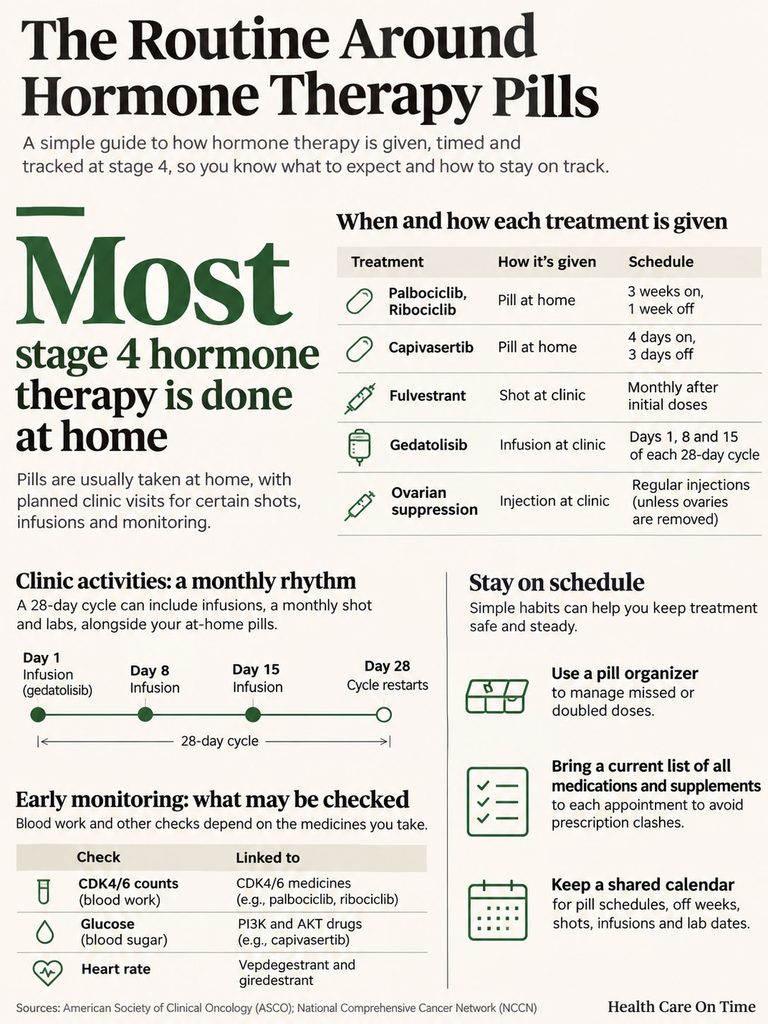
Pill schedules aren’t all daily. Palbociclib and ribociclib run three weeks on and one week off, capivasertib runs four days on and three off each week, and fulvestrant is timed to the clinic visit. Missed or doubled doses are easy on these patterns, and a pill organizer marked with off weeks helps more than memory does.
Bring a current list of every medicine and supplement to each visit, since a new prescription from another doctor can clash with a cancer pill.
Scans follow a schedule the oncologist sets. If the plan includes the camizestrant switch, ESR1 blood tests are added while first-line treatment is still working. A shared calendar with pill days, off weeks, shots, infusions and lab dates keeps everyone on the same schedule.
Side effects worth reporting early
Estrogen blockers as a group cause hot flashes, night sweats, vaginal dryness, joint and muscle pain, fatigue and less interest in sex. Aromatase inhibitors also thin the bones and raise fracture risk, so bone density scans, calcium and vitamin D, and sometimes bone-strengthening drugs such as a bisphosphonate or denosumab become part of care, which matters even more once cancer has reached the bone. Aromatase inhibitors may also affect the heart and blood vessels, so blood pressure and cholesterol deserve routine attention. Joint and muscle pain is common with them; if it’s wearing someone down, it’s fair to ask whether a different aromatase inhibitor or better pain treatment could help. Tamoxifen carries a small risk of blood clots and uterine cancer, and cataracts are a less common effect. New leg swelling, chest pain or vaginal bleeding after menopause should be reported.
The targeted partners bring their own problems. CDK4/6 inhibitors lower white blood cell counts (neutropenia) and cause diarrhea, more often with abemaciclib. PI3K and AKT drugs raise blood sugar, a real concern for anyone with diabetes or prediabetes, and cause rash and diarrhea. Everolimus causes mouth sores, fatigue, anemia, lung problems and high blood sugar.
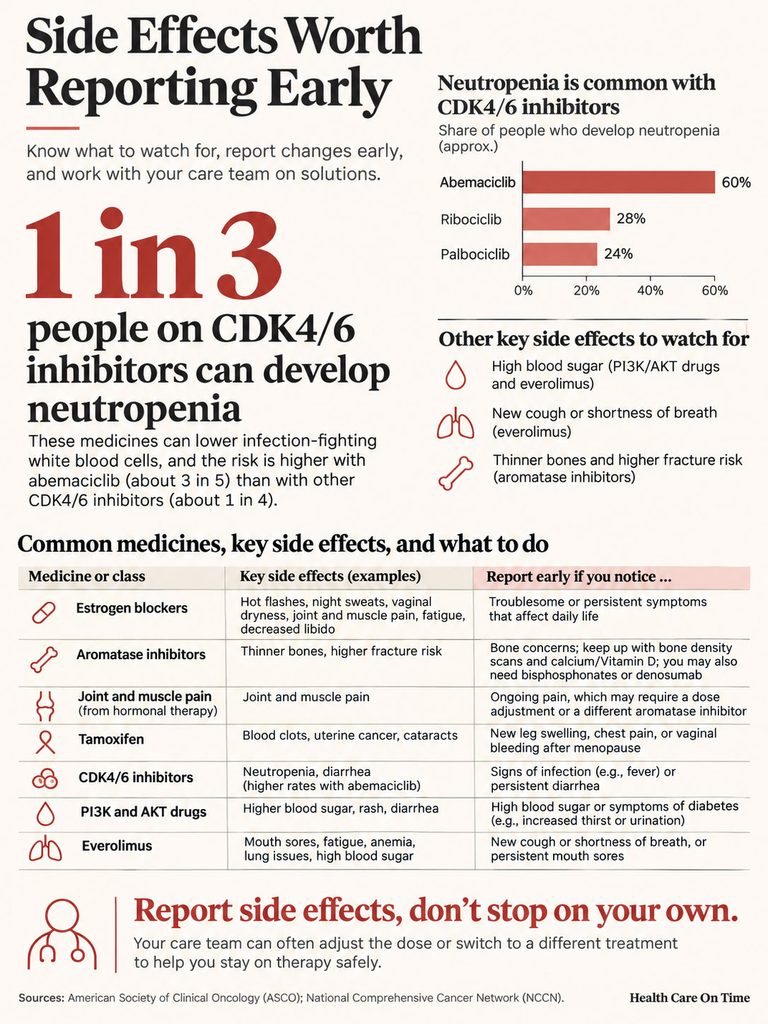
Call the same day about a new cough or shortness of breath on everolimus or on giredestrant plus everolimus. Sudden thirst and frequent urination on a PI3K or AKT drug can mean very high blood sugar.
Report side effects rather than quietly stopping a pill; doses can often be lowered or paused.
Questions to bring to the oncologist
A stage 4 plan unfolds over years, and the “if this, then that” logic is easier to follow when it’s mapped out early. Bring the caregiver, since they often end up holding the reports and the calendar.
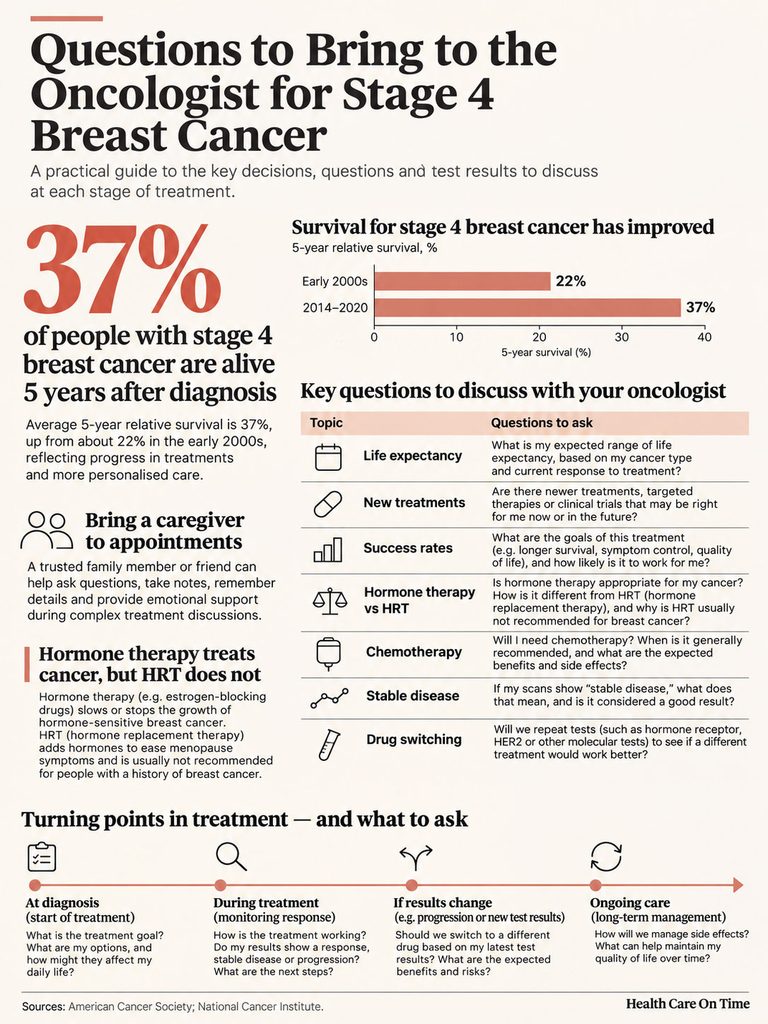
- Which genes were tested, and was it a blood test or tissue?
- Do we repeat the ESR1 blood test while this first treatment is still working, or only when a scan shows growth?
- Why this CDK4/6 inhibitor and not one of the other two?
- If the cancer came back while taking anastrozole after surgery, does that rule out another aromatase inhibitor now?
- Is ovarian suppression needed, and is surgery an option instead of the shots?
- If ESR1 turns up later, which of the pills would come next, and why that one?
- What blood sugar, heart rate or lung symptoms should prompt a same-day call?
- Which side effects are acceptable in exchange for more time, and which would be a reason to switch?
- Is there a clinical trial that fits this situation right now?
Common turning points, and a question to raise at each one:
| If this happens | What usually comes next | What to ask about |
| New stage 4 diagnosis, HR-positive, HER2-negative | Aromatase inhibitor or fulvestrant plus a CDK4/6 inhibitor; ovarian suppression if premenopausal | Were ESR1, PIK3CA, AKT1 and PTEN checked at the start? |
| Cancer returned during or soon after adjuvant hormone therapy | Gene testing first; PIK3CA mutation may lead to inavolisib, palbociclib and fulvestrant | Is the earlier hormone drug now off the list? |
| ESR1 found on a blood test, scans still stable | Discuss switching to camizestrant while keeping the CDK4/6 inhibitor | How often will the blood test be repeated? |
| Scan shows growth, ESR1 mutation | Oral SERD alone, imlunestrant plus abemaciclib, or giredestrant plus everolimus | Which pill fits around meals, heart issues and other medicines? |
| Scan shows growth, PIK3CA, AKT1 or PTEN change | Fulvestrant plus alpelisib or capivasertib | How will blood sugar be checked, and how often? |
| Scan shows growth, no mutation found | Fulvestrant plus gedatolisib (IV), or everolimus combinations | Should a tissue test back up the negative blood test? |
| Several hormone lines used, HER2-low or ultralow | Trastuzumab deruxtecan, or chemotherapy | Is the cancer HER2-low, and is there a trial to consider? |
Frequently Asked Questions
What is the life expectancy with stage 4 breast cancer?
For breast cancer found at a distant stage, the five-year relative survival rate is 32%, based on SEER data for women diagnosed from 2015 to 2021. That figure mixes all subtypes, counts only cancer that was stage 4 at diagnosis, and reflects treatment before most of the 2023 to 2026 approvals. Hormone receptor and HER2 status affect outlook too. In MONALEESA-2, median survival on first-line ribociclib plus letrozole was 63.9 months. Where the cancer has spread, how it responds and overall health shape any one person’s outlook.
What is the new treatment for stage 4 breast cancer?
The newest FDA approval is giredestrant (Wilserdly) plus everolimus, on November 16, 2026, for ESR1-mutated, HR-positive, HER2-negative disease after prior hormone therapy. Vepdegestrant, gedatolisib, camizestrant and imlunestrant plus abemaciclib came earlier in 2026.
What is the success rate of hormone therapy for breast cancer?
Stage 4 has no single success rate. Trials report how long the cancer stays controlled, from a median of 25.3 months for first-line ribociclib plus letrozole down to a few months for single drugs used later. Response rates are reported too; 27% of ESR1-mutated cancers shrank on giredestrant plus everolimus in evERA. Early-stage success rates are a different question.
Has anyone ever been cured of stage 4 breast cancer?
Metastatic breast cancer isn’t considered curable. Some people do have long stretches when scans show no active cancer, called no evidence of disease (NED), and many live for years on a series of treatments.
How long does hormone therapy work for metastatic breast cancer?
It varies by person and by line. First-line combinations tend to work longest. Later lines usually hold for a shorter time, with medians of roughly 4 to 11 months in the trials above, so the next option is planned before it’s needed.
Is hormone therapy for breast cancer the same as HRT?
No. HRT adds estrogen for menopause symptoms; breast cancer hormone therapy blocks or removes it. Estrogen can feed an HR-positive cancer, so check with the oncologist before using any estrogen product, vaginal ones included.
Can men get the same hormone therapy for stage 4 breast cancer?
Mostly. Men usually take tamoxifen, and men on an aromatase inhibitor also need a GnRH agonist shot to stop hormone production in the testes. Elacestrant and alpelisib are labeled for men; for other drugs, the oncologist checks each label.
Is chemotherapy needed for stage 4 hormone-positive breast cancer?
Not usually at the start. Hormone therapy plus a targeted drug is the usual first treatment for HR-positive, HER2-negative stage 4 disease, with chemotherapy as an option once the cancer no longer responds to hormone drugs. Antibody-drug conjugates may come before or after chemotherapy, depending on the cancer’s features.
What does “stable disease” on a scan mean?
It means the cancer hasn’t grown or shrunk enough to count as either. On hormone therapy, stable disease usually means the treatment is working and stays the same.
Why switch drugs if the scan still looks stable?
Because an ESR1 mutation in the blood can come before visible growth. In SERENA-6, switching to camizestrant at that point kept the cancer controlled longer than waiting, though the approval is accelerated and still needs confirmatory data.
Medical disclaimer: This article is general health information for adults in the United States. It isn’t medical advice and doesn’t replace care from an oncologist who knows your full history. Drug approvals, labels and test requirements change; confirm every option, dose and eligibility rule with your care team and the current FDA label before starting or stopping any treatment.
References
- U.S. Food and Drug Administration. FDA approves giredestrant in combination with everolimus for ER-positive, HER2-negative, ESR1-mutated locally advanced or metastatic breast cancer. November 16, 2026.
- U.S. Food and Drug Administration. FDA approves vepdegestrant for ER-positive, HER2-negative, ESR1-mutated advanced or metastatic breast cancer. May 1, 2026.
- U.S. Food and Drug Administration. FDA approves imlunestrant for ER-positive, HER2-negative, ESR1-mutated advanced or metastatic breast cancer. September 25, 2025.
- U.S. Food and Drug Administration. FDA approves imlunestrant in combination with abemaciclib. September 18, 2026.
- U.S. Food and Drug Administration. FDA approves elacestrant for ER-positive, HER2-negative, ESR1-mutated advanced or metastatic breast cancer. January 27, 2023.
- Oncology Nursing Society, reproducing FDA notice. FDA grants accelerated approval to camizestrant with a CDK4/6 inhibitor. September 2026.
- U.S. Food and Drug Administration. FDA approves capivasertib with fulvestrant for breast cancer. November 16, 2023.
- U.S. Food and Drug Administration. FDA approves alpelisib for metastatic breast cancer. May 24, 2019.
- U.S. Food and Drug Administration. FDA approves inavolisib with palbociclib and fulvestrant. October 10, 2024.
- U.S. Food and Drug Administration. FDA approves gedatolisib with fulvestrant, with or without palbociclib. July 14, 2026.
- U.S. Food and Drug Administration. FDA approves fam-trastuzumab deruxtecan-nxki for HR-positive, HER2-low or HER2-ultralow breast cancer. January 27, 2025.
- U.S. Food and Drug Administration. FDA approves datopotamab deruxtecan-dlnk for HR-positive, HER2-negative breast cancer. January 17, 2025.
- U.S. Food and Drug Administration. FDA approves sacituzumab govitecan-hziy for HR-positive breast cancer. February 3, 2023.
- The ASCO Post. Final overall survival analysis of MONALEESA-2. March 2022 (reporting Hortobagyi et al., N Engl J Med 2022).
- American Cancer Society. Treatment of stage IV (metastatic) breast cancer. Revised July 9, 2026.
- American Cancer Society. Survival rates for breast cancer. Revised July 23, 2026.
- Susan G. Komen. Hormone therapy for metastatic breast cancer. Updated March 13, 2026.
- National Cancer Institute. Hormone therapy for breast cancer. Updated September 23, 2026.
- Mayo Clinic. Estrogen blocker therapy for breast cancer. August 28, 2026.
- Living Beyond Breast Cancer. Targeted therapy for hormone receptor-positive breast cancer. Reviewed June 26, 2026.
- Living Beyond Breast Cancer. Being in treatment for life.
- Centers for Disease Control and Prevention. U.S. Cancer Statistics female breast cancer stat bite.
- Pharmaceutical Executive. FDA accepts NDA for giredestrant in ER-positive early-stage breast cancer. June 2, 2026.