
Some strokes do give warning signs 7 days before, or even hours before, and the warning almost always looks like a short stroke that goes away on its own. Doctors call it a transient ischemic attack (TIA), or mini-stroke, and it needs a 911 call even after you feel fine again.
Table of Contents
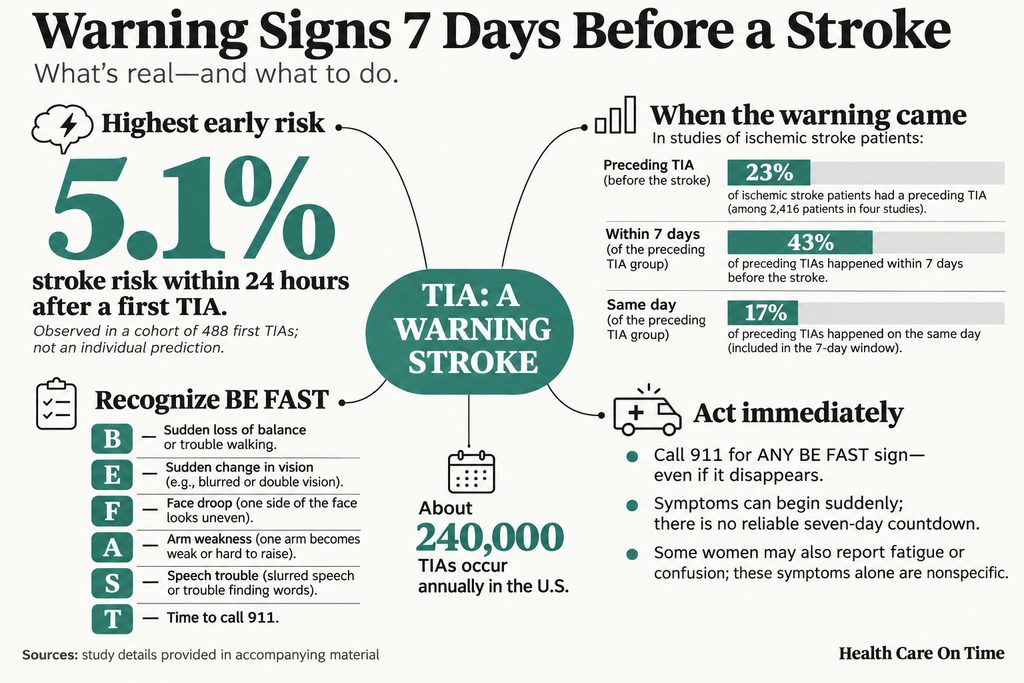
Quick answer: Yes, warning signs can appear in the days before an ischemic stroke. In a large study of 2,416 stroke patients, 23% had a mini-stroke (TIA) first, and 43% of those TIAs happened in the 7 days before the stroke. The warning is rarely vague tiredness; it’s a sudden face droop, arm or leg weakness, speech trouble, vision loss, or loss of balance that clears within minutes. Call 911 anyway.
Can a stroke really warn you a week ahead?
For a minority of people, yes. The week-ahead idea comes from an Oxford analysis that pooled stroke patients from two population studies and two large clinical trials and asked everyone who’d had an ischemic stroke (the kind caused by a blocked artery) whether a brief, stroke-like spell had come first, and when.
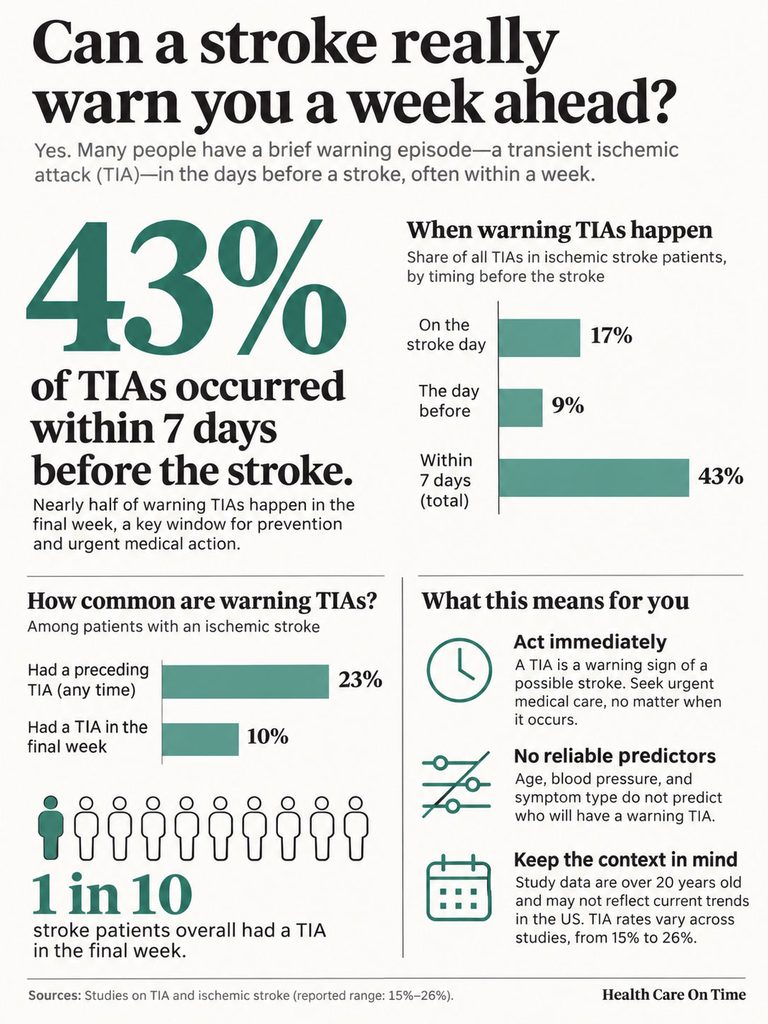
Of 2,416 patients with ischemic stroke, 549 (23%) reported a preceding TIA. The timing barely changed from one data set to the next. Among those warning episodes, 17% happened on the day of the stroke, 9% on the day before, and 43% at some point during the 7 days before the stroke. Peter Rothwell and Charles Warlow published the work in Neurology in 2005, and they concluded that the time window for preventing these strokes is very short.
Nothing in the data predicted who would get a warning right before the stroke. Age, blood pressure and the type of symptom didn’t separate people who could safely wait from people who needed help that hour, so any TIA has to be handled as if it might be the one that comes days before a stroke.
The study has limits worth knowing. The patients were British, the data are more than 20 years old, and they were collected before fast-track TIA clinics existed, so the exact percentages may differ in a US emergency room in the 2020s, even though American guidance still rests on the same basic finding that danger clusters in the hours and days after a warning.
What the 43% figure really means
Viral posts often turn this research into “43% of stroke patients had warning signs in the week before.” That isn’t what the numbers say. The 43% applies only to the 549 people who had a TIA. Do the arithmetic and roughly 236 of the 2,416 patients had a TIA in the final week, which is about 1 in 10 stroke patients overall.
Put another way, about three out of four people in that study had no TIA they could recall before their stroke.
So a warning is worth acting on when it comes, and its absence proves nothing; feeling fine this week says very little about next week.
The timing inside that week also matters more than the headline. Seven days marks the far end of the window. The biggest single slices were the day of the stroke and the day before, which means a person who notices a brief spell on Tuesday and plans to “see how it goes” until the weekend is waiting through the very hours when the risk is highest.
How often a TIA comes first also depends on who is counted. Across the four Oxford groups the share ran from 15% to 26%, and the American Stroke Association’s estimate of about 15% of strokes sits at the low end of that range.
The warning that counts: a TIA, or mini-stroke
During a TIA, blood flow to part of the brain is blocked for a short time and then restored before permanent damage sets in. The symptoms match a stroke’s. They usually start suddenly and fade within an hour, though they can last up to 24 hours.
Your hand goes numb while you’re making coffee, your words come out scrambled for two minutes, and then everything is normal again. Plenty of people decide they were tired or dehydrated or “just had a weird moment,” and many ignore TIAs because the symptoms go away.
Take a 64-year-old man on blood pressure pills whose right hand won’t hold his fork at breakfast, while his wife notices his smile looks lopsided. Ten minutes later both problems are gone. He wants to finish eating and bring it up at his checkup next month, and every number in this article argues for calling 911 from the breakfast table instead. If he does call, the morning will probably bring a head scan, scans of the arteries in his neck, a heart rhythm check, blood work, and a decision about starting a blood thinner that same day, while the risk is still at its peak.
Doctors can’t tell a TIA from a stroke while it’s happening, and the symptoms alone can’t settle it afterward. So NINDS, the federal neurology institute, advises calling an ambulance instead of driving, and to be evaluated ideally within an hour of the first symptom.
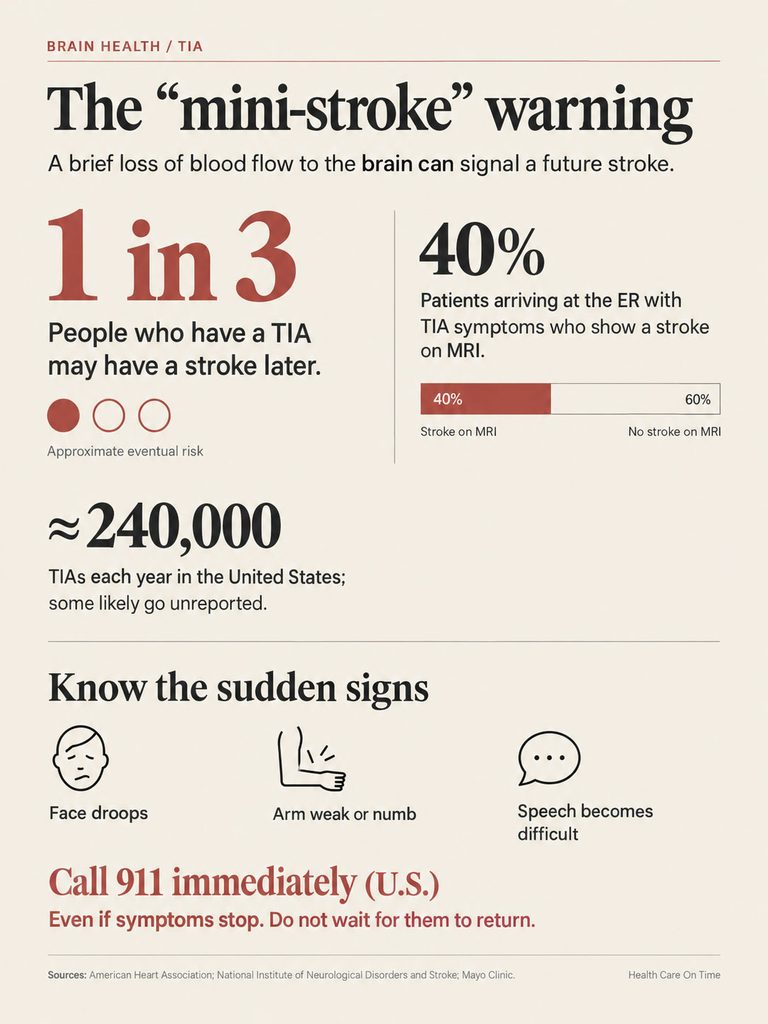
TIAs are common. About 240,000 people in the United States have a TIA every year, likely more, since many spells pass without anyone reporting them. Over the long run, about one-third of people who have a TIA will go on to have a severe stroke.
The word “mini” can make the event sound minor, yet about 40% of emergency room patients who arrive with TIA-type symptoms turn out to have a small stroke on MRI.
Age raises the risk, but 38% of people hospitalized for stroke in 2014 were younger than 65, and a 45-year-old with a brief spell of slurred speech needs the same urgent check as a 75-year-old.
Come-and-go symptoms that need 911
The B.E. F.A.S.T. check stands for Balance, Eyes, Face, Arms, Speech and Time. CDC uses all six letters; the American Stroke Association uses the shorter F.A.S.T. and lists balance and vision separately. On one rule they match exactly: call 911 even if the symptoms go away.
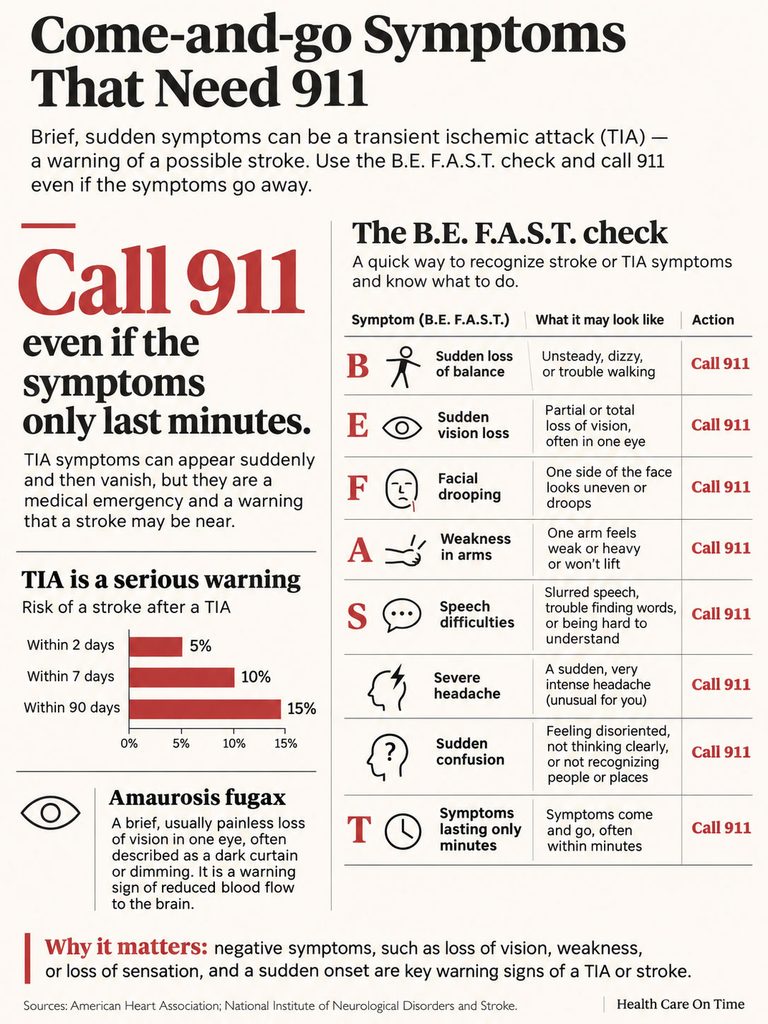
Any of these can appear during a TIA and then vanish, sometimes before anyone else in the room notices.
| Symptom that may come and go | What it can feel like | BE FAST letter | What to do |
| Sudden loss of balance or dizziness | Room tilts, you stagger, you can’t walk a straight line or you feel off-balance out of nowhere | B (Balance) | Call 911 now, even if it passes |
| Sudden vision loss or double vision | A shade drops over one eye, part of your view goes dark, or you see two of everything | E (Eyes) | Call 911 now, even if vision returns |
| One side of the face droops or goes numb | A crooked smile, a lip that won’t move, or numbness on one cheek | F (Face) | Call 911 now; ask the person to smile |
| Weakness or numbness in one arm or leg | A hand drops a cup, an arm drifts down, a leg drags or feels “asleep” on one side | A (Arms) | Call 911 now; ask the person to raise both arms |
| Trouble speaking or understanding | Slurred words, wrong words, or other people’s speech suddenly makes no sense | S (Speech) | Call 911 now; ask the person to repeat a simple phrase |
| Sudden severe headache with no known cause | The worst headache of your life, or a headache unlike any you’ve had | Not a BE FAST letter (on CDC’s symptom list) | Call 911, especially if any other symptom appears with it |
| Sudden confusion | Not knowing where you are, losing track mid-sentence, or acting unlike yourself | Not a BE FAST letter (on CDC’s symptom list) | Call 911 now |
| Any of the above, gone within minutes | You feel completely normal 5 or 10 minutes later | T (Time) | Still call 911 and write down when it started |
These differ from everyday aches in how they start, often over seconds, and in usually sticking to one side of the body. Many are also “negative” symptoms: something stops working, like strength, sight or speech, instead of something extra appearing.
Dizziness is the hardest one to judge, since so many harmless things bring it on. A stroke-type dizzy spell is sudden and usually comes with something else, such as trouble walking, double vision, slurred speech, or one side that feels weak or clumsy. Lightheadedness when you stand up too fast is a different problem, and so is spinning that a doctor has already diagnosed and that feels exactly like your usual episodes. Those belong with a regular doctor visit and standard vertigo diagnosis and treatment rather than an ambulance. New, sudden dizziness with any BE FAST sign gets treated as a stroke until a doctor rules it out.
Less common warning signs include fainting or seizure and sudden nausea or vomiting that isn’t caused by a viral illness. On their own they’re hard to read, and they carry the most weight when one of the classic signs shows up too.
The vision clue people shrug off
A brief, painless loss of sight in one eye is called amaurosis fugax. It often feels like a curtain falling or being drawn across the eye, and it usually clears in seconds to minutes.
Because it doesn’t hurt and goes away fast, people tend to book an eye appointment for next week, or forget about it. It can be a TIA, often from a clot or a bit of plaque traveling up from a narrowed neck artery, and any sudden loss of vision counts as a medical emergency, even when sight comes back.
How fast the risk rises after a warning
Risk is highest in the first 24 hours after a TIA and stays raised for the rest of that week. A later Oxford study followed 488 people after a first TIA and found a stroke risk of 1.2% at 6 hours, 2.1% at 12 hours and 5.1% at 24 hours. Of all the strokes in the 30 days after a first TIA, 42% happened within the first day.
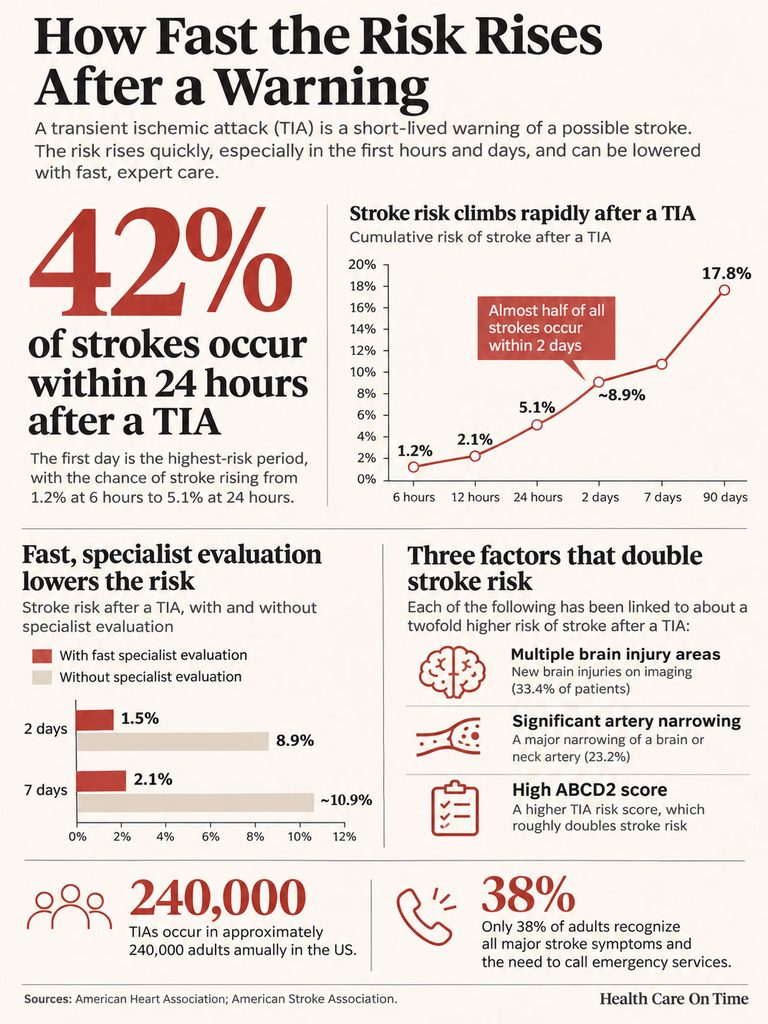
Over 90 days, the stroke risk after a TIA can reach 17.8%, with almost half of those strokes in the first 2 days, according to the American Heart Association’s 2023 scientific statement on TIA care in the emergency department.
Fast care seems to change those odds. An international registry in the New England Journal of Medicine enrolled 4,789 people at clinics set up for urgent TIA evaluation, where 78.4% saw a stroke specialist within 24 hours, and the stroke risk was 1.5% at 2 days, 2.1% at 7 days, 2.8% at 30 days, 3.7% at 90 days and 5.1% at 1 year. Older studies from 1997 to 2003 had estimated a 12% to 20% risk of stroke or acute coronary syndrome in the first 3 months.
| Finding | Figure | Study or source |
| Stroke patients who had a TIA first | 549 of 2,416 (23%) | Rothwell and Warlow, Neurology, 2005 |
| Of those TIAs, share in the 7 days before the stroke | 43% (17% same day, 9% day before) | Rothwell and Warlow, Neurology, 2005 |
| Stroke patients with a new or changed headache in the prior week | 81 of 550 (14.7%) vs 1 of 192 controls | Lebedeva et al., Journal of Headache and Pain, 2020 |
| Stroke risk in the first 24 hours after a first TIA | 5.1% (1.2% by 6 hours, 2.1% by 12 hours) | Chandratheva et al., Neurology, 2009 |
| Share of 30-day strokes that strike in the first 24 hours | 42% | Chandratheva et al., Neurology, 2009 |
| 90-day stroke risk after a TIA | Up to 17.8%, almost half within 2 days | AHA scientific statement, Stroke, 2023 |
| Stroke risk with fast specialist care | 1.5% at 2 days, 2.1% at 7 days, 3.7% at 90 days | Amarenco et al., NEJM, 2016 |
| TIAs in the US each year | About 240,000 | AHA scientific statement, 2023 |
| Adults who knew all major stroke symptoms and to call 911 | 38% | CDC Stroke Facts |
A registry isn’t a randomized trial, so it can’t prove speed alone explains the lower numbers. It does fit the rest of the evidence, though: the risk is front-loaded, and people seen quickly can start treatment before a stroke arrives.
Who is most likely to have a stroke after a warning
Some TIAs carry more risk than others. In that registry, three findings each more than doubled the chance of stroke over the next year: more than one fresh area of brain injury on imaging, plaque narrowing a large artery such as the carotid in the neck, and an ABCD2 risk score of 6 or 7 out of 7. A third of patients (33.4%) already had a new area of brain injury on their scans, 23.2% had at least one artery narrowed by 50% or more, and 10.4% had atrial fibrillation.
Risk also runs higher with heart and blood vessel risk factors, obstructive sleep apnea, peripheral artery disease, atrial fibrillation, coronary artery disease or a prior stroke. None of these can be checked from your kitchen, which is the practical case for a hospital that can image the brain and neck arteries the same day.
Headaches in the week before a stroke
A sentinel headache is either a brand-new kind of headache or a familiar one that suddenly changes: worse, longer, more frequent, or no longer touched by the usual pain reliever. It’s well described before brain bleeds, and a 2020 study found it before clot-type strokes too, which make up about 87% of all strokes in the United States.
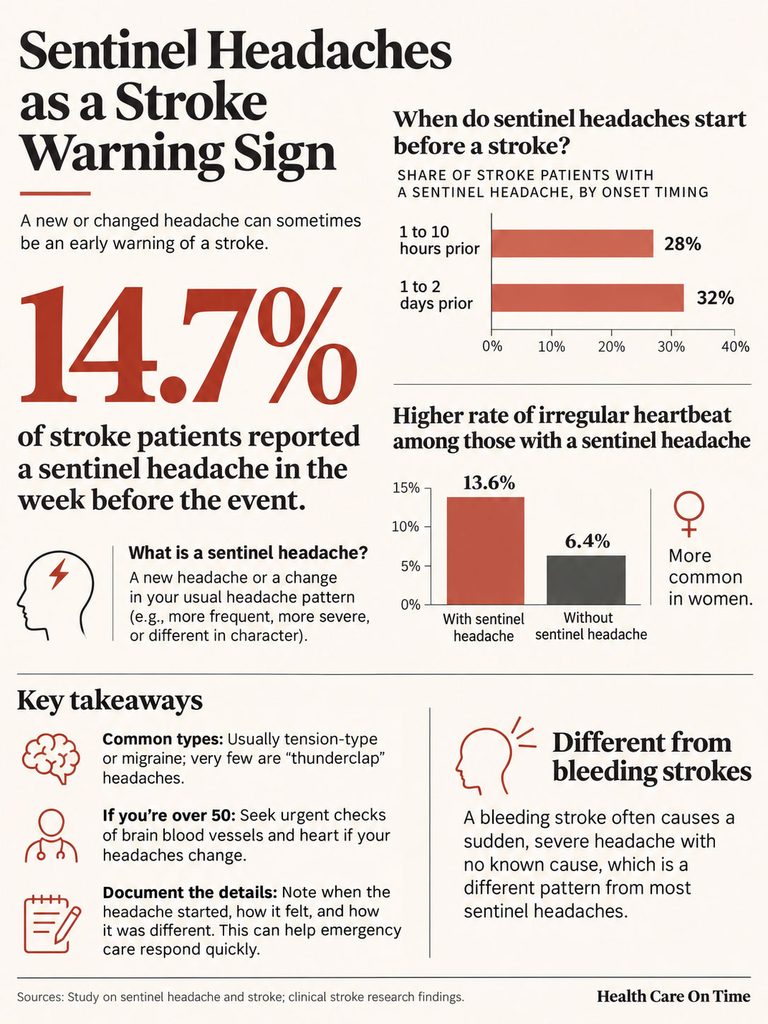
In that study, neurologists in Yekaterinburg, Russia, interviewed 550 people soon after a first ischemic stroke along with 192 emergency room patients who hadn’t had one, and 81 of the stroke patients (14.7%) had a sentinel headache in the week before, against a single person in the comparison group.
Most of these headaches came late. About 28% started 1 to 10 hours before the stroke and 32% started 1 to 2 days before, with the rest spread over days 3 to 7. Most felt like tension-type or migraine headaches; only 2 were the explosive “thunderclap” kind. People with a sentinel headache more often had episodes of irregular heartbeat in the week before (13.6% vs 6.4%), more often had a migraine history, and were more often women.
For anyone over 50 with a new or changed severe headache, the researchers suggest urgent checks of the brain’s blood vessels and the heart. Their study came from one hospital, excluded most of the patients it screened, and hasn’t been repeated in a US population, so a changed headache by itself doesn’t prove a stroke is coming. Paired with any BE FAST sign, though, it needs 911.
In practice, “changed” can look like a person who gets occasional mild headaches suddenly having one that won’t let up for two days, or a lifelong migraine sufferer whose usual medicine stops working. Writing down when the headache started, how it differs from usual and whether anything else came with it (blurred vision, numbness, clumsiness) gives the emergency team useful detail.
Bleeding strokes follow a different pattern. They don’t usually produce the come-and-go TIA picture, and their classic warning is a sudden, severe headache with no known cause, which is on CDC’s symptom list in its own right.
Viral “week before” and “month before” lists, checked
Social media lists of “signs your body gives a month before a stroke” mix a few genuine warnings with things no stroke study backs. Constant tiredness, hiccups, feeling “foggy,” sleeping more than usual and general aches show up often. Some of those come from lists of stroke symptoms in women, where they describe what can happen suddenly during a stroke, not weeks ahead.
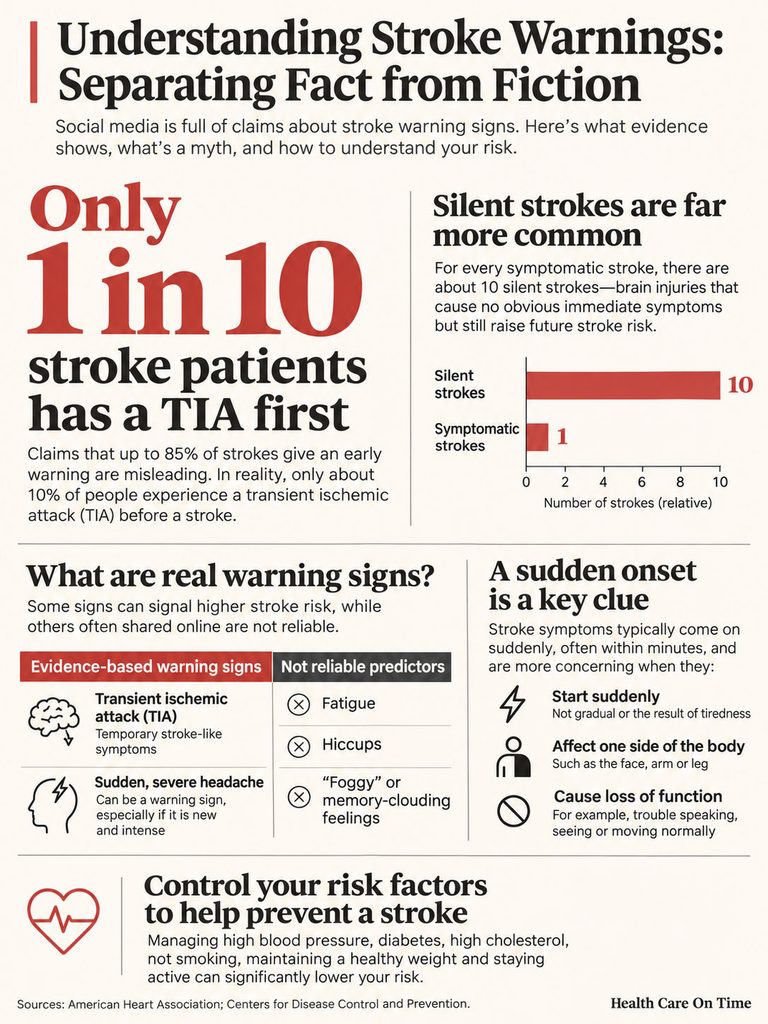
Every official symptom list leans on the word sudden. None names a symptom that predicts a stroke a month out. Research supports two kinds of warning in the week before a stroke: a TIA and, less certainly, a new or changed headache. Weeks of fatigue can point to plenty of conditions worth a regular doctor visit, including anemia, thyroid trouble, sleep apnea or depression, but fatigue alone isn’t a stroke warning.
Claims that “up to 85%” or “nearly half” of strokes give early warning don’t match the Oxford numbers above, where only about 1 in 10 patients had a TIA in the final week.
When a symptom on one of these lists worries you, three plain questions settle most cases. Did it start suddenly, over seconds or minutes? Is it on one side of the body, or in one eye? Did something stop working, like your grip, your words or your balance? A yes to any of them points toward an emergency call. A no to all three, with symptoms that built slowly over weeks, points toward a regular appointment, where a doctor can look for the many ordinary causes of feeling run down.
Other strokes leave no clear symptom at all. There are thought to be about 10 silent strokes for every stroke with obvious symptoms, and about one-fourth of people over 80 have at least one area of silent brain damage, usually found on a scan done for another reason. You can’t feel those coming, so the only defense is controlling the risk factors behind them.
Stroke warning signs in women
Women get the same core signs as men: a drooping face, a weak arm, trouble speaking, and vision or balance problems. They’re also more likely to have symptoms that don’t point clearly at the brain, such as general weakness, disorientation or memory trouble, fatigue, nausea or vomiting, and hiccups, chest pain, shortness of breath or a racing heartbeat. Those are easy to brush off, and the delay costs treatment time.
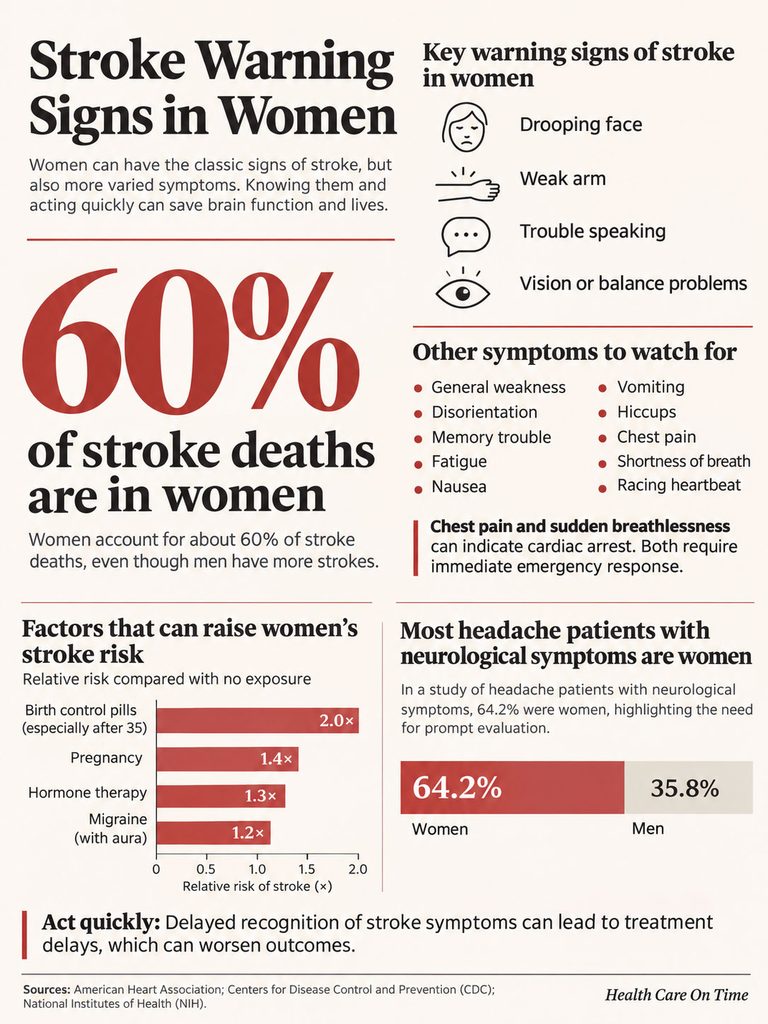
Chest pain and sudden breathlessness can also be early signs of cardiac arrest in women, and there’s no need to work out in the moment whether the heart or the brain is behind them, because both get the same 911 call.
Men have more strokes, but women account for about 6 in 10 stroke deaths. Birth control pills can nearly double stroke risk, especially after 35, and pregnancy, hormone therapy and migraine raise it as well. Migraine with aura adds a complication of its own, because a visual aura can look like a TIA.
In the headache study, women made up 64.2% of the sentinel headache group, compared with 42.6% of stroke patients without one. It’s a single study, but it supports getting a woman with a new or changed headache and any other neurological symptom checked fast.
Symptoms went away. Do you still call 911?
Yes, for any BE FAST sign, whether it’s still happening or already gone. Two other rules trip people up. Don’t drive to the hospital yourself, and don’t let a relative drive you either; paramedics can start assessment and treatment on the way and take you to a stroke center. Then check the clock and write down when the symptoms began, because doctors use that time to decide which treatments are safe.
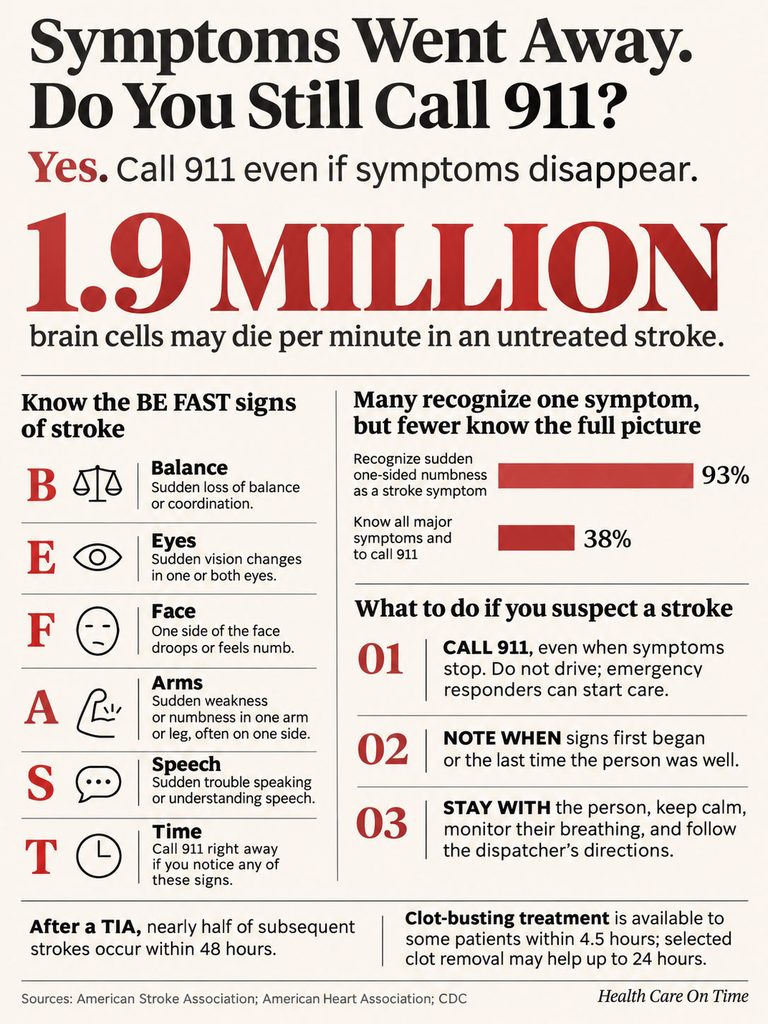
The most effective treatments are generally available only if a stroke is recognized and diagnosed within 3 hours of the first symptom. The clot-dissolving drug tPA must be given within four and a half hours of stroke onset, and a procedure to pull the clot out can be used in carefully selected patients up to 24 hours after symptoms start. On average, 1.9 million brain cells die every minute a stroke goes untreated, which is why paramedics move so fast.
People who reach the emergency room within 3 hours of their first symptoms often have less disability three months later than people who wait. Yet in survey data, 93% of people recognized sudden numbness on one side as a stroke symptom while only 38% knew all the major symptoms and knew to call 911, a gap that matters most for the quieter signs: vision loss in one eye, sudden confusion, or a balance problem that seems to fix itself.
| Situation | Do this | Why |
| Any BE FAST sign happening right now | Call 911; don’t drive; check the time | Clot drugs work only within hours; paramedics can start care on the way |
| Symptoms lasted a few minutes and are gone | Call 911 anyway | About half of 90-day strokes after a TIA happen within 2 days |
| A brief spell yesterday or 2 to 3 days ago that you never reported | Go to the ER today, or call 911 if symptoms return | Risk stays high through the first week; 43% of pre-stroke TIAs fell in the final 7 days |
| Brief painless vision loss in one eye (“curtain”) | Treat as an emergency, even if sight is back | It can be a TIA from a narrowed neck artery |
| New “worst ever” headache, or your usual headache suddenly changed | Seek urgent care; call 911 if any BE FAST sign appears with it | 14.7% of stroke patients in one study had a sentinel headache in the prior week |
| Visual aura exactly like your usual migraine, no weakness or speech change | Call your doctor; call 911 if it’s new, different or comes with other symptoms | Migraine can mimic stroke, but only a doctor can sort it out |
| Person with diabetes who is shaky, sweaty and confused | Check blood sugar if you can and follow the low-sugar plan; call 911 if symptoms don’t clear or BE FAST signs appear | Low blood sugar is a common stroke mimic |
| Weeks of tiredness or “brain fog” with no sudden symptom | Book a regular doctor visit | Not a recognized stroke warning; many other causes |
When the dispatcher answers, say plainly that you think it’s a stroke, give the time the symptoms started (or the last time the person was seen normal), and mention any blood thinner. If you’re alone and the symptoms are yours, call first and handle everything else second.
While you wait for the ambulance, open the front door, gather a list of medicines (especially blood thinners), and keep the person sitting or lying down so they don’t fall.
Don’t let them “sleep it off.”
If the symptoms fade before help arrives, keep the call going anyway and let the paramedics check, because a spell that looks finished can return within hours as a stroke that a scan can see.
What doctors check after a warning sign
A good TIA workup in the emergency room usually starts with a non-contrast CT scan of the head to rule out bleeding, then a CT angiogram of the head and neck to look for narrowed arteries, which nearly half of people with TIA symptoms have. A brain MRI should ideally be done within 24 hours, and an electrocardiogram screens for atrial fibrillation, which turns up in about 7% of people with a TIA or stroke. Blood work checks for infection, diabetes and high cholesterol. A neurologist should see the patient within 48 hours, and no later than a week.
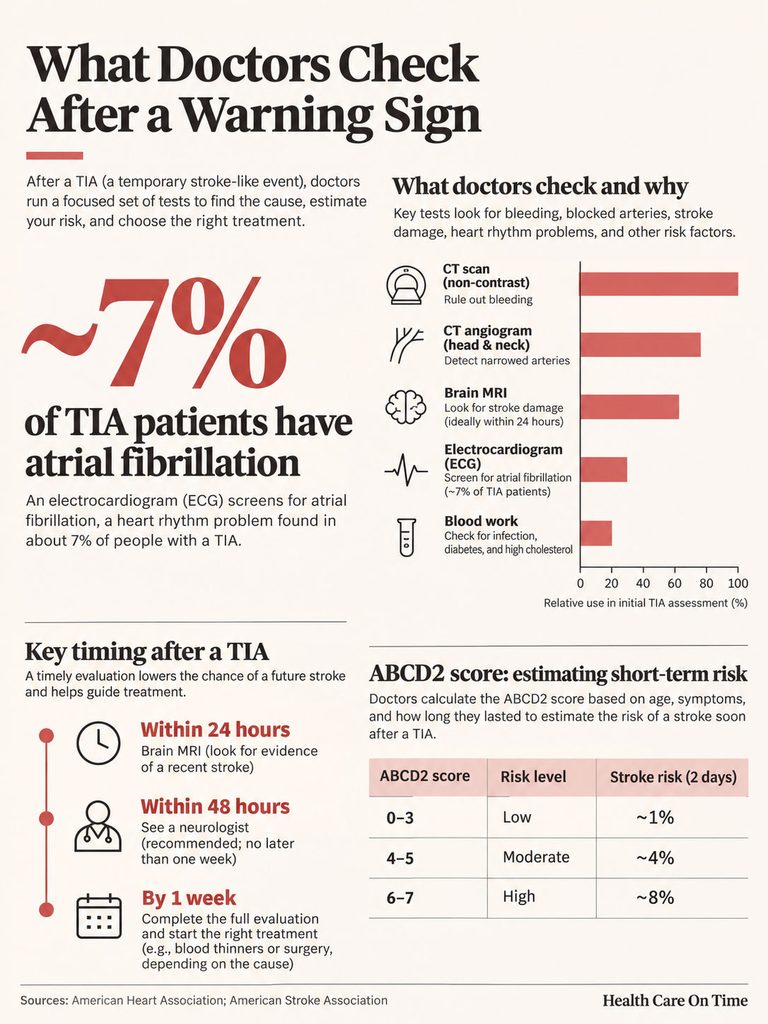
Many hospitals also calculate the ABCD2 score from age, blood pressure, the kind of symptoms, how long they lasted and diabetes. From there, treatment depends on the cause: blood thinners to prevent clots, surgery when a neck artery is blocked, and control of blood pressure and other risk factors.
Sometimes the cause is something else entirely. Seizures, migraine, low blood sugar and functional neurological disorder are among the stroke mimics that account for about 1 in 4 stroke admissions. Mimic symptoms may spread to other body parts or get stronger, while TIA symptoms fade, but telling them apart takes a hospital. If a brain scan shows no bleeding, being treated for a stroke that turns out to be a mimic is considered very safe, so going in costs little even if the final answer is migraine.
Not everyone with a TIA is admitted. People judged lower risk may go home with a plan, and that plan should include a named follow-up with a neurologist within days and clear instructions to call 911 if any symptom comes back. Leaving without either is a reason to ask before walking out the door.
Questions worth asking in the ER
- Was this a TIA, a small stroke, or something that only looks like one?
- Did the MRI show any damage, and do we need one today if it wasn’t done?
- Are the neck arteries narrowed, and does that need surgery or a stent?
- Is a blood thinner needed now, and which one?
- Was the heart rhythm checked for atrial fibrillation, and for how long?
- When is the neurology follow-up, and what should make us come back sooner?
Lowering the odds after a TIA
With more than 795,000 strokes in the United States each year, about one every 40 seconds, the weeks after a TIA are the best chance most people will get to find and fix the cause. High blood pressure is a leading cause of stroke and often has no symptoms, so a TIA usually means more frequent readings and a clear plan. Some readings are high enough to need the ER the same day, and it helps to know which blood pressure readings mean an ER trip before one shows up on the cuff.
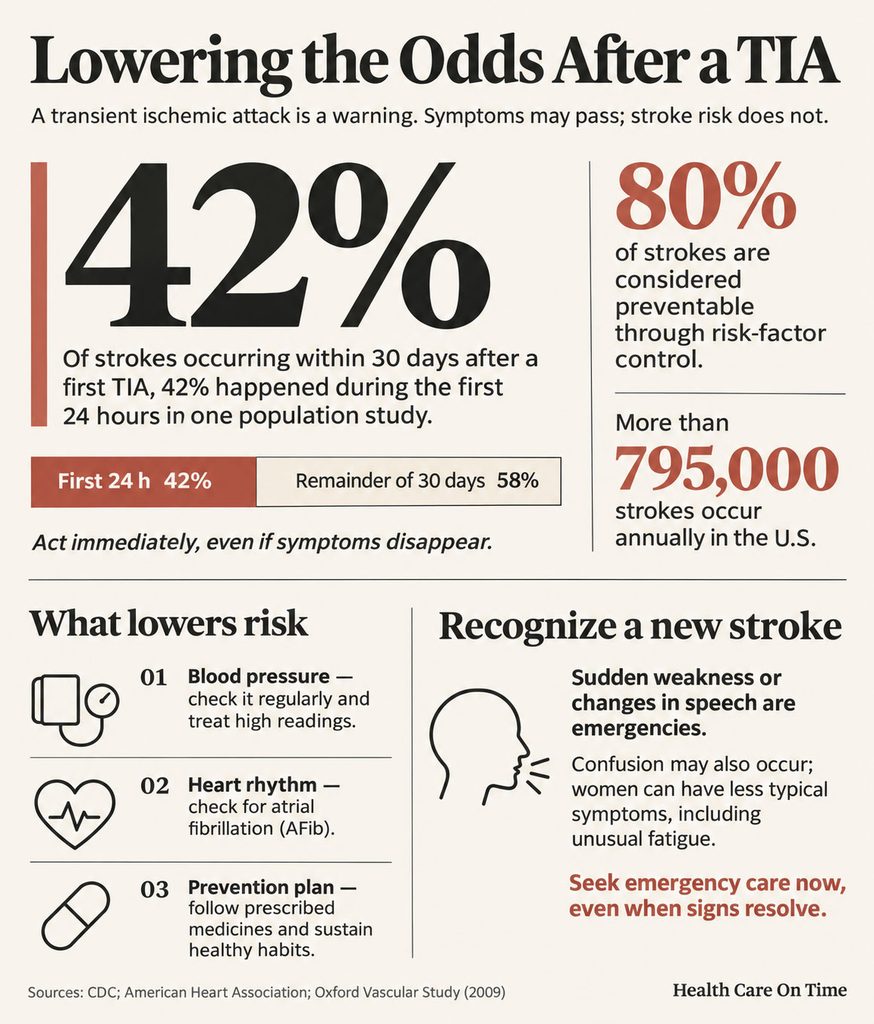
Heart rhythm is the next thing doctors check. With atrial fibrillation (AFib), you’re up to five times more likely to have a stroke, and it can cause no symptoms at all. Cholesterol, diabetes, smoking, weight and alcohol are the other usual targets. Diet counts too, and a Mediterranean-style eating pattern has been linked to lower stroke risk in women.
An estimated 80% of strokes are preventable, and most of that prevention is routine work: taking the prescribed blood thinner every day, getting more exercise, losing weight if needed, quitting smoking and keeping blood pressure in range. A cholesterol-lowering statin may come up at the follow-up visit as well.
After a stroke, the warning signs of a second one are the same, but leftover weakness or speech changes can hide new symptoms. Families should watch for anything new, sudden or clearly worse than the person’s usual baseline. Recovery brings its own work too, including rebuilding communication skills after a stroke for people whose speech was affected.
Frequently Asked Questions
What strange behavior happens before a stroke?
Sudden confusion, disorientation, memory lapses or speech that doesn’t make sense can appear during a stroke or TIA. Women in particular may show general weakness or confusion rather than one-sided weakness. Any sudden change in how someone acts, especially with trouble walking, seeing or speaking, needs a 911 call, even if it clears quickly.
Can you feel unwell days before a stroke?
Some people do, but feeling “unwell” is too vague to count as a warning. The best-studied early signs are a TIA, with stroke symptoms that come and go, and a new or changed headache in the week before. People with those headaches were also more likely to have had episodes of irregular heartbeat in the prior week. Plain tiredness isn’t a recognized stroke warning, though it’s worth a regular doctor visit.
What are 80% of strokes caused by?
A blocked artery. About 87% of strokes are ischemic, meaning blood flow to the brain is cut off. The 80% figure people remember usually refers to prevention: an estimated 80% of strokes are preventable.
What are the early signs that a stroke is coming?
The clearest one is a TIA: sudden face droop, arm or leg weakness, speech trouble, vision loss or loss of balance that goes away within minutes or hours. Most TIAs that come before a stroke happen in the final week, many on the same day or the day before. A new or suddenly changed severe headache is a less certain warning. Either one calls for urgent care.
Should you go to the ER if stroke symptoms went away?
Call 911. A TIA can come shortly before a full stroke, so symptoms that disappear still need the same emergency response.
How long after a mini-stroke does a stroke usually happen?
Often within days. In an Oxford study, 42% of the strokes that occurred in the month after a first TIA happened within 24 hours, and across 90 days the risk can reach 17.8%, with almost half of those strokes in the first 2 days. Fast evaluation and treatment cut that risk, which is why the first hours matter most.
Do women get different stroke warning signs?
The main signs are the same in women and men. Women may also have general weakness, confusion or memory trouble, fatigue, nausea, vomiting, hiccups, chest pain, shortness of breath or a racing heartbeat. These count when they’re sudden and unexplained.
Can anxiety or stress cause stroke-like symptoms?
Sometimes. Psychiatric conditions and functional neurological disorder are among the stroke mimics, along with seizures, migraine and low blood sugar, and mimics together make up about 1 in 4 stroke admissions. There’s no way to tell at home, so sudden symptoms still mean calling 911 and letting the hospital decide.
Can a doctor tell later that a TIA happened?
Often, but not always. Doctors mostly diagnose a TIA from the story of what happened and an exam, because symptoms are usually gone by the time the patient arrives. An MRI helps: about 40% of people with TIA-type symptoms show a small stroke on the scan. Artery imaging and a heart rhythm check then look for the cause, even when the brain scan itself is clear.
Can a stroke happen with no warning at all?
That’s the usual pattern. About three in four stroke patients in the Oxford pooled data had no TIA beforehand, and silent strokes outnumber strokes with symptoms. Controlling blood pressure, treating atrial fibrillation and not smoking protect you whether or not a warning ever comes.
Medical disclaimer: This article is for general information and does not replace advice from a doctor. If you or someone near you has sudden face drooping, arm or leg weakness, trouble speaking, vision loss, loss of balance or a sudden severe headache, call 911 right away, even if the symptoms go away.
References
- Rothwell PM, Warlow CP. Timing of TIAs preceding stroke: time window for prevention is very short. Neurology. 2005. https://rdm.ox.ac.uk/publications/119341
- Centers for Disease Control and Prevention. Signs and Symptoms of Stroke. Last reviewed May 19, 2026. https://www.cdc.gov/stroke/signs-symptoms/index.html
- Centers for Disease Control and Prevention. Stroke Facts. https://www.cdc.gov/stroke/data-research/facts-stats/index.html
- Centers for Disease Control and Prevention. Risk Factors for Stroke. https://www.cdc.gov/stroke/risk-factors
- American Stroke Association. Stroke Symptoms. https://www.stroke.org/en/about-stroke/stroke-symptoms
- National Institute of Neurological Disorders and Stroke. Transient Ischemic Attack (TIA). https://www.ninds.nih.gov/node/821
- National Institute of Neurological Disorders and Stroke. Endovascular Therapy for Stroke. https://www.ninds.nih.gov/sites/default/files/documents/Endovascular_Therapy_Stroke_PDF-FINAL_081319_508C.pdf
- Chandratheva A, Mehta Z, Geraghty OC, Marquardt L, Rothwell PM. Population-based study of risk and predictors of stroke in the first few hours after a TIA. Neurology. 2009;72(22):1941-1947. https://pmc.ncbi.nlm.nih.gov/articles/PMC2690971
- Amarenco P, et al. One-year risk of stroke after transient ischemic attack or minor stroke. N Engl J Med. 2016;374(16):1533-1542. https://ora.ox.ac.uk/objects/uuid:2c2cb386-20e2-43dc-8ca6-04c64e4690be
- American Heart Association. Diagnosis, Workup, Risk Reduction of Transient Ischemic Attack in the Emergency Department Setting (scientific statement summary). 2023. https://professional.heart.org/en/science-news/diagnosis-workup-risk-reduction-of-transient-ischemic-attack-in-the-emergency-department-setting
- American Heart Association News. Stroke symptoms require emergency treatment even if they quickly disappear. January 19, 2023. https://www.heart.org/en/news/2023/01/19/stroke-symptoms-require-emergency-treatment-even-if-they-quickly-disappear-new-report-says
- American Heart Association News. When symptoms suggest a stroke, but it’s something else. February 2, 2024. https://heart.org/en/news/2024/02/02/when-symptoms-suggest-a-stroke-but-its-something-else
- Lebedeva ER, Ushenin AV, Gurary NM, Gilev DV, Olesen J. Sentinel headache as a warning symptom of ischemic stroke. J Headache Pain. 2020;21(1):70. https://pmc.ncbi.nlm.nih.gov/articles/PMC7285795
- Northwestern Medicine. Warning Signs of Stroke. https://www.nm.org/conditions-and-care-areas/neurosciences/comprehensive-stroke-centers/before-stroke/warning-signs
- Northwestern Medicine. Symptoms of Stroke in Women. https://www.nm.org/conditions-and-care-areas/neurosciences/comprehensive-stroke-centers/before-stroke/symptoms-in-women
- Cleveland Clinic. Amaurosis Fugax. https://my.clevelandclinic.org/health/diseases/amaurosis-fugax
- American Heart Association. FAQ About AFib. https://www.heart.org/-/media/Files/Health-Topics/Atrial-Fibrillation/FAQ-About-AFib.pdf