You opened the fridge, eyed last night’s leftover broccoli, and reached for your calorie tracker. Then came the question every American on a goal has typed at some point: how many calories are actually in one cup of this stuff?
Table of Contents
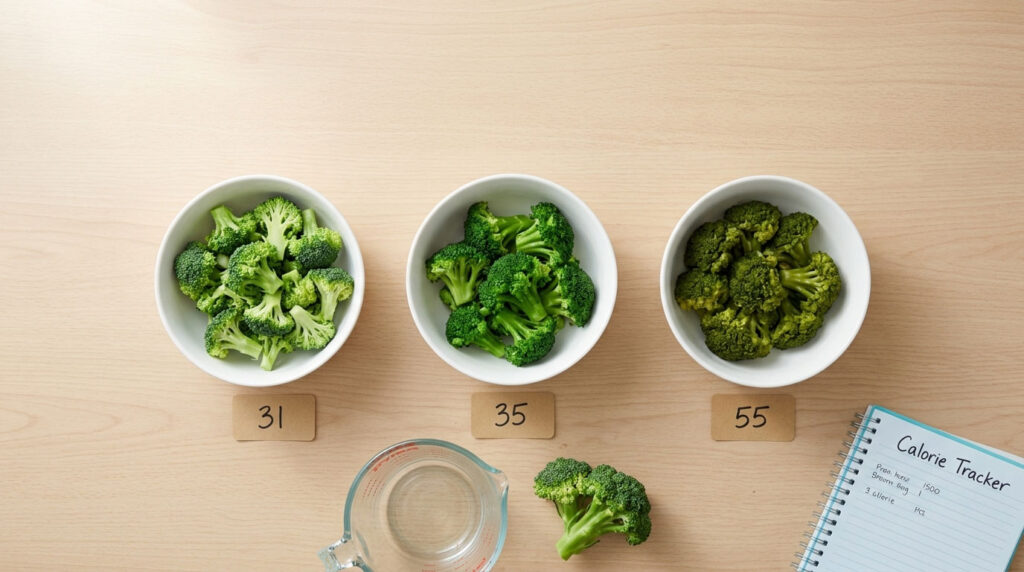
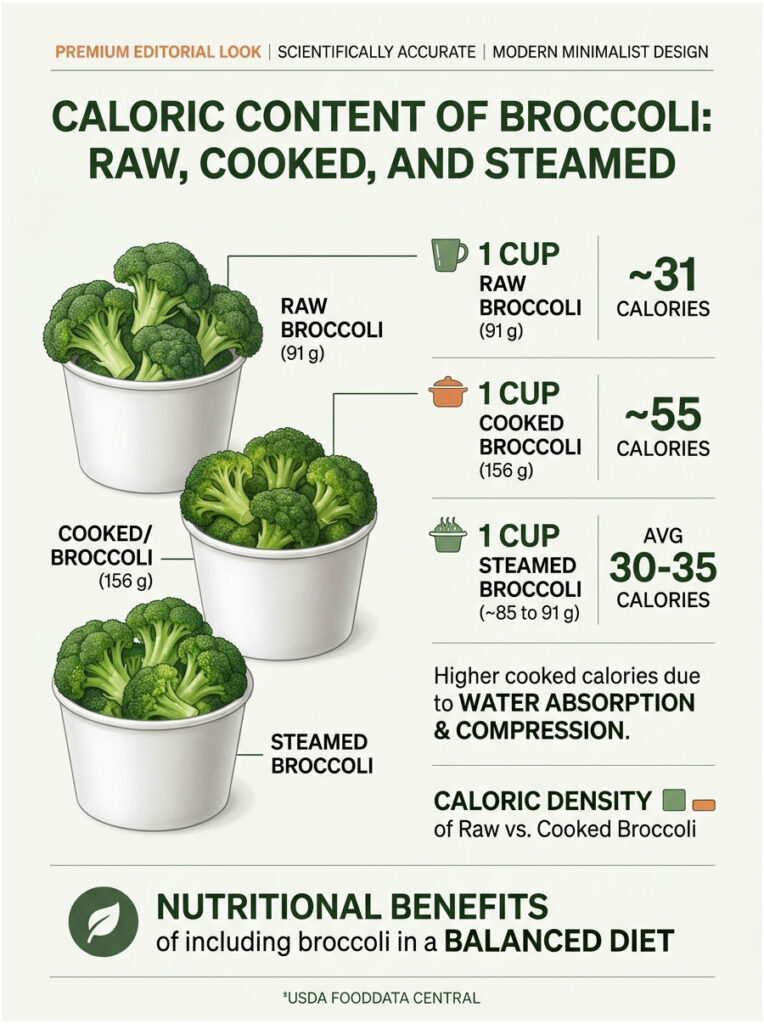
Quick Answer: A 1-cup chopped serving of raw broccoli (91 g) contains about 31 calories, per USDA FoodData Central. A 1-cup chopped serving of cooked or boiled broccoli (156 g) contains about 55 calories. A 1-cup serving of steamed broccoli florets (~85 to 91 g) averages 30 to 35 calories. The cooked number runs higher because florets compress and absorb water, packing more grams into the same cup.
At a Glance
- USDA: 31 calories raw, 55 calories cooked (boiled, drained), per 1 cup chopped.
- Cooking method matters less for calories than cup density and added oils.
- Broccoli is one of the lowest calorie-dense foods on the US grocery shelf (about 0.34 kcal per gram raw).
- One tablespoon of olive oil adds roughly 120 calories, often more than the broccoli itself.
- One cup of raw broccoli counts as one cup-equivalent of the USDA MyPlate Vegetable group.
- Only 10% of US adults meet the 2 to 3 cups daily vegetable target (CDC, 2022).
- HealthCareOnTime offers nutrition-focused lab panels and metabolic testing across the United States.
The Quick Answer: Calories in 1 Cup of Broccoli at a Glance
Here is the no-nonsense version. If you came in just to log a meal in MyFitnessPal, Cronometer, or LoseIt, these are the numbers our nutrition team uses, all sourced from USDA FoodData Central:
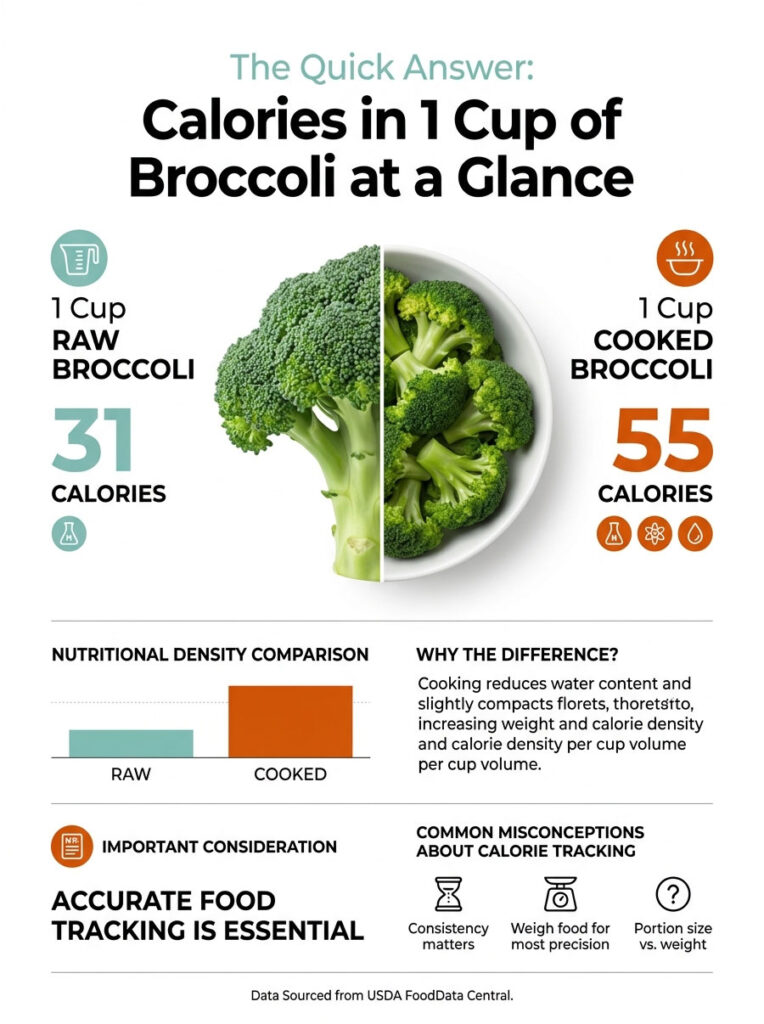
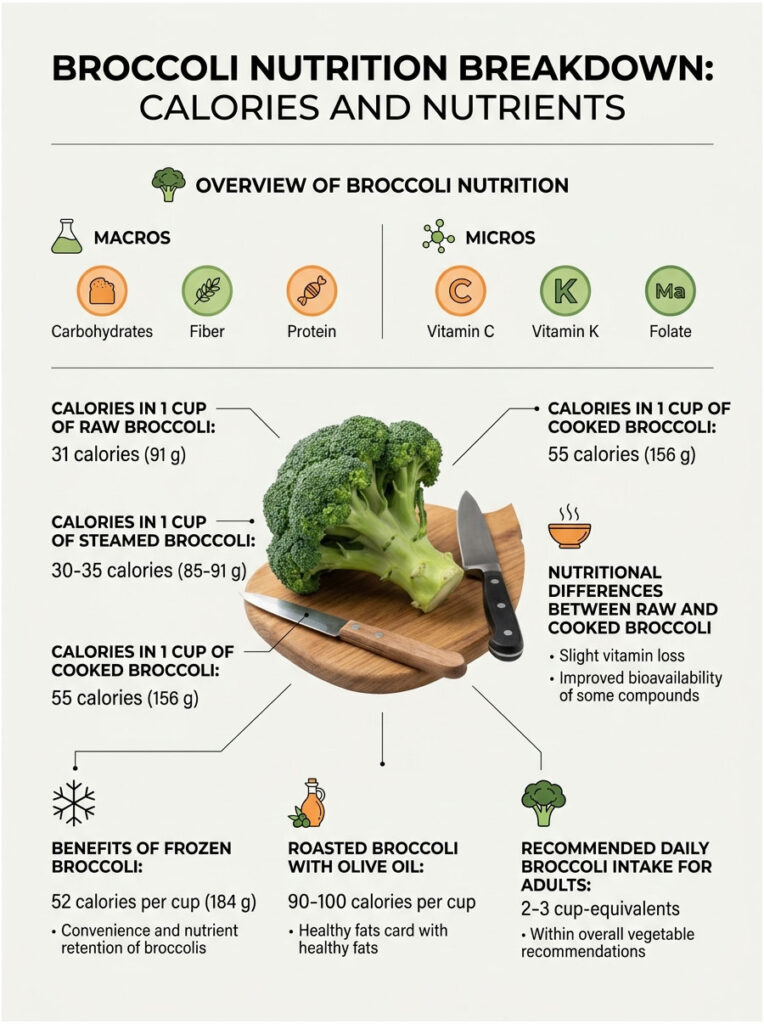
- 1 cup chopped raw broccoli (91 g): about 31 calories
- 1 cup steamed broccoli florets (85 to 91 g): about 30 to 35 calories
- 1 cup chopped cooked or boiled broccoli, drained (156 g): about 55 calories
- 1 cup frozen broccoli, cooked and drained (184 g): about 52 calories
- 1 cup roasted broccoli with 1 tsp olive oil (~150 g): about 95 calories
Notice the spread. Patients tracking calories with us are often surprised that the cup-for-cup count nearly doubles between raw and cooked. The broccoli has not changed nutritionally; the cup just holds more of it.
Why the Calorie Count Changes (Raw vs Cooked)
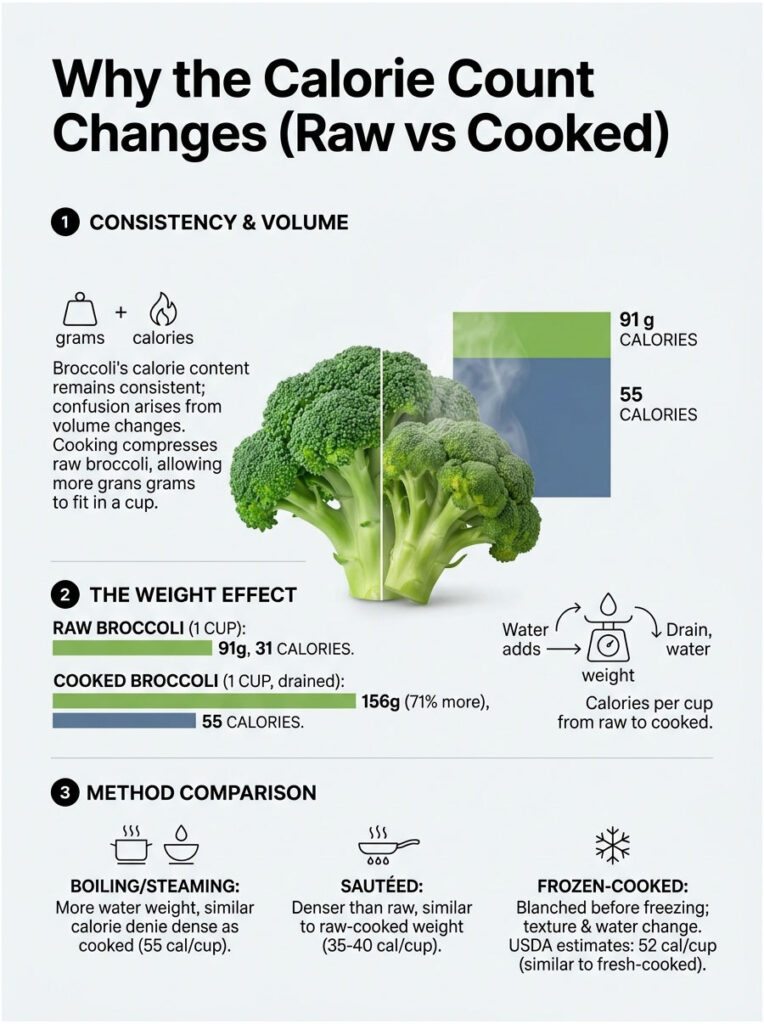
Broccoli does not gain or lose meaningful calories during cooking. What changes is how much broccoli physically fits into a one-cup measure. That single fact explains 95% of the confusion online.
Volume Compresses When Cooked
Raw broccoli florets are airy. They trap pockets of space in your measuring cup. Apply heat and the cell walls soften, the florets collapse, and you pack significantly more grams into the same volume.
USDA’s reference weight for 1 cup chopped raw broccoli is 91 g. The same cup, once cooked and drained, holds 156 g. That is roughly 71% more food, which translates almost exactly to the calorie jump from 31 to 55 calories per cup.
Water Absorption and Drainage
Boiling and steaming both add some water weight, which the broccoli holds in its cell structure. Draining helps but does not remove all of it. A “drained boiled” cup still weighs more than a raw cup but slightly less than an undrained one.
Microwaving with a splash of water behaves similarly to steaming. Sautéing in a dry pan or with minimal oil ends up closer to raw weight per cup. Our nutrition consultants point out this is why sautéed broccoli often tracks closer to 35 to 40 calories per cup, not 55.
Why Frozen Behaves Differently
Frozen broccoli is blanched (briefly boiled) before freezing. When you reheat it, the texture and water profile sit between fresh-raw and fresh-cooked.
USDA pegs 1 cup of frozen-then-cooked broccoli at about 52 calories (184 g), almost identical to fresh-cooked on a per-cup basis. The takeaway: frozen versus fresh is a freshness and texture decision, not a calorie one.
Calories in 1 Cup of Broccoli by Preparation Method
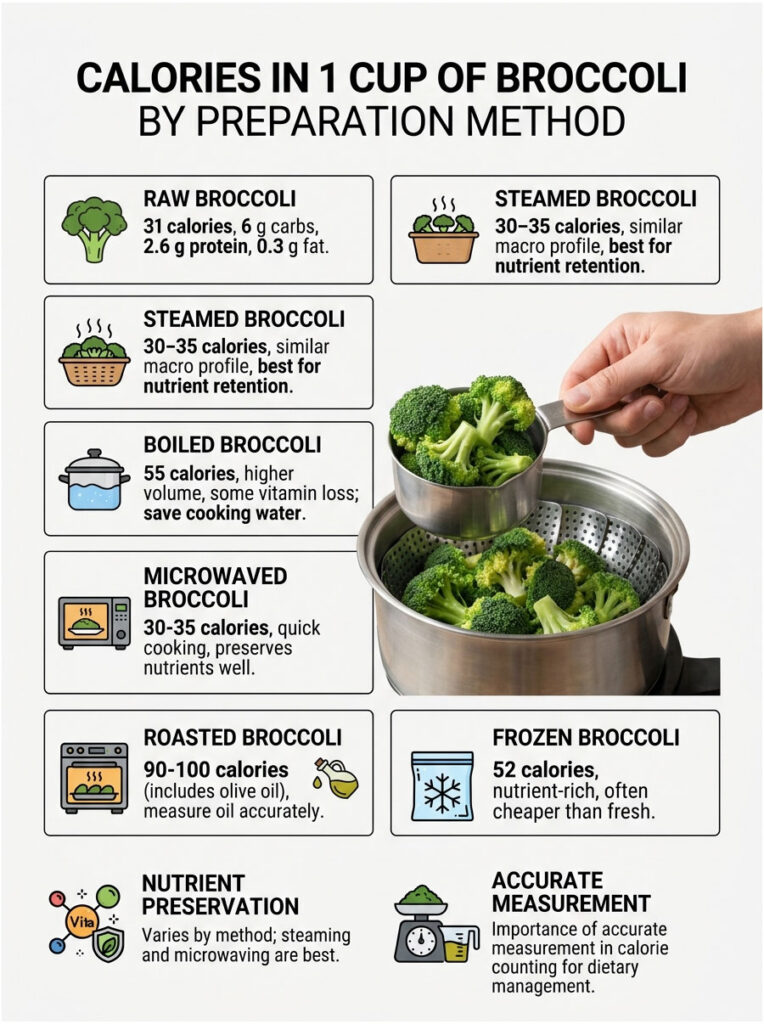
This is the section to bookmark if you cook broccoli more than one way (most US households do). Each method below uses USDA standard serving weights so the math stays consistent.
Raw Broccoli (1 Cup Chopped, 91 g)
Calories: 31. Macros: 6 g carbs (2.4 g of which is fiber), 2.6 g protein, 0.3 g fat. This is the lowest calorie option per cup because raw florets pack the least density.
Raw broccoli works for crudité plates, slaws, salads, and dipping with hummus or Greek yogurt ranch. Just rinse, chop, and serve. No oil, no compression, no calorie inflation.
Steamed Broccoli (1 Cup, ~85 to 91 g)
Calories: about 30 to 35. Macros stay almost identical to raw because steaming adds water but no fat. Vitamin C and sulforaphane retention is best with light steaming for 3 to 5 minutes.
Patients booking metabolic panels through HealthCareOnTime often ask which prep method preserves the most nutrition. Light steaming wins on both nutrient retention and calorie predictability, and is the method our nutrition team recommends most for weight-management diets.
Boiled Broccoli (1 Cup Chopped, 156 g)
Calories: 55. Macros: 11 g carbs (5.1 g fiber), 3.7 g protein, 0.6 g fat. Higher calories per cup, but you are also eating roughly 1.7 times more broccoli by weight.
Boiling does leach some water-soluble vitamins (vitamin C and folate) into the cooking water. If you want the fiber and bulk benefits without the vitamin loss, save the cooking water for soup stock or use a steam method instead.
Microwaved Broccoli (1 Cup)
Calories: about 30 to 35 per 1 cup of florets cooked with a splash of water. The microwave behaves like a quick steamer.
Research summarized by the Harvard T.H. Chan School of Public Health shows microwaving with minimal water actually preserves more nutrients than boiling because the broccoli spends less time in contact with hot water. Faster, equally low-calorie, and weeknight-friendly.
Roasted Broccoli (1 Cup with Olive Oil)
Calories: about 90 to 100 per 1 cup roasted with 1 teaspoon olive oil (40 calories from oil). Bump it to 1 tablespoon and you are at 150+ calories per cup.
This is where dieters most often miscount. The broccoli itself is still low-calorie; the fat coating doubles or triples the meal’s calorie load. Measure your oil with an actual teaspoon or tablespoon rather than free-pouring. This is the single biggest accuracy fix our nutrition consultants recommend.
Frozen-Then-Cooked Broccoli (1 Cup)
Calories: about 52 per 1 cup chopped (184 g). Frozen broccoli is picked at peak ripeness, blanched, then flash-frozen, which actually preserves more nutrients than fresh broccoli sitting in your fridge for 5 days.
For US shoppers, frozen broccoli is also typically cheaper per pound (about $1.50 to $2.50 per pound) versus fresh ($1.99 to $3.99 per pound, depending on region). Patients on a budget meal-planning track often switch to frozen with no nutritional downside.
Table 1: Calories in 1 Cup of Broccoli by Preparation Method (USDA-Sourced)
| Preparation Method | Cup Weight (g) | Calories per Cup | Carbs / Fiber / Protein |
| Raw, chopped | 91 g | 31 | 6 g / 2.4 g / 2.6 g |
| Steamed florets | 85 to 91 g | 30 to 35 | 6 g / 2.4 g / 2.6 g |
| Boiled, drained | 156 g | 55 | 11 g / 5.1 g / 3.7 g |
| Microwaved (water splash) | ~91 g | 30 to 35 | 6 g / 2.4 g / 2.6 g |
| Roasted with 1 tsp olive oil | ~150 g | 90 to 100 | 11 g / 4.5 g / 3.5 g |
| Frozen, cooked, drained | 184 g | 52 | 10 g / 5.5 g / 4.7 g |
Full USDA Nutrition Breakdown (Beyond Just Calories)
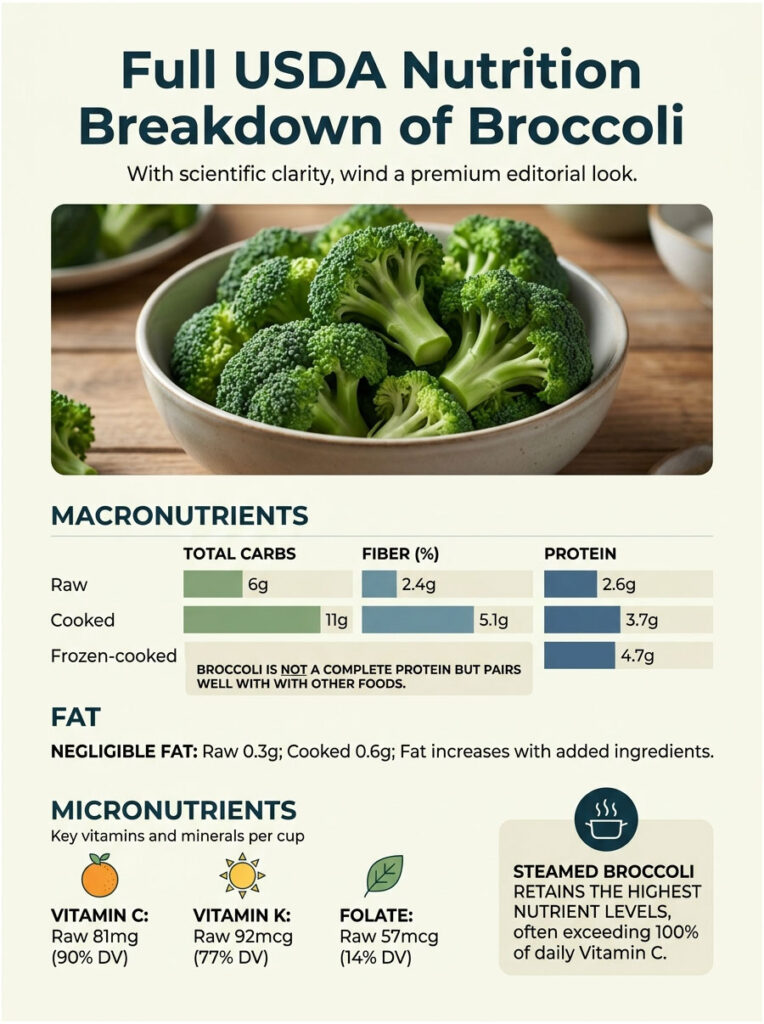
Calories tell you the energy. Macros and micros tell you the value. Here is what 1 cup of broccoli actually delivers, raw and cooked, straight from USDA FoodData Central.
Carbs and Fiber per Cup
Raw: 6 g total carbs, 2.4 g fiber. Cooked (boiled): 11 g total carbs, 5.1 g fiber. The carbs are mostly fiber and slow-release plant sugars, not the kind that spike blood sugar.
Two cups of cooked broccoli covers about a third of the Dietary Guidelines for Americans daily fiber target (28 g for women, 38 g for men under 50). For high-fiber goals, cooked beats raw on a per-cup basis.
Protein per Cup
Raw: 2.6 g. Cooked: 3.7 g. Frozen-cooked: about 4.7 g. That is more protein per calorie than most non-legume vegetables.
Broccoli is not a complete protein on its own, but it pairs well with eggs, fish, chicken, tofu, or quinoa to round out a meal.
Fat per Cup
Negligible. Raw broccoli is 0.3 g of fat per cup; cooked is 0.6 g. The fat content only changes meaningfully when you add oil, butter, or cheese.
This is why broccoli is a staple in low-fat, low-calorie, and Mediterranean-style meal plans alike.
Vitamins and Minerals (Vitamin C, Vitamin K, Folate, Potassium)
A 1-cup raw serving delivers roughly 81 mg of vitamin C (90% of the Daily Value), 92 micrograms of vitamin K (77% DV), and 57 micrograms of folate (14% DV). Cooked broccoli loses some vitamin C in boiling water but retains vitamin K and folate well.
Steamed broccoli sits at the top of the nutrient-retention chart, often delivering more than 100% of daily vitamin C in a single cup. Our nutrition consultants flag broccoli as one of the most nutrient-dense low-calorie foods on the US produce shelf.
Daily Value Percentages
Per 1 cup raw, you cover roughly:
- 90% DV vitamin C
- 77% DV vitamin K
- 14% DV folate
- 6% DV potassium
- 9% DV fiber
For 31 calories, that is one of the strongest nutrient-per-calorie ratios in the entire grocery store.
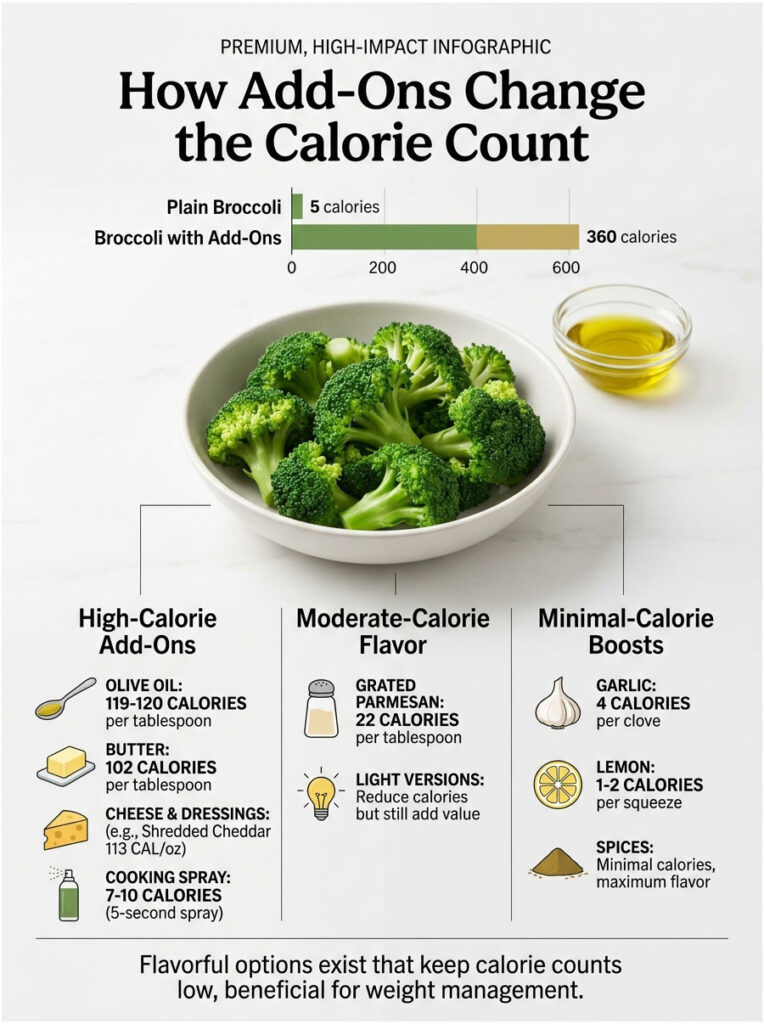
How Add-Ons Change the Calorie Count
Plain broccoli is almost free of calories. The real-world meal you eat rarely is. Here is how the most common US toppings change the math.
Olive Oil, Butter and Cooking Sprays
One tablespoon of olive oil: 119 to 120 calories. One tablespoon of butter: 102 calories. A 5-second spray of standard cooking spray: about 7 to 10 calories.
If you toss 2 cups of broccoli florets in 1 tablespoon of oil before roasting, that is roughly 60 added calories per cup before plating. Patients tracking calories with us tell us that swapping cooking spray for pour-from-the-bottle oil is what made their calorie deficit work.
Cheese, Sauces and Dressings
A 1-ounce sprinkle of shredded cheddar: 113 calories. Two tablespoons of cheese sauce: 90 to 130 calories depending on brand. Two tablespoons of ranch dressing: 130 to 145 calories.
Light versions help but don’t eliminate the load. A tablespoon of grated parmesan adds only about 22 calories with strong flavor return, which is why it shows up so often in registered-dietitian meal plans.
Garlic, Lemon, Spices and Salt
Free or near-free. A clove of fresh garlic: 4 calories. A squeeze of lemon: 1 to 2 calories. Smoked paprika, cumin, garlic powder, red pepper flakes: under 5 calories per teaspoon.
This is the no-trade-off lane. Bold flavor, almost no calorie impact. Across patients we serve who hit their weight goals with broccoli as a daily side, this is the most common flavor strategy.
Table 2: Common Broccoli Add-Ons, Typical Servings, Calories Added (US Brand-Average Data)
| Add-On | Typical Serving | Calories Added | Source |
| Olive oil | 1 tablespoon | 119 to 120 | USDA FoodData Central |
| Butter (salted) | 1 tablespoon | 102 | USDA FoodData Central |
| Cooking spray (5-sec) | ~0.25 g | 7 to 10 | FDA Nutrition Facts label |
| Shredded cheddar | 1 oz (~28 g) | 113 | USDA FoodData Central |
| Grated parmesan | 1 tablespoon | 22 | USDA FoodData Central |
| Ranch dressing | 2 tablespoons | 130 to 145 | USDA FoodData Central (brand average) |
Broccoli for Weight Loss: A Real US Plan
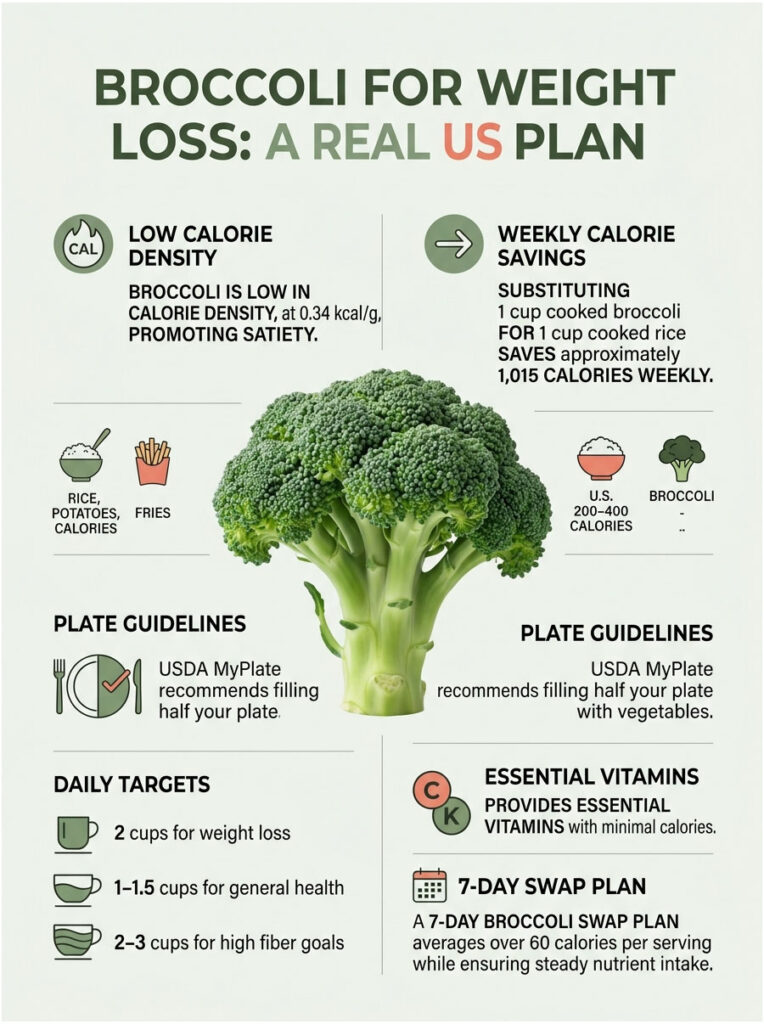
Broccoli sits near the top of every US weight-loss food list for one reason: it lets you eat a high-volume, high-fiber meal without spending many calories. That combination supports satiety, which is the single biggest predictor of whether a calorie deficit lasts.
Why Calorie Density Matters
Calorie density is calories per gram. Lower density usually means more food volume for the same energy intake, which fills you up faster. Raw broccoli runs about 0.34 kcal per gram.
For comparison: cooked white rice is 1.3 kcal/g, cheddar cheese is 4.0 kcal/g, and almonds are 5.7 kcal/g. Swap 1 cup of cooked rice (about 200 calories) for 1 cup of cooked broccoli (55 calories) at one meal a day, and you save roughly 1,015 calories per week with no portion-size sacrifice.
How Broccoli Stacks Up Against Other Common US Sides
A typical US dinner plate adds roughly 200 to 400 calories from the side dish alone. Most of that load comes from refined starches (rice, mashed potatoes, pasta) or fried sides (fries, tots).
Substitute broccoli once or twice a day and the math tilts hard in your favor. This is the practical mechanic behind the “fill half your plate with vegetables” rule that USDA MyPlate has promoted since 2011.
Daily Broccoli Targets for Different Goals
For weight loss: 2 cups of cooked broccoli daily, replacing one starchy side. About 110 calories total, plus 10 g fiber.
For general health: 1 to 1.5 cups daily, in any form. Covers most of your vitamin C and a meaningful chunk of vitamin K. For high-fiber goals: 2 to 3 cups daily, mixed prep methods, adding roughly 110 to 165 calories and 10 to 15 g fiber.
A 7-Day Broccoli Swap Plan (Calorie-Smart)
- Day 1: Steamed broccoli with lemon at lunch (35 cal).
- Day 2: Roasted with 1 tsp olive oil and garlic at dinner (95 cal).
- Day 3: Raw florets with hummus snack (60 cal total: 35 broccoli + 25 hummus).
- Day 4: Stir-fried with chicken, low sodium soy, ginger (85 cal).
- Day 5: Microwaved with parmesan dust (55 cal: 35 broccoli + 22 parm).
- Day 6: Frozen broccoli in soup or pasta dish (52 cal).
- Day 7: Riced broccoli as a rice substitute (~30 cal per cup).
Across the week, this rotation averages just over 60 calories per serving while delivering steady fiber, vitamin C, and vitamin K.
How Much Broccoli Should You Actually Eat?
The numbers are smaller than most Americans assume, but the gap between recommended and actual is huge.
USDA MyPlate Recommendation
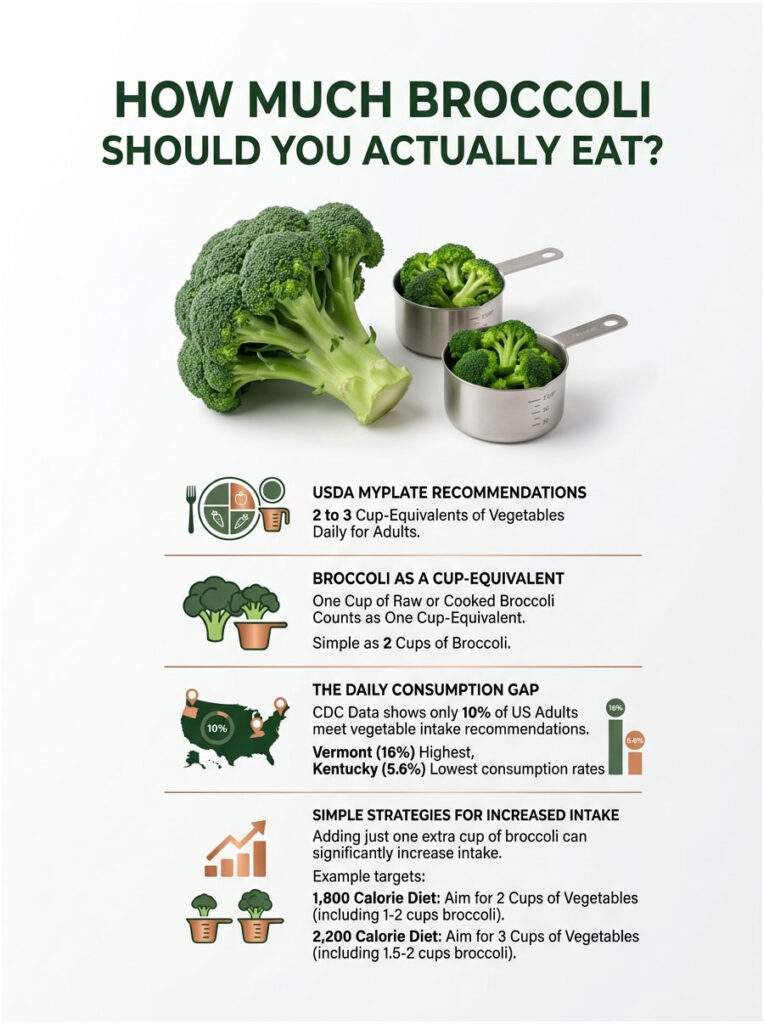
USDA MyPlate calls for 2 to 3 cup-equivalents of vegetables daily for most adults, depending on age, sex, and activity level. One cup of raw broccoli or one cup of cooked broccoli both count as one cup-equivalent.
That means as little as two cups of broccoli a day, or split across other vegetables, hits the federal target.
CDC Adult Vegetable Intake Reality Check
CDC’s 2019 Behavioral Risk Factor Surveillance System data found that only 10% of US adults met daily vegetable intake recommendations. State variation is striking: Vermont led at 16%, while Kentucky came in last at 5.6%.
In other words, 9 out of 10 American adults are eating less broccoli, kale, peppers, and the like than the federal guideline says they should. Adding even one extra cup of broccoli most days moves the needle materially.
Practical Daily Targets in Cups and Calories
For a 1,800-calorie diet (typical US adult woman): 2 cups of vegetables daily, of which 1 to 2 cups can be broccoli (about 31 to 110 calories total, depending on prep).
For a 2,200-calorie diet (typical US adult man): 3 cups of vegetables daily, of which 1.5 to 2 cups can be broccoli (about 55 to 110 calories total). Either way, broccoli’s contribution to daily calorie load is small enough to be a budgeting non-issue.
Smart Ways to Eat More Broccoli Without Adding Calories
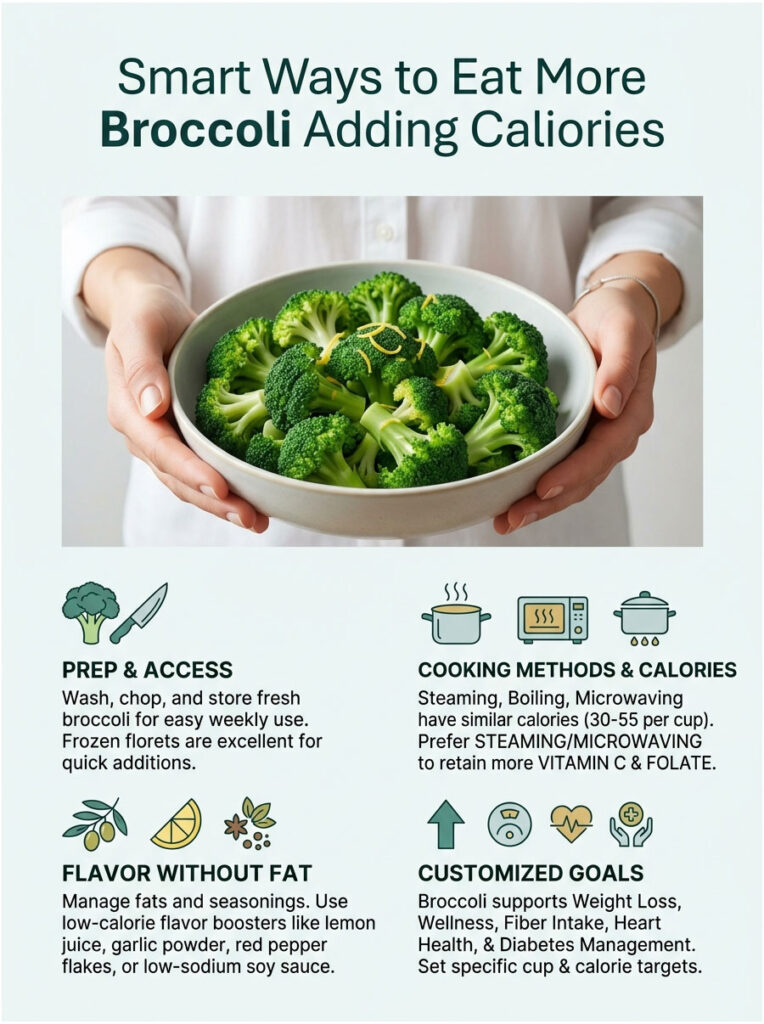
You can eat broccoli twice as often and barely move your calorie ledger if you control the fats and seasonings.
Steam vs Boil vs Microwave (Calorie Neutral, Nutrient Different)
All three deliver roughly 30 to 55 calories per cup depending on volume. Steaming and microwaving preserve more vitamin C and folate than boiling. Save boiled broccoli for cases where you’ll use the cooking liquid (soups, sauces, blended purees).
Three Low-Calorie Flavor Boosters
- Lemon zest plus minced garlic plus a pinch of red pepper flakes (under 10 calories)
- Smoked paprika plus cumin plus a teaspoon of nutritional yeast (about 15 calories)
- Rice vinegar plus low-sodium soy plus sesame seeds (about 25 calories)
Each adds bright flavor without the 100+ calorie hit of butter or oil-based sauces.
Meal-Prep Tips for Busy US Households
Wash and chop a whole head on Sunday; store in a paper-towel-lined container in the fridge for up to 5 days. Freeze leftover florets in a single layer on a sheet pan, then bag for later use in soups or stir-fries.
A bag of frozen florets in the freezer is a 5-minute dinner side every night of the week. Patients who keep frozen broccoli on hand are dramatically more likely to hit their MyPlate targets, our nutrition consultants have noticed.
Table 3: Broccoli Plan by Goal (Cup Targets, Calorie Targets, and Best Prep)
| Your Goal | Cups of Broccoli per Day | Best Preparation | Approximate Daily Broccoli Calories |
| Weight loss | 2 cups (split across meals) | Steamed or roasted with cooking spray | 60 to 110 |
| General wellness | 1 to 1.5 cups | Any prep, rotate methods | 30 to 80 |
| High fiber goal (28 to 38 g daily) | 2 to 3 cups | Boiled or roasted | 110 to 165 |
| Heart health (DASH style) | 1.5 to 2 cups | Steamed, no added salt | 50 to 110 |
| Diabetes-friendly low-carb | 1 to 2 cups | Roasted with olive oil + protein | 60 to 200 (with oil) |
Common Mistakes That Inflate Your Broccoli Calorie Count
The broccoli is rarely the problem. The way it gets prepared usually is.
Mistake #1: Free-pouring oil. A “drizzle” is often 2 tablespoons, not 1 teaspoon. That alone is the difference between a 35-calorie cup and a 270-calorie cup.
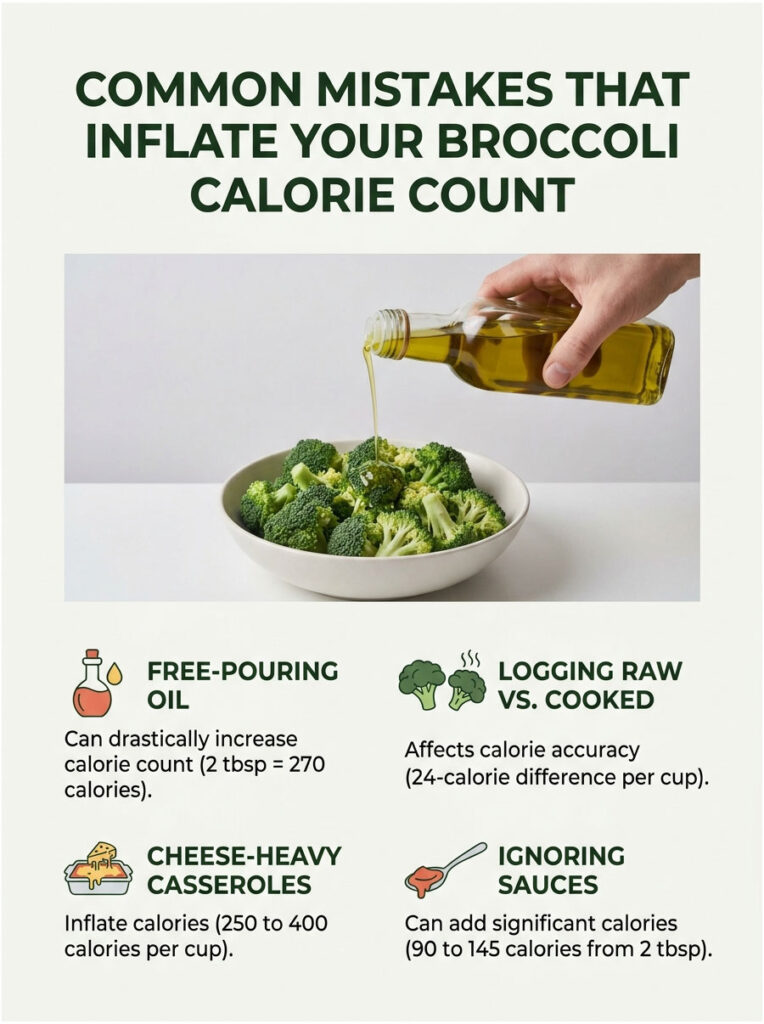
Mistake #2: Logging “broccoli” without distinguishing raw from cooked. The 24-calorie gap per cup adds up fast across a week of meal logging.
Mistake #3: Cheese-bombing the casserole. A typical broccoli-cheddar casserole runs 250 to 400 calories per cup. The broccoli isn’t the issue; the cheese, breadcrumbs, and cream are.
Mistake #4: Ignoring sauces. Two tablespoons of teriyaki, ranch, or honey-mustard adds 90 to 145 calories. Measure or pre-portion.
Want the Full Nutrition Breakdown?
If you want the deeper dive on macros, micronutrients, and the full health-benefit picture beyond calories, see our companion guide on Broccoli Nutrition Facts: Calories, Protein, Carbs and Fiber Per Cup on HealthCareOnTime. It covers the full USDA nutrient panel for both raw and cooked, plus the science on cooking-method nutrient retention.
Frequently Asked Questions
How many calories are in 1 cup of raw broccoli?
A 1-cup chopped serving of raw broccoli weighs 91 g and contains about 31 calories per USDA FoodData Central. About 65% come from carbs (mostly fiber), 27% from protein, and 8% from a small amount of fat. It is one of the lowest calorie-dense options in the produce aisle.
How many calories are in 1 cup of steamed broccoli?
A 1-cup serving of steamed broccoli florets weighs about 85 to 91 g and runs roughly 30 to 35 calories. Steaming adds water but no fat, so the count stays close to raw. Light steaming for 3 to 5 minutes also preserves the most vitamin C and sulforaphane, our nutrition team notes.
How many calories are in 1 cup of cooked or boiled broccoli?
A 1-cup chopped serving of cooked, boiled, drained broccoli weighs 156 g and contains about 55 calories. The cooked cup is heavier than raw because florets compress and absorb water. You also pick up more fiber (5.1 g) and protein (3.7 g) per cup than the raw version delivers.
Why does cooked broccoli have more calories per cup than raw?
Because the same cup measure holds more grams of food once cooked. Heat softens cell walls, the florets collapse, and water gets absorbed, so 1 cup cooked weighs roughly 1.7 times more than 1 cup raw. The broccoli does not gain energy; you are simply eating more of it per cup.
How many calories are in 1 cup of frozen broccoli?
A 1-cup chopped serving of frozen broccoli, cooked and drained, weighs 184 g and contains about 52 calories. Frozen broccoli is blanched before freezing, which preserves nutrients well. Per-cup calories sit very close to fresh-cooked, making frozen a smart, cheaper option for budget-conscious US households.
How many calories are in roasted broccoli with olive oil?
About 90 to 100 calories per 1 cup roasted with 1 teaspoon olive oil. Bump the oil to 1 tablespoon and you are looking at 150+ calories per cup. The broccoli itself stays low-calorie; the added oil drives the increase. Measure with a teaspoon, not a free-pour, for accurate tracking.
Is broccoli good for weight loss?
Yes, and decisively. Broccoli is one of the most weight-loss-friendly vegetables in US grocery stores. Its low calorie density (about 0.34 kcal per gram raw), high fiber, and high water content help you feel full on fewer calories. Replacing a starchy side with broccoli at one meal a day can save roughly 1,000 calories weekly with no portion sacrifice.
How many cups of broccoli should I eat per day?
USDA MyPlate suggests 2 to 3 cup-equivalents of vegetables daily for most US adults. One cup of broccoli (raw or cooked) counts as one cup-equivalent. For weight loss, 2 cups of cooked broccoli daily is a smart target, adding roughly 110 calories and 10 g of fiber to your day.
How many calories in 100g of broccoli?
Per 100 g, raw broccoli has about 34 calories. Cooked, boiled, drained broccoli also runs about 35 calories per 100 g. Per gram, the calorie content barely changes between raw and cooked. The big difference shows up only when you measure by cup volume rather than by weight.
Does cooking broccoli destroy nutrients?
Cooking changes nutrient levels but does not destroy all of them. Boiling leaches some water-soluble vitamins (vitamin C, folate) into the cooking water. Steaming and microwaving with minimal water preserve more nutrients. Light cooking can also boost the bioavailability of certain compounds like sulforaphane.
Are broccoli florets and broccoli stems the same calories?
Very close. Both fall in the 30 to 35 calorie range per cup raw. Stems run slightly higher in fiber and slightly lower in vitamin C. Don’t toss the stems; peel the tough outer layer, slice them into coins, and roast or steam them alongside the florets for zero added calories.
How many calories in a whole head of broccoli?
A medium head of broccoli weighs about 600 g and contains roughly 200 to 210 calories raw. That works out to about 6 to 7 cups of chopped raw broccoli, or about 4 cups once cooked. A full head is a generous family-of-four side serving for under 250 calories total.
Disclaimer: This article is for educational purposes only and is not a substitute for professional medical, nutritional, or dietary advice. Calorie and nutrient values reflect USDA FoodData Central averages and can vary by variety, growing conditions, and exact preparation. Always consult a licensed registered dietitian or healthcare provider before starting a new meal plan, especially if you have a chronic condition like diabetes, kidney disease, or are taking blood-thinning medication (broccoli’s vitamin K content can affect warfarin dosing). HealthCareOnTime offers diagnostic and metabolic lab testing across the United States; bookings are facilitated through our partner network and do not constitute a doctor-patient relationship.
References
- USDA FoodData Central, Agricultural Research Service
- USDA MyPlate – Vegetables
- CDC MMWR. Adults Meeting Fruit and Vegetable Intake Recommendations — United States, 2019
- CDC NCHS. Fruit and Vegetable Consumption Among Adults in the United States, 2015–2018
- Dietary Guidelines for Americans 2020–2025
- FDA. Nutrition Information for Raw Vegetables
- USDA Food and Nutrition Service. Broccoli, Fresh – MyPlate Facts Sheet
- Harvard T.H. Chan School of Public Health – The Nutrition Source