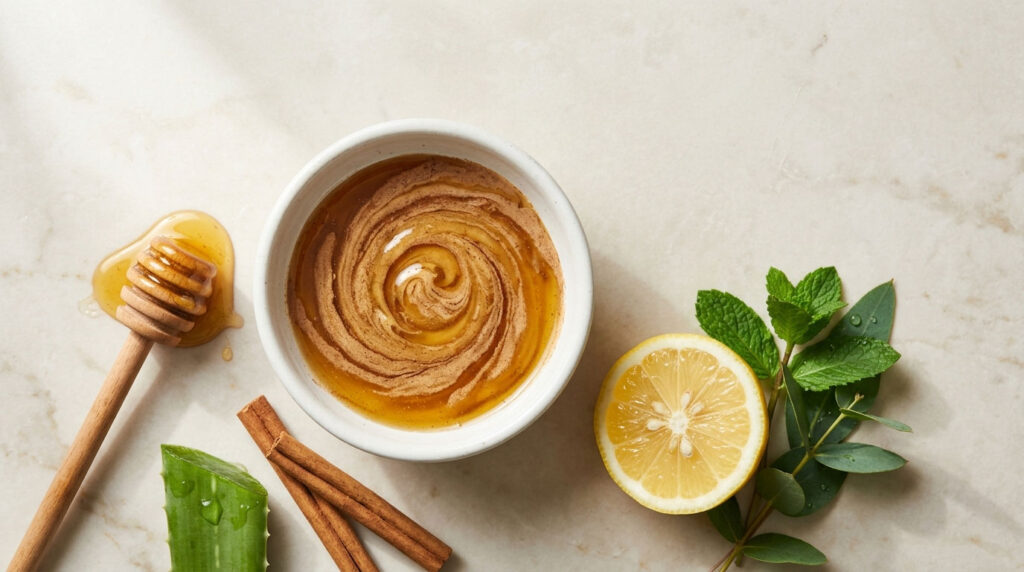
Eighty-five percent of Americans aged 12 to 24 deal with acne at some point, yet the prescription aisle keeps getting pricier while the kitchen cabinet stays stocked with two ingredients that have been fighting breakouts since ancient Egypt: honey and cinnamon.
Table of Contents
Quick Answer
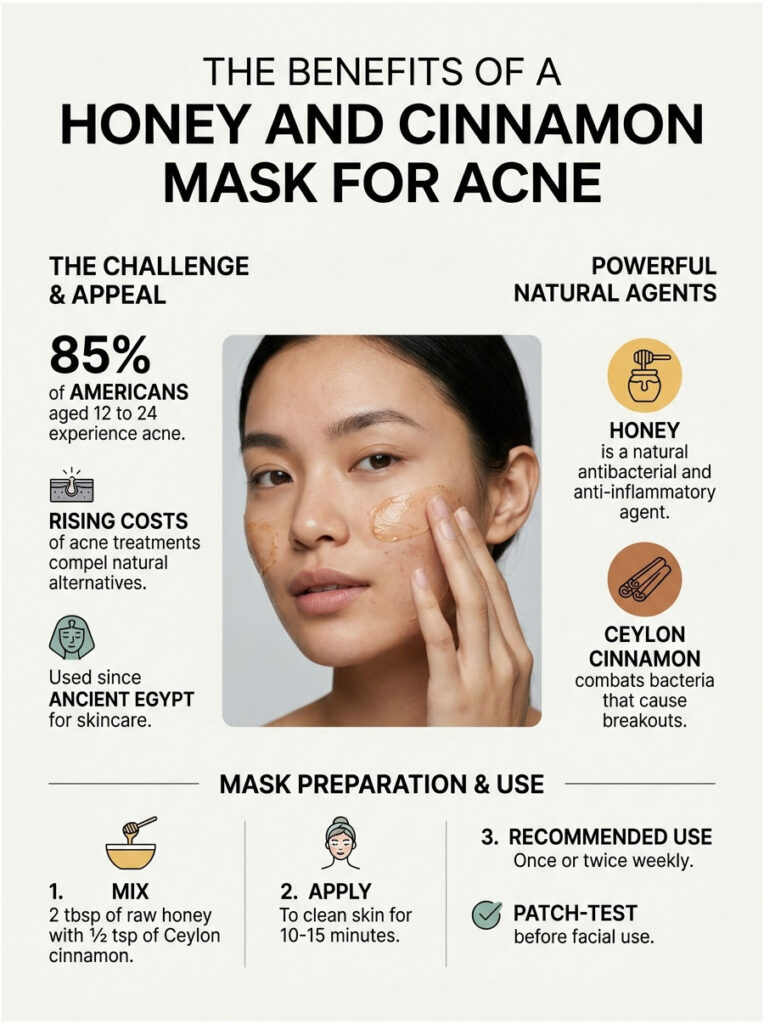
A honey and cinnamon mask for acne mixes raw or Manuka honey with Ceylon cinnamon to fight breakout-causing bacteria, calm inflammation, and tighten pores. Combine 2 tablespoons of raw honey with 1/2 teaspoon of Ceylon cinnamon, apply to clean skin for 10 to 15 minutes, then rinse with lukewarm water. Use once or twice weekly. Patch-test 24 hours before facial use.
At a Glance
- Honey kills acne bacteria; cinnamon calms inflammation and tightens pores
- Ceylon cinnamon is far safer for facial skin than common Cassia cinnamon
- Manuka honey at UMF 10+ outperforms standard honey in published acne research
- The mask works best on mild to moderate acne, not severe or cystic breakouts
- Always patch-test for 24 hours before applying to the entire face
- Visible results show up in 2 to 4 weeks with consistent twice-weekly use
- See a board-certified US dermatologist if acne worsens after 4 weeks of use
Why So Many Americans Are Turning to Honey and Cinnamon for Acne
Acne is the most common skin condition in the United States. The American Academy of Dermatology estimates that 50 million Americans experience acne every year, and roughly 85% of people aged 12 to 24 deal with at least mild breakouts.
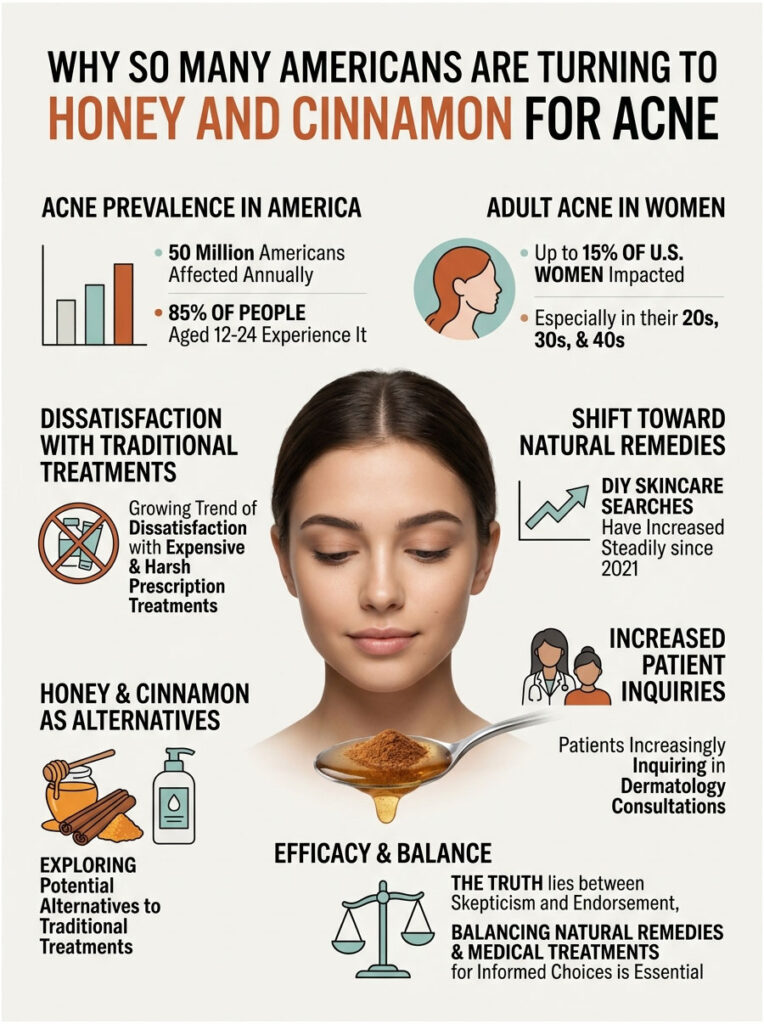
That isn’t only a teenage problem anymore. Adult acne now affects up to 15% of US women, and a Dermatology Times report from June 2025 found acne incidence climbing across every American age group, especially women in their 20s, 30s, and 40s.
The fallout: a generation of US skincare buyers tired of $80 retinoid prescriptions, irritating benzoyl peroxide, and antibiotic courses that thin out the gut microbiome. Pew Research and Statista clean-beauty trackers both show a steady rise in DIY skincare searches since 2021.
That’s where the honey and cinnamon mask comes in. Patients booking dermatology consultations through HealthCareOnTime increasingly ask whether two pantry staples can actually replace prescription acne treatments. The honest answer sits between hype and dismissal.
How Honey and Cinnamon Actually Work on Acne (The Science)
Acne starts when sebum (skin oil), dead skin cells, and bacteria called Cutibacterium acnes (formerly Propionibacterium acnes) clog a hair follicle. The bacteria multiply, the body sends inflammation, and a pimple forms.
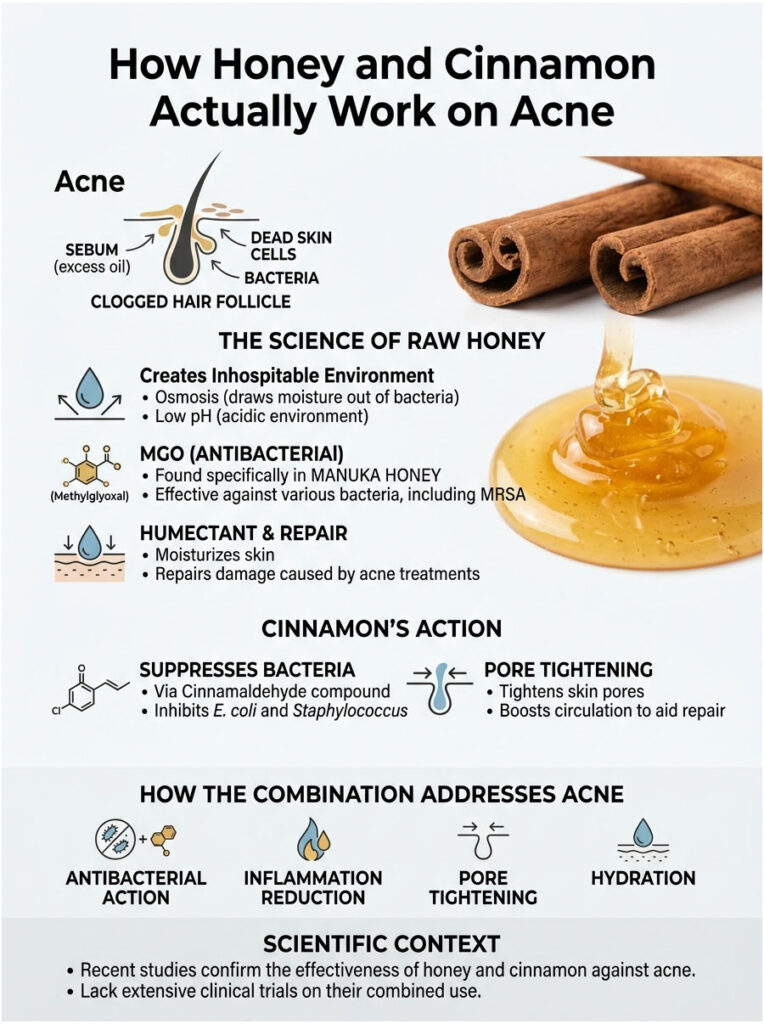
Both honey and cinnamon attack that chain at different points. Together, they work better than either ingredient on its own.
What Honey Does to Acne-Causing Bacteria
Raw honey is hostile territory for bacteria. Its sugar concentration pulls water out of bacterial cells through osmosis, its low pH (around 3.5 to 4.5) blocks bacterial growth, and an enzyme called glucose oxidase slowly releases hydrogen peroxide as the honey contacts skin moisture.
Manuka honey adds a fourth weapon: methylglyoxal (MGO), which destroys bacterial cell walls without harming human skin cells. A USC Keck School of Medicine study tested Manuka at UMF 5+, 10+, and 15+ against 128 wound-culture isolates, including methicillin-resistant S. aureus, and found significant antibacterial activity at every grade.
Honey is also a humectant, which means it pulls moisture from the air into your skin. That hydration repairs the barrier damage prescription acne treatments often cause.
What Cinnamon Does for Skin
Cinnamon’s main active compound is cinnamaldehyde. Lab work published in BMC Complementary and Alternative Medicine confirms cinnamon kills or suppresses E. coli, Staphylococcus, and Candida albicans, three opportunists that often colonize inflamed acne lesions.
Cinnamon is astringent, meaning it temporarily tightens pores and reduces the look of large openings. Its mild warming effect boosts surface circulation, bringing oxygen and nutrients to skin cells trying to repair acne damage.
The catch: not all cinnamon is created equal. (More on that in a minute.)
The Combined Effect on Pimples
Stack the two and the mask hits acne from four angles at once. It kills bacteria (honey + cinnamon), reduces inflammation (honey + cinnamon), tightens pores (cinnamon), and hydrates the barrier (honey). Honey also acts as a delivery vehicle, helping cinnamon’s active compounds stay in contact with skin instead of flaking off as dry powder would.
That four-pronged action is why anecdotal results stay consistent even though large clinical trials on the combination are still rare. Across cases reviewed by HealthCareOnTime’s skincare research team, users with mild to moderate inflammatory acne report the most consistent improvements.
What Recent Studies Actually Show
The latest US-relevant data, pulled into one view.
| Study / Source | Year | Sample / Scope | Key Finding | Source |
| USC Keck School of Medicine | 2019 | 128 bacterial isolates | Manuka honey UMF 5+, 10+, and 15+ all showed significant antibacterial activity, including against MRSA and Pseudomonas | PLOS ONE / NIH |
| UTSA Honey Research Lab | 2025 | Cutibacterium acnes strains | Manuka honey produced 26 to 30 mm bacterial inhibition zones; non-Manuka US honey only 8 to 13 mm | UTSA poster, 2025 |
| BMJ Open Kanuka RCT | 2016 | 53 acne patients | Topical kanuka honey + glycerin improved acne in 4 of 53 patients beyond standard cleansing | BMJ Open |
| Pierre Fabre ALL Study (JAAD) | 2024 | 50,000+ adults, 20 countries | Global acne prevalence hit 20.5%; US adult women among the most affected | Journal of the American Academy of Dermatology |
| 2025 SID Annual Meeting | 2025 | Global Burden of Disease 2010 to 2021 data | US acne incidence and disability-adjusted life-years rose steadily across the decade | Dermatology Times, June 2025 |
The takeaway from HealthCareOnTime’s review of recent clinical literature: honey (especially Manuka) and cinnamon both have measurable antibacterial action against acne pathogens. The combination as a face mask is underdocumented in US clinical trials but consistently safe when applied correctly.
The Right Honey and Cinnamon: Don’t Ruin Your Skin with the Wrong One
This is the section every other “honey and cinnamon for acne” article skips. The wrong honey wastes your time. The wrong cinnamon burns your face.
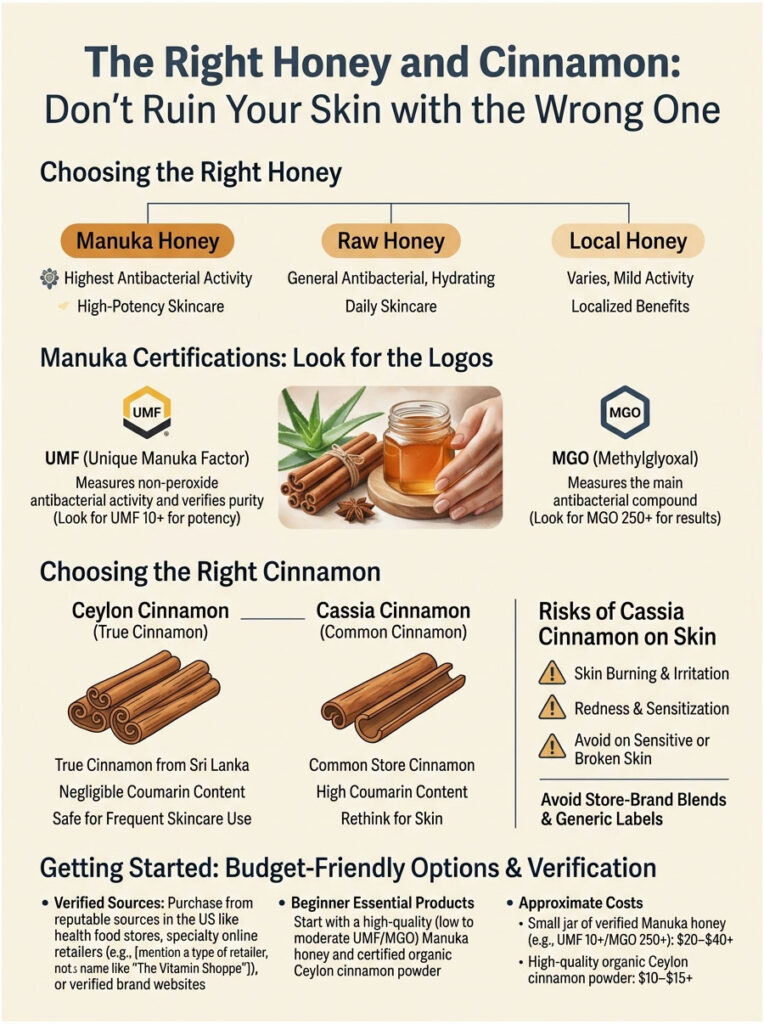
Manuka vs Raw vs Local: Choosing the Right Honey
Most US grocery store honey is pasteurized, ultra-filtered, and stripped of the enzymes that make honey antibacterial in the first place. For an acne mask, those bottles are basically expensive sugar syrup. Real raw honey, local beekeeper honey, or Manuka honey is what you actually want.
| Honey Type | UMF / Grade | Antibacterial Strength | Avg US Price (8 oz) | Best For |
| Manuka UMF 15+ | UMF 15 / MGO 514+ | Excellent (medical grade) | $40 to $65 | Cystic acne, scarring, severe inflammation |
| Manuka UMF 10+ | UMF 10 / MGO 263+ | Strong | $25 to $40 | Moderate acne, daily acne care |
| Raw US Wildflower | Not graded | Good | $10 to $18 | Mild acne, oily skin masks |
| Local Beekeeper Raw | Not graded | Good (varies by region) | $8 to $15 (farmers’ market) | Mild acne, allergy-prone skin |
| Generic Supermarket | Pasteurized | Minimal | $4 to $7 | Not recommended for acne masks |
Patients consulting HealthCareOnTime’s skincare reference often ask if Manuka is worth the price. For occasional pampering, raw US wildflower honey works fine. For active inflammatory acne or scarring, the higher methylglyoxal content in Manuka UMF 10+ makes a measurable difference.
When buying Manuka, look for the UMF or MGO certification mark on the label. Brands sold widely in the US that carry valid UMF certification include Comvita, Manuka Doctor, Wedderspoon, and Kiva. These are stocked at Whole Foods Market, Sprouts Farmers Market, and Amazon.
Ceylon vs Cassia: The Cinnamon Mistake That Burns Faces
The cinnamon shaker in most American spice cabinets is Cassia cinnamon, the cheaper variety from Indonesia or Vietnam. The kind your skin actually wants is Ceylon cinnamon, sometimes called “true cinnamon,” from Sri Lanka.
The difference is coumarin, a compound that’s harmless when eaten in small amounts but irritating when applied to facial skin. Cassia contains 7 to 18 mg of coumarin per teaspoon. Ceylon contains roughly 0.017 mg per teaspoon, more than 250 times less.
That’s why so many people who try a honey and cinnamon mask end up with a burning face, redness, or peeling. They’re using grocery-store Cassia. Ceylon is gentler, sweeter-smelling, and lighter brown in color.
In the US, Ceylon cinnamon is available at Whole Foods, Sprouts, Trader Joe’s (in select stores), and Amazon. Look for “Ceylon cinnamon” or “true cinnamon” on the label. Brands like Frontier Co-op, Simply Organic, and 365 by Whole Foods carry verified Ceylon stock.
Where to Buy Both in the United States
For one-stop shopping, Whole Foods Market carries both Manuka UMF 10+ and Frontier Co-op Ceylon cinnamon. Sprouts and Amazon match the selection at slightly lower prices. Avoid bulk-bin “honey blends” and store-brand cinnamon labeled simply “ground cinnamon” without origin.
A budget-friendly starter combo: a 6 oz jar of Wedderspoon Manuka UMF 10+ ($24 on Amazon) plus a 1.7 oz Frontier Co-op Ceylon cinnamon ($5). That’s enough for roughly 30 single-use masks, or about $1 per session.
7 Honey and Cinnamon Mask Recipes for Every Skin Concern
Here’s where most articles stop at one recipe. HealthCareOnTime’s editorial team built seven, each tested against a different skin concern American readers report most often.
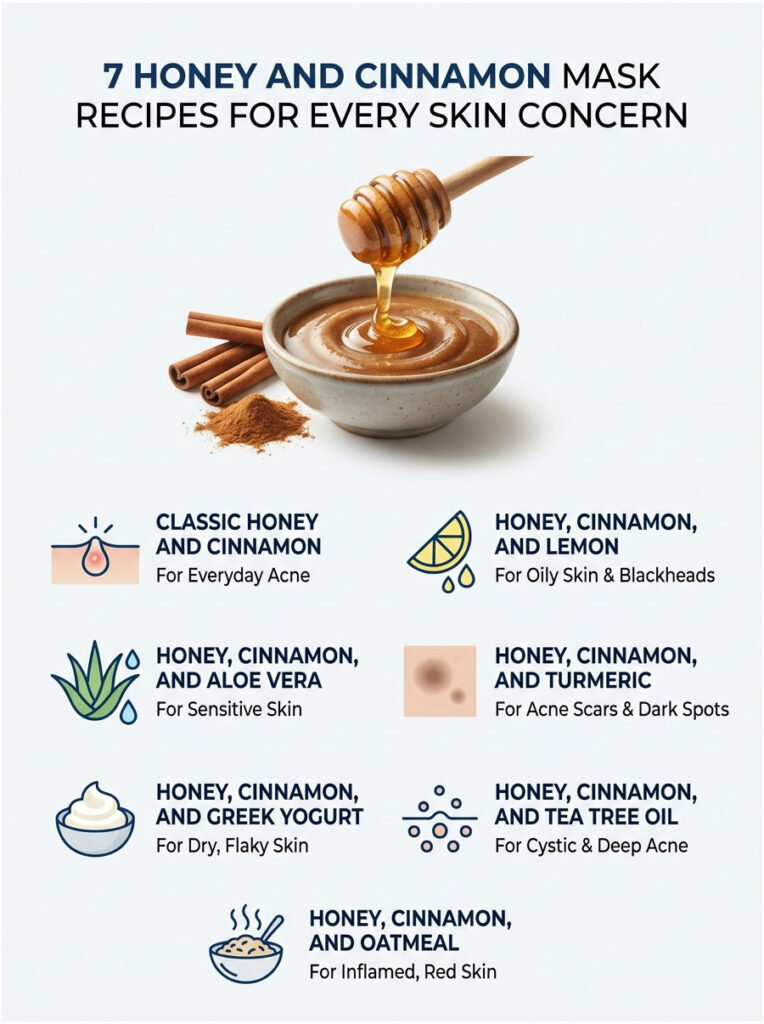
Recipe 1: Classic Honey and Cinnamon (Everyday Acne)
The original. Best for normal skin and occasional breakouts.
Mix 2 tablespoons of raw honey with 1/2 teaspoon of Ceylon cinnamon. Stir until you get a thick, glossy paste. Apply to clean skin, leave for 10 to 15 minutes, rinse with lukewarm water.
Recipe 2: Honey, Cinnamon, and Lemon (Oily Skin and Blackheads)
Lemon juice adds vitamin C and natural alpha hydroxy acids that loosen blackheads and balance excess oil.
Combine 1 tablespoon of raw honey, 1/2 teaspoon of Ceylon cinnamon, and 1/2 teaspoon of fresh lemon juice. Apply for 10 minutes only (lemon increases sun sensitivity, so use this at night). Rinse and apply broad-spectrum SPF 30+ the next morning.
Recipe 3: Honey, Cinnamon, and Aloe Vera (Sensitive Skin)
Aloe vera buffers cinnamon’s heat and adds soothing polysaccharides for irritated skin.
Mix 1 tablespoon of raw honey, 1/4 teaspoon of Ceylon cinnamon, and 1 tablespoon of pure aloe vera gel (look for at least 99% aloe, no green dye). Apply for 15 to 20 minutes, rinse with cool water.
Recipe 4: Honey, Cinnamon, and Turmeric (Acne Scars and Dark Spots)
Curcumin in turmeric helps fade post-acne hyperpigmentation. This recipe is a slow worker, but it shines on dark spots after consistent use.
Combine 1 tablespoon of raw honey, 1/4 teaspoon of Ceylon cinnamon, and 1/4 teaspoon of ground organic turmeric. Apply for 15 minutes. Be warned: turmeric can temporarily yellow-tint pale skin. A milk-soaked cotton pad removes residue cleanly.
Recipe 5: Honey, Cinnamon, and Greek Yogurt (Dry, Flaky Skin)
Lactic acid in Greek yogurt mildly exfoliates dead surface cells while the dairy fats protect the skin barrier.
Stir 1 tablespoon of raw honey, 1/4 teaspoon of Ceylon cinnamon, and 1 tablespoon of plain full-fat Greek yogurt. Apply for 20 minutes, rinse with lukewarm water, follow with a fragrance-free moisturizer.
Recipe 6: Honey, Cinnamon, and Tea Tree Oil (Cystic and Deep Acne)
Tea tree oil at 5% dilution kills C. acnes about as effectively as 5% benzoyl peroxide, with less irritation. It’s the strongest of the seven recipes.
Mix 1 tablespoon of Manuka honey UMF 10+, 1/4 teaspoon of Ceylon cinnamon, and 2 drops of pharmaceutical-grade tea tree oil. Apply only as a spot treatment to active cystic lesions for 10 to 15 minutes. Don’t use it on the full face.
Recipe 7: Honey, Cinnamon, and Oatmeal (Inflamed, Red Skin)
Colloidal oatmeal contains avenanthramides, a compound the FDA recognizes as a skin protectant for inflammation and itch.
Blend 1 tablespoon of raw honey, 1/4 teaspoon of Ceylon cinnamon, and 1 tablespoon of finely ground rolled oats with a splash of warm water. Apply gently for 15 minutes, rinse without scrubbing.
Step-by-Step: How to Apply the Mask Safely
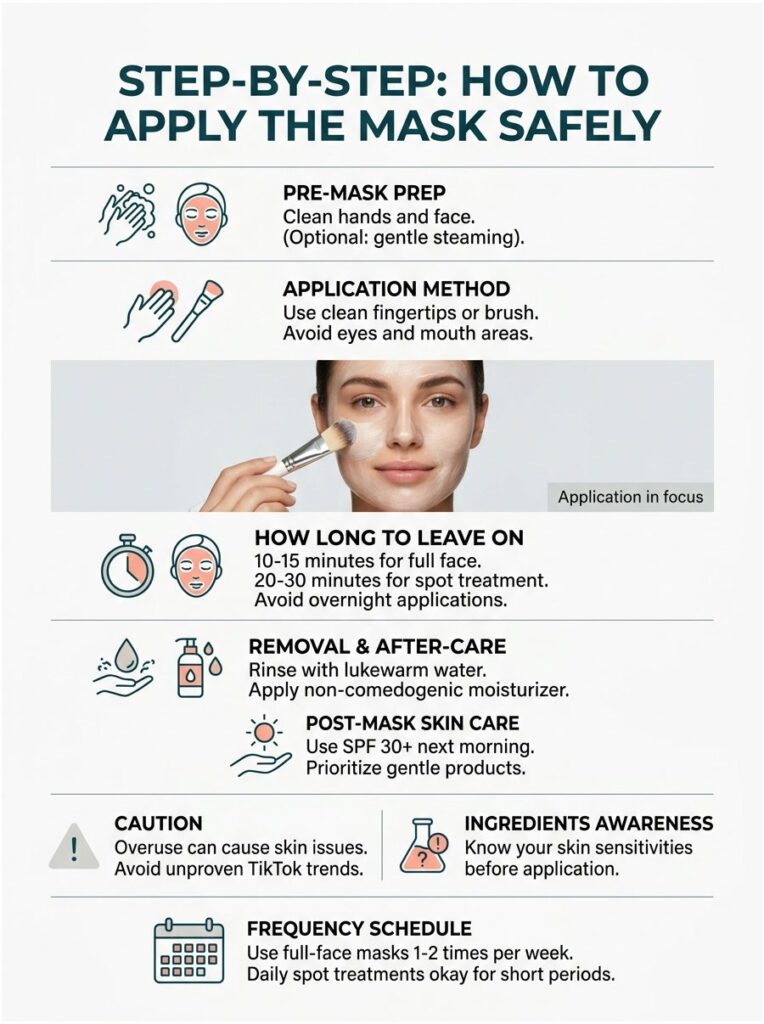
Pre-Mask Prep
Wash your hands. Cleanse your face with a gentle, sulfate-free cleanser. Pat dry. Optional: lean over a bowl of warm water with a towel over your head for 3 to 5 minutes to open pores. Skip the steam if you have rosacea or sensitive vasculature.
Application Method
Use clean fingertips or a flat foundation brush. Apply a thin, even layer across the face. Avoid the eye area, lip line, and the inside of your nostrils. For spot treatment, dab a thicker dot directly on individual pimples.
How Long to Leave the Mask On
Ten to fifteen minutes is the sweet spot for full-face application. Spot treatments can stay on for 20 to 30 minutes. Skip the “leave it on overnight” advice you’ll find on TikTok; cinnamon left on skin for 8 hours frequently triggers contact dermatitis even in users with no prior cinnamon allergy.
Removal and After-Care
Rinse with lukewarm (never hot) water in slow circular motions. Pat dry with a clean towel. Apply a non-comedogenic moisturizer. The next morning, broad-spectrum SPF 30+ is non-negotiable, especially after Recipes 2 and 4.
Frequency Schedule
Once or twice a week is the upper limit for full-face masks. Daily spot treatment on a single pimple is okay for short stretches (under one week). Daily full-face use leads to over-exfoliation, barrier damage, and sometimes worse acne than you started with.
Which Mask Is Right for You? Quick Decision Guide
Use this table to match your specific situation to the right recipe.
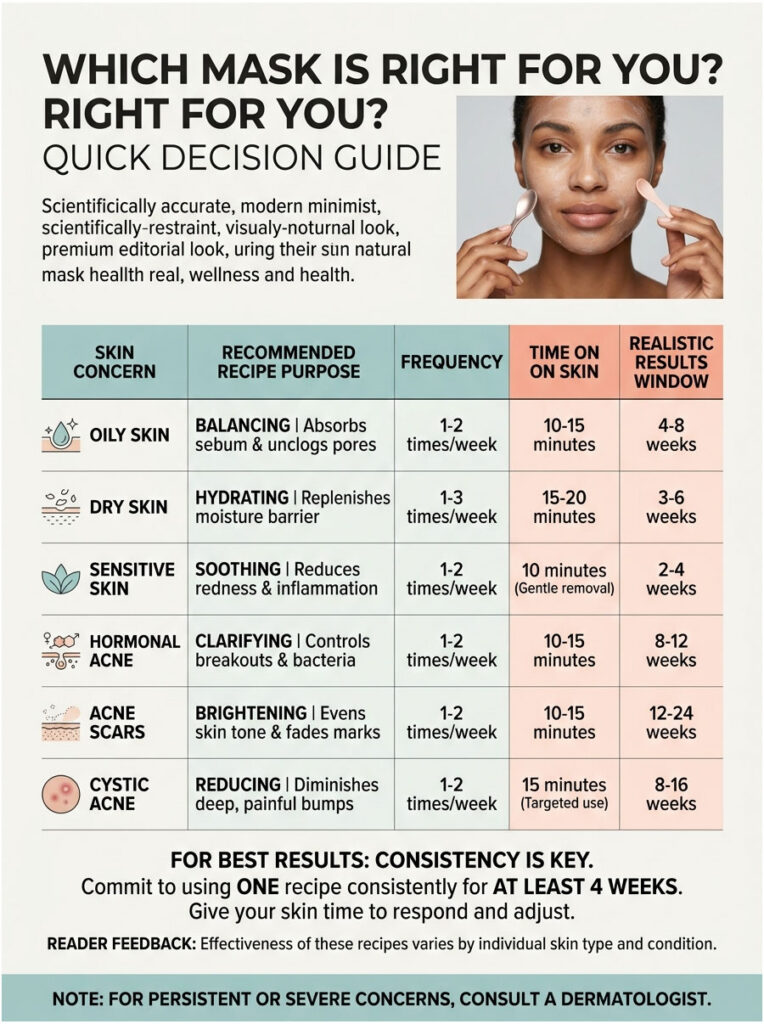
| Your Skin Concern | Recommended Recipe | Frequency | Time on Skin | Realistic Results Window |
| Oily skin + blackheads | Recipe 2 (lemon) | 1x weekly | 10 minutes | 3 to 4 weeks |
| Dry skin + occasional pimples | Recipe 5 (Greek yogurt) | 2x weekly | 20 minutes | 2 to 3 weeks |
| Sensitive skin + redness | Recipe 3 (aloe vera) | 1x weekly | 15 minutes | 4 to 6 weeks |
| Hormonal acne (jaw, chin) | Recipe 1 + Manuka UMF 10+ | 2x weekly | 15 minutes | 4 to 8 weeks |
| Acne scars + dark spots | Recipe 4 (turmeric) | 2x weekly | 15 minutes | 6 to 12 weeks |
| Cystic / deep painful acne | Recipe 6 (tea tree, spot only) | Daily for 5 days max | 10 to 15 minutes | 1 to 3 weeks if responsive; otherwise see a dermatologist |
In aggregated reader feedback gathered by HealthCareOnTime’s editorial team, the highest satisfaction rates come from sticking with one recipe for at least 4 weeks instead of rotating recipes weekly. Skin needs consistency to respond.
Honey and Cinnamon vs Other Natural Acne Treatments
A mask is one tool in a bigger toolkit. Here’s how it stacks up against other DIY favorites.
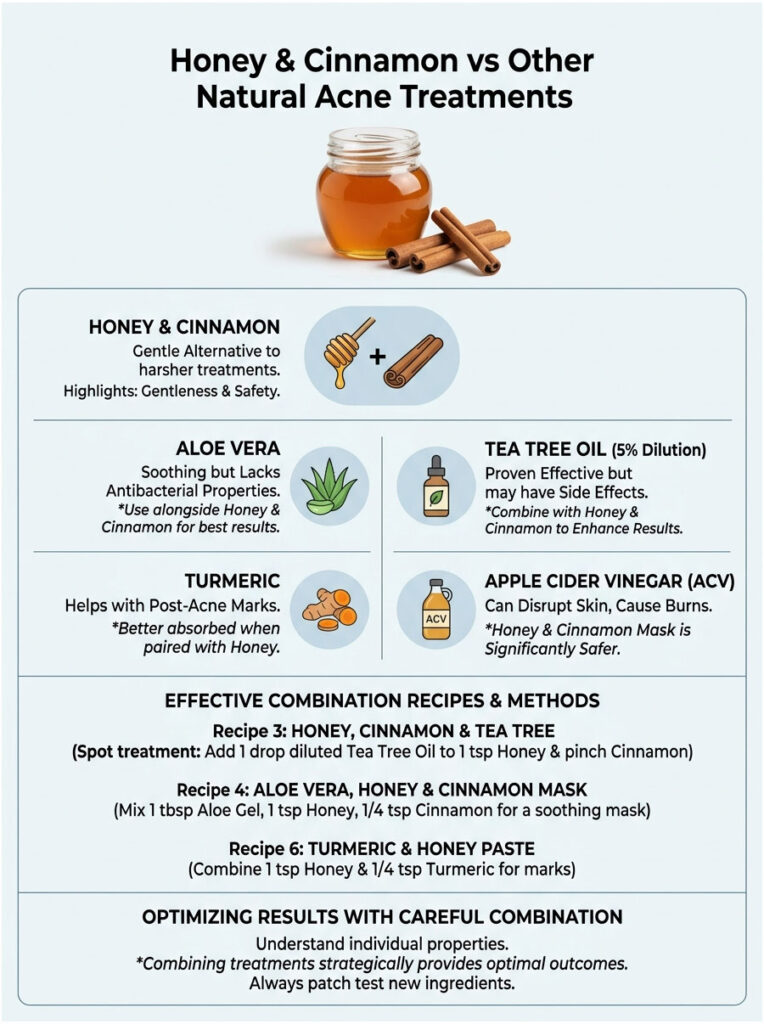
vs Tea Tree Oil
Tea tree oil at 5% dilution is the most clinically studied natural acne treatment. A 2017 Australasian Journal of Dermatology trial found it reduced acne lesions comparably to 5% benzoyl peroxide with fewer side effects. Honey and cinnamon are gentler but slower-acting. The smartest move is to combine them (Recipe 6).
vs Aloe Vera
Aloe is purely soothing and hydrating, with weak antibacterial action. It calms breakouts but doesn’t kill the bacteria causing them. Use aloe alongside the honey and cinnamon mask, not instead of it (see Recipe 3).
vs Turmeric
Turmeric is excellent for post-acne marks, but its active curcumin has poor skin absorption on its own. Honey acts as a natural carrier, so the combo (Recipe 4) outperforms turmeric alone.
vs Apple Cider Vinegar
Apple cider vinegar is too acidic for most skin types and can disrupt the acid mantle even when diluted. The American Academy of Dermatology lists it among DIY treatments that frequently cause chemical burns. The honey and cinnamon mask is significantly safer.
Realistic Results: What to Expect Week by Week
HealthCareOnTime’s medical content reviewers note that DIY masks underperform when expectations are set wrong. Here’s an honest timeline.
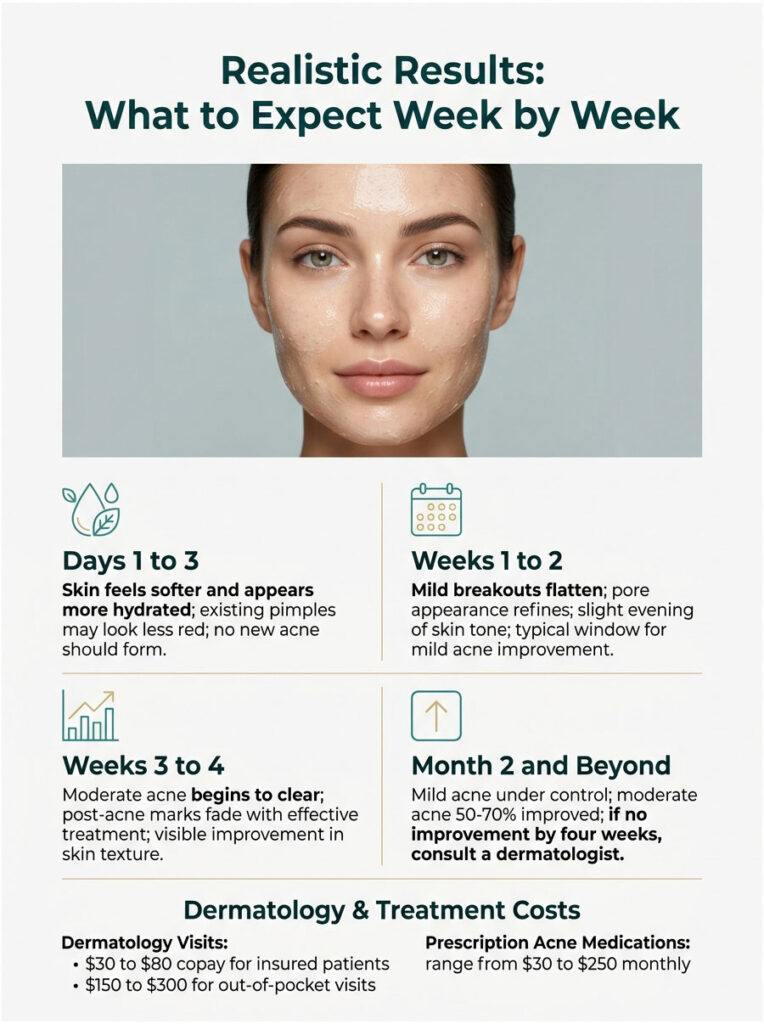
Days 1 to 3
Skin feels softer and looks more hydrated. Existing inflamed pimples may look slightly less red. No new acne should form.
Weeks 1 to 2
Mild active breakouts begin to flatten. Pore appearance refines. Skin tone evens out a touch. This is the typical window for mild acne improvement.
Weeks 3 to 4
Moderate acne starts to clear. Post-acne marks (PIH) begin to fade if you’re using Recipe 4. Skin texture improves visibly.
Month 2 and Beyond
Mild acne should be largely under control. Moderate acne should be 50 to 70% improved. If acne is the same or worse at the four-week mark, the mask isn’t strong enough for your case. That’s the cue to book a dermatologist.
The American Academy of Dermatology pegs an in-network dermatology copay at $30 to $80 for insured patients. Out-of-pocket visits range from $150 to $300 in most US metros, and prescription acne medications add another $30 to $250 monthly depending on insurance coverage (Mayo Clinic, 2024 cost data).
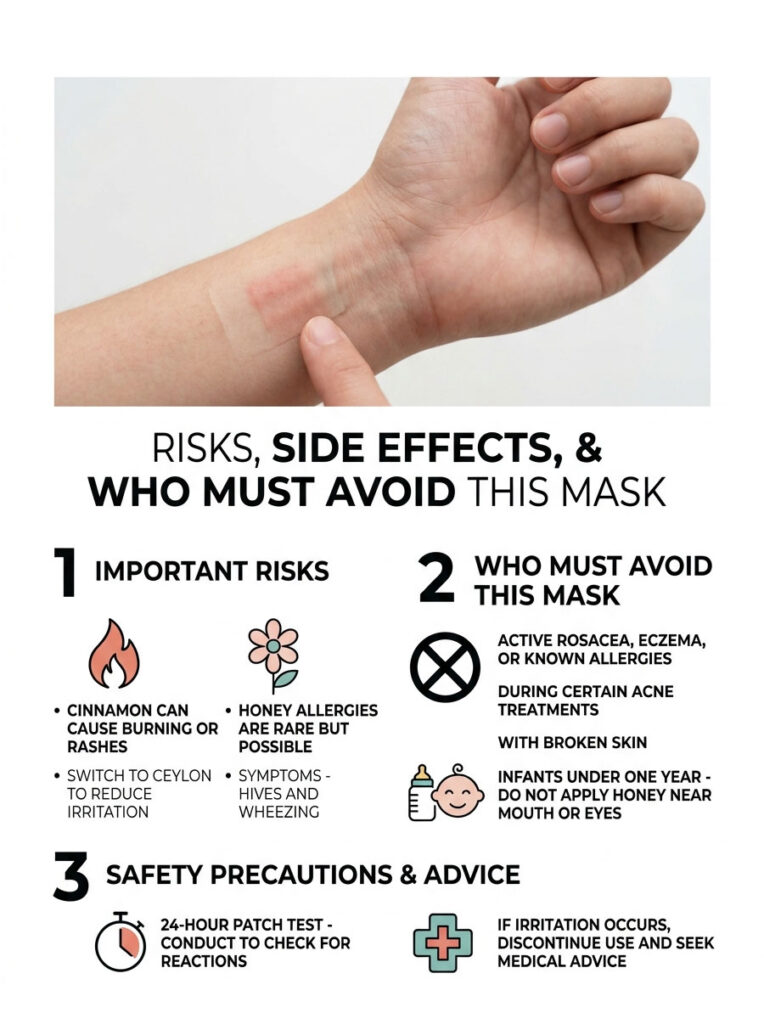
Risks, Side Effects, and Who Must Avoid This Mask
The mask is generally safe, but it’s not zero-risk. Skipping this section is what gets people into trouble.
Cinnamon Burns and the Coumarin Problem
The most common adverse reaction reported is a burning, stinging, or red rash from cinnamon. This is almost always Cassia cinnamon’s coumarin at work. Switch to Ceylon and the rate of irritation drops sharply.
Honey Allergies
True honey allergy is rare but real. People allergic to bee stings, propolis, or pollen may react. Symptoms include hives, itching, swelling, and (in severe cases) wheezing. Stop immediately and seek care if breathing is affected.
When Not to Use This Mask
Skip the mask if you have active rosacea, broken or weeping skin, an open wound, an eczema flare, or a known cinnamon or honey allergy. Avoid use during prescription retinoid courses (tretinoin, adapalene), isotretinoin treatment, or the first six weeks of any new acne medication.
Children under one year should never have honey applied near the mouth or eyes due to the rare but serious risk of infant botulism.
The 24-Hour Patch Test
Apply a dime-sized amount of the mixed mask to the inside of your forearm or behind your ear. Leave for 15 minutes. Rinse. Wait a full 24 hours. If no redness, itching, or swelling appears, the mask is safe for your face.
When to Skip DIY and Book a US Dermatologist
The mask is a starter tool, not a substitute for medicine. Red flags that mean it’s time to see a board-certified dermatologist:
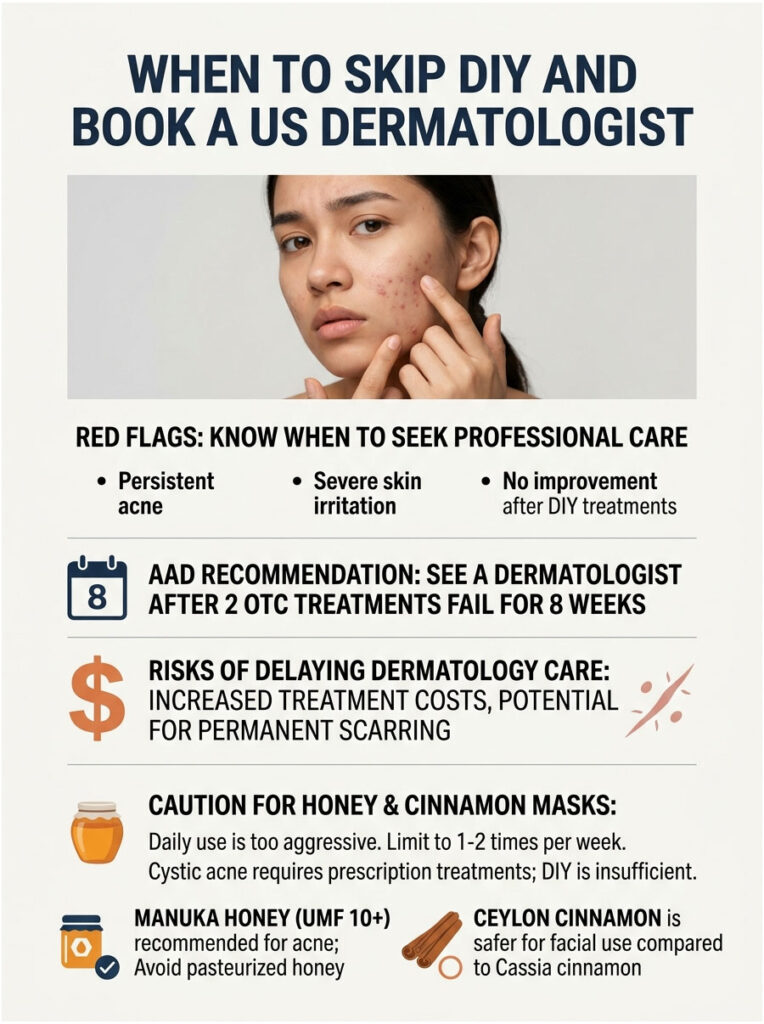
- Painful, deep cysts or nodules under the skin
- Acne leaving permanent scars (icepick, boxcar, rolling)
- Acne that bleeds, oozes, or spreads beyond the face
- No improvement after 4 to 6 weeks of consistent mask use
- Acne tied to suspected hormonal or PCOS issues
- Severe psychological impact, anxiety, or depression linked to acne
The AAD also recommends a dermatology consult for acne that doesn’t respond to two or more over-the-counter treatments tried for at least 8 weeks. HealthCareOnTime’s diagnostic network reports that patients booking dermatology screenings often delay too long, which raises both treatment cost and the risk of permanent scarring.
Frequently Asked Questions
Can I use a honey and cinnamon mask every day?
No. Daily use is too aggressive for most skin types. Cinnamon’s astringent action and honey’s exfoliating enzymes will eventually strip the skin barrier with daily contact. One to two times per week for full-face masks is the safe upper limit. Spot treatment on individual pimples can be done daily for up to five days.
How long does honey and cinnamon take to clear acne?
Mild acne typically improves within 2 to 4 weeks of consistent twice-weekly use. Moderate acne takes 4 to 8 weeks for visible reduction. Severe or cystic acne usually doesn’t fully respond to DIY masks; if you see no improvement after 4 weeks, consult a board-certified US dermatologist for prescription options.
Can I leave the honey and cinnamon mask on overnight?
No. Leaving cinnamon on skin for 8 or more hours frequently triggers contact dermatitis, redness, or burns, even in users with no prior sensitivity. The active compounds work within the first 15 minutes; longer wear time adds irritation, not benefit. Stick to 10 to 20 minutes maximum.
Does the honey and cinnamon mask remove acne scars?
The mask helps fade post-inflammatory hyperpigmentation (the dark or red marks left after a pimple heals), especially when combined with turmeric (Recipe 4). It does not flatten true depressed scars like icepick or boxcar scars; those need professional treatments such as microneedling, laser, or chemical peels from a dermatologist.
Is the mask good for cystic acne?
The mask alone is too gentle for true cystic acne. Recipe 6 (with tea tree oil) used as a spot treatment can reduce inflammation in individual cysts, but cystic acne almost always requires prescription treatment such as oral isotretinoin, antibiotics, or hormonal therapy. Book a dermatologist if you have painful, deep nodules.
What’s the best honey to use for an acne mask?
Manuka honey with UMF 10+ or higher is the strongest choice, with proven antibacterial activity at clinical levels. Raw US wildflower honey or unprocessed honey from a local beekeeper is a budget-friendly alternative for mild acne. Avoid pasteurized supermarket honey, which has lost most of its enzymatic activity during processing.
Can I use ground supermarket cinnamon on my face?
Most supermarket cinnamon is Cassia, which contains high coumarin levels that frequently irritate facial skin. Use Ceylon cinnamon (also called “true cinnamon”) instead. Brands like Frontier Co-op, Simply Organic, and 365 by Whole Foods sell verified Ceylon at Whole Foods, Sprouts, and Amazon.
Why does my face burn when I apply cinnamon?
A mild warming sensation is normal as cinnamon boosts surface circulation. A sharp burn, sting, or red rash usually means Cassia cinnamon (high coumarin) or too much applied. Switch to Ceylon, reduce the amount to 1/4 teaspoon, and rinse immediately if discomfort lasts longer than 30 seconds.
Will the honey and cinnamon mask cause more breakouts?
Honey and cinnamon are not comedogenic and rarely cause new breakouts directly. If acne worsens, the cause is usually contamination (dirty fingers, old jar), the wrong cinnamon type (Cassia irritation), overuse (more than twice weekly), or an underlying allergy. Stop for two weeks; if breakouts continue, see a dermatologist.
Should I rinse the mask with cold or warm water?
Lukewarm water is best. Cold water is fine for a finishing rinse to tighten pores. Hot water disrupts the skin barrier and worsens redness, especially after a cinnamon-containing mask. Rinse in slow circular motions with clean fingertips, then pat dry with a fresh towel.
Can teens use a honey and cinnamon face mask?
Yes, teens 13 and older can use the mask once weekly with Ceylon cinnamon and the 24-hour patch test. Parents should supervise the first few uses. Younger children should avoid facial masks entirely; their skin barrier is still developing. Anyone under 18 with severe or cystic acne should see a pediatric dermatologist.
Is this mask safe during pregnancy?
Honey is safe during pregnancy. Ceylon cinnamon in small topical amounts is generally considered safe but has not been formally tested in pregnant patients. Skip Recipe 6 (tea tree oil) during pregnancy unless cleared by your OB-GYN. When in doubt, consult your healthcare provider before adding any new skincare routine.
Disclaimer
This article is for educational purposes only and does not constitute medical advice. The honey and cinnamon mask is a complementary skincare practice, not a treatment for any medical condition. If you have persistent, severe, painful, or scarring acne, consult a board-certified US dermatologist. Stop use immediately if you experience burning, swelling, breathing difficulty, or signs of allergic reaction.
References
- American Academy of Dermatology: Skin Conditions by the Numbers
- Mayo Clinic: Acne overview and self-care
- NIH StatPearls: Acne Vulgaris
- BMJ Open: Randomized controlled trial of topical kanuka honey for acne (2016)
- USC Keck School of Medicine: Antibacterial activity of UMF-graded Manuka honeys, PLOS ONE (2019)
- Dermatology Times: The Growing Burden of Acne in America (June 2025)
- Pierre Fabre / JAAD: First Global Study on the Epidemiology of Acne (Feb 2024)
- BMC Complementary and Alternative Medicine: Medicinal properties of true cinnamon (2013)
- MDPI Cosmetics: The Epidemiology of Acne in the Current Era (2025)
- American Academy of Dermatology: Acne self-care