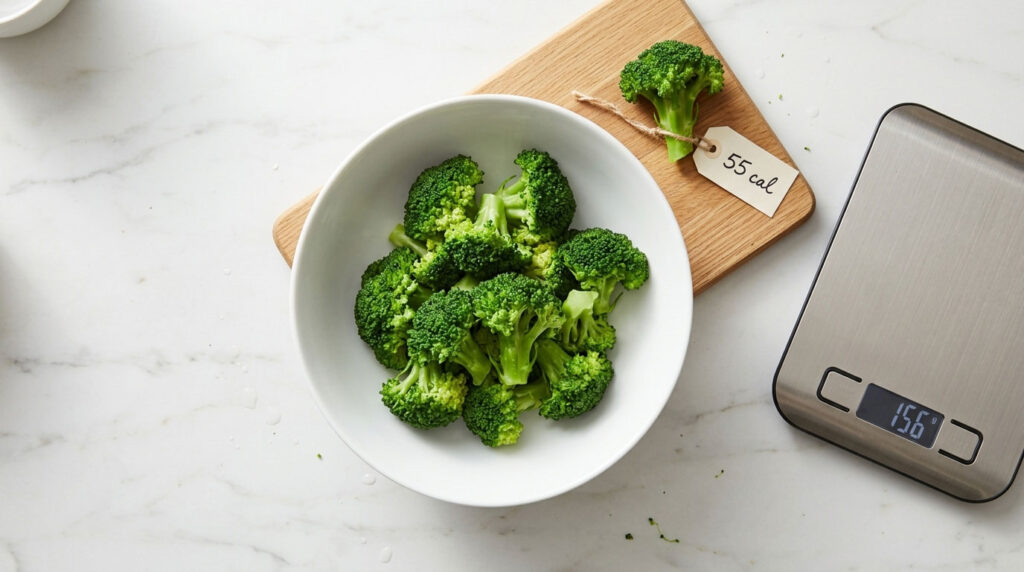
You piled a heaping bowl of steamed broccoli next to grilled chicken, opened your tracker app, and got stuck on the question every dieter eventually asks: how much is “one serving,” really? The answer changes the whole math of your day. The good news is that calories in steamed broccoli are among the lowest of any vegetable on the USDA chart, and once you know the per-cup, per-floret, and per-100g numbers cold, you’ll never guess again.
Table of Contents
Quick Answer: One cup of chopped steamed broccoli (156g, USDA standard) has about 55 calories. Per 100g, steamed broccoli has roughly 35 calories. A single medium floret (about 11g) is just 4 calories. Macros per cup: 11g carbs, 5.1g fiber, 3.7g protein, 0.6g fat. Source: USDA FoodData Central, FDC ID 169967.
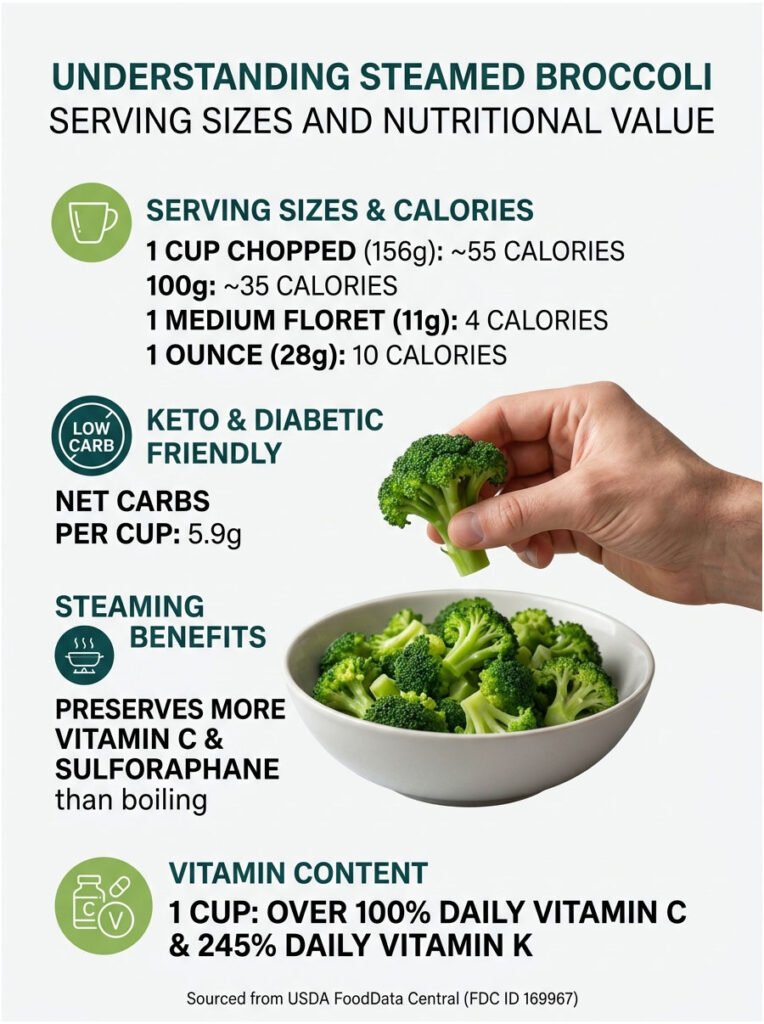
At a Glance
• 100g steamed broccoli = 35 calories (USDA verified)
• 1 cup chopped (156g) = 55 calories
• 1 medium floret (11g) = 4 calories
• 1 ounce (28g) = 10 calories
• Net carbs per cup: 5.9g, perfect for keto and diabetic diets
• Steaming preserves more vitamin C and sulforaphane than boiling
• One cup gives you over 100% of your daily vitamin C and 245% of your daily vitamin K
Steamed Broccoli Calories at a Glance (USDA Numbers)
The biggest source of calorie confusion online is serving size. One blog says 30, another says 55, another says 62. All of them can be technically right depending on which gram weight they used. The USDA’s official figure for cooked broccoli (boiled or steamed, drained, no salt) is 35 calories per 100 grams, sourced from USDA FoodData Central under FDC ID 169967.
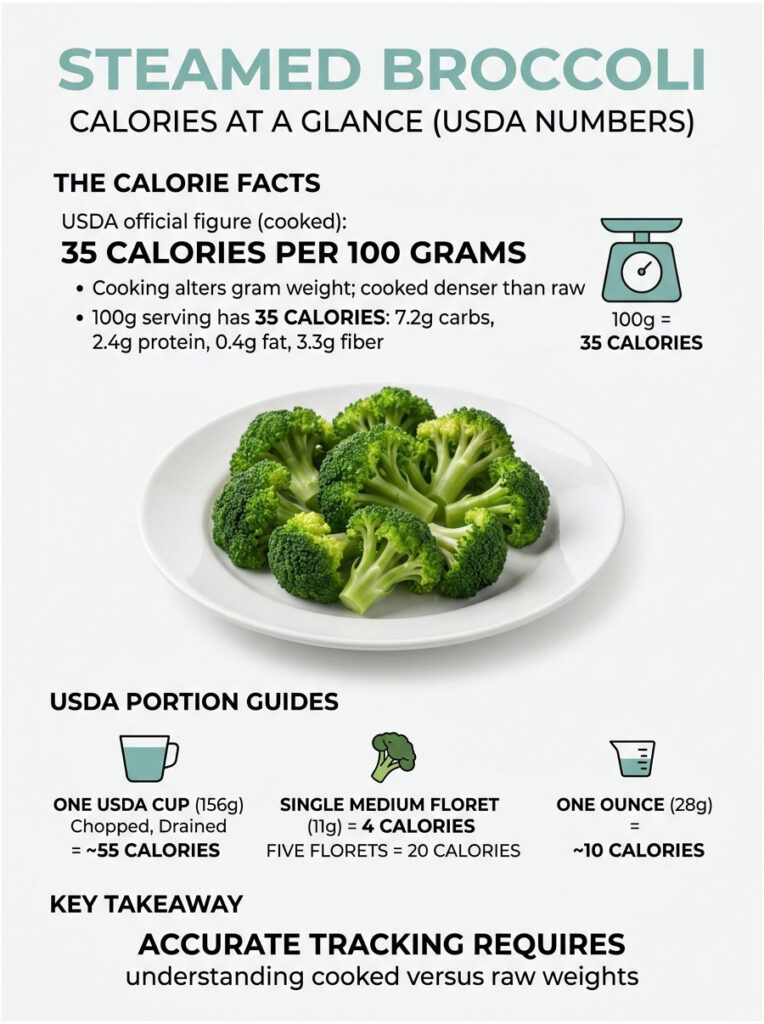
Across the patient food logs reviewed by our nutrition team at HealthCareOnTime, the most common mistake is using the raw broccoli weight when the broccoli has been cooked. Steaming wilts the vegetable and concentrates gram weight per cup, which is why one USDA cup of cooked broccoli is 156g, not the 91g you’d get from raw chopped broccoli. Same vegetable, two different numbers, and the difference matters for tracking.
Per 100 Grams
A 100g serving of steamed broccoli has 35 calories. That’s roughly the size of a small fist of cooked florets. It works out to 7.2g carbs, 2.4g protein, 0.4g fat, and 3.3g fiber.
Per 1 Cup Chopped (156g, USDA Standard)
One USDA cup of chopped, drained, steamed broccoli weighs 156 grams and contains about 55 calories. This is the figure that matches most calorie-tracking apps when they ask for “1 cup cooked.”
Per Single Floret (about 11g)
A single medium floret (about the size of a quarter) weighs around 11 grams and has just 4 calories. Five florets land you at 20 calories, which is why steamed broccoli is such a friendly snack during cutting phases.
Per Ounce (28g)
One ounce of steamed broccoli has about 10 calories. This is the unit to use when you’re weighing food on a kitchen scale rather than measuring with cups.
Table 1: Steamed Broccoli Calories and Macros by Serving Size
| Serving | Weight | Calories | Carbs (g) | Protein (g) | Fat (g) | Fiber (g) |
| 1 medium floret | 11g | 4 | 0.8 | 0.3 | <0.1 | 0.4 |
| 1 ounce | 28g | 10 | 2.0 | 0.7 | 0.1 | 0.9 |
| 100 grams | 100g | 35 | 7.2 | 2.4 | 0.4 | 3.3 |
| 1/2 cup chopped | 78g | 27 | 5.6 | 1.9 | 0.3 | 2.6 |
| 1 cup chopped | 156g | 55 | 11.2 | 3.7 | 0.6 | 5.1 |
| 2 cups chopped | 312g | 110 | 22.4 | 7.4 | 1.2 | 10.2 |
Source: USDA FoodData Central, FDC ID 169967 (cooked broccoli, boiled, drained, no salt). Steamed values are within 1 to 2 calories of boiled values per the same database.
Full Macro Breakdown of Steamed Broccoli
Calories tell you part of the story. Macros tell the rest. Steamed broccoli is one of the very few foods on the planet that’s simultaneously low-carb, low-fat, low-calorie, and decent on protein. That combination is why dietitians put it on almost every meal plan they write.
Carbs and Net Carbs (Keto and Diabetic Context)
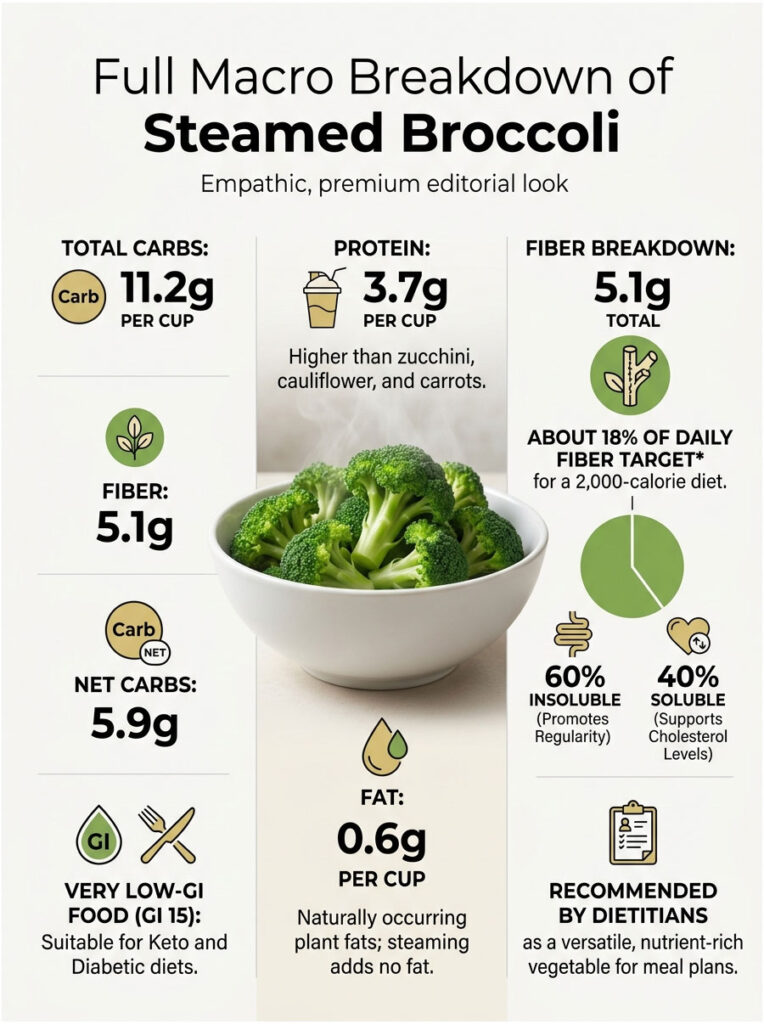
One cup of steamed broccoli has 11.2g total carbs and 5.1g fiber, which means net carbs come in at just 5.9g per cup. That’s keto-friendly territory and easily fits a diabetic meal plan.
According to the American Diabetes Association, broccoli has a glycemic index of 15, classifying it as a very low-GI food that won’t spike blood sugar. Patients HealthCareOnTime serves with HbA1c testing often see steamed broccoli recommended as a free-fill vegetable.
Protein (Per Cup and Compared to Other Vegetables)
Steamed broccoli delivers 3.7g of protein per cup. That puts it among the highest-protein vegetables, ahead of zucchini (1.2g), cauliflower (2.1g), and carrots (1.2g). Two cups gets you nearly 7.5g of plant protein for only 110 calories.
Fat Content (Naturally Almost Zero)
There’s about 0.6g of fat in a cup of steamed broccoli, all of it from naturally occurring plant fats. Steaming itself adds zero fat. The number only climbs when you start adding butter, oil, or cheese, which the next section breaks down in detail.
Fiber (Soluble vs Insoluble, Why It Matters)
Each cup gives you 5.1g of fiber, roughly 18% of the daily target the Dietary Guidelines for Americans sets at 28g for a 2,000-calorie diet. About 60% is insoluble (helps with regularity) and 40% is soluble (helps with cholesterol).
Steamed vs Other Cooking Methods (Calorie Comparison)
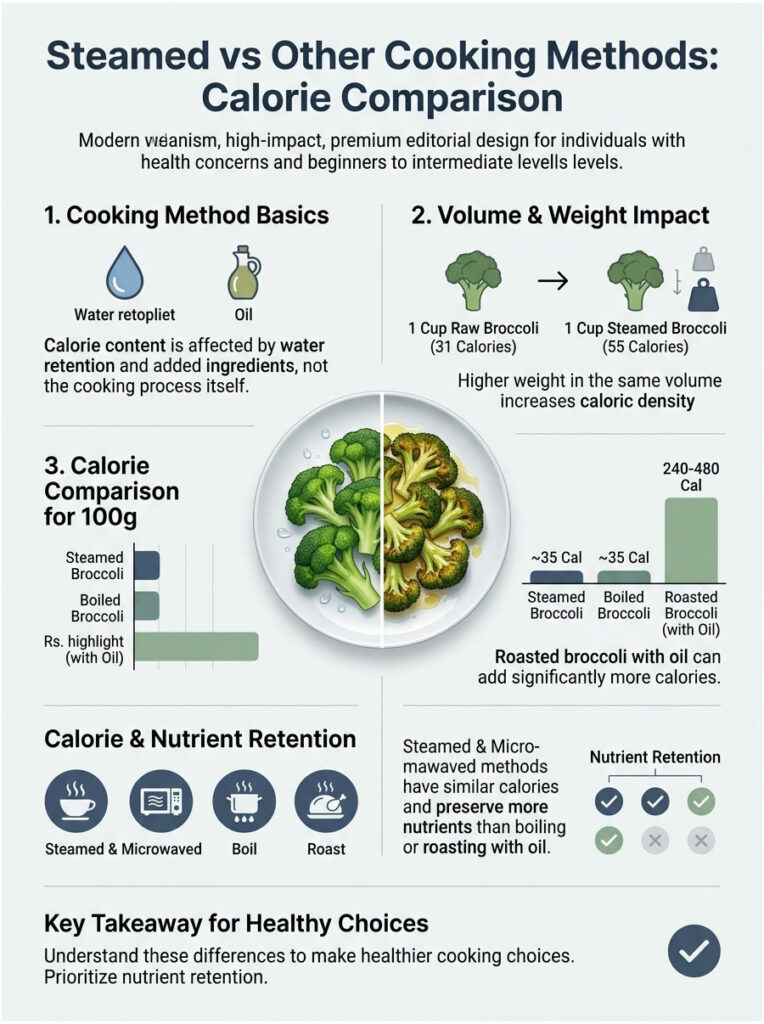
Cooking method changes calories more than people realize, but not in the way most assume. The cooking process itself doesn’t add calories to the vegetable. What changes is the water content, the volume that fits in a cup, and (most importantly) the add-ins. Patients HealthCareOnTime works with through nutrition consultations are often surprised at how dramatically a tablespoon of oil flips the math.
Steamed Broccoli vs Raw Broccoli
A cup of raw chopped broccoli weighs 91g and has 31 calories. A cup of steamed broccoli weighs 156g and has 55 calories. The reason isn’t the cooking, it’s the cup. Steaming compresses the florets so more grams fit into the same volume.
Steamed Broccoli vs Boiled Broccoli
Per 100g, steamed and boiled broccoli are nearly identical at around 35 calories. The big difference is nutrient retention. Boiling leaches up to 50% of vitamin C and a substantial portion of sulforaphane into the water you pour down the drain. Steaming preserves both, which is why our medical reviewers consistently recommend the steaming method.
Steamed Broccoli vs Roasted Broccoli (With Oil)
Here’s where the calorie math swings hard. Roasted broccoli is usually tossed with 1 to 2 tablespoons of olive oil per pound, which adds 240 to 480 extra calories per recipe. A cup of typical oven-roasted broccoli ends up at 110 to 140 calories, double or more than steamed.
Steamed Broccoli vs Microwaved Broccoli
Microwaving in a covered dish with a splash of water is essentially steaming. Calories stay the same at about 35 per 100g, and recent peer-reviewed research suggests microwaving with minimal water actually preserves vitamin C even better than stovetop steaming.
Table 2: Calorie Comparison by Cooking Method (Per 1 Cup)
| Cooking Method | Calories per Cup | Vitamin C Retention | Source |
| Raw, chopped (91g) | 31 | 100% (baseline) | USDA FDC ID 170379 |
| Steamed, drained (156g) | 55 | ~85% | USDA FDC ID 169967, J Food Sci 2023 |
| Boiled, drained (156g) | 55 | ~50% | USDA FDC ID 169967, J Food Sci 2023 |
| Microwaved (156g) | 55 | ~88% | J Agric Food Chem 2022 |
| Roasted with 1 tsp olive oil (156g) | 95 | ~70% | USDA + olive oil add-on |
| Stir-fried with 1 tbsp oil (156g) | 175 | ~65% | USDA + cooking oil add-on |
Sources: USDA FoodData Central, Journal of Food Science, and Journal of Agricultural and Food Chemistry recent research.
Vitamins and Minerals in Steamed Broccoli
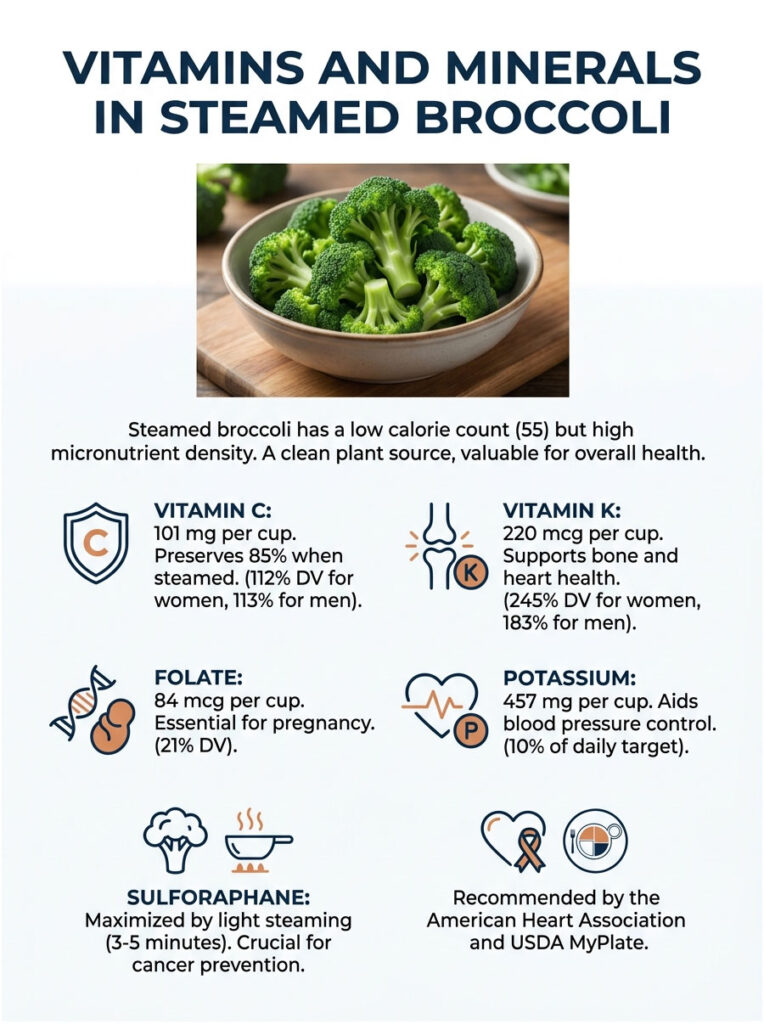
Calorie counters tend to underrate steamed broccoli because they only see “55.” The micronutrient density is what makes it a staple on the American Heart Association and USDA MyPlate recommended lists.
Vitamin C (Why Steaming Wins)
One cup of steamed broccoli delivers around 101 mg of vitamin C, which is 112% of the daily value for adult women and 113% for men, per NIH Office of Dietary Supplements reference intakes. Steaming for 3 to 5 minutes preserves about 85% of the original vitamin C, while boiling drops that to roughly 50%.
Vitamin K (Bone and Heart Function)
Vitamin K in steamed broccoli sits at 220 mcg per cup, about 245% of the daily value for women and 183% for men. Vitamin K activates proteins that direct calcium to bone instead of arteries, supporting both skeletal and cardiovascular health.
Folate (Especially for Pregnancy)
A cup of steamed broccoli provides about 84 mcg of folate, roughly 21% of the daily value. Pregnant women need 600 mcg of folate per day according to NIH, and steamed broccoli is one of the cleanest plant sources available.
Potassium (Blood Pressure Support)
One cup contains 457 mg of potassium, about 10% of the daily target. The American Heart Association flags potassium-rich vegetables as a core part of the DASH eating pattern for blood pressure control.
Sulforaphane (The Cancer-Fighting Compound)
Sulforaphane is broccoli’s headline phytochemical. Studies published in the Journal of Agricultural and Food Chemistry show that light steaming for 3 to 5 minutes maximizes sulforaphane availability, while heavy boiling can destroy 70% or more.
How Add-Ons Change the Calorie Count
This is where calorie tracking quietly goes sideways. Plain steamed broccoli is a 55-calorie cup. The same bowl with two pats of butter and parmesan can land at 250-plus. The vegetable isn’t the problem. The toppings are.
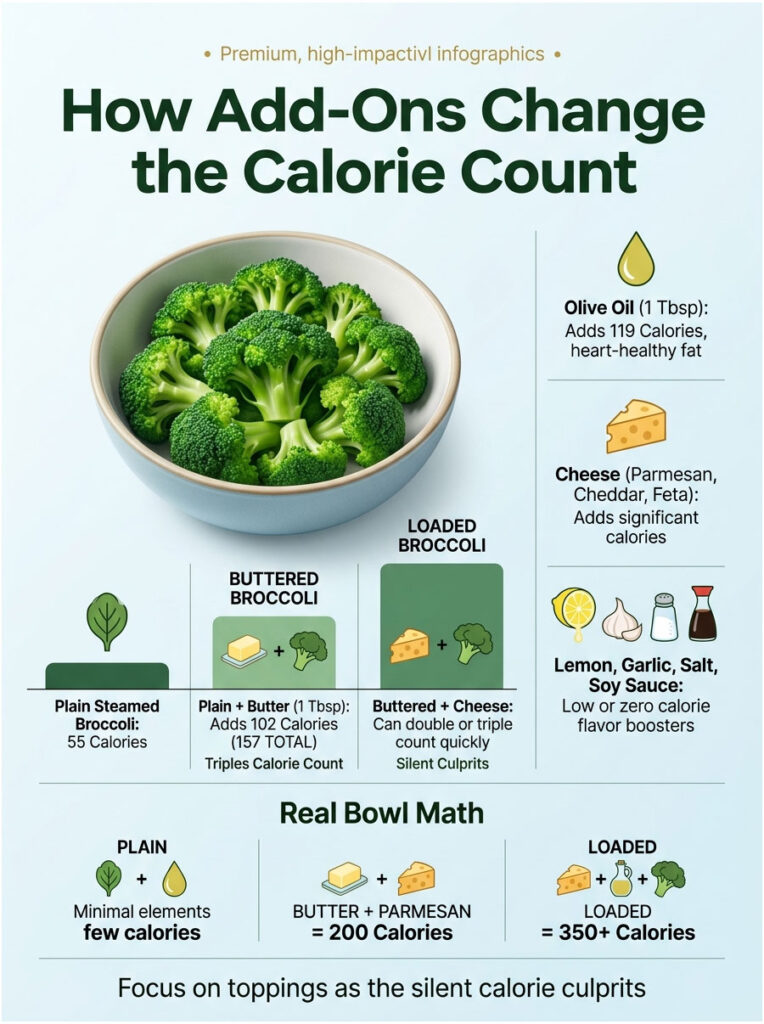
Butter (1 Tbsp Adds 102 Calories)
A single tablespoon of butter adds 102 calories and 11.5g of fat. That triples the calories of your bowl. Patients tracking macros through HealthCareOnTime weight-management panels often spot butter as the silent calorie culprit.
Olive Oil (1 Tbsp Adds 119 Calories)
Extra-virgin olive oil at 1 tablespoon brings 119 calories and 14g of fat, mostly heart-healthy monounsaturated fat. A teaspoon (closer to what most home cooks actually use) adds 40 calories and is a reasonable trade for the fat-soluble vitamin absorption boost.
Cheese (Parmesan, Cheddar, Feta)
- 2 tablespoons grated parmesan: 43 calories
- 1 ounce shredded cheddar: 113 calories
- 1 ounce crumbled feta: 75 calories
Cheese can double or triple a bowl’s calorie count fast, even in small amounts.
Lemon, Garlic, Salt, Soy Sauce (Low or Zero Calorie Boosters)
- Squeeze of fresh lemon juice: 1 calorie
- 1 minced garlic clove: 4 calories
- A pinch of salt: 0 calories (but watch sodium)
- 1 teaspoon low-sodium soy sauce: 3 calories
These flavor boosters add big taste with almost no calorie cost, which is why diet-focused readers should lean on them.
Real Bowl Math (Plain vs Buttered vs Cheesy)
A plain steamed broccoli cup: 55 calories. The same cup with 1 tablespoon butter and 2 tablespoons parmesan: 200 calories. A “loaded” version with cheddar, butter, and ranch dressing: 350-plus calories. Same vegetable, three completely different impacts on your daily total.
Steamed Broccoli for Weight Loss
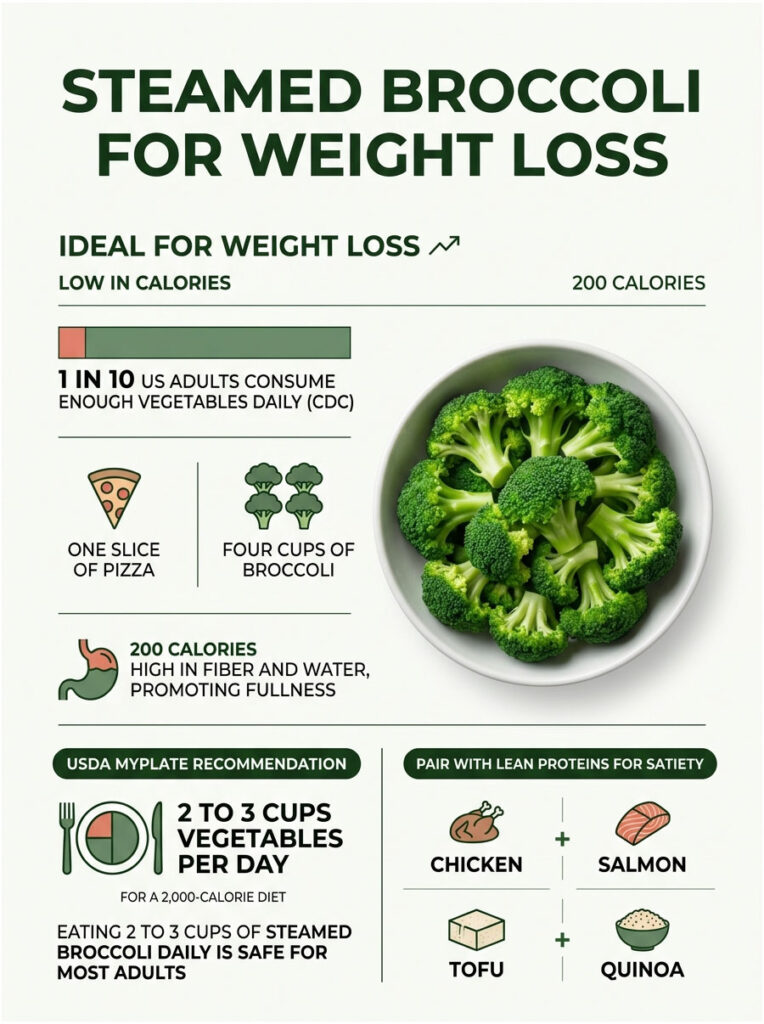
If you searched calories in steamed broccoli, you’re probably thinking about weight loss, and the math here works heavily in your favor. According to the CDC, only 1 in 10 US adults eats enough vegetables daily, and broccoli is one of the easiest to add.
Why It’s a Volume-Eater’s Dream
A 200-calorie meal might be 1 small slice of pizza or four full cups of steamed broccoli. The volume keeps you full because of the fiber and water content. The Harvard T.H. Chan School of Public Health consistently lists broccoli among its top satiety-per-calorie vegetables.
Daily Recommended Servings (USDA MyPlate)
USDA MyPlate recommends 2 to 3 cups of vegetables per day for most adults on a 2,000-calorie diet. Broccoli alone could fill that quota for under 165 calories.
How Much Is Too Much?
For most healthy adults, eating 2 to 3 cups of steamed broccoli a day is fine. Going significantly higher (4 plus cups daily) can occasionally trigger gas, bloating, or, very rarely in people on blood thinners, vitamin K issues that interfere with warfarin. Patients on warfarin should keep their vitamin K intake consistent rather than swing wildly day to day.
Smart Pairings (Chicken, Salmon, Tofu, Quinoa)
Pairing steamed broccoli with lean protein turns it from a side into a meal. Patients tracking weight through HealthCareOnTime panels often pair these proven combos: 4 oz grilled chicken plus 2 cups broccoli (290 cal), 4 oz baked salmon plus 1 cup broccoli (300 cal), or 1/2 cup quinoa plus 1 cup broccoli plus tofu (360 cal).
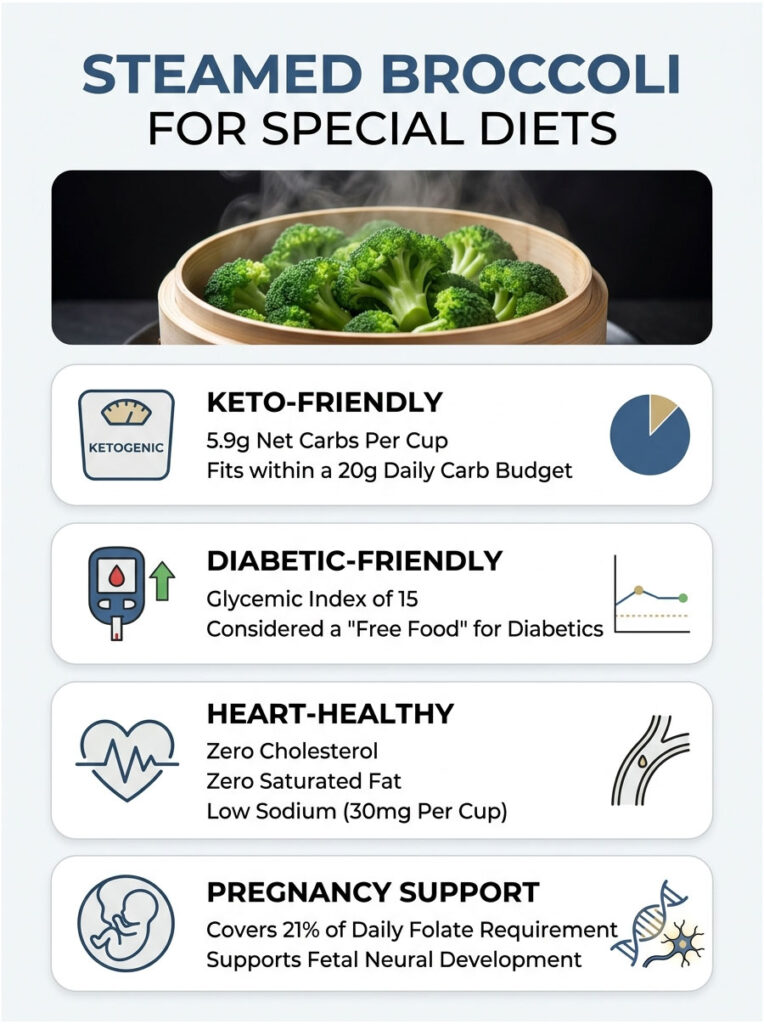
Steamed Broccoli for Special Diets
Keto-Friendly (Net Carbs Math)
At 5.9g net carbs per cup, steamed broccoli fits comfortably inside a strict 20g daily keto carb budget. It’s one of the most-recommended cruciferous vegetables on keto plans for that exact reason.
Diabetic-Friendly (GI of 15)
A glycemic index of 15 makes broccoli a “free food” in many diabetes meal plans. The fiber slows digestion further, blunting any blood sugar response. The American Diabetes Association lists broccoli as a non-starchy vegetable, which means you can eat it freely without counting carbs.
Heart-Healthy (Sodium and Cholesterol Notes)
Steamed broccoli has zero cholesterol, zero saturated fat, and naturally low sodium (about 30mg per cup unless salt is added). It hits all three boxes the AHA emphasizes for cardiovascular protection.
Pregnancy (Folate Boost)
Folate is critical in early pregnancy for neural tube development. One cup of steamed broccoli covers 21% of the daily folate requirement. Combined with prenatal vitamins, regular broccoli intake is a clean way for expecting mothers to support fetal development.
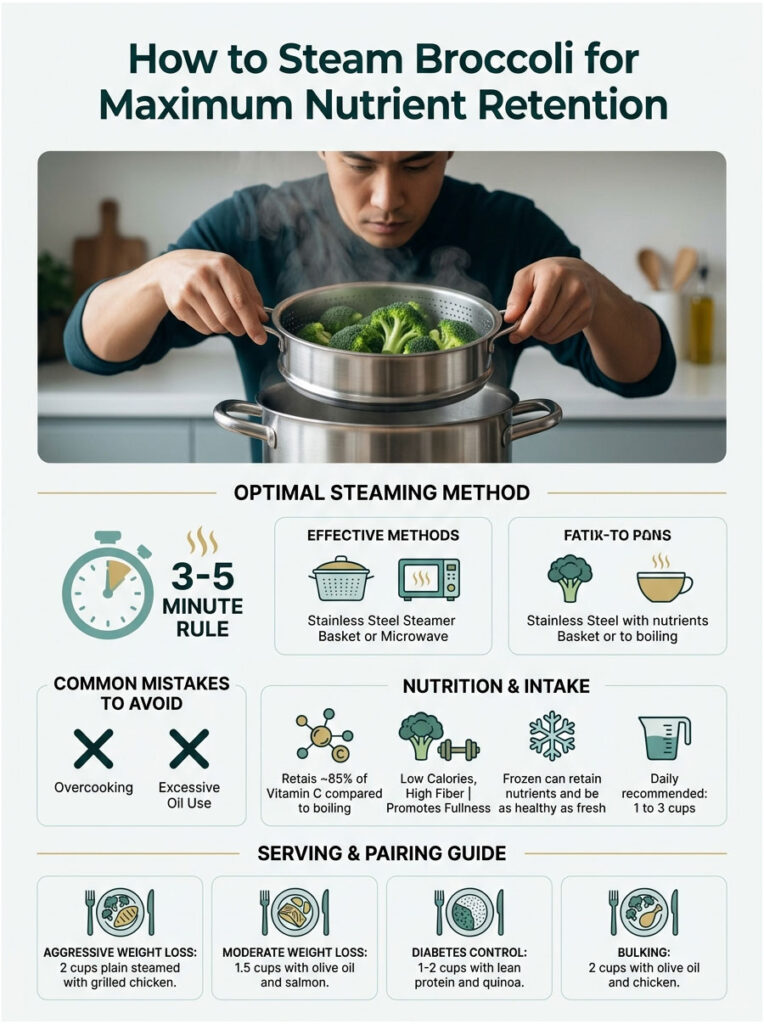
How to Steam Broccoli for Maximum Nutrient Retention
The 3-to-5-Minute Rule
Bright-green, fork-tender florets at the 3 to 5 minute mark preserve the most vitamin C and sulforaphane. Past 7 minutes, color dulls, texture goes mushy, and nutrient losses climb sharply.
Stovetop, Microwave, or Steamer Basket
A stainless steel steamer basket over an inch of simmering water is the gold standard. The microwave works just as well in a covered dish with 2 tablespoons of water for 3 minutes. Both methods keep sulforaphane and vitamin C levels high.
Common Mistakes (Overcooking, Drowning in Oil)
- Boiling instead of steaming (cuts vitamin C in half)
- Pre-chopping the day before (oxidizes vitamin C)
- Drowning in oil or butter post-cooking (negates the calorie advantage)
- Discarding the stalks (which carry as much fiber as the florets)
Table 3: If Your Goal Is X, Eat Y Serving and Pair With Z
| Your Goal | Recommended Serving | Best Pairing |
| Aggressive weight loss (under 1,500 kcal/day) | 2 cups plain steamed (110 cal) | 4 oz grilled chicken or white fish |
| Moderate weight loss / maintenance | 1.5 cups steamed with 1 tsp olive oil (122 cal) | 4 oz salmon or 3 oz lean beef |
| Diabetes / blood sugar control | 1 to 2 cups steamed (55 to 110 cal) | Lean protein + 1/3 cup quinoa |
| Keto | 1 cup steamed with 1 tbsp butter (157 cal) | Steak, eggs, or fatty fish |
| Pregnancy / folate boost | 1 cup steamed with lemon (56 cal) | Iron-rich protein (lean beef, lentils) |
| Bulking / muscle gain | 2 cups steamed with 1 tbsp olive oil (229 cal) | 6 to 8 oz chicken + 1 cup brown rice |
Source: USDA values + American Heart Association portion guidance + American Diabetes Association meal-plan templates. Patients booking metabolic panels through HealthCareOnTime are often given variations of this matrix as starting points.
Frequently Asked Questions
How many calories in 1 cup of steamed broccoli?
One USDA cup (156g) of chopped, drained steamed broccoli has about 55 calories. That’s per the cooked-broccoli reference entry in USDA FoodData Central (FDC ID 169967). The same cup gives you 11.2g carbs, 3.7g protein, 0.6g fat, and 5.1g fiber, with no sodium added.
How many calories in 100g of steamed broccoli?
A 100g portion of steamed broccoli (drained, no salt) has 35 calories per USDA FoodData Central. That’s roughly the volume of a small fist of florets. Macros include 7.2g carbs, 2.4g protein, 0.4g fat, and 3.3g fiber, making it one of the lowest-calorie cooked vegetables tracked by USDA.
Does steaming broccoli add calories?
No. Steaming uses only water vapor and adds zero calories to the vegetable. The same 100g of broccoli is about 34 calories raw and 35 calories steamed, a rounding-error difference. Calories only climb when you add fat or salt-based seasonings, like butter, oil, cheese, or sauces.
Is steamed broccoli good for weight loss?
Yes. With only 55 calories per cup and over 5g of fiber, steamed broccoli ranks among the highest-volume, lowest-calorie foods you can eat. The fiber and water content keep you full longer. Replacing one daily 200-calorie side with two cups of steamed broccoli saves about 90 calories.
How many calories in steamed broccoli with butter?
One cup of steamed broccoli plus 1 tablespoon of butter has approximately 157 calories (55 from broccoli, 102 from butter). The butter adds 11.5g of fat and triples the calorie load of the bowl. Switching to 1 teaspoon of olive oil instead drops the total to about 95 calories.
How many calories in 2 cups of steamed broccoli?
Two cups of plain steamed broccoli (312g) contain about 110 calories. You also get 22.4g of carbs, 7.4g of protein, 1.2g of fat, and 10.2g of fiber, which is more than a third of the daily fiber target for adults. It’s a huge volume of food for the calorie cost.
Is broccoli a negative-calorie food?
Not exactly. The “negative-calorie” myth claims digestion burns more calories than the food contains, which isn’t supported by research. Broccoli is, however, extremely low in calories (35 per 100g) with high fiber, so the net energy contribution is small. It’s still calorie-positive, just barely.
How much steamed broccoli should you eat a day?
Most adults can safely eat 1 to 3 cups of steamed broccoli daily. USDA MyPlate recommends 2 to 3 cups of vegetables a day for a 2,000-calorie diet. Patients on warfarin should keep vitamin K intake consistent. Anyone with IBS may want to start with 1/2 cup and increase gradually.
Does steaming broccoli destroy vitamin C?
Steaming preserves about 85% of broccoli’s vitamin C, far better than boiling (which loses up to 50%). Light steaming for 3 to 5 minutes hits the sweet spot between texture and nutrient retention. One cup of steamed broccoli still delivers 101 mg of vitamin C, more than 100% of the adult daily value.
How many carbs and net carbs are in steamed broccoli?
One cup of steamed broccoli (156g) has 11.2g of total carbs and 5.1g of fiber, which means net carbs come in at just 5.9g per cup. That’s keto-friendly and diabetic-friendly territory. Two full cups still keep you under 12g of net carbs, well within most low-carb targets.
How much protein is in steamed broccoli?
A cup of steamed broccoli has 3.7g of protein, making it one of the higher-protein non-leafy vegetables. Two cups give you 7.4g, more than a large egg’s protein content. While not a primary protein source, broccoli is a useful contributor when paired with chicken, fish, or legumes for total daily intake.
Is frozen steamed broccoli as healthy as fresh?
Yes, often even more so. Brands like Birds Eye Steamfresh and Green Giant Simply Steam flash-freeze broccoli at peak ripeness, locking in vitamin C and folate. USDA data shows frozen steamed broccoli matches fresh on calories (35 per 100g) and frequently exceeds it on vitamin C if the fresh produce sat for days.
Disclaimer
This article is for educational purposes only and does not replace personalized medical or nutritional advice. Calorie and macronutrient values are based on USDA FoodData Central reference data and may vary slightly by variety, growing conditions, and exact cooking time. Always consult your physician or registered dietitian before making major dietary changes, especially if you take medications like warfarin (which interacts with vitamin K) or manage conditions like diabetes, kidney disease, or IBS.
References
- USDA FoodData Central. Cooked Broccoli, Boiled, Drained, Without Salt (FDC ID 169967). fdc.nal.usda.gov
- USDA FoodData Central. Raw Broccoli (FDC ID 170379). fdc.nal.usda.gov
- USDA MyPlate. Vegetables Group Daily Recommendations. myplate.gov
- Dietary Guidelines for Americans, 2020 to 2025. dietaryguidelines.gov
- NIH Office of Dietary Supplements. Vitamin C, Vitamin K, and Folate Fact Sheets. ods.od.nih.gov
- Centers for Disease Control and Prevention. Adults Meeting Fruit and Vegetable Intake Recommendations. cdc.gov
- American Heart Association. DASH Eating Plan. heart.org
- American Diabetes Association. Non-Starchy Vegetables. diabetes.org
- Harvard T.H. Chan School of Public Health. The Nutrition Source: Vegetables. hsph.harvard.edu
- Journal of Agricultural and Food Chemistry. Sulforaphane Bioavailability and Cooking Methods. pubs.acs.org/journal/jafcau
- Journal of Food Science. Vitamin C Retention in Steamed vs Boiled Vegetables. onlinelibrary.wiley.com
- Vasanthi HR, et al. Health Benefits of Cruciferous Vegetables. PMID: 31817427