
You’re in the bathroom, staring at a faint pink smudge on the toilet paper, running the math in your head. Your period isn’t quite due. You’ve been trying (or maybe not trying) to get pregnant. And your brain is bouncing between two answers that feel worlds apart.
Table of Contents
That single moment drives one of the most-searched questions in early pregnancy. It deserves a clear answer instead of a guessing game, and it deserves one that doesn’t pretend the situation is simpler than it is.
Quick Answer: Implantation bleeding is light spotting that stays light. A period usually starts light and gets heavier over a few hours. The popular “4-hour rule” says bleeding that doesn’t intensify within about four hours may be implantation, while bleeding that steadily builds is more likely your period. It’s a helpful memory aid, not a diagnosis. The only dependable way to know is a pregnancy test taken after a missed period.
At a Glance
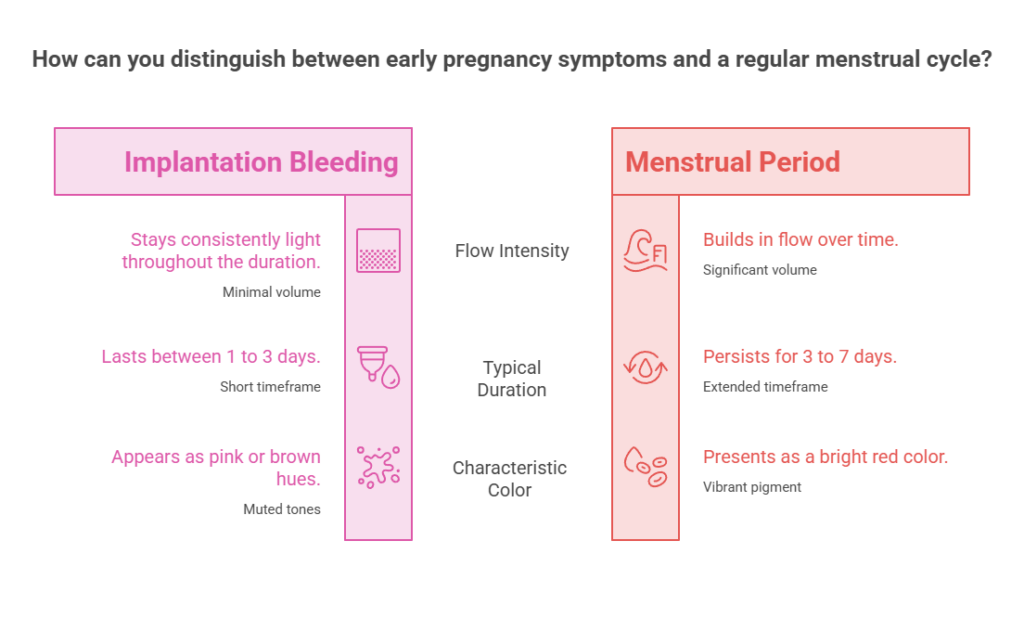
- Implantation bleeding stays light; a period builds in flow. That contrast is your most useful clue.
- The “4-hour rule” is a rule of thumb, not medical proof. Treat it as a starting point, not a verdict.
- About 1 in 4 women have implantation bleeding, so missing it doesn’t mean you’re not pregnant.
- Color (pink or brown versus bright red), duration (1 to 3 days versus 3 to 7), and clots all help.
- Light bleeding does not rule out a problem. Ectopic pregnancy often bleeds light, so spotting plus pain needs care.
- A pregnancy test after your missed period is the only reliable answer.
- Sharp one-sided pain, dizziness, or feeling faint means call a doctor the same day.
What Implantation Bleeding Actually Is
Implantation bleeding is light spotting that can happen when a fertilized egg attaches to the lining of your uterus. It’s one of the earliest physical hints that a pregnancy may be starting.
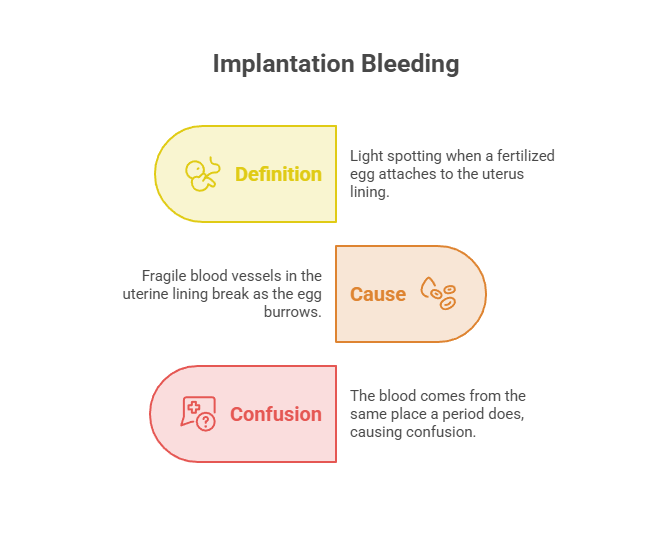
The bleeding appears because your uterine lining is packed with tiny, fragile blood vessels. As the egg burrows in, a few of those vessels can break, and a small amount of blood works its way out.
Readers trying to conceive ask our team about early spotting more than almost any other first-trimester question, and the confusion makes sense. The blood comes from the same place a period does, so your body can’t exactly hand you a label.
How Implantation Happens
After an egg is fertilized in the fallopian tube, it travels toward the uterus over several days. By the time it arrives, it has become a tiny ball of cells called a blastocyst.
That blastocyst settles into the endometrium, your uterine lining, and begins forming what will become the placenta. This attachment is implantation, and it marks the real beginning of a pregnancy.
Once implantation is underway, the developing tissue starts producing human chorionic gonadotropin (hCG), the hormone pregnancy tests look for. That detail matters later when we talk about timing your test.
How Common It Really Is
If you don’t notice any spotting, don’t read too much into it. Cleveland Clinic notes that about 1 in 4 pregnant women experience implantation bleeding, which means most don’t, or don’t notice it.
Some women see it once and never again. Others have light spotting on and off for a day or two. Both patterns sit comfortably within the normal range.
Patients who book pregnancy-related blood work through HealthCareOnTime often describe this exact moment of uncertainty. If you’re second-guessing yourself, you’re in very common company.
What It Typically Looks and Feels Like
Implantation bleeding usually shows up as a small amount of pink or brown discharge, often noticed only when you wipe or as a faint mark in your underwear. It rarely fills a pad.
It may come and go rather than flow steadily, and it’s often painless or paired with the mildest cramping. Think tinted discharge, not a stream.
That light, on-and-off quality is exactly why it gets mistaken for the start of a period, and why the rest of this guide focuses on the clues that tell them apart.
What the “4-Hour Rule” Really Means (and What It Misses)
The “4-hour rule” has been circulating on pregnancy forums and symptom-checker sites. The idea is simple: watch your bleeding for about four hours and see which direction it goes.
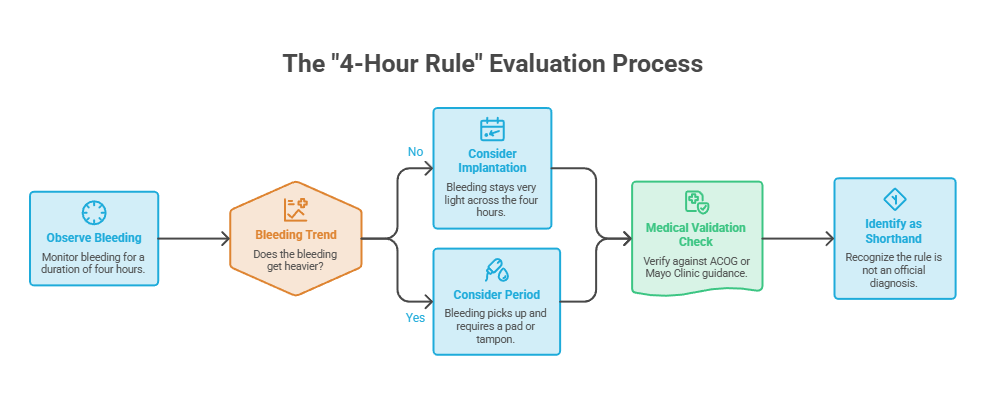
If the bleeding stays very light and doesn’t get heavier across those hours, the rule says it may be implantation. If it picks up and you reach for a pad or tampon, it leans toward your period.
Here’s the honest part. That rule isn’t an official guideline from any major US medical body. You won’t find a “4-hour rule” in ACOG or Mayo Clinic guidance. It’s popular shorthand, not a diagnosis.
Where the Rule Comes From
The rule caught on because it’s catchy and easy to remember. People want a clear test they can run at home, and “watch it for four hours” feels concrete in a moment that feels anything but.
Our editorial reviewers see this term repeated across forums stripped of the context that makes it safe to use. Without that context, a simple rule can do more harm than good.
It also gives a feeling of control. When you can’t test yet and can’t stop thinking about it, a stopwatch feels like a plan. That’s understandable, but a feeling of certainty isn’t the same as certainty.
The Real Principle Underneath It
The rule isn’t pure nonsense, though. It’s a simplified version of something doctors genuinely watch: how your bleeding behaves over time.
A true period is driven by hormone shifts that cause your uterine lining to shed. That shedding tends to build, so menstrual flow usually starts light, turns heavier, then tapers.
Implantation bleeding doesn’t follow that arc. It’s light, often intermittent, and it doesn’t ramp into a full flow. So the principle behind the rule, does the bleeding climb or stay flat, is real and useful.
Why “Light and Not Worsening” Doesn’t Equal “Safe”
This is the part the rule leaves out, and it’s the part that matters most. Light bleeding that doesn’t get heavier is not automatically harmless.
An ectopic pregnancy, where a fertilized egg implants outside the uterus, often shows up as light bleeding or spotting rather than a heavy flow. That’s exactly the kind of bleeding the 4-hour rule would wave through as “probably fine.”
In the questions our team fields, the most common mistake is assuming light bleeding rules out a problem. Use the rule as one clue among several, never as permission to ignore pain, dizziness, or other warning signs.
Implantation Bleeding vs Period: The 7 Real Differences
Doctors don’t rely on a single sign to tell these apart. They read a cluster of clues, and so should you. Color, flow, duration, amount, clots, cramping, and timing each tell part of the story.
The table below lines up implantation bleeding against a period across the features that matter most.
| Feature | Implantation Bleeding | Period | Why It Matters |
| Color | Pink or brown (often older blood) | Bright red to dark red | Brown or pink hints at slow, light bleeding |
| Flow over time | Stays light, may start and stop | Starts light, then gets heavier | Progression is the single most useful tell |
| Duration | A few hours up to 1 to 3 days | Usually 3 to 7 days | Short and self-limiting points toward implantation |
| Amount | Spotting; a panty liner at most | Enough to need pads or tampons | Soaking through protection isn’t typical of implantation |
| Clots | Usually none | Clots common, especially on heavy days | Clots strongly suggest a period |
| Cramps | Mild, brief, sometimes a one-sided twinge | Mild to strong, lower abdomen | Intensity helps separate the two |
| Timing | About 6 to 12 days after ovulation | At your cycle’s end, roughly on schedule | Calendar timing is a strong clue |
Timing on the Calendar
When the bleeding shows up tells you a lot. Implantation tends to happen earlier than your expected period, while a period arrives roughly on schedule.
ACOG and other sources place implantation around 6 to 12 days after ovulation, which often lands a few days before your period is due. Cleveland Clinic frames it as roughly 10 to 14 days after ovulation, so there’s a window, not a fixed date.
If you track your cycle, count back. Spotting at day 22 of a 28-day cycle leans toward implantation; bleeding right at day 28 leans toward your period. Across the readers we hear from, the calmest ones are usually those who jotted down their dates.
Color and Consistency
Color is a quieter clue, but a useful one. Implantation bleeding skews pink or brown, while a period more often runs bright or dark red, especially once it’s flowing.
Consistency matters too. Implantation spotting tends to be thin and on-and-off, almost like tinted discharge, rather than a steady stream you have to manage.
What Brown Spotting (Old Blood) Means
Brown blood usually means older blood that took its time leaving the body. That’s common with implantation bleeding, with spotting between periods, and at the very start or end of a period.
Bright red blood, by contrast, signals fresh, active bleeding, which fits a period better. Color alone won’t settle the question, but it adds weight to the other clues.
Cramps: Implantation vs Period
Cramping confuses people because both can cause it. The difference is usually intensity and length, not whether cramps happen at all.
Implantation cramps tend to be light and short, sometimes a faint twinge low in the abdomen. Period cramps more often build, last longer, and can range from mild to strong. Severe or escalating pain doesn’t fit normal implantation and is worth a call.
Other Reasons You Might Be Spotting
Implantation and a period aren’t the only explanations for mid-cycle blood. Several harmless causes can mimic both, and knowing them helps you stay calm instead of spiraling.
This matters because the internet tends to jump straight to pregnancy or emergency, when the real answer is often something ordinary. Patients commonly ask us about these in-between situations.
A Sensitive (Friable) Cervix
During pregnancy and at other times, blood flow to the cervix increases, which can make it bleed more easily. This is sometimes called a friable cervix.
That’s why some people notice light spotting after sex or a pelvic exam. Bleeding from a sensitive cervix is usually not a cause for concern, though it’s worth mentioning to your provider.
Ovulation Spotting
A small number of women spot briefly around ovulation, near the middle of the cycle. The hormonal shift that releases an egg can trigger light, short-lived bleeding.
Because ovulation falls well before your period is due, timing usually separates it from both implantation and menstruation. It tends to be very light and resolves on its own.
Birth Control and IUDs
Starting, stopping, or switching hormonal birth control can cause breakthrough bleeding while your body adjusts. This is common in the first few months on a new method.
Hormonal and copper IUDs can also cause spotting, especially early on. If you’ve recently changed contraception, that may be the simplest explanation for unexpected blood.
Stress and Hormonal Shifts
Significant stress, big changes in sleep or weight, and thyroid or other hormonal fluctuations can nudge your cycle and produce spotting. The bleeding is usually light and irregular.
It’s easy to overlook how much life stress affects a cycle. If your spotting lines up with an unusually hard stretch, that context is worth weighing alongside the other clues.
Subchorionic Hemorrhage
In some early pregnancies, a small pocket of blood collects between the uterine wall and the membrane around the embryo. This is a subchorionic hemorrhage, and it can cause light bleeding.
Many resolve on their own and the pregnancy continues. Still, any bleeding in a confirmed pregnancy should be reported to your provider so they can assess it properly.
Infection or Irritation
A vaginal or cervical infection, or simple irritation, can cause spotting too. Infections sometimes come with discharge changes, odor, itching, or discomfort.
If those symptoms show up with bleeding, that points toward a cause your provider can treat. Don’t try to diagnose an infection on your own.
By the Numbers: What US Data Tells Us
Sometimes plain numbers settle the spinning thoughts better than reassurance does. The figures below come from established US sources and help put your situation in context.
| Metric | Figure | Source |
| Women who experience implantation bleeding | About 1 in 4 (25%) | Cleveland Clinic |
| Pregnancies with first-trimester bleeding | Roughly 15 to 25% | ACOG and others |
| Typical implantation window | 6 to 12 days after ovulation | ACOG |
| Known pregnancies ending in miscarriage | About 10 to 20% | Mayo Clinic |
| Ectopic pregnancies in the US (ED data, 2006 to 2013) | About 7 to 8 per 1,000 pregnancies | CDC |
| Home pregnancy test accuracy (used correctly) | About 99% | Mayo Clinic |
A few of these deserve a second look. The fact that first-trimester bleeding shows up in up to a quarter of pregnancies tells you that some bleeding, by itself, is not a red alert.
At the same time, miscarriage affects a meaningful share of known pregnancies, and many happen so early that people assume the bleeding was a period. That’s why pairing the numbers with your own symptoms matters.
The ectopic figures come from CDC emergency-department data spanning 2006 to 2013, so treat them as a general scale rather than a current-year count. Ectopic pregnancy is uncommon, not rare, and it’s treatable when caught early, which is the whole reason doctors take early bleeding with pain seriously.
When Spotting Is a Red Flag (Don’t Skip This)
Most light spotting turns out to be harmless. Still, a handful of warning signs mean you should stop watching the clock and reach out to a professional.
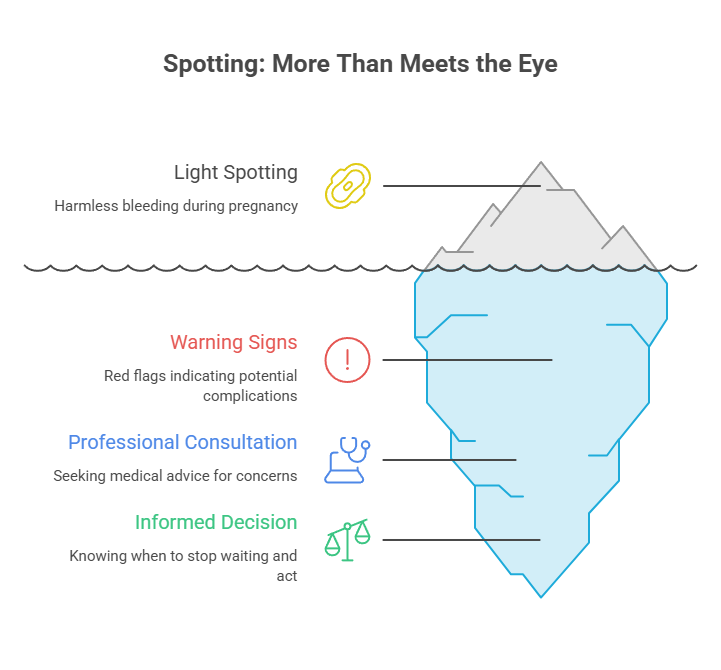
This section isn’t meant to scare you. It’s meant to give you a short, clear list so you know when “wait and see” stops being the right move.
Ectopic Pregnancy Warning Signs
An ectopic pregnancy can’t develop normally and can become a medical emergency if it ruptures. The classic combination is light vaginal bleeding plus pain, often on one side of the lower abdomen.
Other signs include dizziness or feeling faint, shoulder-tip pain, and pain that worsens rather than eases. If you have a positive test or could be pregnant and any of these appear, treat it as urgent.
Miscarriage Signs
Bleeding that gets heavier in a known or suspected pregnancy can point to a miscarriage, especially with cramping and the passing of tissue or clots. Threatened miscarriage often shows up as bleeding with belly pain in the first trimester.
Not all early bleeding ends a pregnancy. Plenty continue after some spotting, which is exactly why a provider’s evaluation, rather than self-diagnosis, is the right next step.
When to Call Your Doctor or Head to the ER
You don’t need a perfect explanation to make the call. The table below covers the situations that warrant prompt attention.
| Your Situation | What It Might Mean | What To Do |
| Light pink or brown spotting, stops in a day or two, no real pain, period not due yet | Possibly implantation bleeding | Wait, track the dates, test once your period is late |
| Bleeding starts light then turns heavy and red, maybe with clots, on your usual schedule | Most likely your period | Treat as a normal period; test later if it’s oddly light or short |
| Light bleeding plus sharp or one-sided pelvic pain, dizziness, or shoulder pain | Could be an ectopic pregnancy | Seek urgent or ER care the same day |
| Heavier bleeding with cramping and a positive test or known pregnancy | Possible miscarriage | Call your OB-GYN promptly |
| Spotting after sex or a pelvic exam during a known pregnancy | Often a sensitive (friable) cervix | Mention it to your provider; usually not an emergency |
| Any bleeding you’re unsure about, or with fever or feeling faint | Needs evaluation | Contact your doctor; don’t wait it out |
Disclaimer: This article is for general education and isn’t a substitute for personal medical advice. Bleeding in early pregnancy can have many causes, and only a qualified clinician can assess your specific situation. If you’re worried, pregnant, or have pain alongside bleeding, contact your healthcare provider or seek urgent care.
How to Track What’s Happening
When you can’t test yet, good notes are the next best thing. They turn a blur of worry into a few concrete facts, and those facts help you and your doctor far more than memory does.
This is the practical move that takes the pressure off. Instead of refreshing the same thoughts, you write down what you see and let the pattern reveal itself.
What to Write Down
Note when the spotting started and where you are in your cycle. Record the color (pink, brown, or red), how light or heavy it is, and whether you’re using a liner, a pad, or nothing.
Add any cramping and how strong it is, plus other symptoms like sore breasts, nausea, or fatigue. A simple phone note with date and time stamps does the job.
Why Your Notes Help Your Doctor
A clear timeline lets a provider see the trajectory at a glance: did the bleeding climb or stay flat, how long did it last, and what came with it. That picture speeds up the conversation.
Our lab partners note that patients who arrive with a short symptom log tend to get to the right tests faster. Your notes aren’t just for reassurance; they’re useful clinical detail.
When and How to Take a Pregnancy Test
A test is the closest thing to a real answer you’ll get at home. The trick is timing it so the result actually means something.
Home pregnancy tests work by detecting hCG in your urine, and your body only starts making that hormone after implantation. Test too soon and there may not be enough hCG to register, which produces a false negative.
Why Testing Too Early Backfires
If you spot, feel hopeful, and test the next morning, a negative result might just mean it’s early. hCG becomes detectable around 10 days after conception, but levels rise gradually rather than spiking overnight.
That gap is why people get a negative test, then a positive one a few days later. The hormone simply needed time to build to a detectable level.
Urine Test vs Blood Test
A home urine test is convenient and, when used correctly, about 99% accurate. Testing with your first morning urine gives the highest hCG concentration and the most reliable read.
A blood test, ordered by a provider, can detect pregnancy earlier and measure the exact hCG level. Because early-pregnancy hCG tends to rise on a predictable schedule, repeat blood tests can also show whether levels are climbing as expected.
The Best Time to Test After Spotting
The most reliable moment is on or after the day your period is due. If your cycles are irregular, waiting about three weeks after the sexual activity in question gives hCG time to climb.
When used correctly, home pregnancy tests are about 99% accurate. If you get a negative result but your period still doesn’t arrive, wait a few days and retest, or ask your provider for a blood test.
What to Remember
Tell the two apart by behavior, not by a single glance. Implantation bleeding stays light and brief; a period builds, runs red, and often brings clots and stronger cramps.
The 4-hour rule can nudge your thinking, but it can’t replace a test, and it can’t override pain or other warning signs. Watch the pattern, note your dates, and test at the right time.
When something feels off, lean toward caution. A quick call to a provider beats hours of worried scrolling, and most of the time you’ll walk away reassured.
Frequently Asked Questions
How do I know if it’s my period or implantation bleeding?
Look at the pattern, not one moment. Implantation bleeding stays light, runs pink or brown, and lasts a few hours to a couple of days. A period starts light, turns red, gets heavier, and may bring clots. A pregnancy test after a missed period gives the real answer.
What color is implantation bleeding?
Implantation bleeding is usually light pink or brown, because it tends to be older, slow-moving blood. A period more often appears bright red or dark red, especially once flow picks up. Color is a helpful clue, but not proof on its own, so weigh it alongside flow, duration, and timing.
How long does implantation bleeding last?
Implantation bleeding is short-lived. For many women it’s a few hours to one or two days, and it may come and go rather than run steadily. A typical period lasts about 3 to 7 days. Bleeding that stretches well past a couple of days and gets heavier points toward a period.
Can implantation bleeding be heavy or fill a pad?
Heavy bleeding isn’t typical of implantation. It’s spotting, usually needing nothing more than a panty liner. If you’re soaking through pads or tampons, that’s far more consistent with a period or, less often, another issue a provider should check, especially if you have pain.
Does implantation bleeding have clots?
Implantation bleeding generally doesn’t produce clots. Because it’s light, it tends to look like spotting or tinted discharge rather than a mix of blood and tissue. Clots are much more common with menstrual bleeding. If you notice clots, you can be fairly confident you’re looking at a period.
Is the 4-hour rule accurate?
The 4-hour rule is a popular memory aid, not a medical diagnosis, and no major US health body endorses it as a test. The principle behind it (a period builds while implantation stays light) is real. The danger is that light bleeding can also signal an ectopic pregnancy, so never use the rule to dismiss pain.
Can you have implantation bleeding and still get your period?
Not in the usual sense. If implantation happens, a true period that month typically doesn’t follow, since pregnancy pauses the menstrual cycle. What can happen is light early-pregnancy bleeding mistaken for a light period. If your period seems unusually light or short, a test is worth taking.
How many days after ovulation does implantation bleeding happen?
Implantation usually occurs about 6 to 12 days after ovulation, with some sources citing 10 to 14 days. That often lands a few days before your expected period, which is part of why the two are so easy to confuse. Tracking your ovulation and cycle dates makes the timing far easier to read.
Can implantation bleeding cause cramps?
Yes, mild cramping can accompany implantation. These cramps are usually light and short, sometimes felt as a small twinge low in the abdomen. Period cramps tend to be stronger and last longer. Strong, escalating, or one-sided pain isn’t typical of normal implantation and deserves a call to your provider.
When should I take a pregnancy test after spotting?
Wait until on or after the day your period is due for the most reliable result. Testing earlier risks a false negative, since hCG needs time to build after implantation. If your cycles are irregular, test about three weeks after possible conception. A negative result with no period means retest in a few days.
Is light spotting always a sign of pregnancy?
No. Light spotting has many causes besides implantation, including hormonal shifts, stress, a sensitive cervix, ovulation, birth control changes, or the start or end of a period. Only about 1 in 4 pregnant women notice implantation bleeding at all. A test, taken at the right time, is the way to confirm or rule out pregnancy.
When should I see a doctor about early-pregnancy bleeding?
Reach out promptly if bleeding is heavy, comes with sharp or one-sided pelvic pain, or brings dizziness, faintness, fever, or shoulder pain. Those can signal an ectopic pregnancy or miscarriage. When you’re pregnant or could be and feel unsure about any bleeding, it’s always reasonable to call your provider rather than wait.
References
- Implantation Bleeding: Causes, Symptoms & What To Expect, Cleveland Clinic
- Bleeding During Pregnancy, The American College of Obstetricians and Gynecologists (ACOG)
- Ectopic Pregnancy, The American College of Obstetricians and Gynecologists (ACOG)
- Implantation Bleeding: Common in Early Pregnancy?, Mayo Clinic
- Miscarriage: Symptoms and Causes, Mayo Clinic
- Home Pregnancy Tests: Can You Trust the Results?, Mayo Clinic
- Trends in Ectopic Pregnancy Diagnoses in United States Emergency Departments, CDC
- Human Chorionic Gonadotropin, StatPearls / NIH (NCBI Bookshelf)
- Implantation Bleeding vs. Your Period: How to Tell the Difference, Essentia Health