Britain’s Royal Air Force never claimed carrots gave its pilots night vision. Food officials in London invented that story in 1940 to hide a radar system, and more than eighty years later American parents still repeat it at the dinner table.
Table of Contents
The odd part is that the lie was built on a real nutrient. Carrots do feed your retina something it cannot work without. What they will not do is the thing almost everyone assumes.
Quick Answer
Yes, with limits. Carrots supply beta-carotene, which becomes vitamin A, the raw material your retina uses to see in dim light. If you are vitamin A deficient, carrots restore night vision. If your levels are normal, extra carrots will not sharpen sight or replace glasses.
At a Glance
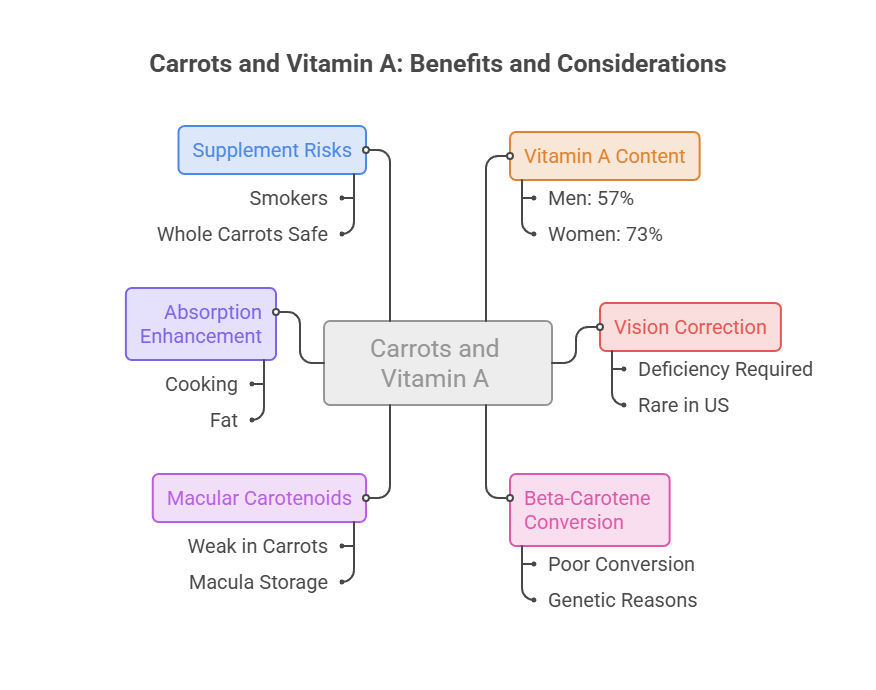
One medium raw carrot delivers about 509 mcg RAE of vitamin A activity, roughly 57% of the daily target for men and 73% for women
Vitamin A corrects vision only when a real deficiency exists, and frank deficiency is rare in the United States
About 4 in 10 people convert beta-carotene poorly for genetic reasons, so carrots work better for some bodies than others
Carrots are weak in lutein and zeaxanthin, the two carotenoids your macula actually stores
Cooking carrots and eating them with a little fat raises how much you absorb
Beta-carotene in supplement form carries a lung cancer signal in smokers; whole carrots do not
Where the Carrot Myth Came From, and Why It Still Matters
Start with the history, because the reason so many Americans believe carrots and eye health are tightly linked has nothing to do with a laboratory.
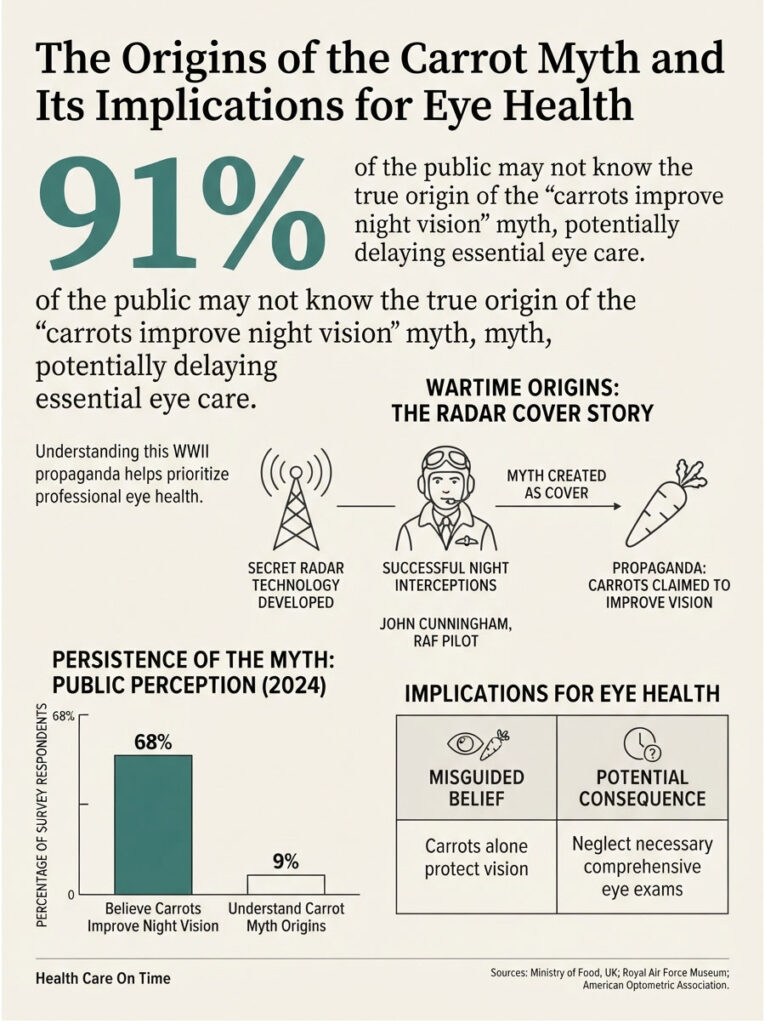
During the Blitz, Britain deployed airborne interception radar that let night fighters find German bombers in total darkness. The technology had to stay secret.
In 1940, RAF fighter ace John Cunningham, nicknamed “Cat’s Eyes,” became the first British pilot to shoot down an enemy plane using that radar, eventually reaching 20 kills, 19 of them at night. The government told newspapers the real reason for the RAF’s success was that pilots like Cunningham ate an excess of carrots.
A cover story that solved two problems at once
Britain was rationing imported food and sitting on a vegetable it grew in abundance. The propaganda served the war effort and the pantry simultaneously.
Posters, BBC radio broadcasts, and a cartoon mascot named Doctor Carrot pushed the public to eat more, and by 1942 the country had built a 100,000-ton carrot surplus. The Ministry of Food ran daily recipes on the BBC program The Kitchen Front, and Food Minister Lord Woolton was quoted saying a carrot a day keeps the blackout at bay.
How it reached American kitchens
A Washington Post article on December 7, 1941 profiled Cunningham admiringly and suggested his diet would push parents in Britain and across the Atlantic to feed their children carrots, as Americans braced for their own blackouts.
Whether German intelligence ever fell for it remains debated. A Royal Air Force Museum curator has argued the British were happy to go along with the story but never set out to fool the Germans, who already knew about ground-based radar.
The claim survived because it is half true, and half-truths are the hardest kind to kill. The cost today is not historical trivia. Americans who believe carrots protect their vision skip the eye exam that would catch glaucoma while it is still silent.
The Short Answer: What Carrots Can and Cannot Do for Your Eyes
Carrots earn their reputation through one pathway. Beta-carotene travels to the liver, converts to retinol, and moves to the retina.
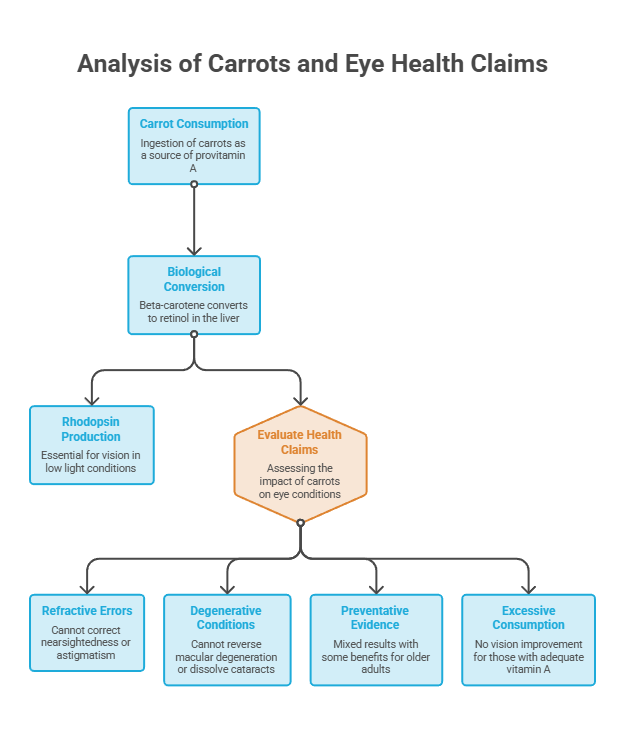
There it becomes 11-cis-retinal and binds with a protein called opsin to form rhodopsin, the light-sensitive pigment your rod cells use in low light. No vitamin A, no rhodopsin, no dark adaptation.
That chain is real. The trouble starts with what people extrapolate from it.
What carrots genuinely deliver
Carrots are among the most efficient sources of provitamin A in the American grocery store, and they are cheap, shelf-stable, and easy to eat raw. They also carry alpha-carotene, a second provitamin A carotenoid that shows some of the strongest protective signals in recent US population data.
Patients booking vision-related panels through HealthCareOnTime ask whether carrots are good for eye health more often than almost any other food question, usually right after a first pair of reading glasses.
What carrots cannot deliver
More carrots will not improve acuity in someone whose vitamin A status is already adequate. Once liver stores are full and rhodopsin production is running normally, additional retinol has nowhere useful to go.
Carrots cannot correct refractive error. Nearsightedness, farsightedness, and astigmatism are shape-and-focus problems in the cornea and lens.
They also will not reverse existing macular degeneration, dissolve a cataract, or fix the gritty eyes you get after nine hours on a laptop.
| Popular Claim | What the Evidence Shows | Evidence Strength | Who It Applies To | Verdict |
| Carrots help you see in the dark | Vitamin A is required for rhodopsin, but topping up a normal level changes nothing | Strong mechanism, no benefit in replete adults | Only people who are vitamin A deficient | Mostly false |
| Carrots cure night blindness | Restoring vitamin A reverses deficiency-caused nyctalopia | Strong clinical evidence | Deficient patients, not cataract-caused night vision loss | True in a narrow case |
| Carrots give you 20/20 vision | No mechanism links beta-carotene to refractive error | No supporting evidence | Nobody | False |
| Carrots prevent macular degeneration | Higher carotenoid intake tracks with 25% to 40% lower advanced AMD risk in large US cohorts | Moderate, observational | Adults 50+, strongest for lutein and zeaxanthin, which carrots supply poorly | Partly true |
| Carrots lower cataract risk | Top-quartile serum alpha-carotene tied to a cataract odds ratio of 0.37 in NHANES adults 50+ | Moderate, cross-sectional | Middle-aged and older adults, strongest signal in women | Promising |
| Carrots fix digital eye strain | Screen discomfort is a blink-rate and tear-film problem | No supporting evidence | Nobody | False |
Table 1. Common carrot and eyesight claims measured against current evidence.
The Actual Biology: Beta-Carotene, Vitamin A, and the Retina
From carrot to rhodopsin, in plain English
Plants contain no true vitamin A. What carrots hold is beta-carotene and alpha-carotene, orange pigments your body treats as raw material.
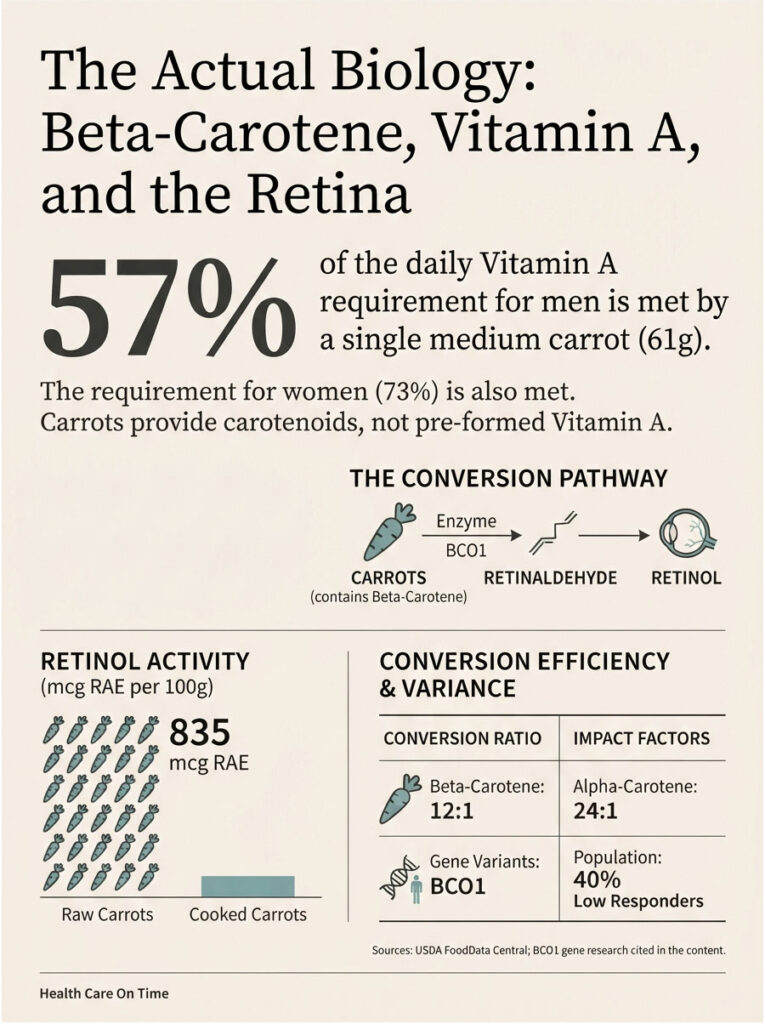
An enzyme called beta-carotene oxygenase 1, or BCO1, splits beta-carotene inside your intestinal lining into retinaldehyde, which is then reduced to retinol. Retinol goes to the liver for storage and is released as the retina calls for it.
Duke ophthalmologist Jill Koury, MD, has described what happens when the supply runs out: the outer segments of the eye’s photoreceptors begin to deteriorate, and the normal chemical processes of vision stop working. Restoring intake restores function.
How much vitamin A one carrot really provides
USDA FoodData Central lists raw carrots at 8,285 mcg of beta-carotene and about 3,477 mcg of alpha-carotene per 100 grams, adding up to 835 mcg RAE of vitamin A activity.
A medium raw carrot weighs roughly 61 grams. That works out to about 5,054 mcg of beta-carotene and 509 mcg RAE.
Against the NIH recommended intake of 900 mcg RAE for adult men and 700 mcg RAE for adult women, one medium carrot covers 57% and 73%. A cup of chopped raw carrot, about 128 grams, clears the full daily requirement for both.
The 12-to-1 conversion tax nobody mentions
Those RAE figures already absorb a detail most food articles skip. Dietary beta-carotene converts to retinol at roughly 12 to 1, and alpha-carotene at 24 to 1.
That is why 8,285 mcg of beta-carotene yields only about 690 mcg RAE. The number on the nutrition panel and the number your retina can use are not the same.
The BCO1 gene: why carrots work better for some people
Conversion efficiency is not uniform. Two common variants in the BCO1 gene, rs12934922 and rs7501331, reduce enzyme activity.
Roughly 40% of healthy individuals are classified as low responders to beta-carotene, isotope studies show up to an 8-fold gap between the most and least efficient converters, and 44% of the Western population carries the 379V haplotype.
Our medical reviewers flag this as the most under-reported detail in carrot nutrition coverage. For a large share of Americans, especially those relying on plants as their main vitamin A source, the orange vegetable on the plate delivers considerably less usable retinol than the label implies.
Deficiency vs Sufficiency: Who Actually Gains Vision Benefit
This is the hinge the entire question turns on, and no top-ranking page states it plainly.
What vitamin A deficiency does to the eye
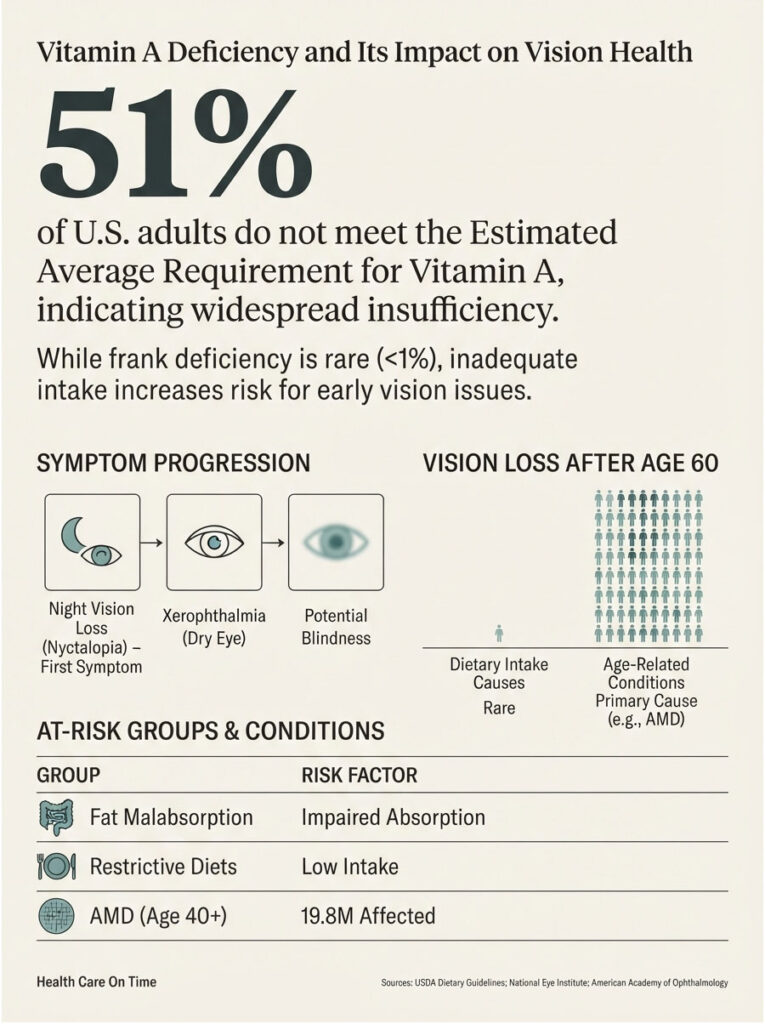
Deficiency follows a predictable order. Night vision fades first, a condition called nyctalopia, because rod cells run out of rhodopsin before anything else breaks.
If depletion continues, the eye surface dries. That stage is xerophthalmia, progressing through conjunctival dryness to corneal ulceration and permanent blindness.
This is the only scenario in which carrots restore vision, and in that scenario they work well.
Why frank deficiency is rare in the United States
Fortification and food supply largely solved this decades ago. NHANES serum retinol data put vitamin A deficiency at under 1% of the US population, although dietary surveys show 51% of adults fall short of the Estimated Average Requirement even after counting fortified foods.
Those two numbers measure different things. Blood retinol holds steady until liver reserves drain, so low intake can run for years without registering as deficiency.
The Americans still at genuine risk
Risk clusters around fat malabsorption, because vitamin A and carotenoids need dietary fat to be absorbed at all. That includes people after bariatric surgery, and those with cystic fibrosis, chronic pancreatitis, cholestatic liver disease, Crohn’s disease, or untreated celiac disease.
Very restrictive plant-only diets with minimal fat can also fall short, particularly when paired with a low-converter BCO1 genotype. Anyone in these groups noticing new night vision trouble should get retinol tested rather than eating more carrots.
| Metric | US Figure | Population | Source |
| Age-related macular degeneration, any stage | 19.8 million (12.6%) | Adults 40 and older, 2019 | CDC VEHSS / Rein et al., JAMA Ophthalmology 2022 |
| Vision-threatening late AMD | 1.49 million (0.94%) | Adults 40 and older, 2019 | CDC VEHSS / Rein et al., JAMA Ophthalmology 2022 |
| AMD prevalence at age 85 and older | 46.6% | Adults 85 and older | CDC Vision and Eye Health Surveillance System |
| Cataract | 24.4 million (about 17%) | Adults over 40 | National Eye Institute / Prevent Blindness |
| Vitamin A deficiency by serum retinol | Under 1% | Full US population | NHANES via Linus Pauling Institute |
| Adults below the vitamin A Estimated Average Requirement | 51% | US adults | NHANES via Linus Pauling Institute |
Table 2. United States eye disease and vitamin A status figures, with source attribution.
AMD prevalence climbs steeply with age, from about 2% among people aged 40 to 44 to 46.6% among those 85 and older. That gradient, not carrot intake, drives most American vision loss after 60.
Carrots vs the Real Eye-Health Heavyweights
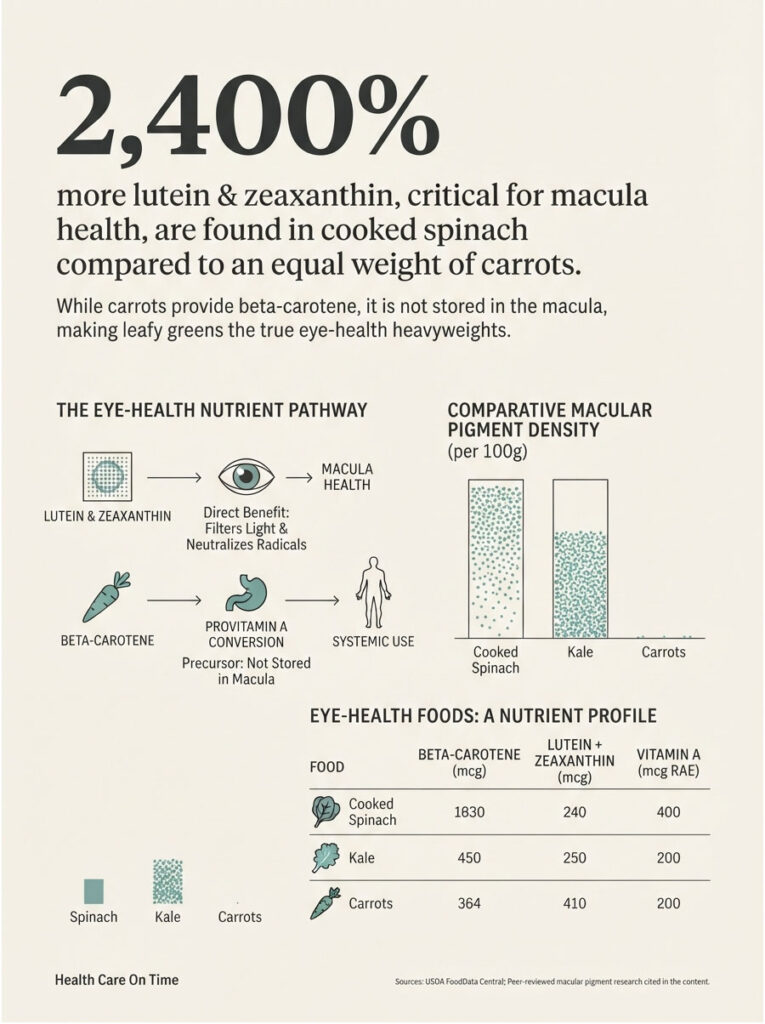
Lutein and zeaxanthin are what your macula actually stores
The center of your retina holds a yellow pigment built from two carotenoids: lutein and zeaxanthin. They filter high-energy blue wavelengths and neutralize free radicals exactly where damage occurs.
Beta-carotene is not stored in the macula. It is a precursor, useful upstream, but it never becomes macular pigment.
Why leafy greens beat carrots for macular pigment
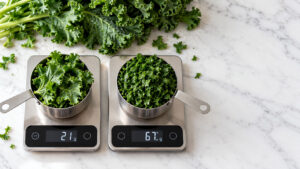
Here is where the carrot reputation cracks. USDA carotenoid analysis puts cooked spinach at 11,308 mcg of lutein and zeaxanthin per 100 grams, making spinach the single largest dietary source, followed by broccoli and iceberg lettuce. Raw kale runs higher still.
Carrots contribute a few hundred micrograms per 100 grams. For anyone specifically worried about macular degeneration, a handful of spinach does more than a bag of baby carrots.
Where carrots still pull ahead
Carrots win on provitamin A density per dollar, on alpha-carotene content, and on the plain fact that people finish them. A vegetable nobody eats has a nutrient profile of zero.
Across patients we serve, adherence beats optimization. The best eye-health vegetable is the one that stays in the rotation for twenty years.
| Food (per 100 g) | Beta-Carotene (mcg) | Lutein + Zeaxanthin (mcg) | Vitamin A (mcg RAE) | Best Used For |
| Carrot, raw | 8,285 | About 256 | 835 | Vitamin A supply, snacking |
| Carrot, cooked | About 8,330 | About 690 | About 850 | Better carotenoid absorption |
| Kale, raw | About 9,200 | Roughly 39,550 | About 500 | Macular pigment, highest lutein |
| Spinach, cooked | About 6,290 | 11,308 | About 524 | Macular pigment, easy volume |
| Sweet potato, baked | About 11,500 | Trace | About 960 | Highest vitamin A per serving |
| Egg yolk | Trace | About 1,090 | About 370 | Absorbable lutein, preformed retinol |
Table 3. Approximate USDA carotenoid and vitamin A values for common eye-health foods.
What the Major Trials Actually Found
AREDS, and why beta-carotene got pulled
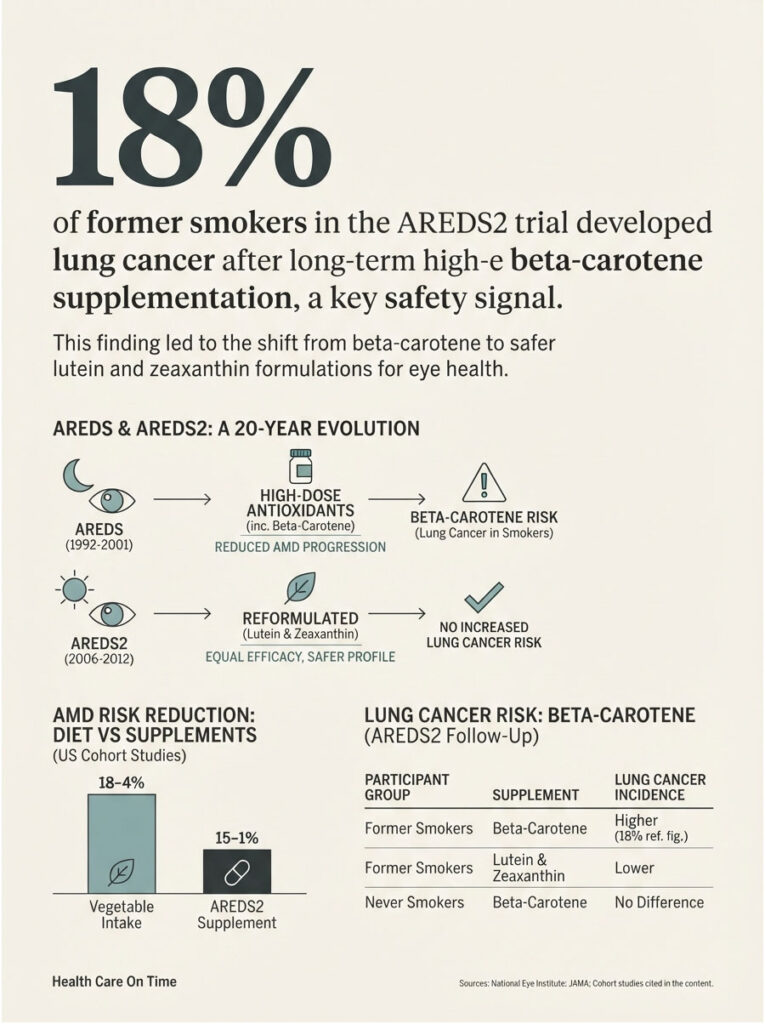
The National Eye Institute ran the Age-Related Eye Disease Study to test whether a high-dose antioxidant formula could slow AMD. The original formulation cut the risk of progressing from intermediate to late AMD by 25% over five years, but beta-carotene, one of its ingredients, was later found to nearly double lung cancer risk, mostly among people who had formerly smoked.
In 2013, AREDS2 tested omega-3 fatty acids and lutein with zeaxanthin as possible replacements. Lutein and zeaxanthin went into the formula. Beta-carotene came out.
The smoker warning that still stands
This distinction matters and food coverage routinely loses it. The risk attaches to high-dose beta-carotene supplements, not to carrots.
Emily Chew, MD, who directs epidemiology and clinical applications at the National Eye Institute, has noted the increased lung cancer risk with beta-carotene applies mostly to smokers and former smokers. Nobody has ever shown that eating vegetables produces the same effect.
In cases reviewed by our medical team, the food-versus-supplement line is where readers most often go wrong. If you smoke or used to, skip standalone beta-carotene pills and eat the vegetable instead.
AREDS2 at ten years
Researchers followed 3,882 of the original 4,203 AREDS2 participants, covering 6,351 eyes, with a mean baseline age of 72 and 57.7% women. Lung cancer nearly doubled among former smokers who had taken the beta-carotene version, while those on the lutein and zeaxanthin version showed no increased risk, and lutein and zeaxanthin were associated with reduced progression to late AMD.
Chew has since recommended that everyone with intermediate or late macular degeneration take the AREDS2 formulation, which is sold over the counter.
What US cohorts show about eating carotenoids rather than swallowing them
Twenty years of data from 102,046 participants in the Nurses’ Health Study and the Health Professionals Follow-up Study found that people with the highest predicted plasma lutein and zeaxanthin levels had a 40% lower risk of advanced AMD than those with the lowest. Beta-cryptoxanthin, alpha-carotene, and beta-carotene each tracked with 25% to 35% lower advanced AMD risk across the same comparison.
A December 2025 analysis in Frontiers in Medicine measured carotenoids in blood rather than estimating them from questionnaires. Among 1,478 NHANES participants aged 50 and older, top-quartile serum alpha-carotene was associated with a cataract odds ratio of 0.37 (95% CI 0.21 to 0.64), beta-carotene 0.57, and lutein with zeaxanthin 0.45.
Both are observational, so they show association rather than proof of cause. People who eat the most vegetables also tend to smoke less and exercise more.
How to Eat Carrots for Maximum Eye Benefit
Cook them, then add fat
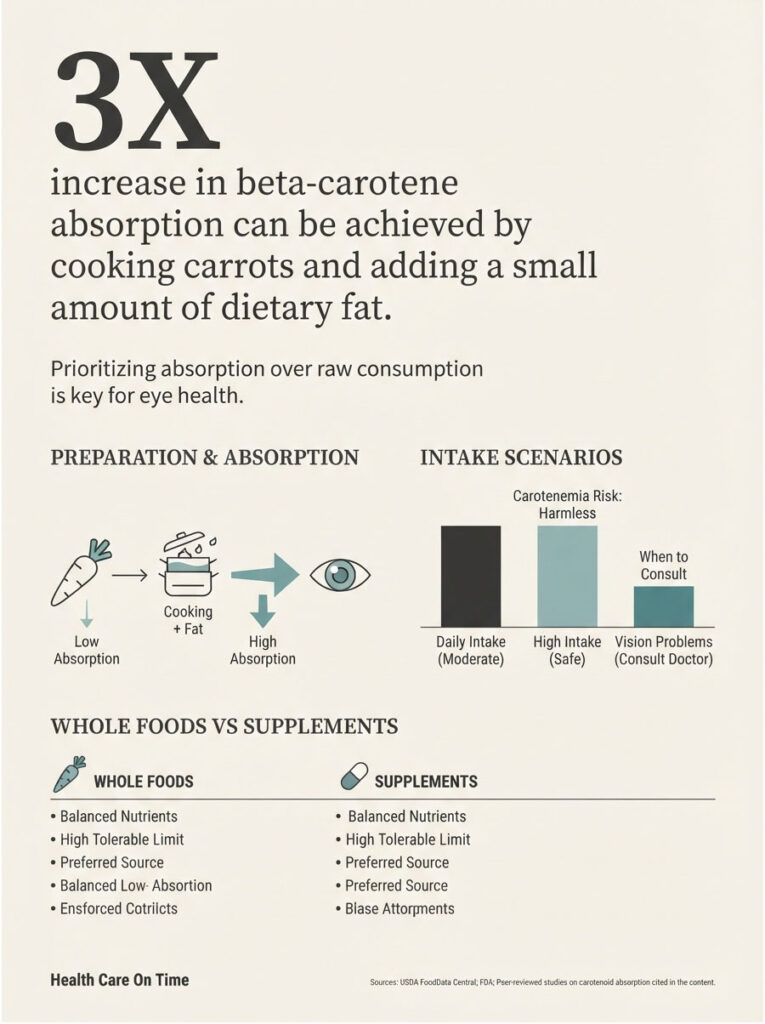
Beta-carotene sits locked inside plant cell walls. Heat breaks those walls down, and dietary fat carries the released carotenoids across the intestinal lining.
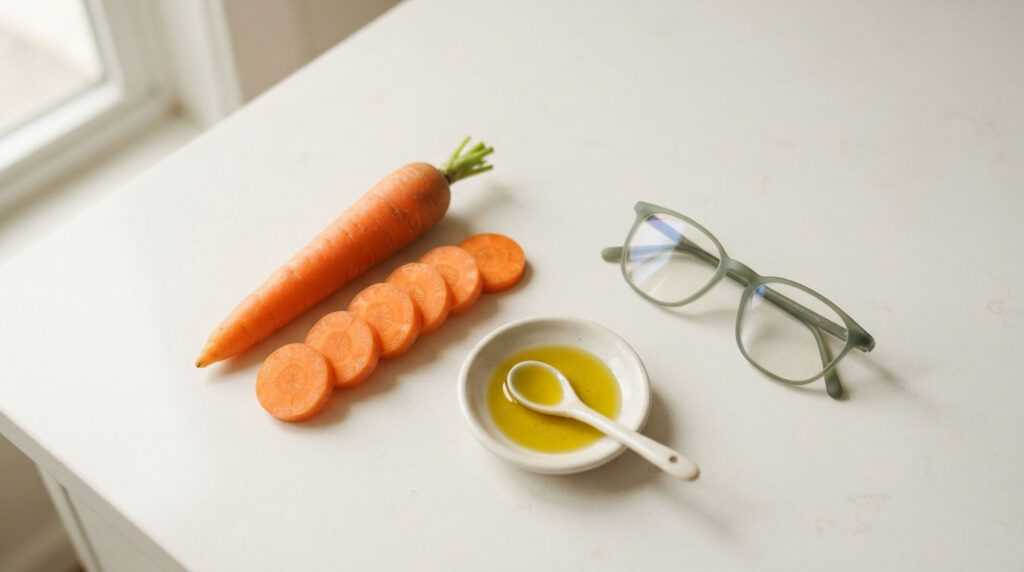
Dietitians consistently advise cooking carrots and pairing them with healthy fats like avocado or olive oil to absorb more of these eye-protecting nutrients. A teaspoon of oil in the pan is enough to matter.
Across patients we serve, the simplest correction is not a bigger bag of carrots. It is roasting them instead of eating them dry.
Raw sticks, juice, or roasted
Raw carrots deliver the least absorbable carotenoid but the most fiber and the steadiest blood sugar response. Juicing strips the fiber and concentrates carotenoids into a fast, high dose.
Roasting or steaming with a fat source lands in the middle and is the most practical daily option for most households.
How many carrots a day is enough
- Healthy adult, general eye health: 1 medium carrot most days, cooked with a little fat
- Want the vitamin A ceiling covered: 1 cup chopped, roughly 2 medium carrots, clears the full RDA
- Practical upper limit: 2 to 3 per day, since nothing above this adds vision benefit
- Where skin tinting starts: sustained intake above about 30 mg beta-carotene daily, roughly 6 medium carrots
- Pair every day with one serving of spinach, kale, or egg yolk for the lutein carrots lack
The tolerable upper limit of 3,000 mcg applies to preformed retinol from supplements and animal foods, not to beta-carotene from vegetables. Your body throttles conversion when stores are full, which is why carrot overdose does not cause vitamin A toxicity.
Carotenemia, the orange-palm effect
Sustained high intake can tint the skin yellow-orange, most visibly on the palms and soles. Duke’s ophthalmology guidance notes this comes from a build-up of blood carotene levels.
It is harmless and reverses within weeks once intake drops. The whites of the eyes stay white, which is how clinicians separate it from jaundice.
| Your Situation | Recommended Action | Why | When to See an Eye Doctor |
| Healthy adult, no eye symptoms | 1 carrot most days, plus a daily leafy green | Covers vitamin A and adds the lutein carrots lack | Baseline full eye exam at age 40 |
| New trouble seeing at night | Do not self-treat with carrots | Cataract and retinal disease cause this far more often than deficiency | Within 2 to 4 weeks |
| Diagnosed intermediate AMD | Ask about the AREDS2 formulation and keep eating vegetables | Trial evidence supports the supplement, not food alone, at this stage | At your next scheduled visit |
| Current or former smoker eyeing supplements | Avoid standalone beta-carotene pills, use whole foods | Beta-carotene nearly doubled lung cancer risk in former smokers | Before starting any eye supplement |
| Post-bariatric surgery or fat malabsorption | Request vitamin A testing and follow your care team’s plan | Absorption, not intake, is the failure point | Promptly if night vision changes |
| Vegan or fully plant-based diet | Cook carotenoid foods with oil and rotate sources | Low BCO1 converters may not hit targets from plants alone | Annually |
| Child refusing vegetables | Offer cooked carrots with a dip containing fat | Improves absorption and acceptance at once | Per pediatric screening schedule |
Table 4. Scenario-based guidance on carrots, supplements, and when to book an eye exam.
What Actually Protects Your Vision
The exam schedule matters more than your grocery list
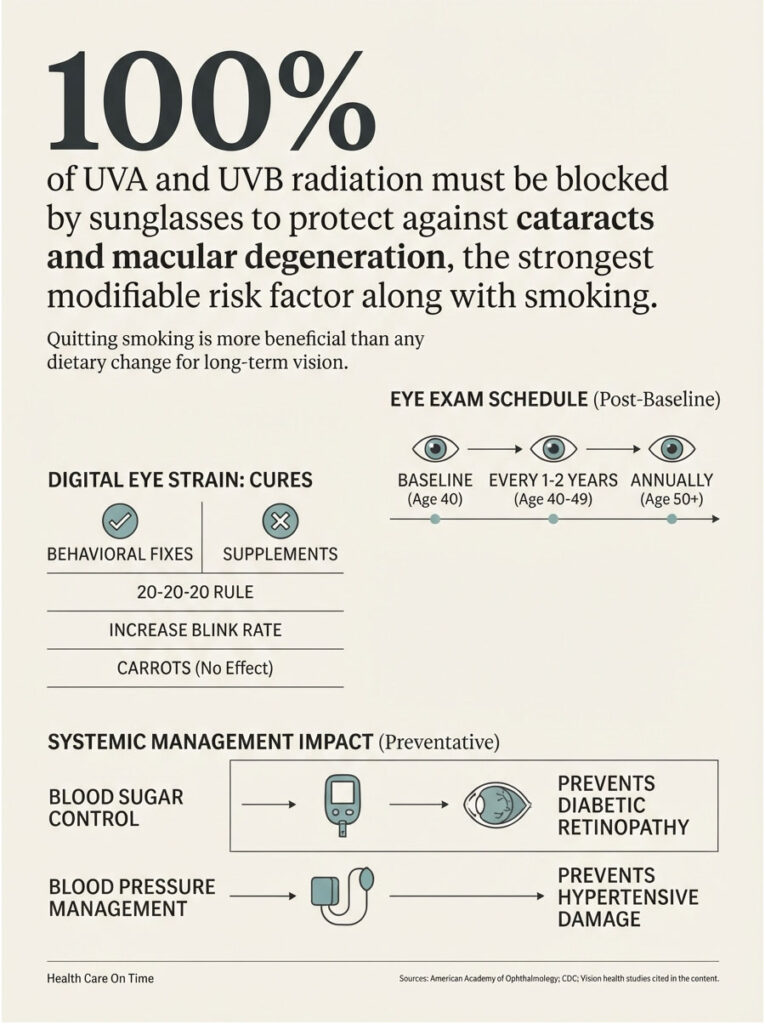
The American Academy of Ophthalmology recommends a baseline eye exam at age 40, with follow-up exams every one or two years or as your eye doctor advises, because several eye diseases begin in midlife without noticeable symptoms. Duke guidance suggests annual visits after age 50, and every two years for healthy adults without a family history of eye disease.
Glaucoma and early AMD are silent. No diet detects them.
The four levers that outrank diet
Smoking is the strongest modifiable risk factor for both AMD and cataract. Quitting does more for your retina than any vegetable.
Ultraviolet protection comes second. Sunglasses rated for 100% UVA and UVB blocking cut cumulative lens and retinal exposure.
Blood sugar and blood pressure control come next. Diabetic retinopathy and hypertensive retinal damage account for a large share of preventable vision loss in working-age Americans.
Our lab partners report the same pattern in the panels they process. Uncontrolled A1c and untreated hypertension do far more damage than any nutrient gap.
A reality check on screens
Digital eye strain is real, but it is not a nutrient deficiency. Long screen sessions cut your blink rate by roughly half, destabilizing the tear film and producing the burning, gritty feeling people mistake for damage.
The fix is behavioral: the 20-20-20 pattern, deliberate blinking, and lubricating drops when needed. Carrots have no role here.
The Bottom Line
Carrots are good for your eyes the way a seatbelt is good for your commute. They protect against a specific failure mode, they do nothing to make the drive faster, and skipping them for years raises a risk you will not notice until something goes wrong.
So the answer to whether carrots are good for eye health is a qualified yes. Eat them cooked, with a little fat, a few times a week.
Then add spinach or kale for the macular pigment carrots cannot supply, wear real sunglasses, keep your blood sugar in range, quit smoking if you smoke, and book the eye exam you have been postponing.
Frequently Asked Questions
Do carrots really improve eyesight?
Only if you are vitamin A deficient. Carrots restore night vision in that case. For adults with normal vitamin A status, eating more produces no measurable gain in sharpness, and carrots cannot correct nearsightedness, farsightedness, or astigmatism, which are optical rather than nutritional problems.
How many carrots should I eat a day for my eyes?
One medium carrot most days covers about 57% of the daily vitamin A target for men and 73% for women. Two or three is generous. Beyond roughly six a day, sustained over weeks, your skin may turn faintly orange with no added benefit to vision.
Can carrots help me see better in the dark?
Not if your vitamin A levels are normal. Rhodopsin production is already running at capacity, and extra retinol does not speed it up. The wartime claim that carrots grant night vision was a cover story for radar, and the science never supported it for well-nourished people.
Are raw or cooked carrots better for your eyes?
Cooked, with a small amount of fat. Heat breaks the cell walls that trap beta-carotene, and fat carries the released carotenoid across your intestinal lining. Raw carrots still count and offer more fiber, but roasted or steamed carrots with olive oil deliver more usable vitamin A.
Is carrot juice as good as whole carrots for vision?
Juice concentrates carotenoids and removes the cell-wall barrier, so absorption tends to be high. The tradeoff is lost fiber and a faster blood sugar rise. Whole cooked carrots with a fat source give you most of the absorption advantage without the spike.
Can carrots reverse macular degeneration?
No. Nothing in the diet reverses established AMD. Higher carotenoid intake is linked to lower progression risk in large cohorts, and people with intermediate or late AMD may benefit from the AREDS2 supplement formula, but that is slowing damage rather than undoing it.
Are carrots or spinach better for your eyes?
Spinach, for macular protection. Cooked spinach holds over 11,000 mcg of lutein and zeaxanthin per 100 grams while carrots offer a few hundred. Carrots win on vitamin A supply. The practical answer is both, since they protect different parts of the system.
Do carrots help with dry eyes or computer eye strain?
Not meaningfully. Screen discomfort comes from a reduced blink rate and an unstable tear film, not a carotenoid shortage. Regular breaks, deliberate blinking, humidified air, and lubricating drops address the real mechanism. Severe vitamin A deficiency does cause dryness, but that is a different clinical picture.
Should I take a beta-carotene supplement instead?
Not if you smoke or used to smoke. High-dose beta-carotene nearly doubled lung cancer risk among former smokers in the AREDS trials, which is why it was removed from the modern formula. Whole carrots have never shown that effect. Food is the safer route for everyone.
What happens if you eat too many carrots?
You may develop carotenemia, a harmless yellow-orange tint that shows first on the palms and soles. It appears with sustained intake above roughly 30 mg of beta-carotene daily and fades within weeks once you cut back. The whites of your eyes stay clear, distinguishing it from jaundice.
How long before eating carrots affects your vision?
In genuine deficiency, night vision often improves within days to a few weeks of restoring vitamin A. In everyone else there is no timeline, because there is no acute effect. The protective association with cataract and AMD reflects dietary patterns measured over decades, not weeks.
Are baby carrots as good for your eyes as full-size carrots?
Close enough to make no practical difference. Baby-cut carrots are simply whittled-down full carrots and carry a similar carotenoid profile per gram. The same rule applies: cook them with a little fat if you want more of the beta-carotene to reach your bloodstream.
Medical Disclaimer
This article is for general education and does not replace a professional eye examination or personalized medical advice. Nutrient needs and eye disease risk vary by individual. Anyone experiencing new night vision difficulty, blurred vision, or eye pain should be evaluated by an ophthalmologist or optometrist. People who smoke or formerly smoked should discuss any beta-carotene supplement with a physician before starting it.
References
- USDA FoodData Central, Carrots, raw (SR Legacy 170393)
- NIH Office of Dietary Supplements, Vitamin A and Carotenoids Fact Sheet
- National Eye Institute, Age-Related Eye Disease Studies (AREDS and AREDS2)
- Chew EY et al. AREDS2 Report 28. JAMA Ophthalmology, 2022
- American Academy of Ophthalmology EyeNet, Long-Term Outcomes of the Revised AREDS2 Supplement
- Wu J et al. Intakes of Lutein, Zeaxanthin, and Other Carotenoids and AMD. JAMA Ophthalmology, 2015
- Rein DB et al. Prevalence of Age-Related Macular Degeneration in the US in 2019. JAMA Ophthalmology, 2022
- CDC Vision and Eye Health Surveillance System, AMD Prevalence Estimates
- Che S, Ma Y, Cao J. Serum carotenoid concentrations and age-related eye diseases. Frontiers in Medicine, 2025
- Linus Pauling Institute, Micronutrient Inadequacies in the US Population
- USDA Agricultural Research Service, National Food and Nutrient Analysis Program Carotenoid Data
- Duke Health, Myth or Fact: Eating Carrots Improves Eyesight
- University of Utah Health, Carrots and Eye Health: Myth or Fact?
- Smithsonian Magazine, Carrots Cannot Help You See in the Dark
- Harvard T.H. Chan School of Public Health, The Nutrition Source: Vitamin A