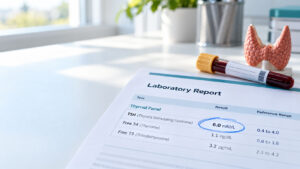
You have Hashimoto’s, you take levothyroxine every morning, and your doctor just mentioned Ozempic or Zepbound. Then you open the box and see a boxed warning about thyroid tumors. It’s a scary moment, and it’s the reason so many people search this exact question.
Table of Contents
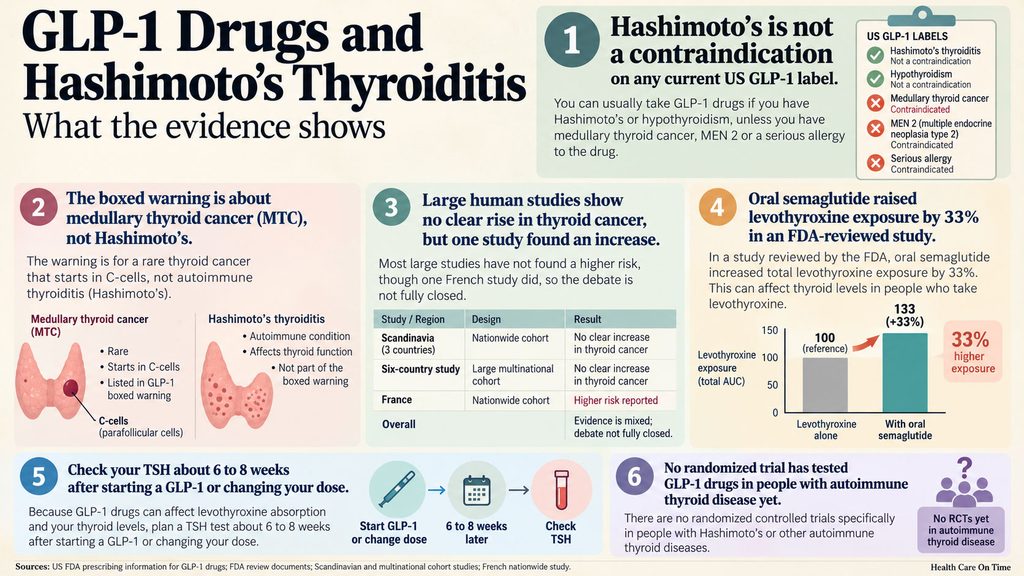
Quick Answer: Yes, most people with Hashimoto’s can take a GLP-1 drug. The FDA labels for Ozempic, Wegovy, Mounjaro and Zepbound do not list Hashimoto’s or hypothyroidism as a reason to avoid them. The real “do not take” list is a personal or family history of medullary thyroid cancer (MTC) or MEN 2. If you take levothyroxine, plan a TSH recheck after you start, because weight loss and the drug itself can shift your dose.
At a Glance
- Hashimoto’s is not a contraindication on any current US GLP-1 label.
- The boxed warning is about medullary thyroid cancer, a rare C-cell cancer, not autoimmune thyroiditis.
- Large human studies from Scandinavia and six countries found no clear rise in thyroid cancer; one French study did, so the debate is not fully closed.
- Oral semaglutide raised levothyroxine exposure by 33% in an FDA-reviewed study.
- Plan a TSH check about 6 to 8 weeks after starting a GLP-1 or changing your dose.
- No randomized trial has tested GLP-1 drugs in people with autoimmune thyroid disease yet.
What Hashimoto’s Is and Why the GLP-1 Question Comes Up
Hashimoto’s is an autoimmune disease. Your immune system makes antibodies that attack the thyroid, and over time the gland can’t make enough hormone.
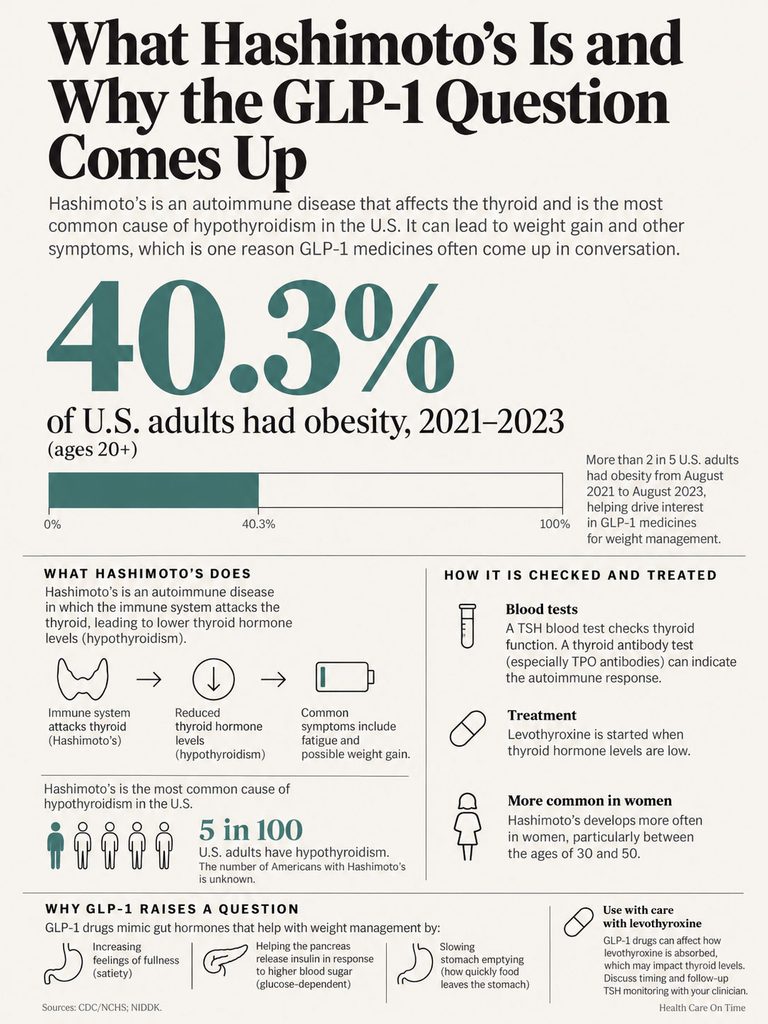
It’s common. The National Institute of Diabetes and Digestive and Kidney Diseases (NIDDK) says Hashimoto’s is the most common cause of hypothyroidism, which affects about 5 in 100 Americans. It is 4 to 10 times more common in women and often shows up between ages 30 and 50.
How doctors confirm Hashimoto’s
Doctors usually diagnose Hashimoto’s with a TSH blood test and a thyroid antibody test. The NIDDK says most people with Hashimoto’s have TPO antibodies, which show the immune system is attacking the gland.
Not everyone with these antibodies needs medicine right away. Treatment starts when hormone levels drop, and that’s when levothyroxine enters the picture.
Why weight loss feels harder with Hashimoto’s
Weight gain and fatigue are classic hypothyroid symptoms, and the NIDDK lists both. Once your levothyroxine dose is right, metabolism usually normalizes, but many people still carry extra weight they gained before diagnosis.
That overlap is why GLP-1 drugs and Hashimoto’s keep crossing paths. About 40.3% of US adults had obesity in 2021 to 2023, according to the CDC’s National Center for Health Statistics. A KFF poll from late 2025 found 12% of US adults were currently taking a GLP-1 drug and 18% had taken one at some point.
How GLP-1 drugs work
GLP-1 drugs copy a gut hormone that tells your brain you’re full and helps your pancreas release insulin after meals. They also slow how fast food leaves your stomach.
That slower stomach emptying matters for anyone on a daily pill, including levothyroxine. We’ll come back to it, because it’s the part most guides skip.
Readers often ask us whether “thyroid problem” on a drug label means any thyroid problem. It doesn’t, and the next section shows exactly what the labels say.
The Short Answer: Hashimoto’s Is Not on the “Do Not Take” List
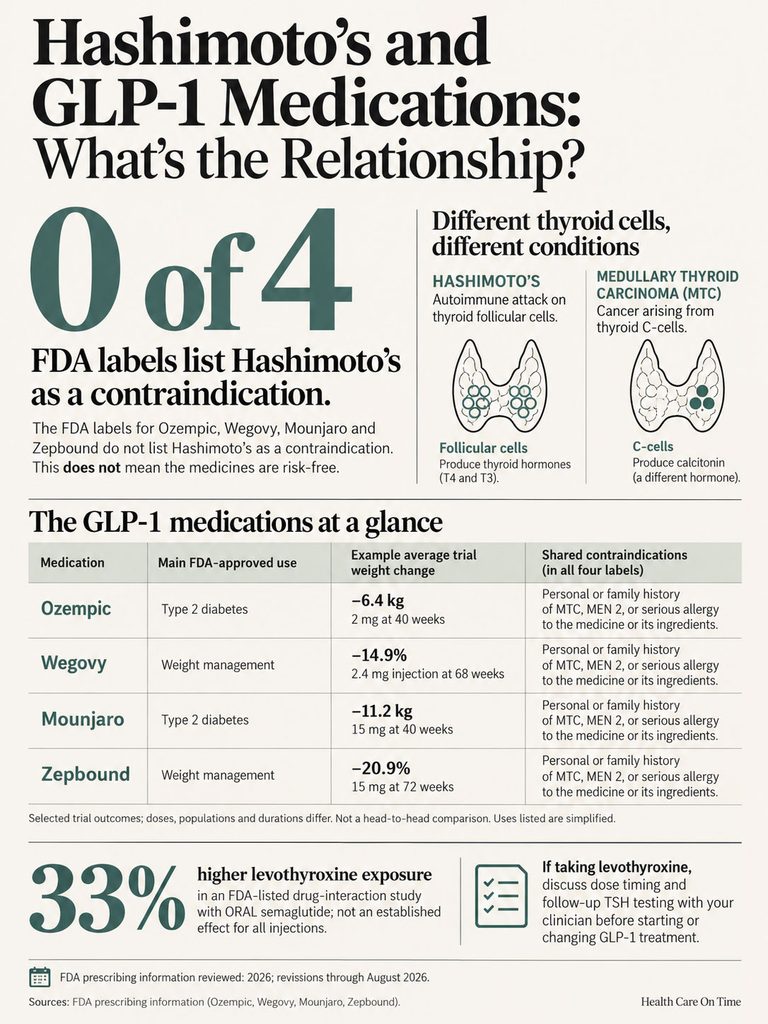
Our editors checked this against the current FDA prescribing information for all four brands, revised between April and August 2026. Every label lists the same two thyroid-related contraindications, and Hashimoto’s is not one of them.
What the FDA labels actually say
The Wegovy label says the drug is contraindicated in people with “a personal or family history of MTC or in patients with MEN 2.” The other contraindication is a prior serious allergic reaction to the drug.
The Ozempic, Mounjaro and Zepbound labels use the same wording. None mentions Hashimoto’s, autoimmune thyroiditis or hypothyroidism as a reason to avoid treatment.
Why Hashimoto’s is a different thyroid problem
Your thyroid has two main cell types. Follicular cells make thyroid hormone, and those are the cells Hashimoto’s damages.
C-cells are a separate, small group that make calcitonin. Medullary thyroid cancer starts in C-cells, and that’s the cancer behind the GLP-1 warning. So the warning and your Hashimoto’s involve different cells and different diseases.
Drug-by-drug comparison
This table pulls each point straight from the current US labels. It’s the side-by-side view most articles leave out.
| Drug (ingredient) | FDA-approved use | Who must not take it | Note for levothyroxine users | Avg weight loss in main trial |
| Ozempic (semaglutide injection) | Type 2 diabetes, including heart and kidney risk reduction | Personal or family history of MTC, MEN 2, or serious allergy to semaglutide | Label says use caution with oral medicines because stomach emptying slows | Not FDA-approved for weight loss |
| Wegovy injection (semaglutide 2.4 mg) | Long-term weight management | Same as Ozempic | Label says monitor the effects of oral medicines | 14.9% vs 2.4% on placebo at 68 weeks |
| Wegovy tablets (semaglutide 25 mg) | Long-term weight management | Same as Ozempic | Levothyroxine exposure rose 33% in a semaglutide tablet study; wait 30 minutes after the tablet before other pills | 13.6% vs 2.4% on placebo at 64 weeks |
| Mounjaro (tirzepatide) | Type 2 diabetes, ages 10 and up | Personal or family history of MTC, MEN 2, or serious allergy to tirzepatide | Monitor narrow-range oral medicines; switch or back up birth control pills for 4 weeks after start and each dose increase | Not FDA-approved for weight loss |
| Zepbound (tirzepatide) | Weight loss, obstructive sleep apnea | Same as Mounjaro | Same as Mounjaro; stomach-emptying delay is largest after the first dose | 20.9% (15 mg) vs 3.1% on placebo at 72 weeks |
Levothyroxine has a narrow dosing range, which is why the “narrow therapeutic index” language on these labels applies to it. That doesn’t mean you can’t combine them. It means you should check your thyroid labs more closely for a while.
The Thyroid Cancer Warning in Real Numbers
Every GLP-1 label opens with a boxed warning titled “Risk of Thyroid C-Cell Tumors.” Here’s where it came from and what human data show so far.
Where the boxed warning comes from
The warning is based on rodent studies. The Wegovy label says semaglutide caused dose-dependent C-cell tumors in mice and rats at clinically relevant exposures, and that it is “unknown” whether the same happens in people.
The label also notes that cases of MTC have been reported after liraglutide, an older GLP-1, but those reports can’t prove or rule out cause. That honest uncertainty is why the warning stays on the box.
What large human studies show
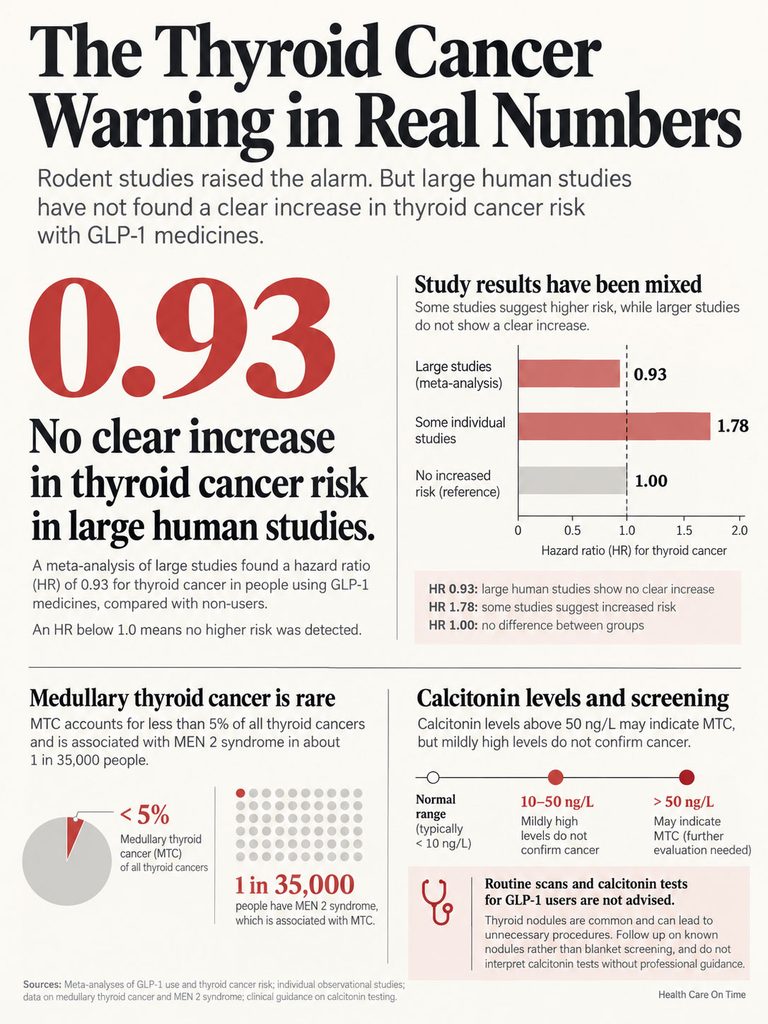
A Scandinavian cohort study in BMJ (2024) followed 145,410 GLP-1 users and 291,667 users of DPP-4 inhibitors in Denmark, Norway and Sweden. The thyroid cancer hazard ratio was 0.93 (95% CI 0.66 to 1.31), meaning no clear increase.
The American Thyroid Association highlighted a 2025 study in the journal Thyroid covering six countries, 92,497 GLP-1 users and 2,484,408 DPP-4 inhibitor users. It found no evidence that GLP-1 use raised thyroid cancer risk.
Our medical content team read each study’s numbers, not just the headlines. Not every study agrees. A French case-control study in Diabetes Care (2023) linked 1 to 3 years of GLP-1 use to a higher risk of all thyroid cancer (adjusted HR 1.58) and of medullary cancer (adjusted HR 1.78).
Why the studies disagree
The ATA commentary points out two limits: follow-up in the big studies was short, 1.8 to 3.0 years, and most people studied had type 2 diabetes, not obesity alone. Long-term data in weight-loss users are still thin.
Some of the early signal may come from more neck scans and lab tests once people start a new drug. Doctors call this surveillance bias, and it can make small, slow-growing cancers show up sooner.
Who is actually at risk: MTC and MEN 2
Medullary thyroid cancer is rare. The American Cancer Society says it makes up less than 5% of all thyroid cancers, and about 1 in 4 cases runs in families.
MEN 2 is an inherited syndrome caused by changes in the RET gene. MedlinePlus Genetics estimates it affects about 1 in 35,000 people, and medullary thyroid cancer is its most common feature.
| Measure | Number | Source |
| Americans with hypothyroidism | About 5 in 100 | NIDDK |
| US adults with obesity (2021 to 2023) | 40.3% | CDC NCHS Data Brief 508 |
| US adults currently taking a GLP-1 drug | 12% | KFF poll, Oct to Nov 2025 |
| New US thyroid cancer cases estimated for 2026 | About 45,240 | American Cancer Society |
| Share of thyroid cancers that are medullary | Less than 5% | American Cancer Society |
| People affected by MEN 2 | About 1 in 35,000 | MedlinePlus Genetics |
| Thyroid cancer risk, GLP-1 vs DPP-4 users (Scandinavia) | HR 0.93 (0.66 to 1.31) | BMJ 2024 |
| Medullary cancer risk after 1 to 3 years of GLP-1 use (France) | Adjusted HR 1.78 (1.04 to 3.05) | Diabetes Care 2023 |
What a calcitonin number means
Calcitonin is the hormone C-cells make, so doctors sometimes use it to look for medullary cancer. The Wegovy label notes that people with MTC usually have calcitonin levels above 50 ng/L.
A mildly high result doesn’t mean cancer, though. If you’ve had a calcitonin test for another reason, ask your doctor to explain your number before you start a GLP-1.
Why routine scans and calcitonin tests aren’t advised
You might expect doctors to scan everyone’s neck before starting a GLP-1. The labels say the opposite: routine calcitonin tests or thyroid ultrasounds are “of uncertain value” and may lead to unnecessary procedures.
The reason is that thyroid nodules are very common, and calcitonin tests can flag harmless results. If you already have a nodule on file, though, your doctor should keep following it as planned.
Levothyroxine and GLP-1: The Interaction Most Guides Skip
This is where Hashimoto’s makes a real difference. Most people with Hashimoto’s-related hypothyroidism take levothyroxine, and the dose has to be just right.
The 33% finding with oral semaglutide
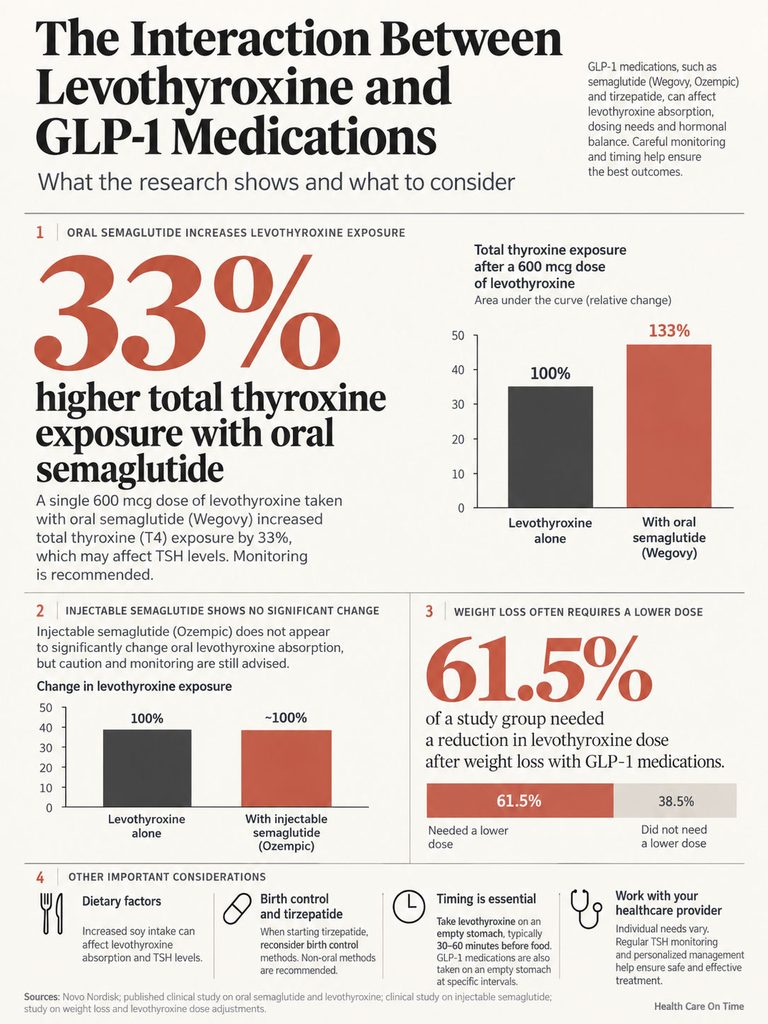
In a drug interaction study listed on the Wegovy label, taking a semaglutide tablet raised total thyroxine exposure by 33% after a single 600 mcg dose of levothyroxine. The peak level stayed the same; the total amount absorbed over time went up.
The label’s advice is to monitor the effects of oral medicines taken with Wegovy. For you, that means a TSH check is reasonable after starting the pill form, even if you feel fine.
Injections vs pills
The injectable labels don’t report a specific levothyroxine number. Ozempic’s label says semaglutide injection didn’t change oral drug absorption to a clinically relevant degree in its studies, but it still advises caution.
Zepbound and Mounjaro labels say to monitor oral medicines with a narrow therapeutic range. Tirzepatide’s effect on stomach emptying is strongest after the first dose and fades over time, so the early weeks are the time to pay attention.
Weight loss can change your dose
Readers on thyroid medicine often write to us asking why their TSH drifts after weight loss. Levothyroxine needs partly track body size, so losing a lot of weight can mean you need less.
A 2025 review in Cureus says weight loss on GLP-1 drugs may lower levothyroxine needs and advises close monitoring of thyroid tests. A small 2026 conference study of 26 levothyroxine users on semaglutide or tirzepatide found 61.5% needed a dose cut within three months, and none needed an increase.
That study is an abstract, not a full peer-reviewed paper, so treat it as an early signal. A 2024 case report in the Journal of the American Pharmacists Association described a woman whose TSH became suppressed after starting semaglutide, and her levothyroxine dose had to drop by 25%.
Other things that change levothyroxine absorption
A GLP-1 isn’t the only thing that can shift your levels. The NIDDK lists grapefruit juice, espresso coffee, soy and multivitamins with iron or calcium as items that can interfere with levothyroxine.
If you change your diet a lot on a GLP-1, for example adding protein shakes with soy or a new multivitamin, tell your doctor. Those swaps can move your TSH just as much as the drug.
A note on birth control pills
Tirzepatide has its own oral-medicine warning. The Mounjaro and Zepbound labels advise switching to a non-oral birth control method, or adding a barrier method, for 4 weeks after starting and for 4 weeks after each dose increase.
This matters for many readers with Hashimoto’s, since the condition is far more common in women of childbearing age.
Timing tips for your morning pills
The NIDDK advises taking levothyroxine on an empty stomach, 30 to 60 minutes before your first meal. Keep doing that on any GLP-1.
If you take Wegovy tablets, the label says to take them on an empty stomach with up to 4 ounces of water and wait at least 30 minutes before food, drinks or other pills. Ask your pharmacist how to line up both morning tablets, since both want an empty stomach.
What to Monitor: Your TSH Recheck Plan
The NIDDK says a blood test usually comes about 6 to 8 weeks after you start levothyroxine or change its dose. That same window makes sense after starting a GLP-1 or stepping up its dose.
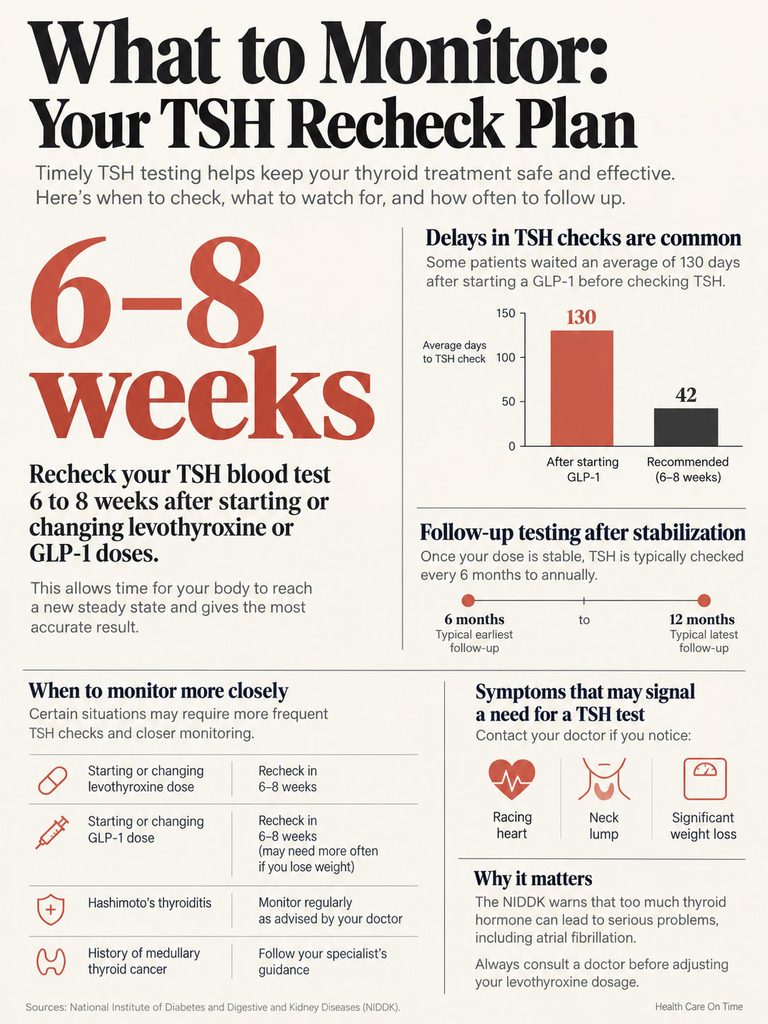
One reason this matters: a 2026 letter in the Cleveland Clinic Journal of Medicine noted that in one US analysis, TSH wasn’t checked until a mean of about 130 days after a GLP-1 was started. That’s a long gap for a narrow-range drug.
| Your situation | What to do | Why |
| You have Hashimoto’s and no MTC or MEN 2 history | Discuss a GLP-1 with your doctor; it’s not ruled out | Hashimoto’s isn’t a label contraindication |
| You or a close relative had medullary thyroid cancer, or you have MEN 2 | Don’t start a GLP-1; tell your doctor about this history | It’s a contraindication on all four labels |
| You take levothyroxine and just started any GLP-1 | Ask for a TSH check in about 6 to 8 weeks | Absorption and dose needs can shift |
| You switched to Wegovy tablets | Ask for a TSH check after starting; space your pills | Levothyroxine exposure rose 33% in a tablet study |
| You’ve lost 10% or more of your body weight | Ask whether your levothyroxine dose still fits | Dose needs may drop with weight loss |
| You have a racing heart, shakiness or new anxiety | Call your doctor and ask for a TSH test | These can signal too much thyroid hormone |
| You feel a neck lump, hoarseness or trouble swallowing | See your doctor promptly | The labels list these as thyroid tumor symptoms |
For help reading your numbers, see our guide to the TSH blood test explained and what high or low TSH results mean.
Signs your dose may now be too high
The NIDDK warns that too much thyroid hormone can cause serious problems such as atrial fibrillation or bone loss. Watch for a fast heartbeat, heat intolerance, trouble sleeping or tremor.
After your dose settles, the NIDDK says follow-up tests usually move to every 6 months and then once a year. Weight loss on a GLP-1 is a good reason to go back to more frequent checks for a while.
Never change your levothyroxine dose on your own. Let a lab result and your doctor guide the change.
Side Effects That Look Like Hypothyroid Symptoms
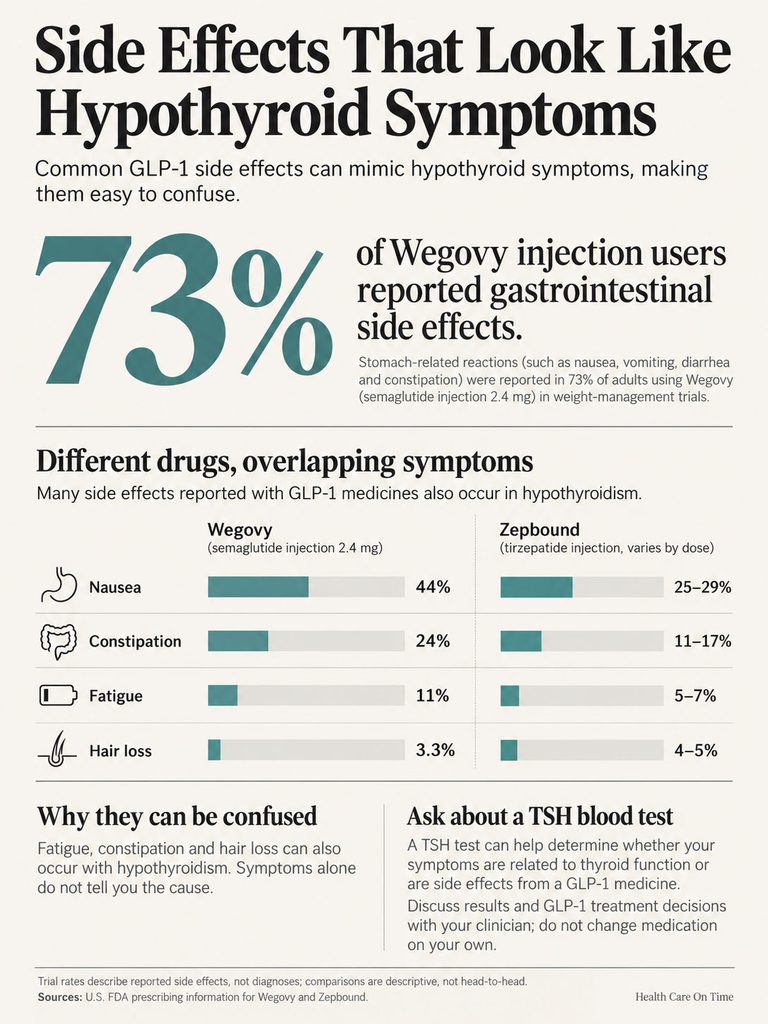
Here’s a tricky part. Several common GLP-1 side effects look a lot like an underactive thyroid, so it’s easy to blame the wrong thing.
Stomach side effects come first
Stomach problems are the most common GLP-1 side effects. On the Wegovy injection label, 73% of users had a stomach-related reaction compared with 47% on placebo, and nausea hit 44% vs 16%.
Zepbound users had nausea at rates of 25% to 29% depending on dose, vs 8% on placebo. These effects tend to show up during dose increases.
Constipation
The NIDDK lists constipation as a hypothyroid symptom. On the Zepbound label, constipation affected 11% to 17% of users depending on dose, compared with 5% on placebo. On Wegovy injection, it was 24% vs 11%.
Fatigue
Fatigue showed up in 11% of Wegovy injection users vs 5% on placebo, and in 5% to 7% of Zepbound users vs 3% on placebo. Low thyroid hormone causes fatigue too.
Hair loss
Hair thinning is another overlap. Wegovy’s label reports hair loss in 3.3% of users vs 1% on placebo. The NIDDK lists dry, thinning hair as a hypothyroid symptom too. Zepbound’s label reports 4% to 5% vs 1%.
If one of these symptoms is new or getting worse, a TSH test helps sort out the cause. Readers often ask us whether to stop the GLP-1 first. That’s a call to make with your doctor, not alone. For eating tips that ease stomach side effects, see our Wegovy diet plan and Zepbound side effects guide.
Weight Loss With Hashimoto’s: What to Expect
Is it harder to lose weight with Hashimoto’s? Untreated hypothyroidism can cause weight gain, according to the NIDDK. Once TSH is in range on levothyroxine, the thyroid itself is usually not the main barrier.
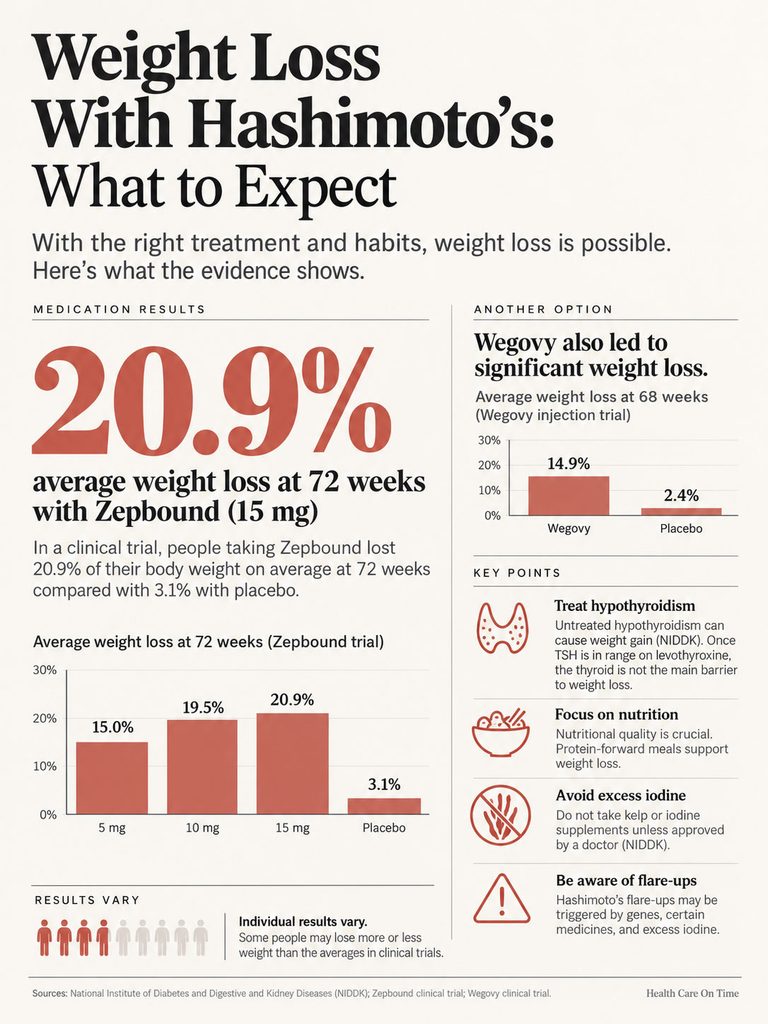
GLP-1 trials didn’t single out Hashimoto’s, so there are no Hashimoto’s-specific weight loss numbers. The trial averages in the table above are the best guide available, and individual results vary.
What the trial numbers looked like
In the main Zepbound trial, average weight loss at 72 weeks was 15.0% on 5 mg, 19.5% on 10 mg and 20.9% on 15 mg, compared with 3.1% on placebo. In the main Wegovy injection trial, it was 14.9% vs 2.4% at 68 weeks.
Those are averages from people with obesity, not a promise. Some people lose more, and some lose much less.
Protect muscle and nutrition
Eating less makes protein and nutrient quality more important. Our Ozempic meal plan covers protein-forward meals that are easy on a slower stomach.
Also skip kelp and iodine supplements unless your doctor approves them. The NIDDK says large amounts of iodine can cause or worsen hypothyroidism in people with Hashimoto’s.
What about Hashimoto’s flare-ups?
People often ask what triggers Hashimoto’s flare-ups. The NIDDK says genes and some viruses may play a role, and certain medicines and excess iodine can cause or worsen hypothyroidism.
There’s no proof that GLP-1 drugs trigger flares. The same Cureus review notes that big trials such as STEP, SUSTAIN and SURPASS did not report meaningful rises in autoimmune thyroid disease.
What the Evidence Can’t Tell You Yet
Our medical content team wants to be straight about the gaps. The 2025 Cureus review states plainly that no randomized controlled trials have tested GLP-1 drugs in autoimmune thyroid disease.
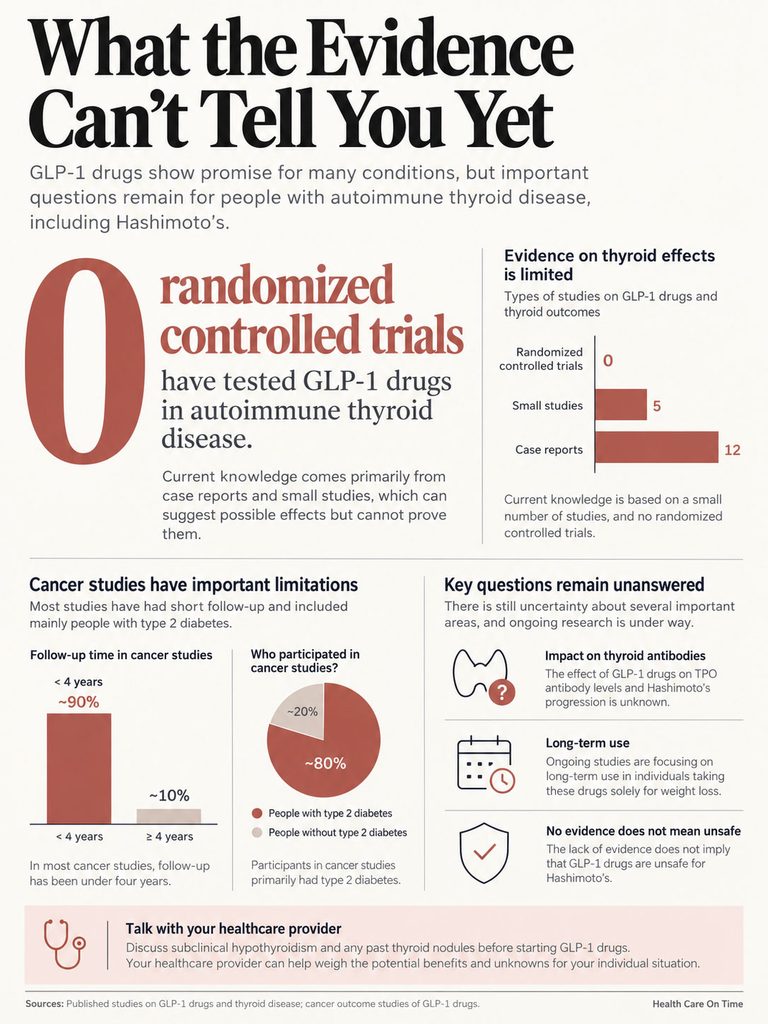
Most of what we know comes from case reports, small studies and secondary looks at large diabetes and obesity trials. Whether GLP-1 drugs change TPO antibody levels or slow Hashimoto’s over years is simply unknown.
The cancer studies have limits too. Follow-up was mostly under four years, and most participants had type 2 diabetes. People taking these drugs only for weight loss, for many years, are still being studied.
None of this means the drugs are unsafe for Hashimoto’s. It means the reassuring answer rests on labels and observational data, not on trials built around your condition. If you have subclinical hypothyroidism or a past thyroid nodule, bring that up too.
When to Call Your Doctor
Call your doctor promptly if you notice a lump or swelling in your neck, hoarseness that won’t go away, trouble swallowing or shortness of breath. Every GLP-1 label lists these as possible thyroid tumor symptoms.
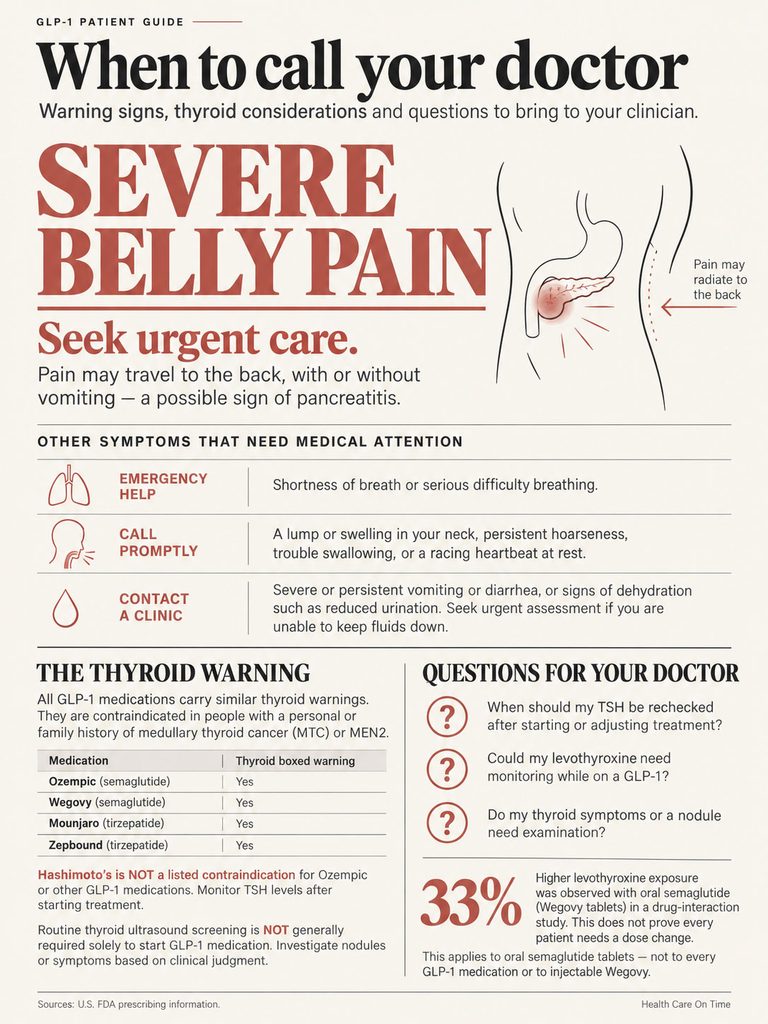
Get urgent care for severe belly pain that won’t go away, sometimes spreading to your back, with or without vomiting. The labels list this as a sign of possible pancreatitis.
Also call if you have a racing heartbeat at rest, severe or ongoing vomiting or diarrhea, or signs of dehydration. Dehydration from stomach side effects has been linked to kidney injury on these drugs.
Questions to bring to your appointment
- Does a family history of thyroid cancer change whether this drug is safe for you?
- When should your next TSH test be after starting?
- Should your levothyroxine timing change with this drug?
- If you use a pill form, how should you space it from levothyroxine?
- At what amount of weight loss should your thyroid dose be rechecked?
Frequently Asked Questions
Can you take Ozempic if you have Hashimoto’s?
Yes, in most cases. The Ozempic label does not list Hashimoto’s or hypothyroidism as a contraindication. It is only off-limits if you or a close family member had medullary thyroid cancer, if you have MEN 2, or if you had a serious allergy to semaglutide. Plan a TSH check after starting if you take levothyroxine.
What GLP-1 is safe for thyroid patients?
No US GLP-1 label favors one brand for thyroid patients. Ozempic, Wegovy, Mounjaro and Zepbound share the same thyroid warning and contraindications. The practical difference is form: Wegovy tablets raised levothyroxine exposure by 33% in a study, so the pill form needs closer TSH monitoring and careful timing.
Is it hard to lose weight if you have Hashimoto’s?
Untreated hypothyroidism can cause weight gain, according to the NIDDK. Once levothyroxine brings TSH into range, the thyroid is usually not the main barrier. Many people still find weight loss slow, which is one reason doctors consider GLP-1 drugs. No trial has reported Hashimoto’s-specific weight loss results yet.
What triggers Hashimoto’s flare-ups?
The NIDDK says genes and some viruses, such as hepatitis C, may play a role in Hashimoto’s. Large amounts of iodine, including kelp and some supplements, can cause or worsen hypothyroidism. Certain heart and mental health medicines can too. There is no evidence that GLP-1 drugs trigger Hashimoto’s flares.
Does Wegovy affect levothyroxine?
It can. The Wegovy label reports that a semaglutide tablet raised levothyroxine exposure by 33% in a drug interaction study. The injection affects stomach emptying too. The label advises monitoring oral medicines taken with Wegovy, so ask for a TSH test about 6 to 8 weeks after starting or changing your dose.
Do GLP-1 drugs cause thyroid cancer in humans?
It hasn’t been proven. The warning comes from rodent studies. A Scandinavian study of over 145,000 users found no clear increase, and a six-country study highlighted by the American Thyroid Association agreed. A French study found higher risk after 1 to 3 years of use, so research continues.
Do you need a thyroid ultrasound before starting a GLP-1?
Not routinely. The FDA labels say routine calcitonin tests or thyroid ultrasounds are of uncertain value and may lead to unnecessary procedures. If you already have a thyroid nodule, keep up with the follow-up your doctor planned. New neck lumps or hoarseness should always be checked.
Will you need a lower levothyroxine dose on a GLP-1?
Possibly. A 2025 review says weight loss may lower levothyroxine needs. A small 2026 conference study found 61.5% of 26 users needed a dose cut within three months. Your doctor should base any change on your TSH result, not on weight alone, and you should never adjust it yourself.
How soon should you check TSH after starting Zepbound?
The NIDDK says thyroid blood tests usually follow 6 to 8 weeks after a levothyroxine change, and that window is a sensible guide after starting Zepbound or raising its dose. Tirzepatide slows stomach emptying most after the first dose, so the first two months are the key time to watch.
Can GLP-1 drugs make Hashimoto’s worse?
There’s no evidence they do. A 2025 review found large trials did not report meaningful increases in autoimmune thyroid disease, and thyroid test changes were usually temporary. It also says no randomized trial has studied autoimmune thyroid disease directly, so long-term effects on antibodies are unknown.
Can you take a GLP-1 after thyroid removal?
A thyroidectomy alone is not a label contraindication. What matters is why it was removed. If the cause was medullary thyroid cancer, GLP-1 drugs are off-limits. A published case report described a woman without a thyroid whose levothyroxine dose had to drop by 25% after starting semaglutide.
Medical Disclaimer: This article is for general education only and is not medical advice. HealthCareOnTime does not diagnose or treat any condition. Talk with your doctor or pharmacist before starting, stopping or changing any medicine, including levothyroxine or a GLP-1 drug. If you have a medical emergency, call 911.
References
- FDA. Wegovy (semaglutide) prescribing information, revised 05/2026
- FDA. Ozempic (semaglutide) prescribing information, revised 05/2026
- FDA. Mounjaro (tirzepatide) prescribing information, revised 04/2026
- Eli Lilly. Zepbound (tirzepatide) prescribing information, revised 08/2026
- NIDDK. Hashimoto’s Disease
- Pasternak B, et al. GLP-1 receptor agonist use and risk of thyroid cancer: Scandinavian cohort study. BMJ 2024 (abstract record)
- Bezin J, et al. GLP-1 Receptor Agonists and the Risk of Thyroid Cancer. Diabetes Care 2023
- American Thyroid Association. Risk of Thyroid Cancer Among GLP1-RA Users
- Mazza AD. The Thyroid Twist: How GLP-1 Agonists Are Influencing Autoimmune Thyroid Care. Cureus 2025
- Or Koca A, et al. Levothyroxine dose changes after GLP-1 therapy. Endocrine Abstracts 2026
- Wilcox L, Van Dril E. Suppressed TSH after GLP-1 receptor agonist initiation in a post-thyroidectomy patient. J Am Pharm Assoc 2024
- Cleveland Clinic Journal of Medicine. Letter on TSH testing after GLP-1 initiation, 2026
- American Cancer Society. What Is Thyroid Cancer?
- American Cancer Society. Key Statistics for Thyroid Cancer
- MedlinePlus Genetics. Multiple endocrine neoplasia
- CDC NCHS. Obesity and Severe Obesity Prevalence in Adults: United States, August 2021 to August 2023
- KFF. Poll: 1 in 8 adults say they are currently taking a GLP-1 drug, 2025