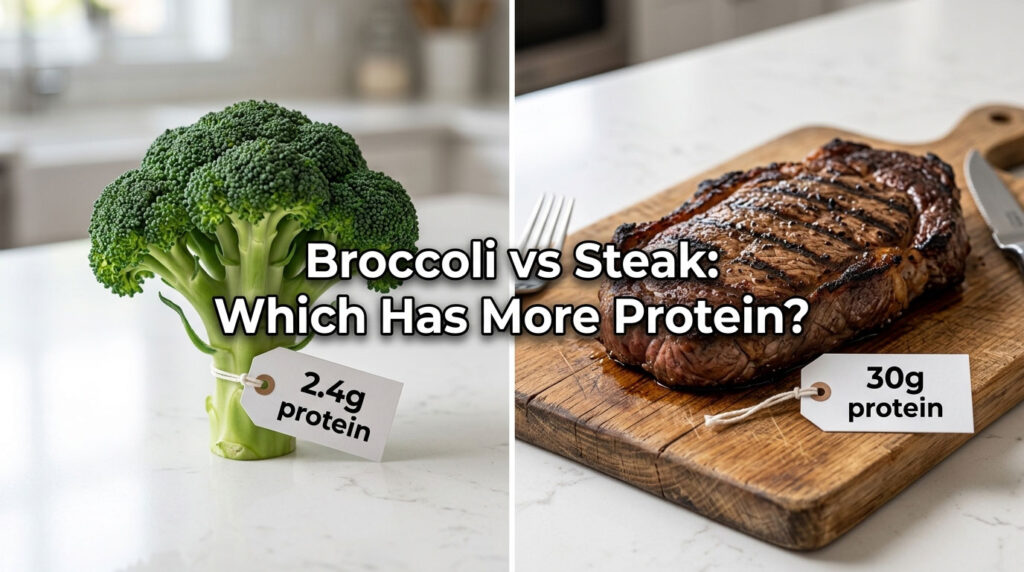
The viral meme has been making the rounds for over a decade: “Broccoli has more protein than steak!” It’s plastered on social feeds, repeated in vegan documentaries, and quoted with absolute confidence at dinner parties. Here’s what nobody seems to mention: you’d have to eat roughly 2.5 pounds of cooked broccoli to match the protein in a single 3.5-ounce ribeye.
Table of Contents
| Quick Answer: No, broccoli does not have more protein than steak by any practical measure. A 3.5-ounce serving of cooked broccoli has about 2.4 grams of protein. The same weight of cooked ribeye delivers roughly 25 to 29 grams. The viral claim works only by comparing protein per calorie, and even there, lean steak still wins. By any normal serving size, weight, or amino acid quality score, the broccoli vs steak protein debate isn’t close. |
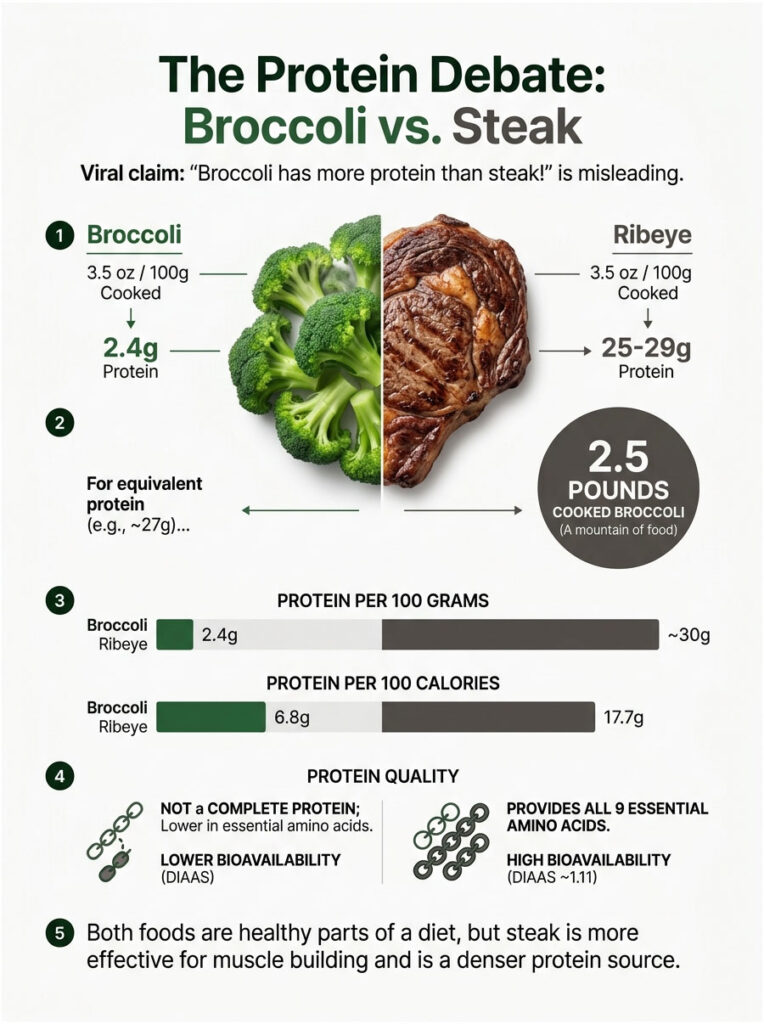
| At a Glance • Per 100 grams cooked: broccoli has ~2.4g protein; sirloin steak has ~30g protein. • Per 100 calories: broccoli has ~6.8g (cooked); lean broiled sirloin has ~17.7g. • You’d need 2.5 pounds of cooked broccoli to match the protein in a single 3.5-oz steak. • Broccoli is not a complete protein; steak contains all 9 essential amino acids. • The DIAAS score for beef is ~1.11; broccoli scores far lower on bioavailability. • US adults need 0.8 g of protein per kg of body weight per day (NIH/IOM RDA), often more for athletes and seniors. • Both foods belong on a healthy plate, but for muscle building, steak (or another animal protein) does the heavy lifting. |
The Short Answer (and Why the Myth Won’t Die)
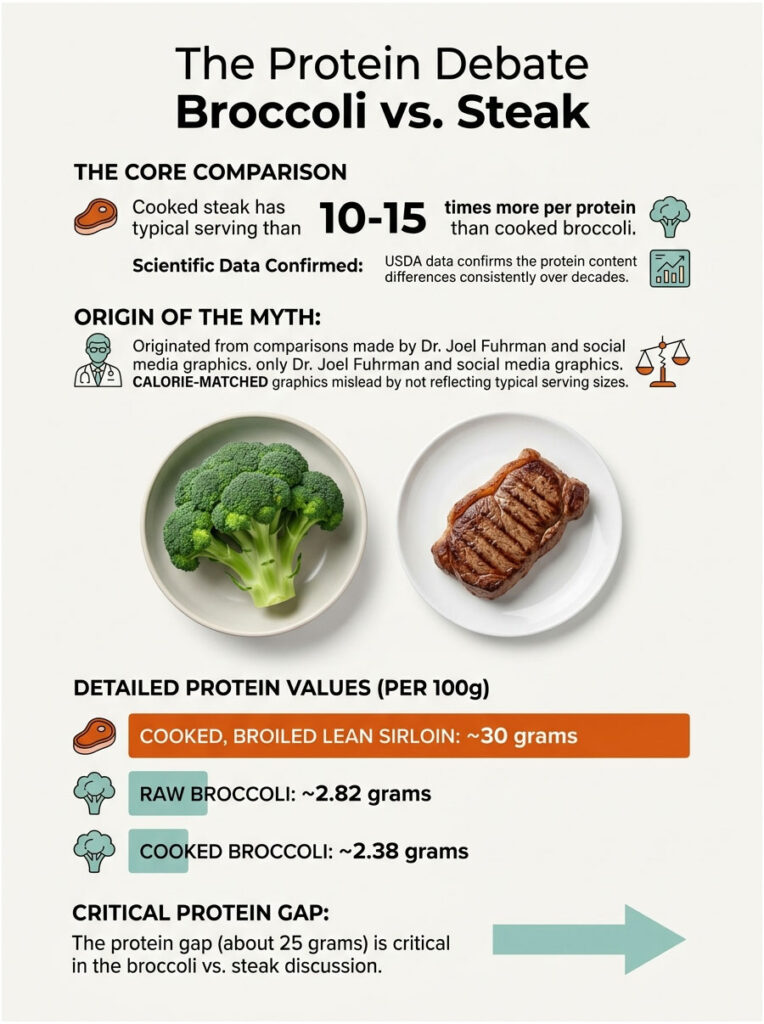
Cooked steak has somewhere between 10 and 15 times more protein per typical serving than cooked broccoli. That’s not a rounding error or a matter of opinion. USDA data has been clear and consistent for decades.
So why does the broccoli vs steak protein claim keep showing up? Because of a single statistical trick that flips the comparison on its head, and a lot of people who repeat it have never run the numbers themselves.
Where the Myth Comes From
The “broccoli has more protein than steak” line traces back largely to Dr. Joel Fuhrman, a US physician who popularized plant-based eating, and was amplified by viral social-media graphics in the 2010s. The graphics typically show a small steak cube next to a tall stack of broccoli florets with both labeled “100 calories.”
That comparison is technically accurate on a calorie-matched basis for some cuts of beef. The trouble is that nobody eats food by the calorie. You eat by the plate.
What’s Actually True About Broccoli’s Protein
According to USDA FoodData Central, raw broccoli contains roughly 2.82 grams of protein per 100 grams. Cooked (boiled, no salt added), broccoli has about 2.38 grams of protein per 100 grams.
That’s a respectable percentage for a vegetable. Most vegetables average 1 to 4 grams of protein per 100 grams. Broccoli’s relative protein content is one reason it gets called a “high-protein vegetable” in dietitian guides.
What’s Actually True About Steak’s Protein
The same USDA database puts cooked, broiled lean sirloin at about 30 grams of protein per 100 grams. Cooked ribeye lands between 24 and 29 grams depending on the trim and grade. T-bone and porterhouse cuts hover around 22 to 27 grams.
That gap, roughly 25 grams in steak vs 2.4 grams in broccoli per identical 100-gram weight, is the heart of the broccoli vs steak protein debate. Across the patient education work we support at HealthCareOnTime, our nutrition reviewers see this number quoted incorrectly more often than almost any other diet claim.
| Food | Protein per 100g (3.5 oz) | Protein per Typical Serving | Protein per 100 Calories |
| Broccoli, raw | 2.82g | 2.4g (1 cup chopped) | 8.3g |
| Broccoli, cooked (boiled) | 2.38g | 4.0g (1 cup, ~150g) | 6.8g |
| Sirloin steak, lean, broiled | 30g | 25.5g (3 oz / 85g) | 17.7g |
| Ribeye, trimmed, broiled | 24 to 29g | 22g (3 oz / 85g) | 11 to 13g |
| T-bone steak, lean | 27g | 23g (3 oz / 85g) | 14g |
| New York strip, broiled | 28g | 24g (3 oz / 85g) | 15g |
| Filet mignon, broiled | 27g | 23g (3 oz / 85g) | 16g |
| Flank steak, broiled | 28g | 24g (3 oz / 85g) | 16g |
Table 1: Broccoli vs steak protein content across common US cuts. Source: USDA FoodData Central.
The Three Ways to Measure (and Why They Tell Different Stories)
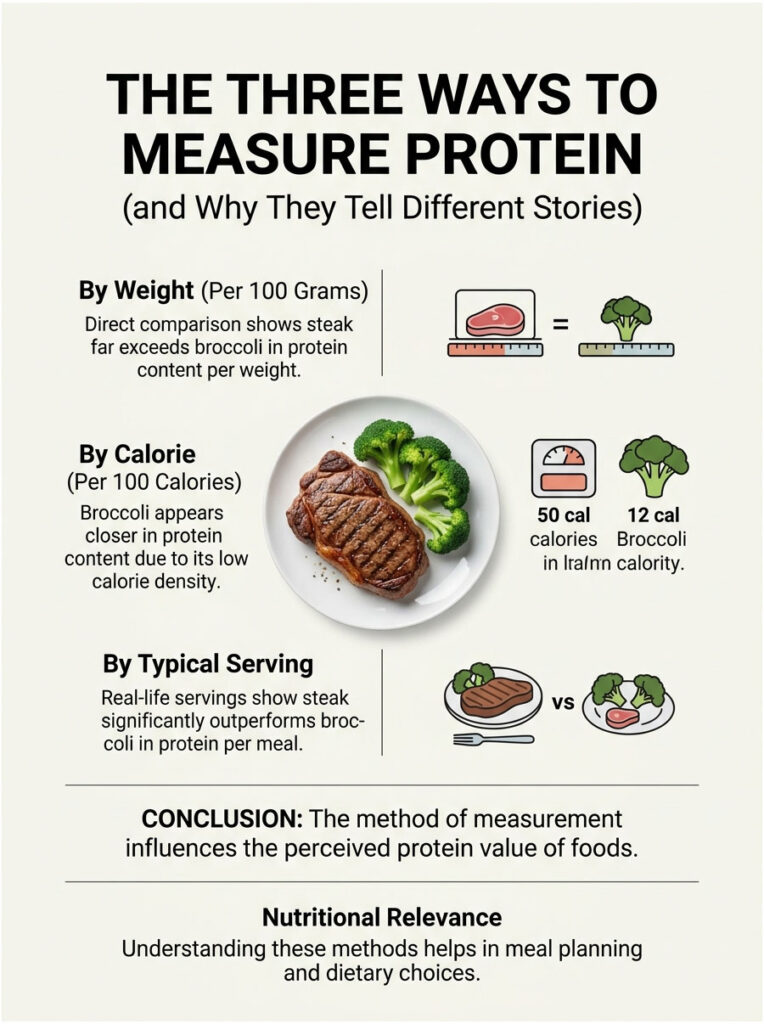
The whole broccoli vs steak protein debate is really a debate about how you measure protein in the first place. Three methods dominate. Each one paints a different picture.
By Weight (Per 100 Grams)
This is the most intuitive method. You weigh the food, you look up the protein content, you compare.
By this measure, steak wins by a country mile. A 100-gram cooked sirloin has roughly 12 times more protein than the same weight of cooked broccoli.
End of debate, if you’re counting grams on a kitchen scale.
By Calorie (Per 100 Calories)
This is the metric that powers the viral myth. Because broccoli is mostly water and fiber (only about 35 calories per 100 grams cooked), and because steak has fat baked in alongside protein, the protein-per-calorie ratio looks much closer than the per-weight ratio.
Raw broccoli has about 8.3 grams of protein per 100 calories. Cooked broccoli drops to about 6.8 grams per 100 calories.
Lean broiled sirloin runs roughly 17.7 grams of protein per 100 calories, almost triple the broccoli number. Fattier cuts like a heavily marbled ribeye come closer to 11 to 13 grams per 100 calories. Even on a calorie-matched basis, the popular claim that broccoli beats steak holds only for the fattiest cuts.
By Typical Serving
This is how people actually eat. A standard US serving of steak is 3 ounces (about 85 grams), which delivers 22 to 26 grams of protein. A standard serving of cooked broccoli is one cup (about 150 grams), which delivers around 4 grams of protein.
That’s a roughly 6 to 1 ratio in steak’s favor for one normal-sized plate. In tests booked through HealthCareOnTime, patients counting macros for weight loss or muscle goals almost always use serving-size math, not per-calorie math.
Which Method Matters for Your Plate
For nutrition science papers, per-100-calorie is useful because it controls for energy density. For real-life meal planning, per-serving and per-100-gram numbers matter more. The answer to “does broccoli have more protein than steak” depends entirely on which question you’re really asking.
What the USDA Data Actually Says
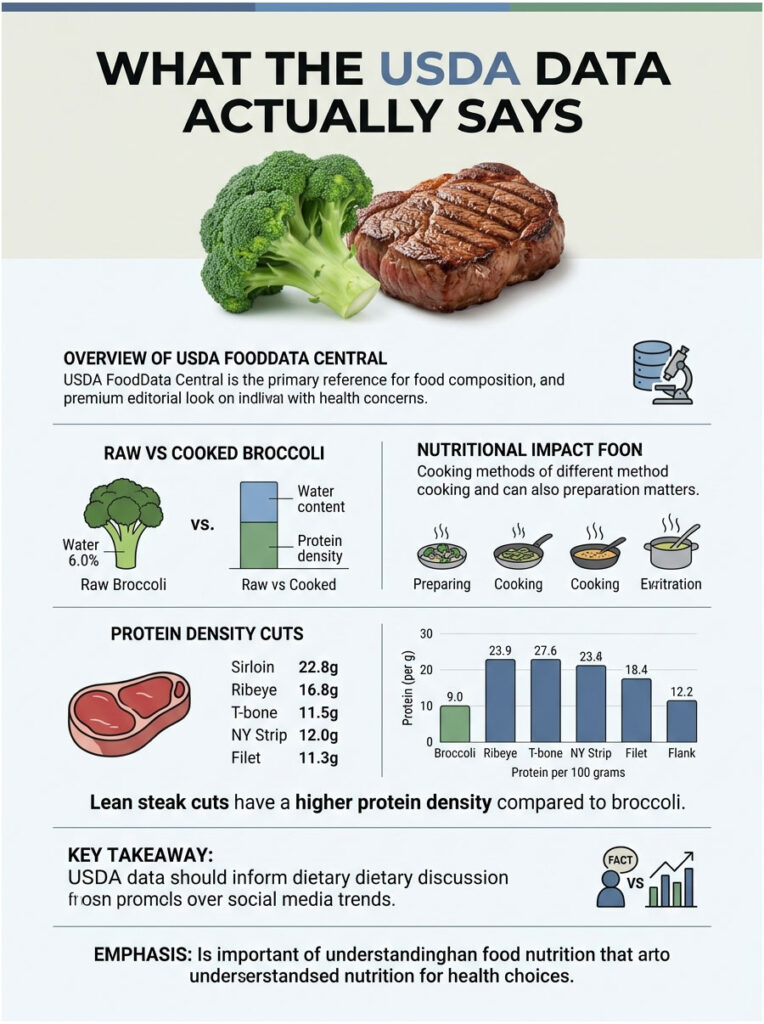
The USDA FoodData Central database is the official US reference for food composition. It’s used by the FDA, NIH, hospital dietitians, and food labels nationwide. Here’s what the numbers look like when you stack them honestly.
Broccoli, Raw vs Cooked
Raw broccoli is roughly 89% water, with the remainder split between carbohydrate, fiber, and protein. Cooking (especially boiling) loses some water-soluble nutrients but concentrates the dry matter slightly.
Steamed broccoli, which is the cooking method most US dietitians recommend, sits between raw and boiled in protein content, averaging roughly 2.4 to 2.6 grams per 100 grams. Roasted broccoli loses more water and can edge up to 3 grams per 100 grams as moisture cooks off.
Steak by Cut: Sirloin, Ribeye, T-bone, NY Strip, Filet, Flank
Lean cuts like top sirloin, flank, filet mignon, and eye of round pack the highest protein per gram and per calorie. Heavily marbled cuts like ribeye and prime rib have lower protein per calorie because more of the energy comes from fat.
Eye of round, one of the leanest cuts available at US grocers like Costco and Kroger, can hit 31 to 33 grams of protein per 100 grams cooked. That’s the same protein density as cooked chicken breast.
| Food | Protein per 100g | Calories per 100g | Protein per 100 kcal | Source |
| Broccoli, raw | 2.82g | 34 | 8.3g | USDA FDC |
| Broccoli, cooked (boiled) | 2.38g | 35 | 6.8g | USDA FDC |
| Sirloin steak, lean, broiled | 30g | 187 | 16.0g | USDA |
| Ribeye, trimmed, broiled | 25g | 249 | 10.0g | USDA |
| Filet mignon, broiled | 27g | 212 | 12.7g | USDA |
| Flank steak, broiled | 28g | 192 | 14.6g | USDA |
| Eye of round, lean, roasted | 33g | 175 | 18.9g | USDA |
Table 2: USDA protein density data for broccoli vs common US steak cuts.
Across the board, lean cuts of beef pack 5 to 12 times more protein per gram than broccoli, and 1.5 to 3 times more protein per calorie than broccoli, depending on cut. Our medical reviewers note that USDA numbers, not social media memes, should anchor any honest broccoli vs steak protein discussion.
Protein Quality: Why Not All Grams Are Equal
Here’s the part of the broccoli vs steak protein debate that almost never makes it into the viral graphic. The grams on the nutrition label don’t tell you how much usable protein your body actually gets.
Complete vs Incomplete Proteins
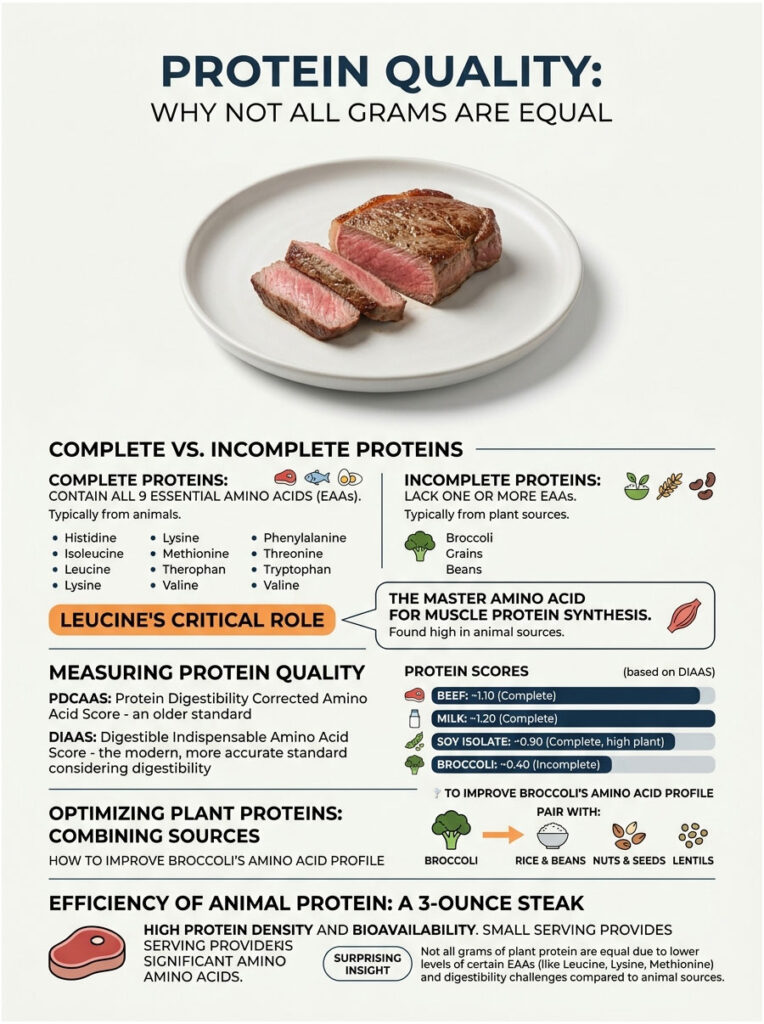
A complete protein contains all 9 essential amino acids your body cannot make on its own. An incomplete protein is missing one or more of those amino acids, or contains them in such small amounts that you’d need an enormous quantity to meet daily needs.
Steak is a complete protein. Broccoli is not. Broccoli is low in methionine and limited in lysine relative to body needs, which means even if you ate enough broccoli to hit your gram target, your body would only build muscle and tissue up to the lowest amino acid available.
Essential Amino Acids: The 9 Your Body Cannot Make
The 9 essential amino acids are histidine, isoleucine, leucine, lysine, methionine, phenylalanine, threonine, tryptophan, and valine. Leucine in particular drives the mTOR pathway that signals your body to build muscle.
A 3-ounce steak delivers roughly 2.5 to 3 grams of leucine, which hits the threshold researchers consider necessary to trigger muscle protein synthesis in a single meal. The same protein-gram amount of broccoli (which would require eating roughly 2.5 pounds) would barely cross that threshold even before factoring in bioavailability.
DIAAS and PDCAAS Explained for Humans
The Digestible Indispensable Amino Acid Score (DIAAS) is the modern protein-quality benchmark, replacing the older PDCAAS. It measures the percentage of essential amino acids your body actually absorbs and uses.
Beef scores roughly 1.11 on DIAAS. Whole milk scores 1.18. Soy isolate is around 0.91. Broccoli has not been formally scored, but other vegetables in similar nutrient profiles score between 0.45 and 0.65, meaning roughly half of broccoli’s protein on paper translates to usable protein in your body.
What Broccoli Is Missing (and How to Fix It)
Combining broccoli with grains, beans, nuts, or seeds within the same day (not necessarily the same meal) fills the amino acid gaps. Quinoa, soy, buckwheat, and amaranth are complete plant proteins on their own.
A plant-only eater can absolutely meet protein needs by combining sources. They just need to eat substantially more total grams to land at the same usable protein as a steak eater.
Why Steak’s Protein Goes Further
A single 3-ounce serving of steak gives you complete protein, a high DIAAS score, and roughly 25 grams of protein, all on a plate that costs $4 to $8 in most US grocery stores. Patients booking dietary panels with us often arrive surprised to learn how efficient animal protein is by these measures, even compared to legumes.
How Much Protein Do You Actually Need in a Day?
The broccoli vs steak protein debate matters only in the context of your daily target. Hitting 30 grams from broccoli alone is theoretically possible. The question is whether it’s practical or healthy.
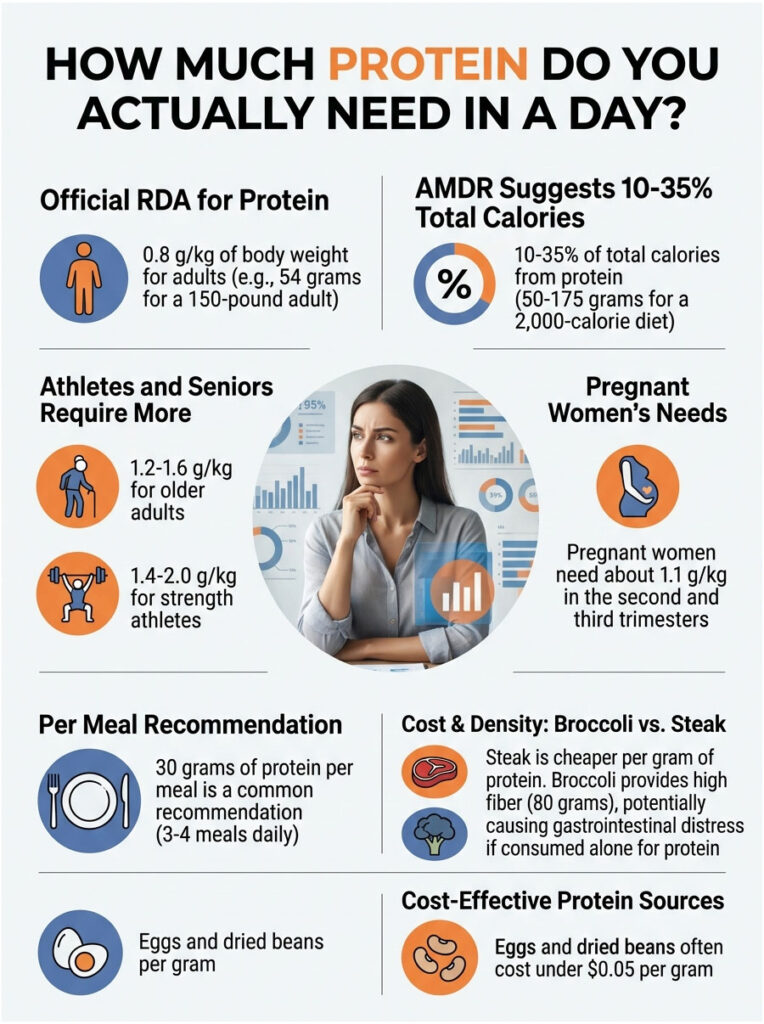
The Official US RDA (NIH/IOM)
The NIH-affiliated Institute of Medicine RDA for protein is 0.8 grams per kilogram of body weight per day for adults aged 19 and older. For a 150-pound (68-kg) US adult, that’s about 54 grams per day.
This is the minimum to prevent deficiency, not the optimal level. The Acceptable Macronutrient Distribution Range (AMDR) suggests 10 to 35% of total calories from protein, which for a 2,000-calorie diet is 50 to 175 grams per day.
Why Athletes, Seniors, and Pregnant Women Need More
Most US nutrition researchers now agree that the 0.8 g/kg RDA is too low for several populations. The Frontiers in Nutrition review by Dr. Stuart Phillips recommends 1.2 to 1.6 g/kg for older adults to fight muscle loss.
US Olympic Committee and major sports nutrition guidelines recommend 1.4 to 2.0 g/kg for serious strength athletes. Pregnant women in their second and third trimesters need about 1.1 g/kg per Mayo Clinic guidance.
Real-World Math: What 30g of Protein Looks Like
The 30-gram mark matters because most US dietitians recommend roughly 25 to 40 grams per meal across 3 to 4 meals to hit daily targets. Here’s what 30 grams of protein looks like in different foods.
- 3.5 ounces of broiled lean sirloin (about a deck of cards)
- 4 large eggs
- 1 cup of cottage cheese
- 1 scoop of whey protein powder
- 12.5 cups (about 2.7 pounds) of cooked broccoli
- 3 cups of cooked lentils
- 1 can of tuna packed in water
The broccoli serving alone would deliver close to 80 grams of fiber, which is roughly triple the US daily fiber target and a recipe for gastrointestinal distress.
Cost Per Gram of Protein: Broccoli vs Steak in USD
At US grocery stores in 2025, broccoli runs about $2.50 per pound, and lean ground beef or budget sirloin runs about $7 per pound. On the surface, broccoli looks cheaper.
The math shifts when you factor in protein density. Per gram of usable protein, broccoli costs roughly $0.20 to $0.30. Sirloin steak comes in around $0.10 to $0.14 per gram. Lean beef wins on cost-per-gram-of-protein in nearly every US zip code. Eggs and dried beans are even cheaper, often under $0.05 per gram of protein.
The Practical Verdict: When Each Food Wins
The right answer to broccoli vs steak protein isn’t “broccoli beats steak” or “steak beats broccoli.” It’s “use both, and pick based on what you’re trying to accomplish.”
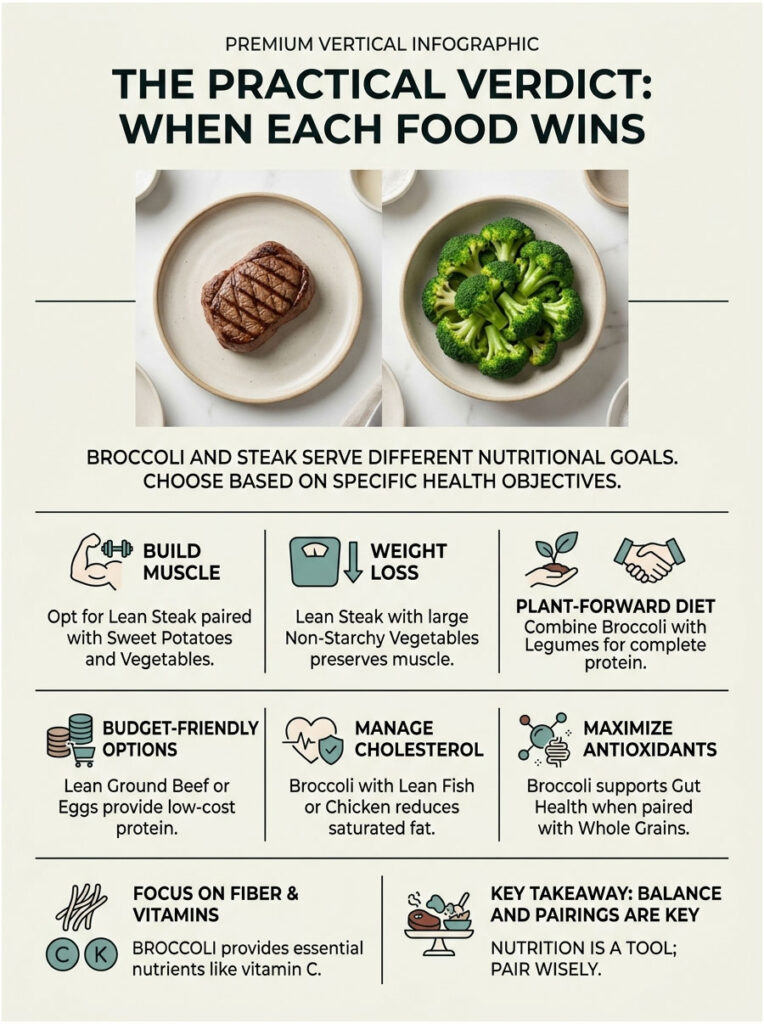
| Your Goal | Better Pick | Why | What to Pair With |
| Build muscle / gain lean mass | Steak (lean cuts) | Complete protein, high DIAAS, hits leucine threshold | Sweet potato, salad, broccoli side |
| Lose weight while preserving muscle | Steak (lean cuts) | High protein per calorie keeps you full | Large non-starchy vegetable portion |
| Boost fiber, vitamin C, and folate | Broccoli | 5g fiber, 135% DV vitamin C per cup | Beans, chicken, eggs |
| Eat plant-forward but hit protein | Combine broccoli with legumes | Complementary amino acids | Lentils, tofu, quinoa, beans |
| Hit a tight food budget per gram of protein | Lean ground beef or eggs | Lowest cost per usable gram | Brown rice, frozen vegetables |
| Manage high LDL cholesterol | Broccoli + lean fish or chicken | Less saturated fat, more fiber | Salmon, brown rice, olive oil |
| Maximize antioxidants and gut health | Broccoli | Sulforaphane, fiber, prebiotic load | Whole grains, fermented foods |
Table 3: When broccoli or steak is the better pick for common US health goals.
Common Mistakes People Make in This Debate
Most of the confusion around broccoli vs steak protein comes from five specific reasoning errors. Our nutrition reviewers see these come up every January when New Year diet plans start.
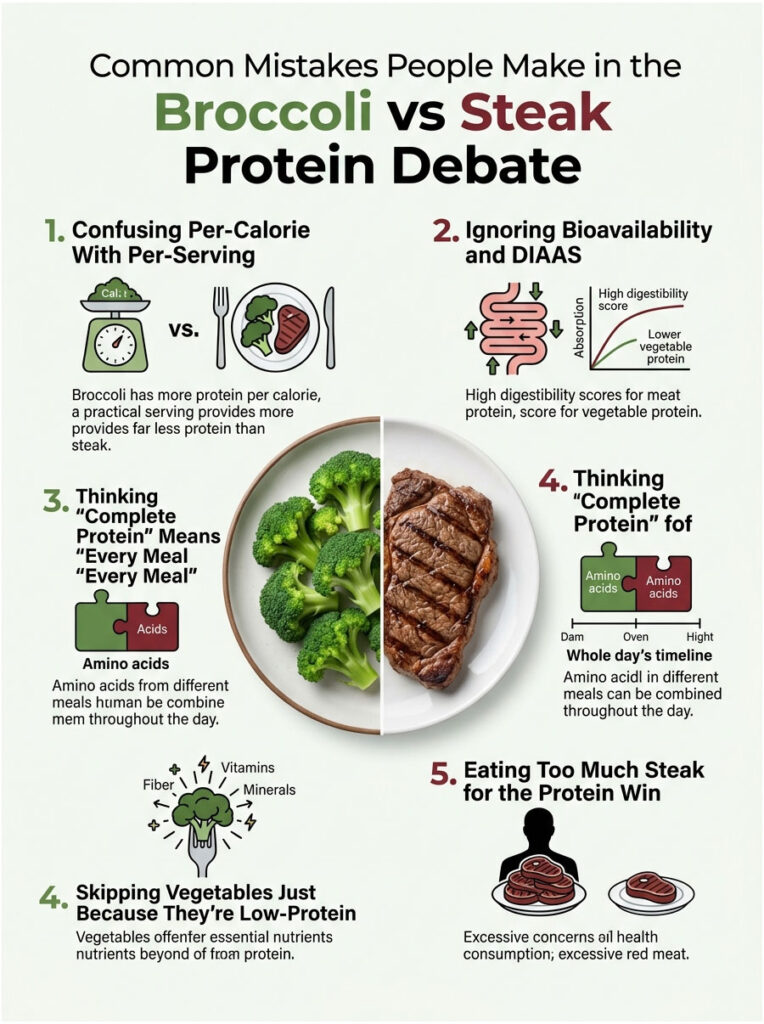
Mistake 1: Confusing Per-Calorie With Per-Serving
A graphic showing “100 calories of broccoli vs 100 calories of steak” is technically valid but practically meaningless. Nobody eats by the calorie. They eat by the plate, the bowl, or the ounce.
Mistake 2: Ignoring Bioavailability and DIAAS
A gram of plant protein and a gram of animal protein are not equivalent in what your body can use. The DIAAS scoring system was created specifically because researchers needed a clearer measure than just “grams on the label.”
Mistake 3: Thinking “Complete Protein” Means “Every Meal”
You do not need a complete protein at every meal. The Academy of Nutrition and Dietetics and most major US nutrition bodies confirm that combining plant proteins across a day works fine for healthy adults.
Mistake 4: Skipping Vegetables Just Because They’re Low-Protein
Broccoli’s value goes far beyond protein. The fiber, sulforaphane, vitamin C, vitamin K, folate, and prebiotics are reasons enough to eat it daily, even if you also eat steak.
Mistake 5: Eating Too Much Steak for the Protein Win
The American Heart Association recommends limiting red meat to under 12 to 18 ounces per week to manage saturated fat and cardiovascular risk. More protein from steak isn’t always better. Cases reviewed by our medical team show that patients eating multiple ribeyes per week often have elevated LDL cholesterol even on otherwise healthy diets.
How to Use Both in a Real US Diet
You don’t need to pick a team in the broccoli vs steak protein debate. Most US dietitians recommend a plate that includes both animal protein and a serving of cruciferous vegetables like broccoli.
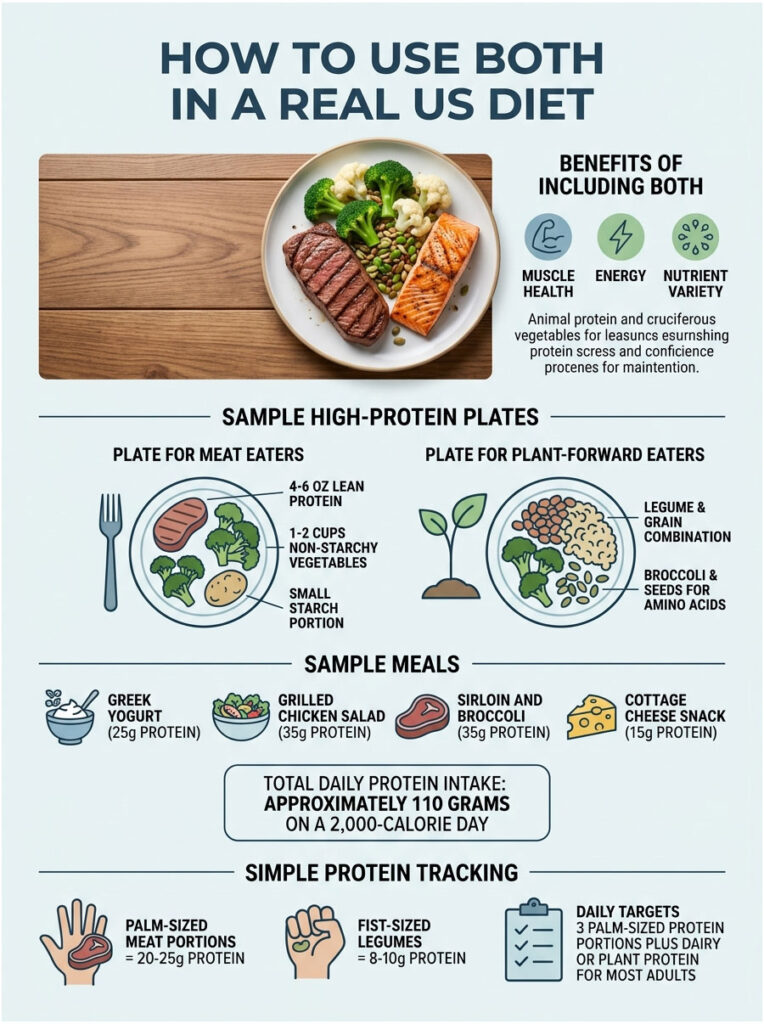
Building a High-Protein Plate (Meat Eaters)
A US-style high-protein dinner plate typically looks like 4 to 6 ounces of cooked lean protein (sirloin, chicken breast, salmon, or pork tenderloin), 1 to 2 cups of non-starchy vegetables (broccoli, asparagus, spinach), and a smaller portion of starch (sweet potato, brown rice, quinoa).
That single plate delivers 35 to 50 grams of protein and most of your daily fiber.
Building a High-Protein Plate (Plant-Forward Eaters)
A plant-forward high-protein plate combines two protein sources: a legume (lentils, black beans, chickpeas) plus a grain (quinoa, brown rice, farro). Add 1 to 2 cups of broccoli and a tablespoon of tahini or pumpkin seeds for amino acid completeness.
That combination can hit 25 to 35 grams of protein per plate without any animal products.
Sample US-Friendly Meals
Breakfast: Greek yogurt with berries and walnuts. 25g protein.
Lunch: Grilled chicken salad with broccoli, chickpeas, and quinoa. 35g protein.
Dinner: 4 oz broiled sirloin, roasted broccoli, sweet potato. 35g protein.
Snack: Cottage cheese with sliced apple and almonds. 15g protein.
Total: about 110 grams of protein on a 2,000-calorie day, well above the RDA for a 150-pound adult.
Tracking Protein Without an App
A simple US shortcut: each “palm-sized” portion of cooked meat, fish, or poultry is roughly 20 to 25 grams of protein. A “fist-sized” portion of cooked legumes is about 8 to 10 grams. A cup of dairy or a large egg adds 6 to 8 grams.
Most US adults can hit their daily target with 3 palm-sized protein portions plus a couple of dairy or plant-protein adds.
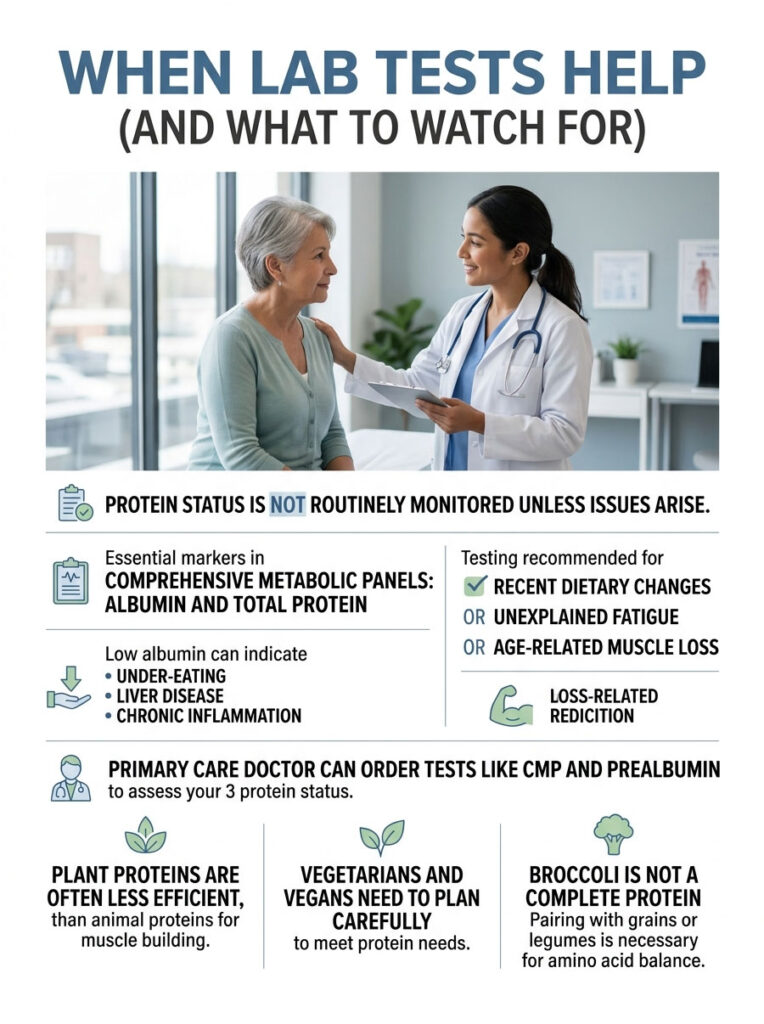
When Lab Tests Help (and What to Watch For)
Protein status isn’t usually monitored with routine bloodwork unless something is off. Still, a few markers can flag under-eating or absorption problems.
Albumin and Total Protein Markers
A standard US comprehensive metabolic panel (CMP) includes albumin and total protein. Low albumin (under 3.5 g/dL) can suggest poor protein intake, liver disease, kidney loss, or chronic inflammation.
In dietary panels ordered through HealthCareOnTime, low albumin often correlates with under-eating protein, regardless of whether the source was plant or animal. The fix is rarely just “eat more steak”; it’s eating enough total protein across whatever foods fit your diet.
When a Doctor Should Check Protein Status
Lab testing makes sense if you’ve recently switched to a strict vegan diet without planning, have unexplained fatigue or hair loss, are recovering from surgery or illness, or are over 65 and losing muscle.
A primary care doctor can order a CMP, prealbumin, and sometimes BUN (blood urea nitrogen) to confirm protein status. Most US insurance plans cover these basic panels.
Frequently Asked Questions
Does broccoli have more protein than steak gram for gram?
No, not even close. Cooked broccoli has about 2.4 grams of protein per 100 grams. Cooked sirloin steak has about 30 grams of protein per 100 grams, roughly 12 times more. Even compared to the leanest cooked broccoli sample (around 3 grams per 100 grams roasted), steak wins by a factor of 8 to 10 on a per-weight basis. The viral broccoli vs steak protein claim doesn’t survive a USDA reality check.
Does broccoli have more protein per calorie than steak?
Only for the fattiest steak cuts. Raw broccoli has about 8.3 grams of protein per 100 calories. Lean broiled sirloin delivers roughly 17.7 grams of protein per 100 calories, more than double. Heavily marbled ribeye or prime rib comes closer (around 10 to 13 grams per 100 calories), and very high-fat ground beef can fall below broccoli on this single metric, but lean steak still wins.
How much broccoli equals one 8 oz steak in protein?
An 8-ounce (227-gram) cooked sirloin delivers roughly 65 to 70 grams of protein. To match that with cooked broccoli, you’d need to eat about 2,800 to 3,000 grams, or roughly 6.5 pounds. That’s about 19 cups of cooked broccoli. The fiber load alone, around 175 grams, would cause severe gastrointestinal distress and exceed the US daily fiber target by 6 to 7 times.
Is broccoli a complete protein?
No. A complete protein contains all 9 essential amino acids in proportions adequate to meet body needs. Broccoli falls short on methionine and is limited in lysine relative to body requirements. You can still get all 9 essential amino acids on a broccoli-heavy diet by combining it with grains, legumes, nuts, or seeds across the day, but broccoli alone won’t supply the full set.
What’s the most protein-rich vegetable in the US?
Edamame (immature soybeans) is the most protein-dense common vegetable in the US, with about 18 grams of protein per cup cooked, and it’s a complete protein. Other strong choices include green peas (8 grams per cup), spinach (5 grams per cup cooked), and asparagus (4 grams per cup). Broccoli sits at about 4 grams per cup cooked, which is mid-range for vegetables but not protein-dense compared to meat or beans.
Can you build muscle eating only broccoli?
In theory, yes, by eating enormous quantities and meeting your calorie and amino acid needs. In practice, no human can eat the 10 to 15 pounds of broccoli daily that would be required to support meaningful muscle growth in an active adult. Building muscle on a plant-based diet works far better with concentrated plant proteins like soy, tofu, lentils, tempeh, and pea protein isolate alongside vegetables.
How much protein do US adults need daily?
The NIH/IOM RDA is 0.8 grams of protein per kilogram of body weight per day, which works out to about 54 grams for a 150-pound adult. Current research suggests this is the minimum to prevent deficiency, not the optimum. Athletes, older adults, and pregnant women generally benefit from 1.2 to 2.0 g/kg per day. The Acceptable Macronutrient Distribution Range allows 10 to 35% of calories from protein.
What’s the best cut of steak for protein?
Eye of round, top sirloin, flank steak, and filet mignon are the leanest cuts and pack the most protein per calorie. Eye of round trimmed of fat can hit 33 grams of protein per 100 grams cooked. Ribeye and prime rib have lower protein-to-calorie ratios because more of the energy comes from fat, though they still deliver substantial absolute protein. For muscle-focused eaters, sirloin or eye of round is typically the best value.
Is plant protein worse than animal protein?
Not “worse,” but generally less efficient. Animal proteins (beef, eggs, milk, fish, chicken) score higher on the DIAAS bioavailability scale and are complete in essential amino acids. Plant proteins, except soy and a handful of others, are typically incomplete and somewhat less digestible. A well-planned plant-based diet can absolutely meet protein needs, but it usually requires eating 20 to 50% more grams of protein than an animal-based diet for equivalent muscle effects.
Does cooking change broccoli’s protein content?
Slightly. Raw broccoli has about 2.82 grams of protein per 100 grams. Boiled broccoli drops to about 2.38 grams as some water-soluble nutrients leach into the cooking water. Roasted or steamed broccoli loses water mass and can concentrate slightly higher (2.6 to 3.0 grams per 100 grams). The protein amount per typical cup serving doesn’t change dramatically, though steaming preserves more vitamin C and folate than boiling.
How much protein per dollar does broccoli vs steak give you?
At average US grocery prices (2025), broccoli runs about $2.50 per pound and provides roughly $0.20 to $0.30 per gram of usable protein. Lean ground beef or sirloin steak at $7 per pound delivers protein at about $0.10 to $0.14 per gram. Lean beef wins on protein per dollar in most US markets. Eggs and dried beans are even cheaper per gram of protein, often under $0.05.
Should vegetarians worry about getting enough protein?
Most healthy vegetarians in the US who eat enough total calories do hit their protein RDA, especially if they include dairy, eggs, soy, legumes, and whole grains regularly. Strict vegans need to plan more carefully, particularly around amino acid completeness, vitamin B12, iron, and calcium. The Academy of Nutrition and Dietetics confirms that well-planned vegetarian and vegan diets are nutritionally adequate for all life stages, including pregnancy and athletic performance.
| Disclaimer: This article is general nutrition education and is not medical advice. Individual protein needs vary based on age, weight, activity level, and medical conditions including kidney disease, liver disease, or pregnancy. Talk to a US-licensed dietitian, primary care doctor, or registered nutritionist before making major dietary changes. If you have kidney disease or are on a protein-restricted diet, do not increase protein intake without your doctor’s guidance. |
References
- USDA FoodData Central. Broccoli, raw and cooked nutrient profiles.
- USDA ARS. Nutrient Data Set for Retail Beef Cuts (Release 2.0).
- Phillips SM. Current Concepts and Unresolved Questions in Dietary Protein Requirements. Frontiers in Nutrition, 2017.
- Institute of Medicine (NIH). Protein and Amino Acids: Recommended Dietary Allowances.
- The Daily Meal. Does Broccoli Actually Contain More Protein Than Steak?
- Nutrivore (Sarah Ballantyne, PhD). Busting Broccoli Myths.
- Whole Foods Market. Yes, Plants Have Protein.
- American Heart Association. Dietary recommendations on red meat.
- Mayo Clinic. Protein needs during pregnancy.
- The Nutrition Coalition. Erosion of Protein in US Dietary Guidelines.
- Academy of Nutrition and Dietetics. Vegetarian Diets position paper.