
Here is a curveball. In a 2025 clinical trial, the snack with nearly three times more sugar came out ahead for blood sugar control.
That snack was mango. Pitted against a low-sugar granola bar in adults with prediabetes, daily mango won on glucose regulation and even on body fat.
Table of Contents
So the sweetest fruit in the produce aisle may not be the villain its sugar label suggests. The real answer, as always with diabetes, lives in the details: how much, how ripe, and what you eat it with.
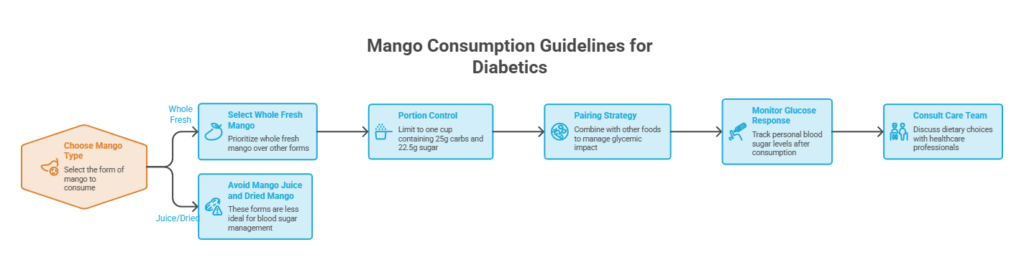
Quick Answer. Yes, most people with diabetes can eat mango in controlled portions. A half-cup to one-cup serving carries a low-to-moderate glycemic load, and the fruit’s fiber slows sugar absorption. Pairing mango with protein or fat blunts the spike further. The bigger problems are mango juice and dried mango. Individual blood sugar response varies, so portion size and personal monitoring matter most.
At a Glance
- Mango is not off-limits for diabetics when portioned well.
- The glycemic index of ripe mango is about 51, low to moderate.
- One cup holds roughly 25 grams of carbs and 22.5 grams of sugar.
- Portion size and pairing decide the size of the blood sugar spike.
- Whole fresh mango beats mango juice and dried mango every time.
- Monitor your own glucose response and check with your care team.
Mango, Sugar, and Diabetes: The Short Answer
Mango earns its nickname, the king of fruits, partly through sweetness. That sweetness is exactly why people with diabetes hesitate before taking a slice.
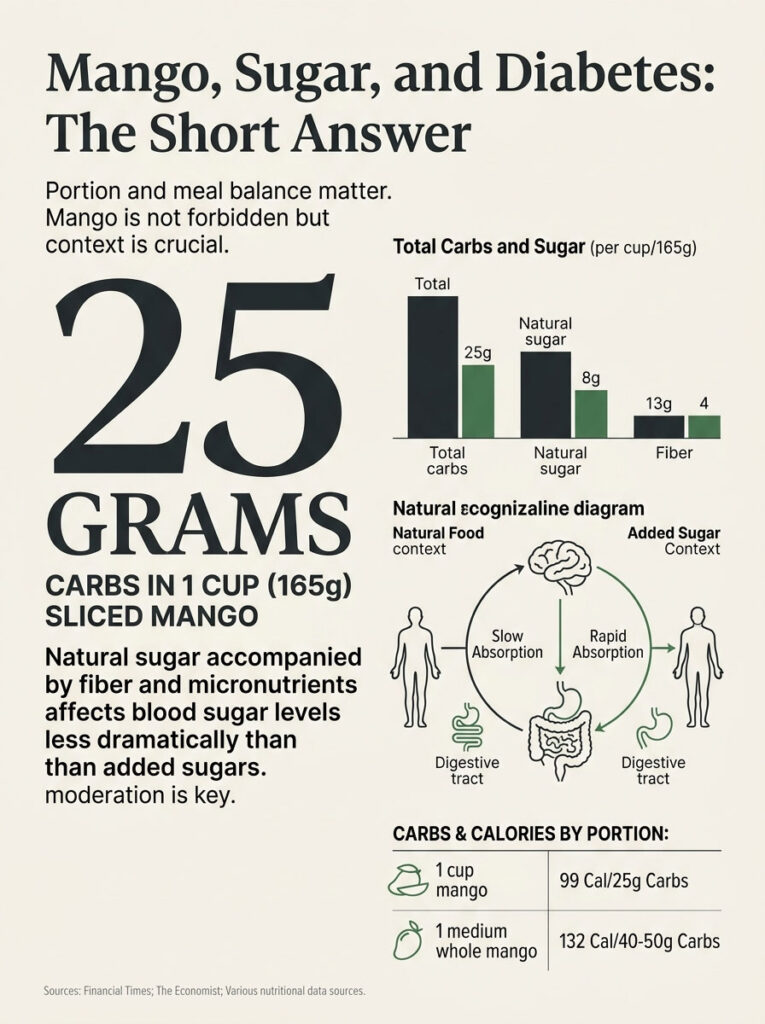
The honest short answer is that mango can fit a diabetic diet. It is not a free pass, and it is not forbidden either. The deciding factors are portion, ripeness, and what sits next to it on the plate.
Readers often ask our team whether one fruit can really be safe when it tastes that sugary. The data says it can, as long as the serving stays sensible and the rest of the meal is balanced.
What is actually in a mango
Mango is mostly water and carbohydrate, with a surprising amount of fiber and micronutrients packed in. The carbs are why it affects blood sugar, but they arrive wrapped in fiber and antioxidants that soften the impact.
According to USDA data, one cup of sliced mango (about 165 grams) contains roughly 99 calories. That same cup holds close to 25 grams of carbohydrate, about 22.5 grams of sugar, around 2.6 grams of fiber, and a little over 1 gram of protein.
A whole medium mango is bigger than people expect, near 220 grams and about 132 calories. As one endocrinologist put it, a single medium mango can carry 40 to 50 grams of carbs, similar to more than two slices of bread.
Why natural sugar is not the same as added sugar
This is where the conversation usually goes wrong. People treat all sugar as identical, so a fruit with 22 grams of sugar looks worse than a cookie with 12.
Natural sugar in whole fruit comes bundled with fiber, water, vitamins, and plant compounds. Added sugar in processed snacks arrives stripped of all that, hitting the bloodstream faster and offering little in return.
When our editorial team reviewed the newest research, this distinction kept surfacing as the central point. The container the sugar travels in changes how your body handles it, a theme the next sections make concrete.
Glycemic Index and Glycemic Load, Decoded
Two numbers do most of the heavy lifting in any fruit-and-diabetes question: glycemic index and glycemic load. Knowing the difference is what separates a useful answer from a scary one.
What GI and GL actually mean
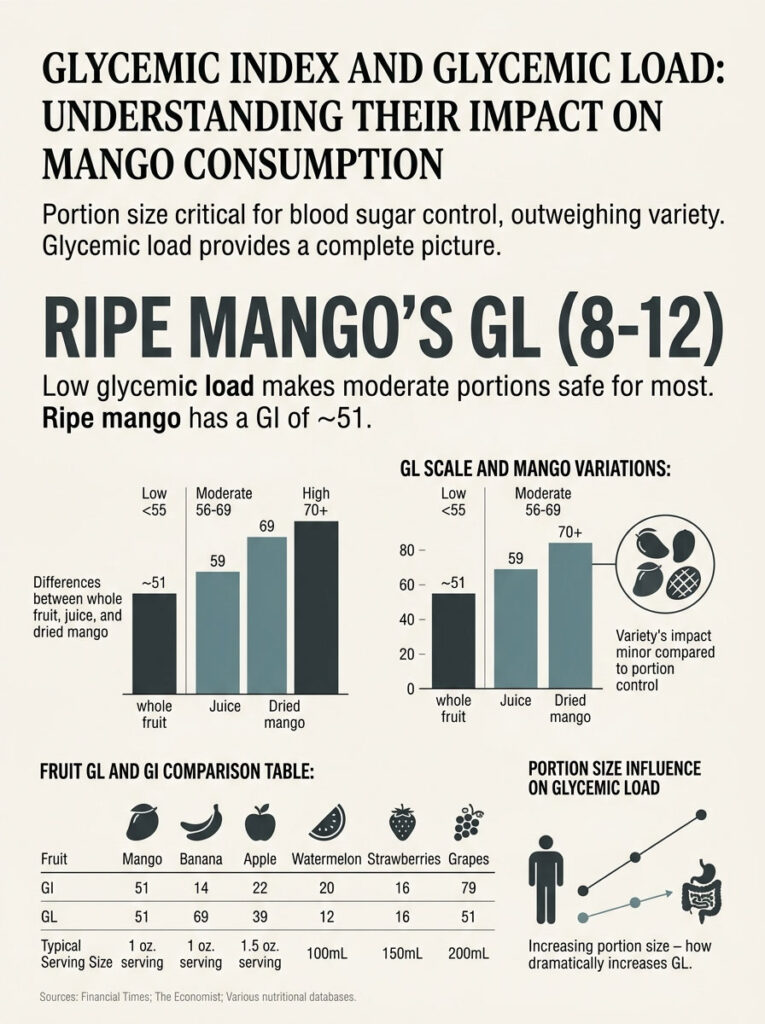
Glycemic index ranks how fast a carbohydrate food raises blood glucose, on a scale of 0 to 100. Anything under 55 is considered low, 56 to 69 is moderate, and 70 or above is high.
Glycemic load goes a step further. It factors in how many carbs are actually in a normal serving, so it reflects the real-world blood sugar hit, not just the speed.
A food can have a high GI but a low GL if a typical portion is small. Watermelon is the classic example, which is why GL is often the more practical number for daily choices.
Mango’s GI and GL numbers
Ripe mango lands at a glycemic index of about 51, which sits in the low-to-moderate zone. Published values range from roughly 41 to 60 depending on variety and ripeness.
The glycemic load is the reassuring part. A one-cup serving of fresh mango has a glycemic load of around 8 to 12, low to moderate. The fiber, near 2.6 grams per cup, helps blunt the rise.
The catch is quantity. Eat half a mango and the effect stays modest, but eat two or three in one sitting and the carbs multiply, dragging the glycemic load up with them. Our medical reviewers note that portion size, more than the fruit itself, drives most blood sugar trouble with mango.
How to picture mango’s glycemic load
Here is the math in plain terms. Glycemic load is the carbs in your serving multiplied by the GI, then divided by 100. For a one-cup serving of mango, that works out to roughly 8, firmly in the low range.
A glycemic load under 10 is considered low, 11 to 19 is moderate, and 20 or more is high. So one cup of mango sits comfortably at the gentle end, while two or three cups stacked together would push you into moderate or high territory.
This is why the serving, not the fruit, is the number to watch. The same mango can be a low-load snack or a high-load problem depending entirely on how much lands in the bowl.
| Fruit (typical serving) | Glycemic Index | Glycemic Load | Sugar (g) | Fiber (g) |
| Mango (1 cup, 165 g) | About 51 | About 8 | 22.5 | 2.6 |
| Banana (1 medium) | About 51 | About 11 | 14 | 3.1 |
| Apple (1 medium) | About 36 | About 6 | 19 | 4.4 |
| Watermelon (1 cup) | About 76 | About 5 | 9.5 | 0.6 |
| Strawberries (1 cup) | About 40 | About 4 | 7 | 3.0 |
| Grapes (1 cup) | About 53 | About 11 | 23 | 1.4 |
GI and GL values are approximate and vary by ripeness, variety, and source. They are best used to compare options, not as exact predictions.
Ripeness and form change the math
Ripeness quietly changes everything. As a mango ripens, enzymes convert starch into simple sugars, so a soft, very ripe mango raises blood sugar faster than a firmer, slightly underripe one.
Form matters even more than ripeness. Whole fresh mango keeps its fiber intact, while juice strips it away and sends sugar in fast. Dried mango is the trickiest of all, with a glycemic index that can climb into the 60s and far more sugar packed into a small handful.
Across the questions our nutrition team fields, dried mango and mango smoothies are the most common hidden traps. They feel healthy, yet they behave more like candy than fruit.
Do mango varieties matter?
US shoppers see several varieties, and the differences are smaller than the marketing suggests. Tommy Atkins, Kent, Keitt, Haden, and the smaller Ataulfo, often sold as Honey or Champagne mango, all behave similarly once ripe.
Sweeter, softer types like Ataulfo can taste more sugary, but the practical blood sugar difference comes down to ripeness and portion, not the label. A firm Kent and a soft Ataulfo eaten in equal amounts land in a similar range.
Patients commonly ask us which variety is safest, and the honest answer is that portion beats variety every time. Pick whichever you enjoy, then measure the serving.
What the Research Actually Shows
For years, advice on mango leaned on general principles about fruit and sugar. A recent US trial gave the topic real data, and it pointed in a friendlier direction than many expected.
The George Mason daily-mango study
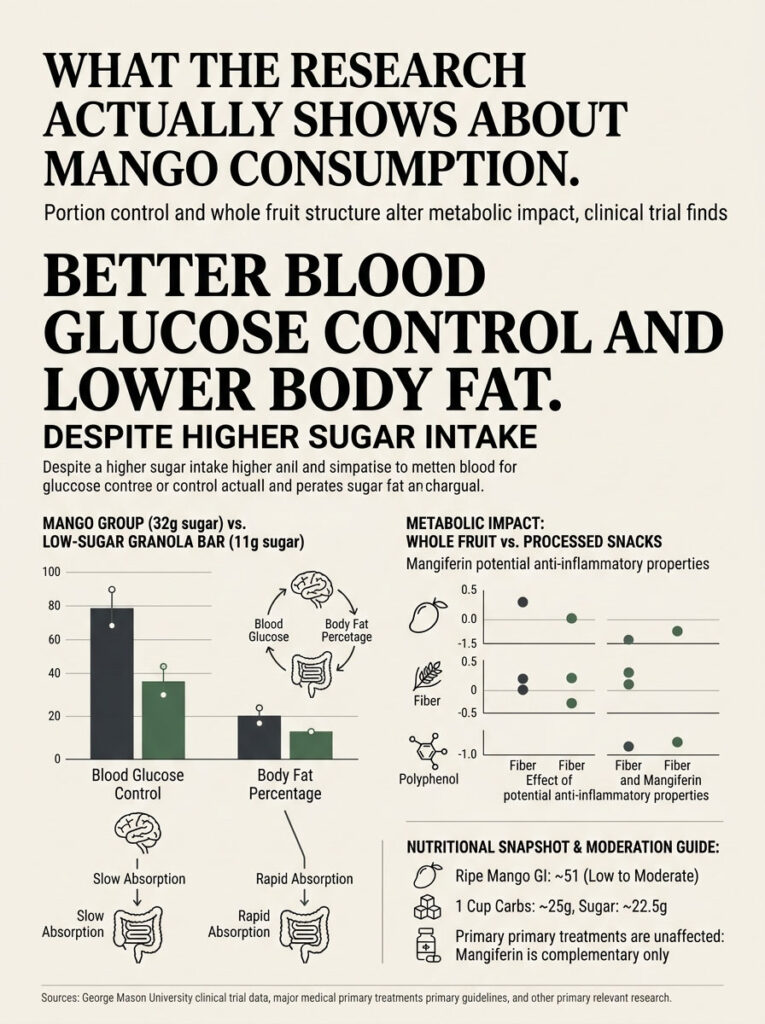
Researchers at George Mason University ran a clinical trial in adults with prediabetes. One group ate a daily mango carrying about 32 grams of sugar, while another ate a low-sugar granola bar with about 11 grams.
The result surprised the headline writers. The mango group showed better blood glucose control and lower body fat than the lower-sugar snack group, despite eating far more sugar.
The lead researcher framed it simply: it is not just the sugar content that matters, but the overall food context. Whole fruit, fiber and all, behaves differently from a processed bar, which is the through-line of this entire guide.
Mangiferin and antioxidants
Mango also brings plant compounds that may work in a diabetic’s favor. The standout is mangiferin, a polyphenol studied for anti-inflammatory and anti-diabetic activity in laboratory settings.
Mango is also a strong source of vitamin C, vitamin A, and potassium. Its antioxidants help temper the stress response that rising blood sugar can trigger, which may soften the overall metabolic impact.
These benefits are promising rather than proven cures. Patients commonly ask us whether mangiferin is a treatment, and the honest answer is that it is an interesting compound under study, not a substitute for medication or a meal plan.
The honest verdict: yes, with portions
Put the pieces together and a clear picture forms. Mango is a moderate-GI, low-to-moderate-GL fruit whose fiber and nutrients help it behave better than its sugar number implies.
The verdict is yes, with portions. A controlled serving fits most diabetic eating patterns, especially when paired thoughtfully and tracked against your own glucose readings.
In the guidance we share with readers, the goal is never to demonize a fruit. It is to put a sensible number on the serving so the enjoyment does not come with a spike.
| Stat | Figure | Source |
| Americans living with diabetes | 40.1 million (about 1 in 8) | CDC, January 2026 |
| US adults with prediabetes | 115.2 million (more than 2 in 5) | CDC, 2026 |
| Total diabetes prevalence in adults | 15.8 percent | CDC / NCHS, NHANES 2021 to 2023 |
| Glycemic index of ripe mango | About 51 (low to moderate) | USDA-based GI data |
| Carbohydrate in one cup of mango | About 25 grams | USDA |
| Sugar in one cup of mango | About 22.5 grams | USDA |
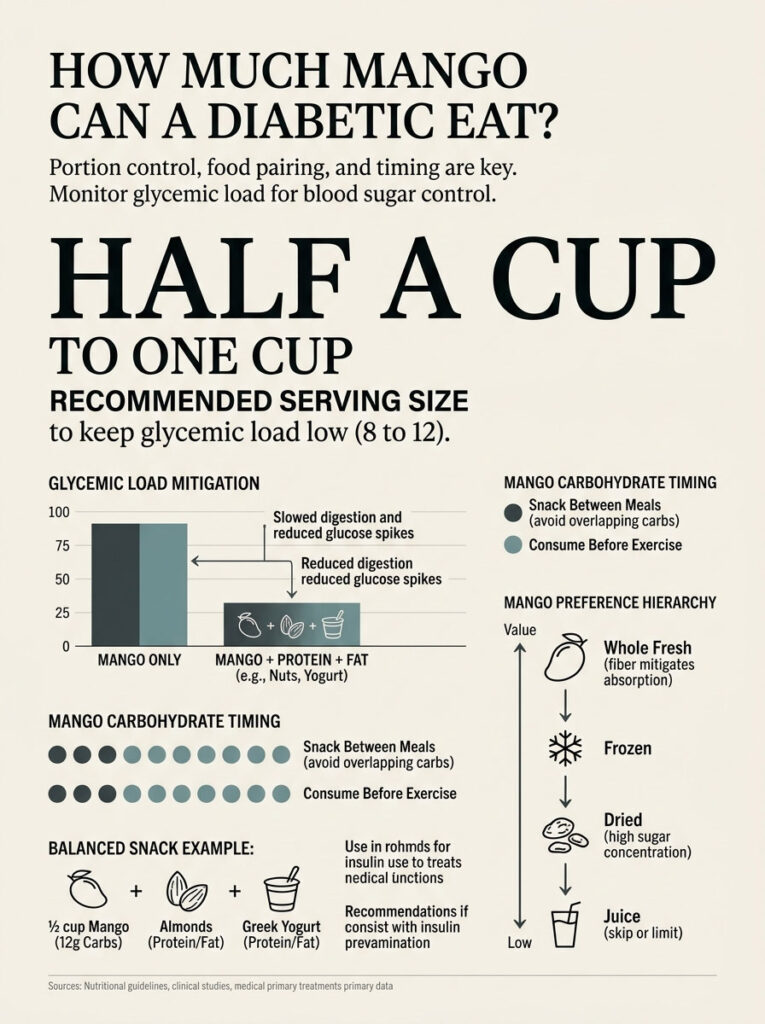
How Much Mango Can a Diabetic Eat?
This is the question the competition keeps answering with the word moderation and nothing more. Here is the actual number, with the reasoning behind it.
The portion that keeps glycemic load low
For most people with diabetes or prediabetes, a practical serving is about half a cup to one cup of fresh mango at a time. That keeps the glycemic load in the low-to-moderate range, roughly 8 to 12.
Some clinicians suggest staying near 100 grams, about half a cup, on days when blood sugar is harder to control. That portion delivers the nutrients without a meaningful spike for many people.
The point is to treat mango as a measured serving of fruit, not an open bowl. A kitchen scale or a simple measuring cup removes the guesswork on day one.
Pairing and timing to blunt the spike
What you eat alongside mango changes its effect. Pairing it with protein or healthy fat, such as a small handful of nuts or a scoop of Greek yogurt, slows digestion and flattens the glucose curve.
Timing helps too. Eating mango as a mid-morning or afternoon snack between meals, rather than piled on top of a carb-heavy plate, prevents overlapping carbohydrate loads.
Our medical reviewers note that pairing is the easiest lever most people ignore. The same mango that nudges glucose alone can sit much more gently when it shares the plate with protein and fiber.
A balanced mango snack in practice
A simple example shows how the numbers work together. Half a cup of mango, around 12 grams of carbohydrate, paired with a small handful of almonds and a few spoons of plain Greek yogurt, turns a sugar hit into a balanced snack.
The almonds add fat, the yogurt adds protein, and both slow how fast the mango sugar reaches your blood. The total stays satisfying without pushing glucose sharply upward.
This is the template to copy: a measured fruit portion plus a protein or fat partner. It works for breakfast bowls, salads, and afternoon snacks alike.
Whole fruit vs juice vs dried mango
If there is one rule to keep, it is to choose whole fresh mango. The intact fiber is what makes the fruit’s sugar manageable in the first place.
Mango juice should be limited or skipped, since juicing removes fiber and concentrates sugar into a fast-acting liquid. Dried mango deserves the same caution, because the water is gone and the sugar per bite is high.
The good news is that whole mango is also the most satisfying form. Readers often ask our team how to enjoy mango safely, and the simplest answer is to eat it the way it grows.
Frozen mango is a fine middle option, as long as it is plain with no added sugar. It keeps the fiber of fresh fruit and works well in a portion-controlled smoothie blended with yogurt and seeds. The order of preference is simple: whole fresh or frozen mango first, then small amounts of dried, and juice last or not at all.
| Scenario | Recommended Action | Why |
| You want a mango snack | Stick to about half a cup to one cup of fresh mango | Keeps the glycemic load in the low-to-moderate range |
| Your blood sugar runs high after fruit | Pair mango with protein or fat, then recheck your glucose | Slows absorption and reveals your personal response |
| You are craving mango juice | Choose whole fresh mango instead | Juice removes fiber and spikes glucose faster |
| You love dried mango | Keep it to a tiny amount as a rare treat, or skip it | Dried mango is sugar-dense with a higher GI |
| You take insulin or a GLP-1 like Ozempic | Count the carbs and ask your care team about timing | Mango’s carbs still need to fit your overall plan |
| The mango is very soft and overripe | Pick a firmer, slightly less ripe one | Riper fruit has more sugar and a higher GI |
Mango’s Benefits for People With Diabetes
Mango is not just tolerable for diabetics. Eaten well, it brings real nutritional value that supports several priorities common in diabetes care.
Fiber and steadier blood sugar
The fiber in mango is the quiet hero. It slows the rate at which sugar enters the bloodstream, so the rise is gradual rather than sharp.
That steadier curve is exactly what blood sugar management aims for. Compared with processed sweets of similar sugar content, whole mango produces a more gentle response.
Fiber also supports digestion and fullness, which helps with the weight management that matters so much in type 2 diabetes. A satisfying fruit can crowd out less helpful snacks.
Vitamins, potassium, and eye health
Mango is rich in vitamin C and vitamin A, both useful antioxidants. It also supplies potassium, which supports heart health, a major concern for people with diabetes.
Eye health is another quiet benefit. Conditions like diabetic retinopathy make the vitamin A and antioxidant content of mango a small but welcome contribution when glucose is well controlled.
None of these nutrients cancels out the carbs, and our medical reviewers are careful to frame mango as a nutritious food within a budget, not a medicine. The benefits count only when the portion stays in range.
A satisfying alternative to processed sweets
For anyone with a sweet tooth, mango offers a way to satisfy it with real food. A measured serving of fruit can replace a cookie or candy that delivers the same sugar with none of the fiber or nutrients.
Swapping a processed dessert for whole mango most days is a small change that adds up. The fruit brings vitamins and fiber to the table, while the cookie brings only sugar and refined flour.
Patients commonly ask us for a treat that does not derail the day, and a portioned bowl of mango is a reasonable answer. It feels indulgent while staying close to a whole food.
The scale of the problem
Context explains why this question matters to so many people. As of the CDC’s January 2026 report, about 1 in 8 Americans has diabetes.
The full picture is larger still. CDC figures show 40.1 million Americans living with diabetes, more than 1 in 4 of them unaware they have it, and 115.2 million adults with prediabetes.
NHANES data for 2021 to 2023 put total diabetes prevalence at 15.8 percent of adults, climbing from 6.8 percent in normal-weight adults to 24.2 percent in adults with obesity. For a population this size, knowing how to enjoy fruit without fear is genuinely useful.
Risks and Mistakes to Avoid
Mango can fit a diabetic diet, but a few common mistakes turn a friendly fruit into a blood sugar problem. These are the ones worth watching.
Overripe fruit and oversized portions
The two biggest errors travel together: a very ripe mango eaten in a large amount. Ripeness raises the sugar and the GI, and a big portion multiplies the carbs.
A whole large mango in one sitting can deliver 40 to 50 grams of carbohydrate, enough to spike many people. Splitting that mango across servings, or sharing it, keeps the math in check.
Our medical reviewers note that most mango-related spikes trace back to portion creep, not the fruit’s nature. A measured serving is a different food from a heaping bowl.
Juice, smoothies, and products with added sugar
Mango juice, mango smoothies, and sweetened mango products are where many people get caught. Juice strips the fiber, and store-bought versions often add extra sugar on top.
Even homemade smoothies can spike glucose quickly when fruit is blended without protein or fat to slow it down. The label is the place to check, since the word mango on a package rarely means whole fruit.
A note on gestational diabetes
Pregnancy adds another layer. People managing gestational diabetes can usually include small portions of mango, but blood sugar targets in pregnancy are tighter, so portions are often smaller.
Pairing the fruit with protein and spreading carbs across the day becomes even more important. Anyone with gestational diabetes should follow the plan their obstetric and diabetes team set, rather than a general guideline.
Individual variation: monitor your own response
No single rule fits everyone. Two people with diabetes can eat the same mango and see different glucose readings, based on their medication, activity, and metabolism.
This is why checking your blood sugar after trying mango is so valuable. A reading an hour or two later shows how your body, specifically, handles the fruit.
A continuous glucose monitor or a simple finger-stick test turns guesswork into personal data. Patients commonly ask us for one universal serving, and the truthful answer is that your meter is the final word.
Smart Ways to Enjoy Mango Without the Spike
The best part is that eating mango safely does not mean eating it joylessly. A few simple habits let you keep the flavor and skip the spike.
Best pairings
Protein and healthy fat are mango’s best partners. A few slices with Greek yogurt, cottage cheese, or a small handful of nuts slows sugar absorption and adds staying power.
Fiber-rich pairings help too. Adding mango to a salad with leafy greens, or eating it after a balanced meal that includes protein, keeps the overall glycemic load lower.
Easy diabetes-friendly ideas
Mango works beautifully in savory dishes that dilute its sugar across a meal. Dice a small amount into a green salad, or toss it with arugula, cucumber, and a squeeze of lime.
A yogurt bowl with a measured half-cup of mango, chia seeds, and nuts makes a balanced snack. For dessert, a small fruit salad mixing mango with strawberries and kiwi spreads the sugar across lower-load options.
Reading labels on mango products
Packaged mango can hide a lot. Dried mango, mango bars, canned mango in syrup, and bottled smoothies frequently carry added sugar far beyond the fruit itself.
Check the ingredient list for added sugars, and favor products that list only fruit. In the guidance we share with readers, the rule of thumb is that the closer a mango product is to a fresh mango, the better it behaves for blood sugar.
Frequently Asked Questions
Are mangoes good for diabetics?
Yes, in controlled portions. Mango has a low-to-moderate glycemic index of about 51, and its fiber slows sugar absorption. A half-cup to one-cup serving fits most diabetic diets, especially when paired with protein or fat. Monitor your own blood sugar, since individual responses vary.
How much mango can a diabetic eat per day?
A practical serving is about half a cup to one cup of fresh mango, roughly 100 to 165 grams. That keeps the glycemic load low to moderate. On days when blood sugar is harder to control, stay closer to half a cup, and always count it toward your daily carbs.
Does mango raise blood sugar quickly?
Not dramatically when eaten as whole fruit in a normal portion. Its fiber slows the rise, producing a gradual increase rather than a sharp spike. Large portions, very ripe fruit, juice, or dried mango raise blood sugar faster, so the form and amount matter more than the fruit itself.
What is the glycemic index of mango?
Ripe fresh mango has a glycemic index of about 51, which is low to moderate. Published values range from roughly 41 to 60 depending on variety and ripeness. A riper mango trends higher, while a firmer, slightly underripe one scores a few points lower on the scale.
Can type 2 diabetics eat mango?
Yes. People with type 2 diabetes can include mango in measured portions as part of a balanced diet. Keep servings to about half a cup to one cup, pair with protein or fat, and track your glucose response. Whole fresh mango is far better than juice or dried mango.
Is dried mango OK for diabetics?
Use caution. Dried mango loses its water, so sugar is concentrated and the glycemic index can climb into the 60s. A small handful packs far more sugar than the same weight of fresh fruit. Treat it as a rare, tiny treat, or choose fresh mango instead.
Can diabetics drink mango juice or smoothies?
Mango juice should be limited or avoided, since juicing removes fiber and concentrates sugar into a fast-acting liquid. Smoothies can spike glucose too unless blended with protein, fat, and fiber. Whole fresh mango is always the better choice for steadier blood sugar.
What is the best time to eat mango for diabetes?
A mid-morning or afternoon snack between meals works well, rather than piling mango on top of a carb-heavy plate. Some people tolerate it best before light activity. Eating it away from other high-carb foods prevents overlapping carbohydrate loads and helps keep glucose steadier.
Is mango high in sugar compared to other fruits?
Mango is on the higher-sugar end of fruits, with about 22.5 grams per cup, similar to grapes and higher than berries. But its fiber and moderate glycemic index temper the impact. Portion control and pairing keep it manageable despite the higher sugar number.
Can a diabetic eat mango every day?
Often yes, if the portion stays controlled and fits your carb budget. A 2025 clinical trial even found daily mango improved blood sugar control in adults with prediabetes. Keep servings to about half a cup to one cup, monitor your glucose, and check with your care team.
Does ripeness change mango’s effect on blood sugar?
Yes. As mango ripens, starch converts to simple sugars, so a soft, very ripe mango raises blood sugar faster than a firmer, slightly underripe one. The published glycemic index of 51 reflects ripe fresh fruit, so overripe mango can push higher and underripe a bit lower.
Can diabetics on medications like Ozempic eat mango?
Generally yes, in moderate portions. People on insulin or GLP-1 medications can usually include mango, but should count the carbs and monitor blood sugar, especially when starting or adjusting a medication. Discuss timing and portion with your healthcare provider for personalized guidance.
Disclaimer. This article is for general information only and is not medical advice. It is not a substitute for diagnosis or treatment from a qualified healthcare professional or registered dietitian. Individual blood sugar responses to mango vary. Talk to your care team before making changes to your diet, and monitor your own glucose levels.
References
- CDC, National Diabetes Statistics Report: https://www.cdc.gov/diabetes/php/data-research/index.html
- CDC, Diabetes A U.S. Report Card (prevalence statistics): https://www.cdc.gov/diabetes/communication-resources/diabetes-statistics.html
- CDC / NCHS, Data Brief No. 516, Prevalence of Diabetes in Adults (2024): https://www.cdc.gov/nchs/products/databriefs/db516.htm
- USDA FoodData Central, Mango Nutrition: https://fdc.nal.usda.gov/
- George Mason University, daily mango and prediabetes study (2025): https://nutrition.gmu.edu/news/2025-09/can-mango-day-keep-diabetes-away-pioneering-study-shows-benefits-foods-natural-sugars
- Healthline, Is It Safe to Eat Mango If You Have Diabetes?: https://www.healthline.com/nutrition/mango-is-good-for-diabetes
- American Diabetes Association, Diabetes Statistics: https://diabetes.org/about-diabetes/statistics/about-diabetes