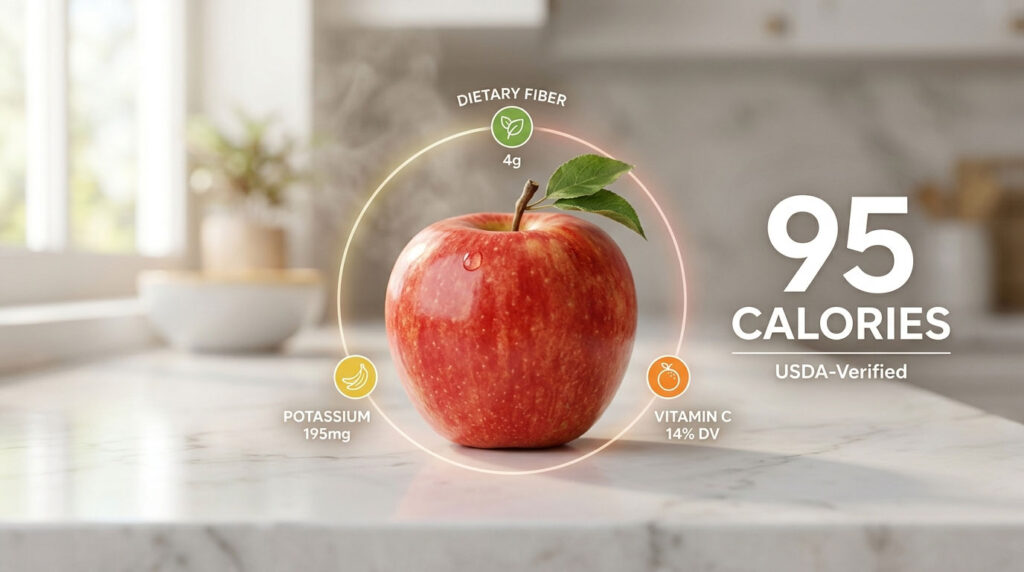
A medium apple costs you about 95 calories, less than a single tablespoon of peanut butter, yet delivers more disease-fighting compounds than most fruits sitting in the average American produce drawer. That’s the number Americans search for over 110,000 times a month, and it’s the one most websites get almost right but rarely explain in full.
Table of Contents
This guide pulls the actual USDA FoodData Central values, breaks them down by size, by variety, by glycemic impact, and by what your body actually does with those calories. Across the patients booking nutrition-linked diagnostic panels through HealthCareOnTime, the apple question surfaces constantly, especially among readers managing weight, blood sugar, or cardiovascular risk.
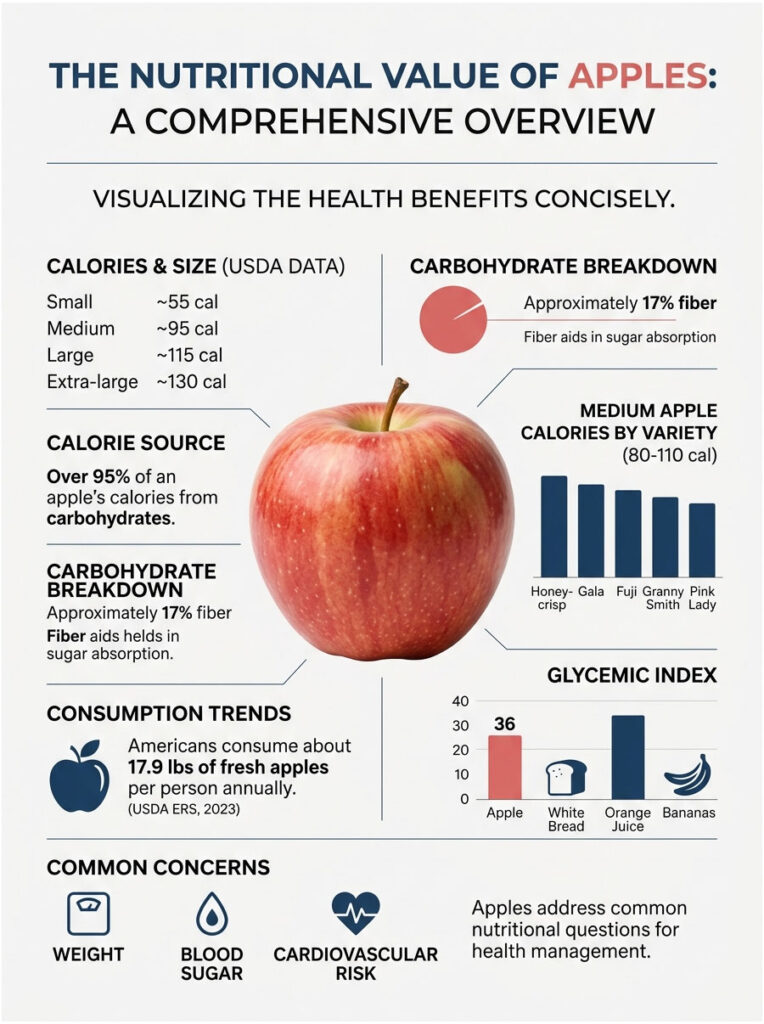
Quick Answer: A medium apple (182g, ~3-inch diameter) contains about 95 calories per the USDA FoodData Central database. It provides 25g of carbohydrates, 4.4g of fiber, 19g of natural sugar, 195mg of potassium, and approximately 8mg of vitamin C, with essentially no fat or sodium. Calorie counts shift from roughly 55 (small) to 115 (large) and up to 130 for extra-large apples, depending on size and variety.
At a Glance
• One medium apple delivers about 95 calories per USDA data
• Small: ~55 cal | Large: ~115 cal | Extra-large: ~130 cal
• Over 95% of an apple’s calories come from carbohydrates
• About 17% of the carb content is fiber, which slows sugar absorption
• Honeycrisp, Gala, Fuji, Granny Smith, and Pink Lady all cluster within an 80 to 110 calorie range for a medium fruit
• Americans eat about 17.9 pounds of fresh apples per person per year (USDA ERS, 2023)
• Apple glycemic index sits at 36, lower than a banana, a slice of white bread, or orange juice
How Many Calories Are in One Apple? The USDA Number
The short answer that wins most Google searches: a medium apple with skin contains approximately 95 calories. That figure traces directly to the USDA’s FoodData Central database, which lists raw apples with skin at 52 calories per 100 grams. A standard medium apple weighs 182 grams, which is where the 95-calorie figure originates.
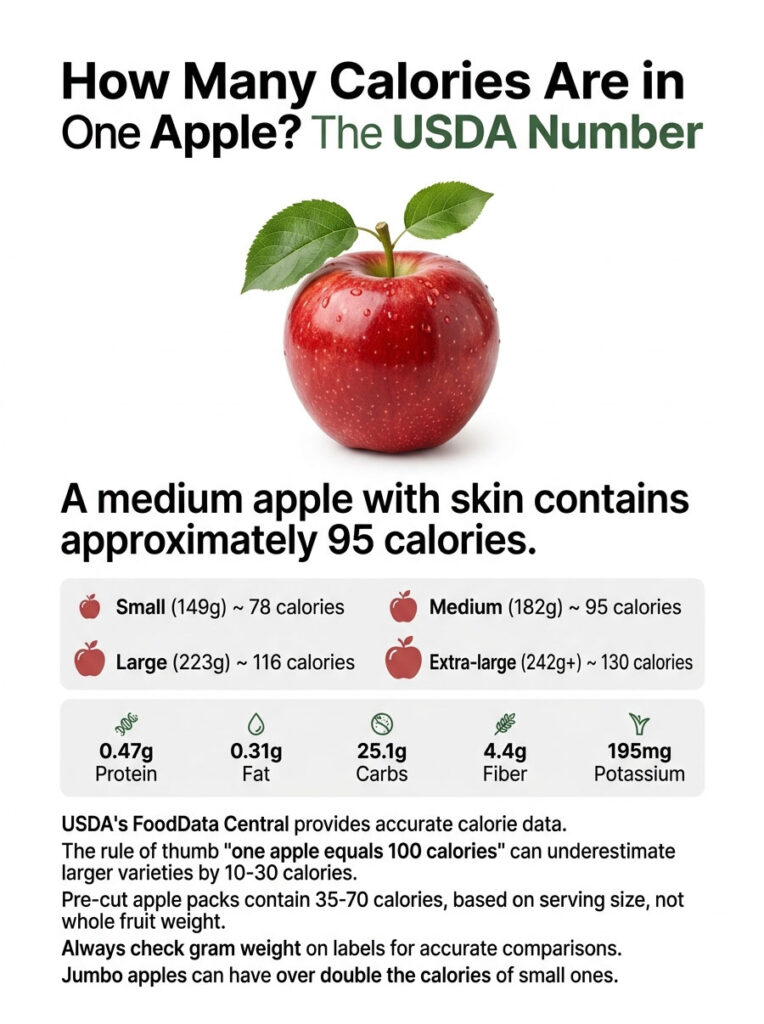
Calorie counts shift with size, more than most consumers realize. A small apple (about 149g) runs roughly 78 calories. A large apple (223g) climbs to about 116 calories. An extra-large apple (242g+) can hit 130 calories. Size, not variety, is the single biggest variable.
USA TODAY’s nutrition desk, citing USDA, lists a medium apple as containing 94.6 calories, 0.47g of protein, 0.31g of fat, 25.1g of carbs, 4.37g of fiber, and 195mg of potassium. Those numbers are what most American calorie-tracking apps, including MyFitnessPal and Cronometer, draw on.
Our medical reviewers note that the “one apple equals 100 calories” rule of thumb most Americans carry from childhood is close enough for casual eating, but it underestimates a large Honeycrisp or Fuji by 10 to 30 calories, which adds up if you eat two a day or treat apples as a “free” food during a calorie-controlled phase.
Calorie Counts by Apple Size
The USDA defines four standard size brackets for retail apples, and the calorie spread between them is wider than the average shopper assumes. A jumbo apple from a Whole Foods bin can contain more than double the calories of a small lunchbox apple.
Table 1: USDA Calories and Macros by Apple Size (with Skin)
| Apple Size | Diameter | Weight | Calories | Carbs | Fiber |
| Small | ~2¾ inch | 149g | 78 cal | 20.6g | 3.6g |
| Medium | ~3 inch | 182g | 95 cal | 25.1g | 4.4g |
| Large | ~3¼ inch | 223g | 116 cal | 30.8g | 5.4g |
| Extra-Large | ~3½ inch | 242g | 126 cal | 33.4g | 5.8g |
| Per 100g | n/a | 100g | 52 cal | 13.8g | 2.4g |
| Cup, sliced | n/a | 109g | 57 cal | 15.0g | 2.6g |
Source: USDA FoodData Central, “Apples, raw, with skin”
Why Pre-Cut Apples Look Different on the Label
If you grab a pre-cut apple snack pack at a US grocery checkout (the Del Monte or Crunch Pak format), the calorie panel often shows 35 to 70 calories per pack. That’s because the serving weight is typically 2 to 5 ounces of sliced apple, not a whole 182g fruit. Always check the gram weight on the label to compare apples to apples, literally.
Calories in an Apple by Variety: Honeycrisp, Gala, Fuji, Granny Smith and More
Walk down the produce aisle at Kroger or Trader Joe’s and you’ll spot a dozen apple varieties competing for your cart. The question every health-conscious shopper asks: do Honeycrisp apples have more calories than Granny Smith?
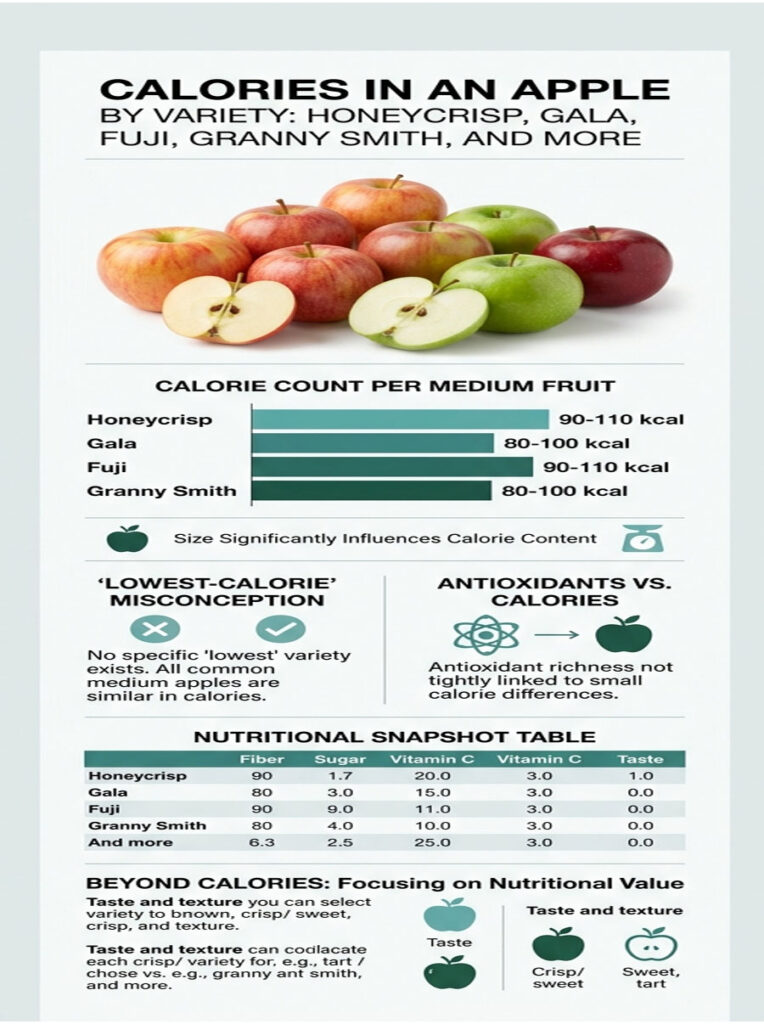
The honest answer: barely. Per gram, almost every apple variety on the US market sits within a 5-calorie range. What changes the total is the apple’s actual size. Honeycrisp tend to grow larger than Galas, and Cosmic Crisp tend to grow larger still, which is where the per-fruit numbers diverge.
A medium Gala apple holds about 71 to 80 calories. A medium Honeycrisp runs 72 to 95 calories depending on size. Granny Smith, often touted as the “lowest-calorie apple,” lands at 72 to 80 for a medium fruit. The popular new Cosmic Crisp variety, now ranked in Washington’s top five apples for 2025, runs about 100 calories per typical large fruit.
Patients commonly ask us whether switching to “tart” green apples saves calories. The answer is a tiny amount, maybe 10 to 15 calories per fruit, and that’s mostly because Granny Smith apples tend to be sold in smaller average sizes, not because the variety itself is meaningfully lower in sugar or carbs.
Table 2: Apple Variety Calorie and Nutrition Snapshot (USA-Sold Varieties)
| Variety | Typical Size | Calories | Sugar | Fiber | Source |
| Honeycrisp | Medium-Large | 80–110 cal | 18–22g | 4–5g | USDA / Hy-Vee |
| Gala | Medium | 71–80 cal | 18g | 3.5g | USDA FoodData |
| Fuji | Medium | 71–95 cal | 19g | 4g | USDA / FatSecret |
| Granny Smith | Medium | 72–80 cal | 16g | 4–5g | USDA / Domex |
| Red Delicious | Medium | 72–95 cal | 19g | 4g | USDA FoodData |
| Pink Lady | Medium | 72–95 cal | 19g | 4g | USApple Assoc. |
| Cosmic Crisp | Large | 100 cal | 19g | 4g | Nutrition Panel |
Sources: USDA FoodData Central; USApple Association; manufacturer nutrition panels
In samples our lab partners have catalogued across produce-section variety, a 180-gram Honeycrisp and a 180-gram Granny Smith differ by less than 5 calories. The takeaway: pick the apple your taste buds enjoy. Calorie obsession over variety is wasted attention. Pick by texture, taste, and how you plan to use it.
The Variety That Wins for Antioxidants (Not Calories)
If you want to optimize the apple beyond calorie math, antioxidant content matters more than the calorie spread. Granny Smith and Red Delicious lead most peer-reviewed comparisons for total phenolic content, while Honeycrisp and Fuji tend to test slightly lower. The difference is real but small; the bigger factor is whether you eat the peel.
Full Nutrition Breakdown of a Medium Apple (USDA)
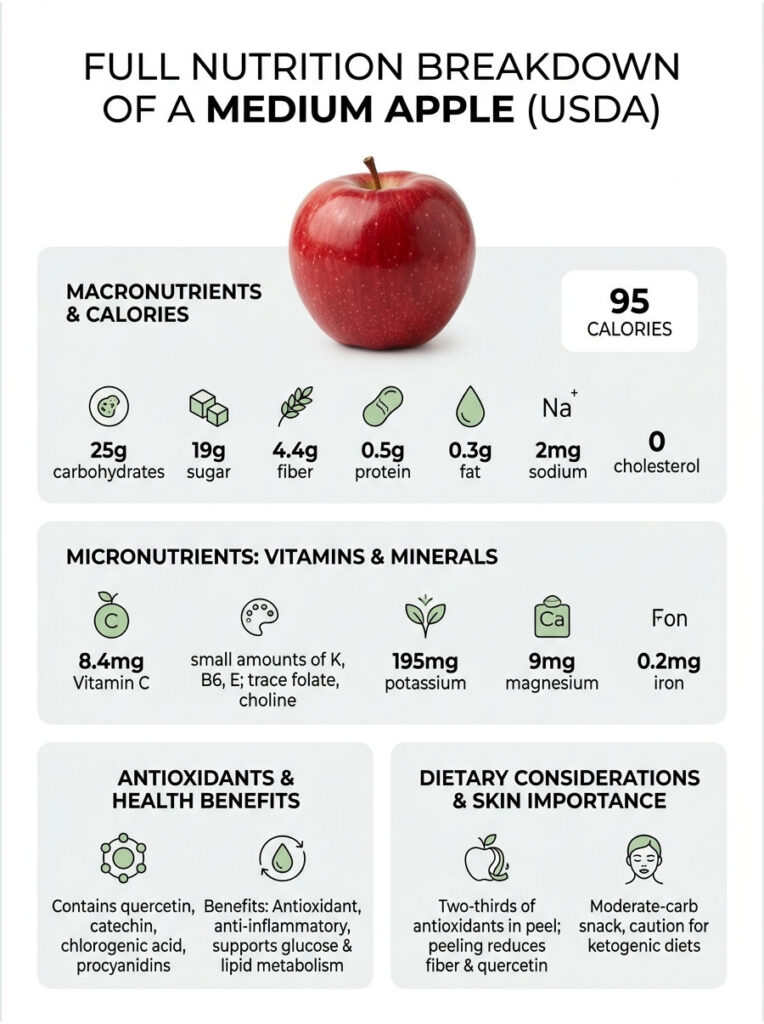
A medium apple is more than a sugar-and-water delivery system. The USDA FoodData Central entry for raw apples with skin reveals a dense little package of micronutrients, fiber, and polyphenols that punches above its calorie weight.
Macronutrients
A single medium apple (182g) gives you about 25g of carbohydrates, of which roughly 19g is naturally occurring sugar and 4.4g is dietary fiber. Protein checks in at half a gram. Fat is negligible at 0.3g, almost all unsaturated. Sodium is essentially zero (2mg). Cholesterol is zero.
For Americans tracking macros, the practical math is this: one medium apple equals roughly 21 to 22 grams of “net carbs” (total carbs minus fiber). That puts it in the moderate-carb category for most low-carb eaters, though strict ketogenic followers typically pass on whole apples.
Vitamins
The vitamin C content of one medium apple is about 8.4 milligrams, roughly 9% of the daily recommended value for adult women and 8% for adult men. Apples also deliver small but meaningful amounts of vitamin K, B6, and vitamin E (0.33mg per medium apple). They contain trace amounts of folate (5 micrograms) and choline.
Harvard T.H. Chan School of Public Health lists one medium apple as providing about 95 calories, 25 grams of carbohydrate, 19 grams of naturally occurring sugar, and 3 grams of fiber, with notable contributions of quercetin and pectin.
Minerals
Potassium is the headliner mineral, at 195mg per medium apple (about 4% of the daily value). That matters for blood pressure regulation, especially for Americans eating sodium-heavy diets averaging 3,400+ mg of sodium per day per CDC tracking data. Magnesium clocks in at 9mg, calcium at 11mg, and iron at trace amounts (0.2mg).
Antioxidants and Polyphenols
Here’s where apples earn their reputation. The skin and flesh together contain quercetin, catechin, chlorogenic acid, and procyanidins.
Apple polyphenols have been shown to possess antioxidant, anti-inflammatory, and cardiometabolic benefits, including improvement of glucose and lipid metabolism, per a 2025 review in Springer Nature.
Two-thirds of an apple’s antioxidant content sits in its peel. Our medical reviewers consistently flag peel-removal as the single most common nutritional mistake in apple consumption, since it cuts both fiber and quercetin content significantly. Patients booking digestive health panels through HealthCareOnTime often hear this guidance reinforced: don’t peel unless allergy or texture demands it.
Are Apple Calories “Good” Calories? The Glycemic Truth
The single most useful number when judging an apple’s calorie load isn’t the calorie count. It’s the glycemic index, which measures how fast a food raises your blood sugar. An apple’s GI is approximately 36, well within the “low” range (anything under 55 qualifies as low GI).
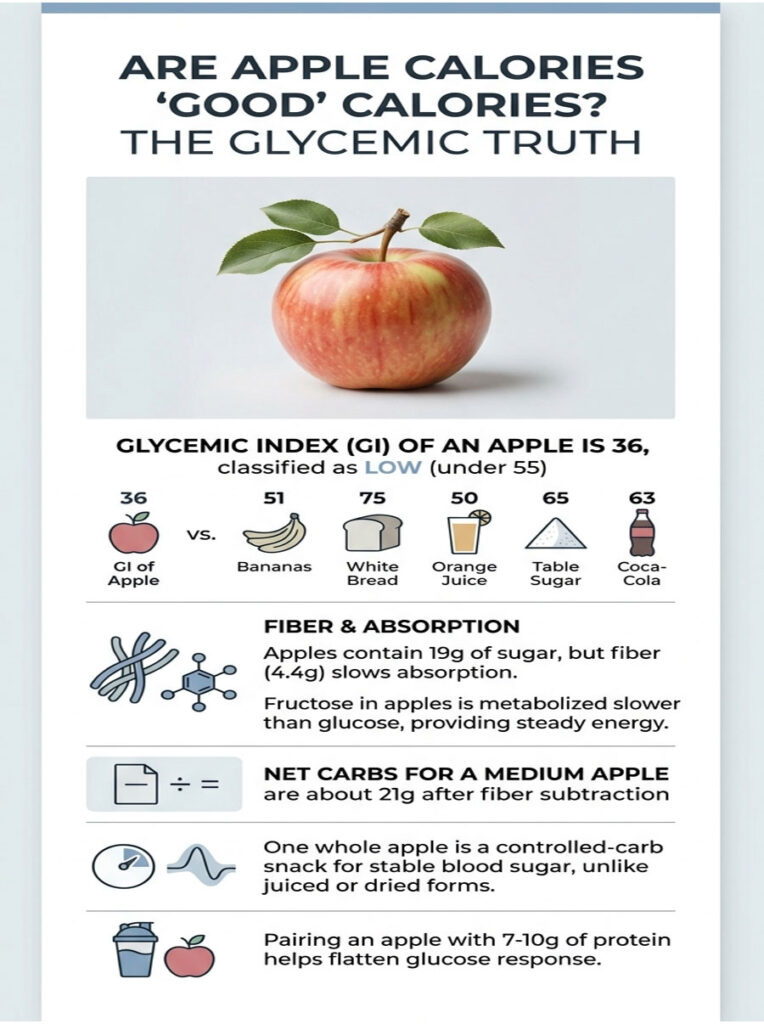
That’s lower than a banana (GI 51), a slice of white bread (GI 75), or a glass of orange juice (GI 50). For context, table sugar registers at 65 on the same scale. Two cups of regular Coca-Cola sit at GI 63. The apple is in a fundamentally different metabolic category from most American snack-aisle competitors.
Why does an apple with 19 grams of sugar produce such a gentle blood-sugar curve? Two reasons. First, the 4.4 grams of fiber slows sugar absorption in the small intestine. Second, much of an apple’s sugar is fructose, which the liver metabolizes more slowly than glucose, producing a steadier energy release.
Net Carbs: The Real Number That Matters
If you’re managing diabetes, pre-diabetes, or insulin resistance, the relevant figure isn’t the gross 25g of carbs in a medium apple. It’s the net carbs after subtracting fiber: about 21 grams. That’s lower than a slice of whole-wheat bread, comparable to a small cup of berries with milk, and significantly lower than most processed snack bars marketed as “healthy.”
Patients booking diabetes screening panels through HealthCareOnTime often ask whether an afternoon apple wrecks their HbA1c results. Across the patient-education sessions our team runs, the consistent guidance is that one whole apple, eaten with skin, is a controlled-carb snack for most people with stable blood sugar. Juiced or dried apple is a different metabolic story, with much higher glycemic load and faster blood-sugar response.
The Apple-Plus-Protein Trick
For tighter glycemic control, pair your apple with about 7 to 10 grams of protein. A small handful of almonds, a string cheese, a tablespoon of nut butter, or a small Greek yogurt all work. The protein and fat slow gastric emptying, which flattens the glucose curve further. Many endocrinologists recommend this pairing as a default for pre-diabetic patients who want fruit without spikes.
Apple Calories vs. Common Snacks: How One Apple Stacks Up
Numbers in isolation don’t mean much. The real question is how an apple compares to the alternatives sitting next to it in your pantry or vending machine. The contrast is stark and, for most Americans, eye-opening.
A medium apple gives you 95 calories of fiber-rich, vitamin-loaded, low-glycemic carbohydrate. A 100-calorie pack of Oreo Thins delivers nearly identical calories with zero fiber, zero vitamin C, and a 70+ GI. A medium banana hits 105 calories with less fiber per calorie. A handful (28g) of almonds runs 164 calories, more than a large apple, though almonds bring fat and protein the apple doesn’t.
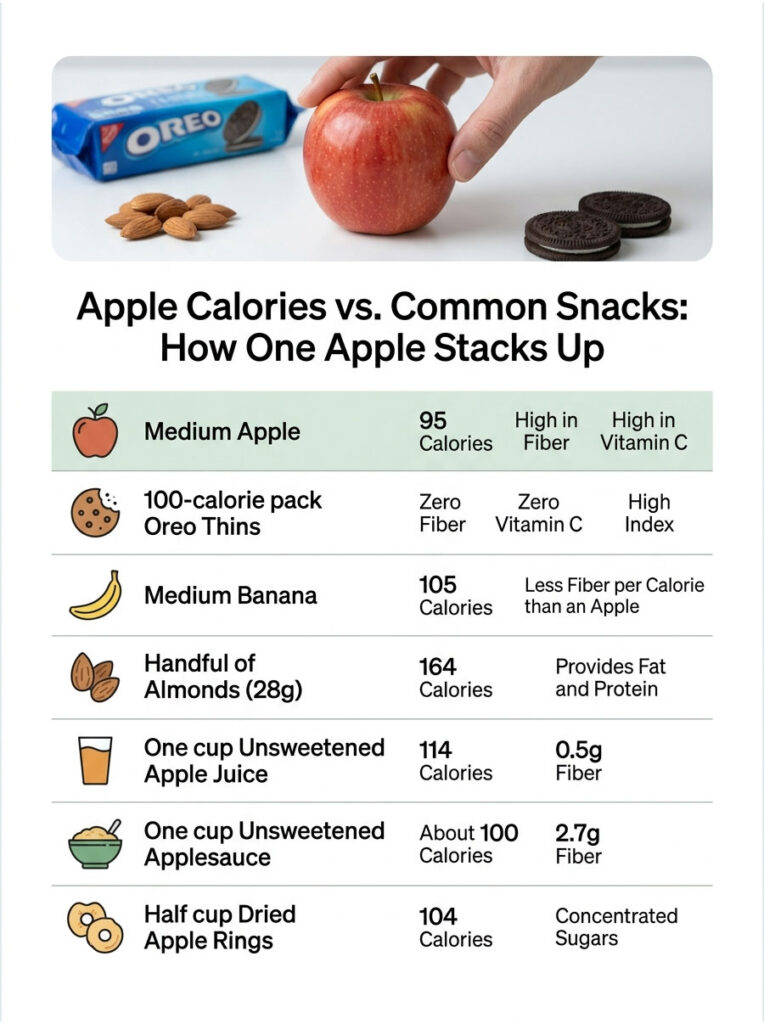
The format you eat your apple in changes everything. One cup of unsweetened apple juice has about 114 calories but only 0.5 grams of fiber. One cup of unsweetened applesauce sits at roughly 100 calories with 2.7 grams of fiber. A half cup of dried apple rings packs 104 calories with the sugar concentrated to almost three times that of fresh fruit per gram.
Our lab partners report that patients monitoring caloric intake routinely under-count dried fruit. A handful of dried apple chips can deliver 200+ calories before the bag registers as “eaten” psychologically. Whole apples self-regulate; their water and fiber make overeating physically difficult. The body fills up before the calories add up.
When an Apple Beats Coffee for Energy
A 2010 study from Lehigh University suggested an apple can provide a more sustained morning energy lift than a cup of coffee, since the natural sugar releases slowly via the fiber matrix rather than spiking and crashing like caffeine. That doesn’t mean apples replace coffee, but it does mean a mid-afternoon apple often outperforms a vending-machine candy bar for energy stability.
How Long Does It Take to Burn Off One Apple?
Here’s a question competitor articles dance around but rarely answer cleanly. How much movement does it take to burn the 95 calories of a medium apple?
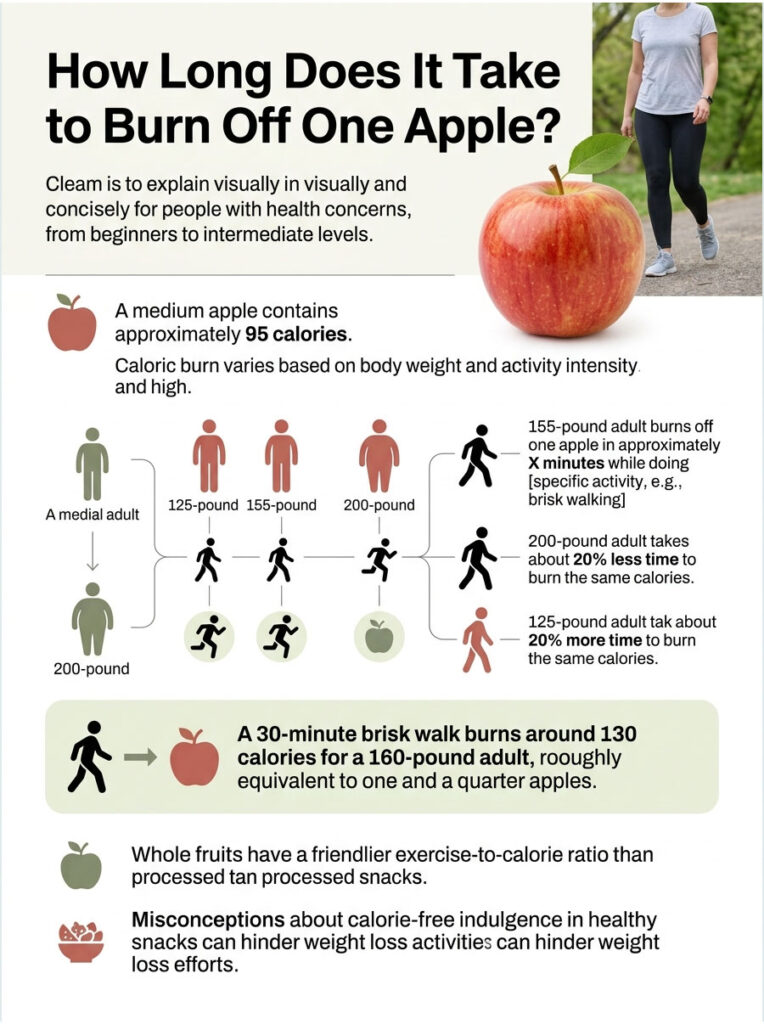
The math depends on body weight and activity intensity. For a 155-pound American adult (close to CDC-tracked average US body weight for adult women), one medium apple’s calories burn off in roughly:
- 25 minutes of walking at 3 mph
- 10 minutes of jogging at 6 mph
- 15 minutes of light cycling
- 22 minutes of strength training
- 18 minutes of vacuuming or general housework
- 12 minutes of moderate swimming
For a 200-pound adult, those times drop by about 20%. For a 125-pound adult, add about 20% more time. These numbers come from MET-value tables published in the Compendium of Physical Activities used widely in NIH-funded studies.
Patients we serve at HealthCareOnTime often hear that “an apple is so healthy you don’t have to count it.” Calorie-wise, that’s misleading. An apple is excellent fuel, but two large Honeycrisp apples can equal a 260-calorie mini-meal, which matters if you’re in a weight-loss phase or tracking macros carefully.
The Burn-Off Math Most Americans Get Wrong
It’s tempting to assume a 30-minute walk “earns” several apples. In practice, a 30-minute brisk walk for a 160-pound adult burns about 130 calories, roughly one and a quarter apples. The exercise-to-calorie ratio for whole fruit is friendlier than for processed snacks, but it’s not the unlimited license casual gym-goers sometimes assume.
Are Apples Good for Weight Loss? What the Research Actually Shows
Apples earn their weight-loss reputation honestly. They’re 86% water, dense in fiber, and trigger satiety hormones disproportionately to their calorie cost. The science is solid, though not magic.
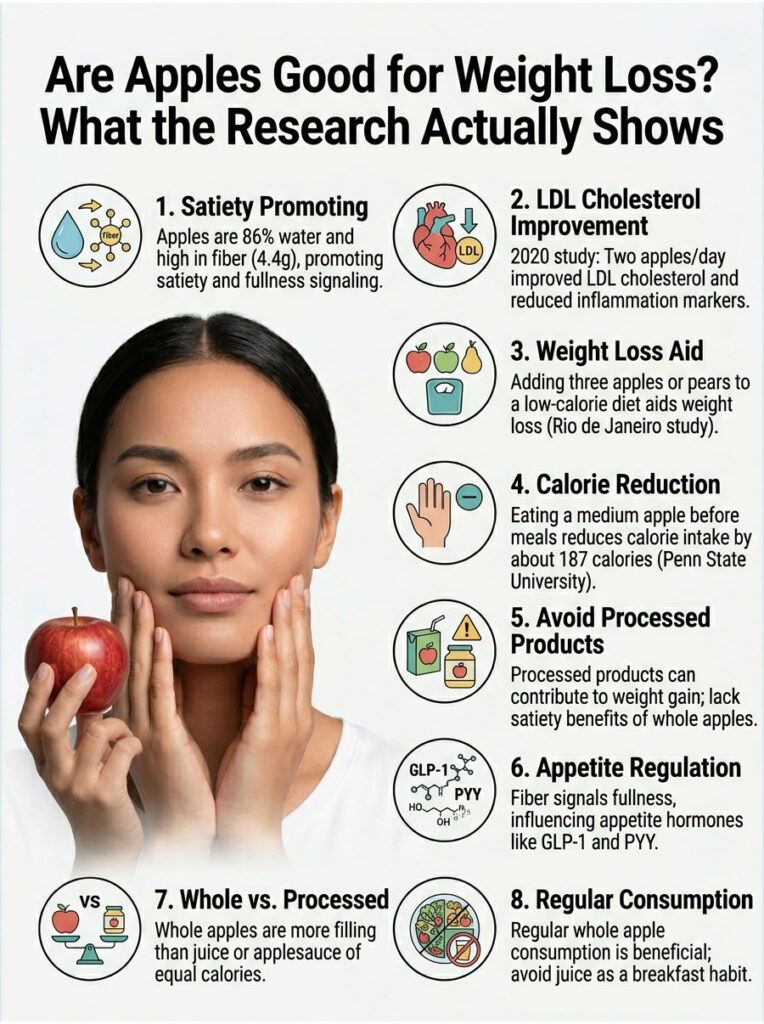
A 2020 randomized controlled trial published in The American Journal of Clinical Nutrition tracked adults eating two apples per day for eight weeks. Participants showed measurable improvements in LDL cholesterol and inflammatory markers regardless of weight change, according to coverage by Parade citing the trial.
Brazilian researchers from the State University of Rio de Janeiro found that overweight women adding three apples or pears daily to a low-calorie diet lost more weight than those who didn’t add fruit, according to research summarized by the Washington Apple Commission.
A separate 2009 trial out of Penn State University showed that participants who ate a medium apple before a meal consumed about 187 fewer calories at that meal on average. The pre-meal apple effectively pre-loaded their stomach with low-calorie volume.
That said, apples can stall weight loss when eaten in processed form. Apple juice (114 cal/cup), apple chips (often sugar-coated at 140+ cal/oz), baked apple desserts, and caramel-dipped apples can turn a 95-calorie food into a 300- to 600-calorie one without producing the satiety benefit of the whole fruit. In nutrition consultations our team conducts, the apple-juice-for-breakfast habit is a frequent hidden cause of slow weight loss in otherwise disciplined eaters.
The Fiber-Satiety Connection
The 4.4 grams of fiber in a medium apple contributes to satiety in two ways. First, it physically expands in the stomach, signaling fullness. Second, soluble fiber (pectin) ferments in the colon, producing short-chain fatty acids that influence appetite-regulating hormones like GLP-1 and PYY. This is partly why apples feel more “filling” than equal-calorie servings of juice or applesauce.
How Many Apples a Day Is Healthy?
The USDA Dietary Guidelines for Americans recommend two cups of fruit daily for adults on a 2,000-calorie diet. Two cups of sliced or diced apples equals roughly one large apple or two small apples. So the answer for most adults: one to two medium apples per day fits comfortably inside federal nutrition guidance.
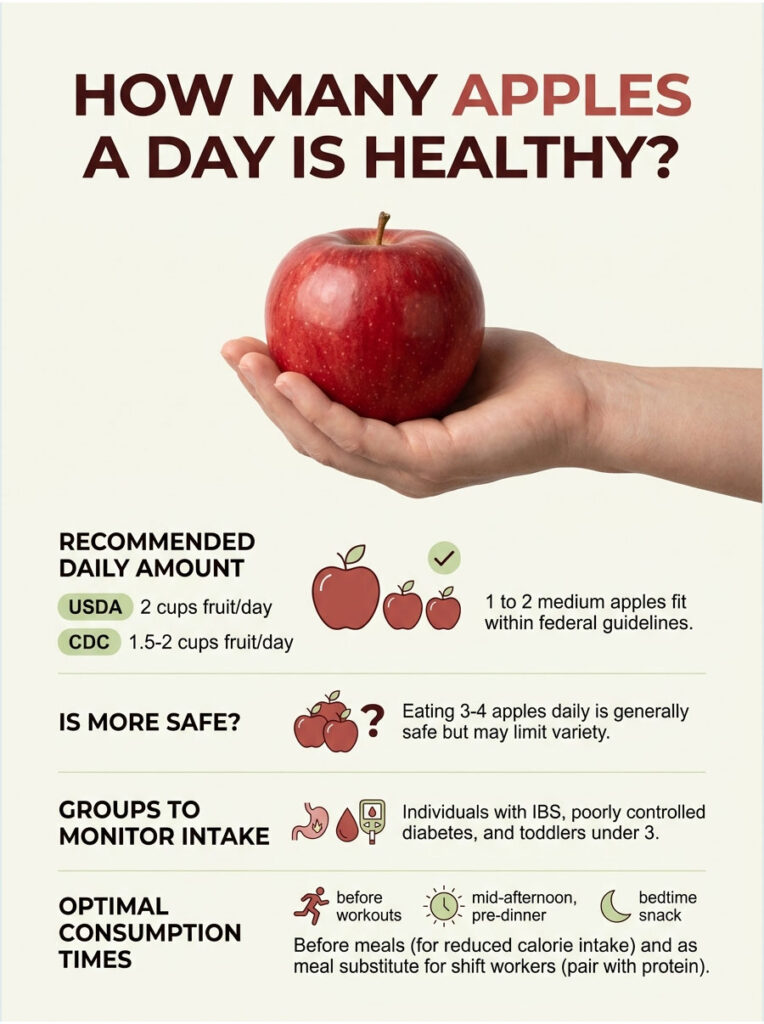
The CDC notes that adults should consume around 1.5 to 2 cups of fruit per day, and apples are one of the easiest, most portable ways to hit that target without resorting to ultra-processed fruit snacks. Eating three or four apples in a single day isn’t dangerous for most healthy adults, but it can crowd out other fruits and provide an outsized fructose load if your diet is otherwise low in fiber and varied micronutrients.
Three groups should pace themselves. People with IBS or FODMAP sensitivity (apples are high in sorbitol and can trigger bloating). People with poorly controlled diabetes (clustering all fruit servings in one meal can spike blood glucose). And toddlers under three (excess fruit juice or sauce can contribute to dental caries and chronic loose stools per AAP guidance).
Best Times to Eat an Apple
Before workouts: the 21g of net carbs gives quick, clean fuel. Mid-afternoon: the fiber blunts the 3 p.m. energy crash. Pre-dinner: studies suggest eating an apple before a meal can reduce total meal calories by 15% or more. As a bedtime snack: fine for most adults but skip if you have nocturnal acid reflux, since apple acidity can aggravate GERD symptoms.
For shift workers or anyone with irregular hours, an apple paired with a hard-boiled egg or a few almonds makes a portable, low-prep meal-substitute that holds energy for 2 to 3 hours.
“An Apple a Day” Myth, Science, or Both?
The proverb dates to a Welsh saying first recorded in 1866. Modern research can’t quite say apples replace doctors, but they’re closer to delivering on the promise than most folk remedies.
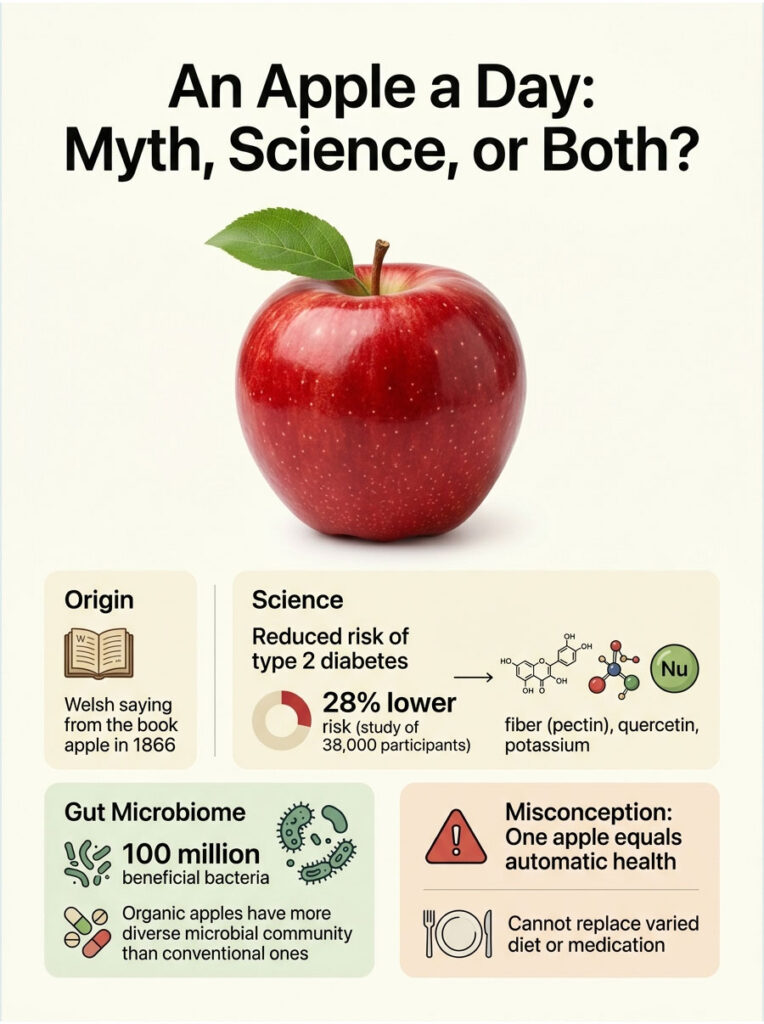
A 2019 review in the BMJ linked higher apple intake to reduced risk of type 2 diabetes. USApple Association cites a study of over 38,000 participants showing 28% lower likelihood of developing Type 2 diabetes in those who ate more than one apple daily than those who didn’t eat apples at all.
What apples genuinely deliver: meaningful soluble fiber (pectin) that feeds gut bacteria and binds cholesterol; quercetin, a polyphenol with demonstrated anti-inflammatory and antioxidant effects; potassium that helps offset high-sodium American diets; and a very low calorie cost for the nutrient density delivered.
What apples can’t do: replace a varied diet, undo a high-sodium fast-food intake, or substitute for medication. Across the cardiac and metabolic patient education sessions HealthCareOnTime supports, the “one apple equals automatic health” framing is a recurring misconception that needs gentle correction.
The Gut-Microbiome Angle
A 2019 study published in Frontiers in Microbiology found that a single average apple harbors around 100 million bacterial cells, mostly from the seeds and core. While that sounds alarming, most of those microbes are beneficial fiber-fermenting strains that contribute to gut diversity. Organic apples appear to host a more varied microbial community than conventionally farmed apples, per the same research.
Smart Ways to Eat Apples Without Wrecking the Calorie Math
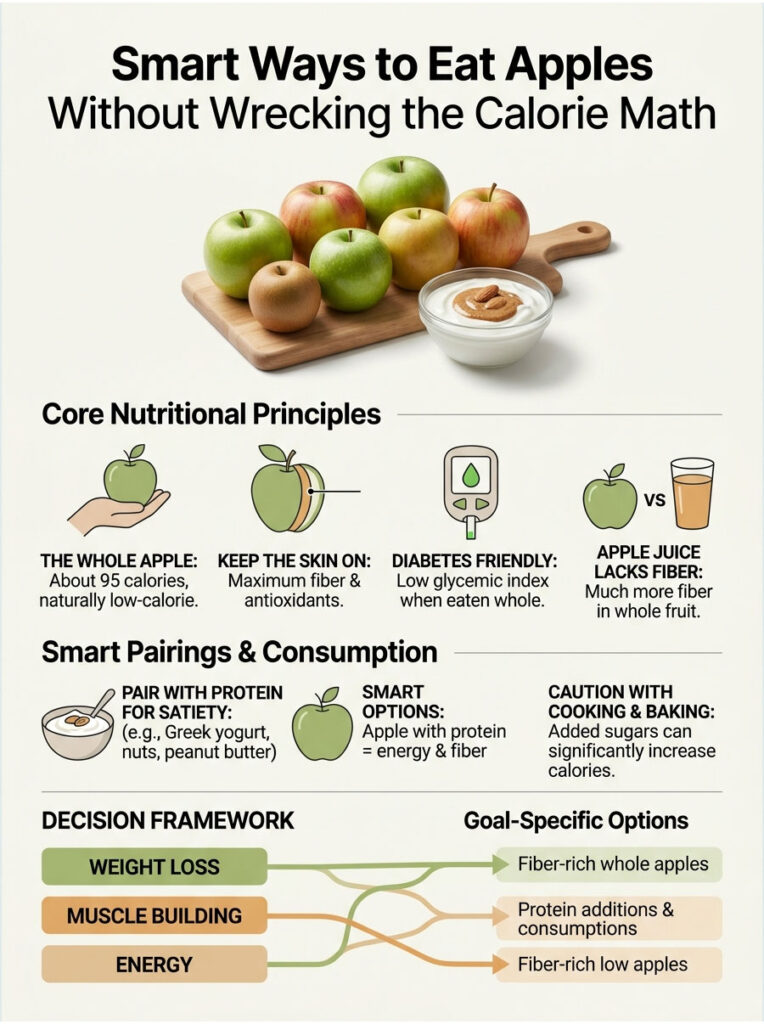
The apple itself is virtually foolproof. What you pair it with and how you process it decides whether your snack stays at 95 calories or balloons past 400.
Pair With Protein
A medium apple plus one tablespoon of natural peanut butter: roughly 190 calories with 4g of protein, 5g of fiber, and excellent staying power. A medium apple plus a string cheese: 175 calories with 7g of protein. A medium apple plus a small Greek yogurt: 165 calories with 12g of protein. All three combinations beat most granola bars on satiety per calorie.
Don’t Peel the Apple
Roughly two-thirds of an apple’s polyphenol content sits in the skin. Peeled apples lose about 1g of fiber and a substantial fraction of their quercetin. Patients commonly ask us about pesticide concerns; the practical solution is rinsing under cool running water for 15 to 20 seconds, or buying organic if budget allows. The fiber and antioxidant trade-off heavily favors eating the peel.
Watch the Cooking and Baking Trap
Apple pie filling can include 2 cups of sugar per pie. Baked apples drizzled with maple syrup can easily double the calorie count. Apple crisps made with oats and butter cross 350 calories per serving. Caramel-dipped apples at fall festivals routinely top 600 calories. The whole apple’s natural calorie-and-fiber balance disappears the moment sugar, butter, or syrup gets added.
The Smart Snack Pairings to Remember
If you want stable energy for 2 to 3 hours: apple + 1 tbsp almond butter. If you want maximum fiber: apple with skin + 1 tbsp chia seeds in yogurt. If you’re trying to lose weight: medium apple 20 minutes before lunch. If you’re refueling after a workout: medium apple + scoop of whey protein blended with water.
Table 3: Decision and Action Guide for Apple Eating
| If Your Goal Is… | Eat Apple Like This | Avoid | Calories |
| Weight loss | Medium apple with skin, before meals | Apple juice, dried apple chips | 95 |
| Muscle building | Apple + 1 oz nuts or string cheese | Apple-only as recovery snack | 175–250 |
| Blood-sugar control | Small-medium apple + protein | Apple juice, sweetened applesauce | 130–180 |
| Pre-workout fuel | Medium apple, 30–45 min before | Heavy meal with apple as side | 95 |
| Kid’s lunchbox | Small apple, sliced with lemon juice | Sweetened applesauce pouches | 55–78 |
| Bedtime snack | ½ apple + 1 tbsp almond butter | Large apple + cheese plate | 95–130 |
Source: HealthCareOnTime nutrition team review of USDA nutrient data
Frequently Asked Questions
How many calories in a medium apple without the skin?
A peeled medium apple drops to about 77 to 80 calories, down from 95 calories with the skin. The USDA lists peeled raw apples at 48 calories per 100 grams versus 52 for unpeeled. You also lose about 1g of fiber and a significant portion of the apple’s antioxidant content, including most of the quercetin. For most people, the small calorie saving doesn’t justify giving up the fiber and polyphenols stored in the peel.
How many calories in a small apple?
A small apple (about 149 grams, roughly 2¾ inches in diameter) contains approximately 78 calories per USDA FoodData Central. That includes 20.6g of carbs, 3.6g of fiber, and around 16g of natural sugar. Small apples are ideal for children’s lunches, calorie-conscious snacking, or pairing with higher-calorie foods like nut butters or cheese sticks.
How many calories in a large Honeycrisp apple?
A large Honeycrisp apple (around 223 to 240 grams) contains about 110 to 130 calories. Honeycrisp apples tend to be physically bigger than other commercial varieties, which is the main reason their per-fruit calorie count can run higher than a Gala or Granny Smith. Per gram, Honeycrisp is roughly equivalent in calories to other popular apple varieties on the US market.
Are apple calories all from sugar?
About 95% of an apple’s calories come from carbohydrates, and roughly 75 to 80% of those carbs are sugars. However, the sugars in an apple are accompanied by 4g+ of fiber, which slows their absorption significantly. This means apples don’t behave like a candy bar despite having natural sugar; the glycemic impact remains low even though the gram count of sugar looks high on a label.
How many calories in an apple with peanut butter?
A medium apple (95 cal) plus one tablespoon of natural peanut butter (95 cal) totals approximately 190 calories. The combination adds 4g of protein and about 5g of total fiber, making it more satiating than either food alone. Many dietitians recommend this pairing for sustained energy, stable blood sugar, and post-workout recovery in moderate-intensity training contexts.
Do green apples have fewer calories than red apples?
The difference is minimal, usually 5 to 15 calories per medium fruit. Granny Smith apples (the classic green variety) often run 80 calories per medium, while red varieties like Gala or Fuji typically hit 80 to 95 calories. The variation comes mostly from average fruit size, not from green-versus-red color or sugar content per gram. Both are equally fine choices nutritionally for most adults.
How many calories in a cup of sliced apple?
One cup of sliced raw apple weighs about 109 grams and contains roughly 57 calories per USDA data. That includes 15g of carbs, 2.6g of fiber, and 11g of natural sugar. Sliced apple is a useful portion for salads, oatmeal toppings, or controlled-snack situations when a whole apple feels too much.
Is one apple a day enough fruit?
For an average American adult, one medium apple covers roughly half the USDA’s recommended two cups of daily fruit. Federal dietary guidelines encourage variety, so combining one apple with another fruit like berries, citrus, or banana hits the target without monotony. Eating only apples for years isn’t harmful, but it limits the polyphenol and micronutrient diversity available from other fruit colors and types.
Are apples bad for diabetics because of sugar?
No, apples are generally considered diabetes-friendly when eaten whole. The glycemic index of an apple is about 36, which is low. The fiber slows sugar absorption, and the natural sugar load is moderate (19g per medium apple). People with diabetes should still monitor portion sizes and ideally pair apples with protein for tighter blood-sugar control. Apple juice, in contrast, behaves very differently and should be limited or avoided.
How many calories in apple juice vs. a whole apple?
One cup of unsweetened apple juice contains about 114 calories versus 95 for a whole medium apple. The bigger issue is fiber: juice has roughly 0.5g of fiber compared to the whole apple’s 4.4g. This means apple juice causes a much faster blood-sugar rise and provides far less satiety per calorie. Whole apples win for almost every health and weight management goal, with juice serving only as an occasional treat.
Do organic apples have fewer calories?
No, organic and conventional apples have identical calorie counts. Both varieties contain about 52 calories per 100 grams. The difference is in pesticide residue exposure (lower in organic) and sometimes minor variations in antioxidant content based on growing conditions and soil microbiome. Calorie-wise, the certification doesn’t matter.
Can I eat an apple at night without gaining weight?
For most adults, yes. Total daily calories matter more than timing. A medium apple at 95 calories is unlikely to cause weight gain unless it pushes you over your daily energy needs. However, people with acid reflux or GERD may want to avoid apples within two hours of bedtime, since the fruit’s natural acidity can worsen nighttime symptoms or disrupt sleep.
Disclaimer: This article is for educational purposes only and does not replace personalized medical or nutritional advice. People with diabetes, kidney conditions, GI disorders, food allergies, or specific dietary needs should consult a registered dietitian, physician, or qualified healthcare provider before making significant changes to fruit intake. The USDA values cited are reference averages and may vary slightly by apple variety, growing conditions, and individual fruit size.
References
- USDA FoodData Central: Apples, raw, with skin
- Harvard T.H. Chan School of Public Health: Apples
- USDA Economic Research Service: Food Availability and Consumption
- USApple Association: Health Benefits of Apple Consumption
- Washington Apple Commission: Apple Nutrition
- Healthline: 10 Impressive Health Benefits of Apples
- Parade Health: How Many Calories Are in an Apple
- USA TODAY via AOL: Apple Nutrition Facts
- USDA Dietary Guidelines for Americans
- CDC: Adults Fruit and Vegetable Recommendations
- Springer Nature: Apple Polyphenols, Composition, Bioactivity, and Health Implications (2025)
- American Journal of Clinical Nutrition: Daily apple consumption RCT (2020)
- BMJ Review: Apple intake and type 2 diabetes risk (2019)