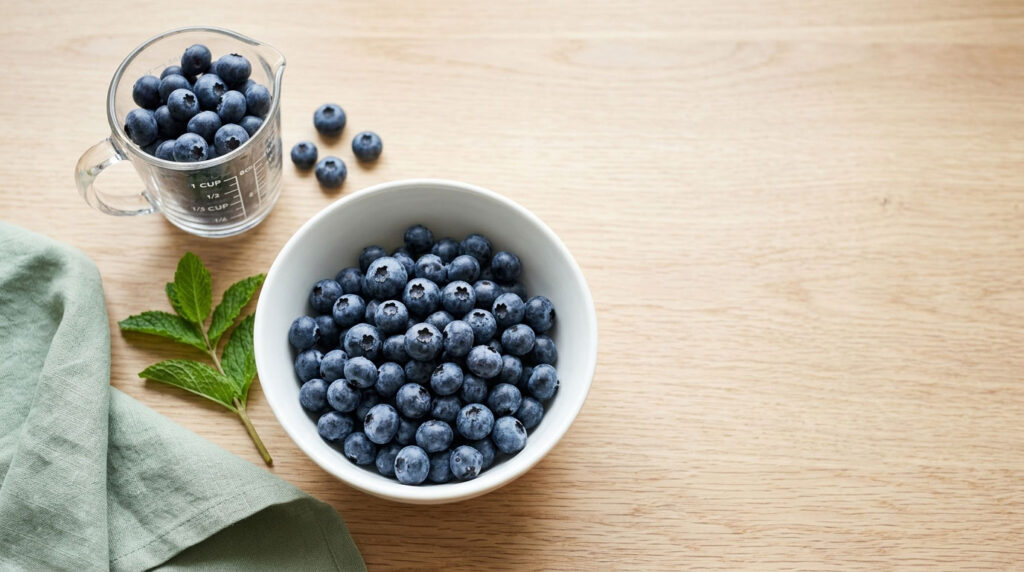
Picture the smallest diet change that still shows up in your bloodwork. For a lot of Americans, it looks like a single cup of blueberries, about 84 calories, eaten on most days. The fruit ranks among the most antioxidant-dense in the grocery store, yet the average shopper buys it as an occasional treat rather than a habit. That mismatch is the whole opportunity, because a change this small with evidence this deep behind it is rare in nutrition.
Table of Contents
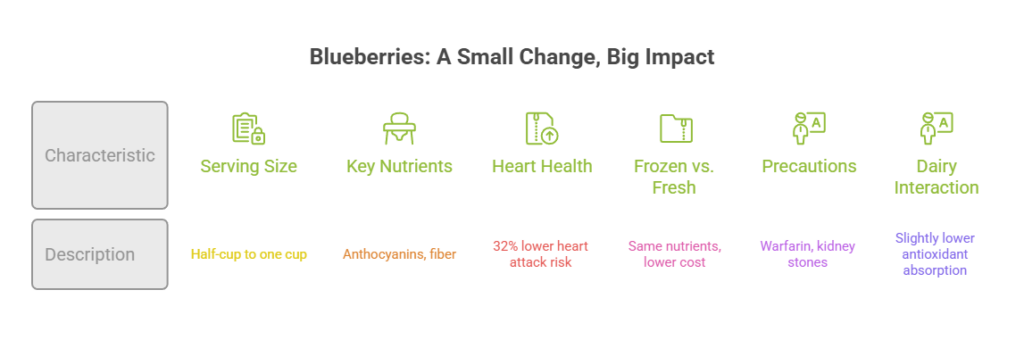
Quick Answer: Eating blueberries every day is safe for most people and may support heart health, brain function, blood sugar control, and healthy aging. The benefits trace mainly to anthocyanins, the pigments behind the blue color. A daily half-cup to one-cup serving, fresh or frozen, matches what researchers use. The clearest results show up in adults already at risk for heart disease or high blood sugar.
At a Glance
- A daily half-cup to one cup lines up with the doses used in most studies.
- Anthocyanins and fiber drive the heart, brain, and blood sugar effects.
- Top berry eaters had a 32% lower heart attack risk in a major Harvard cohort.
- Frozen berries carry the same nutrients as fresh, usually for less money.
- People on warfarin or with a kidney-stone history should check with a doctor.
- Eating berries with dairy may slightly lower antioxidant absorption.
A Daily Cup Is Smaller Than You Think
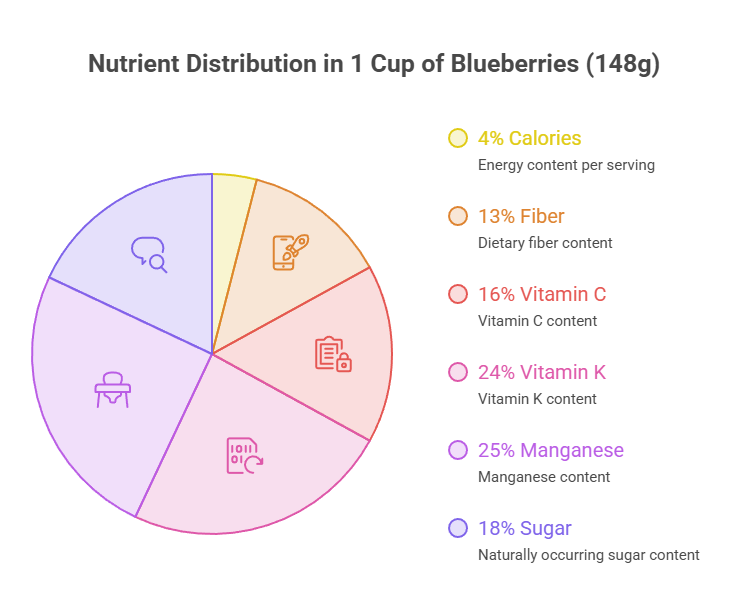
One serving of blueberries is one cup, roughly 148 grams. That is a small bowl, not a heaping pile, and the calorie cost stays low. Per cup, you get about 84 calories, 1 gram of protein, and 21 grams of carbohydrate.
The nutrition punching above its weight is the point. That same cup delivers around 3.6 grams of fiber, 14.4 mg of vitamin C, and 28.6 mcg of vitamin K, and it counts as an excellent source of manganese. Four nutrients, one handful.
Wild berries concentrate even more. A cup of wild (lowbush) blueberries can hold close to 6 grams of fiber, about 72% more than the larger cultivated type, plus roughly 170% of the daily value for manganese. Either kind earns its spot in your cart.
Most of the headline benefits come back to one pigment family. Anthocyanins give blueberries their deep blue color and are thought to drive much of the fruit’s health effect. Keep that word in mind; it explains nearly everything below.
Among the people HealthCareOnTime works with, the appeal is the low effort. A cup of berries asks for no recipe and no prep, which is why it tends to stick when fancier habits fade.
| Nutrient (per 1 cup, 148g) | Amount | Approx. % Daily Value |
| Calories | 84 | 4% |
| Fiber | 3.6 g | 13% |
| Vitamin C | 14.4 mg | 16% |
| Vitamin K | 28.6 mcg | 24% |
| Manganese | 0.5 mg | 25% |
| Sugar | 15 g | naturally occurring |
Source: USDA-based nutrition data
Why Blueberries Are Having a Moment in America
Americans are buying blueberries like never before. Fresh per capita consumption climbed from about 1.41 pounds in 2013 to 2.64 pounds in 2023, part of a roughly tenfold rise since 2000.
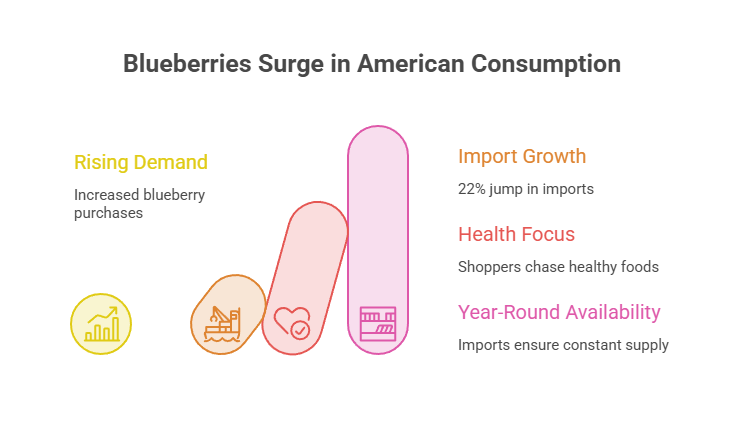
The demand curve keeps bending up. In 2024, US fresh blueberry imports hit 684 million pounds, a 22% jump in one year, worth about $2.18 billion. That ranked blueberries the fourth most valuable fresh fruit import, trailing only avocados, bananas, and grapes.
Why the surge? Shoppers are chasing foods tied to heart and brain health, and blueberries wear that reputation well. Forecasts put per capita intake near 3.09 pounds by 2028.
The fruit also carries deep roots here. Blueberries are native to North America, where Indigenous peoples ate them more than 13,000 years ago and called them “star fruits” for the five-pointed crown at the berry’s tip. The science is only now confirming what they sensed.
That popularity has a practical upside for shoppers. Year-round imports from Peru and Chile mean blueberries now sit in nearly every US grocery store in every season, fresh or frozen, often at a price that rivals a candy bar. A daily habit no longer depends on a short summer window.
9 Proven Benefits of Eating Blueberries Every Day
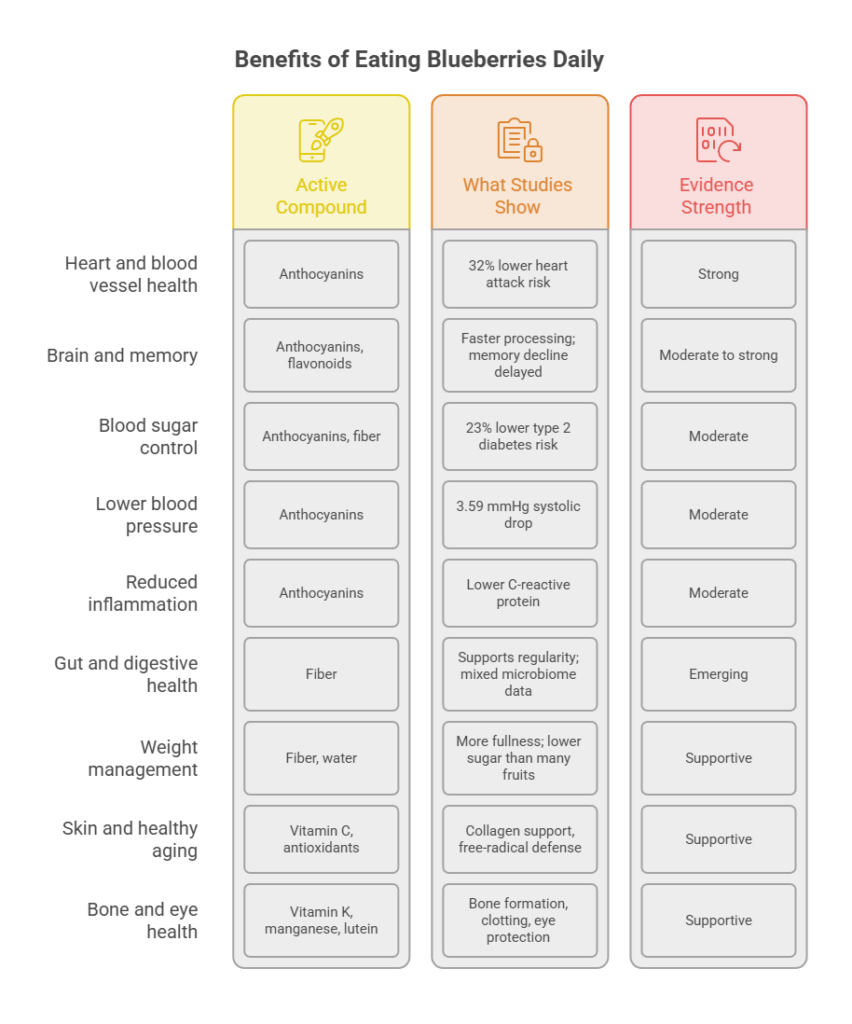
The case for a daily habit is strongest on three fronts, heart, brain, and blood sugar, and steady across several more. The table maps each benefit to the compound behind it and to what the research actually found.
| Benefit | Active Compound | What Studies Show | Evidence Strength |
| Heart and blood vessel health | Anthocyanins | 32% lower heart attack risk in top berry eaters | Strong |
| Brain and memory | Anthocyanins, flavonoids | Faster processing; memory decline delayed up to 2.5 years | Moderate to strong |
| Blood sugar control | Anthocyanins, fiber | 23% lower type 2 diabetes risk; lower HbA1c | Moderate |
| Lower blood pressure | Anthocyanins | 3.59 mmHg systolic drop over 12 weeks | Moderate |
| Reduced inflammation | Anthocyanins | Lower C-reactive protein | Moderate |
| Gut and digestive health | Fiber | Supports regularity; mixed microbiome data | Emerging |
| Weight management | Fiber, water | More fullness; lower sugar than many fruits | Supportive |
| Skin and healthy aging | Vitamin C, antioxidants | Collagen support, free-radical defense | Supportive |
| Bone and eye health | Vitamin K, manganese, lutein | Bone formation, clotting, eye protection | Supportive |
The anthocyanin advantage
Nearly every benefit on this list traces back to one thing. Anthocyanins are the deep blue-purple pigments packed into the skin, and they work as antioxidants that calm inflammation and shield the lining of your blood vessels.
Wild blueberries carry more of them than the larger cultivated type, which is why so many studies reach for wild blueberry powder. Your body converts these compounds into smaller metabolites that interact with gut bacteria, and that gut connection may explain how a single fruit reaches the heart and brain at the same time.
1. A stronger heart and healthier blood vessels
Heart protection is the most studied benefit, and the evidence is hard to wave off. In Harvard’s Nurses’ Health Study II, researchers followed 93,600 women aged 25 to 42 for 18 years, logging their diets every four years.
The result made headlines for good reason. Women eating the most blueberries and strawberries, three or more servings a week, had a 32% lower heart attack risk than those eating berries once a month or less. The findings ran in Circulation, an American Heart Association journal.
How does a berry do that? Anthocyanins appear to help dilate arteries, slow plaque buildup, and protect the vessel lining. A 2024 review found that a month of daily blueberries measurably improved blood flow.
The effect tends to be strongest in people who already carry heart risk, which describes a large share of American adults over 50. For them, a daily cup is low-cost insurance.
Our medical reviewers put it plainly: trading one daily processed snack for a cup of berries is among the easiest heart-friendly swaps a person can make.
2. Sharper memory and slower cognitive decline
The aging brain may hold its edge longer on a berry habit. A 2025 trial in the American Journal of Clinical Nutrition gave 61 healthy adults aged 65 to 80 either freeze-dried wild blueberry powder or a placebo for 12 weeks.
The thinking tests favored the berries. Blueberry eaters showed better executive function, stronger short-term memory, and faster reaction times, with the powder dose equal to about 178 grams of fresh berries.
Adults already slipping benefited too. In a six-month study of 86 people with mild cognitive decline, those on wild blueberry powder equal to roughly 1.5 cups of fresh berries sped up to match peers with no cognitive issues.
The long view is the encouraging part. Harvard researchers tie flavonoid-rich berry diets to delaying memory decline in older women by about two and a half years.
One likely mechanism is blood flow. Anthocyanins help widen blood vessels, and stronger circulation to the brain supports the memory and processing gains these trials keep finding.
3. Steadier blood sugar over time
Blueberries taste sweet but behave gently in the bloodstream. Their fiber slows how fast sugar lands, while anthocyanins improve insulin sensitivity.
The population data is strong here. People eating two or more servings of blueberries a week had a 23% lower risk of type 2 diabetes than those eating none. That NIH-funded research tracked about 200,000 US adults for up to 24 years.
The bar is reachable. A daily half-cup clears the two-servings-a-week threshold with room to spare.
Pairing them with a little protein, like a small handful of nuts or a plain nondairy yogurt, flattens the blood sugar curve even further. The combination slows digestion and softens any spike.
Among the prediabetes patients we work with, the first question is usually whether fruit is even allowed. Blueberries are one of the lower-impact answers on the list.
4. Naturally lower blood pressure
High blood pressure is a top driver of heart disease, and blueberries may shave a few points off. In that 12-week trial of older adults, daily wild blueberries lowered systolic pressure by 3.59 mmHg versus placebo and improved vessel function.
Artery flexibility improved alongside it. Flow-mediated dilation, a marker of healthy blood vessels, rose after 12 weeks of daily intake.
Set the expectation honestly, though. Berries seem to help mainly in people who already run high, not those with normal readings. This works with treatment, not instead of it.
Even a few points matters at scale. Trimming several mmHg off systolic pressure across a population meaningfully lowers stroke and heart attack rates over the years, which is why diet-based gains draw real interest.
5. Less inflammation body-wide
Slow-burning inflammation feeds many long-term diseases, and blueberries push back. Anthocyanins carry both antioxidant and anti-inflammatory effects that touch vascular and cognitive function.
The markers respond to a steady habit. Several studies show blueberry intake lowering inflammatory markers like C-reactive protein. Better cholesterol numbers and more elastic vessels tend to travel with those gains.
This matters because chronic, low-grade inflammation sits upstream of heart disease, type 2 diabetes, and cognitive decline alike. Tamping it down with everyday food is a quiet form of prevention.
6. Better gut and digestive health
Fiber is the quiet workhorse. Blueberries rank among the highest-fiber fruits, which helps keep digestion moving.
The microbiome story is still being written. Some studies show regular blueberries helping balance gut bacteria, while others find no effect, so the verdict is open. The fiber still feeds the gut ecosystem that backs up immunity.
That same fiber acts as a prebiotic, feeding helpful bacteria. For anyone dealing with occasional irregularity, a daily cup is a gentle, food-first nudge toward a steadier routine.
7. Easier weight management
Berries pair water with fiber, a combination that keeps you fuller longer. That high water and fiber content helps with satiety, which supports weight goals.
They are also a smarter sweet. At about 15 grams of sugar per cup, blueberries hit blood sugar more gently than many fruits, thanks to their bioactive compounds. Swap them in for chips or candy and the math works in your favor.
Because they satisfy a sweet craving for few calories, blueberries make portion control easier than reaching for a snack bar. A frozen cup eaten slowly can stretch across an evening when cravings hit hardest.
8. Healthier skin and slower aging
Vitamin C feeds collagen, the scaffolding that keeps skin firm. One serving covers about 16% of the daily vitamin C target, and vitamin C drives tissue repair and wound healing.
The antioxidant load helps with visible aging too. Blueberries may rank among the best natural antioxidant sources, helping neutralize the free radicals that damage cells.
Those antioxidants also help defend skin against the everyday oxidative stress of sun and pollution, one reason berries turn up so often in skin-health advice.
9. Support for bones and eyes
A daily cup quietly supports the skeleton. Vitamin K backs bone strength and clotting, while manganese aids bone formation and metabolism.
Eyes and aging bones gain as well. A human trial and preclinical work suggest blueberries may help protect bone health, and the fruit’s pigments support eye function. These are supporting acts, but they fill out a strong profile.
The eye angle is worth a note for screen-heavy adults. Pigments like lutein and zeaxanthin concentrate in the retina, where they help filter high-energy light and may ease digital eye strain over time.
The Research, by the Numbers
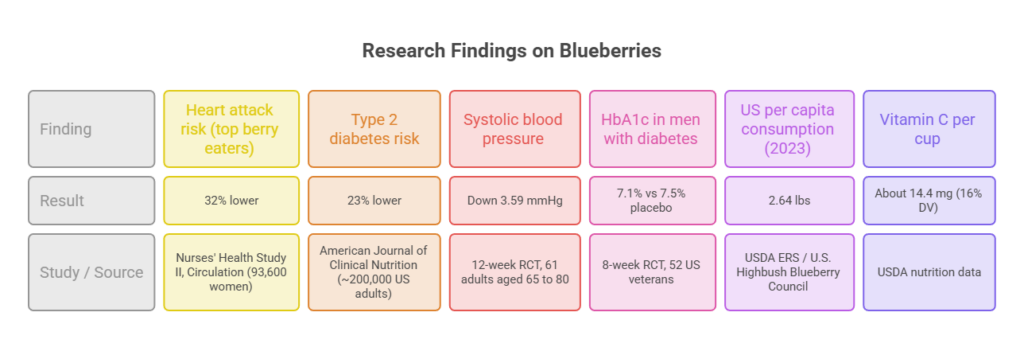
Figures carry this story better than adjectives. The numbers below come from large US cohorts and controlled trials.
| Finding | Result | Study / Source |
| Heart attack risk (top berry eaters) | 32% lower | Nurses’ Health Study II, Circulation (93,600 women) |
| Type 2 diabetes risk | 23% lower | American Journal of Clinical Nutrition (~200,000 US adults) |
| Systolic blood pressure | Down 3.59 mmHg | 12-week RCT, 61 adults aged 65 to 80 |
| HbA1c in men with diabetes | 7.1% vs 7.5% placebo | 8-week RCT, 52 US veterans |
| US per capita consumption (2023) | 2.64 lbs | USDA ERS / U.S. Highbush Blueberry Council |
| Vitamin C per cup | About 14.4 mg (16% DV) | USDA nutrition data |
One detail keeps expectations honest. In the veterans trial, men eating freeze-dried blueberries posted lower HbA1c and triglycerides than placebo, while fasting glucose and weight barely moved. Benefits build slowly and reward the people most at risk.
The question we field most often is about timing: how fast will results show? These trials run 8 to 24 weeks, so a daily cup is a long game, not an overnight switch.
How Blueberries Stack Up Against Other Fruits
A fair question is whether blueberries truly beat other fruit or just market themselves better. On the numbers, they hold their own. They run lower in sugar than grapes or bananas, carry respectable fiber, and lead most everyday fruit on antioxidant density. The table compares common picks per one-cup serving.
| Fruit (1 cup, approx.) | Calories | Fiber | Sugar | Antioxidant standout |
| Blueberries | 84 | 3.6 g | 15 g | High anthocyanins |
| Strawberries | 49 | 3 g | 7 g | Very high vitamin C |
| Blackberries | 62 | 7.6 g | 7 g | Highest fiber of the group |
| Banana (sliced) | 134 | 3.9 g | 18 g | Potassium |
| Apple (sliced) | 65 | 3 g | 13 g | Quercetin |
Source: Approximate USDA values per cup
No single berry wins everything. Strawberries edge blueberries on vitamin C, and blackberries pack more fiber, so a mix is smart. What sets blueberries apart is anthocyanin density, the pigment behind most of the heart and brain findings above.
In the food questions our team sees, people often assume sweeter fruit must be worse. With blueberries, the bioactive compounds soften the blood sugar hit, which is exactly why they appear so often in the diabetes research rather than on the avoid list.
How to Eat Blueberries Daily for Maximum Benefit
How many should you eat?
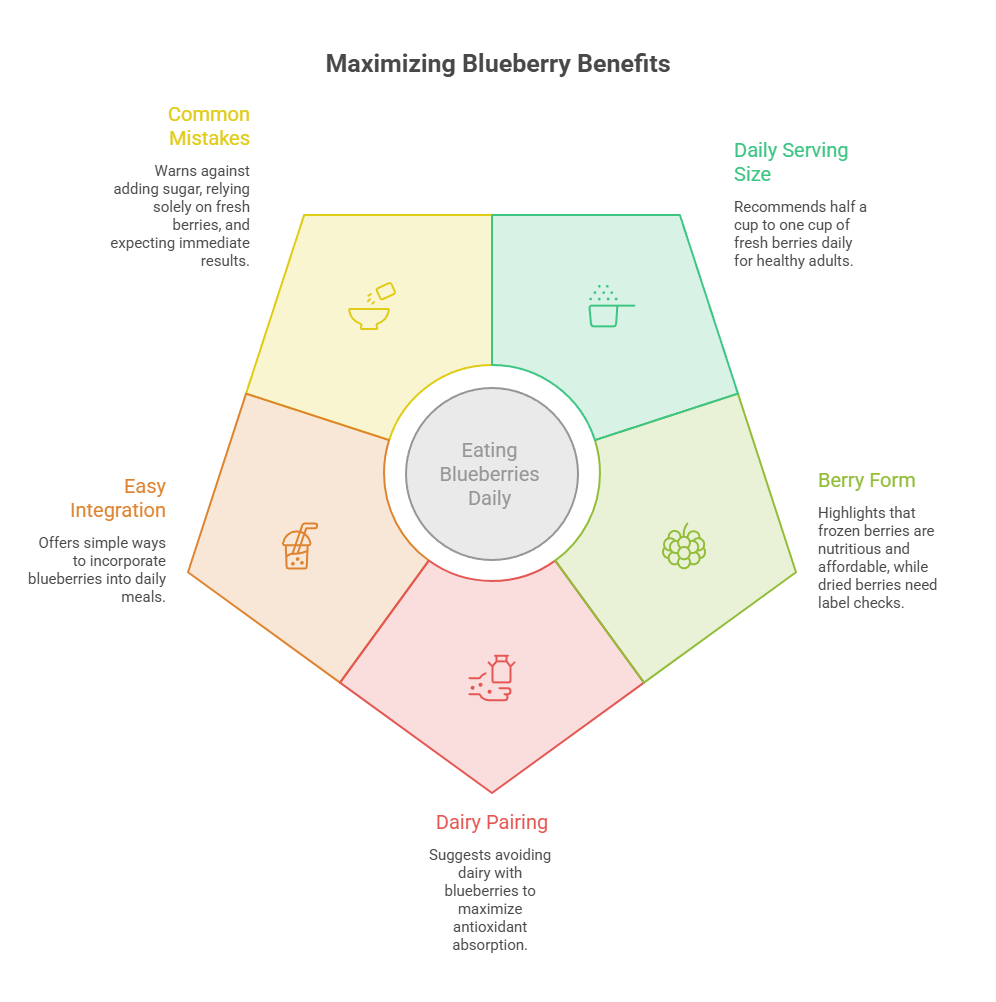
Most studies land on half a cup to one cup of fresh berries a day. The trial dose of 26 grams of freeze-dried powder matched roughly 178 grams of fresh blueberries, a bit over a cup. That is a sensible daily target for healthy adults. There is no need to chase the largest study dose; the lower end still delivers meaningful fiber and anthocyanins.
There is little upside to going overboard. Ramping up slowly helps you dodge the bloating and gas that come with a fiber jump.
Fresh, frozen, or dried?
Frozen berries hold their nutrients and usually cost less, which makes the daily habit affordable in February as much as July. Both fresh and frozen are nutritious picks. Freezing locks the anthocyanins in.
Dried berries need a label check. They are handy in trail mix and cereal, but added sugars sneak in easily. Research, for what it is worth, shows benefits from fresh, frozen, and freeze-dried forms alike.
The dairy question
How you eat them can change what your body keeps. Pairing blueberries with milk or yogurt may lower the antioxidants you absorb, and studies suggest dairy can blunt effects like lower blood pressure.
The fix is easy. Eat them on their own or with a nondairy option, and pairing a half-cup with a protein or healthy fat like almonds helps steady blood sugar. In the nutrition questions reaching our team, this milk-and-berries combo comes up constantly.
Easy ways to hit a daily serving
Small swaps win. Blueberries fold into oatmeal, salads, smoothies, baked goods, or a savory sauce without much thought.
Keep a bag in the freezer for the off-season. Readers who write in and actually stick with the habit tend to anchor it to breakfast, the one meal that rarely gets skipped.
Common mistakes to avoid
The most frequent slip is treating blueberries as a license to add sugar. Drowning them in sweetened yogurt, syrup, or sugary cereal cancels much of the benefit and pushes the blood sugar load right back up.
Two more trip people up. Buying only fresh means the habit lapses in winter when prices climb, so keep frozen as a backup. And washing berries days ahead can speed spoilage, so rinse them only right before you eat.
The last mistake is expecting too much too fast. The research rewards a steady daily habit over months, not a single bowl during a one-week health kick. Consistency is the whole game.
Who Should Be Careful
Blueberries are safe for most people; the cautions are about specific conditions, not the fruit itself. For the average person, a daily habit is not risky. A few groups should loop in a provider first.
Warfarin and blood thinners
Blueberries are a low vitamin K food. They carry about 19 mcg of vitamin K per 100 grams, which keeps them generally safe for warfarin patients in steady, moderate portions. Consistency beats avoidance, since sudden swings can throw off INR control.
Newer drugs are more forgiving. Direct oral anticoagulants like apixaban and rivaroxaban have no vitamin K food limits. Anyone planning a big jump in intake should tell their anticoagulation clinic.
Kidney stones
Blueberries hold natural oxalates. Oxalates can form crystals in urine and feed kidney stones, so people with a calcium-oxalate stone history may be told to limit high-oxalate foods. A daily cup suits most, but a stone history calls for a doctor’s read.
Other situations
A handful of less common flags apply. Rare salicylate sensitivity can trigger anything from digestive upset to skin rashes. People with fructose intolerance may feel bloated after larger servings.
Two practical notes finish the list. Big amounts taken with iron pills may cut iron absorption, and whole berries are a choking risk for infants under one year.
Should You Make Blueberries a Daily Habit?
For most American adults, a daily half-cup to one cup is a low-risk, well-supported move. Think of it less as a treatment and more as a steady deposit into long-term health. The grid below turns the research into quick calls.
| Your Situation | Recommended Action | Why |
| Healthy adult | Eat 1/2 to 1 cup daily, fresh or frozen | Matches studied doses; supports heart and brain |
| Managing blood pressure | Make it daily; watch sodium elsewhere | Trials show modest systolic drops |
| Prediabetes or type 2 diabetes | Pick berries over higher-sugar fruit; add protein | Lower glycemic impact; tied to better HbA1c |
| On warfarin | Keep intake steady; call your clinic before changes | Vitamin K consistency protects INR |
| Kidney-stone history | Limit large amounts; ask your doctor | Oxalates can add risk |
| Buying for a family | Keep frozen on hand | Same nutrients, lower cost, year-round |
Here is the bottom line. A daily handful is a smart, cheap habit for most people, with a quick provider check for anyone on blood thinners or with a stone history. Our lab partners see it often enough: small, repeatable food habits are the ones that eventually show up in better long-term markers. Start with a portion you will actually finish, fresh or frozen, and let consistency do the slow, compounding work. The best berry habit is the one that survives a busy week.
Frequently Asked Questions
Is it OK to eat blueberries every day?
Yes. For most people, a daily half-cup to one cup is safe and may support heart, brain, and blood sugar health. The main exceptions are people on warfarin or with a kidney-stone history, who should ask a doctor about the right amount first.
How many blueberries should you eat a day?
Most research uses the equivalent of half a cup to one cup of fresh blueberries, roughly 75 to 150 grams. That range gives you meaningful fiber, vitamin C, and anthocyanins without excess sugar. Larger amounts add little extra benefit and can cause bloating in sensitive people.
What happens to your body when you eat blueberries every day?
Over weeks, daily blueberries can support healthier blood vessels, steadier blood sugar, and lower inflammation markers. Some people notice modest blood pressure drops and sharper focus. Most clinical effects appear after 8 to 24 weeks of consistent intake, not after a single serving.
Do blueberries lower blood pressure?
They can help modestly. In a 12-week trial of older adults, daily wild blueberries cut systolic blood pressure by about 3.59 mmHg versus placebo. The effect is clearest in people with elevated readings and works alongside, not instead of, prescribed treatment.
Are blueberries good for diabetics?
Generally yes, in moderation. Blueberries have a gentle blood sugar effect from their fiber, and an 8-week trial found lower HbA1c in men with type 2 diabetes. People with diabetes should pair berries with protein and work with a dietitian on portion sizes.
Are frozen blueberries as healthy as fresh?
Yes. Freezing preserves anthocyanins and other nutrients well, and frozen berries usually cost less. Studies show benefits from fresh, frozen, and freeze-dried forms alike. Frozen blueberries make a daily habit easy to keep year-round, especially outside the summer season.
Can you eat too many blueberries?
For most people, very large amounts mainly cause bloating, gas, or loose stools from extra fiber and fructose. Those with kidney stones should watch oxalate intake, and people on iron supplements may absorb slightly less iron. A daily cup or two is reasonable for most adults.
Do blueberries help your memory?
Evidence is encouraging, especially for older adults. Trials link daily wild blueberries to faster processing speed and better short-term recall. One Harvard analysis tied berry-rich diets to delaying memory decline by up to two and a half years in older women. The effects build over months.
When is the best time to eat blueberries?
There is no single best time; consistency matters most. Many people add them to breakfast oatmeal or a midday snack. Pairing berries with protein or a healthy fat, rather than dairy, may help steady blood sugar and support antioxidant absorption.
Do blueberries help you lose weight?
They can support weight goals. Their fiber and water content promote fullness, and they run lower in sugar than many fruits at about 15 grams per cup. Blueberries work best as a swap for higher-calorie snacks within an overall balanced eating pattern.
Should you eat blueberries with milk or yogurt?
You can, but some research suggests dairy may lower how many antioxidants your body absorbs from blueberries. For the most benefit, enjoy them on their own or with nondairy options like nuts or seeds. The dairy effect is modest, not a reason to skip berries.
Who should not eat blueberries?
Few people need to avoid them entirely. Those on warfarin should keep intake steady and consult their clinic. People with kidney stones, salicylate sensitivity, or fructose intolerance may need to limit amounts. Whole berries are a choking hazard for infants under one year old.
Disclaimer: This article is for educational purposes only and is not a substitute for professional medical advice, diagnosis, or treatment. Always consult a qualified healthcare provider before making major dietary changes, especially if you take medication such as blood thinners or have a chronic condition.
References
- USDA Economic Research Service: US blueberry consumption trends
- Circulation (American Heart Association): high anthocyanin intake and heart attack risk
- American Journal of Clinical Nutrition: wild blueberries, vascular and cognitive function
- Harvard Gazette: whole fruit intake and type 2 diabetes risk
- Effect of blueberry consumption in men with type 2 diabetes (RCT)
- National Library of Medicine (PMC): the state of the science on blueberry health benefits
- Frontiers in Physiology: blueberries and endothelial function meta-analysis
- Healthline: blueberry nutrition facts and health benefits