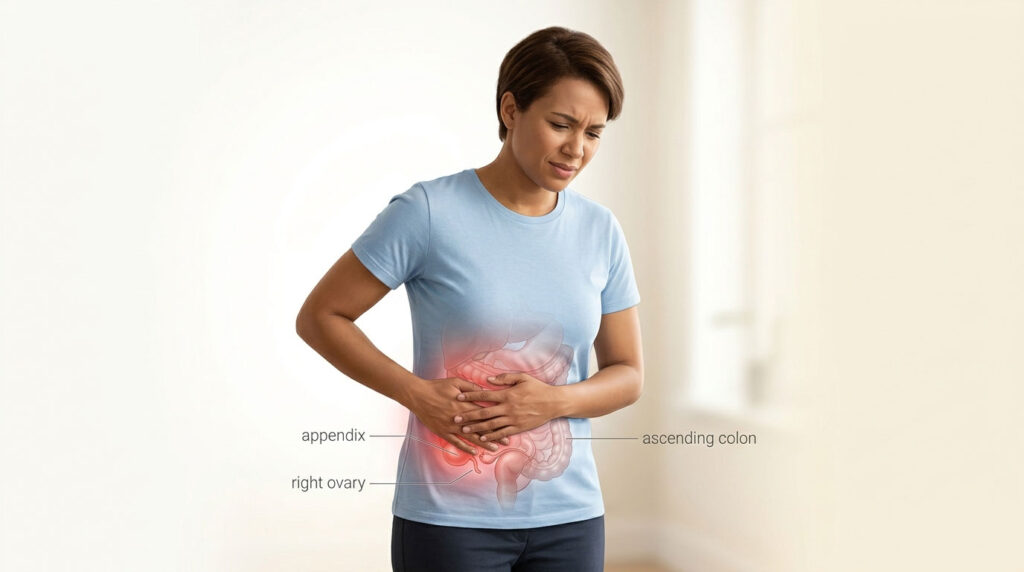
Roughly 1 in 12 American men and 1 in 15 American women will live through a bout of appendicitis at some point, according to NIH data. That’s the loud one, the cause that lands 300,000 Americans in the hospital each year. Most lower right abdominal pain, though, is something far quieter: trapped gas, a backed-up colon, a flaring ovarian cyst, or a kidney stone making its slow march south. The hard part is telling them apart fast, before the rare emergency turns into a 3 a.m. ambulance ride.
Table of Contents
Quick Answer
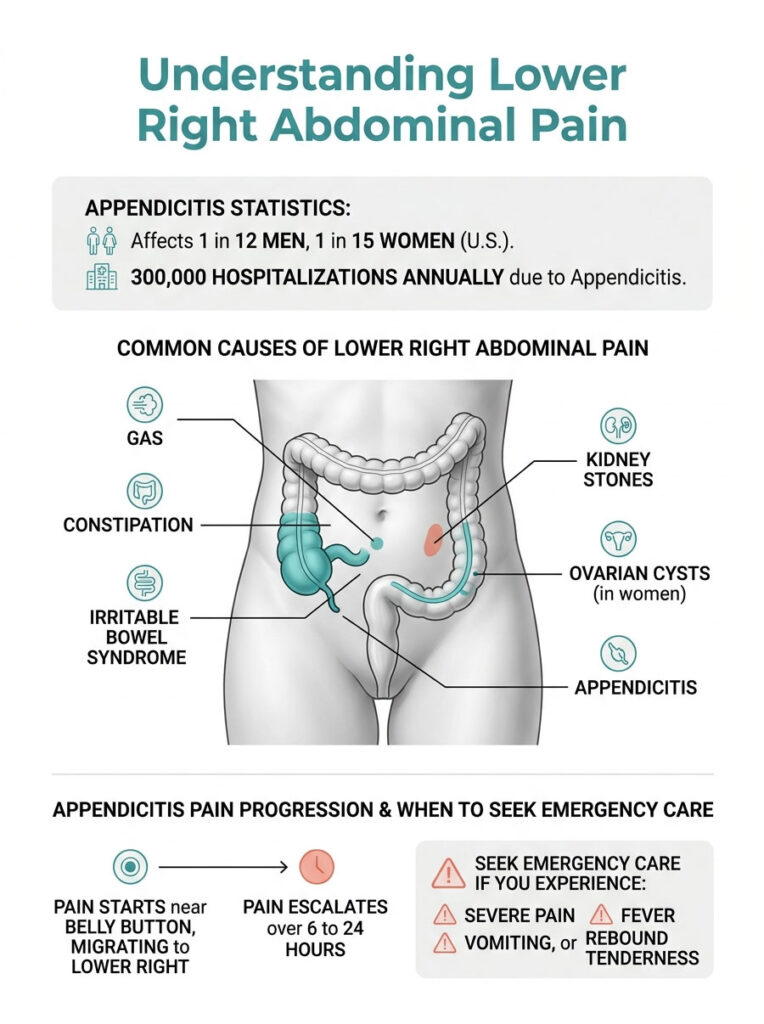
Pain in the lower right side of your stomach is most often caused by gas, constipation, irritable bowel syndrome, kidney stones, ovarian cysts in women, or appendicitis. Appendicitis pain typically begins near the belly button, then migrates to the lower right and worsens over 6 to 24 hours. Severe, escalating pain with fever, vomiting, or rebound tenderness needs the emergency room right away.
At a Glance
- The right lower quadrant houses your appendix, part of your colon, the right ureter, and the right ovary in women
- About 300,000 Americans are hospitalized for appendicitis each year, per NIH StatPearls
- Classic appendicitis pain migrates from the belly button to the lower right within hours, not days
- Women have ovarian and gynecologic causes that mimic appendicitis closely
- Sharp, sudden, worsening pain plus fever or vomiting is an ER-level red flag
- Most mild lower right abdominal pain resolves at home within 48 hours with rest and fluids
- Patients booking abdominal scans through HealthCareOnTime often arrive after one common mistake: waiting too long
What’s Inside Your Lower Right Abdomen
The lower right abdomen, what doctors call the right lower quadrant or RLQ, sits below your belly button and to the right of your midline. Picture drawing a cross over your belly. The lower-right square is what you’re feeling.
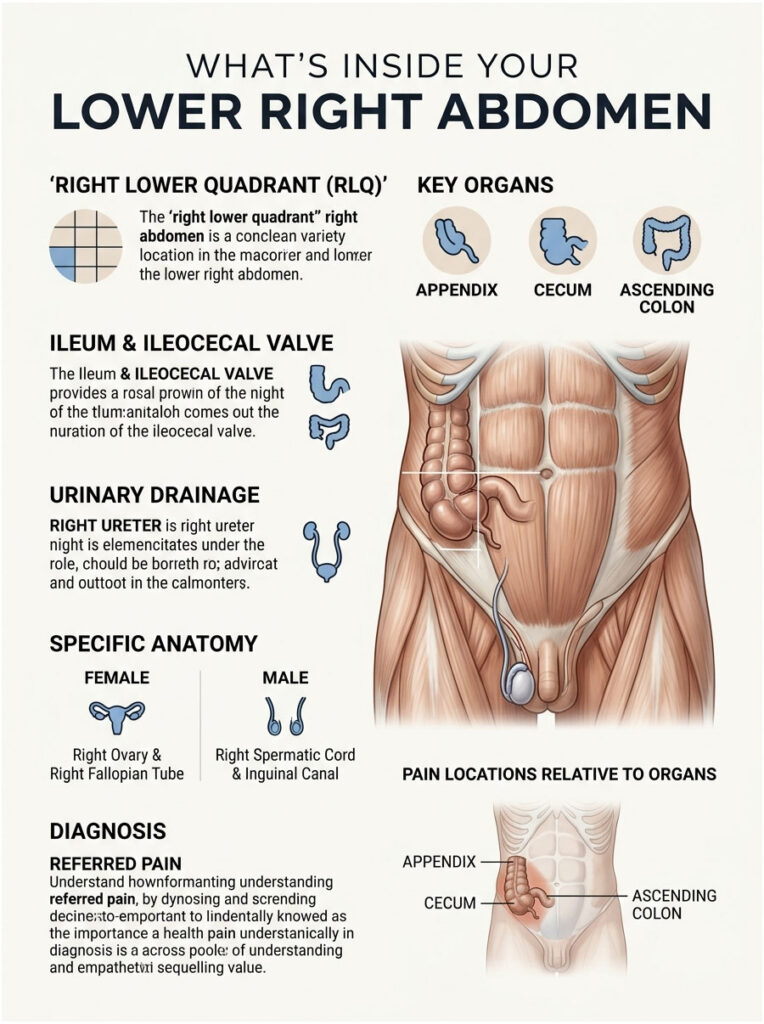
Several organs share this small piece of real estate, and any one of them can be the troublemaker. The appendix is the most famous resident, a finger-sized pouch hanging off the start of your large intestine. The cecum and the lower part of the ascending colon also pass through here.
Behind those, the last loop of your small intestine (the ileum) connects to your colon at a valve called the ileocecal valve. Your right ureter, the tube draining urine from your right kidney to your bladder, runs through this zone. In women, the right ovary and right fallopian tube sit just below.
In men, the right spermatic cord and the right inguinal canal pass through the lower margin. Pain here can also be referred from the testicle. Our medical reviewers point out that referred pain trips up self-diagnosis more often than any other factor, since the pain you feel rarely sits exactly over the inflamed organ.
14 Causes of Pain in the Lower Right Side of Your Stomach
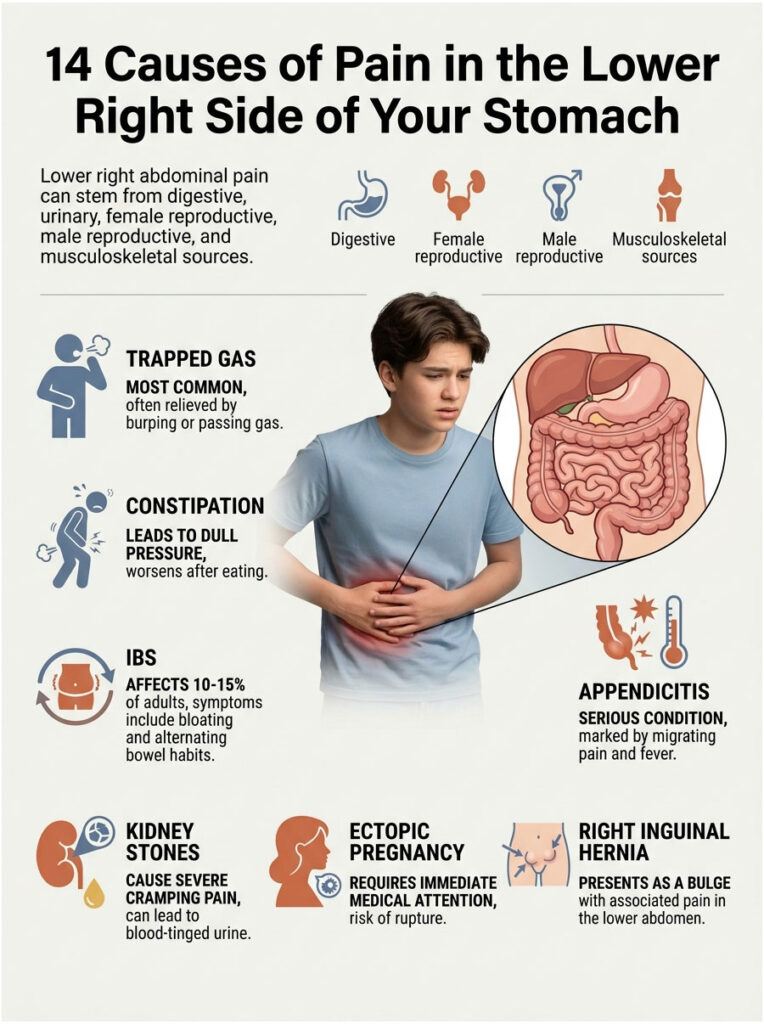
Lower right abdominal pain falls into five buckets: digestive, urinary, female reproductive, male reproductive, and musculoskeletal. Patients commonly ask us to name a single cause, but the same pain pattern can come from very different organs. The clue is almost always in the surrounding symptoms, not the location alone.
Digestive Causes
1. Trapped Gas
Gas pockets are the most common, least dangerous source of right-sided belly pain. The colon makes a sharp right-angle turn at the hepatic flexure, and gas often pools there or further down. Burping, walking, or passing gas usually clears it within a few hours.
2. Constipation
Hard stool building up in the cecum or ascending colon creates a dull, achy pressure that worsens after meals and eases after a bowel movement. Many Americans go three or fewer times a week, well below the daily target the American Gastroenterological Association considers healthy.
3. Irritable Bowel Syndrome (IBS)
IBS affects roughly 10 to 15% of US adults, per Mayo Clinic. The pain shifts location, brings bloating, alternates between constipation and diarrhea, and often eases after a bowel movement. Stress, dairy, and high-FODMAP foods top the trigger list.
4. Crohn’s Disease and Inflammatory Bowel Disease
Crohn’s disease commonly inflames the terminal ileum and the cecum, both sitting in the lower right quadrant. Symptoms include weeks of cramping, weight loss, fatigue, and bloody or mucousy stool. The CDC estimates more than 3 million Americans live with IBD.
5. Right-Sided Diverticulitis
Diverticulitis usually hits the left side, but right-sided cases happen, especially in younger adults and Asian-American patients. The pain is steady, worsens with eating, and often pairs with low-grade fever. CT imaging confirms the diagnosis quickly.
6. Gastroenteritis (Stomach Flu)
A stomach virus inflames the entire digestive tract, but cramping can localize to the lower right when the small intestine takes the brunt. Diarrhea and vomiting are the giveaways. It’s typically self-limiting within 24 to 72 hours.
7. Appendicitis
Inflammation of the appendix is the cause most people fear, and rightly so. About 300,000 Americans are hospitalized for appendicitis each year, and roughly 280,000 undergo appendectomy, according to the AMA. The classic pattern (covered in detail below) is migrating pain plus fever plus loss of appetite.
Urinary Causes
8. Kidney Stones (Right Side)
A stone moving from the right kidney down the right ureter triggers waves of severe, cramping pain that radiate from the flank to the groin. Blood-tinged urine, nausea, and an inability to find a comfortable position are classic. The CDC reports about 1 in 11 Americans will pass a kidney stone in their lifetime.
9. Right Kidney Infection (Pyelonephritis)
A urinary tract infection that climbs to the right kidney causes back and side pain that can wrap around to the lower right abdomen. Fever, chills, frequent painful urination, and cloudy urine point the way. Untreated, it can damage kidney function within days.
Female Reproductive Causes
10. Ovarian Cyst (Right Ovary)
A right ovarian cyst can ache dully for days, then suddenly stab if it ruptures or twists on its stalk. Pain near the start or middle of the menstrual cycle is the strongest clue. Most cysts resolve on their own within two to three cycles.
11. Mittelschmerz (Ovulation Pain)
About 1 in 5 women feel a sharp twinge mid-cycle when an ovary releases an egg. If it’s the right ovary’s turn, the pain lands squarely in the lower right abdomen. It typically lasts minutes to a few hours and never brings fever.
12. Ectopic Pregnancy
A fertilized egg implanting in the right fallopian tube is a true emergency. Sharp, one-sided lower abdominal pain plus a missed period, spotting, or dizziness needs an ER visit immediately. Untreated, it can rupture the tube and cause life-threatening internal bleeding.
Male and Shared Causes
13. Right Inguinal Hernia
When a loop of intestine pushes through a weak spot in the lower abdominal wall, it creates a tender bulge in the groin and an ache in the lower right belly. It’s seven to nine times more common in men. A hernia that suddenly turns painful, hard, or won’t reduce signals strangulation, an ER-level emergency.
14. Right-Side Muscle Strain
Pulled abdominal or psoas muscles from coughing, lifting, or core work cause sharp pain that worsens with movement and fades with rest. There’s no fever, no nausea, and no change in bowel habits. Two to three days of rest usually settles it.
Table 1: Lower Right Abdominal Pain Causes Compared
| Cause | Pain Type | Onset Pattern | Other Symptoms | Urgency |
| Trapped Gas | Crampy, shifting | Sudden, after meals | Bloating, burping | Self-care |
| Constipation | Dull, pressure | Gradual, days | Hard stool, bloating | Self-care |
| IBS | Cramping, variable | Recurrent, stress-linked | Bloating, altered stool | Primary care |
| Crohn’s Disease | Dull, persistent | Weeks to months | Weight loss, bloody stool | Specialist |
| Right Diverticulitis | Steady, sharp | Hours to 1 day | Low fever, nausea | Urgent care |
| Gastroenteritis | Cramping, diffuse | Sudden, 24-72 hr | Vomiting, diarrhea | Self-care/UC |
| Appendicitis | Sharp, migrating | 6-24 hr escalation | Fever, vomiting, loss of appetite | ER NOW |
| Kidney Stones | Severe, wavelike | Sudden, intense | Bloody urine, restlessness | ER |
| Kidney Infection | Deep, achy | 1-2 days | Fever, chills, painful urination | Urgent care |
| Ovarian Cyst | Dull or sharp | Cycle-linked | Bloating, spotting | Primary care |
| Mittelschmerz | Brief stabbing | Mid-cycle | Light spotting (sometimes) | Self-care |
| Ectopic Pregnancy | Sharp, one-sided | Sudden, severe | Missed period, dizziness | ER NOW |
| Inguinal Hernia | Achy, with bulge | Gradual or sudden | Visible groin lump | Primary/ER if hard |
| Muscle Strain | Sharp with movement | After activity | None | Self-care |
Is It Appendicitis? How to Tell the Difference
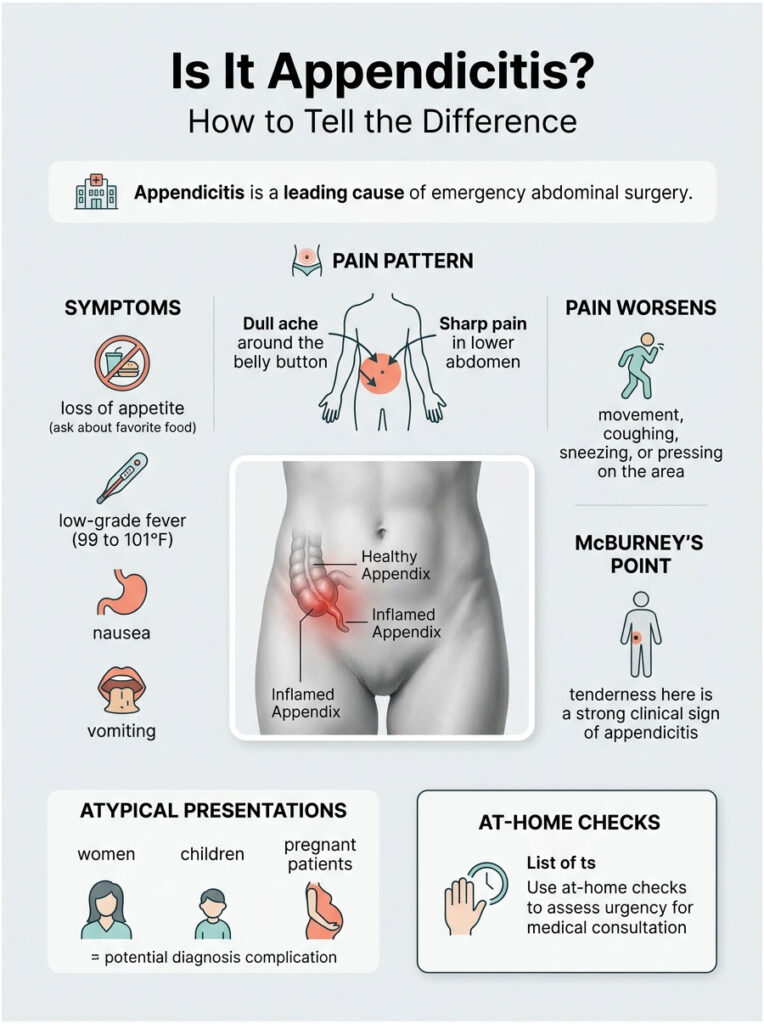
This is the question driving most lower right abdominal pain searches, and rightly so. Appendicitis remains the leading cause of emergency abdominal surgery in the United States. The good news: it follows a recognizable pattern in roughly half of patients.
The Classic Appendicitis Pain Pattern
Appendicitis usually begins as a vague, dull ache around the belly button. Over 4 to 12 hours, the pain shifts and sharpens, settling into the lower right abdomen. The Cleveland Clinic describes this migration as the single most reliable warning sign in classic cases.
Loss of appetite is so consistent that surgeons sometimes use a simple test: ask the patient about their favorite food. If they say no thanks, suspicion goes up sharply. Low-grade fever (typically 99 to 101°F), nausea, and one or two episodes of vomiting often follow.
The pain becomes worse with movement, coughing, sneezing, or pressing on the area. By the 24-hour mark, untreated appendicitis can progress to rupture, which spreads infection across the abdominal cavity and turns a routine 30-minute laparoscopic surgery into a multi-day hospital stay.
McBurney’s Point: The Self-Check
McBurney’s point sits about two-thirds of the way down a line drawn from your belly button to the bony bump on the front of your right hip. Tenderness exactly at this spot is one of the strongest clinical signs of appendicitis.
Three at-home checks worth knowing:
- Cough test: A sharp cough that triggers a stab in the lower right is a red flag.
- Hop test: Hopping on the right foot or jumping in place. Pain that spikes on landing is concerning.
- Rebound tenderness: Press slowly into the lower right, hold for a few seconds, then release quickly. Pain that hurts more on release than on press is a textbook sign.
These tests don’t replace a doctor; they help you decide how urgently to call one.
Why Women, Kids, and Pregnant Patients Present Differently
Only about half of appendicitis patients show the classic textbook pattern, per Cleveland Clinic. Women often have overlap with ovarian and gynecologic conditions. Children may have less localized pain and a higher fever. Pregnant patients feel the pain higher up, since the growing uterus pushes the appendix toward the upper right.
In cases reviewed across our diagnostic network, atypical presentation in women under 35 is the most common reason an early appendicitis is initially mistaken for a UTI or ovarian cyst. When the picture is unclear, a CT scan or transabdominal ultrasound becomes the deciding factor.
Lower Right Abdominal Pain in Women vs Men
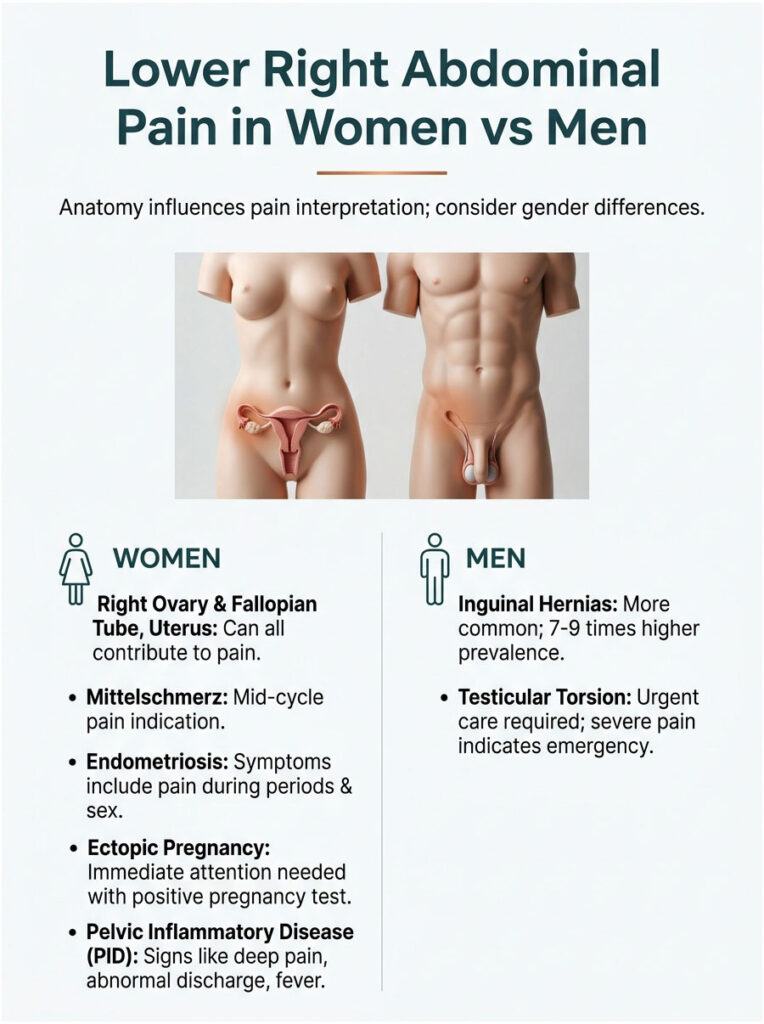
The same pain location can mean very different things depending on anatomy. Our medical team recommends always factoring in cycle timing, pregnancy status, and groin examination before settling on a working theory.
Female-Specific Patterns
Women face a wider list of possibilities because the right ovary, right fallopian tube, and uterus all project pain into the lower right quadrant. Cycle timing is the single most useful clue.
Pain that arrives mid-cycle and lasts hours is usually mittelschmerz. Pain that worsens during periods, with heavy bleeding or pain during sex, suggests endometriosis. Sharp, one-sided pain plus a positive home pregnancy test (or a missed period plus spotting) is ectopic pregnancy until proven otherwise, and demands an ER visit the same day.
Pelvic inflammatory disease (PID), often from untreated chlamydia or gonorrhea, brings deep lower abdominal pain along with abnormal discharge and fever. The CDC estimates about 1 in 20 American women aged 18 to 44 have had PID at least once.
Male-Specific Patterns
Men’s options are narrower but include a few that punch above their weight. Right-sided inguinal hernias are about 7 to 9 times more common in men than women, per Mayo Clinic. Testicular torsion, when the right testicle twists on its cord, refers sharp pain straight up into the lower right abdomen. Any sudden, severe testicular pain in a male of any age is a 6-hour emergency window.
Lifetime appendicitis risk runs about 8.6% for American men and 6.7% for American women, per NIH data. Despite the slightly higher male risk, women face a tougher diagnostic puzzle because of the gynecologic overlap.
Pain by Pattern: Sharp, Dull, Cramping, or Burning?
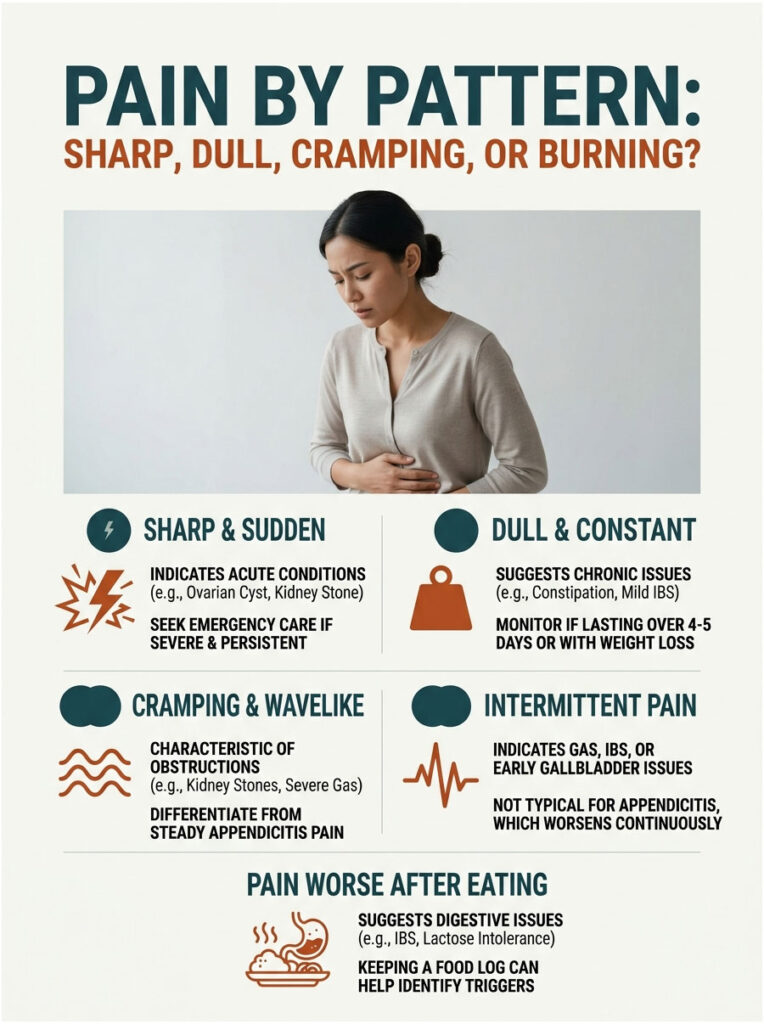
The character of the pain is often more diagnostic than the location. A sharp, sudden pain rarely behaves like a dull ache, and the body uses these patterns to point at very different organs.
Sharp and Sudden
Sudden, sharp, severe pain that drops you in your tracks usually signals something acute: a twisting ovarian cyst, an ectopic rupture, kidney stone passage, or a strangulated hernia. Time matters here. If the pain is the worst you’ve ever felt and isn’t easing within 30 minutes, head to the ER.
Dull and Constant
A dull, constant ache that’s been there for hours or days usually points to constipation, gas, mild IBS flares, or early Crohn’s. It’s almost never an immediate emergency, but it shouldn’t be ignored if it lasts more than 4 to 5 days or pairs with weight loss.
Cramping and Wavelike
Pain that comes in waves, building and easing every few minutes, is the calling card of obstruction. Kidney stones do this as the stone moves down the ureter. Severe gas and partial bowel obstruction follow the same pattern. The wavelike rhythm distinguishes it from appendicitis, which is steady and worsening.
Pain That Comes and Goes
Intermittent pain that disappears for hours or days then returns suggests gas, IBS, ovulation pain, or early gallbladder issues. Appendicitis rarely behaves this way. Once it starts, it stays and gets worse.
Pain Worse After Eating
Pain that flares 30 minutes to 2 hours after meals usually points to digestive causes: IBS, food sensitivities, lactose intolerance, or rarely, mesenteric ischemia. Keeping a food log for two weeks often surfaces the trigger.
Table 2: US Lower Abdominal Pain and Appendicitis Statistics
| Statistic | Figure | Source |
| Annual US appendicitis hospitalizations | ~300,000 | NIH StatPearls |
| Annual US appendectomies | ~280,000 | American Medical Association |
| Lifetime appendicitis risk (US males) | 8.6% | NIH StatPearls |
| Lifetime appendicitis risk (US females) | 6.7% | NIH StatPearls |
| Mean US age at appendicitis presentation | 28 years | NIH StatPearls |
| US appendicitis-related deaths (1999-2020) | 15,243 | CDC WONDER Database |
| US adults with kidney stones (lifetime) | ~1 in 11 | CDC |
| US adults living with IBD | 3+ million | CDC |
| US adults with IBS | 10-15% | Mayo Clinic |
When to Go to the ER vs Urgent Care vs Primary Care
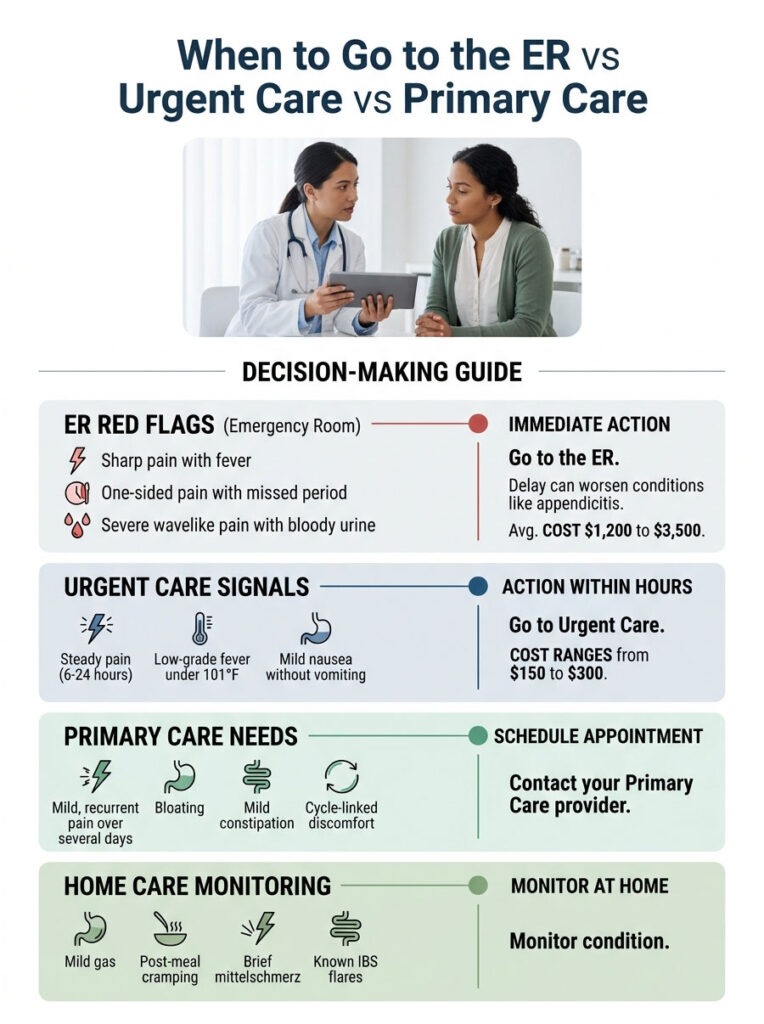
The single most actionable question in this whole article. Patients booking tests with us often arrive after one critical mistake: assuming “it’ll feel better tomorrow.” With a possible appendicitis, tomorrow is sometimes 12 hours too late.
ER Red Flags (Go Now)
Any of these means call 911 or have someone drive you to the nearest ER:
- Severe, escalating pain that doubles you over
- Pain plus fever above 101°F
- Pain plus repeated vomiting (more than 2 episodes)
- Pain plus blood in stool, urine, or vomit
- Pain plus dizziness, fainting, or rapid heartbeat
- Pain plus a rigid, board-like belly
- One-sided sharp pain with a missed period or known pregnancy
- Sudden testicular pain (in men)
- Hard, painful, non-reducible groin bulge
Average US ER visits for abdominal pain run $1,200 to $3,500 before insurance, per Kaiser Family Foundation analysis. Most plans cover emergency abdominal evaluation when symptoms meet medical-necessity criteria, which the warning list above easily clears.
Urgent Care Signals (Within 24 Hours)
Steady pain present for 6 to 24 hours, low-grade fever (under 101°F), mild nausea without vomiting, or a known UTI getting worse. Most major US urgent care chains can run a urinalysis, basic blood work, and an X-ray on the spot, often for $150 to $300 out-of-pocket.
Schedule with Primary Care (Within a Week)
Mild, recurrent, or intermittent pain over several days, especially when paired with bloating, mild constipation, or cycle-linked discomfort. Your primary care provider can order targeted blood tests, a stool study, or a referral for ultrasound.
Safe to Watch at Home (24 to 48 Hours)
Mild gas, mild post-meal cramping, brief mittelschmerz, or known IBS flares. Watch closely. If pain worsens or new symptoms appear, escalate quickly.
Table 3: When-to-Worry Decision Guide
| Your Scenario | Recommended Action | Timeline |
| Sharp pain + fever + vomiting | Emergency room | Now (within 1 hour) |
| One-sided pain + missed period | Emergency room | Now (within 1 hour) |
| Severe wavelike pain + bloody urine | Emergency room | Now (within 2 hours) |
| Steady pain 6-24 hr + low fever | Urgent care | Same day |
| Recurrent cycle-linked dull pain | Primary care + ultrasound | Within 1 week |
| Mild gas or constipation cramping | Home care + monitor | 24-48 hours |
How Doctors Diagnose Lower Right Abdominal Pain
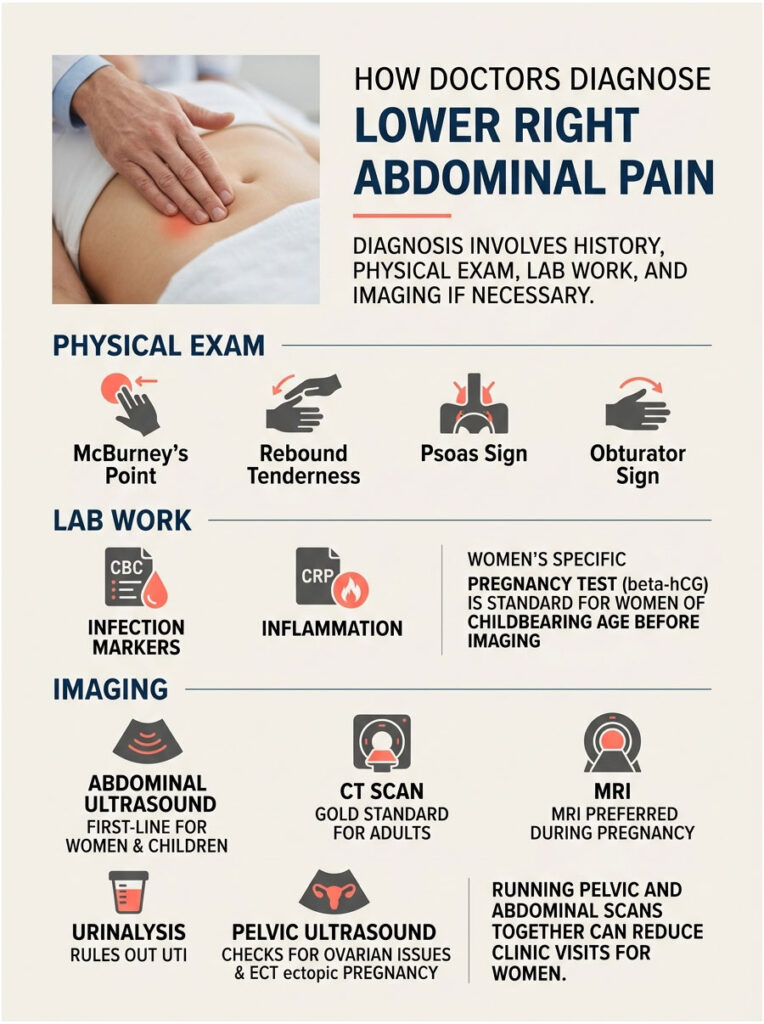
Diagnosis follows a layered approach: history, physical exam, lab work, then imaging if needed. Knowing what’s coming makes the visit faster and less stressful.
Physical Exam
The doctor will press at McBurney’s point, check for rebound tenderness, and test the psoas sign (extending your right leg) and obturator sign (rotating your right hip inward). These three signs together raise appendicitis suspicion sharply, and a skilled exam alone catches most classic cases within minutes.
Blood Tests
A complete blood count (CBC) checks for elevated white blood cells, a marker of infection. C-reactive protein (CRP) flags inflammation. In women of childbearing age, a pregnancy blood test (beta-hCG) is standard before any imaging. Most US labs return CBC and CRP results in under an hour.
Imaging
Abdominal ultrasound is first-line for women and children, since it avoids radiation and shows ovarian and uterine causes well. A CT scan with contrast is the gold standard for adults, with about 95% accuracy for appendicitis, per Johns Hopkins. MRI is preferred during pregnancy. In tests booked through HealthCareOnTime, abdominal ultrasound typically reports within 4 to 6 hours, while CT results come back the same day.
Lab Work for Women
Urinalysis rules out UTI and kidney issues. Pelvic ultrasound checks for ovarian cysts, ectopic pregnancy, and PID. Vaginal swabs for chlamydia and gonorrhea are routine when PID is suspected. Our medical reviewers note that running pelvic and abdominal scans together saves women an average of two extra clinic visits.
How to Relieve Mild Lower Right Stomach Pain at Home
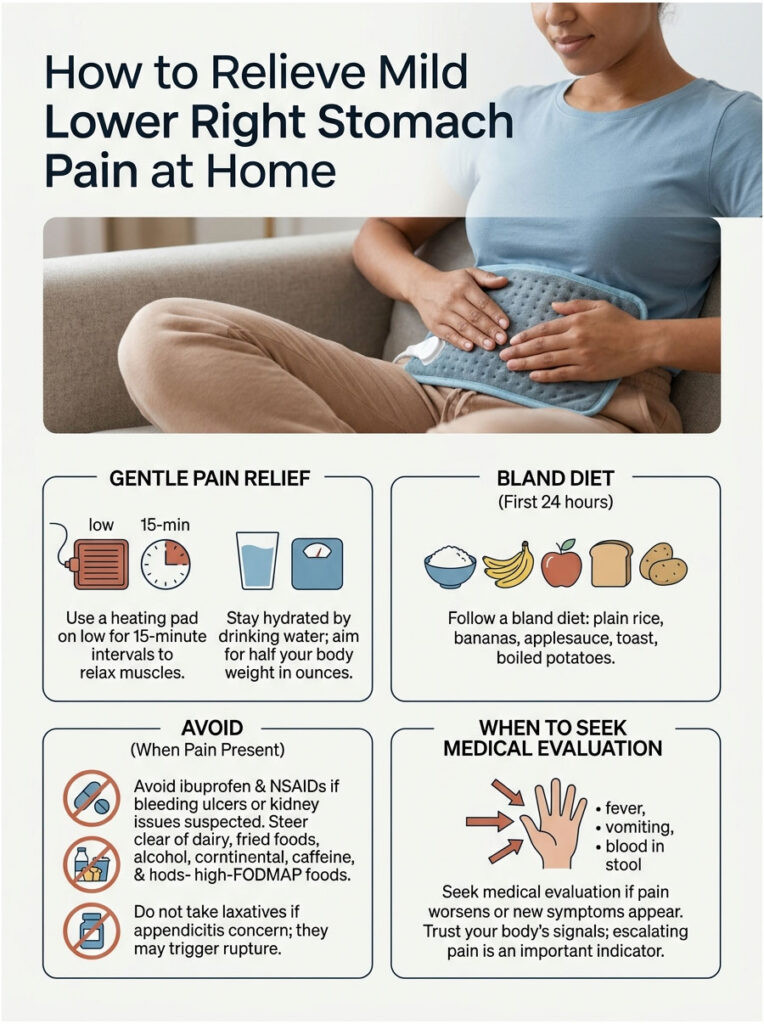
When ER red flags are absent and the pain is mild, simple home care works for most cases.
Heat, Hydration, and a Bland Diet
A heating pad set on low for 15-minute stretches relaxes cramped muscle and intestinal walls. Sip water steadily through the day; a useful target is half your body weight in ounces. Eat plain rice, bananas, applesauce, toast, or boiled potatoes for the first 24 hours.
What to Avoid
Skip ibuprofen and other NSAIDs if you suspect a bleeding ulcer or kidney issue. Stay off dairy, fried food, alcohol, caffeine, and high-FODMAP foods (onions, beans, garlic, certain fruits) until pain settles. Don’t take laxatives if appendicitis is on the table; they can trigger rupture.
When Home Care Stops Working
If pain hasn’t improved in 24 to 48 hours, has worsened, or new symptoms have appeared (fever, vomiting, blood in stool), stop home care and seek medical evaluation. Trust the body’s signal. Pain that escalates is information.
How to Reduce Your Risk of Recurrence
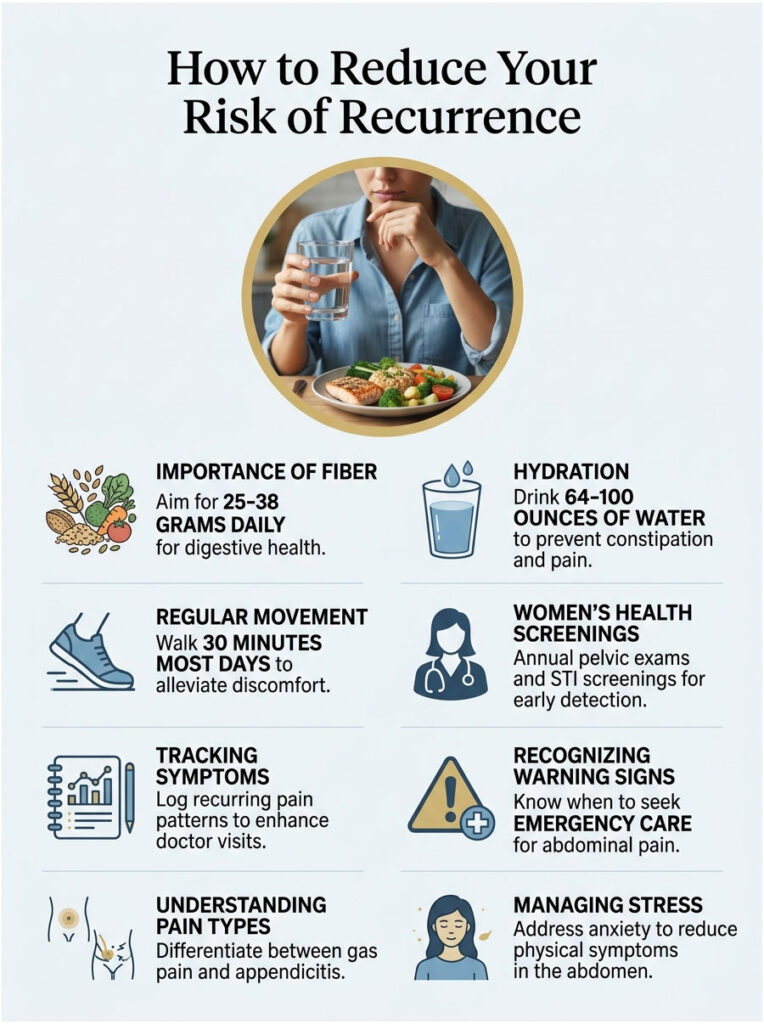
Most causes of lower right abdominal pain are at least partially preventable.
Fiber, Hydration, and Movement
Aim for 25 to 38 grams of fiber daily, the range recommended by the American Heart Association. Drink 64 to 100 ounces of water. Walk 30 minutes most days. These three habits alone prevent most cases of constipation, gas, and diverticular flares.
Screening for Women
Annual pelvic exams, regular STI screening if sexually active, and a baseline pelvic ultrasound by age 35 catch ovarian cysts and endometriosis early. The American College of Obstetricians and Gynecologists recommends discussing recurring pelvic pain with a gynecologist rather than absorbing it as normal.
Listening to Body Signals
Pain is data. A pattern that repeats every cycle, every weekend, or every time you eat a specific food deserves a logged record and a doctor’s eyes. Most chronic conditions get caught earlier when patients track symptoms in plain text for a few weeks before the visit.
Frequently Asked Questions
What organ is in the lower right side of your stomach?
The right lower quadrant contains the appendix, the cecum and start of the ascending colon, the last part of the small intestine (terminal ileum), and the right ureter. In women, the right ovary and right fallopian tube sit there too. In men, the right spermatic cord runs through the lower edge.
Can gas cause lower right abdominal pain?
Yes. Trapped gas is the most common cause of lower right abdominal pain in healthy adults. Gas can pool at the colon’s bend on the right side, creating sharp or crampy pain that comes and goes. Walking, gentle stretching, or passing gas usually relieves it within an hour or two.
How do I know if it’s appendicitis or just gas?
Gas pain shifts location, eases with movement or passing gas, and never causes fever. Appendicitis pain stays put, worsens steadily over hours, often migrates from the belly button to the lower right, and brings fever, nausea, and loss of appetite. Pain still escalating after 4 hours needs medical evaluation.
Should I go to the ER for lower right stomach pain?
Go to the ER if your pain is severe, worsening over hours, or paired with fever above 101°F, repeated vomiting, blood in stool or urine, fainting, a missed period with one-sided pain, or a hard belly. For mild, intermittent pain without these warning signs, urgent care or your primary care doctor is appropriate.
Why does my lower right side hurt when I press on it?
Pressing on an inflamed organ irritates nearby nerves, which is why doctors use palpation tests. Tenderness at McBurney’s point (about two-thirds down from your belly button to your right hip bone) suggests appendicitis. Pain that’s worse on release than on press (rebound tenderness) is a stronger warning sign.
Can stress or anxiety cause lower right abdominal pain?
Yes. Stress amplifies IBS, accelerates gut motility, and increases visceral sensitivity. Many patients with chronic stress feel real, physical lower abdominal cramping that comes and goes with anxiety levels. The pain is genuine, not imagined, and often responds well to stress management plus dietary adjustments.
What does ovarian cyst pain feel like?
Ovarian cyst pain is typically a dull, one-sided ache that may flare into sharp pain if the cyst ruptures or twists. It often correlates with the menstrual cycle, may worsen during sex or bowel movements, and can radiate to the lower back. A pelvic ultrasound is the most reliable diagnostic tool.
Can lower right abdominal pain be a sign of cancer?
Rarely. Most lower right pain is benign. Persistent pain lasting weeks, paired with unintentional weight loss, blood in stool, fatigue, or a palpable lump, can occasionally signal colon, ovarian, or appendiceal cancer. Anyone over 45 with new persistent symptoms should get screened, including a colonoscopy if not done recently.
Why does the pain come and go?
Intermittent pain typically points to gas, IBS, ovulation, ovarian cysts, or kidney stones moving through the ureter. These conditions follow wavelike or cyclical patterns. Pain that disappears for days then returns is rarely appendicitis, since appendicitis pain stays once it starts and worsens steadily.
How long does appendicitis pain last before rupture?
Appendicitis usually progresses to rupture within 36 to 72 hours of the first symptoms, though some cases rupture in under 24 hours. Pain typically becomes severe and unbearable in the 12 hours before rupture. After rupture, pain may briefly ease before peritonitis sets in, which is why migrating pain is never safe to ignore.
Is it normal to have lower right pain during pregnancy?
Mild, brief pain from ligament stretching is common, especially in the second trimester. Sharp, persistent, or severe pain is not normal. During pregnancy the appendix shifts upward, so pain may be felt higher on the right side. Any severe pregnancy pain warrants same-day evaluation by an OB or ER.
Can dehydration cause lower right abdominal pain?
Yes, indirectly. Dehydration triggers constipation, which causes right-sided pressure and crampy pain. It also raises kidney stone risk by concentrating minerals in urine. Drinking 64 to 100 ounces of water daily is one of the simplest preventive habits across nearly every cause on this list.
Disclaimer
This article is for general health education. It does not replace personal medical evaluation, diagnosis, or treatment. Lower right abdominal pain has many possible causes, some of which are surgical emergencies. Anyone with severe, worsening, or unusual symptoms should contact a licensed healthcare provider or call 911 immediately.
References
- Cleveland Clinic, Right Side Abdominal Pain
- Cleveland Clinic, Appendicitis
- Mayo Clinic, Appendicitis Symptoms and Causes
- American Medical Association, What Doctors Wish Patients Knew About Appendicitis
- NIH StatPearls, Appendicitis
- CDC WONDER Database, Appendicitis Mortality Trends
- Healthline, Pain in Lower Right Abdomen
- Cedars-Sinai, Appendicitis Symptoms
- Orlando Health, How to Tell if a Stomachache is Appendicitis