Here’s the strange part most keto trackers miss: a cup of cooked broccoli has more carbs than a cup of raw, even though the broccoli itself didn’t change. Heat shrinks the florets, so more grams pack into the same measuring cup. That single quirk trips up beginners every week, and it’s why “how many carbs in broccoli” deserves a real answer instead of a one-liner. Below, we walk through the USDA numbers, the keto math, and the portions that actually fit on your plate.
Table of Contents
Quick Answer
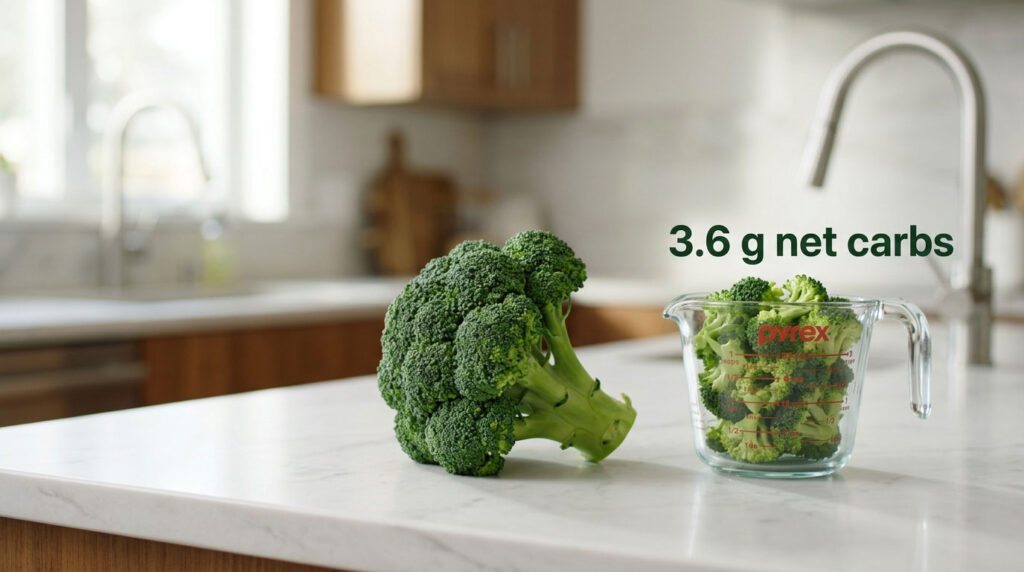
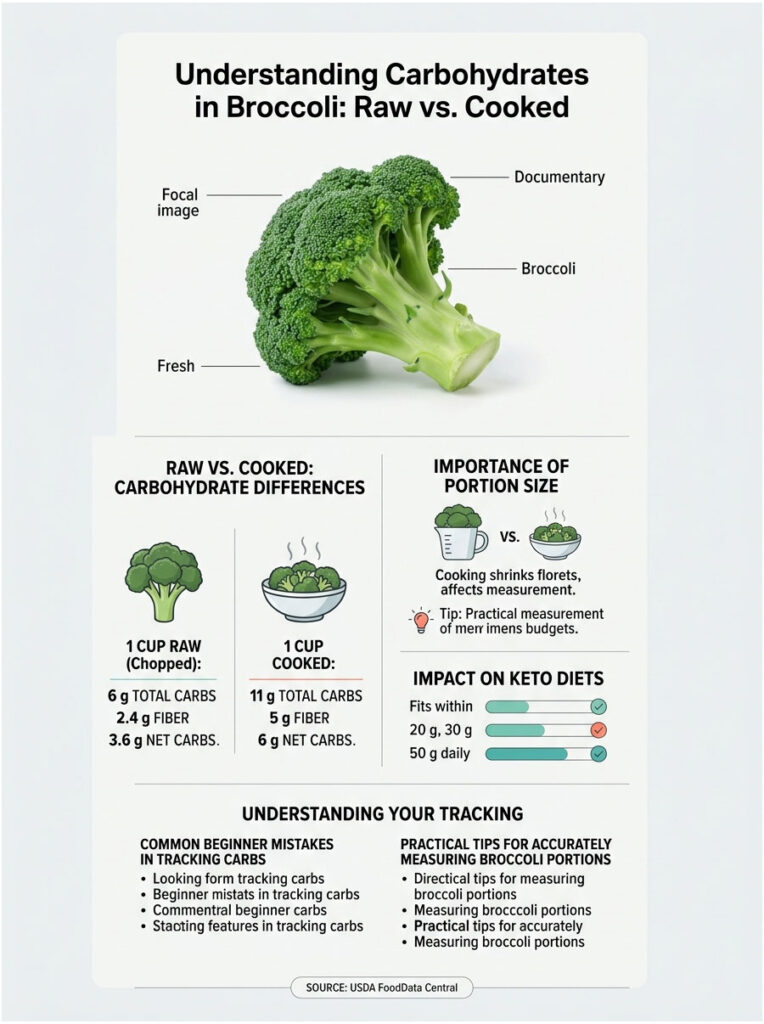
One cup of raw chopped broccoli (91 g) has 6 g total carbs, 2.4 g fiber, and 3.6 g net carbs, per USDA FoodData Central. One cup of cooked broccoli has about 11 g total carbs, 5 g fiber, and 6 g net carbs. At those levels, broccoli fits comfortably into 20 g, 30 g, and 50 g daily keto budgets.
At a Glance
- One cup of raw broccoli has roughly 3.6 g net carbs (USDA FoodData Central)
- One cup of cooked broccoli has about 6 g net carbs because cooked florets pack tighter
- Per 100 g, broccoli holds about 4 g net carbs, well within keto territory
- Net carbs equal total carbs minus fiber, since fiber doesn’t raise blood sugar
- The FDA does not officially recognize “net carbs” as a labeling term
- Broccoli is one of the lowest-carb vegetables on the standard US grocery shelf
- Patients booking metabolic panels through HealthCareOnTime often ask whether broccoli stalls ketosis; for most people, the answer is no
How Many Carbs Are in Broccoli? The Quick Numbers
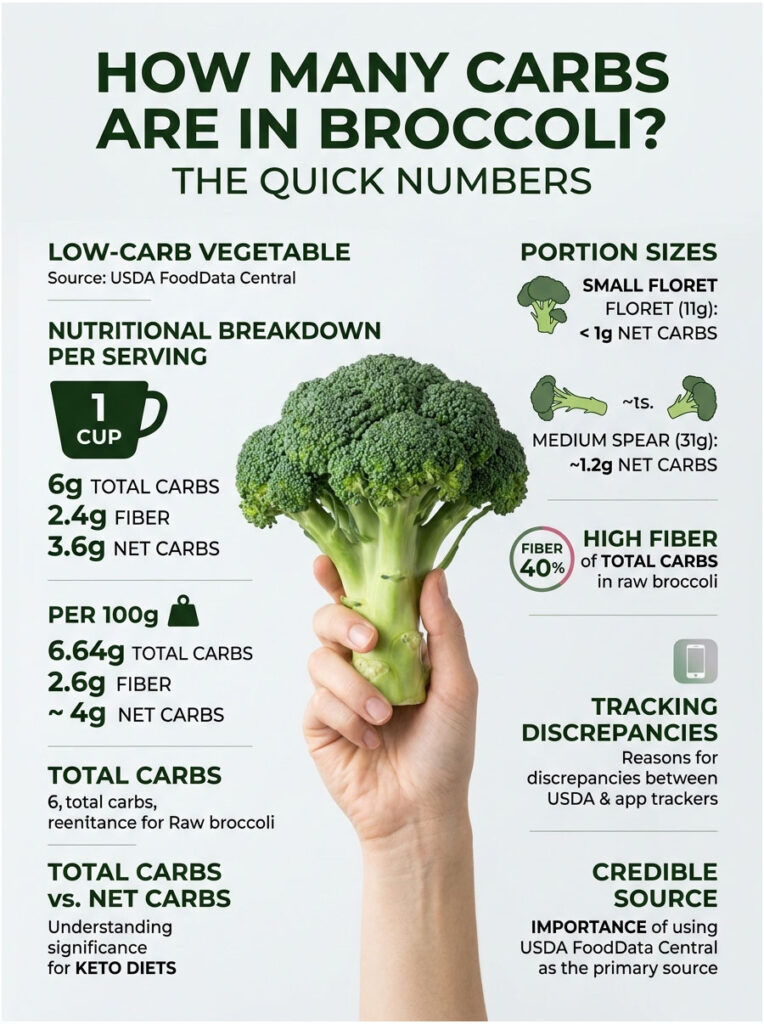
Broccoli is a low-carb vegetable by almost any measure. The numbers below all come from the USDA FoodData Central database, the same source US Nutrition Facts panels are built from. Carb Manager, MyFitnessPal, and Cronometer all pull from this dataset, which is why their broccoli entries match within a small rounding window.
Per Cup, Per 100 g, Per Floret
A 1-cup serving of raw chopped broccoli (91 grams) contains 6 grams of total carbohydrates, of which 2.4 grams is fiber. That leaves 3.6 grams of net carbs and just 31 calories. Per 100 grams (a clean metric reference), raw broccoli holds 6.64 grams of total carbs, 2.6 grams of fiber, and roughly 4 grams of net carbs.
A single small floret weighs about 11 grams and brings less than 1 gram of net carbs. A medium spear (around 31 grams) lands at about 1.2 grams of net carbs. These small-portion numbers matter when you’re snacking off a veggie tray and want to keep mental tally without a kitchen scale.
Total Carbs vs Net Carbs (the keto distinction)
Total carbs is the literal number printed on the Nutrition Facts panel. Net carbs is total carbs minus dietary fiber. Most keto plans count net carbs because the body cannot break down most fiber into glucose, so it doesn’t raise blood sugar or interrupt ketosis.
For broccoli, that distinction is meaningful. Raw broccoli is 40% fiber by total carb weight, which is unusually high for a vegetable. That fiber chunk is what makes broccoli so forgiving on a strict keto budget.
Why USDA Numbers Sometimes Differ from App Trackers
In tests booked through HealthCareOnTime, patients often ask why their tracker shows 7 grams of carbs while the package label shows 4 grams. Three reasons usually explain the gap. First, US Nutrition Facts include fiber inside the total carb number; many tracker entries already pre-subtract fiber. Second, some apps round; a 3.6 g entry can show as 4 g. Third, raw vs cooked entries are sometimes mislabeled in user-submitted databases. When in doubt, default to USDA FoodData Central as your primary source.
Net Carbs Explained Using Broccoli
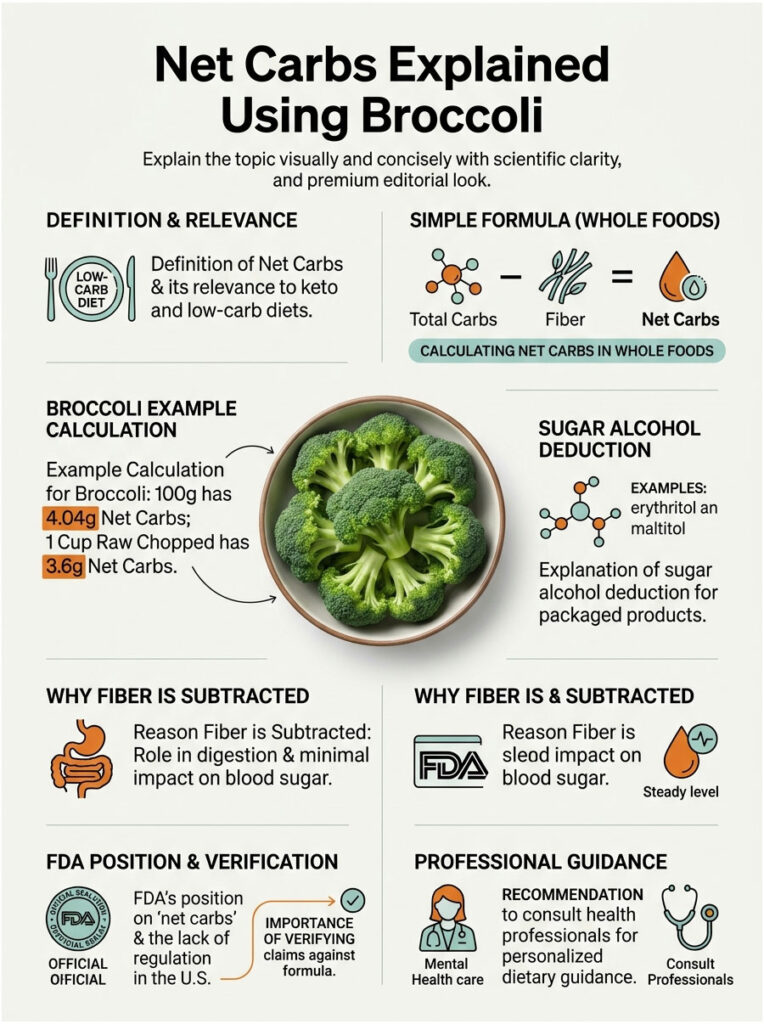
Net carbs is the metric that drives keto and low-carb decision-making, but it isn’t a regulated term in the United States. Knowing exactly what gets subtracted (and what doesn’t) is the difference between staying in ketosis and accidentally drifting out.
The Net Carb Formula
For whole foods like broccoli, the formula is simple: total carbs minus fiber equals net carbs. For broccoli per 100 g, that’s 6.64 grams minus 2.6 grams, which equals 4.04 grams of net carbs. For 1 cup raw chopped, the math is 6 minus 2.4, which equals 3.6 grams of net carbs.
For packaged keto products, the formula stretches further. You also subtract sugar alcohols (or half of them, depending on type), since most don’t fully convert to glucose. Erythritol can be subtracted entirely; maltitol should typically be counted as half, per Healthline guidance.
Why Fiber Doesn’t Count Toward Your Keto Budget
Fiber escapes digestion in the small intestine. Insoluble fiber passes through unchanged. Soluble fiber gets fermented by gut bacteria into short-chain fatty acids, which provide minimal calories and don’t trigger an insulin response. That’s why subtracting fiber from total carbs gives you a closer estimate of carbs that actually affect blood sugar and ketosis.
FDA Position on “Net Carbs”
UCLA Health notes that the FDA does not endorse the term “net carbs” and that nutrition labels in the US must show only total carbohydrates and fiber separately. The “net carb” label you see on keto bars and snacks is a marketing calculation, not a federally regulated number. Our nutrition reviewers recommend cross-checking packaged “net carb” claims against the formula above before trusting them.
Carbs in Broccoli by Cooking Method
Cooking changes the math, but in a quirky way. Heat softens cell walls and reduces volume, so a cup of cooked broccoli contains more grams than a cup of raw. The carbs per gram stay nearly identical. The carbs per cup go up.
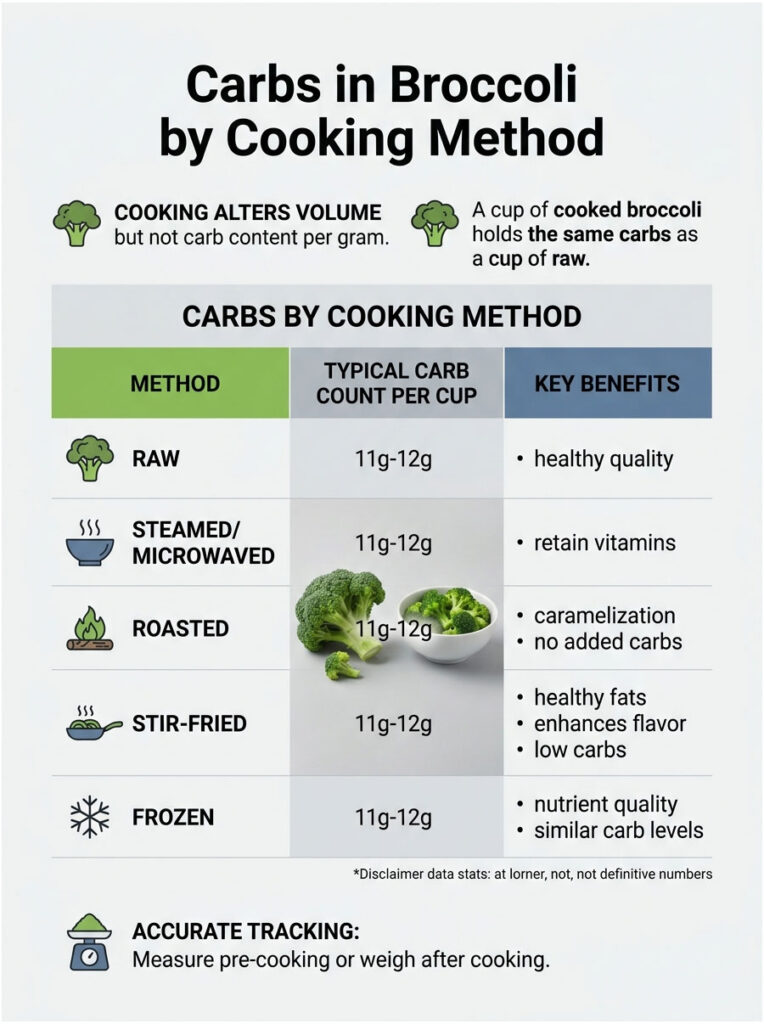
That distinction matters because most keto and low-carb apps default to cup measurements. If you steam a cup of raw broccoli (3.6 g net carbs) and end up with 1/2 cup cooked, that 1/2 cup still holds the same 3.6 g of net carbs, even though the volume is now smaller. Always log what you measured before you cooked, or weigh after if you measure cooked.
Steaming and Microwaving (Best for Vitamin Retention)
Steaming over simmering water for 4 to 5 minutes is the gold standard for vitamin C retention. Microwaving with a tablespoon of water tracks nearly identically. Both preserve nutrients better than boiling, which leaches water-soluble vitamins into the cooking water that you’ll likely pour down the drain.
Roasting (Most Popular US Preparation)
Roast at 400°F for 15 to 20 minutes with olive oil, salt, and pepper. Carbs per cup match steamed (about 6 g net), and caramelization adds depth without adding carbs. Olive oil contributes 0 carbs but adds 120 calories per tablespoon, worth tracking if you’re calorie-conscious.
Stir-Frying with Keto Fats
Quick high-heat cooking in butter, ghee, or avocado oil locks in color and crunch. Add garlic and a teaspoon of soy sauce (about 1 g carb) for flavor without breaking the keto budget.
Frozen Broccoli (Pre-Cut & Florets)
Per the USDA SNAP-Ed program, commercial frozen broccoli is blanched briefly before freezing, which preserves most nutrients near peak harvest quality. Net carbs per cup track within 0.5 g of fresh. A standard 12-ounce US frozen bag (about 340 g) yields roughly 13.6 g net carbs total, or about 3 g per generous serving.
Table 1: Broccoli Carbs by Cooking Method (USDA Data)
| Method | Serving | Total Carbs | Fiber | Net Carbs | Calories |
| Raw, chopped | 1 cup (91 g) | 6.0 g | 2.4 g | 3.6 g | 31 |
| Raw, per 100 g | 100 g | 6.6 g | 2.6 g | 4.0 g | 34 |
| 1 small floret | ~11 g | 0.7 g | 0.3 g | 0.4 g | 4 |
| Steamed | 1/2 cup | 5.6 g | 2.6 g | 3.0 g | 27 |
| Steamed | 1 cup | 11.0 g | 5.0 g | 6.0 g | 55 |
| Boiled | 1 cup | 11.0 g | 5.1 g | 5.9 g | 55 |
| Roasted (no oil) | 1 cup | 11.0 g | 5.0 g | 6.0 g | 55 |
| Frozen, cooked | 1 cup | 11.0 g | 5.5 g | 5.5 g | 52 |
Broccoli on a Keto Diet: How Much Fits Your Budget?
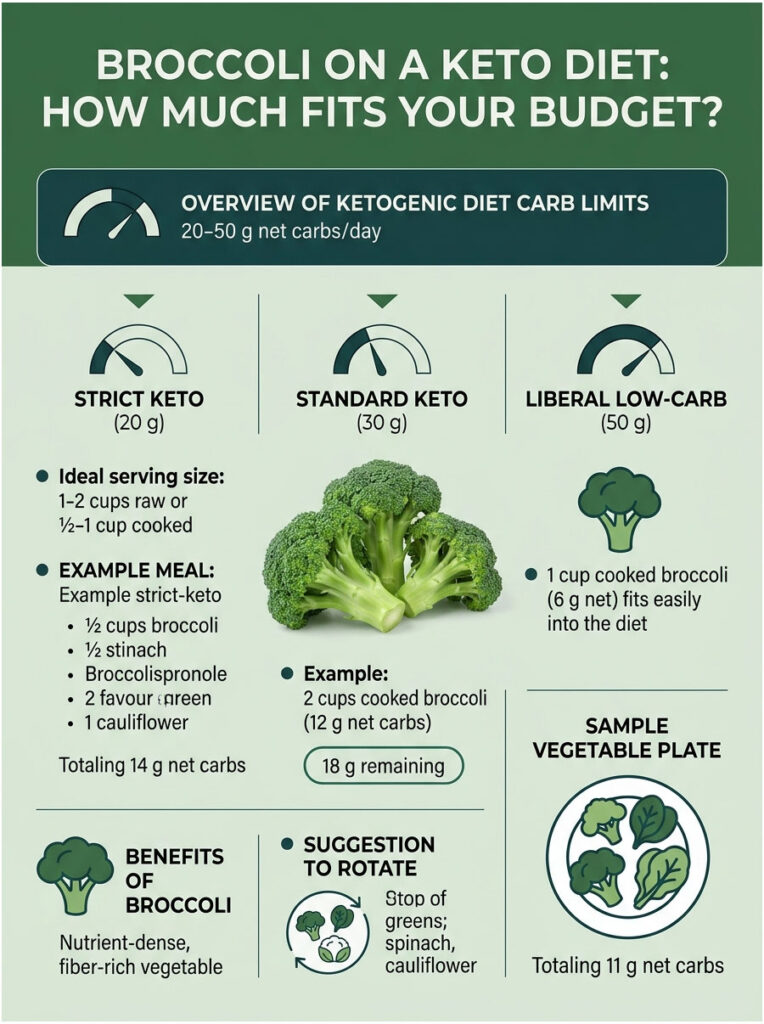
The standard ketogenic diet limits carbs to between 20 and 50 grams of net carbs per day, per Harvard T.H. Chan School of Public Health. Where broccoli fits depends on which tier you’re on, what other carbs you’ve eaten, and how much fiber you want to hit.
Strict Keto (20 g Net Carbs/Day)
At 3.6 g net carbs per raw cup, you could theoretically eat about 5 cups of raw broccoli and still stay under the 20 g ceiling, assuming no other carbs. Nobody actually does that. A realistic strict-keto serving runs 1 to 2 cups raw or 1/2 to 1 cup cooked, which uses 3 to 6 g of your daily budget and leaves room for cheese, eggs, meats, oils, and trace carbs from condiments.
A real strict-keto day might look like: 2 eggs cooked in butter (1 g net), 4 oz roasted chicken (0 g), 1 cup roasted broccoli (6 g), 1/2 avocado (2 g), 1 oz almonds (3 g), 1 oz cheddar (1 g), and small salad with 2 cups spinach and olive oil dressing (1 g). Total: about 14 g net carbs, well under the 20 g ceiling.
Standard Keto (30 g Net Carbs/Day)
You have more headroom. Two cups cooked broccoli (12 g net carbs) fits comfortably with 18 g remaining for berries, nuts, dairy, and trace carbs in eggs and meat. Patients commonly ask us how to spread that 30 g across a day; broccoli is usually the easiest “always yes” pick because of its fiber load and micronutrient density.
Liberal Low-Carb (50 g Net Carbs/Day)
Diet Doctor’s liberal low-carb tier runs 20 to 50 g net carbs daily. Broccoli at 6 g per cooked cup fits with plenty of room to spare. You can include broccoli at every meal at this tier without any keto risk, and still have budget left for a small serving of berries or a few extra nuts.
Combining Broccoli with Other Low-Carb Vegetables
Most US registered dietitians recommend rotating cruciferous and leafy greens to cover a wider micronutrient profile. A common keto-day vegetable plate: 1 cup cooked broccoli (6 g net), 1 cup raw spinach (0.4 g net), 1/2 cup cucumber (1.5 g net), and 1 cup zucchini (3 g net) totals about 11 g net carbs and packs more vitamins than any single vegetable alone.
Broccoli vs Other Low-Carb Vegetables
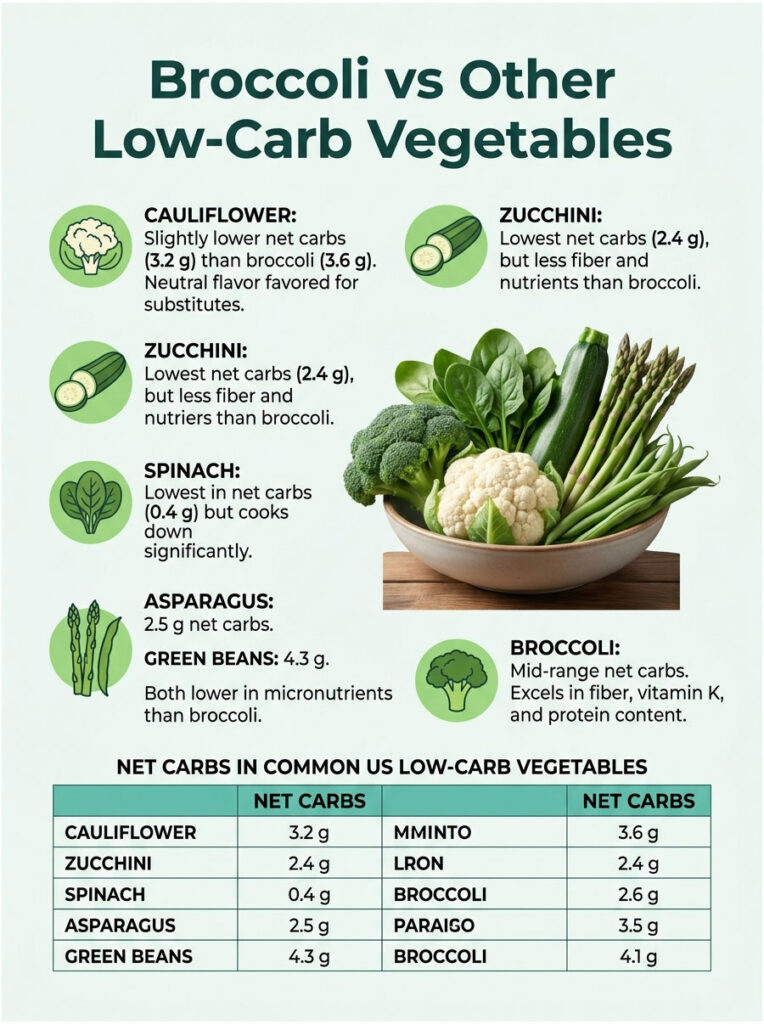
Broccoli sits near the middle of the low-carb vegetable rankings. It’s not the lowest, but its fiber-to-carb ratio and micronutrient density are hard to beat.
Broccoli vs Cauliflower
Cauliflower is the keto crowd’s favorite swap, but its net carb count per raw cup is actually slightly lower than broccoli’s: 3.2 g versus broccoli’s 3.6 g. Cauliflower wins on neutral flavor for “rice” and “mash” substitutes; broccoli wins on fiber, vitamin K, and protein content.
Broccoli vs Zucchini
Zucchini is lighter at about 2.4 g net carbs per cup raw. It’s a better choice if you’re squeezed against a strict 20 g daily ceiling. Broccoli still delivers more fiber, vitamin C, and folate per serving.
Broccoli vs Asparagus, Green Beans, Spinach
Spinach raw is the runaway winner at roughly 0.4 g net carbs per cup, but it cooks down so dramatically that 1 cup cooked is closer to 4 g. Asparagus runs about 2.5 g per cup. Green beans hover around 4.3 g per cup raw, which is close to broccoli but with less micronutrient punch.
Table 2: Net Carbs in Common US Low-Carb Vegetables (Per 1 Cup Raw, USDA Data)
| Vegetable | Net Carbs | Calories | Fiber | Source |
| Spinach (raw, chopped) | 0.4 g | 7 | 0.7 g | USDA FoodData Central |
| Romaine lettuce | 0.6 g | 8 | 1.0 g | USDA FoodData Central |
| Zucchini (raw, sliced) | 2.4 g | 19 | 1.2 g | USDA FoodData Central |
| Asparagus (raw, chopped) | 2.5 g | 27 | 2.8 g | USDA FoodData Central |
| Cauliflower (raw, chopped) | 3.2 g | 27 | 2.1 g | USDA FoodData Central |
| Broccoli (raw, chopped) | 3.6 g | 31 | 2.4 g | USDA FoodData Central |
| Green beans (raw, chopped) | 4.3 g | 31 | 2.7 g | USDA FoodData Central |
| Bell pepper, green | 4.4 g | 30 | 1.7 g | USDA FoodData Central |
Beyond Carbs: What Else Broccoli Brings to a Keto Plate
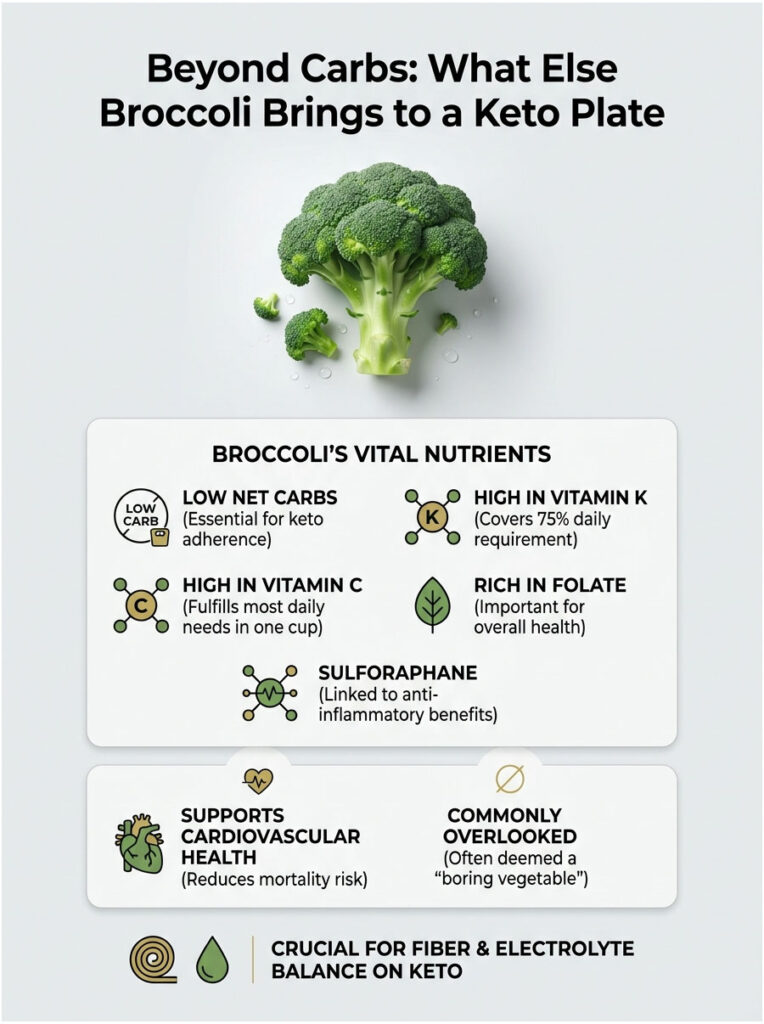
Net carbs is only one column in the spreadsheet. Broccoli also delivers serious micronutrients that matter especially on keto, where fruit and grain sources are stripped out.
Vitamin K, Vitamin C, Folate
A single cup of raw broccoli covers most of an adult’s daily vitamin C requirement and roughly three-quarters of the vitamin K target, per the NIH Office of Dietary Supplements. That’s a big deal on keto, where many traditional vitamin C sources (oranges, mango, potatoes) are off the menu.
Sulforaphane and Cruciferous Benefits
Broccoli is rich in glucoraphanin, the precursor to sulforaphane, a compound studied for anti-inflammatory and chemo-preventive effects. Harvard T.H. Chan School of Public Health research links higher cruciferous vegetable intake to lower cardiovascular mortality.
Why Keto Dieters Often Underestimate Broccoli’s Role
Across diet consultations our nutrition partners run, broccoli ranks as the most-cited “boring vegetable I forgot to plan around.” On keto, it’s one of the few vegetables that simultaneously hits low-carb, high-fiber, and high-micronutrient targets. The cost of skipping it usually shows up as fiber and electrolyte deficits later in the diet.
Practical Portioning: How Much Broccoli Should You Eat?
The right portion depends on your goal and your daily carb ceiling. Here’s how to size servings without overthinking the math.
Serving Sizes by Goal
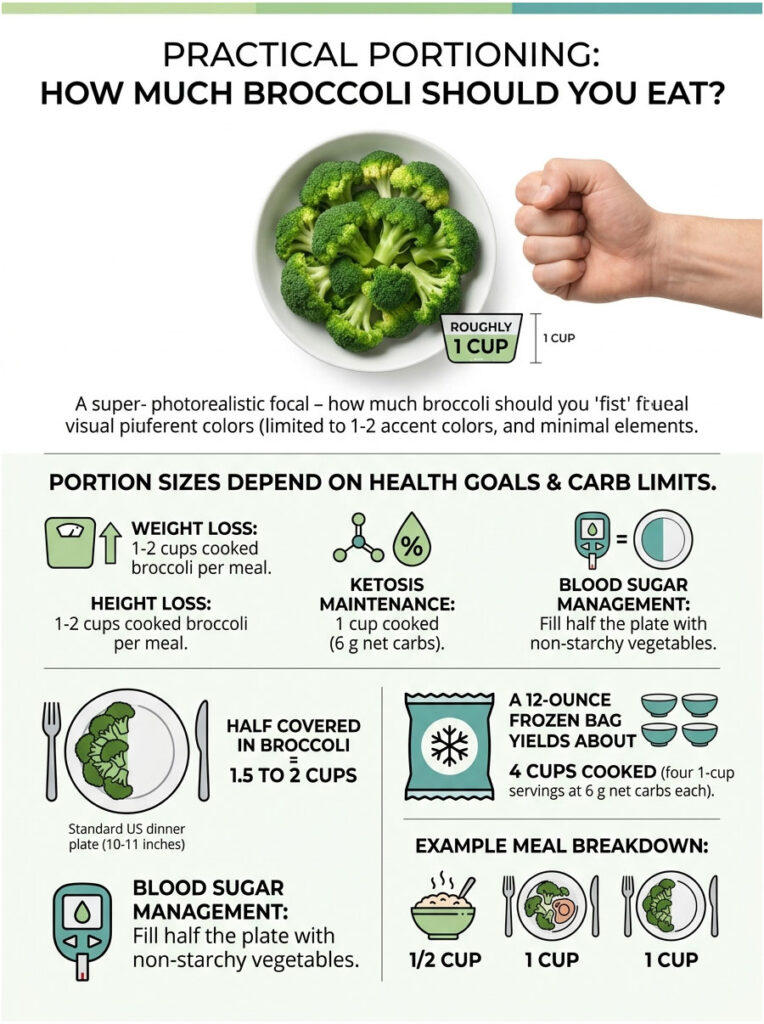
For weight loss without strict keto, 1 to 2 cups of cooked broccoli per meal is a solid baseline. For ketosis maintenance, 1 cup cooked (6 g net) is the sweet spot. For blood sugar management in pre-diabetic adults, the American Diabetes Association suggests filling half the plate with non-starchy vegetables; broccoli is a top pick.
Visual Portion Cues for US Plates
A “fist” of cooked broccoli is roughly 1 cup. A standard US dinner plate (10 to 11 inches) with half covered in broccoli equals about 1.5 to 2 cups. A 12-ounce frozen bag yields about 4 cups cooked, or four 1-cup servings at roughly 6 g net carbs each.
Per-Meal Examples
Breakfast: 1/2 cup steamed broccoli with 2 eggs and butter (3 g net carbs from broccoli). Lunch: chicken breast with 1 cup roasted broccoli and olive oil (6 g net carbs). Dinner: salmon, 1 cup steamed broccoli, side salad of 2 cups spinach (about 6.5 g net carbs from vegetables).
When Broccoli Could Push You Out of Keto
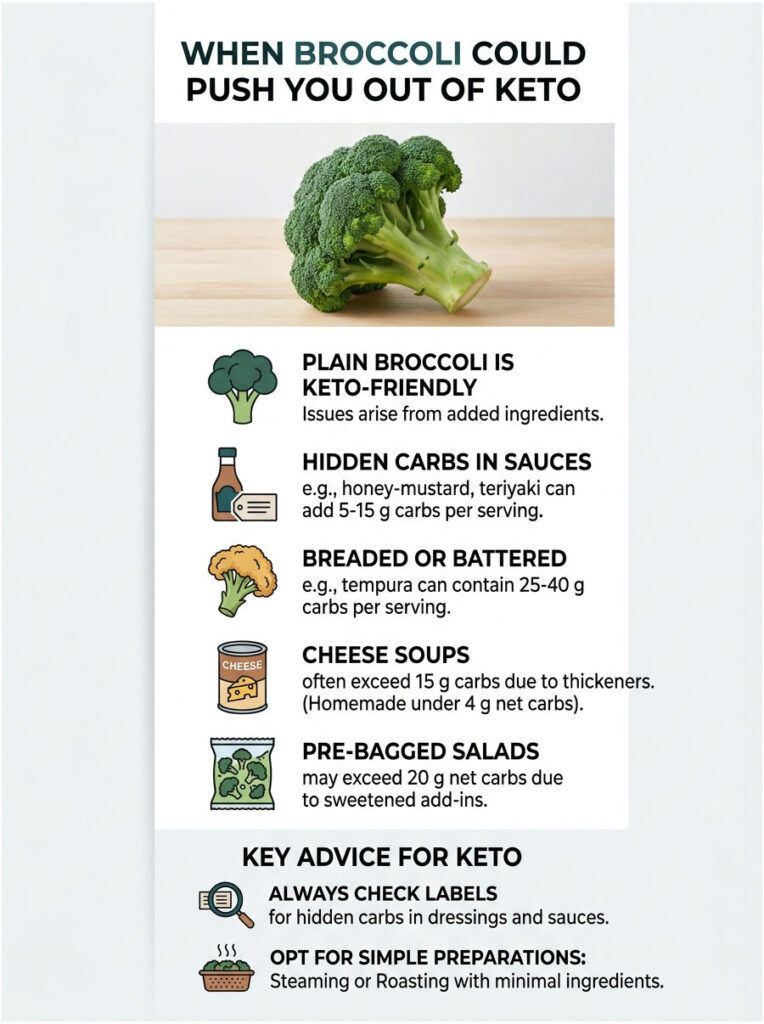
Plain broccoli is essentially keto-bulletproof. Most issues come from what’s added on top.
Hidden Carbs in Sauces and Dressings
Honey-mustard, teriyaki, and sweet-and-sour sauces add 5 to 15 g carbs per 2-tablespoon serving. Read the label, or default to olive oil, butter, lemon juice, garlic, or grated parmesan.
Breaded or Battered Broccoli
A typical restaurant tempura broccoli appetizer can run 25 to 40 g carbs per serving from the batter alone. That’s an entire keto day’s worth in one side dish.
Cheese-Sauce and Casserole Versions
Stove-top broccoli cheese soup (canned) often includes flour or cornstarch thickener, pushing the carb count above 15 g per cup. Homemade cheese sauce with heavy cream and shredded cheddar stays under 4 g net carbs per serving.
Bagged “Broccoli Salad” Mixes
Pre-bagged broccoli salads with raisins, candied nuts, or sweetened cranberries can push 20 g+ net carbs per cup. The base broccoli is fine; the dressing and add-ins are the trap.
Table 3: Broccoli Form vs Keto Verdict
| Scenario | Broccoli Form | Net Carbs | Keto Verdict |
| Plain side dish | Steamed, 1 cup | 6 g | Yes, easily fits |
| Roasted with olive oil | Roasted, 1 cup | 6 g | Yes, ideal keto prep |
| Cheese sauce (homemade) | Steamed + heavy cream sauce | 8-10 g | Yes, with portion control |
| Cheese soup (canned) | Cup of canned soup | 15-22 g | Risky on strict keto |
| Tempura/battered | 1 restaurant serving | 25-40 g | Skip on keto |
| Broccoli salad with cranberries | 1 cup pre-mixed | 20+ g | Skip on keto |
How to Cook Broccoli to Preserve Nutrients (Without Adding Carbs)
The cooking method changes nutrient retention more than carb count. Steaming, microwaving, and roasting all keep carbs essentially flat while protecting vitamins. Our medical reviewers frequently recommend steaming or roasting for patients building sustainable keto habits, since both keep prep under 10 minutes and require no special equipment.
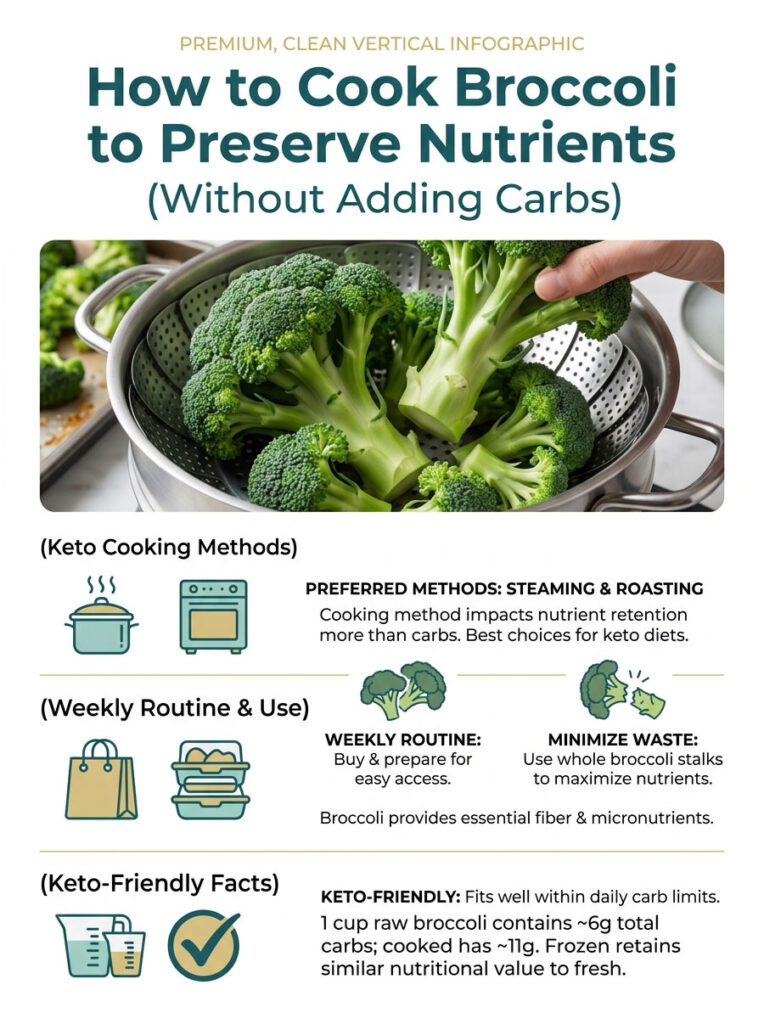
A simple weekly routine: buy two heads of broccoli or one large frozen bag on grocery day, cut into florets, and either roast a sheet pan on Sunday or store cleaned florets in the fridge for quick steaming during the week. That single habit covers your fiber and micronutrient targets for most days, at a typical US grocery cost of $3 to $5 per week.
Frequently Asked Questions
How many carbs are in 1 cup of broccoli?
One cup of raw chopped broccoli (91 g) contains 6 grams of total carbs, 2.4 grams of fiber, and 3.6 grams of net carbs, per USDA FoodData Central. One cup of cooked broccoli (steamed, roasted, or boiled) holds about 11 grams of total carbs, 5 grams of fiber, and 6 grams of net carbs because cooked florets pack tighter into the cup.
How many net carbs are in 100 g of broccoli?
Per 100 grams of raw broccoli, you get about 6.64 grams of total carbs and 2.6 grams of fiber, which works out to roughly 4 grams of net carbs. Cooked broccoli runs nearly identical per 100 g, since cooking doesn’t materially change the carb content per gram, only per cup.
Is broccoli keto-friendly?
Yes. Broccoli is one of the most keto-friendly vegetables on the standard US grocery shelf. At 3.6 grams of net carbs per raw cup and 6 grams per cooked cup, it fits easily into 20 g, 30 g, and 50 g daily keto budgets. It also delivers fiber, vitamin K, vitamin C, and folate that keto dieters often run low on.
How much broccoli can I eat on keto per day?
On a strict 20 g net carb day, 2 to 3 cups cooked broccoli (12 to 18 g net) is reasonable, leaving room for trace carbs in other foods. On a 30 g day, 3 to 4 cups cooked is comfortable. Most US keto eaters land at 1 to 2 cups per meal, which is plenty to hit fiber and micronutrient targets.
Does cooking broccoli change the carb count?
Per gram, no. Per cup, yes. Cooking shrinks broccoli’s volume, so a cup of cooked broccoli weighs more than a cup of raw and contains more total carbs (about 11 g vs 6 g). Net carbs per gram stay the same; the difference is purely about how much broccoli physically fits in your measuring cup.
Are frozen broccoli carbs the same as fresh?
Essentially yes. Per the USDA SNAP-Ed program, frozen broccoli is blanched before freezing, which preserves carbs, fiber, and most micronutrients. A cup of cooked frozen broccoli runs about 5.5 to 6 grams of net carbs, within rounding distance of fresh. Frozen is also more budget-friendly and easier for portion-controlled keto meal prep.
How many carbs are in a broccoli floret?
A small floret weighs about 11 grams and contains roughly 0.4 grams of net carbs. A medium floret (about 20 g) lands at 0.8 grams of net carbs. Five small florets total about 2 grams of net carbs, light enough to add to almost any keto meal without checking your daily total.
Is broccoli or cauliflower better for keto?
It’s close. Cauliflower runs about 3.2 g net carbs per cup raw, slightly lower than broccoli’s 3.6 g. Cauliflower wins for low-carb rice and mash substitutes thanks to its neutral flavor. Broccoli wins on fiber (2.4 g vs 2.1 g per cup), vitamin K, vitamin C, and protein. Most keto dieters use both, rotating for variety.
Can broccoli kick me out of ketosis?
Plain broccoli almost never kicks anyone out of ketosis. You’d need to eat about 5 to 6 cups raw or roughly 3 cups cooked in a day to hit a 20 g net carb ceiling from broccoli alone. The real risk comes from sauces, breading, sweetened salad add-ins, and cream-of-broccoli soups with flour thickeners.
How many carbs in roasted broccoli?
Roasted broccoli with no added sauce holds roughly 6 grams of net carbs per cooked cup, identical to steamed. Adding 1 tablespoon of olive oil contributes 0 carbs but adds 120 calories. Adding parmesan, lemon, and garlic stays nearly carb-neutral. Avoid honey glazes, sweet barbecue sauce, or breadcrumb toppings on a keto plan.
Are the carbs in broccoli stems different from florets?
Stems and florets have nearly identical carb counts gram for gram, but stems are slightly higher in fiber and lower in moisture, so they shrink less when cooked. Peeling and slicing the stem extends a single broccoli head into more servings without adding meaningful carbs. Patients commonly ask us; the short answer is to use the whole stalk.
Can I eat broccoli every day on a low-carb diet?
Yes, and many US dietitians recommend it. Daily broccoli supports fiber targets, electrolyte intake, and cruciferous vegetable variety, all of which support long-term keto adherence. The only caveat: if you’re on warfarin or a blood thinner, broccoli’s vitamin K content can affect dosing, so coordinate intake with your prescribing physician.
Disclaimer
This article is for general nutrition education and does not replace personal medical advice. Anyone with diabetes, kidney disease, thyroid conditions, or who takes blood-thinning medication should consult a licensed healthcare provider before making major dietary changes. Carb counts are based on USDA FoodData Central averages and may vary slightly by source, brand, and preparation.
References
- USDA FoodData Central, Broccoli Raw
- Harvard T.H. Chan School of Public Health, Ketogenic Diet Review
- Healthline, Broccoli 101: Nutrition Facts and Health Benefits
- Healthline, How to Calculate Net Carbs
- UCLA Health, Net Carbs are Carbs Minus Fiber and Sugar Alcohols
- USDA SNAP-Ed Connection, Broccoli
- Diet Doctor, How Low Carb is Keto?
- Cleveland Clinic, Broccoli Health Benefits
- Carb Manager, Carbs in Broccoli Raw
- Diet Doctor, How to Calculate Net Carbs