Here’s something most blood pressure charts won’t tell you upfront. The “average” reading for your age group is not the same as a healthy reading, and confusing the two can leave a real problem hiding in plain sight.
Table of Contents
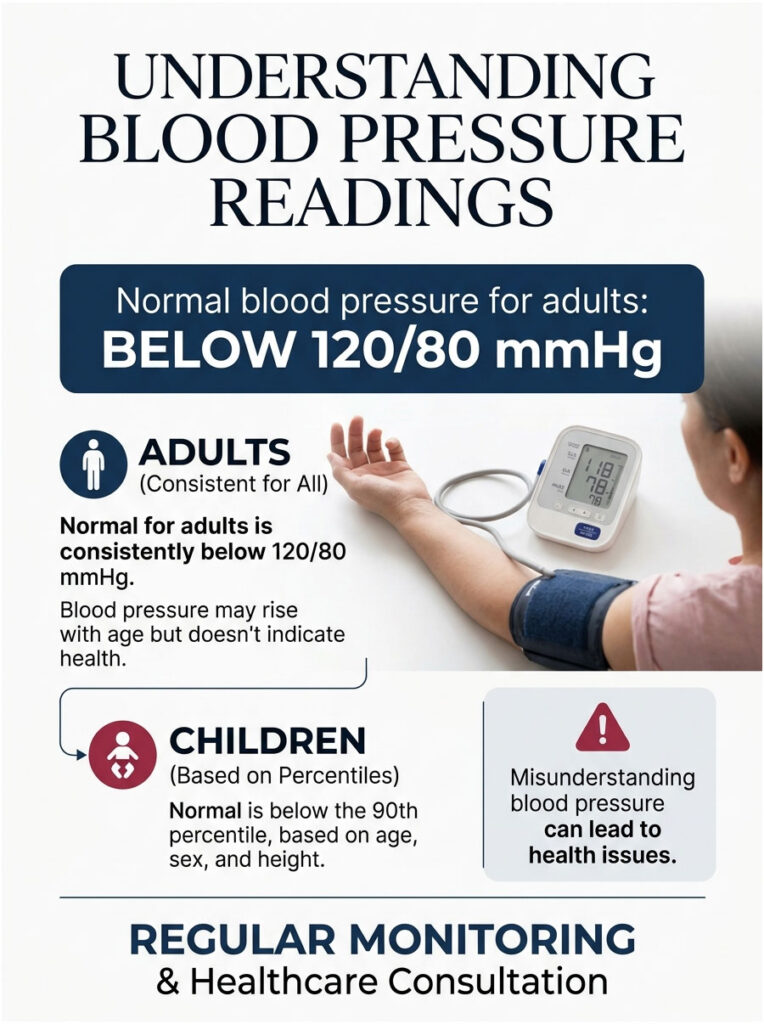
Quick Answer: Normal blood pressure for adults is below 120/80 mmHg, and this target stays the same at every adult age under current American Heart Association guidelines. Readings tend to rise with age, but rising is not the same as healthy. In children, normal is defined by percentile for age, sex, and height rather than a single number, with anything below the 90th percentile considered normal.
At a Glance
- Normal adult blood pressure is below 120/80 mmHg, regardless of age.
- Average readings climb with age, but the healthy target does not move.
- Blood pressure has two numbers: systolic (top) and diastolic (bottom).
- Children are assessed by percentile, not a fixed cutoff.
- Nearly half of US adults meet the definition of hypertension.
- One accurate reading needs rest, the right cuff, and correct posture.
How Blood Pressure Is Measured and What the Numbers Mean
A chart of numbers means nothing until the numbers themselves do. Blood pressure is the force your blood exerts against artery walls, and it is written as one number over another.
Systolic Versus Diastolic
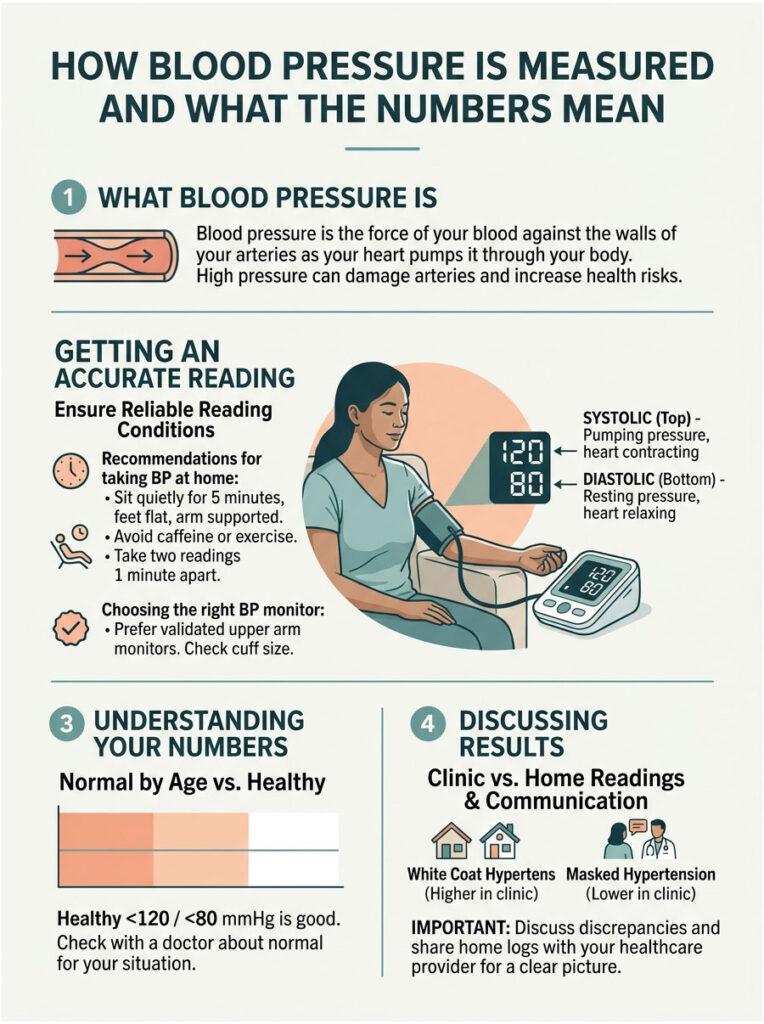
The top number is systolic pressure, the force when your heart beats and pushes blood out. The bottom number is diastolic pressure, the force when your heart rests between beats and refills.
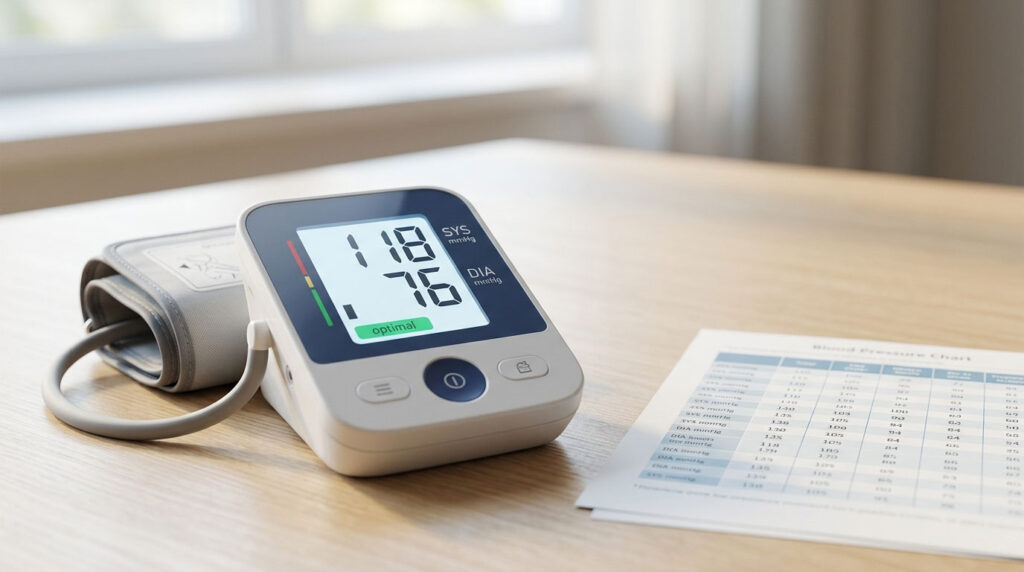
A reading of 118/76 mmHg is spoken as “118 over 76.” Both numbers matter, and either one being high is enough to move you into a higher category. Our medical reviewers note that people often watch only the top number and miss a rising diastolic.
What Counts as a Single Reliable Reading
A blood pressure number is only as good as the conditions it was taken in. One rushed reading after coffee and a flight of stairs can read 15 points too high.
For a trustworthy result, sit quietly for five minutes first, keep both feet flat, support your back, and rest your arm at heart level. Take two readings a minute apart and average them. Patients booking tests with us often ask why their home numbers differ from the clinic, and posture plus timing explain most of the gap.
Choosing the Right Blood Pressure Monitor
For home use, an automatic upper-arm monitor is the standard recommendation. These inflate on their own, display both numbers clearly, and need little technique to use well.
Wrist and finger monitors are convenient but tend to be less accurate, since position affects them strongly. Whatever device you choose, pick one that has been clinically validated, and bring it to a checkup once so you can compare it against the clinic reading.
Why “Normal by Age” Is Often Misunderstood
Search “normal blood pressure by age” and you’ll find charts of average readings that creep upward decade by decade. Those averages are real, but they describe what is common, not what is healthy.
Blood pressure does tend to rise as people get older, yet the American Heart Association sets the same target, below 120/80 mmHg, for every adult age group. In cases reviewed by our medical team, treating a high age-appropriate average as acceptable is one of the most common reasons elevated readings go unaddressed.
White Coat and Masked Hypertension
Two patterns make a single clinic reading unreliable. White coat hypertension is when blood pressure spikes at the doctor’s office from nerves but sits normal elsewhere. Masked hypertension is the reverse, normal at the clinic but high in daily life.
Both are common, and both are reasons clinicians increasingly rely on home or 24-hour ambulatory monitoring. If your clinic readings and home readings consistently disagree, that gap is itself useful information worth raising with your provider.
Normal Blood Pressure Chart for Adults by Age
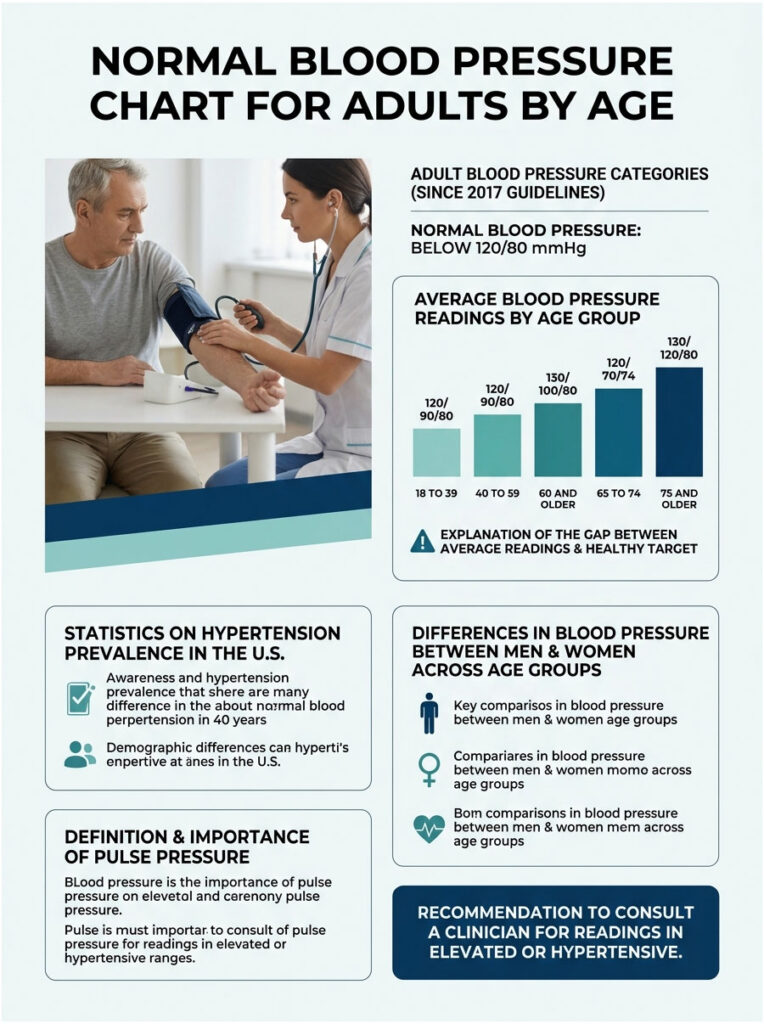
Adults share one healthy target, but their typical readings differ by age. Seeing both side by side is the clearest way to read your own number honestly.
The Adult Blood Pressure Categories
Since the 2017 American Heart Association and American College of Cardiology guideline, adult blood pressure falls into five categories. Normal is below 120/80 mmHg.
Elevated is 120 to 129 systolic with diastolic still under 80. Stage 1 hypertension is 130 to 139 systolic or 80 to 89 diastolic. Stage 2 hypertension is 140 or higher systolic or 90 or higher diastolic. A hypertensive crisis is a reading above 180 and/or 120.
That 2017 update lowered the bar. The old prehypertension label disappeared, and many Americans whose readings had been called borderline were reclassified into Stage 1 hypertension. The numbers on the monitor did not change, but what they mean did.
Average Readings Versus the Healthy Target
The table below pairs typical average readings by adult age group with the single healthy target that applies to all of them. The gap between the two columns is the part worth your attention.
| Age Group | Average Reading (mmHg) | Healthy Target (mmHg) | Notes |
| 18 to 39 | Around 115/75 | Below 120/80 | Young adults often sit near target |
| 40 to 59 | Around 120/80 | Below 120/80 | Averages reach the edge of normal |
| 60 and older | Around 125/80 | Below 120/80 | Average drifts into elevated range |
| 65 to 74 | Around 130/77 | Below 120/80 | Many readings now fall in Stage 1 |
| 75 and older | Around 134/76 | Below 120/80 | Wide pulse pressure becomes common |
The pattern is clear. Average readings drift upward, while the target holds firm. A 70-year-old reading 132/78 is at an age-typical number, but that number still sits in Stage 1 hypertension and deserves a conversation with a clinician.
High blood pressure is far from rare in the United States, which is exactly why the gap above matters. The statistics below show how widespread it is.
| Metric | US Figure | Source |
| Adults meeting the hypertension definition | About 47.7% | NHANES via PubMed |
| Age-adjusted hypertension prevalence | 44.5% | CDC NCHS |
| Prevalence, ages 18 to 25 | 12.4% | Journal of Clinical Hypertension |
| Prevalence, ages 65 and older | 76.6% | Journal of Clinical Hypertension |
| Adults with hypertension who are aware of it | 59.2% | CDC NCHS |
| Highest prevalence by group (Black adults) | 58.0% | CDC MMWR |
Do Men and Women Differ?
Men and women track somewhat differently. Through early and middle adulthood, men tend to post slightly higher readings than women of the same age, partly due to differences in hormones and body composition.
That pattern shifts later in life. After menopause, many women catch up to and sometimes pass men of the same age, which is one reason the healthy target stays identical for both. Sex influences the average reading, not the goal.
Understanding Pulse Pressure
Pulse pressure is the gap between your systolic and diastolic numbers. A reading of 120/80 has a pulse pressure of 40, which is considered typical for a healthy adult.
As arteries stiffen with age, systolic pressure can rise while diastolic falls, widening that gap. A pulse pressure consistently above about 60 is worth mentioning to a clinician, since it can reflect arterial stiffness rather than a passing fluctuation.
Normal Blood Pressure Chart for Children and Teens
Children are where most blood pressure charts get vague, and where parents have the most questions. The honest answer is that a child’s normal cannot be read off a single number.
Why Children Use Percentiles, Not Fixed Numbers
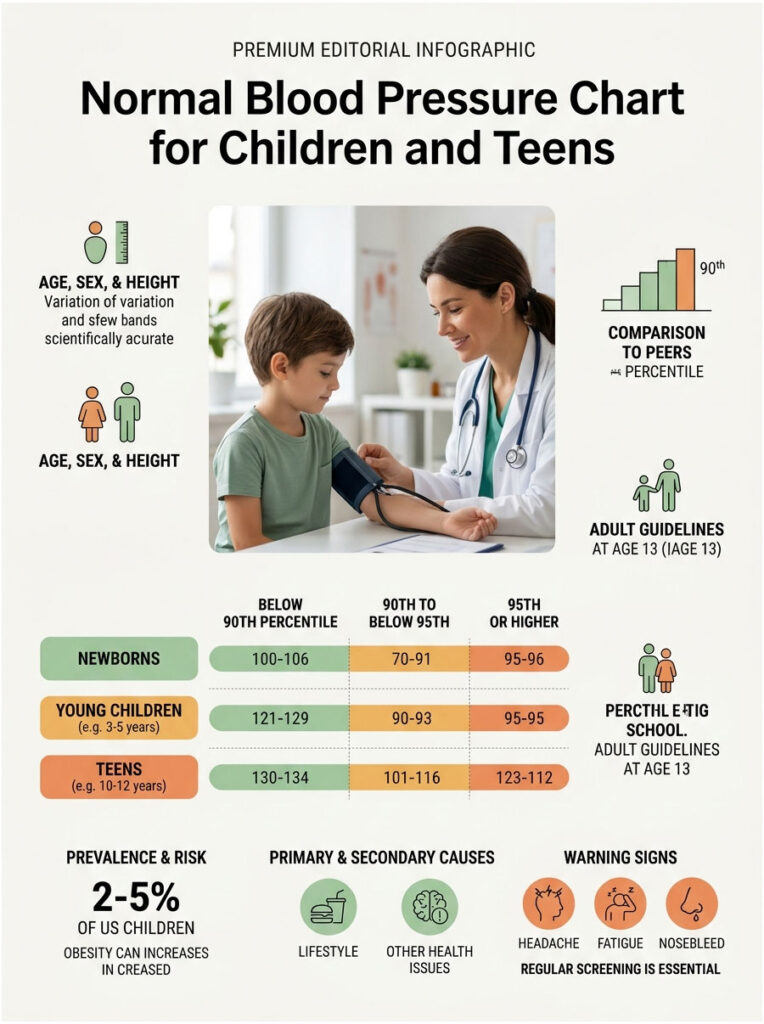
A healthy reading for a tall 12-year-old can be elevated for a shorter child of the same age. Because children vary so much in size, the American Academy of Pediatrics defines normal by percentile, factoring in age, sex, and height.
Normal is below the 90th percentile. Elevated is the 90th to below the 95th percentile. Hypertension is the 95th percentile or higher, confirmed on three separate occasions. A single high reading is a reason to recheck, not a diagnosis, and our medical reviewers note that anxiety, a recent rush, or a wrong cuff size frequently explains it.
This percentile approach mirrors the growth charts pediatricians already use for height and weight. It can sound complex, but the takeaway for parents is simple: a child’s blood pressure is judged against children of the same age, sex, and size, never against a fixed adult number.
Approximate Ranges by Child Age Band
While exact assessment needs a pediatric percentile chart, these approximate ranges give parents a general sense of what is typical at each stage.
| Age Band | Typical Systolic (mmHg) | Typical Diastolic (mmHg) | How It’s Assessed |
| Newborn to 12 months | 65 to 100 | 50 to 65 | Checked only if risk factors exist |
| 1 to 5 years | 80 to 110 | 50 to 75 | Percentile by age, sex, height |
| 6 to 9 years | 90 to 115 | 55 to 78 | Routine screening from age 3 |
| 10 to 12 years | 95 to 120 | 58 to 80 | Percentile by age, sex, height |
| 13 to 17 years | 110 to 130 | 65 to 85 | Adult thresholds begin to apply |
How to Read a Pediatric Percentile
A percentile compares your child to other children of the same age, sex, and height. A reading at the 75th percentile means 75 percent of similar children have a lower number, which is still well within the normal range.
The number crosses into elevated only at the 90th percentile. A pediatrician plots readings over time, because a trend tells a far clearer story than any single visit, and most children flagged once turn out fine on a careful recheck.
Parents sometimes confuse percentiles with test scores, where a higher number is better. With blood pressure the opposite is true. A lower percentile simply means a lower reading relative to peers, and the goal is to stay comfortably below the 90th.
When Teens Switch to Adult Thresholds
Once a child reaches age 13, the guidelines shift. From 13 onward, the adult cutoffs apply, so 120/80 or higher counts as elevated and 130/80 or higher counts as Stage 1 hypertension.
Childhood hypertension is no longer rare. Across recent national data, roughly 2 to 5 percent of US children and teens have hypertension, and obesity raises that risk substantially. Across patients we serve, family history and weight are the two factors that most often prompt earlier monitoring.
What Causes High Blood Pressure in Children
Causes split into two groups. Primary hypertension, with no single identifiable cause, is increasingly common and closely tied to excess weight, high-sodium diets, and inactivity. It is now the leading type in older children and teens.
Secondary hypertension stems from another condition, often kidney disease, a heart problem, or a hormonal disorder. It is more likely in younger children and in any child with a strikingly high reading, which is one reason a child’s hypertension always warrants a full medical workup.
Warning Signs Parents Should Know
High blood pressure in children is usually silent, which is why routine screening from age 3 matters so much. Most cases are caught at a checkup, not because of obvious symptoms.
When symptoms do appear, they can include headaches, unusual fatigue, nosebleeds, or vision changes, though these are nonspecific. Any child with a confirmed high reading should be evaluated, since early treatment protects long-term heart and kidney health.
Why Blood Pressure Changes With Age
Understanding why readings drift upward helps you separate normal aging from a problem worth treating. Several changes stack up over the decades.
Arterial Stiffening and Rising Systolic Pressure
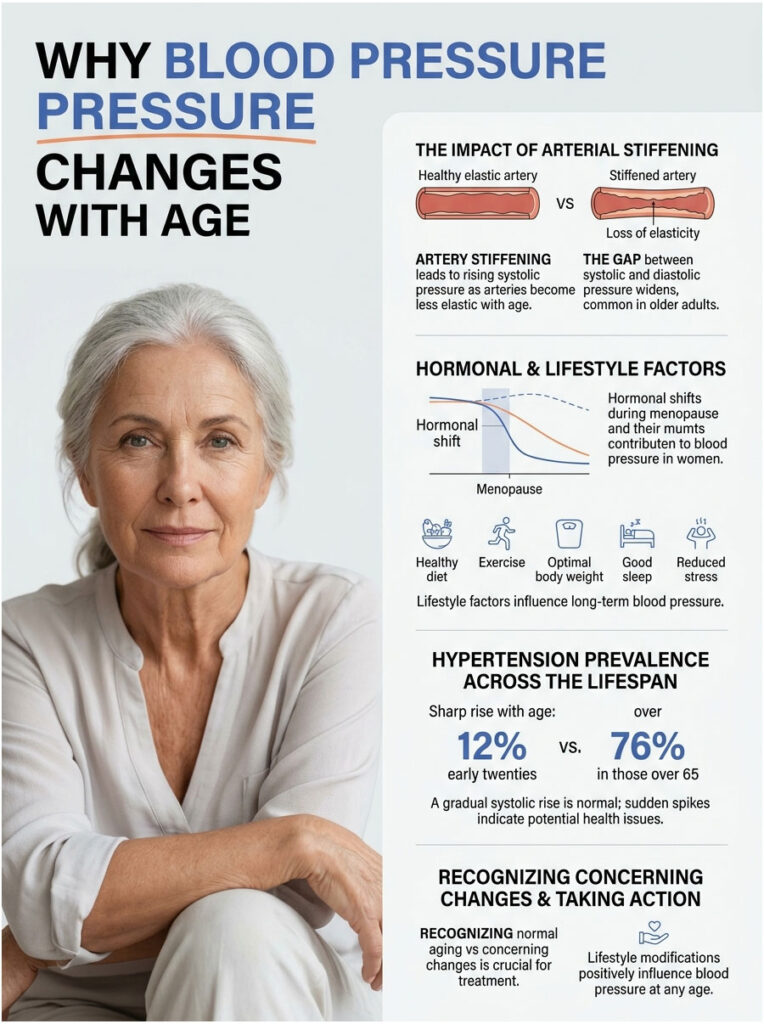
The largest driver is arterial stiffening. Young arteries are elastic and expand easily with each heartbeat, then rebound. With age, artery walls grow stiffer and less springy.
A stiffer artery cannot cushion the surge of each beat as well, so systolic pressure climbs. This is why the top number tends to rise steadily with age while the bottom number can even fall in very old age, widening the gap between them.
This is also why isolated systolic hypertension, a high top number paired with a normal bottom number, becomes the most common pattern in older adults. It still counts as high blood pressure, and it still benefits from treatment.
Hormonal Shifts, Including Menopause
Hormones play a measurable role, especially for women. Estrogen helps keep blood vessels flexible, so as estrogen declines around menopause, many women see blood pressure rise noticeably.
Women who held normal readings through their forties sometimes find numbers climbing in their early fifties. Men experience a more gradual rise tied to other factors. Patients commonly ask us whether this jump is avoidable, and while biology sets the stage, lifestyle still shifts the outcome.
Lifestyle Factors That Accumulate Over Decades
Aging arteries are only part of the story. Decades of diet, activity level, body weight, sleep quality, and stress accumulate and shape long-term blood pressure.
This is also why hypertension prevalence rises so steeply with age, from about 12 percent of adults in their early twenties to more than 76 percent of those over 65. The encouraging part is that the same modifiable factors remain worth addressing at any age.
What Is Not Just Normal Aging
It helps to know where to draw the line. A gradual, modest rise in systolic pressure over the decades reflects normal arterial aging. A reading that has jumped into Stage 2, or climbed sharply over a short period, does not.
Sudden changes, very high numbers, or readings that resist healthy habits deserve a medical look rather than a shrug. Our medical reviewers note that the phrase normal for your age has quietly delayed care for many people who genuinely needed it.
When Your Numbers Signal a Problem
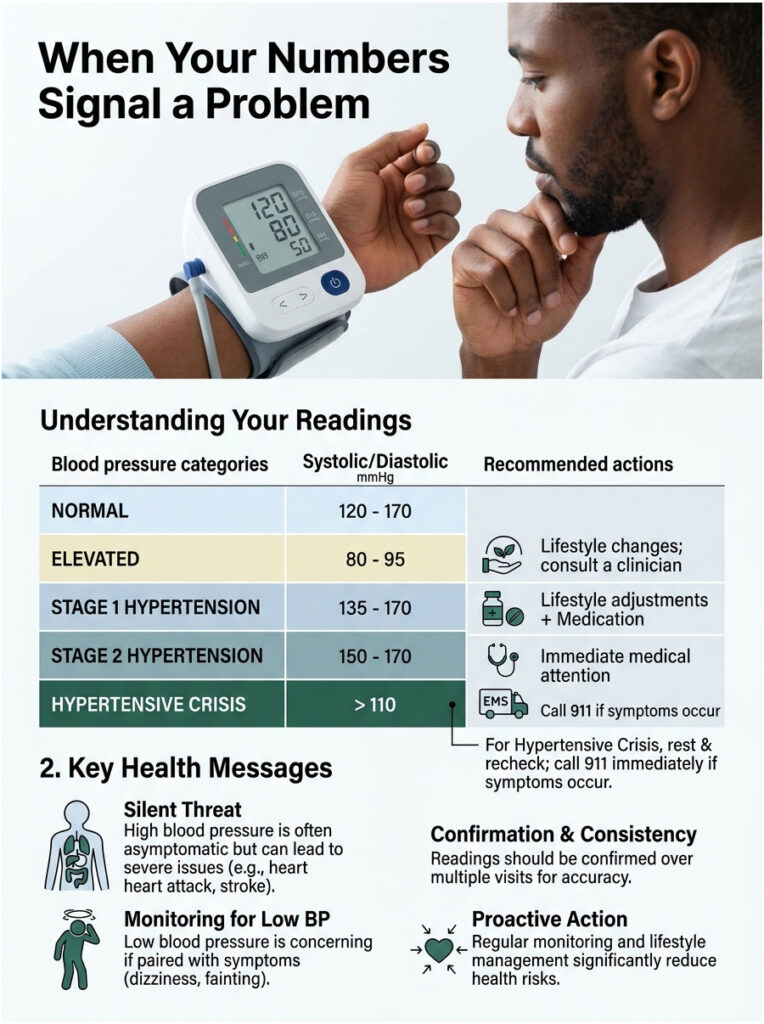
Knowing your category turns a number into a decision. Here is what each range means and what to do about it.
Elevated and Stage 1 Readings
An elevated reading, 120 to 129 systolic with diastolic under 80, is a yellow light. It is not yet hypertension, but it predicts it. This is the ideal moment for lifestyle changes.
Stage 1 hypertension, 130 to 139 systolic or 80 to 89 diastolic, usually calls for a clinician visit. Depending on your overall heart risk, treatment may start with lifestyle changes alone or add medication.
One caution applies to both ranges. A diagnosis is never built on a single reading. Clinicians confirm elevated and Stage 1 numbers across two or more visits, often with home readings too, before settling on a plan.
Stage 2 Hypertension
Stage 2, a reading of 140/90 mmHg or higher, generally means a doctor will recommend both lifestyle changes and medication. Confirmed readings in this range carry a real, measurable rise in stroke and heart disease risk.
This category should never be written off as an age-appropriate average. A reading here means the artery walls are under sustained strain that compounds over time.
What Untreated High Blood Pressure Does
High blood pressure earns its nickname, the silent killer, because it usually causes no symptoms while it does damage. Sustained pressure strains the heart and slowly scars artery walls.
Over years, that strain raises the risk of heart attack, stroke, heart failure, kidney disease, and vision loss. The reassuring side is that lowering blood pressure measurably reduces those risks, even when treatment starts later in life.
Hypertensive Crisis and Emergency Signs
A reading above 180 and/or 120 mmHg is a hypertensive crisis. If you record one, rest for five minutes and measure again.
If it stays that high, contact your doctor right away. If the high reading comes with chest pain, shortness of breath, vision changes, weakness, numbness, or trouble speaking, call 911. Those signs can indicate the blood pressure is already damaging organs.
A crisis reading with symptoms is not the moment to drive yourself anywhere. Calling 911 means trained help arrives quickly and treatment can begin on the way to the hospital rather than after you reach it.
When Blood Pressure Is Too Low
Low blood pressure matters too. There is no single cutoff, but readings below about 90/60 mmHg, paired with symptoms, are worth attention.
Dizziness, lightheadedness, fainting, blurred vision, or fatigue alongside low numbers can signal dehydration, a medication effect, or a heart issue. The table below turns each reading range into a clear next step.
Some people simply run low and feel perfectly well, which needs no treatment at all. The concern is low numbers that arrive with symptoms or appear suddenly, since those can point to blood loss, infection, a heart rhythm problem, or a medication dose that needs adjusting.
| Reading (mmHg) | Category | Recommended Action |
| Below 90/60 with symptoms | Low blood pressure | Discuss with a doctor; rule out causes |
| Below 120/80 | Normal | Maintain habits; recheck per schedule |
| 120 to 129 / under 80 | Elevated | Start lifestyle changes; recheck soon |
| 130 to 139 / 80 to 89 | Stage 1 hypertension | See a clinician; assess overall risk |
| 140/90 or higher | Stage 2 hypertension | Medical care; likely lifestyle plus medication |
| Above 180 and/or 120, no symptoms | Hypertensive urgency | Rest, recheck, contact your doctor promptly |
| Above 180 and/or 120, with symptoms | Hypertensive crisis | Call 911 immediately |
How to Keep Your Blood Pressure in a Healthy Range
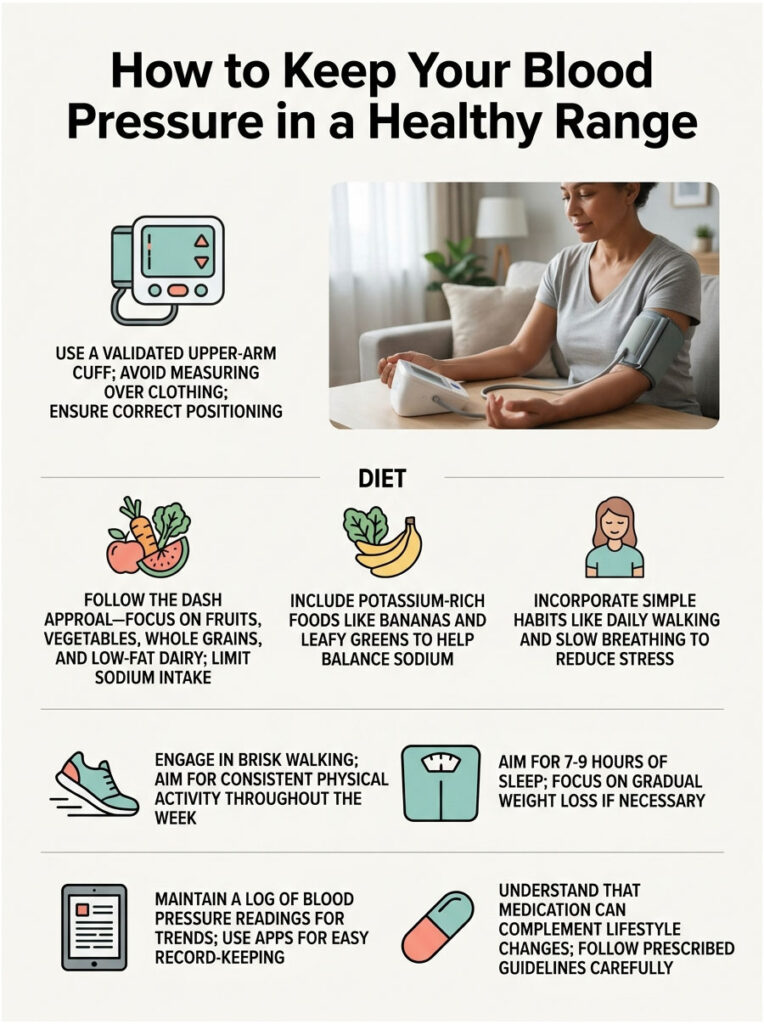
The target does not move with age, and neither do the tools that protect it. Small, steady habits do most of the work.
Measuring Accurately at Home
Home monitoring catches trends between visits, but only if done right. Use a validated upper-arm cuff sized to your arm, since a cuff that is too small reads falsely high.
A few common mistakes quietly inflate readings: measuring over clothing, letting your arm dangle below heart level, sitting with your back unsupported or legs crossed, and talking during the reading. Avoid caffeine, exercise, and smoking for 30 minutes beforehand, sit quietly for five minutes, record the date and time, and bring the log to appointments.
Consistency beats frequency. Measuring at the same two times each day, such as morning and evening, reveals your real pattern far better than random checks scattered through the week.
Diet, Sodium, and the DASH Approach
Diet is one of the strongest levers you control. The DASH eating pattern, rich in vegetables, fruit, whole grains, and low-fat dairy, is well studied for lowering blood pressure.
Cutting sodium matters too, and most of it hides in packaged and restaurant food rather than the salt shaker. Reading labels and cooking more at home gives you direct control over intake.
Potassium deserves a mention alongside sodium. Found in foods like bananas, leafy greens, beans, and potatoes, it helps the body balance sodium and ease pressure on artery walls. For most healthy adults, federal guidance suggests keeping sodium under 2,300 milligrams a day, with a lower goal often advised for those who already have high blood pressure.
In practice, the DASH pattern is less a strict diet than a steady shift: more produce on the plate, whole grains in place of refined ones, lean proteins, nuts and beans, and less processed food. Research shows it can lower systolic pressure by several points within weeks.
Movement, Weight, Sleep, and Stress
Regular physical activity, even brisk walking most days, lowers blood pressure measurably. Losing modest excess weight, sleeping seven to nine hours, limiting alcohol, and managing chronic stress all add up.
None of these requires a dramatic overhaul. Across patients we serve, the people who succeed usually change one habit at a time and let it stick before adding the next.
Alcohol and tobacco deserve specific attention. Heavy drinking raises blood pressure directly, and cutting back tends to lower it within weeks. Smoking stiffens and damages arteries, so quitting is one of the highest-value changes a person can make for long-term heart health.
Chronic stress works more indirectly, nudging people toward poor sleep, comfort eating, and skipped activity. Simple, repeatable habits, a short daily walk, steady sleep and wake times, a few minutes of slow breathing, do more over a year than any single dramatic effort.
Tracking Your Numbers Over Time
A single reading is a snapshot; a log is the story. Keeping a simple record, the date, time, and result, turns scattered numbers into a trend a clinician can act on.
Many home monitors store past readings, and free apps do the same. Bringing several weeks of data to an appointment often answers more questions than any reading taken in the office, and it helps separate a true pattern from a one-off spike.
When Testing and Medical Review Make Sense
A blood pressure screening every two years is the general recommendation for adults with normal readings, and yearly or more often for elevated readings or known hypertension.
If your home numbers run consistently elevated, a clinician may suggest blood and urine tests to check for related conditions. Booking that review early, rather than waiting on a string of high readings, is something patients tell us they wish they had done sooner.
If you have diabetes, kidney disease, or a history of heart problems, your personal target may be set lower than the general one. That is a conversation worth having directly with your clinician, since the right number for you depends on your full health picture.
Understanding Blood Pressure Medication
When lifestyle steps are not enough, medication is a normal and effective next step, not a personal failure. Several drug classes exist, and clinicians often combine low doses rather than pushing a single drug to its maximum.
Medication works best alongside healthy habits, not instead of them. Anyone prescribed treatment should keep taking it as directed, since stopping suddenly can cause readings to rebound. Questions about side effects are worth raising with your prescriber rather than acting alone.
Common Myths About Blood Pressure and Age
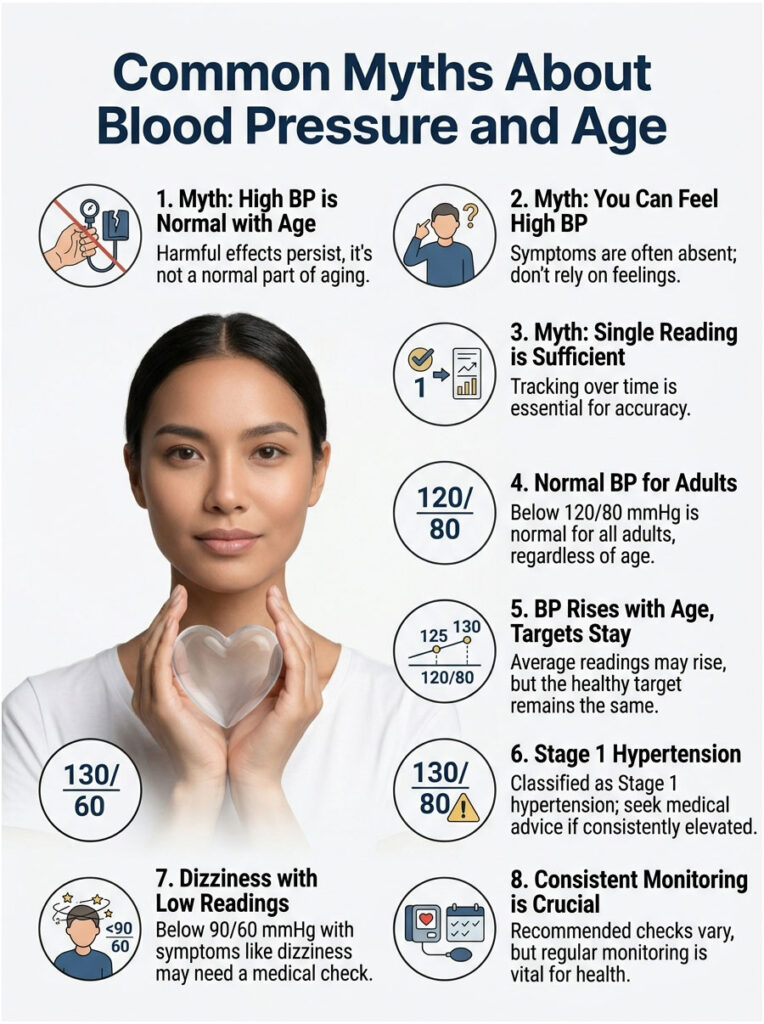
A few persistent myths lead people to misjudge their own numbers. Clearing them up makes the chart above far easier to use well.
Myth: High Blood Pressure Is Normal Once You’re Old
Rising readings are common with age, but common is not the same as harmless. The healthy target does not change, and lowering high blood pressure benefits people well into their seventies and eighties. Age is a reason to pay closer attention, not to stop.
Myth: You Can Feel When Your Blood Pressure Is High
Most high blood pressure causes no symptoms at all, which is why it goes undiagnosed in so many people. A headache or a flushed face is an unreliable signal. The only way to truly know your numbers is to measure them.
Myth: A Single Normal Reading Means You’re Fine
Blood pressure varies through the day and from one setting to another. One good number is reassuring but not conclusive. Tracking readings over time, at consistent moments, gives a far more honest picture than any single measurement.
Frequently Asked Questions
What is a normal blood pressure reading by age?
For all adults, normal blood pressure is below 120/80 mmHg, no matter the age. Average readings rise with age, roughly 115/75 in young adults and 125/80 or higher past 60, but those are typical numbers, not healthy targets. Children are assessed by percentile instead.
Is 120/80 still considered normal?
Not quite. Under current American Heart Association guidelines, normal is below 120/80 mmHg. A reading of exactly 120/80 falls into the elevated category. It is not hypertension, but it is a signal to focus on diet, activity, and other lifestyle habits.
What is normal blood pressure for a 70-year-old?
The healthy target for a 70-year-old is the same as for any adult, below 120/80 mmHg. Average readings at that age often run closer to 130/77, which sits in Stage 1 hypertension. An age-typical number is not automatically a healthy one.
What is normal blood pressure for a child?
Children do not have a single normal number. Normal is defined as below the 90th percentile for the child’s age, sex, and height. A pediatrician uses percentile charts or calculators, since a reading that is fine for a tall child may be elevated for a shorter one.
Is 130/80 considered high blood pressure?
Yes. Since the 2017 guideline update, a reading of 130/80 mmHg is classified as Stage 1 hypertension for adults. Before 2017 it was often called prehypertension. If you consistently read at or above this level, it is worth a clinician visit.
Does blood pressure naturally increase with age?
Average blood pressure does tend to rise with age, mostly because arteries stiffen and lose elasticity over time. That rise is common, but it is not considered healthy or harmless. The recommended target stays below 120/80 mmHg at every adult age.
What blood pressure is dangerously high?
A reading above 180 and/or 120 mmHg is a hypertensive crisis. Rest and recheck after five minutes. If it stays that high, contact your doctor immediately, and call 911 if it comes with chest pain, shortness of breath, vision changes, or trouble speaking.
What blood pressure is too low?
There is no single cutoff, but readings under about 90/60 mmHg may be considered low, especially with symptoms. Dizziness, fainting, blurred vision, or fatigue alongside low numbers warrant a medical check to rule out dehydration, medication effects, or heart issues.
What is a good blood pressure for a teenager?
For teens 13 and older, adult thresholds apply, so normal is below 120/80 mmHg. For younger teens, normal still depends on percentile for age, sex, and height. Readings of 120/80 or higher in any teen are worth discussing with a pediatrician.
How often should I check my blood pressure?
Adults with normal readings generally need a check every two years. Those with elevated readings should check yearly, and anyone with diagnosed hypertension should monitor more often, frequently at home. Your clinician can set a schedule based on your personal risk.
Why is my blood pressure higher in the morning?
Blood pressure follows a daily rhythm, typically peaking in the morning hours as the body releases cortisol to prepare for the day. It usually dips in the afternoon and is lowest during sleep. Measuring at consistent times helps you track your true pattern.
Can blood pressure be different in each arm?
Yes, a small difference between arms is normal. A large or consistent gap, however, can signal a circulation issue and is worth mentioning to a clinician. When first measuring, check both arms, then use the arm with the higher reading for future checks.
Medical Disclaimer: This article is for general educational purposes only and does not replace professional medical advice, diagnosis, or treatment. HealthCareOnTime.com does not diagnose conditions or recommend treatments. Blood pressure targets can vary with individual health conditions, so always consult a qualified healthcare provider, and seek emergency care for a hypertensive crisis.
References
- American Heart Association – Understanding Blood Pressure Readings
- CDC – High Blood Pressure Facts
- CDC NCHS – Hypertension Prevalence Among Adults, Data Brief
- American Academy of Pediatrics – Clinical Practice Guideline for High Blood Pressure in Children
- Journal of Clinical Hypertension – 25-Year Trends in US Hypertension
- NHANES via PubMed – Hypertension Prevalence Before and After the Pandemic