
A team of US researchers once tracked 68 college students diagnosed with ADHD through their entire degree, looking specifically at how they handled the foreign language requirement. Every one of them passed. Two-thirds did it without a single classroom accommodation.
Table of Contents
That finding sits awkwardly next to how most people with ADHD describe their language-learning experience: three restarts, four abandoned apps, and a quiet suspicion that their brain simply is not built for verb conjugations.
Both things are true. The ceiling is not the problem. The delivery format is.
Quick Answer
ADHD does not lower your ability to learn a second language, but it does change which study formats work. Long lessons, open-ended goals, and streak-based apps tend to fail. Short 8 to 12 minute sessions, speaking practice before grammar drills, pre-built spaced-repetition decks, movement before study, and external accountability all improve follow-through. US college data shows students with ADHD pass foreign language courses at normal rates.
At a Glance
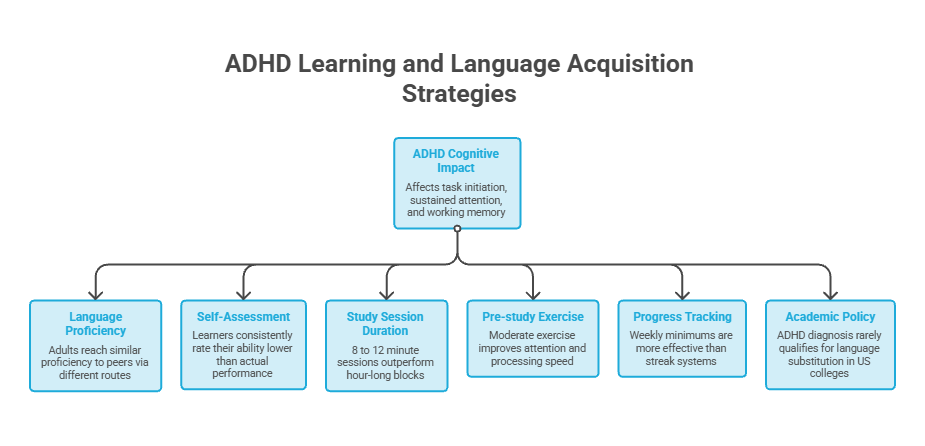
ADHD affects task initiation, sustained attention, and working memory, not language aptitude itself.
Adults with ADHD reach similar second-language proficiency to peers, often by a different route.
Learners with ADHD consistently rate their own ability lower than their performance justifies.
Sessions of 8 to 12 minutes outperform hour-long study blocks for most people with ADHD.
A short bout of moderate exercise before studying improves attention and processing speed.
Streak systems trigger abandonment after one missed day; weekly minimums work better.
In US colleges, an ADHD diagnosis alone rarely qualifies for a foreign language substitution.
Why Language Learning Feels Harder With ADHD
Language study is unusually demanding on exactly the systems ADHD touches. A single beginner lesson asks you to hold new sounds in memory, map them to meaning, apply a grammar rule, monitor your own output, and stay seated through all of it.
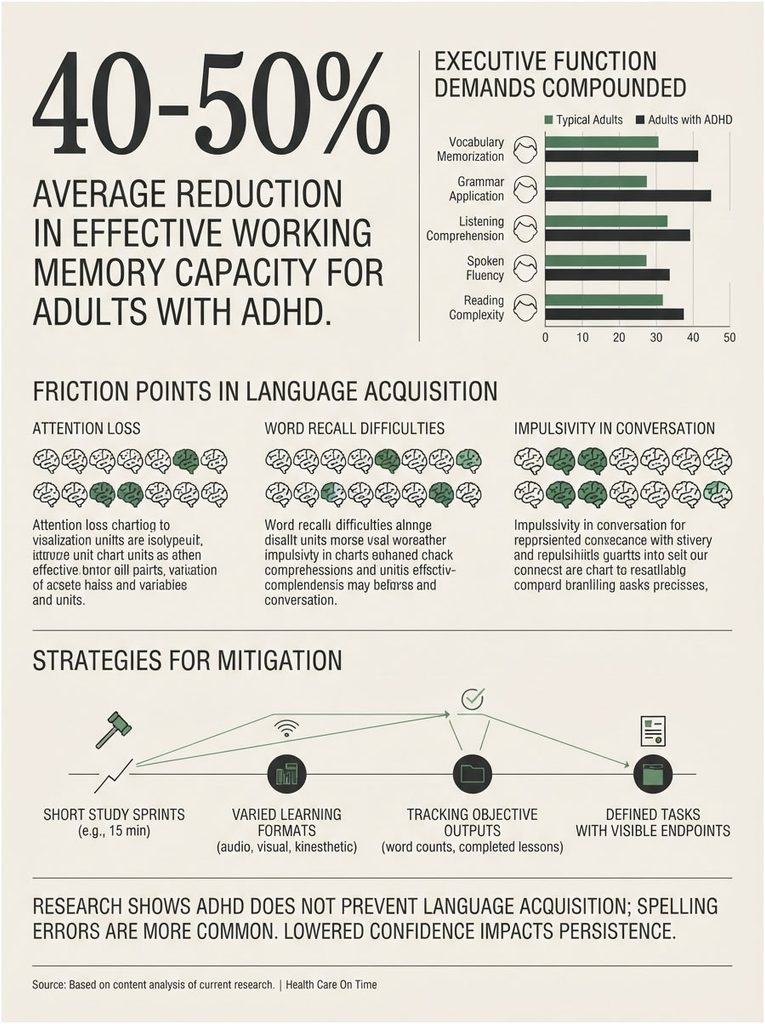
Our medical reviewers describe this as a stacking problem. No individual task is beyond reach, but the stack runs continuously for forty minutes, and that is where the difficulty starts.
The Executive Load Hidden in a Typical Lesson
Executive function covers the mental skills that plan, start, sustain, and monitor a task. ADHD is not a motivation problem; it is an executive function difference affecting task initiation, sustained attention, working memory, and emotional regulation.
A standard language lesson leans on all four at once. That is different from a history lecture, where you can drift for ninety seconds and pick the thread back up.
In a language class, ninety seconds of drift means you miss the rule that the next twenty minutes depend on. The gap compounds fast. By the third missed thread, the lesson stops making sense, and the room starts to feel like evidence about you rather than a scheduling problem.
Where Learners Report the Most Friction
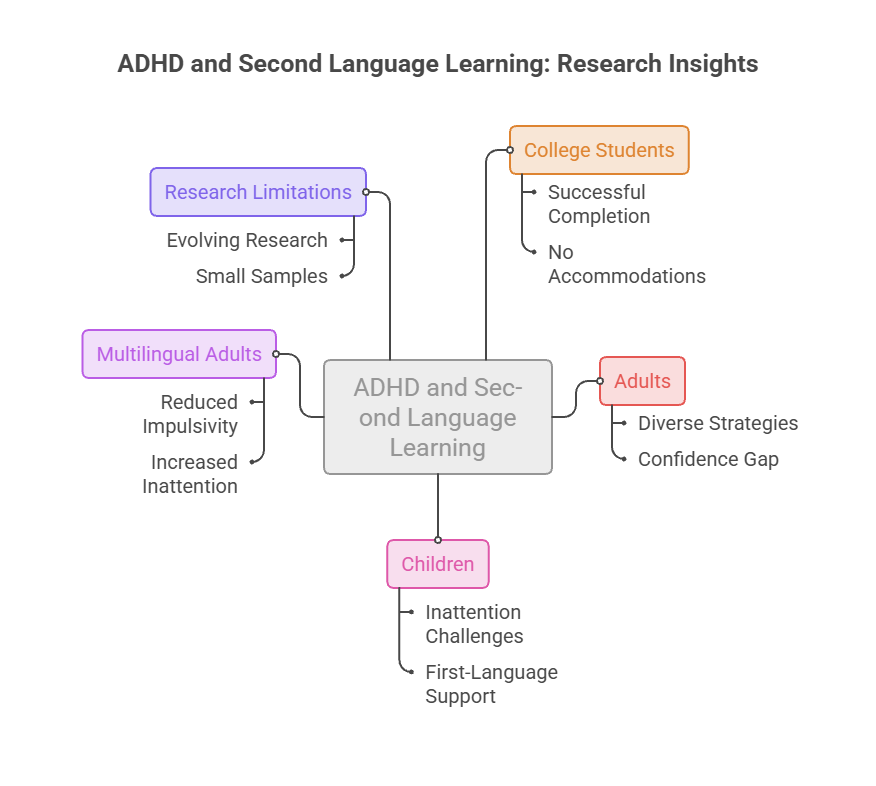
Research on adults with ADHD who speak multiple languages has found consistent patterns. A 2024 study of 59 adults found that difficulty with attention was a common theme, along with memory and word-recall problems during conversation and symptoms such as interrupting others.
A parallel study of 226 multilingual adults reported effects on code-switching, concentration, hyperfocus, impulsivity, memory, and pragmatic communication.
Notice what is absent from those lists: comprehension, grammar reasoning, and aptitude. The friction clusters around delivery and retrieval, not understanding.
Task Initiation and the Blank Study Hour
“Study Spanish for an hour” gives an ADHD brain nothing to grab. There is no visible endpoint, no obvious first move, and the reward sits weeks away.
A defined task like “complete one 8-minute cafe scenario” has a clear beginning, middle, and end, which sharply reduces initiation friction because the finish line is visible before you start.
That single reframe rescues more abandoned study plans than any app switch.
Word Recall in Live Conversation
The vocabulary is in there. Getting it out in under two seconds while also tracking what the other person just said is the hard part.
Working memory holds the sentence you are building while retrieval hunts for the next word. When those two compete, the word vanishes and the sentence collapses.
Patients booking cognitive assessments through our diagnostic network often describe this exact moment as proof they are failing. It is not. It is a retrieval-speed bottleneck, and it responds well to changes in practice format.
What ADHD Does Not Take Away
Here is the part that usually gets buried. Previous research shows that ADHD does not prevent the successful acquisition of a second or third language, and high-school students with ADHD who had average or above-average first-language literacy performed like a high-achieving group on most second-language measures.
University students with ADHD can achieve high scores in foreign language classes, with performance in memorization, grammatical structure analysis, and reading comprehension comparable to high achievers, though they do make more spelling mistakes.
Spelling. That is the reliable difference. Not comprehension, not grammar, not speaking.
| Friction Point | What Research Found | How It Shows Up Day to Day | Strategy That Fixes It | Setup Effort |
| Sustained attention in long lessons | Difficulty maintaining attention in classrooms is the most commonly reported challenge across adult ADHD studies | You lose the thread 12 minutes into a 50-minute class and never recover it | Split into 8 to 12 minute sprints, each with a defined endpoint | Low, 10 minutes to restructure |
| Task initiation | Open-ended goals with distant payoffs trigger avoidance | The app sits unopened for nine days | Replace “study Spanish” with one named 8-minute scenario | Low, one-time |
| Working memory and word recall | Word-recall difficulty during conversation reported by adults in the 59-participant 2024 cohort | You know the word but cannot produce it mid-sentence | Spaced retrieval on pre-built decks plus scripted speaking drills | Medium, 30 minutes to set up |
| Impulsive interrupting | Reported as a specific barrier to conversational practice | You talk over your tutor and lose the correction | One-on-one sessions with an explicit turn-taking rule | Low |
| Motivation crash after novelty fades | Engagement and motivation fluctuate frequently, and learning is described as chaotic | Week three, the app becomes invisible | Rotate format weekly (audio, video, conversation, reading) | Low |
| Spelling accuracy | Students with ADHD made more spelling errors than peers despite matching on grammar and reading | Written work gets marked down more than oral work | Type instead of handwrite; enable target-language spellcheck | Low |
| Self-rated confidence | Adults with ADHD express lower confidence and a more pessimistic view of their proficiency than peers | You quit at intermediate believing you plateaued | Track objective output (minutes spoken, phrases used), not felt progress | Low |
What the Research Actually Says About ADHD and Second Languages
Most articles on this topic stop at “ADHD makes language learning hard.” The published evidence is considerably more interesting than that.
US College Students With ADHD Pass Foreign Language Courses
In a study of 68 college students classified with ADHD who graduated from the same university over a five-year period, the classification of ADHD did not appear to interfere with performance in foreign language courses, and the authors concluded that such students should enroll in and fulfill the requirement by passing courses.
Their college entrance scores matched the middle 50% of freshmen at that university, their graduating GPA matched the typical graduating senior, one student majored in a foreign language, eight minored, and two-thirds passed all their language courses without instructional accommodations.
All 68 students completed the requirement by passing courses. None needed a substitution.
Adults Reach Similar Proficiency Through Different Routes
Adults with ADHD reach similar proficiency in a second language, potentially via different pathways, and individual language learning strategies appear to offset challenges associated with the condition.
That phrase, different pathways, is the operative one. The destination is reachable. The road that works for a neurotypical classmate may not be your road, and treating that as a personal failing wastes years.
One interview study found participants positioned themselves as autonomous, engaged, motivated, and passionate learners who developed high fluency with advanced social and communication skills, while also admitting their engagement fluctuated frequently and describing their learning as chaotic.
Chaotic and successful are not mutually exclusive.
The Confidence Gap Nobody Names
This is the finding that changes how people relate to their own progress. Despite seemingly equal proficiency levels, adults with ADHD express lower confidence and a more pessimistic view of their second-language ability compared with neurotypical individuals.
A separate study of young adults with ADHD found that short-term memory capacity was not impaired, yet subjective self-estimates of language and music performance were misaligned with actual results.
Read that again. The gap between how well you are doing and how well you think you are doing is itself a documented ADHD pattern. Quitting at intermediate because “it stopped working” is often a measurement error, not a plateau.
This is why every effective set of ADHD language learning strategies has to include an external progress measure. Your internal one is running slow.
Where Children and Adults Diverge
The evidence is not uniformly reassuring, and honest coverage should say so. In children, inattention appears to have a greater effect on additional language learning, with lower achievement in English as a foreign language correlating with inattention in primary school students.
Research also indicates that roughly 30% of children with ADHD show significant delays in reading proficiency and about 40% struggle with phonological processing, which affects both reading and writing.
For a child, support in first-language literacy matters before a second language is added. For an adult, the picture is far more favorable.
The Surprising Second-Language Effect on Impulsivity
One result stands out as genuinely counterintuitive. In a survey of 179 multilingual adults, 91 with ADHD and 88 without, hyperactive and impulsive communication behaviors were significantly reduced when people with ADHD communicated in a second or third language.
Researchers suggest that using a second language could support more regulated and less impulsive interaction, though the findings come from self-report and need confirmation through observational methods.
The same study found that inattention-related difficulties went the other way, with both groups more inattentive in a third language than in their first or second.
| Finding | Number | Population Studied | Source |
| US adults with a current ADHD diagnosis | 15.5 million (6.0%) | US adults 18+, 2023 | CDC NCHS Data Brief 543 (Dec 2025) |
| US adults first diagnosed at age 18 or older | 55.9% | US adults with ADHD, 2023 | CDC NCHS Data Brief 543 |
| US children ever diagnosed with ADHD | 7.1 million (11.4%), about 1 in 9 | Children aged 3 to 17, 2022 | CDC / National Survey of Children’s Health |
| College students with ADHD who passed the foreign language requirement | 68 of 68 (100%) | US university graduates over 5 years | Sparks, Javorsky & Philips, J Learn Disabil 2004 |
| Passed all language courses with no accommodations | Two-thirds | Same 68-student cohort | Sparks, Javorsky & Philips, 2004 |
| Drop in US college language enrollment, 2016 to 2021 | 16.6% (1,418,584 to 1,182,562) | 2,455 US colleges and universities | MLA 26th Enrollment Census |
Our medical reviewers note one caveat worth keeping in view. Much of the ADHD and language-learning literature relies on self-report and small samples. The direction of the evidence is consistent, but the field is young, and anyone claiming precise percentages about ADHD and fluency is inventing them.
Eight ADHD Language Learning Strategies That Actually Hold Up
These are ordered by how much difference they make relative to how hard they are to start.
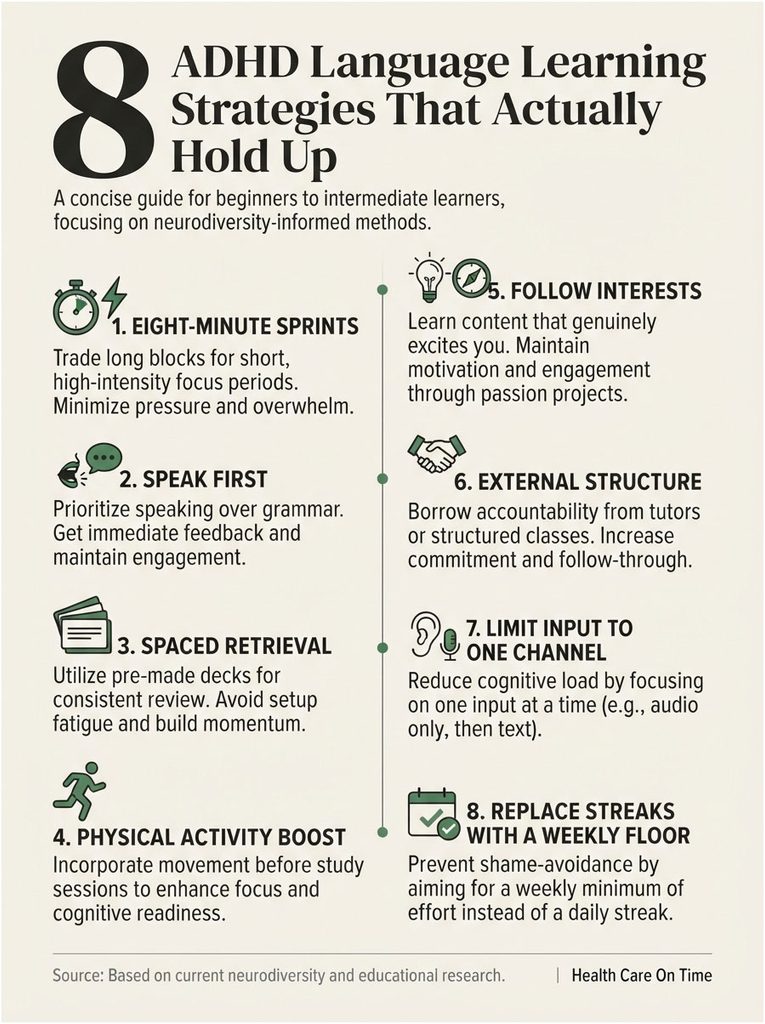
1. Trade Study Blocks for 8 to 12 Minute Sprints
The standard advice is fifteen minutes every evening at the same time. For many people with ADHD, that structure creates a new obligation to fail at, which adds guilt on top of the original difficulty.
The 5 to 12 minute range works because it is short enough that starting feels low-risk and long enough to accomplish something real.
Set a timer. When it rings, stop even if you want to continue. Stopping while you still want more is what makes tomorrow’s session easy to start.
2. Put Speaking Before Grammar
Speaking more and reading or writing less was among the strategies people with ADHD reported would help them most. Active production holds attention in a way that passive drills do not.
Speaking also gives immediate feedback, which matters for a brain that struggles with delayed reward. You find out in two seconds whether the sentence worked.
Start with fifteen phrases you will actually use. Order coffee, ask for directions, introduce yourself, say you did not understand. Repetition of real scenarios builds automaticity faster than abstract exercises ever will.
3. Use Spaced Retrieval, but Never Build the Deck Yourself
Spaced repetition works. Building flashcards does not, at least not for most people with ADHD.
Deck creation is a setup tax that consumes exactly the energy you needed for studying. By the time the deck is ready, the interest window has closed.
Download a pre-made frequency deck of the top 1,000 words in your target language. Review only. If you find yourself reorganizing tags instead of reviewing cards, that is avoidance wearing a productivity costume.
4. Move Your Body Before You Study
This is where a health publisher can offer something a language blog cannot. Physical activity has measurable short-term effects on the exact functions language study depends on.
In a study of 23 adults with ADHD and 23 matched controls, 30 minutes of moderate stationary cycling significantly improved reaction times on an attention task in the ADHD group but not in controls, indicating exercise-induced gains in attention and processing speed.
A meta-analysis of aerobic exercise trials in children and adolescents with ADHD found moderate positive effects on inhibitory control (SMD -0.69), working memory (SMD -0.52), and cognitive flexibility (SMD -0.64).
Practical version: a brisk 15 to 20 minute walk, then study. Not after. The window matters, and it is not long.
Across patients we serve who track study habits, the pre-study walk has the highest adherence rate of any change we suggest, largely because it requires no new tools and no subscription.
5. Follow Interest, Not Level
The conventional path says start with graded beginner content. For an ADHD learner, boring beginner content is worse than difficult interesting content, because the first one never gets opened.
If you love cooking shows, watch cooking shows in Spanish at whatever level they happen to be. You will understand 20% at first. The 20% you understand will stick, because you cared about it.
ADHD learners run on an interest-based nervous system rather than an importance-based one. Fighting that costs more energy than working with it.
6. Borrow External Structure
Self-directed study is the format most likely to be abandoned. External accountability changes performance in ADHD more reliably than internal resolve does.
A weekly tutor session creates a deadline. A conversation partner creates a social cost to skipping. A class creates a schedule you did not have to build yourself.
Body doubling, working alongside another person in real time or over video, targets the initiation problem specifically. The mechanism is not fully understood, but the effect is consistent enough to be worth using.
What to Ask a Tutor Before the First Lesson
Three questions surface whether a tutor will work for you.
- Can you run 25-minute sessions instead of 60?
- Are you comfortable saving corrections for the end rather than interrupting mid-sentence?
- Will you send lesson notes afterward, so I am not splitting attention between speaking and writing?
A tutor who says yes to all three is worth more than one with better credentials who says no.
7. Cut Input to One Channel at a Time
Watching a video with target-language audio and English subtitles is two channels competing. Your brain reads and stops listening.
Pick one. Audio only, or text only, or video with target-language subtitles once you are past beginner stage. Fewer channels means lower cognitive load, and lower load means longer sustained attention.
The same rule applies to your environment. Music with lyrics during vocabulary review is one channel too many, whatever your instincts say.
8. Replace Streaks With a Weekly Floor
Streak counters are engineered to create loss aversion. For ADHD learners, streak-based systems often trigger shame-avoidance after a missed day, leading to permanent abandonment.
Set a weekly floor instead: four sessions of any length, in any distribution. Miss Monday through Thursday and you can still hit target over the weekend.
The floor survives a bad week. A streak does not.
Picking a Language, a Format, and Tools That Fit
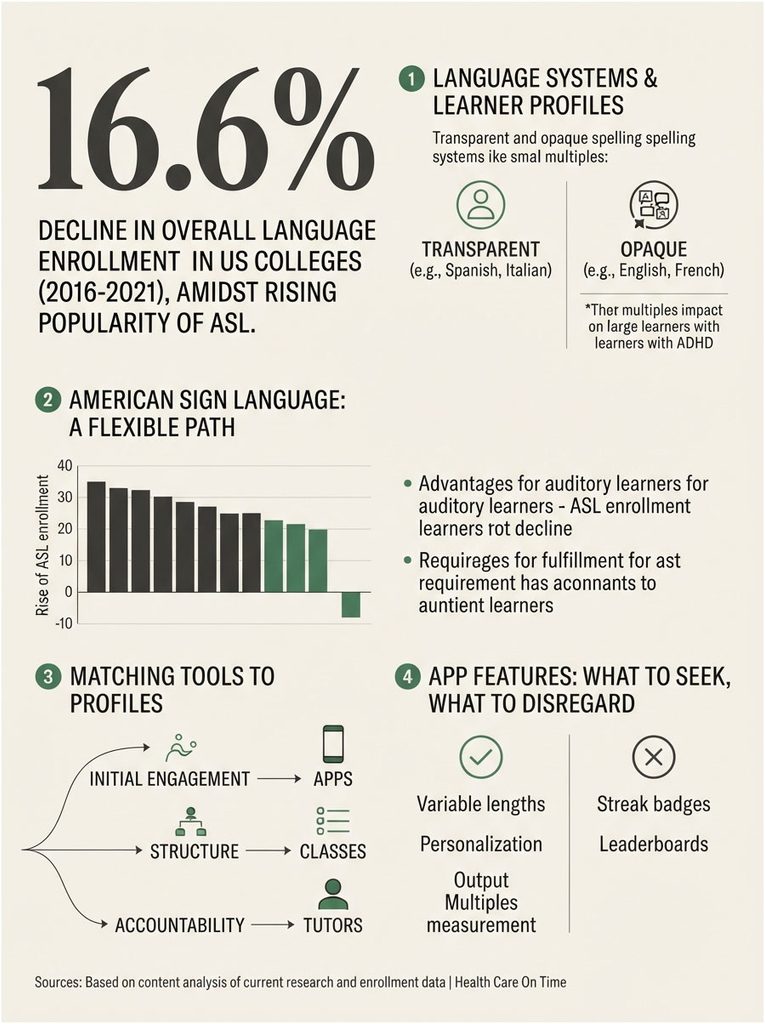
Transparent Spelling Systems Versus Opaque Ones
Languages differ in how consistently spelling maps to sound. Spanish and Italian are transparent, meaning a letter reliably makes the same sound. English and French are opaque, with long lists of exceptions.
Given that spelling accuracy is the one area where learners with ADHD reliably differ from peers, a transparent language removes a known friction source before you start.
This is a tiebreaker, not a rule. Interest beats orthography every time.
Why American Sign Language Keeps Gaining Ground
US college language enrollment has been falling for over a decade. Between fall 2016 and fall 2021, enrollments in languages other than English fell 16.6%, and of the fifteen most commonly taught languages only American Sign Language, Biblical Hebrew, and Korean showed gains.
ASL is visual and kinesthetic rather than auditory, and it satisfies the language requirement at most institutions. For learners whose main difficulty is auditory discrimination, it deserves serious consideration.
Only about 11% of US colleges and universities now require language study at the intermediate level. Check your institution’s actual rule before assuming you are locked in.
App, Class, or Tutor: Matching Format to Your Profile
Apps are excellent at removing setup friction and poor at accountability. If your problem is starting, apps help. If your problem is continuing, they will not solve it.
Classes provide structure and a schedule, but session length and pacing are fixed. That fits some ADHD profiles and fights others.
Tutors are the most expensive option and the most adaptable. Most people who succeed long-term use a combination: an app for daily contact, a tutor for weekly accountability.
What to Look For in an App (and What to Ignore)
Look for variable session lengths, speaking practice built in, content you choose yourself, and progress measured in output rather than points.
Ignore streak badges, leaderboards, and gem economies. These are retention mechanics for the company, not learning mechanics for you.
If an app makes you feel worse after a missed day, it is working against you. Switching is not failure.
School and College: Accommodations, Requirements, and Waivers
This is where families and students get the least reliable information online, so a plain account of how the US system works is warranted.
What a 504 Plan or IEP Can Cover in a Language Class
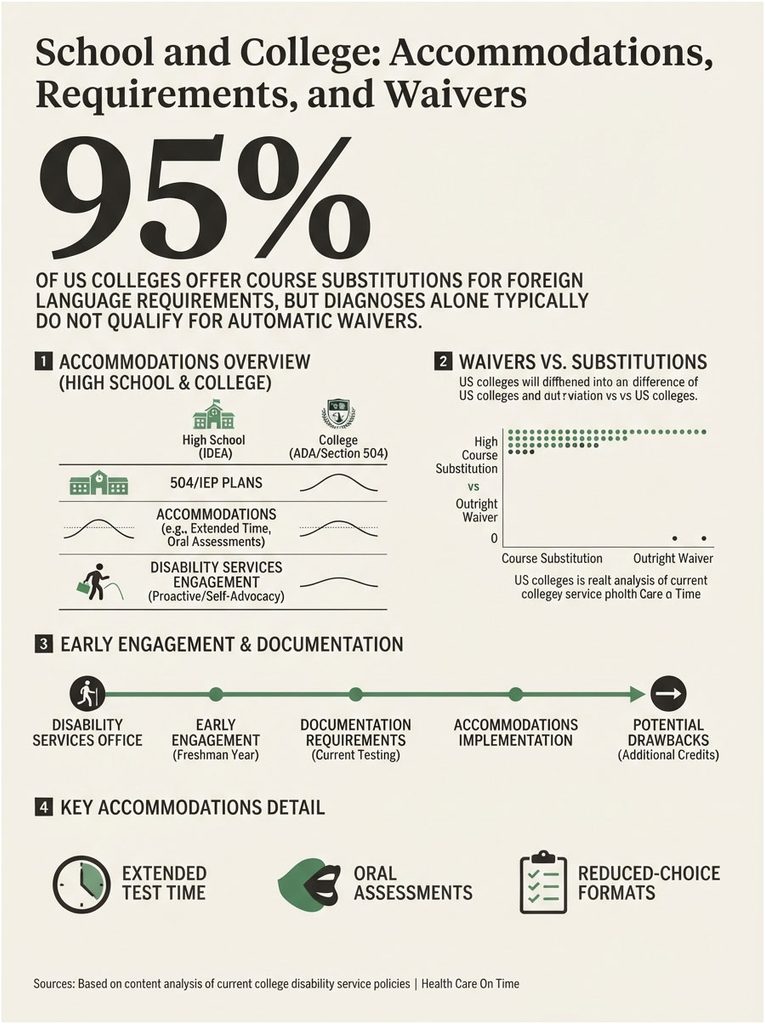
In K-12, a 504 plan or an IEP can specify supports inside a foreign language course. Common ones include extended time on tests, oral rather than written assessment, a note-taker, reduced-choice quiz formats, and seating away from distraction.
One publicly reported district approach lowers cognitive load directly. In a modified foreign language program in Boulder, Colorado, quizzes give students two answer choices printed under each blank instead of a twenty-word bank, on the reasoning that choosing between two words creates less pressure.
Ask for accommodations inside the class before asking to leave the class.
Why an ADHD Diagnosis Alone Rarely Wins a College Substitution
This surprises families, so it deserves direct wording. College is not high school, and the rules genuinely differ.
Many universities state that conditions such as ADHD, chronic health conditions, and psychological disabilities do not typically qualify for a second language substitution, which is reserved for language-based disabilities that directly affect the ability to succeed in language courses.
Neither Section 504 nor the ADA lays out a required process, and colleges are allowed to define their own essential requirements and decline substitutions even when a disability makes a course very difficult.
At the college level, outright waivers are typically not provided; institutions more often offer a substitution, such as courses in culture or literature in translation.
Even students who received a waiver in high school are not automatically granted a substitution in college. A high school waiver can also shrink the list of colleges you qualify for on admissions criteria, which families rarely hear before signing.
How to Approach a Disability Services Office
Start at least two semesters before you need the outcome. Documentation review takes time, and some institutions require you to attempt the course with accommodations first.
Bring current psychoeducational or neuropsychological testing, not just the IEP or 504 document. Colleges routinely state that prior K-12 plans alone are insufficient.
Ask, in writing, what their criteria are and whether substitution has ever been approved for a student with a profile like yours. A vague verbal answer from an advisor is not policy.
The Case for Taking the Class Anyway
Given what the 68-student data shows, the researchers’ own recommendation was that students with ADHD should enroll in and complete the requirement rather than seek a substitution.
There is also a quiet cost to substitution that nobody mentions. Substituted credits often cannot count toward other requirements, so you may end up taking more courses, not fewer.
Patients commonly ask us whether pushing through is worth the stress. The honest answer is that it depends on whether a language-based learning disability is also present, which is a question for a qualified evaluator rather than a self-assessment.
Health Factors That Change Your Study Window
Language learning advice usually stops at technique. For a brain that varies hour to hour, the physical conditions around study often matter more than the method inside it.
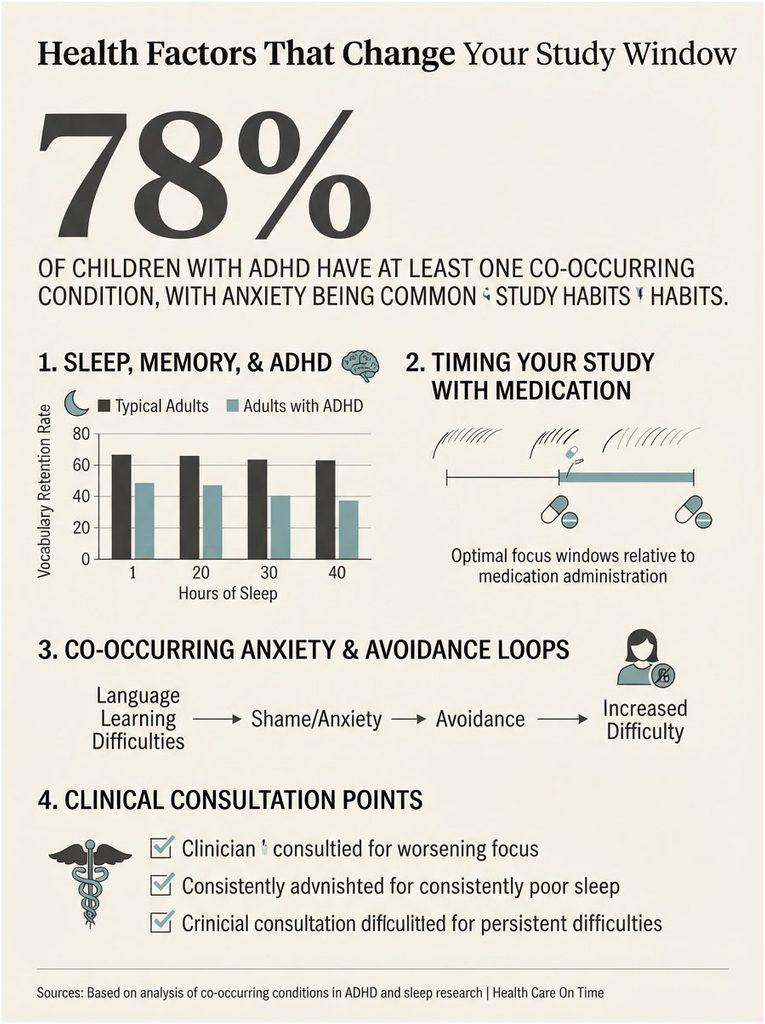
Sleep and Vocabulary Consolidation
Vocabulary moves from short-term to long-term storage largely during sleep. Studying hard on four hours of sleep produces less retention than studying half as much on seven.
The practical test is simple. If you can recall words during a session but not the next morning, effort is not the issue. Consolidation is.
Sleep difficulties are common alongside ADHD and they are treatable. Delayed sleep timing, in particular, tends to push study into the worst possible window, late at night when both attention and consolidation are compromised.
Move your hardest study earlier by even ninety minutes before concluding a method has failed.
Medication Timing and Session Planning
If you take prescribed ADHD medication, the practical question is where your study window falls relative to your dose. Many people find that demanding work fits best inside their period of clearest focus, and that vocabulary review can sit at the edges.
This is a conversation for your prescribing clinician, not a self-adjustment. Do not change dose or timing on your own, and do not use someone else’s prescription to study.
Our medical team reviews questions like this regularly. The consistent guidance is to plan study around your existing regimen rather than reshape the regimen around study goals.
Anxiety, Shame, and the Avoidance Loop
Repeated failed attempts at language learning create a specific kind of dread. Opening the app becomes a reminder of every previous quit, and the reminder itself is unpleasant enough to justify closing the phone.
That loop is a real barrier, and it responds to real changes: starting a different language, changing format entirely, or working with a tutor who knows the history and will not make you re-explain it.
Nearly 78% of children with ADHD have at least one co-occurring condition, and about 4 in 10 have anxiety. Similar overlap continues into adulthood. If study avoidance looks more like dread than disinterest, that distinction is worth naming with a professional.
When to Talk With a Clinician
Speak with a licensed clinician if focus difficulties are new, worsening, or affecting work and relationships well beyond study. The same applies if sleep is consistently poor, or if low mood travels alongside the frustration.
Language learning struggles alone are not a diagnostic sign of anything. Persistent difficulty across multiple settings is a different matter, and it deserves a proper evaluation rather than an online quiz.
Common Pitfalls and How to Recover
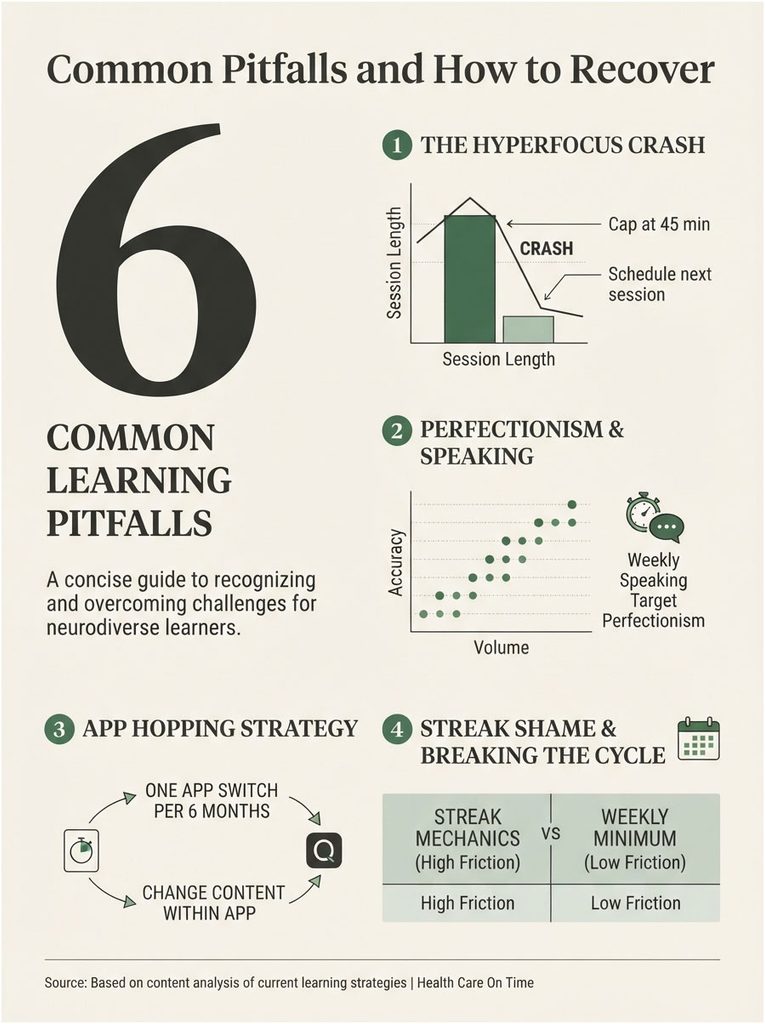
The Hyperfocus Crash
Hyperfocus produces spectacular days: five hours, three hundred words, real measurable progress. Then eleven days of nothing, followed by guilt that makes day twelve harder than day one.
Recovery move: cap sessions at 45 minutes even when you feel unstoppable, and schedule the next session before you close the laptop. A booked 10-minute session two days out is what breaks the crash cycle.
Restarting From Lesson One (for the Fifth Time)
Restarting at the beginning feels responsible. It is usually avoidance, because beginner content is comfortable, familiar, and requires no tolerance for confusion.
Recovery move: skip to where you actually stopped, accept feeling lost for exactly two sessions, and keep going. Write “two bad sessions is the price” somewhere you will see it. Comfort is not the same as learning.
App Hopping
Switching apps produces a novelty hit that feels identical to progress. Three weeks later you have four half-finished trees and roughly the same vocabulary you started with.
Recovery move: allow one deliberate switch per six months, and satisfy the novelty craving by changing content inside the app instead. New podcast, new show, new topic. Same tool.
Perfectionism About Accent and Grammar
Waiting until your grammar is correct before speaking is the most reliable way to never speak at all. Fluent speakers with heavy accents communicate successfully every day. Perfect grammarians who never open their mouths do not.
Recovery move: set a weekly minute target for speaking out loud, even to yourself, and count minutes rather than accuracy. Accuracy follows volume; it does not precede it.
| If This Sounds Like You | Do This First | Why It Works |
| “I open the app and close it immediately” | Cut your session to one named 8-minute task and do it standing up | Defined endpoints reduce initiation friction; movement adds arousal |
| “I did great for three weeks then vanished” | Switch format, not app: audio one week, conversation the next | Novelty is the fuel; rotating content refuels without losing progress |
| “I know the word but can’t say it in time” | Add 10 minutes of scripted speaking drills per week | Repetition builds automatic retrieval, easing the working-memory bottleneck |
| “I broke my streak and stopped” | Delete the streak; set a floor of 4 sessions per week | Weekly floors survive bad days; streaks convert one miss into total abandonment |
| “My college requires a language and I’m panicking” | Book with disability services 2 semesters early; ask for in-course accommodations first | Substitutions for ADHD alone are rarely approved; accommodations usually are |
| “My child is failing high school Spanish” | Request a 504 meeting focused on reduced-choice testing and extra time | Lowering assessment load often closes the gap without a waiver |
| “I feel like I’m not improving at all” | Log minutes spoken and phrases used, not felt progress | Adults with ADHD systematically underrate their own proficiency |
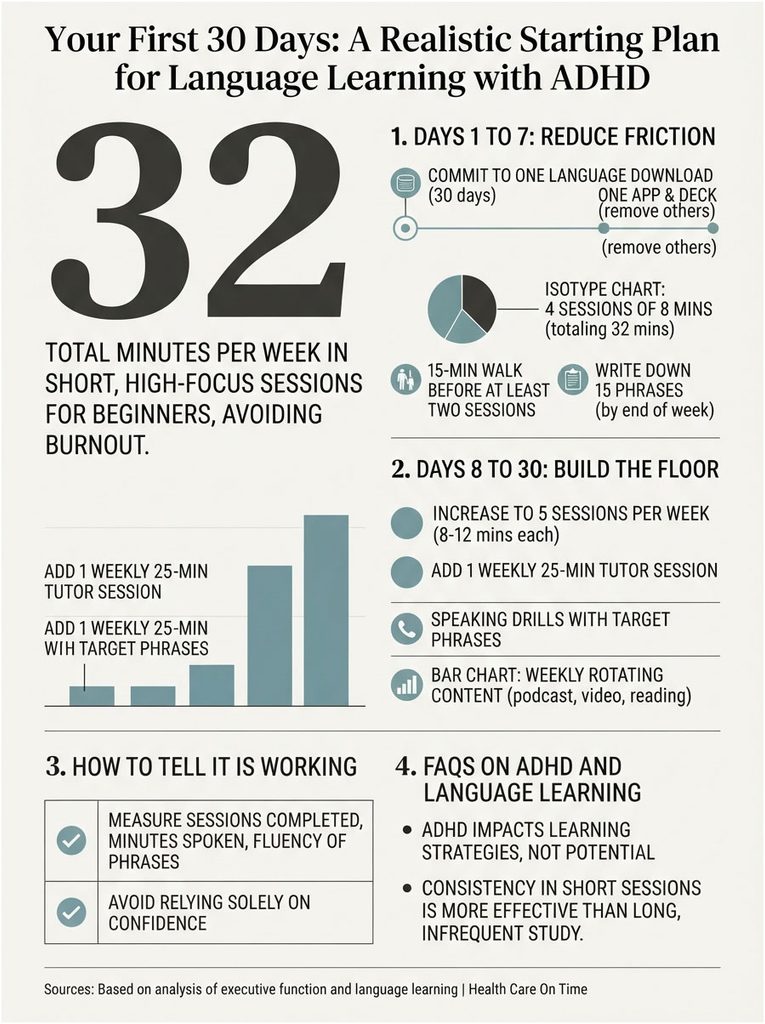
Your First 30 Days: A Realistic Starting Plan
Days 1 to 7: Reduce Friction
Pick one language and commit to it for thirty days. Download one app and one pre-built frequency deck. Delete every other language app from your phone, including the ones you feel guilty about.
Do four sessions of 8 minutes across the week. That is 32 minutes total. The goal is not learning, it is proving the format is survivable.
Take a 15-minute walk before at least two of those sessions and note whether the session felt different. Most people notice something by the second try.
Write down your fifteen target phrases at the end of week one. Do not learn them yet.
Days 8 to 30: Build the Floor
Move to five sessions per week, still 8 to 12 minutes each. Add one 25-minute tutor or conversation-exchange session, ideally on a fixed day.
Begin the scripted speaking drills. Take your fifteen phrases and say them out loud until they arrive without effort. Two minutes at the start of each session is enough.
Rotate your input content every week so novelty keeps working in your favor rather than against it. Podcast week, then video week, then reading week.
By day 30 you should have roughly 20 sessions logged, four conversation sessions, and fifteen phrases you can produce automatically. That is a real foundation, and it took under four hours.
How to Tell It Is Working
Do not measure by how confident you feel. That measure runs unreliably in ADHD, and it will tell you to quit right around the point where you are actually improving.
Measure three things: sessions completed, minutes spoken aloud, and how many of your fifteen phrases arrive without hesitation.
If those numbers are moving, you are learning, whatever your gut is reporting.
Frequently Asked Questions
Does ADHD make it harder to learn a second language?
ADHD affects how you learn, not whether you can. Research consistently finds that adults with ADHD reach similar second-language proficiency to peers, though often through different strategies. The difficulty concentrates in sustained attention during long lessons and word recall during live conversation, not in grammar or comprehension ability.
Can adults with ADHD become fluent?
Yes. Studies of multilingual adults with ADHD describe learners who developed high fluency alongside strong social and communication skills, while also reporting that their motivation fluctuated and their study path felt chaotic. Fluency is reachable; the route just tends to be less linear than a textbook syllabus assumes.
What is the best language learning app for ADHD?
No single app wins for everyone. Look for variable session lengths, built-in speaking practice, and content you can choose yourself. Avoid apps built around streaks and leaderboards, since one missed day frequently triggers permanent abandonment. Pairing any app with a weekly tutor session improves follow-through far more than switching apps does.
How long should a study session be if I have ADHD?
Most people do best with 8 to 12 minutes per session. That range is short enough that starting feels low-risk and long enough to complete something meaningful. Four to five short sessions per week beats one long weekend session, because consistency matters more than total hours for language retention.
Which language is easiest to learn with ADHD?
Spanish and Italian have transparent spelling, where letters map reliably to sounds, reducing the one area where learners with ADHD show consistent difficulty. American Sign Language suits people who struggle with auditory processing and satisfies most US college requirements. Personal interest still outweighs all of these factors.
Does ADHD qualify for a college foreign language waiver?
Usually not on its own. Many US universities state that ADHD, chronic health conditions, and psychological disabilities do not typically qualify for a second language substitution, which is reserved for documented language-based disabilities. Colleges may define their own essential requirements and are not obligated to grant substitutions.
Can I get accommodations for a high school Spanish class?
Yes, through a 504 plan or IEP. Common accommodations include extended test time, oral instead of written assessment, note-takers, reduced-choice quiz formats, and seating adjustments. Some districts also run modified foreign language programs that lower cognitive load, such as offering two answer choices instead of a large word bank.
Does ADHD medication help with language study?
Prescribed medication may improve the attention needed for study sessions, but timing and dosing decisions belong with your prescribing clinician. A practical approach is scheduling demanding study inside your existing window of clearest focus rather than adjusting medication around study plans. Never change dose or timing independently.
Why do I keep quitting after two weeks?
Two weeks is roughly when novelty fades and the task shifts from interesting to obligatory. ADHD motivation runs on interest rather than importance, so the fix is rotating format weekly, changing content rather than apps, and replacing streak targets with a weekly minimum that survives a missed day.
Is immersion better than structured classes for ADHD?
Interest-driven immersion holds attention better than graded beginner material for many people with ADHD, even when the content sits above their level. Structured classes supply external accountability, which is equally valuable. Most successful learners combine both: immersion for daily contact, a class or tutor for deadlines.
Do people with ADHD have trouble with accents and pronunciation?
Some research found adults with ADHD performed less well at discriminating unfamiliar speech in demanding conditions requiring greater attentional control, though short-term memory capacity was not impaired. In practice, pronunciation responds well to repetition and speaking volume. Accent perfectionism damages progress more than accent itself ever does.
Should I learn one language at a time or several?
One at a time, at least until you reach conversational comfort. Research on multilingual adults with ADHD found inattention-related communication difficulties were more pronounced in a third language than in the first or second, suggesting that spreading limited attentional resources across multiple new systems creates avoidable friction.
Medical Disclaimer
This article is for general education and does not replace professional medical, psychological, or educational advice. ADHD diagnosis and treatment require evaluation by a licensed clinician. Accommodation eligibility varies by school and institution. Do not start, stop, or adjust any medication based on this content. If you have concerns about attention, learning, sleep, or mood, speak with a qualified healthcare provider.
References
- College students classified with ADHD and the foreign language requirement (Sparks, Javorsky & Philips, Journal of Learning Disabilities, 2004)
- Learning and using multiple languages: Experiences of adults with ADHD (Koder, Rummelhoff & Garraffa, 2024)
- Comparing pragmatic abilities across multiple languages in adults with ADHD (PubMed, 2024)
- Effects of ADHD on additional language learning and use (Studies in Second Language Acquisition)
- Additional language learning in ADHD: a call for research (Applied Psycholinguistics)
- Visits to Health Centers by Adults With ADHD: United States, 2023 (CDC NCHS Data Brief 543)
- Data on ADHD in Children (CDC)
- General Prevalence of ADHD in Adults (CHADD)
- Acute Effects of Aerobic Exercise on Executive Function and Attention in Adult Patients With ADHD (Frontiers in Psychiatry)
- Effects of aerobic exercise on executive function in children and adolescents with ADHD (BMC Sports Science, Medicine and Rehabilitation, 2025)
- Misjudgement of One’s Own Performance? ADHD and Complex Music and Foreign Language Perception (IJERPH, 2023)
- Identifying Language Development in Children with ADHD (Children, 2024)
- Enrollments in Languages Other Than English in US Institutions of Higher Education, Fall 2021 (Modern Language Association)
- ACTA Report on Foreign Language Study in US Colleges (2026)
- Substitution for Intermediate Competency in Second Language (University of Mary Washington Disability Resources)
- Do Colleges Have to Approve Course Substitutions for Students with Disabilities? (LD Advisory)
- ADHD and language learning: Challenges and tips (Medical News Today)
- ADHD, Bilingualism, and Executive Functions (CHADD)